
What is a female threaded tap connector?
It is an adaptor that screws onto a compatible male threaded fitting and provides a male quick-connect outlet for connecting compatible hose fittings.

Commercial Products
Commercial Products
 Professional Growing Media
 Plant Nutrition
 Plant Health
 Sprayers & Protective Clothing
 Pots, Planters & Trays
 Propagation
 Baskets & Planters
 Fabrics & Netting
 Environment
 Plant Lighting
 Irrigation
 Plant Support & Tree Care
 Equipment
 Tools
 Plant Labels
 Packaging
 Lawn Care
 Clearance
Retail Products
Retail Products
 Growing Media
 Plant Nutrition
 Plant Health
 Pots, Planters & Tanks
 Propagation
 Baskets & Planters
 Fabrics & Netting
 Environment
 Plant Lighting
 Plant Support
 Equipment
 Tools
1993 products
1993 products
Sort by:

13mm (½") female threaded tap connector for adding a male quick-connect hose outlet to compatible irrigation and watering fittings.
This 13mm Female Threaded Tap Connector provides a convenient connection between compatible female-threaded watering points and standard quick-connect hose fittings. The threaded end screws onto a corresponding male connection, while the opposite end provides a male click-on outlet for a compatible female hose connector.
Compact and easy to incorporate into a watering setup, it is a useful irrigation accessory for connecting hose systems to compatible threaded outlets, fittings and other water-supply components.
Why choose a 13mm Female Threaded Tap Connector?
What is a 13mm female threaded tap connector used for?
This connector is used where a female threaded fitting is required on one side and a male quick-connect hose outlet is needed on the other. Once fitted to a compatible male threaded connection, a corresponding female click-on hose connector can be attached to the outlet.
It is particularly useful for horticultural irrigation and general watering setups where threaded components need to interface with convenient quick-connect hose fittings.
How to use a 13mm Female Threaded Tap Connector
Screw the female threaded end onto the corresponding compatible male threaded connection and secure it appropriately. The male quick-connect outlet can then be connected to a compatible female click-on hose fitting.
Once installed, turn on the water supply and inspect the threaded and quick-connect joints to make sure they are securely fitted and operating without leaks.
Product details
| Product | Female Threaded Tap Connector |
|---|---|
| Product type | Threaded irrigation & hose adaptor |
| Thread size | 13mm (½") |
| Thread connection | Female |
| Outlet connection | Male quick-connect |
| Configuration | Female thread to male quick-connect |
| Colour | Green |
| Typical applications | Horticultural irrigation, watering systems & quick-connect hose setups |
13mm Female Threaded Tap Connector FAQs
What is a female threaded tap connector?
It is an adaptor that screws onto a compatible male threaded fitting and provides a male quick-connect outlet for connecting compatible hose fittings.
What size is this threaded hose connector?
This version is the 13mm (½") size.
Is the threaded connection male or female?
The threaded side of this connector is female, so it is designed to screw onto a corresponding compatible male threaded connection.
What is the connection on the other end?
The opposite end provides a male quick-connect outlet designed to accept a compatible female click-on hose connector.
Does 13mm mean this connector takes 13mm hose directly?
No. On this fitting, 13mm refers to the threaded connection size rather than a barbed connection for inserting directly into 13mm hose. The opposite end is a male quick-connect hose fitting.
Can this connector be used for horticultural irrigation?
Yes. It is useful in compatible horticultural irrigation and watering systems where a threaded fitting needs to connect to quick-connect hose equipment.
Can I leave the threaded adaptor fitted and disconnect the hose?
Yes. The quick-connect end allows a compatible female hose connector to be disconnected while the threaded adaptor remains fitted to the water or irrigation connection.
Is this the same as a 13mm barbed hose connector?
No. A 13mm barbed connector is designed to connect directly to compatible hose or irrigation pipe. This fitting combines a female threaded connection with a male quick-connect hose outlet.
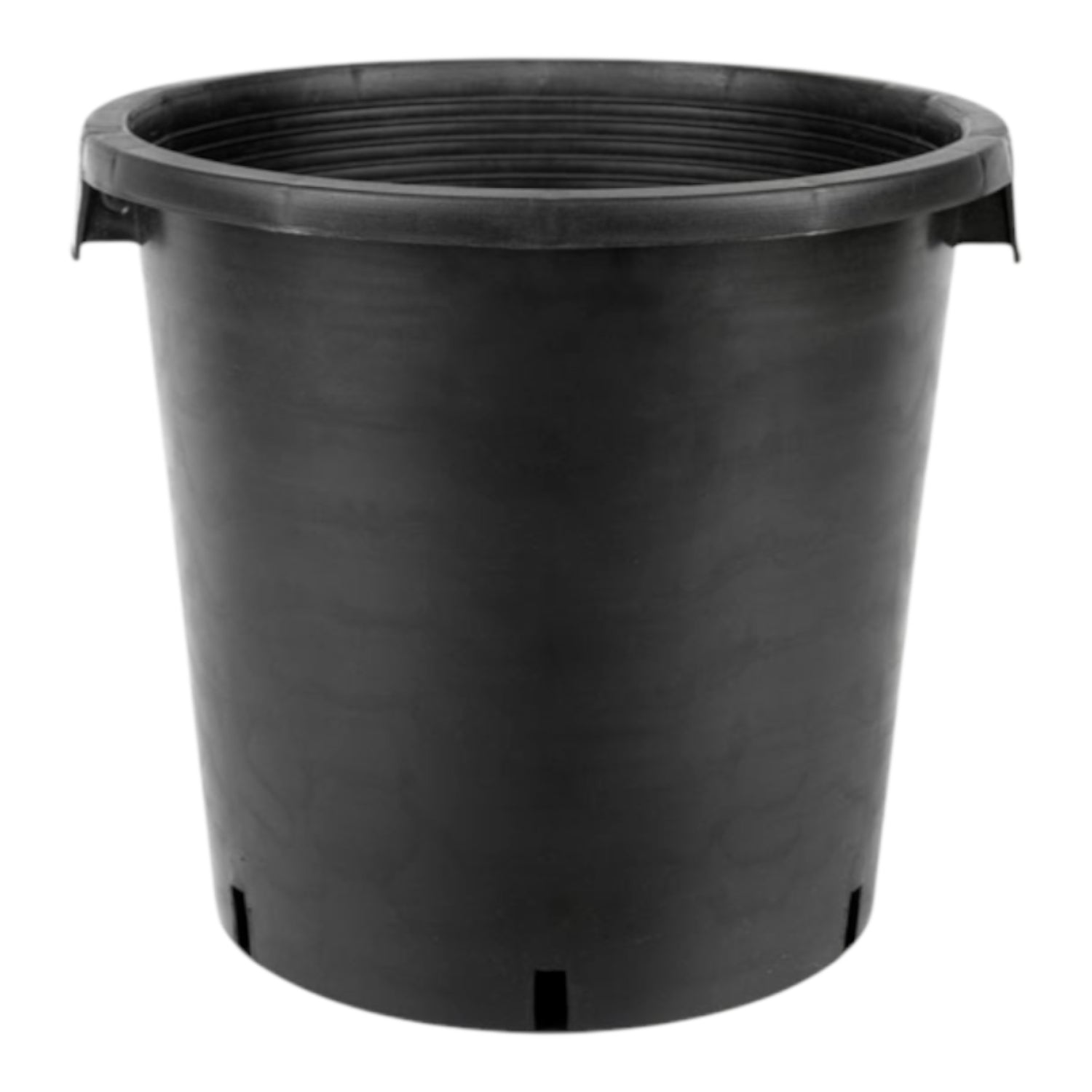
The 14L Reinforced Nursery Pot is a professional growing container designed for professional nursery production where a more substantial container format is required.
The 14L format provides substantial root volume for crops that need more space than standard nursery pots, while the container style is intended for repeated handling through production, spacing, irrigation and dispatch.
Sold individually. A full commercial pallet contains 600 pots.
Key benefits
Professional nursery production
The reinforced 14L format is intended for nursery crops that need a robust production container through repeated irrigation, spacing, handling and dispatch operations.
Choose the pot size to provide sufficient root volume without moving crops into an unnecessarily large substrate mass too early in production.
Choosing the growing medium
Use a professional growing medium appropriate to the crop, container size and irrigation system. Larger pots need a substrate with enough structure to maintain air-filled porosity and drainage throughout the production period while retaining sufficient available moisture.
Avoid excessive compaction during filling. Settle the medium consistently and leave suitable watering space at the top of the container.
Irrigation & root-zone management
Container size has a major effect on drying behaviour. Check moisture through the root zone rather than judging only the surface, and adjust irrigation frequency and volume as crop size, weather and rooting increase.
Ensure drainage points remain clear and avoid leaving containers standing in prolonged saturation unless the crop and production system are specifically designed for it.
Handling, spacing & stability
Position larger pots on a stable, well-drained growing surface and allow sufficient spacing for crop development and access. Consider wind exposure as top-heavy trees and shrubs develop.
Filled containers can be substantially heavier than their nominal litre capacity suggests. Use appropriate lifting and handling methods, particularly with the larger sizes in this range.
Reuse & crop hygiene
Where pots remain serviceable, they may be reused subject to the nursery's crop-hygiene requirements. Remove old substrate and plant material, inspect the container for damage and clean or disinfect as appropriate before the next crop cycle.
14L Reinforced Nursery Pot product details
| Product type | Reinforced Nursery Pot |
|---|---|
| Nominal capacity | 14L |
| Selling quantity | 1 pot |
| Primary application | professional nursery production where a more substantial container format is required |
| Commercial pallet quantity | 600 pots |
14L Reinforced Nursery Pot FAQs
Is this nursery pot sold individually?
Yes. The selling unit is one pot. What capacity is this pot?
The stated nominal capacity is 14L. What is this pot suitable for?
It is intended for professional nursery production where a more substantial container format is required. What growing medium should I use?
Use a professional substrate appropriate to the crop, container size and irrigation system, with suitable structure, drainage, aeration and moisture retention. How should larger pots be watered?
Check moisture through the root zone and adjust irrigation to crop size, rooting, weather and substrate behaviour rather than relying on a fixed timetable. Can the pot be reused?
Yes where it remains serviceable and nursery hygiene requirements are met. Remove old substrate and clean appropriately before reuse. What should I consider when moving a filled pot?
A filled and watered container can be very heavy. Use appropriate manual-handling methods or mechanical assistance where required. How do I choose between pot sizes?
Match container volume to crop vigour, root development, production period and intended finished-plant size. How many pots are on a full pallet?
A full commercial pallet contains 600 pots. The product itself is sold individually.
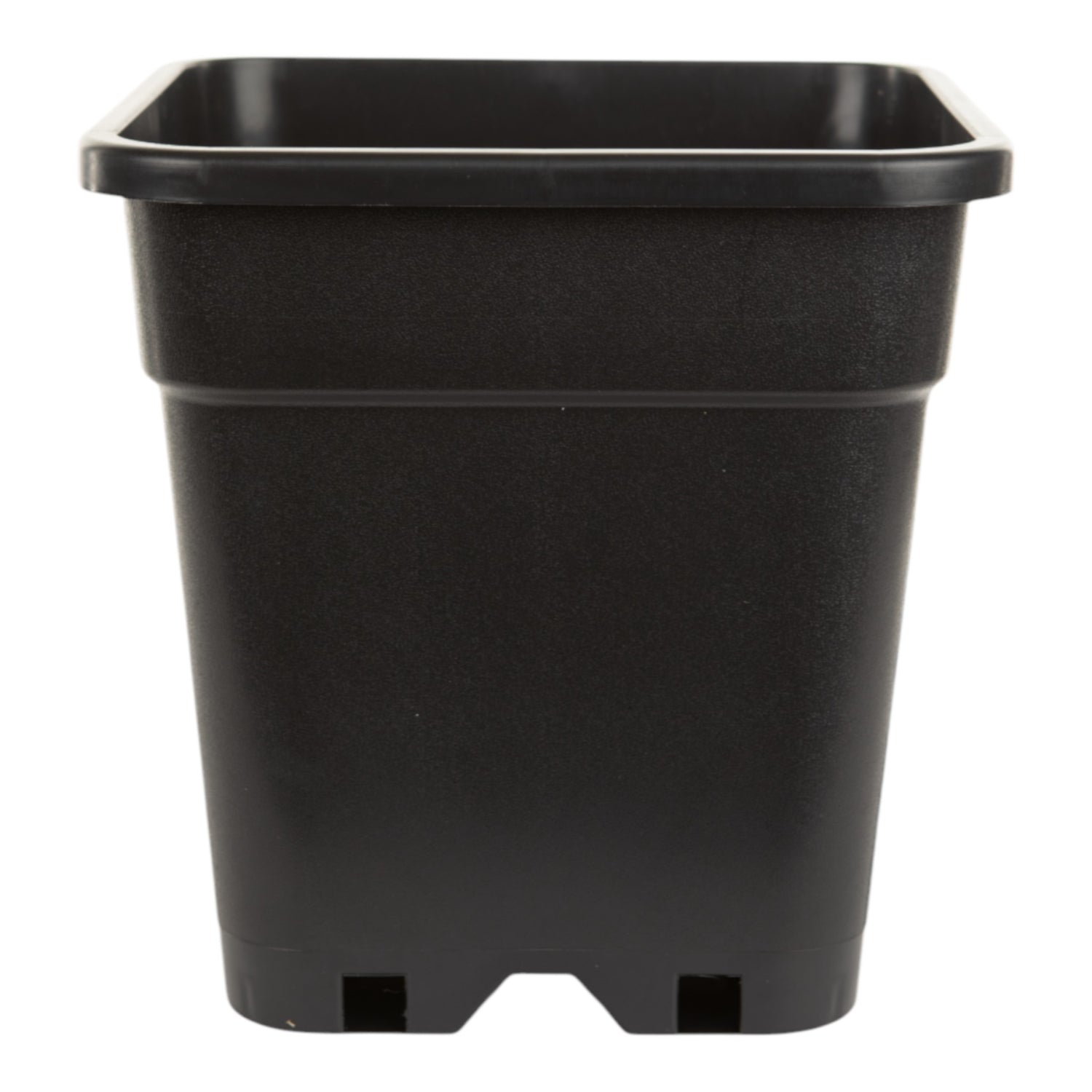
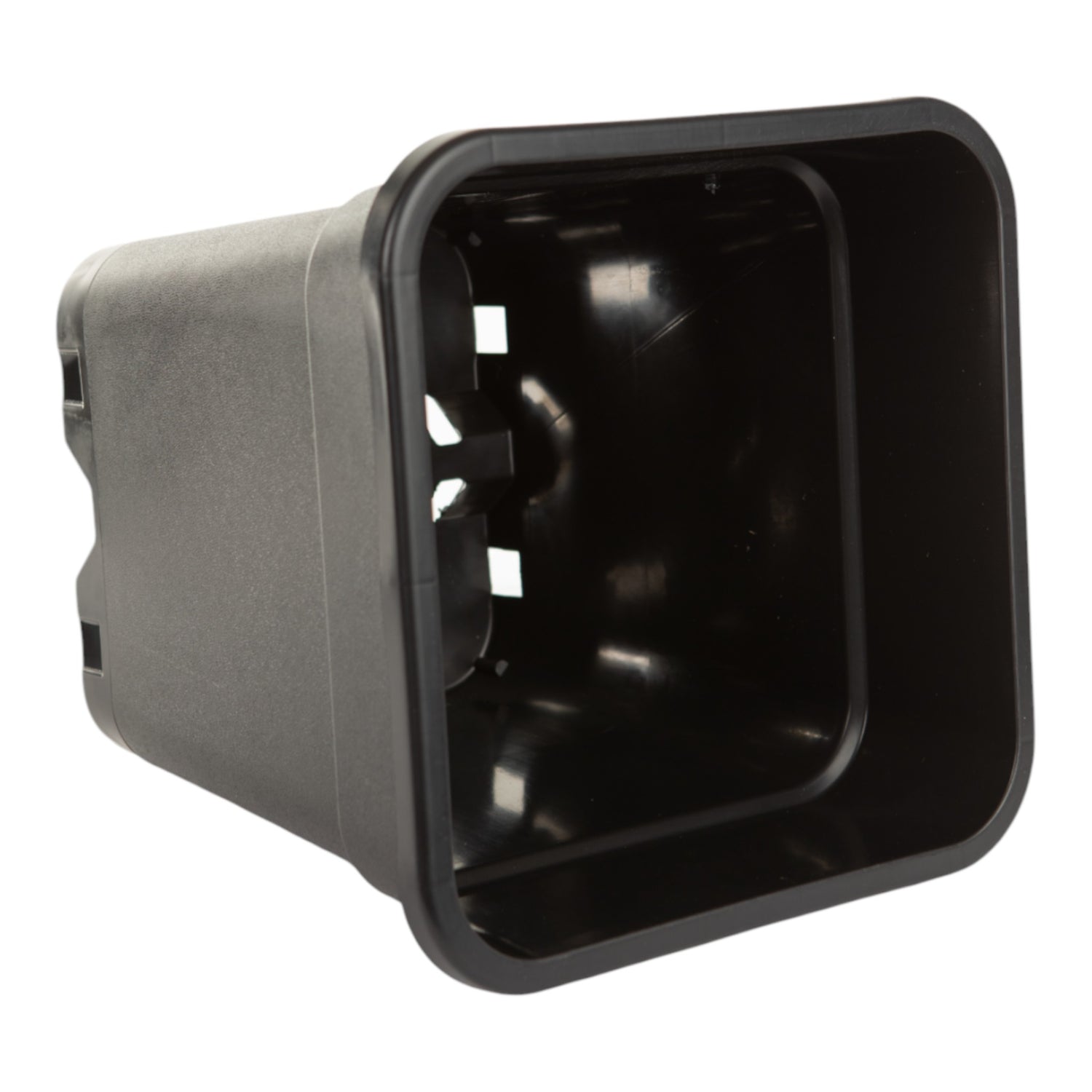
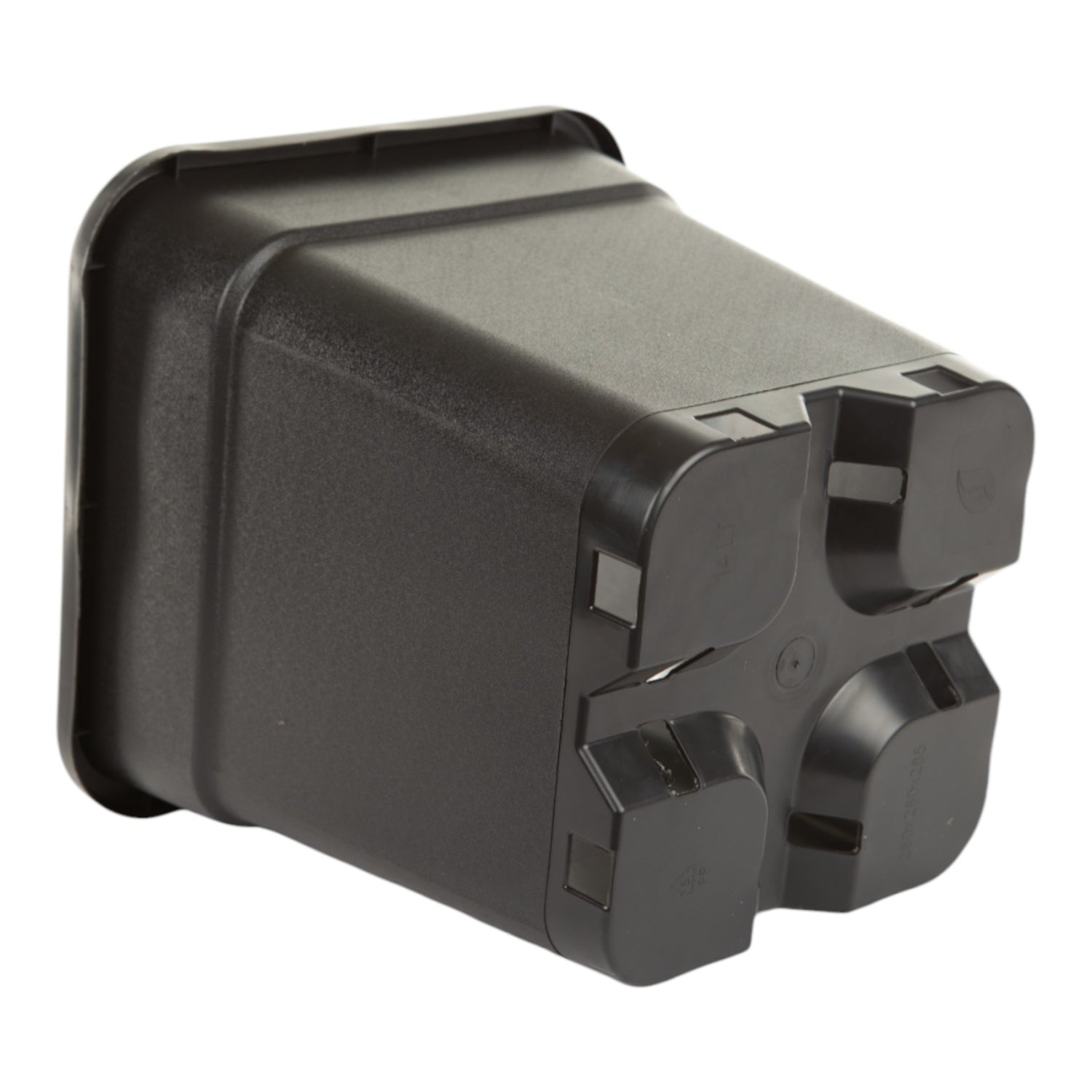
The 14L Square Pot is a professional growing container designed for professional container production where efficient bench or floor spacing is useful.
The 14L format provides substantial root volume for crops that need more space than standard nursery pots, while the container style is intended for repeated handling through production, spacing, irrigation and dispatch.
Sold individually.
Key benefits
Efficient container production
The 14L square format is useful where growers want to organise crops efficiently across benches, beds or standing areas. Square pots can reduce unused gaps between adjacent containers compared with equivalent round formats.
Match the container volume to the crop and production period, allowing adequate root space without creating an excessively wet or slow-drying root zone.
Choosing the growing medium
Use a professional growing medium appropriate to the crop, container size and irrigation system. Larger pots need a substrate with enough structure to maintain air-filled porosity and drainage throughout the production period while retaining sufficient available moisture.
Avoid excessive compaction during filling. Settle the medium consistently and leave suitable watering space at the top of the container.
Irrigation & root-zone management
Container size has a major effect on drying behaviour. Check moisture through the root zone rather than judging only the surface, and adjust irrigation frequency and volume as crop size, weather and rooting increase.
Ensure drainage points remain clear and avoid leaving containers standing in prolonged saturation unless the crop and production system are specifically designed for it.
Handling, spacing & stability
Position larger pots on a stable, well-drained growing surface and allow sufficient spacing for crop development and access. Consider wind exposure as top-heavy trees and shrubs develop.
Filled containers can be substantially heavier than their nominal litre capacity suggests. Use appropriate lifting and handling methods, particularly with the larger sizes in this range.
Reuse & crop hygiene
Where pots remain serviceable, they may be reused subject to the nursery's crop-hygiene requirements. Remove old substrate and plant material, inspect the container for damage and clean or disinfect as appropriate before the next crop cycle.
14L Square Pot product details
| Product type | Square Nursery Pot |
|---|---|
| Nominal capacity | 14L |
| Selling quantity | 1 pot |
| Primary application | professional container production where efficient bench or floor spacing is useful |
14L Square Pot FAQs
Is this nursery pot sold individually?
Yes. The selling unit is one pot. What capacity is this pot?
The stated nominal capacity is 14L. What is this pot suitable for?
It is intended for professional container production where efficient bench or floor spacing is useful. What growing medium should I use?
Use a professional substrate appropriate to the crop, container size and irrigation system, with suitable structure, drainage, aeration and moisture retention. How should larger pots be watered?
Check moisture through the root zone and adjust irrigation to crop size, rooting, weather and substrate behaviour rather than relying on a fixed timetable. Can the pot be reused?
Yes where it remains serviceable and nursery hygiene requirements are met. Remove old substrate and clean appropriately before reuse. What should I consider when moving a filled pot?
A filled and watered container can be very heavy. Use appropriate manual-handling methods or mechanical assistance where required. How do I choose between pot sizes?
Match container volume to crop vigour, root development, production period and intended finished-plant size.
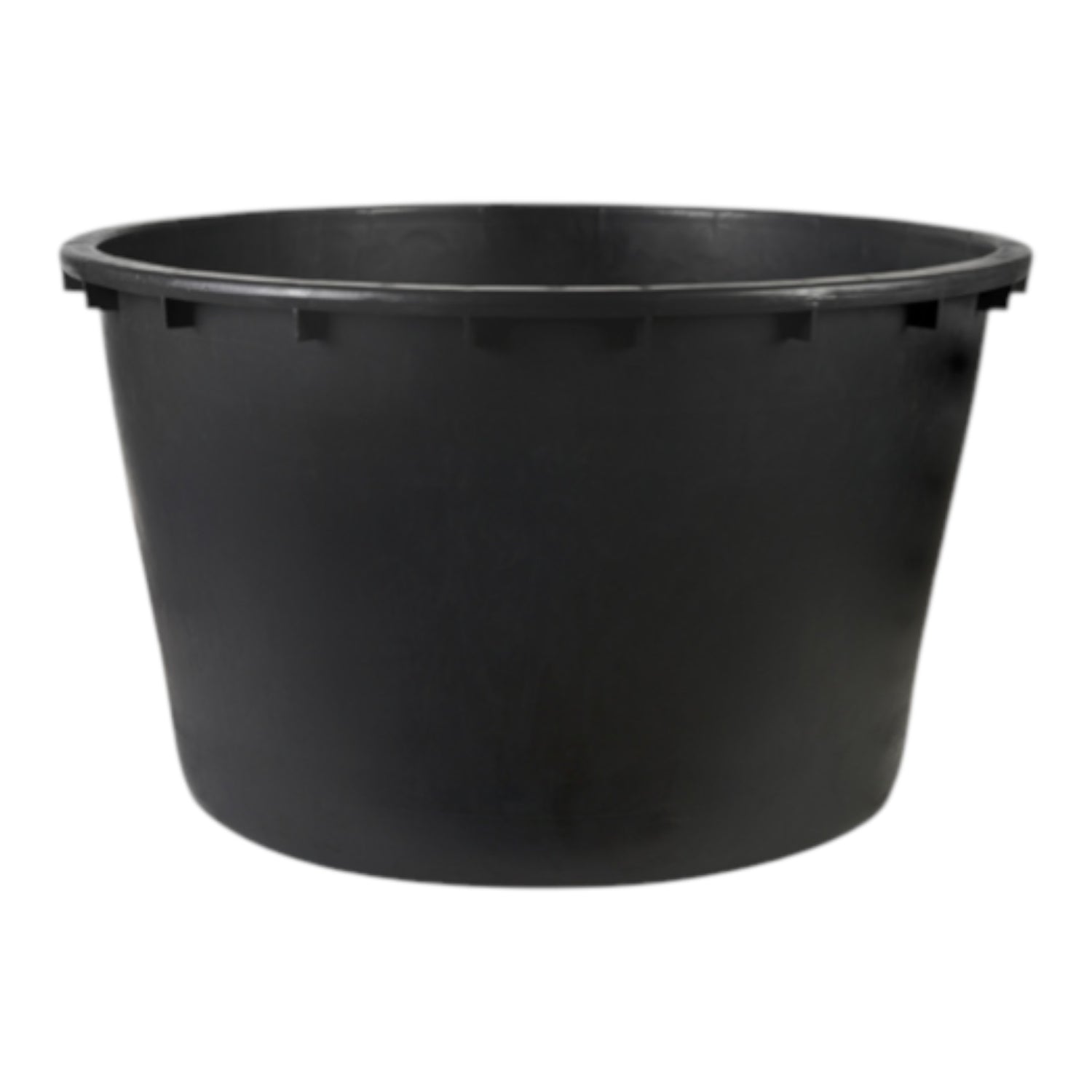
The 150L Nursery Tub is a professional growing container designed for large-specimen, tree, shrub and nursery container production.
The 150L format provides substantial root volume for crops that need more space than standard nursery pots, while the container style is intended for repeated handling through production, spacing, irrigation and dispatch.
Sold individually.
Key benefits
Large-volume nursery & specimen production
The 150L nursery tub is intended for crops requiring a substantial container volume, including larger shrubs, trees and specimen plants where the crop, production period and root system justify the additional growing-medium volume.
Large containers become extremely heavy once filled and irrigated. Plan the production area, irrigation method and mechanical or team handling arrangements before potting.
Choosing the growing medium
Use a professional growing medium appropriate to the crop, container size and irrigation system. Larger pots need a substrate with enough structure to maintain air-filled porosity and drainage throughout the production period while retaining sufficient available moisture.
Avoid excessive compaction during filling. Settle the medium consistently and leave suitable watering space at the top of the container.
Irrigation & root-zone management
Container size has a major effect on drying behaviour. Check moisture through the root zone rather than judging only the surface, and adjust irrigation frequency and volume as crop size, weather and rooting increase.
Ensure drainage points remain clear and avoid leaving containers standing in prolonged saturation unless the crop and production system are specifically designed for it.
Handling, spacing & stability
Position larger pots on a stable, well-drained growing surface and allow sufficient spacing for crop development and access. Consider wind exposure as top-heavy trees and shrubs develop.
Filled containers can be substantially heavier than their nominal litre capacity suggests. Use appropriate lifting and handling methods, particularly with the larger sizes in this range.
Reuse & crop hygiene
Where pots remain serviceable, they may be reused subject to the nursery's crop-hygiene requirements. Remove old substrate and plant material, inspect the container for damage and clean or disinfect as appropriate before the next crop cycle.
150L Nursery Tub product details
| Product type | Large Nursery Tub |
|---|---|
| Nominal capacity | 150L |
| Selling quantity | 1 pot |
| Primary application | large-specimen, tree, shrub and nursery container production |
150L Nursery Tub FAQs
Is this nursery pot sold individually?
Yes. The selling unit is one pot. What capacity is this pot?
The stated nominal capacity is 150L. What is this pot suitable for?
It is intended for large-specimen, tree, shrub and nursery container production. What growing medium should I use?
Use a professional substrate appropriate to the crop, container size and irrigation system, with suitable structure, drainage, aeration and moisture retention. How should larger pots be watered?
Check moisture through the root zone and adjust irrigation to crop size, rooting, weather and substrate behaviour rather than relying on a fixed timetable. Can the pot be reused?
Yes where it remains serviceable and nursery hygiene requirements are met. Remove old substrate and clean appropriately before reuse. What should I consider when moving a filled pot?
A filled and watered container can be very heavy. Use appropriate manual-handling methods or mechanical assistance where required. How do I choose between pot sizes?
Match container volume to crop vigour, root development, production period and intended finished-plant size.

£1.99
Unit price per£1.99
Unit price perThe 150mm (6") Fast Clamp provides a strong, secure and vibration-reducing connection between compatible circular ventilation components such as inline fans, filters and rigid duct fittings.
Rather than joining two pieces of ventilation equipment with a short section of flexible ducting, a Fast Clamp fits around adjoining circular spigots to create a neat mechanical connection. This makes it particularly useful when installing fans directly alongside filters, silencers and other compatible ventilation equipment.
The strong metal outer band provides a secure connection, while the cushioned inner lining helps isolate vibration between connected components. Reducing the direct transfer of fan vibration into adjoining equipment and ductwork can help reduce structure-borne noise within the ventilation system.
The clamp can also be released when equipment needs to be removed, making it a practical choice for installations where fans, filters or other components require periodic inspection, cleaning or servicing.
Why use a 150mm Fast Clamp?
Connecting fans, filters and ventilation equipment
Fast Clamps are particularly useful where two compatible pieces of circular ventilation equipment need to be connected directly together. A common application is joining an inline extraction fan to a compatible filter, although they can also be used with suitable silencers, rigid circular ductwork and other ventilation fittings.
The cushioned inner lining sits between the outer clamp and the connected components. This helps create a secure fit while reducing the direct transmission of vibration from operating equipment into adjoining parts of the ventilation system.
This makes the 150mm Fast Clamp useful in propagation facilities, nurseries, growing areas, controlled environments and general ventilation installations where secure connections and vibration management are important.
How to install a 150mm Fast Clamp
Position the two compatible 150mm circular components together so their connection points are correctly aligned. Open or loosen the Fast Clamp sufficiently to position it evenly around the joint.
Make sure the cushioned inner lining sits correctly around the connection before tightening the clamp. Tighten the fixings evenly until the components are held securely in position.
Avoid excessive tightening beyond what is required to produce a secure connection. Fans, filters and other substantial ventilation equipment should be independently supported rather than relying on the Fast Clamp to carry their weight.
150mm (6") Fast Clamp product details
| Product type | Anti-vibration ventilation Fast Clamp |
|---|---|
| Nominal connection size | 150mm / 6" |
| Outer construction | Metal clamping band |
| Inner construction | Cushioned anti-vibration lining |
| Primary purpose | Connecting compatible circular ventilation components |
| Vibration control | Inner lining helps reduce vibration transfer between connected components |
| Typical connections | Fans, filters, silencers, rigid circular ductwork & compatible ventilation fittings |
| Maintenance | Removable connection allows compatible equipment to be disconnected for servicing or cleaning |
| Suitable applications | Controlled environment, propagation, nursery, growing area & general ventilation systems |
150mm (6") Fast Clamp FAQs
What is a ventilation Fast Clamp?
A Fast Clamp is a mechanical connector designed to securely join compatible circular ventilation components while its cushioned inner lining helps isolate vibration between them. What size is this Fast Clamp?
This model is designed for compatible ventilation components with a nominal 150mm / 6" circular connection. Can I use it to connect a 6-inch fan to a filter?
Yes. Connecting compatible fans and filters is one of the common applications for a 150mm Fast Clamp. Can it connect a fan directly to rigid ducting?
Yes, provided the components have compatible nominal 150mm circular connections suitable for this type of clamp. Can a Fast Clamp connect a fan to a silencer?
Yes. It can be used between compatible 150mm circular fan and silencer connections where the equipment is correctly aligned and independently supported. Does a Fast Clamp reduce vibration?
Yes. The cushioned inner lining helps isolate vibration rather than allowing it to transfer directly from an operating fan into adjoining ductwork or equipment. Can reducing vibration make a ventilation system quieter?
It can help. Mechanical vibration transferred from a fan into ductwork can contribute to system noise, so isolating the connection can help reduce this source of transmitted noise. Is the Fast Clamp made from metal?
Yes. The Fast Clamp uses a strong metal outer clamping band together with a cushioned inner lining. Can the Fast Clamp be removed again?
Yes. The mechanical connection can be released, making it useful where equipment needs to be disconnected for inspection, cleaning or servicing. Is a Fast Clamp suitable for a direct fan-to-filter connection?
Yes, where the fan and filter have compatible 150mm circular connections and both components are correctly supported. Does the Fast Clamp support the weight of a fan or filter?
No. Fans, filters and other substantial ventilation equipment should be properly and independently supported. The Fast Clamp secures the connection rather than acting as the primary equipment support. Why use a Fast Clamp instead of flexible ducting between components?
Where two compatible circular components are positioned directly together, a Fast Clamp provides a compact mechanical connection while also helping isolate vibration between the components. Where can a 150mm Fast Clamp be used?
It is suitable for compatible circular ventilation systems in controlled environments, propagation facilities, nurseries, growing areas and other commercial or general ventilation applications.

£3.49
Unit price per£3.49
Unit price per150mm flat ceramic air stone for producing a wide spread of fine bubbles across hydroponic nutrient reservoirs and DWC systems.
The 150mm Round Flat Ceramic Air Stone provides a simple way to increase aeration and movement throughout a hydroponic nutrient solution. Its broad, porous ceramic surface releases air as many small bubbles, spreading aeration over a much wider area than a compact ball-style air stone.
At 150mm or 6 inches in diameter, the disc sits flat at the bottom of a reservoir or tank. Connect the 4mm inlet to a suitable air pump using compatible airline and the incoming air is distributed through the porous ceramic body.
It is particularly useful for DWC systems, hydroponic nutrient reservoirs and other growing systems where continuous aeration helps keep the solution moving around the root zone.
Why choose a 150mm Flat Ceramic Air Stone?
What is a flat ceramic air stone used for?
A flat ceramic air stone is a submerged diffuser that takes air from an external pump and distributes it through thousands of small pores. Instead of releasing air from a single open airline, the ceramic surface produces a broad spread of bubbles across the reservoir.
The 150mm disc format is particularly useful where you want aeration distributed across a wider area. Its low, flat shape allows the air stone to sit at the bottom of the tank while bubbles rise through the nutrient solution above it.
Ideal for DWC and nutrient reservoirs
In deep water culture systems, roots spend extended periods in nutrient solution, making active aeration an important part of the setup. A flat air stone positioned beneath the root zone creates a continuous stream of bubbles while helping keep the nutrient solution moving.
The 150mm size is also well suited to standalone nutrient reservoirs and other hydroponic tanks where a broader diffusing surface is preferred to a small individual air stone.
How to use the 150mm Ceramic Air Stone
Connect compatible 4mm airline to the inlet on the side of the air stone, then connect the other end to a suitably sized external air pump. Place the ceramic disc flat at the bottom of the reservoir and keep the porous section submerged.
Once the pump is switched on, air passes through the ceramic body and bubbles rise through the surrounding water or nutrient solution.
Keep the airline free from kinks and restrictions. For added protection against water travelling back towards the pump when it is switched off, the air pump can be positioned above the water level or a suitable non-return valve can be incorporated into the airline.
Product details
| Product type | Ceramic air stone / air diffuser |
|---|---|
| Shape | Round flat disc |
| Diameter | 150mm / 6" |
| Airline inlet | 4mm |
| Diffuser material | Porous ceramic |
| Position | Sits flat in the bottom of a reservoir or tank |
| Typical applications | Hydroponic nutrient reservoirs, DWC systems & aerated water tanks |
| Outer case quantity | 30 |
| Air pump included | No |
| Airline included | No |
150mm Ceramic Air Stone FAQs
What size is this ceramic air stone?
The air stone is 150mm, or approximately 6 inches, in diameter and has a flat circular design.
What size airline does the 150mm air stone use?
This 150mm version has a 4mm inlet for connecting compatible airline to a suitable air pump.
What does a ceramic air stone do?
Air supplied by an external pump passes through the porous ceramic body and is released as many small bubbles, helping aerate and circulate the surrounding water or nutrient solution.
Is the 150mm air stone suitable for DWC?
Yes. Its broad diffusing surface makes it particularly useful for aerating nutrient solution in deep water culture systems.
Where should I position a flat air stone?
Place it flat towards the bottom of the reservoir or tank. This allows bubbles to rise through the nutrient solution from a low position in the system.
Does this air stone need an air pump?
Yes. The ceramic air stone is a diffuser and requires a suitable external air pump to supply the airflow.
Is an air pump or airline included?
No. The air stone is supplied separately, so a suitable air pump and compatible 4mm airline are required to create a complete aeration setup.
Can I use more than one 150mm air stone?
Yes. Multiple air stones can be incorporated into a larger aeration system provided the connected air pump has sufficient output. A suitable manifold can be used to divide the air supply between separate airline runs.
Why use a flat air stone instead of a small ball air stone?
The larger flat ceramic surface spreads bubbles across a wider area, making it useful when you want broader aeration across the bottom of a nutrient reservoir rather than a concentrated stream from a smaller diffuser.

£25.99
Unit price per£25.99
Unit price per152mm (6") x 10m Mute Silent Ducting is an acoustically insulated flexible ventilation duct designed to help reduce the transmission of fan and airflow noise through extraction and intake systems.
Ventilation systems can transmit a considerable amount of sound through standard ducting. Noise generated by the fan, together with turbulence and fast-moving air, can travel along the duct run and become audible at the inlet or outlet.
This acoustic ducting uses an insulated construction around the flexible inner airflow duct to help absorb transmitted sound. It provides a practical upgrade from standard uninsulated flexible ducting where quieter ventilation is required.
With a 152mm (6") nominal internal diameter and generous 10m length, it is particularly useful for larger installations, longer duct runs or projects requiring several shorter sections of acoustic ducting.
Why choose 152mm acoustic silent ducting?
How does acoustic ducting reduce ventilation noise?
Standard flexible ducting provides an effective route for moving air but offers relatively little acoustic isolation. Sound produced by an extraction fan and turbulent airflow can therefore travel along the same route.
Acoustic ducting adds a layer of sound-absorbing insulation around the inner flexible duct. This helps reduce the amount of noise transmitted through and along the ventilation system.
It can be particularly effective on duct sections immediately before or after an extraction fan, between a carbon filter and fan, or along longer duct runs where ventilation noise would otherwise be noticeable.
Acoustic ducting should be regarded as a noise-reduction component rather than a complete silencing solution. Fan vibration, motor noise, airflow velocity and other components can also contribute to the overall sound produced by an extraction system.
Quieter 6-inch grow room ventilation
152mm-class ventilation equipment is widely used in indoor horticulture where substantial airflow is required for managing heat, humidity and air exchange.
As extraction capacity increases, fan and airflow noise can become more noticeable. Acoustic ducting helps reduce sound transmitted through the ductwork while retaining the flexibility required to route the system around the growing environment.
The 10m length makes this version particularly useful for larger grow rooms, longer extraction routes and installations where the fan or exhaust point is positioned some distance from the growing area.
Building a quieter extraction system
The best results are achieved by considering noise throughout the complete ventilation installation. Sound can originate from the fan motor, vibration, turbulent airflow and air travelling at high velocity through restrictive ductwork.
Acoustic ducting addresses sound transmitted through the duct run, while correctly sized fans and ducting help prevent excessive airflow velocity and resistance.
Where additional noise reduction is required, acoustic ducting can be combined with compatible ventilation silencers, suitable fan-speed control and vibration-isolating mounting methods.
Maintaining airflow through a 10m duct run
Longer duct runs create more resistance than short runs, so installation becomes particularly important when using a substantial length of flexible ducting.
Use only the length required and extend the flexible inner duct sufficiently to avoid unnecessary compression. Excessive internal corrugation, tight bends and crushed sections all increase resistance to airflow.
Keep the route as straight as the installation allows. Where a substantial direction change is required, an appropriately sized rigid metal elbow can provide a cleaner airflow route than forcing the flexible duct around an extremely tight corner.
When planning a long extraction run, remember that carbon filters, silencers, bends, reducers and other fittings also contribute to the total resistance the fan must overcome.
Installing 152mm acoustic ducting
Measure the required route before cutting the duct. The 10m length can be used as a longer continuous run or divided into shorter sections depending on the ventilation layout.
When connecting the ducting to a fan, carbon filter, silencer or rigid fitting, secure the inner duct to the compatible connection using an appropriately sized duct clamp or clip.
Arrange the insulation and outer covering neatly around the joint. Where minimising air leakage is important, suitable HVAC foil tape can also be used as part of the connection and sealing process.
Longer insulated duct runs should be supported at suitable intervals. Avoid allowing the entire weight of the duct to hang directly from an extraction fan, carbon filter or other ventilation component.
Compatible 152mm / 6" ventilation equipment
This ducting is designed for nominal 152mm (6") ventilation installations and can be used alongside appropriately sized components including:
Always check the actual connection diameter of adjoining equipment before installation. Metric and imperial ventilation sizes are frequently used together in product descriptions, but exact connection dimensions can vary slightly between manufacturers.
152mm (6") x 10m Mute Silent Ducting product details
| Product type | Acoustic insulated flexible ventilation ducting |
|---|---|
| Nominal diameter | 152mm / 6" |
| Length | 10m |
| Duct type | Flexible |
| Construction | Insulated acoustic ducting |
| Primary purpose | Ventilation with reduced transmission of fan and airflow noise |
| Suitable airflow | Extraction & intake |
| Compatible system size | Nominal 152mm / 6" round ventilation systems |
| Suitable applications | Grow rooms, indoor horticulture, workshops & general ventilation installations |
152mm (6") Mute Silent Ducting FAQs
What is acoustic ducting?
Acoustic ducting is flexible ventilation ducting surrounded by an insulating layer designed to help reduce sound transmitted through the ventilation system. What size is this silent ducting?
It has a nominal internal duct diameter of 152mm, approximately 6 inches, and is supplied in a 10m length. Is this suitable for a 6-inch extraction fan?
Yes, provided the fan has a compatible nominal 152mm / 6" connection. Will acoustic ducting completely silence my extraction fan?
No. It helps reduce noise transmitted through the ductwork, but fan motor noise, vibration and airflow can still be audible. Is acoustic ducting quieter than standard flexible ducting?
Its insulated construction is specifically intended to reduce sound transmission compared with basic uninsulated flexible ventilation ducting. Can I use it with a carbon filter?
Yes. It can be used with a compatible 152mm / 6" carbon filter as part of an extraction system. Can acoustic ducting be used with a ventilation silencer?
Yes. Acoustic ducting and a compatible silencer can be used together where additional reduction of transmitted ventilation noise is required. Can the 10m duct be cut into shorter lengths?
Yes. The ducting can be cut to suit the installation using suitable tools, taking care when cutting the flexible inner duct, reinforcement and insulation. Can I use this ducting for air intake?
Yes. It can be incorporated into compatible intake systems as well as extraction installations. Does a 10m duct run reduce airflow?
Longer duct runs introduce more resistance than shorter runs. The actual effect depends on the fan, installation, bends and other components, so unnecessary excess ducting should be avoided. Should acoustic ducting be stretched out?
It should be extended sufficiently for the required run rather than left heavily compressed. This helps reduce excessive internal corrugation and unnecessary airflow resistance. Can I bend the ducting around corners?
Yes. Its flexible construction allows changes in direction, but very tight bends that crush the inner duct should be avoided. How should acoustic ducting be secured?
The inner duct can be secured to compatible ventilation connections using appropriately sized duct clamps or clips, with suitable HVAC foil tape used where additional sealing is required. Is 152mm silent ducting suitable for grow rooms?
Yes. It is particularly useful for indoor horticultural installations where 6-inch extraction equipment is used and reducing ventilation noise is desirable. What else can I do to reduce grow room extraction noise?
Use correctly sized ducting, minimise unnecessary bends, isolate fan vibration and consider compatible fan-speed control and acoustic silencers where appropriate.
£12.92
Unit price per£12.92
Unit price per152mm (6") x 5m Mute Silent Ducting is an acoustically insulated flexible ventilation duct designed to help reduce the transmission of fan and airflow noise through extraction and intake systems.
Ventilation systems can transmit a surprising amount of sound through standard ducting. Noise from the fan itself, together with turbulence and fast-moving air, can travel along the duct run and become audible at the inlet or outlet.
This acoustic ducting uses an insulated construction around the flexible inner airflow duct to help absorb transmitted sound. It provides a practical upgrade from standard uninsulated flexible ducting where quieter ventilation is required.
With a 152mm (6") nominal internal diameter and 5m length, it is particularly well suited to grow rooms, indoor horticulture, workshops and other ventilation installations using compatible 6-inch fans, carbon filters and duct fittings.
Why choose 152mm acoustic silent ducting?
How does acoustic ducting work?
Standard flexible ducting provides an airflow route but offers relatively little acoustic isolation. Sound generated by the extraction fan and moving air can therefore travel along the duct run.
Acoustic ducting adds a layer of sound-absorbing insulation around the inner flexible duct. This helps reduce the amount of sound transmitted through and along the ventilation run.
It is particularly useful on sections immediately before or after an extraction fan, between a carbon filter and fan, or wherever ventilation noise needs to be reduced.
Acoustic ducting should be considered a noise-reduction component rather than a complete silencing solution. Fan vibration, motor noise, airflow velocity and other parts of the installation can also contribute to the overall sound level.
Quieter 6-inch grow room ventilation
150mm and 152mm-class extraction systems are widely used where considerably more airflow is required than smaller ventilation systems can provide. As fan capacity increases, however, ventilation noise can become more noticeable.
Using acoustic ducting helps reduce sound transmitted along the ductwork while retaining the flexibility required to route the ventilation system around a grow room or indoor horticultural space.
It can be combined with compatible fans, carbon filters, acoustic silencers and fan-speed controllers as part of a complete ventilation and noise-management system.
How to make an extraction system quieter
Acoustic ducting works best as part of a correctly designed ventilation system. Noise can originate from the fan motor, fan vibration, turbulent airflow and air moving rapidly through undersized or restrictive ductwork.
For a quieter installation, use appropriately sized ducting, keep the ventilation route as direct as practical and avoid crushing the duct around tight corners.
Fan-speed control, vibration isolation and compatible acoustic silencers can also be considered where further noise reduction is required.
Maintaining airflow through flexible ducting
Flexible ducting should be installed carefully to avoid creating unnecessary resistance. Leaving large amounts of duct compressed together creates deeper internal corrugations and can make the airflow path more restrictive.
Extend the duct sufficiently for the required run, remove unnecessary excess length and avoid excessively tight bends. The straighter and smoother the route, the easier it is for the fan to move air through the system.
Where a sharp direction change is unavoidable, using an appropriately sized rigid metal elbow can provide a cleaner turn than forcing the flexible duct through an extremely tight bend.
Installing 152mm acoustic ducting
Measure the required ventilation route and cut the ducting to the appropriate length. Take care when cutting through the flexible inner duct, reinforcement and surrounding insulation.
When connecting to a fan, carbon filter, silencer or rigid fitting, secure the inner duct to the compatible connection using an appropriately sized duct clamp or clip.
Arrange the insulation and outer covering neatly around the joint. Where minimising air leakage is important, suitable HVAC foil tape can also be used as part of the sealing process.
Longer runs should be adequately supported so that the weight of the insulated ducting is not left hanging directly from the fan, filter or other ventilation equipment.
Compatible 152mm / 6" ventilation equipment
This ducting is designed for nominal 152mm (6") ventilation installations and can be used with appropriately sized components including:
Always check the actual connection diameter of the equipment being installed. Metric and imperial ventilation sizes are commonly used together in product descriptions, but actual connection dimensions can vary slightly between manufacturers.
152mm (6") x 5m Mute Silent Ducting product details
| Product type | Acoustic insulated flexible ventilation ducting |
|---|---|
| Nominal diameter | 152mm / 6" |
| Length | 5m |
| Duct type | Flexible |
| Construction | Insulated acoustic ducting |
| Primary purpose | Ventilation with reduced transmission of fan and airflow noise |
| Suitable airflow | Extraction & intake |
| Compatible system size | Nominal 152mm / 6" round ventilation systems |
| Suitable applications | Grow rooms, indoor horticulture, workshops & general ventilation installations |
152mm (6") Mute Silent Ducting FAQs
What is acoustic ducting?
Acoustic ducting is flexible ventilation ducting surrounded by an insulating layer designed to help reduce sound transmitted through the ventilation system. What size is this silent ducting?
It has a nominal internal duct diameter of 152mm, approximately 6 inches, and is supplied in a 5m length. Is this suitable for a 6-inch extraction fan?
Yes, provided the fan has a compatible nominal 152mm / 6" connection. Will acoustic ducting completely silence my fan?
No. It helps reduce noise transmitted through the ductwork but cannot eliminate every source of sound from a ventilation system. Is acoustic ducting quieter than normal flexible ducting?
Its insulated construction is specifically intended to reduce sound transmission compared with basic uninsulated flexible ventilation ducting. Can I use this ducting with a carbon filter?
Yes. It can connect compatible 152mm / 6" carbon filters and extraction equipment. Can acoustic ducting be used with a silencer?
Yes. Acoustic ducting and a compatible ventilation silencer can be used together where further reduction of transmitted ventilation noise is required. Can I cut the 5m length?
Yes. The ducting can be cut to suit the installation using appropriate tools, taking care when cutting the inner reinforcement and insulation. Can this ducting be used for intake ventilation?
Yes. It can be incorporated into compatible air-intake systems as well as extraction installations. Does flexible acoustic ducting affect airflow?
All ductwork creates some resistance. Keeping flexible duct reasonably extended and avoiding excessive length, compression and tight bends helps minimise additional pressure loss. Should I stretch acoustic ducting out during installation?
Extend it sufficiently for the required run rather than leaving unnecessary sections heavily compressed. This helps create a less restrictive internal airflow path. Can I bend this ducting around corners?
Yes. Its flexible construction allows it to follow changes in direction, but extremely tight bends that crush the inner duct should be avoided. How do I secure acoustic ducting?
The inner duct can be secured to compatible ventilation connections using an appropriately sized duct clamp or clip, with suitable HVAC foil tape used where additional sealing is required. Is 152mm silent ducting suitable for grow rooms?
Yes. It is particularly useful for indoor horticultural installations where 6-inch extraction equipment is used and reducing ventilation noise is desirable. What else can reduce grow room fan noise?
Correctly sized ducting, smooth airflow routes, fan-speed control, vibration isolation and compatible acoustic silencers can all contribute to a quieter ventilation installation.
£30.67
Unit price per£30.67
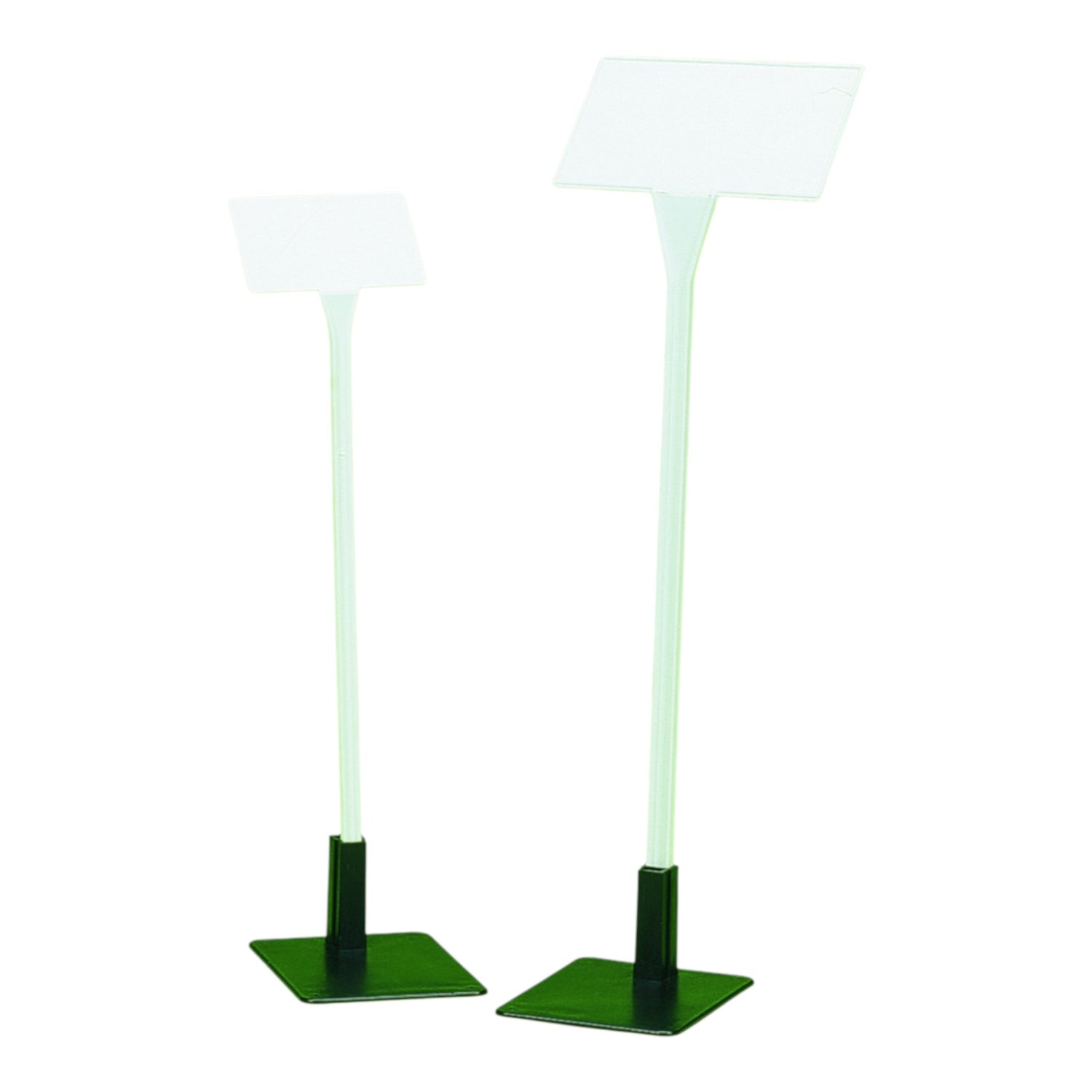
Unit price perThe 15cm Base for Angled Head Labels for SL275, 400, 440 and 500 BLACK (Pack of 25) is a base for angled-head labels designed for supporting compatible angled-head labels in displays.
Clear, consistent plant identification helps nurseries, garden centres and growers keep varieties, batches and retail information organised from production through to display.
Supplied as: Pack of 25.
Key benefits
Plant identification in professional horticulture
Labels can carry variety names, sowing or potting dates, batch references, pricing, care information or other details needed by the growing or retail operation.
Using a consistent colour and label format can also help visually separate crop groups or production batches.
Using the label
Insert the label securely into the growing medium or compatible holder so the writing area remains visible without interfering with the plant. Position it where it can be read during crop handling and retail display.
Choose a suitable permanent, weather-resistant or removable marking method according to the label material, growing environment and length of time the information needs to remain legible.
15cm Base for Angled Head Labels for SL275, 400, 440 and 500 BLACK (Pack of 25) product details
| Product type | Base for angled-head labels |
|---|---|
| Colour | Black |
| Selling quantity | Pack of 25 |
15cm Base for Angled Head Labels for SL275, 400, 440 and 500 BLACK (Pack of 25) FAQs
How many are supplied?
This product is supplied as a Pack of 25. What colour is this version?
This version is Black. What can I write on the label?
Typical information includes variety, crop batch, sowing or potting date, price and care information. Where should the label be positioned?
Place it where it remains visible and legible without interfering with plant growth or routine crop handling. What should I use to write on it?
Choose a marker appropriate to the label material and growing environment. Test compatibility where permanence or removability matters.

£0.92
Unit price per£0.92
Unit price perThe 15L Round Plant Pot is a versatile black horticultural grow pot designed for established plants, shrubs, larger ornamentals and productive edible crops. Measuring approximately 32cm across the upper rim, 24cm across the base and 26cm high, it provides substantial root volume in a practical professional nursery format.
With a nominal capacity of 15 litres, this pot is an excellent growing-on or finishing container for plants that have outgrown smaller nursery pots but do not yet require the footprint of a very large container.
The broad upper opening makes planting, top-dressing and checking the growing medium straightforward, while the tapered sides help established root balls release from the pot when plants need repotting or transplanting.
Suitable for peat-based and peat-free compost, soil mixes, coco coir, living soil and other appropriate horticultural substrates, the 15L Round Pot is suitable for professional nurseries, greenhouses, polytunnels, indoor growing and outdoor container cultivation.
Why choose the 15L Round Plant Pot?
Substantial 15 litre root volume
A 15L plant pot provides considerably more growing-medium volume than small propagation and intermediate nursery containers, giving established plants room to develop larger root systems and support increased above-ground growth.
The additional substrate volume also creates a greater reserve of moisture and nutrients. Once fully rooted, this can make moisture management more forgiving than in smaller pots, although irrigation requirements will still vary according to plant size, growing medium and environmental conditions.
Fifteen litres is a particularly useful size for plants that need significant root space while still remaining relatively easy to handle and reposition.
What can you grow in a 15L pot?
The 15L Round Plant Pot is suitable for a wide range of established edible and ornamental plants, including:
Whether 15L is appropriate as the final container depends on the mature size, vigour and expected growing period of the individual crop. Larger plants may eventually benefit from additional root volume.
Ideal for potting-on established plants
The 15L Round Pot provides a useful next stage for established plants that have thoroughly rooted through smaller containers.
Signs that a plant may be ready for a larger pot include roots extensively occupying the existing growing medium, increasingly rapid drying after irrigation or the plant becoming disproportionately large relative to its current container.
When potting-on, use a suitable fresh growing medium and position the existing root ball at an appropriate depth before filling around it. Water appropriately after transplanting to settle the new substrate around the root zone.
Suitable growing media
The 15L Round Plant Pot can be used with a broad range of horticultural substrates, including:
Choose a growing medium appropriate for the crop and cultivation method. In larger containers, a good balance between moisture retention, drainage and air-filled porosity is particularly important for maintaining a healthy root environment.
Watering plants in 15L containers
Irrigation should be matched to the size of the plant, development of the root system and moisture-holding characteristics of the chosen substrate.
Immediately after potting-on, a plant's existing roots may occupy only part of the fresh 15L volume. Avoid repeatedly saturating a large volume of unrooted growing medium simply because the upper surface appears dry.
Once the plant becomes well established, water demand can increase considerably, particularly during warm weather and periods of rapid vegetative growth, flowering or fruit development.
The pot is suitable for hand watering and compatible nursery, greenhouse and drip irrigation systems.
Fits the 30cm Pot Saucer
The 15L Round Plant Pot is listed for use with the 30cm saucer, product code P00019.
The compatible saucer measures approximately 31cm across the rim, 28cm across the base and 5cm high.
Using a saucer can help collect irrigation runoff and protect greenhouse benches, patios, shelving, floors and other surfaces from excess water.
Unless using a cultivation method specifically designed around standing water, avoid leaving the pot permanently sitting in stagnant runoff.
Professional nursery & greenhouse grow pot
The 15L size provides commercial growers with a practical container for finishing larger plants and holding established nursery stock.
Its conventional round shape and tapered profile make plants straightforward to arrange and reposition as spacing requirements change throughout production.
As plant canopies develop, increasing the spacing between pots where necessary can help improve airflow, light interception and access for irrigation and crop maintenance.
Reusable horticultural plant pot
Pots that remain in good condition can be emptied, cleaned and reused for subsequent plants.
Remove old roots and growing-medium residue before cleaning. Where containers are reused between different crops, suitable hygiene procedures can help reduce the risk of transferring pests or plant pathogens.
The tapered profile also allows empty pots to nest together, helping minimise storage requirements between production cycles.
15L Round Plant Pot product details
| Product | Round Plant Pot |
|---|---|
| Nominal capacity | 15L |
| Shape | Round |
| Colour | Black |
| Upper rim width | Approximately 32cm |
| Base width | Approximately 24cm |
| Height | Approximately 26cm |
| Primary use | Established plants, growing-on, finishing & nursery production |
| Suitable media | Soil, compost, peat-free media, coco, living soil & compatible horticultural substrates |
| Suitable environments | Nurseries, greenhouses, polytunnels, indoor growing & outdoor cultivation |
| Compatible saucer | 30cm Saucer - product code P00019 |
| Saucer dimensions | Rim 31cm x base 28cm x height 5cm |
| Reusable | Yes, when cleaned and maintained appropriately |
15L Round Plant Pot FAQs
What are the dimensions of the 15L Round Plant Pot?
The pot measures approximately 32cm across the upper rim, 24cm across the base and 26cm high.
Which saucer fits the 15L Round Pot?
The specified compatible option is the 30cm saucer, product code P00019. It measures approximately 31cm across the rim, 28cm across the base and 5cm high.
Is a 15L pot suitable for tomatoes?
Yes. A 15L container provides useful root volume for many container-grown tomato plants. Particularly vigorous varieties may benefit from a larger final container.
Can I grow chillies and peppers in a 15L pot?
Yes. Fifteen litres provides substantial root volume for mature chilli and pepper plants and can make a practical final container.
Can I grow shrubs in a 15L pot?
Yes. It is suitable for many young shrubs and established nursery plants, although final container requirements depend on the species and mature size.
Can I use peat-free compost?
Yes. The 15L Round Pot can be used with peat-free compost as well as other suitable horticultural growing media.
Can I use coco coir in this pot?
Yes. Coco coir and coco-based growing media can be used, with irrigation and nutrition managed according to the chosen cultivation system.
Can I use living soil in a 15L pot?
Yes. Living soil can be used, although growers should consider whether 15 litres provides sufficient soil volume for the crop and biological growing method being used.
Is 15L large enough as a final plant pot?
For many medium-sized ornamental and edible plants it can be. Large, vigorous or long-lived plants may eventually require additional root volume.
Is the 15L pot suitable for professional nurseries?
Yes. Its capacity and conventional tapered profile make it useful for growing and finishing established nursery stock.
Can the 15L pot be used outdoors?
Yes. It is suitable for outdoor cultivation as well as greenhouses, nurseries, polytunnels and indoor growing environments.
Why use a saucer under a 15L plant pot?
A saucer helps collect excess irrigation runoff and can protect greenhouse benches, patios, floors and other surfaces around the pot.
Can this plant pot be reused?
Yes. Pots that remain in sound condition can be emptied, cleaned and reused for subsequent crops.
When should I move a plant into a 15L pot?
Consider potting-on once roots have established throughout the existing container and the plant needs additional growing-medium volume for continued development.
Does a 15L pot need watering less often than a small pot?
The larger substrate volume can retain more total moisture, but irrigation frequency still depends on plant size, root development, growing medium, temperature, light and other environmental conditions.

£59.95
Unit price per£59.95
Unit price perThe 16 Way + 2 MDF Lighting Timer Board provides centralised switching and power distribution for larger lighting installations, combining 16 timed lighting sockets with 2 auxiliary sockets for compatible fans and supporting equipment.
Rather than controlling numerous lights with individual plug-in timers, the board brings the lighting connections together around a single timer and contactor-controlled switching system.
The 16 timed UK sockets allow compatible lighting equipment to operate from the same automatic schedule, while the 2 auxiliary sockets provide separate connections for compatible ventilation or environmental equipment.
Components are mounted together on a rigid MDF board, creating an organised central control point for larger horticultural lighting installations.
Why choose the 16 Way + 2 MDF Lighting Timer Board?
16 timed sockets for centralised lighting control
The main section of the board provides 16 timed UK sockets, allowing multiple compatible lighting systems to follow the same automatic operating schedule.
Centralised switching helps maintain a consistent lighting cycle across the installation and avoids having numerous individual timers that each need to be set and checked separately.
This is particularly useful where all lighting within an area needs to switch simultaneously at the beginning and end of each programmed lighting period.
The total electrical load must always be considered when specifying the installation. Socket count alone does not determine the number or wattage of lights that can safely be connected.
Contactor-controlled switching
Larger lighting installations place much greater demands on switching equipment than a single low-load appliance. Lighting systems can also produce significant starting or inrush currents depending on the technology and control gear being used.
The timer board uses a contactor-controlled arrangement. The timer determines when the lighting should operate, while the contactor system performs the switching of the connected lighting circuit.
This separates the timing function from the high-load switching function and provides a more appropriate arrangement for controlling multiple lighting systems than attempting to place the complete load through an ordinary domestic timer.
2 auxiliary sockets for fans & supporting equipment
Alongside the 16 lighting outlets are 2 auxiliary sockets intended for compatible supporting equipment such as ventilation fans.
Providing separate auxiliary connections makes it easier to integrate equipment that may need to operate independently from the main lighting schedule.
Typical applications can include compatible extraction or intake fans, circulation equipment and other environmental devices, subject to their electrical requirements and the design of the installation.
A central control point for larger installations
As the number of lights increases, power distribution can quickly become difficult to manage if it is assembled from numerous individual extension leads, timers and separate connections.
A dedicated timer board provides a much more organised approach by locating the lighting sockets, auxiliary connections, timer and switching components together.
This also makes the installation easier to understand and inspect because the principal lighting connections are located in one central area rather than distributed across multiple independent timers.
Professional fixed installation
A 16-way lighting timer board forms part of a substantial electrical installation. The available electrical supply, connected equipment, circuit protection and cabling must therefore be considered as a complete system.
The MDF board should be securely mounted in a suitable dry location with sufficient access for operation, inspection and maintenance. Keep the complete assembly protected from irrigation water, spray, condensation and excessive moisture.
The electrical supply and installation requirements should be assessed and completed by a suitably qualified electrician.
16 Way + 2 MDF Lighting Timer Board product details
| Product type | MDF lighting contactor and timer board |
|---|---|
| Timed lighting sockets | 16 |
| Auxiliary sockets | 2 |
| Socket format | UK sockets |
| Lighting control | Integrated timer with contactor-controlled switching |
| Mounting format | MDF board |
| Primary application | Centralised control of larger multi-light installations |
| Typical auxiliary applications | Compatible ventilation fans and supporting environmental equipment |
| Outer case quantity | 4 boards |
16 Way + 2 MDF Lighting Timer Board FAQs
What does 16 Way + 2 mean?
The board provides 16 sockets for the main timed lighting circuit plus 2 additional auxiliary sockets for compatible supporting equipment such as fans. Why use a lighting timer board instead of individual plug-in timers?
A timer board centralises the lighting connections and switching system. This makes a larger installation easier to organise and allows the connected lighting circuit to follow one common schedule rather than relying on numerous separately programmed timers. What does the contactor do?
The timer determines when the lighting should switch, while the contactor handles the electrical switching of the connected lighting circuit. This separates the timing function from the higher-load switching function. What can the two auxiliary sockets be used for?
They are intended for compatible supporting electrical equipment, with ventilation fans being a typical application. Always check the electrical requirements of the equipment before connection. Can I use all 16 lighting sockets?
The usable lighting capacity depends on the electrical characteristics of the connected equipment and the supply available to the board. The complete connected load must be assessed rather than assuming capacity from the number of sockets alone. Can this timer board control LED lighting?
Compatible LED lighting can be used where its drivers, total connected load and starting or inrush characteristics are suitable for the electrical installation and switching equipment. Is a timer board only for HID lighting?
No. Timer boards can be used with compatible lighting technologies where the electrical characteristics of the connected equipment are suitable. The installation should be specified according to the actual lighting equipment being used. Will all connected lights switch at the same time?
Lights connected to the same timed circuit follow the board's common timer schedule, allowing the lighting installation to switch together rather than relying on independently programmed timers. Where should the MDF timer board be installed?
Mount the board securely in a suitable dry location protected from irrigation water, spray, condensation and excessive moisture. It should remain accessible for operation, inspection and maintenance. Does this board need professional electrical installation?
The board forms part of a high-capacity multi-way electrical installation. The supply, circuit protection, cabling and connected load should be assessed and installed by a suitably qualified electrician. How do I know how many lights the board can safely operate?
This must be determined from the actual electrical characteristics of the lighting equipment, including running load and any starting or inrush current, together with the board and electrical supply specifications. Socket count alone should not be used to calculate electrical capacity. How many 16 Way + 2 timer boards are in an outer case?
The outer case quantity is 4 boards.

£70.78
Unit price per£70.78
Unit price perThe 16cm Metal Support Hooks for PVC Pipe and Accessories (Pack of 100) is designed for supporting compatible PVC pipe and accessories in professional horticultural, nursery, landscaping or warehouse applications.
Use the material according to the site, crop and installation requirements, and match fixing methods to the expected load and exposure.
Key benefits
Practical installation & handling
Use the product only for a compatible application and avoid overloading or forcing fixings. Position components so they do not create sharp projections or avoidable hazards in working areas.
Installation & site conditions
Plan fixing points, overlaps and support before installation. Outdoor materials may be exposed to wind, UV, rain and mechanical damage, so inspect them periodically and repair or replace damaged sections.
Storage & reuse
Store unused material clean and dry and protect rolls, fabrics and fixings from crushing or contamination. Reuse only where the product remains serviceable and appropriate hygiene requirements can be met.
16cm Metal Support Hooks for PVC Pipe and Accessories (Pack of 100) product details
| Product type | PVC Pipe Support Hooks |
|---|---|
| Primary use | supporting compatible PVC pipe and accessories |
| Source designation | 16cm Metal Support Hooks for PVC Pipe and Accessories (Pack of 100) |
| Application | Professional horticulture, landscaping or warehouse use |
16cm Metal Support Hooks for PVC Pipe and Accessories (Pack of 100) FAQs
What is this product used for?
Supporting compatible pvc pipe and accessories. Are the dimensions in the title the supplied size?
Yes. The dimensions and pack information shown are retained from the source product specification. How should it be installed?
Use fixing and support methods appropriate to the material, site and expected load or exposure. Can outdoor conditions affect the product?
Yes. Wind, weather, UV exposure and physical contact can affect materials over time. Should the installation be inspected?
Yes. Check fixings and material condition periodically and repair or replace damaged sections. How should unused material be stored?
Keep it clean, dry and protected from crushing, contamination and unnecessary weather exposure. Can it be reused?
Where it remains serviceable, reuse may be possible subject to the application and appropriate hygiene requirements. Does the product replace good site or crop management?
No. It should be used as one part of an appropriate horticultural, landscape or packing system.

16mm irrigation elbow connector for joining two sections of compatible pipe and creating a neat 90° change of direction.
This 16mm Irrigation Elbow Connector provides a simple way to route irrigation pipework around corners and changes in direction. The two barbed connections join compatible 16mm irrigation pipe, allowing the supply line to turn through approximately 90° without having to force the pipe around a tight bend.
Ideal for hydroponic and horticultural irrigation layouts, the elbow can be used when building a new watering system, altering existing pipework or replacing an existing 16mm elbow fitting.
Why choose a 16mm Irrigation Elbow Connector?
What is a 16mm irrigation elbow used for?
A 16mm irrigation elbow is used to connect two sections of compatible 16mm irrigation pipe while changing the direction of the supply line. Rather than bending flexible pipe tightly around a corner, the elbow creates a defined turn in the irrigation layout.
It is useful for routing supply pipe around growing areas, reservoirs, benches and other equipment, as well as creating tidy irrigation layouts where the direction of the main line needs to change.
How to use a 16mm Irrigation Elbow Connector
Position the elbow where the 16mm irrigation line needs to change direction. Connect one section of compatible 16mm pipe to each barbed end, pushing the pipe securely onto the fitting to create the required elbow in the supply line.
Once the irrigation layout has been assembled, run the system and inspect both connections to make sure the pipework remains securely positioned and there are no leaks around the fitting.
Product details
| Product | 16mm Irrigation Elbow Connector |
|---|---|
| Product type | Irrigation elbow fitting |
| Pipe size | 16mm |
| Connections | 2 x 16mm |
| Connection style | Barbed |
| Configuration | 90° elbow |
| Colour | Black |
| Typical applications | Hydroponic irrigation, horticultural watering systems & 16mm supply pipework |
16mm Irrigation Elbow Connector FAQs
What is a 16mm irrigation elbow used for?
A 16mm irrigation elbow joins two sections of compatible 16mm irrigation pipe while allowing the pipework to change direction through approximately 90°.
What size pipe does this irrigation elbow fit?
Both ends of the connector are designed for compatible 16mm irrigation pipework.
Does the 16mm elbow create a 90° bend?
Yes. The elbow configuration allows the irrigation line to change direction through approximately 90°, making it useful when routing pipework around corners.
Why use an elbow instead of bending 16mm irrigation pipe?
An elbow provides a defined change of direction without requiring the irrigation pipe itself to be forced around a tight bend. This helps create a neater pipe layout and reduces the risk of restricting the line through an excessively tight bend.
Does the 16mm Irrigation Elbow have barbed connections?
Yes. The fitting has barbed ends designed to connect to compatible flexible 16mm irrigation pipe.
Can this elbow be used in hydroponic irrigation systems?
Yes. The connector is suitable for compatible hydroponic and horticultural irrigation layouts that use 16mm pipework.
Can I use several 16mm elbows in one irrigation system?
Yes. Multiple elbow connectors can be incorporated where the 16mm irrigation line needs to change direction at different points around the growing area.
Is this the same as a 16mm tee connector?
No. A 16mm elbow connects two sections of pipe and changes the direction of the line. A tee connector creates an additional branch from the irrigation supply.

16mm straight irrigation connector for joining, extending or repairing compatible 16mm supply pipework.
This 16mm Irrigation Straight Connector provides a simple way to join two lengths of compatible 16mm irrigation pipe in a continuous straight run. Its double-barbed design creates a connection point between the two sections of pipe, making it a useful fitting for both new irrigation installations and existing systems.
Use it to extend a 16mm supply line, connect separate lengths of pipe or replace a damaged section without having to replace a longer run of irrigation tubing. It is a straightforward component for hydroponic, greenhouse and general horticultural watering systems using compatible 16mm pipework.
Why choose a 16mm Irrigation Straight Connector?
What is a 16mm irrigation straight connector used for?
A 16mm straight connector, sometimes called a 16mm coupling or joiner, is used to connect two lengths of compatible 16mm irrigation pipe. Unlike an elbow or tee, it keeps the pipework running in the same direction without creating a bend or additional branch.
This makes it useful for extending irrigation supply lines, joining separate lengths of pipe and carrying out straightforward repairs. If a section of 16mm pipe becomes damaged, the affected area can be removed and a straight connector used as part of the repair.
How to use a 16mm Irrigation Straight Connector
Position the connector between the two lengths of compatible 16mm irrigation pipe that need to be joined. Push one pipe securely onto each barbed end so that the two sections form a continuous straight irrigation line.
Once the system is assembled, run the irrigation supply and inspect both sides of the connection. Make sure the pipework remains securely seated on the fitting and check for leaks before returning the system to normal operation.
Product details
| Product | 16mm Irrigation Straight Connector |
|---|---|
| Alternative names | 16mm coupling / 16mm straight joiner |
| Product type | Straight irrigation pipe connector |
| Pipe size | 16mm |
| Connections | 2 x 16mm |
| Connection style | Double barbed |
| Configuration | Straight |
| Colour | Black |
| Typical applications | Joining, extending & repairing compatible 16mm irrigation pipework |
16mm Irrigation Straight Connector FAQs
What is a 16mm irrigation straight connector?
It is a straight fitting used to join two lengths of compatible 16mm irrigation pipe together, creating a continuous run of pipework.
Is a 16mm straight connector the same as a 16mm coupling?
Yes. In horticultural irrigation, the terms straight connector, coupling and straight joiner are commonly used for fittings that connect two sections of irrigation pipe in a straight line.
What size pipe does this connector fit?
The connector is designed to join two sections of compatible 16mm irrigation pipework.
Can I use a 16mm straight connector to extend irrigation pipe?
Yes. Extending a 16mm irrigation line is one of the main uses for a straight connector. It allows another section of compatible 16mm pipe to be joined to the existing run.
Can a 16mm coupling be used to repair irrigation pipe?
Yes. Where an appropriate damaged section can be removed, a straight connector can be used to reconnect compatible 16mm pipework as part of the repair.
Does this 16mm connector have barbed ends?
Yes. The connector has a barbed connection at each end for joining compatible flexible 16mm irrigation pipe.
Can this connector be used in hydroponic irrigation systems?
Yes. It is suitable for compatible hydroponic and horticultural irrigation systems that use 16mm supply pipework.
What is the difference between a 16mm coupling, elbow and tee?
A straight coupling joins two lengths of 16mm pipe in the same direction. An elbow changes the direction of the pipework, while a tee creates an additional branch in the irrigation line.

Three-way 16mm irrigation tee connector for branching compatible 16mm supply pipework around hydroponic and horticultural watering systems.
This 16mm Irrigation Tee Connector joins three sections of compatible 16mm irrigation pipe, allowing a single supply line to split into two directions. With three equal barbed connections, it provides a simple way to create branches within an irrigation layout while keeping the same pipe size throughout.
Use it when building a new irrigation system, extending existing pipework or introducing an additional 16mm branch to supply another section of the growing area. It is a useful core fitting for hydroponic, greenhouse and general horticultural irrigation systems using 16mm pipework.
Why choose a 16mm Irrigation Tee Connector?
What is a 16mm irrigation tee used for?
A 16mm irrigation tee is used when a 16mm supply line needs to branch in another direction. Three equal connections allow compatible 16mm pipe to enter the fitting and continue through two separate outlets, creating a T-shaped junction within the irrigation system.
This makes the fitting useful for distributing water or nutrient solution around larger growing areas, connecting different sections of an irrigation layout and adding additional 16mm supply lines without changing pipe size.
How to use a 16mm Irrigation Tee Connector
Position the tee at the point where the 16mm irrigation pipework needs to branch. Connect compatible 16mm pipe to each required barbed connection, pushing the pipe securely onto the fitting.
Route the two outgoing pipe runs towards the required areas of the irrigation system. Once everything is assembled, run the system and inspect all three connections to make sure the pipework remains securely fitted and there are no leaks.
Product details
| Product | 16mm Irrigation Tee Connector |
|---|---|
| Product type | Three-way irrigation tee fitting |
| Pipe size | 16mm |
| Connections | 3 x 16mm |
| Connection style | Barbed |
| Configuration | Equal three-way tee |
| Colour | Black |
| Typical applications | Branching hydroponic, horticultural & drip irrigation supply pipework |
16mm Irrigation Tee Connector FAQs
What is a 16mm irrigation tee connector?
It is a three-way irrigation fitting used to join three sections of compatible 16mm pipe and create a branch within the supply line.
Are all three connections 16mm?
Yes. This is an equal tee with three 16mm connections, so the same compatible 16mm irrigation pipe can be used on each side of the fitting.
What size irrigation pipe does this tee fit?
The tee is designed for compatible 16mm irrigation pipework, with a 16mm connection on all three sides.
Can I use a 16mm tee to split an irrigation line?
Yes. That is the main purpose of the fitting. It allows one 16mm irrigation line to branch into two separate 16mm pipe runs.
Does this irrigation tee have barbed connections?
Yes. All three connections are barbed for use with compatible flexible 16mm irrigation pipe.
Can this tee be used in hydroponic irrigation systems?
Yes. It is suitable for compatible hydroponic and horticultural irrigation systems using 16mm supply pipework.
What is the difference between this tee and the 16mm x 3mm Dripper Line Tee?
This fitting has three equal 16mm connections and is designed to branch the main 16mm supply pipe. The 16mm x 3mm Dripper Line Tee has a smaller side connection designed for compatible dripper line with a 3mm internal diameter.
What is the difference between a 16mm tee and a straight connector?
A 16mm straight connector joins two lengths of pipe in one continuous run. A 16mm tee has three connections and introduces an additional branch into the irrigation layout.
Can I use multiple 16mm tees in one irrigation system?
Yes. Multiple tees can be used to create additional 16mm branches where required. The pump, pipework and overall irrigation layout should be appropriately sized for the number of outlets and branches being supplied.

16mm irrigation tee with a reducing side outlet for connecting 3mm internal-diameter dripper line to a 16mm main irrigation supply.
This 16mm x 3mm Dripper Line Tee Connector provides a simple way to branch an individual dripper feed from a larger irrigation supply line. The two 16mm connections sit inline with the main pipework, while the smaller side connection accepts compatible dripper line with a 3mm internal diameter.
It is a useful fitting for building hydroponic and horticultural drip irrigation systems, allowing water or nutrient solution to travel through the main 16mm supply pipe before being directed towards individual growing positions through smaller dripper lines.
Why choose a 16mm x 3mm Dripper Line Tee Connector?
What is a 16mm x 3mm dripper line tee used for?
The tee is used to take an individual dripper feed from a 16mm main irrigation line. Water or nutrient solution continues through the larger pipework while the reducing side connection allows a smaller dripper line to branch towards an individual pot, plant or growing position.
This makes the fitting particularly useful when constructing drip irrigation layouts with a 16mm supply line and separate 3mm internal-diameter dripper lines feeding individual plants.
How to use a 16mm x 3mm Dripper Line Tee Connector
Install the tee inline with the compatible 16mm irrigation supply pipe, using the two larger connections to continue the main line through the growing area. Connect compatible 3mm internal-diameter dripper line to the smaller side outlet and route it towards the required growing position.
Position the dripper line without unnecessary kinks or tight bends. Once the irrigation system has been assembled, run the pump and inspect the connection points to make sure the pipework is securely fitted and water is reaching the required feed points.
Product details
| Product | 16mm x 3mm Dripper Line Tee Connector |
|---|---|
| Product type | Reducing irrigation tee connector |
| Main line connection | 16mm |
| Dripper line connection | For 3mm internal-diameter dripper line |
| Configuration | Inline tee with reducing dripper line outlet |
| Colour | Black |
| Typical applications | Drip irrigation, hydroponic watering systems & individual plant feed lines |
16mm x 3mm Dripper Line Tee FAQs
What is a 16mm x 3mm dripper line tee?
It is an irrigation fitting designed to sit inline with 16mm supply pipe while providing a smaller side connection for compatible dripper line with a 3mm internal diameter.
What size dripper line does this tee connector take?
The smaller side connection is intended for compatible dripper line with a 3mm internal diameter.
Does this fitting connect to 16mm irrigation pipe?
Yes. The two larger connections allow the tee to sit inline with compatible 16mm irrigation pipework.
What is the smaller outlet on the irrigation tee for?
The smaller connection allows a dripper line to branch away from the main 16mm supply pipe and carry water or nutrient solution towards an individual growing position.
Can this tee be used with the 80cm Pre-Cut Dripper Line?
Yes. The fitting is suitable for connecting compatible dripper line with a 3mm internal diameter, including the 80cm pre-cut 3mm ID dripper line used within this irrigation range.
Can this fitting be used in hydroponic irrigation systems?
Yes. It is suitable for compatible hydroponic and horticultural drip irrigation systems using a 16mm main supply line with smaller dripper feeds running to individual growing positions.
Does this tee split the 16mm pipe into three 16mm lines?
No. This is a reducing tee rather than a standard three-way 16mm tee. The main irrigation supply runs through the two 16mm connections, while the smaller side connection is used for 3mm internal-diameter dripper line.
Can I use several of these tees along one 16mm irrigation line?
Yes. Multiple tee connectors can be positioned along a compatible 16mm irrigation layout to create separate dripper feeds for multiple growing positions. The overall irrigation system still needs to be appropriately sized for the number of outlets being supplied.
The 17.5L Reinforced Nursery Pot is a professional growing container designed for professional nursery production where a more substantial container format is required.
The 17.5L format provides substantial root volume for crops that need more space than standard nursery pots, while the container style is intended for repeated handling through production, spacing, irrigation and dispatch.
Sold individually. A full commercial pallet contains 450 pots.
Key benefits
Professional nursery production
The reinforced 17.5L format is intended for nursery crops that need a robust production container through repeated irrigation, spacing, handling and dispatch operations.
Choose the pot size to provide sufficient root volume without moving crops into an unnecessarily large substrate mass too early in production.
Choosing the growing medium
Use a professional growing medium appropriate to the crop, container size and irrigation system. Larger pots need a substrate with enough structure to maintain air-filled porosity and drainage throughout the production period while retaining sufficient available moisture.
Avoid excessive compaction during filling. Settle the medium consistently and leave suitable watering space at the top of the container.
Irrigation & root-zone management
Container size has a major effect on drying behaviour. Check moisture through the root zone rather than judging only the surface, and adjust irrigation frequency and volume as crop size, weather and rooting increase.
Ensure drainage points remain clear and avoid leaving containers standing in prolonged saturation unless the crop and production system are specifically designed for it.
Handling, spacing & stability
Position larger pots on a stable, well-drained growing surface and allow sufficient spacing for crop development and access. Consider wind exposure as top-heavy trees and shrubs develop.
Filled containers can be substantially heavier than their nominal litre capacity suggests. Use appropriate lifting and handling methods, particularly with the larger sizes in this range.
Reuse & crop hygiene
Where pots remain serviceable, they may be reused subject to the nursery's crop-hygiene requirements. Remove old substrate and plant material, inspect the container for damage and clean or disinfect as appropriate before the next crop cycle.
17.5L Reinforced Nursery Pot product details
| Product type | Reinforced Nursery Pot |
|---|---|
| Nominal capacity | 17.5L |
| Selling quantity | 1 pot |
| Primary application | professional nursery production where a more substantial container format is required |
| Commercial pallet quantity | 450 pots |
17.5L Reinforced Nursery Pot FAQs
Is this nursery pot sold individually?
Yes. The selling unit is one pot. What capacity is this pot?
The stated nominal capacity is 17.5L. What is this pot suitable for?
It is intended for professional nursery production where a more substantial container format is required. What growing medium should I use?
Use a professional substrate appropriate to the crop, container size and irrigation system, with suitable structure, drainage, aeration and moisture retention. How should larger pots be watered?
Check moisture through the root zone and adjust irrigation to crop size, rooting, weather and substrate behaviour rather than relying on a fixed timetable. Can the pot be reused?
Yes where it remains serviceable and nursery hygiene requirements are met. Remove old substrate and clean appropriately before reuse. What should I consider when moving a filled pot?
A filled and watered container can be very heavy. Use appropriate manual-handling methods or mechanical assistance where required. How do I choose between pot sizes?
Match container volume to crop vigour, root development, production period and intended finished-plant size. How many pots are on a full pallet?
A full commercial pallet contains 450 pots. The product itself is sold individually.
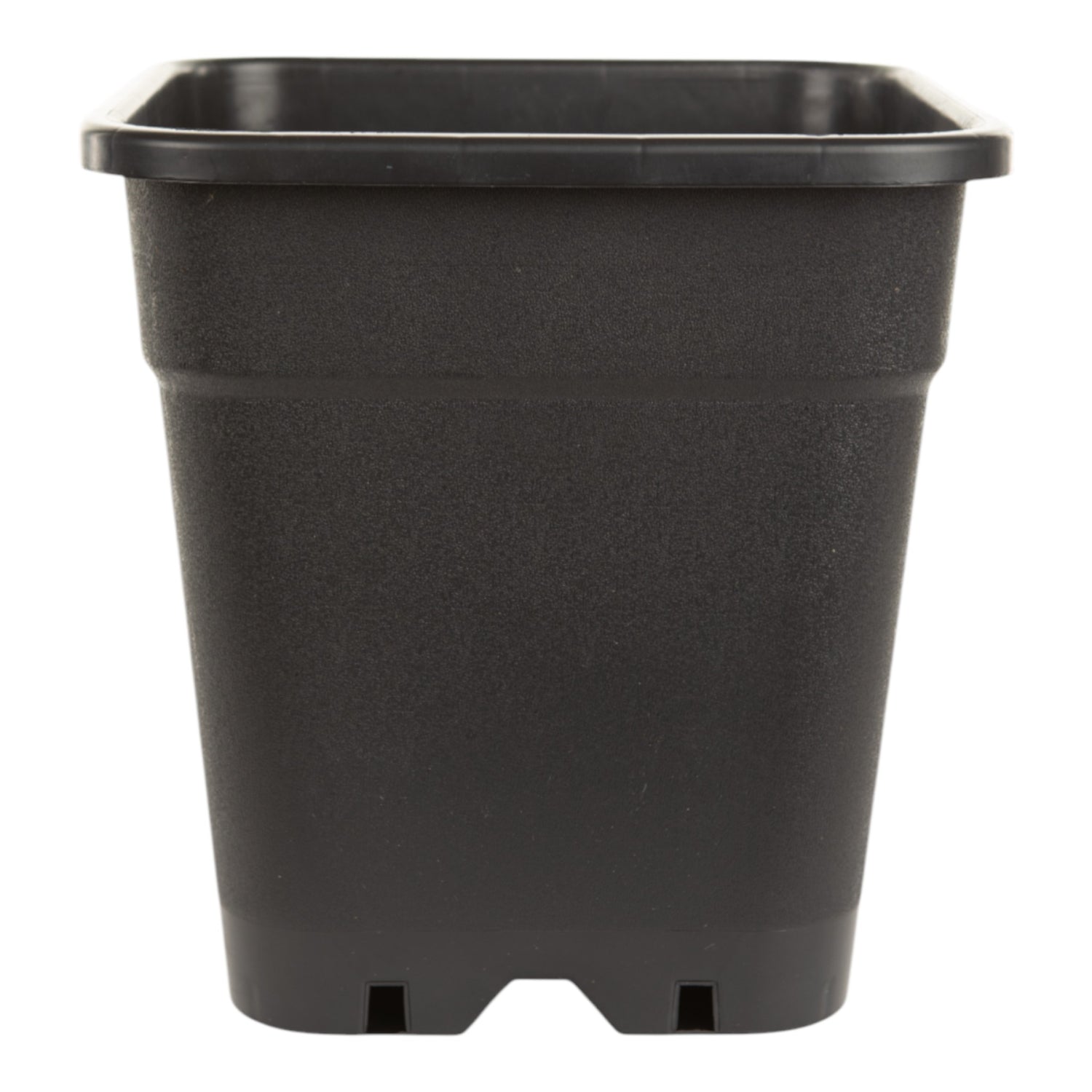
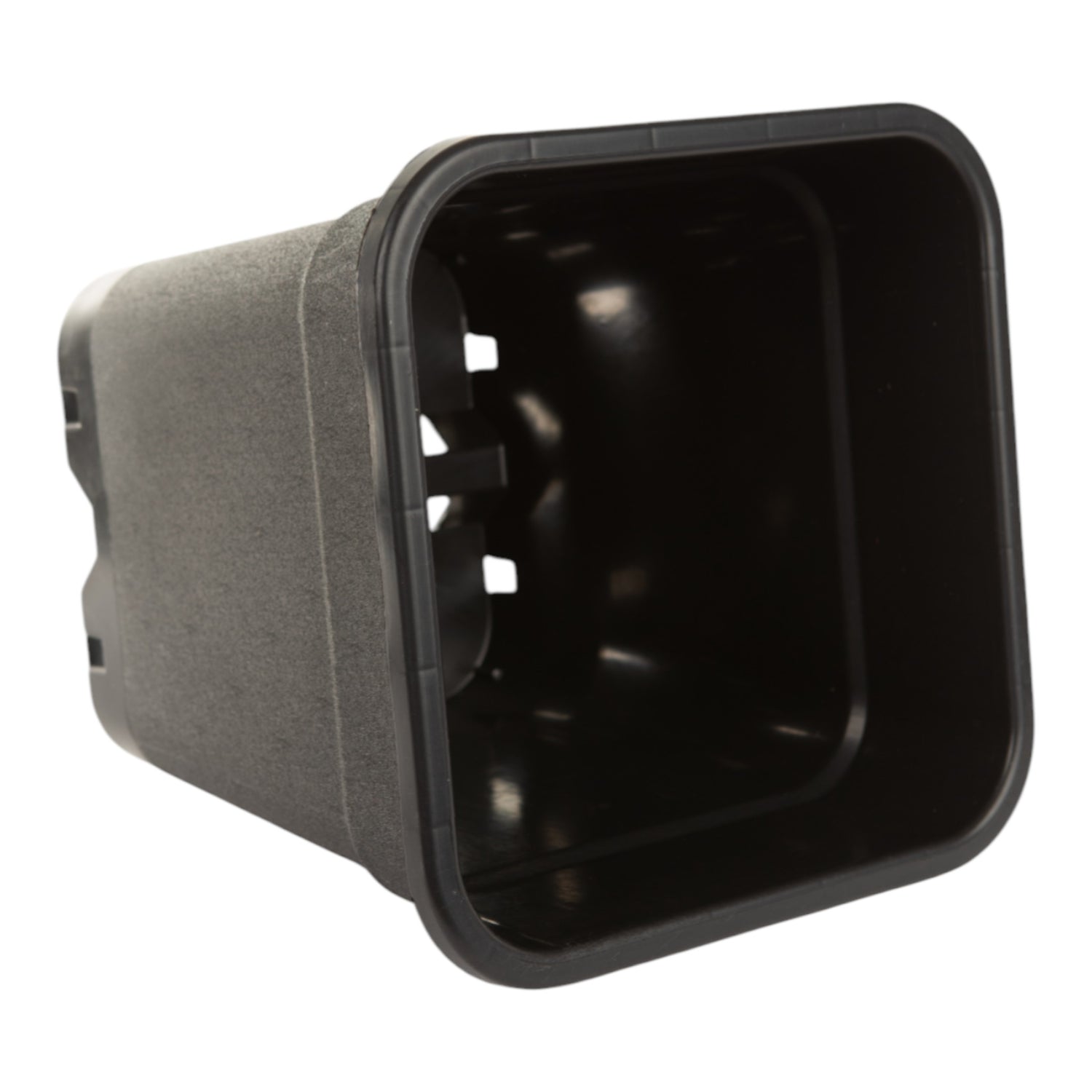
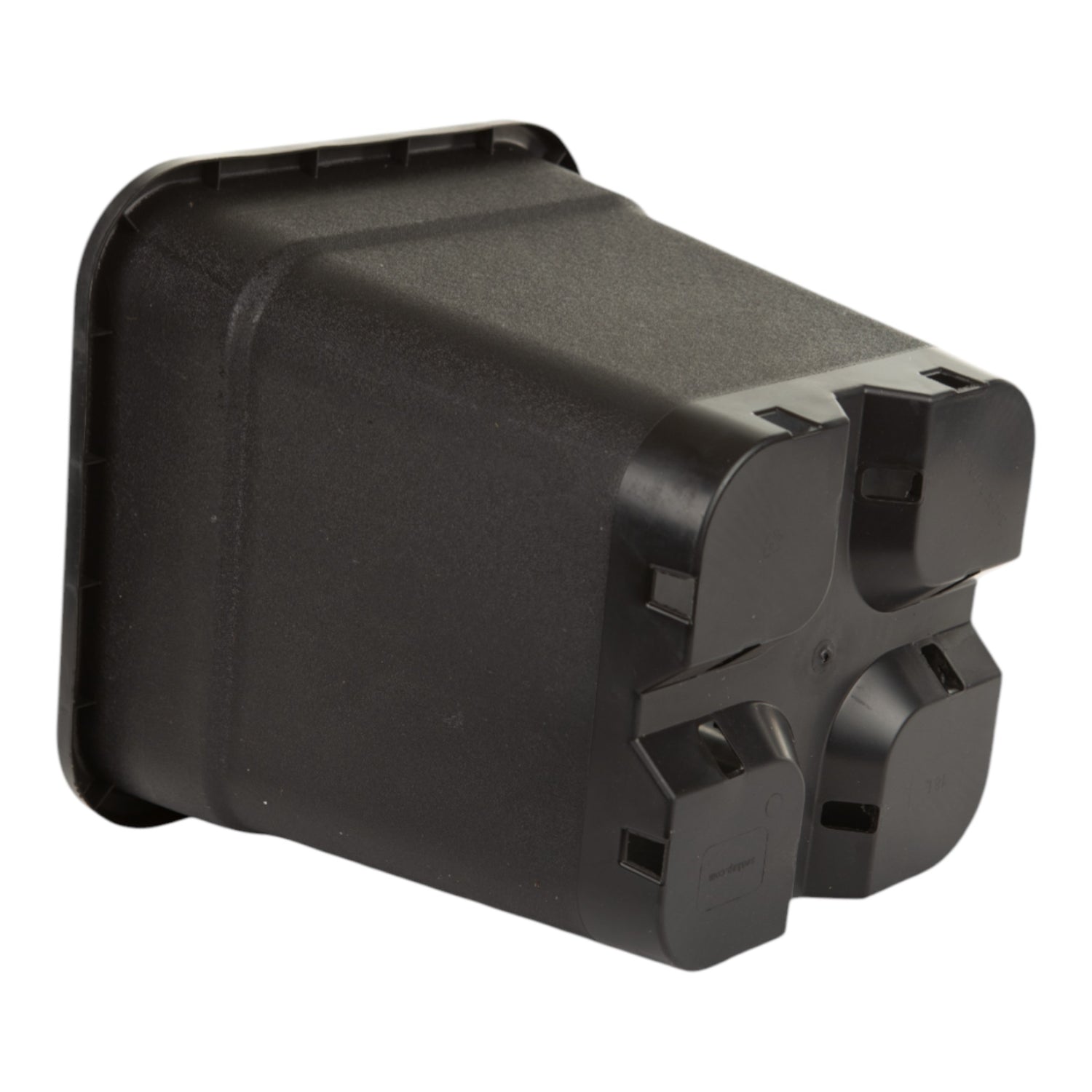
The 18L Square Pot is a professional growing container designed for professional container production where efficient bench or floor spacing is useful.
The 18L format provides substantial root volume for crops that need more space than standard nursery pots, while the container style is intended for repeated handling through production, spacing, irrigation and dispatch.
Sold individually.
Key benefits
Efficient container production
The 18L square format is useful where growers want to organise crops efficiently across benches, beds or standing areas. Square pots can reduce unused gaps between adjacent containers compared with equivalent round formats.
Match the container volume to the crop and production period, allowing adequate root space without creating an excessively wet or slow-drying root zone.
Choosing the growing medium
Use a professional growing medium appropriate to the crop, container size and irrigation system. Larger pots need a substrate with enough structure to maintain air-filled porosity and drainage throughout the production period while retaining sufficient available moisture.
Avoid excessive compaction during filling. Settle the medium consistently and leave suitable watering space at the top of the container.
Irrigation & root-zone management
Container size has a major effect on drying behaviour. Check moisture through the root zone rather than judging only the surface, and adjust irrigation frequency and volume as crop size, weather and rooting increase.
Ensure drainage points remain clear and avoid leaving containers standing in prolonged saturation unless the crop and production system are specifically designed for it.
Handling, spacing & stability
Position larger pots on a stable, well-drained growing surface and allow sufficient spacing for crop development and access. Consider wind exposure as top-heavy trees and shrubs develop.
Filled containers can be substantially heavier than their nominal litre capacity suggests. Use appropriate lifting and handling methods, particularly with the larger sizes in this range.
Reuse & crop hygiene
Where pots remain serviceable, they may be reused subject to the nursery's crop-hygiene requirements. Remove old substrate and plant material, inspect the container for damage and clean or disinfect as appropriate before the next crop cycle.
18L Square Pot product details
| Product type | Square Nursery Pot |
|---|---|
| Nominal capacity | 18L |
| Selling quantity | 1 pot |
| Primary application | professional container production where efficient bench or floor spacing is useful |
18L Square Pot FAQs
Is this nursery pot sold individually?
Yes. The selling unit is one pot. What capacity is this pot?
The stated nominal capacity is 18L. What is this pot suitable for?
It is intended for professional container production where efficient bench or floor spacing is useful. What growing medium should I use?
Use a professional substrate appropriate to the crop, container size and irrigation system, with suitable structure, drainage, aeration and moisture retention. How should larger pots be watered?
Check moisture through the root zone and adjust irrigation to crop size, rooting, weather and substrate behaviour rather than relying on a fixed timetable. Can the pot be reused?
Yes where it remains serviceable and nursery hygiene requirements are met. Remove old substrate and clean appropriately before reuse. What should I consider when moving a filled pot?
A filled and watered container can be very heavy. Use appropriate manual-handling methods or mechanical assistance where required. How do I choose between pot sizes?
Match container volume to crop vigour, root development, production period and intended finished-plant size.
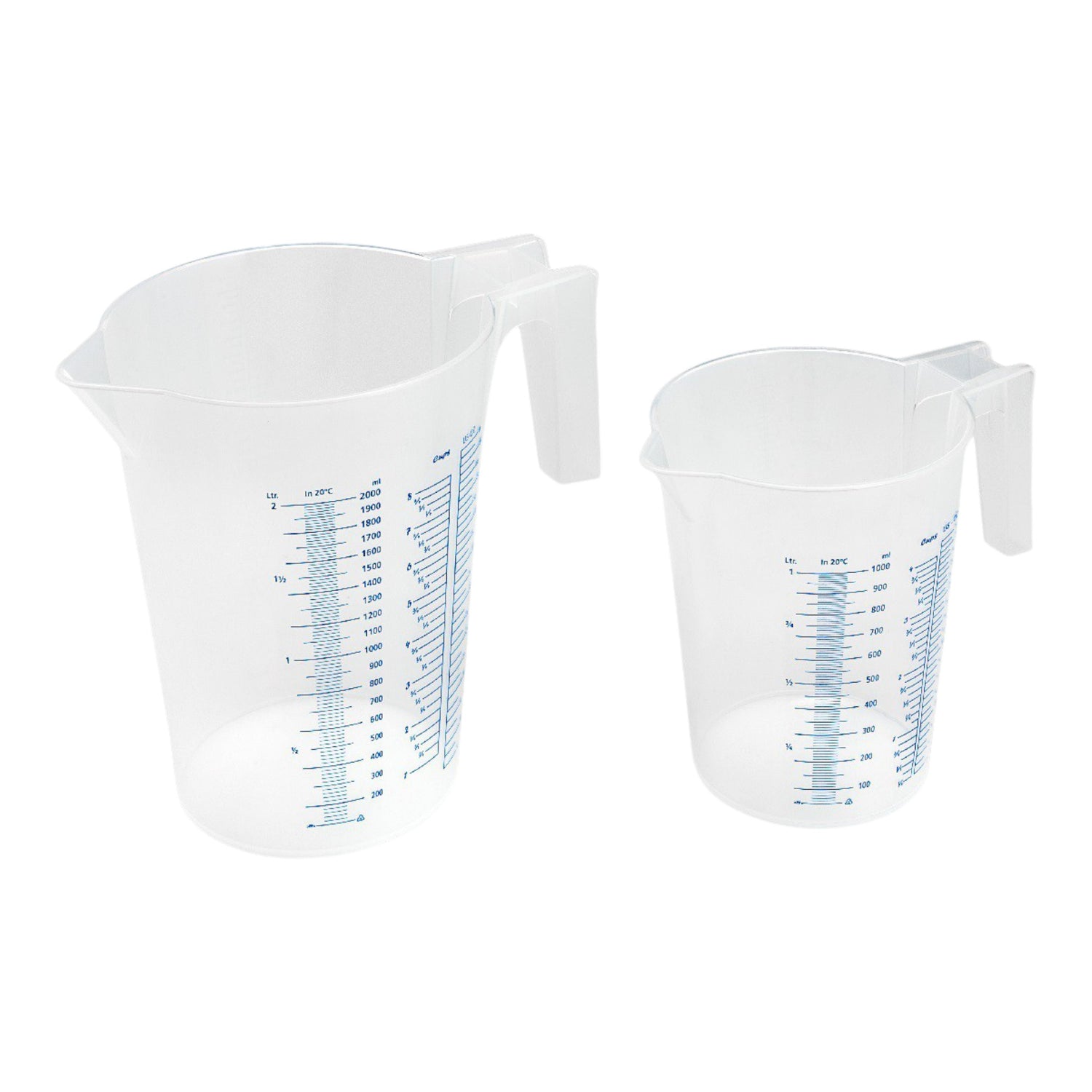
The 1L Measuring Jug is designed for measuring suitable horticultural liquids and concentrates.
Accurate measuring helps improve repeatability when preparing feeds, additives or other suitable horticultural liquids.
Key benefits
Repeatable liquid measurement
Place the jug on a level surface and read the graduation at eye level where practical. Use a jug size appropriate to the volume being measured so small additions are not estimated from an unnecessarily large vessel.
Rinse between incompatible products to avoid cross-contamination and use separate measuring equipment where product instructions or site procedures require it.
Good working practice
Keep equipment and materials clean and clearly identified. Follow the instructions for any fertiliser, additive or treatment being prepared and use appropriate PPE where required by the product label or workplace assessment.
Storage & maintenance
Store the product clean, dry and protected from damage. Electronic meters should be maintained according to their manufacturer instructions; measuring equipment should be replaced if markings or condition no longer allow reliable use.
1L Measuring Jug product details
| Product | 1L Measuring Jug |
|---|---|
| Product type | Measuring Jug |
| Primary use | measuring suitable horticultural liquids and concentrates |
| Stated size / capacity | 1L |
1L Measuring Jug FAQs
What is this product used for?
Measuring suitable horticultural liquids and concentrates. How should it be used?
Follow the product instructions and use it only for compatible horticultural applications. How should it be stored?
Keep it clean, dry and protected from physical damage or contamination. Should equipment be cleaned between uses?
Yes where appropriate, particularly when moving between different solutions or materials. Can one measurement represent every part of a crop or growing area?
Not necessarily. Use representative sampling where conditions may vary. When should the product be replaced?
Replace damaged equipment or material that can no longer be used reliably for its intended purpose. Does this replace crop-specific guidance?
No. Use measurements or growing-media components alongside the requirements of the crop and production system. What should I do if a reading or result looks wrong?
Repeat the measurement or check the equipment and method before making significant adjustments.

The 1L Round Plant Pot is a compact black horticultural grow pot designed for propagation, potting-on, nursery production and general plant cultivation. Measuring approximately 13cm across the upper rim, 9.5cm across the base and 11.5cm high, it provides a practical 1 litre root volume for young plants that have outgrown plugs, cells and smaller propagation pots.
One litre pots are widely used by professional growers as an early growing-on container. They provide developing root systems with additional substrate volume while maintaining a compact footprint that allows large numbers of plants to be accommodated efficiently on nursery and greenhouse benches.
The traditional tapered round design makes plants straightforward to handle and allows empty pots to nest together for efficient storage. A pronounced upper rim adds rigidity and provides a convenient point for lifting and moving the container.
Drainage openings in the base allow excess irrigation water to escape, helping maintain the balance of moisture and oxygen required around developing roots.
Suitable for peat-based and peat-free compost, soil, coco coir and other horticultural growing media, the 1L Round Pot is useful for commercial nurseries, propagation facilities, greenhouse production and home growing.
Why choose the 1L Round Plant Pot?
Ideal for growing-on young plants
The 1L pot occupies an important position between propagation containers and larger nursery pots.
Once seedlings, cuttings and young plants have developed a healthy root system in their initial propagation container, moving into approximately one litre of fresh growing medium provides additional room for continued root and shoot development.
Progressive potting can also make irrigation easier to manage. Placing a very small root system directly into a much larger container can leave a significant volume of unrooted substrate wet for longer periods.
For many compact plants, herbs and nursery crops, 1L may also be a useful finishing or retail size. More vigorous plants can subsequently be moved into 2L, 3L or larger containers as required.
1L Round Pot dimensions
The pot measures approximately 13cm across the upper rim, 9.5cm across the base and 11.5cm high.
These compact dimensions provide useful growing-medium volume while allowing growers to maintain efficient plant density across benches, beds and propagation areas.
The tapered sides allow empty pots to nest inside one another, reducing storage and transport space between production runs.
What can you grow in a 1L pot?
One litre pots are suitable for establishing and growing-on a broad range of young horticultural crops, including:
Whether a 1L pot can be used as the final container depends on the plant species and intended finished size. Larger and more vigorous plants will normally require additional root volume as they develop.
Suitable growing media
The 1L Round Plant Pot can be used with a wide range of horticultural substrates, including:
Select a growing medium appropriate for the crop and stage of development. Young plants generally benefit from a substrate that combines reliable moisture retention with sufficient air-filled porosity for healthy root growth.
Drainage & irrigation
Pre-formed drainage openings in the base allow excess irrigation water to leave the pot rather than accumulating around the lower root zone.
This is particularly important in small containers because the entire substrate volume can become wet quickly. Healthy root development depends on maintaining both adequate moisture and oxygen within the growing medium.
The pot can be used with hand watering, overhead nursery irrigation, drip irrigation and other suitable watering systems.
Irrigation frequency should be based on the crop, root development, substrate and environmental conditions rather than following a fixed schedule.
Fits the 14cm Pot Saucer
The 1L Round Plant Pot is compatible with the 14cm Pot Saucer, product code P00047.
The matching saucer measures approximately 17cm across the rim, 14cm across the base and 2cm high.
This provides a useful option when the pot is used indoors or on protected surfaces where irrigation runoff needs to be contained.
The same 14cm saucer can also accommodate compatible pots with a slightly larger upper diameter because saucer compatibility is primarily determined by the footprint at the base of the pot.
Made for efficient nursery production
The compact 1L format is particularly useful for commercial growers because large numbers of young plants can be maintained within a relatively small production area.
Plants remain lightweight and straightforward to move, grade, space and irrigate while still having considerably more growing-medium volume than they would in a propagation cell or small starter pot.
The simple black horticultural finish also provides a clean presentation when plants are supplied directly to retailers, landscapers or end users.
When should you pot on from a 1L pot?
Plants should be moved into a larger container according to root development and crop requirements rather than after a fixed number of weeks.
A well-established root system throughout the existing growing medium, increasingly rapid drying or vigorous top growth relative to the pot can all indicate that additional root volume may be beneficial.
Where the 1L container is being used as an intermediate stage, moving into an appropriately sized 2L, 3L or larger pot allows the root system to continue developing while maintaining manageable moisture conditions.
Practical & reusable
Pots that remain in good condition can be emptied, cleaned and reused for subsequent crops.
Remove old substrate and root debris before cleaning. Where pots are being reused between crops, appropriate hygiene procedures can help reduce the risk of transferring pests or plant pathogens.
The tapered design allows empty pots to nest together for compact storage.
1L Round Plant Pot product details
| Product | Round Plant Pot |
|---|---|
| Nominal capacity | 1L |
| Shape | Round |
| Colour | Black |
| Upper rim diameter | Approximately 13cm |
| Base diameter | Approximately 9.5cm |
| Height | Approximately 11.5cm |
| Drainage | Pre-formed base drainage openings |
| Suitable media | Soil, compost, peat-free media, coco & compatible horticultural substrates |
| Suitable environments | Nurseries, propagation areas, greenhouses, polytunnels, indoor growing & outdoor cultivation |
| Typical applications | Young plants, rooted cuttings, herbs, perennials, bedding plants, vegetables, ornamentals & nursery stock |
| Compatible saucer | 14cm Pot Saucer - product code P00047 |
| Compatible saucer dimensions | Rim 17cm x base 14cm x height 2cm |
| Reusable | Yes, when cleaned and maintained appropriately |
1L Round Plant Pot FAQs
What are the dimensions of the 1L Round Pot?
The pot measures approximately 13cm across the upper rim, 9.5cm across the base and 11.5cm high.
What can I grow in a 1L plant pot?
One litre pots are suitable for young perennials, herbs, bedding plants, rooted cuttings, strawberries, young vegetables, ornamentals and many other nursery crops.
Is a 1L pot suitable for growing-on seedlings and cuttings?
Yes. Once seedlings or rooted cuttings have established sufficiently in their propagation container, a 1L pot can provide a useful next stage with additional room for root development.
Can I grow herbs in a 1L pot?
Yes. Many herbs can be grown or supplied in 1L pots. Vigorous or long-term plants may eventually benefit from a larger container.
Can I grow chillies in a 1L pot?
A 1L pot is useful for establishing young chilli and pepper plants. Most vigorous plants will normally benefit from potting-on into a larger final container as they develop.
Can I use coco coir in the 1L Round Pot?
Yes. Coco coir and coco-based mixes can be used in the pot. Irrigation should be adjusted to the crop and the drainage characteristics of the substrate.
Can I use peat-free compost?
Yes. The 1L pot is suitable for peat-free growing media as well as conventional compost, soil-based mixes, coco and other suitable horticultural substrates.
Does the 1L Round Pot have drainage holes?
Yes. Pre-formed drainage openings in the base allow excess irrigation water to leave the growing medium.
Which saucer fits the 1L Round Pot?
The compatible option is the 14cm Pot Saucer, product code P00047. The saucer measures approximately 17cm across the rim, 14cm across the base and 2cm high.
Why does a 13cm pot fit a 14cm saucer?
Saucer compatibility is determined primarily by the footprint of the pot rather than its widest upper rim. The 1L pot has an approximately 9.5cm base, allowing it to sit comfortably within the 14cm saucer.
Is the 1L pot suitable for professional nursery production?
Yes. The compact size is useful for growing-on young nursery plants while maintaining efficient plant density across production areas.
Can this pot be used outdoors?
Yes. It can be used outdoors as well as in greenhouses, polytunnels, propagation areas and indoor growing environments.
Can the 1L pot be reused?
Yes. Pots that remain in good condition can be emptied, cleaned and reused. Appropriate crop hygiene is recommended between uses.
When should I move a plant from a 1L to a larger pot?
Pot on when the root system has established well through the existing growing medium and the plant requires additional root volume. Increasingly rapid drying between irrigations can also indicate that a larger container may be appropriate.
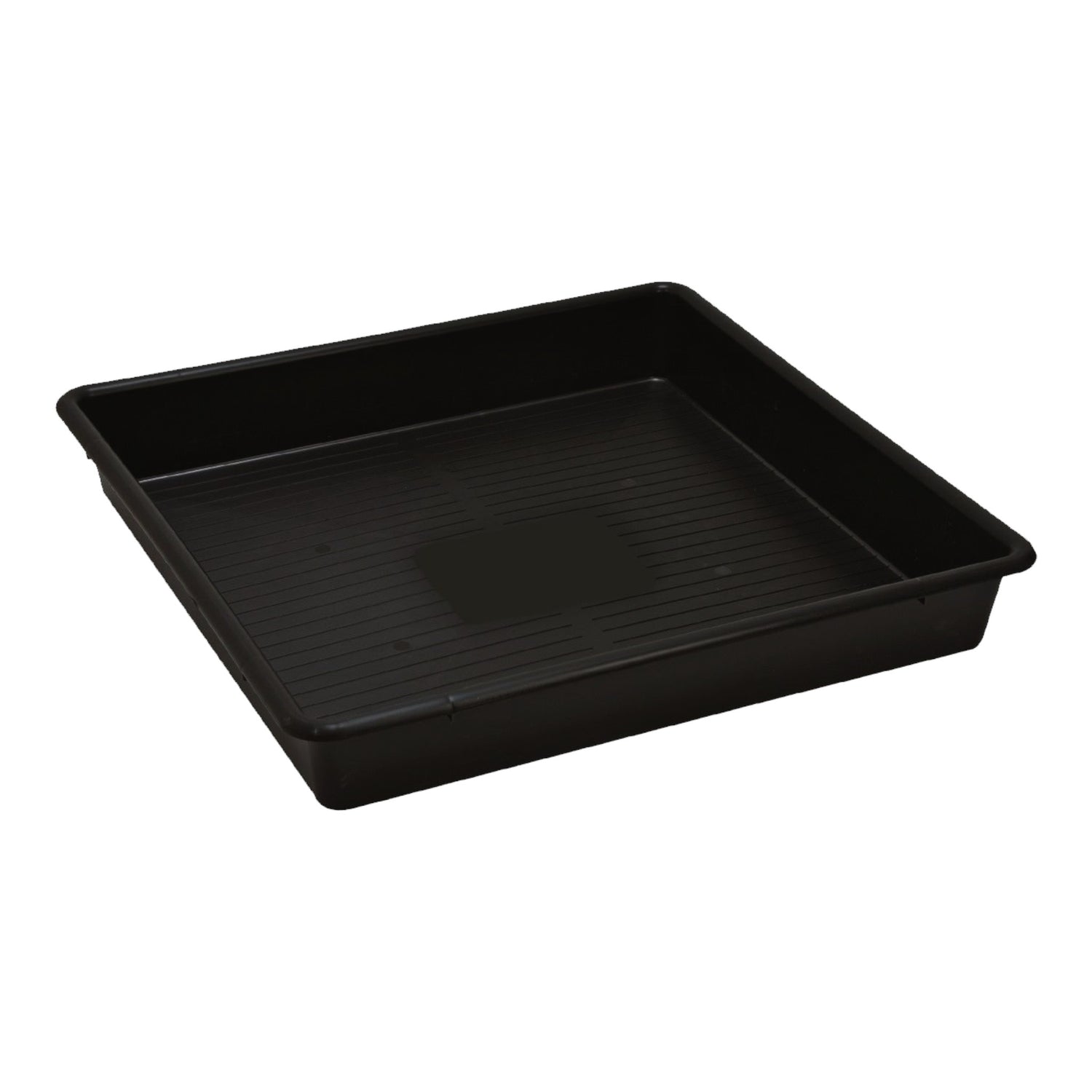
£16.95
Unit price per£16.95
Unit price perThe 1m x 1m Square Plastic Garden Tray provides a large, contained area for grouping pots, planters and propagation trays while helping to control water and keep growing areas tidy. With no drainage holes, it can be used as a large drip tray or for bottom watering suitable container-grown plants.
Its generous 100cm x 100cm footprint makes it particularly useful where several pots need to be managed together. Rather than placing individual saucers beneath multiple containers, the entire group can be positioned within one large tray.
The tray can be used in greenhouses, nurseries, propagation areas and other horticultural growing spaces. It is also useful beneath groups of pots where catching irrigation run-off and protecting the surrounding growing area are the main priorities.
Why choose the 1m x 1m Square Plastic Tray?
Ideal for bottom watering groups of plants
Because the tray is manufactured without drainage holes, it can be used for bottom watering suitable container-grown plants. Water is added to the tray and taken up through drainage holes in the individual plant pots.
Bottom watering can be particularly convenient where several plants need to be watered together. Instead of applying water separately to the surface of every pot, compatible containers can be grouped within the tray and allowed to absorb water from below.
The amount of water and the length of time pots are left standing in it should always be appropriate for the crop, container and growing medium. Excess water should not be left around plants that require free-draining conditions.
Contain irrigation run-off and spills
The tray is equally useful where its primary purpose is simply to catch drainage from pots. Water draining from several containers can be retained within the tray rather than spreading immediately across the surrounding floor or growing surface.
This makes a large tray particularly useful beneath groups of plants that are regularly hand watered. It can also make the growing area easier to organise by defining a clear space for container-grown plants and their associated irrigation run-off.
Suitable for nurseries, greenhouses & propagation areas
With a full square metre of tray area, this is a useful general-purpose piece of growing equipment for both professional and domestic horticulture.
| Nurseries | Useful for grouping batches of container-grown plants within a defined watering area. |
|---|---|
| Greenhouses | Provides a large contained area for pots, planters and smaller propagation trays. |
| Propagation | Can accommodate groups of smaller pots and trays where controlled watering is required. |
| Bottom watering | No drainage holes allow water to be retained for suitable pots to absorb from below. |
| Run-off collection | Helps contain water draining from pots during irrigation. |
1m x 1m Square Plastic Tray product details
| Product | Square Plastic Garden Tray |
|---|---|
| Product type | Large plant watering & drip tray |
| Length | 1m |
| Width | 1m |
| Tray area | 1m² |
| Material | Plastic |
| Drainage holes | None |
| Suitable for | Pots, planters, propagation trays, bottom watering & irrigation run-off collection |
| Primary application | Plant watering, grouping containers & containing drainage |
1m x 1m Square Plastic Tray FAQs
What size is this plastic tray?
The tray has a 1m x 1m footprint, providing approximately one square metre of space for pots, planters and smaller plant trays. Does the tray have drainage holes?
No. This tray is designed without drainage holes, allowing it to retain irrigation water and run-off. Can I use the tray for bottom watering?
Yes. Suitable pots with drainage holes can be placed within the tray and allowed to absorb water from below. Watering should always be adjusted to the requirements of the plants and growing medium. Can it be used underneath several plant pots?
Yes. Its large 1m x 1m area makes it particularly useful for grouping several pots together rather than using a separate saucer beneath every container. Will the tray catch water draining from pots?
Yes. With no drainage holes, it can collect water draining from containers and help prevent irrigation run-off spreading immediately across the surrounding growing area. Can I use propagation trays inside it?
Yes. The large square footprint can accommodate smaller propagation trays or groups of individual propagation pots, subject to their dimensions. Is this suitable for professional nursery use?
Yes. The tray is suitable for commercial growers and nurseries as well as greenhouse and general horticultural use. Should pots be left standing in water permanently?
Not necessarily. Watering should be managed according to the crop, growing medium and container. Plants that require freely drained root conditions should not be left standing in excess water for prolonged periods. Is a larger version available?
Yes. A larger 1.2m x 1.2m Square Plastic Tray is also available for growing areas requiring additional tray space.

£0.00
Unit price per£0.00
Unit price perThe 2" Irrigation Pressure Filter - 155 Mesh / 100 micron is a irrigation filter for compatible professional horticultural irrigation systems.
The stated filtration grade is 155 mesh / 100 micron. Filtration helps protect drippers, sprinklers, foggers and valves from suspended debris that can reduce flow or cause blockage.
Key benefits
Why irrigation filtration matters
Small emitter waterways are vulnerable to suspended particles. A correctly selected filter reduces the amount of debris reaching downstream equipment, helping maintain irrigation uniformity and reducing avoidable blockage.
The stated grade for this version is 155 mesh / 100 micron. Select filtration according to the water source and the requirements of the most restrictive downstream component.
Choosing filter grade
Mesh and micron figures describe filtration fineness in different ways. A finer filter is not automatically better if it creates excessive pressure loss or requires impractical cleaning frequency. Follow the irrigation-equipment requirements and account for water quality and expected flow.
Installation & pressure loss
Install the filter in the correct flow direction and orientation for the filter body. Allow access for inspection and cleaning. Pipework should be supported so its weight does not strain the filter connections.
As debris accumulates, pressure loss across the filter can increase. Monitor the system and clean the element before restriction begins to affect downstream irrigation performance.
Cleaning & maintenance
Depressurise the system before opening a filter housing. Remove the element carefully and clean it using a method appropriate to the element material and the contamination present. Inspect seals, screens and housing components before reassembly.
Replace damaged or permanently blocked elements rather than operating with compromised filtration.
Water quality & system management
Filtration is one part of irrigation maintenance. Source-water quality, line flushing, storage tanks and chemical or biological contamination can all influence system reliability. Maintain the complete water system rather than relying on the filter alone.
2" Irrigation Pressure Filter - 155 Mesh / 100 micron product details
| Product type | Pressure Filter |
|---|---|
| Stated size | 2" |
| Filtration grade | 155 mesh |
| Equivalent stated filtration | 100 micron |
| Colour | Yellow |
| Application | Professional horticultural irrigation |
2" Irrigation Pressure Filter - 155 Mesh / 100 micron FAQs
What filtration grade is stated?
This version is stated as 155 mesh / 100 micron. What is the filter used for?
It helps remove suspended debris before water reaches downstream irrigation equipment such as drippers, sprinklers, foggers and valves. How do I choose the right filtration grade?
Follow the requirements of the downstream irrigation equipment and consider water quality, flow demand and acceptable pressure loss. Does a finer filter always improve the system?
No. Excessively fine filtration can increase pressure loss and cleaning frequency if it is not appropriate to the water source and equipment. When should the filter be cleaned?
Inspect and clean it before accumulated debris causes unacceptable pressure loss or reduced downstream performance. Should the system be depressurised before opening the filter?
Yes. Safely isolate and depressurise the system before opening a filter housing. Can a damaged element be reused?
No. Replace damaged, distorted or persistently blocked filtration elements. Does filtration remove the need to flush irrigation lines?
No. Filtration and line flushing perform different roles and both may be required as part of system maintenance. How can I tell if the filter is restricting flow?
A growing pressure difference across the filter or reduced downstream performance can indicate that cleaning or inspection is required.

£0.00
Unit price per£0.00
Unit price perThe 2" Irrigation Pressure Filter - 75 Mesh / 200 micron is a irrigation filter for compatible professional horticultural irrigation systems.
The stated filtration grade is 75 mesh / 200 micron. Filtration helps protect drippers, sprinklers, foggers and valves from suspended debris that can reduce flow or cause blockage.
Key benefits
Why irrigation filtration matters
Small emitter waterways are vulnerable to suspended particles. A correctly selected filter reduces the amount of debris reaching downstream equipment, helping maintain irrigation uniformity and reducing avoidable blockage.
The stated grade for this version is 75 mesh / 200 micron. Select filtration according to the water source and the requirements of the most restrictive downstream component.
Choosing filter grade
Mesh and micron figures describe filtration fineness in different ways. A finer filter is not automatically better if it creates excessive pressure loss or requires impractical cleaning frequency. Follow the irrigation-equipment requirements and account for water quality and expected flow.
Installation & pressure loss
Install the filter in the correct flow direction and orientation for the filter body. Allow access for inspection and cleaning. Pipework should be supported so its weight does not strain the filter connections.
As debris accumulates, pressure loss across the filter can increase. Monitor the system and clean the element before restriction begins to affect downstream irrigation performance.
Cleaning & maintenance
Depressurise the system before opening a filter housing. Remove the element carefully and clean it using a method appropriate to the element material and the contamination present. Inspect seals, screens and housing components before reassembly.
Replace damaged or permanently blocked elements rather than operating with compromised filtration.
Water quality & system management
Filtration is one part of irrigation maintenance. Source-water quality, line flushing, storage tanks and chemical or biological contamination can all influence system reliability. Maintain the complete water system rather than relying on the filter alone.
2" Irrigation Pressure Filter - 75 Mesh / 200 micron product details
| Product type | Pressure Filter |
|---|---|
| Stated size | 2" |
| Filtration grade | 75 mesh |
| Equivalent stated filtration | 200 micron |
| Colour | White |
| Application | Professional horticultural irrigation |
2" Irrigation Pressure Filter - 75 Mesh / 200 micron FAQs
What filtration grade is stated?
This version is stated as 75 mesh / 200 micron. What is the filter used for?
It helps remove suspended debris before water reaches downstream irrigation equipment such as drippers, sprinklers, foggers and valves. How do I choose the right filtration grade?
Follow the requirements of the downstream irrigation equipment and consider water quality, flow demand and acceptable pressure loss. Does a finer filter always improve the system?
No. Excessively fine filtration can increase pressure loss and cleaning frequency if it is not appropriate to the water source and equipment. When should the filter be cleaned?
Inspect and clean it before accumulated debris causes unacceptable pressure loss or reduced downstream performance. Should the system be depressurised before opening the filter?
Yes. Safely isolate and depressurise the system before opening a filter housing. Can a damaged element be reused?
No. Replace damaged, distorted or persistently blocked filtration elements. Does filtration remove the need to flush irrigation lines?
No. Filtration and line flushing perform different roles and both may be required as part of system maintenance. How can I tell if the filter is restricting flow?
A growing pressure difference across the filter or reduced downstream performance can indicate that cleaning or inspection is required.
£285.16
Unit price per£285.16
Unit price perThe 2" Pressure-Regulating Control Valve - 0.8–6 bar - 24V AC is designed for automated control of compatible professional irrigation zones.
Solenoid and pressure-regulating valves allow irrigation sections to be opened, closed or controlled as part of a correctly designed nursery, greenhouse, landscape or horticultural water system.
Key benefits
Pressure regulation within irrigation zones
This valve is stated with a pressure-regulation range of 0.8–6 bar. Set and verify downstream pressure according to the requirements of the irrigation equipment and zone rather than assuming one pressure is suitable for every emitter or sprinkler.
Pressure regulation cannot compensate for an undersized water supply, excessive flow demand or unsuitable pipe sizing.
Electrical compatibility
Confirm controller output, solenoid type and wiring requirements before connection. Do not apply an assumed voltage simply because another valve in the same irrigation system uses it.
Electrical installation in wet horticultural environments should use suitable connections and protection and should be carried out in accordance with the applicable installation requirements.
Installation & commissioning
Flush upstream pipework before final commissioning where appropriate. Install the valve with adequate access for service, support connected pipework and avoid transferring pipe strain into the valve body.
Pressurise the system gradually, check for leakage and confirm that the valve opens and closes correctly under normal controller operation.
Flow, pressure & filtration
Valve performance depends on the complete hydraulic system. Available pressure, flow demand, pipe size, elevation and downstream equipment all influence operation. Use filtration appropriate to the water source and the irrigation components being protected.
Maintenance & fault finding
If a valve fails to open, close or regulate correctly, isolate the system safely and check controller output, wiring, solenoid condition, debris, diaphragm or internal components as appropriate to the valve design. Replace damaged parts rather than forcing manual operation.
2" Pressure-Regulating Control Valve - 0.8–6 bar - 24V AC product details
| Product type | Pressure-Regulating Control Valve |
|---|---|
| Valve size | 2" |
| Pressure-regulation range | 0.8–6 bar |
| Application | Professional irrigation-zone control |
2" Pressure-Regulating Control Valve - 0.8–6 bar - 24V AC FAQs
What size is this valve?
The stated valve size is 2". What is a solenoid irrigation valve used for?
It opens and closes an irrigation zone in response to a compatible electrical controller or switching system. What pressure range is stated?
The stated pressure-regulation range is 0.8–6 bar. Can I connect it to any irrigation controller?
No. Confirm the required solenoid voltage/type and controller output before connection. Does valve size alone determine how much water the zone can supply?
No. Available pressure, pipe sizing, valve characteristics, elevation and downstream flow demand all affect system performance. Should pipework be flushed before commissioning?
Yes where appropriate, to reduce the risk of installation debris entering the valve or downstream irrigation equipment. Is filtration important?
Yes. Suitable filtration can reduce debris-related problems in valves and downstream emitters. How should the valve be installed?
Follow the correct flow direction, support connected pipework and leave adequate access for servicing. What should I check if the valve will not open or close?
Safely check controller output, wiring, solenoid operation, water supply and internal contamination or damage as appropriate. Should the valve be leak-tested after installation?
Yes. Pressurise the system gradually and inspect the valve and connections before routine operation.
£259.31
Unit price per£259.31
Unit price perThe 2" Pressure-Regulating Solenoid Valve - 0.8–6 bar - 24V AC is designed for automated control of compatible professional irrigation zones.
Solenoid and pressure-regulating valves allow irrigation sections to be opened, closed or controlled as part of a correctly designed nursery, greenhouse, landscape or horticultural water system.
Key benefits
Pressure regulation within irrigation zones
This valve is stated with a pressure-regulation range of 0.8–6 bar. Set and verify downstream pressure according to the requirements of the irrigation equipment and zone rather than assuming one pressure is suitable for every emitter or sprinkler.
Pressure regulation cannot compensate for an undersized water supply, excessive flow demand or unsuitable pipe sizing.
Electrical compatibility
The stated electrical designation for this version is 24V AC. Confirm controller output, solenoid type and wiring requirements before connection. Do not apply an assumed voltage simply because another valve in the same irrigation system uses it.
Electrical installation in wet horticultural environments should use suitable connections and protection and should be carried out in accordance with the applicable installation requirements.
Installation & commissioning
Flush upstream pipework before final commissioning where appropriate. Install the valve with adequate access for service, support connected pipework and avoid transferring pipe strain into the valve body.
Pressurise the system gradually, check for leakage and confirm that the valve opens and closes correctly under normal controller operation.
Flow, pressure & filtration
Valve performance depends on the complete hydraulic system. Available pressure, flow demand, pipe size, elevation and downstream equipment all influence operation. Use filtration appropriate to the water source and the irrigation components being protected.
Maintenance & fault finding
If a valve fails to open, close or regulate correctly, isolate the system safely and check controller output, wiring, solenoid condition, debris, diaphragm or internal components as appropriate to the valve design. Replace damaged parts rather than forcing manual operation.
2" Pressure-Regulating Solenoid Valve - 0.8–6 bar - 24V AC product details
| Product type | Pressure-Regulating Solenoid Valve |
|---|---|
| Valve size | 2" |
| Electrical designation | 24V AC |
| Pressure-regulation range | 0.8–6 bar |
| Application | Professional irrigation-zone control |
2" Pressure-Regulating Solenoid Valve - 0.8–6 bar - 24V AC FAQs
What size is this valve?
The stated valve size is 2". What is a solenoid irrigation valve used for?
It opens and closes an irrigation zone in response to a compatible electrical controller or switching system. What pressure range is stated?
The stated pressure-regulation range is 0.8–6 bar. Can I connect it to any irrigation controller?
No. Confirm the required solenoid voltage/type and controller output before connection. Does valve size alone determine how much water the zone can supply?
No. Available pressure, pipe sizing, valve characteristics, elevation and downstream flow demand all affect system performance. Should pipework be flushed before commissioning?
Yes where appropriate, to reduce the risk of installation debris entering the valve or downstream irrigation equipment. Is filtration important?
Yes. Suitable filtration can reduce debris-related problems in valves and downstream emitters. How should the valve be installed?
Follow the correct flow direction, support connected pipework and leave adequate access for servicing. What should I check if the valve will not open or close?
Safely check controller output, wiring, solenoid operation, water supply and internal contamination or damage as appropriate. Should the valve be leak-tested after installation?
Yes. Pressurise the system gradually and inspect the valve and connections before routine operation.
The 2.5mm Galvanised Wire 25kg (approx 650M) is a practical horticultural wire designed for plant training and support.
It is suited to routine horticultural work in nurseries, greenhouses, garden centres and gardens where a straightforward accessory is required.
Key benefits
How to use it
Use this product for plant training and support. Select the size and format to suit the plant, container or growing area and check its position periodically as plants develop.
When supporting stems, avoid fastening so tightly that growth is restricted. Check ties and supports during the season and adjust them as stems thicken.
For professional & garden use
This accessory can be used for individual plants and displays or incorporated into larger nursery, landscaping and retail programmes.
2.5mm Galvanised Wire 25kg (approx 650M) product details
| Supplier | Creation Horticulture |
|---|---|
| Product type | Horticultural wire |
| Stated size | 2.5mm |
| Primary use | plant training and support |
2.5mm Galvanised Wire 25kg (approx 650M) FAQs
What size is this product?
The stated size is 2.5mm. What is this product used for?
It is designed for plant training and support. Can it be used on young plants?
Yes, where the size and support method are appropriate. Leave enough room for stems to expand and check the support as the plant grows. How tightly should plants be secured?
Secure plants firmly enough for support but not so tightly that stems are pinched or restricted. Should supports be checked during the season?
Yes. Adjust ties, clips and supports as plants grow and replace anything that has become damaged or restrictive.
The 2.5mm Galvanised Wire 5kg (approx 130M) is a practical horticultural wire designed for plant training and support.
It is suited to routine horticultural work in nurseries, greenhouses, garden centres and gardens where a straightforward accessory is required.
Key benefits
How to use it
Use this product for plant training and support. Select the size and format to suit the plant, container or growing area and check its position periodically as plants develop.
When supporting stems, avoid fastening so tightly that growth is restricted. Check ties and supports during the season and adjust them as stems thicken.
For professional & garden use
This accessory can be used for individual plants and displays or incorporated into larger nursery, landscaping and retail programmes.
2.5mm Galvanised Wire 5kg (approx 130M) product details
| Supplier | Creation Horticulture |
|---|---|
| Product type | Horticultural wire |
| Stated size | 2.5mm |
| Primary use | plant training and support |
2.5mm Galvanised Wire 5kg (approx 130M) FAQs
What size is this product?
The stated size is 2.5mm. What is this product used for?
It is designed for plant training and support. Can it be used on young plants?
Yes, where the size and support method are appropriate. Leave enough room for stems to expand and check the support as the plant grows. How tightly should plants be secured?
Secure plants firmly enough for support but not so tightly that stems are pinched or restricted. Should supports be checked during the season?
Yes. Adjust ties, clips and supports as plants grow and replace anything that has become damaged or restrictive.

£85.00
Unit price per£85.00
Unit price perThe 20 Way + 4 + Heater MDF Lighting Timer Board is a high-capacity centralised power and lighting control system featuring 20 timed lighting sockets, 4 constant auxiliary sockets and a dedicated heater connection.
Designed for larger professional lighting installations, the board brings multiple lighting outputs and supporting environmental equipment together on a single organised, wall-mounted MDF control board.
The 20 timed sockets allow multiple compatible lighting systems to follow the same automatic schedule, while 4 constant auxiliary sockets provide continuous power for compatible equipment such as extraction and circulation fans.
A separate heater connection provides additional flexibility for environmental management, making this configuration particularly useful where lighting, ventilation and heating equipment need to be managed from one central location.
Why choose the 20 Way MDF Lighting Timer Board?
20 timed sockets for large lighting installations
The main section of the board provides 20 timed UK sockets. These allow compatible lighting equipment to be connected to a central switching system rather than relying on numerous separate plug-in timers.
The integrated contactor system handles the switching function, allowing the timer to control the lighting schedule without the lighting load passing directly through the timer contacts.
This type of arrangement is particularly valuable with larger lighting installations, where simultaneous switching can place substantial demands on ordinary domestic timing equipment.
The actual lighting equipment connected to the board must be suitable for the electrical supply and installation. Total circuit loading should be calculated as part of the electrical design rather than assuming that every socket can automatically be operated at a particular wattage.
4 constant auxiliary sockets for fans & equipment
In addition to the 20 timed lighting outlets, the board provides 4 constant auxiliary sockets.
These outlets are useful for compatible equipment that needs to remain powered independently of the lighting schedule. Typical applications include extraction fans, intake fans, circulation equipment and environmental control devices.
Separating constant-power equipment from the timed lighting circuit means ventilation can continue operating when the lighting switches off, where that is required by the environmental control strategy.
Dedicated heater connection
This version of the MDF timer board also includes a dedicated heater connection, distinguishing it from standard lighting and auxiliary-only configurations.
Heating can be particularly useful during lights-off periods, when the heat generated by horticultural lighting is no longer contributing to the growing environment.
The heater outlet provides a convenient connection point for compatible heating equipment as part of the overall installation. The electrical requirements and control method of the specific heater should always be checked before connection.
Why use a contactor timer board?
Switching a large number of lighting systems is very different from controlling a single low-load appliance. Lighting equipment can produce significant starting loads, particularly with HID and other ballast-based systems.
A contactor allows the timer to control the switching operation while the contactor itself handles the larger electrical load. This is a much more appropriate architecture for multi-light installations than attempting to place the complete lighting load through an ordinary plug-in timer.
Bringing the timer, contactor system and socket outlets together on one board also creates a cleaner and more manageable installation, making connections easier to identify and access.
Professional fixed installation
A 20-way timer board is a substantial piece of electrical distribution and control equipment and should be treated accordingly.
The board should be securely mounted in a suitable dry location with sufficient access for operation, inspection and maintenance. It should be protected from irrigation water, spray, condensation and other sources of moisture.
The electrical supply, protective devices, cable sizing, circuit arrangement and total connected load must all be appropriate for the installation.
Installation and electrical supply arrangements should be assessed and completed by a suitably qualified electrician.
20 Way + 4 + Heater MDF Lighting Timer Board product details
| Product type | MDF lighting contactor and timer board |
|---|---|
| Timed lighting sockets | 20 |
| Auxiliary sockets | 4 constant-power sockets |
| Heater connection | 1 dedicated heater connection |
| Board specification | 100A |
| Lighting control | Integrated timer and contactor switching |
| Auxiliary operation | Constant power, independent of the lighting timer |
| Mounting format | MDF board |
| Approximate dimensions | 60cm x 41cm x 13.5cm |
| Typical application | Large multi-light horticultural installations with associated ventilation and heating equipment |
| Outer case quantity | 4 boards |
20 Way MDF Lighting Timer Board FAQs
What does 20 Way + 4 + Heater mean?
The board provides 20 timed lighting sockets, 4 constant auxiliary sockets and a separate connection for compatible heating equipment. What is the difference between the timed and auxiliary sockets?
The 20 lighting sockets operate according to the timer schedule. The 4 auxiliary sockets provide constant power, making them useful for compatible equipment that needs to continue operating independently of the lighting cycle. Why does a large lighting installation need a contactor?
A contactor provides heavy-duty electrical switching for the connected lighting circuits. The timer controls the contactor rather than carrying the complete lighting load through its own switching contacts. Can the auxiliary sockets be used for extraction fans?
Yes. Compatible extraction, intake and circulation fans are typical applications for constant-power auxiliary sockets because they can remain powered when the timed lighting circuit switches off. Does the heater socket switch off with the lights?
The heater connection is separate from the main bank of timed lighting sockets. The operating arrangement should be checked against the board configuration and the requirements of the heating equipment during installation. Can I use all 20 lighting sockets at the same time?
The number and type of lights that can operate simultaneously depends on their electrical characteristics, the board specification and the electrical supply. Total connected load should be assessed as part of the installation rather than determined by socket count alone. Can this timer board be used with LED lighting?
It can be used with compatible lighting equipment where the electrical characteristics of the fixtures, drivers and switching system are suitable. The connected load and any starting or inrush current should be considered when specifying the installation. Where should an MDF lighting timer board be mounted?
It should be securely mounted in a suitable dry location, protected from irrigation water, spray and excessive moisture while remaining accessible for operation, inspection and maintenance. Does a 100A board mean I can automatically draw 100A from the mains?
No. The 100A figure is the board specification and does not determine what the premises electrical supply can provide. Available supply capacity, circuit protection, cabling and connected load must all be assessed for the individual installation. Does this need to be installed by an electrician?
A high-capacity multi-way lighting control board requires an appropriately designed electrical supply and protection. Installation and supply requirements should be assessed and completed by a suitably qualified electrician. Why use one central timer board instead of multiple extension leads?
A purpose-designed timer board centralises lighting control, contactor switching and auxiliary connections in one organised installation. It is designed for multi-light control rather than building a large system from numerous independent domestic extension leads and timers. How many 20 Way + 4 + Heater timer boards are in an outer case?
The outer case quantity is 4 boards.

20 way plastic airline manifold for distributing one larger air supply across multiple air stones, air curtains and aeration points.
This 20 Way Plastic Airline Manifold provides a straightforward way to divide the output from a larger air pump or compressor across multiple airline runs. With 20 separate outlets available, it is particularly useful for larger hydroponic systems where numerous reservoirs, pots or air stones require aeration.
Bringing multiple airline feeds together at one central manifold helps keep larger aeration systems organised and avoids the need for a separate pump outlet for every air stone.
The manifold can be used with compatible 4mm airline to supply air stones and air curtains throughout a growing system. It can also be used to distribute nutrient solution in suitable NFT installations.
Why use a 20 Way Airline Manifold?
What is a 20 way airline manifold used for?
A 20 way manifold is designed for larger systems where a single high-output air pump or compressor needs to supply numerous aeration points. The incoming supply enters the manifold and is divided between 20 individual outlets.
Individual airline runs can then be routed to air stones, air curtains or other compatible aeration equipment positioned throughout the growing system.
This makes the manifold particularly useful for multi-pot hydroponic installations, larger nutrient reservoirs and systems containing several separate tanks or growing modules.
How to use the 20 Way Plastic Airline Manifold
Connect the manifold inlet to a suitable main supply from your air pump or compressor. Attach compatible 4mm airline to the required outlets and route each line to its air stone, air curtain or other aeration device.
When running a large number of outlets, the connected air pump needs sufficient output to supply the complete system. Air delivery at each point will depend on pump performance, the number of outlets being used, airline length and the resistance created by the connected air stones or diffusers.
Keep airline routes as tidy and direct as practical, avoiding unnecessary kinks or restrictions that could reduce airflow.
Product details
| Product type | Air / nutrient distribution manifold |
|---|---|
| Number of outlets | 20 |
| Outlet size | 4mm |
| Configuration | 20 way distribution manifold |
| Construction | Plastic |
| Primary application | Splitting airline from a larger air pump or compressor |
| Suitable accessories | Compatible airline, air stones & air curtains |
| Typical uses | Hydroponic aeration, reservoirs, multi-pot systems, DWC & suitable NFT systems |
20 Way Plastic Airline Manifold FAQs
What does a 20 way airline manifold do?
It divides one larger air supply between up to 20 individual airline runs, allowing multiple air stones or other aeration devices to operate from a suitable air pump or compressor.
How many air stones can I connect to the manifold?
The manifold provides 20 outlets, allowing up to 20 individual airline runs. The number of air stones that can operate effectively will depend on the output of the connected air pump and the requirements of the aeration equipment.
What size airline fits the outlets?
The manifold uses 4mm outlets for connecting compatible airline to air stones, air curtains and other aeration accessories.
Can I use this manifold with a hydroponic air pump?
Yes. It is designed to split the supply from a suitable larger air pump or compressor across multiple airline feeds.
Can the manifold be used with air stones and air curtains?
Yes. It can distribute air through individual airline runs to compatible air stones, air curtains and similar aeration equipment.
Is a 20 way manifold suitable for DWC?
Yes. It is particularly useful for larger DWC installations where one suitably sized air pump needs to supply multiple buckets, reservoirs or air stones.
Can this manifold distribute nutrient solution?
Yes. This style of plastic manifold can also be used to distribute nutrient solution in suitable NFT systems.
Does the manifold have individual airflow controls?
No. This is a simple plastic distribution manifold rather than a valved manifold, so the individual outlets do not have built-in airflow adjustment controls.
Do I need a larger air pump for a 20 way manifold?
A pump needs sufficient output for the number of outlets and aeration devices being operated. Running 20 air stones will require considerably more air than using only a few outlets, so the pump should be sized for the complete installation.
£2.75
Unit price per£2.75
Unit price perThe 200mm (8") Fast Clamp provides a strong, secure and vibration-reducing connection between compatible circular ventilation components such as inline fans, filters and rigid duct fittings.
Rather than joining two pieces of ventilation equipment with a short section of flexible ducting, a Fast Clamp fits around adjoining circular spigots to create a neat mechanical connection. This makes it particularly useful when installing fans directly alongside filters, silencers and other compatible ventilation equipment.
The metal outer band provides a strong connection, while the cushioned inner lining helps isolate vibration between connected components. Reducing the direct transfer of fan vibration into adjoining ductwork can help reduce structure-borne noise within a ventilation system.
The clamp can also be released when equipment needs to be removed, making it a practical choice for installations where fans, filters or other components require periodic inspection, cleaning or servicing.
Why use a 200mm Fast Clamp?
Connecting fans, filters and ventilation equipment
Fast Clamps are particularly useful where two compatible pieces of circular ventilation equipment need to be connected directly together. A common application is joining an inline extraction fan to a compatible filter, although they can also be used with suitable rigid circular ducting and other ventilation components.
The cushioned inner lining sits between the outer clamp and the connected components. This helps create a secure connection while reducing the direct transmission of vibration from operating equipment into adjoining parts of the ventilation system.
This makes the 200mm Fast Clamp useful in propagation facilities, nurseries, growing areas, controlled environments and general ventilation installations where both secure connections and vibration management are important.
How to install a 200mm Fast Clamp
Position the two compatible 200mm circular components together so that their connection points are correctly aligned. Open or loosen the Fast Clamp sufficiently to position it evenly around the joint.
Make sure the cushioned inner lining sits correctly around the connection before tightening the clamp. Tighten the fixings evenly until the components are held securely in position.
Avoid excessive tightening beyond what is required to produce a secure connection. Fans, filters and other substantial ventilation equipment should be independently supported rather than relying on the Fast Clamp to carry their weight.
200mm (8") Fast Clamp product details
| Product type | Anti-vibration ventilation Fast Clamp |
|---|---|
| Nominal connection size | 200mm / 8" |
| Outer construction | Metal clamping band |
| Inner construction | Cushioned anti-vibration lining |
| Primary purpose | Connecting compatible circular ventilation components |
| Vibration control | Inner lining helps reduce vibration transfer between connected components |
| Typical connections | Fans, filters, rigid circular ductwork & compatible ventilation fittings |
| Maintenance | Removable connection allows compatible equipment to be disconnected for servicing or cleaning |
| Suitable applications | Controlled environment, propagation, nursery, growing area & general ventilation systems |
200mm (8") Fast Clamp FAQs
What is a ventilation Fast Clamp?
A Fast Clamp is a mechanical connector designed to securely join compatible circular ventilation components while its cushioned inner lining helps isolate vibration between them. What size is this Fast Clamp?
This model is designed for compatible ventilation components with a nominal 200mm / 8" circular connection. Can I use it to connect a fan to a filter?
Yes. Connecting compatible fans and filters is one of the common applications for this type of Fast Clamp. Can it connect a fan directly to rigid ducting?
Yes, provided the components have compatible nominal 200mm circular connections suitable for this type of clamp. Does a Fast Clamp reduce vibration?
Yes. The cushioned inner lining helps isolate vibration rather than allowing it to transfer directly from an operating fan into adjoining ductwork or equipment. Can reducing vibration make a ventilation system quieter?
It can help. Mechanical vibration transferred from a fan into ductwork can contribute to system noise, so isolating the connection can help reduce this source of transmitted noise. Is the Fast Clamp made from metal?
Yes. The Fast Clamp uses a strong metal outer clamping band together with a cushioned inner lining. Can the Fast Clamp be removed again?
Yes. The mechanical connection can be released, making it useful where equipment needs to be disconnected for inspection, cleaning or servicing. Is a Fast Clamp suitable for a direct fan-to-filter connection?
Yes, where the fan and filter have compatible 200mm circular connections and both components are correctly supported. Can I use this with 200mm ventilation equipment?
It is intended for compatible nominal 200mm circular connections. Check the connection size and arrangement of the components being joined before installation. Does the Fast Clamp support the weight of a fan or filter?
No. Fans, filters and other substantial ventilation equipment should be properly and independently supported. The Fast Clamp secures the connection rather than acting as the primary equipment support. Why use a Fast Clamp instead of flexible ducting between components?
Where two compatible circular components are positioned directly together, a Fast Clamp provides a compact mechanical connection while also helping isolate vibration between the components. Where can a 200mm Fast Clamp be used?
It is suitable for compatible circular ventilation systems in controlled environments, propagation facilities, nurseries, growing areas and other commercial or general ventilation applications.

£0.49
Unit price per£0.49
Unit price per200mm (8") Quick Release Ducting Clip provides a strong, secure and removable connection for compatible 200mm round ventilation ducting, fans, filters and fittings.
A secure duct connection is important for maintaining an efficient ventilation system. Loose connections can allow ducting to move, create unwanted air leakage and make servicing more difficult. This adjustable metal clip fits around the outside of the duct and tightens securely around the connection point.
The quick-release design is particularly useful where ventilation equipment may need to be disconnected for cleaning, maintenance or replacement. Rather than permanently fixing the ductwork, the clip can be released and refitted when access is required.
Sized for 200mm / 8" ventilation systems, it is suitable for connecting compatible flexible ducting and acoustic ducting to fans, carbon filters, rigid fittings and other round ventilation components.
Why choose a quick release ducting clip?
Secure 200mm ventilation connections
Quick release ducting clips are designed to create a reliable mechanical connection between flexible ducting and round ventilation equipment.
They are particularly useful in indoor horticultural ventilation systems where fans, filters and ductwork may need periodic inspection, cleaning or replacement.
The clip can be used around the flexible inner section of acoustic ducting or around compatible standard flexible ducting, securing it to an appropriately sized spigot or connector.
How to fit a quick release ducting clip
Position the ducting over the compatible 200mm connection and place the clip around the outside of the duct. Make sure sufficient ducting overlaps the connection before tightening the clip.
Tighten the band until the duct is held securely. The connection should be firm without unnecessarily crushing or damaging the ducting.
Where a particularly airtight connection is required, suitable HVAC foil tape can also be used in conjunction with the mechanical fixing.
When equipment needs to be removed, release the clip, disconnect the duct and refit the clip when the system is reassembled.
What can a 200mm ducting clip be used with?
Always check the actual outside diameter of the connection and the required clamping range before installation, particularly when combining components from different manufacturers.
200mm (8") Quick Release Ducting Clip product details
| Product type | Quick release ventilation ducting clip |
|---|---|
| Nominal size | 200mm / 8" |
| Construction | Metal band clamp |
| Fastening type | Adjustable quick-release fastening |
| Primary purpose | Securing ducting to compatible round ventilation connections |
| Suitable ducting | Compatible flexible & acoustic ventilation ducting |
| Suitable equipment | Fans, carbon filters, connectors & compatible round ventilation fittings |
| Outer case quantity | 100 clips |
200mm (8") Quick Release Ducting Clip FAQs
What is a quick release ducting clip?
It is an adjustable metal band clamp used to secure flexible ducting around a compatible round ventilation connection. What size ventilation system is this clip for?
This version is intended for compatible nominal 200mm / 8" ventilation connections. Can I use this with flexible ducting?
Yes. It is designed for securing compatible flexible ventilation ducting to round fans, filters, connectors and fittings. Can it be used with acoustic ducting?
Yes. It can be used to secure the flexible duct section of compatible 200mm acoustic ducting to an appropriately sized connection. Can I use it to connect ducting to an extraction fan?
Yes, provided the fan connection and ducting are compatible with the clip's 200mm nominal size. Can it secure ducting to a carbon filter?
Yes. It is suitable for compatible 200mm carbon filter connections. Why use a ducting clip instead of tape?
A ducting clip provides a mechanical fixing around the connection and can be released when equipment needs servicing. Foil tape can still be added where additional air sealing is required. Is the ducting clip reusable?
Yes. The quick-release fastening allows the clip to be opened and refitted when ventilation components need to be disconnected. How tight should the clip be?
It should be tightened sufficiently to hold the duct securely without unnecessarily crushing or damaging the ducting or connection. Does a ducting clip help prevent air leaks?
A secure mechanical connection helps keep ducting firmly seated on the fitting. Where additional sealing is required, suitable HVAC foil tape can be used alongside the clip. Can it be used on intake and extraction systems?
Yes. The clip can be used on compatible duct connections in both intake and extraction ventilation systems. Is this suitable for horticultural ventilation systems?
Yes. It is suitable for compatible ventilation installations used in propagation areas, indoor growing areas and other controlled horticultural environments. Can it connect two pieces of ducting directly together?
A suitable duct connector or coupler is normally placed between the two duct sections, with a separate clip securing the duct at each end. Should I check the connection diameter before ordering?
Yes. Check the nominal and actual connection dimensions of your fan, filter or fitting, particularly when combining ventilation equipment from different manufacturers.


£13.50
Unit price per£13.50
Unit price perThe 200mm Galvanised Steel Tee Piece is a rigid round ducting fitting designed to create a 90-degree branch within 200mm ventilation, extraction and air-distribution systems.
Featuring three 200mm circular connections, the tee provides a simple way to split a main ventilation duct into two routes or combine separate duct runs into a common line.
Its galvanised steel construction creates a strong and stable junction within the duct system. Unlike an improvised flexible-duct connection, the rigid tee maintains a defined airflow path while providing secure connection points for adjoining 200mm ductwork.
The 200mm diameter makes this fitting particularly useful for medium to high-airflow systems in grow rooms, horticultural environments, workshops, warehouses and general ventilation installations.
Why choose a 200mm galvanised tee piece?
What is a 200mm ventilation tee used for?
A tee piece creates a three-way junction within a round ventilation system. The straight section continues the main duct run while the perpendicular connection introduces an additional branch.
Depending on the direction of airflow, this allows one main airflow to be divided between two duct routes or separate branches to be combined into a common duct.
This makes a 200mm tee useful when one ventilation system needs to serve different areas, when several extraction points need to be connected or when air needs to be distributed through multiple duct routes.
200mm ducting for grow rooms & horticulture
Indoor growing environments require effective air exchange to help remove excess heat and humidity. Larger grow rooms and higher-output ventilation systems often use larger diameter ductwork to accommodate the required airflow.
A 200mm tee can be incorporated into these systems to create separate intake or extraction branches, connect multiple ventilation points or build a more comprehensive air-distribution network.
It can be used alongside compatible 200mm inline fans, carbon filters, silencers and ducting to construct a complete ventilation system.
Rigid galvanised steel construction
Flexible ducting is convenient for routing air between ventilation components, but rigid metal fittings are particularly useful at junctions and direction changes.
The galvanised steel body maintains its shape and provides defined circular connection points for adjoining ductwork. This helps create a stable and tidy junction within the ventilation system.
Rigid fittings are particularly useful in permanent and semi-permanent installations where ductwork needs to be securely supported and connected.
Installing a 200mm ducting tee
Plan the complete duct route before installation and determine whether the tee will be used to divide one airflow into two branches or combine multiple branches into a single line.
Connect compatible 200mm ducting or fittings to each opening and secure the connections using a suitable method. Flexible ducting can typically be held in position with appropriately sized duct clips or clamps.
Where air leakage needs to be minimised, seal the connections using suitable HVAC foil tape or another appropriate ventilation sealing product.
Ensure surrounding ductwork is adequately supported so that excessive weight is not transferred to the tee or connected ventilation equipment.
Understanding airflow through a tee piece
Airflow does not necessarily divide equally when a ventilation system is branched. Air naturally follows the route presenting the least resistance.
A short and relatively straight branch may therefore carry more airflow than a longer branch containing several bends, a carbon filter, silencer or other restrictive components.
Where balanced airflow is important, suitable dampers can be installed within the branches to provide additional control.
Building an efficient 200mm ventilation system
The airflow delivered by a ventilation fan is affected by the resistance of the complete system. Duct length, bends, filters, silencers, reducers and junctions can all reduce the airflow achieved compared with the fan's unrestricted rating.
Keeping duct runs reasonably short and avoiding unnecessary bends can help reduce pressure losses. Where several branches are connected to one fan, the fan should be selected according to the requirements of the complete system.
A correctly planned system can provide effective air movement while avoiding unnecessary restrictions and excessive fan loading.
Compatible 200mm ventilation equipment
The tee piece can form part of a complete 200mm round ventilation system and can be used alongside appropriately sized components including:
Always check the actual connection dimensions and fitting method of adjoining components before installation.
200mm Galvanised Tee Piece product details
| Product | Round Ventilation Tee Piece |
|---|---|
| Nominal diameter | 200mm |
| Number of connections | 3 |
| Branch angle | 90 degrees |
| Material | Galvanised steel |
| Shape | Round |
| Fitting type | Tee / three-way duct junction |
| Primary use | Branching, combining or distributing airflow in round ventilation systems |
| Airflow application | Extraction & intake ventilation systems |
| Suitable applications | Grow rooms, horticultural environments, workshops, warehouses & general ventilation installations |
200mm Galvanised Tee Piece FAQs
What is a 200mm ducting tee used for?
It creates a three-way junction within a 200mm round ventilation system, allowing airflow to be divided between branches or combined into a common duct run. What size ducting fits this tee piece?
It is designed for nominal 200mm round ventilation systems. Check the dimensions and connection style of adjoining equipment before installation. Is the branch at 90 degrees?
Yes. The side branch is positioned perpendicular to the main straight duct path to create a conventional tee junction. What is the 200mm tee piece made from?
It is manufactured from galvanised steel, providing a rigid and durable fitting for ventilation ductwork. Can I connect flexible ducting to the tee?
Yes. Compatible 200mm flexible ventilation ducting can be connected and secured using suitable duct clips or clamps. Can I use it with rigid ducting?
Yes. The fitting can be incorporated into a compatible 200mm rigid round ducting system using the appropriate connection method. Can this tee be used with an extraction fan?
Yes. It can be used to create branches or combine duct runs within a correctly designed 200mm extraction system. Can the tee be used for air intake?
Yes. It is also suitable for compatible air-intake and supply-air ducting systems. Will both branches receive the same airflow?
Not necessarily. The airflow through each branch depends on its resistance, including duct length, bends, filters, silencers and other components. Can I balance airflow between the branches?
Yes. Suitable ventilation dampers can be added where more precise control of airflow through individual branches is required. Should I seal the connections?
Where reducing air leakage is important, secure the joints correctly and seal them using suitable HVAC foil tape or another appropriate ventilation sealing method. Can this tee be used with a 200mm carbon filter?
Yes. It can form part of a ventilation system containing a compatible 200mm carbon filter, provided the overall system is correctly designed. Can one fan extract through two branches?
Yes, provided the fan has sufficient capacity for the resistance and airflow requirements of the complete branched system. Airflow balancing may also be required. Is 200mm ducting suitable for grow rooms?
Yes. 200mm ducting is commonly used in medium and larger indoor ventilation systems where higher airflow is required than smaller duct diameters can conveniently provide.

£16.99
Unit price per£16.99
Unit price per203mm (8") x 10m Acoustic Ducting is an insulated flexible ventilation duct designed to help reduce noise transmission while moving air through extraction and intake systems.
Ventilation fans generate both mechanical noise and sound from the movement of air. Standard uninsulated ducting can allow this noise to travel along the ventilation route, while acoustic ducting uses an insulating layer around the inner duct to help absorb transmitted sound.
This makes acoustic ducting particularly useful for indoor horticulture and controlled growing environments where extraction equipment may operate for long periods and keeping fan and airflow noise under control is important.
Supplied in a generous 10 metre length with a nominal 203mm / 8" diameter, it can be used with compatible fans, carbon filters and ventilation fittings. The flexible construction allows it to be routed around equipment and cut into the exact lengths required for the installation.
Why choose 203mm acoustic ducting?
How does acoustic ducting work?
A ventilation system can produce noise from several sources. The fan motor itself creates sound, while fast-moving air can generate additional noise and turbulence as it passes through the ducting.
Acoustic ducting incorporates an insulating layer around the flexible inner air passage. This insulation helps absorb sound energy that would otherwise travel along the ductwork, reducing the amount of ventilation noise transmitted through the system.
It can be particularly useful close to an extraction fan, between a fan and carbon filter, and along longer sections of duct where transmitted noise would otherwise be noticeable.
Acoustic ducting is designed to reduce noise rather than make a ventilation system completely silent. Fan design, fan speed, airflow, vibration and the layout of the ductwork will all affect the overall noise level.
Ideal for horticultural extraction systems
Effective ventilation is essential for managing temperature, humidity and air exchange in indoor horticultural environments. However, moving large quantities of air can make extraction systems one of the main sources of environmental-control noise.
Replacing basic uninsulated ducting with acoustic ducting can help control the amount of sound transmitted through the ventilation route while still providing a flexible connection between compatible components.
The 203mm / 8" size is suitable for appropriately sized medium to high-capacity ventilation systems using compatible inline fans, carbon filters and duct fittings.
The 10m length is particularly useful for larger growing areas, longer ventilation routes or installations requiring several individual sections of acoustic ducting.
Getting the best airflow from acoustic ducting
Correct duct installation is important for maintaining ventilation performance. Flexible ducting should be extended sufficiently rather than left heavily compressed, as excessive compression creates a less efficient internal airflow path.
Keep the duct route as short and direct as practical. Tight bends, crushed sections and unnecessary changes in direction increase resistance and can reduce the effective airflow delivered by the extraction fan.
Where a change of direction is required, use a gradual bend wherever possible. Although 10 metres of ducting is supplied, there is no requirement to use the complete length in one continuous run.
Cutting each section to the length actually required can help minimise unnecessary airflow resistance while leaving the remaining duct available for other parts of the ventilation installation.
Installing 203mm acoustic ducting
Before installation, confirm that the fan, carbon filter and other ventilation components have compatible nominal 203mm / 8" connections.
Fit the flexible inner duct securely over the connection and fasten it using a suitable duct clamp or fixing. HVAC foil tape can also be used where additional sealing is required.
Arrange the surrounding insulation and outer covering neatly around the joint so that the acoustic layer remains as continuous as practical.
Longer sections of ducting should be supported appropriately rather than allowing their full weight to hang directly from a fan, carbon filter or other ventilation component.
Compatible ventilation equipment
Check the actual connection diameter of individual ventilation components before installation, as dimensions can vary slightly between manufacturers.
203mm (8") x 10m Acoustic Ducting product details
| Product type | Insulated acoustic flexible ducting |
|---|---|
| Nominal diameter | 203mm / 8" |
| Length | 10m |
| Duct type | Flexible |
| Construction | Acoustically insulated flexible ventilation duct |
| Primary purpose | Air movement with reduced transmission of ventilation noise |
| Suitable airflow | Extraction & intake |
| Compatible system size | Nominal 203mm / 8" round ventilation systems |
| Suitable applications | Indoor horticulture, propagation areas, controlled growing environments & compatible ventilation installations |
203mm (8") Acoustic Ducting FAQs
What is acoustic ducting?
Acoustic ducting is insulated flexible ventilation duct designed to help absorb and reduce sound transmitted through an extraction or intake system. What size is this acoustic duct?
This version has a nominal 203mm / 8" diameter and is supplied in a 10 metre length. Is this suitable for an 8-inch extraction fan?
Yes, provided the fan has a compatible nominal 203mm / 8" duct connection. Can I use it with an 8-inch carbon filter?
Yes. It can be used to connect compatible 203mm / 8" carbon filters and extraction fans as part of an appropriately sized ventilation system. Does acoustic ducting reduce fan noise?
It helps reduce fan and airflow sound transmitted along the ductwork. It does not eliminate noise produced directly by the fan itself. Is acoustic ducting quieter than ordinary ducting?
Its insulating layer is specifically intended to absorb transmitted sound, making it useful where noise reduction is a priority. Can acoustic ducting be used for horticultural extraction?
Yes. It is well suited to indoor horticultural extraction systems where temperature, humidity and air exchange need to be managed while keeping ventilation noise under control. Can it also be used for air intake?
Yes. Acoustic ducting can be incorporated into compatible intake as well as extraction systems. Can I cut the 10m length?
Yes. The duct can be cut to suit the required ventilation route or divided into several shorter sections. Do I need to use the full 10 metres?
No. Use only the amount required for the installation. Keeping duct routes reasonably short and direct generally helps minimise unnecessary airflow resistance. Should flexible acoustic ducting be fully extended?
It should be extended sufficiently for the installation rather than left unnecessarily compressed. This helps create a smoother internal path for airflow. Do bends reduce airflow?
Yes. Tight bends increase resistance and turbulence, so gradual changes in direction are preferable wherever possible. Does a longer duct run affect extraction performance?
Every length of duct introduces some resistance. Longer runs, multiple bends and additional fittings can therefore reduce the effective airflow of a ventilation system. How should a long run of acoustic ducting be supported?
Longer runs should be supported at suitable intervals so that the weight of the duct is not carried entirely by the fan, filter or connecting fittings. How can horticultural ventilation noise be reduced further?
Correct fan sizing, sensible duct routing, vibration isolation, suitable fan-speed control and ventilation silencers can be combined with acoustic ducting to create a quieter overall system.
£27.50
Unit price per£27.50
Unit price per203mm (8") x 10m Mute Silent Ducting is an acoustically insulated flexible ventilation duct designed to help reduce the noise transmitted through extraction and intake systems.
Ventilation fans create more than just motor noise. Air movement, turbulence and vibration can all travel through standard ducting, making an otherwise effective extraction system noticeably louder. Acoustic ducting helps tackle this by surrounding the inner airflow path with an insulating layer that absorbs and reduces transmitted sound.
With a 203mm (8") internal duct diameter and 10m length, this ducting is particularly suited to medium and high-airflow ventilation systems used in grow rooms, indoor horticulture, workshops and other environments where reducing ventilation noise is important.
Its flexible construction also makes installation considerably easier than rigid ductwork where the ventilation route needs to negotiate equipment, corners or structural obstacles.
Why choose 203mm acoustic silent ducting?
How does acoustic ducting reduce noise?
A ventilation system can transmit sound along the same route used to move air. Fan noise and turbulence can travel through ordinary thin-walled ducting and emerge from the opposite end of the system.
Acoustic ducting is constructed differently. An inner flexible airflow duct is surrounded by sound-absorbing insulation and an outer protective layer. The insulation helps absorb some of the sound energy travelling through the duct rather than allowing it to transmit as readily along the ventilation run.
This makes insulated ducting particularly useful immediately before or after an extraction fan, between a fan and carbon filter, or along sections of ductwork where ventilation noise would otherwise be noticeable.
Reducing grow room extraction noise
For the quietest practical ventilation system, noise control should be considered throughout the complete installation rather than relying on one component alone.
Acoustic ducting can help reduce noise transmitted through the ductwork, while fan speed control, acoustic silencers, correctly sized ducting and vibration isolation can address other sources of sound.
Using adequately sized ducting is particularly important. Forcing a large volume of air through undersized ductwork increases air velocity and turbulence, which can make the ventilation system considerably noisier.
Ideal for grow rooms & indoor horticulture
Extraction is essential in many indoor growing environments, but larger fans can create significant noise when operating continuously.
203mm acoustic ducting provides a practical option for installations where 8-inch ventilation equipment is required but keeping the system quieter is also a priority.
It can be used with compatible extraction fans, carbon filters, silencers and other 203mm ventilation components to create a complete air-management system.
Installing 203mm silent ducting
Route the ducting as directly as practical between the ventilation components. Avoid unnecessary tight bends, excessive compression and long sections of heavily sagging duct, as these can increase resistance and turbulence.
When connecting the ducting to a fan, filter, silencer or metal fitting, secure the inner duct correctly to the connection and use a suitable duct clamp or clip. The outer insulated section can then be positioned neatly around the joint.
Where minimising air leakage is important, suitable HVAC foil tape can be used as part of the connection and sealing process.
Support longer duct runs at suitable intervals rather than allowing the weight of the ducting to hang directly from the fan, filter or other ventilation equipment.
Get the best airflow from flexible ducting
Flexible ducting works best when it is installed with unnecessary compression kept to a minimum. Extending the duct sufficiently helps reduce deep internal folds that can increase resistance to airflow.
Keep the route as short and straight as the installation allows. Every bend, restriction and additional length of duct contributes to the resistance the extraction fan must overcome.
Where a sharp 90-degree direction change is required, a compatible rigid metal elbow may provide a cleaner airflow route than forcing flexible ducting around an extremely tight corner.
Compatible 203mm / 8" ventilation equipment
The ducting is intended for compatible nominal 203mm (8") round ventilation systems and can be used alongside appropriately sized components such as:
Always check the actual connection diameter of adjoining equipment before installation, particularly where equipment is described using both metric and imperial sizes.
203mm (8") x 10m Mute Silent Ducting product details
| Product type | Acoustic insulated flexible ventilation ducting |
|---|---|
| Nominal diameter | 203mm / 8" |
| Length | 10m |
| Duct type | Flexible |
| Construction | Insulated acoustic ducting |
| Primary purpose | Ventilation with reduced transmission of fan and airflow noise |
| Suitable airflow | Extraction & intake |
| Compatible system size | Nominal 203mm / 8" round ventilation systems |
| Suitable applications | Grow rooms, indoor horticulture, workshops & general ventilation installations |
203mm (8") Mute Silent Ducting FAQs
What is silent ducting?
Silent or acoustic ducting is flexible ventilation duct surrounded by an insulating layer designed to help absorb and reduce noise transmitted through the duct system. What size is this acoustic ducting?
It has a nominal internal duct diameter of 203mm, equivalent to approximately 8 inches, and is supplied in a 10m length. Will acoustic ducting make my extraction fan silent?
No. It is designed to reduce noise transmitted through the ductwork, but it cannot eliminate all fan, airflow or vibration noise. A quieter system may also require suitable fan control, vibration isolation and acoustic silencers. Is acoustic ducting quieter than standard flexible ducting?
Its insulated construction is specifically intended to reduce sound transmission through the duct compared with basic uninsulated flexible ventilation ducting. Can I use this with an 8-inch extraction fan?
Yes, provided the fan has a compatible nominal 203mm / 8" connection. Can I connect it to a carbon filter?
Yes. It can be used with a compatible 203mm / 8" carbon filter as part of an extraction system. Can silent ducting be used with an acoustic silencer?
Yes. Acoustic ducting and a compatible ventilation silencer can be used together as part of a system designed to reduce transmitted ventilation noise. Can I cut the 10m ducting to shorter lengths?
Yes. Flexible ducting can be cut to the length required for the installation using suitable tools, taking care to deal correctly with the internal reinforcement and insulation. Can this ducting be used for intake air?
Yes. It can be incorporated into compatible air-intake systems as well as extraction installations. Does acoustic ducting reduce airflow?
All ductwork creates some resistance. Flexible ducting should be installed without unnecessary compression, excessive length or tight bends to help minimise additional pressure loss. Should flexible ducting be fully stretched out?
It should generally be extended sufficiently to avoid excessive internal corrugation while using only the length needed for the installation. Unnecessary excess duct should not be left heavily compressed. Can I bend the ducting around corners?
Yes, its flexible construction allows direction changes. Avoid very tight bends that crush the internal duct, as these can increase airflow resistance and noise. How should I attach acoustic ducting to a fan?
Secure the inner duct to the compatible fan connection using a suitable duct clamp or clip, then arrange the insulation and outer covering neatly around the connection. Is 203mm acoustic ducting suitable for grow rooms?
Yes. It is particularly useful for indoor horticultural ventilation systems where 203mm extraction equipment is required and reducing fan and airflow noise is desirable. What else can I do to make a ventilation system quieter?
Use correctly sized ducting, minimise unnecessary bends, isolate fan vibration, avoid excessive air velocity and consider compatible fan-speed control and acoustic silencers where appropriate.
£8.95
Unit price per£8.95
Unit price per203mm (8") x 5m Acoustic Ducting is an insulated flexible ventilation duct designed to help reduce noise transmission while moving air through horticultural extraction and intake systems.
Ventilation fans generate both mechanical noise and sound from the movement of air. Standard uninsulated ducting can allow this noise to travel along the ventilation route, while acoustic ducting uses an insulating layer around the inner duct to help absorb transmitted sound.
This makes acoustic ducting particularly useful for indoor horticulture and controlled growing environments where extraction equipment may operate for long periods and keeping fan and airflow noise under control is important.
Supplied in a 5 metre length with a nominal 203mm / 8" diameter, it can be used with compatible fans, carbon filters and 8-inch ventilation fittings. The flexible construction allows it to be routed around equipment and cut to the required length during installation.
Why choose 203mm acoustic ducting?
How does acoustic ducting work?
A horticultural ventilation system can produce noise from several sources. The fan motor itself creates sound, while fast-moving air can generate additional noise and turbulence as it passes through the ducting.
Acoustic ducting incorporates an insulating layer around the flexible inner air passage. This insulation helps absorb sound energy that would otherwise travel along the ductwork, reducing the amount of ventilation noise transmitted through the system.
It can be particularly useful close to an extraction fan, between a fan and carbon filter, and along sections of duct where transmitted noise would otherwise be noticeable.
Acoustic ducting is designed to reduce noise rather than make a ventilation system completely silent. Fan design, fan speed, airflow, vibration and the layout of the ductwork will all affect the overall noise level.
Ideal for horticultural extraction systems
Effective ventilation is essential for managing temperature, humidity and air exchange in indoor horticultural environments. However, moving large quantities of air can make extraction systems one of the main sources of environmental-control noise.
Replacing basic uninsulated ducting with acoustic ducting can help control the amount of sound transmitted through the ventilation route while still providing a flexible connection between compatible components.
The 203mm / 8" size is suitable for appropriately sized medium to high-capacity ventilation systems using compatible inline fans, carbon filters and duct fittings.
Getting the best airflow from acoustic ducting
Correct duct installation is important for maintaining ventilation performance. Flexible ducting should be extended sufficiently rather than left heavily compressed, as excessive compression creates a less efficient internal airflow path.
Keep the duct route as short and direct as practical. Tight bends, crushed sections and unnecessary changes in direction increase resistance and can reduce the effective airflow delivered by the extraction fan.
Where a change of direction is required, use a gradual bend wherever possible. The 5m duct can also be cut down so that only the length actually required is installed.
Installing 203mm acoustic ducting
Before installation, confirm that the fan, carbon filter and other ventilation components have compatible nominal 203mm / 8" connections.
Fit the flexible inner duct securely over the connection and fasten it using a suitable duct clamp or fixing. HVAC foil tape can also be used where additional sealing is required.
Arrange the surrounding insulation and outer covering neatly around the joint so that the acoustic layer remains as continuous as practical.
Support longer sections of ducting appropriately rather than allowing their full weight to hang directly from a fan, carbon filter or other ventilation component.
Compatible ventilation equipment
Check the actual connection diameter of individual ventilation components before installation, as dimensions can vary slightly between manufacturers.
203mm (8") x 5m Acoustic Ducting product details
| Product type | Insulated acoustic flexible ducting |
|---|---|
| Nominal diameter | 203mm / 8" |
| Length | 5m |
| Duct type | Flexible |
| Construction | Acoustically insulated flexible ventilation duct |
| Primary purpose | Air movement with reduced transmission of ventilation noise |
| Suitable airflow | Extraction & intake |
| Compatible system size | Nominal 203mm / 8" round ventilation systems |
| Suitable applications | Indoor horticulture, propagation areas, controlled growing environments & compatible ventilation installations |
203mm (8") Acoustic Ducting FAQs
What is acoustic ducting?
Acoustic ducting is insulated flexible ventilation duct designed to help absorb and reduce sound transmitted through an extraction or intake system. What size is this acoustic duct?
This version has a nominal 203mm / 8" diameter and is supplied in a 5 metre length. Is this suitable for an 8-inch extraction fan?
Yes, provided the fan has a compatible nominal 203mm / 8" duct connection. Can I use it with an 8-inch carbon filter?
Yes. It can be used to connect compatible 203mm / 8" carbon filters and extraction fans as part of an appropriately sized ventilation system. Does acoustic ducting reduce fan noise?
It helps reduce fan and airflow sound transmitted along the ductwork. It does not eliminate noise produced directly by the fan itself. Is acoustic ducting quieter than ordinary ducting?
Its insulating layer is specifically intended to absorb transmitted sound, making it useful where noise reduction is a priority. Can acoustic ducting be used for horticultural extraction?
Yes. It is well suited to indoor horticultural extraction systems where temperature, humidity and air exchange need to be managed while keeping ventilation noise under control. Can it also be used for air intake?
Yes. Acoustic ducting can be incorporated into compatible intake as well as extraction systems. Can I cut the 5m length?
Yes. The duct can be cut to suit the required ventilation route or divided into shorter sections. Should flexible acoustic ducting be fully extended?
It should be extended sufficiently for the installation rather than left unnecessarily compressed. This helps create a smoother internal path for airflow. Do bends reduce airflow?
Yes. Tight bends increase resistance and turbulence, so gradual changes in direction are preferable wherever possible. Does longer ducting affect extraction performance?
Every length of duct introduces some resistance. Longer runs, multiple bends and additional fittings can therefore reduce the effective airflow of a ventilation system. Where should acoustic ducting be installed?
It can be used throughout a compatible ventilation route. Sections around the extraction fan are particularly useful where transmitted fan noise is a concern. How should acoustic ducting be secured?
Use appropriately sized duct clamps or suitable ventilation fixings, with HVAC foil tape where additional sealing is required. How can horticultural ventilation noise be reduced further?
Correct fan sizing, sensible duct routing, vibration isolation, suitable fan-speed control and ventilation silencers can be combined with acoustic ducting to create a quieter overall system.


£4.65
Unit price per£4.65
Unit price perThis 20L Black Plastic Bucket with Lid & Handle is a versatile reusable storage container suitable for horticultural, nursery, garden, warehouse, workshop and general-purpose use. Supplied complete with a fitted lid and carrying handle, it provides a practical way to store, organise and transport suitable materials.
The 20 litre capacity provides useful storage space without the additional bulk of a larger container, making this size particularly practical for day-to-day use around nurseries, growing areas and warehouses.
Use it to organise suitable dry fertilisers, growing media additives, horticultural accessories, irrigation components, tools and other supplies. The lid helps keep contents contained between uses, while the handle makes the bucket easier to move around the workplace.
Why choose this 20L bucket with lid?
Ideal for horticultural & nursery storage
A lidded bucket is a useful addition to commercial growing operations where numerous materials, components and accessories need to be kept organised and readily accessible.
Potential applications include:
Always check that the container is suitable for the specific material being stored. Food-contact suitability, chemical resistance or hazardous-material certification should not be assumed unless separately confirmed.
Keep materials organised between uses
The fitted lid helps keep suitable stored materials contained while reducing exposure to general workplace dust and debris. This makes the bucket particularly useful for products and components that are used regularly but need to be stored between jobs.
For dry horticultural materials that are sensitive to moisture, always follow the original product manufacturer's storage instructions. A fitted bucket lid should not automatically be considered an airtight or moisture-proof seal.
A practical 20L size for everyday use
At 20 litres, this bucket sits between smaller accessory containers and larger bulk-storage buckets. That makes it a useful all-round size for nurseries, growers, landscapers, workshops and warehouses.
It provides enough capacity for substantial quantities of suitable materials while remaining practical for routine handling. When carrying a filled bucket, always consider the total weight of the contents and use appropriate manual-handling practices.
20L Black Bucket product details
| Product type | Reusable plastic bucket with lid |
|---|---|
| Capacity | 20 litres |
| Colour | Black |
| Lid included | Yes |
| Handle | Yes |
| Reusable | Yes |
| Primary use | Storage, organisation and transport of suitable materials |
| Suitable environments | Nurseries, growing areas, gardens, warehouses, workshops and general storage areas |
20L Bucket with Lid FAQs
What capacity is this bucket?
The bucket has a nominal capacity of 20 litres, providing a useful size for horticultural, workshop and general storage applications. Does the 20L bucket come with a lid?
Yes. The bucket is supplied complete with a fitted lid. Does it have a carrying handle?
Yes. The bucket includes a carrying handle. Always consider the total weight of the contents before lifting or transporting a filled bucket. Can I use it for horticultural products?
Yes. It can be used to organise suitable dry fertilisers, substrate additives, irrigation fittings, plant accessories and other horticultural supplies. Can the bucket be reused?
Yes. It can be cleaned and reused where appropriate, taking account of its previous contents and the intended new application. Can it be used for liquids?
It may be suitable for compatible liquids, but no leak-proof specification is stated. The lid should therefore not be assumed to provide leak-proof transport. Is this bucket food safe?
No food-contact certification is specified, so food-grade suitability should not be assumed. Can the bucket be used for chemicals?
Compatibility depends on the particular substance. Check the chemical's storage requirements and confirm container compatibility before use.

£1.25
Unit price per£1.25
Unit price perThe 20L Round Plant Pot is a large black horticultural grow pot designed for established plants, shrubs, larger ornamentals and productive edible crops. Measuring approximately 35.5cm across the upper rim, 27.5cm across the base and 29cm high, it provides generous root volume while retaining the practical tapered shape of a professional nursery container.
With approximately 20 litres of growing-medium capacity, this pot is well suited to plants that have progressed beyond smaller nursery containers and need substantially more room for continued root and canopy development.
The wide upper opening makes potting, top-dressing and checking the growing medium straightforward, while the tapered profile helps established root balls release from the container when plants need repotting or transplanting.
Suitable for peat-based and peat-free compost, soil mixes, coco coir and other appropriate horticultural substrates, the 20L Round Pot is a versatile choice for professional nurseries, greenhouses, polytunnels, indoor growing and home gardens.
Why choose the 20L Round Plant Pot?
Generous 20 litre root volume
Moving a plant into a 20L container gives its root system substantially more growing-medium volume than smaller nursery pots. This can support larger plants, longer growing periods and crops with greater water and nutrient demand.
The additional substrate also creates a larger moisture and nutrient reserve. This can make a well-established 20L container less prone to the rapid drying associated with very small pots, although irrigation requirements will still depend heavily on crop size, substrate and growing conditions.
For many ornamental and edible crops, 20L can serve as a substantial final container. Particularly vigorous or long-lived plants may eventually benefit from an even larger pot or permanent planting position.
What can you grow in a 20L pot?
A 20L plant pot provides enough root volume for a broad range of established plants and container-grown crops, including:
Final pot size should always be selected according to the mature size, vigour and expected growing period of the individual plant.
Ideal for potting-on established plants
The 20L Round Pot is particularly useful when plants have developed substantial root systems in smaller containers and require additional space to continue growing.
Signs that a plant may need potting-on include roots extensively occupying the existing container, increasingly rapid drying after irrigation, restricted growth or a plant becoming disproportionately large compared with its current pot.
When potting-on, use an appropriate fresh growing medium and position the existing root ball at a suitable depth before filling around it. Water appropriately after transplanting to settle the new substrate around the root zone.
Suitable growing media
The 20L Round Plant Pot can be used with a wide range of horticultural growing media, including:
Growing-medium structure becomes increasingly important in larger containers. Choose a substrate that provides an appropriate balance between moisture retention, aeration and drainage for the crop being grown.
Watering plants in 20L containers
Larger pots contain considerably more growing medium than small propagation containers, so irrigation should be matched to both the size of the plant and how extensively roots have colonised the substrate.
A newly transplanted plant may not immediately use moisture from the entire 20L volume. Avoid repeatedly saturating a large volume of unrooted substrate simply because the surface appears dry.
Once a large plant becomes fully established, water demand can increase considerably, particularly during warm weather or periods of rapid vegetative, flowering or fruit development.
The container is suitable for hand watering and compatible nursery, greenhouse and drip irrigation systems.
Fits the 40cm Pot Saucer
The 20L Round Plant Pot is listed for use with the 40cm saucer, product code P00082.
The compatible saucer measures approximately 41cm across the rim, 37.5cm across the base and 6cm high.
A saucer is particularly useful where large container plants are grown on greenhouse benches, patios, indoor surfaces or other areas where irrigation runoff needs to be collected.
Unless using an irrigation method specifically designed around standing water, avoid leaving the root zone permanently sitting in stagnant runoff.
Suitable for nursery & greenhouse production
The 20L format provides professional growers with a substantial container for finishing larger nursery plants or holding established stock before sale or transplanting.
Its conventional round, tapered profile makes it straightforward to arrange, handle and reposition plants as crop spacing requirements change.
As plants develop larger canopies, adequate spacing between pots can help improve airflow, light interception and access for irrigation and crop maintenance.
Reusable horticultural grow pot
Pots that remain in sound condition can be reused for subsequent crops, making them a practical choice for nurseries and growers with repeat production cycles.
Remove old roots and substrate residue before cleaning. Where pots are transferred between different crops, suitable hygiene procedures can help minimise the transfer of pests or plant pathogens.
The tapered shape also allows empty pots to nest together, reducing the storage space required when they are not in use.
20L Round Plant Pot product details
| Product | Round Plant Pot |
|---|---|
| Nominal capacity | 20L |
| Shape | Round |
| Colour | Black |
| Upper rim width | Approximately 35.5cm |
| Base width | Approximately 27.5cm |
| Height | Approximately 29cm |
| Primary use | Established plants, larger container crops, growing-on & nursery production |
| Suitable media | Soil, compost, peat-free media, coco, living soil & compatible horticultural substrates |
| Suitable environments | Nurseries, greenhouses, polytunnels, indoor growing & outdoor cultivation |
| Compatible saucer | 40cm Saucer - product code P00082 |
| Saucer dimensions | Rim 41cm x base 37.5cm x height 6cm |
| Reusable | Yes, when cleaned and maintained appropriately |
20L Round Plant Pot FAQs
What are the dimensions of the 20L Round Plant Pot?
The pot measures approximately 35.5cm across the upper rim, 27.5cm across the base and 29cm high.
Which saucer fits the 20L Round Pot?
The specified compatible option is the 40cm saucer, product code P00082. It measures approximately 41cm across the rim, 37.5cm across the base and 6cm high.
Is a 20L pot suitable for tomatoes?
Yes. A 20L container provides useful root volume for many container-grown tomato plants, although particularly vigorous varieties may benefit from larger containers.
Can I grow chillies and peppers in a 20L pot?
Yes. Twenty litres provides generous root volume for mature chilli and pepper plants and can be used as a substantial final container.
Can I grow shrubs in a 20L pot?
Yes. The pot is suitable for many young and established shrubs, although the appropriate final container size depends on the species and mature size.
Can I use peat-free compost?
Yes. The 20L pot can be used with peat-free compost and other suitable horticultural growing media.
Can the 20L pot be used with coco coir?
Yes. Coco coir and coco-based mixes can be used, with irrigation and nutrition managed according to the chosen growing system.
Can I use living soil in this pot?
Yes. A 20L container can accommodate living soil mixes, although growers should consider whether the soil volume is appropriate for their particular crop and intended biological growing method.
Is 20L large enough for a final plant pot?
For many container-grown plants it can be. Particularly large, vigorous or long-lived plants may eventually require additional root volume.
Is this pot suitable for professional nurseries?
Yes. Its capacity and conventional tapered nursery format make it suitable for growing and finishing larger nursery stock.
Can the pot be used outdoors?
Yes. It is suitable for outdoor cultivation as well as greenhouse, polytunnel, nursery and indoor growing applications.
Why use a saucer with a 20L plant pot?
A saucer can collect excess irrigation runoff and help protect benches, patios, floors and other surfaces around the container.
Can this plant pot be reused?
Yes. Pots that remain in good condition can be emptied, cleaned and reused for subsequent plants.
When should I pot a plant into a 20L container?
Consider potting-on when the plant has developed a well-established root system in its existing container and requires additional substrate volume for continued growth.
Does a 20L pot need watering less often than a small pot?
The larger substrate volume generally holds more moisture than a small pot, but watering frequency ultimately depends on plant size, root development, growing medium, temperature, light and environmental conditions.

Compact 20ml measuring syringe for accurately measuring and dispensing liquid plant nutrients, additives and boosters.
This 20ml Nutrient Measuring Syringe offers a simple, controlled way to measure smaller quantities of liquid when preparing feeds and nutrient solutions. Its compact capacity is particularly useful when working with concentrated nutrients and additives where only a relatively small volume is required.
A useful addition to any nutrient mixing station, the syringe allows growers to draw up a measured quantity of suitable liquid before dispensing it into water or a reservoir. It is a straightforward piece of measuring equipment for grow rooms, propagation areas, greenhouses and general horticultural use.
Why choose a 20ml Nutrient Measuring Syringe?
What is a 20ml Measuring Syringe suitable for?
A 20ml measuring syringe is particularly useful when preparing plant feeds and nutrient solutions that require relatively small quantities of liquid nutrients, supplements or compatible additives.
The smaller capacity gives growers good control when measuring low-volume doses and can be more convenient than using a larger measuring jug for these quantities. It is suitable for hydroponic growing, greenhouse production, propagation and general horticultural feeding applications.
How to use a 20ml Nutrient Measuring Syringe
Place the syringe tip into the liquid and slowly draw back the plunger until the required quantity is shown on the graduated barrel. Remove the syringe and dispense the measured liquid into the appropriate mixing vessel, water or nutrient reservoir.
Always follow the manufacturer's recommended dosage for the nutrient or additive being measured. Take care to avoid cross-contamination between concentrated products and clean or replace measuring equipment as appropriate between different liquids.
Product details
| Product | Nutrient Measuring Syringe |
|---|---|
| Product type | Liquid measuring syringe |
| Capacity | 20ml |
| Scale | Graduated barrel |
| Typical applications | Measuring liquid plant nutrients, feeds, additives & boosters |
| Pack quantity | 50 |
20ml Nutrient Measuring Syringe FAQs
What is a 20ml syringe used for in horticulture?
A 20ml measuring syringe provides a convenient way to measure and dispense smaller quantities of suitable liquid plant nutrients, feeds, supplements and additives.
Can I use a 20ml syringe for measuring plant nutrients?
Yes. A graduated 20ml syringe is particularly useful when a liquid nutrient or additive needs to be measured in relatively small quantities before being added to water or a nutrient reservoir.
Why use a syringe for measuring nutrients?
A syringe gives you greater control when measuring small volumes of liquid and can be more convenient than trying to measure the same quantity with a larger jug or container.
Should I use a 20ml or 60ml nutrient syringe?
A 20ml syringe is particularly convenient for smaller doses and concentrated products, while a 60ml syringe provides more capacity when larger quantities need to be measured. The best size depends on the dosage and volume you regularly work with.
Can I use the same syringe for different nutrients?
Take care to avoid transferring concentrated products from one container to another. Clean the syringe appropriately between compatible products or use separate measuring equipment where cross-contamination could be an issue.
Can a 20ml syringe be used to measure pH adjustment products?
Only use measuring equipment that is compatible with the product being handled. Concentrated acids and alkalis can require chemical-resistant equipment, so check the instructions and compatibility information for the specific pH adjustment product before use.
How many 20ml syringes are in a pack?
The pack quantity is 50 syringes. This figure is provided for logistical and stock-planning purposes and does not mean the product must be purchased by the full pack.
The 23L Reinforced Nursery Pot is a professional growing container designed for professional nursery production where a more substantial container format is required.
The 23L format provides substantial root volume for crops that need more space than standard nursery pots, while the container style is intended for repeated handling through production, spacing, irrigation and dispatch.
Sold individually. A full commercial pallet contains 450 pots.
Key benefits
Professional nursery production
The reinforced 23L format is intended for nursery crops that need a robust production container through repeated irrigation, spacing, handling and dispatch operations.
Choose the pot size to provide sufficient root volume without moving crops into an unnecessarily large substrate mass too early in production.
Choosing the growing medium
Use a professional growing medium appropriate to the crop, container size and irrigation system. Larger pots need a substrate with enough structure to maintain air-filled porosity and drainage throughout the production period while retaining sufficient available moisture.
Avoid excessive compaction during filling. Settle the medium consistently and leave suitable watering space at the top of the container.
Irrigation & root-zone management
Container size has a major effect on drying behaviour. Check moisture through the root zone rather than judging only the surface, and adjust irrigation frequency and volume as crop size, weather and rooting increase.
Ensure drainage points remain clear and avoid leaving containers standing in prolonged saturation unless the crop and production system are specifically designed for it.
Handling, spacing & stability
Position larger pots on a stable, well-drained growing surface and allow sufficient spacing for crop development and access. Consider wind exposure as top-heavy trees and shrubs develop.
Filled containers can be substantially heavier than their nominal litre capacity suggests. Use appropriate lifting and handling methods, particularly with the larger sizes in this range.
Reuse & crop hygiene
Where pots remain serviceable, they may be reused subject to the nursery's crop-hygiene requirements. Remove old substrate and plant material, inspect the container for damage and clean or disinfect as appropriate before the next crop cycle.
23L Reinforced Nursery Pot product details
| Product type | Reinforced Nursery Pot |
|---|---|
| Nominal capacity | 23L |
| Selling quantity | 1 pot |
| Primary application | professional nursery production where a more substantial container format is required |
| Commercial pallet quantity | 450 pots |
23L Reinforced Nursery Pot FAQs
Is this nursery pot sold individually?
Yes. The selling unit is one pot. What capacity is this pot?
The stated nominal capacity is 23L. What is this pot suitable for?
It is intended for professional nursery production where a more substantial container format is required. What growing medium should I use?
Use a professional substrate appropriate to the crop, container size and irrigation system, with suitable structure, drainage, aeration and moisture retention. How should larger pots be watered?
Check moisture through the root zone and adjust irrigation to crop size, rooting, weather and substrate behaviour rather than relying on a fixed timetable. Can the pot be reused?
Yes where it remains serviceable and nursery hygiene requirements are met. Remove old substrate and clean appropriately before reuse. What should I consider when moving a filled pot?
A filled and watered container can be very heavy. Use appropriate manual-handling methods or mechanical assistance where required. How do I choose between pot sizes?
Match container volume to crop vigour, root development, production period and intended finished-plant size. How many pots are on a full pallet?
A full commercial pallet contains 450 pots. The product itself is sold individually.

£5.85
Unit price per£5.85
Unit price perThis 24 Hour Digital Plug Timer provides simple automatic control of compatible mains-powered equipment from a standard UK socket. The digital display and programmable switching function allow connected equipment to be turned on and off automatically, removing the need for daily manual switching.
A useful accessory for lighting, fans, pumps and other suitable electrical equipment, the timer plugs directly into a UK wall socket with the appliance then connected to the timer's front socket.
Digital programming provides greater flexibility than a basic mechanical segment timer and is particularly useful where equipment needs to follow a consistent daily operating schedule.
Why choose a 24 Hour Digital Plug Timer?
Automatic control for everyday electrical equipment
Plug-in timers are a simple way to automate equipment that only needs to receive power during predetermined periods. Once programmed, the timer controls the electrical supply to the connected appliance automatically.
This can be useful for suitable lighting, circulation fans, pumps and other equipment where a repeatable operating schedule is required.
Always check the electrical requirements and switching characteristics of the equipment being connected. High-inrush equipment and HID lighting systems can place considerably greater demands on a timer during start-up than their normal running wattage suggests.
Digital programming
The LCD display makes it easy to view the timer's clock and programming settings. Dedicated control buttons are positioned beneath the display for setting and adjusting the required switching programme.
Compared with a traditional mechanical timer, a digital timer removes the need to set physical segments around a dial and provides a clear numerical display when checking the programmed time.
Useful for lighting, ventilation & irrigation schedules
Maintaining consistent operating periods is important across many horticultural applications. A plug-in timer can automate suitable lighting periods, ventilation schedules or irrigation equipment without somebody having to switch the appliance manually each day.
For pumps and other irrigation equipment, make sure the connected device is suitable for timer-controlled operation and that the timer itself is kept away from water and excessive moisture.
Choosing the correct timer for your equipment
The electrical load should always be checked before connecting equipment to a plug-in timer. Do not assume that an appliance is suitable simply because its normal running wattage appears low.
In particular, HID lighting ballasts and some motors can produce a high start-up or inrush current. Where a high-load lighting system is being controlled, use a suitably rated contactor or dedicated lighting controller rather than placing an unsuitable load directly through a general-purpose timer.
The timer should be used in a suitable dry environment and must not be overloaded. Always follow the electrical ratings marked on the individual timer supplied.
24 Hour Digital Timer product details
| Product type | Digital plug-in timer |
|---|---|
| Timer format | 24 hour digital timer |
| Display | LCD digital display |
| Socket format | UK 3-pin socket |
| Control | Push-button digital programming |
| Installation | Plug-in |
| Suitable for | Compatible mains-powered equipment requiring automatic timed switching |
| Typical applications | Suitable lighting, fans, pumps, circulation equipment & other compatible electrical devices |
| Colour | White |
| Outer case quantity | 50 units |
24 Hour Digital Plug Timer FAQs
What does a digital plug timer do?
It automatically switches the electrical supply to compatible connected equipment according to the schedule programmed into the timer. Is this a UK plug timer?
Yes. The timer shown uses a standard UK 3-pin socket format for compatible UK mains equipment. Can I use this timer for lighting?
It can be used with suitable lighting equipment provided the electrical and switching load is within the timer's stated rating. High-inrush HID lighting may require a separate contactor or dedicated lighting controller. Can I use the timer for a fan?
It can be used with compatible fans where the electrical load and start-up characteristics fall within the timer's rating. Check the specifications of both the fan and timer before use. Can a digital timer control an irrigation pump?
Potentially, provided the pump is designed for timer-controlled operation and its electrical requirements are suitable. The timer itself should be kept in an appropriate dry location away from water. Why choose a digital timer instead of a mechanical timer?
A digital timer uses an LCD display and push-button programming rather than physical dial segments, making it convenient where a clearly displayed programmed schedule is preferred. Can I plug a 600W HID ballast directly into this timer?
Do not judge suitability from the 600W running figure alone. HID ballasts can create a substantial start-up current, so a suitably rated contactor or dedicated lighting controller may be required. Always check the timer and ballast specifications before connection. Can this timer be used outdoors?
It should not be assumed to be weatherproof. Unless the individual unit is specifically marked with an appropriate environmental rating, use it only in a suitable dry location. Does it have a manual control?
The timer shown includes a manual control button, allowing the operating mode to be changed directly from the unit when required. How many timers are in an outer box?
The outer case quantity for this product is 50 timers. Individual units can still be sold separately unless otherwise stated.
The 240L Nursery Tub is a professional growing container designed for large-specimen, tree, shrub and nursery container production.
The 240L format provides substantial root volume for crops that need more space than standard nursery pots, while the container style is intended for repeated handling through production, spacing, irrigation and dispatch.
Sold individually.
Key benefits
Large-volume nursery & specimen production
The 240L nursery tub is intended for crops requiring a substantial container volume, including larger shrubs, trees and specimen plants where the crop, production period and root system justify the additional growing-medium volume.
Large containers become extremely heavy once filled and irrigated. Plan the production area, irrigation method and mechanical or team handling arrangements before potting.
Choosing the growing medium
Use a professional growing medium appropriate to the crop, container size and irrigation system. Larger pots need a substrate with enough structure to maintain air-filled porosity and drainage throughout the production period while retaining sufficient available moisture.
Avoid excessive compaction during filling. Settle the medium consistently and leave suitable watering space at the top of the container.
Irrigation & root-zone management
Container size has a major effect on drying behaviour. Check moisture through the root zone rather than judging only the surface, and adjust irrigation frequency and volume as crop size, weather and rooting increase.
Ensure drainage points remain clear and avoid leaving containers standing in prolonged saturation unless the crop and production system are specifically designed for it.
Handling, spacing & stability
Position larger pots on a stable, well-drained growing surface and allow sufficient spacing for crop development and access. Consider wind exposure as top-heavy trees and shrubs develop.
Filled containers can be substantially heavier than their nominal litre capacity suggests. Use appropriate lifting and handling methods, particularly with the larger sizes in this range.
Reuse & crop hygiene
Where pots remain serviceable, they may be reused subject to the nursery's crop-hygiene requirements. Remove old substrate and plant material, inspect the container for damage and clean or disinfect as appropriate before the next crop cycle.
240L Nursery Tub product details
| Product type | Large Nursery Tub |
|---|---|
| Nominal capacity | 240L |
| Selling quantity | 1 pot |
| Primary application | large-specimen, tree, shrub and nursery container production |
240L Nursery Tub FAQs
Is this nursery pot sold individually?
Yes. The selling unit is one pot. What capacity is this pot?
The stated nominal capacity is 240L. What is this pot suitable for?
It is intended for large-specimen, tree, shrub and nursery container production. What growing medium should I use?
Use a professional substrate appropriate to the crop, container size and irrigation system, with suitable structure, drainage, aeration and moisture retention. How should larger pots be watered?
Check moisture through the root zone and adjust irrigation to crop size, rooting, weather and substrate behaviour rather than relying on a fixed timetable. Can the pot be reused?
Yes where it remains serviceable and nursery hygiene requirements are met. Remove old substrate and clean appropriately before reuse. What should I consider when moving a filled pot?
A filled and watered container can be very heavy. Use appropriate manual-handling methods or mechanical assistance where required. How do I choose between pot sizes?
Match container volume to crop vigour, root development, production period and intended finished-plant size.
£2.95
Unit price per£2.95
Unit price perThe 250mm (10") Fast Clamp provides a strong, secure and vibration-reducing connection between compatible circular ventilation components such as inline fans, filters and rigid duct fittings.
Rather than joining two pieces of ventilation equipment with a short section of flexible ducting, a Fast Clamp fits around the adjoining circular spigots to create a neat mechanical connection. This makes it particularly useful when installing fans directly alongside filters, silencers and other compatible ventilation equipment.
The galvanised steel outer band provides a strong connection, while the cushioned inner lining helps isolate vibration between connected components. Reducing the direct transfer of fan vibration into adjoining ductwork can help reduce structure-borne noise within a ventilation system.
The clamp can also be released when equipment needs to be removed, making it a practical choice for installations where fans or other components may require periodic inspection, cleaning or servicing.
Why use a 250mm Fast Clamp?
Connecting fans, filters and ventilation equipment
Fast Clamps are particularly useful where two compatible pieces of circular ventilation equipment need to be connected directly together. Typical examples include joining an inline extraction fan to a filter or connecting a fan to compatible rigid circular ductwork.
The cushioned lining sits between the metal clamp and the connected components, helping provide a secure fit while reducing the direct transmission of vibration from operating equipment into the rest of the ventilation system.
This makes Fast Clamps useful in propagation facilities, nurseries, growing areas, controlled environments and general ventilation installations where both secure connections and vibration management are important.
How to install a 250mm Fast Clamp
Position the two compatible 250mm circular components together so that their connection points are correctly aligned. Open or loosen the Fast Clamp sufficiently to position it evenly around the joint.
Make sure the cushioned inner lining sits correctly around the connection before tightening the clamp. Tighten the fixings evenly until the components are held securely in position.
Avoid excessive tightening beyond what is required to produce a secure connection. Fans, filters and other heavy ventilation equipment should be independently supported rather than relying on the Fast Clamp to carry their weight.
250mm (10") Fast Clamp product details
| Product type | Anti-vibration ventilation Fast Clamp |
|---|---|
| Nominal connection size | 250mm / 10" |
| Outer construction | Galvanised steel |
| Inner construction | Cushioned anti-vibration lining |
| Primary purpose | Connecting compatible circular ventilation components |
| Vibration control | Inner lining helps reduce vibration transfer between connected components |
| Typical connections | Fans, filters, rigid circular ductwork & compatible ventilation fittings |
| Maintenance | Removable connection allows compatible equipment to be disconnected for servicing or cleaning |
| Suitable applications | Controlled environment, propagation, nursery, growing area & general ventilation systems |
250mm (10") Fast Clamp FAQs
What is a ventilation Fast Clamp?
A Fast Clamp is a metal connector designed to securely join compatible circular ventilation components while its cushioned inner lining helps isolate vibration between them. What size is this Fast Clamp?
This model is designed for compatible ventilation components with a nominal 250mm / 10" circular connection. Can I use it to connect a fan to a filter?
Yes. Connecting compatible fans and filters is one of the common applications for this type of Fast Clamp. Can it connect a fan directly to rigid ducting?
Yes, provided the components have compatible nominal 250mm circular connections suitable for this type of clamp. Does a Fast Clamp reduce vibration?
Yes. The cushioned inner lining helps isolate vibration rather than allowing it to transfer directly from an operating fan into adjoining ductwork or equipment. Can reducing vibration make a ventilation system quieter?
It can help. Mechanical vibration transferred from a fan into ductwork can contribute to system noise, so isolating the connection can reduce this source of transmitted noise. Is the Fast Clamp made from metal?
Yes. The outer clamp is manufactured from galvanised steel and incorporates a cushioned inner lining. Can the Fast Clamp be removed again?
Yes. The mechanical connection can be released, making it useful where equipment needs to be disconnected for inspection, cleaning or servicing. Is a Fast Clamp suitable for a direct fan-to-filter connection?
Yes, where the fan and filter have compatible 250mm circular connections and are correctly supported. Can I use this with 250mm ducting?
It is designed for compatible nominal 250mm circular ventilation connections. Check the actual connection arrangement of the components being joined before installation. Does the Fast Clamp support the weight of a fan or filter?
No. Fans, filters and other substantial ventilation equipment should be properly and independently supported. The Fast Clamp secures the connection rather than acting as the primary equipment support. Where can a 250mm Fast Clamp be used?
It is suitable for compatible circular ventilation systems in controlled environments, propagation facilities, nurseries, growing areas and other commercial or general ventilation applications.
£0.89
Unit price per£0.89
Unit price per250mm (10") Quick Release Ducting Clip provides a strong, secure and removable connection for compatible 250mm round ventilation ducting, fans, filters and fittings.
A secure duct connection is important for maintaining an efficient ventilation system. Loose connections can allow ducting to move and create unwanted air leakage. This adjustable metal clip fits around the outside of the duct and tightens securely around the connection point.
The quick-release design is particularly useful where ventilation equipment may need to be disconnected for cleaning, maintenance or replacement. The clip can be released and refitted, providing a practical alternative to relying solely on tape for mechanical fixing.
Sized for 250mm / 10" ventilation systems, it is suitable for connecting compatible flexible ducting and acoustic ducting to fans, carbon filters, rigid fittings and other round ventilation components.
Why choose a quick release ducting clip?
Secure 250mm ventilation connections
Quick release ducting clips are designed to create a reliable mechanical connection between flexible ducting and round ventilation equipment.
They are particularly useful in controlled environment and horticultural ventilation systems where fans, filters and ductwork may need periodic inspection, cleaning or replacement.
The 250mm size is suitable for larger ventilation installations using compatible 10-inch fans, filters and ductwork. The clip can be used around standard flexible ducting or the flexible inner section of compatible acoustic ducting.
How to fit a 250mm quick release ducting clip
Position the ducting over the compatible 250mm connection and place the clip around the outside of the duct. Make sure sufficient ducting overlaps the connection before tightening the clip.
Tighten the band until the duct is held securely. The connection should be firm without unnecessarily crushing or damaging the ducting.
Where additional air sealing is required, suitable HVAC foil tape can also be used alongside the mechanical fixing.
When equipment needs to be removed for cleaning or maintenance, release the clip, disconnect the duct and refit the clip when the system is reassembled.
What can a 250mm ducting clip be used with?
Always check the actual outside diameter of the connection and the required clamping range before installation, particularly when combining components from different manufacturers.
250mm (10") Quick Release Ducting Clip product details
| Product type | Quick release ventilation ducting clip |
|---|---|
| Nominal size | 250mm / 10" |
| Construction | Metal band clamp |
| Fastening type | Adjustable quick-release fastening |
| Primary purpose | Securing ducting to compatible round ventilation connections |
| Suitable ducting | Compatible flexible & acoustic ventilation ducting |
| Suitable equipment | Fans, carbon filters, connectors & compatible round ventilation fittings |
| Outer case quantity | 100 clips |
250mm (10") Quick Release Ducting Clip FAQs
What is a quick release ducting clip?
It is an adjustable metal band clamp used to secure flexible ducting around a compatible round ventilation connection. What size ventilation system is this clip for?
This version is intended for compatible nominal 250mm / 10" ventilation connections. Can I use this with flexible ducting?
Yes. It is designed for securing compatible flexible ventilation ducting to round fans, filters, connectors and fittings. Can it be used with acoustic ducting?
Yes. It can be used to secure the flexible duct section of compatible 250mm acoustic ducting to an appropriately sized connection. Can I use it to connect ducting to an extraction fan?
Yes, provided the fan connection and ducting are compatible with the clip's 250mm nominal size. Can it secure ducting to a carbon filter?
Yes. It is suitable for compatible 250mm carbon filter connections. Why use a ducting clip instead of tape?
A ducting clip provides a mechanical fixing around the connection and can be released when equipment needs servicing. Foil tape can still be added where additional air sealing is required. Is the ducting clip reusable?
Yes. The quick-release fastening allows the clip to be opened and refitted when ventilation components need to be disconnected. How tight should the clip be?
It should be tightened sufficiently to hold the duct securely without unnecessarily crushing or damaging the ducting or connection. Does a ducting clip help prevent air leaks?
A secure mechanical connection helps keep ducting firmly seated on the fitting. Where additional sealing is required, suitable HVAC foil tape can be used alongside the clip. Can it be used on intake and extraction systems?
Yes. The clip can be used on compatible duct connections in both intake and extraction ventilation systems. Is this suitable for horticultural ventilation systems?
Yes. It can be used as part of compatible ventilation systems in propagation areas, indoor growing areas and other controlled horticultural environments. Can it connect two pieces of ducting directly together?
A suitable duct connector or coupler is normally placed between the two duct sections, with a separate clip securing the duct at each end. Should I check the connection diameter before ordering?
Yes. Check the nominal and actual connection dimensions of your fan, filter or fitting, particularly when combining ventilation equipment from different manufacturers.


£8.47
Unit price per£8.47
Unit price perThe 250mm Galvanised Steel 90° Elbow is a rigid round ventilation bend designed to change the direction of 250mm ducting through approximately 90 degrees while maintaining the full nominal duct diameter.
Also known as a 250mm duct bend, ventilation elbow or 90-degree duct elbow, this fitting provides a purpose-made solution when a ventilation run needs to turn around walls, ceilings, equipment or other obstacles.
Its curved, segmented construction creates a controlled change of direction without requiring flexible ducting to be crushed or folded tightly around a corner. This helps maintain a more consistent airflow path while creating a stronger and neater ventilation installation.
Manufactured from galvanised steel, the elbow is suitable for 250mm extraction and intake systems used in grow rooms, commercial horticulture, workshops, warehouses and other medium to high-airflow ventilation applications.
Why choose a 250mm galvanised duct elbow?
What is a 250mm ducting elbow used for?
A ventilation elbow allows a round duct run to change direction while retaining the same nominal diameter. This is useful wherever a straight duct route is not practical.
Typical applications include changing from horizontal to vertical ducting, routing an extraction system around a corner, directing ductwork towards an external outlet or positioning ducting correctly between fans, filters and silencers.
Because the fitting remains at a nominal 250mm diameter at both ends, it can be incorporated into a compatible 250mm system without intentionally reducing the duct size.
250mm duct elbow for grow room ventilation
Effective environmental control in an indoor growing area depends on moving sufficient air through the space. Extraction systems help remove heat and humidity while fresh-air intake contributes to regular air exchange.
Larger grow rooms frequently use 250mm ventilation equipment where substantial airflow is required. A rigid elbow allows the ductwork to change direction cleanly where the layout of the room prevents a straight run.
The fitting can be used as part of systems containing compatible 250mm inline fans, carbon filters, acoustic silencers and flexible or rigid ducting.
Avoid crushing flexible ducting around corners
Flexible ducting can negotiate gradual changes in direction, but forcing it through a very tight bend can compress the duct and reduce its effective internal area.
A rigid metal elbow provides a defined route through the corner, helping prevent the severe deformation that can occur when flexible duct is folded or crushed.
This can be particularly useful with larger 250mm ducting, where maintaining the shape of the ventilation route becomes increasingly important.
How does a 90° elbow affect airflow?
Any significant change in airflow direction introduces additional resistance into a ventilation system. A 90-degree elbow therefore creates more resistance than an equivalent straight section of duct.
The complete system should be considered when selecting a fan. Carbon filters, silencers, reducers, tee pieces, duct length and bends all contribute to the overall resistance the fan must overcome.
Keeping duct runs as short and direct as practical and avoiding unnecessary bends can help maintain airflow and improve the overall efficiency of the ventilation system.
Installing a 250mm ventilation elbow
Position the elbow at the required change of direction and ensure sufficient space is available for the fitting, adjoining ductwork and any clamps or supports.
Connect compatible 250mm ducting or ventilation components to each end. Flexible ducting can typically be secured using appropriately sized duct clamps or clips.
Where minimising air leakage is important, joints can additionally be sealed using suitable HVAC foil tape or another appropriate ventilation-system sealing method.
Support larger duct runs correctly so that unnecessary weight is not transferred to the elbow, fan, carbon filter or other connected equipment.
Building an efficient 250mm ventilation system
When designing a 250mm extraction or intake system, consider the complete airflow route rather than individual components in isolation.
A high-capacity fan connected to restrictive ductwork may deliver significantly less airflow than its unrestricted specification suggests. Keeping the correct duct diameter and reducing unnecessary bends, restrictions and excessively long runs can help preserve system performance.
Where a direction change is unavoidable, a purpose-made rigid elbow provides a controlled and repeatable way to route the ductwork around the obstacle.
Compatible 250mm ventilation equipment
The 250mm elbow can form part of a complete round ventilation system using appropriately sized components including:
Nominal duct diameter does not always confirm the exact male or female connection arrangement. Check the physical dimensions and fitting style of adjoining components before installation.
250mm Galvanised Steel Elbow product details
| Product | Round Ventilation Duct Elbow |
|---|---|
| Nominal diameter | 250mm |
| Nominal bend angle | 90° |
| Material | Galvanised steel |
| Shape | Round |
| Fitting type | Ventilation elbow / duct bend |
| Number of connections | 2 |
| Nominal diameter change | None - 250mm at both ends |
| Primary use | Changing the direction of 250mm round ventilation ducting |
| Airflow application | Extraction & intake ventilation systems |
| Suitable applications | Grow rooms, commercial horticulture, workshops, warehouses & general ventilation installations |
250mm Galvanised Steel Elbow FAQs
What is a 250mm duct elbow used for?
It allows compatible 250mm round ventilation ductwork to change direction while maintaining the same nominal duct diameter. What angle is this ducting elbow?
It is a nominal 90-degree ventilation elbow designed for substantial changes in the direction of a duct run. What is the elbow made from?
It is manufactured from galvanised steel, providing a rigid and durable fitting for ventilation installations. Does this elbow reduce the duct size?
No. The fitting maintains a nominal 250mm diameter at both connections. A separate reducer is required if the system needs to transition to another duct size. Can I connect 250mm flexible ducting to it?
Yes. Compatible 250mm flexible ducting can be connected and secured using appropriately sized duct clamps or clips. Can it be used with rigid ducting?
Yes, provided the adjoining rigid ductwork has compatible dimensions and connection arrangements. Can the elbow be used for extraction?
Yes. It is suitable for use in compatible 250mm extraction and exhaust-air ventilation systems. Can it be used on an intake system?
Yes. The elbow can also be incorporated into compatible intake and supply-air ventilation systems. Is a rigid elbow better than bending flexible duct?
A rigid elbow is particularly useful for tight direction changes because it avoids the severe crushing or deformation that can occur when flexible ducting is forced around a corner. Does a 90-degree duct bend restrict airflow?
Any substantial direction change adds resistance to a ventilation system. The overall effect depends on the fan, duct layout and other components installed in the system. Should I minimise the number of bends in my ducting?
Where practical, yes. Shorter, straighter duct routes generally create less resistance than systems containing numerous bends and other restrictions. Should the elbow connections be sealed?
Where reducing air leakage is important, secure the joints correctly and seal them using suitable HVAC foil tape or another appropriate ventilation sealing method. Can this be used with a 250mm carbon filter?
Yes. The elbow can form part of a ventilation system containing a compatible 250mm carbon filter, fan or acoustic silencer. Is a 250mm elbow suitable for grow room ventilation?
Yes. It is suitable for medium and larger indoor horticultural ventilation systems where 250mm ductwork needs to change direction. Does 250mm ductwork need supporting?
Yes. Larger duct runs should be properly supported so that excessive weight is not transferred to the elbow or adjoining fans, filters and other equipment.
£11.60
Unit price per£11.60
Unit price perThe 250mm Galvanised Steel Tee Piece is a rigid round ducting fitting designed to create a 90-degree branch within 250mm ventilation, extraction and air-distribution systems.
Featuring three 250mm circular connections, this tee fitting provides a straightforward way to divide a main duct run into two routes or combine separate duct runs into a common ventilation line.
Its galvanised steel construction provides a strong, rigid junction for permanent and semi-permanent ventilation installations. Compared with trying to create a branch using flexible ducting alone, a purpose-made metal tee maintains a defined airflow path and provides secure connection points for adjoining ductwork.
The 250mm diameter makes this fitting well suited to medium and high-airflow ventilation systems used in grow rooms, commercial horticulture, workshops, warehouses and other indoor environments.
Why choose a 250mm galvanised tee piece?
What is a 250mm ducting tee used for?
A ventilation tee creates a three-way junction in a round ducting system. The straight section continues the main duct route while the side connection creates an additional 90-degree branch.
Depending on the direction of airflow and system design, the tee can be used to divide airflow between two duct runs or combine airflow from separate branches into one main duct.
This makes it useful for multi-zone extraction systems, air-distribution installations and ventilation layouts where several components or areas need to connect to a shared duct run.
250mm ducting for grow rooms & horticulture
Environmental control in larger indoor growing spaces often requires substantial airflow to remove excess heat and humidity while maintaining regular air exchange.
A 250mm ventilation system can accommodate considerably more airflow than smaller duct sizes when matched with appropriately sized fans and other equipment.
This tee piece can be used to create separate extraction or intake branches, combine suitable duct runs or build a more comprehensive ventilation network serving different parts of a growing area.
When branching a system, remember that airflow will not automatically divide equally. The length and resistance of each branch will influence how much air travels through it.
Rigid galvanised steel construction
Flexible ventilation ducting is useful for connecting equipment and routing air through difficult spaces, but junctions benefit from the additional stability provided by rigid fittings.
The galvanised steel construction allows the tee to retain its shape while providing defined circular connections for adjoining ductwork.
This makes it suitable for creating a tidy, robust and professional ventilation installation, particularly where ducting may need to be supported over longer distances.
Installing a 250mm ventilation tee
Plan the complete duct route before installation and decide whether the tee will divide one airflow into two branches or combine separate branches into a single line.
Connect compatible 250mm ducting or ventilation fittings to each opening and secure them using a suitable connection method. Flexible ducting can typically be secured using appropriately sized duct clips or clamps.
Where air leakage needs to be minimised, joints can also be sealed using suitable HVAC foil tape or another appropriate ventilation-system sealing product.
Support the surrounding ductwork correctly so that excessive weight is not transferred to the tee or adjoining equipment.
Understanding airflow through a tee junction
Installing a tee changes the pressure characteristics of a ventilation system. Air naturally follows the route offering the least resistance, so two branches connected to the same tee may carry different amounts of air.
A short, straight branch will generally present less resistance than a longer route containing several bends, a filter or other restrictive components.
Where airflow needs to be distributed accurately between different branches, suitable balancing dampers or other airflow-control components may be required.
Designing an efficient 250mm ventilation system
Duct diameter is only one part of ventilation-system design. The actual airflow delivered by a fan is affected by the total resistance of the complete installation.
Carbon filters, silencers, long duct runs, tight bends, reducers and junctions all introduce resistance. Keeping duct routes as short and direct as practical can help reduce unnecessary pressure losses.
When several branches are being connected to one extraction fan, ensure that the fan has sufficient capacity for the complete system rather than sizing it for an individual duct run.
Compatible 250mm ventilation equipment
The tee piece can form part of a complete 250mm round ventilation system and can be used alongside appropriately sized equipment including:
Always check the actual connection dimensions and fitting method of adjoining equipment before installation.
250mm Galvanised Tee Piece product details
| Product | Round Ventilation Tee Piece |
|---|---|
| Nominal diameter | 250mm |
| Number of connections | 3 |
| Branch angle | 90 degrees |
| Material | Galvanised steel |
| Shape | Round |
| Fitting type | Tee / three-way duct junction |
| Primary use | Branching, combining or distributing airflow in round ventilation systems |
| Airflow application | Extraction & intake ventilation systems |
| Suitable applications | Grow rooms, horticultural environments, workshops, warehouses & general ventilation installations |
250mm Galvanised Tee Piece FAQs
What is a 250mm ducting tee used for?
It creates a three-way junction within a 250mm round ventilation system, allowing duct runs to be divided or combined. What size ducting fits this tee piece?
It is designed for nominal 250mm round ventilation systems. Check the dimensions and connection style of adjoining equipment before installation. Is the side branch at 90 degrees?
Yes. The branch is positioned perpendicular to the main straight duct path to form a conventional tee junction. What is the tee piece made from?
It is manufactured from galvanised steel, providing a strong and rigid fitting for ventilation ductwork. Can I connect 250mm flexible ducting to it?
Yes. Compatible 250mm flexible ducting can be connected and secured using appropriately sized duct clips or clamps. Can it be used with rigid ventilation ducting?
Yes. The tee can form part of a compatible rigid 250mm round ducting system using the appropriate connectors and installation method. Can a 250mm tee be used for extraction?
Yes. It can be incorporated into a correctly designed extraction system to divide or combine duct routes. Can it be used for intake ventilation?
Yes. The fitting can also be used in suitable air-intake and supply-air systems. Will airflow divide equally through both branches?
Not necessarily. Airflow through each branch depends on its resistance, including duct length, bends, filters, silencers and other components. Can I use a damper with the tee?
Yes. Dampers can be useful where airflow needs to be balanced between different branches of a ventilation system. Should the duct joints be sealed?
Where minimising air leakage is important, joints should be secured and sealed using suitable ventilation clamps, HVAC foil tape or another appropriate method. Can this be used with a 250mm carbon filter?
Yes. It can form part of a system containing a 250mm carbon filter, provided the complete ventilation system is correctly sized and the adjoining connections are compatible. Can one extraction fan serve two duct branches?
Potentially, yes. The fan must have sufficient capacity to overcome the combined resistance of the complete system, and airflow may need to be balanced between the branches. Is 250mm ducting suitable for high-airflow grow rooms?
250mm is a substantial ventilation duct size commonly used in medium and high-airflow systems. Actual airflow capacity depends on the fan, duct layout and resistance of the complete installation.


£3.91
Unit price per£3.91
Unit price perThe 250mm to 200mm Galvanised Steel Reducer is a rigid round ventilation adapter designed to connect 250mm ducting or ventilation equipment to a 200mm duct system.
Also known as a duct reducer, duct adapter or size converter, this fitting provides a neat transition between two different round ventilation diameters without the need to improvise a connection using compressed flexible ducting.
The reducer transitions from a 250mm nominal connection to a 200mm nominal connection, making it useful when fans, carbon filters, silencers or sections of ductwork have different connection sizes.
Manufactured from galvanised steel, the fitting provides a strong and rigid connection suitable for extraction and intake systems in grow rooms, horticultural environments, workshops, warehouses and general ventilation installations.
Why choose a 250mm to 200mm duct reducer?
What is a ventilation duct reducer used for?
Ventilation components are available with many different connection diameters. A reducer allows two otherwise incompatible nominal duct sizes to be incorporated into the same system.
This 250mm to 200mm reducer provides the transition required where one side of the installation uses 250mm round ducting and the adjoining section uses 200mm.
Common applications include adapting ducting to a differently sized fan, connecting a carbon filter or silencer with a different flange diameter, or changing duct diameter at a particular point within a ventilation run.
Reducer or enlarger?
Although commonly called a reducer, the fitting itself is not limited to one physical orientation. It simply connects a nominal 250mm round connection to a 200mm round connection.
Depending on the direction of airflow, it can therefore function as a reduction from 250mm to 200mm or as a transition from 200mm up to 250mm.
The effect on the ventilation system will depend on the direction of airflow, fan characteristics and resistance of the complete installation.
250mm to 200mm reducer for grow room ventilation
Indoor growing systems often combine extraction fans, carbon filters, silencers and ducting from different product ranges. Connection diameters do not always match, particularly when an existing ventilation system is being upgraded or modified.
A metal reducer provides a straightforward way to connect suitable 250mm and 200mm components while maintaining a secure, purpose-made airflow path.
It can be particularly useful when replacing an extraction fan, changing filter size or integrating existing ductwork with new ventilation equipment.
How does reducing duct diameter affect airflow?
Reducing a ventilation system from 250mm to 200mm decreases the available cross-sectional area through which the air can travel. This can increase air velocity and introduce additional resistance into the system.
The effect is particularly important in high-airflow installations. A ventilation system that has been designed around 250mm ducting may not deliver the same airflow if a significant part of the duct run is reduced to 200mm.
When selecting fans and ducting, consider the resistance of the complete installation, including reducers, bends, carbon filters, silencers and the total length of ductwork.
Installing a 250mm to 200mm duct adapter
Identify the 250mm and 200mm sides of the installation and check that the adjoining ducting or ventilation equipment uses a compatible connection arrangement.
Connect each side of the reducer to the corresponding nominal duct size. Flexible ducting can typically be secured using appropriately sized duct clamps or clips.
Where minimising air leakage is important, seal the connections using suitable HVAC foil tape or another appropriate ventilation-system sealing method.
Support the surrounding ductwork correctly so that the reducer is not carrying unnecessary weight from long sections of ducting or heavy ventilation equipment.
Plan duct reductions carefully
A reducer is an extremely useful component when different connection sizes need to be joined, but it should not automatically be used to make an undersized duct system compatible with a larger fan.
Long runs of smaller-diameter ducting can create considerably more resistance than an appropriately sized larger duct. Where possible, maintain the larger duct diameter through as much of the system as practical and introduce a size transition only where required.
This is particularly important with high-capacity extraction systems where unnecessary restrictions can significantly reduce delivered airflow.
Compatible ventilation equipment
The 250mm to 200mm reducer can be used when connecting compatible components such as:
Nominal diameter alone does not always confirm that two components will connect directly. Check the actual fitting dimensions and male or female connection arrangement of adjoining equipment before installation.
250mm to 200mm Galvanised Reducer product details
| Product | Round Ventilation Duct Reducer |
|---|---|
| Large connection | 250mm nominal diameter |
| Small connection | 200mm nominal diameter |
| Size transition | 250mm to 200mm |
| Material | Galvanised steel |
| Shape | Round |
| Fitting type | Duct reducer / ventilation adapter |
| Number of connections | 2 |
| Primary use | Connecting compatible 250mm and 200mm round ventilation components |
| Airflow application | Extraction & intake ventilation systems |
| Suitable applications | Grow rooms, horticultural environments, workshops, warehouses & general ventilation installations |
250mm to 200mm Galvanised Reducer FAQs
What does a 250mm to 200mm duct reducer do?
It provides a transition between compatible 250mm and 200mm round ventilation components, allowing different nominal duct sizes to be connected. What is this ventilation reducer made from?
It is manufactured from galvanised steel, providing a strong and rigid connection within a ventilation system. Can I use it from 200mm to 250mm?
The fitting physically connects the two nominal diameters and can therefore be installed in either orientation where appropriate. The airflow implications of increasing or decreasing duct size should still be considered. Can I connect flexible ducting to this reducer?
Yes. Compatible 250mm and 200mm flexible ducting can be connected using appropriately sized clamps or clips. Can it be used with rigid ducting?
Yes, provided the adjoining rigid duct components have compatible dimensions and connection arrangements. Can I use this reducer with an extraction fan?
Yes. It can be used where a compatible extraction fan connection and the adjoining ductwork are different nominal sizes. Can I use it with a carbon filter?
Yes. A reducer can be used to connect a compatible carbon filter to differently sized ducting or ventilation equipment, provided the complete system is correctly designed. Will reducing from 250mm to 200mm reduce airflow?
A reduction in duct diameter introduces additional resistance and reduces the available cross-sectional area. The actual effect on airflow depends on the fan and the resistance of the complete ventilation system. Should I run the whole system in 200mm after the reducer?
That depends on the required airflow and fan specification. For higher-airflow systems, maintaining the larger duct diameter for as much of the run as practical can help minimise unnecessary resistance. Does the reducer need to be sealed?
Where minimising air leakage is important, connections should be secured and sealed using suitable duct clamps, HVAC foil tape or another appropriate ventilation sealing method. Can this reducer be used on an intake system?
Yes. It can be incorporated into compatible intake and supply-air systems as well as extraction systems. Is this suitable for grow room ventilation?
Yes. It is useful when connecting differently sized fans, filters, silencers and ductwork within grow room and indoor horticultural ventilation systems. Is a duct reducer the same as a duct adapter?
In ventilation systems, both terms are commonly used for fittings that connect two different duct diameters. This fitting transitions between nominal 250mm and 200mm round connections. Do I need to check the actual fitting dimensions?
Yes. Nominal duct diameter does not always describe the exact physical diameter or male/female connection arrangement, so adjoining components should be checked before installation.
£17.50
Unit price per£17.50
Unit price per254mm (10") x 10m Acoustic Ducting is an insulated flexible ventilation duct designed to help reduce fan and airflow noise transmitted through high-capacity extraction and intake systems.
Powerful ventilation equipment can generate noise from both the fan itself and the movement of air through the system. Standard uninsulated ducting can allow this sound to travel along the ventilation route, while acoustic ducting incorporates an insulating layer around the inner duct to help absorb transmitted noise.
This makes it particularly useful for indoor horticulture, propagation areas, commercial growing areas and controlled growing environments where ventilation equipment may operate for extended periods and controlling unnecessary noise is important.
Supplied in a generous 10 metre length with a nominal 254mm / 10" diameter, it can be connected to compatible fans, carbon filters and ventilation fittings. Its flexible construction allows the duct to be routed around equipment and cut into the exact lengths required for the installation.
Why choose 254mm acoustic ducting?
How does acoustic ducting reduce noise?
Noise within a ventilation system can come from the fan motor, vibration and turbulent air moving through the ductwork. Some of this sound can travel along ordinary flexible duct and become noticeable elsewhere in the installation.
Acoustic ducting surrounds the flexible inner airflow passage with insulation designed to absorb transmitted sound. This helps reduce the amount of fan and airflow noise travelling through the ventilation route.
It can be particularly useful around extraction fans, between compatible fans and carbon filters, and along longer sections of ductwork where transmitted ventilation noise needs to be controlled.
Acoustic ducting is intended to reduce transmitted noise rather than make a ventilation system completely silent. Fan design, fan speed, airflow velocity, vibration and installation quality all contribute to the final noise level.
Acoustic ducting for controlled growing environments
Effective ventilation is important for managing temperature, humidity and air exchange within indoor growing environments. Higher-capacity extraction and intake equipment can, however, become a significant source of environmental-control noise.
Acoustic ducting provides a practical way to reduce sound transmission while maintaining the flexibility needed to connect ventilation equipment and route air through the installation.
The 254mm / 10" size is suitable for compatible higher-capacity ventilation systems using appropriately sized inline fans, carbon filters, connectors and other round duct fittings.
The 10m length is particularly useful for larger growing areas, longer ventilation routes or installations requiring several separate sections of acoustic ducting.
Getting the best airflow from acoustic ducting
Correct duct installation is important for maintaining ventilation performance. Flexible ducting should be extended sufficiently rather than left heavily compressed, helping create a smoother internal path for moving air.
Keep the duct route as short and direct as practical. Tight bends, crushed sections and unnecessary changes in direction create additional resistance and can reduce the effective airflow delivered by the fan.
Where the duct needs to change direction, use gradual bends wherever possible. Although this product provides 10 metres of ducting, there is no need to use the entire length in one continuous run.
Cutting each section to the length actually required can help minimise unnecessary airflow resistance while leaving the remaining duct available for other parts of the ventilation installation.
Installing 254mm acoustic ducting
Before installation, check that the fan, carbon filter and other ventilation components have compatible nominal 254mm / 10" connections.
Fit the flexible inner duct securely over the ventilation connection and fasten it using a suitably sized duct clamp or appropriate fixing. HVAC foil tape can also be used where additional sealing is required.
Arrange the surrounding insulation and outer covering neatly around the completed connection so that the acoustic layer remains as continuous as practical.
Larger insulated ducting should be supported appropriately rather than allowing its full weight to hang directly from a fan, carbon filter or connecting fitting.
Compatible ventilation equipment
Check the actual connection diameter of individual ventilation components before installation, as nominal sizes and connection dimensions can vary between manufacturers.
254mm (10") x 10m Acoustic Ducting product details
| Product type | Insulated acoustic flexible ducting |
|---|---|
| Nominal diameter | 254mm / 10" |
| Length | 10m |
| Duct type | Flexible |
| Construction | Acoustically insulated flexible ventilation duct |
| Primary purpose | Air movement with reduced transmission of ventilation noise |
| Suitable airflow | Extraction & intake |
| Compatible system size | Nominal 254mm / 10" round ventilation systems |
| Suitable applications | Indoor horticulture, propagation areas, commercial growing areas, controlled growing environments & compatible ventilation installations |
254mm (10") Acoustic Ducting FAQs
What is acoustic ducting?
Acoustic ducting is insulated flexible ventilation duct designed to help absorb and reduce sound transmitted through an extraction or intake system. What size is this acoustic duct?
This version has a nominal diameter of 254mm, equivalent to 10 inches, and is supplied in a 10 metre length. Is this suitable for a 10-inch extraction fan?
Yes, provided the fan has a compatible nominal 254mm / 10" duct connection. Can it be used with a 10-inch carbon filter?
Yes. It can be used with compatible 254mm / 10" carbon filters and extraction fans as part of an appropriately sized ventilation system. Does acoustic ducting reduce fan noise?
It helps reduce fan and airflow sound transmitted along the ductwork. It does not completely eliminate noise generated directly by the fan. Is acoustic ducting quieter than ordinary flexible ducting?
Its insulating layer is specifically intended to absorb transmitted sound, making it useful where reducing ventilation noise is important. Can acoustic ducting be used for horticultural extraction?
Yes. It is well suited to indoor horticultural ventilation systems where temperature, humidity and air exchange need to be managed while keeping transmitted ventilation noise under control. Can it be used for air intake?
Yes. Acoustic ducting can be incorporated into compatible intake as well as extraction systems. Can I cut the 10m duct into shorter sections?
Yes. It can be cut to suit the required ventilation route or divided into several individual sections. Do I need to use the full 10 metre length?
No. Use only the amount required for the installation. Keeping duct routes reasonably short and direct generally helps minimise unnecessary airflow resistance. Should flexible acoustic ducting be fully extended?
It should be extended sufficiently for the installation rather than left unnecessarily compressed. This helps create a smoother internal path for airflow. Do bends in acoustic ducting affect airflow?
Yes. Tight bends increase resistance and turbulence, so smooth and gradual changes in direction are preferable wherever possible. Does a longer duct run affect extraction performance?
Every length of duct introduces some resistance. Longer runs, multiple bends and additional fittings can therefore reduce the effective airflow of a ventilation system. How should a long run of acoustic ducting be supported?
Longer sections should be supported at suitable intervals so that their weight is not carried entirely by the fan, filter or connecting fittings. How can horticultural ventilation noise be reduced further?
Correct fan sizing, sensible duct routing, vibration isolation, suitable fan-speed control and ventilation silencers can be combined with acoustic ducting to create a quieter overall system.

£16.99
Unit price per£16.99
Unit price per254mm (10") x 10m COMBI Ducting is a large-diameter flexible reinforced ventilation duct designed for reliable air movement in extraction and intake systems.
COMBI ducting combines the flexibility required for straightforward installation with a more robust outer construction than basic foil ducting. It provides a practical solution for connecting ventilation equipment where rigid ductwork would be difficult or unnecessary.
The flexible construction allows the duct to be extended, routed around equipment and cut to the required length. Its 254mm diameter makes it particularly suitable for higher-airflow ventilation systems using correspondingly sized fans, filters and fittings.
Supplied in a generous 10 metre length, it can be installed as a longer continuous duct run or divided into several shorter sections to suit the ventilation layout.
Why choose COMBI ducting?
Large-diameter flexible ventilation ducting
The diameter of a ventilation system has a significant influence on the volume of air it can move efficiently. This 254mm COMBI ducting is intended for larger ventilation installations where compatible 10-inch fans, filters and fittings are being used.
It can be used to create flexible connections between ventilation components in propagation facilities, nurseries, growing areas, controlled environments and other applications requiring dependable air extraction or intake.
The 10 metre length provides additional flexibility when planning larger installations and can be divided into individual sections where several duct connections are required.
Installing 254mm COMBI ducting
Plan the duct route before making the final connections and cut the ducting to the length actually required. Keeping the route reasonably short and direct helps minimise unnecessary airflow resistance.
Avoid excessively tight bends, severe compression or crushing the duct. Restrictions within the airflow path can increase resistance and reduce the effective performance of the ventilation system.
Fit the duct securely over compatible 254mm connections and use an appropriately sized ducting clip or clamp to provide a reliable mechanical fixing. Suitable HVAC foil tape can also be used where additional air sealing is required.
Longer horizontal runs should be supported at suitable intervals to reduce sagging and help maintain a clear airflow path.
Getting the best airflow from 254mm ducting
Fan performance is affected by the complete ventilation route. Duct length, bends, filters, reducers, connectors and other fittings all introduce resistance, so careful duct routing can make a significant difference to system performance.
Extend flexible ducting properly and keep it as straight as practical. Where a direction change is required, use a gradual bend rather than sharply folding or compressing the duct.
There is no need to use the entire 10 metre length where a shorter run will do the job. Cutting the duct to the required length helps avoid unnecessary resistance and creates a cleaner installation.
254mm (10") x 10m COMBI Ducting product details
| Product type | Reinforced flexible ventilation ducting |
|---|---|
| Nominal diameter | 254mm / 10" |
| Length | 10m |
| Duct type | Flexible |
| Primary purpose | Air extraction & intake ventilation |
| Compatible system size | Nominal 254mm / 10" round ventilation systems |
| Suitable connections | Compatible fans, filters, connectors, reducers & round ventilation fittings |
| Suitable applications | Controlled environment, propagation, nursery, growing area & general ventilation installations |
254mm (10") x 10m COMBI Ducting FAQs
What is COMBI ducting?
COMBI ducting is flexible ventilation ducting with a reinforced outer construction, providing a practical way to connect ventilation equipment while retaining the flexibility required for installation. What diameter is this COMBI ducting?
This version has a nominal diameter of 254mm, commonly referred to as 10-inch ducting. How long is the ducting?
This product is supplied as a 10 metre length. What is 254mm ducting typically used for?
Its large diameter makes it suitable for compatible higher-airflow extraction and intake systems using correspondingly sized ventilation equipment. Can it be connected to a 10-inch extraction fan?
Yes. It can be used with a compatible fan designed for a nominal 254mm / 10" duct connection. Can 254mm COMBI ducting connect to an air filter?
Yes. It can be connected to compatible 254mm filters or incorporated into systems using suitable reducers and adapters where component sizes differ. Can COMBI ducting be used for air intake?
Yes. It is suitable for both extraction and intake applications within an appropriately designed ventilation system. Can I cut the 10m duct into shorter lengths?
Yes. The ducting can be cut to suit the installation, making the 10 metre length useful where several separate sections are required. Do I need to use the entire 10m length?
No. Use only the length required for the installation. Keeping duct runs reasonably short and direct can help reduce unnecessary airflow resistance. How should 254mm COMBI ducting be attached?
Fit the duct over the compatible connection and secure it using an appropriately sized ducting clip or clamp. HVAC foil tape can be used where additional air sealing is required. Can this ducting bend around obstacles?
Yes. Its flexible construction allows it to be routed around equipment and obstacles, although gradual bends are preferable to tight folds. Do bends reduce airflow?
Tight bends, excessive duct length and compressed sections can increase airflow resistance. Keeping the route direct and unrestricted helps maintain system performance. Can I use a reducer with 254mm COMBI ducting?
Yes. A suitable ventilation reducer can be used to transition between different duct diameters where required by the system design. Should long runs of flexible ducting be supported?
Yes. Supporting longer duct runs helps prevent excessive sagging and keeps the intended airflow path open. Is COMBI ducting the same as acoustic ducting?
No. COMBI ducting is primarily a reinforced flexible air duct. Acoustic ducting incorporates additional insulation specifically intended to help reduce transmitted fan and airflow noise.
£47.50
Unit price per£47.50
Unit price per254mm (10") x 10m Mute Silent Ducting is an acoustically insulated flexible ventilation duct designed to help reduce fan and airflow noise in high-capacity extraction and intake systems.
Powerful ventilation equipment can generate considerable noise from both the fan and the movement of air through the ductwork. This insulated ducting provides a practical way to reduce sound transmission while retaining the flexibility and straightforward installation of conventional flexible duct.
The flexible inner airflow duct is surrounded by an acoustic insulation layer that helps absorb sound travelling along the ventilation system. This makes it particularly useful in grow rooms and indoor horticultural environments where extraction equipment may operate for extended periods.
Supplied in a generous 10 metre length with a nominal 254mm / 10" diameter, the duct can be used as one extended run or cut into shorter sections to suit the installation.
Why choose 254mm acoustic silent ducting?
How does acoustic ducting reduce ventilation noise?
Ventilation noise does not only originate directly from an extraction fan. Fan sound, vibration and turbulent airflow can travel through ordinary ductwork and become audible at other points in the ventilation route.
Acoustic ducting surrounds the flexible inner air passage with an insulating layer designed to absorb transmitted sound. This helps reduce the amount of fan and airflow noise travelling along the duct run.
It can be particularly useful immediately before or after an extraction fan, between a fan and carbon filter, or along longer ventilation routes where transmitted sound needs to be controlled.
Acoustic ducting is designed to reduce ventilation noise rather than make an extraction system completely silent. Fan design, fan speed, airflow velocity, vibration, duct routing and installation quality will all influence the final noise level.
Designed for high-capacity grow room ventilation
Larger grow rooms and controlled horticultural environments can require substantial air movement to manage heat, humidity and general air exchange. As ventilation capacity increases, controlling the associated noise becomes increasingly important.
The 254mm / 10" diameter is suitable for compatible high-volume extraction equipment, while the insulated construction helps reduce sound transmitted through the ducting.
It can be incorporated into complete ventilation systems using compatible inline fans, carbon filters, metal duct fittings, reducers, bends and other appropriately sized components.
Maintaining good airflow through flexible ducting
Correct installation is important because every length of duct, bend and fitting introduces resistance to airflow. This becomes especially relevant with longer ventilation runs.
Extend the duct sufficiently rather than leaving unnecessary sections heavily compressed. A more fully extended inner duct provides a smoother airflow path and can help reduce avoidable turbulence and resistance.
Keep the route as short and direct as the installation allows. Avoid crushing the duct and minimise tight bends, with gradual changes in direction preferable wherever possible.
Although this product provides 10 metres of ducting, there is no requirement to use the full length. Cutting each section to the amount actually required can help create a cleaner and more efficient ventilation installation.
Installing 254mm Mute Silent Ducting
Check that the fan, carbon filter and other ventilation fittings have compatible nominal 254mm / 10" connections before installation.
Fit the flexible inner duct securely over the ventilation connection and fasten it using an appropriately sized duct clamp or suitable fixing. HVAC foil tape can be used where additional sealing is required.
Arrange the acoustic insulation and outer covering neatly around the completed joint so that the insulating layer remains as continuous as practical.
Long duct runs should be supported at suitable intervals. Avoid allowing the full weight of a long section of ducting to hang directly from the extraction fan, carbon filter or another ventilation component.
Compatible ventilation equipment
Always check the actual connection dimensions of individual components before installation, as nominal sizes and connection details can vary between ventilation equipment manufacturers.
254mm (10") x 10m Mute Silent Ducting product details
| Product type | Acoustic insulated flexible ventilation ducting |
|---|---|
| Nominal diameter | 254mm / 10" |
| Length | 10m |
| Duct type | Flexible |
| Construction | Insulated acoustic ducting |
| Primary purpose | Ventilation with reduced transmission of fan and airflow noise |
| Suitable airflow | Extraction & intake |
| Compatible system size | Nominal 254mm / 10" round ventilation systems |
| Suitable applications | Grow rooms, indoor horticulture & other compatible ventilation installations |
254mm (10") Mute Silent Ducting FAQs
What is acoustic ducting?
Acoustic ducting is flexible ventilation duct surrounded by insulation designed to help reduce sound transmitted through a ventilation system. What size is this ducting?
This version has a nominal diameter of 254mm, equivalent to 10 inches, and is supplied in a 10 metre length. Is this suitable for a 10-inch extraction fan?
Yes, provided the fan has a compatible nominal 254mm / 10" connection. Check the fan connection dimensions before installation. Can it be connected to a 10-inch carbon filter?
Yes. It can be used with a compatible 254mm / 10" carbon filter as part of an appropriately sized extraction system. Does acoustic ducting make an extraction fan silent?
No. Acoustic ducting helps reduce noise transmitted through the ductwork, but it cannot completely eliminate fan motor noise, vibration or the sound created by moving air. Is acoustic ducting quieter than standard flexible ducting?
Its insulated construction is specifically intended to reduce transmitted ventilation noise compared with basic uninsulated flexible ducting. Can this ducting be used for intake as well as extraction?
Yes. It can be incorporated into compatible fresh-air intake systems as well as extraction systems. Can I cut the 10m duct into shorter lengths?
Yes. The ducting can be cut to suit the installation, making the 10m version useful when several individual duct sections are required. Do I need to use the entire 10 metre length?
No. Use only the amount required. Keeping ventilation routes reasonably short and direct generally helps minimise unnecessary resistance. Does a longer duct run reduce airflow?
Longer duct runs introduce additional resistance. Bends, fittings and compressed flexible duct can add further resistance, so ventilation systems should be planned with the total duct route in mind. Do bends in the duct affect extraction performance?
Yes. Tight bends can increase airflow resistance, so smooth and gradual changes in direction are preferable where the installation allows. Should flexible acoustic ducting be fully extended?
It should be extended sufficiently for the required run rather than left unnecessarily compressed. This helps provide a smoother internal path for airflow. Where is the best place to use acoustic ducting?
It can be used throughout a compatible ventilation route. Sections immediately around powerful extraction fans can be particularly useful where reducing transmitted fan noise is a priority. Does a 10m run need supporting?
Yes. Longer duct runs should be supported appropriately rather than allowing their weight to hang entirely from the fan, filter or connecting fittings. How can I make a grow room extraction system quieter?
Acoustic ducting can form part of a quieter installation alongside sensible duct routing, correctly sized fans and filters, vibration isolation, suitable fan-speed control and ventilation silencers.
£12.99
Unit price per£12.99
Unit price per254mm (10") x 5m Acoustic Ducting is an insulated flexible ventilation duct designed to help reduce fan and airflow noise transmitted through extraction and intake systems.
Powerful ventilation equipment can generate noise from both the fan itself and the movement of air through the system. Standard uninsulated ducting can allow this sound to travel along the ventilation route, while acoustic ducting incorporates an insulating layer around the inner duct to help absorb transmitted noise.
This makes it particularly useful for indoor horticulture, propagation areas, commercial growing areas and controlled growing environments where ventilation equipment may operate for extended periods.
Supplied in a 5 metre length with a nominal 254mm / 10" diameter, it can be connected to compatible fans, carbon filters and ventilation fittings. Its flexible construction allows the duct to be routed around equipment and cut to the required length during installation.
Why choose 254mm acoustic ducting?
How does acoustic ducting reduce noise?
Noise within a ventilation system can come from the fan motor, vibration and turbulent air moving through the ductwork. Some of this sound can travel along ordinary flexible duct and become noticeable elsewhere in the installation.
Acoustic ducting surrounds the flexible inner airflow passage with insulation designed to absorb transmitted sound. This helps reduce the amount of fan and airflow noise travelling through the ventilation route.
It can be particularly useful around extraction fans, between compatible fans and carbon filters, and along sections of ductwork where transmitted ventilation noise needs to be controlled.
Acoustic ducting is intended to reduce transmitted noise rather than make a ventilation system completely silent. Fan design, fan speed, airflow velocity, vibration and installation quality all contribute to the final noise level.
Acoustic ducting for controlled growing environments
Effective ventilation is important for managing temperature, humidity and air exchange within indoor growing environments. Higher-capacity extraction and intake equipment can, however, become a significant source of environmental-control noise.
Acoustic ducting provides a practical way to reduce sound transmission while maintaining the flexibility needed to connect ventilation equipment and route air through the installation.
The 254mm / 10" size is suitable for compatible higher-capacity ventilation systems using appropriately sized inline fans, carbon filters, connectors and other round duct fittings.
Getting the best airflow from acoustic ducting
Correct duct installation is important for maintaining ventilation performance. Flexible ducting should be extended sufficiently rather than left heavily compressed, helping create a smoother internal path for moving air.
Keep the duct route as short and direct as practical. Tight bends, crushed sections and unnecessary changes in direction create additional resistance and can reduce the effective airflow delivered by the fan.
Where the duct needs to change direction, use gradual bends wherever possible. The supplied 5m length can be cut so that only the amount actually required is installed.
Installing 254mm acoustic ducting
Before installation, check that the fan, carbon filter and other ventilation components have compatible nominal 254mm / 10" connections.
Fit the flexible inner duct securely over the ventilation connection and fasten it using a suitably sized duct clamp or appropriate fixing. HVAC foil tape can also be used where additional sealing is required.
Arrange the surrounding insulation and outer covering neatly around the completed connection so that the acoustic layer remains as continuous as practical.
Larger insulated ducting should be supported appropriately rather than allowing its full weight to hang directly from a fan, carbon filter or connecting fitting.
Compatible ventilation equipment
Check the actual connection diameter of individual ventilation components before installation, as nominal sizes and connection dimensions can vary between manufacturers.
254mm (10") x 5m Acoustic Ducting product details
| Product type | Insulated acoustic flexible ducting |
|---|---|
| Nominal diameter | 254mm / 10" |
| Length | 5m |
| Duct type | Flexible |
| Construction | Acoustically insulated flexible ventilation duct |
| Primary purpose | Air movement with reduced transmission of ventilation noise |
| Suitable airflow | Extraction & intake |
| Compatible system size | Nominal 254mm / 10" round ventilation systems |
| Suitable applications | Indoor horticulture, propagation areas, commercial growing areas, controlled growing environments & compatible ventilation installations |
254mm (10") Acoustic Ducting FAQs
What is acoustic ducting?
Acoustic ducting is insulated flexible ventilation duct designed to help absorb and reduce sound transmitted through an extraction or intake system. What size is this acoustic duct?
This version has a nominal diameter of 254mm, equivalent to 10 inches, and is supplied in a 5 metre length. Is this suitable for a 10-inch extraction fan?
Yes, provided the fan has a compatible nominal 254mm / 10" duct connection. Can it be used with a 10-inch carbon filter?
Yes. It can be used with compatible 254mm / 10" carbon filters and extraction fans as part of an appropriately sized ventilation system. Does acoustic ducting reduce fan noise?
It helps reduce fan and airflow sound transmitted along the ductwork. It does not completely eliminate noise generated directly by the fan. Is acoustic ducting quieter than ordinary flexible ducting?
Its insulating layer is specifically intended to absorb transmitted sound, making it useful where reducing ventilation noise is important. Can acoustic ducting be used for horticultural extraction?
Yes. It is well suited to indoor horticultural ventilation systems where temperature, humidity and air exchange need to be managed while keeping transmitted ventilation noise under control. Can it be used for air intake?
Yes. Acoustic ducting can be incorporated into compatible intake as well as extraction systems. Can I cut the 5m duct into shorter sections?
Yes. It can be cut to suit the required ventilation route or divided into several individual sections. Should flexible acoustic ducting be fully extended?
It should be extended sufficiently for the installation rather than left unnecessarily compressed. This helps create a smoother internal path for airflow. Do bends in acoustic ducting affect airflow?
Yes. Tight bends increase resistance and turbulence, so smooth and gradual changes in direction are preferable wherever possible. Does duct length affect extraction performance?
Every length of duct introduces some resistance. Longer runs, multiple bends and additional fittings can therefore reduce the effective airflow of a ventilation system. Does larger acoustic ducting need supporting?
Yes. Larger insulated duct should be supported appropriately so its weight is not carried entirely by the fan, filter or connecting fittings. How should acoustic ducting be secured?
Use appropriately sized duct clamps or suitable ventilation fixings, with HVAC foil tape where additional sealing is required. How can horticultural ventilation noise be reduced further?
Correct fan sizing, sensible duct routing, vibration isolation, suitable fan-speed control and ventilation silencers can be combined with acoustic ducting to create a quieter overall system.