
What is the NPK analysis?
The declared NPK analysis is 18-11-18 (N–P₂O₅–K₂O), with 2.5% MgO and trace elements.

Commercial Products
Commercial Products
 Professional Growing Media
 Plant Nutrition
 Plant Health
 Sprayers & Protective Clothing
 Pots, Planters & Trays
 Propagation
 Baskets & Planters
 Fabrics & Netting
 Environment
 Plant Lighting
 Irrigation
 Plant Support & Tree Care
 Equipment
 Tools
 Plant Labels
 Packaging
 Lawn Care
 Clearance
Retail Products
Retail Products
 Growing Media
 Plant Nutrition
 Plant Health
 Pots, Planters & Tanks
 Propagation
 Baskets & Planters
 Fabrics & Netting
 Environment
 Plant Lighting
 Plant Support
 Equipment
 Tools
248 products
248 products
Sort by:

ICL Universol Blue 25kg is a professional water-soluble fertiliser for balanced mid-season feeding for nursery, pot and bedding crops.
With a declared analysis of 18-11-18 + 2.5% MgO + trace elements, this formulation allows growers to select nutrition for a specific crop stage and irrigation-water profile.
ICL's Universol range uses its Bright Solution System and colour-coded formulations to help professional growers prepare consistent feeding programmes. Supplied in a 25kg bag.
Key benefits
Where this formulation fits
Use Blue for balanced mid-season feeding for nursery, pot and bedding crops. Crop response depends on the species, growth stage, root-zone conditions and the balance of nutrients already supplied by the growing medium and irrigation water.
Where hard or soft irrigation water presents particular challenges, compare the dedicated Universol Hard Water and Soft Water ranges before selecting a feed.
Preparing & applying the feed
Dissolve the fertiliser in water using the current ICL mixing and application guidance for the product and your crop. Check irrigation-water analysis, including alkalinity and EC, when setting a fertigation programme.
Monitor stock solution clarity, feed EC and pH, crop growth and drainage. Avoid assuming a single concentration is appropriate for all crops or irrigation systems. Check concentrated stock-tank compatibility before mixing with other fertilisers, especially calcium-containing products.
Managing a professional nutrition programme
Consider how this water-soluble feed complements any controlled-release fertiliser already present in the substrate. Review nutrition as crops establish, grow and finish, rather than relying on a fixed recipe for the entire production period.
Store sealed in a dry area, protect from moisture and follow the current product label and safety information when handling fertilisers.
ICL Universol Blue 25kg product details
| Manufacturer | ICL Growing Solutions |
|---|---|
| Range | Universol Standard |
| Formulation | Blue |
| NPK (N–P₂O₅–K₂O) | 18-11-18 |
| Magnesium oxide (MgO) | 2.5% |
| Micronutrients | Trace elements (TE) |
| Bag size | 25kg |
| Primary application | balanced mid-season feeding for nursery, pot and bedding crops |
ICL Universol Blue 25kg FAQs
What is the NPK analysis?
The declared NPK analysis is 18-11-18 (N–P₂O₅–K₂O), with 2.5% MgO and trace elements. When is this formulation most useful?
It is designed for balanced mid-season feeding for nursery, pot and bedding crops. Select it in the context of your wider nutrition programme. Can I use it through fertigation?
Universol is a water-soluble fertiliser range used in professional feeding programmes. Confirm your irrigation equipment, stock-tank dilution and water quality are suitable. How do I choose a feeding concentration?
Base the concentration on crop demand, water analysis, substrate EC and the current manufacturer recommendations; monitor the feed solution and crop response. Can it be mixed with other fertilisers?
Do not assume all products are compatible in a concentrated stock tank. Follow the ICL product-specific mixing guidance and conduct a compatibility check before changing the programme. How should I store an opened bag?
Keep it sealed in a cool, dry place and prevent moisture entering the bag. Does water quality affect product selection?
Yes. Irrigation-water hardness, bicarbonate content and existing nutrients can affect which Universol formulation is appropriate.
£124.73
Unit price per£124.73
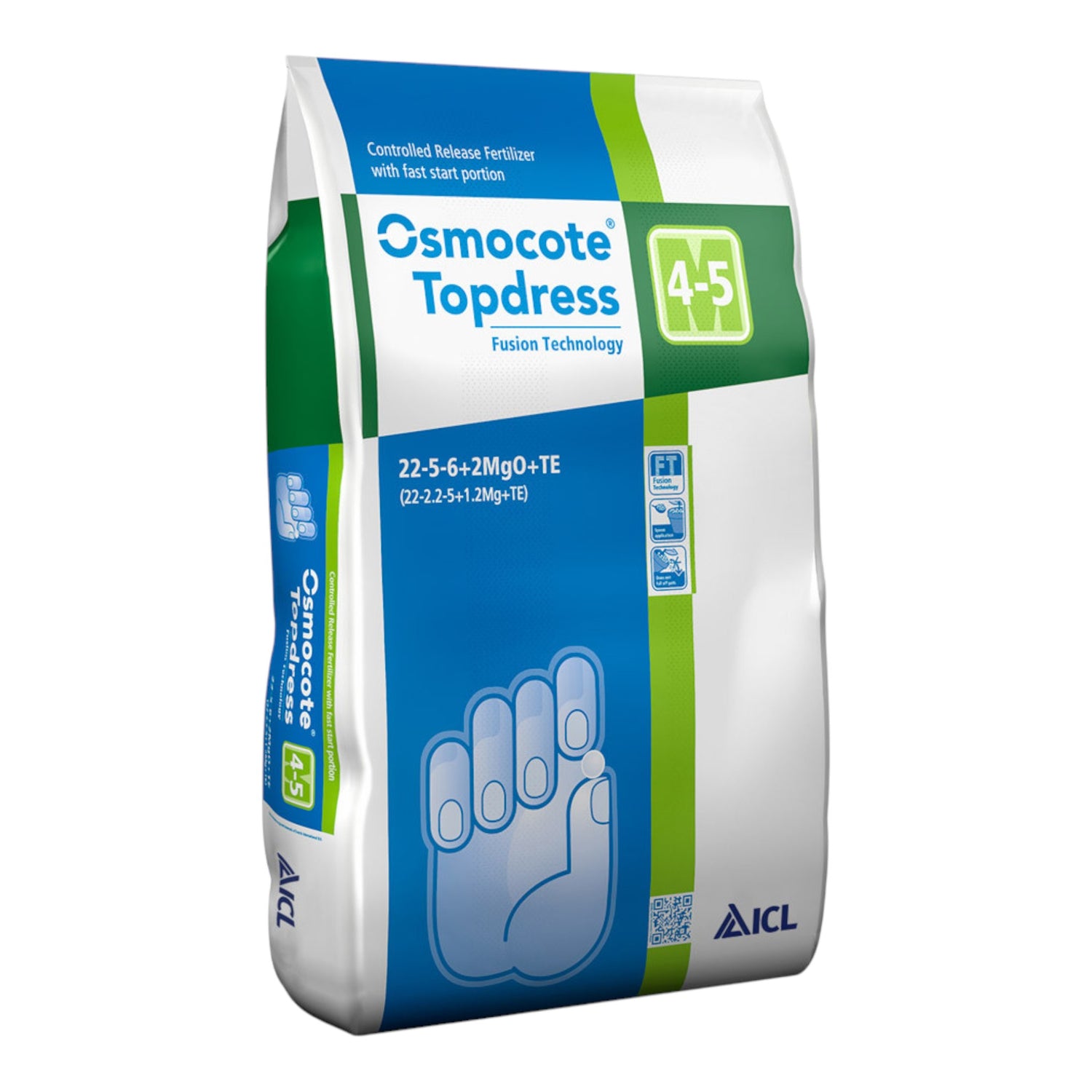
Unit price perICL Osmocote Topdress Pro Fusion Technology - 25kg is a professional Osmocote Topdress FT controlled-release fertiliser formulated for topdressing established container nursery stock.
Its resin-coated nutrients provide a measured supply over a nominal 4–5-month period at 21°C, helping growers match fertiliser longevity to their crop cycle.
Key benefits
Professional applications
Suitable for topdressing established container nursery stock. Plan nutrition around crop demand, irrigation water, substrate properties and any supplementary feeding.
How to apply
Apply evenly to the growing-medium surface according to ICL’s current topdress instructions and crop requirements. Fusion Technology helps the fertiliser adhere to the substrate surface, reducing granule loss when containers are moved or tipped.
Application rates & nutrient management
Use the current ICL topdress dosage guidance for the crop and container size; a universal application rate is not appropriate.
Manufacturer rates are general recommendations for unfertilised substrates. Adjust to local growing conditions and other nutrient inputs. Trial programme changes on a small scale before wider adoption.
Storage & handling
Keep partly used bags sealed and store in dry conditions. Follow current ICL product information and safety guidance.
Technical specifications
| Manufacturer | ICL Growing Solutions |
|---|---|
| Range | Osmocote Topdress FT controlled-release fertiliser |
| NPK (oxide basis) | 22-5-6 |
| Magnesium | 2% MgO |
| Trace elements | Included |
| Nominal longevity | 4–5 months at 21°C |
| Pack size | 25 kg |
| Typical application | topdressing established container nursery stock |
Frequently asked questions
What is this fertiliser used for?
It is designed for topdressing established container nursery stock. What does the stated longevity mean?
ICL rates this product at 4–5 months at a growing-medium temperature of 21°C. Higher temperatures generally shorten the release period; lower temperatures extend it. Can it be combined with liquid feeding?
Yes, where the crop programme calls for it. Reduce the controlled-release fertiliser rate appropriately when adding water-soluble nutrients to avoid excessive total feeding. How should unused product be stored?
Reseal opened bags and store in dry conditions, following the manufacturer’s storage instructions. How do I select a rate?
Choose a rate according to crop demand, growing medium, container volume, season and any additional feeding. The published rates are general starting points for unfertilised substrates; trial changes on a small scale. What is Fusion Technology?
It is designed to help fertiliser granules adhere to the surface of the growing medium after topdressing. Is this a substitute for incorporating fertiliser at potting?
It is particularly useful for topdressing established containers; choose a nutrition programme based on the crop’s current and future needs.

£8.50
Unit price per£8.50
Unit price perClover Chicken Manure Pellets are a natural organic fertiliser made from composted chicken manure, providing slow-release plant nutrition while adding valuable organic matter to the soil. Supplied in a convenient 7kg resealable bucket, they are suitable for vegetables, flowers, fruit, shrubs, borders and lawns.
Chicken manure is naturally rich in the major nutrients required for healthy plant growth. Once incorporated into the soil and watered, the pellets gradually break down, releasing nutrients while also contributing organic matter to the growing environment.
Unlike fresh manure, the dry pelleted format is straightforward to handle, measure, spread and store. This makes Clover Chicken Manure Pellets a practical option for gardeners, allotment growers, landscapers and professional horticultural users looking for a convenient organic fertiliser.
They can be incorporated into soil before planting or applied around established plants as a top dressing, making them a versatile feed and soil improver for use throughout the growing season.
Why choose Clover Chicken Manure Pellets?
Natural slow-release plant nutrition
Clover Chicken Manure Pellets provide the three principal macronutrients associated with healthy plant growth: nitrogen, phosphorus and potassium.
Nitrogen supports vegetative growth and healthy foliage, phosphorus contributes to normal root development and plant energy processes, while potassium plays an important role in overall plant strength, flowering, fruit development and water regulation.
Because these nutrients are supplied within an organic manure-based fertiliser, availability develops as the pellets break down in moist soil rather than behaving like a highly soluble mineral feed.
Feed the plant while improving the soil
Chicken manure pellets offer more than plant nutrients alone. They also introduce organic matter into the soil, making them useful where the aim is to maintain or improve soil fertility over time.
Organic matter supports soil structure and biological activity and can contribute to better moisture and nutrient management within cultivated soils.
This makes pelleted chicken manure particularly useful in vegetable plots, allotments, beds and borders where soil is repeatedly cultivated and cropped.
What can Clover Chicken Manure Pellets be used for?
Application should be adjusted according to the crop and soil condition. Always follow the directions provided on the current product packaging.
How to use chicken manure pellets
For soil preparation, spread the required quantity over the growing area and work the pellets into the soil before planting. Watering after application helps begin the breakdown and nutrient-release process.
For established plants, pellets can be distributed around the surrounding soil and gently incorporated into the surface where appropriate. Avoid concentrating fertiliser directly against plant stems or other sensitive plant tissue.
Clover's pellets can also be reapplied during active growth where additional feeding is required. The amount and frequency should follow the current instructions on the product packaging and take account of the crop, soil fertility and previous fertiliser applications.
Ideal for vegetable plots & allotments
Pelleted chicken manure is particularly useful for preparing productive ground before planting vegetables. It can be incorporated during bed preparation, allowing organic matter and nutrients to begin integrating with the soil before crops establish.
It can also be used during the growing season as part of a wider crop-feeding programme, depending on the nutritional requirements of the vegetables being grown.
For allotment growers managing the same ground season after season, regular additions of appropriate organic materials can play an important role in maintaining productive soil.
Convenient 7kg resealable bucket
The 7kg bucket provides a practical alternative to an open fertiliser bag, particularly where the entire product will not be used in a single application.
Keep the container closed and store it in a cool, dry location away from excessive moisture. Keeping the pellets dry during storage helps maintain their free-flowing form and makes subsequent application easier.
Clover Chicken Manure Pellets product details
| Brand | Clover |
|---|---|
| Product type | Pelleted organic fertiliser and soil improver |
| Primary ingredient | Composted chicken manure |
| Form | Dry pellets |
| Pack size | 7kg |
| Packaging | Resealable bucket |
| Key nutrients | Nitrogen, phosphorus and potassium (NPK) |
| Nutrient release | Slow release |
| Suitable for | Vegetables, flowers, fruit, shrubs, borders, lawns and general garden use |
| Application | Soil incorporation before planting or top dressing established plants |
Clover Chicken Manure Pellets FAQs
What are Clover Chicken Manure Pellets made from?
They are made from composted chicken manure that has been processed into convenient dry pellets for easier application and storage. Are chicken manure pellets a fertiliser or a soil improver?
They perform both roles. Chicken manure supplies plant nutrients while its organic matter also contributes to soil fertility and structure. Are Clover Chicken Manure Pellets slow release?
Yes. The pellets gradually break down in the soil, providing a slower release of nutrients than highly soluble plant feeds. Can I use chicken manure pellets for vegetables?
Yes. They are well suited to vegetable plots and allotments and can be incorporated into the soil before planting or used during the growing season according to the product directions. Can they be used around fruit trees and bushes?
Yes. Chicken manure pellets can be used around suitable established fruit trees and bushes as part of their feeding programme. Apply according to the current pack instructions. Can Clover Chicken Manure Pellets be used on lawns?
Yes, Clover lists lawns among the suitable applications for its chicken manure pellets. Apply evenly and follow the current directions on the packaging. Do chicken manure pellets need watering in?
Watering after application helps the pellets begin to break down and release their nutrients into the surrounding soil. Can I dig the pellets into the soil before planting?
Yes. Incorporating chicken manure pellets during soil preparation is a useful way to introduce organic matter and nutrients before planting. Are chicken manure pellets easier to use than fresh manure?
The dry pelleted form is generally easier to store, distribute and measure than fresh loose manure, making it particularly convenient for routine garden and allotment use. Can chicken manure pellets improve poor soil?
They add organic matter and nutrients, so they can form part of a wider programme for improving soil fertility. Soil condition, texture, pH and drainage should also be considered when managing poor ground. How should I store the 7kg bucket?
Keep the lid closed and store the bucket in a cool, dry location. Protecting the pellets from unnecessary moisture helps keep them in good condition between applications. How much Clover Chicken Manure should I apply?
Application rate varies according to the crop and intended use. Follow the current directions printed on the Clover packaging for the appropriate rate and frequency.
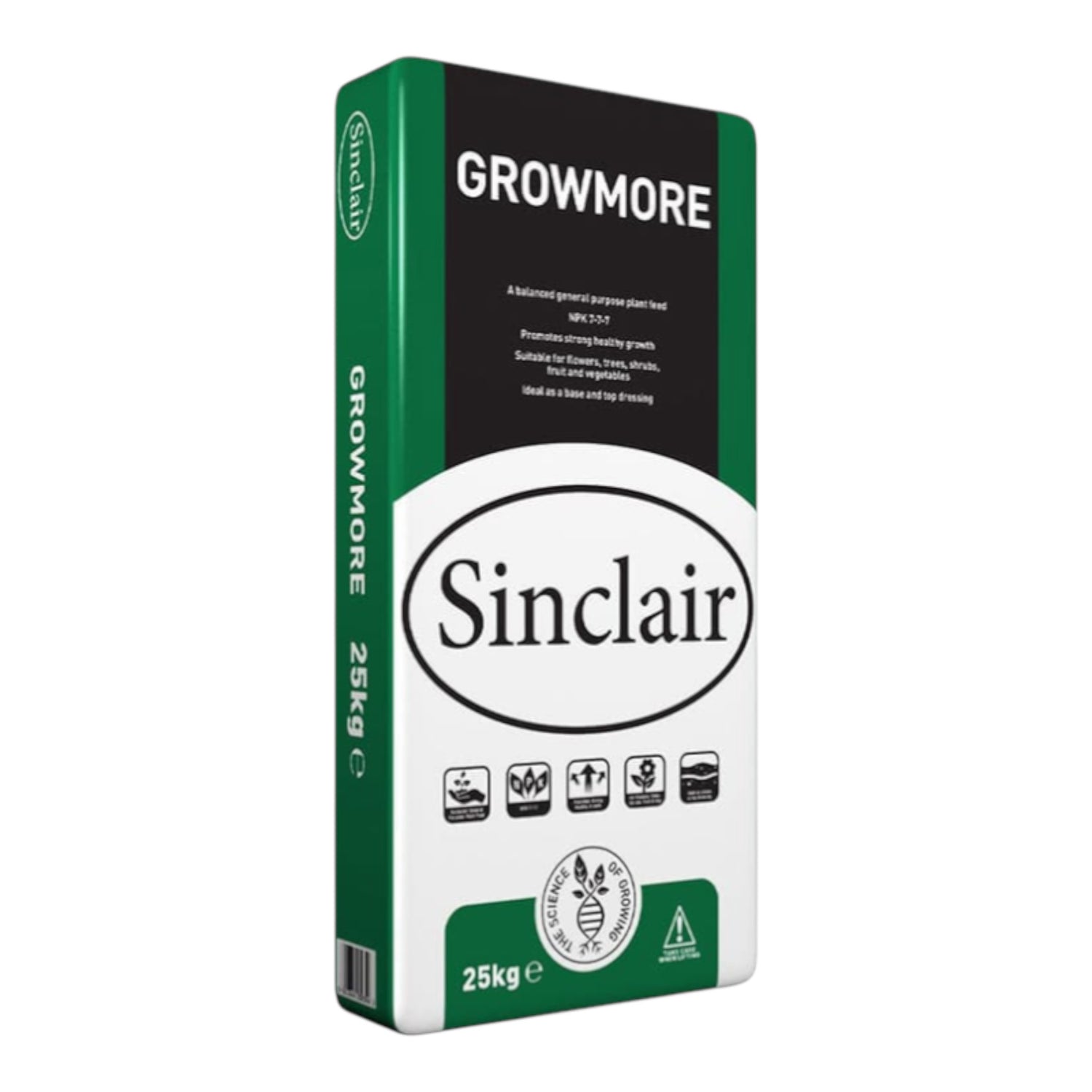
Sinclair Growmore 25kg — Balanced granular general-purpose fertiliser for flowers, fruit, vegetables and other suitable garden and landscape crops.
Selected for professional horticulture, nursery production and garden or landscape applications where the product suits the crop and growing conditions.
Key benefits
Balanced NPK nutrition
Growmore supplies nitrogen to support vegetative growth, phosphate for root and energy processes, and potash for water regulation and general plant function. Its equal NPK analysis makes it a flexible general-purpose feed, not a substitute for crop-specific nutrition planning.
Where to use Growmore
Sinclair identifies Growmore for most types of flowers and for fruit and vegetables. It can be used as a base dressing or top dressing where the current label and crop requirements permit.
Application and handling
Apply evenly at the rate stated on the current bag label for the crop and soil conditions. Avoid concentrated deposits against stems or roots, and wash any fertiliser granules off plant foliage as the manufacturer advises.
Sinclair Growmore 25kg product details
| Fertiliser type | Granular general-purpose fertiliser |
|---|---|
| NPK analysis | 7-7-7 |
| Particle size | 0.5–3mm |
| Bag size | 25kg |
| Pallet quantity | 39 bags |
| Manufacturer product reference | F1504473S |
Sinclair Growmore 25kg FAQs
What does NPK 7-7-7 mean?
The declared nitrogen, phosphate and potash figures are equal, making this a balanced general-purpose fertiliser. Can it be used on fruit and vegetables?
Yes. Sinclair identifies fruit and vegetables among its intended applications. Can Growmore be used before planting?
Yes. The manufacturer lists base dressing as an application; follow the current label for rate and incorporation guidance. Can it be used on established plants?
Yes. It is also suitable as a top dressing where appropriate for the crop. Should granules be left on leaves?
No. Sinclair advises washing fertiliser off foliage. How is it supplied?
One 25kg bag; 39 bags per full pallet.
£139.80
Unit price per£139.80
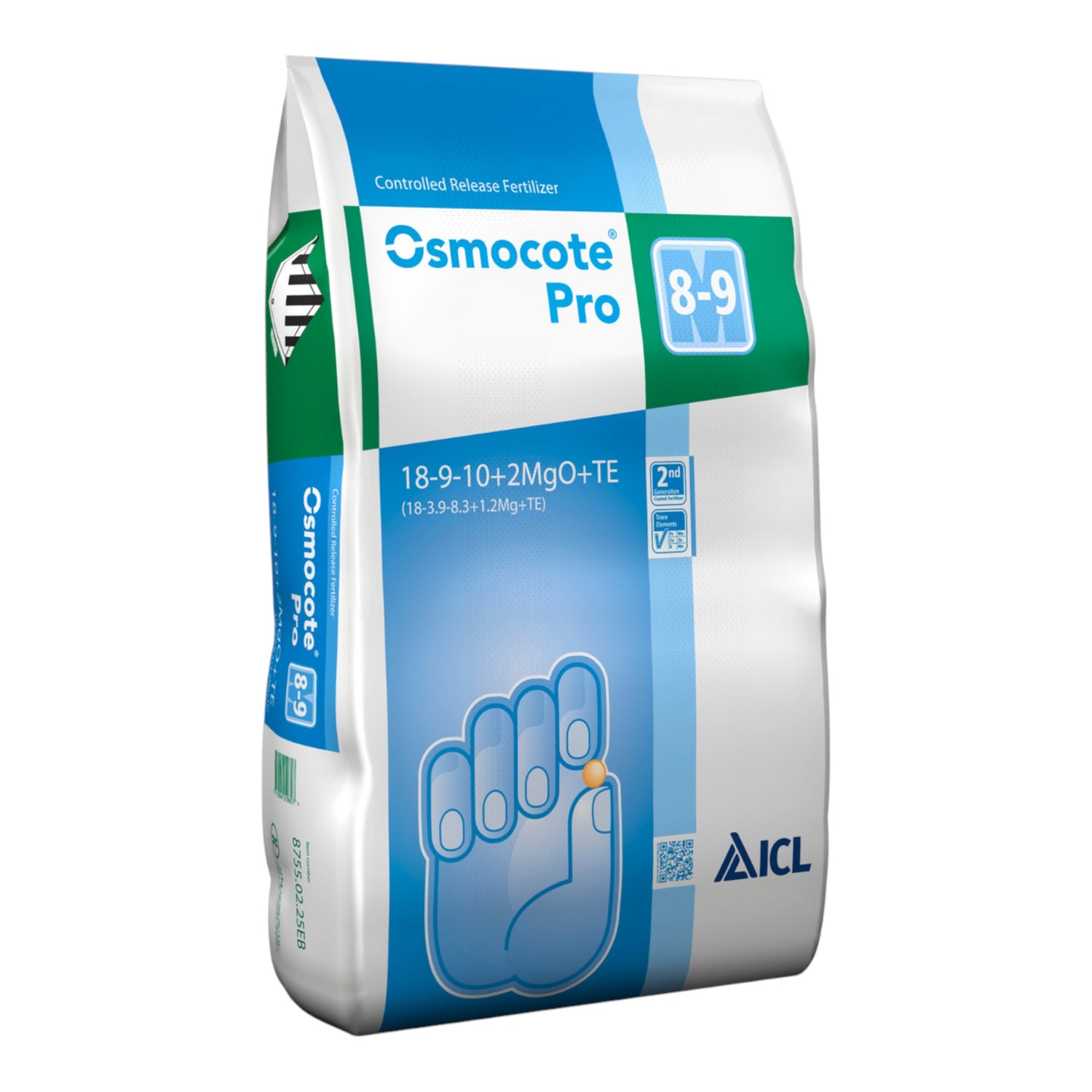
Unit price perICL Osmocote Pro 8-9 Months 18-9-10 2MgO+TE 25kg is a professional Osmocote Pro controlled-release fertiliser formulated for incorporation into growing media for container nursery stock.
Its resin-coated nutrients provide a measured supply over a nominal 8–9-month period at 21°C, helping growers match fertiliser longevity to their crop cycle.
Key benefits
Professional applications
Suitable for incorporation into growing media for container nursery stock. Plan nutrition around crop demand, irrigation water, substrate properties and any supplementary feeding.
How to apply
Mix granules evenly through the growing medium before potting, following the current manufacturer instructions. ICL advises against dibbling for the short-duration Pro variants; check the current instructions for the exact product before choosing any alternative application method.
Application rates & nutrient management
Container nursery stock: 3–3.5 g/L (light), 3.5–4.5 g/L (normal), 4.5–5.5 g/L (heavy).
Manufacturer rates are general recommendations for unfertilised substrates. Adjust to local growing conditions and other nutrient inputs. Trial programme changes on a small scale before wider adoption.
Storage & handling
Keep partly used bags sealed and store in dry conditions. Follow current ICL product information and safety guidance.
Technical specifications
| Manufacturer | ICL Growing Solutions |
|---|---|
| Range | Osmocote Pro controlled-release fertiliser |
| NPK (oxide basis) | 18-9-10 |
| Magnesium | 2% MgO |
| Trace elements | Included |
| Nominal longevity | 8–9 months at 21°C |
| Pack size | 25 kg |
| Typical application | incorporation into growing media for container nursery stock |
| Manufacturer guidance | Container nursery stock: 3–3.5 g/L (light), 3.5–4.5 g/L (normal), 4.5–5.5 g/L (heavy). |
Frequently asked questions
What is this fertiliser used for?
It is designed for incorporation into growing media for container nursery stock. What does the stated longevity mean?
ICL rates this product at 8–9 months at a growing-medium temperature of 21°C. Higher temperatures generally shorten the release period; lower temperatures extend it. Can it be combined with liquid feeding?
Yes, where the crop programme calls for it. Reduce the controlled-release fertiliser rate appropriately when adding water-soluble nutrients to avoid excessive total feeding. How should unused product be stored?
Reseal opened bags and store in dry conditions, following the manufacturer’s storage instructions. How do I select a rate?
Choose a rate according to crop demand, growing medium, container volume, season and any additional feeding. The published rates are general starting points for unfertilised substrates; trial changes on a small scale. Is this suitable for every crop?
No. Match the formulation and longevity to the crop, growing period and feeding requirements. How does temperature affect nutrient release?
Nutrient release generally speeds up at higher growing-medium temperatures and slows at lower temperatures.

£28.59
Unit price per£28.59
Unit price perAtami Bloombastic 325ml is a highly concentrated PK 14-15 all-in-one bloom and ripening additive developed to support dense flower development, increased sugar production, enhanced aroma and a strong finish during the final stages of flowering.
Bloombastic is Atami's award-winning all-in-one bloom additive, developed for the final 4-6 weeks of flowering and ripening. It combines the functions of a bloom stimulator, hardener, taste enhancer and activator of various enzymatic processes, providing concentrated support as flowering and fruiting crops move towards maturity.
With a powerful PK 14-15 W/W formulation, Bloombastic supplies high levels of phosphorus and potassium during the period when productive crops have significant demand for these important flowering nutrients. Atami states that Bloombastic contains more than 50% more bio-minerals in the form of phosphorus and potassium than other liquid flowering products.
No ballast substances such as sodium or chlorine are used. The concentrated formulation is designed to encourage sugar and flower production, supporting the development of thicker, denser and more aromatic flowers during the final stages of the crop cycle.
Applied at only 0.5-1ml/L, the 325ml bottle can prepare approximately 325-650 litres of nutrient solution, making it a practical size for smaller reservoirs and individual growing systems.
Why choose Atami Bloombastic?
What is Atami Bloombastic suitable for?
Bloombastic can be used with a wide range of flowering and fruiting plants, including vegetables, fruits, herbs and ornamental flowering crops. Atami gives examples including chilli peppers, strawberries and blueberries, as well as flowering plants such as orchids and violets.
It is suitable for cultivation in Hydro, Coco and Soil and can be incorporated into different substrate and irrigation systems.
Bloombastic is specifically intended for established flowering crops approaching the later stages of flower and fruit development. It is not a vegetative growth additive or complete base fertiliser.
Crop development should determine application timing rather than relying entirely on fixed calendar weeks. Atami recommends Bloombastic for the final 4-6 weeks of flowering and ripening, so crops with different flowering durations will naturally begin the programme at different points.
How to use Atami Bloombastic
Apply Bloombastic during the final 4-6 weeks of flowering and ripening in combination with your basic nutrients. Use 0.5-1ml per litre of water or nutrient solution, adjusting the overall nutrient programme according to crop requirements.
At 0.5ml/L, use 5ml for 10L, 25ml for 50L, 50ml for 100L, 250ml for 500L and 500ml for a 1,000L nutrient reservoir.
At 1ml/L, use 10ml for 10L, 50ml for 50L, 100ml for 100L, 500ml for 500L and 1L for a 1,000L nutrient reservoir.
A 325ml bottle therefore prepares approximately 650 litres of nutrient solution at 0.5ml/L or 325 litres at 1ml/L.
Bloombastic increases the EC value of the basic nutrient solution, so EC should be monitored during use. Take the strength of the base nutrient and other additives into account when preparing the final solution.
Bloombastic can be combined with a bloom stimulator such as B'cuzz Bloom Stimulator where additional flowering-phase stimulation is required.
Important: Do not combine Bloombastic with another PK nutrient. Atami advises that this is unnecessary and can increase the risk of overfertilisation.
Understanding Bloombastic PK 14-15
Bloombastic provides a concentrated but relatively balanced combination of phosphorus and potassium, with a PK analysis of 14-15 W/W.
Phosphorus is involved in essential plant processes including energy transfer and reproductive development. Potassium contributes to numerous physiological functions associated with water regulation, nutrient movement and productive crop development.
During flowering and ripening, demand for these elements becomes increasingly important as the plant directs resources towards developing flowers and fruits.
Bloombastic combines this concentrated PK nutrition with its wider bloom-stimulating formulation, which is why Atami positions the product as an all-in-one flowering additive rather than simply a conventional PK fertiliser.
Bloombastic as part of a flowering programme
Bloombastic is designed to supplement rather than replace the plant's basic nutrient programme. Continue using an appropriate base nutrient for the chosen growing medium while introducing Bloombastic during the recommended flowering and ripening stages.
A bloom stimulator can also be incorporated where appropriate because a stimulator performs a different role from concentrated PK nutrition.
However, Bloombastic already provides a substantial PK 14-15 concentration. Adding another dedicated PK booster on top of it can create excessive phosphorus and potassium levels, which is why Atami specifically advises against combining Bloombastic with another PK nutrient.
Monitoring EC and crop response allows growers to account for the contribution made by both the base nutrient and Bloombastic rather than treating additives independently.
Atami Bloombastic 325ml product details
| Brand | Atami |
|---|---|
| Product | Bloombastic |
| Product type | All-in-one bloom & ripening additive |
| Size | 325ml |
| PK analysis | PK 14-15 W/W |
| Application rate | 0.5-1ml/L |
| Application period | Final 4-6 weeks of flowering & ripening |
| 10L nutrient solution | 5-10ml |
| 50L nutrient solution | 25-50ml |
| 100L nutrient solution | 50-100ml |
| Approximate solution from 325ml | 325L at 1ml/L or 650L at 0.5ml/L |
| Growing media | Hydro, Coco & Soil |
| Irrigation | Suitable for irrigation systems |
| Use with base nutrients | Yes |
| Use with bloom stimulator | Yes |
| Use with another PK nutrient | No - Atami advises against combining Bloombastic with another PK nutrient |
| Outer case quantity | 12 x 325ml bottles |
Atami Bloombastic 325ml FAQs
What does Atami Bloombastic do?
Bloombastic is an all-in-one bloom and ripening additive designed to support plants during the final stages of flowering. It combines bloom stimulation, concentrated PK nutrition, flower hardening, taste enhancement and activation of various enzymatic processes.
What is the PK ratio of Atami Bloombastic?
Bloombastic has a PK 14-15 W/W analysis, providing high concentrations of both phosphorus and potassium during flowering and ripening.
When should I use Atami Bloombastic?
Atami recommends using Bloombastic during the final 4-6 weeks of flowering and ripening. Follow the actual development of the crop when determining the appropriate starting point.
How much Atami Bloombastic should I use?
Use 0.5-1ml per litre of water or nutrient solution alongside the crop's basic nutrients.
Does Bloombastic increase EC?
Yes. Bloombastic increases the EC of the basic nutrient solution because it contains concentrated mineral nutrition. Monitor EC and account for the strength of the complete feeding programme.
Can I use Bloombastic with my base nutrients?
Yes. Bloombastic is intended to be used in combination with appropriate basic nutrients during flowering and ripening. It is not a complete base fertiliser on its own.
Can Bloombastic be used with Bloom Stimulator?
Yes. Atami states that Bloombastic can be combined with a bloom stimulator such as B'cuzz Bloom Stimulator because the products perform different roles within the flowering programme.
Can Bloombastic be used with another PK booster?
No. Atami advises against combining Bloombastic with another PK nutrient. Bloombastic already contains a concentrated PK 14-15 formulation, and additional PK supplementation can increase the risk of overfertilisation.
Can I use Bloombastic in coco?
Yes. Bloombastic is suitable for coco and coco-based growing systems when incorporated into an appropriate coco nutrient programme.
Can I use Bloombastic in hydroponics?
Yes. Bloombastic is suitable for hydroponic cultivation and can be added to the nutrient solution during the appropriate flowering and ripening stages.
Can I use Bloombastic in soil?
Yes. Bloombastic is suitable for soil-grown flowering and fruiting plants when used alongside an appropriate base nutrient programme.
What plants can Bloombastic be used on?
Bloombastic can be used with many flowering and fruiting crops. Atami gives examples including chilli peppers, strawberries and blueberries, along with flowering ornamental plants such as orchids and violets.
Does Bloombastic support sugar production?
Yes. Atami specifically positions Bloombastic to encourage sugar production during flowering, supporting crop weight, aroma and final flower or fruit development.
What is the difference between Bloombastic and Rokzbastic?
Bloombastic is an all-in-one PK 14-15 bloom additive with a relatively balanced phosphorus-to-potassium profile. Rokzbastic is a PK 10-20 late-flowering booster with twice as much potassium as phosphorus. They have different formulations and should not be stacked together as additional PK products.
How much nutrient solution will a 325ml bottle of Bloombastic make?
A 325ml bottle prepares approximately 325 litres at 1ml/L or 650 litres at 0.5ml/L.
How many 325ml bottles of Atami Bloombastic are in a full case?
A full outer case contains 12 x 325ml bottles of Atami Bloombastic.


£98.41
Unit price per£98.41
Unit price perAtami B'cuzz Coco Bloom Stimulator 5L is a concentrated flowering stimulator developed specifically for plants grown in coco-based substrates, helping support a longer, more intense flowering period and the development of denser, firmer and more numerous flowers and fruits.
As plants move from vegetative growth into flowering, their development changes significantly. Vegetative growth begins to reduce while the plant increasingly directs its energy towards reproductive growth, flower formation and fruit development.
B'cuzz Coco Bloom Stimulator has been developed specifically for this stage of crops grown in coco. Atami recommends introducing it from flower formation and continuing it through the flowering and ripening stages as part of the B'cuzz Coco feeding programme.
Atami highlights three principal characteristics of Coco Bloom Stimulator: a longer and more intense flowering period, support for the natural smell and taste of the crop, and a formulation developed specifically for coco-based substrates.
The recommended dosage is 0.5-1ml/L. A 5L container therefore prepares approximately 5,000-10,000 litres of nutrient solution, depending on the concentration used.
Why choose Atami B'cuzz Coco Bloom Stimulator?
Designed for the transition into flowering
The transition from vegetative growth into flowering represents a major change in plant development. Instead of concentrating primarily on leaves, shoots and stems, the crop increasingly directs resources towards flowers and fruits.
Atami B'cuzz Coco Bloom Stimulator is designed specifically for this generative stage. It is introduced as flower formation begins, allowing the feeding programme to change alongside the developmental priorities of the crop.
Atami's current B'cuzz Coco grow guide uses Coco Bloom Stimulator through early bloom, bloom, early ripening and ripening rather than restricting it to only the first part of flowering.
This makes it a dedicated flowering-stage stimulator rather than a general vegetative booster or base fertiliser.
Denser, firmer & more flowers and fruits
Atami describes Coco Bloom Stimulator as supporting the production of denser, firmer and more numerous flowers and fruits.
This is particularly relevant once plants have established sufficient vegetative structure and begin concentrating on reproductive development.
The product is designed to intensify this flowering phase rather than simply increasing the overall nutrient concentration of the root zone.
For growers using a structured crop-stage feeding programme, Coco Bloom Stimulator therefore provides a specialist product for the flowering period while Coco A&B continues to supply the main mineral nutrition.
Flowering stimulation specifically for coco
Coco coir combines excellent water retention with a highly aerated physical structure, but crop nutrition is largely controlled by the irrigation solution supplied by the grower.
Atami has therefore developed a dedicated B'cuzz Coco programme rather than simply treating coco as conventional soil or compost.
Coco Bloom Stimulator is the flowering-stage stimulator within this programme and is designed to work alongside coco-specific base nutrition and other appropriate crop-stage products.
This makes it particularly suitable for growers who want to manage nutrition closely while retaining the drainage, aeration and responsive feeding characteristics associated with coco cultivation.
Supporting aroma & taste during flowering
Atami highlights great smell and taste as one of the key characteristics of B'cuzz Coco Bloom Stimulator.
Flowering and ripening are important stages for crops grown for aromatic flowers, herbs, vegetables and fruits, as the plant's reproductive structures continue to mature.
Coco Bloom Stimulator is designed to support this generative development as part of a balanced feeding programme rather than acting as a substitute for appropriate base nutrition or environmental control.
How to use Atami B'cuzz Coco Bloom Stimulator
Atami recommends using 0.5-1ml of Coco Bloom Stimulator per litre of water, beginning when flowers start to form.
At this concentration, use 5-10ml for 10L, 25-50ml for 50L, 50-100ml for 100L, 250-500ml for 500L and 500ml-1L for 1,000L of nutrient solution.
A 5L container can therefore prepare approximately 10,000L at 0.5ml/L or 5,000L at 1ml/L.
Atami recommends adding Coco Bloom Stimulator during watering from flower formation onwards. The precise concentration can be adjusted to suit the individual plant or crop.
Feeding schedules should be treated as guidance. Plant species, crop condition, environment, light intensity, source water and the EC of the complete nutrient solution should all be considered when adjusting nutrition.
Where Coco Bloom Stimulator fits in the B'cuzz Coco programme
Atami's B'cuzz Coco programme changes as the crop progresses through its different developmental stages.
During initial establishment, Root Stimulator can be used to support early root development. Coco Booster Uni then provides additional support as the plant enters active vegetative growth and approaches flowering.
Coco Bloom Stimulator is introduced as flowers begin to form and becomes the dedicated flowering stimulator within the programme.
Coco A&B continues to provide the main base nutrition, while suitable bloom and ripening products can be incorporated according to the crop stage and chosen Atami programme.
Coco Bloom Stimulator & Coco Booster Uni
Atami specifically recommends using B'cuzz Coco Bloom Stimulator in combination with B'cuzz Coco Booster for optimum effect.
The products have complementary roles. Coco Booster Uni primarily supports the plant during active vegetative development and the transition towards flowering, while Coco Bloom Stimulator becomes increasingly relevant once flower formation begins.
This creates a smooth transition between vegetative and generative crop development rather than making an abrupt change from one programme to another.
Coco Bloom Stimulator vs Coco A&B
Coco Bloom Stimulator should not be confused with the main B'cuzz Coco base nutrient.
B'cuzz Coco A&B is the base nutrient, supplying the primary mineral nutrition required by plants grown in coco throughout the crop cycle.
B'cuzz Coco Bloom Stimulator is a flowering stimulator, designed to provide additional crop-stage support once flower formation begins.
Coco Bloom Stimulator is therefore normally used alongside an appropriate base nutrient rather than replacing Coco A&B.
Coco Bloom Stimulator vs Bloombastic
Coco Bloom Stimulator and Bloombastic are both associated with flowering, but they perform different roles.
Coco Bloom Stimulator is a dedicated coco flowering stimulator used from flower formation through the generative stages.
Bloombastic is a concentrated PK 14-15 bloom and ripening additive intended primarily for the final 4-6 weeks of flowering and ripening.
Atami allows Coco Bloom Stimulator to form part of a programme that also uses a later-stage flowering additive, provided the overall feeding programme and EC are managed appropriately.
5L Coco Bloom Stimulator for commercial growing
The 5L format is particularly well suited to nurseries, larger coco growing systems and professional horticultural operations preparing substantial quantities of irrigation solution.
At the recommended 0.5-1ml/L dosage, a 5L container prepares approximately 5,000-10,000 litres of nutrient solution.
This makes the larger pack practical for repeat crop production and larger reservoirs where Coco Bloom Stimulator forms a regular part of the flowering programme.
Atami B'cuzz Coco Bloom Stimulator 5L product details
| Brand | Atami |
|---|---|
| Range | B'cuzz |
| Product | Coco Bloom Stimulator |
| Product type | Coco flowering & bloom stimulator |
| Size | 5L |
| Growing medium | Coco & coco-based substrates |
| Primary function | Flowering-stage stimulation |
| Key benefits | Longer & more intense flowering; denser, firmer & more flowers and fruits |
| Application stage | From flower formation through flowering & ripening |
| Dosage | 0.5-1ml/L |
| 10L solution | 5-10ml |
| 50L solution | 25-50ml |
| 100L solution | 50-100ml |
| 500L solution | 250-500ml |
| 1,000L solution | 500ml-1L |
| Approximate solution from 5L | 5,000-10,000L depending on dosage |
| Recommended combination | B'cuzz Coco Booster Uni |
| Use with base nutrient | Yes - suitable alongside B'cuzz Coco A&B |
| Standalone base nutrient | No |
Atami B'cuzz Coco Bloom Stimulator 5L FAQs
What does Atami B'cuzz Coco Bloom Stimulator do?
It is a dedicated flowering stimulator for coco-grown plants. Atami positions it to support a longer, more intense flowering period and the development of denser, firmer and more numerous flowers and fruits.
When should I start using Coco Bloom Stimulator?
Atami recommends introducing Coco Bloom Stimulator as soon as flowers begin to form.
How much Coco Bloom Stimulator should I use?
The recommended dosage is 0.5-1ml/L. A 5L container therefore prepares approximately 5,000-10,000 litres of nutrient solution, depending on the concentration used.
Is Coco Bloom Stimulator only for coco?
It is specifically developed and positioned by Atami for cultivation in coco-based substrates.
Is Coco Bloom Stimulator a base nutrient?
No. It is a flowering stimulator rather than a complete base nutrient. B'cuzz Coco A&B provides the main mineral nutrition within Atami's coco programme.
Can I use Coco Bloom Stimulator with Coco A&B?
Yes. Coco Bloom Stimulator is designed to complement a coco feeding programme and can be used alongside B'cuzz Coco A&B.
Can Coco Bloom Stimulator be used with Coco Booster Uni?
Yes. Atami specifically recommends combining Coco Bloom Stimulator with B'cuzz Coco Booster for optimum effect.
Does Coco Bloom Stimulator continue into ripening?
Yes. Atami's current B'cuzz Coco grow guide continues Coco Bloom Stimulator through bloom, early ripening and ripening.
Does Coco Bloom Stimulator contain a high PK concentration?
Coco Bloom Stimulator is positioned as a flowering stimulator rather than a concentrated PK finisher. Growers wanting a dedicated high-PK bloom or ripening additive should consider an appropriate product such as Bloombastic or Rokzbastic according to their feeding programme.
Is Coco Bloom Stimulator the same as Bloombastic?
No. Coco Bloom Stimulator is a coco-specific flowering stimulator used from flower formation, while Bloombastic is a concentrated PK 14-15 additive used primarily during the final 4-6 weeks of flowering and ripening.
Can Coco Bloom Stimulator support flower and fruit quality?
Yes. Atami describes the product as supporting denser, firmer and more numerous flowers and fruits, as well as the natural aroma and taste of the crop.
Should I monitor EC when using Coco Bloom Stimulator?
Yes. The complete nutrient solution should be monitored when combining base nutrients, stimulators and flowering additives so that overall nutrient concentration remains appropriate for the crop.
What types of plants can Coco Bloom Stimulator be used on?
Atami lists vegetables, fruits and herbs such as tomatoes, sage and basil, as well as indoor and container-grown ornamentals including Alocasia and lavender. The dosage should be adapted to the requirements of the individual crop.
Is the 5L size suitable for commercial coco growing?
Yes. The 5L format can prepare approximately 5,000-10,000 litres of nutrient solution, making it well suited to larger reservoirs, nurseries and commercial coco production.

£20.31
Unit price per£20.31
Unit price perAtami B'cuzz Bloom Stimulator 1L is a highly concentrated flowering stimulator designed to intensify the bloom period, supporting abundant flower formation, thick compact flowers and productive fruit development while helping maintain the natural taste and aroma of the crop.
Flowering marks an important change in the plant life cycle. Vegetative growth begins to reduce and the plant increasingly directs its development towards the production of flowers and, in fruiting crops, subsequent fruit formation.
B'cuzz Bloom Stimulator is designed to be introduced as the plant begins forming flowers. It supports the transition into generative growth and is formulated to make the flowering period more intense and productive.
Atami highlights the development of thick and compact flowers, an intense flowering period and eventual fruits with strong natural taste and aroma among the principal reasons for incorporating Bloom Stimulator into a flowering programme.
Bloom Stimulator has almost no NPK value, distinguishing it from conventional base nutrients and concentrated PK boosters. Applied at only 0.5-1ml/L, a 1L bottle can prepare approximately 1,000-2,000 litres of nutrient solution.
Why choose Atami B'cuzz Bloom Stimulator?
Helping kick-start the bloom phase
The transition from vegetative growth into flowering is one of the most significant developmental changes for a flowering crop.
During vegetative development, much of the plant's activity is concentrated on roots, leaves, stems and shoots. As flowers begin to form, development becomes increasingly generative.
Atami recommends introducing B'cuzz Bloom Stimulator at this transition point. The product is designed to kick-start the bloom phase and help make flowering more intense and longer lasting.
Introducing a specialist flowering stimulator at flower formation allows the feeding programme to develop alongside the changing priorities of the crop.
Supports thick, compact & abundant flowers
B'cuzz Bloom Stimulator is formulated around the development of a strong and productive flowering crop.
Atami describes its use as supporting an explosive production of thick and compact flowers, while helping the flowering period become more intense and last longer.
This makes Bloom Stimulator suitable for ornamental flowering plants as well as fruiting crops where successful flower development forms the foundation for subsequent fruit production.
It is therefore best viewed as a specialist flowering additive rather than simply another fertiliser.
Supporting flower & fruit development
Strong flowering is central to the productive potential of many horticultural crops. Once flowers have developed successfully, fruiting plants can progress towards fruit set, development and eventual ripening.
Atami highlights Bloom Stimulator for vegetables and fruits including bell peppers, chilli peppers and aubergines, as well as flowering ornamental plants.
The product is intended to support generative development while helping flowers and eventual fruits retain their natural taste and aroma.
Final crop performance will also depend on genetics, pollination, root health, nutrition, irrigation, light and environmental conditions.
A flowering stimulator, not a PK booster
An important characteristic of B'cuzz Bloom Stimulator is that it has almost no NPK value.
Its primary purpose is therefore flowering stimulation rather than supplying the main nitrogen, phosphorus and potassium requirements of the crop.
A suitable base nutrient continues to provide the broader mineral nutrition required by the plant, while Bloom Stimulator performs its specialist role during generative development.
This distinguishes it from products such as Blossom Builder Liquid, Bloombastic and Rokzbastic, which contribute significant levels of phosphorus and potassium during flowering and ripening.
How to use Atami B'cuzz Bloom Stimulator
Atami recommends applying 0.5-1ml of B'cuzz Bloom Stimulator per litre of water, beginning as flowers start to form.
At this concentration, use 5-10ml for 10L, 25-50ml for 50L, 50-100ml for 100L, 250-500ml for 500L and 500ml-1L for 1,000L of nutrient solution.
A 1L bottle therefore prepares approximately 2,000L at 0.5ml/L or 1,000L at 1ml/L.
Atami advises adding Bloom Stimulator when watering from the point of flower formation. The exact concentration can be adjusted according to the needs of the individual plant or crop.
Consider crop condition, species, environment, source water and the wider feeding programme when determining the appropriate nutrient strength.
Bloom Stimulator & B'cuzz Booster
Atami states that Bloom Stimulator achieves its optimal effect in combination with B'cuzz Booster.
The appropriate Booster can be selected according to the cultivation programme, allowing vegetative support and flowering stimulation to perform complementary roles as the crop transitions into generative development.
This gives growers greater control over the transition between crop stages without expecting one product to perform every nutritional function.
Compatible with practically all base nutrients
Atami describes B'cuzz Bloom Stimulator as easy to integrate because it can be combined with practically all base nutrients.
The chosen base fertiliser continues to supply the primary mineral nutrition required by the plant, while Bloom Stimulator provides specialist support for flowering.
This makes it suitable for integration into different cultivation programmes while retaining the appropriate base nutrition for the growing medium.
The complete feeding programme should always be adjusted to the requirements of the crop and growing conditions.
Bloom Stimulator vs Coco Bloom Stimulator
Both products support flowering, but they are positioned for different nutrient programmes.
B'cuzz Bloom Stimulator is the broader flowering stimulator that Atami describes as compatible with practically all base nutrients.
B'cuzz Coco Bloom Stimulator is specifically developed for plants cultivated in coco and coco-based substrates.
Growers following Atami's dedicated coco programme can therefore select Coco Bloom Stimulator, while the standard Bloom Stimulator provides a flexible option across wider feeding programmes.
Bloom Stimulator vs Blossom Builder Liquid
Bloom Stimulator and Blossom Builder Liquid are both associated with flowering but perform fundamentally different functions.
B'cuzz Bloom Stimulator has almost no NPK value and is introduced from flower formation to stimulate and intensify bloom.
Blossom Builder Liquid is a concentrated PK 18-23 flowering product supplying substantial phosphorus and potassium during generative development.
Atami specifically recommends the two products as a compatible combination, allowing flowering stimulation and concentrated PK nutrition to perform complementary roles.
Bloom Stimulator vs Bloombastic
Bloom Stimulator and Bloombastic occupy different positions within a flowering programme.
Bloom Stimulator is introduced from flower formation to stimulate and intensify the flowering process.
Bloombastic is Atami's concentrated PK 14-15 all-in-one bloom additive, primarily intended for the final 4-6 weeks of flowering and ripening.
Bloom Stimulator can therefore support flowering from its initial formation, while a later-stage flowering additive can be introduced as the crop progresses towards maturity where appropriate.
1L format for larger flowering programmes
The 1L size provides a practical format for growers regularly using B'cuzz Bloom Stimulator across multiple plants or larger nutrient reservoirs.
At the recommended 0.5-1ml/L dosage, each 1L bottle prepares approximately 1,000-2,000 litres of nutrient solution.
A full outer case contains 12 x 1L bottles, providing 12 litres of Bloom Stimulator concentrate in total.
Atami B'cuzz Bloom Stimulator 1L product details
| Brand | Atami |
|---|---|
| Range | B'cuzz |
| Product | Bloom Stimulator |
| Product type | Concentrated flowering stimulator |
| Size | 1L |
| Primary function | Flowering & generative development stimulation |
| Application stage | From flower formation onwards |
| NPK value | Almost no NPK value |
| Key benefits | Supports intense flowering, thick compact flowers, fruit development, taste & aroma |
| Dosage | 0.5-1ml/L |
| 10L solution | 5-10ml |
| 50L solution | 25-50ml |
| 100L solution | 50-100ml |
| 500L solution | 250-500ml |
| 1,000L solution | 500ml-1L |
| Approximate solution from 1L | 1,000-2,000L depending on dosage |
| Recommended combination | Appropriate B'cuzz Booster |
| Base nutrient compatibility | Can be combined with practically all base nutrients |
| Example crops | Bell peppers, chilli peppers, aubergines & flowering ornamentals |
| Outer case quantity | 12 x 1L bottles |
Atami B'cuzz Bloom Stimulator 1L FAQs
What does Atami B'cuzz Bloom Stimulator do?
It is a specialist flowering additive designed to kick-start and intensify bloom, supporting abundant production of thick, compact flowers and subsequent fruit development.
When should I start using B'cuzz Bloom Stimulator?
Atami recommends introducing it as the plant begins forming flowers, at the transition into the main bloom phase.
How much B'cuzz Bloom Stimulator should I use?
Atami recommends 0.5-1ml/L. A 1L bottle therefore prepares approximately 1,000-2,000 litres of nutrient solution.
Is B'cuzz Bloom Stimulator a PK booster?
No. Atami states that Bloom Stimulator has almost no NPK value. Its primary role is flowering stimulation rather than supplying concentrated phosphorus and potassium.
Do I still need a base nutrient with Bloom Stimulator?
Yes. Bloom Stimulator is not a complete base fertiliser. It complements the main nutrient programme while providing specialist flowering support.
Can Bloom Stimulator be used with B'cuzz Booster?
Yes. Atami specifically states that Bloom Stimulator achieves its optimal effect in combination with B'cuzz Booster.
Does Bloom Stimulator support compact flowers?
Yes. Atami specifically highlights the development of thick and compact flowers among the intended benefits of the product.
Can Bloom Stimulator be used on fruiting plants?
Yes. Atami gives bell peppers, chilli peppers and aubergines as examples of suitable fruiting crops.
Can Bloom Stimulator be used on flowering ornamental plants?
Yes. It can also be used with flowering ornamental plants where strong generative development is required.
Does Bloom Stimulator support taste and aroma?
Yes. Atami describes Bloom Stimulator as supporting flowers and eventual fruits with strong natural taste and smell.
What is the difference between Bloom Stimulator and Blossom Builder Liquid?
Bloom Stimulator has almost no NPK value and focuses on flowering stimulation. Blossom Builder Liquid is a concentrated PK 18-23 product supplying phosphorus and potassium during generative development. Atami recommends the two as complementary products.
What is the difference between Bloom Stimulator and Bloombastic?
Bloom Stimulator is introduced from flower formation to intensify bloom, while Bloombastic is a concentrated PK 14-15 all-in-one bloom additive intended primarily for the final 4-6 weeks of flowering and ripening.
How many 1L bottles are in an outer case?
A full outer case contains 12 x 1L bottles.


£10.00
Unit price per£10.00
Unit price perAqua Culture Natural Seaweed Plant Growth Stimulant is a 100% natural seaweed-based plant feed produced from sustainably collected seaweed from the Cornish coastline, providing plants with a broad spectrum of naturally occurring nutrients and micronutrients.
Containing more than 60 naturally occurring plant nutrients and micronutrients, Aqua Culture is designed to support healthy roots, vigorous shoots, soil health and overall plant vitality across a wide range of crops and ornamental plants.
Rather than harvesting living seaweed specifically for production, Aqua Culture makes use of cast seaweed that has naturally washed ashore. This valuable natural material is collected and gently processed into a versatile liquid plant growth stimulant, giving an existing resource a productive second use.
The resulting liquid can be incorporated into regular plant-care programmes as a root drench, foliar application, propagation soak or general plant feed, making it useful from early propagation through to established plant production.
Why choose Aqua Culture Natural Seaweed?
Natural seaweed nutrition for healthier plants
Seaweed has a long history of use in horticulture because it naturally contains a complex mixture of minerals, trace elements and bioactive compounds.
Unlike a conventional fertiliser formulated primarily around nitrogen, phosphorus and potassium, a seaweed plant stimulant is valued for the broader contribution it can make to plant development and overall crop management.
Aqua Culture contains a naturally occurring blend of more than 60 plant nutrients and micronutrients, providing a simple way to incorporate the benefits of seaweed into an existing feeding programme.
Root, shoot & soil support
Aqua Culture can be used throughout the plant lifecycle, but it is particularly useful where strong establishment and healthy root development are priorities.
During propagation and potting-on, developing plants are building new root systems while adapting to their growing environment. Incorporating a natural seaweed stimulant into the programme can support this period of active development.
For established plants, regular seaweed applications can complement the main nutrition programme and support continued root and shoot development, plant vitality and soil biological activity.
Four versatile ways to use Aqua Culture
Root drench
Apply diluted Aqua Culture around the root zone as part of the normal irrigation programme. This is a straightforward way to incorporate seaweed into container production, beds, borders and other soil or substrate-based growing systems.
Foliar application
Aqua Culture can also be applied as an appropriately diluted foliar treatment, providing another route for incorporating seaweed into a professional crop-management programme.
Propagation soak
The product can be used during propagation as a diluted soak, making it useful when establishing young plants and developing new root systems.
General plant feeding
Use throughout the growing season alongside an appropriate crop nutrition programme to provide the naturally occurring nutrients and plant-stimulating compounds associated with seaweed.
Suitable for a wide range of plants
Aqua Culture is not restricted to one crop type, making it a useful product for mixed nurseries, professional growers and gardeners managing a diverse range of plants.
A circular approach to seaweed plant nutrition
One of the features that distinguishes Aqua Culture is the way its raw material is sourced. Seaweed naturally washed onto the Cornish coastline is collected and repurposed rather than simply being treated as waste.
Aqua Culture then processes this material using traditional methods, solar energy and local spring water. The company operates a zero-waste production process and describes its manufacturing approach as carbon negative.
This creates a circular system in which an existing natural resource is transformed into useful plant nutrition while keeping processing and waste to a minimum.
Using seaweed alongside your main fertiliser
Aqua Culture is best understood as a natural plant growth stimulant and supplementary plant feed. Its broad range of naturally occurring nutrients and micronutrients makes it an excellent addition to a feeding programme, but crop nutrition should still be matched to the specific requirements of the plants being grown.
Where crops have significant nitrogen, phosphorus or potassium requirements, continue using an appropriate base fertiliser and incorporate Aqua Culture as part of the wider plant-health programme.
Always follow the current Aqua Culture label for dilution and application guidance appropriate to the intended method of use.
For professional & home growing
The versatility of the formulation makes Aqua Culture equally useful in commercial nursery production and smaller-scale plant care.
Professional growers can integrate it into propagation, establishment and routine crop-management programmes, while gardeners can use the same product across multiple plant groups rather than requiring a separate seaweed stimulant for each crop.
The 1L size provides a practical format for regular use, while the product is also available in larger formats for higher-volume applications.
Aqua Culture Natural Seaweed Plant Growth Stimulant product details
| Brand | Aqua Culture |
|---|---|
| Product type | Natural seaweed plant growth stimulant and supplementary plant feed |
| Pack size | 1L |
| Formulation | 100% natural seaweed |
| Nutrient profile | More than 60 naturally occurring plant nutrients and micronutrients |
| Seaweed source | Cast seaweed collected from the Cornish coastline |
| Application methods | Root drench, foliar application, propagation soak and general plant feeding |
| Suitable for | Propagation, nursery stock, ornamentals, fruit, vegetables, container plants and general garden plants |
| Production | Produced using solar energy and local spring water |
| Manufacturing approach | Carbon-negative, circular and zero-waste production process |
| Outer case quantity | 40 x 1L bottles |
Aqua Culture Natural Seaweed Plant Growth Stimulant FAQs
Is Aqua Culture a fertiliser or a plant growth stimulant?
Aqua Culture is a 100% natural seaweed plant growth stimulant that also supplies a broad range of naturally occurring plant nutrients and micronutrients. It can be incorporated into a wider crop nutrition programme alongside an appropriate base fertiliser where required. Where does the seaweed come from?
Aqua Culture uses cast seaweed collected from the Cornish coastline. This gives seaweed that has naturally washed ashore a productive second use. Does Aqua Culture contain artificial additives?
The formulation is based on 100% natural seaweed without artificial additives, providing a naturally derived option for growers wanting to incorporate seaweed into their plant-care programme. Can Aqua Culture be used during propagation?
Yes. Propagation soaking is one of the stated application methods, making Aqua Culture useful during the establishment of cuttings, seedlings and other young plants. Can it be applied as a foliar feed?
Yes. Aqua Culture can be used as a diluted foliar application as well as a root drench. Follow the current product label for the appropriate dilution and application instructions. Can I use Aqua Culture on vegetables and edible crops?
Aqua Culture is suitable for a broad range of plant types, including fruit, vegetables and herbs. Always follow the current product label when using any plant nutrition product on edible crops. Is it suitable for container plants?
Yes. It can be incorporated into the irrigation and feeding programme for container-grown plants as a root drench, subject to the manufacturer's current dilution guidance. Does seaweed replace my normal base fertiliser?
Not necessarily. Aqua Culture provides naturally occurring nutrients and plant-stimulating compounds, but crops with defined nutritional requirements may still require an appropriate base fertiliser. It works particularly well as part of a wider plant nutrition programme. Why use seaweed during plant establishment?
Seaweed products are widely used during establishment because they provide naturally occurring nutrients and bioactive compounds while supporting root and shoot development during an important stage of plant growth. Can professional nurseries use Aqua Culture?
Yes. Its root drench, foliar and propagation applications make it suitable for integration into professional nursery and young-plant production programmes as well as general garden use. What makes Aqua Culture's production process different?
The product makes use of cast Cornish seaweed and is produced using solar energy and local spring water. Aqua Culture operates a circular, zero-waste manufacturing process and describes its production as carbon negative. How many 1L bottles are supplied in an outer case?
The 1L Aqua Culture Natural Seaweed Plant Growth Stimulant is packed 40 bottles per outer case for wholesale and professional supply.
£144.76
Unit price per£144.76
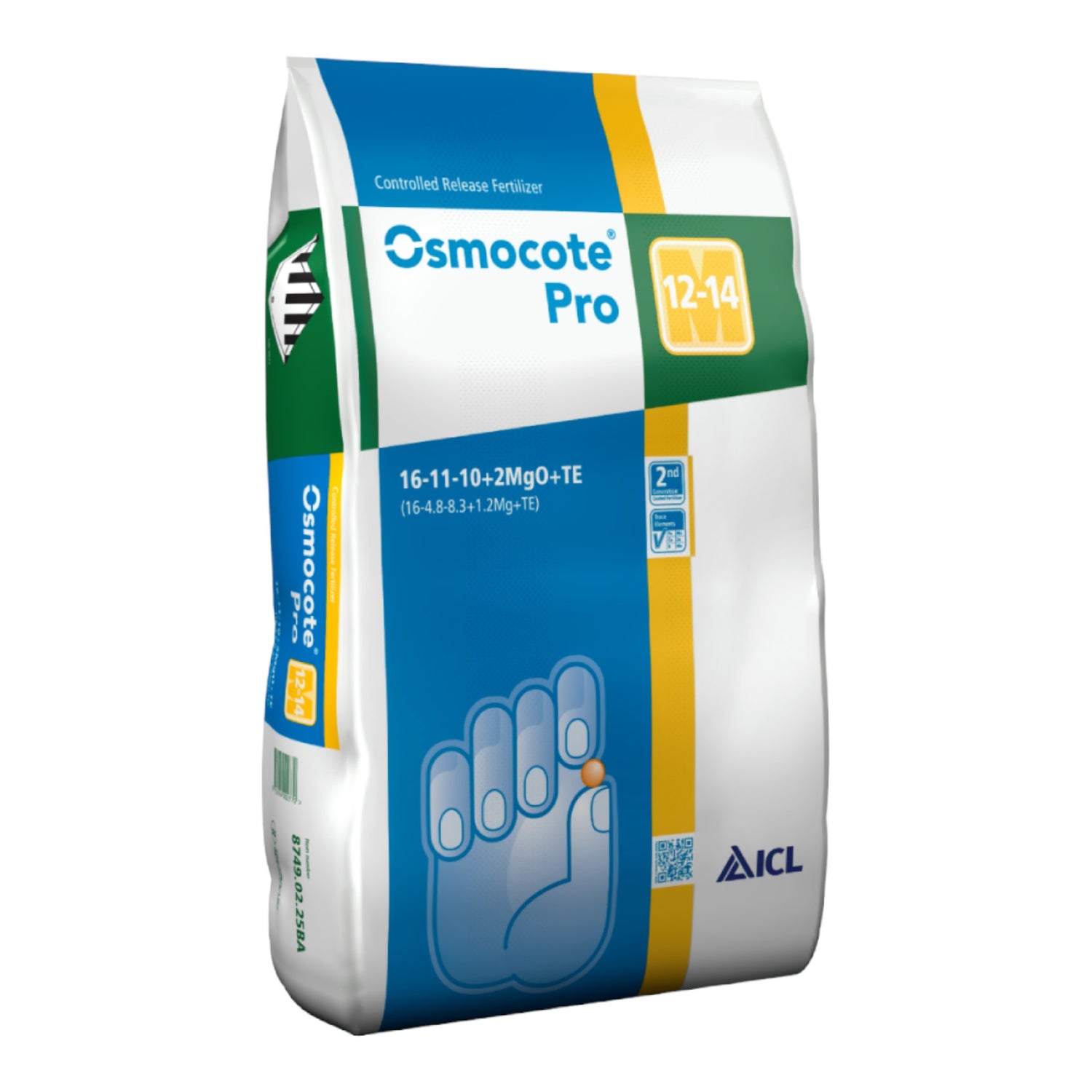
Unit price perICL Osmocote Pro 12-14 Months 18-9-10 2MgO+TE 25kg is a professional Osmocote Pro controlled-release fertiliser formulated for incorporation into growing media for container nursery stock.
Its resin-coated nutrients provide a measured supply over a nominal 12–14-month period at 21°C, helping growers match fertiliser longevity to their crop cycle.
Key benefits
Professional applications
Suitable for incorporation into growing media for container nursery stock. Plan nutrition around crop demand, irrigation water, substrate properties and any supplementary feeding.
How to apply
Mix granules evenly through the growing medium before potting, following the current manufacturer instructions. ICL advises against dibbling for the short-duration Pro variants; check the current instructions for the exact product before choosing any alternative application method.
Application rates & nutrient management
Container nursery stock: 3–4 g/L (light), 4–5 g/L (normal), 5–6 g/L (heavy).
Manufacturer rates are general recommendations for unfertilised substrates. Adjust to local growing conditions and other nutrient inputs. Trial programme changes on a small scale before wider adoption.
Storage & handling
Keep partly used bags sealed and store in dry conditions. Follow current ICL product information and safety guidance.
Technical specifications
| Manufacturer | ICL Growing Solutions |
|---|---|
| Range | Osmocote Pro controlled-release fertiliser |
| NPK (oxide basis) | 18-9-10 |
| Magnesium | 2% MgO |
| Trace elements | Included |
| Nominal longevity | 12–14 months at 21°C |
| Pack size | 25 kg |
| Typical application | incorporation into growing media for container nursery stock |
| Manufacturer guidance | Container nursery stock: 3–4 g/L (light), 4–5 g/L (normal), 5–6 g/L (heavy). |
Frequently asked questions
What is this fertiliser used for?
It is designed for incorporation into growing media for container nursery stock. What does the stated longevity mean?
ICL rates this product at 12–14 months at a growing-medium temperature of 21°C. Higher temperatures generally shorten the release period; lower temperatures extend it. Can it be combined with liquid feeding?
Yes, where the crop programme calls for it. Reduce the controlled-release fertiliser rate appropriately when adding water-soluble nutrients to avoid excessive total feeding. How should unused product be stored?
Reseal opened bags and store in dry conditions, following the manufacturer’s storage instructions. How do I select a rate?
Choose a rate according to crop demand, growing medium, container volume, season and any additional feeding. The published rates are general starting points for unfertilised substrates; trial changes on a small scale. Is this suitable for every crop?
No. Match the formulation and longevity to the crop, growing period and feeding requirements. How does temperature affect nutrient release?
Nutrient release generally speeds up at higher growing-medium temperatures and slows at lower temperatures.


£11.75
Unit price per£11.75
Unit price perBioCore Agri Hydrolysed Fish Blood & Bones - 1L is a concentrated liquid fish-based fertiliser for professional horticultural and growing applications.
Made from hydrolysed fish blood and bone, it provides an easy-to-apply liquid source of organic nutrients for use in suitable crop and soil-feeding programmes.
Key benefits
Liquid fish-based plant nutrition
Hydrolysed fish fertilisers provide organic nutrient inputs in a liquid format that can be incorporated into suitable soil and crop nutrition programmes. Use should be matched to crop requirements, existing soil fertility and any other fertilisers being applied.
Dilution & application
The currently published product information gives a dilution rate of 1.2ml per litre of water. Measure accurately and mix consistently. Where crop, soil or application conditions require a different programme, follow the current BioCore Agri label or technical guidance.
When introducing a new feed programme, monitor crop response and avoid assuming that more concentrated applications will produce better results.
Soil biology & nutrient management
Organic liquid fertilisers can form part of programmes focused on soil biological activity and nutrient cycling. Results depend on soil condition, crop, weather, irrigation and the wider nutrition strategy, so use the product as one component of crop management rather than in isolation.
Using alongside other fertilisers
Account for nutrients already supplied by the soil, growing medium, irrigation water and other fertilisers. Avoid unnecessary duplication of nutrient inputs and check compatibility before tank-mixing with other products.
Storage & handling
Store in the original container according to the current product instructions. Keep measuring and application equipment clean and rinse equipment appropriately after use. Follow any current label or safety information for handling and storage.
BioCore Agri Success Story
Want to see BioCore Agri in action? Read our BioCore Agri Success Story, featuring the 275kg prize-winning squash grown using BioCore Agri.
BioCore Agri Hydrolysed Fish Blood & Bones - 1L product details
| Brand | BioCore Agri |
|---|---|
| Product type | Hydrolysed fish blood & bone liquid fertiliser |
| Pack size | 1L |
| Published dilution rate | 1.2ml per litre of water |
| Application | Professional horticulture and crop nutrition |
BioCore Agri Hydrolysed Fish Blood & Bones - 1L FAQs
What is BioCore Agri Hydrolysed Fish Blood & Bones?
It is a concentrated liquid fertiliser made from hydrolysed fish blood and bone for suitable horticultural and crop applications. What dilution rate is published?
The currently published product information states 1.2ml per litre of water. Is this a liquid fertiliser?
Yes. It is supplied as a concentrated liquid. Can it be used as part of a soil-health programme?
It can form part of a wider nutrition and soil-management programme; crop response also depends on soil, irrigation, weather and other nutrient inputs. Can it be mixed with other fertilisers?
Check product compatibility before tank mixing and account for nutrients already supplied by other inputs. Should I increase the concentration for a stronger effect?
Do not assume that higher concentration is beneficial. Follow current product guidance and monitor crop response. How should it be measured?
Use suitable clean measuring equipment so the concentrate can be diluted consistently. How should it be stored?
Keep it in the original container and follow current product instructions for storage and handling. Is the 1L/10L size the selling unit?
Yes. This listing is for one 1L container.

Sinclair Fish, Blood & Bone 25kg — Organic-based general-purpose plant fertiliser for professional growing, planting and garden nutrition.
Selected for professional horticulture, nursery production and garden or landscape applications where the product suits the crop and growing conditions.
Key benefits
Organic-based plant nutrition
Sinclair Fish, Blood & Bone provides nitrogen, phosphate and potash in an organic-based formulation. The relatively high phosphate analysis can be useful where soil testing and crop requirements indicate a need for phosphate.
Applications in planting and growing
The manufacturer positions this as a general-purpose feed. Consider it for suitable planting and maintenance programmes, taking account of existing soil fertility, crop requirements and any other fertilisers already applied.
Application and precautions
Follow the current bag label for the application rate and timing; these are not specified here. Spread evenly, avoid direct concentrated contact with foliage, and wash fertiliser from leaves as Sinclair advises. Store securely and follow the packaging precautions.
Sinclair Fish, Blood & Bone 25kg product details
| Fertiliser type | Organic-based general-purpose fertiliser |
|---|---|
| NPK analysis | 3-9-3 |
| Bag size | 25kg |
| Pallet quantity | 39 bags |
| Manufacturer product reference | F1504471S |
Sinclair Fish, Blood & Bone 25kg FAQs
What is the NPK analysis?
Sinclair specifies 3-9-3. Is Fish, Blood & Bone an organic-based fertiliser?
Yes. Sinclair describes it as an organic-based general-purpose plant food; this does not itself establish certification for every organic production scheme. What does the higher phosphate content contribute?
Phosphate is important for root development and energy transfer in plants. Actual benefit depends on the crop and existing soil nutrient levels. Is it a complete replacement for soil testing?
No. A soil or substrate test can help determine whether phosphate or other nutrients are needed. What application rate should I use?
Follow the current Sinclair pack instructions for the crop and planting conditions. How is it supplied?
One 25kg bag; 39 bags per full pallet.

Sinclair Bonemeal 25kg — Natural organic, slow-acting fertiliser with a phosphate-rich analysis for planting and establishment.
Selected for professional horticulture, nursery production and garden or landscape applications where the product suits the crop and growing conditions.
Key benefits
Bonemeal for root establishment
Sinclair Bonemeal is a slow-acting organic plant food with a 3-9-0 NPK analysis. Phosphate supports root development, while the product supplies some nitrogen and no declared potash in the NPK analysis.
Tree, shrub and herbaceous planting
Sinclair identifies bonemeal as suitable for planting trees, shrubs and herbaceous plants. Match use to soil fertility and the plant species; adding phosphorus is not always necessary where soil levels are already sufficient.
Application and precautions
Follow the current bag label for the rate, placement and timing. Avoid leaving concentrated fertiliser against plant tissues, wash fertiliser from foliage as advised by Sinclair, and store securely.
Sinclair Bonemeal 25kg product details
| Fertiliser type | Natural organic slow-acting fertiliser |
|---|---|
| NPK analysis | 3-9-0 |
| Bag size | 25kg |
| Pallet quantity | 39 bags |
| Manufacturer product reference | F1504472S |
Sinclair Bonemeal 25kg FAQs
What is the NPK analysis of Sinclair Bonemeal?
The manufacturer specifies 3-9-0. Why is bonemeal used when planting trees and shrubs?
It supplies phosphate, an important nutrient for root development. Use should reflect soil nutrient levels and planting requirements. Is bonemeal fast acting?
Sinclair describes it as a slow-acting organic fertiliser. Does it supply potash?
The declared NPK analysis is 3-9-0, so no potash is declared in the NPK figure. How much should I apply?
Use the current Sinclair pack instructions and consider soil testing before adding phosphate. How is it supplied?
One 25kg bag; 39 bags per full pallet.

ICL Universol Hard Water 211 25kg is a professional water-soluble fertiliser for nitrogen-led growth feeding in hard irrigation water with elevated bicarbonates.
With a declared analysis of 23-10-10 + 2% MgO + trace elements, this formulation allows growers to select nutrition for a specific crop stage and irrigation-water profile.
ICL's Universol range uses its Bright Solution System and colour-coded formulations to help professional growers prepare consistent feeding programmes. Supplied in a 25kg bag.
Key benefits
Where this formulation fits
Use Hard Water 211 for nitrogen-led growth feeding in hard irrigation water with elevated bicarbonates. Crop response depends on the species, growth stage, root-zone conditions and the balance of nutrients already supplied by the growing medium and irrigation water.
This Hard Water product is designed for water with elevated bicarbonate levels; it should not be treated as interchangeable with a soft-water formulation.
Preparing & applying the feed
Dissolve the fertiliser in water using the current ICL mixing and application guidance for the product and your crop. Check irrigation-water analysis, including alkalinity and EC, when setting a fertigation programme.
Monitor stock solution clarity, feed EC and pH, crop growth and drainage. Avoid assuming a single concentration is appropriate for all crops or irrigation systems. Check concentrated stock-tank compatibility before mixing with other fertilisers, especially calcium-containing products.
Managing a professional nutrition programme
Consider how this water-soluble feed complements any controlled-release fertiliser already present in the substrate. Review nutrition as crops establish, grow and finish, rather than relying on a fixed recipe for the entire production period.
Store sealed in a dry area, protect from moisture and follow the current product label and safety information when handling fertilisers.
ICL Universol Hard Water 211 25kg product details
| Manufacturer | ICL Growing Solutions |
|---|---|
| Range | Universol Hard Water |
| Formulation | Hard Water 211 |
| NPK (N–P₂O₅–K₂O) | 23-10-10 |
| Magnesium oxide (MgO) | 2% |
| Micronutrients | Trace elements (TE) |
| Bag size | 25kg |
| Primary application | nitrogen-led growth feeding in hard irrigation water with elevated bicarbonates |
ICL Universol Hard Water 211 25kg FAQs
What is the NPK analysis?
The declared NPK analysis is 23-10-10 (N–P₂O₅–K₂O), with 2% MgO and trace elements. When is this formulation most useful?
It is designed for nitrogen-led growth feeding in hard irrigation water with elevated bicarbonates. Select it in the context of your wider nutrition programme. Can I use it through fertigation?
Universol is a water-soluble fertiliser range used in professional feeding programmes. Confirm your irrigation equipment, stock-tank dilution and water quality are suitable. How do I choose a feeding concentration?
Base the concentration on crop demand, water analysis, substrate EC and the current manufacturer recommendations; monitor the feed solution and crop response. Can it be mixed with other fertilisers?
Do not assume all products are compatible in a concentrated stock tank. Follow the ICL product-specific mixing guidance and conduct a compatibility check before changing the programme. How should I store an opened bag?
Keep it sealed in a cool, dry place and prevent moisture entering the bag. Is this suitable for rainwater or very soft water?
This formulation is developed for hard irrigation water. Check water alkalinity and consult ICL guidance before using it with soft or rainwater.
£136.36
Unit price per£136.36
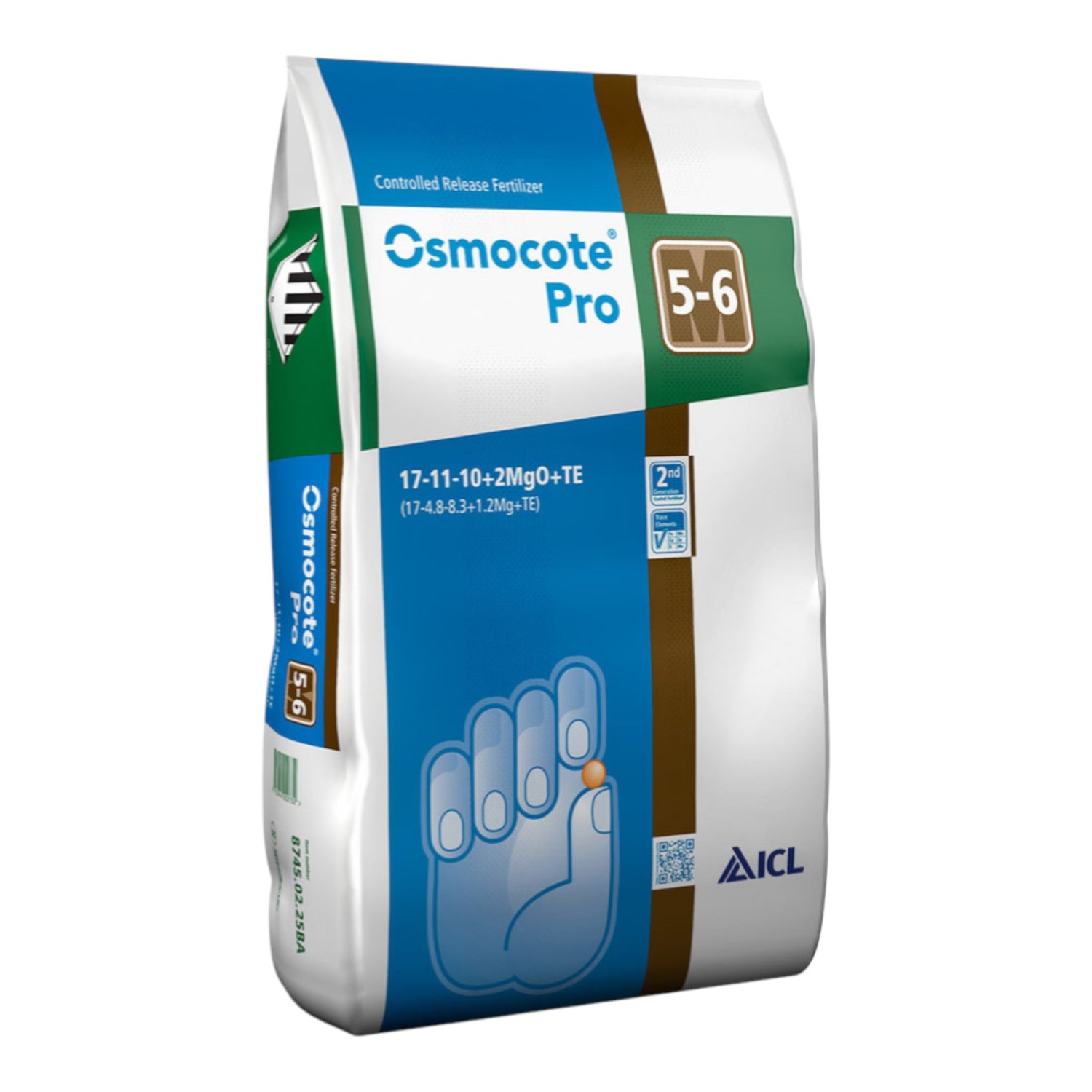
Unit price perICL Osmocote Pro 5–6M is a professional controlled-release fertiliser with an NPK analysis of 19-9-10, 2% MgO and trace elements, supplied in a 25kg bag.
Its fully coated nutrient granules are designed to provide sustained nutrition over a predefined 5–6 months longevity period, making this version suited to professional container production where the crop cycle matches the stated release period.
Key benefits
Verified nutrient analysis
The current ICL product information states 19% total nitrogen, 9% P₂O₅, 10% K₂O and 2% MgO, together with trace elements. This page uses the current 19-9-10 analysis rather than relying on older or market-specific product information.
For medium-duration container production
ICL specifies a 5–6 month longevity for this Osmocote Pro formulation. This makes it suitable for professional container crops where sustained nutrition is required across a medium-duration production cycle, subject to crop requirements and growing conditions.
Using controlled-release fertiliser
Choose the product longevity and application rate according to crop species, container size, production period, growing-medium fertility, irrigation regime and supplementary feeding programme. Controlled-release fertiliser should be distributed consistently through or applied to the growing medium using a method appropriate to the crop and production system.
Avoid damaging coated granules during mechanical handling or application, as damage to the coating can alter nutrient release.
Temperature & nutrient release
Controlled-release fertiliser performance is influenced by growing conditions, particularly temperature. Crop nutrient demand also changes with growth rate, irrigation and season, so monitor crop response rather than assuming the stated longevity alone guarantees the correct nutrition programme.
Integrating with irrigation & water-soluble feeding
Account for nutrients already supplied by irrigation water, growing media and any supplementary fertiliser. Where water-soluble feeds are also used, adjust the overall programme to avoid unnecessary nutrient loading.
Storage & handling
Store fertiliser dry and protected from contamination and physical damage. Follow the current ICL product information and safety data sheet for handling, application and storage requirements.
ICL Osmocote Pro 5–6M 19-9-10 + 2MgO + TE - 25kg product details
| Brand | ICL |
|---|---|
| Range | Osmocote Pro |
| Product type | Controlled-release fertiliser |
| Longevity | 5–6 months |
| NPK | 19-9-10 |
| Magnesium | 2% MgO |
| Trace elements | Yes |
| Pack size | 25kg |
ICL Osmocote Pro 5–6M 19-9-10 + 2MgO + TE - 25kg FAQs
What is the stated longevity?
This version has a stated controlled-release longevity of 5–6 months. What is the NPK analysis?
The current ICL product information states 19-9-10. Does it contain magnesium?
Yes. The stated analysis includes 2% MgO. Does Osmocote Pro contain trace elements?
Yes. This formulation includes trace elements. Is the 25kg bag the selling unit?
Yes. This product is supplied as one 25kg bag. How do I choose an application rate?
Base the rate on the crop, container, growing medium, production period and wider feeding programme, following current ICL guidance. Does temperature affect nutrient release?
Yes. Controlled-release fertiliser performance is influenced by growing conditions, including temperature. Can it be used alongside water-soluble fertiliser?
It can form part of a wider nutrition programme, but account for all nutrient sources and avoid unnecessary overfeeding. Can coated granules be damaged?
Yes. Avoid crushing or damaging the coating during handling or application because this can affect nutrient release. Where should I check current technical guidance?
Use the current ICL product information and safety data sheet for the exact product and intended crop.

£19.95
Unit price per£19.95
Unit price perA highly concentrated water-soluble Grow component for the Advanced Nutrients Cultivator Series three-part base nutrient system.
Advanced Nutrients Cultivator Series Grow is a professional soluble powder nutrient designed to work alongside Cultivator Series Base during vegetative growth. Rather than transporting and storing large volumes of liquid concentrate, growers can accurately weigh the dry powder as required and dissolve it into their nutrient solution.
Cultivator Series has been developed with larger and more technically managed growing environments in mind, but its straightforward mixing rate also makes the 1kg bag practical for smaller growers who want the efficiency and control of a professional powdered nutrient programme.
Grow is not intended to be used as a standalone complete feed. During vegetative growth it is combined with Cultivator Series Base, with both components contributing to the final nutrient profile supplied to the crop.
Why choose Advanced Nutrients Cultivator Series Grow?
What is Cultivator Series Grow suitable for?
Cultivator Series Grow is intended for the vegetative phase, when plants are establishing and developing their main root, leaf and structural growth before flowering.
It is used together with Cultivator Series Base rather than on its own. This two-component vegetative combination forms part of the wider three-part Cultivator Series programme, with Cultivator Series Bloom used as the crop moves into flowering.
Advanced Nutrients identifies the Cultivator Series for indoor and outdoor production, regular watering, watering systems, hydroponics and coco coir. Its soluble powder format is particularly useful where accurate, repeatable nutrient preparation and efficient storage are priorities.
How to use Cultivator Series Grow
During vegetative growth, use Cultivator Series Grow together with Cultivator Series Base. Advanced Nutrients' current Cultivator Series programme specifies 4g per US gallon of Grow and 4g per US gallon of Base.
For UK growers, this is approximately 1.06g/L of Grow and 1.06g/L of Base. As a practical metric guide, this works out at approximately 10.6g of each component for 10L, 52.8g of each for 50L and 105.7g of each for 100L.
Measure each powder accurately and dissolve it thoroughly into the water. Do not combine concentrated dry fertilisers together before dilution. Each component should be properly dispersed in the nutrient solution as part of the complete Cultivator Series programme.
As the crop moves from vegetative growth into flowering, follow the Cultivator Series flowering programme rather than continuing the vegetative Grow and Base combination unchanged.
Advanced Nutrients Cultivator Series Grow 1kg product details
| Product | Advanced Nutrients Cultivator Series Grow |
|---|---|
| Product type | Vegetative base nutrient component |
| Product size | 1kg |
| Format | Water-soluble powder |
| NPK shown on this product | 2-8-24 |
| Nutrient system | Three-part Cultivator Series |
| Vegetative combination | Cultivator Series Grow + Cultivator Series Base |
| Manufacturer vegetative rate | 4g/US gal Grow + 4g/US gal Base |
| Approximate metric rate | 1.06g/L Grow + 1.06g/L Base |
| 10L solution | Approx. 10.6g Grow + 10.6g Base |
| 50L solution | Approx. 52.8g Grow + 52.8g Base |
| 100L solution | Approx. 105.7g Grow + 105.7g Base |
| Application stage | Vegetative growth |
| Hydroponics | Suitable |
| Coco coir | Suitable |
| Growing environment | Indoor & outdoor |
| European pack size | 1kg |
Advanced Nutrients Cultivator Series Grow FAQs
What is Advanced Nutrients Cultivator Series Grow?
Cultivator Series Grow is the vegetative Grow component of Advanced Nutrients' three-part water-soluble powder base nutrient system. During vegetative growth it is used together with Cultivator Series Base.
Is Cultivator Series Grow a complete standalone fertiliser?
No. Cultivator Series Grow forms part of the Cultivator Series three-part nutrient programme and is used with Cultivator Series Base during vegetative growth.
How much Cultivator Series Grow should I use?
Advanced Nutrients' current vegetative programme specifies 4g per US gallon of Cultivator Series Grow together with 4g per US gallon of Cultivator Series Base. This is approximately 1.06g/L of each component.
How much Cultivator Series Grow do I need for 10 litres?
The manufacturer's 4g per US gallon rate converts to approximately 10.6g of Cultivator Series Grow for 10 litres of water. Use approximately the same amount of Cultivator Series Base as part of the vegetative programme.
How much Cultivator Series Grow do I need for a 100L reservoir?
At the manufacturer's current rate, a 100L reservoir requires approximately 105.7g of Cultivator Series Grow together with approximately 105.7g of Cultivator Series Base.
When should I use Cultivator Series Grow?
Use Cultivator Series Grow during vegetative development as part of the Cultivator Series Grow and Base combination. Follow the Cultivator Series flowering programme once the crop moves into its flowering phase.
Can Cultivator Series Grow be used in hydroponics?
Yes. Advanced Nutrients identifies Cultivator Series as suitable for hydroponic growing and watering systems.
Can Cultivator Series Grow be used in coco?
Yes. Advanced Nutrients specifically identifies the Cultivator Series as coco coir safe.
Why use a powdered nutrient instead of a liquid nutrient?
A concentrated water-soluble powder reduces the amount of water being stored and transported as part of the nutrient concentrate. It also allows growers to weigh precise quantities for repeatable reservoir preparation.
What other products make up the Cultivator Series?
The core Cultivator Series consists of Grow, Base and Bloom. Grow and Base are used together during vegetative development, with the nutrient combination changing as the crop progresses into flowering.
What sizes of Cultivator Series are available in Europe?
Advanced Nutrients currently lists Cultivator Series in 1kg and 10kg bags for the European market.

£331.08
Unit price per£331.08
Unit price perAtami Bloombastic 5.5L is a highly concentrated PK 14-15 all-in-one bloom and ripening additive developed to support dense flower development, increased sugar production, enhanced aroma and a strong finish during the final stages of flowering.
Bloombastic is Atami's award-winning all-in-one bloom additive, developed for the final 4-6 weeks of flowering and ripening. It combines the functions of a bloom stimulator, hardener, taste enhancer and activator of various enzymatic processes, providing concentrated support as flowering and fruiting crops move towards maturity.
With a powerful PK 14-15 W/W formulation, Bloombastic supplies high levels of phosphorus and potassium during the period when productive crops have significant demand for these important flowering nutrients. Atami states that Bloombastic contains more than 50% more bio-minerals in the form of phosphorus and potassium than other liquid flowering products.
No ballast substances such as sodium or chlorine are used. The concentrated formulation is designed to encourage sugar and flower production, supporting the development of thicker, denser and more aromatic flowers during the final stages of the crop cycle.
Applied at only 0.5-1ml/L, the professional 5.5L format is particularly economical for commercial growers, larger irrigation systems and high-volume nutrient reservoirs.
Why choose Atami Bloombastic?
What is Atami Bloombastic suitable for?
Bloombastic can be used with a wide range of flowering and fruiting plants, including vegetables, fruits, herbs and ornamental flowering crops. Atami gives examples including chilli peppers, strawberries and blueberries, as well as flowering plants such as orchids and violets.
It is suitable for cultivation in Hydro, Coco and Soil and can be incorporated into different substrate and irrigation systems.
Bloombastic is specifically intended for established flowering crops approaching the later stages of flower and fruit development. It is not a vegetative growth additive or complete base fertiliser.
Crop development should determine application timing rather than relying entirely on fixed calendar weeks. Atami recommends Bloombastic for the final 4-6 weeks of flowering and ripening, so crops with different flowering durations will naturally begin the programme at different points.
How to use Atami Bloombastic
Apply Bloombastic during the final 4-6 weeks of flowering and ripening in combination with your basic nutrients. Use 0.5-1ml per litre of water or nutrient solution, adjusting the overall nutrient programme according to crop requirements.
At 0.5ml/L, use 5ml for 10L, 25ml for 50L, 50ml for 100L, 250ml for 500L and 500ml for a 1,000L nutrient reservoir.
At 1ml/L, use 10ml for 10L, 50ml for 50L, 100ml for 100L, 500ml for 500L and 1L for a 1,000L nutrient reservoir.
A 5.5L container therefore prepares approximately 11,000 litres of nutrient solution at 0.5ml/L or 5,500 litres at 1ml/L.
Bloombastic increases the EC value of the basic nutrient solution, so EC should be monitored during use. Take the strength of the base nutrient and other additives into account when preparing the final solution.
Bloombastic can be combined with a bloom stimulator such as B'cuzz Bloom Stimulator where additional flowering-phase stimulation is required.
Important: Do not combine Bloombastic with another PK nutrient. Atami advises that this is unnecessary and can increase the risk of overfertilisation.
Understanding Bloombastic PK 14-15
Bloombastic provides a concentrated but relatively balanced combination of phosphorus and potassium, with a PK analysis of 14-15 W/W.
Phosphorus is involved in essential plant processes including energy transfer and reproductive development. Potassium contributes to numerous physiological functions associated with water regulation, nutrient movement and productive crop development.
During flowering and ripening, demand for these elements becomes increasingly important as the plant directs resources towards developing flowers and fruits.
Bloombastic combines this concentrated PK nutrition with its wider bloom-stimulating formulation, which is why Atami positions the product as an all-in-one flowering additive rather than simply a conventional PK fertiliser.
Bloombastic as part of a flowering programme
Bloombastic is designed to supplement rather than replace the plant's basic nutrient programme. Continue using an appropriate base nutrient for the chosen growing medium while introducing Bloombastic during the recommended flowering and ripening stages.
A bloom stimulator can also be incorporated where appropriate because a stimulator performs a different role from concentrated PK nutrition.
However, Bloombastic already provides a substantial PK 14-15 concentration. Adding another dedicated PK booster on top of it can create excessive phosphorus and potassium levels, which is why Atami specifically advises against combining Bloombastic with another PK nutrient.
Monitoring EC and crop response allows growers to account for the contribution made by both the base nutrient and Bloombastic rather than treating additives independently.
Atami Bloombastic 5.5L product details
| Brand | Atami |
|---|---|
| Product | Bloombastic |
| Product type | All-in-one bloom & ripening additive |
| Size | 5.5L |
| PK analysis | PK 14-15 W/W |
| Application rate | 0.5-1ml/L |
| Application period | Final 4-6 weeks of flowering & ripening |
| 10L nutrient solution | 5-10ml |
| 50L nutrient solution | 25-50ml |
| 100L nutrient solution | 50-100ml |
| 500L nutrient solution | 250-500ml |
| 1,000L nutrient solution | 500ml-1L |
| Approximate solution from 5.5L | 5,500L at 1ml/L or 11,000L at 0.5ml/L |
| Growing media | Hydro, Coco & Soil |
| Irrigation | Suitable for irrigation systems |
| Use with base nutrients | Yes |
| Use with bloom stimulator | Yes |
| Use with another PK nutrient | No - Atami advises against combining Bloombastic with another PK nutrient |
Atami Bloombastic 5.5L FAQs
What does Atami Bloombastic do?
Bloombastic is an all-in-one bloom and ripening additive designed to support plants during the final stages of flowering. It combines bloom stimulation, concentrated PK nutrition, flower hardening, taste enhancement and activation of various enzymatic processes.
What is the PK ratio of Atami Bloombastic?
Bloombastic has a PK 14-15 W/W analysis, providing high concentrations of both phosphorus and potassium during flowering and ripening.
When should I use Atami Bloombastic?
Atami recommends using Bloombastic during the final 4-6 weeks of flowering and ripening. Follow the actual development of the crop when determining the appropriate starting point.
How much Atami Bloombastic should I use?
Use 0.5-1ml per litre of water or nutrient solution alongside the crop's basic nutrients.
Does Bloombastic increase EC?
Yes. Bloombastic increases the EC of the basic nutrient solution because it contains concentrated mineral nutrition. Monitor EC and account for the strength of the complete feeding programme.
Can I use Bloombastic with my base nutrients?
Yes. Bloombastic is intended to be used in combination with appropriate basic nutrients during the flowering and ripening stages. It is not a complete base fertiliser on its own.
Can Bloombastic be used with Bloom Stimulator?
Yes. Atami states that Bloombastic can be combined with a bloom stimulator such as B'cuzz Bloom Stimulator because the products perform different roles within the flowering programme.
Can Bloombastic be used with another PK booster?
No. Atami advises against combining Bloombastic with another PK nutrient. Bloombastic already contains a concentrated PK 14-15 formulation, and additional PK supplementation can increase the risk of overfertilisation.
Can I use Bloombastic in coco?
Yes. Bloombastic is suitable for coco and coco-based growing systems when incorporated into an appropriate coco nutrient programme.
Can I use Bloombastic in hydroponics?
Yes. Bloombastic is suitable for hydroponic cultivation and can be added to the nutrient solution during the appropriate flowering and ripening stages.
Can I use Bloombastic in soil?
Yes. Bloombastic is suitable for soil-grown flowering and fruiting plants when used alongside an appropriate base nutrient programme.
What plants can Bloombastic be used on?
Bloombastic can be used with many flowering and fruiting crops. Atami gives examples including chilli peppers, strawberries and blueberries, along with flowering ornamental plants such as orchids and violets.
Does Bloombastic support sugar production?
Yes. Atami specifically positions Bloombastic to encourage sugar production during flowering, supporting crop weight, aroma and final flower or fruit development.
What is the difference between Bloombastic and Rokzbastic?
Bloombastic is an all-in-one PK 14-15 bloom additive with a relatively balanced phosphorus-to-potassium profile. Rokzbastic is a PK 10-20 late-flowering booster with twice as much potassium as phosphorus. They have different formulations and should not be stacked together as additional PK products.
How much nutrient solution will 5.5L of Bloombastic make?
A 5.5L container makes approximately 5,500 litres at 1ml/L or 11,000 litres at 0.5ml/L, making this size particularly suitable for professional and high-volume cultivation.

£93.59
Unit price per£93.59
Unit price perAtami Bloombastic 1.25L is a highly concentrated PK 14-15 all-in-one bloom and ripening additive developed to support dense flower development, increased sugar production, enhanced aroma and a strong finish during the final stages of flowering.
Bloombastic is Atami's award-winning all-in-one bloom additive, developed for the final 4-6 weeks of flowering and ripening. It combines the functions of a bloom stimulator, hardener, taste enhancer and activator of various enzymatic processes, providing concentrated support as flowering and fruiting crops move towards maturity.
With a powerful PK 14-15 W/W formulation, Bloombastic supplies high levels of phosphorus and potassium during the period when productive crops have significant demand for these important flowering nutrients. Atami states that Bloombastic contains more than 50% more bio-minerals in the form of phosphorus and potassium than other liquid flowering products.
No ballast substances such as sodium or chlorine are used. The concentrated formulation is designed to encourage sugar and flower production, supporting the development of thicker, denser and more aromatic flowers during the final stages of the crop cycle.
Applied at only 0.5-1ml/L, the 1.25L bottle can prepare approximately 1,250-2,500 litres of nutrient solution, making it an economical choice for medium to larger growing systems and nutrient reservoirs.
Why choose Atami Bloombastic?
What is Atami Bloombastic suitable for?
Bloombastic can be used with a wide range of flowering and fruiting plants, including vegetables, fruits, herbs and ornamental flowering crops. Atami gives examples including chilli peppers, strawberries and blueberries, as well as flowering plants such as orchids and violets.
It is suitable for cultivation in Hydro, Coco and Soil and can be incorporated into different substrate and irrigation systems.
Bloombastic is specifically intended for established flowering crops approaching the later stages of flower and fruit development. It is not a vegetative growth additive or complete base fertiliser.
Crop development should determine application timing rather than relying entirely on fixed calendar weeks. Atami recommends Bloombastic for the final 4-6 weeks of flowering and ripening, so crops with different flowering durations will naturally begin the programme at different points.
How to use Atami Bloombastic
Apply Bloombastic during the final 4-6 weeks of flowering and ripening in combination with your basic nutrients. Use 0.5-1ml per litre of water or nutrient solution, adjusting the overall nutrient programme according to crop requirements.
At 0.5ml/L, use 5ml for 10L, 25ml for 50L, 50ml for 100L, 250ml for 500L and 500ml for a 1,000L nutrient reservoir.
At 1ml/L, use 10ml for 10L, 50ml for 50L, 100ml for 100L, 500ml for 500L and 1L for a 1,000L nutrient reservoir.
A 1.25L bottle therefore prepares approximately 2,500 litres of nutrient solution at 0.5ml/L or 1,250 litres at 1ml/L.
Bloombastic increases the EC value of the basic nutrient solution, so EC should be monitored during use. Take the strength of the base nutrient and other additives into account when preparing the final solution.
Bloombastic can be combined with a bloom stimulator such as B'cuzz Bloom Stimulator where additional flowering-phase stimulation is required.
Important: Do not combine Bloombastic with another PK nutrient. Atami advises that this is unnecessary and can increase the risk of overfertilisation.
Understanding Bloombastic PK 14-15
Bloombastic provides a concentrated but relatively balanced combination of phosphorus and potassium, with a PK analysis of 14-15 W/W.
Phosphorus is involved in essential plant processes including energy transfer and reproductive development. Potassium contributes to numerous physiological functions associated with water regulation, nutrient movement and productive crop development.
During flowering and ripening, demand for these elements becomes increasingly important as the plant directs resources towards developing flowers and fruits.
Bloombastic combines this concentrated PK nutrition with its wider bloom-stimulating formulation, which is why Atami positions the product as an all-in-one flowering additive rather than simply a conventional PK fertiliser.
Bloombastic as part of a flowering programme
Bloombastic is designed to supplement rather than replace the plant's basic nutrient programme. Continue using an appropriate base nutrient for the chosen growing medium while introducing Bloombastic during the recommended flowering and ripening stages.
A bloom stimulator can also be incorporated where appropriate because a stimulator performs a different role from concentrated PK nutrition.
However, Bloombastic already provides a substantial PK 14-15 concentration. Adding another dedicated PK booster on top of it can create excessive phosphorus and potassium levels, which is why Atami specifically advises against combining Bloombastic with another PK nutrient.
Monitoring EC and crop response allows growers to account for the contribution made by both the base nutrient and Bloombastic rather than treating additives independently.
Atami Bloombastic 1.25L product details
| Brand | Atami |
|---|---|
| Product | Bloombastic |
| Product type | All-in-one bloom & ripening additive |
| Size | 1.25L |
| PK analysis | PK 14-15 W/W |
| Application rate | 0.5-1ml/L |
| Application period | Final 4-6 weeks of flowering & ripening |
| 10L nutrient solution | 5-10ml |
| 50L nutrient solution | 25-50ml |
| 100L nutrient solution | 50-100ml |
| 500L nutrient solution | 250-500ml |
| 1,000L nutrient solution | 500ml-1L |
| Approximate solution from 1.25L | 1,250L at 1ml/L or 2,500L at 0.5ml/L |
| Growing media | Hydro, Coco & Soil |
| Irrigation | Suitable for irrigation systems |
| Use with base nutrients | Yes |
| Use with bloom stimulator | Yes |
| Use with another PK nutrient | No - Atami advises against combining Bloombastic with another PK nutrient |
| Outer case quantity | 12 x 1.25L bottles |
Atami Bloombastic 1.25L FAQs
What does Atami Bloombastic do?
Bloombastic is an all-in-one bloom and ripening additive designed to support plants during the final stages of flowering. It combines bloom stimulation, concentrated PK nutrition, flower hardening, taste enhancement and activation of various enzymatic processes.
What is the PK ratio of Atami Bloombastic?
Bloombastic has a PK 14-15 W/W analysis, providing high concentrations of both phosphorus and potassium during flowering and ripening.
When should I use Atami Bloombastic?
Atami recommends using Bloombastic during the final 4-6 weeks of flowering and ripening. Follow the actual development of the crop when determining the appropriate starting point.
How much Atami Bloombastic should I use?
Use 0.5-1ml per litre of water or nutrient solution alongside the crop's basic nutrients.
Does Bloombastic increase EC?
Yes. Bloombastic increases the EC of the basic nutrient solution because it contains concentrated mineral nutrition. Monitor EC and account for the strength of the complete feeding programme.
Can I use Bloombastic with my base nutrients?
Yes. Bloombastic is intended to be used in combination with appropriate basic nutrients during flowering and ripening. It is not a complete base fertiliser on its own.
Can Bloombastic be used with Bloom Stimulator?
Yes. Atami states that Bloombastic can be combined with a bloom stimulator such as B'cuzz Bloom Stimulator because the products perform different roles within the flowering programme.
Can Bloombastic be used with another PK booster?
No. Atami advises against combining Bloombastic with another PK nutrient. Bloombastic already contains a concentrated PK 14-15 formulation, and additional PK supplementation can increase the risk of overfertilisation.
Can I use Bloombastic in coco?
Yes. Bloombastic is suitable for coco and coco-based growing systems when incorporated into an appropriate coco nutrient programme.
Can I use Bloombastic in hydroponics?
Yes. Bloombastic is suitable for hydroponic cultivation and can be added to the nutrient solution during the appropriate flowering and ripening stages.
Can I use Bloombastic in soil?
Yes. Bloombastic is suitable for soil-grown flowering and fruiting plants when used alongside an appropriate base nutrient programme.
What plants can Bloombastic be used on?
Bloombastic can be used with many flowering and fruiting crops. Atami gives examples including chilli peppers, strawberries and blueberries, along with flowering ornamental plants such as orchids and violets.
Does Bloombastic support sugar production?
Yes. Atami specifically positions Bloombastic to encourage sugar production during flowering, supporting crop weight, aroma and final flower or fruit development.
What is the difference between Bloombastic and Rokzbastic?
Bloombastic is an all-in-one PK 14-15 bloom additive with a relatively balanced phosphorus-to-potassium profile. Rokzbastic is a PK 10-20 late-flowering booster with twice as much potassium as phosphorus. They have different formulations and should not be stacked together as additional PK products.
How much nutrient solution will a 1.25L bottle of Bloombastic make?
A 1.25L bottle prepares approximately 1,250 litres at 1ml/L or 2,500 litres at 0.5ml/L.
How many 1.25L bottles of Atami Bloombastic are in a full case?
A full outer case contains 12 x 1.25L bottles of Atami Bloombastic.

£25.70
Unit price per£25.70
Unit price perAtami B'cuzz Soil A&B 5L is a concentrated two-part mineral base nutrient developed specifically for plants grown in soil and soil-based substrates, providing the essential nutrition required throughout the complete growth and flowering cycle.
Designed as the nutritional foundation of the B'cuzz soil feeding programme, Soil A&B supplies a broad range of essential mineral nutrients to support strong, healthy plant development from vegetative growth through flowering and ripening.
The formula is divided between two concentrates because certain nutrients can react with each other when stored together at high concentration. Soil A and Soil B should therefore never be mixed together in concentrated form. Each component should be added separately to water or nutrient solution.
Soil A provides an NK 3-3 W/W analysis, while Soil B provides PK 3-4 W/W. Together they form the complete B'cuzz Soil base nutrient programme and can be adjusted according to the crop's stage of development and the nutrient content already present in the substrate.
This 5L A&B set provides 5 litres of Soil A and 5 litres of Soil B, giving growers 10 litres of concentrated two-part base nutrient in total.
Why choose Atami B'cuzz Soil A&B?
What is B'cuzz Soil A&B suitable for?
B'cuzz Soil A&B is designed specifically for soil and soil-based growing substrates. It can be used throughout the complete crop cycle rather than requiring separate base fertilisers for vegetative and flowering growth.
Atami gives examples including vegetables, fruits and herbs such as courgettes, beans and thyme, together with indoor and container-grown ornamental plants including Delphinium and ornamental grasses.
Because soil substrates vary considerably in their existing nutrient content, the appropriate dosage depends partly on whether the crop is planted into a lightly fertilised or heavily fertilised substrate.
A nutrient-rich potting compost requires less additional base fertiliser than a lightly fertilised substrate. The grower should therefore consider both crop demand and the starting nutrient charge of the growing medium.
Why does Soil Nutrition come in A & B parts?
Two-part nutrients are separated for chemical stability. At the concentration found inside the original bottles, some mineral elements can react with one another and form compounds that are less available to plants.
Separating the formulation into Soil A and Soil B allows these nutrients to remain stable during storage. Once each concentrate is sufficiently diluted in water, the two parts can safely form the complete nutrient solution.
For this reason, never pour concentrated Soil A directly into concentrated Soil B.
Add Part A to the required volume of water and mix thoroughly. Part B can then be added separately and mixed into the diluted nutrient solution.
Soil A NK 3-3 & Soil B PK 3-4
B'cuzz Soil A and B divide the crop's mineral nutrition between two complementary concentrates.
Soil A has an NK analysis of 3-3 W/W. Atami's technical information identifies Part A as supplying nitrogen, calcium and micronutrients alongside its potassium contribution.
Soil B has a PK analysis of 3-4 W/W, providing phosphorus and potassium alongside additional micronutrients to complete the base feeding programme.
Nitrogen is particularly important during active vegetative development, while phosphorus and potassium become increasingly important as plants progress through reproductive growth, flowering and fruit development.
Atami therefore notes that growers can adjust the relative dosage, using slightly more A during vegetative growth or slightly more B during flowering where crop requirements justify doing so.
How to use Atami B'cuzz Soil A&B
The correct application rate depends on the nutrient content of the growing substrate.
For heavily fertilised potting compost, Atami recommends 1-3ml of Soil A and 1-3ml of Soil B per litre of water.
For lightly fertilised potting compost, Atami recommends 1-5ml of Soil A and 1-5ml of Soil B per litre of water.
For example, at 3ml/L of each component, a 10L nutrient solution requires 30ml A + 30ml B, a 50L reservoir requires 150ml A + 150ml B and a 100L reservoir requires 300ml A + 300ml B.
Add Soil A to the water first and mix thoroughly. Add Soil B separately and mix again. Never combine the undiluted A and B concentrates directly.
Nutrient demand changes according to crop species, plant size, substrate, environmental conditions and light intensity. Start with an appropriate concentration for the substrate being used and adjust according to plant response and measured EC.
Using Soil A&B through the crop cycle
One of the main advantages of B'cuzz Soil A&B is that it can provide the base nutrition throughout growth, early flowering, flowering and ripening.
Atami's current soil grow guide varies the amount of A&B according to crop stage rather than treating one dosage as correct throughout the entire cycle. This allows nutrient concentration to follow the changing requirements of the plant.
The base nutrient can then be supplemented with appropriate products from the wider Atami programme where required, including root stimulators, bloom stimulators, silicon, CalMag and flowering additives.
These additional products do not replace Soil A&B. The A&B combination remains the nutritional foundation of the feeding programme, while stimulators and additives perform more specialised functions.
Atami B'cuzz Soil A&B 5L product details
| Brand | Atami |
|---|---|
| Range | B'cuzz |
| Product | Soil A&B |
| Product type | Two-part mineral base nutrient |
| Pack size | 5L Soil A + 5L Soil B |
| Total concentrate | 10L |
| Soil A analysis | NK 3-3 W/W |
| Soil B analysis | PK 3-4 W/W |
| Heavily fertilised substrate | 1-3ml/L Soil A + 1-3ml/L Soil B |
| Lightly fertilised substrate | 1-5ml/L Soil A + 1-5ml/L Soil B |
| Suitable substrate | Soil & soil-based growing media |
| Crop stages | Growth, flowering & ripening |
| Indoor cultivation | Yes |
| Outdoor cultivation | Yes |
| Important mixing instruction | Never mix concentrated Soil A & Soil B directly together. Dilute in water. |
Atami B'cuzz Soil A&B 5L FAQs
What is Atami B'cuzz Soil A&B?
B'cuzz Soil A&B is a concentrated two-part mineral base nutrient formulated specifically for plants grown in soil and soil-based substrates. Together, Parts A and B provide the essential base nutrition required throughout the crop cycle.
Does the 5L B'cuzz Soil A&B set contain 5L of each part?
Yes. The set contains 5L of Soil A and 5L of Soil B, providing 10 litres of concentrated base nutrient across the two components.
What is the NPK of Atami Soil A&B?
The two components have separate analyses. Soil A is NK 3-3 W/W and Soil B is PK 3-4 W/W. They are designed to work together after dilution in water.
Why are Atami Soil A and B separate?
Certain mineral nutrients can chemically react when stored together at high concentration. Separating them into A and B components maintains stability until they are diluted into the nutrient solution.
Can I mix Soil A and Soil B together before adding water?
No. Never mix the concentrated A and B nutrients directly together. Add each component separately to water and mix thoroughly.
How much Atami Soil A&B should I use?
For heavily fertilised potting compost, Atami recommends 1-3ml/L of A and 1-3ml/L of B. For lightly fertilised potting compost, the range increases to 1-5ml/L of each component. Adjust the final concentration to crop requirements and EC.
Can I use B'cuzz Soil A&B throughout flowering?
Yes. Soil A&B is a complete base nutrient designed for use throughout the growth cycle, including vegetative growth, flowering and ripening.
Do I need separate grow and bloom base nutrients?
Not with this system. B'cuzz Soil A&B can be used throughout the complete crop cycle. Atami allows the relative amounts of A and B to be adjusted according to the plant's stage and requirements.
Can I use B'cuzz Soil A&B with Bloombastic?
Yes. Soil A&B provides the base nutrition while Bloombastic is a specialised flowering and ripening additive. Atami includes the products together in its official soil feeding programmes.
Can I use B'cuzz Soil A&B with Atami stimulators?
Yes. Soil A&B can form the base of a wider B'cuzz programme incorporating suitable root, bloom and silicon products according to crop stage and requirements.
Is Atami Soil A&B suitable for coco?
Soil A&B is specifically formulated for soil-based substrates. For plants grown primarily in coco coir, Atami produces the dedicated B'cuzz Coco A&B formulation.
Is Atami Soil A&B suitable for hydroponics?
Soil A&B is intended for soil-based substrates. Atami produces B'cuzz Hydro A&B specifically for hydroponic growing systems.
Can B'cuzz Soil A&B be used with pre-fertilised compost?
Yes, but the existing nutrient charge must be considered. Atami specifies a lower 1-3ml/L range for heavily fertilised compost and allows up to 1-5ml/L for lightly fertilised compost.
Can B'cuzz Soil A&B be used indoors and outdoors?
Yes. Atami specifies Soil A&B for both indoor and outdoor cultivation where plants are being grown in suitable soil-based substrates.
What plants can I feed with Atami Soil A&B?
It can be used with a wide range of soil-grown vegetables, fruiting plants, herbs and ornamentals. Atami gives examples including courgettes, beans, thyme, Delphinium and ornamental grasses.

£7.06
Unit price per£7.06
Unit price perAtami B'cuzz Hydro A&B 1L is a concentrated two-part mineral base nutrient developed specifically for hydroponic cultivation, providing the essential nutrition plants require for healthy development throughout the crop cycle.
Hydroponic growing gives the grower direct control over plant nutrition. Unlike fertilised soil and compost, hydroponic growing media generally provide relatively little stored nutrition, meaning plants depend heavily on the nutrient solution supplied to their roots.
B'cuzz Hydro A&B has been formulated specifically for these conditions. The two-part system supplies a balanced range of mineral nutrients and can provide the nutritional foundation from active vegetative development through flowering and ripening.
The formulation is divided between Hydro A and Hydro B because certain concentrated mineral nutrients can react with one another if stored or mixed together before dilution. Separating the concentrates maintains their stability until they are individually added to water.
This set provides 1L of Hydro A and 1L of Hydro B, giving 2 litres of concentrated base nutrient in total.
Why choose Atami B'cuzz Hydro A&B?
Base nutrition developed for hydroponic growing
Hydroponic growing media behave differently from fertilised soils and composts. In many hydro systems the growing medium provides physical support and suitable root-zone conditions but contributes relatively little stored nutrition.
The grower must therefore provide the crop with a carefully prepared nutrient solution containing the mineral elements required for healthy development.
B'cuzz Hydro A&B has been formulated specifically around these requirements, providing concentrated mineral nutrition for crops where the nutrient solution is the primary source of plant food.
Because the grower has direct control over the root-zone solution, accurate nutrient preparation together with appropriate EC and pH management is particularly important.
Why does Hydro Nutrition come in A & B?
Hydro A and Hydro B are two components of the same base nutrient. They are not separate growth and flowering fertilisers and should normally be used together.
Certain mineral nutrients can chemically react with one another when present together at high concentrations. These reactions can produce insoluble compounds, potentially reducing the availability of some nutrients to the plant.
Dividing the formulation between A and B keeps these concentrated components separate during storage.
When preparing a nutrient solution, add Hydro A to the water and mix thoroughly before adding Hydro B. Never mix concentrated Hydro A and Hydro B directly together.
Hydro A NK 5-5 & Hydro B PK 4-6
The European B'cuzz Hydro A&B formulation divides its mineral nutrition between two complementary concentrates.
Hydro A has an NK analysis of 5-5 W/W, while Hydro B has a PK analysis of 4-6 W/W.
The two components are designed to work together rather than independently, providing the base mineral nutrition required by the crop.
Feeding strength can then be adapted according to crop stage, plant condition, source water, environmental conditions and the EC of the complete nutrient solution.
How to use Atami B'cuzz Hydro A&B
Use 1-3ml of Hydro A and 1-3ml of Hydro B per litre of water, adjusting the concentration according to the crop and its stage of development.
Add the required amount of Hydro A to the reservoir or irrigation water and mix thoroughly. Then add the required amount of Hydro B and mix again.
Never combine the undiluted A and B concentrates directly.
At the general application range, a 10L reservoir requires 10-30ml of Hydro A plus 10-30ml of Hydro B. A 50L reservoir requires 50-150ml of each part, while a 100L reservoir requires 100-300ml of each part.
Each 1L component can prepare approximately 333-1,000 litres of nutrient solution, depending on whether the product is being used towards the upper or lower end of the application range.
Adjusting Hydro A&B through the crop cycle
Hydro A&B can provide base nutrition throughout the crop cycle, but plants do not require exactly the same nutrient concentration at every stage of development.
Atami's hydro feeding programme varies the concentration as crops progress through active vegetative development, early flowering, full flowering and ripening.
Younger plants and less demanding crops may require a weaker solution, while larger established plants can have a greater nutrient requirement.
The general 1-3ml/L range should therefore be treated as an adjustable application range rather than a requirement to feed every plant at the maximum concentration.
pH & EC management in hydroponics
Monitoring pH and EC is particularly useful in hydroponic cultivation because the nutrient solution has such a direct influence on the root environment.
Atami's hydro feeding guidance uses a nutrient-solution pH of approximately 5.5-5.8.
EC should be adapted according to crop stage, source water and the complete nutrient programme. When using additional additives or stimulators, their contribution to the final solution should also be taken into account.
Measure the complete nutrient solution after all required components have been added and thoroughly mixed.
Using Hydro A&B with the B'cuzz feeding programme
Hydro A&B forms the base nutrient within the B'cuzz hydroponic programme. Specialist additives can then be introduced according to the crop's stage of development.
During early establishment, growers may use products focused on root development. The programme can then progress towards products designed for vegetative development before flowering and ripening products are introduced later in the crop cycle.
Products such as B'cuzz Root Stimulator, bloom stimulators, Bloombastic or Rokzbastic perform different specialist roles and should not be considered replacements for Hydro A&B base nutrition.
When combining several nutrient products, monitor the final EC of the complete solution rather than considering each dosage independently.
Hydro A&B vs Soil A&B and Coco A&B
Atami produces different A&B base nutrients because hydroponic systems, soil-based substrates and coco coir have different nutritional characteristics.
B'cuzz Hydro A&B is formulated specifically for hydroponic cultivation where nutrition is supplied predominantly through the nutrient solution.
B'cuzz Soil A&B is formulated for soil and soil-based substrates, while B'cuzz Coco A&B is designed around the particular characteristics of coco coir.
Choosing the base nutrient designed for the growing medium helps provide a more appropriate nutritional foundation for the crop.
Atami B'cuzz Hydro A&B 1L product details
| Brand | Atami |
|---|---|
| Range | B'cuzz |
| Product | Hydro A&B |
| Product type | Two-part mineral base nutrient |
| Growing method | Hydroponics |
| Pack contents | 1L Hydro A + 1L Hydro B |
| Total concentrate | 2L |
| Hydro A analysis | NK 5-5 W/W |
| Hydro B analysis | PK 4-6 W/W |
| General dosage | 1-3ml/L Hydro A + 1-3ml/L Hydro B |
| 10L reservoir | 10-30ml A + 10-30ml B |
| 50L reservoir | 50-150ml A + 50-150ml B |
| 100L reservoir | 100-300ml A + 100-300ml B |
| Approximate solution from 1L of each part | Approximately 333-1,000L depending on application rate |
| Application period | Throughout the crop cycle |
| Hydro pH guidance | Approximately 5.5-5.8 |
| Mixing | Dilute A and B separately in water. Never mix the concentrates directly together. |
Atami B'cuzz Hydro A&B 1L FAQs
What is Atami B'cuzz Hydro A&B?
B'cuzz Hydro A&B is a two-part mineral base nutrient developed specifically for hydroponic cultivation. It supplies the nutritional foundation required for healthy plant development throughout the crop cycle.
Why is Atami Hydro Nutrition supplied as A and B?
Certain mineral nutrients can react when stored together at high concentration. Separating the formulation into Hydro A and Hydro B maintains stability until each component is diluted into water.
Do I use Hydro A and Hydro B together?
Yes. Hydro A and Hydro B are complementary parts of the same base nutrient. They are designed to be used together rather than as separate growth and flowering fertilisers.
Can I mix Hydro A and B concentrates together?
No. Never mix the concentrated A and B liquids directly together. Add Hydro A to the water and mix before adding Hydro B.
How much Atami Hydro A&B should I use?
The general application range is 1-3ml/L of Hydro A plus 1-3ml/L of Hydro B. Adjust the final concentration according to crop stage, plant demand, source water and EC.
Can Hydro A&B be used throughout flowering?
Yes. Hydro A&B can provide the base nutrition throughout growth, flowering and ripening, with the concentration adjusted as the crop develops.
What is the NPK of Atami Hydro A&B?
The European formulation lists Hydro A as NK 5-5 W/W and Hydro B as PK 4-6 W/W. The two parts are intended to work together.
What pH should I use with Atami Hydro A&B?
Atami's hydro feeding guidance uses approximately pH 5.5-5.8. The requirements of the individual crop and hydroponic system should also be considered.
Should I monitor EC with Hydro A&B?
Yes. Monitoring EC helps growers assess the overall concentration of dissolved mineral nutrients in the solution, particularly when additional additives and stimulators are being used.
Is Atami Hydro A&B suitable for vegetables and herbs?
Yes. Hydro A&B can be used with a broad range of hydroponically cultivated vegetables, herbs, fruiting crops and ornamental plants, with feeding strength adapted to the individual crop.
Is Hydro A&B the same as Soil A&B?
No. Hydro A&B is formulated for hydroponic cultivation, while Soil A&B is designed for soil and soil-based growing media.
Can I use Hydro A&B in coco?
Atami produces a dedicated B'cuzz Coco A&B formulation for coco cultivation. Where coco is the primary growing medium, the coco-specific base nutrient is the more appropriate Atami programme.
Can I use Atami additives with Hydro A&B?
Yes. Hydro A&B provides the base nutrition within the B'cuzz hydro programme and can be combined with appropriate Atami root, growth and flowering products according to crop stage. Monitor the final EC when combining nutrient products.
How much nutrient solution does the 1L Hydro A&B set make?
With 1L of each component, the set can prepare approximately 333-1,000 litres of nutrient solution across the general 1-3ml/L application range.

£57.12
Unit price per£57.12
Unit price perAtami B'cuzz Coco Booster Uni 5L is a concentrated growth and plant vitality booster developed specifically for crops grown in coco coir, supplying plant extracts, magnesium and iron during the important transition between rooting and flowering.
Coco is a highly responsive growing medium that allows growers to control plant nutrition closely through the irrigation solution. B'cuzz Coco Booster Uni has been developed specifically to complement this style of cultivation and forms part of Atami's dedicated B'cuzz Coco feeding programme.
The formulation contains plant extracts, magnesium and iron and is positioned between the initial rooting stage and flowering, providing additional support while the plant is undergoing rapid vegetative development.
Atami also highlights Coco Booster Uni for helping plants cope with environmental changes and supplying key elements involved in chlorophyll, making it particularly relevant during periods of vigorous above-ground growth.
The current Atami B'cuzz Coco grow guide uses Coco Booster Uni at 0.5ml/L. At this concentration, a 5L container can prepare approximately 10,000 litres of nutrient solution.
Why choose Atami B'cuzz Coco Booster Uni?
Developed specifically for growing in coco
Coco coir behaves differently from conventional soil and peat-based compost. It provides an excellent combination of water retention and root-zone aeration, but crop nutrition is largely controlled through the irrigation solution supplied by the grower.
This makes a coco-specific feeding programme particularly useful. Rather than treating coco as soil, growers can provide nutrition formulated around the characteristics of the medium and adjust feeding as the crop develops.
B'cuzz Coco Booster Uni forms part of Atami's dedicated coco programme alongside Coco A&B, Root Stimulator, Coco Bloom Stimulator and later-stage flowering products.
Support between rooting & flowering
Coco Booster Uni occupies a specific position within the crop cycle. Atami places it during the transition between the initial rooting period and flowering.
Once a young plant has established its root system, attention shifts towards vigorous vegetative development. Leaves, shoots and stems expand as the plant prepares for the reproductive stage.
Coco Booster Uni provides supplementary support during this period, complementing the main Coco A&B nutrition while the plant develops its above-ground structure.
As flowering begins, the B'cuzz programme introduces dedicated products such as Coco Bloom Stimulator to support the changing requirements of the crop.
Plant extracts, magnesium & iron
Atami identifies plant extracts, magnesium and iron as important components of B'cuzz Coco Booster Uni.
Magnesium is an essential plant nutrient and forms part of the chlorophyll molecule itself. Chlorophyll allows plants to capture light energy for photosynthesis, making adequate magnesium nutrition particularly important during periods of active leaf development.
Iron is an essential micronutrient involved in several important plant processes and is closely associated with normal chlorophyll formation and healthy green growth.
These components supplement the crop's main nutrition rather than replacing the complete mineral profile provided by a suitable coco base nutrient.
Support through environmental changes
Plants continually adapt to changes in their growing environment. Temperature, humidity, light intensity, irrigation frequency and nutrient concentration can all change during the crop cycle.
Atami positions Coco Booster Uni as providing support during environmental changes, particularly during the period of rapid development between rooting and flowering.
Coco Booster Uni should be used alongside good crop management rather than as a substitute for it. Appropriate irrigation, temperature, humidity, lighting, nutrient concentration, pH and root-zone conditions remain fundamental to healthy plant development.
How to use Atami B'cuzz Coco Booster Uni
Atami's current B'cuzz Coco grow guide uses 0.5ml of Coco Booster Uni per litre of water.
At this concentration, use 5ml for 10L, 25ml for 50L, 50ml for 100L, 250ml for 500L and 500ml for 1,000L of nutrient solution.
A 5L container can therefore prepare approximately 10,000 litres of nutrient solution at the current 0.5ml/L programme rate.
Atami notes that grow-guide dosages are indications and should be adapted according to plant species, plant condition, environment and light intensity. Growers should also use the final EC of the nutrient solution when adjusting feeding strength.
Where Coco Booster Uni fits in the B'cuzz Coco programme
B'cuzz Coco Booster Uni is not intended to replace the main base nutrient. Instead, it performs a specialist role within Atami's wider coco feeding programme.
During initial establishment, Root Stimulator can be used to support early root development. As the plant moves into active vegetative growth, Coco Booster Uni provides additional growth-stage support alongside Coco A&B.
When flower formation begins, B'cuzz Coco Bloom Stimulator can then be introduced to support the transition towards generative growth and flowering.
Later in the crop cycle, appropriate bloom and ripening additives can be incorporated according to the chosen Atami programme.
Coco Booster Uni vs Coco A&B
B'cuzz Coco Booster Uni and B'cuzz Coco A&B perform different roles and are designed to complement one another.
B'cuzz Coco A&B is the base nutrient, supplying the main mineral nutrition required throughout the crop cycle.
B'cuzz Coco Booster Uni is a supplementary booster containing plant extracts, magnesium and iron, used primarily during active growth and the transition towards flowering.
Coco Booster Uni should therefore be incorporated alongside an appropriate base nutrient rather than used as a standalone fertiliser.
Coco Booster Uni vs Coco Bloom Stimulator
These two B'cuzz products are designed for different stages of crop development.
Coco Booster Uni focuses on the period between rooting and flowering, supporting active growth and plant vitality.
Coco Bloom Stimulator is introduced as flower formation begins and is specifically designed to intensify flowering in crops grown in coco substrates.
Atami recommends combining Coco Bloom Stimulator with Coco Booster for optimum effect as the crop makes the transition into flowering.
5L Coco Booster Uni for commercial growing
The 5L format is particularly suitable for nurseries, larger coco growing systems and professional horticultural operations preparing significant quantities of nutrient solution.
At the current 0.5ml/L programme rate, one 5L container prepares approximately 10,000 litres of solution.
This concentrated application rate makes the 5L format practical for larger reservoirs and repeat crop production where Coco Booster Uni forms a regular part of the B'cuzz Coco programme.
Atami B'cuzz Coco Booster Uni 5L product details
| Brand | Atami |
|---|---|
| Range | B'cuzz |
| Product | Coco Booster Uni |
| Product type | Coco growth & plant vitality booster |
| Size | 5L |
| Growing medium | Coco & coco-based substrates |
| Key components | Plant extracts, magnesium & iron |
| Primary function | Supplementary support during active growth & transition towards flowering |
| Current programme dosage | 0.5ml/L |
| Application stage | Between initial rooting & flowering |
| 10L solution | 5ml |
| 50L solution | 25ml |
| 100L solution | 50ml |
| 500L solution | 250ml |
| 1,000L solution | 500ml |
| Approximate solution from 5L | 10,000L at 0.5ml/L |
| Use with base nutrient | Yes - designed to complement B'cuzz Coco A&B |
| Standalone base nutrient | No |
Atami B'cuzz Coco Booster Uni 5L FAQs
What is Atami B'cuzz Coco Booster Uni?
Coco Booster Uni is a supplementary booster developed specifically for coco cultivation. It contains plant extracts, magnesium and iron and is used to support plants during active growth and the transition towards flowering.
What does Coco Booster Uni contain?
Atami identifies plant extracts, magnesium and iron as key components of Coco Booster Uni.
When should I use Atami Coco Booster Uni?
Atami positions Coco Booster Uni during the period between initial rooting and flowering, when plants are undergoing active vegetative development and preparing for bloom.
How much Coco Booster Uni should I use?
Atami's current B'cuzz Coco programme uses 0.5ml/L. At this rate, a 5L container prepares approximately 10,000 litres of nutrient solution.
Is Coco Booster Uni a base nutrient?
No. Coco Booster Uni is a supplementary booster. B'cuzz Coco A&B provides the main base nutrition within Atami's coco feeding programme.
Can I use Coco Booster Uni with Coco A&B?
Yes. Coco Booster Uni is specifically designed to complement the B'cuzz Coco programme and can be used alongside Coco A&B.
Why does Coco Booster Uni contain magnesium?
Magnesium is an essential plant nutrient and forms part of the chlorophyll molecule, making it particularly important during periods of active photosynthesis and vegetative development.
Why is iron important for plants?
Iron is an essential micronutrient involved in important plant processes and normal chlorophyll formation, supporting healthy plant development.
Does Coco Booster Uni support plants through environmental changes?
Yes. Atami highlights support during environmental changes as one of the roles of its B'cuzz booster products. Suitable irrigation and environmental management should still remain the foundation of the crop programme.
Is Coco Booster Uni a root stimulator?
No. B'cuzz Root Stimulator is the dedicated early-stage rooting product. Coco Booster Uni follows the rooting stage and provides additional support during active vegetative development.
Is Coco Booster Uni the same as Coco Bloom Stimulator?
No. Coco Booster Uni supports active growth and the transition towards flowering. Coco Bloom Stimulator is specifically designed for the flowering stage and is introduced as flower formation begins.
Can Coco Booster Uni and Coco Bloom Stimulator be used together?
Yes. Atami specifically states that Coco Bloom Stimulator has an optimal effect when combined with B'cuzz Coco Booster as the crop progresses into flowering.
Should I monitor EC when using Coco Booster Uni?
Yes. Atami recommends using EC to guide nutrient adjustments because the correct concentration depends on plant type, crop condition, environment, light intensity and the complete feeding programme.
Is the 5L size suitable for commercial coco growing?
Yes. At 0.5ml/L, the 5L container prepares approximately 10,000 litres of solution, making it well suited to larger reservoirs, nurseries and commercial horticultural production.

£12.73
Unit price per£12.73
Unit price perAtami B'cuzz Coco Booster Uni 1L is a concentrated growth and plant vitality booster developed specifically for crops grown in coco coir, supplying plant extracts, magnesium and iron during the important transition between rooting and flowering.
Coco is a highly responsive growing medium that allows growers to control plant nutrition closely through the irrigation solution. B'cuzz Coco Booster Uni has been developed specifically to complement this style of cultivation and forms part of Atami's dedicated B'cuzz Coco feeding programme.
The formulation contains plant extracts, magnesium and iron and is positioned between the initial rooting stage and flowering, providing additional support while plants undergo rapid vegetative development.
Atami highlights Coco Booster Uni for helping plants through environmental changes and supplying key elements associated with chlorophyll and healthy plant development.
Atami's current B'cuzz Coco programme uses Coco Booster Uni at 0.5ml/L. At this concentration, a 1L bottle can prepare approximately 2,000 litres of nutrient solution.
Why choose Atami B'cuzz Coco Booster Uni?
Developed specifically for coco cultivation
Coco coir behaves differently from conventional soil and peat-based compost. It provides excellent water retention while maintaining a relatively open, well-aerated root environment.
Nutrition in coco is largely controlled through the irrigation solution supplied by the grower, making a dedicated coco feeding programme particularly useful.
Atami's B'cuzz Coco range has been developed around these characteristics. Coco Booster Uni forms part of this programme alongside Coco A&B, Root Stimulator, Coco Bloom Stimulator and appropriate later-stage flowering products.
Support between rooting & flowering
Coco Booster Uni occupies a specific position within the crop cycle. Atami places the product during the transition between initial root establishment and flowering.
Once plants have developed their early root systems, growth increasingly shifts towards leaves, shoots and stems as the crop establishes the above-ground structure required for later flowering and fruit development.
Coco Booster Uni provides supplementary support during this period while Coco A&B continues to provide the crop's main base nutrition.
As flowering develops, the wider B'cuzz programme introduces dedicated products such as Coco Bloom Stimulator to support the changing requirements of the crop.
Plant extracts, magnesium & iron
Atami identifies plant extracts, magnesium and iron as important components of B'cuzz Coco Booster Uni.
Magnesium is an essential plant nutrient and forms part of the chlorophyll molecule itself. Chlorophyll enables plants to absorb light energy for photosynthesis, making adequate magnesium nutrition particularly important during periods of active leaf development.
Iron is an essential micronutrient involved in several important plant processes and contributes to normal chlorophyll formation and healthy green growth.
These components supplement the crop's main nutritional programme rather than replacing the complete mineral nutrition supplied by a suitable coco base feed.
Support through changing growing conditions
Plants continually respond to changes within their growing environment. Light intensity, temperature, humidity, irrigation frequency and nutrient concentration can all change as a crop develops.
Atami positions Coco Booster Uni as providing additional support during environmental changes, particularly during the period of rapid development between rooting and flowering.
Coco Booster Uni should form part of good crop management rather than replacing it. Appropriate irrigation, root-zone conditions, temperature, humidity, lighting, nutrient concentration, pH and EC remain fundamental to healthy plant development.
How to use Atami B'cuzz Coco Booster Uni
Atami's current B'cuzz Coco grow guide uses 0.5ml of Coco Booster Uni per litre of water.
At this concentration, use 5ml for 10L, 25ml for 50L, 50ml for 100L, 250ml for 500L and 500ml for 1,000L of nutrient solution.
A 1L bottle can therefore prepare approximately 2,000 litres of nutrient solution at the current 0.5ml/L programme rate.
Feeding rates should still be considered alongside plant species, crop condition, environmental conditions, light intensity and the EC of the complete nutrient solution.
Where Coco Booster Uni fits in the B'cuzz Coco programme
B'cuzz Coco Booster Uni performs a specialist role within Atami's wider coco feeding programme rather than replacing the main base nutrient.
During initial establishment, B'cuzz Root Stimulator can be used to support early root development. As plants move into active vegetative growth, Coco Booster Uni provides additional growth-stage support alongside Coco A&B.
When flower formation begins, Coco Bloom Stimulator can be introduced to support the crop as its priorities move increasingly towards flowering and fruit development.
Later-stage bloom and ripening additives can then be incorporated where appropriate for the crop and chosen Atami feeding programme.
Coco Booster Uni vs Coco A&B
B'cuzz Coco Booster Uni and Coco A&B perform different roles and are designed to complement one another.
B'cuzz Coco A&B is the base nutrient, providing the main mineral nutrition required by plants grown in coco throughout the crop cycle.
B'cuzz Coco Booster Uni is a supplementary booster containing plant extracts, magnesium and iron, used to provide additional support during active growth and the transition towards flowering.
Coco Booster Uni should therefore be used alongside an appropriate base nutrient rather than as a standalone fertiliser.
Coco Booster Uni vs Coco Bloom Stimulator
These products are designed to support different stages of plant development.
Coco Booster Uni focuses primarily on active growth and the transition between rooting and flowering.
Coco Bloom Stimulator is a dedicated flowering-stage product and becomes relevant as the crop enters bloom.
This allows the B'cuzz Coco programme to change with the crop rather than relying on the same supplementary product throughout every stage.
1L Coco Booster Uni for professional growing
The 1L bottle provides useful coverage for growers running multiple coco-grown plants or regularly preparing larger quantities of nutrient solution.
At the current 0.5ml/L programme rate, each bottle prepares approximately 2,000 litres of nutrient solution.
A full outer case contains 12 x 1L bottles, providing 12 litres of Coco Booster Uni concentrate in total.
Atami B'cuzz Coco Booster Uni 1L product details
| Brand | Atami |
|---|---|
| Range | B'cuzz |
| Product | Coco Booster Uni |
| Product type | Coco growth & plant vitality booster |
| Size | 1L |
| Growing medium | Coco & coco-based substrates |
| Key components | Plant extracts, magnesium & iron |
| Primary function | Supplementary support during active growth & transition towards flowering |
| Current programme dosage | 0.5ml/L |
| Application stage | Between initial rooting & flowering |
| 10L solution | 5ml |
| 50L solution | 25ml |
| 100L solution | 50ml |
| 500L solution | 250ml |
| 1,000L solution | 500ml |
| Approximate solution from 1L | 2,000L at 0.5ml/L |
| Use with base nutrient | Yes - designed to complement B'cuzz Coco A&B |
| Standalone base nutrient | No |
| Outer case quantity | 12 x 1L bottles |
Atami B'cuzz Coco Booster Uni 1L FAQs
What is Atami B'cuzz Coco Booster Uni?
Coco Booster Uni is a supplementary booster developed specifically for coco cultivation. It contains plant extracts, magnesium and iron and supports plants during active growth and the transition towards flowering.
What does Coco Booster Uni contain?
Atami identifies plant extracts, magnesium and iron as key components of Coco Booster Uni.
When should I use Coco Booster Uni?
Atami positions Coco Booster Uni during the transition between rooting and flowering, when plants are undergoing active vegetative development.
How much Coco Booster Uni should I use?
Atami's current B'cuzz Coco programme uses 0.5ml/L. At this rate, a 1L bottle prepares approximately 2,000 litres of nutrient solution.
Is Coco Booster Uni a base nutrient?
No. Coco Booster Uni is a supplementary booster. B'cuzz Coco A&B provides the main base nutrition within Atami's coco feeding programme.
Can Coco Booster Uni be used with Coco A&B?
Yes. Coco Booster Uni is designed to complement Atami's B'cuzz Coco programme and can be used alongside Coco A&B.
Why does Coco Booster Uni contain magnesium?
Magnesium is an essential plant nutrient and forms part of the chlorophyll molecule, making it particularly important during active photosynthesis and vegetative development.
Why is iron important for plants?
Iron is an essential micronutrient involved in important plant processes and normal chlorophyll formation.
Is Coco Booster Uni a root stimulator?
No. B'cuzz Root Stimulator is Atami's dedicated early-stage rooting product. Coco Booster Uni follows the initial rooting period and supports subsequent active growth.
Is Coco Booster Uni the same as Coco Bloom Stimulator?
No. Coco Booster Uni primarily supports active growth and the transition towards flowering, while Coco Bloom Stimulator is specifically intended for the flowering stage.
Should I monitor EC when using Coco Booster Uni?
Yes. Monitoring the final EC helps growers manage overall nutrient concentration when Coco Booster Uni is combined with base nutrients and other products.
Is Coco Booster Uni only for coco?
It is specifically positioned within Atami's B'cuzz Coco range and is intended to complement crops grown in coco and coco-based substrates.
How many 1L bottles are in an outer case?
A full outer case contains 12 x 1L bottles.


£20.31
Unit price per£20.31
Unit price perAtami B'cuzz Coco Bloom Stimulator 1L is a concentrated flowering stimulator developed specifically for plants grown in coco-based substrates, helping support a longer, more intense flowering period and the development of denser, firmer and more numerous flowers and fruits.
As plants move from vegetative growth into flowering, their development changes significantly. Growth increasingly shifts away from leaves, shoots and stems towards flower formation, fruit development and ripening.
B'cuzz Coco Bloom Stimulator has been developed specifically for this stage of crops grown in coco. Atami recommends introducing it from flower formation and using it as part of the B'cuzz Coco feeding programme through flowering and ripening.
Atami highlights a longer and more intense flowering period, support for the natural smell and taste of the crop and a formulation developed specifically for coco-based substrates.
The recommended dosage is 0.5-1ml/L. A 1L bottle therefore prepares approximately 1,000-2,000 litres of nutrient solution, depending on the concentration used.
Why choose Atami B'cuzz Coco Bloom Stimulator?
Designed for the transition into flowering
The transition from vegetative growth into flowering represents a major change in plant development. Instead of concentrating primarily on leaves, shoots and stems, the crop increasingly directs resources towards flowers and fruits.
Atami B'cuzz Coco Bloom Stimulator is designed specifically for this generative stage. It is introduced as flower formation begins, allowing the supplementary feeding programme to change alongside the developmental priorities of the crop.
Atami's B'cuzz Coco programme continues Coco Bloom Stimulator through the flowering and ripening stages rather than restricting its use to the initial transition into bloom.
It is therefore a dedicated flowering-stage stimulator rather than a vegetative booster or complete base fertiliser.
Denser, firmer & more flowers and fruits
Atami describes Coco Bloom Stimulator as supporting the development of denser, firmer and more numerous flowers and fruits.
This becomes increasingly important once plants have established sufficient vegetative structure and begin concentrating their development on reproductive growth.
Coco Bloom Stimulator is designed to intensify this flowering phase rather than simply increasing the overall concentration of the base nutrient.
Coco A&B can continue to provide the main mineral nutrition while Coco Bloom Stimulator performs its specialist flowering-stage role.
Flowering stimulation specifically for coco
Coco coir combines excellent moisture retention with a highly aerated root-zone structure. At the same time, much of the crop's nutrition is controlled directly through the irrigation solution supplied by the grower.
Atami has developed the B'cuzz Coco programme specifically around these characteristics rather than treating coco in exactly the same way as conventional soil or compost.
Coco Bloom Stimulator is the dedicated flowering stimulator within this programme and is designed to work alongside coco-specific base nutrition and appropriate crop-stage additives.
This makes it particularly useful for growers who want close control over nutrition while taking advantage of the aeration, drainage and responsive feeding characteristics of coco.
Supporting aroma & taste during flowering
Atami highlights smell and taste as important characteristics associated with B'cuzz Coco Bloom Stimulator.
Flowering and ripening are important developmental stages for crops grown for aromatic flowers, herbs, vegetables and fruits, as flowers and fruits continue to form and mature.
Coco Bloom Stimulator is designed to support this generative development as part of a balanced crop programme rather than replacing appropriate base nutrition, irrigation or environmental management.
How to use Atami B'cuzz Coco Bloom Stimulator
Atami recommends using 0.5-1ml of Coco Bloom Stimulator per litre of water, beginning when flowers start to form.
At this concentration, use 5-10ml for 10L, 25-50ml for 50L, 50-100ml for 100L, 250-500ml for 500L and 500ml-1L for 1,000L of nutrient solution.
A 1L bottle can therefore prepare approximately 2,000L at 0.5ml/L or 1,000L at 1ml/L.
Coco Bloom Stimulator can be incorporated into the watering programme from flower formation onwards. The precise concentration can be adapted to the requirements and condition of the individual crop.
Plant species, crop condition, environmental conditions, light intensity, source water and the EC of the complete nutrient solution should all be considered when adjusting the wider feeding programme.
Where Coco Bloom Stimulator fits in the B'cuzz Coco programme
Atami's B'cuzz Coco programme changes as plants progress through rooting, active growth, flowering and ripening.
During initial establishment, B'cuzz Root Stimulator can support early root development. Coco Booster Uni then provides additional support as the crop enters active vegetative development and approaches flowering.
Coco Bloom Stimulator is introduced as flowers begin to form and becomes the dedicated flowering stimulator within the programme.
Coco A&B continues to provide the main base nutrition, while appropriate later-stage bloom and ripening additives can be incorporated according to crop requirements.
Coco Bloom Stimulator & Coco Booster Uni
Atami specifically recommends using B'cuzz Coco Bloom Stimulator in combination with B'cuzz Coco Booster for optimum effect.
The two products perform complementary roles. Coco Booster Uni primarily supports active vegetative development and the transition towards flowering, while Coco Bloom Stimulator becomes increasingly important once flower formation begins.
This allows the feeding programme to make a progressive transition between vegetative and generative crop development.
Coco Bloom Stimulator vs Coco A&B
Coco Bloom Stimulator and Coco A&B perform different functions within the B'cuzz Coco programme.
B'cuzz Coco A&B is the base nutrient, supplying the primary mineral nutrition required by plants grown in coco throughout the crop cycle.
B'cuzz Coco Bloom Stimulator is a flowering stimulator, designed to provide additional crop-stage support once flower formation begins.
Coco Bloom Stimulator should therefore normally be used alongside an appropriate base nutrient rather than as a standalone fertiliser.
Coco Bloom Stimulator vs Bloombastic
Both products are associated with flowering, but they have different functions within a crop programme.
Coco Bloom Stimulator is a coco-specific flowering stimulator introduced from flower formation and used through the generative stages.
Bloombastic is a concentrated PK 14-15 bloom and ripening additive intended primarily for the final 4-6 weeks of flowering and ripening.
This means Coco Bloom Stimulator can form the foundation of the flowering-stimulation programme before a suitable later-stage PK product is introduced where required.
1L Coco Bloom Stimulator for professional growing
The 1L format provides useful coverage for growers running multiple coco-grown plants or regularly preparing larger quantities of flowering nutrient solution.
At the recommended 0.5-1ml/L dosage, each bottle prepares approximately 1,000-2,000 litres of nutrient solution.
A full outer case contains 12 x 1L bottles, providing 12 litres of Coco Bloom Stimulator concentrate in total.
Atami B'cuzz Coco Bloom Stimulator 1L product details
| Brand | Atami |
|---|---|
| Range | B'cuzz |
| Product | Coco Bloom Stimulator |
| Product type | Coco flowering & bloom stimulator |
| Size | 1L |
| Growing medium | Coco & coco-based substrates |
| Primary function | Flowering-stage stimulation |
| Key benefits | Longer & more intense flowering; denser, firmer & more flowers and fruits |
| Application stage | From flower formation through flowering & ripening |
| Dosage | 0.5-1ml/L |
| 10L solution | 5-10ml |
| 50L solution | 25-50ml |
| 100L solution | 50-100ml |
| 500L solution | 250-500ml |
| 1,000L solution | 500ml-1L |
| Approximate solution from 1L | 1,000-2,000L depending on dosage |
| Recommended combination | B'cuzz Coco Booster Uni |
| Use with base nutrient | Yes - suitable alongside B'cuzz Coco A&B |
| Standalone base nutrient | No |
| Outer case quantity | 12 x 1L bottles |
Atami B'cuzz Coco Bloom Stimulator 1L FAQs
What does Atami B'cuzz Coco Bloom Stimulator do?
It is a dedicated flowering stimulator for coco-grown plants. Atami positions it to support a longer, more intense flowering period and the development of denser, firmer and more numerous flowers and fruits.
When should I start using Coco Bloom Stimulator?
Atami recommends introducing Coco Bloom Stimulator when flowers begin to form and continuing it through the appropriate flowering and ripening stages.
How much Coco Bloom Stimulator should I use?
The recommended dosage is 0.5-1ml/L. A 1L bottle therefore prepares approximately 1,000-2,000 litres of nutrient solution depending on the concentration used.
Is Coco Bloom Stimulator only for coco?
It is specifically developed and positioned by Atami for plants grown in coco and coco-based substrates.
Is Coco Bloom Stimulator a base nutrient?
No. It is a flowering stimulator rather than a complete base nutrient. B'cuzz Coco A&B supplies the main mineral nutrition within Atami's coco programme.
Can I use Coco Bloom Stimulator with Coco A&B?
Yes. Coco Bloom Stimulator is designed to complement a coco feeding programme and can be used alongside B'cuzz Coco A&B.
Can Coco Bloom Stimulator be used with Coco Booster Uni?
Yes. Atami recommends combining Coco Bloom Stimulator with B'cuzz Coco Booster for optimum effect.
Does Coco Bloom Stimulator continue into ripening?
Yes. Atami's current B'cuzz Coco programme continues Coco Bloom Stimulator through the flowering and ripening stages.
Is Coco Bloom Stimulator a high-PK booster?
No. Coco Bloom Stimulator is positioned as a flowering stimulator rather than a concentrated PK finisher. Products such as Bloombastic or Rokzbastic perform a different later-stage role within the Atami range.
Is Coco Bloom Stimulator the same as Bloombastic?
No. Coco Bloom Stimulator is introduced from flower formation, while Bloombastic is a concentrated PK 14-15 bloom and ripening additive intended primarily for the final 4-6 weeks.
Can Coco Bloom Stimulator support flower and fruit quality?
Yes. Atami describes the product as supporting denser, firmer and more numerous flowers and fruits, as well as the natural smell and taste of the crop.
Should I monitor EC when using Coco Bloom Stimulator?
Yes. Monitoring the complete nutrient solution is good practice when combining base nutrients, stimulators and flowering additives, allowing overall nutrient concentration to be adjusted to the crop.
How many 1L bottles are in an outer case?
A full outer case contains 12 x 1L bottles.

£25.70
Unit price per£25.70
Unit price perAtami B'cuzz Coco A&B 5L is a concentrated two-part mineral base nutrient developed specifically for plants grown in coco and coco-based substrates, providing balanced nutrition from active growth through flowering and ripening.
Coco coir is a highly responsive growing medium that gives growers close control over crop nutrition. B'cuzz Coco A&B has been formulated specifically around the nutritional requirements of plants cultivated in coco rather than treating the medium in the same way as conventional soil or compost.
The nutrient is supplied as two complementary concentrates. Coco A has an NK analysis of 5-5 W/W, while Coco B has a PK analysis of 4-6 W/W. Both parts are required to create the complete base feed.
Atami describes Coco A&B as suitable for use throughout the whole growth cycle, making it the nutritional foundation of the B'cuzz Coco programme. Specialist root, growth, flowering and ripening products can then be incorporated around this base nutrition according to crop stage.
The general Atami dosage is 1-3ml/L of Coco A plus 1-3ml/L of Coco B, adjusted according to the requirements of the crop and the EC of the final nutrient solution.
Why choose Atami B'cuzz Coco A&B?
Base nutrition developed specifically for coco
Coco has become a widely used horticultural growing medium because it combines excellent water retention with a light, well-aerated root-zone structure.
Unlike a heavily fertilised compost, however, coco cultivation relies heavily on the nutrient solution supplied by the grower. This gives considerable control over feeding but also makes appropriate base nutrition particularly important.
B'cuzz Coco A&B is Atami's dedicated base nutrient for this growing method. Rather than being a general-purpose fertiliser, its two-part formulation is designed specifically around plants cultivated in coco-based substrates.
This makes it particularly suitable for growers who want the physical advantages of coco alongside a controlled liquid-feeding programme.
Why does Coco A&B come in two parts?
B'cuzz Coco A&B is deliberately supplied as two separate concentrates because some mineral nutrients can react with one another when present together at very high concentrations.
These reactions can form compounds that are less available to the plant and can reduce the effectiveness of the nutrient solution.
Separating the formula into Coco A and Coco B allows these components to remain stable in their concentrated form.
The two parts are brought together only after dilution with water. Both components are required for the complete B'cuzz Coco base feeding programme.
Important: never mix Coco A & B concentrates together
Do not mix undiluted Coco A directly with undiluted Coco B.
Atami specifically separates the nutrients because certain components can chemically react when combined at high concentration.
Add the required quantity of Coco A to the irrigation water first and mix thoroughly. Coco B can then be added to the diluted solution and mixed thoroughly again.
Any other compatible nutrients or additives can then be incorporated according to the chosen feeding programme before the final pH and EC are checked.
One base nutrient throughout the crop cycle
B'cuzz Coco A&B is designed to remain the nutritional foundation of the crop from active growth through flowering and ripening.
This means growers do not need completely separate base fertilisers for vegetative growth and flowering. Instead, the concentration of Coco A&B can be adjusted as crop demand changes.
Atami's current coco grow guide progressively adjusts the amount of Coco A and Coco B according to crop stage, while specialist additives are introduced or removed as the plant moves through rooting, growth, flowering and ripening.
This provides a flexible approach in which the base nutrition remains consistent while the wider programme changes around it.
How to use Atami B'cuzz Coco A&B
Atami gives a general application rate of 1-3ml/L of Coco A plus 1-3ml/L of Coco B.
At this range, a 100L reservoir requires 100-300ml of Coco A plus 100-300ml of Coco B. A 500L reservoir requires 500ml-1.5L of each part, while a 1,000L reservoir requires 1-3L of each part.
Each 5L component can prepare approximately 1,667-5,000 litres of nutrient solution across the general 1-3ml/L dosage range.
The correct concentration should be adapted to the plant species, crop stage, plant condition, environment, light intensity, source water and other products included in the nutrient programme.
Atami recommends using the EC of the complete nutrient solution as an important guide when adjusting the final feeding strength.
pH & EC management in coco
Controlled coco cultivation allows growers to manage the root-zone nutrient solution with considerable precision.
Atami's current B'cuzz Coco grow guide uses a nutrient-solution pH of approximately 5.5-6.0. The guide also uses EC as the principal reference for adjusting overall nutrient concentration as crop demand changes.
Source water, crop type and any additional nutrients or stimulators will affect the final EC, so the complete mixed solution should be assessed rather than judging Coco A&B in isolation.
The foundation of the B'cuzz Coco feeding programme
Coco A&B provides the base mineral nutrition around which the wider B'cuzz Coco programme can be constructed.
During early establishment, a dedicated root product can be incorporated to support initial root development. Coco Booster Uni can then provide additional support during active vegetative development.
As flowers begin to form, Coco Bloom Stimulator can be introduced to support generative growth, while suitable bloom and ripening products can be incorporated later according to crop requirements.
Coco A&B remains the base nutrient through these changing stages, with its concentration adjusted to suit the crop and complete feeding programme.
Coco A&B vs Coco Booster Uni
These products perform different roles within the Atami B'cuzz Coco programme.
Coco A&B is the base nutrient. It supplies the fundamental mineral nutrition required by the plant and is used throughout the crop cycle.
Coco Booster Uni is a supplementary growth-stage booster containing plant extracts, magnesium and iron and is used to provide additional support during active development.
Coco Booster Uni therefore complements Coco A&B rather than replacing it.
Coco A&B vs Soil A&B
Atami produces separate base nutrients for different growing methods because coco and soil-based substrates have different nutritional characteristics.
Coco A&B is formulated specifically for coco and coco-based substrates, with Coco A carrying an NK 5-5 analysis and Coco B a PK 4-6 analysis.
Soil A&B is designed specifically for soil and soil-based composts and uses a different nutrient formulation.
Growers using coco should therefore select the dedicated Coco A&B formulation rather than treating coco as conventional potting compost.
5L Coco A&B for larger reservoirs & commercial growing
The 5L format contains 5L of Coco A and 5L of Coco B, providing 10 litres of concentrated two-part base nutrient in total.
At the general 1-3ml/L application range, each 5L component is sufficient for approximately 1,667-5,000 litres of nutrient solution.
This makes the 5L format suitable for larger reservoirs, repeat crop production, nurseries and professional horticultural operations where coco forms a regular part of the growing system.
Atami B'cuzz Coco A&B 5L product details
| Brand | Atami |
|---|---|
| Range | B'cuzz |
| Product | Coco A&B |
| Product type | Two-part mineral base nutrient for coco |
| Pack size | 5L Coco A + 5L Coco B |
| Total concentrate | 10L |
| Growing medium | Coco & coco-based substrates |
| Coco A analysis | NK 5-5 W/W |
| Coco B analysis | PK 4-6 W/W |
| General dosage | 1-3ml/L Coco A + 1-3ml/L Coco B |
| Application stages | Growth, flowering & ripening |
| 100L solution | 100-300ml Coco A + 100-300ml Coco B |
| 500L solution | 500ml-1.5L Coco A + 500ml-1.5L Coco B |
| 1,000L solution | 1-3L Coco A + 1-3L Coco B |
| Approximate solution from each 5L part | 1,667-5,000L across the 1-3ml/L dosage range |
| Atami coco pH guidance | Approximately 5.5-6.0 |
| Mixing | Dilute A and B separately in water - never mix the concentrates directly |
Atami B'cuzz Coco A&B 5L FAQs
What is Atami B'cuzz Coco A&B?
Coco A&B is Atami's two-part mineral base nutrient developed specifically for plants grown in coco and coco-based substrates. It provides base nutrition throughout the crop cycle.
What is the NPK of Atami Coco A&B?
Atami specifies Coco A as NK 5-5 W/W and Coco B as PK 4-6 W/W. The two components are designed to be used together.
Why are Coco A and Coco B supplied separately?
Certain mineral nutrients can chemically react when combined at high concentration. Separating the formula into A and B keeps the concentrated components stable until they are diluted into water.
Can I mix Coco A and Coco B together?
Only after dilution. Never mix the undiluted concentrates directly together. Add Coco A to water and mix thoroughly before adding Coco B and mixing again.
How much Atami Coco A&B should I use?
Atami gives a general dosage of 1-3ml/L of Coco A plus 1-3ml/L of Coco B. The exact concentration should be adjusted according to the crop and final EC.
Can Coco A&B be used throughout flowering?
Yes. Atami describes Coco A&B as usable throughout the whole crop cycle, including growth, flowering and ripening.
Do I need a separate grow and bloom base nutrient?
No. Coco A&B remains the base nutrient throughout the crop cycle. Its concentration and the supplementary products used alongside it can change as the crop develops.
Is Coco A&B suitable for soil?
Coco A&B is formulated specifically for coco-based substrates. Atami produces B'cuzz Soil A&B as the dedicated base nutrient for soil and soil-based growing media.
Can I use Coco Booster Uni with Coco A&B?
Yes. Coco Booster Uni is a supplementary product designed to complement the B'cuzz Coco feeding programme during active plant development.
Can I use Coco Bloom Stimulator with Coco A&B?
Yes. Coco Bloom Stimulator can be incorporated as flowers begin to form while Coco A&B continues to provide the main base nutrition.
What pH should I use with Atami Coco A&B?
Atami's current coco grow guide uses a nutrient-solution pH of approximately 5.5-6.0.
Should I monitor EC when using Coco A&B?
Yes. Atami recommends using EC to guide adjustments to nutrient strength because requirements vary with plant species, crop condition, environment, light intensity and the complete feeding programme.
Is Atami Coco A&B suitable for automatic irrigation?
Yes. Coco A&B can form the base nutrition in appropriately managed automatic irrigation and fertigation systems. The nutrient solution, reservoir and irrigation equipment should be maintained correctly.
How much nutrient is included in the 5L Coco A&B pack?
The pack contains 5L of Coco A plus 5L of Coco B, giving 10 litres of concentrate in total.

£42.56
Unit price per£42.56
Unit price perAtami B'cuzz Coco A&B 10L is a professional-size two-part mineral base nutrient developed specifically for plants grown in coco and coco-based substrates, providing essential nutrition throughout vegetative growth, flowering and ripening.
Coco coir provides an excellent combination of water retention, drainage and root-zone aeration while giving growers close control over the nutrients supplied to the crop. Its nutritional characteristics differ from conventional soil and peat-based compost, making a dedicated coco fertiliser particularly important.
B'cuzz Coco A&B has been formulated specifically around these characteristics. Coco A has an NK analysis of 5-5 W/W and contains approximately 4% calcium W/W, while Coco B has a PK analysis of 4-6 W/W and provides phosphorus and essential micronutrients.
The additional calcium supplied by Coco A is particularly relevant in coco cultivation because coco is naturally poor in calcium. Coco B complements the A component to create the complete two-part base nutrient.
Atami recommends a general dosage of 1-3ml/L of Coco A plus 1-3ml/L of Coco B. The 10L format contains 10L of each component, providing 20L of concentrated base nutrient in total for larger reservoirs and commercial growing systems.
Why choose Atami B'cuzz Coco A&B?
Why coco needs dedicated base nutrition
Coco is widely used by professional and hobby growers because its fibrous structure provides a favourable balance between moisture retention and oxygen availability around the roots.
Unlike heavily fertilised compost, however, much of the crop's nutrition must be supplied through irrigation. This gives the grower considerable control but also places greater importance on selecting a base nutrient formulated for the medium.
Coco also has particular nutrient characteristics. Atami highlights that coco is naturally rich in potassium while being naturally poor in calcium.
Coco A therefore contains approximately 4% calcium W/W alongside its NK 5-5 analysis. Coco B supplies complementary phosphorus, potassium and micronutrients to create a complete two-part coco feeding system.
Why is Atami Coco A&B a two-part nutrient?
Some mineral nutrients cannot remain together at high concentrations without reacting with one another. These reactions can form compounds that are less available to plants.
Atami therefore separates the concentrated base nutrient into Coco A and Coco B. Keeping the components apart maintains the stability of the concentrates during storage.
The two components are only brought together after they have been diluted into irrigation water.
Coco A and Coco B are not separate grow and bloom nutrients. They are complementary parts of the same base fertiliser and should be used together throughout the crop cycle.
Important: never mix Coco A & B concentrates directly
Never combine undiluted Coco A directly with undiluted Coco B.
Start with the required volume of irrigation water. Add the required amount of Coco A and mix thoroughly until it is completely dispersed.
Add the required amount of Coco B to the diluted solution and mix thoroughly again.
Compatible stimulators and additives can then be incorporated according to the chosen crop programme. Check the EC and pH of the complete nutrient solution before irrigation.
Base nutrition from growth through ripening
B'cuzz Coco A&B is designed to remain the base nutrient throughout the crop cycle rather than requiring separate base feeds for vegetative growth and flowering.
During vegetative development, the two-part nutrient provides the mineral foundation required as roots, leaves, shoots and stems develop.
As the crop transitions into flowering, Coco A&B remains in the feeding programme while specialist flowering products can be introduced according to plant requirements.
During later flowering and ripening, the concentration of the base nutrient and any additional bloom products can be managed according to crop condition and the EC of the complete solution.
How to use Atami B'cuzz Coco A&B
Atami gives a general application rate of 1-3ml/L of Coco A plus 1-3ml/L of Coco B.
For a 100L reservoir, use 100-300ml of Coco A plus 100-300ml of Coco B. For 500L, use 500ml-1.5L of each component. For a 1,000L reservoir, use 1-3L of Coco A plus 1-3L of Coco B.
Each 10L component can prepare approximately 10,000L of nutrient solution at 1ml/L or approximately 3,333L at 3ml/L.
Feeding strength should be adapted according to plant species, crop stage, plant condition, environment, light intensity, source water and any additional products included in the nutrient programme.
The final EC of the complete nutrient solution provides an important reference when adjusting nutrient strength.
pH & EC management in coco
Coco cultivation gives growers considerable control over the nutrient solution entering the root zone, making accurate pH and EC management particularly useful.
Atami's coco cultivation guidance places the nutrient solution in the mildly acidic range, with approximately pH 5.5-6.2 providing a useful working range for coco cultivation.
Source water, Coco A&B and any additional stimulators or flowering products will all influence the final EC. The complete mixed solution should therefore be measured rather than assessing individual products in isolation.
The foundation of the B'cuzz Coco programme
Coco A&B provides the main mineral nutrition around which Atami's wider B'cuzz Coco programme can be constructed.
During initial establishment, B'cuzz Root Stimulator can be incorporated to support early root development. Coco Booster Uni can then provide additional support during active vegetative growth and the transition towards flowering.
Once flowers begin to form, Coco Bloom Stimulator can be introduced to support the generative stage, with suitable bloom and ripening additives incorporated later where required.
Coco A&B remains the nutritional foundation throughout these stages, with its concentration adjusted according to plant demand and the overall feeding programme.
Coco A&B vs Coco Booster Uni
These products have different roles within the B'cuzz Coco programme.
Coco A&B is the base nutrient, providing the primary mineral nutrition required throughout the crop cycle.
Coco Booster Uni is a supplementary growth booster containing plant extracts, magnesium and iron and is positioned around active vegetative development and the transition towards flowering.
Coco Booster Uni therefore complements Coco A&B rather than replacing it.
Coco A&B vs Coco Bloom Stimulator
Coco Bloom Stimulator is another supplementary product rather than an alternative base nutrient.
Coco A&B supplies the main mineral nutrition throughout the crop cycle, while Coco Bloom Stimulator is introduced from flower formation to provide specialist flowering-stage support.
The two can therefore form different parts of the same B'cuzz Coco feeding programme.
Coco A&B vs Soil A&B
Atami produces separate base nutrients for coco and soil because the two growing media have different nutritional characteristics.
Coco A&B is formulated specifically around coco-based substrates, including their naturally low calcium content.
Soil A&B uses a different formulation designed specifically for soil and soil-based growing media.
Growers using coco should therefore choose the dedicated Coco A&B formulation rather than treating coco as conventional potting compost.
10L Coco A&B for commercial coco growing
The 10L format is particularly suited to professional growers, nurseries, larger reservoirs and commercial coco production where significant quantities of nutrient solution are prepared regularly.
The pack contains 10L of Coco A plus 10L of Coco B, providing 20 litres of concentrated base nutrient in total.
At 1ml/L, each 10L component can prepare approximately 10,000 litres of nutrient solution. At the maximum general rate of 3ml/L, each component prepares approximately 3,333 litres.
This high treatment capacity makes the 10L format particularly practical for repeat crop production and larger-scale coco fertigation systems.
Atami B'cuzz Coco A&B 10L product details
| Brand | Atami |
|---|---|
| Range | B'cuzz |
| Product | Coco A&B |
| Product type | Two-part mineral base nutrient for coco |
| Pack size | 10L Coco A + 10L Coco B |
| Total concentrate | 20L |
| Growing medium | Coco & coco-based substrates |
| Coco A analysis | NK 5-5 W/W |
| Coco A calcium content | Approximately 4% W/W |
| Coco B analysis | PK 4-6 W/W |
| General dosage | 1-3ml/L Coco A + 1-3ml/L Coco B |
| Application stages | Growth, flowering & ripening |
| 100L solution | 100-300ml Coco A + 100-300ml Coco B |
| 500L solution | 500ml-1.5L Coco A + 500ml-1.5L Coco B |
| 1,000L solution | 1-3L Coco A + 1-3L Coco B |
| Approximate solution from each 10L part | 3,333-10,000L across the 1-3ml/L dosage range |
| Atami coco pH guidance | Approximately 5.5-6.2 |
| Mixing | Dilute A and B separately in water - never mix the concentrates directly |
Atami B'cuzz Coco A&B 10L FAQs
What is Atami B'cuzz Coco A&B?
Coco A&B is Atami's concentrated two-part mineral base nutrient formulated specifically for plants grown in coco and coco-based substrates. It can provide the base nutrition throughout the crop cycle.
What is the nutrient analysis of Atami Coco A&B?
Coco A has an NK 5-5 W/W analysis and contains approximately 4% calcium W/W. Coco B has a PK 4-6 W/W analysis and provides complementary nutrition.
Why does Coco A contain additional calcium?
Coco is naturally poor in calcium. Atami therefore includes approximately 4% calcium W/W in Coco A as part of its dedicated coco base nutrient formulation.
Why are Coco A and Coco B supplied separately?
Some mineral nutrients can react when stored together at high concentration. Separating A and B keeps the concentrated components stable until they are diluted into water.
Can I mix Coco A and Coco B directly together?
No. Never mix the undiluted concentrates directly. Add Coco A to water and mix thoroughly before adding Coco B to the diluted solution.
How much Atami Coco A&B should I use?
Atami gives a general dosage of 1-3ml/L of Coco A plus 1-3ml/L of Coco B. The final strength should be adjusted according to the crop and EC of the complete nutrient solution.
Can Coco A&B be used throughout flowering?
Yes. Coco A&B is designed to provide base nutrition throughout vegetative growth, flowering and ripening.
Do I need separate grow and bloom base nutrients?
No. Coco A and Coco B are complementary parts of the same base nutrient and remain in the feeding programme throughout the crop cycle. Specialist additives can be changed according to crop stage.
Can I use Coco Booster Uni with Coco A&B?
Yes. Coco Booster Uni is a supplementary product designed to complement the B'cuzz Coco programme during active growth and the transition towards flowering.
Can I use Coco Bloom Stimulator with Coco A&B?
Yes. Coco Bloom Stimulator can be introduced from flower formation while Coco A&B continues to supply the crop's base mineral nutrition.
What pH should I use when growing in coco?
Atami's coco cultivation guidance places the nutrient solution at approximately pH 5.5-6.2. The requirements of the crop, source water and growing system should also be considered.
Should I monitor EC when using Coco A&B?
Yes. EC provides a useful indication of the total nutrient concentration and should be checked after the complete feeding programme has been mixed.
Is Coco A&B suitable for automatic irrigation systems?
Yes. Coco A&B can be used in appropriately managed coco fertigation and automatic irrigation systems. Reservoirs and irrigation equipment should be maintained correctly.
How much nutrient is included in the 10L Coco A&B pack?
The pack contains 10L of Coco A plus 10L of Coco B, providing 20 litres of concentrated two-part nutrient in total.
Is the 10L size suitable for commercial coco growing?
Yes. Each 10L component can prepare approximately 3,333-10,000 litres of nutrient solution across Atami's general 1-3ml/L dosage range, making this size particularly suitable for larger reservoirs, nurseries and professional production.

£19.41
Unit price per£19.41
Unit price perAtami B'cuzz Blossom Builder Liquid 1L is a highly concentrated PK 18-23 bloom finisher developed for the later stages of flowering and ripening, supporting increased yield, larger fruits and flowers, improved structure and enhanced aromatic properties.
As flowering progresses, the nutritional priorities of a crop change. Plants increasingly concentrate their development on flowers, fruits and ripening, while the requirement for phosphorus and potassium becomes increasingly important.
B'cuzz Blossom Builder Liquid has been developed specifically for this later generative stage. Its concentrated PK 18-23 W/W formulation supplies high levels of phosphorus and potassium to support productive flower and fruit development as the crop approaches maturity.
Atami highlights increased yield, increased fruit size, a unique PK ratio and higher levels of sugars and essential oils among the key characteristics of Blossom Builder Liquid.
Suitable for soil, coco and hydroponic cultivation, Blossom Builder Liquid is highly concentrated and is applied at just 0.25-0.5ml/L. A 1L bottle can therefore prepare approximately 2,000-4,000 litres of nutrient solution.
Why choose Atami B'cuzz Blossom Builder Liquid?
Designed for later flowering & ripening
Blossom Builder Liquid is a specialist generative-stage product rather than a vegetative fertiliser. Its role becomes increasingly relevant as the crop progresses through flowering and moves towards ripening.
During this period, plants increasingly direct resources towards flower and fruit development. Phosphorus and potassium play important roles in this stage of crop development, which is reflected in Blossom Builder Liquid's concentrated PK 18-23 formulation.
Atami positions Blossom Builder Liquid as a finishing product that can be incorporated as the crop moves towards its final productive stages.
This allows growers to adapt the nutritional profile of the feeding programme as plant requirements change rather than simply increasing the concentration of the base nutrient.
Concentrated PK 18-23 nutrition
Atami specifies Blossom Builder Liquid as PK 18-23 W/W, providing a particularly concentrated source of phosphorus and potassium.
The formulation is designed around the increasing importance of these macronutrients as crops progress through flowering and fruit development.
Atami specifically highlights improved fruit structure, increased fruit size and increased yield among the intended benefits of the product.
Because Blossom Builder Liquid is highly concentrated, it should be accurately measured and incorporated into a balanced feeding programme rather than simply added on top of an already high-EC nutrient solution.
Supporting yield, fruit size, sugars & essential oils
Blossom Builder Liquid is designed around both crop productivity and final quality.
Atami highlights increased yield and increased fruit size, alongside improved aromatic properties as flowers and fruits mature.
The manufacturer also highlights a higher content of sugars and essential oils, making the product particularly relevant to flowering and fruiting crops where flavour, fragrance and final quality are important.
Final results will naturally depend on plant genetics, crop health, root development, irrigation, environment, light levels and the wider nutritional programme.
Suitable for soil, coco & hydro
B'cuzz Blossom Builder Liquid can be used across the three principal cultivation methods within the Atami nutrient range.
It is suitable for soil, coco and hydroponic cultivation, allowing growers to incorporate the same specialist bloom finisher while selecting the appropriate base nutrient for their growing medium.
This makes Blossom Builder Liquid useful across manually irrigated container crops, coco fertigation systems and appropriately managed hydroponic installations.
The base nutrient should always be selected and managed according to the growing medium and requirements of the crop.
How to use Atami B'cuzz Blossom Builder Liquid
Atami recommends using 0.25-0.5ml of Blossom Builder Liquid per litre of water.
At this concentration, use 2.5-5ml for 10L, 12.5-25ml for 50L, 25-50ml for 100L, 125-250ml for 500L and 250-500ml for 1,000L of nutrient solution.
A 1L bottle therefore prepares approximately 4,000L at 0.25ml/L or 2,000L at 0.5ml/L.
Blossom Builder Liquid is intended for later flowering and ripening. Exact timing and feeding strength should be adapted to the individual crop, its condition and the complete nutrient programme rather than following a rigid week-based schedule.
Because this is a concentrated PK product, monitor the EC of the complete nutrient solution and take account of other phosphorus and potassium products already being used.
Using Blossom Builder Liquid with a base nutrient
Blossom Builder Liquid can be integrated alongside the appropriate base nutrition for the chosen growing medium.
For coco-grown crops this may be B'cuzz Coco A&B, while soil and hydroponic growers can use the corresponding Atami base nutrient for their cultivation method.
The base nutrient provides the broader mineral nutrition required by the crop, while Blossom Builder Liquid supplies concentrated phosphorus and potassium as the plant progresses through later flowering and ripening.
This allows the feeding programme to respond to changing crop requirements without replacing the complete nutritional foundation.
Blossom Builder Liquid & B'cuzz Bloom Stimulator
Atami recommends using Blossom Builder Liquid in combination with B'cuzz Bloom Stimulator.
The two products have complementary roles. B'cuzz Bloom Stimulator provides flowering-stage stimulation, while Blossom Builder Liquid supplies concentrated PK nutrition during the later generative stages.
This allows flowering stimulation and late-stage phosphorus and potassium nutrition to be managed separately within the wider crop programme.
Blossom Builder Liquid vs Blossom Builder Tabzz
Blossom Builder Liquid and Blossom Builder Tabzz are both designed for later flowering, but they are different products with different formulations and application methods.
Blossom Builder Liquid is a concentrated PK 18-23 liquid finisher dosed into the nutrient solution at 0.25-0.5ml/L.
Blossom Builder Tabzz uses effervescent tablets that dissolve into the nutrient solution and has its own separate PK analysis and dosage instructions.
The two formats should therefore be used according to their individual application instructions rather than treated as directly interchangeable products.
Blossom Builder Liquid vs Bloombastic
Both products are used during flowering, but their formulations and roles differ.
Blossom Builder Liquid is a concentrated PK 18-23 finisher focused on phosphorus and potassium nutrition during later flowering and ripening.
Bloombastic is a PK 14-15 all-in-one bloom additive that Atami positions as a bloom stimulator, hardener, taste enhancer and activator of enzymatic processes during the final flowering stages.
Because both contribute substantial phosphorus and potassium, concentrated PK products should not automatically be stacked together. The complete nutrient programme and final EC should be considered first.
1L Blossom Builder Liquid for larger flowering programmes
The 1L bottle provides a practical size for larger reservoirs, repeat crop production and growers regularly using a late-flowering PK programme.
At the recommended 0.25-0.5ml/L dosage, each bottle prepares approximately 2,000-4,000 litres of nutrient solution.
A full outer case contains 12 x 1L bottles, providing 12 litres of Blossom Builder Liquid concentrate in total.
Atami B'cuzz Blossom Builder Liquid 1L product details
| Brand | Atami |
|---|---|
| Range | B'cuzz |
| Product | Blossom Builder Liquid |
| Product type | Concentrated bloom finisher |
| Size | 1L |
| PK analysis | PK 18-23 W/W |
| Primary function | Late flowering & ripening support |
| Key benefits | Supports yield, fruit size, structure, sugars, essential oils & aromatic properties |
| Suitable growing media | Soil, coco & hydro |
| Dosage | 0.25-0.5ml/L |
| 10L solution | 2.5-5ml |
| 50L solution | 12.5-25ml |
| 100L solution | 25-50ml |
| 500L solution | 125-250ml |
| 1,000L solution | 250-500ml |
| Approximate solution from 1L | 2,000-4,000L depending on dosage |
| Recommended combination | B'cuzz Bloom Stimulator |
| Irrigation | Suitable for manual & automatic irrigation systems |
| Outer case quantity | 12 x 1L bottles |
Atami B'cuzz Blossom Builder Liquid 1L FAQs
What does Atami Blossom Builder Liquid do?
Blossom Builder Liquid is a concentrated PK 18-23 bloom finisher designed to support yield, fruit size, flower and fruit structure and aromatic properties during later flowering and ripening.
What is the PK ratio of Blossom Builder Liquid?
The current European Atami formulation is PK 18-23 W/W.
When should Blossom Builder Liquid be used?
It is designed for later flowering and ripening, when plants are increasingly concentrating their development on flowers and fruits.
How much Blossom Builder Liquid should I use?
Atami recommends 0.25-0.5ml/L. One 1L bottle therefore prepares approximately 2,000-4,000 litres of nutrient solution.
Can Blossom Builder Liquid be used in coco?
Yes. Blossom Builder Liquid is suitable for coco and can be used alongside an appropriate coco base nutrient such as B'cuzz Coco A&B.
Can Blossom Builder Liquid be used in hydroponics?
Yes. Atami specifies Blossom Builder Liquid for hydroponic cultivation as well as coco and soil.
Can Blossom Builder Liquid be used in soil?
Yes. It can be incorporated into a soil-based flowering programme alongside suitable base nutrition.
Does Blossom Builder Liquid support larger fruits?
Yes. Atami specifically highlights increased fruit size and increased yield among the intended benefits of Blossom Builder Liquid.
Does Blossom Builder Liquid support sugars and essential oils?
Yes. Atami highlights higher sugar and essential-oil content among the characteristics associated with the product.
Can Blossom Builder Liquid be used with B'cuzz Bloom Stimulator?
Yes. Atami specifically recommends combining Blossom Builder Liquid with B'cuzz Bloom Stimulator as part of a flowering programme.
Is Blossom Builder Liquid a complete base nutrient?
It is primarily a concentrated late-flowering PK product. It can be integrated with the appropriate base nutrition for soil, coco or hydro according to the crop and feeding programme.
Is Blossom Builder Liquid the same as Blossom Builder Tabzz?
No. Blossom Builder Liquid is a PK 18-23 liquid concentrate, while Blossom Builder Tabzz uses dissolvable tablets with a different formulation and application rate.
Is Blossom Builder Liquid the same as Bloombastic?
No. Blossom Builder Liquid is a PK 18-23 bloom finisher, while Bloombastic is Atami's PK 14-15 all-in-one bloom additive. They occupy different positions within the Atami flowering range.
How many 1L bottles are in an outer case?
A full outer case contains 12 x 1L bottles.

£98.41
Unit price per£98.41
Unit price perAtami B'cuzz Bloom Stimulator 5L is a highly concentrated flowering stimulator designed to intensify the bloom period, supporting abundant flower formation, compact flowers and productive fruit development while helping maintain the natural taste and aroma of the crop.
Flowering represents a major change in the plant life cycle. Vegetative development begins to slow and the plant increasingly directs its resources towards generative growth, including the formation of flowers and eventually fruits.
B'cuzz Bloom Stimulator is introduced as the plant begins forming flowers. Atami describes it as helping kick-start the bloom phase, making flowering more intense and supporting a longer-lasting productive period.
The product is designed to encourage an abundant production of thick and compact flowers while supporting the eventual development of fruits with strong natural taste and aroma.
Bloom Stimulator is highly concentrated and contains almost no NPK value, meaning its role is fundamentally different from a base fertiliser or concentrated PK booster. Atami recommends 0.5-1ml/L, giving the 5L container a treatment capacity of approximately 5,000-10,000 litres of nutrient solution.
Why choose Atami B'cuzz Bloom Stimulator?
Helping kick-start the bloom phase
The transition from vegetative growth into flowering is one of the most important developmental changes in a flowering crop.
Before flowering, much of the plant's energy is directed towards roots, leaves, shoots and stems. As flowers begin to form, development becomes increasingly generative and the priorities of the crop change.
Atami recommends introducing B'cuzz Bloom Stimulator at this transition point. The product is designed to kick-start the bloom phase and make flowering more intense and longer lasting.
Starting at flower formation means the flowering programme can change alongside the developmental priorities of the plant rather than waiting until the crop is already well into bloom.
Supports thick, compact & abundant flowers
Atami specifically positions Bloom Stimulator around the development of a productive flowering crop.
The manufacturer describes its use as resulting in an explosive production of thick and compact flowers, with the flowering period becoming more intense and lasting longer.
This makes the product suitable for crops where the quality and abundance of flowers are important, as well as fruiting plants where successful flowering forms the foundation for subsequent fruit development.
Bloom Stimulator is therefore best viewed as a specialist generative-stage additive rather than simply another source of mineral nutrition.
From flower formation to fruit development
Flowering is closely linked to the productive potential of many horticultural crops. Once flowers have formed successfully, fruiting crops can progress towards fruit set, development and ripening.
Atami highlights Bloom Stimulator for vegetables and fruits such as bell peppers, chilli peppers and aubergines, as well as flowering ornamental plants.
The product is intended to support this generative development while helping preserve the natural taste and smell associated with the crop.
Final fruit size and yield will also depend on successful pollination, genetics, nutrition, irrigation, root health and environmental conditions.
A bloom stimulator, not a PK fertiliser
One of the most important distinctions with B'cuzz Bloom Stimulator is that it has almost no NPK value.
This means it performs a different role from a conventional base nutrient or concentrated phosphorus and potassium product.
The base fertiliser remains responsible for supplying the principal mineral nutrition required by the crop, while Bloom Stimulator provides specialist support for the flowering process.
This also distinguishes it from products such as Blossom Builder Liquid, Bloombastic and Rokzbastic, which contribute significant amounts of phosphorus and potassium during later flowering and ripening.
How to use Atami B'cuzz Bloom Stimulator
Atami recommends using 0.5-1ml of B'cuzz Bloom Stimulator per litre of water, beginning as flowers start to form.
At this dosage, use 5-10ml for 10L, 25-50ml for 50L, 50-100ml for 100L, 250-500ml for 500L and 500ml-1L for 1,000L of nutrient solution.
A 5L container therefore prepares approximately 10,000L at 0.5ml/L or 5,000L at 1ml/L.
Atami advises adding Bloom Stimulator when watering from the point of flower formation. The exact concentration can be adapted to the requirements of the individual plant or crop.
When using Bloom Stimulator as part of a wider nutrient programme, consider plant species, crop condition, environment, source water and the EC of the complete nutrient solution.
Bloom Stimulator & B'cuzz Booster
Atami states that Bloom Stimulator achieves its optimal effect in combination with B'cuzz Booster.
The appropriate Booster depends on the cultivation method. Growers using coco can integrate it alongside Coco Booster Uni, while corresponding B'cuzz programmes are available for soil and hydroponic cultivation.
The Booster and Bloom Stimulator perform complementary roles as the plant transitions from active vegetative development into flowering.
This allows the crop programme to progress gradually rather than making an abrupt change between vegetative and flowering nutrition.
Compatible with practically all base nutrients
Atami describes B'cuzz Bloom Stimulator as easy to use because it can be combined with practically all base nutrients.
This allows it to perform its specialist flowering role while the chosen base fertiliser continues supplying the plant's primary mineral nutrition.
Within the Atami range, it can therefore be incorporated alongside the appropriate B'cuzz base nutrient for soil, coco or hydro cultivation.
The final feeding programme should always be adjusted to the crop and growing system rather than assuming every plant requires identical nutrient strength.
Bloom Stimulator vs Coco Bloom Stimulator
Both products support flowering, but Atami positions them for different cultivation programmes.
B'cuzz Bloom Stimulator is the broader flowering stimulator that can be combined with practically all base nutrients and used across different cultivation programmes.
B'cuzz Coco Bloom Stimulator is specifically developed for plants cultivated in coco and coco-based substrates.
Growers following Atami's dedicated coco programme can therefore select Coco Bloom Stimulator, while the standard Bloom Stimulator provides a flexible option across wider growing systems.
Bloom Stimulator vs Blossom Builder Liquid
These products are both associated with flowering but have fundamentally different nutritional roles.
B'cuzz Bloom Stimulator has almost no NPK value and is introduced from flower formation to stimulate and intensify the bloom phase.
Blossom Builder Liquid is a highly concentrated PK 18-23 flowering and ripening product supplying significant phosphorus and potassium during generative development.
Atami specifically recommends combining Blossom Builder Liquid with B'cuzz Bloom Stimulator, allowing flowering stimulation and concentrated PK nutrition to perform complementary roles.
Bloom Stimulator vs Bloombastic
Bloom Stimulator and Bloombastic are designed for different points and functions within the flowering programme.
Bloom Stimulator begins at flower formation and is intended to stimulate and intensify the flowering process.
Bloombastic is Atami's concentrated PK 14-15 all-in-one bloom additive used primarily during the final 4-6 weeks of flowering and ripening.
This means Bloom Stimulator can establish the flowering-stimulation programme earlier, while a later-stage product can be introduced as the crop approaches maturity where appropriate.
5L Bloom Stimulator for professional & commercial growing
The 5L format is particularly suitable for larger reservoirs, nurseries, commercial horticultural crops and growers repeatedly preparing flowering nutrient solutions.
At the recommended 0.5-1ml/L dosage, a single 5L container prepares approximately 5,000-10,000 litres of nutrient solution.
This high treatment capacity makes the 5L format practical for larger flowering programmes while retaining the same concentrated application rate as smaller pack sizes.
Atami B'cuzz Bloom Stimulator 5L product details
| Brand | Atami |
|---|---|
| Range | B'cuzz |
| Product | Bloom Stimulator |
| Product type | Concentrated flowering stimulator |
| Size | 5L |
| Primary function | Flowering & generative development stimulation |
| Application stage | From flower formation onwards |
| NPK value | Almost no NPK value |
| Key benefits | Supports intense flowering, thick compact flowers, fruit development, taste & aroma |
| Dosage | 0.5-1ml/L |
| 10L solution | 5-10ml |
| 50L solution | 25-50ml |
| 100L solution | 50-100ml |
| 500L solution | 250-500ml |
| 1,000L solution | 500ml-1L |
| Approximate solution from 5L | 5,000-10,000L depending on dosage |
| Recommended combination | Appropriate B'cuzz Booster |
| Base nutrient compatibility | Can be combined with practically all base nutrients |
| Example crops | Bell peppers, chilli peppers, aubergines & flowering ornamentals |
Atami B'cuzz Bloom Stimulator 5L FAQs
What does Atami B'cuzz Bloom Stimulator do?
It is designed to kick-start and intensify the flowering phase, supporting abundant production of thick, compact flowers and subsequent fruit development.
When should I start using B'cuzz Bloom Stimulator?
Atami recommends introducing it as the plant begins forming flowers, just before or as it enters the main bloom phase.
How much B'cuzz Bloom Stimulator should I use?
The recommended dosage is 0.5-1ml/L. A 5L container therefore prepares approximately 5,000-10,000 litres of nutrient solution.
Is B'cuzz Bloom Stimulator a PK booster?
No. Atami states that Bloom Stimulator has almost no NPK value. Its primary role is flowering stimulation rather than supplying concentrated phosphorus and potassium.
Do I still need a base nutrient with Bloom Stimulator?
Yes. Bloom Stimulator is a specialist additive rather than a complete base fertiliser. Atami states that it can be combined with practically all base nutrients.
Can Bloom Stimulator be used with B'cuzz Booster?
Yes. Atami specifically states that Bloom Stimulator achieves its optimal effect in combination with B'cuzz Booster.
Does Bloom Stimulator support compact flowers?
Yes. Atami specifically describes the product as supporting an abundant production of thick and compact flowers.
Can Bloom Stimulator be used on fruiting plants?
Yes. Atami lists crops such as bell peppers, chilli peppers and aubergines as suitable examples.
Can Bloom Stimulator be used on ornamental plants?
Yes. Atami also recommends it for flowering ornamental plants, making it useful beyond edible fruiting crops.
Does Bloom Stimulator support taste and aroma?
Yes. Atami positions the product as supporting flowers and eventual fruits with strong natural taste and smell.
What is the difference between Bloom Stimulator and Blossom Builder Liquid?
Bloom Stimulator has almost no NPK value and focuses on stimulating flowering. Blossom Builder Liquid is a concentrated PK 18-23 product supplying phosphorus and potassium during generative development. Atami recommends the two as complementary products.
What is the difference between Bloom Stimulator and Bloombastic?
Bloom Stimulator is introduced from flower formation to intensify flowering. Bloombastic is a concentrated PK 14-15 all-in-one bloom additive intended primarily for the final 4-6 weeks of flowering and ripening.
Is B'cuzz Bloom Stimulator suitable for commercial growing?
Yes. The 5L size is particularly practical for larger reservoirs and professional flowering programmes, providing approximately 5,000-10,000 litres of treated nutrient solution.

£11.16
Unit price per£11.16
Unit price perAtami ATA Clean 1L is a highly concentrated irrigation system cleaner designed to prevent and remove mineral deposits from pumps, filters, drippers, tanks and irrigation pipework. Used at only 0.1ml/L, it helps keep nutrient delivery systems clean, free-flowing and operating efficiently.
Fertigation systems repeatedly carry water containing dissolved mineral nutrients. Over time, minerals including iron, manganese, calcium and magnesium can contribute to the formation of sediment, crystals and scale inside irrigation equipment.
ATA Clean is formulated to bond with these metallic nutrients and help break down the resulting crystals and flakes, making the residue water-soluble again so it can be discharged with the irrigation water.
It can be used preventatively and curatively, helping reduce new deposits while also tackling mineral residue that has already formed.
Atami recommends ATA Clean particularly for use with tap water. At the recommended 0.1ml/L dosage, one 1L bottle can treat approximately 10,000 litres of irrigation water.
Why choose Atami ATA Clean?
Why do irrigation systems develop mineral deposits?
Nutrient solutions contain dissolved minerals that must repeatedly travel through reservoirs, pumps, filters, pipes and irrigation outlets before reaching the crop.
Over time, some of these dissolved elements can form sediment, crystals and scale. Atami specifically identifies water-soluble metallic nutrients and ions such as iron, manganese, calcium and magnesium as potential contributors.
These deposits can gradually accumulate on internal surfaces, restrict irrigation lines and interfere with small drippers and nozzles.
Maintaining a clean irrigation system helps preserve water flow and reduces the risk of individual outlets becoming restricted by mineral accumulation.
How does Atami ATA Clean work?
ATA Clean contains substances that bond with the metallic nutrients responsible for mineral sediment formation.
Atami explains that the product helps break down crystals and flakes and make residue water-soluble again, allowing it to be carried out of the system with the irrigation water.
This allows ATA Clean to perform two useful maintenance functions. Preventative application helps control deposits before they become significant, while curative application can help remove residue that has already developed.
Regular maintenance is particularly valuable in systems with narrow irrigation lines and small dripper outlets where even relatively modest deposits can affect water flow.
For pumps, filters, drippers, tanks & pipes
ATA Clean is designed for maintenance across the complete irrigation circuit rather than for one individual component.
Atami's current grow guides specifically recommend it for cleaning pumps, filters, drippers, tanks and irrigation pipes.
This makes it particularly useful for automatic fertigation systems where one reservoir may supply numerous plants through a network of pipes and emitters.
Keeping these components free from excessive mineral residue supports more consistent water and nutrient delivery throughout the irrigation network.
Helps prevent clogged drippers & irrigation lines
Drip systems can be particularly vulnerable to mineral accumulation because water must pass through narrow internal channels and small outlets.
As deposits accumulate, water pressure and flow rate can be affected. Eventually, severe build-up can lead to partially or completely blocked irrigation outlets.
ATA Clean helps control the mineral deposits responsible for these restrictions, supporting efficient operation of drip irrigation and other nutrient-delivery systems.
This can be especially important in larger crops where a restricted dripper may otherwise be difficult to identify immediately.
How to use Atami ATA Clean
Atami recommends ATA Clean at 0.1ml per litre of water.
Prepare the normal base nutrient solution first and correct the pH if required. Atami specifies a pH range of 5.5-6.5 in its ATA Clean application guidance. Allow the base nutrient solution to stand briefly before adding ATA Clean.
At 0.1ml/L, use 1ml for 10L, 5ml for 50L, 10ml for 100L, 50ml for 500L and 100ml for 1,000L of irrigation water.
One 1L bottle therefore provides enough concentrate for approximately 10,000 litres of irrigation water.
Accurate measuring equipment is recommended when preparing smaller reservoirs because ATA Clean is used at a very low concentration.
Preventative & curative irrigation maintenance
ATA Clean can be incorporated before an irrigation system develops a serious blockage.
Atami describes the product as suitable for both preventative and curative use. Preventative application helps minimise mineral accumulation, while curative application helps break down deposits that have already formed.
Atami's current grow guides recommend using ATA Clean at 0.1ml/L in a couple of irrigations each week when maintaining automatic irrigation systems.
This regular low-dose approach helps maintain pumps, filters, drippers, tanks and pipes without waiting for severe mineral accumulation to develop.
Especially useful with tap water
Atami specifically recommends ATA Clean for systems using tap water.
The mineral composition of tap water varies considerably between areas. Harder water can contain significant levels of dissolved calcium and magnesium, which can contribute to scale and mineral residue within irrigation equipment.
These source-water minerals combine with the mineral elements introduced through fertilisers, increasing the importance of irrigation-system maintenance.
Growers in hard-water areas can therefore benefit particularly from a preventative cleaning programme.
PK 18-6, but not a plant fertiliser
ATA Clean carries a PK 18-6 W/W analysis, but Atami specifically states that the product is not considered a fertiliser.
This is because ATA Clean is used at only 0.1ml/L. At such a low concentration, the phosphorus and potassium contained in the product have very little nutritional effect on the plant.
Its primary function is to maintain irrigation equipment by controlling mineral deposits rather than to supply crop nutrition.
Growers should therefore continue using the appropriate base nutrient and crop-stage supplements rather than treating ATA Clean as a PK flowering feed.
Ideal for automatic irrigation & fertigation
ATA Clean is particularly useful in systems where nutrient solution regularly passes through pumps, filters, pipes and small irrigation emitters.
Automatic irrigation can save substantial labour and provide consistent crop watering, but it also makes system reliability especially important.
Mineral deposits can affect pressure and flow within these systems. Keeping internal components cleaner helps maintain reliable nutrient delivery and can reduce maintenance associated with blocked irrigation equipment.
ATA Clean can be incorporated into irrigation maintenance from the early stages of a crop rather than waiting for visible scale or blockages to appear.
ATA Clean vs Atazyme
ATA Clean and Atazyme are both useful for maintaining growing systems, but they target different types of material.
ATA Clean is primarily an irrigation-system cleaner. It targets mineral-based scale and sediment within pumps, filters, drippers, tanks and pipes.
Atazyme is an enzyme-based additive that helps break down old and dead root material and other organic debris within the growing environment.
ATA Clean therefore focuses on mineral deposits within irrigation equipment, while Atazyme performs an enzyme-based role associated with the substrate and root zone.
1L ATA Clean for up to 10,000L of irrigation water
ATA Clean's very low 0.1ml/L application rate gives the 1L bottle excellent treatment capacity.
One bottle contains 1,000ml of concentrate and can therefore treat approximately 10,000 litres of irrigation water.
This makes the 1L format suitable for hobby and professional growers using automatic irrigation, drip systems and nutrient reservoirs without requiring the larger 5L or 10L commercial formats.
The 1L format is supplied in outer cases of 12 bottles.
Atami ATA Clean 1L product details
| Brand | Atami |
|---|---|
| Range | ATA |
| Product | ATA Clean |
| Product type | Irrigation system cleaner & mineral deposit remover |
| Size | 1L |
| Primary function | Prevents & removes mineral sediment from irrigation systems |
| Suitable equipment | Pumps, filters, drippers, tanks & irrigation pipework |
| Application | Preventative & curative |
| Dosage | 0.1ml/L |
| 10L water | 1ml |
| 50L water | 5ml |
| 100L water | 10ml |
| 500L water | 50ml |
| 1,000L water | 100ml |
| Approximate treatment capacity | 10,000L of irrigation water |
| Atami application pH | 5.5-6.5 |
| Analysis | PK 18-6 W/W |
| Fertiliser | No - Atami states that ATA Clean is not considered a fertiliser due to its very low application rate |
| Water source | Especially recommended for tap water |
| Automatic irrigation | Suitable |
| Outer case quantity | 12 x 1L bottles |
Atami ATA Clean 1L FAQs
What is Atami ATA Clean used for?
ATA Clean is designed to prevent and remove mineral deposits from irrigation equipment including pumps, filters, drippers, nutrient tanks and pipework.
How does ATA Clean remove mineral deposits?
ATA Clean bonds with metallic nutrients associated with sediment formation and helps break down crystals and flakes, making the residue water-soluble so it can be discharged with the irrigation water.
How much ATA Clean should I use?
Atami recommends 0.1ml/L. At this concentration, one 1L bottle can treat approximately 10,000L of irrigation water.
Can ATA Clean help prevent blocked drippers?
Yes. By controlling mineral deposits, ATA Clean helps reduce the accumulation that can restrict narrow irrigation lines and dripper outlets.
Can ATA Clean remove deposits that have already formed?
Yes. Atami states that ATA Clean can be used both preventatively and curatively, so it can help tackle existing mineral residue as well as reduce future accumulation.
How often should ATA Clean be used?
Atami's product guidance supports preventative addition to nutrient solutions, while its current grow guides recommend using ATA Clean in a couple of irrigations each week at 0.1ml/L when maintaining automatic irrigation systems.
When should ATA Clean be added to the reservoir?
Prepare the normal base nutrient solution first and correct the pH if required. Allow the base nutrient to stand briefly and then add ATA Clean.
Is ATA Clean suitable for hard tap water?
Yes. Atami specifically recommends ATA Clean for tap water, making it particularly useful where dissolved minerals contribute to scale and sediment formation.
Is ATA Clean a fertiliser?
No. Although it has a PK 18-6 W/W analysis, Atami states that ATA Clean is not considered a fertiliser because its very low application rate means the nutrients have little effect on the plant itself.
Can ATA Clean be used while plants are growing?
Yes. ATA Clean is designed for use as part of an active irrigation programme, and Atami describes it as harmless to plants and the environment when used as directed.
What is the difference between ATA Clean and Atazyme?
ATA Clean targets mineral deposits inside irrigation equipment. Atazyme is an enzyme-based additive used to help break down old root material and organic debris within the growing environment.
Can ATA Clean be used with plant nutrients?
Yes. ATA Clean is designed to be incorporated alongside normal crop nutrition. Prepare the base nutrient solution first and add ATA Clean afterwards according to Atami's instructions.
How many ATA Clean 1L bottles are in an outer case?
A full outer case contains 12 x 1L bottles.


£69.00
Unit price per£69.00
Unit price perAqua Culture Natural Seaweed Plant Growth Stimulant 10L is a professional-size, 100% natural seaweed plant feed produced from sustainably collected Cornish seaweed and designed to support healthy roots, shoots, soil and overall plant vitality.
Naturally rich in more than 60 plant nutrients and vital micronutrients, Aqua Culture provides growers with a versatile way to incorporate the benefits of seaweed into propagation, nursery production and general crop-management programmes.
The product is produced from cast seaweed collected from the Cornish shoreline. Rather than allowing this naturally washed-ashore material to become waste, Aqua Culture collects and gently processes it into useful plant nutrition with nothing artificial added.
The 10 litre professional format is particularly well suited to nurseries, landscapers, commercial growers and other higher-volume users. It can be applied as a root drench, foliar feed, propagation soak or general plant feed across a wide variety of plant types.
Why choose Aqua Culture Natural Seaweed?
Natural seaweed nutrition for professional plant production
Seaweed has been used in horticulture for generations because of the naturally diverse range of minerals, trace elements and plant-supporting compounds it contains.
Aqua Culture transforms Cornish seaweed into an easy-to-apply liquid that can be incorporated into an existing crop-management programme without unnecessarily complicating the feeding regime.
Rather than being formulated simply around nitrogen, phosphorus and potassium, the value of a natural seaweed product lies in its broader nutritional profile. Aqua Culture contains more than 60 naturally occurring plant nutrients and micronutrients.
10L format for nurseries & professional growers
The 10L size is designed for users who need substantially more product than a standard retail bottle provides.
This makes it particularly useful for nurseries, propagation facilities, commercial horticulture, landscaping operations, larger gardens and other environments where seaweed is incorporated routinely into plant-care programmes.
Keeping a larger volume on site can also simplify repeated applications across multiple crops or production batches without requiring numerous smaller containers.
Four versatile ways to use Aqua Culture
Root drench
Diluted Aqua Culture can be applied around the root zone as part of the irrigation programme. This provides a straightforward application method for container crops, nursery stock, beds, borders and other substrate or soil-based production.
Foliar feed
Aqua Culture can be applied to foliage at the appropriate dilution, providing professional growers with another way to integrate seaweed into an established crop-management programme.
Propagation soak
The product can be incorporated into propagation programmes as a diluted soak, making it useful during the establishment of cuttings, seedlings and young plants.
General plant feeding
Aqua Culture can be used throughout the growing season as part of a wider plant nutrition programme, supplying the naturally occurring nutrients and micronutrients associated with seaweed.
Useful from propagation to established plants
Young plants undergo rapid changes as new roots and shoots develop. Aqua Culture's suitability for propagation soaking and root-zone application makes it particularly useful during this important establishment period.
The same product can then remain part of the programme as plants move through potting-on and into established production, avoiding the need to restrict the seaweed treatment to one specific crop stage.
For nurseries producing multiple varieties and plant types, this versatility can make stock management and feeding programmes considerably simpler.
Suitable for a wide range of crops & plants
Aqua Culture is designed for broad plant use rather than one specific crop, making the 10L format particularly useful for mixed horticultural operations.
100% circular approach to seaweed
Aqua Culture's production starts with seaweed that has naturally washed ashore on the Cornish coastline. Material that could otherwise become waste is collected and given a new purpose as plant nutrition.
The seaweed is then gently processed using traditional methods, with solar energy and local spring water forming part of the manufacturing process.
Aqua Culture operates a zero-waste process and describes its production as carbon negative, creating a plant-growth product with sustainability built into both the raw material and the way it is manufactured.
Using Aqua Culture with a fertiliser programme
Aqua Culture can be used alongside an established fertiliser programme rather than requiring the entire crop nutrition strategy to be changed.
Its naturally broad nutrient profile and seaweed-derived compounds complement conventional plant nutrition, while crops with significant nitrogen, phosphorus, potassium or other specific nutritional requirements should continue to receive an appropriately balanced base fertiliser.
This makes Aqua Culture particularly useful as a supplementary plant feed and growth stimulant within professional crop-management programmes.
Application guidance
Application concentration can vary according to whether Aqua Culture is being used as a root drench, foliar feed, propagation soak or general plant feed.
Always follow the current product label for the correct dilution and application frequency for the intended use. Where Aqua Culture is being introduced into a professional feeding programme for the first time, monitor crop response and incorporate it consistently alongside the existing irrigation and nutrition strategy.
Aqua Culture Natural Seaweed Plant Growth Stimulant 10L product details
| Brand | Aqua Culture |
|---|---|
| Product type | Natural seaweed plant growth stimulant and supplementary plant feed |
| Pack size | 10L |
| Formulation | 100% natural seaweed |
| Nutrient profile | More than 60 naturally occurring plant nutrients and micronutrients |
| Seaweed source | Cast seaweed collected from the Cornish coastline |
| Application methods | Root drench, foliar feed, propagation soak and general plant feeding |
| Suitable for | Propagation, nursery stock, ornamentals, fruit, vegetables, container plants and general garden plants |
| Production | Produced using solar energy and local spring water |
| Manufacturing approach | Circular, carbon-negative and zero-waste production process |
| Format | Professional high-volume 10L container |
Aqua Culture Natural Seaweed Plant Growth Stimulant 10L FAQs
Who is the 10L Aqua Culture size designed for?
The 10L format is particularly useful for nurseries, commercial growers, propagation facilities, landscapers and larger gardens where seaweed plant feed is used regularly or across substantial numbers of plants. Is Aqua Culture made entirely from seaweed?
Yes. Aqua Culture describes the formulation as 100% natural seaweed, produced without artificial additives. Where is the seaweed sourced?
The raw material is cast seaweed collected from the Cornish coastline, giving naturally washed-ashore seaweed a productive second use. Can professional nurseries use Aqua Culture during propagation?
Yes. Propagation soaking is one of the stated application methods, and the product can continue to be incorporated into the programme as young plants establish and move through subsequent production stages. Can it be used as a root drench?
Yes. Root-zone application is one of the product's main uses and makes it suitable for container crops, nursery stock and other soil or substrate-grown plants. Can Aqua Culture be applied to foliage?
Yes. It can be used as a foliar feed at the appropriate dilution. Follow the current product instructions for the correct concentration and application method. Does Aqua Culture replace a complete base fertiliser?
Not necessarily. It supplies a broad range of naturally occurring nutrients and micronutrients, but crops with specific nutritional demands may still require an appropriate balanced base fertiliser. Aqua Culture can be incorporated as a supplementary feed and growth stimulant. Can the same product be used on different crops?
Yes. Its broad application makes it useful for mixed nurseries and growing operations handling ornamentals, fruit, vegetables, container plants and numerous other plant types. Why use cast seaweed rather than harvesting fresh seaweed?
Aqua Culture makes use of seaweed that has naturally washed ashore, allowing an existing material to be repurposed as plant nutrition as part of the company's circular production approach. How is Aqua Culture produced?
The seaweed is gently processed using traditional methods. Aqua Culture states that its production uses solar energy and local spring water and operates through a zero-waste process. Is the 10L product different from the 1L Aqua Culture Seaweed Stimulant?
The 10L product provides the same type of natural seaweed plant growth stimulant in a substantially larger format, making it more practical for regular professional and high-volume applications. How should Aqua Culture be stored?
Keep the container securely closed and store it according to the instructions on the current product label. For professional stock rotation, keep containers clearly identified and use older stock first.
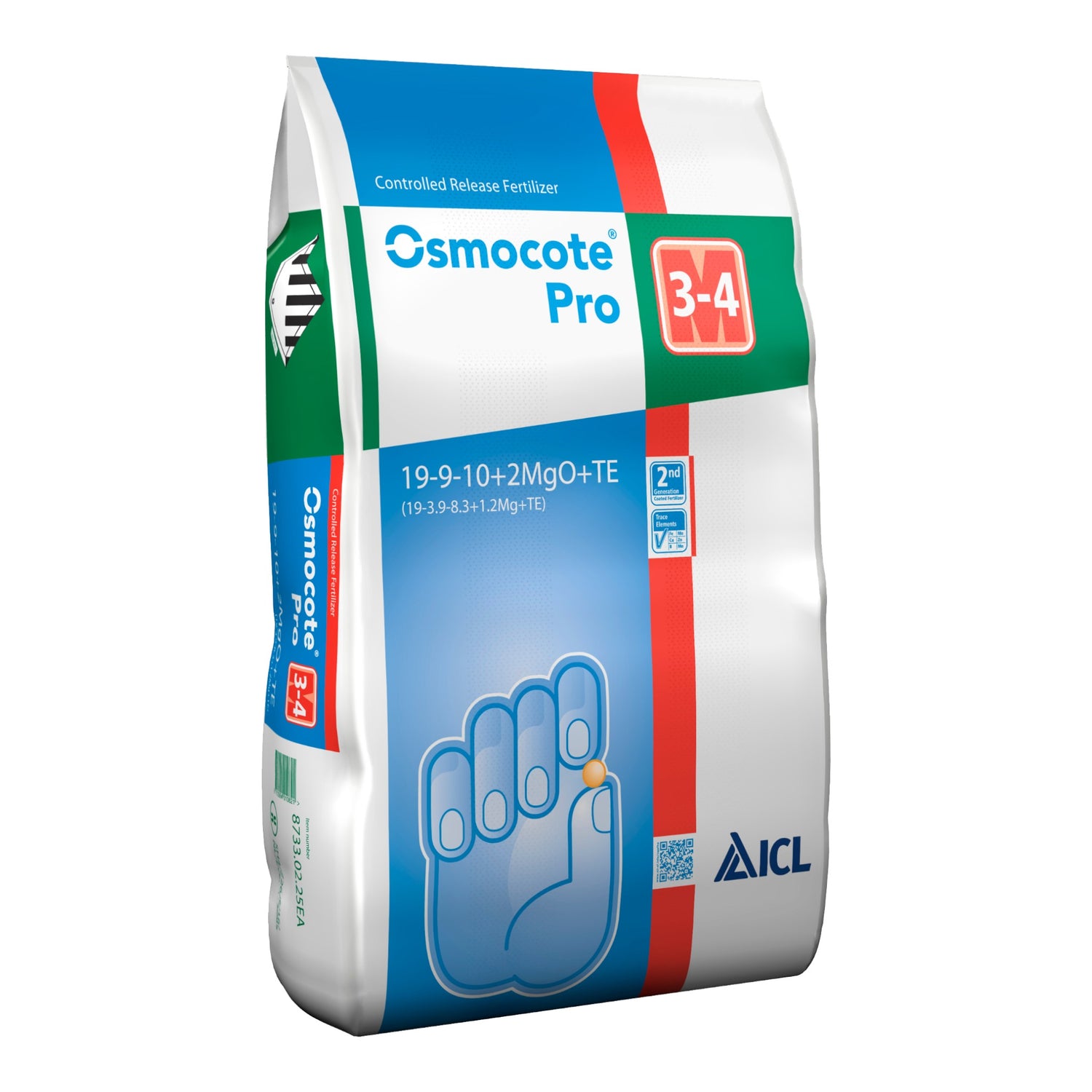
£132.06
Unit price per£132.06
Unit price perICL Osmocote Pro 3–4M is a professional controlled-release fertiliser with an NPK analysis of 19-9-10, 2% MgO and trace elements, supplied in a 25kg bag.
Its fully coated nutrient granules are designed to provide sustained nutrition over a predefined 3–4 months longevity period, making this version suited to professional container production where the crop cycle matches the stated release period.
Key benefits
Verified nutrient analysis
The current ICL product information states 19% total nitrogen, 9% P₂O₅, 10% K₂O and 2% MgO, together with trace elements. This page uses the current 19-9-10 analysis rather than relying on older or market-specific product information.
For shorter crop cycles
ICL describes Osmocote Pro 3–4M as a controlled-release fertiliser for short crop cycles and rapidly growing plant material. Its 3–4 month longevity can make it appropriate where the production period is relatively short and a longer-duration fertiliser would extend beyond the intended crop cycle.
Using controlled-release fertiliser
Choose the product longevity and application rate according to crop species, container size, production period, growing-medium fertility, irrigation regime and supplementary feeding programme. Controlled-release fertiliser should be distributed consistently through or applied to the growing medium using a method appropriate to the crop and production system.
Avoid damaging coated granules during mechanical handling or application, as damage to the coating can alter nutrient release.
Temperature & nutrient release
Controlled-release fertiliser performance is influenced by growing conditions, particularly temperature. Crop nutrient demand also changes with growth rate, irrigation and season, so monitor crop response rather than assuming the stated longevity alone guarantees the correct nutrition programme.
Integrating with irrigation & water-soluble feeding
Account for nutrients already supplied by irrigation water, growing media and any supplementary fertiliser. Where water-soluble feeds are also used, adjust the overall programme to avoid unnecessary nutrient loading.
Storage & handling
Store fertiliser dry and protected from contamination and physical damage. Follow the current ICL product information and safety data sheet for handling, application and storage requirements.
ICL Osmocote Pro 3–4M 19-9-10 + 2MgO + TE - 25kg product details
| Brand | ICL |
|---|---|
| Range | Osmocote Pro |
| Product type | Controlled-release fertiliser |
| Longevity | 3–4 months |
| NPK | 19-9-10 |
| Magnesium | 2% MgO |
| Trace elements | Yes |
| Pack size | 25kg |
ICL Osmocote Pro 3–4M 19-9-10 + 2MgO + TE - 25kg FAQs
What is the stated longevity?
This version has a stated controlled-release longevity of 3–4 months. What is the NPK analysis?
The current ICL product information states 19-9-10. Does it contain magnesium?
Yes. The stated analysis includes 2% MgO. Does Osmocote Pro contain trace elements?
Yes. This formulation includes trace elements. Is the 25kg bag the selling unit?
Yes. This product is supplied as one 25kg bag. How do I choose an application rate?
Base the rate on the crop, container, growing medium, production period and wider feeding programme, following current ICL guidance. Does temperature affect nutrient release?
Yes. Controlled-release fertiliser performance is influenced by growing conditions, including temperature. Can it be used alongside water-soluble fertiliser?
It can form part of a wider nutrition programme, but account for all nutrient sources and avoid unnecessary overfeeding. Can coated granules be damaged?
Yes. Avoid crushing or damaging the coating during handling or application because this can affect nutrient release. Where should I check current technical guidance?
Use the current ICL product information and safety data sheet for the exact product and intended crop.
£126.69
Unit price per£126.69
Unit price perICL Osmocote Exact Tablet 5-6 Months 14-8-11 2MgO+TE 5.0g 7.5kg is a professional Osmocote Exact controlled-release fertiliser tablet formulated for precise nutrition dosing of individual pots, containers and hanging baskets.
Its resin-coated nutrients provide a measured supply over a nominal 5–6-month period at 21°C, helping growers match fertiliser longevity to their crop cycle.
Key benefits
Professional applications
Suitable for precise nutrition dosing of individual pots, containers and hanging baskets. Plan nutrition around crop demand, irrigation water, substrate properties and any supplementary feeding.
How to apply
Push tablets fully into the growing medium. In hanging baskets, position tablets around the plant; under drip irrigation, ICL recommends positioning beneath the dripper. The water-soluble adhesive breaks down after watering.
Application rates & nutrient management
Container nursery stock and pot plants: 3–4 g/L; hanging baskets: 3–5 g/L (manufacturer guidance for unfertilised substrates).
Manufacturer rates are general recommendations for unfertilised substrates. Adjust to local growing conditions and other nutrient inputs. Trial programme changes on a small scale before wider adoption.
Storage & handling
Keep partly used bags sealed and store in dry conditions. Follow current ICL product information and safety guidance.
Technical specifications
| Manufacturer | ICL Growing Solutions |
|---|---|
| Range | Osmocote Exact controlled-release fertiliser tablet |
| NPK (oxide basis) | 14-8-11 |
| Magnesium | 2% MgO |
| Trace elements | Included |
| Nominal longevity | 5–6 months at 21°C |
| Pack size | 7.5 kg |
| Tablet size | 5 g |
| Typical application | precise nutrition dosing of individual pots, containers and hanging baskets |
| Manufacturer guidance | Container nursery stock and pot plants: 3–4 g/L; hanging baskets: 3–5 g/L (manufacturer guidance for unfertilised substrates). |
Frequently asked questions
What is this fertiliser used for?
It is designed for precise nutrition dosing of individual pots, containers and hanging baskets. What does the stated longevity mean?
ICL rates this product at 5–6 months at a growing-medium temperature of 21°C. Higher temperatures generally shorten the release period; lower temperatures extend it. Can it be combined with liquid feeding?
Yes, where the crop programme calls for it. Reduce the controlled-release fertiliser rate appropriately when adding water-soluble nutrients to avoid excessive total feeding. How should unused product be stored?
Reseal opened bags and store in dry conditions, following the manufacturer’s storage instructions. How do I select a rate?
Choose a rate according to crop demand, growing medium, container volume, season and any additional feeding. The published rates are general starting points for unfertilised substrates; trial changes on a small scale. How are the tablets applied?
Push the tablets fully into the growing medium. For drip-irrigated pots, position beneath the dripper. How many tablets should be used per pot?
Calculate the total grams required for the pot volume and crop, then select a whole number of 5 g tablets that matches the feeding plan. ICL provides a 3 L pot example using three 5 g tablets for a 15 g total.


£9.90
Unit price per£9.90
Unit price perAtami VGN CalMag 1L - Veganic Calcium & Magnesium is a plant-derived liquid nutrient developed for soil-based growing and the wider Atami VGN veganic feeding programme.
Veganic calcium and magnesium supplementation without extra nitrogen. Supplied as one 1L bottle, this SKU is sold individually, not as a case or pallet.
Atami formulates VGN using plant-derived residual materials and positions the range around nutrient delivery alongside support for beneficial soil microorganisms. The VGN line is approved for use in organic farming by Control Union; this is a product-input approval, not a claim that any crop becomes certified organic simply by using it.
The range is designed for soil cultivation. Atami cautions that these organic liquids are less suitable for irrigation systems because they can generate odours and biofilm.
Why choose Atami VGN CalMag?
Understanding the CalMag formulation
Calcium is important for normal cell-wall structure and developing tissues, while magnesium is central to chlorophyll. VGN CalMag is especially relevant where irrigation water contains little calcium or magnesium, such as soft tap water, collected rainwater or reverse-osmosis water.
Use when source-water analysis, crop requirements or growing conditions indicate that additional calcium and magnesium are needed. Unlike many conventional CalMag products, Atami describes this formulation as nitrogen-free, allowing supplementation without adding nitrogen to the nutrient programme.
Plant-based nutrition and soil biology
VGN is Atami’s veganic fertiliser range: its nutrient ingredients are derived from plants rather than animal by-products. Atami describes the line as a way to make productive use of residual plant materials from other industries, supporting a circular approach to fertiliser production.
Organic molecules in these products also provide inputs to the soil ecosystem. Beneficial microorganisms play a role in nutrient cycling and substrate health, although results depend on soil conditions, crop management and the wider growing programme.
Control Union approval relates to use as an input in organic farming. Growers working to a formal organic certification scheme should still check their certifier’s requirements and retain the relevant product documentation.
How much VGN CalMag should I use?
Atami’s product-level dosage guidance: 1–2ml per litre of water throughout the growing cycle, according to Atami.
The manufacturer also publishes stage-by-stage grow guides. Their rates can differ by crop type and growing programme, so use the guide appropriate to your crop rather than combining separate maximum rates automatically.
Begin conservatively when working with a new crop, monitor plant response and adjust feeding according to substrate, water quality, environmental conditions and the manufacturer’s latest instructions.
Mixing and application
Use clean tap or rainwater in a clean watering can or suitable mixing container. Start with approximately half of the required water volume, then measure the recommended amount of product.
Add VGN CalMag to water and stir before introducing the other VGN nutrients or additives.
Stir thoroughly and top up to the final water volume before applying to the growing medium. Never mix concentrated fertilisers directly together before dilution unless the manufacturer expressly instructs you to do so.
VGN is primarily intended for soil growing and manual or otherwise suitable application. Because of the organic formulation, Atami warns that it can cause odours and biofilm in irrigation systems.
How CalMag fits into the Atami VGN system
VGN 5-2-2: nitrogen-led base nutrient for leafy growth and general development. VGN 2-2-4: potassium-led base nutrient that complements 5-2-2 and allows the overall nutrient balance to be adjusted.
VGN 1-4-4: phosphorus- and potassium-led booster introduced around flowering and ripening. VGN CalMag: nitrogen-free calcium and magnesium supplement used when water quality or crop demand calls for it.
The two base nutrients form the foundation of the programme; the bloom booster and CalMag are supplementary tools rather than automatic replacements for balanced feeding. Follow Atami’s crop-specific feeding guidance when combining them.
Suitable plants and professional applications
The VGN range is intended for soil-grown crops including ornamental plants, flowering plants, container-grown edibles and other suitable horticultural crops. Select products according to the crop’s growth stage, nutritional needs and growing medium.
Commercial nurseries, specialist retailers and serious growers can use the four-product system to explain a coherent plant-based feeding approach rather than selling unrelated nutrient bottles. For crops grown in recirculating or drip-fed systems, review Atami’s compatibility warning before specifying VGN.
Handling, storage and good practice
Store the bottle securely, upright and according to the product label, away from unnecessary heat and direct sunlight. Keep out of reach of children and pets.
Measure doses accurately using clean equipment. Avoid contaminating the original container and do not store diluted nutrient solution for longer than the manufacturer recommends. Follow the product label for shelf life, storage conditions and any safety precautions.
Atami VGN product details
| Manufacturer | Atami |
|---|---|
| Range | VGN – Veganic Fertilisers |
| Product | VGN CalMag |
| Bottle size | 1L |
| Shopify selling unit | 1 bottle |
| Product role | Nitrogen-free calcium and magnesium supplement |
| NPK / nutrient description | Not assigned (nitrogen-free calcium/magnesium additive) |
| Manufacturer dosage | 1–2ml per litre of water throughout the growing cycle, according to Atami. |
| Recommended growing medium | Soil |
| Ingredients positioning | Plant-derived / veganic |
| Organic farming input status | Approved for organic farming by Control Union |
| Irrigation-system caution | Less suitable; may cause odours and biofilm |
Atami VGN CalMag 1L FAQs
What is Atami VGN CalMag used for?
Use when source-water analysis, crop requirements or growing conditions indicate that additional calcium and magnesium are needed. Unlike many conventional CalMag products, Atami describes this formulation as nitrogen-free, allowing supplementation without adding nitrogen to the nutrient programme. What does veganic mean?
Veganic nutrition uses plant-derived inputs rather than animal-derived ingredients. Atami’s VGN range is designed around this approach. Is VGN CalMag suitable for soil growing?
Yes. Atami identifies soil as the intended growing medium for VGN. Can it be used in automated irrigation systems?
Atami says the organic VGN range is less suitable for irrigation systems because it may produce odours and biofilm. What is the recommended dosage?
1–2ml per litre of water throughout the growing cycle, according to Atami. Can I combine it with other VGN products?
Yes, where the Atami feeding guide calls for a combination. Dilute each product separately into water and avoid mixing concentrates directly. Is this product approved for organic farming?
Atami states that the VGN range is approved for use in organic farming by Control Union. The grower remains responsible for meeting their own certification requirements. What size is supplied on this listing?
One 1L bottle. Case and pallet quantities, if supplied elsewhere, are logistics figures rather than the selling unit. Do I need all four VGN products?
Not necessarily. The two base nutrients form the core programme; the booster and CalMag are used according to growth stage, crop demand and water quality. How should I store it?
Follow the product label, keep the original container closed and upright, and avoid contamination and unsuitable temperatures. Does VGN CalMag add nitrogen?
No. Atami specifically describes VGN CalMag as nitrogen-free.


£4.79
Unit price per£4.79
Unit price perAtami VGN 5-2-2 500ml - Veganic Base Nutrient is a plant-derived liquid nutrient developed for soil-based growing and the wider Atami VGN veganic feeding programme.
Plant-based nitrogen nutrition for strong leafy growth. Supplied as one 500ml bottle, this SKU is sold individually, not as a case or pallet.
Atami formulates VGN using plant-derived residual materials and positions the range around nutrient delivery alongside support for beneficial soil microorganisms. The VGN line is approved for use in organic farming by Control Union; this is a product-input approval, not a claim that any crop becomes certified organic simply by using it.
The range is designed for soil cultivation. Atami cautions that these organic liquids are less suitable for irrigation systems because they can generate odours and biofilm.
Why choose Atami VGN 5-2-2?
Understanding the 5-2-2 formulation
The higher nitrogen proportion makes this the growth-focused member of the VGN base nutrient pair. Nitrogen contributes to chlorophyll and new leaf and shoot development, while the accompanying phosphorus and potassium provide complementary nutrition.
Use it as a foundation for leafy crops, establishing ornamentals and plants building vegetative growth. Its contribution can be adjusted relative to VGN 2-2-4 as the crop progresses. The product also contains chelated trace elements, according to Atami.
Plant-based nutrition and soil biology
VGN is Atami’s veganic fertiliser range: its nutrient ingredients are derived from plants rather than animal by-products. Atami describes the line as a way to make productive use of residual plant materials from other industries, supporting a circular approach to fertiliser production.
Organic molecules in these products also provide inputs to the soil ecosystem. Beneficial microorganisms play a role in nutrient cycling and substrate health, although results depend on soil conditions, crop management and the wider growing programme.
Control Union approval relates to use as an input in organic farming. Growers working to a formal organic certification scheme should still check their certifier’s requirements and retain the relevant product documentation.
How much VGN 5-2-2 should I use?
Atami’s product-level dosage guidance: 2–5ml per litre of water when used individually; alternatively 1–3ml per litre alongside 1–3ml per litre of VGN 2-2-4.
The manufacturer also publishes stage-by-stage grow guides. Their rates can differ by crop type and growing programme, so use the guide appropriate to your crop rather than combining separate maximum rates automatically.
Begin conservatively when working with a new crop, monitor plant response and adjust feeding according to substrate, water quality, environmental conditions and the manufacturer’s latest instructions.
Mixing and application
Use clean tap or rainwater in a clean watering can or suitable mixing container. Start with approximately half of the required water volume, then measure the recommended amount of product.
When used with VGN 2-2-4, add each concentrate separately to water and stir before adding the next product.
Stir thoroughly and top up to the final water volume before applying to the growing medium. Never mix concentrated fertilisers directly together before dilution unless the manufacturer expressly instructs you to do so.
VGN is primarily intended for soil growing and manual or otherwise suitable application. Because of the organic formulation, Atami warns that it can cause odours and biofilm in irrigation systems.
How 5-2-2 fits into the Atami VGN system
VGN 5-2-2: nitrogen-led base nutrient for leafy growth and general development. VGN 2-2-4: potassium-led base nutrient that complements 5-2-2 and allows the overall nutrient balance to be adjusted.
VGN 1-4-4: phosphorus- and potassium-led booster introduced around flowering and ripening. VGN CalMag: nitrogen-free calcium and magnesium supplement used when water quality or crop demand calls for it.
The two base nutrients form the foundation of the programme; the bloom booster and CalMag are supplementary tools rather than automatic replacements for balanced feeding. Follow Atami’s crop-specific feeding guidance when combining them.
Suitable plants and professional applications
The VGN range is intended for soil-grown crops including ornamental plants, flowering plants, container-grown edibles and other suitable horticultural crops. Select products according to the crop’s growth stage, nutritional needs and growing medium.
Commercial nurseries, specialist retailers and serious growers can use the four-product system to explain a coherent plant-based feeding approach rather than selling unrelated nutrient bottles. For crops grown in recirculating or drip-fed systems, review Atami’s compatibility warning before specifying VGN.
Handling, storage and good practice
Store the bottle securely, upright and according to the product label, away from unnecessary heat and direct sunlight. Keep out of reach of children and pets.
Measure doses accurately using clean equipment. Avoid contaminating the original container and do not store diluted nutrient solution for longer than the manufacturer recommends. Follow the product label for shelf life, storage conditions and any safety precautions.
Atami VGN product details
| Manufacturer | Atami |
|---|---|
| Range | VGN – Veganic Fertilisers |
| Product | VGN 5-2-2 |
| Bottle size | 500ml |
| Shopify selling unit | 1 bottle |
| Product role | Nitrogen-rich base nutrient |
| NPK / nutrient description | 5-2-2 |
| Manufacturer dosage | 2–5ml per litre of water when used individually; alternatively 1–3ml per litre alongside 1–3ml per litre of VGN 2-2-4. |
| Recommended growing medium | Soil |
| Ingredients positioning | Plant-derived / veganic |
| Organic farming input status | Approved for organic farming by Control Union |
| Irrigation-system caution | Less suitable; may cause odours and biofilm |
Atami VGN 5-2-2 500ml FAQs
What is Atami VGN 5-2-2 used for?
Use it as a foundation for leafy crops, establishing ornamentals and plants building vegetative growth. Its contribution can be adjusted relative to VGN 2-2-4 as the crop progresses. The product also contains chelated trace elements, according to Atami. What does veganic mean?
Veganic nutrition uses plant-derived inputs rather than animal-derived ingredients. Atami’s VGN range is designed around this approach. Is VGN 5-2-2 suitable for soil growing?
Yes. Atami identifies soil as the intended growing medium for VGN. Can it be used in automated irrigation systems?
Atami says the organic VGN range is less suitable for irrigation systems because it may produce odours and biofilm. What is the recommended dosage?
2–5ml per litre of water when used individually; alternatively 1–3ml per litre alongside 1–3ml per litre of VGN 2-2-4. Can I combine it with other VGN products?
Yes, where the Atami feeding guide calls for a combination. Dilute each product separately into water and avoid mixing concentrates directly. Is this product approved for organic farming?
Atami states that the VGN range is approved for use in organic farming by Control Union. The grower remains responsible for meeting their own certification requirements. What size is supplied on this listing?
One 500ml bottle. Case and pallet quantities, if supplied elsewhere, are logistics figures rather than the selling unit. Do I need all four VGN products?
Not necessarily. The two base nutrients form the core programme; the booster and CalMag are used according to growth stage, crop demand and water quality. How should I store it?
Follow the product label, keep the original container closed and upright, and avoid contamination and unsuitable temperatures. Can the two VGN base nutrients be mixed together?
Yes, in water. Atami gives a combined-use example of 1–3ml per litre of each base nutrient, adjusted to the crop.


Atami VGN 5-2-2 1L - Veganic Base Nutrient is a plant-derived liquid nutrient developed for soil-based growing and the wider Atami VGN veganic feeding programme.
Plant-based nitrogen nutrition for strong leafy growth. Supplied as one 1L bottle, this SKU is sold individually, not as a case or pallet.
Atami formulates VGN using plant-derived residual materials and positions the range around nutrient delivery alongside support for beneficial soil microorganisms. The VGN line is approved for use in organic farming by Control Union; this is a product-input approval, not a claim that any crop becomes certified organic simply by using it.
The range is designed for soil cultivation. Atami cautions that these organic liquids are less suitable for irrigation systems because they can generate odours and biofilm.
Why choose Atami VGN 5-2-2?
Understanding the 5-2-2 formulation
The higher nitrogen proportion makes this the growth-focused member of the VGN base nutrient pair. Nitrogen contributes to chlorophyll and new leaf and shoot development, while the accompanying phosphorus and potassium provide complementary nutrition.
Use it as a foundation for leafy crops, establishing ornamentals and plants building vegetative growth. Its contribution can be adjusted relative to VGN 2-2-4 as the crop progresses. The product also contains chelated trace elements, according to Atami.
Plant-based nutrition and soil biology
VGN is Atami’s veganic fertiliser range: its nutrient ingredients are derived from plants rather than animal by-products. Atami describes the line as a way to make productive use of residual plant materials from other industries, supporting a circular approach to fertiliser production.
Organic molecules in these products also provide inputs to the soil ecosystem. Beneficial microorganisms play a role in nutrient cycling and substrate health, although results depend on soil conditions, crop management and the wider growing programme.
Control Union approval relates to use as an input in organic farming. Growers working to a formal organic certification scheme should still check their certifier’s requirements and retain the relevant product documentation.
How much VGN 5-2-2 should I use?
Atami’s product-level dosage guidance: 2–5ml per litre of water when used individually; alternatively 1–3ml per litre alongside 1–3ml per litre of VGN 2-2-4.
The manufacturer also publishes stage-by-stage grow guides. Their rates can differ by crop type and growing programme, so use the guide appropriate to your crop rather than combining separate maximum rates automatically.
Begin conservatively when working with a new crop, monitor plant response and adjust feeding according to substrate, water quality, environmental conditions and the manufacturer’s latest instructions.
Mixing and application
Use clean tap or rainwater in a clean watering can or suitable mixing container. Start with approximately half of the required water volume, then measure the recommended amount of product.
When used with VGN 2-2-4, add each concentrate separately to water and stir before adding the next product.
Stir thoroughly and top up to the final water volume before applying to the growing medium. Never mix concentrated fertilisers directly together before dilution unless the manufacturer expressly instructs you to do so.
VGN is primarily intended for soil growing and manual or otherwise suitable application. Because of the organic formulation, Atami warns that it can cause odours and biofilm in irrigation systems.
How 5-2-2 fits into the Atami VGN system
VGN 5-2-2: nitrogen-led base nutrient for leafy growth and general development. VGN 2-2-4: potassium-led base nutrient that complements 5-2-2 and allows the overall nutrient balance to be adjusted.
VGN 1-4-4: phosphorus- and potassium-led booster introduced around flowering and ripening. VGN CalMag: nitrogen-free calcium and magnesium supplement used when water quality or crop demand calls for it.
The two base nutrients form the foundation of the programme; the bloom booster and CalMag are supplementary tools rather than automatic replacements for balanced feeding. Follow Atami’s crop-specific feeding guidance when combining them.
Suitable plants and professional applications
The VGN range is intended for soil-grown crops including ornamental plants, flowering plants, container-grown edibles and other suitable horticultural crops. Select products according to the crop’s growth stage, nutritional needs and growing medium.
Commercial nurseries, specialist retailers and serious growers can use the four-product system to explain a coherent plant-based feeding approach rather than selling unrelated nutrient bottles. For crops grown in recirculating or drip-fed systems, review Atami’s compatibility warning before specifying VGN.
Handling, storage and good practice
Store the bottle securely, upright and according to the product label, away from unnecessary heat and direct sunlight. Keep out of reach of children and pets.
Measure doses accurately using clean equipment. Avoid contaminating the original container and do not store diluted nutrient solution for longer than the manufacturer recommends. Follow the product label for shelf life, storage conditions and any safety precautions.
Atami VGN product details
| Manufacturer | Atami |
|---|---|
| Range | VGN – Veganic Fertilisers |
| Product | VGN 5-2-2 |
| Bottle size | 1L |
| Shopify selling unit | 1 bottle |
| Product role | Nitrogen-rich base nutrient |
| NPK / nutrient description | 5-2-2 |
| Manufacturer dosage | 2–5ml per litre of water when used individually; alternatively 1–3ml per litre alongside 1–3ml per litre of VGN 2-2-4. |
| Recommended growing medium | Soil |
| Ingredients positioning | Plant-derived / veganic |
| Organic farming input status | Approved for organic farming by Control Union |
| Irrigation-system caution | Less suitable; may cause odours and biofilm |
Atami VGN 5-2-2 1L FAQs
What is Atami VGN 5-2-2 used for?
Use it as a foundation for leafy crops, establishing ornamentals and plants building vegetative growth. Its contribution can be adjusted relative to VGN 2-2-4 as the crop progresses. The product also contains chelated trace elements, according to Atami. What does veganic mean?
Veganic nutrition uses plant-derived inputs rather than animal-derived ingredients. Atami’s VGN range is designed around this approach. Is VGN 5-2-2 suitable for soil growing?
Yes. Atami identifies soil as the intended growing medium for VGN. Can it be used in automated irrigation systems?
Atami says the organic VGN range is less suitable for irrigation systems because it may produce odours and biofilm. What is the recommended dosage?
2–5ml per litre of water when used individually; alternatively 1–3ml per litre alongside 1–3ml per litre of VGN 2-2-4. Can I combine it with other VGN products?
Yes, where the Atami feeding guide calls for a combination. Dilute each product separately into water and avoid mixing concentrates directly. Is this product approved for organic farming?
Atami states that the VGN range is approved for use in organic farming by Control Union. The grower remains responsible for meeting their own certification requirements. What size is supplied on this listing?
One 1L bottle. Case and pallet quantities, if supplied elsewhere, are logistics figures rather than the selling unit. Do I need all four VGN products?
Not necessarily. The two base nutrients form the core programme; the booster and CalMag are used according to growth stage, crop demand and water quality. How should I store it?
Follow the product label, keep the original container closed and upright, and avoid contamination and unsuitable temperatures. Can the two VGN base nutrients be mixed together?
Yes, in water. Atami gives a combined-use example of 1–3ml per litre of each base nutrient, adjusted to the crop.

Atami VGN 2-2-4 5L - Veganic Base Nutrient is a plant-derived liquid nutrient developed for soil-based growing and the wider Atami VGN veganic feeding programme.
Plant-derived potassium nutrition for resilient growth. Supplied as one 5L bottle, this SKU is sold individually, not as a case or pallet.
Atami formulates VGN using plant-derived residual materials and positions the range around nutrient delivery alongside support for beneficial soil microorganisms. The VGN line is approved for use in organic farming by Control Union; this is a product-input approval, not a claim that any crop becomes certified organic simply by using it.
The range is designed for soil cultivation. Atami cautions that these organic liquids are less suitable for irrigation systems because they can generate odours and biofilm.
Why choose Atami VGN 2-2-4?
Understanding the 2-2-4 formulation
VGN 2-2-4 provides a greater proportion of potassium than nitrogen. Potassium plays a key role in water regulation and normal plant metabolism, making this an important counterpart to the nitrogen-led 5-2-2 base nutrient.
Use as a base feed for soil-grown ornamentals, flowering plants and edible crops where a more potassium-led nutrient balance is appropriate. Atami states that this product includes chelated trace elements and can be combined with 5-2-2 to tailor the feed.
Plant-based nutrition and soil biology
VGN is Atami’s veganic fertiliser range: its nutrient ingredients are derived from plants rather than animal by-products. Atami describes the line as a way to make productive use of residual plant materials from other industries, supporting a circular approach to fertiliser production.
Organic molecules in these products also provide inputs to the soil ecosystem. Beneficial microorganisms play a role in nutrient cycling and substrate health, although results depend on soil conditions, crop management and the wider growing programme.
Control Union approval relates to use as an input in organic farming. Growers working to a formal organic certification scheme should still check their certifier’s requirements and retain the relevant product documentation.
How much VGN 2-2-4 should I use?
Atami’s product-level dosage guidance: 2–5ml per litre of water when used individually; alternatively 1–3ml per litre alongside 1–3ml per litre of VGN 5-2-2.
The manufacturer also publishes stage-by-stage grow guides. Their rates can differ by crop type and growing programme, so use the guide appropriate to your crop rather than combining separate maximum rates automatically.
Begin conservatively when working with a new crop, monitor plant response and adjust feeding according to substrate, water quality, environmental conditions and the manufacturer’s latest instructions.
Mixing and application
Use clean tap or rainwater in a clean watering can or suitable mixing container. Start with approximately half of the required water volume, then measure the recommended amount of product.
Blend with VGN 5-2-2 at the recommended combined-use rates, adding concentrates separately to water.
Stir thoroughly and top up to the final water volume before applying to the growing medium. Never mix concentrated fertilisers directly together before dilution unless the manufacturer expressly instructs you to do so.
VGN is primarily intended for soil growing and manual or otherwise suitable application. Because of the organic formulation, Atami warns that it can cause odours and biofilm in irrigation systems.
How 2-2-4 fits into the Atami VGN system
VGN 5-2-2: nitrogen-led base nutrient for leafy growth and general development. VGN 2-2-4: potassium-led base nutrient that complements 5-2-2 and allows the overall nutrient balance to be adjusted.
VGN 1-4-4: phosphorus- and potassium-led booster introduced around flowering and ripening. VGN CalMag: nitrogen-free calcium and magnesium supplement used when water quality or crop demand calls for it.
The two base nutrients form the foundation of the programme; the bloom booster and CalMag are supplementary tools rather than automatic replacements for balanced feeding. Follow Atami’s crop-specific feeding guidance when combining them.
Suitable plants and professional applications
The VGN range is intended for soil-grown crops including ornamental plants, flowering plants, container-grown edibles and other suitable horticultural crops. Select products according to the crop’s growth stage, nutritional needs and growing medium.
Commercial nurseries, specialist retailers and serious growers can use the four-product system to explain a coherent plant-based feeding approach rather than selling unrelated nutrient bottles. For crops grown in recirculating or drip-fed systems, review Atami’s compatibility warning before specifying VGN.
Handling, storage and good practice
Store the bottle securely, upright and according to the product label, away from unnecessary heat and direct sunlight. Keep out of reach of children and pets.
Measure doses accurately using clean equipment. Avoid contaminating the original container and do not store diluted nutrient solution for longer than the manufacturer recommends. Follow the product label for shelf life, storage conditions and any safety precautions.
Atami VGN product details
| Manufacturer | Atami |
|---|---|
| Range | VGN – Veganic Fertilisers |
| Product | VGN 2-2-4 |
| Bottle size | 5L |
| Shopify selling unit | 1 bottle |
| Product role | Potassium-rich base nutrient |
| NPK / nutrient description | 2-2-4 |
| Manufacturer dosage | 2–5ml per litre of water when used individually; alternatively 1–3ml per litre alongside 1–3ml per litre of VGN 5-2-2. |
| Recommended growing medium | Soil |
| Ingredients positioning | Plant-derived / veganic |
| Organic farming input status | Approved for organic farming by Control Union |
| Irrigation-system caution | Less suitable; may cause odours and biofilm |
Atami VGN 2-2-4 5L FAQs
What is Atami VGN 2-2-4 used for?
Use as a base feed for soil-grown ornamentals, flowering plants and edible crops where a more potassium-led nutrient balance is appropriate. Atami states that this product includes chelated trace elements and can be combined with 5-2-2 to tailor the feed. What does veganic mean?
Veganic nutrition uses plant-derived inputs rather than animal-derived ingredients. Atami’s VGN range is designed around this approach. Is VGN 2-2-4 suitable for soil growing?
Yes. Atami identifies soil as the intended growing medium for VGN. Can it be used in automated irrigation systems?
Atami says the organic VGN range is less suitable for irrigation systems because it may produce odours and biofilm. What is the recommended dosage?
2–5ml per litre of water when used individually; alternatively 1–3ml per litre alongside 1–3ml per litre of VGN 5-2-2. Can I combine it with other VGN products?
Yes, where the Atami feeding guide calls for a combination. Dilute each product separately into water and avoid mixing concentrates directly. Is this product approved for organic farming?
Atami states that the VGN range is approved for use in organic farming by Control Union. The grower remains responsible for meeting their own certification requirements. What size is supplied on this listing?
One 5L bottle. Case and pallet quantities, if supplied elsewhere, are logistics figures rather than the selling unit. Do I need all four VGN products?
Not necessarily. The two base nutrients form the core programme; the booster and CalMag are used according to growth stage, crop demand and water quality. How should I store it?
Follow the product label, keep the original container closed and upright, and avoid contamination and unsuitable temperatures. Can the two VGN base nutrients be mixed together?
Yes, in water. Atami gives a combined-use example of 1–3ml per litre of each base nutrient, adjusted to the crop.

£4.79
Unit price per£4.79
Unit price perAtami VGN 2-2-4 500ml - Veganic Base Nutrient is a plant-derived liquid nutrient developed for soil-based growing and the wider Atami VGN veganic feeding programme.
Plant-derived potassium nutrition for resilient growth. Supplied as one 500ml bottle, this SKU is sold individually, not as a case or pallet.
Atami formulates VGN using plant-derived residual materials and positions the range around nutrient delivery alongside support for beneficial soil microorganisms. The VGN line is approved for use in organic farming by Control Union; this is a product-input approval, not a claim that any crop becomes certified organic simply by using it.
The range is designed for soil cultivation. Atami cautions that these organic liquids are less suitable for irrigation systems because they can generate odours and biofilm.
Why choose Atami VGN 2-2-4?
Understanding the 2-2-4 formulation
VGN 2-2-4 provides a greater proportion of potassium than nitrogen. Potassium plays a key role in water regulation and normal plant metabolism, making this an important counterpart to the nitrogen-led 5-2-2 base nutrient.
Use as a base feed for soil-grown ornamentals, flowering plants and edible crops where a more potassium-led nutrient balance is appropriate. Atami states that this product includes chelated trace elements and can be combined with 5-2-2 to tailor the feed.
Plant-based nutrition and soil biology
VGN is Atami’s veganic fertiliser range: its nutrient ingredients are derived from plants rather than animal by-products. Atami describes the line as a way to make productive use of residual plant materials from other industries, supporting a circular approach to fertiliser production.
Organic molecules in these products also provide inputs to the soil ecosystem. Beneficial microorganisms play a role in nutrient cycling and substrate health, although results depend on soil conditions, crop management and the wider growing programme.
Control Union approval relates to use as an input in organic farming. Growers working to a formal organic certification scheme should still check their certifier’s requirements and retain the relevant product documentation.
How much VGN 2-2-4 should I use?
Atami’s product-level dosage guidance: 2–5ml per litre of water when used individually; alternatively 1–3ml per litre alongside 1–3ml per litre of VGN 5-2-2.
The manufacturer also publishes stage-by-stage grow guides. Their rates can differ by crop type and growing programme, so use the guide appropriate to your crop rather than combining separate maximum rates automatically.
Begin conservatively when working with a new crop, monitor plant response and adjust feeding according to substrate, water quality, environmental conditions and the manufacturer’s latest instructions.
Mixing and application
Use clean tap or rainwater in a clean watering can or suitable mixing container. Start with approximately half of the required water volume, then measure the recommended amount of product.
Blend with VGN 5-2-2 at the recommended combined-use rates, adding concentrates separately to water.
Stir thoroughly and top up to the final water volume before applying to the growing medium. Never mix concentrated fertilisers directly together before dilution unless the manufacturer expressly instructs you to do so.
VGN is primarily intended for soil growing and manual or otherwise suitable application. Because of the organic formulation, Atami warns that it can cause odours and biofilm in irrigation systems.
How 2-2-4 fits into the Atami VGN system
VGN 5-2-2: nitrogen-led base nutrient for leafy growth and general development. VGN 2-2-4: potassium-led base nutrient that complements 5-2-2 and allows the overall nutrient balance to be adjusted.
VGN 1-4-4: phosphorus- and potassium-led booster introduced around flowering and ripening. VGN CalMag: nitrogen-free calcium and magnesium supplement used when water quality or crop demand calls for it.
The two base nutrients form the foundation of the programme; the bloom booster and CalMag are supplementary tools rather than automatic replacements for balanced feeding. Follow Atami’s crop-specific feeding guidance when combining them.
Suitable plants and professional applications
The VGN range is intended for soil-grown crops including ornamental plants, flowering plants, container-grown edibles and other suitable horticultural crops. Select products according to the crop’s growth stage, nutritional needs and growing medium.
Commercial nurseries, specialist retailers and serious growers can use the four-product system to explain a coherent plant-based feeding approach rather than selling unrelated nutrient bottles. For crops grown in recirculating or drip-fed systems, review Atami’s compatibility warning before specifying VGN.
Handling, storage and good practice
Store the bottle securely, upright and according to the product label, away from unnecessary heat and direct sunlight. Keep out of reach of children and pets.
Measure doses accurately using clean equipment. Avoid contaminating the original container and do not store diluted nutrient solution for longer than the manufacturer recommends. Follow the product label for shelf life, storage conditions and any safety precautions.
Atami VGN product details
| Manufacturer | Atami |
|---|---|
| Range | VGN – Veganic Fertilisers |
| Product | VGN 2-2-4 |
| Bottle size | 500ml |
| Shopify selling unit | 1 bottle |
| Product role | Potassium-rich base nutrient |
| NPK / nutrient description | 2-2-4 |
| Manufacturer dosage | 2–5ml per litre of water when used individually; alternatively 1–3ml per litre alongside 1–3ml per litre of VGN 5-2-2. |
| Recommended growing medium | Soil |
| Ingredients positioning | Plant-derived / veganic |
| Organic farming input status | Approved for organic farming by Control Union |
| Irrigation-system caution | Less suitable; may cause odours and biofilm |
Atami VGN 2-2-4 500ml FAQs
What is Atami VGN 2-2-4 used for?
Use as a base feed for soil-grown ornamentals, flowering plants and edible crops where a more potassium-led nutrient balance is appropriate. Atami states that this product includes chelated trace elements and can be combined with 5-2-2 to tailor the feed. What does veganic mean?
Veganic nutrition uses plant-derived inputs rather than animal-derived ingredients. Atami’s VGN range is designed around this approach. Is VGN 2-2-4 suitable for soil growing?
Yes. Atami identifies soil as the intended growing medium for VGN. Can it be used in automated irrigation systems?
Atami says the organic VGN range is less suitable for irrigation systems because it may produce odours and biofilm. What is the recommended dosage?
2–5ml per litre of water when used individually; alternatively 1–3ml per litre alongside 1–3ml per litre of VGN 5-2-2. Can I combine it with other VGN products?
Yes, where the Atami feeding guide calls for a combination. Dilute each product separately into water and avoid mixing concentrates directly. Is this product approved for organic farming?
Atami states that the VGN range is approved for use in organic farming by Control Union. The grower remains responsible for meeting their own certification requirements. What size is supplied on this listing?
One 500ml bottle. Case and pallet quantities, if supplied elsewhere, are logistics figures rather than the selling unit. Do I need all four VGN products?
Not necessarily. The two base nutrients form the core programme; the booster and CalMag are used according to growth stage, crop demand and water quality. How should I store it?
Follow the product label, keep the original container closed and upright, and avoid contamination and unsuitable temperatures. Can the two VGN base nutrients be mixed together?
Yes, in water. Atami gives a combined-use example of 1–3ml per litre of each base nutrient, adjusted to the crop.

Atami VGN 2-2-4 1L - Veganic Base Nutrient is a plant-derived liquid nutrient developed for soil-based growing and the wider Atami VGN veganic feeding programme.
Plant-derived potassium nutrition for resilient growth. Supplied as one 1L bottle, this SKU is sold individually, not as a case or pallet.
Atami formulates VGN using plant-derived residual materials and positions the range around nutrient delivery alongside support for beneficial soil microorganisms. The VGN line is approved for use in organic farming by Control Union; this is a product-input approval, not a claim that any crop becomes certified organic simply by using it.
The range is designed for soil cultivation. Atami cautions that these organic liquids are less suitable for irrigation systems because they can generate odours and biofilm.
Why choose Atami VGN 2-2-4?
Understanding the 2-2-4 formulation
VGN 2-2-4 provides a greater proportion of potassium than nitrogen. Potassium plays a key role in water regulation and normal plant metabolism, making this an important counterpart to the nitrogen-led 5-2-2 base nutrient.
Use as a base feed for soil-grown ornamentals, flowering plants and edible crops where a more potassium-led nutrient balance is appropriate. Atami states that this product includes chelated trace elements and can be combined with 5-2-2 to tailor the feed.
Plant-based nutrition and soil biology
VGN is Atami’s veganic fertiliser range: its nutrient ingredients are derived from plants rather than animal by-products. Atami describes the line as a way to make productive use of residual plant materials from other industries, supporting a circular approach to fertiliser production.
Organic molecules in these products also provide inputs to the soil ecosystem. Beneficial microorganisms play a role in nutrient cycling and substrate health, although results depend on soil conditions, crop management and the wider growing programme.
Control Union approval relates to use as an input in organic farming. Growers working to a formal organic certification scheme should still check their certifier’s requirements and retain the relevant product documentation.
How much VGN 2-2-4 should I use?
Atami’s product-level dosage guidance: 2–5ml per litre of water when used individually; alternatively 1–3ml per litre alongside 1–3ml per litre of VGN 5-2-2.
The manufacturer also publishes stage-by-stage grow guides. Their rates can differ by crop type and growing programme, so use the guide appropriate to your crop rather than combining separate maximum rates automatically.
Begin conservatively when working with a new crop, monitor plant response and adjust feeding according to substrate, water quality, environmental conditions and the manufacturer’s latest instructions.
Mixing and application
Use clean tap or rainwater in a clean watering can or suitable mixing container. Start with approximately half of the required water volume, then measure the recommended amount of product.
Blend with VGN 5-2-2 at the recommended combined-use rates, adding concentrates separately to water.
Stir thoroughly and top up to the final water volume before applying to the growing medium. Never mix concentrated fertilisers directly together before dilution unless the manufacturer expressly instructs you to do so.
VGN is primarily intended for soil growing and manual or otherwise suitable application. Because of the organic formulation, Atami warns that it can cause odours and biofilm in irrigation systems.
How 2-2-4 fits into the Atami VGN system
VGN 5-2-2: nitrogen-led base nutrient for leafy growth and general development. VGN 2-2-4: potassium-led base nutrient that complements 5-2-2 and allows the overall nutrient balance to be adjusted.
VGN 1-4-4: phosphorus- and potassium-led booster introduced around flowering and ripening. VGN CalMag: nitrogen-free calcium and magnesium supplement used when water quality or crop demand calls for it.
The two base nutrients form the foundation of the programme; the bloom booster and CalMag are supplementary tools rather than automatic replacements for balanced feeding. Follow Atami’s crop-specific feeding guidance when combining them.
Suitable plants and professional applications
The VGN range is intended for soil-grown crops including ornamental plants, flowering plants, container-grown edibles and other suitable horticultural crops. Select products according to the crop’s growth stage, nutritional needs and growing medium.
Commercial nurseries, specialist retailers and serious growers can use the four-product system to explain a coherent plant-based feeding approach rather than selling unrelated nutrient bottles. For crops grown in recirculating or drip-fed systems, review Atami’s compatibility warning before specifying VGN.
Handling, storage and good practice
Store the bottle securely, upright and according to the product label, away from unnecessary heat and direct sunlight. Keep out of reach of children and pets.
Measure doses accurately using clean equipment. Avoid contaminating the original container and do not store diluted nutrient solution for longer than the manufacturer recommends. Follow the product label for shelf life, storage conditions and any safety precautions.
Atami VGN product details
| Manufacturer | Atami |
|---|---|
| Range | VGN – Veganic Fertilisers |
| Product | VGN 2-2-4 |
| Bottle size | 1L |
| Shopify selling unit | 1 bottle |
| Product role | Potassium-rich base nutrient |
| NPK / nutrient description | 2-2-4 |
| Manufacturer dosage | 2–5ml per litre of water when used individually; alternatively 1–3ml per litre alongside 1–3ml per litre of VGN 5-2-2. |
| Recommended growing medium | Soil |
| Ingredients positioning | Plant-derived / veganic |
| Organic farming input status | Approved for organic farming by Control Union |
| Irrigation-system caution | Less suitable; may cause odours and biofilm |
Atami VGN 2-2-4 1L FAQs
What is Atami VGN 2-2-4 used for?
Use as a base feed for soil-grown ornamentals, flowering plants and edible crops where a more potassium-led nutrient balance is appropriate. Atami states that this product includes chelated trace elements and can be combined with 5-2-2 to tailor the feed. What does veganic mean?
Veganic nutrition uses plant-derived inputs rather than animal-derived ingredients. Atami’s VGN range is designed around this approach. Is VGN 2-2-4 suitable for soil growing?
Yes. Atami identifies soil as the intended growing medium for VGN. Can it be used in automated irrigation systems?
Atami says the organic VGN range is less suitable for irrigation systems because it may produce odours and biofilm. What is the recommended dosage?
2–5ml per litre of water when used individually; alternatively 1–3ml per litre alongside 1–3ml per litre of VGN 5-2-2. Can I combine it with other VGN products?
Yes, where the Atami feeding guide calls for a combination. Dilute each product separately into water and avoid mixing concentrates directly. Is this product approved for organic farming?
Atami states that the VGN range is approved for use in organic farming by Control Union. The grower remains responsible for meeting their own certification requirements. What size is supplied on this listing?
One 1L bottle. Case and pallet quantities, if supplied elsewhere, are logistics figures rather than the selling unit. Do I need all four VGN products?
Not necessarily. The two base nutrients form the core programme; the booster and CalMag are used according to growth stage, crop demand and water quality. How should I store it?
Follow the product label, keep the original container closed and upright, and avoid contamination and unsuitable temperatures. Can the two VGN base nutrients be mixed together?
Yes, in water. Atami gives a combined-use example of 1–3ml per litre of each base nutrient, adjusted to the crop.


Atami VGN 1-4-4 5L - Veganic Bloom Booster is a plant-derived liquid nutrient developed for soil-based growing and the wider Atami VGN veganic feeding programme.
Plant-based phosphorus and potassium support for flowering crops. Supplied as one 5L bottle, this SKU is sold individually, not as a case or pallet.
Atami formulates VGN using plant-derived residual materials and positions the range around nutrient delivery alongside support for beneficial soil microorganisms. The VGN line is approved for use in organic farming by Control Union; this is a product-input approval, not a claim that any crop becomes certified organic simply by using it.
The range is designed for soil cultivation. Atami cautions that these organic liquids are less suitable for irrigation systems because they can generate odours and biofilm.
Why choose Atami VGN 1-4-4?
Understanding the 1-4-4 formulation
With a 1-4-4 NPK ratio, this supplementary fertiliser provides additional phosphorus and potassium relative to nitrogen. It is designed to complement—not replace—the two VGN base nutrients as plants move into reproductive development.
For flowering ornamentals, fruiting crops and other plants with a defined bloom or ripening phase, use VGN 1-4-4 as the crop enters flowering. Atami positions it as the dedicated booster in the VGN system.
Plant-based nutrition and soil biology
VGN is Atami’s veganic fertiliser range: its nutrient ingredients are derived from plants rather than animal by-products. Atami describes the line as a way to make productive use of residual plant materials from other industries, supporting a circular approach to fertiliser production.
Organic molecules in these products also provide inputs to the soil ecosystem. Beneficial microorganisms play a role in nutrient cycling and substrate health, although results depend on soil conditions, crop management and the wider growing programme.
Control Union approval relates to use as an input in organic farming. Growers working to a formal organic certification scheme should still check their certifier’s requirements and retain the relevant product documentation.
How much VGN 1-4-4 should I use?
Atami’s product-level dosage guidance: 1–3ml per litre of water according to Atami’s product guidance; begin towards the end of vegetative growth and increase as appropriate through flowering and ripening.
The manufacturer also publishes stage-by-stage grow guides. Their rates can differ by crop type and growing programme, so use the guide appropriate to your crop rather than combining separate maximum rates automatically.
Begin conservatively when working with a new crop, monitor plant response and adjust feeding according to substrate, water quality, environmental conditions and the manufacturer’s latest instructions.
Mixing and application
Use clean tap or rainwater in a clean watering can or suitable mixing container. Start with approximately half of the required water volume, then measure the recommended amount of product.
Prepare the base nutrients in water first, stirring well, then add the VGN 1-4-4 booster and top up with the remaining water.
Stir thoroughly and top up to the final water volume before applying to the growing medium. Never mix concentrated fertilisers directly together before dilution unless the manufacturer expressly instructs you to do so.
VGN is primarily intended for soil growing and manual or otherwise suitable application. Because of the organic formulation, Atami warns that it can cause odours and biofilm in irrigation systems.
How 1-4-4 fits into the Atami VGN system
VGN 5-2-2: nitrogen-led base nutrient for leafy growth and general development. VGN 2-2-4: potassium-led base nutrient that complements 5-2-2 and allows the overall nutrient balance to be adjusted.
VGN 1-4-4: phosphorus- and potassium-led booster introduced around flowering and ripening. VGN CalMag: nitrogen-free calcium and magnesium supplement used when water quality or crop demand calls for it.
The two base nutrients form the foundation of the programme; the bloom booster and CalMag are supplementary tools rather than automatic replacements for balanced feeding. Follow Atami’s crop-specific feeding guidance when combining them.
Suitable plants and professional applications
The VGN range is intended for soil-grown crops including ornamental plants, flowering plants, container-grown edibles and other suitable horticultural crops. Select products according to the crop’s growth stage, nutritional needs and growing medium.
Commercial nurseries, specialist retailers and serious growers can use the four-product system to explain a coherent plant-based feeding approach rather than selling unrelated nutrient bottles. For crops grown in recirculating or drip-fed systems, review Atami’s compatibility warning before specifying VGN.
Handling, storage and good practice
Store the bottle securely, upright and according to the product label, away from unnecessary heat and direct sunlight. Keep out of reach of children and pets.
Measure doses accurately using clean equipment. Avoid contaminating the original container and do not store diluted nutrient solution for longer than the manufacturer recommends. Follow the product label for shelf life, storage conditions and any safety precautions.
Atami VGN product details
| Manufacturer | Atami |
|---|---|
| Range | VGN – Veganic Fertilisers |
| Product | VGN 1-4-4 |
| Bottle size | 5L |
| Shopify selling unit | 1 bottle |
| Product role | Flowering and ripening booster |
| NPK / nutrient description | 1-4-4 |
| Manufacturer dosage | 1–3ml per litre of water according to Atami’s product guidance; begin towards the end of vegetative growth and increase as appropriate through flowering and ripening. |
| Recommended growing medium | Soil |
| Ingredients positioning | Plant-derived / veganic |
| Organic farming input status | Approved for organic farming by Control Union |
| Irrigation-system caution | Less suitable; may cause odours and biofilm |
Atami VGN 1-4-4 5L FAQs
What is Atami VGN 1-4-4 used for?
For flowering ornamentals, fruiting crops and other plants with a defined bloom or ripening phase, use VGN 1-4-4 as the crop enters flowering. Atami positions it as the dedicated booster in the VGN system. What does veganic mean?
Veganic nutrition uses plant-derived inputs rather than animal-derived ingredients. Atami’s VGN range is designed around this approach. Is VGN 1-4-4 suitable for soil growing?
Yes. Atami identifies soil as the intended growing medium for VGN. Can it be used in automated irrigation systems?
Atami says the organic VGN range is less suitable for irrigation systems because it may produce odours and biofilm. What is the recommended dosage?
1–3ml per litre of water according to Atami’s product guidance; begin towards the end of vegetative growth and increase as appropriate through flowering and ripening. Can I combine it with other VGN products?
Yes, where the Atami feeding guide calls for a combination. Dilute each product separately into water and avoid mixing concentrates directly. Is this product approved for organic farming?
Atami states that the VGN range is approved for use in organic farming by Control Union. The grower remains responsible for meeting their own certification requirements. What size is supplied on this listing?
One 5L bottle. Case and pallet quantities, if supplied elsewhere, are logistics figures rather than the selling unit. Do I need all four VGN products?
Not necessarily. The two base nutrients form the core programme; the booster and CalMag are used according to growth stage, crop demand and water quality. How should I store it?
Follow the product label, keep the original container closed and upright, and avoid contamination and unsuitable temperatures. Is VGN 1-4-4 a complete base feed?
No. Atami positions it as a flowering booster to accompany the VGN base nutrients.

£12.60
Unit price per£12.60
Unit price perAtami VGN 1-4-4 500ml - Veganic Bloom Booster is a plant-derived liquid nutrient developed for soil-based growing and the wider Atami VGN veganic feeding programme.
Plant-based phosphorus and potassium support for flowering crops. Supplied as one 500ml bottle, this SKU is sold individually, not as a case or pallet.
Atami formulates VGN using plant-derived residual materials and positions the range around nutrient delivery alongside support for beneficial soil microorganisms. The VGN line is approved for use in organic farming by Control Union; this is a product-input approval, not a claim that any crop becomes certified organic simply by using it.
The range is designed for soil cultivation. Atami cautions that these organic liquids are less suitable for irrigation systems because they can generate odours and biofilm.
Why choose Atami VGN 1-4-4?
Understanding the 1-4-4 formulation
With a 1-4-4 NPK ratio, this supplementary fertiliser provides additional phosphorus and potassium relative to nitrogen. It is designed to complement—not replace—the two VGN base nutrients as plants move into reproductive development.
For flowering ornamentals, fruiting crops and other plants with a defined bloom or ripening phase, use VGN 1-4-4 as the crop enters flowering. Atami positions it as the dedicated booster in the VGN system.
Plant-based nutrition and soil biology
VGN is Atami’s veganic fertiliser range: its nutrient ingredients are derived from plants rather than animal by-products. Atami describes the line as a way to make productive use of residual plant materials from other industries, supporting a circular approach to fertiliser production.
Organic molecules in these products also provide inputs to the soil ecosystem. Beneficial microorganisms play a role in nutrient cycling and substrate health, although results depend on soil conditions, crop management and the wider growing programme.
Control Union approval relates to use as an input in organic farming. Growers working to a formal organic certification scheme should still check their certifier’s requirements and retain the relevant product documentation.
How much VGN 1-4-4 should I use?
Atami’s product-level dosage guidance: 1–3ml per litre of water according to Atami’s product guidance; begin towards the end of vegetative growth and increase as appropriate through flowering and ripening.
The manufacturer also publishes stage-by-stage grow guides. Their rates can differ by crop type and growing programme, so use the guide appropriate to your crop rather than combining separate maximum rates automatically.
Begin conservatively when working with a new crop, monitor plant response and adjust feeding according to substrate, water quality, environmental conditions and the manufacturer’s latest instructions.
Mixing and application
Use clean tap or rainwater in a clean watering can or suitable mixing container. Start with approximately half of the required water volume, then measure the recommended amount of product.
Prepare the base nutrients in water first, stirring well, then add the VGN 1-4-4 booster and top up with the remaining water.
Stir thoroughly and top up to the final water volume before applying to the growing medium. Never mix concentrated fertilisers directly together before dilution unless the manufacturer expressly instructs you to do so.
VGN is primarily intended for soil growing and manual or otherwise suitable application. Because of the organic formulation, Atami warns that it can cause odours and biofilm in irrigation systems.
How 1-4-4 fits into the Atami VGN system
VGN 5-2-2: nitrogen-led base nutrient for leafy growth and general development. VGN 2-2-4: potassium-led base nutrient that complements 5-2-2 and allows the overall nutrient balance to be adjusted.
VGN 1-4-4: phosphorus- and potassium-led booster introduced around flowering and ripening. VGN CalMag: nitrogen-free calcium and magnesium supplement used when water quality or crop demand calls for it.
The two base nutrients form the foundation of the programme; the bloom booster and CalMag are supplementary tools rather than automatic replacements for balanced feeding. Follow Atami’s crop-specific feeding guidance when combining them.
Suitable plants and professional applications
The VGN range is intended for soil-grown crops including ornamental plants, flowering plants, container-grown edibles and other suitable horticultural crops. Select products according to the crop’s growth stage, nutritional needs and growing medium.
Commercial nurseries, specialist retailers and serious growers can use the four-product system to explain a coherent plant-based feeding approach rather than selling unrelated nutrient bottles. For crops grown in recirculating or drip-fed systems, review Atami’s compatibility warning before specifying VGN.
Handling, storage and good practice
Store the bottle securely, upright and according to the product label, away from unnecessary heat and direct sunlight. Keep out of reach of children and pets.
Measure doses accurately using clean equipment. Avoid contaminating the original container and do not store diluted nutrient solution for longer than the manufacturer recommends. Follow the product label for shelf life, storage conditions and any safety precautions.
Atami VGN product details
| Manufacturer | Atami |
|---|---|
| Range | VGN – Veganic Fertilisers |
| Product | VGN 1-4-4 |
| Bottle size | 500ml |
| Shopify selling unit | 1 bottle |
| Product role | Flowering and ripening booster |
| NPK / nutrient description | 1-4-4 |
| Manufacturer dosage | 1–3ml per litre of water according to Atami’s product guidance; begin towards the end of vegetative growth and increase as appropriate through flowering and ripening. |
| Recommended growing medium | Soil |
| Ingredients positioning | Plant-derived / veganic |
| Organic farming input status | Approved for organic farming by Control Union |
| Irrigation-system caution | Less suitable; may cause odours and biofilm |
Atami VGN 1-4-4 500ml FAQs
What is Atami VGN 1-4-4 used for?
For flowering ornamentals, fruiting crops and other plants with a defined bloom or ripening phase, use VGN 1-4-4 as the crop enters flowering. Atami positions it as the dedicated booster in the VGN system. What does veganic mean?
Veganic nutrition uses plant-derived inputs rather than animal-derived ingredients. Atami’s VGN range is designed around this approach. Is VGN 1-4-4 suitable for soil growing?
Yes. Atami identifies soil as the intended growing medium for VGN. Can it be used in automated irrigation systems?
Atami says the organic VGN range is less suitable for irrigation systems because it may produce odours and biofilm. What is the recommended dosage?
1–3ml per litre of water according to Atami’s product guidance; begin towards the end of vegetative growth and increase as appropriate through flowering and ripening. Can I combine it with other VGN products?
Yes, where the Atami feeding guide calls for a combination. Dilute each product separately into water and avoid mixing concentrates directly. Is this product approved for organic farming?
Atami states that the VGN range is approved for use in organic farming by Control Union. The grower remains responsible for meeting their own certification requirements. What size is supplied on this listing?
One 500ml bottle. Case and pallet quantities, if supplied elsewhere, are logistics figures rather than the selling unit. Do I need all four VGN products?
Not necessarily. The two base nutrients form the core programme; the booster and CalMag are used according to growth stage, crop demand and water quality. How should I store it?
Follow the product label, keep the original container closed and upright, and avoid contamination and unsuitable temperatures. Is VGN 1-4-4 a complete base feed?
No. Atami positions it as a flowering booster to accompany the VGN base nutrients.

A highly concentrated mid-flower enhancer formulated to support flower development, weight and overall crop performance during a key stage of the bloom cycle.
ROX Flower Enhancer is a specialist flowering additive designed for use during the period when ornamental flowering plants begin putting significant energy into flower development. Rather than replacing your normal base nutrients, ROX is added alongside the existing feeding programme for a relatively short period during mid-flower.
Its formulation includes humates, seaweed extract, triacontanol and plant growth regulators (PGRs), giving ROX its reputation as a particularly powerful and concentrated flowering additive.
ROX can be used with recirculating hydroponic systems as well as soil, coco and run-to-waste growing. Application rates differ depending on the growing system, so accurate measurement is important when preparing the nutrient solution.
Why use ROX Flower Enhancer?
When should ROX Flower Enhancer be used?
ROX is intended for the middle of the flowering cycle rather than being used throughout bloom. Published application guidance places its main use between approximately day 21 and day 35 of flowering.
For crops with an eight to nine week flowering period, this broadly corresponds with weeks four and five, when established flowering plants are moving into a period of more substantial flower development.
ROX is an additive, so your normal base nutrient programme should continue alongside it. It can be incorporated into recirculating hydroponic systems or used with soil, coco and run-to-waste feeding programmes at the appropriate application rate.
ROX contains plant growth regulators and should be reserved for appropriate ornamental flowering crops.
How to use ROX Flower Enhancer
Shake the bottle thoroughly before use. Prepare your normal nutrient solution first, then add ROX separately and mix thoroughly into the diluted nutrient solution.
For recirculating hydroponic systems, use ROX at 3ml per litre of fresh nutrient solution. Leave the solution in the system for seven days, topping up with the normal nutrient solution as required rather than adding further ROX during that period.
For soil, coco and run-to-waste systems, use 5ml per litre of nutrient solution. Published guidance for run-to-waste applications recommends that plants receive ROX for at least 10 days.
Never mix ROX directly with other nutrients or additives while they are still concentrated. Add each product separately to the water and mix thoroughly before introducing the next component of the feeding programme.
ROX is highly concentrated, so measure accurately and do not exceed the recommended application rate.
ROX Flower Enhancer specifications
| Product | ROX Flower Enhancer |
|---|---|
| Product type | Mid-flower enhancer / bloom additive |
| Size | 1 litre |
| Application period | Approximately day 21 to day 35 of flowering |
| Recirculating hydroponics | 3ml per litre |
| Soil | 5ml per litre |
| Coco / run-to-waste | 5ml per litre |
| Use with base nutrients | Yes |
| Contains PGRs | Yes – plant growth regulators |
| Other reported components | Humates, seaweed extract & triacontanol |
| Crop use | Ornamental flowering crops |
ROX Flower Enhancer FAQs
What is ROX Flower Enhancer?
ROX is a highly concentrated flowering additive designed to support flower development and weight during the middle of the bloom cycle. It is used alongside a normal base nutrient rather than replacing it.
When should I use ROX Flower Enhancer?
Published feeding guidance recommends using ROX from approximately day 21 through to day 35 of flowering. For plants with an eight to nine week flowering period, this broadly corresponds with weeks four and five.
How much ROX Flower Enhancer should I use?
Use 3ml per litre in recirculating hydroponic systems. For soil, coco and run-to-waste systems, use 5ml per litre of nutrient solution.
Can ROX be used in hydroponics?
Yes. ROX can be used in recirculating hydroponic systems at 3ml per litre. Start with a fresh nutrient solution and leave it in the system for seven days, topping up with your normal nutrient solution as necessary.
Can ROX Flower Enhancer be used in coco?
Yes. ROX can be used with coco and run-to-waste growing systems at 5ml per litre of working nutrient solution.
Does ROX Flower Enhancer contain PGRs?
Yes. ROX Flower Enhancer is formulated with plant growth regulators (PGRs), alongside other reported components including humates, seaweed extract and triacontanol.
Is ROX a complete flowering nutrient?
No. ROX is a flowering additive and should be used alongside your normal base nutrient programme rather than as a standalone plant feed.
Do I need to shake ROX before use?
Yes. Shake the bottle thoroughly before measuring ROX and adding it to your nutrient solution.
Can ROX be mixed directly with other concentrated nutrients?
No. Prepare the water and base nutrient solution first, then add ROX separately and mix thoroughly. Concentrated nutrients and additives should not be mixed directly together.

£42.50
Unit price per£42.50
Unit price perA fish-based organic liquid fertiliser with an NPK of 5-1-1, providing nitrogen-rich nutrition for healthy plant growth indoors and outdoors.
Arctic Fish Fertiliser is a concentrated liquid plant feed made from fish-derived organic matter. With an NPK ratio of 5-1-1, it provides a nitrogen-led nutrient profile that makes it particularly useful for supporting healthy vegetative growth.
Fish has a long history of use as a natural source of plant nutrition. As the organic matter in Arctic Fish breaks down within the growing medium, nutrients become available to plants while the organic material contributes to a biologically active root environment.
Suitable for a wide range of indoor and outdoor plants, Arctic Fish offers growers a straightforward way to incorporate a fish-based organic fertiliser into their regular plant feeding programme.
Why choose Arctic Fish Fertiliser?
What is Arctic Fish Fertiliser suitable for?
With an NPK of 5-1-1, Arctic Fish has considerably more nitrogen than phosphorus or potassium. That makes it particularly useful during periods when plants are actively producing leaves, stems and other vegetative growth.
It can be used with a broad range of indoor and outdoor plants, including ornamental plants, vegetable gardens, roses, trees and shrubs. This versatility makes it useful for growers who want a fish-based liquid fertiliser that can be used across several different plant types.
Arctic Fish is also well suited to soil-focused growing programmes where organic matter and biological activity form an important part of the approach to plant nutrition.
How to use Arctic Fish Fertiliser
Shake the bottle thoroughly before every use. Natural separation can occur while fish fertiliser is standing in storage, so thorough mixing helps ensure the product is evenly distributed before measuring.
Dilute Arctic Fish Fertiliser with water according to the application instructions on the product label and the requirements of the plants being grown. Mix thoroughly before applying the prepared feed.
When incorporating Arctic Fish into an existing feeding programme, take the nutrients already being supplied into account rather than treating every fertiliser as an isolated addition. Its 5-1-1 analysis means Arctic Fish makes a meaningful contribution to the nitrogen supplied to the crop.
Store the container securely with the cap firmly closed and shake thoroughly again before the next application.
Arctic Fish Fertiliser specifications
| Product | Arctic Fish Fertiliser |
|---|---|
| Product type | Fish-based organic liquid fertiliser |
| Size | 5 litres |
| NPK | 5-1-1 |
| Primary nutrient | Nitrogen |
| Form | Liquid |
| Suitable for | Indoor & outdoor plants |
| Typical applications | Vegetative plant growth, general plant feeding & soil-focused growing programmes |
| Other suitable plants | Vegetable gardens, roses, trees & shrubs |
| Preparation | Shake well before use |
Arctic Fish Fertiliser FAQs
What is Arctic Fish Fertiliser?
Arctic Fish is a fish-based organic liquid fertiliser designed to provide nutrients and organic matter to plants. It has an NPK analysis of 5-1-1.
What is the NPK of Arctic Fish Fertiliser?
Arctic Fish Fertiliser has an NPK of 5-1-1, meaning nitrogen is the most prominent of the three primary plant nutrients in its analysis.
Is Arctic Fish Fertiliser good for vegetative growth?
Its nitrogen-led 5-1-1 nutrient profile makes Arctic Fish particularly useful during periods of active vegetative growth, when plants are developing leaves and stems.
Can Arctic Fish Fertiliser be used on indoor plants?
Yes. Arctic Fish is suitable for both indoor and outdoor plants, making it a versatile option for growers working across different growing environments.
Can Arctic Fish Fertiliser be used in the garden?
Yes. Arctic Fish can be used for outdoor plant feeding and is suitable for applications including vegetable gardens, roses, trees and shrubs.
Why does Arctic Fish Fertiliser need to be shaken?
Ingredient separation can occur naturally while the product is standing in storage. Shake the bottle thoroughly before use so the contents are properly mixed before measuring and diluting the fertiliser.
Does Arctic Fish Fertiliser support soil microbes?
Fish fertiliser introduces organic matter into the growing medium. As this material breaks down, it provides a food source for microbial activity within biologically active soils and growing media.
Is Arctic Fish Fertiliser a flowering booster?
Arctic Fish is better described as a general fish-based fertiliser with a nitrogen-led NPK of 5-1-1 rather than a dedicated high-phosphorus or high-potassium flowering booster.

£49.95
Unit price per£49.95
Unit price perA highly concentrated 0-49-32 PK bloom booster designed to support heavier, denser flower and fruit development during the middle stage of flowering.
Future Harvest Ton O Bud is a concentrated powdered phosphorus and potassium additive formulated for established flowering plants. With an NPK analysis of 0-49-32, it delivers a substantial PK boost at the point in the flowering cycle when flowers and fruits are actively developing.
Ton O Bud forms the mid-flower stage of Future Harvest's powdered bloom booster programme. Bud Start is used during early flowering, Ton O Bud takes over once flower sites are established, and Bud Boom is designed for the later stages of the flowering cycle.
Because Ton O Bud is a supplement rather than a complete base nutrient, it can be incorporated into an existing feeding programme. The powder is highly concentrated, with a typical application rate of just 5g per 10 litres of nutrient solution.
Why use Future Harvest Ton O Bud?
Designed for the middle of the flowering cycle
Ton O Bud is not intended as an all-purpose fertiliser or something that needs to be used throughout the entire crop cycle. Its job is much more specific. It provides concentrated phosphorus and potassium once flowering sites have become established and plants have entered the main flower and fruit-building stage.
Future Harvest positions Ton O Bud between Bud Start and Bud Boom within its powdered flowering programme. Bud Start supports the transition into early flowering, Ton O Bud targets the middle stage, and Bud Boom is used towards the later flowering and ripening period.
This staged approach allows growers to alter their supplemental PK input as the requirements of flowering plants change, rather than relying on the same bloom additive from the beginning to the end of flowering.
How to use Future Harvest Ton O Bud
Begin using Ton O Bud once flower sites are established or flowers are already present.
Mix at a rate of 5g per 10 litres of nutrient solution, equivalent to 0.5g per litre. Dissolve the measured powder thoroughly into the nutrient solution before application.
Ton O Bud is a concentrated PK supplement rather than a complete plant food, so continue using an appropriate base nutrient according to your normal feeding programme.
When using Ton O Bud alongside other nutrient additives, take their phosphorus and potassium contribution into account to avoid unnecessarily stacking multiple concentrated PK products within the same feed.
Future Harvest Ton O Bud specifications
| Brand | Future Harvest |
|---|---|
| Product | Ton O Bud |
| Product type | Powdered PK bloom booster |
| Size | 500g |
| NPK | 0-49-32 |
| Available phosphate (P₂O₅) | 49% |
| Soluble potash (K₂O) | 32% |
| Application stage | Mid-flowering |
| Application rate | 5g per 10 litres (0.5g/L) |
| Suitable growing media | Hydroponics, coco & soil |
| Form | Concentrated powder |
| Primary use | Flower & fruit bulking during mid-flower |
Future Harvest Ton O Bud FAQs
What is Future Harvest Ton O Bud?
Ton O Bud is a concentrated powdered PK bloom booster designed for the middle stage of flowering. It supplies high levels of phosphorus and potassium to support developing flowers and fruits.
What is the NPK of Ton O Bud?
Powdered Future Harvest Ton O Bud has an NPK analysis of 0-49-32, providing 49% available phosphate and 32% soluble potash.
When should I use Ton O Bud?
Start using Ton O Bud once flower sites are established or flowers are already present. It is designed specifically for the middle stage of the flowering cycle.
How much Ton O Bud should I use?
Mix 5g of Ton O Bud into 10 litres of nutrient solution. This is equivalent to an application rate of 0.5g per litre.
Can Ton O Bud be used in hydroponics?
Yes. Future Harvest Ton O Bud is suitable for hydroponic growing as well as coco and soil-based growing methods.
Can Ton O Bud be used in coco?
Yes. Ton O Bud can be incorporated into a coco feeding programme at the recommended application rate once plants have reached the appropriate flowering stage.
Is Ton O Bud a complete flowering nutrient?
No. Ton O Bud is a concentrated phosphorus and potassium supplement. It is intended to complement a suitable base nutrient rather than provide complete plant nutrition on its own.
What is the difference between Ton O Bud and Liquid Ton O Bud?
This product is the concentrated powdered version with an NPK of 0-49-32. Future Harvest also produces Liquid Ton O Bud, which has a different concentration and an NPK of 0-10-6. They should therefore be measured according to the directions for the specific version being used.
What is the difference between Bud Start, Ton O Bud and Bud Boom?
The three powdered Future Harvest bloom additives target different parts of flowering. Bud Start is intended for early flowering, Ton O Bud for the middle stage, and Bud Boom for the later flowering stage.

£57.23
Unit price per£57.23
Unit price perThe Micro 3 component of the Advanced Hydroponics Dutch Formula three-part nutrient system, supplying chelated microelements and pH buffering throughout the growing cycle.
Advanced Hydroponics Dutch Formula Micro is the third component in the Dutch Formula Grow, Bloom and Micro nutrient system. Rather than being reserved for one particular stage, Micro is used throughout the crop cycle alongside changing proportions of Dutch Formula Grow and Bloom.
The formula supplies a concentrated mix of chelated microelements, helping provide the trace nutrition required alongside the primary nutrients supplied by the complete three-part feeding programme. Integrated pH buffers also contribute to nutrient solution stability.
Dutch Formula is not restricted to hydroponics. The three-part programme can be adapted for hydroponic systems, coco and soil, making it a flexible base nutrient range for growers working with different growing media.
Why choose Dutch Formula Micro?
What does Dutch Formula Micro do?
Dutch Formula Micro provides the micronutrient element of the Advanced Hydroponics three-part feeding system. Plants require trace elements in much smaller quantities than nitrogen, phosphorus and potassium, but they remain an essential part of balanced plant nutrition.
Micro is therefore not simply an optional additive for correcting a deficiency. It forms part of the core Dutch Formula feeding programme and is designed to be combined with Grow and Bloom in the appropriate proportions.
The three-part format gives growers more control over nutrition as the crop develops. The balance between Grow, Bloom and Micro changes through the growing cycle, while Micro continues supplying chelated trace elements and supporting nutrient solution stability.
How to use Dutch Formula Micro
Shake Dutch Formula Micro thoroughly before use. Add the required amount to water as part of the complete Dutch Formula Grow, Bloom and Micro feeding programme.
The amount of each Dutch Formula component changes according to the stage of plant development. Micro is typically used at approximately 0.5 to 1ml per litre within the standard three-part programme, with the precise rate determined by the current stage and feeding schedule.
Add each nutrient component to the water separately and mix thoroughly before introducing the next component. Do not mix Grow, Bloom and Micro together in their concentrated forms.
Once the complete nutrient solution has been prepared and mixed thoroughly, monitor and adjust the solution as required for the crop and growing system.
Dutch Formula Micro 3 specifications
| Brand | Advanced Hydroponics of Holland |
|---|---|
| Range | Dutch Formula |
| Product | Micro 3 |
| Product type | Three-part base nutrient component |
| System component | Part 3 of Grow, Bloom & Micro |
| Size | 10 litres |
| Form | Concentrated liquid nutrient |
| Key formulation | Chelated microelements & pH buffers |
| Application stage | Throughout the growing cycle |
| Typical Micro dosage | 0.5 to 1ml/L depending on growth stage |
| Suitable growing media | Hydroponics, coco & soil |
| Use with | Dutch Formula Grow 1 & Bloom 2 |
Advanced Hydroponics Dutch Formula Micro FAQs
What is Dutch Formula Micro?
Dutch Formula Micro is the third component of the Advanced Hydroponics of Holland three-part base nutrient system. It provides chelated microelements and pH buffering as part of the complete Grow, Bloom and Micro feeding programme.
Is Dutch Formula Micro a complete nutrient?
Dutch Formula Micro is designed as one component of a three-part nutrient system. For a complete Dutch Formula feeding programme, it is used alongside Dutch Formula Grow 1 and Bloom 2 in proportions appropriate to the plant's stage of development.
When should I use Dutch Formula Micro?
Micro is used throughout the growing cycle rather than being limited to either vegetative growth or flowering. Its dosage is adjusted as part of the wider three-part Dutch Formula feeding schedule.
How much Dutch Formula Micro should I use?
Micro is typically used at approximately 0.5 to 1ml per litre as part of the Dutch Formula programme. The required amount changes according to the stage of plant development, so it should be measured alongside the corresponding Grow and Bloom rates.
Can Dutch Formula Micro be used in hydroponics?
Yes. Dutch Formula is designed for hydroponic growing and can be used to prepare a balanced mineral nutrient solution when Micro is combined with the appropriate Grow and Bloom components.
Can Dutch Formula Micro be used in coco?
Yes. Advanced Hydroponics states that Dutch Formula can be used across different substrates, including coco.
Can Dutch Formula Micro be used in soil?
Yes. The Dutch Formula range is suitable for soil as well as coco and hydroponic growing. The feeding strength should be adapted to the growing medium and crop requirements.
Does Dutch Formula Micro contain chelated micronutrients?
Yes. Advanced Hydroponics describes Micro as a concentrated nutrient mix containing chelated microelements together with pH buffers.
Can I mix Dutch Formula Grow, Bloom and Micro concentrates together?
Add the required nutrients separately to the water, mixing thoroughly between each addition. The concentrated components should not be combined together before dilution.
What are Dutch Formula Grow 1, Bloom 2 and Micro 3?
They are the three components of the Advanced Hydroponics Dutch Formula base nutrient system. Grow 1, Bloom 2 and Micro 3 are used in changing proportions to tailor the nutrient solution as plants progress through vegetative growth and flowering.

£39.50
Unit price per£39.50
Unit price perThe Bloom 2 component of the Advanced Hydroponics Dutch Formula three-part nutrient system, formulated to support plants as they move into flowering and flower development.
Advanced Hydroponics Dutch Formula Bloom is the second component in the Dutch Formula Grow, Bloom and Micro nutrient system. Its role becomes increasingly important as plants move away from vegetative growth and begin concentrating their energy on flowering.
Rather than relying on separate fixed grow and bloom feeds, Dutch Formula uses three liquid nutrient components in changing proportions. This gives growers greater control over the balance of nutrition supplied as the crop progresses through its life cycle.
Bloom 2 works alongside Dutch Formula Grow 1 and Micro 3 to create the complete base nutrient solution. It can be used across hydroponic systems, coco and soil, making the same three-part programme suitable for a wide range of growing methods.
Why choose Dutch Formula Bloom?
How Bloom 2 fits into the Dutch Formula system
Dutch Formula is built around three core nutrients: Grow 1, Bloom 2 and Micro 3. The components are used together, but their proportions change as plants develop.
During vegetative growth, Grow makes up the largest proportion of the three-part feed. As flowering begins, the balance shifts towards Bloom. During full bloom, Bloom becomes the dominant component while Micro continues to provide the micronutrient part of the feeding programme.
Advanced Hydroponics describes the basic Grow : Bloom : Micro ratios as 2:1:1 during growth, 1:2:1 around the flowering transition and 0:3:1 during full bloom. This changing ratio is what allows one three-part nutrient system to follow plants through different stages of development.
How to use Dutch Formula Bloom
Shake the container thoroughly before use. Measure Dutch Formula Bloom according to the stage of plant development and add it to water as part of the complete Grow, Bloom and Micro feeding programme.
Bloom starts at a relatively low concentration during vegetative growth and increases as flowering progresses. A typical Dutch Formula programme uses approximately 0.5ml/L during early growth, increasing to around 1ml/L as flowering begins, 2ml/L during established flowering and up to 3ml/L during the later flowering stage.
Add the Dutch Formula components to the water separately, mixing the solution thoroughly between each addition. Do not combine Grow, Bloom and Micro together while they are still concentrated.
Once all required components have been added, mix the nutrient solution thoroughly before checking and making any required adjustments to the final working solution.
Dutch Formula Bloom 2 specifications
| Brand | Advanced Hydroponics of Holland |
|---|---|
| Range | Dutch Formula |
| Product | Bloom 2 |
| Product type | Three-part base nutrient component |
| System component | Part 2 of Grow, Bloom & Micro |
| Size | 10 litres |
| Form | Concentrated liquid nutrient |
| Primary application stage | Flowering |
| Typical Bloom dosage | 0.5 to 3ml/L depending on growth stage |
| Growing stage ratio | 2:1:1 – Grow : Bloom : Micro |
| Flowering transition ratio | 1:2:1 – Grow : Bloom : Micro |
| Full bloom ratio | 0:3:1 – Grow : Bloom : Micro |
| Suitable growing media | Hydroponics, coco & soil |
| Use with | Dutch Formula Grow 1 & Micro 3 |
Advanced Hydroponics Dutch Formula Bloom FAQs
What is Dutch Formula Bloom?
Dutch Formula Bloom is the second component of the Advanced Hydroponics of Holland three-part base nutrient system. It is formulated for flower production and is used alongside Dutch Formula Grow and Micro.
Is Dutch Formula Bloom a complete nutrient?
Bloom is one component of the three-part Dutch Formula system. It should be combined with Dutch Formula Grow 1 and Micro 3 in the appropriate proportions to create the complete base nutrient programme.
When should I start using Dutch Formula Bloom?
Bloom is actually present at a low level during the vegetative programme, but its proportion increases as plants move into flowering. It then becomes the dominant Dutch Formula component during full bloom.
How much Dutch Formula Bloom should I use?
The amount changes throughout the growing cycle. Bloom is typically used at around 0.5ml/L during early growth, increasing through approximately 1ml/L and 2ml/L as flowering develops, with up to 3ml/L used during the later flowering programme.
What is the Dutch Formula Grow, Bloom and Micro ratio?
Advanced Hydroponics describes the basic Grow : Bloom : Micro ratios as 2:1:1 during vegetative growth, 1:2:1 around the flowering transition and 0:3:1 during full bloom.
Can Dutch Formula Bloom be used in hydroponics?
Yes. Dutch Formula is suitable for hydroponic growing and allows the proportions of Grow, Bloom and Micro to be adjusted as the crop progresses.
Can Dutch Formula Bloom be used in coco?
Yes. The Dutch Formula three-part nutrient system can be used with coco as well as hydroponic systems and soil.
Can Dutch Formula Bloom be used in soil?
Yes. Advanced Hydroponics states that Dutch Formula is suitable for different growing media, including soil.
Can Dutch Formula Grow, Bloom and Micro be mixed together?
The three components are combined within the final nutrient solution, but the concentrated products should not be mixed directly together. Add each component separately to the water and mix thoroughly between additions.
What are Dutch Formula Grow 1, Bloom 2 and Micro 3?
They are the three components of the Advanced Hydroponics Dutch Formula base nutrient system. Their proportions are changed throughout the growing cycle so the overall nutrient balance can be adapted to vegetative growth, the transition into flowering and full bloom.

£132.80
Unit price per£132.80
Unit price perA concentrated 2-10-4 late-flowering finisher designed to support the final ripening and development of flowers and fruit during the last three weeks of bloom.
Ecolizer Top-Up is a specialist flowering additive developed for the final stage of the crop cycle. Rather than being used throughout flowering, Top-Up is introduced during the last three weeks to provide targeted support as flowers and fruit move through their final stages of development and ripening.
The concentrated liquid combines botanical extracts and minerals with a phosphorus and potassium-rich nutrient profile. Its low-nitrogen 2-10-4 analysis is particularly suited to late flowering, when the nutritional demands of the crop are very different from those during vegetative growth.
Suitable for soil, coco and hydroponic cultivation, this 5L format is a practical choice for commercial growers and larger growing facilities using Top-Up across significant volumes of irrigation or nutrient solution.
Why choose Ecolizer Top-Up?
What is Ecolizer Top-Up used for?
Ecolizer Top-Up is used during the final three weeks of flowering, when the crop is approaching maturity. Its formulation is designed to support the development and ripening of flowers and fruit during this important final stage.
Unlike a general-purpose nutrient, Top-Up is intended for a specific point in the crop cycle. It works alongside the grower's normal base nutrition and flowering programme, providing additional phosphorus and potassium with relatively little nitrogen.
Top-Up can be incorporated into feeding programmes for plants grown in soil, coco or hydroponic systems, making it suitable for a wide range of professional and hobby growing setups.
How to use Ecolizer Top-Up
Add 1ml of Ecolizer Top-Up per litre of irrigation water or nutrient solution. This is equivalent to 10ml per 10 litres.
Introduce Top-Up during the final three weeks of the flowering period. Continue using an appropriate base nutrient programme while Top-Up is being applied.
Do not combine Ecolizer Top-Up with PK 13/14. Top-Up already provides concentrated phosphorus and potassium for the final flowering stage and is intended to take the place of a separate PK 13/14 product during this period.
Ecolizer Top-Up 5L product details
| Product | Ecolizer Top-Up |
|---|---|
| Product type | Late-flowering finisher |
| Size | 5L |
| Form | Concentrated liquid |
| NPK | 2-10-4 |
| Application rate | 1ml per litre |
| Equivalent dosage | 10ml per 10L |
| Growth stage | Final 3 weeks of flowering |
| Suitable growing methods | Soil, coco & hydroponics |
| Use with base nutrients | Yes |
| Use with PK 13/14 | No – combination is not recommended |
| Approximate working solution | Up to 5,000L at 1ml/L |
Ecolizer Top-Up FAQs
What is Ecolizer Top-Up used for?
Ecolizer Top-Up is a specialist late-flowering product designed to support the final development and ripening of flowers and fruit. It is introduced during the last three weeks of the flowering period.
When should I start using Ecolizer Top-Up?
Start using Ecolizer Top-Up during the final three weeks of flowering. It is specifically formulated for this late stage rather than for vegetative or early flowering growth.
How much Ecolizer Top-Up should I use?
Use Ecolizer Top-Up at 1ml per litre of water or nutrient solution, equivalent to 10ml per 10 litres.
What is the NPK of Ecolizer Top-Up?
Ecolizer Top-Up has an NPK analysis of approximately 2-10-4, giving it a low-nitrogen and phosphorus-rich profile suited to the final flowering stage.
Can Ecolizer Top-Up be used in hydroponics?
Yes. Ecolizer Top-Up is suitable for hydroponic cultivation as well as plants grown in coco and soil.
Can Ecolizer Top-Up be used with PK 13/14?
No. Current Ecolizer Top-Up application guidance specifically recommends against combining the product with PK 13/14. Top-Up already provides concentrated phosphorus and potassium for the final flowering stage.
Do I still use my base nutrients with Ecolizer Top-Up?
Yes. Top-Up is a specialist late-flowering product rather than a complete base feeding programme. It is designed to work alongside suitable base nutrition during the final flowering period.
Is Ecolizer Top-Up a bloom booster or finisher?
Top-Up is best described as a late-flowering finisher. Unlike flowering boosters intended for earlier stages, it is specifically designed for the final three weeks of bloom and the crop's ripening stage.
How much nutrient solution will 5L of Ecolizer Top-Up treat?
At the recommended application rate of 1ml per litre, a 5L container provides enough Ecolizer Top-Up to treat approximately 5,000 litres of working solution.

£33.64
Unit price per£33.64
Unit price perA concentrated 2-10-4 late-flowering finisher designed to support the final development and ripening of flowers and fruit during the last three weeks of bloom.
Ecolizer Top-Up is a specialist flowering additive developed for the closing stages of the crop cycle. Rather than being used throughout bloom, it is introduced during the final three weeks of flowering, when plants are approaching maturity and their nutritional requirements begin to change.
Its low-nitrogen 2-10-4 nutrient profile provides concentrated phosphorus and potassium for late flowering. The liquid formulation also combines botanical extracts and minerals and is designed to complement an established base nutrient programme.
Suitable for soil, coco and hydroponic cultivation, the 1L bottle provides a convenient size for smaller growing rooms and regular crop cycles, with enough concentrate to prepare up to approximately 1,000 litres of working solution.
Why choose Ecolizer Top-Up?
What is Ecolizer Top-Up used for?
Ecolizer Top-Up is used during the final three weeks of flowering, when flowers and fruit are moving towards maturity. Its formulation provides targeted late-stage nutrition to support this final period of development and ripening.
Unlike a general-purpose fertiliser, Top-Up has a clearly defined place within the feeding schedule. Its 2-10-4 analysis provides relatively little nitrogen while supplying higher levels of phosphorus and potassium for the late flowering period.
Top-Up can be incorporated into feeding programmes for plants grown in soil, coco or hydroponic systems, making it suitable for a broad range of indoor and professional growing setups.
How to use Ecolizer Top-Up
Add 1ml of Ecolizer Top-Up per litre of irrigation water or nutrient solution. This is equivalent to 10ml per 10 litres.
Introduce Top-Up during the final three weeks of the flowering period. Continue using an appropriate base nutrient programme while Top-Up is being applied.
Do not combine Ecolizer Top-Up with PK 13/14. Top-Up already supplies concentrated phosphorus and potassium for the final flowering stage and is intended to take the place of a separate PK 13/14 product during this period.
Ecolizer Top-Up 1L product details
| Product | Ecolizer Top-Up |
|---|---|
| Product type | Late-flowering finisher |
| Size | 1L |
| Form | Concentrated liquid |
| NPK | 2-10-4 |
| Application rate | 1ml per litre |
| Equivalent dosage | 10ml per 10L |
| Growth stage | Final 3 weeks of flowering |
| Suitable growing methods | Soil, coco & hydroponics |
| Use with base nutrients | Yes |
| Use with PK 13/14 | No – combination is not recommended |
| Approximate working solution | Up to 1,000L at 1ml/L |
| Outer case quantity | 12 |
Ecolizer Top-Up FAQs
What is Ecolizer Top-Up used for?
Ecolizer Top-Up is a specialist late-flowering product designed to support the final development and ripening of flowers and fruit. It is introduced during the last three weeks of the flowering period.
When should I start using Ecolizer Top-Up?
Start using Ecolizer Top-Up during the final three weeks of flowering. It is specifically formulated for this late stage rather than for vegetative growth or early flowering.
How much Ecolizer Top-Up should I use?
Use Ecolizer Top-Up at a rate of 1ml per litre of water or nutrient solution, equivalent to 10ml per 10 litres.
What is the NPK of Ecolizer Top-Up?
Ecolizer Top-Up has an NPK analysis of 2-10-4, giving it a low-nitrogen, phosphorus and potassium-rich profile suited to the final flowering stage.
Can Ecolizer Top-Up be used in hydroponics?
Yes. Ecolizer Top-Up is suitable for hydroponic cultivation as well as plants grown in coco and soil.
Can Ecolizer Top-Up be used with PK 13/14?
No. Current application guidance recommends against combining Ecolizer Top-Up with PK 13/14. Top-Up already provides concentrated phosphorus and potassium for the final flowering stage.
Do I still use base nutrients with Ecolizer Top-Up?
Yes. Top-Up is a specialist late-flowering product rather than a complete base feeding programme. It is designed to complement suitable base nutrition during the final flowering period.
Is Ecolizer Top-Up a bloom booster or finisher?
Ecolizer Top-Up is best described as a late-flowering finisher. Unlike bloom boosters intended for earlier stages, it is specifically designed for the final three weeks of flowering.
How much nutrient solution will 1L of Ecolizer Top-Up treat?
At the recommended application rate of 1ml per litre, a 1L bottle provides enough Ecolizer Top-Up to treat approximately 1,000 litres of working solution.

£82.12
Unit price per£82.12
Unit price perA highly concentrated root stimulator designed to encourage fine root-hair development, improve nutrient and water uptake and support vigorous early plant growth.
Ecolizer Root Up is a concentrated root biostimulant formulated for propagation and vegetative growth. It supports the biological environment around the roots and encourages the development of fine root hairs, helping young and established plants build a more effective root system.
The formulation uses naturally derived seaweed and botanical extracts alongside enzymes. By supporting a healthy, active root zone, Root Up helps plants make efficient use of the water and nutrients available to them during the important establishment and vegetative stages.
Root Up does not alter the pH or EC of the nutrient solution, making it particularly easy to incorporate into an established feeding programme. The 5L format is well suited to commercial growers, nurseries and larger growing facilities where a concentrated root treatment is used across substantial volumes of irrigation water.
Why choose Ecolizer Root Up?
What is Ecolizer Root Up used for?
Ecolizer Root Up is designed for the stages of cultivation where establishing a healthy root system is the priority. It can be introduced once roots are developing and used during propagation and vegetative growth to encourage further root-hair formation.
Increased fine-root development gives the plant a larger effective area through which it can absorb water and dissolved nutrients. This makes Root Up particularly useful for young plants, recently established plants and crops developing their root structure before flowering or fruiting.
Root Up can be incorporated into soil, coco and hydroponic feeding programmes. Because it does not alter EC or pH, it can be used alongside an appropriate base nutrient without unnecessarily changing the measured strength or acidity of the nutrient solution.
How to use Ecolizer Root Up
Mix Ecolizer Root Up at a concentration of 1:2000, equivalent to 0.5ml per litre of water or nutrient solution.
This equates to 5ml per 10 litres, 25ml per 50 litres or 50ml per 100 litres of working solution.
Use Root Up during propagation, establishment and the vegetative growth period when active root development is required. Add the required amount to the water or nutrient solution and mix thoroughly before application.
Root Up is a root-zone biostimulant rather than a complete base nutrient, so it should be incorporated into an appropriate feeding programme where additional plant nutrition is required.
Ecolizer Root Up 5L product details
| Product | Ecolizer Root Up |
|---|---|
| Product type | Concentrated root stimulator & biostimulant |
| Size | 5L |
| Form | Concentrated liquid |
| Key components | Seaweed extracts, botanical extracts & enzymes |
| Concentration | 1:2000 |
| Application rate | 0.5ml per litre |
| Equivalent dosage | 5ml per 10L / 50ml per 100L |
| Growth stage | Propagation, establishment & vegetative growth |
| Suitable growing methods | Soil, coco & hydroponics |
| Effect on EC | Does not affect EC |
| Effect on pH | Does not affect pH |
| Complete base nutrient | No – use alongside an appropriate nutrient programme |
| Approximate working solution | Up to 10,000L at 0.5ml/L |
Ecolizer Root Up FAQs
What does Ecolizer Root Up do?
Ecolizer Root Up is a concentrated root biostimulant designed to encourage fine root-hair development and support an active, healthy root zone. This helps plants absorb water and nutrients efficiently during establishment and vegetative growth.
How much Ecolizer Root Up should I use?
Use Ecolizer Root Up at a concentration of 1:2000, equivalent to 0.5ml per litre of water or nutrient solution. That works out at 5ml per 10 litres or 50ml per 100 litres.
When should I use Ecolizer Root Up?
Root Up is intended primarily for propagation, plant establishment and vegetative growth, when developing a strong and effective root system is particularly important.
Can Ecolizer Root Up be used with cuttings?
Yes. Root Up is particularly suited to young plants and rooted cuttings as they establish and begin developing their root systems.
Can Ecolizer Root Up be used in hydroponics?
Yes. Ecolizer Root Up can be incorporated into hydroponic nutrient programmes as well as soil and coco cultivation.
Does Ecolizer Root Up affect EC?
No. Ecolizer Root Up is formulated so that its use does not affect the EC value of the nutrient solution.
Does Ecolizer Root Up affect pH?
No. Root Up does not affect the pH value of the nutrient solution, helping it fit easily into an established feeding programme.
Is Ecolizer Root Up a fertiliser?
Root Up is best described as a root stimulator and biostimulant rather than a complete base fertiliser. It is designed to support root development alongside an appropriate nutrient programme.
Does Ecolizer Root Up contain seaweed?
Yes. Ecolizer Root Up is formulated using concentrated seaweed and botanical extracts together with enzymes to support root-zone activity and plant establishment.
How much working solution will 5L of Ecolizer Root Up make?
At the 1:2000 concentration of 0.5ml per litre, a 5L container is sufficient for approximately 10,000 litres of working solution.
£19.92
Unit price per£19.92
Unit price perA highly concentrated root stimulator designed to encourage fine root-hair development and help plants make efficient use of water and nutrients.
Ecolizer Root Up is a concentrated root stimulator developed to support vigorous root development during propagation, establishment and vegetative growth. It encourages the production of fine root hairs, increasing the effective root area available for absorbing water and nutrients.
The formulation is based on naturally derived ingredients, including concentrated seaweed and botanical extracts. Root Up also contains enzymes that support the root-zone environment while providing a cleansing action within irrigation lines and drip systems.
Suitable for soil, coco and hydroponic cultivation, Root Up can be incorporated into an existing feeding programme without affecting the pH or EC of the nutrient solution.
Why choose Ecolizer Root Up?
What is Ecolizer Root Up used for?
Ecolizer Root Up is used when developing a healthy and extensive root system is the priority. It is particularly suited to young plants and rooted cuttings as they establish, as well as plants progressing through vegetative growth.
By encouraging the formation of fine root hairs, Root Up increases the active root area available for absorbing water and dissolved nutrients. A well-developed root system gives the plant a strong foundation for the growth stages that follow.
Root Up can be incorporated into soil, coco and hydroponic feeding programmes and used alongside appropriate base nutrients.
How to use Ecolizer Root Up
Mix Ecolizer Root Up at 0.5ml per litre of water or nutrient solution, equivalent to a concentration of 1:2000.
This equates to 5ml per 10 litres, 25ml per 50 litres or 50ml per 100 litres of working solution.
Use during propagation, establishment and vegetative growth when active root development is required. Add the measured Root Up to the water or nutrient solution and mix thoroughly before application.
Root Up is a specialist root stimulator rather than a complete base nutrient, so it should be used alongside an appropriate feeding programme where additional plant nutrition is required.
Ecolizer Root Up 1L product details
| Product | Ecolizer Root Up |
|---|---|
| Product type | Concentrated root stimulator |
| Size | 1L |
| Form | Concentrated liquid |
| Key components | Concentrated seaweed extracts, botanical extracts & enzymes |
| Concentration | 1:2000 |
| Application rate | 0.5ml per litre |
| Equivalent dosage | 5ml per 10L / 50ml per 100L |
| Growth stage | Propagation, establishment & vegetative growth |
| Suitable growing methods | Soil, coco & hydroponics |
| Effect on EC | Does not affect EC |
| Effect on pH | Does not affect pH |
| Complete base nutrient | No – use alongside an appropriate nutrient programme |
| Approximate working solution | Up to 2,000L at 0.5ml/L |
Ecolizer Root Up FAQs
What does Ecolizer Root Up do?
Ecolizer Root Up encourages the development of fine root hairs, helping to create a larger active root system through which plants can absorb water and nutrients.
How much Ecolizer Root Up should I use?
Use Ecolizer Root Up at 0.5ml per litre of water or nutrient solution. This is equivalent to a concentration of 1:2000.
When should I use Ecolizer Root Up?
Root Up is primarily used during propagation, establishment and vegetative growth, when developing an extensive and active root system is particularly important.
Can Ecolizer Root Up be used with rooted cuttings?
Yes. Root Up is suitable for rooted cuttings and young plants as they establish and develop their root systems.
Can Ecolizer Root Up be used in hydroponics?
Yes. Root Up is suitable for hydroponic growing as well as plants cultivated in coco and soil.
Does Ecolizer Root Up affect EC?
No. Ecolizer Root Up does not affect the EC of the nutrient solution, allowing it to be incorporated into an existing feeding programme.
Does Ecolizer Root Up affect pH?
No. Root Up does not affect the pH of the nutrient solution.
Is Ecolizer Root Up a complete fertiliser?
No. Root Up is a specialist root stimulator rather than a complete base fertiliser. It is intended to complement an appropriate nutrient programme.
Does Ecolizer Root Up contain seaweed extracts?
Yes. Root Up contains highly concentrated seaweed and botanical extracts as part of its root-supporting formulation.
How much working solution will 1L of Ecolizer Root Up make?
At the standard 0.5ml per litre concentration, a 1L bottle provides enough Ecolizer Root Up for approximately 2,000 litres of working solution.

£4.69
Unit price per£4.69
Unit price perA concentrated 27% nitrogen supplement for correcting nitrogen deficiencies and providing additional nitrogen when plants need it most.
Ecolizer N 27% is a fast-acting standalone nitrogen supplement designed to complement an existing base nutrient programme. It gives growers a straightforward way to increase nitrogen availability without unnecessarily changing the phosphorus and potassium supplied by the main feed.
Nitrogen is particularly important during vegetative growth, where it contributes to the development of leaves and plant biomass. It is also an essential component of chlorophyll, proteins and enzymes, making an adequate nitrogen supply fundamental to healthy plant development.
The concentrated single-nutrient formulation makes Ecolizer N 27% particularly useful when correcting a nitrogen deficiency or fine-tuning a feeding programme where additional nitrogen is required.
Why choose Ecolizer N 27%?
What is Ecolizer N 27% used for?
Ecolizer N 27% is primarily used to supplement a normal feeding programme when plants require additional nitrogen. This may be particularly useful during vegetative growth, when plants are actively producing new leaves and increasing their overall biomass.
It can also be used as a corrective nutrient where a nitrogen deficiency has been identified. Because N 27% supplies nitrogen independently, growers can increase this particular nutrient without automatically adding more phosphorus and potassium at the same time.
This makes Ecolizer N 27% especially useful for experienced growers who want greater control over individual nutrient levels rather than relying solely on adjustments to a complete base feed.
How to use Ecolizer N 27%
Ecolizer N 27% should be used as a supplement to the normal base nutrient programme when additional nitrogen is required.
Prepare the normal nutrient solution first, then incorporate N 27% according to the requirements of the crop and existing feeding programme. Mix the solution thoroughly before application.
Because this is a highly concentrated single-nutrient product, it should be used to make controlled adjustments rather than as a replacement for a complete base nutrient.
Ecolizer N 27% 1L product details
| Product | Ecolizer N 27% |
|---|---|
| Product type | Concentrated nitrogen supplement |
| Size | 1L |
| Form | Concentrated liquid |
| Nitrogen | 27% |
| Primary nutrient | Nitrogen (N) |
| Primary use | Supplementing nitrogen & correcting nitrogen deficiencies |
| Key growth stage | Vegetative growth |
| Application | Add to an existing nutrient programme when additional nitrogen is required |
| Complete base nutrient | No – concentrated single-nutrient supplement |
Ecolizer N 27% FAQs
What is Ecolizer N 27% used for?
Ecolizer N 27% is a concentrated nitrogen supplement used to provide additional nitrogen alongside a normal base nutrient programme. It is particularly useful when plants require more nitrogen or when correcting a nitrogen deficiency.
How much nitrogen does Ecolizer N 27% contain?
Ecolizer N 27% contains 27% nitrogen, making it a highly concentrated standalone nitrogen supplement.
When should I use Ecolizer N 27%?
N 27% is particularly useful during vegetative growth, when plants have a strong requirement for nitrogen to support leaf formation and increasing plant biomass. It can also be used when additional nitrogen is required within an established feeding programme.
Can Ecolizer N 27% help with nitrogen deficiency?
Yes. Ecolizer N 27% is specifically sold as a supplementary nutrient for situations where additional nitrogen is required, including the correction of nitrogen deficiencies.
Is Ecolizer N 27% a complete fertiliser?
No. N 27% is a concentrated single-nutrient supplement rather than a complete base fertiliser. It is designed to add nitrogen to an existing plant nutrition programme.
Why do plants need nitrogen?
Nitrogen is an essential plant nutrient involved in chlorophyll formation, proteins, enzymes and the development of new plant tissue. During vegetative growth, an adequate nitrogen supply is particularly important for healthy leaf and biomass development.
What is the advantage of a standalone nitrogen supplement?
A standalone nitrogen supplement allows growers to increase nitrogen without simultaneously increasing every nutrient supplied by the base fertiliser. This provides greater control when fine-tuning a feeding programme.
Can Ecolizer N 27% replace my base nutrient?
No. Ecolizer N 27% is intended to supplement a suitable base nutrient rather than replace it. A complete feeding programme needs to provide the wider range of nutrients required by the crop.
Is Ecolizer N 27% only for nitrogen deficiencies?
No. Correcting a nitrogen deficiency is one of its main uses, but experienced growers can also use N 27% to adjust the nitrogen contribution of an existing nutrient programme when crop requirements call for additional nitrogen.

£4.69
Unit price per£4.69
Unit price perA fast-acting 20% potassium supplement for correcting potassium deficiencies and providing additional potassium during flowering.
Ecolizer K 20% is a concentrated potassium supplement designed to complement an existing base nutrient programme. It provides growers with a targeted way to increase potassium when crop requirements call for it, without simply increasing the complete base feed.
Potassium performs several important functions within the plant. It is involved in the regulation of stomata and water balance, contributes to nutrient transport and supports the strength of plant cell tissue. Potassium demand is also particularly relevant during flowering, making K 20% a useful addition to a carefully managed bloom feeding programme.
As a standalone nutrient supplement, Ecolizer K 20% is particularly useful for correcting an identified potassium deficiency or fine-tuning the potassium contribution of an established feeding programme.
Why choose Ecolizer K 20%?
What is Ecolizer K 20% used for?
Ecolizer K 20% is used when a crop requires additional potassium beyond that supplied by its normal base nutrient. One of its primary applications is the correction of an identified potassium deficiency.
It can also be incorporated into a nutrient programme during flowering. Potassium has an important role in water regulation, nutrient transport and plant tissue strength, while Ecolizer specifically positions K 20% as a potassium supplement for the flowering phase.
Because K 20% supplies potassium independently, it gives experienced growers greater control over nutrient management. Additional potassium can be supplied without automatically increasing every other nutrient contained within the base fertiliser.
How to use Ecolizer K 20%
Use Ecolizer K 20% as a supplement to the normal base nutrient programme when additional potassium is required, including during the flowering phase.
Prepare the normal nutrient solution before incorporating K 20% according to the requirements of the crop and feeding programme. Mix the nutrient solution thoroughly before application.
Ecolizer K 20% is a concentrated single-nutrient supplement rather than a complete plant feed. Avoid treating it as a replacement for the base nutrient or automatically increasing potassium where no additional requirement has been identified.
Ecolizer K 20% 1L product details
| Product | Ecolizer K 20% |
|---|---|
| Product type | Concentrated potassium supplement |
| Size | 1L |
| Form | Concentrated liquid |
| Potassium | 20% |
| Primary nutrient | Potassium (K) |
| Primary use | Supplementing potassium & correcting potassium deficiencies |
| Key growth stage | Flowering / bloom |
| Plant functions supported | Cell tissue strength, stomatal regulation, water balance & nutrient transport |
| Application | Add to an existing nutrient programme when additional potassium is required |
| Complete base nutrient | No – concentrated single-nutrient supplement |
Ecolizer K 20% FAQs
What is Ecolizer K 20% used for?
Ecolizer K 20% is a concentrated potassium supplement used when additional potassium is required alongside a normal base nutrient programme. It can be used to correct potassium deficiencies and during the flowering phase.
How much potassium does Ecolizer K 20% contain?
Ecolizer K 20% is a concentrated liquid supplement containing 20% potassium.
Can Ecolizer K 20% help with potassium deficiency?
Yes. Correcting potassium deficiency is one of the main applications of Ecolizer K 20%. It allows additional potassium to be supplied alongside the crop's normal base nutrient programme.
Can Ecolizer K 20% be used during flowering?
Yes. Ecolizer K 20% can be incorporated into the nutrient solution during the flowering phase when additional potassium is required.
What does potassium do for plants?
Potassium is involved in several important plant processes. It contributes to stomatal regulation and water balance, supports nutrient transport and plays a role in maintaining strong plant cell tissue.
Is Ecolizer K 20% a bloom booster?
It is better described as a concentrated potassium supplement. It can be used during flowering, but its purpose is to provide additional potassium rather than act as a complete flowering nutrient.
Is Ecolizer K 20% a complete fertiliser?
No. Ecolizer K 20% is a single-nutrient supplement designed to complement a suitable base nutrient programme.
What is the advantage of a standalone potassium supplement?
A standalone potassium supplement gives growers greater control over the nutrient profile. Potassium can be increased when required without automatically increasing all of the other nutrients contained in a complete base feed.
What is the difference between Ecolizer K 20% and N 27%?
Ecolizer K 20% is a potassium supplement that is particularly relevant to potassium correction and flowering-stage nutrition. Ecolizer N 27% supplies additional nitrogen and is particularly relevant to nitrogen correction and vegetative growth.
Plant Nutrition
Feeding plants well isn’t just science—it’s good growing.
Every grower knows that getting nutrition right makes all the difference. That’s why we offer a carefully selected range of feeds and fertilisers built around what plants actually need at different stages of growth.
Whether you're looking for a slow-release fertiliser for bedding plants, a soluble feed to green up tired foliage, or an organic liquid that’s gentle but effective—we’ve sourced it, used it, and seen it work.
We stock what we trust. That means brands with solid reputations and products that have proven themselves in commercial growing settings—not just on paper, but in polytunnels, glasshouses and nursery beds.
In short: good products, well tested, that help plants grow stronger and look better—without overcomplicating things.
Popular lines include:
Controlled-release fertilisers for pots and containers
Soluble and liquid feeds for fast, targeted results
Organic options for growers who want to go peat-free or pesticide-light
Nutrient support across propagation, growth and flowering stages
Apply for a trade account today to browse the full range, view live stock, and order at wholesale prices.