
What are Clover Chicken Manure Pellets made from?
They are made from composted chicken manure that has been processed into convenient dry pellets for easier application and storage.

Commercial Products
Commercial Products
 Professional Growing Media
 Plant Nutrition
 Plant Health
 Sprayers & Protective Clothing
 Pots, Planters & Trays
 Propagation
 Baskets & Planters
 Fabrics & Netting
 Environment
 Plant Lighting
 Irrigation
 Plant Support & Tree Care
 Equipment
 Tools
 Plant Labels
 Packaging
 Lawn Care
 Clearance
Retail Products
Retail Products
 Growing Media
 Plant Nutrition
 Plant Health
 Pots, Planters & Tanks
 Propagation
 Baskets & Planters
 Fabrics & Netting
 Environment
 Plant Lighting
 Plant Support
 Equipment
 Tools

29 products
29 products
Sort by:

£8.50
Unit price per£8.50
Unit price perClover Chicken Manure Pellets are a natural organic fertiliser made from composted chicken manure, providing slow-release plant nutrition while adding valuable organic matter to the soil. Supplied in a convenient 7kg resealable bucket, they are suitable for vegetables, flowers, fruit, shrubs, borders and lawns.
Chicken manure is naturally rich in the major nutrients required for healthy plant growth. Once incorporated into the soil and watered, the pellets gradually break down, releasing nutrients while also contributing organic matter to the growing environment.
Unlike fresh manure, the dry pelleted format is straightforward to handle, measure, spread and store. This makes Clover Chicken Manure Pellets a practical option for gardeners, allotment growers, landscapers and professional horticultural users looking for a convenient organic fertiliser.
They can be incorporated into soil before planting or applied around established plants as a top dressing, making them a versatile feed and soil improver for use throughout the growing season.
Why choose Clover Chicken Manure Pellets?
Natural slow-release plant nutrition
Clover Chicken Manure Pellets provide the three principal macronutrients associated with healthy plant growth: nitrogen, phosphorus and potassium.
Nitrogen supports vegetative growth and healthy foliage, phosphorus contributes to normal root development and plant energy processes, while potassium plays an important role in overall plant strength, flowering, fruit development and water regulation.
Because these nutrients are supplied within an organic manure-based fertiliser, availability develops as the pellets break down in moist soil rather than behaving like a highly soluble mineral feed.
Feed the plant while improving the soil
Chicken manure pellets offer more than plant nutrients alone. They also introduce organic matter into the soil, making them useful where the aim is to maintain or improve soil fertility over time.
Organic matter supports soil structure and biological activity and can contribute to better moisture and nutrient management within cultivated soils.
This makes pelleted chicken manure particularly useful in vegetable plots, allotments, beds and borders where soil is repeatedly cultivated and cropped.
What can Clover Chicken Manure Pellets be used for?
Application should be adjusted according to the crop and soil condition. Always follow the directions provided on the current product packaging.
How to use chicken manure pellets
For soil preparation, spread the required quantity over the growing area and work the pellets into the soil before planting. Watering after application helps begin the breakdown and nutrient-release process.
For established plants, pellets can be distributed around the surrounding soil and gently incorporated into the surface where appropriate. Avoid concentrating fertiliser directly against plant stems or other sensitive plant tissue.
Clover's pellets can also be reapplied during active growth where additional feeding is required. The amount and frequency should follow the current instructions on the product packaging and take account of the crop, soil fertility and previous fertiliser applications.
Ideal for vegetable plots & allotments
Pelleted chicken manure is particularly useful for preparing productive ground before planting vegetables. It can be incorporated during bed preparation, allowing organic matter and nutrients to begin integrating with the soil before crops establish.
It can also be used during the growing season as part of a wider crop-feeding programme, depending on the nutritional requirements of the vegetables being grown.
For allotment growers managing the same ground season after season, regular additions of appropriate organic materials can play an important role in maintaining productive soil.
Convenient 7kg resealable bucket
The 7kg bucket provides a practical alternative to an open fertiliser bag, particularly where the entire product will not be used in a single application.
Keep the container closed and store it in a cool, dry location away from excessive moisture. Keeping the pellets dry during storage helps maintain their free-flowing form and makes subsequent application easier.
Clover Chicken Manure Pellets product details
| Brand | Clover |
|---|---|
| Product type | Pelleted organic fertiliser and soil improver |
| Primary ingredient | Composted chicken manure |
| Form | Dry pellets |
| Pack size | 7kg |
| Packaging | Resealable bucket |
| Key nutrients | Nitrogen, phosphorus and potassium (NPK) |
| Nutrient release | Slow release |
| Suitable for | Vegetables, flowers, fruit, shrubs, borders, lawns and general garden use |
| Application | Soil incorporation before planting or top dressing established plants |
Clover Chicken Manure Pellets FAQs
What are Clover Chicken Manure Pellets made from?
They are made from composted chicken manure that has been processed into convenient dry pellets for easier application and storage. Are chicken manure pellets a fertiliser or a soil improver?
They perform both roles. Chicken manure supplies plant nutrients while its organic matter also contributes to soil fertility and structure. Are Clover Chicken Manure Pellets slow release?
Yes. The pellets gradually break down in the soil, providing a slower release of nutrients than highly soluble plant feeds. Can I use chicken manure pellets for vegetables?
Yes. They are well suited to vegetable plots and allotments and can be incorporated into the soil before planting or used during the growing season according to the product directions. Can they be used around fruit trees and bushes?
Yes. Chicken manure pellets can be used around suitable established fruit trees and bushes as part of their feeding programme. Apply according to the current pack instructions. Can Clover Chicken Manure Pellets be used on lawns?
Yes, Clover lists lawns among the suitable applications for its chicken manure pellets. Apply evenly and follow the current directions on the packaging. Do chicken manure pellets need watering in?
Watering after application helps the pellets begin to break down and release their nutrients into the surrounding soil. Can I dig the pellets into the soil before planting?
Yes. Incorporating chicken manure pellets during soil preparation is a useful way to introduce organic matter and nutrients before planting. Are chicken manure pellets easier to use than fresh manure?
The dry pelleted form is generally easier to store, distribute and measure than fresh loose manure, making it particularly convenient for routine garden and allotment use. Can chicken manure pellets improve poor soil?
They add organic matter and nutrients, so they can form part of a wider programme for improving soil fertility. Soil condition, texture, pH and drainage should also be considered when managing poor ground. How should I store the 7kg bucket?
Keep the lid closed and store the bucket in a cool, dry location. Protecting the pellets from unnecessary moisture helps keep them in good condition between applications. How much Clover Chicken Manure should I apply?
Application rate varies according to the crop and intended use. Follow the current directions printed on the Clover packaging for the appropriate rate and frequency.

Sinclair Growmore 25kg — Balanced granular general-purpose fertiliser for flowers, fruit, vegetables and other suitable garden and landscape crops.
Selected for professional horticulture, nursery production and garden or landscape applications where the product suits the crop and growing conditions.
Key benefits
Balanced NPK nutrition
Growmore supplies nitrogen to support vegetative growth, phosphate for root and energy processes, and potash for water regulation and general plant function. Its equal NPK analysis makes it a flexible general-purpose feed, not a substitute for crop-specific nutrition planning.
Where to use Growmore
Sinclair identifies Growmore for most types of flowers and for fruit and vegetables. It can be used as a base dressing or top dressing where the current label and crop requirements permit.
Application and handling
Apply evenly at the rate stated on the current bag label for the crop and soil conditions. Avoid concentrated deposits against stems or roots, and wash any fertiliser granules off plant foliage as the manufacturer advises.
Sinclair Growmore 25kg product details
| Fertiliser type | Granular general-purpose fertiliser |
|---|---|
| NPK analysis | 7-7-7 |
| Particle size | 0.5–3mm |
| Bag size | 25kg |
| Pallet quantity | 39 bags |
| Manufacturer product reference | F1504473S |
Sinclair Growmore 25kg FAQs
What does NPK 7-7-7 mean?
The declared nitrogen, phosphate and potash figures are equal, making this a balanced general-purpose fertiliser. Can it be used on fruit and vegetables?
Yes. Sinclair identifies fruit and vegetables among its intended applications. Can Growmore be used before planting?
Yes. The manufacturer lists base dressing as an application; follow the current label for rate and incorporation guidance. Can it be used on established plants?
Yes. It is also suitable as a top dressing where appropriate for the crop. Should granules be left on leaves?
No. Sinclair advises washing fertiliser off foliage. How is it supplied?
One 25kg bag; 39 bags per full pallet.


£10.00
Unit price per£10.00
Unit price perAqua Culture Natural Seaweed Plant Growth Stimulant is a 100% natural seaweed-based plant feed produced from sustainably collected seaweed from the Cornish coastline, providing plants with a broad spectrum of naturally occurring nutrients and micronutrients.
Containing more than 60 naturally occurring plant nutrients and micronutrients, Aqua Culture is designed to support healthy roots, vigorous shoots, soil health and overall plant vitality across a wide range of crops and ornamental plants.
Rather than harvesting living seaweed specifically for production, Aqua Culture makes use of cast seaweed that has naturally washed ashore. This valuable natural material is collected and gently processed into a versatile liquid plant growth stimulant, giving an existing resource a productive second use.
The resulting liquid can be incorporated into regular plant-care programmes as a root drench, foliar application, propagation soak or general plant feed, making it useful from early propagation through to established plant production.
Why choose Aqua Culture Natural Seaweed?
Natural seaweed nutrition for healthier plants
Seaweed has a long history of use in horticulture because it naturally contains a complex mixture of minerals, trace elements and bioactive compounds.
Unlike a conventional fertiliser formulated primarily around nitrogen, phosphorus and potassium, a seaweed plant stimulant is valued for the broader contribution it can make to plant development and overall crop management.
Aqua Culture contains a naturally occurring blend of more than 60 plant nutrients and micronutrients, providing a simple way to incorporate the benefits of seaweed into an existing feeding programme.
Root, shoot & soil support
Aqua Culture can be used throughout the plant lifecycle, but it is particularly useful where strong establishment and healthy root development are priorities.
During propagation and potting-on, developing plants are building new root systems while adapting to their growing environment. Incorporating a natural seaweed stimulant into the programme can support this period of active development.
For established plants, regular seaweed applications can complement the main nutrition programme and support continued root and shoot development, plant vitality and soil biological activity.
Four versatile ways to use Aqua Culture
Root drench
Apply diluted Aqua Culture around the root zone as part of the normal irrigation programme. This is a straightforward way to incorporate seaweed into container production, beds, borders and other soil or substrate-based growing systems.
Foliar application
Aqua Culture can also be applied as an appropriately diluted foliar treatment, providing another route for incorporating seaweed into a professional crop-management programme.
Propagation soak
The product can be used during propagation as a diluted soak, making it useful when establishing young plants and developing new root systems.
General plant feeding
Use throughout the growing season alongside an appropriate crop nutrition programme to provide the naturally occurring nutrients and plant-stimulating compounds associated with seaweed.
Suitable for a wide range of plants
Aqua Culture is not restricted to one crop type, making it a useful product for mixed nurseries, professional growers and gardeners managing a diverse range of plants.
A circular approach to seaweed plant nutrition
One of the features that distinguishes Aqua Culture is the way its raw material is sourced. Seaweed naturally washed onto the Cornish coastline is collected and repurposed rather than simply being treated as waste.
Aqua Culture then processes this material using traditional methods, solar energy and local spring water. The company operates a zero-waste production process and describes its manufacturing approach as carbon negative.
This creates a circular system in which an existing natural resource is transformed into useful plant nutrition while keeping processing and waste to a minimum.
Using seaweed alongside your main fertiliser
Aqua Culture is best understood as a natural plant growth stimulant and supplementary plant feed. Its broad range of naturally occurring nutrients and micronutrients makes it an excellent addition to a feeding programme, but crop nutrition should still be matched to the specific requirements of the plants being grown.
Where crops have significant nitrogen, phosphorus or potassium requirements, continue using an appropriate base fertiliser and incorporate Aqua Culture as part of the wider plant-health programme.
Always follow the current Aqua Culture label for dilution and application guidance appropriate to the intended method of use.
For professional & home growing
The versatility of the formulation makes Aqua Culture equally useful in commercial nursery production and smaller-scale plant care.
Professional growers can integrate it into propagation, establishment and routine crop-management programmes, while gardeners can use the same product across multiple plant groups rather than requiring a separate seaweed stimulant for each crop.
The 1L size provides a practical format for regular use, while the product is also available in larger formats for higher-volume applications.
Aqua Culture Natural Seaweed Plant Growth Stimulant product details
| Brand | Aqua Culture |
|---|---|
| Product type | Natural seaweed plant growth stimulant and supplementary plant feed |
| Pack size | 1L |
| Formulation | 100% natural seaweed |
| Nutrient profile | More than 60 naturally occurring plant nutrients and micronutrients |
| Seaweed source | Cast seaweed collected from the Cornish coastline |
| Application methods | Root drench, foliar application, propagation soak and general plant feeding |
| Suitable for | Propagation, nursery stock, ornamentals, fruit, vegetables, container plants and general garden plants |
| Production | Produced using solar energy and local spring water |
| Manufacturing approach | Carbon-negative, circular and zero-waste production process |
| Outer case quantity | 40 x 1L bottles |
Aqua Culture Natural Seaweed Plant Growth Stimulant FAQs
Is Aqua Culture a fertiliser or a plant growth stimulant?
Aqua Culture is a 100% natural seaweed plant growth stimulant that also supplies a broad range of naturally occurring plant nutrients and micronutrients. It can be incorporated into a wider crop nutrition programme alongside an appropriate base fertiliser where required. Where does the seaweed come from?
Aqua Culture uses cast seaweed collected from the Cornish coastline. This gives seaweed that has naturally washed ashore a productive second use. Does Aqua Culture contain artificial additives?
The formulation is based on 100% natural seaweed without artificial additives, providing a naturally derived option for growers wanting to incorporate seaweed into their plant-care programme. Can Aqua Culture be used during propagation?
Yes. Propagation soaking is one of the stated application methods, making Aqua Culture useful during the establishment of cuttings, seedlings and other young plants. Can it be applied as a foliar feed?
Yes. Aqua Culture can be used as a diluted foliar application as well as a root drench. Follow the current product label for the appropriate dilution and application instructions. Can I use Aqua Culture on vegetables and edible crops?
Aqua Culture is suitable for a broad range of plant types, including fruit, vegetables and herbs. Always follow the current product label when using any plant nutrition product on edible crops. Is it suitable for container plants?
Yes. It can be incorporated into the irrigation and feeding programme for container-grown plants as a root drench, subject to the manufacturer's current dilution guidance. Does seaweed replace my normal base fertiliser?
Not necessarily. Aqua Culture provides naturally occurring nutrients and plant-stimulating compounds, but crops with defined nutritional requirements may still require an appropriate base fertiliser. It works particularly well as part of a wider plant nutrition programme. Why use seaweed during plant establishment?
Seaweed products are widely used during establishment because they provide naturally occurring nutrients and bioactive compounds while supporting root and shoot development during an important stage of plant growth. Can professional nurseries use Aqua Culture?
Yes. Its root drench, foliar and propagation applications make it suitable for integration into professional nursery and young-plant production programmes as well as general garden use. What makes Aqua Culture's production process different?
The product makes use of cast Cornish seaweed and is produced using solar energy and local spring water. Aqua Culture operates a circular, zero-waste manufacturing process and describes its production as carbon negative. How many 1L bottles are supplied in an outer case?
The 1L Aqua Culture Natural Seaweed Plant Growth Stimulant is packed 40 bottles per outer case for wholesale and professional supply.


£11.75
Unit price per£11.75
Unit price perBioCore Agri Hydrolysed Fish Blood & Bones - 1L is a concentrated liquid fish-based fertiliser for professional horticultural and growing applications.
Made from hydrolysed fish blood and bone, it provides an easy-to-apply liquid source of organic nutrients for use in suitable crop and soil-feeding programmes.
Key benefits
Liquid fish-based plant nutrition
Hydrolysed fish fertilisers provide organic nutrient inputs in a liquid format that can be incorporated into suitable soil and crop nutrition programmes. Use should be matched to crop requirements, existing soil fertility and any other fertilisers being applied.
Dilution & application
The currently published product information gives a dilution rate of 1.2ml per litre of water. Measure accurately and mix consistently. Where crop, soil or application conditions require a different programme, follow the current BioCore Agri label or technical guidance.
When introducing a new feed programme, monitor crop response and avoid assuming that more concentrated applications will produce better results.
Soil biology & nutrient management
Organic liquid fertilisers can form part of programmes focused on soil biological activity and nutrient cycling. Results depend on soil condition, crop, weather, irrigation and the wider nutrition strategy, so use the product as one component of crop management rather than in isolation.
Using alongside other fertilisers
Account for nutrients already supplied by the soil, growing medium, irrigation water and other fertilisers. Avoid unnecessary duplication of nutrient inputs and check compatibility before tank-mixing with other products.
Storage & handling
Store in the original container according to the current product instructions. Keep measuring and application equipment clean and rinse equipment appropriately after use. Follow any current label or safety information for handling and storage.
BioCore Agri Success Story
Want to see BioCore Agri in action? Read our BioCore Agri Success Story, featuring the 275kg prize-winning squash grown using BioCore Agri.
BioCore Agri Hydrolysed Fish Blood & Bones - 1L product details
| Brand | BioCore Agri |
|---|---|
| Product type | Hydrolysed fish blood & bone liquid fertiliser |
| Pack size | 1L |
| Published dilution rate | 1.2ml per litre of water |
| Application | Professional horticulture and crop nutrition |
BioCore Agri Hydrolysed Fish Blood & Bones - 1L FAQs
What is BioCore Agri Hydrolysed Fish Blood & Bones?
It is a concentrated liquid fertiliser made from hydrolysed fish blood and bone for suitable horticultural and crop applications. What dilution rate is published?
The currently published product information states 1.2ml per litre of water. Is this a liquid fertiliser?
Yes. It is supplied as a concentrated liquid. Can it be used as part of a soil-health programme?
It can form part of a wider nutrition and soil-management programme; crop response also depends on soil, irrigation, weather and other nutrient inputs. Can it be mixed with other fertilisers?
Check product compatibility before tank mixing and account for nutrients already supplied by other inputs. Should I increase the concentration for a stronger effect?
Do not assume that higher concentration is beneficial. Follow current product guidance and monitor crop response. How should it be measured?
Use suitable clean measuring equipment so the concentrate can be diluted consistently. How should it be stored?
Keep it in the original container and follow current product instructions for storage and handling. Is the 1L/10L size the selling unit?
Yes. This listing is for one 1L container.

Sinclair Fish, Blood & Bone 25kg — Organic-based general-purpose plant fertiliser for professional growing, planting and garden nutrition.
Selected for professional horticulture, nursery production and garden or landscape applications where the product suits the crop and growing conditions.
Key benefits
Organic-based plant nutrition
Sinclair Fish, Blood & Bone provides nitrogen, phosphate and potash in an organic-based formulation. The relatively high phosphate analysis can be useful where soil testing and crop requirements indicate a need for phosphate.
Applications in planting and growing
The manufacturer positions this as a general-purpose feed. Consider it for suitable planting and maintenance programmes, taking account of existing soil fertility, crop requirements and any other fertilisers already applied.
Application and precautions
Follow the current bag label for the application rate and timing; these are not specified here. Spread evenly, avoid direct concentrated contact with foliage, and wash fertiliser from leaves as Sinclair advises. Store securely and follow the packaging precautions.
Sinclair Fish, Blood & Bone 25kg product details
| Fertiliser type | Organic-based general-purpose fertiliser |
|---|---|
| NPK analysis | 3-9-3 |
| Bag size | 25kg |
| Pallet quantity | 39 bags |
| Manufacturer product reference | F1504471S |
Sinclair Fish, Blood & Bone 25kg FAQs
What is the NPK analysis?
Sinclair specifies 3-9-3. Is Fish, Blood & Bone an organic-based fertiliser?
Yes. Sinclair describes it as an organic-based general-purpose plant food; this does not itself establish certification for every organic production scheme. What does the higher phosphate content contribute?
Phosphate is important for root development and energy transfer in plants. Actual benefit depends on the crop and existing soil nutrient levels. Is it a complete replacement for soil testing?
No. A soil or substrate test can help determine whether phosphate or other nutrients are needed. What application rate should I use?
Follow the current Sinclair pack instructions for the crop and planting conditions. How is it supplied?
One 25kg bag; 39 bags per full pallet.

Sinclair Bonemeal 25kg — Natural organic, slow-acting fertiliser with a phosphate-rich analysis for planting and establishment.
Selected for professional horticulture, nursery production and garden or landscape applications where the product suits the crop and growing conditions.
Key benefits
Bonemeal for root establishment
Sinclair Bonemeal is a slow-acting organic plant food with a 3-9-0 NPK analysis. Phosphate supports root development, while the product supplies some nitrogen and no declared potash in the NPK analysis.
Tree, shrub and herbaceous planting
Sinclair identifies bonemeal as suitable for planting trees, shrubs and herbaceous plants. Match use to soil fertility and the plant species; adding phosphorus is not always necessary where soil levels are already sufficient.
Application and precautions
Follow the current bag label for the rate, placement and timing. Avoid leaving concentrated fertiliser against plant tissues, wash fertiliser from foliage as advised by Sinclair, and store securely.
Sinclair Bonemeal 25kg product details
| Fertiliser type | Natural organic slow-acting fertiliser |
|---|---|
| NPK analysis | 3-9-0 |
| Bag size | 25kg |
| Pallet quantity | 39 bags |
| Manufacturer product reference | F1504472S |
Sinclair Bonemeal 25kg FAQs
What is the NPK analysis of Sinclair Bonemeal?
The manufacturer specifies 3-9-0. Why is bonemeal used when planting trees and shrubs?
It supplies phosphate, an important nutrient for root development. Use should reflect soil nutrient levels and planting requirements. Is bonemeal fast acting?
Sinclair describes it as a slow-acting organic fertiliser. Does it supply potash?
The declared NPK analysis is 3-9-0, so no potash is declared in the NPK figure. How much should I apply?
Use the current Sinclair pack instructions and consider soil testing before adding phosphate. How is it supplied?
One 25kg bag; 39 bags per full pallet.


£69.00
Unit price per£69.00
Unit price perAqua Culture Natural Seaweed Plant Growth Stimulant 10L is a professional-size, 100% natural seaweed plant feed produced from sustainably collected Cornish seaweed and designed to support healthy roots, shoots, soil and overall plant vitality.
Naturally rich in more than 60 plant nutrients and vital micronutrients, Aqua Culture provides growers with a versatile way to incorporate the benefits of seaweed into propagation, nursery production and general crop-management programmes.
The product is produced from cast seaweed collected from the Cornish shoreline. Rather than allowing this naturally washed-ashore material to become waste, Aqua Culture collects and gently processes it into useful plant nutrition with nothing artificial added.
The 10 litre professional format is particularly well suited to nurseries, landscapers, commercial growers and other higher-volume users. It can be applied as a root drench, foliar feed, propagation soak or general plant feed across a wide variety of plant types.
Why choose Aqua Culture Natural Seaweed?
Natural seaweed nutrition for professional plant production
Seaweed has been used in horticulture for generations because of the naturally diverse range of minerals, trace elements and plant-supporting compounds it contains.
Aqua Culture transforms Cornish seaweed into an easy-to-apply liquid that can be incorporated into an existing crop-management programme without unnecessarily complicating the feeding regime.
Rather than being formulated simply around nitrogen, phosphorus and potassium, the value of a natural seaweed product lies in its broader nutritional profile. Aqua Culture contains more than 60 naturally occurring plant nutrients and micronutrients.
10L format for nurseries & professional growers
The 10L size is designed for users who need substantially more product than a standard retail bottle provides.
This makes it particularly useful for nurseries, propagation facilities, commercial horticulture, landscaping operations, larger gardens and other environments where seaweed is incorporated routinely into plant-care programmes.
Keeping a larger volume on site can also simplify repeated applications across multiple crops or production batches without requiring numerous smaller containers.
Four versatile ways to use Aqua Culture
Root drench
Diluted Aqua Culture can be applied around the root zone as part of the irrigation programme. This provides a straightforward application method for container crops, nursery stock, beds, borders and other substrate or soil-based production.
Foliar feed
Aqua Culture can be applied to foliage at the appropriate dilution, providing professional growers with another way to integrate seaweed into an established crop-management programme.
Propagation soak
The product can be incorporated into propagation programmes as a diluted soak, making it useful during the establishment of cuttings, seedlings and young plants.
General plant feeding
Aqua Culture can be used throughout the growing season as part of a wider plant nutrition programme, supplying the naturally occurring nutrients and micronutrients associated with seaweed.
Useful from propagation to established plants
Young plants undergo rapid changes as new roots and shoots develop. Aqua Culture's suitability for propagation soaking and root-zone application makes it particularly useful during this important establishment period.
The same product can then remain part of the programme as plants move through potting-on and into established production, avoiding the need to restrict the seaweed treatment to one specific crop stage.
For nurseries producing multiple varieties and plant types, this versatility can make stock management and feeding programmes considerably simpler.
Suitable for a wide range of crops & plants
Aqua Culture is designed for broad plant use rather than one specific crop, making the 10L format particularly useful for mixed horticultural operations.
100% circular approach to seaweed
Aqua Culture's production starts with seaweed that has naturally washed ashore on the Cornish coastline. Material that could otherwise become waste is collected and given a new purpose as plant nutrition.
The seaweed is then gently processed using traditional methods, with solar energy and local spring water forming part of the manufacturing process.
Aqua Culture operates a zero-waste process and describes its production as carbon negative, creating a plant-growth product with sustainability built into both the raw material and the way it is manufactured.
Using Aqua Culture with a fertiliser programme
Aqua Culture can be used alongside an established fertiliser programme rather than requiring the entire crop nutrition strategy to be changed.
Its naturally broad nutrient profile and seaweed-derived compounds complement conventional plant nutrition, while crops with significant nitrogen, phosphorus, potassium or other specific nutritional requirements should continue to receive an appropriately balanced base fertiliser.
This makes Aqua Culture particularly useful as a supplementary plant feed and growth stimulant within professional crop-management programmes.
Application guidance
Application concentration can vary according to whether Aqua Culture is being used as a root drench, foliar feed, propagation soak or general plant feed.
Always follow the current product label for the correct dilution and application frequency for the intended use. Where Aqua Culture is being introduced into a professional feeding programme for the first time, monitor crop response and incorporate it consistently alongside the existing irrigation and nutrition strategy.
Aqua Culture Natural Seaweed Plant Growth Stimulant 10L product details
| Brand | Aqua Culture |
|---|---|
| Product type | Natural seaweed plant growth stimulant and supplementary plant feed |
| Pack size | 10L |
| Formulation | 100% natural seaweed |
| Nutrient profile | More than 60 naturally occurring plant nutrients and micronutrients |
| Seaweed source | Cast seaweed collected from the Cornish coastline |
| Application methods | Root drench, foliar feed, propagation soak and general plant feeding |
| Suitable for | Propagation, nursery stock, ornamentals, fruit, vegetables, container plants and general garden plants |
| Production | Produced using solar energy and local spring water |
| Manufacturing approach | Circular, carbon-negative and zero-waste production process |
| Format | Professional high-volume 10L container |
Aqua Culture Natural Seaweed Plant Growth Stimulant 10L FAQs
Who is the 10L Aqua Culture size designed for?
The 10L format is particularly useful for nurseries, commercial growers, propagation facilities, landscapers and larger gardens where seaweed plant feed is used regularly or across substantial numbers of plants. Is Aqua Culture made entirely from seaweed?
Yes. Aqua Culture describes the formulation as 100% natural seaweed, produced without artificial additives. Where is the seaweed sourced?
The raw material is cast seaweed collected from the Cornish coastline, giving naturally washed-ashore seaweed a productive second use. Can professional nurseries use Aqua Culture during propagation?
Yes. Propagation soaking is one of the stated application methods, and the product can continue to be incorporated into the programme as young plants establish and move through subsequent production stages. Can it be used as a root drench?
Yes. Root-zone application is one of the product's main uses and makes it suitable for container crops, nursery stock and other soil or substrate-grown plants. Can Aqua Culture be applied to foliage?
Yes. It can be used as a foliar feed at the appropriate dilution. Follow the current product instructions for the correct concentration and application method. Does Aqua Culture replace a complete base fertiliser?
Not necessarily. It supplies a broad range of naturally occurring nutrients and micronutrients, but crops with specific nutritional demands may still require an appropriate balanced base fertiliser. Aqua Culture can be incorporated as a supplementary feed and growth stimulant. Can the same product be used on different crops?
Yes. Its broad application makes it useful for mixed nurseries and growing operations handling ornamentals, fruit, vegetables, container plants and numerous other plant types. Why use cast seaweed rather than harvesting fresh seaweed?
Aqua Culture makes use of seaweed that has naturally washed ashore, allowing an existing material to be repurposed as plant nutrition as part of the company's circular production approach. How is Aqua Culture produced?
The seaweed is gently processed using traditional methods. Aqua Culture states that its production uses solar energy and local spring water and operates through a zero-waste process. Is the 10L product different from the 1L Aqua Culture Seaweed Stimulant?
The 10L product provides the same type of natural seaweed plant growth stimulant in a substantially larger format, making it more practical for regular professional and high-volume applications. How should Aqua Culture be stored?
Keep the container securely closed and store it according to the instructions on the current product label. For professional stock rotation, keep containers clearly identified and use older stock first.


£9.90
Unit price per£9.90
Unit price perAtami VGN CalMag 1L - Veganic Calcium & Magnesium is a plant-derived liquid nutrient developed for soil-based growing and the wider Atami VGN veganic feeding programme.
Veganic calcium and magnesium supplementation without extra nitrogen. Supplied as one 1L bottle, this SKU is sold individually, not as a case or pallet.
Atami formulates VGN using plant-derived residual materials and positions the range around nutrient delivery alongside support for beneficial soil microorganisms. The VGN line is approved for use in organic farming by Control Union; this is a product-input approval, not a claim that any crop becomes certified organic simply by using it.
The range is designed for soil cultivation. Atami cautions that these organic liquids are less suitable for irrigation systems because they can generate odours and biofilm.
Why choose Atami VGN CalMag?
Understanding the CalMag formulation
Calcium is important for normal cell-wall structure and developing tissues, while magnesium is central to chlorophyll. VGN CalMag is especially relevant where irrigation water contains little calcium or magnesium, such as soft tap water, collected rainwater or reverse-osmosis water.
Use when source-water analysis, crop requirements or growing conditions indicate that additional calcium and magnesium are needed. Unlike many conventional CalMag products, Atami describes this formulation as nitrogen-free, allowing supplementation without adding nitrogen to the nutrient programme.
Plant-based nutrition and soil biology
VGN is Atami’s veganic fertiliser range: its nutrient ingredients are derived from plants rather than animal by-products. Atami describes the line as a way to make productive use of residual plant materials from other industries, supporting a circular approach to fertiliser production.
Organic molecules in these products also provide inputs to the soil ecosystem. Beneficial microorganisms play a role in nutrient cycling and substrate health, although results depend on soil conditions, crop management and the wider growing programme.
Control Union approval relates to use as an input in organic farming. Growers working to a formal organic certification scheme should still check their certifier’s requirements and retain the relevant product documentation.
How much VGN CalMag should I use?
Atami’s product-level dosage guidance: 1–2ml per litre of water throughout the growing cycle, according to Atami.
The manufacturer also publishes stage-by-stage grow guides. Their rates can differ by crop type and growing programme, so use the guide appropriate to your crop rather than combining separate maximum rates automatically.
Begin conservatively when working with a new crop, monitor plant response and adjust feeding according to substrate, water quality, environmental conditions and the manufacturer’s latest instructions.
Mixing and application
Use clean tap or rainwater in a clean watering can or suitable mixing container. Start with approximately half of the required water volume, then measure the recommended amount of product.
Add VGN CalMag to water and stir before introducing the other VGN nutrients or additives.
Stir thoroughly and top up to the final water volume before applying to the growing medium. Never mix concentrated fertilisers directly together before dilution unless the manufacturer expressly instructs you to do so.
VGN is primarily intended for soil growing and manual or otherwise suitable application. Because of the organic formulation, Atami warns that it can cause odours and biofilm in irrigation systems.
How CalMag fits into the Atami VGN system
VGN 5-2-2: nitrogen-led base nutrient for leafy growth and general development. VGN 2-2-4: potassium-led base nutrient that complements 5-2-2 and allows the overall nutrient balance to be adjusted.
VGN 1-4-4: phosphorus- and potassium-led booster introduced around flowering and ripening. VGN CalMag: nitrogen-free calcium and magnesium supplement used when water quality or crop demand calls for it.
The two base nutrients form the foundation of the programme; the bloom booster and CalMag are supplementary tools rather than automatic replacements for balanced feeding. Follow Atami’s crop-specific feeding guidance when combining them.
Suitable plants and professional applications
The VGN range is intended for soil-grown crops including ornamental plants, flowering plants, container-grown edibles and other suitable horticultural crops. Select products according to the crop’s growth stage, nutritional needs and growing medium.
Commercial nurseries, specialist retailers and serious growers can use the four-product system to explain a coherent plant-based feeding approach rather than selling unrelated nutrient bottles. For crops grown in recirculating or drip-fed systems, review Atami’s compatibility warning before specifying VGN.
Handling, storage and good practice
Store the bottle securely, upright and according to the product label, away from unnecessary heat and direct sunlight. Keep out of reach of children and pets.
Measure doses accurately using clean equipment. Avoid contaminating the original container and do not store diluted nutrient solution for longer than the manufacturer recommends. Follow the product label for shelf life, storage conditions and any safety precautions.
Atami VGN product details
| Manufacturer | Atami |
|---|---|
| Range | VGN – Veganic Fertilisers |
| Product | VGN CalMag |
| Bottle size | 1L |
| Shopify selling unit | 1 bottle |
| Product role | Nitrogen-free calcium and magnesium supplement |
| NPK / nutrient description | Not assigned (nitrogen-free calcium/magnesium additive) |
| Manufacturer dosage | 1–2ml per litre of water throughout the growing cycle, according to Atami. |
| Recommended growing medium | Soil |
| Ingredients positioning | Plant-derived / veganic |
| Organic farming input status | Approved for organic farming by Control Union |
| Irrigation-system caution | Less suitable; may cause odours and biofilm |
Atami VGN CalMag 1L FAQs
What is Atami VGN CalMag used for?
Use when source-water analysis, crop requirements or growing conditions indicate that additional calcium and magnesium are needed. Unlike many conventional CalMag products, Atami describes this formulation as nitrogen-free, allowing supplementation without adding nitrogen to the nutrient programme. What does veganic mean?
Veganic nutrition uses plant-derived inputs rather than animal-derived ingredients. Atami’s VGN range is designed around this approach. Is VGN CalMag suitable for soil growing?
Yes. Atami identifies soil as the intended growing medium for VGN. Can it be used in automated irrigation systems?
Atami says the organic VGN range is less suitable for irrigation systems because it may produce odours and biofilm. What is the recommended dosage?
1–2ml per litre of water throughout the growing cycle, according to Atami. Can I combine it with other VGN products?
Yes, where the Atami feeding guide calls for a combination. Dilute each product separately into water and avoid mixing concentrates directly. Is this product approved for organic farming?
Atami states that the VGN range is approved for use in organic farming by Control Union. The grower remains responsible for meeting their own certification requirements. What size is supplied on this listing?
One 1L bottle. Case and pallet quantities, if supplied elsewhere, are logistics figures rather than the selling unit. Do I need all four VGN products?
Not necessarily. The two base nutrients form the core programme; the booster and CalMag are used according to growth stage, crop demand and water quality. How should I store it?
Follow the product label, keep the original container closed and upright, and avoid contamination and unsuitable temperatures. Does VGN CalMag add nitrogen?
No. Atami specifically describes VGN CalMag as nitrogen-free.


£4.79
Unit price per£4.79
Unit price perAtami VGN 5-2-2 500ml - Veganic Base Nutrient is a plant-derived liquid nutrient developed for soil-based growing and the wider Atami VGN veganic feeding programme.
Plant-based nitrogen nutrition for strong leafy growth. Supplied as one 500ml bottle, this SKU is sold individually, not as a case or pallet.
Atami formulates VGN using plant-derived residual materials and positions the range around nutrient delivery alongside support for beneficial soil microorganisms. The VGN line is approved for use in organic farming by Control Union; this is a product-input approval, not a claim that any crop becomes certified organic simply by using it.
The range is designed for soil cultivation. Atami cautions that these organic liquids are less suitable for irrigation systems because they can generate odours and biofilm.
Why choose Atami VGN 5-2-2?
Understanding the 5-2-2 formulation
The higher nitrogen proportion makes this the growth-focused member of the VGN base nutrient pair. Nitrogen contributes to chlorophyll and new leaf and shoot development, while the accompanying phosphorus and potassium provide complementary nutrition.
Use it as a foundation for leafy crops, establishing ornamentals and plants building vegetative growth. Its contribution can be adjusted relative to VGN 2-2-4 as the crop progresses. The product also contains chelated trace elements, according to Atami.
Plant-based nutrition and soil biology
VGN is Atami’s veganic fertiliser range: its nutrient ingredients are derived from plants rather than animal by-products. Atami describes the line as a way to make productive use of residual plant materials from other industries, supporting a circular approach to fertiliser production.
Organic molecules in these products also provide inputs to the soil ecosystem. Beneficial microorganisms play a role in nutrient cycling and substrate health, although results depend on soil conditions, crop management and the wider growing programme.
Control Union approval relates to use as an input in organic farming. Growers working to a formal organic certification scheme should still check their certifier’s requirements and retain the relevant product documentation.
How much VGN 5-2-2 should I use?
Atami’s product-level dosage guidance: 2–5ml per litre of water when used individually; alternatively 1–3ml per litre alongside 1–3ml per litre of VGN 2-2-4.
The manufacturer also publishes stage-by-stage grow guides. Their rates can differ by crop type and growing programme, so use the guide appropriate to your crop rather than combining separate maximum rates automatically.
Begin conservatively when working with a new crop, monitor plant response and adjust feeding according to substrate, water quality, environmental conditions and the manufacturer’s latest instructions.
Mixing and application
Use clean tap or rainwater in a clean watering can or suitable mixing container. Start with approximately half of the required water volume, then measure the recommended amount of product.
When used with VGN 2-2-4, add each concentrate separately to water and stir before adding the next product.
Stir thoroughly and top up to the final water volume before applying to the growing medium. Never mix concentrated fertilisers directly together before dilution unless the manufacturer expressly instructs you to do so.
VGN is primarily intended for soil growing and manual or otherwise suitable application. Because of the organic formulation, Atami warns that it can cause odours and biofilm in irrigation systems.
How 5-2-2 fits into the Atami VGN system
VGN 5-2-2: nitrogen-led base nutrient for leafy growth and general development. VGN 2-2-4: potassium-led base nutrient that complements 5-2-2 and allows the overall nutrient balance to be adjusted.
VGN 1-4-4: phosphorus- and potassium-led booster introduced around flowering and ripening. VGN CalMag: nitrogen-free calcium and magnesium supplement used when water quality or crop demand calls for it.
The two base nutrients form the foundation of the programme; the bloom booster and CalMag are supplementary tools rather than automatic replacements for balanced feeding. Follow Atami’s crop-specific feeding guidance when combining them.
Suitable plants and professional applications
The VGN range is intended for soil-grown crops including ornamental plants, flowering plants, container-grown edibles and other suitable horticultural crops. Select products according to the crop’s growth stage, nutritional needs and growing medium.
Commercial nurseries, specialist retailers and serious growers can use the four-product system to explain a coherent plant-based feeding approach rather than selling unrelated nutrient bottles. For crops grown in recirculating or drip-fed systems, review Atami’s compatibility warning before specifying VGN.
Handling, storage and good practice
Store the bottle securely, upright and according to the product label, away from unnecessary heat and direct sunlight. Keep out of reach of children and pets.
Measure doses accurately using clean equipment. Avoid contaminating the original container and do not store diluted nutrient solution for longer than the manufacturer recommends. Follow the product label for shelf life, storage conditions and any safety precautions.
Atami VGN product details
| Manufacturer | Atami |
|---|---|
| Range | VGN – Veganic Fertilisers |
| Product | VGN 5-2-2 |
| Bottle size | 500ml |
| Shopify selling unit | 1 bottle |
| Product role | Nitrogen-rich base nutrient |
| NPK / nutrient description | 5-2-2 |
| Manufacturer dosage | 2–5ml per litre of water when used individually; alternatively 1–3ml per litre alongside 1–3ml per litre of VGN 2-2-4. |
| Recommended growing medium | Soil |
| Ingredients positioning | Plant-derived / veganic |
| Organic farming input status | Approved for organic farming by Control Union |
| Irrigation-system caution | Less suitable; may cause odours and biofilm |
Atami VGN 5-2-2 500ml FAQs
What is Atami VGN 5-2-2 used for?
Use it as a foundation for leafy crops, establishing ornamentals and plants building vegetative growth. Its contribution can be adjusted relative to VGN 2-2-4 as the crop progresses. The product also contains chelated trace elements, according to Atami. What does veganic mean?
Veganic nutrition uses plant-derived inputs rather than animal-derived ingredients. Atami’s VGN range is designed around this approach. Is VGN 5-2-2 suitable for soil growing?
Yes. Atami identifies soil as the intended growing medium for VGN. Can it be used in automated irrigation systems?
Atami says the organic VGN range is less suitable for irrigation systems because it may produce odours and biofilm. What is the recommended dosage?
2–5ml per litre of water when used individually; alternatively 1–3ml per litre alongside 1–3ml per litre of VGN 2-2-4. Can I combine it with other VGN products?
Yes, where the Atami feeding guide calls for a combination. Dilute each product separately into water and avoid mixing concentrates directly. Is this product approved for organic farming?
Atami states that the VGN range is approved for use in organic farming by Control Union. The grower remains responsible for meeting their own certification requirements. What size is supplied on this listing?
One 500ml bottle. Case and pallet quantities, if supplied elsewhere, are logistics figures rather than the selling unit. Do I need all four VGN products?
Not necessarily. The two base nutrients form the core programme; the booster and CalMag are used according to growth stage, crop demand and water quality. How should I store it?
Follow the product label, keep the original container closed and upright, and avoid contamination and unsuitable temperatures. Can the two VGN base nutrients be mixed together?
Yes, in water. Atami gives a combined-use example of 1–3ml per litre of each base nutrient, adjusted to the crop.


Atami VGN 5-2-2 1L - Veganic Base Nutrient is a plant-derived liquid nutrient developed for soil-based growing and the wider Atami VGN veganic feeding programme.
Plant-based nitrogen nutrition for strong leafy growth. Supplied as one 1L bottle, this SKU is sold individually, not as a case or pallet.
Atami formulates VGN using plant-derived residual materials and positions the range around nutrient delivery alongside support for beneficial soil microorganisms. The VGN line is approved for use in organic farming by Control Union; this is a product-input approval, not a claim that any crop becomes certified organic simply by using it.
The range is designed for soil cultivation. Atami cautions that these organic liquids are less suitable for irrigation systems because they can generate odours and biofilm.
Why choose Atami VGN 5-2-2?
Understanding the 5-2-2 formulation
The higher nitrogen proportion makes this the growth-focused member of the VGN base nutrient pair. Nitrogen contributes to chlorophyll and new leaf and shoot development, while the accompanying phosphorus and potassium provide complementary nutrition.
Use it as a foundation for leafy crops, establishing ornamentals and plants building vegetative growth. Its contribution can be adjusted relative to VGN 2-2-4 as the crop progresses. The product also contains chelated trace elements, according to Atami.
Plant-based nutrition and soil biology
VGN is Atami’s veganic fertiliser range: its nutrient ingredients are derived from plants rather than animal by-products. Atami describes the line as a way to make productive use of residual plant materials from other industries, supporting a circular approach to fertiliser production.
Organic molecules in these products also provide inputs to the soil ecosystem. Beneficial microorganisms play a role in nutrient cycling and substrate health, although results depend on soil conditions, crop management and the wider growing programme.
Control Union approval relates to use as an input in organic farming. Growers working to a formal organic certification scheme should still check their certifier’s requirements and retain the relevant product documentation.
How much VGN 5-2-2 should I use?
Atami’s product-level dosage guidance: 2–5ml per litre of water when used individually; alternatively 1–3ml per litre alongside 1–3ml per litre of VGN 2-2-4.
The manufacturer also publishes stage-by-stage grow guides. Their rates can differ by crop type and growing programme, so use the guide appropriate to your crop rather than combining separate maximum rates automatically.
Begin conservatively when working with a new crop, monitor plant response and adjust feeding according to substrate, water quality, environmental conditions and the manufacturer’s latest instructions.
Mixing and application
Use clean tap or rainwater in a clean watering can or suitable mixing container. Start with approximately half of the required water volume, then measure the recommended amount of product.
When used with VGN 2-2-4, add each concentrate separately to water and stir before adding the next product.
Stir thoroughly and top up to the final water volume before applying to the growing medium. Never mix concentrated fertilisers directly together before dilution unless the manufacturer expressly instructs you to do so.
VGN is primarily intended for soil growing and manual or otherwise suitable application. Because of the organic formulation, Atami warns that it can cause odours and biofilm in irrigation systems.
How 5-2-2 fits into the Atami VGN system
VGN 5-2-2: nitrogen-led base nutrient for leafy growth and general development. VGN 2-2-4: potassium-led base nutrient that complements 5-2-2 and allows the overall nutrient balance to be adjusted.
VGN 1-4-4: phosphorus- and potassium-led booster introduced around flowering and ripening. VGN CalMag: nitrogen-free calcium and magnesium supplement used when water quality or crop demand calls for it.
The two base nutrients form the foundation of the programme; the bloom booster and CalMag are supplementary tools rather than automatic replacements for balanced feeding. Follow Atami’s crop-specific feeding guidance when combining them.
Suitable plants and professional applications
The VGN range is intended for soil-grown crops including ornamental plants, flowering plants, container-grown edibles and other suitable horticultural crops. Select products according to the crop’s growth stage, nutritional needs and growing medium.
Commercial nurseries, specialist retailers and serious growers can use the four-product system to explain a coherent plant-based feeding approach rather than selling unrelated nutrient bottles. For crops grown in recirculating or drip-fed systems, review Atami’s compatibility warning before specifying VGN.
Handling, storage and good practice
Store the bottle securely, upright and according to the product label, away from unnecessary heat and direct sunlight. Keep out of reach of children and pets.
Measure doses accurately using clean equipment. Avoid contaminating the original container and do not store diluted nutrient solution for longer than the manufacturer recommends. Follow the product label for shelf life, storage conditions and any safety precautions.
Atami VGN product details
| Manufacturer | Atami |
|---|---|
| Range | VGN – Veganic Fertilisers |
| Product | VGN 5-2-2 |
| Bottle size | 1L |
| Shopify selling unit | 1 bottle |
| Product role | Nitrogen-rich base nutrient |
| NPK / nutrient description | 5-2-2 |
| Manufacturer dosage | 2–5ml per litre of water when used individually; alternatively 1–3ml per litre alongside 1–3ml per litre of VGN 2-2-4. |
| Recommended growing medium | Soil |
| Ingredients positioning | Plant-derived / veganic |
| Organic farming input status | Approved for organic farming by Control Union |
| Irrigation-system caution | Less suitable; may cause odours and biofilm |
Atami VGN 5-2-2 1L FAQs
What is Atami VGN 5-2-2 used for?
Use it as a foundation for leafy crops, establishing ornamentals and plants building vegetative growth. Its contribution can be adjusted relative to VGN 2-2-4 as the crop progresses. The product also contains chelated trace elements, according to Atami. What does veganic mean?
Veganic nutrition uses plant-derived inputs rather than animal-derived ingredients. Atami’s VGN range is designed around this approach. Is VGN 5-2-2 suitable for soil growing?
Yes. Atami identifies soil as the intended growing medium for VGN. Can it be used in automated irrigation systems?
Atami says the organic VGN range is less suitable for irrigation systems because it may produce odours and biofilm. What is the recommended dosage?
2–5ml per litre of water when used individually; alternatively 1–3ml per litre alongside 1–3ml per litre of VGN 2-2-4. Can I combine it with other VGN products?
Yes, where the Atami feeding guide calls for a combination. Dilute each product separately into water and avoid mixing concentrates directly. Is this product approved for organic farming?
Atami states that the VGN range is approved for use in organic farming by Control Union. The grower remains responsible for meeting their own certification requirements. What size is supplied on this listing?
One 1L bottle. Case and pallet quantities, if supplied elsewhere, are logistics figures rather than the selling unit. Do I need all four VGN products?
Not necessarily. The two base nutrients form the core programme; the booster and CalMag are used according to growth stage, crop demand and water quality. How should I store it?
Follow the product label, keep the original container closed and upright, and avoid contamination and unsuitable temperatures. Can the two VGN base nutrients be mixed together?
Yes, in water. Atami gives a combined-use example of 1–3ml per litre of each base nutrient, adjusted to the crop.

Atami VGN 2-2-4 5L - Veganic Base Nutrient is a plant-derived liquid nutrient developed for soil-based growing and the wider Atami VGN veganic feeding programme.
Plant-derived potassium nutrition for resilient growth. Supplied as one 5L bottle, this SKU is sold individually, not as a case or pallet.
Atami formulates VGN using plant-derived residual materials and positions the range around nutrient delivery alongside support for beneficial soil microorganisms. The VGN line is approved for use in organic farming by Control Union; this is a product-input approval, not a claim that any crop becomes certified organic simply by using it.
The range is designed for soil cultivation. Atami cautions that these organic liquids are less suitable for irrigation systems because they can generate odours and biofilm.
Why choose Atami VGN 2-2-4?
Understanding the 2-2-4 formulation
VGN 2-2-4 provides a greater proportion of potassium than nitrogen. Potassium plays a key role in water regulation and normal plant metabolism, making this an important counterpart to the nitrogen-led 5-2-2 base nutrient.
Use as a base feed for soil-grown ornamentals, flowering plants and edible crops where a more potassium-led nutrient balance is appropriate. Atami states that this product includes chelated trace elements and can be combined with 5-2-2 to tailor the feed.
Plant-based nutrition and soil biology
VGN is Atami’s veganic fertiliser range: its nutrient ingredients are derived from plants rather than animal by-products. Atami describes the line as a way to make productive use of residual plant materials from other industries, supporting a circular approach to fertiliser production.
Organic molecules in these products also provide inputs to the soil ecosystem. Beneficial microorganisms play a role in nutrient cycling and substrate health, although results depend on soil conditions, crop management and the wider growing programme.
Control Union approval relates to use as an input in organic farming. Growers working to a formal organic certification scheme should still check their certifier’s requirements and retain the relevant product documentation.
How much VGN 2-2-4 should I use?
Atami’s product-level dosage guidance: 2–5ml per litre of water when used individually; alternatively 1–3ml per litre alongside 1–3ml per litre of VGN 5-2-2.
The manufacturer also publishes stage-by-stage grow guides. Their rates can differ by crop type and growing programme, so use the guide appropriate to your crop rather than combining separate maximum rates automatically.
Begin conservatively when working with a new crop, monitor plant response and adjust feeding according to substrate, water quality, environmental conditions and the manufacturer’s latest instructions.
Mixing and application
Use clean tap or rainwater in a clean watering can or suitable mixing container. Start with approximately half of the required water volume, then measure the recommended amount of product.
Blend with VGN 5-2-2 at the recommended combined-use rates, adding concentrates separately to water.
Stir thoroughly and top up to the final water volume before applying to the growing medium. Never mix concentrated fertilisers directly together before dilution unless the manufacturer expressly instructs you to do so.
VGN is primarily intended for soil growing and manual or otherwise suitable application. Because of the organic formulation, Atami warns that it can cause odours and biofilm in irrigation systems.
How 2-2-4 fits into the Atami VGN system
VGN 5-2-2: nitrogen-led base nutrient for leafy growth and general development. VGN 2-2-4: potassium-led base nutrient that complements 5-2-2 and allows the overall nutrient balance to be adjusted.
VGN 1-4-4: phosphorus- and potassium-led booster introduced around flowering and ripening. VGN CalMag: nitrogen-free calcium and magnesium supplement used when water quality or crop demand calls for it.
The two base nutrients form the foundation of the programme; the bloom booster and CalMag are supplementary tools rather than automatic replacements for balanced feeding. Follow Atami’s crop-specific feeding guidance when combining them.
Suitable plants and professional applications
The VGN range is intended for soil-grown crops including ornamental plants, flowering plants, container-grown edibles and other suitable horticultural crops. Select products according to the crop’s growth stage, nutritional needs and growing medium.
Commercial nurseries, specialist retailers and serious growers can use the four-product system to explain a coherent plant-based feeding approach rather than selling unrelated nutrient bottles. For crops grown in recirculating or drip-fed systems, review Atami’s compatibility warning before specifying VGN.
Handling, storage and good practice
Store the bottle securely, upright and according to the product label, away from unnecessary heat and direct sunlight. Keep out of reach of children and pets.
Measure doses accurately using clean equipment. Avoid contaminating the original container and do not store diluted nutrient solution for longer than the manufacturer recommends. Follow the product label for shelf life, storage conditions and any safety precautions.
Atami VGN product details
| Manufacturer | Atami |
|---|---|
| Range | VGN – Veganic Fertilisers |
| Product | VGN 2-2-4 |
| Bottle size | 5L |
| Shopify selling unit | 1 bottle |
| Product role | Potassium-rich base nutrient |
| NPK / nutrient description | 2-2-4 |
| Manufacturer dosage | 2–5ml per litre of water when used individually; alternatively 1–3ml per litre alongside 1–3ml per litre of VGN 5-2-2. |
| Recommended growing medium | Soil |
| Ingredients positioning | Plant-derived / veganic |
| Organic farming input status | Approved for organic farming by Control Union |
| Irrigation-system caution | Less suitable; may cause odours and biofilm |
Atami VGN 2-2-4 5L FAQs
What is Atami VGN 2-2-4 used for?
Use as a base feed for soil-grown ornamentals, flowering plants and edible crops where a more potassium-led nutrient balance is appropriate. Atami states that this product includes chelated trace elements and can be combined with 5-2-2 to tailor the feed. What does veganic mean?
Veganic nutrition uses plant-derived inputs rather than animal-derived ingredients. Atami’s VGN range is designed around this approach. Is VGN 2-2-4 suitable for soil growing?
Yes. Atami identifies soil as the intended growing medium for VGN. Can it be used in automated irrigation systems?
Atami says the organic VGN range is less suitable for irrigation systems because it may produce odours and biofilm. What is the recommended dosage?
2–5ml per litre of water when used individually; alternatively 1–3ml per litre alongside 1–3ml per litre of VGN 5-2-2. Can I combine it with other VGN products?
Yes, where the Atami feeding guide calls for a combination. Dilute each product separately into water and avoid mixing concentrates directly. Is this product approved for organic farming?
Atami states that the VGN range is approved for use in organic farming by Control Union. The grower remains responsible for meeting their own certification requirements. What size is supplied on this listing?
One 5L bottle. Case and pallet quantities, if supplied elsewhere, are logistics figures rather than the selling unit. Do I need all four VGN products?
Not necessarily. The two base nutrients form the core programme; the booster and CalMag are used according to growth stage, crop demand and water quality. How should I store it?
Follow the product label, keep the original container closed and upright, and avoid contamination and unsuitable temperatures. Can the two VGN base nutrients be mixed together?
Yes, in water. Atami gives a combined-use example of 1–3ml per litre of each base nutrient, adjusted to the crop.

£4.79
Unit price per£4.79
Unit price perAtami VGN 2-2-4 500ml - Veganic Base Nutrient is a plant-derived liquid nutrient developed for soil-based growing and the wider Atami VGN veganic feeding programme.
Plant-derived potassium nutrition for resilient growth. Supplied as one 500ml bottle, this SKU is sold individually, not as a case or pallet.
Atami formulates VGN using plant-derived residual materials and positions the range around nutrient delivery alongside support for beneficial soil microorganisms. The VGN line is approved for use in organic farming by Control Union; this is a product-input approval, not a claim that any crop becomes certified organic simply by using it.
The range is designed for soil cultivation. Atami cautions that these organic liquids are less suitable for irrigation systems because they can generate odours and biofilm.
Why choose Atami VGN 2-2-4?
Understanding the 2-2-4 formulation
VGN 2-2-4 provides a greater proportion of potassium than nitrogen. Potassium plays a key role in water regulation and normal plant metabolism, making this an important counterpart to the nitrogen-led 5-2-2 base nutrient.
Use as a base feed for soil-grown ornamentals, flowering plants and edible crops where a more potassium-led nutrient balance is appropriate. Atami states that this product includes chelated trace elements and can be combined with 5-2-2 to tailor the feed.
Plant-based nutrition and soil biology
VGN is Atami’s veganic fertiliser range: its nutrient ingredients are derived from plants rather than animal by-products. Atami describes the line as a way to make productive use of residual plant materials from other industries, supporting a circular approach to fertiliser production.
Organic molecules in these products also provide inputs to the soil ecosystem. Beneficial microorganisms play a role in nutrient cycling and substrate health, although results depend on soil conditions, crop management and the wider growing programme.
Control Union approval relates to use as an input in organic farming. Growers working to a formal organic certification scheme should still check their certifier’s requirements and retain the relevant product documentation.
How much VGN 2-2-4 should I use?
Atami’s product-level dosage guidance: 2–5ml per litre of water when used individually; alternatively 1–3ml per litre alongside 1–3ml per litre of VGN 5-2-2.
The manufacturer also publishes stage-by-stage grow guides. Their rates can differ by crop type and growing programme, so use the guide appropriate to your crop rather than combining separate maximum rates automatically.
Begin conservatively when working with a new crop, monitor plant response and adjust feeding according to substrate, water quality, environmental conditions and the manufacturer’s latest instructions.
Mixing and application
Use clean tap or rainwater in a clean watering can or suitable mixing container. Start with approximately half of the required water volume, then measure the recommended amount of product.
Blend with VGN 5-2-2 at the recommended combined-use rates, adding concentrates separately to water.
Stir thoroughly and top up to the final water volume before applying to the growing medium. Never mix concentrated fertilisers directly together before dilution unless the manufacturer expressly instructs you to do so.
VGN is primarily intended for soil growing and manual or otherwise suitable application. Because of the organic formulation, Atami warns that it can cause odours and biofilm in irrigation systems.
How 2-2-4 fits into the Atami VGN system
VGN 5-2-2: nitrogen-led base nutrient for leafy growth and general development. VGN 2-2-4: potassium-led base nutrient that complements 5-2-2 and allows the overall nutrient balance to be adjusted.
VGN 1-4-4: phosphorus- and potassium-led booster introduced around flowering and ripening. VGN CalMag: nitrogen-free calcium and magnesium supplement used when water quality or crop demand calls for it.
The two base nutrients form the foundation of the programme; the bloom booster and CalMag are supplementary tools rather than automatic replacements for balanced feeding. Follow Atami’s crop-specific feeding guidance when combining them.
Suitable plants and professional applications
The VGN range is intended for soil-grown crops including ornamental plants, flowering plants, container-grown edibles and other suitable horticultural crops. Select products according to the crop’s growth stage, nutritional needs and growing medium.
Commercial nurseries, specialist retailers and serious growers can use the four-product system to explain a coherent plant-based feeding approach rather than selling unrelated nutrient bottles. For crops grown in recirculating or drip-fed systems, review Atami’s compatibility warning before specifying VGN.
Handling, storage and good practice
Store the bottle securely, upright and according to the product label, away from unnecessary heat and direct sunlight. Keep out of reach of children and pets.
Measure doses accurately using clean equipment. Avoid contaminating the original container and do not store diluted nutrient solution for longer than the manufacturer recommends. Follow the product label for shelf life, storage conditions and any safety precautions.
Atami VGN product details
| Manufacturer | Atami |
|---|---|
| Range | VGN – Veganic Fertilisers |
| Product | VGN 2-2-4 |
| Bottle size | 500ml |
| Shopify selling unit | 1 bottle |
| Product role | Potassium-rich base nutrient |
| NPK / nutrient description | 2-2-4 |
| Manufacturer dosage | 2–5ml per litre of water when used individually; alternatively 1–3ml per litre alongside 1–3ml per litre of VGN 5-2-2. |
| Recommended growing medium | Soil |
| Ingredients positioning | Plant-derived / veganic |
| Organic farming input status | Approved for organic farming by Control Union |
| Irrigation-system caution | Less suitable; may cause odours and biofilm |
Atami VGN 2-2-4 500ml FAQs
What is Atami VGN 2-2-4 used for?
Use as a base feed for soil-grown ornamentals, flowering plants and edible crops where a more potassium-led nutrient balance is appropriate. Atami states that this product includes chelated trace elements and can be combined with 5-2-2 to tailor the feed. What does veganic mean?
Veganic nutrition uses plant-derived inputs rather than animal-derived ingredients. Atami’s VGN range is designed around this approach. Is VGN 2-2-4 suitable for soil growing?
Yes. Atami identifies soil as the intended growing medium for VGN. Can it be used in automated irrigation systems?
Atami says the organic VGN range is less suitable for irrigation systems because it may produce odours and biofilm. What is the recommended dosage?
2–5ml per litre of water when used individually; alternatively 1–3ml per litre alongside 1–3ml per litre of VGN 5-2-2. Can I combine it with other VGN products?
Yes, where the Atami feeding guide calls for a combination. Dilute each product separately into water and avoid mixing concentrates directly. Is this product approved for organic farming?
Atami states that the VGN range is approved for use in organic farming by Control Union. The grower remains responsible for meeting their own certification requirements. What size is supplied on this listing?
One 500ml bottle. Case and pallet quantities, if supplied elsewhere, are logistics figures rather than the selling unit. Do I need all four VGN products?
Not necessarily. The two base nutrients form the core programme; the booster and CalMag are used according to growth stage, crop demand and water quality. How should I store it?
Follow the product label, keep the original container closed and upright, and avoid contamination and unsuitable temperatures. Can the two VGN base nutrients be mixed together?
Yes, in water. Atami gives a combined-use example of 1–3ml per litre of each base nutrient, adjusted to the crop.

Atami VGN 2-2-4 1L - Veganic Base Nutrient is a plant-derived liquid nutrient developed for soil-based growing and the wider Atami VGN veganic feeding programme.
Plant-derived potassium nutrition for resilient growth. Supplied as one 1L bottle, this SKU is sold individually, not as a case or pallet.
Atami formulates VGN using plant-derived residual materials and positions the range around nutrient delivery alongside support for beneficial soil microorganisms. The VGN line is approved for use in organic farming by Control Union; this is a product-input approval, not a claim that any crop becomes certified organic simply by using it.
The range is designed for soil cultivation. Atami cautions that these organic liquids are less suitable for irrigation systems because they can generate odours and biofilm.
Why choose Atami VGN 2-2-4?
Understanding the 2-2-4 formulation
VGN 2-2-4 provides a greater proportion of potassium than nitrogen. Potassium plays a key role in water regulation and normal plant metabolism, making this an important counterpart to the nitrogen-led 5-2-2 base nutrient.
Use as a base feed for soil-grown ornamentals, flowering plants and edible crops where a more potassium-led nutrient balance is appropriate. Atami states that this product includes chelated trace elements and can be combined with 5-2-2 to tailor the feed.
Plant-based nutrition and soil biology
VGN is Atami’s veganic fertiliser range: its nutrient ingredients are derived from plants rather than animal by-products. Atami describes the line as a way to make productive use of residual plant materials from other industries, supporting a circular approach to fertiliser production.
Organic molecules in these products also provide inputs to the soil ecosystem. Beneficial microorganisms play a role in nutrient cycling and substrate health, although results depend on soil conditions, crop management and the wider growing programme.
Control Union approval relates to use as an input in organic farming. Growers working to a formal organic certification scheme should still check their certifier’s requirements and retain the relevant product documentation.
How much VGN 2-2-4 should I use?
Atami’s product-level dosage guidance: 2–5ml per litre of water when used individually; alternatively 1–3ml per litre alongside 1–3ml per litre of VGN 5-2-2.
The manufacturer also publishes stage-by-stage grow guides. Their rates can differ by crop type and growing programme, so use the guide appropriate to your crop rather than combining separate maximum rates automatically.
Begin conservatively when working with a new crop, monitor plant response and adjust feeding according to substrate, water quality, environmental conditions and the manufacturer’s latest instructions.
Mixing and application
Use clean tap or rainwater in a clean watering can or suitable mixing container. Start with approximately half of the required water volume, then measure the recommended amount of product.
Blend with VGN 5-2-2 at the recommended combined-use rates, adding concentrates separately to water.
Stir thoroughly and top up to the final water volume before applying to the growing medium. Never mix concentrated fertilisers directly together before dilution unless the manufacturer expressly instructs you to do so.
VGN is primarily intended for soil growing and manual or otherwise suitable application. Because of the organic formulation, Atami warns that it can cause odours and biofilm in irrigation systems.
How 2-2-4 fits into the Atami VGN system
VGN 5-2-2: nitrogen-led base nutrient for leafy growth and general development. VGN 2-2-4: potassium-led base nutrient that complements 5-2-2 and allows the overall nutrient balance to be adjusted.
VGN 1-4-4: phosphorus- and potassium-led booster introduced around flowering and ripening. VGN CalMag: nitrogen-free calcium and magnesium supplement used when water quality or crop demand calls for it.
The two base nutrients form the foundation of the programme; the bloom booster and CalMag are supplementary tools rather than automatic replacements for balanced feeding. Follow Atami’s crop-specific feeding guidance when combining them.
Suitable plants and professional applications
The VGN range is intended for soil-grown crops including ornamental plants, flowering plants, container-grown edibles and other suitable horticultural crops. Select products according to the crop’s growth stage, nutritional needs and growing medium.
Commercial nurseries, specialist retailers and serious growers can use the four-product system to explain a coherent plant-based feeding approach rather than selling unrelated nutrient bottles. For crops grown in recirculating or drip-fed systems, review Atami’s compatibility warning before specifying VGN.
Handling, storage and good practice
Store the bottle securely, upright and according to the product label, away from unnecessary heat and direct sunlight. Keep out of reach of children and pets.
Measure doses accurately using clean equipment. Avoid contaminating the original container and do not store diluted nutrient solution for longer than the manufacturer recommends. Follow the product label for shelf life, storage conditions and any safety precautions.
Atami VGN product details
| Manufacturer | Atami |
|---|---|
| Range | VGN – Veganic Fertilisers |
| Product | VGN 2-2-4 |
| Bottle size | 1L |
| Shopify selling unit | 1 bottle |
| Product role | Potassium-rich base nutrient |
| NPK / nutrient description | 2-2-4 |
| Manufacturer dosage | 2–5ml per litre of water when used individually; alternatively 1–3ml per litre alongside 1–3ml per litre of VGN 5-2-2. |
| Recommended growing medium | Soil |
| Ingredients positioning | Plant-derived / veganic |
| Organic farming input status | Approved for organic farming by Control Union |
| Irrigation-system caution | Less suitable; may cause odours and biofilm |
Atami VGN 2-2-4 1L FAQs
What is Atami VGN 2-2-4 used for?
Use as a base feed for soil-grown ornamentals, flowering plants and edible crops where a more potassium-led nutrient balance is appropriate. Atami states that this product includes chelated trace elements and can be combined with 5-2-2 to tailor the feed. What does veganic mean?
Veganic nutrition uses plant-derived inputs rather than animal-derived ingredients. Atami’s VGN range is designed around this approach. Is VGN 2-2-4 suitable for soil growing?
Yes. Atami identifies soil as the intended growing medium for VGN. Can it be used in automated irrigation systems?
Atami says the organic VGN range is less suitable for irrigation systems because it may produce odours and biofilm. What is the recommended dosage?
2–5ml per litre of water when used individually; alternatively 1–3ml per litre alongside 1–3ml per litre of VGN 5-2-2. Can I combine it with other VGN products?
Yes, where the Atami feeding guide calls for a combination. Dilute each product separately into water and avoid mixing concentrates directly. Is this product approved for organic farming?
Atami states that the VGN range is approved for use in organic farming by Control Union. The grower remains responsible for meeting their own certification requirements. What size is supplied on this listing?
One 1L bottle. Case and pallet quantities, if supplied elsewhere, are logistics figures rather than the selling unit. Do I need all four VGN products?
Not necessarily. The two base nutrients form the core programme; the booster and CalMag are used according to growth stage, crop demand and water quality. How should I store it?
Follow the product label, keep the original container closed and upright, and avoid contamination and unsuitable temperatures. Can the two VGN base nutrients be mixed together?
Yes, in water. Atami gives a combined-use example of 1–3ml per litre of each base nutrient, adjusted to the crop.


Atami VGN 1-4-4 5L - Veganic Bloom Booster is a plant-derived liquid nutrient developed for soil-based growing and the wider Atami VGN veganic feeding programme.
Plant-based phosphorus and potassium support for flowering crops. Supplied as one 5L bottle, this SKU is sold individually, not as a case or pallet.
Atami formulates VGN using plant-derived residual materials and positions the range around nutrient delivery alongside support for beneficial soil microorganisms. The VGN line is approved for use in organic farming by Control Union; this is a product-input approval, not a claim that any crop becomes certified organic simply by using it.
The range is designed for soil cultivation. Atami cautions that these organic liquids are less suitable for irrigation systems because they can generate odours and biofilm.
Why choose Atami VGN 1-4-4?
Understanding the 1-4-4 formulation
With a 1-4-4 NPK ratio, this supplementary fertiliser provides additional phosphorus and potassium relative to nitrogen. It is designed to complement—not replace—the two VGN base nutrients as plants move into reproductive development.
For flowering ornamentals, fruiting crops and other plants with a defined bloom or ripening phase, use VGN 1-4-4 as the crop enters flowering. Atami positions it as the dedicated booster in the VGN system.
Plant-based nutrition and soil biology
VGN is Atami’s veganic fertiliser range: its nutrient ingredients are derived from plants rather than animal by-products. Atami describes the line as a way to make productive use of residual plant materials from other industries, supporting a circular approach to fertiliser production.
Organic molecules in these products also provide inputs to the soil ecosystem. Beneficial microorganisms play a role in nutrient cycling and substrate health, although results depend on soil conditions, crop management and the wider growing programme.
Control Union approval relates to use as an input in organic farming. Growers working to a formal organic certification scheme should still check their certifier’s requirements and retain the relevant product documentation.
How much VGN 1-4-4 should I use?
Atami’s product-level dosage guidance: 1–3ml per litre of water according to Atami’s product guidance; begin towards the end of vegetative growth and increase as appropriate through flowering and ripening.
The manufacturer also publishes stage-by-stage grow guides. Their rates can differ by crop type and growing programme, so use the guide appropriate to your crop rather than combining separate maximum rates automatically.
Begin conservatively when working with a new crop, monitor plant response and adjust feeding according to substrate, water quality, environmental conditions and the manufacturer’s latest instructions.
Mixing and application
Use clean tap or rainwater in a clean watering can or suitable mixing container. Start with approximately half of the required water volume, then measure the recommended amount of product.
Prepare the base nutrients in water first, stirring well, then add the VGN 1-4-4 booster and top up with the remaining water.
Stir thoroughly and top up to the final water volume before applying to the growing medium. Never mix concentrated fertilisers directly together before dilution unless the manufacturer expressly instructs you to do so.
VGN is primarily intended for soil growing and manual or otherwise suitable application. Because of the organic formulation, Atami warns that it can cause odours and biofilm in irrigation systems.
How 1-4-4 fits into the Atami VGN system
VGN 5-2-2: nitrogen-led base nutrient for leafy growth and general development. VGN 2-2-4: potassium-led base nutrient that complements 5-2-2 and allows the overall nutrient balance to be adjusted.
VGN 1-4-4: phosphorus- and potassium-led booster introduced around flowering and ripening. VGN CalMag: nitrogen-free calcium and magnesium supplement used when water quality or crop demand calls for it.
The two base nutrients form the foundation of the programme; the bloom booster and CalMag are supplementary tools rather than automatic replacements for balanced feeding. Follow Atami’s crop-specific feeding guidance when combining them.
Suitable plants and professional applications
The VGN range is intended for soil-grown crops including ornamental plants, flowering plants, container-grown edibles and other suitable horticultural crops. Select products according to the crop’s growth stage, nutritional needs and growing medium.
Commercial nurseries, specialist retailers and serious growers can use the four-product system to explain a coherent plant-based feeding approach rather than selling unrelated nutrient bottles. For crops grown in recirculating or drip-fed systems, review Atami’s compatibility warning before specifying VGN.
Handling, storage and good practice
Store the bottle securely, upright and according to the product label, away from unnecessary heat and direct sunlight. Keep out of reach of children and pets.
Measure doses accurately using clean equipment. Avoid contaminating the original container and do not store diluted nutrient solution for longer than the manufacturer recommends. Follow the product label for shelf life, storage conditions and any safety precautions.
Atami VGN product details
| Manufacturer | Atami |
|---|---|
| Range | VGN – Veganic Fertilisers |
| Product | VGN 1-4-4 |
| Bottle size | 5L |
| Shopify selling unit | 1 bottle |
| Product role | Flowering and ripening booster |
| NPK / nutrient description | 1-4-4 |
| Manufacturer dosage | 1–3ml per litre of water according to Atami’s product guidance; begin towards the end of vegetative growth and increase as appropriate through flowering and ripening. |
| Recommended growing medium | Soil |
| Ingredients positioning | Plant-derived / veganic |
| Organic farming input status | Approved for organic farming by Control Union |
| Irrigation-system caution | Less suitable; may cause odours and biofilm |
Atami VGN 1-4-4 5L FAQs
What is Atami VGN 1-4-4 used for?
For flowering ornamentals, fruiting crops and other plants with a defined bloom or ripening phase, use VGN 1-4-4 as the crop enters flowering. Atami positions it as the dedicated booster in the VGN system. What does veganic mean?
Veganic nutrition uses plant-derived inputs rather than animal-derived ingredients. Atami’s VGN range is designed around this approach. Is VGN 1-4-4 suitable for soil growing?
Yes. Atami identifies soil as the intended growing medium for VGN. Can it be used in automated irrigation systems?
Atami says the organic VGN range is less suitable for irrigation systems because it may produce odours and biofilm. What is the recommended dosage?
1–3ml per litre of water according to Atami’s product guidance; begin towards the end of vegetative growth and increase as appropriate through flowering and ripening. Can I combine it with other VGN products?
Yes, where the Atami feeding guide calls for a combination. Dilute each product separately into water and avoid mixing concentrates directly. Is this product approved for organic farming?
Atami states that the VGN range is approved for use in organic farming by Control Union. The grower remains responsible for meeting their own certification requirements. What size is supplied on this listing?
One 5L bottle. Case and pallet quantities, if supplied elsewhere, are logistics figures rather than the selling unit. Do I need all four VGN products?
Not necessarily. The two base nutrients form the core programme; the booster and CalMag are used according to growth stage, crop demand and water quality. How should I store it?
Follow the product label, keep the original container closed and upright, and avoid contamination and unsuitable temperatures. Is VGN 1-4-4 a complete base feed?
No. Atami positions it as a flowering booster to accompany the VGN base nutrients.

£12.60
Unit price per£12.60
Unit price perAtami VGN 1-4-4 500ml - Veganic Bloom Booster is a plant-derived liquid nutrient developed for soil-based growing and the wider Atami VGN veganic feeding programme.
Plant-based phosphorus and potassium support for flowering crops. Supplied as one 500ml bottle, this SKU is sold individually, not as a case or pallet.
Atami formulates VGN using plant-derived residual materials and positions the range around nutrient delivery alongside support for beneficial soil microorganisms. The VGN line is approved for use in organic farming by Control Union; this is a product-input approval, not a claim that any crop becomes certified organic simply by using it.
The range is designed for soil cultivation. Atami cautions that these organic liquids are less suitable for irrigation systems because they can generate odours and biofilm.
Why choose Atami VGN 1-4-4?
Understanding the 1-4-4 formulation
With a 1-4-4 NPK ratio, this supplementary fertiliser provides additional phosphorus and potassium relative to nitrogen. It is designed to complement—not replace—the two VGN base nutrients as plants move into reproductive development.
For flowering ornamentals, fruiting crops and other plants with a defined bloom or ripening phase, use VGN 1-4-4 as the crop enters flowering. Atami positions it as the dedicated booster in the VGN system.
Plant-based nutrition and soil biology
VGN is Atami’s veganic fertiliser range: its nutrient ingredients are derived from plants rather than animal by-products. Atami describes the line as a way to make productive use of residual plant materials from other industries, supporting a circular approach to fertiliser production.
Organic molecules in these products also provide inputs to the soil ecosystem. Beneficial microorganisms play a role in nutrient cycling and substrate health, although results depend on soil conditions, crop management and the wider growing programme.
Control Union approval relates to use as an input in organic farming. Growers working to a formal organic certification scheme should still check their certifier’s requirements and retain the relevant product documentation.
How much VGN 1-4-4 should I use?
Atami’s product-level dosage guidance: 1–3ml per litre of water according to Atami’s product guidance; begin towards the end of vegetative growth and increase as appropriate through flowering and ripening.
The manufacturer also publishes stage-by-stage grow guides. Their rates can differ by crop type and growing programme, so use the guide appropriate to your crop rather than combining separate maximum rates automatically.
Begin conservatively when working with a new crop, monitor plant response and adjust feeding according to substrate, water quality, environmental conditions and the manufacturer’s latest instructions.
Mixing and application
Use clean tap or rainwater in a clean watering can or suitable mixing container. Start with approximately half of the required water volume, then measure the recommended amount of product.
Prepare the base nutrients in water first, stirring well, then add the VGN 1-4-4 booster and top up with the remaining water.
Stir thoroughly and top up to the final water volume before applying to the growing medium. Never mix concentrated fertilisers directly together before dilution unless the manufacturer expressly instructs you to do so.
VGN is primarily intended for soil growing and manual or otherwise suitable application. Because of the organic formulation, Atami warns that it can cause odours and biofilm in irrigation systems.
How 1-4-4 fits into the Atami VGN system
VGN 5-2-2: nitrogen-led base nutrient for leafy growth and general development. VGN 2-2-4: potassium-led base nutrient that complements 5-2-2 and allows the overall nutrient balance to be adjusted.
VGN 1-4-4: phosphorus- and potassium-led booster introduced around flowering and ripening. VGN CalMag: nitrogen-free calcium and magnesium supplement used when water quality or crop demand calls for it.
The two base nutrients form the foundation of the programme; the bloom booster and CalMag are supplementary tools rather than automatic replacements for balanced feeding. Follow Atami’s crop-specific feeding guidance when combining them.
Suitable plants and professional applications
The VGN range is intended for soil-grown crops including ornamental plants, flowering plants, container-grown edibles and other suitable horticultural crops. Select products according to the crop’s growth stage, nutritional needs and growing medium.
Commercial nurseries, specialist retailers and serious growers can use the four-product system to explain a coherent plant-based feeding approach rather than selling unrelated nutrient bottles. For crops grown in recirculating or drip-fed systems, review Atami’s compatibility warning before specifying VGN.
Handling, storage and good practice
Store the bottle securely, upright and according to the product label, away from unnecessary heat and direct sunlight. Keep out of reach of children and pets.
Measure doses accurately using clean equipment. Avoid contaminating the original container and do not store diluted nutrient solution for longer than the manufacturer recommends. Follow the product label for shelf life, storage conditions and any safety precautions.
Atami VGN product details
| Manufacturer | Atami |
|---|---|
| Range | VGN – Veganic Fertilisers |
| Product | VGN 1-4-4 |
| Bottle size | 500ml |
| Shopify selling unit | 1 bottle |
| Product role | Flowering and ripening booster |
| NPK / nutrient description | 1-4-4 |
| Manufacturer dosage | 1–3ml per litre of water according to Atami’s product guidance; begin towards the end of vegetative growth and increase as appropriate through flowering and ripening. |
| Recommended growing medium | Soil |
| Ingredients positioning | Plant-derived / veganic |
| Organic farming input status | Approved for organic farming by Control Union |
| Irrigation-system caution | Less suitable; may cause odours and biofilm |
Atami VGN 1-4-4 500ml FAQs
What is Atami VGN 1-4-4 used for?
For flowering ornamentals, fruiting crops and other plants with a defined bloom or ripening phase, use VGN 1-4-4 as the crop enters flowering. Atami positions it as the dedicated booster in the VGN system. What does veganic mean?
Veganic nutrition uses plant-derived inputs rather than animal-derived ingredients. Atami’s VGN range is designed around this approach. Is VGN 1-4-4 suitable for soil growing?
Yes. Atami identifies soil as the intended growing medium for VGN. Can it be used in automated irrigation systems?
Atami says the organic VGN range is less suitable for irrigation systems because it may produce odours and biofilm. What is the recommended dosage?
1–3ml per litre of water according to Atami’s product guidance; begin towards the end of vegetative growth and increase as appropriate through flowering and ripening. Can I combine it with other VGN products?
Yes, where the Atami feeding guide calls for a combination. Dilute each product separately into water and avoid mixing concentrates directly. Is this product approved for organic farming?
Atami states that the VGN range is approved for use in organic farming by Control Union. The grower remains responsible for meeting their own certification requirements. What size is supplied on this listing?
One 500ml bottle. Case and pallet quantities, if supplied elsewhere, are logistics figures rather than the selling unit. Do I need all four VGN products?
Not necessarily. The two base nutrients form the core programme; the booster and CalMag are used according to growth stage, crop demand and water quality. How should I store it?
Follow the product label, keep the original container closed and upright, and avoid contamination and unsuitable temperatures. Is VGN 1-4-4 a complete base feed?
No. Atami positions it as a flowering booster to accompany the VGN base nutrients.

£42.50
Unit price per£42.50
Unit price perA fish-based organic liquid fertiliser with an NPK of 5-1-1, providing nitrogen-rich nutrition for healthy plant growth indoors and outdoors.
Arctic Fish Fertiliser is a concentrated liquid plant feed made from fish-derived organic matter. With an NPK ratio of 5-1-1, it provides a nitrogen-led nutrient profile that makes it particularly useful for supporting healthy vegetative growth.
Fish has a long history of use as a natural source of plant nutrition. As the organic matter in Arctic Fish breaks down within the growing medium, nutrients become available to plants while the organic material contributes to a biologically active root environment.
Suitable for a wide range of indoor and outdoor plants, Arctic Fish offers growers a straightforward way to incorporate a fish-based organic fertiliser into their regular plant feeding programme.
Why choose Arctic Fish Fertiliser?
What is Arctic Fish Fertiliser suitable for?
With an NPK of 5-1-1, Arctic Fish has considerably more nitrogen than phosphorus or potassium. That makes it particularly useful during periods when plants are actively producing leaves, stems and other vegetative growth.
It can be used with a broad range of indoor and outdoor plants, including ornamental plants, vegetable gardens, roses, trees and shrubs. This versatility makes it useful for growers who want a fish-based liquid fertiliser that can be used across several different plant types.
Arctic Fish is also well suited to soil-focused growing programmes where organic matter and biological activity form an important part of the approach to plant nutrition.
How to use Arctic Fish Fertiliser
Shake the bottle thoroughly before every use. Natural separation can occur while fish fertiliser is standing in storage, so thorough mixing helps ensure the product is evenly distributed before measuring.
Dilute Arctic Fish Fertiliser with water according to the application instructions on the product label and the requirements of the plants being grown. Mix thoroughly before applying the prepared feed.
When incorporating Arctic Fish into an existing feeding programme, take the nutrients already being supplied into account rather than treating every fertiliser as an isolated addition. Its 5-1-1 analysis means Arctic Fish makes a meaningful contribution to the nitrogen supplied to the crop.
Store the container securely with the cap firmly closed and shake thoroughly again before the next application.
Arctic Fish Fertiliser specifications
| Product | Arctic Fish Fertiliser |
|---|---|
| Product type | Fish-based organic liquid fertiliser |
| Size | 5 litres |
| NPK | 5-1-1 |
| Primary nutrient | Nitrogen |
| Form | Liquid |
| Suitable for | Indoor & outdoor plants |
| Typical applications | Vegetative plant growth, general plant feeding & soil-focused growing programmes |
| Other suitable plants | Vegetable gardens, roses, trees & shrubs |
| Preparation | Shake well before use |
Arctic Fish Fertiliser FAQs
What is Arctic Fish Fertiliser?
Arctic Fish is a fish-based organic liquid fertiliser designed to provide nutrients and organic matter to plants. It has an NPK analysis of 5-1-1.
What is the NPK of Arctic Fish Fertiliser?
Arctic Fish Fertiliser has an NPK of 5-1-1, meaning nitrogen is the most prominent of the three primary plant nutrients in its analysis.
Is Arctic Fish Fertiliser good for vegetative growth?
Its nitrogen-led 5-1-1 nutrient profile makes Arctic Fish particularly useful during periods of active vegetative growth, when plants are developing leaves and stems.
Can Arctic Fish Fertiliser be used on indoor plants?
Yes. Arctic Fish is suitable for both indoor and outdoor plants, making it a versatile option for growers working across different growing environments.
Can Arctic Fish Fertiliser be used in the garden?
Yes. Arctic Fish can be used for outdoor plant feeding and is suitable for applications including vegetable gardens, roses, trees and shrubs.
Why does Arctic Fish Fertiliser need to be shaken?
Ingredient separation can occur naturally while the product is standing in storage. Shake the bottle thoroughly before use so the contents are properly mixed before measuring and diluting the fertiliser.
Does Arctic Fish Fertiliser support soil microbes?
Fish fertiliser introduces organic matter into the growing medium. As this material breaks down, it provides a food source for microbial activity within biologically active soils and growing media.
Is Arctic Fish Fertiliser a flowering booster?
Arctic Fish is better described as a general fish-based fertiliser with a nitrogen-led NPK of 5-1-1 rather than a dedicated high-phosphorus or high-potassium flowering booster.

£39.75
Unit price per£39.75
Unit price perA straightforward organic nutrient starter kit combining base feeds, a flowering booster and beneficial microbes into one easy-to-follow growing programme.
The Advanced Nutrients Organic Grow Your Own Kit brings together a carefully selected feeding programme for growers who want to cultivate with organic inputs without building a nutrient schedule from scratch.
Inside the kit are OG Organics Iguana Juice Grow and Bloom for phase-specific base nutrition, OG Organics Big Bud for flowering support and Voodoo Juice Plus microbial tablets for the root zone. An accompanying feeding chart brings the products together into a clear programme from vegetative development through flowering.
Advanced Nutrients has developed the OG Organics range around naturally derived nutrition and natural chelation, helping make essential nutrients and micronutrients available to the crop while maintaining an organic-focused feeding approach.
What's included in the Organic Grow Your Own Kit?
Why choose the Advanced Nutrients Organic Grow Your Own Kit?
The biggest advantage of the kit is simplicity. Rather than choosing individual base nutrients, flowering additives and microbial products separately, growers get the core products needed to follow a structured organic nutrient programme in one box.
Iguana Juice Grow and Bloom provide the nutritional foundation for the vegetative and flowering stages. OG Organics Big Bud adds targeted support during active flowering, while Voodoo Juice Plus introduces beneficial microorganisms to support a healthy and active root zone.
Advanced Nutrients lists the European Organic Grow Your Own Kit for both vegetative and flowering stages, indoor and outdoor cultivation, regular watering and watering systems. It is also suitable for hydroponic cultivation and coco coir.
How to use the Organic Grow Your Own Kit
Follow the feeding chart supplied with the kit and adjust the programme to suit the development and response of the crop. Shake liquid nutrients thoroughly before measuring and add each liquid product separately to water, mixing thoroughly as you prepare the nutrient solution.
Vegetative growth
Use OG Organics Iguana Juice Grow as the phase-specific base nutrient during vegetative development. The feeding programme builds the concentration progressively as established plants develop.
Flowering
Move from Iguana Juice Grow to OG Organics Iguana Juice Bloom as the crop enters its flowering phase. Bloom provides the phase-specific base nutrition for flowering development.
OG Organics Big Bud is introduced during active flowering at 2ml/L, complementing the Bloom base nutrient during flower development.
Root-zone support
Voodoo Juice Plus provides the microbial element of the programme. Follow the supplied feeding chart for tablet application so the beneficial microorganisms are introduced at the appropriate crop stages.
The supplied Advanced Nutrients feeding chart should remain the primary reference when using the complete kit, particularly because the individual products have different application stages and rates.
Advanced Nutrients Organic Grow Your Own Kit details
| Product | Advanced Nutrients Organic Grow Your Own Kit |
|---|---|
| Product type | Organic nutrient starter kit |
| Market version | European Market |
| Iguana Juice Grow | 250ml |
| Iguana Juice Bloom | 1L |
| OG Organics Big Bud | 500ml |
| Voodoo Juice Plus | 10 tablets |
| Feeding chart | Included |
| Base nutrition | OG Organics Iguana Juice Grow & Bloom |
| Flowering supplement | OG Organics Big Bud |
| Root-zone supplement | Voodoo Juice Plus microbial tablets |
| Application stages | Vegetative growth & flowering |
| Growing environment | Indoor & outdoor |
| Growing media | Hydroponic growing media & coco coir |
| Suitable applications | Regular watering & watering systems |
Advanced Nutrients Organic Grow Your Own Kit FAQs
What is included in the Advanced Nutrients Organic Grow Your Own Kit?
The kit contains OG Organics Iguana Juice Grow, OG Organics Iguana Juice Bloom, OG Organics Big Bud and Voodoo Juice Plus microbial tablets, together with a feeding chart for the complete programme.
Is the Organic Grow Your Own Kit suitable for beginners?
Yes. One of the main advantages of the kit is that the core base nutrients, flowering supplement and microbial root-zone product are supplied together with a feeding chart, removing much of the guesswork involved in building a programme from separate products.
What does Iguana Juice Grow do?
OG Organics Iguana Juice Grow provides the base nutrition used during vegetative development. It is replaced by the corresponding Iguana Juice Bloom formulation when the crop moves into flowering.
What does Iguana Juice Bloom do?
OG Organics Iguana Juice Bloom provides the base nutrient component for the flowering phase, supplying phase-specific organic nutrition as plants move away from vegetative growth.
What is OG Organics Big Bud used for?
OG Organics Big Bud is the flowering booster included in the kit. It is used alongside the flowering base nutrient during active flower development rather than replacing Iguana Juice Bloom.
What are the Voodoo Juice Plus tablets for?
Voodoo Juice Plus tablets provide beneficial microorganisms for the root zone. They are designed to support root development, nutrient availability and nutrient uptake as part of the complete programme.
Can the Advanced Nutrients Organic Grow Your Own Kit be used in coco?
Yes. Advanced Nutrients lists the European Organic Grow Your Own Kit as coco coir safe.
Can the Organic Grow Your Own Kit be used in hydroponics?
Yes. Advanced Nutrients lists the kit as suitable for hydroponic cultivation as well as regular watering and watering systems.
Can I use the Organic Grow Your Own Kit outdoors?
Yes. The kit is listed for both indoor and outdoor cultivation.
Does the kit cover both vegetative growth and flowering?
Yes. Iguana Juice Grow provides the vegetative base feed before the programme changes to Iguana Juice Bloom for flowering. Big Bud provides additional flowering support, while Voodoo Juice Plus supplies the microbial component of the programme.
Do I use Iguana Juice Grow and Bloom at the same time?
They are phase-specific base nutrients. Use Iguana Juice Grow during vegetative development, then move to Iguana Juice Bloom as the crop transitions into flowering.
Is Big Bud the base flowering nutrient in this kit?
No. Iguana Juice Bloom is the flowering base nutrient. OG Organics Big Bud is a flowering supplement that works alongside the base feed during the appropriate stage of flower development.

£75.95
Unit price per£75.95
Unit price perA premium 3-1-3 organic-input base nutrient combining fish and soy protein hydrolysates with bioavailable amino acids and micronutrients for vigorous vegetative growth.
Advanced Nutrients OG Organics Iguana Juice Grow is a one-part liquid base nutrient developed specifically for the vegetative stage. It provides the foundation of the OG Organics feeding programme, delivering a broad spectrum of nutrition from naturally derived inputs in one straightforward formulation.
Rather than relying on NPK alone, Iguana Juice Grow combines freshwater fish protein hydrolysate and soy protein hydrolysate. These ingredients provide macronutrients, micronutrients, vitamins and bioavailable amino acids to support healthy plant development throughout the vegetative phase.
The formulation also contains vitamin B1 and lignosulfonate. Advanced Nutrients uses lignosulfonate to help create favourable conditions for effective nutrient absorption, while the wider formulation is designed to provide gradually available nutrition throughout plant development.
Why choose OG Organics Iguana Juice Grow?
What is Iguana Juice Grow suitable for?
Iguana Juice Grow is formulated for the vegetative stage, making it suitable from early established growth through to vigorous vegetative development before the crop moves into flowering.
It can be used for indoor and outdoor cultivation, regular watering, hydroponics and watering systems. Advanced Nutrients also lists Iguana Juice Grow as coco coir safe.
The formulation is designed for diverse hydroponic growing media and continuous liquid-feed systems including aeroponics, drip irrigation and emitters, nutrient film technique (NFT), flood and drain and deep water culture (DWC).
When the crop moves from vegetative development into flowering, change from OG Organics Iguana Juice Grow to the corresponding OG Organics Iguana Juice Bloom base nutrient.
How to use OG Organics Iguana Juice Grow
Shake the container thoroughly before measuring. Add Iguana Juice Grow to the required volume of water and mix thoroughly before application.
Advanced Nutrients uses a progressive application rate during vegetative development. Start at 1ml/L during early establishment, increase to 2ml/L as young vegetative growth becomes established, then use 3ml/L during developing vegetative growth.
Increase to 4ml/L during established, active vegetative growth. As the crop transitions into flowering, move from Iguana Juice Grow to OG Organics Iguana Juice Bloom.
At the full 4ml/L vegetative rate, use 40ml for 10L, 200ml for 50L or 400ml for a 100L reservoir.
OG Organics Iguana Juice Grow 5L product details
| Product | Advanced Nutrients OG Organics Iguana Juice Grow |
|---|---|
| Product type | One-part organic-input vegetative base nutrient |
| Product size | 5L |
| Format | Liquid concentrate |
| NPK | 3-1-3 |
| Application stage | Vegetative growth |
| Early establishment rate | 1ml/L |
| Established young growth | 2ml/L |
| Developing vegetative growth | 3ml/L |
| Active vegetative growth | 4ml/L |
| 10L solution at full rate | 40ml |
| 50L solution at full rate | 200ml |
| 100L solution at full rate | 400ml |
| Approximate solution from 5L | 1,250L at the full 4ml/L rate |
| Key inputs | Freshwater fish protein hydrolysate & soy protein hydrolysate |
| Additional formulation features | Micronutrients, bioavailable amino acids, vitamin B1 & lignosulfonate |
| Growing environment | Indoor & outdoor |
| Growing media | Hydroponic growing media & coco coir |
| Suitable systems | Regular watering, aeroponics, drip irrigation, NFT, flood & drain & DWC |
| Flowering-stage partner | OG Organics Iguana Juice Bloom |
| Outer case quantity | 4 |
OG Organics Iguana Juice Grow FAQs
What is Advanced Nutrients Iguana Juice Grow?
OG Organics Iguana Juice Grow is a one-part liquid base nutrient formulated for vegetative growth. It combines a 3-1-3 NPK profile with naturally derived protein hydrolysates, micronutrients, vitamins and bioavailable amino acids.
What is the NPK of Iguana Juice Grow?
The European-market OG Organics Iguana Juice Grow formulation has an NPK ratio of 3-1-3.
Is Iguana Juice Grow a complete base nutrient?
Yes. Iguana Juice Grow is a one-part vegetative base nutrient, so there is no separate Part A and Part B to combine.
How much Iguana Juice Grow should I use per litre?
Use 1ml/L during early establishment, progressing through 2ml/L and 3ml/L as vegetative development increases, before reaching 4ml/L during established active vegetative growth.
How much Iguana Juice Grow do I need for 10 litres?
At the full 4ml/L vegetative rate, use 40ml of Iguana Juice Grow for 10 litres of water.
How much nutrient solution will 5L of Iguana Juice Grow make?
At the full 4ml/L application rate, a 5L container provides enough concentrate for approximately 1,250 litres of nutrient solution.
What is Iguana Juice Grow made from?
The European formulation contains freshwater fish protein hydrolysate and soy protein hydrolysate, which provide macronutrients, micronutrients, vitamins and bioavailable amino acids. The formulation also contains vitamin B1 and lignosulfonate.
Can Iguana Juice Grow be used in hydroponics?
Yes. Advanced Nutrients specifically designs Iguana Juice Grow for diverse hydroponic growing media and continuous liquid-feed systems including aeroponics, drip irrigation, NFT, flood and drain and deep water culture.
Can Iguana Juice Grow be used in coco coir?
Yes. Advanced Nutrients lists OG Organics Iguana Juice Grow as coco coir safe.
Can Iguana Juice Grow be used outdoors?
Yes. The product is suitable for both indoor and outdoor cultivation.
When should I switch from Iguana Juice Grow to Bloom?
Use Iguana Juice Grow throughout vegetative development. As the crop transitions from vegetative growth into flowering, change to OG Organics Iguana Juice Bloom for phase-specific flowering nutrition.
What is the difference between Iguana Juice Grow and Bloom?
Iguana Juice Grow is the 3-1-3 vegetative base nutrient. Iguana Juice Bloom is the corresponding flowering-stage formulation, with a different nutrient profile designed around the requirements of blooming plants.

£19.45
Unit price per£19.45
Unit price perA premium 3-1-3 organic-input base nutrient combining fish and soy protein hydrolysates with bioavailable amino acids and micronutrients for vigorous vegetative growth.
Advanced Nutrients OG Organics Iguana Juice Grow is a one-part liquid base nutrient developed specifically for vegetative growth. It provides the nutritional foundation of the OG Organics programme in a straightforward single-bottle formulation, with no separate A and B concentrates to measure.
The European formulation combines freshwater fish protein hydrolysate and soy protein hydrolysate, providing sources of macronutrients, micronutrients, vitamins and bioavailable amino acids. This broader nutritional profile makes Iguana Juice Grow considerably more than a basic NPK feed.
Vitamin B1 and lignosulfonate are also incorporated into the formulation. Together with its naturally derived nutritional inputs, Iguana Juice Grow is designed to provide effective nutrient availability throughout vegetative development while remaining practical for hydroponic and regularly irrigated crops.
Why choose OG Organics Iguana Juice Grow?
What is Iguana Juice Grow suitable for?
Iguana Juice Grow is designed for the vegetative stage, from early establishment through to vigorous active growth before flowering begins.
It is suitable for indoor and outdoor cultivation, regular watering, hydroponics and watering systems. Advanced Nutrients also lists the European Iguana Juice Grow formulation as coco coir safe.
The formulation can be used across continuous liquid-feed systems including aeroponics, drip irrigation and emitters, nutrient film technique (NFT), flood and drain and deep water culture (DWC).
Once vegetative development is complete and the crop moves into flowering, change to OG Organics Iguana Juice Bloom for phase-specific flowering nutrition.
How to use OG Organics Iguana Juice Grow
Shake the bottle thoroughly before use. Add the required quantity of Iguana Juice Grow to water and mix thoroughly before application.
During early establishment, use 1ml/L. Increase to 2ml/L as young vegetative growth becomes established, then to 3ml/L during developing vegetative growth.
For established, active vegetative growth, increase to the full 4ml/L rate. When the crop transitions into flowering, change from Iguana Juice Grow to OG Organics Iguana Juice Bloom.
At the full 4ml/L rate, use 40ml for 10L, 200ml for 50L or 400ml for a 100L reservoir.
OG Organics Iguana Juice Grow 1L product details
| Product | Advanced Nutrients OG Organics Iguana Juice Grow |
|---|---|
| Product type | One-part organic-input vegetative base nutrient |
| Product size | 1L |
| Format | Liquid concentrate |
| NPK | 3-1-3 |
| Application stage | Vegetative growth |
| Early establishment rate | 1ml/L |
| Established young growth | 2ml/L |
| Developing vegetative growth | 3ml/L |
| Active vegetative growth | 4ml/L |
| 10L solution at full rate | 40ml |
| 50L solution at full rate | 200ml |
| 100L solution at full rate | 400ml |
| Approximate solution from 1L | 250L at the full 4ml/L rate |
| Key inputs | Freshwater fish protein hydrolysate & soy protein hydrolysate |
| Additional formulation features | Micronutrients, bioavailable amino acids, vitamin B1 & lignosulfonate |
| Growing environment | Indoor & outdoor |
| Growing media | Hydroponic growing media & coco coir |
| Suitable systems | Regular watering, aeroponics, drip irrigation, NFT, flood & drain & DWC |
| Flowering-stage partner | OG Organics Iguana Juice Bloom |
| Outer case quantity | 12 |
OG Organics Iguana Juice Grow FAQs
What is Advanced Nutrients Iguana Juice Grow?
OG Organics Iguana Juice Grow is a one-part 3-1-3 liquid base nutrient formulated for vegetative growth. Its European formulation combines naturally derived protein hydrolysates with micronutrients, vitamins and bioavailable amino acids.
What is the NPK of Iguana Juice Grow?
Advanced Nutrients lists the European-market OG Organics Iguana Juice Grow formulation with an NPK ratio of 3-1-3.
Is Iguana Juice Grow a complete base nutrient?
Yes. Iguana Juice Grow is a one-part vegetative base nutrient, so there are no separate Part A and Part B concentrates to combine.
How much Iguana Juice Grow should I use per litre?
Start at 1ml/L during early establishment, increase through 2ml/L and 3ml/L as vegetative development progresses, then use up to 4ml/L during established active vegetative growth.
How much Iguana Juice Grow do I need for 10 litres?
At the full 4ml/L vegetative rate, use 40ml of Iguana Juice Grow for 10 litres of nutrient solution.
How much nutrient solution will 1L of Iguana Juice Grow make?
At the full 4ml/L rate, a 1L bottle provides enough concentrate to prepare approximately 250 litres of nutrient solution.
What is Iguana Juice Grow made from?
The European formulation contains freshwater fish protein hydrolysate and soy protein hydrolysate. These provide sources of macronutrients, micronutrients, vitamins and bioavailable amino acids. The formulation also contains vitamin B1 and lignosulfonate.
Can Iguana Juice Grow be used in hydroponics?
Yes. Iguana Juice Grow is designed for diverse hydroponic growing media and continuous liquid-feed systems including aeroponics, drip irrigation, NFT, flood and drain and deep water culture.
Can Iguana Juice Grow be used in coco coir?
Yes. Advanced Nutrients lists the European OG Organics Iguana Juice Grow formulation as coco coir safe.
Can Iguana Juice Grow be used outdoors?
Yes. Advanced Nutrients lists Iguana Juice Grow for both indoor and outdoor cultivation.
When should I switch from Iguana Juice Grow to Bloom?
Use Iguana Juice Grow throughout vegetative development, then change to OG Organics Iguana Juice Bloom as the crop moves into its flowering phase.
What is the difference between Iguana Juice Grow and Bloom?
Iguana Juice Grow is the 3-1-3 vegetative base nutrient. Iguana Juice Bloom is the corresponding flowering formulation, with a different nutrient profile designed for the changing nutritional requirements of flowering crops.

£75.95
Unit price per£75.95
Unit price perA premium 4-3-6 one-part organic-input base nutrient formulated to provide complete phase-specific nutrition throughout active flowering.
Advanced Nutrients OG Organics Iguana Juice Bloom is the flowering-stage base nutrient in the Iguana Juice programme. Its one-part liquid formulation keeps feeding straightforward while supplying the macronutrients, chelated micronutrients and amino acid complexes required as plants move from vegetative growth into productive flowering.
The European formulation uses naturally derived nutritional inputs including freshwater fish protein hydrolysate. Its 4-3-6 NPK profile is supported by micronutrients including iron, manganese, calcium and zinc, helping provide a broader nutritional programme than NPK alone.
Iguana Juice Bloom is designed to make nutrients gradually available throughout flowering. It also contains lignosulfonates, which Advanced Nutrients uses to help prevent nutrient aggregation and support effective absorption.
Why choose OG Organics Iguana Juice Bloom?
What is Iguana Juice Bloom suitable for?
Iguana Juice Bloom is designed for the flowering phase. Once vegetative growth is complete, move from OG Organics Iguana Juice Grow to Bloom and use it as the crop's phase-specific base nutrient throughout active flowering.
Advanced Nutrients lists Iguana Juice Bloom for indoor and outdoor cultivation, regular watering, watering systems and hydroponics. It is also suitable for coco coir.
The formulation is designed for diverse hydroponic growing media and continuous liquid-feed systems, including aeroponics, drip irrigation and emitters, nutrient film technique (NFT), flood and drain and deep water culture (DWC).
Iguana Juice Bloom provides the base nutrition for flowering. Flowering supplements such as OG Organics Big Bud perform a different role and are used alongside the appropriate base nutrient rather than replacing it.
How to use OG Organics Iguana Juice Bloom
Shake the container thoroughly before measuring. Add Iguana Juice Bloom to the required volume of water and mix thoroughly before feeding.
Use 4ml of Iguana Juice Bloom per litre of water throughout active flowering. Unlike the progressively increasing Grow programme, the current Advanced Nutrients Bloom programme maintains the same 4ml/L rate through the flowering phase.
For a 10L nutrient solution, use 40ml. For 50L, use 200ml. For a 100L reservoir, use 400ml.
At 4ml/L, the 5L container provides enough concentrate to prepare approximately 1,250 litres of nutrient solution.
Continue the Bloom base nutrient through active flowering, then discontinue it as the crop moves into its final flush.
OG Organics Iguana Juice Bloom 5L product details
| Product | Advanced Nutrients OG Organics Iguana Juice Bloom |
|---|---|
| Product type | One-part organic-input flowering base nutrient |
| Product size | 5L |
| Format | Liquid concentrate |
| NPK | 4-3-6 |
| Application stage | Flowering |
| Application rate | 4ml/L throughout active flowering |
| 10L solution | 40ml |
| 50L solution | 200ml |
| 100L solution | 400ml |
| Approximate solution from 5L | 1,250L at 4ml/L |
| Key input | Freshwater fish protein hydrolysate |
| Key micronutrients | Iron, manganese, calcium & zinc |
| Additional formulation features | Multiple amino acid complexes & lignosulfonates |
| Growing environment | Indoor & outdoor |
| Growing media | Hydroponic growing media & coco coir |
| Suitable systems | Regular watering, aeroponics, drip irrigation, NFT, flood & drain & DWC |
| Vegetative-stage partner | OG Organics Iguana Juice Grow |
| Outer case quantity | 4 |
OG Organics Iguana Juice Bloom FAQs
What is Advanced Nutrients Iguana Juice Bloom?
OG Organics Iguana Juice Bloom is a one-part 4-3-6 organic-input base nutrient formulated specifically for the flowering phase. It provides the main flowering nutrition in the Iguana Juice Grow and Bloom programme.
What is the NPK of Iguana Juice Bloom?
Advanced Nutrients lists the European-market OG Organics Iguana Juice Bloom formulation with an NPK ratio of 4-3-6.
Is Iguana Juice Bloom a base nutrient or bloom booster?
Iguana Juice Bloom is a complete flowering-stage base nutrient. It should not be confused with bloom boosters such as OG Organics Big Bud, which are supplements used alongside the base feed.
How much Iguana Juice Bloom should I use per litre?
Use 4ml of Iguana Juice Bloom per litre of water throughout active flowering, then discontinue the nutrient for the final flush.
How much Iguana Juice Bloom do I need for 10 litres?
Use 40ml of Iguana Juice Bloom to prepare 10 litres of nutrient solution at the recommended 4ml/L rate.
How much Iguana Juice Bloom do I need for a 100L reservoir?
Use 400ml of Iguana Juice Bloom for a 100L reservoir at the recommended 4ml/L rate.
How much nutrient solution will 5L of Iguana Juice Bloom make?
At the recommended 4ml/L application rate, a 5L container provides enough concentrate to prepare approximately 1,250 litres of nutrient solution.
What micronutrients are in Iguana Juice Bloom?
Advanced Nutrients specifically highlights iron, manganese, calcium and zinc within the Iguana Juice Bloom formulation. It also provides multiple amino acid complexes and lignosulfonates.
Can Iguana Juice Bloom be used in hydroponics?
Yes. Iguana Juice Bloom is designed for diverse hydroponic growing media and continuous liquid-feed systems including aeroponics, drip irrigation, NFT, flood and drain and deep water culture.
Can Iguana Juice Bloom be used in coco coir?
Yes. Advanced Nutrients lists the European OG Organics Iguana Juice Bloom formulation as coco coir safe.
When should I switch from Iguana Juice Grow to Bloom?
Use Iguana Juice Grow during vegetative development, then change to Iguana Juice Bloom as the crop transitions into flowering.
What is the difference between Iguana Juice Grow and Bloom?
Iguana Juice Grow is the 3-1-3 vegetative base nutrient, while Iguana Juice Bloom has a 4-3-6 profile formulated specifically for flowering. They are phase-specific base feeds used at different stages of crop development.
Can I use OG Organics Big Bud with Iguana Juice Bloom?
Yes. Iguana Juice Bloom provides the flowering base nutrition, while OG Organics Big Bud is a separate flowering supplement designed to complement the base nutrient during active flowering.

£19.45
Unit price per£19.45
Unit price perA premium 4-3-6 one-part organic-input base nutrient formulated to provide phase-specific nutrition throughout active flowering.
Advanced Nutrients OG Organics Iguana Juice Bloom is the flowering-stage base nutrient in the Iguana Juice programme. Its one-part liquid formula keeps feeding straightforward while supplying macronutrients, chelated micronutrients and amino acid complexes as plants move from vegetative growth into flowering.
With an NPK of 4-3-6, Iguana Juice Bloom provides a nutrient profile developed specifically for the bloom phase. The European formulation uses naturally derived nutritional inputs including freshwater fish protein hydrolysate, alongside available micronutrients that include iron, manganese, calcium and zinc.
The formulation also supplies multiple amino acid complexes and lignosulfonates. Advanced Nutrients uses lignosulfonates to help prevent nutrient aggregation and support effective nutrient absorption, while the wider formula is designed to make nutrition gradually available throughout flowering.
Why choose OG Organics Iguana Juice Bloom?
What is Iguana Juice Bloom suitable for?
Iguana Juice Bloom is designed for the flowering phase. Once vegetative development is complete, move from OG Organics Iguana Juice Grow to Bloom and use it as the crop's phase-specific base nutrient throughout active flowering.
It is suitable for indoor and outdoor cultivation, regular watering, watering systems and hydroponics. Advanced Nutrients also lists Iguana Juice Bloom as coco coir safe.
Iguana Juice Bloom can be used with continuous liquid-feed systems including aeroponics, drip irrigation and emitters, nutrient film technique (NFT), flood and drain and deep water culture (DWC).
This is the base nutrient for flowering rather than a bloom booster. Products such as OG Organics Big Bud perform a different role and are used as supplements alongside the appropriate base nutrition.
How to use OG Organics Iguana Juice Bloom
Shake the bottle thoroughly before measuring. Add the required amount of Iguana Juice Bloom to water and mix thoroughly before feeding.
Use 4ml per litre throughout active flowering. The current Advanced Nutrients programme maintains this rate through the flowering phase rather than increasing or decreasing it according to fixed calendar weeks.
For a 10L nutrient solution, use 40ml. For 50L, use 200ml. For a 100L reservoir, use 400ml.
At 4ml/L, a 1L bottle provides enough concentrate to prepare approximately 250 litres of nutrient solution.
Continue using Iguana Juice Bloom throughout active flowering, then discontinue it when the crop moves into its final flush.
OG Organics Iguana Juice Bloom 1L product details
| Product | Advanced Nutrients OG Organics Iguana Juice Bloom |
|---|---|
| Product type | One-part organic-input flowering base nutrient |
| Product size | 1L |
| Format | Liquid concentrate |
| NPK | 4-3-6 |
| Application stage | Active flowering |
| Application rate | 4ml/L throughout active flowering |
| 10L solution | 40ml |
| 50L solution | 200ml |
| 100L solution | 400ml |
| Approximate solution from 1L | 250L at 4ml/L |
| Key input | Freshwater fish protein hydrolysate |
| Key micronutrients | Iron, manganese, calcium & zinc |
| Additional formulation features | Multiple amino acid complexes & lignosulfonates |
| Growing environment | Indoor & outdoor |
| Growing media | Hydroponic growing media & coco coir |
| Suitable systems | Regular watering, aeroponics, drip irrigation, NFT, flood & drain & DWC |
| Vegetative-stage partner | OG Organics Iguana Juice Grow |
| Outer case quantity | 12 |
OG Organics Iguana Juice Bloom FAQs
What is Advanced Nutrients Iguana Juice Bloom?
OG Organics Iguana Juice Bloom is a one-part 4-3-6 organic-input base nutrient formulated specifically for flowering. It provides the main flowering nutrition within the Iguana Juice Grow and Bloom programme.
What is the NPK of Iguana Juice Bloom?
The European-market OG Organics Iguana Juice Bloom formulation has an NPK ratio of 4-3-6.
Is Iguana Juice Bloom a base nutrient or bloom booster?
Iguana Juice Bloom is a flowering-stage base nutrient. Bloom boosters such as OG Organics Big Bud are separate supplements designed to complement the base nutrient during particular stages of flowering.
How much Iguana Juice Bloom should I use per litre?
Use 4ml of Iguana Juice Bloom per litre of water throughout active flowering, then discontinue it for the final flush.
How much Iguana Juice Bloom do I need for 10 litres?
Use 40ml of Iguana Juice Bloom to prepare 10 litres of nutrient solution at the recommended 4ml/L rate.
How much Iguana Juice Bloom do I need for 50 litres?
Use 200ml of Iguana Juice Bloom for 50 litres of nutrient solution at 4ml/L.
How much Iguana Juice Bloom do I need for a 100L reservoir?
Use 400ml of Iguana Juice Bloom for a 100L reservoir at the recommended application rate.
How much nutrient solution will 1L of Iguana Juice Bloom make?
At 4ml/L, a 1L bottle provides enough concentrate to prepare approximately 250 litres of nutrient solution.
What micronutrients are in Iguana Juice Bloom?
Advanced Nutrients specifically highlights iron, manganese, calcium and zinc in the formulation. Iguana Juice Bloom also supplies multiple amino acid complexes and lignosulfonates.
Can Iguana Juice Bloom be used in hydroponics?
Yes. Iguana Juice Bloom is suitable for diverse hydroponic growing media and continuous liquid-feed systems including aeroponics, drip irrigation, NFT, flood and drain and deep water culture.
Can Iguana Juice Bloom be used in coco coir?
Yes. Advanced Nutrients lists OG Organics Iguana Juice Bloom as coco coir safe.
When should I switch from Iguana Juice Grow to Bloom?
Use Iguana Juice Grow throughout vegetative development, then move to Iguana Juice Bloom as the crop transitions into flowering.
What is the difference between Iguana Juice Grow and Bloom?
Iguana Juice Grow is the 3-1-3 vegetative base nutrient, while Iguana Juice Bloom has a 4-3-6 nutrient profile formulated for flowering. They are phase-specific base nutrients used at different stages of crop development.
Can I use OG Organics Big Bud with Iguana Juice Bloom?
Yes. Iguana Juice Bloom supplies the flowering base nutrition, while OG Organics Big Bud is a separate flowering supplement designed to complement the base feed during active flower development.

£0.00
Unit price per£0.00
Unit price perAn organic-input flowering biostimulant combining potassium, sulphur, kelp and alfalfa to support robust growth, strong crop development and productive flowering.
Advanced Nutrients OG Organics Tasty Terpenes is a premium organic-input biostimulant and flowering booster developed for growers who want to build an organic-focused feeding programme without giving up the flexibility of modern hydroponic cultivation.
The formula combines potassium and sulphur with kelp and alfalfa meal. These ingredients are designed to create favourable conditions for robust plant growth and floral development, while kelp and alfalfa provide naturally derived plant-supporting compounds as crops move through productive flowering.
OG Organics Tasty Terpenes also contains two non-ionic surfactants designed to help keep nutrients available within the solution. It can be incorporated alongside an appropriate base nutrient programme and is compatible with a wide range of growing media and continuous liquid-feed systems.
The 5L container is particularly well suited to larger reservoirs, established grow rooms and commercial crop production where consistent application across a greater solution volume is required.
Why choose OG Organics Tasty Terpenes?
What is OG Organics Tasty Terpenes suitable for?
OG Organics Tasty Terpenes is designed for growers who want to add an organic-input biostimulant and flowering booster to an existing nutrient programme. It is particularly useful once plants have moved beyond initial flower setting and are entering active floral development.
Rather than treating every crop as though it follows the same fixed number of flowering weeks, use the product according to crop development. Introduce it once flowering is established, continue through active and later flowering, then withdraw it when the crop reaches its final flushing stage.
It is suitable for diverse hydroponic growing media and continuous liquid-feed systems including aeroponics, drip irrigation and emitters, nutrient film technique (NFT), flood and drain and deep water culture (DWC).
How to use OG Organics Tasty Terpenes
Use OG Organics Tasty Terpenes at 2ml per litre once flowering is established. Continue through active and later flowering, then discontinue when the crop reaches its final flush.
For 10L of nutrient solution, use 20ml. For 50L, use 100ml. For 100L, use 200ml. For a 500L reservoir, use 1L. For a 1,000L reservoir, use 2L.
At the 2ml/L application rate, a full 5L container provides enough concentrate for approximately 2,500 litres of nutrient solution.
OG Organics Tasty Terpenes is a supplementary biostimulant and booster rather than a complete base nutrient. Use it alongside an appropriate base feeding programme for the crop and growing system.
Advanced Nutrients OG Organics Tasty Terpenes 5L product details
| Product | Advanced Nutrients OG Organics Tasty Terpenes |
|---|---|
| Product type | Organic-input flowering biostimulant & booster |
| Product range | OG Organics |
| Product size | 5L |
| Format | Liquid concentrate |
| Key nutrients | Potassium & sulphur |
| Key organic inputs | Kelp & alfalfa meal |
| Application rate | 2ml/L |
| Application stage | Established flowering through active & later flowering |
| Final flush | Discontinue application |
| 10L solution | 20ml |
| 50L solution | 100ml |
| 100L solution | 200ml |
| 500L solution | 1L |
| 1,000L solution | 2L |
| Approximate solution from 5L | 2,500L at 2ml/L |
| Hydroponics | Suitable |
| Continuous liquid-feed systems | Aeroponics, drip irrigation, NFT, flood & drain & DWC |
| Outer case quantity | 4 x 5L containers |
Advanced Nutrients OG Organics Tasty Terpenes FAQs
What is OG Organics Tasty Terpenes?
Advanced Nutrients OG Organics Tasty Terpenes is an organic-input plant biostimulant and flowering booster formulated with potassium, sulphur, kelp and alfalfa. It is designed to support robust plant growth and productive floral development.
Is OG Organics Tasty Terpenes a base nutrient?
No. OG Organics Tasty Terpenes is a supplementary biostimulant and booster. It should be incorporated alongside an appropriate complete base nutrient programme rather than used as the crop's sole source of nutrition.
What is in OG Organics Tasty Terpenes?
The formulation is built around potassium and sulphur and is fortified with kelp and alfalfa meal. It also incorporates two non-ionic surfactants designed to help nutrients remain available within the solution.
Does OG Organics Tasty Terpenes contain kelp?
Yes. Kelp is one of the key organic inputs highlighted by Advanced Nutrients in the OG Organics Tasty Terpenes formulation.
Does OG Organics Tasty Terpenes contain alfalfa?
Yes. The formulation is fortified with alfalfa meal alongside kelp.
What does OG Organics Tasty Terpenes do?
It is designed to create favourable conditions for robust growth and floral development. Its potassium, sulphur, kelp and alfalfa-based formulation is particularly suited to supporting plants as they move through productive flowering.
When should I use OG Organics Tasty Terpenes?
Introduce OG Organics Tasty Terpenes once flowering is established. Continue through active and later flowering, then discontinue it when the crop reaches its final flush.
How much OG Organics Tasty Terpenes should I use per litre?
Use OG Organics Tasty Terpenes at 2ml per litre during the recommended flowering stages.
How much OG Organics Tasty Terpenes do I need for 10 litres?
Use 20ml for 10 litres of nutrient solution at the 2ml/L application rate.
How much do I need for a 50L reservoir?
Use 100ml of OG Organics Tasty Terpenes for a 50L reservoir.
How much do I need for a 100L reservoir?
Use 200ml of OG Organics Tasty Terpenes for a 100L reservoir.
How much do I need for a 500L reservoir?
Use 1 litre of OG Organics Tasty Terpenes for a 500L reservoir at the 2ml/L rate.
How much nutrient solution will 5L make?
At 2ml/L, a 5L container provides enough OG Organics Tasty Terpenes for approximately 2,500 litres of nutrient solution.
Can OG Organics Tasty Terpenes be used in hydroponics?
Yes. It is designed for use with diverse hydroponic growing media and continuous liquid-feed systems.
Can I use OG Organics Tasty Terpenes in DWC?
Yes. Advanced Nutrients identifies deep water culture as a compatible continuous liquid-feed growing system for OG Organics Tasty Terpenes.
Can I use OG Organics Tasty Terpenes in NFT and drip irrigation?
Yes. The product is suitable for NFT systems as well as drip irrigation and emitter-based growing systems.
Is OG Organics Tasty Terpenes the same as standard Tasty Terpenes?
OG Organics Tasty Terpenes belongs specifically to the Advanced Nutrients OG Organics range. When shopping for this product, look for the full OG Organics name rather than assuming every Tasty Terpenes listing refers to the same product format.

£99.95
Unit price per£99.95
Unit price perA 1-2-4 organic-input bloom booster with fish protein hydrolysate, bioavailable amino acids and a 2:1 potassium-to-phosphorus ratio, formulated to support substantial flower development through the main flowering phase.
Advanced Nutrients OG Organics Big Bud brings the established Big Bud approach to an organic-focused feeding programme. This flowering biostimulant combines phosphorus and potassium with fish protein hydrolysate, secondary nutrients and amino acids to support productive flower development once blooming is established.
Its 1-2-4 analysis provides twice as much potassium as phosphorus, while the formula also supplies calcium lignosulfonate, an iron amino acid complex, magnesium and sulphur. Advanced Nutrients further incorporates 20 bioavailable amino acids to support the nutritional conditions required during demanding floral development.
OG Organics Big Bud is OMRI listed and designed for growers looking to incorporate certified organic input materials into their crop programme. It can be used with hydroponics and coco coir as well as a wide range of continuous liquid-feed systems.
The 5L format is particularly well suited to larger reservoirs, established grow rooms and commercial crop production, providing enough concentrate for approximately 2,500 litres of nutrient solution at the recommended 2ml/L rate.
Why choose OG Organics Big Bud?
What is OG Organics Big Bud suitable for?
OG Organics Big Bud is designed for flowering crops that need additional nutritional and biostimulant support during the main period of flower development. It complements an appropriate base nutrient rather than replacing one.
Advanced Nutrients introduces OG Organics Big Bud after the initial transition into flowering. In crop-stage terms, begin once flowering has become established, then continue through active and later flower development. Withdraw the product when the crop reaches its final flushing stage.
It is suitable for indoor and outdoor cultivation, regular watering, irrigation systems, hydroponics and coco coir. Compatible continuous liquid-feed systems include aeroponics, drip irrigation and emitters, nutrient film technique (NFT), flood and drain and deep water culture (DWC).
How to use Advanced Nutrients OG Organics Big Bud
Use OG Organics Big Bud at 2ml per litre once flowering is established. Continue at this rate through active and later flowering, then discontinue application for the final flush.
For 10L of nutrient solution, use 20ml. For 50L, use 100ml. For 100L, use 200ml. For a 500L reservoir, use 1L. For a 1,000L reservoir, use 2L.
At 2ml/L, a full 5L container provides enough OG Organics Big Bud for approximately 2,500 litres of nutrient solution.
Shake the container thoroughly before measuring. Add OG Organics Big Bud to water or an already diluted nutrient solution and mix thoroughly. Never combine concentrated nutrient products together before dilution.
OG Organics Big Bud is a flowering biostimulant and booster rather than a complete base nutrient. Use it alongside an appropriate base feeding programme for the crop and growing system.
Advanced Nutrients OG Organics Big Bud 5L product details
| Product | Advanced Nutrients OG Organics Big Bud |
|---|---|
| Product type | Organic-input bloom booster & biostimulant |
| Product range | OG Organics |
| Product size | 5L |
| Format | Liquid concentrate |
| NPK | 1-2-4 |
| Potassium-to-phosphorus ratio | 2:1 |
| Key ingredients | Fish protein hydrolysate, calcium lignosulfonate, iron amino acid complex, magnesium & sulphur |
| Amino acids | 20 bioavailable amino acids |
| Organic input status | OMRI listed |
| Application rate | 2ml/L |
| Application stage | Established flowering through active & later flowering |
| Final flush | Do not apply |
| 10L solution | 20ml |
| 50L solution | 100ml |
| 100L solution | 200ml |
| 500L solution | 1L |
| 1,000L solution | 2L |
| Approximate solution from 5L | 2,500L at 2ml/L |
| Hydroponics | Suitable |
| Coco coir | Suitable |
| Growing environment | Indoor & outdoor |
| Suitable liquid-feed systems | Aeroponics, drip irrigation, NFT, flood & drain & DWC |
| Nutrient compatibility | Advanced Nutrients pH Perfect, non-pH Perfect & compatible third-party base nutrient programmes |
| Outer case quantity | 4 x 5L containers |
Advanced Nutrients OG Organics Big Bud FAQs
What is Advanced Nutrients OG Organics Big Bud?
OG Organics Big Bud is an organic-input flowering biostimulant and bloom booster. Its 1-2-4 formula combines phosphorus and potassium with fish protein hydrolysate, amino acids and secondary nutrients to support productive flower development.
What is the NPK of OG Organics Big Bud?
Advanced Nutrients OG Organics Big Bud has an NPK analysis of 1-2-4.
What is the PK ratio of OG Organics Big Bud?
The formula provides potassium and phosphorus at a 2:1 potassium-to-phosphorus ratio.
Is OG Organics Big Bud organic?
OG Organics Big Bud is an OMRI-listed organic input material. It can be used as an input in certified organic production under the USDA National Organic Program.
What is in OG Organics Big Bud?
The formulation includes fish protein hydrolysate, calcium lignosulfonate, an iron amino acid complex, magnesium and sulphur, together with 20 bioavailable amino acids.
Does OG Organics Big Bud contain amino acids?
Yes. Advanced Nutrients specifies 20 bioavailable amino acids within the OG Organics Big Bud formulation.
When should I use OG Organics Big Bud?
Begin using OG Organics Big Bud once flowering is established, after the initial transition and flower-setting period. Continue through active and later flowering, then stop for the final flush.
How much OG Organics Big Bud should I use per litre?
Use OG Organics Big Bud at 2ml per litre during the recommended flowering stages.
How much OG Organics Big Bud do I need for 10 litres?
Use 20ml for 10 litres of nutrient solution at the recommended 2ml/L application rate.
How much do I need for a 50L reservoir?
Use 100ml of OG Organics Big Bud for a 50L reservoir.
How much do I need for a 100L reservoir?
Use 200ml of OG Organics Big Bud for a 100L reservoir.
How much do I need for a 500L reservoir?
Use 1 litre of OG Organics Big Bud for a 500L reservoir at the recommended rate.
How much nutrient solution will 5L of OG Organics Big Bud make?
At 2ml/L, a 5L container provides enough concentrate for approximately 2,500 litres of nutrient solution.
Is OG Organics Big Bud a complete base nutrient?
No. OG Organics Big Bud is a flowering biostimulant and booster rather than a complete base feed. Use it alongside an appropriate base nutrient programme.
Can OG Organics Big Bud be used in hydroponics?
Yes. Advanced Nutrients specifies OG Organics Big Bud for diverse hydroponic growing media and continuous liquid-feed systems.
Can OG Organics Big Bud be used in coco?
Yes. Advanced Nutrients identifies OG Organics Big Bud as safe for use with coco coir.
Can OG Organics Big Bud be used in DWC?
Yes. Deep water culture is one of the continuous liquid-feed systems specified by Advanced Nutrients for OG Organics Big Bud.
Can I use OG Organics Big Bud with pH Perfect nutrients?
Yes. OG Organics Big Bud is compatible with Advanced Nutrients pH Perfect base nutrients as well as non-pH Perfect base nutrient programmes.
What is the difference between OG Organics Big Bud and standard Big Bud?
OG Organics Big Bud is the organic-input version within the Advanced Nutrients OG Organics range. It has its own 1-2-4 formulation and ingredient profile, so it should be treated as a distinct product rather than simply another bottle size of standard Big Bud.
Does OG Organics Big Bud contain banned PGRs?
Advanced Nutrients states that OG Organics Big Bud does not contain paclobutrazol, daminozide or other banned plant growth regulators.


£31.00
Unit price per£31.00
Unit price perEcothrive Flourish 5L is a 100% natural, organic-approved seaweed biostimulant made from ultra-purified Ascophyllum nodosum extract. Rich in naturally occurring phytohormones and bioactive compounds, Flourish is designed to improve germination, root and shoot development, vegetative vigour, flower and fruit development, nutrient uptake and plant resilience.
Unlike many traditional seaweed products, Flourish has been specifically processed to create a clean, fully soluble and highly stable extract. This makes it suitable not only for soil and living soil, but also for coco and hydroponic reservoirs where less refined organic extracts can create sediment, fouling or blockages.
Ecothrive produces Flourish using a low-temperature, high-pressure extraction process that preserves a wide spectrum of naturally occurring bioactive compounds within the seaweed. These include auxins, cytokinins, gibberellins, betaines, alginic acid, laminarin, fucoidan and mannitol.
Flourish can be used from propagation through vegetative growth and flowering as a root feed, or applied as a foliar spray during appropriate crop stages. It is particularly useful for plants growing under intensive conditions where strong growth and improved tolerance to environmental stress are important.
At the root-feed rate of 0.25-0.5ml/L, the 5L format treats approximately 10,000-20,000 litres of irrigation water.
Why choose Ecothrive Flourish?
Premium Ascophyllum nodosum seaweed extract
Flourish is produced from Ascophyllum nodosum, a brown seaweed species widely valued in professional horticulture for its naturally occurring bioactive compounds.
Ecothrive sources its seaweed from the tidal waters of Northwest Scotland and the West Coast of Ireland, where it is sustainably hand harvested.
Rather than relying on harsh chemical extraction, Ecothrive uses a low-temperature, high-pressure process. This breaks down the seaweed material while helping preserve sensitive compounds that can otherwise be degraded during aggressive processing.
Advanced filtration then produces the clean, highly soluble liquid that allows Flourish to be used across living soil, coco and hydroponic systems.
It's the bioactive compounds that make Flourish different
Seaweed products are sometimes treated simply as sources of trace minerals. Ecothrive specifically highlights that the primary biostimulant effect of Flourish comes from its natural bioactive compounds rather than its mineral content alone.
Phytohormones
Flourish contains naturally occurring auxins, cytokinins and gibberellins. These plant signalling compounds are associated with processes including root and shoot development, germination, flowering and fruit development.
Betaines
Betaines help plants respond to environmental stress, including conditions associated with drought and temperature extremes.
Polysaccharides
Seaweed-derived polysaccharides including alginic acid, laminarin and fucoidan form part of Flourish's broad bioactive profile and contribute to plant resilience and biological responses.
Mannitol
Mannitol is another naturally occurring seaweed compound retained within the wide-spectrum extract.
Support plants under environmental stress
One of the major reasons growers use seaweed biostimulants is to support the plant's ability to cope with challenging environmental conditions.
Flourish is particularly suited to high-intensity cultivation where plants can experience strong lighting, higher temperatures, rapid wet/dry cycles and demanding growth rates.
It can also be particularly useful around propagation, transplanting and transitions between crop stages, when plants are adapting to changes in their growing environment.
Flourish does not replace good environmental management, irrigation or nutrition. Instead, it provides additional biostimulant support within a well-managed growing system.
Ultra-purified for hydroponic reservoirs
Traditional seaweed products can contain suspended organic material that makes them difficult to use in recirculating hydroponic systems and fine irrigation equipment.
Ecothrive developed Flourish to overcome this limitation. Its proprietary purification and filtration process creates a fully soluble, reservoir-stable seaweed extract.
Ecothrive states that Flourish can remain stable in a hydroponic reservoir for weeks without the fouling and blockages associated with less refined seaweed extracts.
This allows hydroponic and coco growers to access the benefits of a natural seaweed biostimulant while maintaining a cleaner irrigation system.
How to use Flourish as a root feed
Apply Ecothrive Flourish at 0.25-0.5ml per litre with every watering.
It can be used as a stand-alone biostimulant or mixed alongside compatible nutrients and additives as part of a regular feeding programme.
Root application is suitable across the crop cycle, including:
Ecothrive recommends stopping root applications approximately one to two weeks before harvest.
Flourish 5L root-feed calculations
At the recommended root-feed rate of 0.25-0.5ml/L:
A 5L container therefore makes approximately 10,000-20,000L of root-feed solution, depending on application strength.
Using Ecothrive Flourish as a foliar spray
Flourish can also be applied directly to plant foliage at 10ml per litre every 10-14 days.
Foliar application is particularly useful during propagation, after transplanting, during vegetative growth and around important crop transitions.
For plants grown primarily for their flowers, Ecothrive recommends stopping foliar applications once flowers begin to form.
Fruiting plants can continue to receive foliar applications later into the crop where appropriate.
Ecothrive's living soil programme allows Flourish to be used through regular root feeding or alternatively as a foliar treatment, giving growers flexibility over how it is incorporated into their crop management.
Ecothrive Flourish bioactive analysis
Flourish contains a wide spectrum of measured seaweed-derived bioactive compounds. Typical analysis includes:
| Alginic acid | 4.125g/100ml |
|---|---|
| Laminarin | 1.12g/100ml |
| Fucoidan | 1.19g/100ml |
| Mannitol | 0.44g/100ml |
| Betaines | 36mg/100ml |
| Auxins | 10mg/100ml |
| Gibberellins | 5mg/100ml |
| Cytokinins | 10mg/100ml |
Ecothrive Flourish 5L product details
| Brand | Ecothrive |
|---|---|
| Product | Flourish |
| Product type | Natural seaweed extract plant biostimulant |
| Pack size | 5L |
| Seaweed species | Ascophyllum nodosum |
| Seaweed origin | Northwest Scotland & West Coast of Ireland |
| Extraction | Low-temperature, high-pressure extraction with advanced filtration |
| Root-feed rate | 0.25-0.5ml/L with every watering |
| Foliar rate | 10ml/L every 10-14 days |
| Approximate root-feed capacity | 10,000-20,000L |
| Suitable crop stages | Propagation, transplanting, vegetative growth, flowering & fruiting |
| Suitable systems | Living soil, conventional soil, coco & hydroponics |
| Reservoir compatibility | Fully soluble, tank stable & suitable for hydroponic reservoirs |
| Typical nitrogen | 0% |
| Typical phosphorus | 0% |
| Typical potassium | 0.5% |
| Seaweed solids | 3-4% w/v |
| Organic matter | 2.5% |
| Typical pH | 4.2 |
Ecothrive Flourish 5L FAQs
What is Ecothrive Flourish?
Flourish is a concentrated Ascophyllum nodosum seaweed extract containing naturally occurring phytohormones and other bioactive compounds. It is used as a plant biostimulant to support growth, nutrient uptake and resilience.
Is Ecothrive Flourish an organic product?
Ecothrive describes Flourish as a 100% natural and organic-approved biostimulant, making it suitable for living soil and organic growing programmes.
What type of seaweed is used in Flourish?
Flourish is produced from Ascophyllum nodosum, sustainably hand harvested from tidal waters around Northwest Scotland and the West Coast of Ireland.
What makes Flourish different from ordinary seaweed extract?
Ecothrive uses low-temperature, high-pressure extraction followed by advanced filtration. This preserves a wide range of bioactive compounds while creating a clean, fully soluble product suitable for hydroponic reservoirs as well as soil and coco.
What bioactive compounds are in Ecothrive Flourish?
Flourish contains measured levels of auxins, cytokinins, gibberellins, betaines, alginic acid, laminarin, fucoidan and mannitol alongside naturally occurring minerals.
Can Flourish be used from propagation?
Yes. Flourish can be used for seed soaking, cube soaking, seedlings and cuttings, and can then continue through vegetative growth and flowering as part of the crop programme.
Can Ecothrive Flourish help after transplanting?
Yes. Transplanting is an important stage for establishing a healthy root system. Flourish's seaweed-derived biostimulant compounds support root development and help plants respond to environmental stress during establishment.
Can Flourish be used during flowering?
Yes. Root feeding can continue throughout flowering and fruiting, with Ecothrive recommending that root applications stop approximately one to two weeks before harvest.
Can Flourish be foliar sprayed?
Yes. Flourish can be applied at 10ml/L every 10-14 days. For flowering plants, stop foliar applications once flowers begin to form. Fruiting plants can be treated later into their crop where appropriate.
Is Flourish suitable for hydroponics?
Yes. Flourish has been specifically refined and filtered to produce a fully soluble extract that remains stable in hydroponic reservoirs without the fouling associated with many less refined seaweed products.
Can Flourish be used in coco?
Yes. Flourish is compatible with coco cultivation and can be mixed alongside suitable base nutrients and additives as part of a regular irrigation programme.
Is Flourish a complete fertiliser?
No. Flourish is primarily a biostimulant rather than a complete base fertiliser. Its typical analysis contains 0% nitrogen, 0% phosphorus and 0.5% potassium, so plants still require an appropriate source of complete nutrition.
Can Flourish be mixed with other nutrients?
Yes. Ecothrive describes Flourish as tank stable and highly compatible with other nutrients and additives, allowing it to be incorporated into an existing feeding programme.
How much solution does Ecothrive Flourish 5L make?
At the 0.25-0.5ml/L root-feed rate, a 5L container makes approximately 10,000-20,000 litres of irrigation solution.
Who is the 5L Flourish size best suited to?
The 5L format is particularly well suited to commercial horticulture, larger living soil systems, multi-reservoir installations and growers using Flourish regularly throughout propagation, vegetative growth and productive crop stages.

£0.00
Unit price per£0.00
Unit price perEcothrive Flourish 5L is a 100% natural, organic-approved seaweed biostimulant made from ultra-purified Ascophyllum nodosum extract. Rich in naturally occurring phytohormones and bioactive compounds, Flourish is designed to improve germination, root and shoot development, vegetative vigour, flower and fruit development, nutrient uptake and plant resilience.
Unlike many traditional seaweed products, Flourish has been specifically processed to create a clean, fully soluble and highly stable extract. This makes it suitable not only for soil and living soil, but also for coco and hydroponic reservoirs where less refined organic extracts can create sediment, fouling or blockages.
Ecothrive produces Flourish using a low-temperature, high-pressure extraction process that preserves a wide spectrum of naturally occurring bioactive compounds within the seaweed. These include auxins, cytokinins, gibberellins, betaines, alginic acid, laminarin, fucoidan and mannitol.
Flourish can be used from propagation through vegetative growth and flowering as a root feed, or applied as a foliar spray during appropriate crop stages. It is particularly useful for plants growing under intensive conditions where strong growth and improved tolerance to environmental stress are important.
At the root-feed rate of 0.25-0.5ml/L, the 5L format treats approximately 10,000-20,000 litres of irrigation water.
Why choose Ecothrive Flourish?
Premium Ascophyllum nodosum seaweed extract
Flourish is produced from Ascophyllum nodosum, a brown seaweed species widely valued in professional horticulture for its naturally occurring bioactive compounds.
Ecothrive sources its seaweed from the tidal waters of Northwest Scotland and the West Coast of Ireland, where it is sustainably hand harvested.
Rather than relying on harsh chemical extraction, Ecothrive uses a low-temperature, high-pressure process. This breaks down the seaweed material while helping preserve sensitive compounds that can otherwise be degraded during aggressive processing.
Advanced filtration then produces the clean, highly soluble liquid that allows Flourish to be used across living soil, coco and hydroponic systems.
It's the bioactive compounds that make Flourish different
Seaweed products are sometimes treated simply as sources of trace minerals. Ecothrive specifically highlights that the primary biostimulant effect of Flourish comes from its natural bioactive compounds rather than its mineral content alone.
Phytohormones
Flourish contains naturally occurring auxins, cytokinins and gibberellins. These plant signalling compounds are associated with processes including root and shoot development, germination, flowering and fruit development.
Betaines
Betaines help plants respond to environmental stress, including conditions associated with drought and temperature extremes.
Polysaccharides
Seaweed-derived polysaccharides including alginic acid, laminarin and fucoidan form part of Flourish's broad bioactive profile and contribute to plant resilience and biological responses.
Mannitol
Mannitol is another naturally occurring seaweed compound retained within the wide-spectrum extract.
Support plants under environmental stress
One of the major reasons growers use seaweed biostimulants is to support the plant's ability to cope with challenging environmental conditions.
Flourish is particularly suited to high-intensity cultivation where plants can experience strong lighting, higher temperatures, rapid wet/dry cycles and demanding growth rates.
It can also be particularly useful around propagation, transplanting and transitions between crop stages, when plants are adapting to changes in their growing environment.
Flourish does not replace good environmental management, irrigation or nutrition. Instead, it provides additional biostimulant support within a well-managed growing system.
Ultra-purified for hydroponic reservoirs
Traditional seaweed products can contain suspended organic material that makes them difficult to use in recirculating hydroponic systems and fine irrigation equipment.
Ecothrive developed Flourish to overcome this limitation. Its proprietary purification and filtration process creates a fully soluble, reservoir-stable seaweed extract.
Ecothrive states that Flourish can remain stable in a hydroponic reservoir for weeks without the fouling and blockages associated with less refined seaweed extracts.
This allows hydroponic and coco growers to access the benefits of a natural seaweed biostimulant while maintaining a cleaner irrigation system.
How to use Flourish as a root feed
Apply Ecothrive Flourish at 0.25-0.5ml per litre with every watering.
It can be used as a stand-alone biostimulant or mixed alongside compatible nutrients and additives as part of a regular feeding programme.
Root application is suitable across the crop cycle, including:
Ecothrive recommends stopping root applications approximately one to two weeks before harvest.
Flourish 5L root-feed calculations
At the recommended root-feed rate of 0.25-0.5ml/L:
A 5L container therefore makes approximately 10,000-20,000L of root-feed solution, depending on application strength.
Using Ecothrive Flourish as a foliar spray
Flourish can also be applied directly to plant foliage at 10ml per litre every 10-14 days.
Foliar application is particularly useful during propagation, after transplanting, during vegetative growth and around important crop transitions.
For plants grown primarily for their flowers, Ecothrive recommends stopping foliar applications once flowers begin to form.
Fruiting plants can continue to receive foliar applications later into the crop where appropriate.
Ecothrive's living soil programme allows Flourish to be used through regular root feeding or alternatively as a foliar treatment, giving growers flexibility over how it is incorporated into their crop management.
Ecothrive Flourish bioactive analysis
Flourish contains a wide spectrum of measured seaweed-derived bioactive compounds. Typical analysis includes:
| Alginic acid | 4.125g/100ml |
|---|---|
| Laminarin | 1.12g/100ml |
| Fucoidan | 1.19g/100ml |
| Mannitol | 0.44g/100ml |
| Betaines | 36mg/100ml |
| Auxins | 10mg/100ml |
| Gibberellins | 5mg/100ml |
| Cytokinins | 10mg/100ml |
Ecothrive Flourish 5L product details
| Brand | Ecothrive |
|---|---|
| Product | Flourish |
| Product type | Natural seaweed extract plant biostimulant |
| Pack size | 5L |
| Seaweed species | Ascophyllum nodosum |
| Seaweed origin | Northwest Scotland & West Coast of Ireland |
| Extraction | Low-temperature, high-pressure extraction with advanced filtration |
| Root-feed rate | 0.25-0.5ml/L with every watering |
| Foliar rate | 10ml/L every 10-14 days |
| Approximate root-feed capacity | 10,000-20,000L |
| Suitable crop stages | Propagation, transplanting, vegetative growth, flowering & fruiting |
| Suitable systems | Living soil, conventional soil, coco & hydroponics |
| Reservoir compatibility | Fully soluble, tank stable & suitable for hydroponic reservoirs |
| Typical nitrogen | 0% |
| Typical phosphorus | 0% |
| Typical potassium | 0.5% |
| Seaweed solids | 3-4% w/v |
| Organic matter | 2.5% |
| Typical pH | 4.2 |
Ecothrive Flourish 5L FAQs
What is Ecothrive Flourish?
Flourish is a concentrated Ascophyllum nodosum seaweed extract containing naturally occurring phytohormones and other bioactive compounds. It is used as a plant biostimulant to support growth, nutrient uptake and resilience.
Is Ecothrive Flourish an organic product?
Ecothrive describes Flourish as a 100% natural and organic-approved biostimulant, making it suitable for living soil and organic growing programmes.
What type of seaweed is used in Flourish?
Flourish is produced from Ascophyllum nodosum, sustainably hand harvested from tidal waters around Northwest Scotland and the West Coast of Ireland.
What makes Flourish different from ordinary seaweed extract?
Ecothrive uses low-temperature, high-pressure extraction followed by advanced filtration. This preserves a wide range of bioactive compounds while creating a clean, fully soluble product suitable for hydroponic reservoirs as well as soil and coco.
What bioactive compounds are in Ecothrive Flourish?
Flourish contains measured levels of auxins, cytokinins, gibberellins, betaines, alginic acid, laminarin, fucoidan and mannitol alongside naturally occurring minerals.
Can Flourish be used from propagation?
Yes. Flourish can be used for seed soaking, cube soaking, seedlings and cuttings, and can then continue through vegetative growth and flowering as part of the crop programme.
Can Ecothrive Flourish help after transplanting?
Yes. Transplanting is an important stage for establishing a healthy root system. Flourish's seaweed-derived biostimulant compounds support root development and help plants respond to environmental stress during establishment.
Can Flourish be used during flowering?
Yes. Root feeding can continue throughout flowering and fruiting, with Ecothrive recommending that root applications stop approximately one to two weeks before harvest.
Can Flourish be foliar sprayed?
Yes. Flourish can be applied at 10ml/L every 10-14 days. For flowering plants, stop foliar applications once flowers begin to form. Fruiting plants can be treated later into their crop where appropriate.
Is Flourish suitable for hydroponics?
Yes. Flourish has been specifically refined and filtered to produce a fully soluble extract that remains stable in hydroponic reservoirs without the fouling associated with many less refined seaweed products.
Can Flourish be used in coco?
Yes. Flourish is compatible with coco cultivation and can be mixed alongside suitable base nutrients and additives as part of a regular irrigation programme.
Is Flourish a complete fertiliser?
No. Flourish is primarily a biostimulant rather than a complete base fertiliser. Its typical analysis contains 0% nitrogen, 0% phosphorus and 0.5% potassium, so plants still require an appropriate source of complete nutrition.
Can Flourish be mixed with other nutrients?
Yes. Ecothrive describes Flourish as tank stable and highly compatible with other nutrients and additives, allowing it to be incorporated into an existing feeding programme.
How much solution does Ecothrive Flourish 5L make?
At the 0.25-0.5ml/L root-feed rate, a 5L container makes approximately 10,000-20,000 litres of irrigation solution.
Who is the 5L Flourish size best suited to?
The 5L format is particularly well suited to commercial horticulture, larger living soil systems, multi-reservoir installations and growers using Flourish regularly throughout propagation, vegetative growth and productive crop stages.

£3.90
Unit price per£3.90
Unit price perEcothrive Flourish 250ml is a 100% natural, organic-approved seaweed biostimulant made from ultra-purified Ascophyllum nodosum extract. Rich in naturally occurring phytohormones and bioactive compounds, Flourish is designed to support germination, root and shoot development, vegetative vigour, flower and fruit development, nutrient uptake and plant resilience.
Unlike many traditional seaweed products, Flourish has been specifically processed to create a clean, fully soluble and highly stable extract. This makes it suitable for soil and living soil as well as coco and hydroponic reservoirs where less refined organic extracts can create sediment, fouling or blockages.
Ecothrive produces Flourish using a low-temperature, high-pressure extraction process designed to preserve a wide spectrum of naturally occurring bioactive compounds. These include auxins, cytokinins, gibberellins, betaines, alginic acid, laminarin, fucoidan and mannitol.
Flourish can be used from propagation through vegetative growth and flowering as a root feed, or applied as a foliar spray during appropriate crop stages. It is particularly useful in intensive growing environments where plants are exposed to high light levels, rapid growth and changing environmental conditions.
At the recommended root-feed rate of 0.25-0.5ml/L, a 250ml bottle makes approximately 500-1,000 litres of irrigation solution.
Why choose Ecothrive Flourish?
Premium Ascophyllum nodosum seaweed extract
Flourish is produced from Ascophyllum nodosum, a brown seaweed species widely valued in professional horticulture for its naturally occurring bioactive compounds.
Ecothrive sources its seaweed from the tidal waters of Northwest Scotland and the West Coast of Ireland, where it is sustainably hand harvested.
Rather than relying on harsh chemical extraction, Ecothrive uses a low-temperature, high-pressure process. This efficiently breaks down the seaweed material while helping preserve sensitive compounds that can otherwise be degraded during aggressive processing.
Advanced filtration removes residual solids and produces the clean, highly soluble liquid that allows Flourish to be used across living soil, conventional soil, coco and hydroponic systems.
It's the bioactive compounds that make Flourish different
The benefits of a quality seaweed extract extend beyond its trace mineral content. Ecothrive specifically formulates Flourish around a broad spectrum of naturally occurring bioactive compounds and phytohormones.
Phytohormones
Flourish contains naturally occurring auxins, cytokinins and gibberellins. These plant signalling compounds are associated with processes including germination, root and shoot growth, flower development and fruit set.
Betaines
Betaines are naturally occurring compounds associated with plant responses to environmental stresses such as drought and temperature extremes.
Polysaccharides
Seaweed-derived polysaccharides including alginic acid, laminarin and fucoidan form part of Flourish's broad bioactive profile and contribute to its plant biostimulant properties.
Mannitol
Mannitol is another naturally occurring seaweed compound retained within Flourish's wide-spectrum extract.
Support plants under demanding growing conditions
One of the major reasons growers use seaweed biostimulants is to support plants during periods of rapid growth and environmental stress.
Flourish is particularly useful around propagation, transplanting and transitions between vegetative and productive growth, when plants are adapting to changes in their environment.
Ecothrive also highlights Flourish for high-intensity cultivation, including crops grown under powerful LED lighting where higher air temperatures and rapid wet/dry cycles can place additional demands on plants.
Flourish does not replace correct environmental management, irrigation or complete plant nutrition. Instead, it provides additional biostimulant support within a well-managed growing programme.
Ultra-purified for hydroponic reservoirs
Traditional seaweed extracts can contain suspended organic material that makes them difficult to use in recirculating hydroponic systems and fine irrigation equipment.
Ecothrive developed Flourish to overcome this limitation. Its proprietary processing and filtration create a clean, fully soluble and highly stable seaweed extract.
Ecothrive states that Flourish can remain stable in a hydroponic reservoir for weeks without the fouling and blockages associated with less refined seaweed products.
Flourish is also tank stable and highly compatible with other nutrients and additives, allowing it to be incorporated into an existing feeding programme.
How to use Ecothrive Flourish
For root feeding, apply Flourish at 0.25-0.5ml per litre with every watering.
It can be used as a stand-alone biostimulant or mixed with compatible nutrients and additives as part of a regular nutrient programme.
Root application is suitable across the crop cycle, including:
Ecothrive recommends stopping root applications approximately one to two weeks before harvest.
Flourish 250ml root-feed calculations
At the recommended root-feed rate of 0.25-0.5ml/L:
One 250ml bottle therefore makes approximately 500-1,000L of root-feed solution, depending on application strength.
Using Ecothrive Flourish as a foliar spray
Flourish can also be applied directly to plant foliage at 10ml per litre every 10-14 days.
Foliar application is particularly useful during propagation, after transplanting, during vegetative growth and around important crop transitions.
For flowering plants, Ecothrive recommends stopping foliar applications once flowers begin to form. Fruiting plants can continue to receive foliar applications later into the crop where appropriate.
A 250ml bottle makes approximately 25 litres of foliar spray at the standard 10ml/L application rate.
Ecothrive Flourish bioactive analysis
Flourish contains a wide spectrum of measured seaweed-derived bioactive compounds. Typical analysis includes:
| Alginic acid | 4.125g/100ml |
|---|---|
| Laminarin | 1.12g/100ml |
| Fucoidan | 1.19g/100ml |
| Mannitol | 0.44g/100ml |
| Betaines | 36mg/100ml |
| Auxins | 10mg/100ml |
| Gibberellins | 5mg/100ml |
| Cytokinins | 10mg/100ml |
Ecothrive Flourish 250ml product details
| Brand | Ecothrive |
|---|---|
| Product | Flourish |
| Product type | Natural seaweed extract plant biostimulant |
| Pack size | 250ml |
| Seaweed species | Ascophyllum nodosum |
| Seaweed origin | Northwest Scotland & West Coast of Ireland |
| Extraction | Low-temperature, high-pressure extraction with advanced filtration |
| Root-feed rate | 0.25-0.5ml/L with every watering |
| Foliar rate | 10ml/L every 10-14 days |
| Approximate root-feed capacity | 500-1,000L |
| Approximate foliar capacity | 25L of spray solution |
| Suitable crop stages | Propagation, transplanting, vegetative growth, flowering & fruiting |
| Suitable systems | Living soil, conventional soil, coco & hydroponics |
| Reservoir compatibility | Fully soluble, tank stable & suitable for hydroponic reservoirs |
| Typical nitrogen | 0% |
| Typical phosphorus | 0% |
| Typical potassium | 0.5% |
| Typical sodium | 0.13% |
| Seaweed solids | 3-4% w/v |
| Organic matter | 2.5% |
| Typical pH | 4.2 |
Ecothrive Flourish 250ml FAQs
What is Ecothrive Flourish?
Flourish is a concentrated Ascophyllum nodosum seaweed extract containing naturally occurring phytohormones and other bioactive compounds. It is used as a plant biostimulant to support growth, nutrient uptake and plant resilience.
Is Ecothrive Flourish suitable for organic growing?
Yes. Flourish is a 100% natural, organic-approved biostimulant suitable for living soil and organic cultivation programmes.
What type of seaweed is used in Flourish?
Flourish is produced from Ascophyllum nodosum sourced from the tidal waters of Northwest Scotland and the West Coast of Ireland.
What makes Flourish different from ordinary seaweed extract?
Ecothrive uses low-temperature, high-pressure extraction followed by advanced filtration. This preserves a broad spectrum of bioactive compounds while creating a clean, fully soluble product suitable for hydroponics as well as soil and coco.
What bioactive compounds are found in Ecothrive Flourish?
Flourish contains measured levels of auxins, cytokinins, gibberellins, betaines, alginic acid, laminarin, fucoidan and mannitol.
Can Flourish be used during propagation?
Yes. Flourish can be used for seed soaking, cube soaking, seedlings, cuttings and other propagation applications before continuing through later crop stages.
Can Ecothrive Flourish be used after transplanting?
Yes. Ecothrive recommends Flourish around transplanting to support root development and help plants cope with transplant stress as they establish in fresh growing media.
Can Flourish be used during flowering?
Yes. Root applications can continue throughout flowering and fruiting. Ecothrive recommends stopping root feeding approximately one to two weeks before harvest.
Can Flourish be used as a foliar spray?
Yes. Apply Flourish at 10ml/L every 10-14 days. For flowering plants, foliar applications should stop once flowers begin to form. Fruiting plants can continue to receive foliar applications later into the crop where appropriate.
Is Ecothrive Flourish suitable for hydroponics?
Yes. Flourish is highly filtered, fully soluble and reservoir stable, making it suitable for hydroponic systems without the heavy organic residues associated with many traditional seaweed extracts.
Can Flourish be used in coco?
Yes. Flourish is suitable for coco and can be mixed alongside compatible base nutrients and additives as part of a regular irrigation programme.
Is Flourish a complete fertiliser?
No. Flourish is primarily a plant biostimulant rather than a complete base fertiliser. Its typical analysis contains 0% nitrogen, 0% phosphorus and 0.5% potassium, so plants still require appropriate complete nutrition.
Can Ecothrive Flourish be mixed with other nutrients?
Yes. Flourish is tank stable and highly compatible with other nutrients and additives, allowing it to be incorporated into an existing feeding programme.
How far does Ecothrive Flourish 250ml go?
At the 0.25-0.5ml/L root-feed rate, a 250ml bottle makes approximately 500-1,000 litres of irrigation solution. At the 10ml/L foliar rate, it makes approximately 25 litres of spray solution.
Can Flourish and Ecothrive Trace be used together?
Yes. Ecothrive's living soil programmes pair Flourish and Trace as complementary products. Flourish supplies seaweed-derived biostimulant compounds, while Trace supplies essential chelated micronutrients.

£8.50
Unit price per£8.50
Unit price perEcothrive Flourish 1L is a 100% natural, organic-approved seaweed biostimulant made from ultra-purified Ascophyllum nodosum extract. Rich in naturally occurring phytohormones and bioactive compounds, Flourish is designed to support germination, root and shoot development, vegetative vigour, flower and fruit development, nutrient uptake and plant resilience.
Unlike many traditional seaweed products, Flourish has been specifically processed to create a clean, fully soluble and highly stable extract. This makes it suitable for soil and living soil as well as coco and hydroponic reservoirs where less refined organic extracts can create sediment, fouling or blockages.
Ecothrive produces Flourish using a low-temperature, high-pressure extraction process designed to preserve a wide spectrum of naturally occurring bioactive compounds. These include auxins, cytokinins, gibberellins, betaines, alginic acid, laminarin, fucoidan and mannitol.
Flourish can be used from propagation through vegetative growth and flowering as a root feed, or applied as a foliar spray during appropriate crop stages. It is particularly useful in intensive growing environments where plants are exposed to high light levels, rapid growth and changing environmental conditions.
At the recommended root-feed rate of 0.25-0.5ml/L, a 1L bottle makes approximately 2,000-4,000 litres of irrigation solution.
Why choose Ecothrive Flourish?
Premium Ascophyllum nodosum seaweed extract
Flourish is produced from Ascophyllum nodosum, a brown seaweed species widely valued in professional horticulture for its naturally occurring bioactive compounds.
Ecothrive sources its seaweed from the tidal waters of Northwest Scotland and the West Coast of Ireland, where it is sustainably hand harvested.
Rather than relying on harsh chemical extraction, Ecothrive uses a low-temperature, high-pressure process. This efficiently breaks down the seaweed material while helping preserve sensitive compounds that can otherwise be degraded during aggressive processing.
Advanced filtration removes residual solids and produces the clean, highly soluble liquid that allows Flourish to be used across living soil, conventional soil, coco and hydroponic systems.
It's the bioactive compounds that make Flourish different
The benefits of a quality seaweed extract extend beyond its trace mineral content. Ecothrive specifically formulates Flourish around a broad spectrum of naturally occurring bioactive compounds and phytohormones.
Phytohormones
Flourish contains naturally occurring auxins, cytokinins and gibberellins. These plant signalling compounds are associated with processes including germination, root and shoot development, flowering and fruit development.
Betaines
Betaines are naturally occurring compounds associated with plant responses to environmental stresses such as drought and temperature extremes.
Polysaccharides
Seaweed-derived polysaccharides including alginic acid, laminarin and fucoidan form part of Flourish's broad bioactive profile and contribute to its plant biostimulant properties.
Mannitol
Mannitol is another naturally occurring seaweed compound retained within Flourish's wide-spectrum extract.
Support plants under demanding growing conditions
One of the major reasons growers use seaweed biostimulants is to support plants during periods of rapid growth and environmental stress.
Flourish is particularly useful around propagation, transplanting and transitions between vegetative and productive growth, when plants are adapting to changes in their environment.
Ecothrive also highlights Flourish for high-intensity cultivation, where powerful lighting, higher temperatures and rapid wet/dry cycles can place additional demands on plants.
Flourish does not replace correct environmental management, irrigation or complete plant nutrition. Instead, it provides additional biostimulant support within a well-managed growing programme.
Ultra-purified for hydroponic reservoirs
Traditional seaweed extracts can contain suspended organic material that makes them difficult to use in recirculating hydroponic systems and fine irrigation equipment.
Ecothrive developed Flourish to overcome this limitation. Its processing and advanced filtration create a clean, fully soluble and highly stable seaweed extract.
Ecothrive states that Flourish can remain stable in a hydroponic reservoir for weeks without the fouling and blockages associated with less refined seaweed products.
Flourish is also tank stable and highly compatible with other nutrients and additives, allowing it to be incorporated into an existing feeding programme.
How to use Ecothrive Flourish
For root feeding, apply Flourish at 0.25-0.5ml per litre with every watering.
It can be used as a stand-alone biostimulant or mixed with compatible nutrients and additives as part of a regular nutrient programme.
Root application is suitable across the crop cycle, including:
Ecothrive recommends stopping root applications approximately one to two weeks before harvest.
Flourish 1L root-feed calculations
At the recommended root-feed rate of 0.25-0.5ml/L:
One 1L bottle therefore makes approximately 2,000-4,000L of root-feed solution, depending on application strength.
Using Ecothrive Flourish as a foliar spray
Flourish can also be applied directly to plant foliage at 10ml per litre every 10-14 days.
Foliar application is particularly useful during propagation, after transplanting, during vegetative growth and around important crop transitions.
For flowering plants, Ecothrive recommends stopping foliar applications once flowers begin to form. Fruiting plants can continue to receive foliar applications later into the crop where appropriate.
A 1L bottle makes approximately 100 litres of foliar spray at the standard 10ml/L application rate.
Ecothrive Flourish bioactive analysis
Flourish contains a wide spectrum of measured seaweed-derived bioactive compounds. Typical analysis includes:
| Alginic acid | 4.125g/100ml |
|---|---|
| Laminarin | 1.12g/100ml |
| Fucoidan | 1.19g/100ml |
| Mannitol | 0.44g/100ml |
| Betaines | 36mg/100ml |
| Auxins | 10mg/100ml |
| Gibberellins | 5mg/100ml |
| Cytokinins | 10mg/100ml |
Ecothrive Flourish 1L product details
| Brand | Ecothrive |
|---|---|
| Product | Flourish |
| Product type | Natural seaweed extract plant biostimulant |
| Pack size | 1L |
| Seaweed species | Ascophyllum nodosum |
| Seaweed origin | Northwest Scotland & West Coast of Ireland |
| Extraction | Low-temperature, high-pressure extraction with advanced filtration |
| Root-feed rate | 0.25-0.5ml/L with every watering |
| Foliar rate | 10ml/L every 10-14 days |
| Approximate root-feed capacity | 2,000-4,000L |
| Approximate foliar capacity | 100L of spray solution |
| Suitable crop stages | Propagation, transplanting, vegetative growth, flowering & fruiting |
| Suitable systems | Living soil, conventional soil, coco & hydroponics |
| Reservoir compatibility | Fully soluble, tank stable & suitable for hydroponic reservoirs |
| Typical nitrogen | 0% |
| Typical phosphorus | 0% |
| Typical potassium | 0.5% |
| Seaweed solids | 3-4% w/v |
| Organic matter | 2.5% |
| Typical pH | 4.2 |
Ecothrive Flourish 1L FAQs
What is Ecothrive Flourish?
Flourish is a concentrated Ascophyllum nodosum seaweed extract containing naturally occurring phytohormones and other bioactive compounds. It is used as a plant biostimulant to support growth, nutrient uptake and plant resilience.
Is Ecothrive Flourish suitable for organic growing?
Yes. Flourish is a 100% natural, organic-approved biostimulant suitable for living soil and organic cultivation programmes.
What type of seaweed is used in Flourish?
Flourish is produced from Ascophyllum nodosum sourced from the tidal waters of Northwest Scotland and the West Coast of Ireland.
What makes Flourish different from ordinary seaweed extract?
Ecothrive uses low-temperature, high-pressure extraction followed by advanced filtration. This preserves a broad spectrum of bioactive compounds while creating a clean, fully soluble product suitable for hydroponics as well as soil and coco.
What bioactive compounds are found in Ecothrive Flourish?
Flourish contains measured levels of auxins, cytokinins, gibberellins, betaines, alginic acid, laminarin, fucoidan and mannitol.
Can Flourish be used during propagation?
Yes. Flourish can be used for seed soaking, cube soaking, seedlings, cuttings and other propagation applications before continuing through later crop stages.
Can Ecothrive Flourish be used after transplanting?
Yes. Flourish is particularly useful around transplanting, where its seaweed-derived compounds support root development and plant establishment.
Can Flourish be used during flowering?
Yes. Root applications can continue throughout flowering and fruiting. Ecothrive recommends stopping root feeding approximately one to two weeks before harvest.
Can Flourish be used as a foliar spray?
Yes. Apply Flourish at 10ml/L every 10-14 days. For flowering plants, foliar applications should stop once flowers begin to form.
Is Ecothrive Flourish suitable for hydroponics?
Yes. Flourish is highly filtered, fully soluble and reservoir stable, making it suitable for hydroponic systems without the heavy organic residues associated with many traditional seaweed extracts.
Can Flourish be used in coco?
Yes. Flourish is suitable for coco and can be mixed alongside compatible base nutrients and additives as part of a regular irrigation programme.
Is Flourish a complete fertiliser?
No. Flourish is primarily a plant biostimulant rather than a complete base fertiliser. Plants still require an appropriate source of complete nutrition.
Can Ecothrive Flourish be mixed with other nutrients?
Yes. Flourish is tank stable and highly compatible with other nutrients and additives, allowing it to be incorporated into an existing feeding programme.
How far does Ecothrive Flourish 1L go?
At the 0.25-0.5ml/L root-feed rate, a 1L bottle makes approximately 2,000-4,000 litres of irrigation solution. At the 10ml/L foliar rate, it makes approximately 100 litres of spray solution.
Can Flourish and Ecothrive Trace be used together?
Yes. The two products perform different roles. Flourish supplies seaweed-derived biostimulant compounds, while Ecothrive Trace supplies a targeted blend of essential chelated micronutrients.
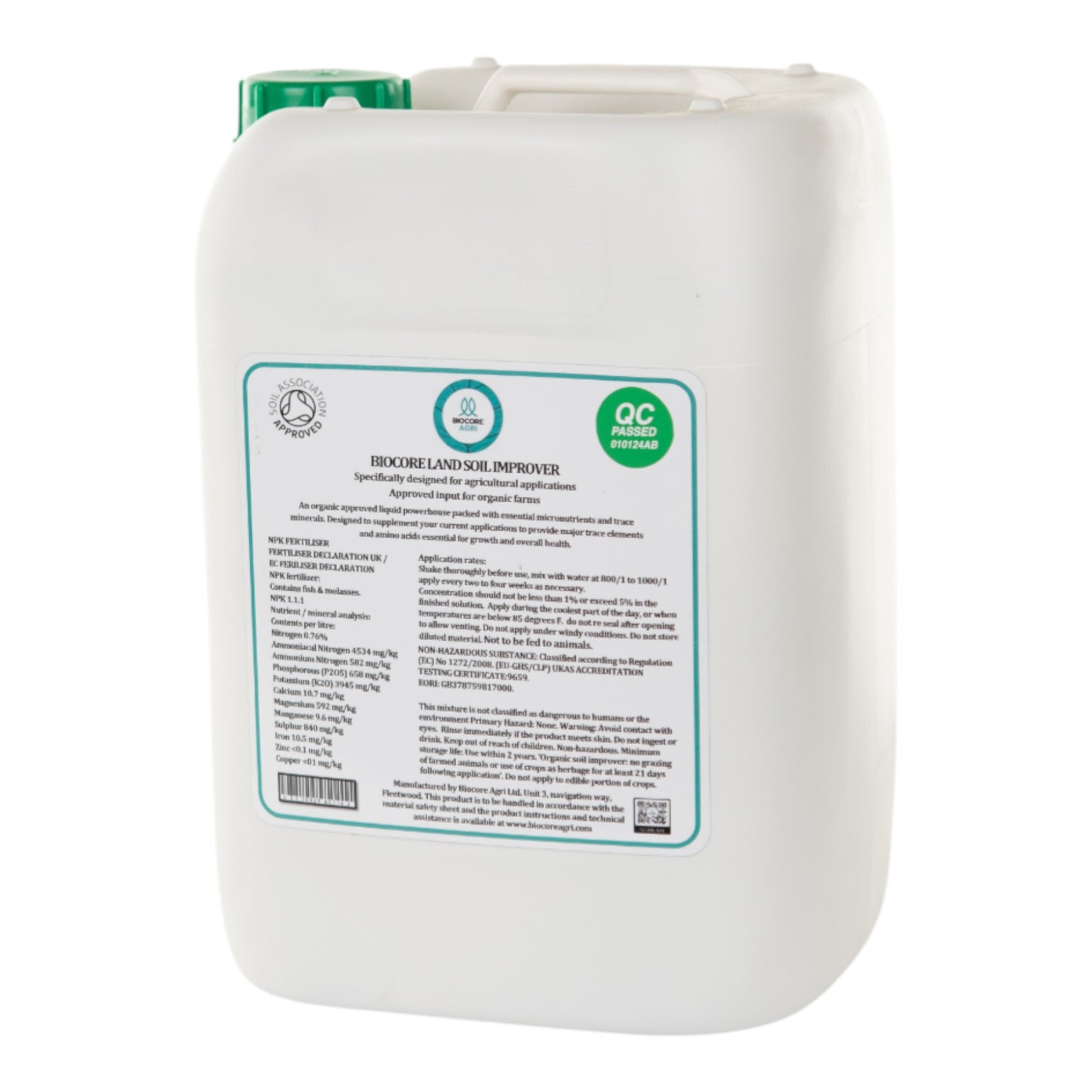


£110.00
Unit price per£110.00
Unit price perBioCore Agri Hydrolysed Fish Blood & Bones - 10L is a concentrated liquid fish-based fertiliser for professional horticultural and growing applications.
Made from hydrolysed fish blood and bone, it provides an easy-to-apply liquid source of organic nutrients for use in suitable crop and soil-feeding programmes.
Key benefits
Liquid fish-based plant nutrition
Hydrolysed fish fertilisers provide organic nutrient inputs in a liquid format that can be incorporated into suitable soil and crop nutrition programmes. Use should be matched to crop requirements, existing soil fertility and any other fertilisers being applied.
Dilution & application
The currently published product information gives a dilution rate of 1.2ml per litre of water. Measure accurately and mix consistently. Where crop, soil or application conditions require a different programme, follow the current BioCore Agri label or technical guidance.
When introducing a new feed programme, monitor crop response and avoid assuming that more concentrated applications will produce better results.
Soil biology & nutrient management
Organic liquid fertilisers can form part of programmes focused on soil biological activity and nutrient cycling. Results depend on soil condition, crop, weather, irrigation and the wider nutrition strategy, so use the product as one component of crop management rather than in isolation.
Using alongside other fertilisers
Account for nutrients already supplied by the soil, growing medium, irrigation water and other fertilisers. Avoid unnecessary duplication of nutrient inputs and check compatibility before tank-mixing with other products.
Storage & handling
Store in the original container according to the current product instructions. Keep measuring and application equipment clean and rinse equipment appropriately after use. Follow any current label or safety information for handling and storage.
BioCore Agri Success Story
Want to see BioCore Agri in action? Read our BioCore Agri Success Story, featuring the 275kg prize-winning squash grown using BioCore Agri.
BioCore Agri Hydrolysed Fish Blood & Bones - 10L product details
| Brand | BioCore Agri |
|---|---|
| Product type | Hydrolysed fish blood & bone liquid fertiliser |
| Pack size | 10L |
| Published dilution rate | 1.2ml per litre of water |
| Application | Professional horticulture and crop nutrition |
BioCore Agri Hydrolysed Fish Blood & Bones - 10L FAQs
What is BioCore Agri Hydrolysed Fish Blood & Bones?
It is a concentrated liquid fertiliser made from hydrolysed fish blood and bone for suitable horticultural and crop applications. What dilution rate is published?
The currently published product information states 1.2ml per litre of water. Is this a liquid fertiliser?
Yes. It is supplied as a concentrated liquid. Can it be used as part of a soil-health programme?
It can form part of a wider nutrition and soil-management programme; crop response also depends on soil, irrigation, weather and other nutrient inputs. Can it be mixed with other fertilisers?
Check product compatibility before tank mixing and account for nutrients already supplied by other inputs. Should I increase the concentration for a stronger effect?
Do not assume that higher concentration is beneficial. Follow current product guidance and monitor crop response. How should it be measured?
Use suitable clean measuring equipment so the concentrate can be diluted consistently. How should it be stored?
Keep it in the original container and follow current product instructions for storage and handling. Is the 1L/10L size the selling unit?
Yes. This listing is for one 10L container.

£64.40
Unit price per£64.40
Unit price per100% Ascophyllum nodosum seaweed meal harvested from the Atlantic Ocean. A natural soil-conditioning product for lawns, flower beds and vegetable-growing areas.
Angus Horticulture supplies specialist turf and soil-care products for growers, grounds teams, landscapers and gardeners. Choosing the right product means matching its analysis and application guidance to the needs of the site.
Why choose Angus Seaweed Meal 20kg - Natural Soil Conditioner?
What this product does
Supports soil conditioning and adds organic carbon; complements, rather than replaces, a balanced fertiliser programme.
When and how to use it
Apply in spring or autumn. Incorporate into the root zone before seeding or turfing, or with top dressing into hollow cores after aeration. In vegetable and flower beds, work into soil during preparation.
Getting the best results
Check the condition of the soil and turf before application. Apply products evenly and avoid excessive overlap. Good mowing, aeration, irrigation and drainage management are important alongside nutrition. Always use the current label or technical sheet for site-specific instructions.
Understanding application rates
The available application guidance is 35–70g/m². The stated coverage is 286–571m². These figures are for planning and must be checked against the current product label before use.
About Angus Horticulture
Angus Horticulture is a Scottish plant-nutrition specialist offering granular and liquid products for turf, amenity and horticultural use. Its product range includes seasonal fertilisers, soil conditioners and specialist lawn treatments.
Angus Seaweed Meal 20kg - Natural Soil Conditioner product details
| Manufacturer | Angus Horticulture |
|---|---|
| Product | Angus Seaweed Meal 20kg - Natural Soil Conditioner |
| Product type | Turf fertiliser / soil conditioner |
| Pack size | 20kg |
| Declared composition | Seaweed meal |
| Application rate | 35–70g/m² |
| Coverage | 286–571m² |
Angus Seaweed Meal 20kg - Natural Soil Conditioner FAQs
What is the product used for?
Supports soil conditioning and adds organic carbon; complements, rather than replaces, a balanced fertiliser programme. What is the declared analysis?
The declared composition is Seaweed meal. What application rate should I use?
The available guidance is 35–70g/m². Always check the current label before application. How much area does it cover?
The stated coverage is 286–571m²; actual coverage depends on the confirmed pack size and label rate. When should it be applied?
Apply in spring or autumn. Incorporate into the root zone before seeding or turfing, or with top dressing into hollow cores after aeration. In vegetable and flower beds, work into soil during preparation. Can I combine it with other lawn-care products?
Only combine or sequence products where their current labels and technical guidance permit it. Avoid unnecessary duplication of nutrients or treatments. Is this suitable for every lawn?
No. Suitability depends on turf type, condition, soil, season and the current label restrictions.
The Organic Fertiliser collection provides nutrient solutions derived from natural sources, designed to support healthy plant growth while improving soil structure and biological activity. These products are widely used in professional horticulture where long-term soil health, sustainability and responsible growing practices are key priorities.
Supplied through specialist horticultural distributors and garden wholesalers, organic fertilisers support nurseries and growers supplying both ornamental and edible crops. This range is essential for professional operations responding to increasing demand for environmentally responsible growing methods.