
Is the Loadstar Pro 600W an HPS lamp?
Yes. It is a 600W high-pressure sodium grow lamp with a dual spectrum output.

Commercial Products
Commercial Products
 Professional Growing Media
 Plant Nutrition
 Plant Health
 Sprayers & Protective Clothing
 Pots, Planters & Trays
 Propagation
 Baskets & Planters
 Fabrics & Netting
 Environment
 Plant Lighting
 Irrigation
 Plant Support & Tree Care
 Equipment
 Tools
 Plant Labels
 Packaging
 Lawn Care
 Clearance
Retail Products
Retail Products
 Growing Media
 Plant Nutrition
 Plant Health
 Pots, Planters & Tanks
 Propagation
 Baskets & Planters
 Fabrics & Netting
 Environment
 Plant Lighting
 Plant Support
 Equipment
 Tools

68 products
68 products
Sort by:

The Loadstar Pro 600W Dual Spectrum Lamp is a high-pressure sodium (HPS) grow lamp designed to provide useful light for both vegetative growth and flowering from a single 600W lamp. Its dual spectrum output combines the predominantly red/orange output associated with HPS lighting with additional blue-spectrum light, allowing growers to use one lamp throughout the crop cycle.
Designed as a cost-effective replacement lamp for compatible 600W HID lighting systems, the Loadstar Pro uses a standard E40 screw fitting and is intended to operate with a suitable 600W ballast and reflector.
Dual spectrum technology makes the lamp particularly convenient for growers who want to avoid changing between separate vegetative and flowering lamps. It can remain in the lighting system as plants move from vegetative development into flowering and fruiting.
Why choose the Loadstar Pro 600W Dual Spectrum Lamp?
Dual spectrum lighting for vegetative growth & flowering
Traditional HPS lamps produce a spectrum heavily weighted towards the warmer red and orange wavelengths commonly associated with flowering. Dual spectrum HPS lamps modify this output by introducing additional blue-spectrum light.
This broader output makes the Loadstar Pro suitable for vegetative growth as well as flowering, providing growers with a straightforward full-cycle lighting option without having to change between separate metal halide and HPS lamps.
The lamp remains particularly well suited to flowering applications while the additional blue component makes it more versatile for earlier stages of established plant growth.
Proven 600W HPS technology
High-pressure sodium lighting has been widely used in controlled-environment horticulture for many years. A 600W HPS system produces intense light from a relatively compact lamp and can be paired with a suitable reflector to distribute that light across the crop area.
HID lamps generate considerable heat during operation. Appropriate ventilation, reflector positioning and plant-to-lamp distance are therefore important parts of any 600W HPS installation.
E40 fitting for compatible 600W lighting systems
The Loadstar Pro 600W Dual Spectrum Lamp uses an E40 screw base, the common large-format lamp fitting used across many single-ended horticultural HID reflectors.
The lamp requires a compatible 600W HPS ballast. The ballast regulates the electrical supply required to start and operate the lamp and should always be correctly matched to the lamp wattage and type.
Before replacing an existing lamp, isolate the lighting system from the mains supply and allow the old lamp and reflector to cool completely.
Ideal as a replacement 600W grow lamp
HID lamps gradually lose light output through use even when they continue to illuminate normally. Replacing ageing lamps can therefore be an important part of maintaining the performance of an existing HID lighting installation.
The Loadstar Pro provides a straightforward replacement option for suitable 600W HPS systems, particularly where a dual spectrum lamp is preferred for both vegetative and flowering use.
Loadstar Pro 600W Dual Spectrum Lamp product details
| Brand | Loadstar |
|---|---|
| Range | Loadstar Pro |
| Product type | Dual spectrum HPS grow lamp |
| Power | 600W |
| Lamp technology | High Pressure Sodium (HPS) |
| Spectrum | Dual spectrum |
| Lamp fitting | E40 screw base |
| Growth stages | Vegetative growth & flowering |
| Ballast required | Yes - compatible 600W HPS ballast |
| Reflector required | Suitable E40 HID reflector / lamp holder |
| Suitable for | Full-cycle plant lighting & replacement in compatible 600W HPS systems |
Loadstar Pro 600W Dual Spectrum Lamp FAQs
Is the Loadstar Pro 600W an HPS lamp?
Yes. It is a 600W high-pressure sodium grow lamp with a dual spectrum output. What does dual spectrum mean?
Dual spectrum HPS lamps supplement the predominantly warm red/orange output of conventional HPS lighting with additional blue-spectrum light, making the lamp more versatile across different plant growth stages. Can I use the Loadstar 600W lamp for vegetative growth?
Yes. The dual spectrum output is designed to make the lamp suitable for vegetative growth as well as flowering. Can I use the same lamp for flowering?
Yes. Flowering is a core application for HPS lighting, and the Loadstar Pro can remain in use as plants move from vegetative growth into the flowering stage. What fitting does the Loadstar Pro 600W use?
It uses an E40 screw fitting, commonly found on single-ended HID horticultural reflectors and lamp holders. Does this lamp need a ballast?
Yes. The lamp must be operated with a suitable ballast designed for a 600W HPS lamp. It must not be connected directly to the mains supply. Can I fit it into an LED fixture?
No. This is a replaceable HID lamp intended for a compatible 600W HPS ballast and E40 reflector system. It is not an LED replacement component. Does a 600W HPS lamp produce much heat?
Yes. HID lighting converts a significant amount of electrical energy into heat as well as light, so suitable ventilation and safe clearance around the lamp and reflector are important. Should I touch the glass when fitting the lamp?
It is good practice to handle HID lamps carefully and avoid unnecessary contact with the glass. Always install or replace the lamp with the lighting system isolated from the mains and completely cool. Is this a good replacement for an old 600W dual spectrum bulb?
It is suitable as a replacement where the existing lighting system uses a compatible 600W HPS ballast and E40 lamp holder. Always check the ballast and reflector specifications before installation.

£0.10
Unit price per£0.10
Unit price perThe RootMASS 1L Propagation Fabric Pot is a compact, breathable container designed for young plants, rooted cuttings and early-stage propagation. Its tall fabric construction provides useful root depth within a small footprint, while the porous sides encourage natural air pruning, free drainage and increased aeration around the developing root system.
At just 1 litre, this is a useful starting size for plants that have progressed beyond plugs or small propagation cells but are not yet ready for a larger container. The narrow format also allows multiple plants to be positioned efficiently together during early development.
Unlike a rigid plastic pot, the breathable RootMASS fabric allows air to reach the outer edge of the growing medium. This changes the way roots develop within the container and helps reduce the continuous root circling that can occur against solid pot walls.
Why choose the RootMASS 1L Propagation Fabric Pot?
Compact fabric pot for propagation & early growth
The 1L RootMASS is particularly useful for staged plant production. Once a seedling or cutting has established sufficiently in its initial propagation environment, moving into a 1 litre container gives the developing root system additional space without immediately surrounding it with a large volume of growing medium.
The tall profile provides good rooting depth while keeping the overall footprint compact. This makes the pot suitable for propagation areas, nursery production and any application where efficient use of space is important.
Encourages a fibrous root system through air pruning
Roots growing inside a conventional rigid pot eventually reach an impermeable wall. They can then continue growing along the inside edge of the container, producing long circling roots.
RootMASS fabric provides a breathable boundary instead. When an actively growing root reaches the aerated edge of the growing medium, continued extension at the root tip is naturally restricted. This encourages additional lateral roots to develop further back within the root system.
The result is a more highly branched root structure that makes use of the available growing medium rather than simply following the perimeter of the container.
Excellent drainage & root-zone aeration
Fabric containers provide a large porous surface through which excess moisture can move. Rather than depending only on drainage holes in the base, water can pass through the fabric around the container.
The same breathable construction increases air exchange around the root zone. This makes RootMASS pots particularly useful where a freely draining and well-aerated growing environment is required.
Because moisture can evaporate through the fabric, watering requirements may differ from an equivalent rigid pot. Check the growing medium regularly and adjust irrigation to suit the crop, substrate and environmental conditions.
Suitable for soil, compost & coco
The RootMASS 1L Fabric Pot can be used with a wide range of suitable growing media, including potting compost, soil-based mixes and coco-based substrates.
Fill the pot evenly without heavily compressing the substrate. Maintaining suitable pore space within the growing medium complements the drainage and aeration provided by the breathable fabric.
Ideal for staged potting-on
A 1 litre fabric pot provides a useful intermediate stage in a progressive potting system. Plants can establish within the compact root volume before being transferred to a larger RootMASS or other suitable finishing container as their requirements increase.
Potting-on should be based on the development of the individual plant and its root system rather than a fixed timetable. Avoid leaving rapidly growing plants in a container once substantially more root volume is required.
RootMASS 1L Propagation Fabric Pot product details
| Brand | RootMASS |
|---|---|
| Product | Propagation Fabric Pot |
| Capacity | 1 litre |
| Format | Tall propagation pot |
| Construction | Breathable fabric |
| Root management | Designed to encourage natural air pruning |
| Drainage | Porous fabric construction provides free drainage |
| Colour | Black |
| Storage | Flexible and foldable when empty |
| Suitable growing media | Soil, compost, coco-based & other suitable container-growing media |
| Suitable for | Young plants, rooted cuttings, propagation & early-stage growing |
RootMASS 1L Propagation Fabric Pot FAQs
What is the RootMASS 1L Fabric Pot best used for?
Its compact capacity and tall format make it particularly useful for young plants, rooted cuttings and early-stage growing before plants progress into larger containers. Why is the 1L RootMASS pot tall and narrow?
The tall format provides useful rooting depth while keeping the footprint compact, allowing multiple young plants to be positioned efficiently together. What is air pruning?
Air pruning occurs when actively growing roots reach the breathable outer edge of the pot. Extension at the root tip is naturally restricted, encouraging additional lateral root development within the growing medium. Can I use the RootMASS 1L pot for rooted cuttings?
Yes. It provides a useful next-stage container for suitably established rooted cuttings that require more growing-medium volume than a small propagation cell or plug. Can I grow in coco with this fabric pot?
Yes. The RootMASS 1L can be used with suitable coco-based substrates as well as compost, soil-based mixes and other appropriate container-growing media. Does the fabric need drainage holes?
No. The porous fabric itself allows excess irrigation water to drain through the container. Position the pot where run-off can drain or be collected appropriately. When should I move a plant into a larger pot?
Pot on when the plant is sufficiently established and its root system requires additional growing-medium volume. The correct timing depends on the crop, growth rate and growing conditions rather than a fixed schedule. Can RootMASS fabric pots be reused?
Yes. Provided the fabric remains in good condition, the pot can be emptied, cleaned, allowed to dry thoroughly and reused. Do fabric pots dry faster than plastic pots?
They can. Moisture can move and evaporate through the breathable sides, so check the substrate regularly rather than following a watering schedule intended for rigid plastic containers. Are the 1L pots easy to store?
Yes. The flexible construction allows empty pots to fold down, making them compact to store and transport compared with rigid containers.
£0.10
Unit price per£0.10
Unit price perThe RootMASS 2L Propagation Fabric Pot is a compact breathable container designed for young plants, rooted cuttings and early-stage growing. Its porous fabric construction encourages natural root pruning, excellent drainage and increased aeration around the root zone, providing a practical alternative to conventional rigid propagation pots.
The tall, narrow 2 litre format provides useful root depth while keeping the overall footprint compact. This makes it particularly useful where large numbers of young plants need to be established efficiently before progressing into larger containers.
RootMASS fabric pots encourage roots to branch throughout the growing medium rather than continuously circling against a solid container wall. The flexible construction is also lightweight and easy to store when not in use.
Why choose the RootMASS 2L Propagation Fabric Pot?
Designed for propagation & young plants
The RootMASS 2L is particularly useful as an early-stage container between initial propagation and a larger finishing pot. It provides substantially more root volume than a small plug or propagation cell while avoiding the unnecessary substrate volume of moving a young plant directly into a large container.
Its tall profile encourages roots to explore a useful depth of growing medium, while the breathable walls provide air contact around the perimeter of the root zone.
Once the plant has established a strong root system, it can be moved into an appropriately sized larger container according to the requirements of the crop.
How RootMASS air pruning works
Roots growing inside a conventional rigid plastic pot eventually reach an impermeable wall. Unable to grow through it, they can begin following the inside edge of the container and form circling roots.
RootMASS uses breathable fabric instead. When actively growing root tips reach the aerated outer edge of the growing medium, their continued extension is naturally restricted. The plant responds by developing additional lateral roots further back within the root system.
This process encourages a more highly branched root mass capable of exploring the available growing medium.
Free drainage & root-zone aeration
The porous fabric provides a much larger permeable surface than a conventional plastic container with drainage holes only in the base. Excess irrigation water can move through the fabric while air can reach the growing medium around the sides of the pot.
This combination makes RootMASS particularly useful where growers want a well-aerated, freely draining root environment.
Because moisture can evaporate through the sides, fabric pots can dry differently from rigid containers. Irrigation frequency should therefore be based on the actual moisture content of the growing medium, plant size and environmental conditions.
Suitable for soil, compost & coco
The RootMASS 2L Propagation Fabric Pot can be used with a wide variety of suitable growing media, including potting compost, soil-based mixes and coco-based substrates.
When filling the pot, distribute the substrate evenly and avoid excessive compaction. Maintaining suitable pore space within the growing medium complements the drainage and aeration provided by the fabric container.
Suitable for hand watering & irrigation systems
RootMASS fabric pots can be used in conventional hand-watered container growing as well as suitable irrigation systems. Their porous construction allows water to move through the fabric, making them compatible with applications where the growing medium is irrigated from above or allowed to take up moisture from below.
Irrigation frequency and duration should always be matched to the growing medium, crop and particular system being used.
RootMASS 2L Propagation Fabric Pot product details
| Brand | RootMASS |
|---|---|
| Product | Propagation Fabric Pot |
| Capacity | 2 litres |
| Format | Tall propagation pot |
| Construction | Breathable fabric |
| Root management | Designed to encourage natural air pruning |
| Drainage | Porous fabric construction provides free drainage |
| Colour | Black |
| Storage | Flexible and foldable when empty |
| Suitable growing media | Soil, compost, coco-based & other suitable container-growing media |
| Suitable for | Young plants, rooted cuttings, propagation & early-stage growing |
RootMASS 2L Propagation Fabric Pot FAQs
What is the RootMASS 2L Fabric Pot designed for?
Its compact, tall format makes it particularly suitable for young plants, rooted cuttings and early-stage growing before plants are moved into larger containers. What capacity is this RootMASS pot?
This model has a nominal growing-medium capacity of 2 litres. Why use a fabric pot for propagation?
The breathable fabric provides drainage and root-zone aeration while encouraging natural root pruning. This helps young plants develop a branched root structure rather than roots simply following a rigid container wall. What is root air pruning?
Air pruning occurs when an actively growing root reaches the aerated edge of a fabric pot. Extension at the root tip is restricted, encouraging further lateral root development within the growing medium. Can I use coco in the RootMASS 2L pot?
Yes. RootMASS fabric pots can be used with suitable coco-based substrates as well as compost, soil-based mixes and other appropriate container-growing media. Does the fabric pot need drainage holes?
No. The porous fabric itself allows excess irrigation water to drain through the container. It should still be positioned where run-off can escape or be collected appropriately. Can the 2L RootMASS pot be used with an irrigation system?
Yes. Fabric pots can be used with suitable irrigation systems as well as conventional hand watering. Irrigation should be adjusted to the crop, substrate and environmental conditions. When should I move a plant from a 2L pot into a larger container?
Potting-on timing depends on the crop and growing method. Move the plant when its root system is sufficiently established and additional growing-medium volume is required for the next stage of development. Are RootMASS fabric pots reusable?
Yes. Provided the fabric remains in suitable condition, pots can be emptied, cleaned, dried thoroughly and reused. Are 2L fabric pots easy to store?
Yes. Their flexible construction allows empty pots to be folded down, so they require much less storage space than equivalent rigid containers.

Compact 10ml measuring syringe for accurate dosing of small quantities of liquid plant nutrients, additives and boosters.
This 10ml Nutrient Measuring Syringe provides a simple way to measure small volumes of liquid when preparing plant feeds and nutrient solutions. Its compact capacity is particularly useful when working with concentrated nutrients and additives where accurate, low-volume dosing matters.
Easy to keep alongside your nutrients and mixing equipment, the syringe allows growers to draw up the required quantity before dispensing it into water or a nutrient reservoir. It is a useful everyday measuring tool for grow rooms, propagation areas, greenhouses and general horticultural use.
Why choose a 10ml Nutrient Measuring Syringe?
What is a 10ml Measuring Syringe suitable for?
A 10ml measuring syringe is particularly useful when working with concentrated plant nutrients, root stimulants, boosters and other compatible liquid additives that are used in relatively small quantities.
Its smaller capacity provides good control for low-volume measurements and can be more convenient than using a larger syringe, measuring cup or jug. This makes it a useful choice for hydroponic growing, propagation, greenhouse production and general horticultural feeding.
How to use a 10ml Nutrient Measuring Syringe
Place the syringe tip into the liquid and slowly draw back the plunger until the required quantity is shown on the graduated barrel. Remove the syringe from the container and dispense the measured liquid into the appropriate mixing vessel, water or nutrient reservoir.
Always follow the dosage instructions supplied with the nutrient or additive being measured. Take care to avoid cross-contamination between concentrated products and clean or replace measuring equipment as appropriate between different liquids.
Product details
| Product | Nutrient Measuring Syringe |
|---|---|
| Product type | Liquid measuring syringe |
| Capacity | 10ml |
| Scale | Graduated barrel |
| Typical applications | Measuring liquid plant nutrients, feeds, additives & boosters |
| Pack quantity | 100 |
10ml Nutrient Measuring Syringe FAQs
What is a 10ml syringe used for in horticulture?
A 10ml measuring syringe is useful for measuring and dispensing small quantities of suitable liquid plant nutrients, feeds, supplements and additives when preparing nutrient solutions.
Can I use a 10ml syringe for measuring plant nutrients?
Yes. The compact 10ml capacity is particularly useful when nutrients or additives need to be measured in relatively small quantities before being added to water or a nutrient reservoir.
Is a 10ml syringe suitable for concentrated nutrients?
A 10ml syringe can be particularly convenient for concentrated liquid nutrients and additives with low application rates, as smaller volumes can be measured more easily than with a large measuring jug.
Should I choose a 10ml, 20ml or 60ml nutrient syringe?
Choose the size that best matches the quantities you regularly measure. A 10ml syringe is useful for smaller doses, while 20ml and 60ml syringes provide greater capacity when larger quantities of liquid need to be measured.
Can I use the same syringe for different nutrients?
Take care to avoid cross-contamination between concentrated products. Clean the syringe appropriately between compatible liquids or use separate measuring equipment where necessary.
Can a 10ml syringe be used for pH adjustment liquids?
Only use measuring equipment that is compatible with the liquid being handled. Concentrated acids and alkalis can require chemical-resistant equipment, so check the instructions for the specific pH adjustment product before use.
How many 10ml syringes are in a pack?
The pack quantity is 100 syringes. This figure is provided for logistical and stock-planning purposes and does not mean the product must be purchased by the full pack.


The RootMASS 1L Propagation Fabric Pot Grey is a reusable fabric growing container designed for propagation and young-plant production.
Fabric pots provide a breathable alternative to rigid plastic containers. Their porous sides allow air movement through the container wall and can help reduce root circling at the outer edge of the growing medium when used in an appropriate growing system.
Sold individually. Commercial box quantity: 1500 pots.
Why choose a RootMASS fabric pot?
Breathable fabric for root development
As roots reach the more aerated outer area of a fabric pot, their growth pattern can differ from roots meeting an impermeable container wall. This can encourage a more branched root system rather than allowing long roots simply to circle the inside of a rigid pot.
Results depend on crop, substrate, irrigation and environment, so fabric pots should be treated as part of the overall growing system rather than as a substitute for good root-zone management.
Growing in fabric pots
Use a growing medium appropriate to the crop, with sufficient structure, drainage and moisture retention. Fill evenly without excessive compaction and position the pot on a surface that allows drainage.
Fabric containers can lose moisture through their sides as well as the growing-medium surface. Check moisture regularly, particularly in warm, bright or windy conditions, and adjust irrigation to actual crop demand.
Professional & garden applications
The 1L format is suitable for propagation and young-plant production where that volume provides appropriate root space. Select container size according to plant vigour, root development and intended production period.
Reuse & crop hygiene
Fabric pots can be reused where they remain in suitable condition. Remove old growing medium, clean appropriately and consider crop-hygiene requirements before moving a container between production cycles.
RootMASS 1L Propagation Fabric Pot Grey product details
| Brand | RootMASS |
|---|---|
| Product type | Fabric pot |
| Capacity | 1L |
| Colour | Grey |
| Selling quantity | 1 pot |
| Commercial box quantity | 1500 pots |
RootMASS 1L Propagation Fabric Pot Grey FAQs
Is this fabric pot sold individually?
Yes. This product is sold as one fabric pot. What capacity is this fabric pot?
The nominal capacity is 1L. Why use a fabric pot instead of a rigid plastic pot?
The breathable fabric wall allows additional air exchange at the edge of the growing medium and can help reduce the tendency for roots to circle around an impermeable container wall. Do fabric pots need more frequent watering?
They can dry differently from rigid pots because moisture can also be lost through the fabric sides. Check the growing medium regularly and irrigate according to crop demand. What growing medium should I use?
Choose a substrate appropriate to the crop with a suitable balance of drainage, aeration, moisture retention and nutrition. Can RootMASS fabric pots be reused?
Yes, where the pot remains in suitable condition and crop-hygiene requirements are met. Remove old substrate and clean appropriately before reuse. How many pots are in a commercial box?
A commercial box contains 1500 pots. Individual pots are sold separately.
Compact 20ml measuring syringe for accurately measuring and dispensing liquid plant nutrients, additives and boosters.
This 20ml Nutrient Measuring Syringe offers a simple, controlled way to measure smaller quantities of liquid when preparing feeds and nutrient solutions. Its compact capacity is particularly useful when working with concentrated nutrients and additives where only a relatively small volume is required.
A useful addition to any nutrient mixing station, the syringe allows growers to draw up a measured quantity of suitable liquid before dispensing it into water or a reservoir. It is a straightforward piece of measuring equipment for grow rooms, propagation areas, greenhouses and general horticultural use.
Why choose a 20ml Nutrient Measuring Syringe?
What is a 20ml Measuring Syringe suitable for?
A 20ml measuring syringe is particularly useful when preparing plant feeds and nutrient solutions that require relatively small quantities of liquid nutrients, supplements or compatible additives.
The smaller capacity gives growers good control when measuring low-volume doses and can be more convenient than using a larger measuring jug for these quantities. It is suitable for hydroponic growing, greenhouse production, propagation and general horticultural feeding applications.
How to use a 20ml Nutrient Measuring Syringe
Place the syringe tip into the liquid and slowly draw back the plunger until the required quantity is shown on the graduated barrel. Remove the syringe and dispense the measured liquid into the appropriate mixing vessel, water or nutrient reservoir.
Always follow the manufacturer's recommended dosage for the nutrient or additive being measured. Take care to avoid cross-contamination between concentrated products and clean or replace measuring equipment as appropriate between different liquids.
Product details
| Product | Nutrient Measuring Syringe |
|---|---|
| Product type | Liquid measuring syringe |
| Capacity | 20ml |
| Scale | Graduated barrel |
| Typical applications | Measuring liquid plant nutrients, feeds, additives & boosters |
| Pack quantity | 50 |
20ml Nutrient Measuring Syringe FAQs
What is a 20ml syringe used for in horticulture?
A 20ml measuring syringe provides a convenient way to measure and dispense smaller quantities of suitable liquid plant nutrients, feeds, supplements and additives.
Can I use a 20ml syringe for measuring plant nutrients?
Yes. A graduated 20ml syringe is particularly useful when a liquid nutrient or additive needs to be measured in relatively small quantities before being added to water or a nutrient reservoir.
Why use a syringe for measuring nutrients?
A syringe gives you greater control when measuring small volumes of liquid and can be more convenient than trying to measure the same quantity with a larger jug or container.
Should I use a 20ml or 60ml nutrient syringe?
A 20ml syringe is particularly convenient for smaller doses and concentrated products, while a 60ml syringe provides more capacity when larger quantities need to be measured. The best size depends on the dosage and volume you regularly work with.
Can I use the same syringe for different nutrients?
Take care to avoid transferring concentrated products from one container to another. Clean the syringe appropriately between compatible products or use separate measuring equipment where cross-contamination could be an issue.
Can a 20ml syringe be used to measure pH adjustment products?
Only use measuring equipment that is compatible with the product being handled. Concentrated acids and alkalis can require chemical-resistant equipment, so check the instructions and compatibility information for the specific pH adjustment product before use.
How many 20ml syringes are in a pack?
The pack quantity is 50 syringes. This figure is provided for logistical and stock-planning purposes and does not mean the product must be purchased by the full pack.


£0.30
Unit price per£0.30
Unit price perThe RootMASS 1L Propagation Thick Fabric Pot Black is a reusable fabric growing container designed for propagation and young-plant production.
Fabric pots provide a breathable alternative to rigid plastic containers. Their porous sides allow air movement through the container wall and can help reduce root circling at the outer edge of the growing medium when used in an appropriate growing system.
Sold individually. Commercial box quantity: 640 pots.
Why choose a RootMASS fabric pot?
Breathable fabric for root development
As roots reach the more aerated outer area of a fabric pot, their growth pattern can differ from roots meeting an impermeable container wall. This can encourage a more branched root system rather than allowing long roots simply to circle the inside of a rigid pot.
Results depend on crop, substrate, irrigation and environment, so fabric pots should be treated as part of the overall growing system rather than as a substitute for good root-zone management.
Growing in fabric pots
Use a growing medium appropriate to the crop, with sufficient structure, drainage and moisture retention. Fill evenly without excessive compaction and position the pot on a surface that allows drainage.
Fabric containers can lose moisture through their sides as well as the growing-medium surface. Check moisture regularly, particularly in warm, bright or windy conditions, and adjust irrigation to actual crop demand.
Professional & garden applications
The 1L format is suitable for propagation and young-plant production where that volume provides appropriate root space. Select container size according to plant vigour, root development and intended production period.
Reuse & crop hygiene
Fabric pots can be reused where they remain in suitable condition. Remove old growing medium, clean appropriately and consider crop-hygiene requirements before moving a container between production cycles.
RootMASS 1L Propagation Thick Fabric Pot Black product details
| Brand | RootMASS |
|---|---|
| Product type | Thick fabric pot |
| Capacity | 1L |
| Colour | Black |
| Selling quantity | 1 pot |
| Commercial box quantity | 640 pots |
RootMASS 1L Propagation Thick Fabric Pot Black FAQs
Is this fabric pot sold individually?
Yes. This product is sold as one fabric pot. What capacity is this fabric pot?
The nominal capacity is 1L. Why use a fabric pot instead of a rigid plastic pot?
The breathable fabric wall allows additional air exchange at the edge of the growing medium and can help reduce the tendency for roots to circle around an impermeable container wall. Do fabric pots need more frequent watering?
They can dry differently from rigid pots because moisture can also be lost through the fabric sides. Check the growing medium regularly and irrigate according to crop demand. What growing medium should I use?
Choose a substrate appropriate to the crop with a suitable balance of drainage, aeration, moisture retention and nutrition. Can RootMASS fabric pots be reused?
Yes, where the pot remains in suitable condition and crop-hygiene requirements are met. Remove old substrate and clean appropriately before reuse. How many pots are in a commercial box?
A commercial box contains 640 pots. Individual pots are sold separately.

£0.35
Unit price per£0.35
Unit price perThe RootMASS 3.8L Fabric Pot is a compact breathable plant container designed to promote natural air pruning, excellent drainage and improved root-zone aeration. Made from porous fabric rather than rigid plastic, it encourages roots to branch throughout the growing medium instead of continuously circling around the inside of the pot.
The 3.8 litre capacity makes this one of the smaller pots in the RootMASS range and a useful choice for young plants, herbs and intermediate-stage growing before plants are moved into a larger final container.
RootMASS fabric pots are flexible, lightweight and reusable. Their breathable construction works with soil, compost, coco-based substrates and other suitable growing media, making them a versatile alternative to conventional plastic pots.
Why choose the RootMASS 3.8L Fabric Pot?
Natural root air pruning
When roots reach the solid wall of a conventional plastic pot, they can begin following the shape of the container. Over time this can produce long roots circling around the perimeter of the root ball.
A RootMASS fabric pot works differently. The breathable wall exposes the outside of the growing medium to air. When an actively growing root tip reaches this aerated boundary, extension at the tip is naturally restricted.
This encourages further lateral root development within the growing medium, helping create a more highly branched and fibrous root structure.
Compact 3.8L size for young plants
At 3.8 litres, this RootMASS pot provides a useful step between small propagation containers and larger finishing pots. It gives developing plants additional root space without immediately placing them into an unnecessarily large volume of growing medium.
It can be particularly useful for young plants, herbs, smaller ornamental plants and crops being grown through a staged potting-on system.
Excellent drainage & root-zone aeration
Rather than depending solely on drainage holes in the base, a fabric pot provides a large porous surface through which excess moisture can move. This promotes free drainage while also allowing air exchange around the growing medium.
Fabric pots can consequently dry differently from rigid plastic containers. Check the actual moisture content of the growing medium and adjust irrigation according to plant size, environmental conditions and the substrate being used.
Suitable for soil, compost & coco
The RootMASS 3.8L Fabric Pot can be used with a wide variety of suitable growing media, including conventional compost, soil-based mixes and coco-based substrates.
When filling, distribute the substrate evenly without excessive compaction. Maintaining good pore space within the growing medium complements the aeration and drainage characteristics of the fabric container.
Flexible, reusable & easy to store
Fabric pots have a major practical advantage when large numbers of empty containers need to be stored. Instead of occupying the same volume whether full or empty, they can be folded down for compact storage and transportation.
After use, remove old growing medium and root material, clean the pot appropriately and allow it to dry thoroughly before storing or reusing it.
RootMASS 3.8L Fabric Pot product details
| Brand | RootMASS |
|---|---|
| Product | Fabric Pot |
| Capacity | 3.8 litres |
| Shape | Round |
| Approximate dimensions | 15cm x 19cm |
| Construction | Breathable fabric |
| Root management | Designed to encourage natural air pruning |
| Drainage | Porous fabric construction provides free drainage |
| Colour | Black |
| Storage | Flexible and foldable when empty |
| Suitable growing media | Soil, compost, coco-based & other suitable container-growing media |
| Suitable for | Young plants, herbs, smaller crops & intermediate-stage growing |
RootMASS 3.8L Fabric Pot FAQs
What capacity is this RootMASS fabric pot?
This model has a nominal capacity of 3.8 litres. What are the dimensions of the RootMASS 3.8L pot?
Published dimensions for the 3.8L round RootMASS fabric pot are approximately 15cm x 19cm. What is air pruning?
Air pruning occurs when actively growing root tips reach the breathable edge of the container. This naturally restricts extension at the tip and encourages further lateral root development within the growing medium. Why use a 3.8L fabric pot instead of a plastic pot?
The breathable fabric provides greater air exchange and drainage around the root zone while helping reduce the continuous root circling that can occur against a solid plastic pot wall. Is 3.8L suitable for young plants?
Yes. Its compact capacity makes it particularly useful for young plants and intermediate-stage growing before potting on into a larger container where required. Can I use coco in this RootMASS pot?
Yes. RootMASS fabric pots can be used with suitable coco-based substrates as well as soil, compost and other appropriate container-growing media. Do I need to add drainage holes?
No. The fabric itself is porous and allows excess irrigation water to drain through the container. The pot should still be positioned where run-off can drain or be collected appropriately. Can RootMASS fabric pots be reused?
Yes. They are reusable. Remove old substrate and roots after use, clean appropriately and allow the pot to dry thoroughly before storing or reusing it. Can the 3.8L fabric pot be used outdoors?
Yes. It is suitable for both indoor and outdoor horticultural use. Irrigation requirements should be adjusted for temperature, wind, rainfall, plant size and growing medium. Are fabric pots easy to store?
Yes. Their flexible construction means they can be folded down when empty, requiring considerably less storage space than equivalent rigid pots.

£0.40
Unit price per£0.40
Unit price perThe RootMASS 8L Fabric Pot is a breathable plant container designed to promote natural air pruning, improved root-zone aeration and free drainage. A practical alternative to a conventional rigid plastic pot, its porous fabric construction encourages plants to develop a dense, fibrous root system throughout the growing medium.
With an 8 litre capacity, this RootMASS pot is a useful intermediate size for establishing plants that need more root space without immediately moving into a large final container. The flexible construction is lightweight and easy to store, while integrated handles provide convenient lifting points when positioning the pot.
RootMASS fabric pots can be used with a wide variety of suitable growing media, including compost, soil and coco-based substrates, making them a versatile option for both indoor and outdoor horticulture.
Why choose the RootMASS 8L Fabric Pot?
How RootMASS fabric pots air prune roots
In a conventional rigid plant pot, actively growing roots eventually reach the solid wall of the container. Because they cannot grow through it, they can begin travelling around the inside edge of the pot, creating the familiar root-circling effect.
RootMASS uses a breathable fabric wall instead. As root tips reach the aerated outer edge of the growing medium, their continued extension is naturally restricted. This encourages additional lateral roots to develop further back within the root system.
The result is a more extensively branched, fibrous root structure capable of exploring the growing medium rather than simply following the perimeter of the container.
Excellent drainage & aeration
One of the major differences between a fabric pot and a conventional plastic container is the amount of permeable surface area. Rather than draining only through a small number of holes in the base, moisture can pass through the porous fabric.
This provides excellent drainage while allowing greater movement of air around the root zone. Good drainage is still dependent on using an appropriate growing medium and irrigation regime, so the pot should not be treated as a substitute for correct watering practice.
Fabric containers may dry more quickly than equivalent rigid pots in warm or dry conditions. Check the moisture level of the substrate and adjust irrigation to suit the crop and environment.
A versatile 8 litre growing container
The 8L capacity makes this RootMASS fabric pot suitable for a broad range of plants and growing situations. It provides considerably more root volume than small propagation containers while remaining compact enough for efficient use of growing space.
Suitable applications include:
Suitable for soil, compost & coco
RootMASS fabric pots are compatible with a wide variety of container-growing substrates. They can be filled with conventional potting compost, soil-based mixes, coco-based substrates or other appropriate growing media.
When filling the pot, distribute the growing medium evenly and avoid excessive compaction. Maintaining suitable pore space within the substrate supports both drainage and oxygen availability around the root system.
Flexible, lightweight & easy to store
Unlike rigid plastic pots, fabric containers can be folded down when empty. This significantly reduces the amount of storage space required when pots are not in use and makes them convenient to transport in quantity.
The integrated handles provide convenient lifting points for positioning the pot. Once filled with wet growing medium and an established plant, however, the complete container can become considerably heavier, so it should always be moved carefully.
RootMASS 8L Fabric Pot product details
| Brand | RootMASS |
|---|---|
| Product | Fabric Pot |
| Capacity | 8 litres |
| Shape | Round |
| Construction | Breathable fabric |
| Handles | Integrated carrying handles |
| Root management | Designed to encourage natural air pruning |
| Drainage | Porous fabric construction provides free drainage |
| Colour | Black |
| Storage | Flexible and foldable when empty |
| Suitable growing media | Soil, compost, coco-based & other suitable container-growing media |
| Suitable for | Indoor & outdoor horticultural growing |
RootMASS 8L Fabric Pot FAQs
What size is this RootMASS fabric pot?
This model has a nominal growing-medium capacity of 8 litres. What is the advantage of a fabric plant pot?
The breathable construction provides excellent drainage and root-zone aeration while encouraging natural air pruning, helping reduce the root circling commonly seen in rigid containers. What is air pruning?
Air pruning occurs when actively growing root tips reach the breathable perimeter of the pot. Continued extension at the tip is restricted, encouraging additional lateral root development within the growing medium. Does the RootMASS 8L pot have handles?
Yes. This black 8L RootMASS pot has integrated handles to provide convenient lifting points when positioning the container. Can I use coco in a RootMASS fabric pot?
Yes. RootMASS fabric pots can be used with suitable coco-based growing media as well as conventional compost, soil mixes and other appropriate substrates. Do I need to make drainage holes in the fabric?
No. The fabric itself is porous and allows excess moisture to pass through the container. Position the pot where drainage water can escape or be collected appropriately. Do fabric pots need different watering?
Potentially. The breathable sides can increase evaporation compared with a rigid plastic pot, particularly in warm conditions. Check substrate moisture regularly and irrigate according to the plant, growing medium and environment. Can the RootMASS 8L pot be reused?
Yes. The fabric pot is reusable. After the crop is removed, clear away old roots and growing medium, clean the pot appropriately and allow it to dry thoroughly before storage or reuse. Can fabric pots be stored flat?
Yes. Their flexible construction means empty RootMASS pots can be folded down, making them much more compact to store than equivalent rigid containers. Can I use the RootMASS 8L Fabric Pot outdoors?
Yes. RootMASS fabric pots are suitable for indoor and outdoor horticultural use. Outdoor watering requirements will vary with rainfall, temperature, wind, plant size and the growing medium used.

£0.50
Unit price per£0.50
Unit price perThe RootMASS Square Fabric Pot 37L is a large breathable plant container designed to encourage a healthy, fibrous root system through natural air pruning. Its square shape makes efficient use of growing space, while the porous fabric construction improves root-zone aeration and allows excess irrigation water to drain freely through the pot.
With a generous 37 litre capacity, this RootMASS fabric pot provides substantially more root volume than smaller propagation and finishing pots, making it well suited to larger plants and longer growing cycles.
Integrated carrying handles make the empty pot easier to position and handle, while the flexible fabric construction means it can be folded relatively flat when not in use.
Why choose the RootMASS Square Fabric Pot 37L?
Air pruning for a more fibrous root system
Roots behave differently in a breathable fabric container than they do inside a conventional rigid plastic pot. When a root reaches the solid wall of a plastic container, it can continue growing along the inside edge, eventually creating long circling roots.
The RootMASS fabric wall allows air to reach the perimeter of the growing medium. As actively growing root tips reach this aerated boundary, their extension is naturally restricted. The plant responds by producing additional lateral roots further back within the root zone.
This natural air-pruning process encourages the development of a dense network of finer feeder roots throughout the available growing medium.
Space-efficient square fabric pot
The square design offers a practical advantage when multiple containers are being positioned together. Unlike round pots, square containers can be arranged side by side with less unused space between them.
This makes the 37L RootMASS particularly useful where growing-area efficiency matters, while still providing each plant with its own substantial volume of growing medium.
Breathable sides & free drainage
A conventional plastic pot normally drains through a limited number of openings in its base. RootMASS fabric pots use a porous construction that allows moisture to move through the fabric itself.
This helps excess water drain from the root zone while increasing air exchange around the outside of the growing medium.
Because moisture can also evaporate through the fabric, watering requirements may differ from an equivalent rigid pot. Irrigation should therefore be based on the moisture level of the growing medium and the needs of the plant rather than a fixed schedule.
Suitable for soil, compost & coco-based growing media
The RootMASS 37L can be used with a wide variety of suitable container-growing media, including soil and compost mixes, coco-based substrates and other free-draining blends.
The ideal medium will depend on the crop and irrigation method. Whatever substrate is selected, avoid excessive compaction when filling the pot, as maintaining good pore space within the growing medium supports effective drainage and root-zone aeration.
Integrated carrying handles
Strong integrated handles provide convenient lifting points when positioning the RootMASS pot. They are particularly useful when setting up containers or moving them before the growing medium becomes fully saturated.
Bear in mind that 37 litres of moist growing medium plus a mature plant can become very heavy. Where possible, position larger fabric pots before filling and avoid unnecessary movement once established.
Getting the best from a 37L fabric pot
Open the pot fully and position it on a firm, level surface before filling. Add the growing medium evenly, allowing the square sides and base to take their intended shape without heavily compressing the substrate.
Fabric pots should be positioned where excess irrigation water can drain safely. A suitable collection tray can be used where run-off needs to be contained.
As plants establish, check moisture throughout the root zone rather than judging watering requirements solely from the appearance of the surface.
RootMASS Square Fabric Pot 37L product details
| Brand | RootMASS |
|---|---|
| Product | Square Fabric Pot |
| Capacity | 37 litres |
| Shape | Square |
| Construction | Breathable fabric |
| Handles | Integrated carrying handles |
| Root management | Designed to encourage natural air pruning |
| Drainage | Porous fabric construction allows excess water to drain through the container |
| Colour | Black |
| Storage | Flexible and foldable when empty |
| Suitable growing media | Soil, compost, coco-based & other suitable container-growing media |
| Suitable for | Large plants & longer-term container growing |
RootMASS Square Fabric Pot 37L FAQs
What capacity is this RootMASS fabric pot?
This model has a nominal growing-medium capacity of 37 litres. Why choose a square fabric pot instead of a round one?
Square pots can be positioned closely together with less unused space between containers, making efficient use of the available growing area. What does air pruning mean?
Air pruning occurs when actively growing root tips reach the breathable outer edge of the pot. Their extension is naturally restricted, encouraging the plant to develop additional lateral feeder roots within the growing medium. Does the 37L RootMASS pot have handles?
Yes. The pot has integrated handles that provide convenient lifting points for positioning and handling. Does a RootMASS fabric pot need drainage holes?
The fabric itself is porous, allowing excess irrigation water to drain through the container rather than relying solely on conventional holes in the base. Can I use coco in this fabric pot?
Yes. The 37L RootMASS can be used with suitable coco-based substrates as well as soil, compost and other appropriate container-growing media. Do fabric pots need watering more often?
They can dry differently from rigid plastic pots because moisture and air can move through the fabric. Watering frequency should therefore be determined by the crop, environment and actual moisture level of the growing medium. Can the RootMASS 37L be reused?
Yes. Provided the fabric remains in good condition, the pot can be emptied, cleaned, allowed to dry thoroughly and reused. Can I move a 37L fabric pot using the handles?
The handles provide useful lifting points, but a 37L pot containing wet growing medium and an established plant can become very heavy. It is best to position large containers before filling whenever possible. How should I store the pot when it is not being used?
Remove the growing medium and root debris, clean and thoroughly dry the pot, then fold it for compact storage in a dry location.
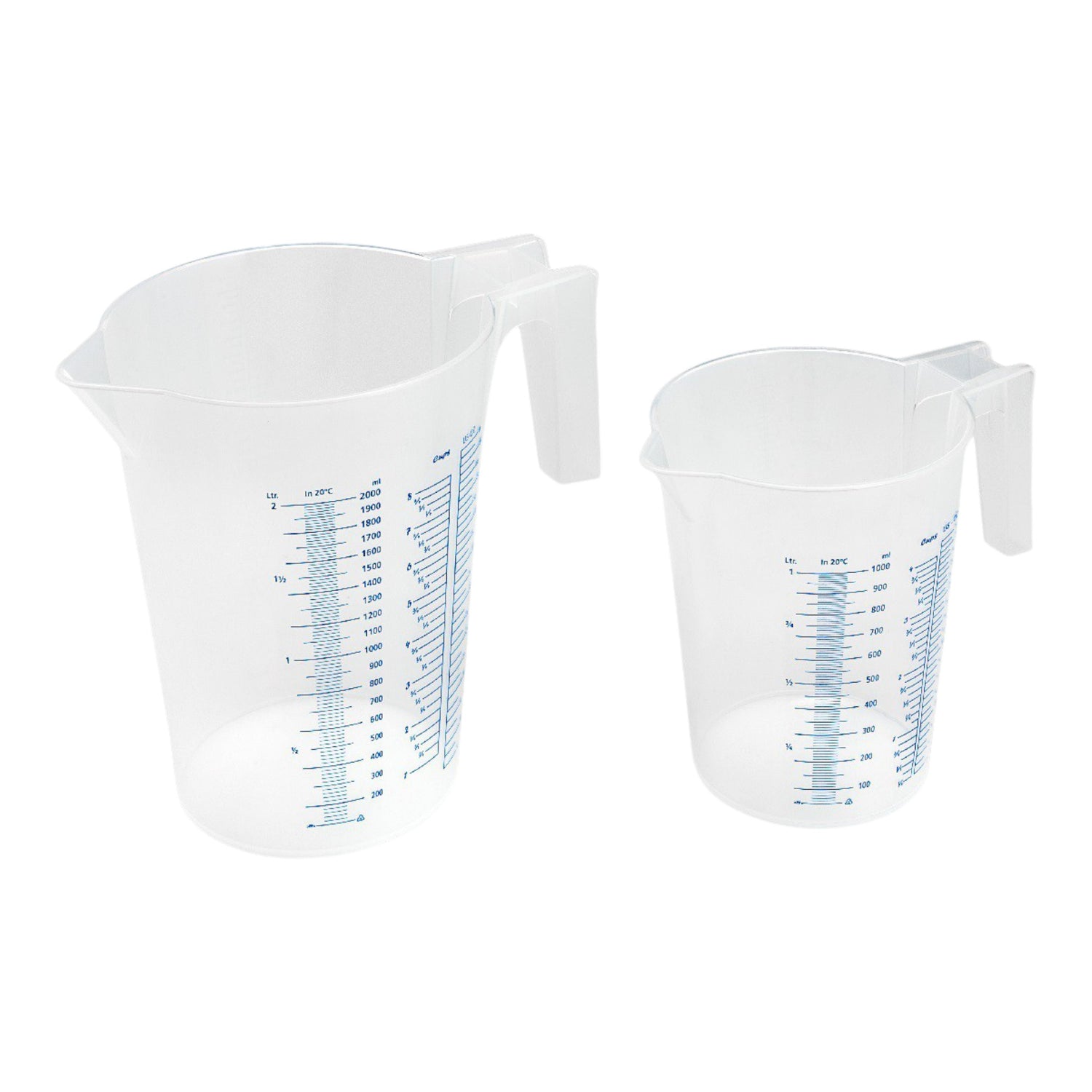
The 500ml Measuring Jug is designed for measuring suitable horticultural liquids and concentrates.
Accurate measuring helps improve repeatability when preparing feeds, additives or other suitable horticultural liquids.
Key benefits
Repeatable liquid measurement
Place the jug on a level surface and read the graduation at eye level where practical. Use a jug size appropriate to the volume being measured so small additions are not estimated from an unnecessarily large vessel.
Rinse between incompatible products to avoid cross-contamination and use separate measuring equipment where product instructions or site procedures require it.
Good working practice
Keep equipment and materials clean and clearly identified. Follow the instructions for any fertiliser, additive or treatment being prepared and use appropriate PPE where required by the product label or workplace assessment.
Storage & maintenance
Store the product clean, dry and protected from damage. Electronic meters should be maintained according to their manufacturer instructions; measuring equipment should be replaced if markings or condition no longer allow reliable use.
500ml Measuring Jug product details
| Product | 500ml Measuring Jug |
|---|---|
| Product type | Measuring Jug |
| Primary use | measuring suitable horticultural liquids and concentrates |
| Stated size / capacity | 500ml |
500ml Measuring Jug FAQs
What is this product used for?
Measuring suitable horticultural liquids and concentrates. How should it be used?
Follow the product instructions and use it only for compatible horticultural applications. How should it be stored?
Keep it clean, dry and protected from physical damage or contamination. Should equipment be cleaned between uses?
Yes where appropriate, particularly when moving between different solutions or materials. Can one measurement represent every part of a crop or growing area?
Not necessarily. Use representative sampling where conditions may vary. When should the product be replaced?
Replace damaged equipment or material that can no longer be used reliably for its intended purpose. Does this replace crop-specific guidance?
No. Use measurements or growing-media components alongside the requirements of the crop and production system. What should I do if a reading or result looks wrong?
Repeat the measurement or check the equipment and method before making significant adjustments.
The 1L Measuring Jug is designed for measuring suitable horticultural liquids and concentrates.
Accurate measuring helps improve repeatability when preparing feeds, additives or other suitable horticultural liquids.
Key benefits
Repeatable liquid measurement
Place the jug on a level surface and read the graduation at eye level where practical. Use a jug size appropriate to the volume being measured so small additions are not estimated from an unnecessarily large vessel.
Rinse between incompatible products to avoid cross-contamination and use separate measuring equipment where product instructions or site procedures require it.
Good working practice
Keep equipment and materials clean and clearly identified. Follow the instructions for any fertiliser, additive or treatment being prepared and use appropriate PPE where required by the product label or workplace assessment.
Storage & maintenance
Store the product clean, dry and protected from damage. Electronic meters should be maintained according to their manufacturer instructions; measuring equipment should be replaced if markings or condition no longer allow reliable use.
1L Measuring Jug product details
| Product | 1L Measuring Jug |
|---|---|
| Product type | Measuring Jug |
| Primary use | measuring suitable horticultural liquids and concentrates |
| Stated size / capacity | 1L |
1L Measuring Jug FAQs
What is this product used for?
Measuring suitable horticultural liquids and concentrates. How should it be used?
Follow the product instructions and use it only for compatible horticultural applications. How should it be stored?
Keep it clean, dry and protected from physical damage or contamination. Should equipment be cleaned between uses?
Yes where appropriate, particularly when moving between different solutions or materials. Can one measurement represent every part of a crop or growing area?
Not necessarily. Use representative sampling where conditions may vary. When should the product be replaced?
Replace damaged equipment or material that can no longer be used reliably for its intended purpose. Does this replace crop-specific guidance?
No. Use measurements or growing-media components alongside the requirements of the crop and production system. What should I do if a reading or result looks wrong?
Repeat the measurement or check the equipment and method before making significant adjustments.

Versatile 100m natural garden twine for tying, training and supporting plants around the garden, greenhouse or growing area.
Garden King Natural Garden Twine is a useful everyday addition to any grower's toolkit. Supplied in a generous 100m length, it gives you plenty of twine for routine plant support, tying and general garden jobs throughout the growing season.
Use it to tie plants to canes and stakes, help train developing growth or tackle everyday tying jobs around the nursery, greenhouse, allotment or garden. The natural brown appearance also sits discreetly amongst plants and traditional garden supports.
Why choose Garden King Natural Garden Twine?
What is Garden King Natural Garden Twine suitable for?
Garden King Natural Garden Twine is a practical choice for tying and supporting plants as they grow. Cut it to the required length for securing stems and branches to canes, stakes, frames and other suitable plant supports.
Its 100m length makes it useful for home gardeners as well as growers working across larger numbers of plants. Keep it close by in the greenhouse, propagation area, nursery, allotment or garden for the many small tying jobs that crop up during day-to-day plant care.
How to use Garden King Natural Garden Twine
Cut off the length of twine required and tie the plant loosely to its support. Avoid pulling the twine tightly against stems, leaving enough room for natural movement and continued plant growth.
Check plant ties periodically as stems and branches develop. Loosen, reposition or replace the twine where necessary so that the support continues to do its job without restricting new growth.
Product details
| Brand | Garden King |
|---|---|
| Product | Natural Garden Twine |
| Product type | Garden tying twine |
| Length | 100m |
| Colour | Natural brown |
| Typical applications | Plant tying, training, supporting & general garden use |
| Outer case quantity | 120 |
Garden King Natural Garden Twine FAQs
What is Garden King Natural Garden Twine used for?
Garden twine is useful for tying, training and supporting plants as well as a wide range of everyday garden and greenhouse jobs. It can be cut to suit the individual task.
How long is Garden King Natural Garden Twine?
Each ball contains 100m of natural garden twine, providing plenty of material for repeated tying and plant support jobs.
Can I use garden twine to tie plants to stakes?
Yes. Garden King Natural Garden Twine can be used to secure plants to canes, stakes and other suitable supports. Leave a little room around the stem rather than tying it too tightly.
Can natural garden twine be used for training plants?
Yes. Cut the twine to the required length and use it to help guide and support developing growth against an appropriate plant support or framework.
Should garden twine be tied tightly around plant stems?
No. Plant ties should provide support without restricting the stem. Leave sufficient room for movement and growth, then inspect the ties periodically as the plant develops.
Is Garden King Natural Garden Twine only for plants?
No. Although it is particularly useful for plant support and training, the 100m twine can also be used for suitable general tying jobs around the garden, greenhouse and growing area.
How many Garden King Natural Garden Twines are in an outer box?
An outer box contains 120 balls of Garden King Natural Garden Twine. The outer case quantity is provided for trade stock planning and does not mean the product has to be purchased by the full box.

£0.95
Unit price per£0.95
Unit price perPacks Protect Clean Hands Gloves S/M are lightweight reusable handling gloves designed to provide extra grip while helping keep hands clean during everyday work. Similar in style to mechanics gloves, they combine a flexible knitted liner with a coated palm and fingers for improved handling without the bulk of a heavy-duty work glove.
The close-fitting design makes them useful for jobs where dexterity is important, particularly when handling tools, equipment, pots, trays, packaging and other dry materials. The textured coated palm provides additional grip while leaving the back of the hand flexible.
This S/M size is intended for users requiring a smaller, closer fit. The all-black finish also helps disguise everyday dirt and marks during general handling work.
Why choose Packs Protect Clean Hands Gloves?
Practical gloves for everyday handling
Clean Hands Gloves are designed for general-purpose handling rather than highly specialised protective work. Their lightweight construction makes them particularly useful for repetitive jobs where grip, flexibility and keeping hands cleaner are the main priorities.
Typical applications can include:
Coated palm for improved grip
The palm and finger areas feature a textured coating to provide additional purchase on the items being handled. This is particularly useful for repetitive picking, packing, carrying and general maintenance tasks where an uncoated fabric glove may provide insufficient grip.
The coating is concentrated around the primary contact areas rather than covering the entire glove, helping retain flexibility through the back of the hand.
Flexible mechanics-style fit
Heavy work gloves can be inconvenient for tasks that require regular use of the fingers. Clean Hands Gloves use a much lighter construction, giving them a mechanics-style feel that provides hand coverage without unnecessary bulk.
This makes them a useful choice when moving between different jobs, such as handling boxes, operating equipment, carrying tools or working with smaller components.
Small / Medium size
This listing is for the S/M size. A correctly fitting handling glove should sit securely around the hand without excessive loose material around the fingertips or palm.
The knitted wrist cuff helps hold the glove in position and reduces movement around the wrist during repetitive work.
Packs Protect Clean Hands Gloves S/M product details
| Brand | Packs Protect |
|---|---|
| Product | Clean Hands Gloves |
| Size | Small / Medium (S/M) |
| Product type | General-purpose handling gloves |
| Style | Lightweight mechanics-style work glove |
| Palm | Textured coated grip surface |
| Finger area | Coated handling surface |
| Cuff | Knitted wrist cuff |
| Colour | Black |
| Reusable | Yes |
| Suitable for | General handling, gardening, warehouse, packing, maintenance & light workshop tasks |
Packs Protect Clean Hands Gloves FAQs
What are Packs Protect Clean Hands Gloves?
They are lightweight reusable work and handling gloves with a flexible liner and coated grip surface across the palm and fingers. What size is this pair?
This listing is for the Small / Medium (S/M) size. Are they similar to mechanics gloves?
Yes. They use a lightweight, close-fitting handling design intended to provide good finger movement and grip without the bulk of heavier work gloves. Are they suitable for gardening?
They are useful for general garden and horticultural handling tasks such as moving pots, trays, tools and other dry materials where lightweight hand coverage and grip are useful. Can they be used for warehouse work?
Yes. Their combination of grip and flexibility makes them useful for general picking, packing, box handling and similar warehouse tasks. Are the palms coated?
Yes. The visible palm and finger surfaces have a textured coating designed to improve grip during general handling. Are these disposable gloves?
No. They are reusable handling gloves rather than thin single-use disposable gloves. Will they protect my hands from chemicals?
These should be treated as general handling gloves. Do not assume chemical protection, cut resistance, heat resistance or other specialist PPE performance unless the required certification and rating are specifically confirmed for the task. Why use coated handling gloves instead of bare hands?
The coated surface provides additional grip while the glove creates a barrier between the hand and everyday dirt, dust and handled materials. Are they suitable for precision work?
The lightweight, close-fitting design provides better dexterity than a bulky work glove, making them useful for many smaller handling tasks where finger movement is important.

£1.00
Unit price per£1.00
Unit price perA highly concentrated organic root and growth stimulator that supports vigorous root development, vegetative growth and beneficial microbial activity at just 2.5ml per 10L.
Aptus Startbooster is a 100% biological root and vegetative growth stimulator designed to get young plants established quickly and support strong development before flowering. Its concentrated formula combines organic nitrogen chelated with L-amino acids, beneficial microlife biomass, humic acid and high-grade fulvic acid.
Rather than simply supplying more mineral fertiliser, Startbooster works around the root zone as well as within the plant. L-amino acids provide organic nitrogen and biostimulation, while the microbial biomass helps break down nutrients and supports a healthy biological environment around developing roots.
Humic and fulvic components complement this activity around the root zone. Aptus specifically identifies improved water retention, root-zone conditioning and cation and anion exchange among the functions of the humic acid in Startbooster.
The standard dose is only 2.5ml per 10 litres of water. This means the compact 50ml bottle provides enough concentrate for approximately 200 litres of nutrient solution at the normal application rate.
Why choose Aptus Startbooster?
What is Aptus Startbooster suitable for?
Startbooster is primarily intended for the establishment and vegetative stages, when developing a healthy root system and strong plant structure is a priority. Use it throughout vegetative growth alongside an appropriate NPK feeding programme.
Aptus continues Startbooster into the beginning of flowering, but only briefly. In its UK feeding programme, Startbooster is used for the first watering during early flowering and is then withdrawn as the crop moves into active flowering.
Startbooster also has specific applications for propagation and transplant establishment. Aptus publishes a separate dilution for feeding new clones and a stronger root-dip solution for transplanting.
It can be used alongside Aptus All-in-One Liquid or another suitable NPK base fertiliser. Aptus also states that Startbooster can be used on pre-fertilised soil without an additional vegetative fertiliser where the growing medium already contains sufficient base nutrition.
How to use Aptus Startbooster
For normal feeding, use 2.5ml of Startbooster per 10 litres of water, equivalent to 0.25ml/L or a 1:4000 dilution. Use throughout vegetative development and for the first watering as the crop enters early flowering.
For 10L of nutrient solution, use 2.5ml. For 50L, use 12.5ml. For 100L, use 25ml. At this rate, a 50ml bottle prepares approximately 200 litres of nutrient solution.
When mixing a feed solution, add the base NPK nutrients first and measure the EC. Add Startbooster afterwards and mix thoroughly.
For new clones, Aptus recommends a separate dilution of 1ml per litre of water. This is a specific propagation application and should not be confused with the normal 0.25ml/L feeding rate.
For transplanting, Aptus recommends dipping the roots in a solution mixed at 10ml per litre of water. Again, this is a specific root-dip treatment rather than the normal reservoir dosage.
Startbooster is an organic product. Do not leave mixed Startbooster standing in a reservoir for longer than 2 – 3 days, as biological activity can lead to organic biofilm developing within the tank and irrigation equipment.
When Startbooster is applied through drip irrigation, use Aptus System-Clean alongside it to help reduce the risk of organic build-up and blocked drippers.
Aptus Startbooster 50ml product details
| Product | Aptus Startbooster |
|---|---|
| Product type | Organic root & growth stimulator |
| Product size | 50ml |
| Format | Highly concentrated liquid |
| Formulation | 100% biological |
| Standard application rate | 2.5ml per 10L |
| Standard rate per litre | 0.25ml/L |
| Standard dilution | 1:4000 |
| Main application stage | Establishment & vegetative growth |
| Early flowering | Use for the first watering in early flowering |
| Key components | Organic nitrogen chelated with L-amino acids, microlife biomass, humic acid & fulvic acid |
| Humic acid source | Leonardite |
| 10L solution | 2.5ml |
| 50L solution | 12.5ml |
| 100L solution | 25ml |
| Approximate solution from 50ml | 200L at the standard rate |
| New clone application | 1ml/L |
| Transplant root dip | 10ml/L |
| Mixing order | Add after the NPK base nutrients & after measuring EC |
| Reservoir guidance | Do not leave mixed Startbooster in the reservoir for longer than 2 – 3 days |
| Drip irrigation | Use alongside Aptus System-Clean to help prevent organic biofilm & blocked irrigation lines |
Aptus Startbooster FAQs
What is Aptus Startbooster?
Aptus Startbooster is a concentrated organic root and vegetative growth stimulator. It is designed to support root development, root hairs, vegetative growth and beneficial microbial activity around the root zone.
Is Aptus Startbooster organic?
Aptus describes Startbooster as a 100% biological product containing active organic ingredients.
What is in Aptus Startbooster?
Startbooster contains organic nitrogen chelated with L-amino acids, microlife biomass produced through controlled fermentation of selected strains, humic acid from Leonardite and high-grade fulvic acid.
What does Aptus Startbooster do?
Startbooster supports the development of roots, root hairs, stems and vegetative plant tissue. Its organic components also help condition the root zone and support beneficial microbial populations.
How much Aptus Startbooster should I use?
For normal feeding, use 2.5ml per 10 litres of water. This is equivalent to 0.25ml/L or a dilution of 1:4000.
How much Startbooster do I need for 50 litres?
Use 12.5ml of Aptus Startbooster for 50 litres of nutrient solution at the standard application rate.
How much Startbooster do I need for 100 litres?
Use 25ml of Startbooster for a 100L reservoir at the standard rate.
How much nutrient solution will 50ml of Aptus Startbooster make?
At the standard 0.25ml/L application rate, a 50ml bottle treats approximately 200 litres of nutrient solution.
When should I use Aptus Startbooster?
Use Startbooster during establishment and vegetative growth. The Aptus UK feeding programme also uses it for the first watering during early flowering before withdrawing it for the remainder of flowering.
Can Aptus Startbooster be used for clones?
Yes. Aptus recommends a 1:1000 dilution for feeding new clones, which is equivalent to 1ml of Startbooster per litre of water.
Can Aptus Startbooster be used when transplanting?
Yes. Aptus recommends a separate root-dip treatment for transplanting, using 10ml of Startbooster per litre of water.
Is Aptus Startbooster a base nutrient?
No. Startbooster is primarily a root and growth biostimulant. For normal cultivation, use it alongside an appropriate NPK base fertiliser.
Can Startbooster be used with another brand of base nutrient?
Yes. The Aptus UK programme allows Startbooster to be used alongside Aptus All-in-One Liquid or another suitable base NPK fertiliser.
Can Startbooster be used with pre-fertilised soil?
Yes. Aptus states that Startbooster can be used on pre-fertilised soil without an additional vegetative fertiliser where the growing medium already provides the required base nutrition.
When should Startbooster be added to the nutrient solution?
Add the base NPK fertiliser first and measure the EC. Add Startbooster afterwards and mix the solution thoroughly.
Can Aptus Startbooster be used in drip irrigation?
Yes, but Startbooster is organic and can contribute to biofilm inside irrigation equipment. Aptus therefore recommends using System-Clean alongside Startbooster in drip irrigation systems.
How long can mixed Startbooster stay in a reservoir?
Aptus recommends keeping Startbooster in a mixed reservoir for no longer than 2 – 3 days. Longer storage increases the risk of organic biofilm and blocked irrigation lines.
Why can Startbooster create biofilm in a reservoir?
Startbooster contains biological material, including spore-forming bacteria. Once mixed with water these organisms become active, and bacterial activity can produce biofilm. This biological activity is useful around the root zone but undesirable inside tanks and irrigation lines.
Can Aptus Startbooster burn young plants?
Aptus states that the organic nitrogen supplied through L-amino acids supports vegetative growth without the normal risk of fertiliser burn associated with excessive mineral nutrient concentration. The standard feeding rate should still be followed for routine use.

Soft, flexible 10m plant tie for supporting stems, fruiting plants and young trees without damaging delicate growth.
Garden King Soft Twist Plant Tie provides reliable support where plants need a little extra help staying upright or growing in the right direction. Strong yet flexible, the soft tie can be secured around stems and supports without the harsh contact associated with rigid garden wire.
Supplied as a practical 10m length, it can be cut to suit each plant, making it useful for everything from supporting individual stems to securing heavier fruiting plants and young trees. It is quick to tie and easy to work with, whether you are maintaining crops in a greenhouse, training plants in a nursery or supporting plants around the garden.
Why choose Garden King Soft Twist Plant Tie?
What is Garden King Soft Twist Plant Tie suitable for?
Garden King Soft Twist Plant Tie is suitable for supporting and training plants where stems need securing to stakes, canes, frames or other suitable supports. Its soft, flexible construction makes it particularly useful where a rigid tie could put unnecessary pressure on plant growth.
It is a practical choice for supporting heavy fruiting plants, young trees and other plants that need additional stability as they develop. The 10m length also gives commercial growers, nurseries and home gardeners the flexibility to cut individual ties to suit different plants and support arrangements.
How to use Garden King Soft Twist Plant Tie
Cut a suitable length of soft tie and loosely secure the plant stem to its stake, cane or support. Leave enough room for natural stem movement and growth rather than pulling the tie tightly against the plant.
Position ties where the plant needs support and check them periodically as the plant develops. Adjust or reposition the tie as required to accommodate new growth and maintain effective support.
Product details
| Brand | Garden King |
|---|---|
| Product | Soft Twist Plant Tie |
| Product type | Soft plant support tie |
| Length | 10m |
| Design | Soft & flexible |
| Typical applications | Supporting & training plants, fruiting crops & young trees |
| Outer case quantity | 100 |
Garden King Soft Twist Plant Tie FAQs
What is Garden King Soft Twist Plant Tie used for?
Garden King Soft Twist Plant Tie is used for supporting and training plants by securing stems to stakes, canes and other suitable supports. It is particularly useful for plants that need extra stability as they grow.
How long is the Garden King Soft Plant Tie?
The Garden King Soft Twist Plant Tie is supplied in a 10m length, allowing individual pieces to be cut to suit different plants and support jobs.
Is Garden King Soft Tie suitable for fruiting plants?
Yes. The soft tie is particularly useful for supporting heavy fruiting plants where developing crops can place additional weight on stems and branches.
Can Garden King Soft Tie be used for young trees?
Yes. Garden King Soft Twist Plant Tie can be used to provide additional support for young trees as well as other plants that need securing to an appropriate stake or support.
Will soft plant tie damage stems?
Garden King Soft Twist Plant Tie is designed to provide support without damaging plant stems. It should be fitted with enough room for natural movement and growth rather than being pulled tightly against the plant.
Can I cut the 10m Garden King Soft Tie to length?
Yes. The 10m length can be cut into individual ties to suit the plants and supports you are working with, reducing waste and giving you more flexibility than fixed-length plant ties.
What is the difference between soft plant tie and twist tie wire?
Soft plant tie is designed to provide a softer point of contact around stems and is particularly useful for supporting plants where gentle handling is important. Garden King Twist Tie Wire is a separate wire-core support product for tying and securing stems.
How many Garden King Soft Ties are in an outer box?
An outer box contains 100 Garden King Soft Twist Plant Ties. The outer case quantity is provided for trade stock planning and does not mean the product has to be purchased by the full box.

£1.00
Unit price per£1.00
Unit price perKrystal Rope Ratchet Hangers provide a simple, secure and fully adjustable way to suspend lighting, carbon filters, extraction fans and other equipment, with a combined load capacity of up to 68kg per pair.
Supplied as a twin pack, the two ratchet hangers allow equipment to be raised, lowered and levelled without repeatedly unhooking it or adjusting chains and fixed-length supports.
Each hanger combines strong rope with an automatic locking ratchet mechanism and metal carabiner-style clips. Pulling the free end of the rope raises the suspended equipment, while the ratchet holds the selected position securely. The release mechanism allows the equipment to be lowered again when required.
This makes Krystal Rope Ratchets particularly useful for lighting installations where hanging height needs regular adjustment, as well as filters, fans and other equipment that may need repositioning during installation or maintenance.
Why choose Krystal Rope Ratchet Hangers?
Ideal for lighting, filters & ventilation equipment
Rope ratchets are one of the most versatile suspension accessories in an indoor horticultural installation because the same simple system can support a wide range of equipment.
Fast, precise lighting height adjustment
Lighting height often needs to change as plants develop or when a different fixture is installed. Fixed chains and basic hanging cords can make these adjustments unnecessarily awkward.
With Krystal Rope Ratchets, the fixture remains suspended while its position is adjusted. Pull the free rope through the ratchet to raise the light, then allow the locking mechanism to hold it at the required height.
Using one ratchet at each suspension point also allows the two sides of a fixture to be adjusted independently, helping keep lighting level over the crop.
Hang carbon filters & extraction equipment
Rope ratchets are equally useful when installing carbon filters and suitable extraction equipment overhead. The adjustable design can make positioning considerably easier than fixed straps or chains, particularly when aligning a filter with a fan or ducting run.
Always check the complete suspended weight before installation. The stated 68kg rating applies to the pair, so the load should be distributed correctly between both ratchets rather than concentrated onto a single hanger.
How to use Krystal Rope Ratchets
Never release a heavily loaded ratchet without supporting the equipment. Make small adjustments to each side to keep the load balanced.
Safe suspension starts with a secure fixing point
A rope ratchet can only support equipment safely when the structure above it is also capable of carrying the load. Always attach the hangers to a strong structural support or properly installed fixing suitable for the combined equipment weight.
Inspect the rope, ratchet mechanism, clips and attachment points periodically, particularly when supporting equipment continuously. Replace the hanger if the rope becomes damaged or frayed, a clip is distorted or the ratchet no longer locks positively.
The 68kg rating is the combined capacity of the pair. Do not treat this figure as the load rating of each individual ratchet.
Krystal Rope Ratchet Hangers product details
| Brand | Krystal |
|---|---|
| Product type | Adjustable rope ratchet equipment hangers |
| Pack quantity | 2 rope ratchet hangers |
| Maximum load | 68kg per pair |
| Adjustment | Fully adjustable ratchet mechanism |
| Attachment | Metal carabiner-style clips |
| Primary applications | Lighting, carbon filters, extraction fans and other suitable suspended equipment |
| Outer case quantity | 100 packs |
Krystal Rope Ratchet Hangers FAQs
How many rope ratchets are supplied?
Each pack contains two Krystal Rope Ratchet Hangers, allowing equipment to be supported and adjusted from two mounting points. How much weight can the Krystal Rope Ratchets hold?
The pair is rated to support a combined load of up to 68kg when correctly installed and the weight is properly distributed across both hangers. Is the 68kg rating for each ratchet?
No. The stated 68kg load capacity applies to the pair rather than to each individual hanger. Can they be used to hang LED lights?
Yes. Adjustable rope ratchets are particularly useful for LED fixtures because they allow the hanging height to be changed without removing the fixture from its supports. Can I hang a carbon filter with them?
Yes, provided the complete filter and associated suspended equipment remain within the rated load and are attached to suitable structural mounting points. Can they be used with an extraction fan?
Yes. Suitable extraction fans can be suspended using rope ratchets where the weight, mounting arrangement and supporting structure are appropriate. How do I raise equipment using a rope ratchet?
Once the equipment is securely attached, pull the free end of the rope through the ratchet. The mechanism automatically holds the rope as the equipment is raised. How do I lower the equipment?
Support the suspended load and carefully operate the ratchet's release mechanism, allowing the rope to feed back through gradually. With a pair, lower each side progressively to keep the equipment balanced. Are rope ratchets better than fixed chains for adjustable lighting?
For equipment that needs frequent height adjustment, rope ratchets are considerably more convenient because the position can be altered without moving hooks between individual chain links. Should I inspect the ratchets after installation?
Yes. Periodically inspect the rope, clips, ratchet mechanism and mounting points for wear or damage, particularly where equipment remains suspended for long periods. Can I use one ratchet on its own?
The product is supplied and rated as a pair. For equipment with two suspension points, using both ratchets distributes the load and allows the equipment to be levelled correctly. How many packs are in an outer box?
There are 100 twin packs per outer box.

£1.00
Unit price per£1.00
Unit price perThe Loadstar 250W Dual Spectrum Lamp is a high-pressure sodium plant lamp designed to provide a broader spectrum for both vegetative growth and flowering, making it a versatile choice for smaller HID lighting systems.
Unlike a conventional flowering-focused HPS lamp, a dual spectrum lamp supplements the strong red and orange output associated with sodium lighting with additional light in the blue region of the spectrum. This creates a more balanced output for use across multiple stages of plant development.
At 250W, the Loadstar offers a lower-power alternative to larger 400W and 600W HID systems. It is particularly useful where a compact lighting footprint is required or where the heat and power consumption of a larger HID lamp would be unnecessary.
The lamp requires a compatible 250W ballast and suitable HID reflector. It is not a self-ballasted lamp and must not be connected directly to the mains supply.
Why choose the Loadstar 250W Dual Spectrum Lamp?
Dual spectrum light for vegetative growth & flowering
Traditional high-pressure sodium lamps are particularly strong in the red, orange and yellow regions of the spectrum. This makes them highly effective during flowering and fruiting, but less balanced than some other light sources for vegetative development.
The Loadstar Dual Spectrum lamp broadens this output by providing additional blue light alongside the characteristic red-rich HPS spectrum.
The result is a more versatile lamp that can remain in use as plants move from vegetative development into flowering, rather than requiring a separate metal halide or blue-spectrum lamp for the earlier growth stage.
Where is a 250W dual spectrum lamp useful?
A 250W HID system occupies a useful position between lower-output propagation lighting and substantially more powerful 400W, 600W and 1000W systems.
Requires a compatible 250W ballast
The Loadstar 250W Dual Spectrum Lamp is an HID discharge lamp and therefore requires suitable control gear to start the lamp and regulate its electrical operation.
A compatible 250W ballast must be installed between the mains supply and lamp. The lamp must not be connected directly to the mains.
Loadstar produces a 250W magnetic ballast, while suitable multi-wattage digital ballasts may also support 250W sodium and dual spectrum lamps. Always confirm compatibility with the specific ballast before installation.
Pair with a suitable HID reflector
The reflector has a major influence on how effectively the lamp's output is distributed across the crop. A suitable reflector directs light that would otherwise travel upwards or sideways back towards the plant canopy.
Reflector shape, mounting height and positioning all affect the resulting lighting footprint. For the most uniform coverage, position the fixture centrally over the intended area and adjust its height according to crop response and environmental conditions.
Heat management & lamp positioning
Although a 250W HPS lamp produces less heat than higher-powered HID lamps, it still operates at a very high temperature and requires appropriate ventilation and clearance.
Lamp-to-canopy distance should be selected according to the reflector, environmental temperature, crop stage and plant response. Avoid positioning the lamp so close that foliage experiences excessive heat or light stress.
The lamp and reflector become extremely hot during operation. Always switch off the ballast and allow the system to cool fully before handling or carrying out maintenance.
Loadstar 250W Dual Spectrum Lamp product details
| Brand | Loadstar |
|---|---|
| Product type | Dual spectrum HID plant lamp |
| Lamp technology | High-pressure sodium (HPS) |
| Power | 250W |
| Spectrum | Dual spectrum |
| Primary spectral characteristics | Red-rich HPS output with additional blue-spectrum light |
| Suitable crop stages | Vegetative growth, flowering and fruiting |
| Ballast required | Yes - compatible 250W control gear required |
| Direct mains operation | No |
| Typical application | Full-cycle and supplementary plant lighting |
Loadstar 250W Dual Spectrum Lamp FAQs
What does dual spectrum mean?
A dual spectrum lamp combines the strong red-rich output associated with HPS lighting with additional blue light, creating a broader spectrum suitable for more than one stage of plant development. Can the Loadstar 250W Dual Spectrum Lamp be used for vegetative growth?
Yes. The additional blue component makes a dual spectrum lamp more suitable for vegetative development than a conventional flowering-focused HPS lamp. Is the lamp suitable for flowering?
Yes. The lamp retains the strong red, orange and yellow output characteristic of HPS technology, making flowering and fruiting key applications. Does this lamp need a separate ballast?
Yes. The Loadstar 250W Dual Spectrum Lamp requires compatible 250W control gear. It is not self-ballasted and must not be connected directly to the mains supply. Can it be used with a digital ballast?
Yes, provided the digital ballast is specifically compatible with 250W sodium or dual spectrum lamps. Some multi-wattage digital ballasts include a dedicated 250W setting. Can I use the same lamp from vegetative growth through flowering?
Yes. Full-cycle use is one of the main reasons for choosing a dual spectrum lamp, as it removes the need to change between separate vegetative and flowering lamps. Why choose 250W instead of a 600W HPS lamp?
A 250W system is better suited to smaller lighting areas or installations where the additional light output, electrical demand and heat generated by a 600W system are unnecessary. Can the lamp be used without a reflector?
A compatible reflector is normally recommended because it redirects otherwise wasted light towards the crop and helps create a more useful lighting footprint. Does a 250W HPS lamp produce much heat?
Yes. It produces less total heat than higher-powered HID lamps, but the lamp itself still operates at a very high temperature. Suitable ventilation, clearance and safe handling remain essential. How do I know when an HPS lamp needs replacing?
HID lamps gradually lose useful light output as they accumulate operating hours. Replacement is best based on operating time, visible lamp condition and measured lighting performance rather than waiting for complete lamp failure. Can a 250W lamp be run at a higher ballast setting?
Only operate the lamp at settings specifically approved for the lamp and ballast combination. Do not run a 250W lamp at a higher output simply because a multi-wattage ballast offers higher settings. How should a used HPS lamp be disposed of?
HID lamps should be sent through an appropriate lamp recycling or WEEE waste route rather than being disposed of with general waste.
Handy 60ml measuring syringe for accurately measuring and dispensing liquid plant nutrients, additives and boosters.
This 60ml Nutrient Measuring Syringe provides a simple way to measure smaller volumes of liquid when preparing nutrient solutions and carrying out routine plant feeding. The graduated barrel allows growers to draw up the required quantity rather than relying on less precise pouring from a bottle or container.
Compact and straightforward to use, a measuring syringe is a useful addition to grow rooms, propagation areas, greenhouses and nutrient mixing stations. Its 60ml capacity provides plenty of measuring range for everyday horticultural dosing while remaining convenient for smaller quantities of concentrated liquid products.
Why choose a 60ml Nutrient Measuring Syringe?
What is a 60ml Measuring Syringe suitable for?
A 60ml measuring syringe is particularly useful for growers who regularly need to measure liquid plant nutrients, feeds, supplements and compatible additives before adding them to water or a nutrient reservoir.
It can be used across hydroponic growing, greenhouse production, propagation and general horticulture wherever controlled measurement of a suitable liquid is required. The 60ml capacity is especially practical for quantities that are inconvenient to measure accurately with a larger jug or measuring container.
How to use a 60ml Nutrient Measuring Syringe
Place the syringe tip into the liquid and slowly draw back the plunger until the required quantity is shown on the graduated barrel. Remove the syringe from the container and dispense the measured liquid into the appropriate mixing vessel or nutrient reservoir.
When measuring different products, avoid cross-contaminating the original containers. Clean the syringe appropriately between compatible products and always follow the instructions and recommended application rate supplied with the nutrient, fertiliser or additive being measured.
Product details
| Product | Nutrient Measuring Syringe |
|---|---|
| Product type | Liquid measuring syringe |
| Capacity | 60ml |
| Scale | Graduated barrel |
| Typical applications | Measuring liquid plant nutrients, feeds, additives & boosters |
| Pack quantity | 16 |
60ml Nutrient Measuring Syringe FAQs
What is a 60ml syringe used for in horticulture?
A 60ml syringe can be used to measure and dispense suitable liquid plant nutrients, feeds, additives and boosters when preparing nutrient solutions.
Can I use a 60ml syringe for measuring plant nutrients?
Yes. A graduated syringe provides a convenient way to measure smaller quantities of liquid plant nutrients before adding them to water or a nutrient reservoir.
Why use a syringe instead of a measuring jug?
A syringe can provide greater control when measuring relatively small quantities of liquid, while a measuring jug or beaker may be more convenient for larger volumes.
Can I use the same syringe for different nutrients?
Care should be taken to avoid cross-contamination between concentrated products. Clean the syringe appropriately between compatible liquids, or use separate measuring equipment where necessary.
Can a 60ml syringe be used for pH adjustment liquids?
Check the compatibility of the syringe before using it with concentrated acids, alkalis or pH adjustment products. Some syringe components may not be suitable for strongly caustic liquids, so purpose-appropriate measuring equipment should be used.
How many 60ml syringes are in a pack?
The pack quantity is 16 syringes. This quantity is provided for logistical and stock-planning purposes and does not necessarily mean the product must be purchased by the full pack.

£1.29
Unit price per£1.29
Unit price perVersatile 1.4mm green coated garden wire on a 50m roll for tying, fixing, training and supporting plants.
Garden King Green Coated Garden Wire is a practical choice for everyday plant support work in gardens, greenhouses and nurseries. The 1.4mm diameter makes it a useful option for routine tying and training where a finer garden wire is preferred, while the 50m roll provides plenty to work with throughout the growing season.
Cut individual lengths as required for securing suitable stems and branches to canes, stakes, frames and other plant supports. Its green coated finish blends discreetly amongst foliage, helping plant ties remain less noticeable once they are in position.
Why choose Garden King Green Coated Garden Wire?
What is 1.4mm green garden wire suitable for?
Garden King Green Coated Garden Wire is designed for tying, fixing, training and supporting. Its 1.4mm diameter makes it particularly useful for everyday plant support jobs where a relatively fine wire is appropriate.
It can be used around nurseries, greenhouses, allotments and gardens for securing suitable plants to canes, stakes, frames and other supports. The wire is also useful for general horticultural fixing tasks where a cut-to-length coated wire is needed.
How to use Garden King Green Coated Garden Wire
Use suitable wire cutters to remove the required length from the roll. Position the wire around the plant and its support, then secure it without pulling the wire tightly against living stems or branches.
Leave enough space for natural movement and continued plant growth. As stems and branches develop, inspect the ties periodically and loosen, reposition or replace them where necessary.
Product details
| Brand | Garden King |
|---|---|
| Product | Green Coated Garden Wire |
| Product type | Coated garden & plant support wire |
| Wire diameter | 1.4mm |
| Roll length | 50m |
| Finish | Green coated |
| Typical applications | Tying, fixing, training & supporting plants |
| Outer case quantity | 40 |
Garden King Green Coated Garden Wire FAQs
What is Garden King Green Coated Garden Wire used for?
It is designed for tying, fixing, training and supporting plants, making it useful for a wide range of everyday horticultural support jobs.
How thick is Garden King Green Garden Wire?
This version has a wire diameter of 1.4mm, making it the finer option in the Garden King garden wire range.
How much garden wire is supplied on the roll?
Each roll contains 50m of Garden King Green Coated Garden Wire. Individual lengths can be cut from the roll as required.
Can 1.4mm garden wire be used for training plants?
Yes. Training is one of the intended uses of this Garden King wire. It can be used to help guide and secure suitable plant growth against canes, stakes, frames and other supports.
Why is garden wire coated green?
The green finish makes the wire less visually prominent amongst stems, leaves and other planting, which is particularly useful where plant ties need to remain discreet.
What is the difference between 1.4mm and 1.8mm garden wire?
The 1.4mm wire is the finer of the two sizes, making it a useful choice for routine tying and plant training. The 1.8mm version has a greater diameter and is the more substantial option where a heavier garden wire is preferred.
Should garden wire be tied tightly around plant stems?
No. When using garden wire around living growth, allow enough space for the stem or branch to move and increase in diameter. Check ties periodically and adjust them as the plant develops.
How many Garden King Green Coated Garden Wire rolls are in an outer box?
An outer box contains 40 rolls. The outer case quantity is provided for trade stock planning and does not mean the product has to be purchased by the full box.
The 2L Measuring Jug is designed for measuring suitable horticultural liquids and concentrates.
Accurate measuring helps improve repeatability when preparing feeds, additives or other suitable horticultural liquids.
Key benefits
Repeatable liquid measurement
Place the jug on a level surface and read the graduation at eye level where practical. Use a jug size appropriate to the volume being measured so small additions are not estimated from an unnecessarily large vessel.
Rinse between incompatible products to avoid cross-contamination and use separate measuring equipment where product instructions or site procedures require it.
Good working practice
Keep equipment and materials clean and clearly identified. Follow the instructions for any fertiliser, additive or treatment being prepared and use appropriate PPE where required by the product label or workplace assessment.
Storage & maintenance
Store the product clean, dry and protected from damage. Electronic meters should be maintained according to their manufacturer instructions; measuring equipment should be replaced if markings or condition no longer allow reliable use.
2L Measuring Jug product details
| Product | 2L Measuring Jug |
|---|---|
| Product type | Measuring Jug |
| Primary use | measuring suitable horticultural liquids and concentrates |
| Stated size / capacity | 2L |
2L Measuring Jug FAQs
What is this product used for?
Measuring suitable horticultural liquids and concentrates. How should it be used?
Follow the product instructions and use it only for compatible horticultural applications. How should it be stored?
Keep it clean, dry and protected from physical damage or contamination. Should equipment be cleaned between uses?
Yes where appropriate, particularly when moving between different solutions or materials. Can one measurement represent every part of a crop or growing area?
Not necessarily. Use representative sampling where conditions may vary. When should the product be replaced?
Replace damaged equipment or material that can no longer be used reliably for its intended purpose. Does this replace crop-specific guidance?
No. Use measurements or growing-media components alongside the requirements of the crop and production system. What should I do if a reading or result looks wrong?
Repeat the measurement or check the equipment and method before making significant adjustments.

£1.45
Unit price per£1.45
Unit price perThe 100mm (4") Fast Clamp provides a strong, secure and vibration-reducing connection between compatible circular ventilation components such as inline fans, filters and rigid duct fittings.
Rather than joining two pieces of ventilation equipment with a short section of flexible ducting, a Fast Clamp fits around adjoining circular spigots to create a neat mechanical connection. This makes it particularly useful when installing fans directly alongside filters, silencers and other compatible ventilation equipment.
The strong metal outer band provides a secure connection, while the cushioned inner lining helps isolate vibration between connected components. Reducing the direct transfer of fan vibration into adjoining equipment and ductwork can help reduce structure-borne noise within the ventilation system.
The clamp can also be released when equipment needs to be removed, making it a practical choice for installations where fans, filters or other components require periodic inspection, cleaning or servicing.
Why use a 100mm Fast Clamp?
Connecting fans, filters and ventilation equipment
Fast Clamps are particularly useful where two compatible pieces of circular ventilation equipment need to be connected directly together. A common application is joining an inline extraction fan to a compatible filter, although they can also be used with suitable silencers, rigid circular ductwork and other ventilation fittings.
The cushioned inner lining sits between the outer clamp and the connected components. This helps create a secure fit while reducing the direct transmission of vibration from operating equipment into adjoining parts of the ventilation system.
This makes the 100mm Fast Clamp useful in propagation areas, nurseries, growing areas, controlled environments and general ventilation installations where secure connections and vibration management are important.
How to install a 100mm Fast Clamp
Position the two compatible 100mm circular components together so their connection points are correctly aligned. Open or loosen the Fast Clamp sufficiently to position it evenly around the joint.
Make sure the cushioned inner lining sits correctly around the connection before tightening the clamp. Tighten the fixings evenly until the components are held securely in position.
Avoid excessive tightening beyond what is required to produce a secure connection. Fans, filters and other substantial ventilation equipment should be independently supported rather than relying on the Fast Clamp to carry their weight.
100mm (4") Fast Clamp product details
| Product type | Anti-vibration ventilation Fast Clamp |
|---|---|
| Nominal connection size | 100mm / 4" |
| Outer construction | Metal clamping band |
| Inner construction | Cushioned anti-vibration lining |
| Primary purpose | Connecting compatible circular ventilation components |
| Vibration control | Inner lining helps reduce vibration transfer between connected components |
| Typical connections | Fans, filters, silencers, rigid circular ductwork & compatible ventilation fittings |
| Maintenance | Removable connection allows compatible equipment to be disconnected for servicing or cleaning |
| Suitable applications | Controlled environment, propagation, nursery, growing area & general ventilation systems |
100mm (4") Fast Clamp FAQs
What is a ventilation Fast Clamp?
A Fast Clamp is a mechanical connector designed to securely join compatible circular ventilation components while its cushioned inner lining helps isolate vibration between them. What size is this Fast Clamp?
This model is designed for compatible ventilation components with a nominal 100mm / 4" circular connection. Can I use it to connect a 4-inch fan to a filter?
Yes. Connecting compatible fans and filters is one of the common applications for a 100mm Fast Clamp. Can it connect a fan directly to rigid ducting?
Yes, provided the components have compatible nominal 100mm circular connections suitable for this type of clamp. Can a Fast Clamp connect a fan to a silencer?
Yes. It can be used between compatible 100mm circular fan and silencer connections where the equipment is correctly aligned and independently supported. Does a Fast Clamp reduce vibration?
Yes. The cushioned inner lining helps isolate vibration rather than allowing it to transfer directly from an operating fan into adjoining ductwork or equipment. Can reducing vibration make a ventilation system quieter?
It can help. Mechanical vibration transferred from a fan into ductwork can contribute to system noise, so isolating the connection can help reduce this source of transmitted noise. Is the Fast Clamp made from metal?
Yes. The Fast Clamp uses a strong metal outer clamping band together with a cushioned inner lining. Can the Fast Clamp be removed again?
Yes. The mechanical connection can be released, making it useful where equipment needs to be disconnected for inspection, cleaning or servicing. Is a Fast Clamp suitable for a direct fan-to-filter connection?
Yes, where the fan and filter have compatible 100mm circular connections and both components are correctly supported. Does the Fast Clamp support the weight of a fan or filter?
No. Fans, filters and other substantial ventilation equipment should be properly and independently supported. The Fast Clamp secures the connection rather than acting as the primary equipment support. Why use a Fast Clamp instead of flexible ducting between components?
Where two compatible circular components are positioned directly together, a Fast Clamp provides a compact mechanical connection while also helping isolate vibration between the components. Where can a 100mm Fast Clamp be used?
It is suitable for compatible circular ventilation systems in controlled environments, propagation facilities, nurseries, growing areas and other commercial or general ventilation applications.

£1.50
Unit price per£1.50
Unit price perSpring-loaded plant trimming scissors with a comfortable soft grip for quick, controlled horticultural cutting.
ChopChop Spring-Loaded Plant Trimming Scissors are a handy pair of horticultural scissors designed for regular trimming work. Their spring-loaded action helps the handles reopen after each cut, making repetitive snipping quicker and more comfortable than working with conventional non-sprung scissors.
A soft-grip handle provides comfortable control while working, making ChopChop scissors a practical tool for growers carrying out detailed plant maintenance and trimming. Compact and straightforward to use, they are well suited to grow rooms, greenhouses, propagation areas, nurseries and general horticultural work.
Why choose ChopChop Spring Scissors?
What are ChopChop Spring Scissors suitable for?
ChopChop Spring Scissors are designed for plant trimming and other suitable light horticultural cutting jobs. Their spring-loaded mechanism is particularly useful where growers are making repeated cuts, as the scissors reopen between snips and are ready for the next cut.
They are a useful addition to the tool kit for routine plant maintenance in nurseries, greenhouses, propagation areas and indoor growing environments. For thicker or woody stems, use appropriately sized secateurs or pruning tools rather than forcing trimming scissors through material they are not designed to cut.
How to use ChopChop Spring Scissors
Hold the scissors comfortably using the soft-grip handles and position the blades around the plant material to be trimmed. Close the handles to make the cut, then allow the spring-loaded mechanism to reopen the scissors ready for the next snip.
Keep the blades clean during use, particularly when working with plant material that leaves sticky or resinous residue. Regular cleaning helps keep the cutting surfaces in good condition and the spring mechanism operating smoothly.
Product details
| Brand | ChopChop |
|---|---|
| Product | Spring-Loaded Plant Trimming Scissors |
| Product type | Horticultural trimming scissors |
| Mechanism | Spring-loaded |
| Handle | Soft grip |
| Typical applications | Plant trimming & general horticultural cutting |
| Outer case quantity | 12 |
ChopChop Spring Scissors FAQs
What are ChopChop Spring Scissors used for?
ChopChop Spring Scissors are designed for plant trimming and suitable light horticultural cutting tasks. Their compact design and spring-loaded action make them particularly useful for repetitive trimming work.
Are ChopChop scissors spring-loaded?
Yes. ChopChop scissors have a spring-loaded mechanism that helps reopen the handles after each cut, allowing you to move quickly onto the next snip.
Do ChopChop Spring Scissors have soft-grip handles?
Yes. They feature soft-grip handles designed to provide comfortable control during plant trimming and other suitable horticultural cutting jobs.
Why use spring-loaded scissors for plant trimming?
Spring-loaded scissors reopen after each cut, reducing the amount of repetitive hand movement needed when carrying out a larger number of trimming jobs.
Can ChopChop scissors cut thick branches?
These scissors are intended for trimming and light horticultural cutting rather than heavy pruning. For thicker or woody branches and stems, use appropriately sized secateurs or pruning tools.
How should I clean plant trimming scissors?
Remove plant material and residue from the blades after use and clean them using a method appropriate for the tool. Keeping the cutting surfaces clean helps maintain smooth operation and good cutting performance.
How many ChopChop Spring Scissors are in an outer box?
The outer box contains 12 pairs of ChopChop Spring Scissors. This quantity is provided for logistical and stock-planning purposes and does not mean the product must be purchased by the full box.
Large 100ml measuring syringe for accurately measuring and dispensing liquid plant nutrients, feeds and additives.
This 100ml Nutrient Measuring Syringe provides a convenient way to measure larger quantities of liquid when preparing plant feeds and nutrient solutions. With more capacity than smaller 10ml, 20ml and 60ml syringes, it is particularly useful when regular nutrient mixing calls for higher-volume measurements.
The graduated barrel helps growers measure the required quantity before dispensing it into water or a nutrient reservoir. Simple and practical, the 100ml syringe is a useful measuring tool for commercial growing areas, nurseries, greenhouses, grow rooms and nutrient mixing stations.
Why choose a 100ml Nutrient Measuring Syringe?
What is a 100ml Measuring Syringe suitable for?
A 100ml measuring syringe is particularly useful when preparing larger nutrient solutions or working with liquid plant feeds and compatible additives that need to be measured in quantities that would be inconvenient with a smaller syringe.
Its larger capacity makes it a practical option for commercial growers, nurseries and other horticultural users who regularly prepare feeds or nutrient reservoirs. For much smaller doses of concentrated products, a 10ml or 20ml syringe may provide more convenient control.
How to use a 100ml Nutrient Measuring Syringe
Place the syringe tip into the liquid and slowly draw back the plunger until the required quantity is shown on the graduated barrel. Remove the syringe from the container and dispense the measured liquid into the appropriate mixing vessel, water or nutrient reservoir.
Always follow the manufacturer's recommended dosage for the plant nutrient, feed or additive being measured. Take care to avoid cross-contamination between concentrated products and clean or replace measuring equipment as appropriate between different liquids.
Product details
| Product | Nutrient Measuring Syringe |
|---|---|
| Product type | Liquid measuring syringe |
| Capacity | 100ml |
| Scale | Graduated barrel |
| Typical applications | Measuring liquid plant nutrients, feeds, additives & boosters |
| Pack quantity | 10 |
100ml Nutrient Measuring Syringe FAQs
What is a 100ml syringe used for in horticulture?
A 100ml measuring syringe can be used to measure and dispense suitable liquid plant nutrients, feeds, supplements and additives when preparing nutrient solutions.
Can I use a 100ml syringe for measuring plant nutrients?
Yes. A 100ml syringe provides a convenient way to measure larger quantities of liquid plant nutrients before adding them to water or a nutrient reservoir.
Why choose a 100ml nutrient syringe?
The larger 100ml capacity is useful when regularly measuring quantities that would require several fills of a smaller syringe. This can make routine nutrient preparation quicker and more convenient.
Should I choose a 10ml, 20ml, 60ml or 100ml nutrient syringe?
Choose the syringe size that best matches the quantities you regularly measure. The 10ml and 20ml versions are useful for smaller doses, while the 60ml and 100ml syringes provide greater capacity for larger measurements.
Can I use the same syringe for different nutrients?
Take care to avoid cross-contamination between concentrated products. Clean the syringe appropriately between compatible liquids or use separate measuring equipment where necessary.
Can a 100ml syringe be used for pH Up or pH Down?
Do not assume a standard nutrient syringe is suitable for concentrated pH adjustment products. Acids and alkalis can require chemical-resistant measuring equipment, so always check compatibility with the specific product before use.
When is a measuring beaker better than a syringe?
A measuring beaker can be more convenient for larger volumes or particularly thick liquids that are difficult to draw through a syringe. A syringe is generally more useful where controlled measurement and dispensing of smaller liquid volumes are required.
How many 100ml syringes are in a pack?
The pack quantity is 10 syringes. This figure is provided for logistical and stock-planning purposes and does not mean the product must be purchased by the full pack.

£1.75
Unit price per£1.75
Unit price perChopChop Curved Spring Scissors are compact plant trimming scissors designed for accurate, controlled cutting during routine plant maintenance. The curved blade profile helps with detailed trimming around plant material, while the spring-loaded action automatically reopens the handles after each cut for quicker repetitive work.
Designed specifically as a horticultural trimming tool, these lightweight scissors combine a fine cutting profile with comfortable soft-grip handles. They are ideal for growers who need greater control than larger secateurs can provide when carrying out detailed trimming, tidying and other light cutting jobs.
The curved blade distinguishes this version from conventional straight trimming scissors and is particularly useful where the cutting angle needs to follow the shape of the plant material being worked on.
Why choose ChopChop Curved Spring Scissors?
Why use curved trimming scissors?
Curved trimming scissors offer a different cutting profile to straight-bladed snips. The curve allows the cutting edge to approach plant material from a slightly different angle, making it easier to work closely around leaves, stems and other plant growth where detailed control is required.
This makes the ChopChop Curved Spring Scissors a useful tool for precision trimming, plant tidying and other light horticultural cutting jobs where full-size secateurs would be unnecessarily large.
Spring-loaded for repetitive trimming
Each time the handles are squeezed together, the blades make the cut before the spring mechanism helps return the scissors to their open position.
This is particularly useful during repetitive trimming sessions. Rather than repeatedly opening the scissors manually, the sprung action prepares the blades for the next cut, helping create a quick and natural cutting rhythm.
Suitable for detailed horticultural cutting
ChopChop Curved Spring Scissors are useful for a variety of light plant maintenance tasks, including:
These are precision trimming scissors rather than heavy-duty secateurs. Thick, hard or woody branches should be cut using an appropriately sized pair of secateurs or pruning tool.
Keeping your trimming scissors clean
Plant sap and other residue can gradually accumulate on trimming blades, particularly during extended periods of use. Wipe the blades regularly and remove plant debris before it builds up around the cutting surfaces and spring mechanism.
After cleaning, allow the scissors to dry before storage. Keeping the blades clean and storing the tool in a dry location will help maintain smooth cutting performance.
ChopChop Curved Spring Scissors product details
| Brand | ChopChop |
|---|---|
| Product | Curved Spring Scissors |
| Product type | Plant trimming scissors |
| Blade profile | Curved |
| Mechanism | Spring-loaded |
| Handle | Soft grip |
| Typical applications | Plant trimming, detailed pruning & general light horticultural cutting |
| Outer case quantity | 12 pairs |
ChopChop Curved Spring Scissors FAQs
What are ChopChop Curved Spring Scissors used for?
They are designed for precision plant trimming and other light horticultural cutting tasks where a compact pair of scissors provides better control than larger pruning tools. What is the advantage of the curved blades?
The curved profile provides a useful cutting angle when working closely around plant material and makes the scissors particularly suitable for detailed trimming work. Are these scissors spring-loaded?
Yes. The spring mechanism helps reopen the handles after each cut, ready for the next snip. Do the ChopChop scissors have soft-grip handles?
Yes. They feature soft-grip handles designed to provide comfortable control during plant trimming and general horticultural work. Can I use them instead of secateurs?
For fine trimming and soft plant material, these scissors provide excellent control. Thick, hard or woody stems should be tackled with appropriately sized secateurs rather than forcing precision scissors through them. Are curved scissors better than straight scissors?
Neither style is universally better. Curved blades are useful for working around the contours of plant material, while straight blades can be preferable for some direct cutting tasks. Many regular growers keep both styles available. How should I clean the scissors?
Remove plant debris and residue from the blades after use, clean them using a method suitable for the tool and allow them to dry before storage. Regular cleaning helps maintain smooth cutting performance. How many ChopChop Curved Scissors are in an outer box?
The outer case contains 12 pairs. This is the trade outer quantity and does not mean the product has to be purchased by the full case.
£1.99
Unit price per£1.99
Unit price perThe 150mm (6") Fast Clamp provides a strong, secure and vibration-reducing connection between compatible circular ventilation components such as inline fans, filters and rigid duct fittings.
Rather than joining two pieces of ventilation equipment with a short section of flexible ducting, a Fast Clamp fits around adjoining circular spigots to create a neat mechanical connection. This makes it particularly useful when installing fans directly alongside filters, silencers and other compatible ventilation equipment.
The strong metal outer band provides a secure connection, while the cushioned inner lining helps isolate vibration between connected components. Reducing the direct transfer of fan vibration into adjoining equipment and ductwork can help reduce structure-borne noise within the ventilation system.
The clamp can also be released when equipment needs to be removed, making it a practical choice for installations where fans, filters or other components require periodic inspection, cleaning or servicing.
Why use a 150mm Fast Clamp?
Connecting fans, filters and ventilation equipment
Fast Clamps are particularly useful where two compatible pieces of circular ventilation equipment need to be connected directly together. A common application is joining an inline extraction fan to a compatible filter, although they can also be used with suitable silencers, rigid circular ductwork and other ventilation fittings.
The cushioned inner lining sits between the outer clamp and the connected components. This helps create a secure fit while reducing the direct transmission of vibration from operating equipment into adjoining parts of the ventilation system.
This makes the 150mm Fast Clamp useful in propagation facilities, nurseries, growing areas, controlled environments and general ventilation installations where secure connections and vibration management are important.
How to install a 150mm Fast Clamp
Position the two compatible 150mm circular components together so their connection points are correctly aligned. Open or loosen the Fast Clamp sufficiently to position it evenly around the joint.
Make sure the cushioned inner lining sits correctly around the connection before tightening the clamp. Tighten the fixings evenly until the components are held securely in position.
Avoid excessive tightening beyond what is required to produce a secure connection. Fans, filters and other substantial ventilation equipment should be independently supported rather than relying on the Fast Clamp to carry their weight.
150mm (6") Fast Clamp product details
| Product type | Anti-vibration ventilation Fast Clamp |
|---|---|
| Nominal connection size | 150mm / 6" |
| Outer construction | Metal clamping band |
| Inner construction | Cushioned anti-vibration lining |
| Primary purpose | Connecting compatible circular ventilation components |
| Vibration control | Inner lining helps reduce vibration transfer between connected components |
| Typical connections | Fans, filters, silencers, rigid circular ductwork & compatible ventilation fittings |
| Maintenance | Removable connection allows compatible equipment to be disconnected for servicing or cleaning |
| Suitable applications | Controlled environment, propagation, nursery, growing area & general ventilation systems |
150mm (6") Fast Clamp FAQs
What is a ventilation Fast Clamp?
A Fast Clamp is a mechanical connector designed to securely join compatible circular ventilation components while its cushioned inner lining helps isolate vibration between them. What size is this Fast Clamp?
This model is designed for compatible ventilation components with a nominal 150mm / 6" circular connection. Can I use it to connect a 6-inch fan to a filter?
Yes. Connecting compatible fans and filters is one of the common applications for a 150mm Fast Clamp. Can it connect a fan directly to rigid ducting?
Yes, provided the components have compatible nominal 150mm circular connections suitable for this type of clamp. Can a Fast Clamp connect a fan to a silencer?
Yes. It can be used between compatible 150mm circular fan and silencer connections where the equipment is correctly aligned and independently supported. Does a Fast Clamp reduce vibration?
Yes. The cushioned inner lining helps isolate vibration rather than allowing it to transfer directly from an operating fan into adjoining ductwork or equipment. Can reducing vibration make a ventilation system quieter?
It can help. Mechanical vibration transferred from a fan into ductwork can contribute to system noise, so isolating the connection can help reduce this source of transmitted noise. Is the Fast Clamp made from metal?
Yes. The Fast Clamp uses a strong metal outer clamping band together with a cushioned inner lining. Can the Fast Clamp be removed again?
Yes. The mechanical connection can be released, making it useful where equipment needs to be disconnected for inspection, cleaning or servicing. Is a Fast Clamp suitable for a direct fan-to-filter connection?
Yes, where the fan and filter have compatible 150mm circular connections and both components are correctly supported. Does the Fast Clamp support the weight of a fan or filter?
No. Fans, filters and other substantial ventilation equipment should be properly and independently supported. The Fast Clamp secures the connection rather than acting as the primary equipment support. Why use a Fast Clamp instead of flexible ducting between components?
Where two compatible circular components are positioned directly together, a Fast Clamp provides a compact mechanical connection while also helping isolate vibration between the components. Where can a 150mm Fast Clamp be used?
It is suitable for compatible circular ventilation systems in controlled environments, propagation facilities, nurseries, growing areas and other commercial or general ventilation applications.

£2.50
Unit price per£2.50
Unit price perThe Garden King Fan Speed Controller is a simple plug-in variable speed controller for compatible AC extraction and intake fans, giving growers manual control over ventilation without complicated wiring or installation.
Designed for indoor growing and ventilation applications, the controller sits directly between a suitable mains socket and fan. Simply plug the controller into the socket, connect the fan and use the rotary dial to adjust airflow to the required level.
With a maximum specified fan load of 1.3A / 300W, the Garden King controller is suitable for a range of compatible AC inline fans. Reducing fan speed can be particularly useful when full extraction is unnecessary, allowing airflow and ventilation noise to be adjusted to suit the environment.
This is a straightforward manual fan controller. It does not use a temperature or humidity sensor and does not automatically change fan speed, making it ideal where simple, inexpensive manual airflow adjustment is required.
Why choose the Garden King Fan Speed Controller?
Simple plug-in fan speed control
The Garden King controller is designed to make manual ventilation adjustment as straightforward as possible.
Connect the controller to a suitable mains socket, plug a compatible fan into the controller and use the rotary dial to increase or decrease fan output.
There is no separate thermostat, temperature probe or control cable to install. This makes it particularly useful for straightforward ventilation systems where automatic environmental control is unnecessary.
Fine-tune grow room airflow
An extraction fan running permanently at full output can sometimes move considerably more air than a growing environment requires. This may increase noise, remove heat too quickly or make it more difficult to maintain the desired environmental conditions.
Adding manual speed control allows the grower to reduce fan output until the required balance between extraction, temperature and air exchange is achieved.
The controller can also be used with a compatible intake fan where manual control of incoming airflow is required.
Fan compatibility & maximum load
The Garden King Fan Speed Controller is specified for compatible fans with a maximum load of 1.3A / 300W. Always check the electrical specifications of the fan before connecting it.
It is commonly used with compatible AC inline ventilation fans, including suitable RVK-type fans. However, not every fan motor is designed to operate correctly with this type of manual speed controller.
The controller is also not recommended for some very small or low-powered AC fans where only a small part of the controller's adjustment range may be usable. If fan compatibility is uncertain, check the fan manufacturer's speed-control requirements before use.
Will this fan controller make an AC fan hum?
Some AC fan motors can produce an audible hum or buzz when their speed is reduced using a basic electronic fan controller. This is a characteristic of the interaction between certain motor designs and this type of speed control rather than necessarily a fault with the controller.
Lowering fan speed can still reduce the sound generated by moving air, but this controller should not be described as a silent fan controller.
Where eliminating motor hum is particularly important, a compatible transformer, variac or frequency-based controller may be a more appropriate option.
Manual control without unnecessary complexity
Not every ventilation system requires an automatic climate controller. For smaller grow tents and straightforward extraction systems, a manual controller can provide all the adjustment required at a considerably lower cost.
Once the required fan speed has been established, the dial can simply be left at that setting. Adjustments can then be made manually as environmental conditions or ventilation requirements change.
How to use the Garden King Fan Speed Controller
Manual fan controller or automatic climate controller?
| Garden King Fan Speed Controller | Simple manual rotary control for setting the speed of one compatible AC fan. |
|---|---|
| Temperature Fan Controller | Uses a temperature sensor to automatically change ventilation according to environmental conditions. |
| Frequency / Transformer Controller | More sophisticated fan-control technology, often selected where smoother AC motor operation and reduced motor hum are priorities. |
| EC Fan Controller | Designed specifically to control compatible electronically commutated fans through their dedicated control interface. |
Garden King Fan Speed Controller product details
| Brand | Garden King |
|---|---|
| Product | Fan Speed Controller |
| Product type | Manual plug-in variable fan speed controller |
| Control | Rotary variable-speed dial |
| Maximum specified load | 1.3A |
| Maximum specified power | 300W |
| Installation | Plug-in, no wiring required |
| Fan application | Compatible AC intake or extraction fans |
| Automatic temperature control | No |
| Temperature probe | No |
| Suitable environments | Grow rooms, grow tents & compatible indoor ventilation systems |
| Outer case quantity | 48 units |
Garden King Fan Speed Controller FAQs
What does the Garden King Fan Speed Controller do?
It provides manual variable-speed control for a compatible AC ventilation fan, allowing airflow to be increased or reduced using the rotary dial. What is the maximum load of the Garden King Fan Speed Controller?
The controller is specified for a maximum fan load of 1.3A or 300W. Always check the connected fan's electrical specifications before use. Does the Garden King Fan Controller need wiring?
No. It is a plug-in controller designed to connect directly between a suitable UK mains socket and compatible fan. Can I use it with an extraction fan?
Yes, provided the extraction fan is compatible with this type of speed control and remains within the controller's 1.3A / 300W maximum load. Can it control an intake fan?
Yes. It can be used with a compatible intake or extraction fan within its electrical rating. Can I use this controller with an RVK fan?
It is suitable for a range of compatible RVK-type fans, but fan size alone does not confirm compatibility. Check the fan's electrical load and speed-control requirements before connection. Is it suitable for a 4-inch RVK fan?
This controller is not recommended for some small or low-powered RVK-type fans because only a limited portion of the adjustment range may be usable. Check the exact fan model before purchasing. Will this fan speed controller make my fan hum?
Some AC motors can produce an audible hum when their speed is reduced using this type of electronic controller. If silent motor operation is essential, consider a compatible transformer, variac or frequency-based controller. Does it automatically control temperature?
No. This is a manual speed controller and does not include a thermostat or temperature probe. Can reducing fan speed reduce noise?
Reducing airflow can lower the noise produced by moving air and ducting, although some compatible AC motors may produce electrical hum when electronically speed controlled. Can reducing fan speed save electricity?
A compatible fan operating at reduced output may consume less power than when running continuously at full output, although the exact reduction depends on the fan and control method. Can I use this with an EC fan?
EC fans normally use a dedicated low-voltage or digital speed-control interface. Use the controller specified by the EC fan manufacturer rather than assuming a mains-side AC controller is suitable. Is this suitable for grow tents?
Yes. It provides a simple way to manually adjust compatible ventilation fans in grow tents, grow rooms and other indoor growing environments. How many Garden King Fan Speed Controllers are in an outer case?
An outer case contains 48 units.

£2.50
Unit price per£2.50
Unit price perThe Loadstar 300W Dual Spectrum CFL is a high-output compact fluorescent plant lamp designed to provide a mixed light spectrum suitable for use across vegetative growth and flowering.
Rather than using a spectrum focused primarily on one stage of plant development, the dual spectrum output combines light suited to both vegetative and flowering growth. This makes the lamp a practical option where one CFL is required for use throughout the crop cycle.
The lamp uses a large E40 screw fitting and incorporates its operating electronics within the lamp assembly, so it does not require the separate HID ballast used with conventional HPS or metal halide lamps.
At 300W, this is one of the higher-powered CFL options in the Loadstar range and is suited to propagation, vegetative growth, supplementary lighting and smaller-scale full-cycle plant lighting where CFL technology is preferred.
Why choose the Loadstar 300W Dual Spectrum CFL?
Dual spectrum light for growth & flowering
Plant lighting requirements change as a crop develops. Blue-weighted light is commonly associated with compact vegetative development, while increased red light is particularly useful during flowering and fruiting.
A dual spectrum CFL combines these requirements into one lamp rather than concentrating almost entirely on either a blue growth spectrum or a red flowering spectrum.
This makes the Loadstar 300W Dual Spectrum CFL particularly convenient where the same lamp is intended to remain in use as plants move from propagation and vegetative development into flowering.
It can also be used as supplementary lighting alongside another suitable primary light source where additional mixed-spectrum light is required.
Self-ballasted CFL technology
The Loadstar 300W is a compact fluorescent lamp with integrated operating electronics. Unlike a conventional HPS or metal halide lamp, it does not require a separate external HID ballast to operate.
This simplifies the lighting arrangement considerably. When fitted to an electrically suitable E40 CFL lamp holder or compatible reflector, the lamp can operate from the appropriate mains-powered holder without a separate ballast positioned elsewhere in the installation.
This distinction is important when selecting equipment. An E40 fitting describes the physical lamp base, but does not mean that every E40 lamp and holder combination is automatically compatible. Always use a holder designed for the electrical requirements and weight of the lamp.
Where can a 300W CFL be used?
The 300W output gives this Loadstar lamp considerably more lighting capacity than smaller propagation CFLs, making it useful across several types of plant-lighting application.
Positioning a 300W CFL lamp
CFL lamps generally produce less intense radiant heat than traditional HID lamps, allowing them to be used effectively in applications where managing heat is important.
However, a 300W CFL still produces heat and requires suitable clearance and airflow. Lamp-to-canopy distance should therefore be determined by observing plant response, light coverage and temperature rather than assuming the lamp can be positioned extremely close to foliage.
When used with a reflector, position the lamp to achieve an even spread across the intended plant area. When used as supplementary lighting, the lamp can be positioned to increase illumination in areas that receive less light from the primary fixture.
Installation & lamp handling
Loadstar 300W Dual Spectrum CFL product details
| Brand | Loadstar |
|---|---|
| Product type | Compact fluorescent plant lamp |
| Power | 300W |
| Spectrum | Dual spectrum |
| Lamp fitting | E40 screw fitting |
| Ballast arrangement | Self-ballasted / integrated operating electronics |
| Suitable crop stages | Propagation, vegetative growth and flowering |
| Typical applications | Full-cycle and supplementary plant lighting |
| Outer case quantity | 10 lamps |
Loadstar 300W Dual Spectrum CFL FAQs
What does dual spectrum mean on a CFL lamp?
Dual spectrum means the lamp combines light suited to vegetative development with light suited to flowering, allowing one lamp to be used across different stages of plant growth. Does the Loadstar 300W CFL need a separate ballast?
No separate HID ballast is required. The CFL incorporates its operating electronics into the lamp assembly and should be fitted to a suitable E40 CFL lamp holder. What lamp fitting does the 300W Loadstar CFL use?
It uses an E40 large Edison screw fitting. Check that the lamp holder is designed for a high-output CFL of this type before installation. Can I use the same lamp for vegetative growth and flowering?
Yes. That is the main advantage of the dual spectrum version. Its mixed output allows the same lamp to remain in use as plants progress from vegetative development into flowering. How is this different from the Loadstar Blue Spectrum CFL?
A blue-spectrum CFL is primarily intended for propagation and vegetative development. The dual spectrum version provides a broader balance suited to both vegetative and flowering stages. Can this lamp be used for supplementary plant lighting?
Yes. A CFL can be positioned to supplement an existing lighting system, particularly where additional light is required around the edges or lower-intensity areas of the main lighting footprint. Can I use the 300W CFL with a reflector?
Yes, provided the reflector has a suitable E40 lamp holder and is designed to accommodate the physical size, weight and electrical requirements of the lamp. Can it be used with a hanging E40 CFL lamp holder?
Yes, where the holder is electrically suitable for the lamp and provides secure mechanical support. The lamp should never be suspended by the electrical cable itself. Does a 300W CFL still produce heat?
Yes. Although CFL technology generally produces less intense radiant heat than traditional HID lighting, a 300W lamp still generates significant heat and requires suitable clearance and airflow. How close should a 300W CFL be to plants?
There is no single correct distance for every installation. Positioning depends on the reflector or holder, plant stage, environmental temperature and plant response. Adjust the height to achieve useful light coverage without causing heat or light stress. How should a used CFL lamp be disposed of?
Fluorescent lamps require appropriate disposal because they contain materials that should not be placed in normal household or commercial general waste. Use an appropriate lamp recycling or WEEE disposal route. How many Loadstar 300W Dual Spectrum CFL lamps are in an outer case?
The outer case quantity is 10 lamps.

£2.50
Unit price per£2.50
Unit price perThe RootMASS 245L Fabric Bed is an extra-large round breathable planter designed to provide a generous shared root zone for large plants, multiple plants and intensive container growing. With approximately 245 litres of growing-medium capacity, its breathable fabric construction encourages air pruning, improved root-zone aeration and free drainage compared with a conventional rigid-sided container.
Also sold as the RootMASS 60 Gallon Fabric Pot, this is the largest capacity in the RootMASS round fabric pot range. Its substantial growing volume makes it particularly useful where growers want the advantages of a fabric container without restricting plants to individual smaller pots.
The flexible fabric construction allows air to reach the outside of the root zone. When actively growing roots reach this aerated boundary, their tips naturally stop extending and the plant is encouraged to produce additional lateral feeder roots further back within the growing medium. This process is commonly known as air pruning.
Why choose the RootMASS 245L Fabric Bed?
How does a RootMASS fabric bed air prune roots?
In a conventional plastic pot, roots eventually reach an impermeable wall. Unable to grow through it, they can begin following the shape of the container and circling around its perimeter.
A breathable fabric pot behaves differently. The porous wall allows the outer root zone to be exposed to air. When a growing root tip reaches this drier, oxygen-rich boundary, extension at the tip is naturally restricted.
The plant responds by developing additional lateral roots further back along the root system. Repeated throughout the container, this can help produce a dense network of finer feeder roots rather than a smaller number of long circling roots.
A large shared root zone
At 245 litres, this RootMASS container is considerably larger than a typical individual plant pot. That opens up several different growing approaches.
It can be used as one very large container for a substantial plant, or as a fabric growing bed containing several compatible plants. The product image demonstrates this bed-style approach, with multiple plants sharing the same body of growing medium.
A larger volume of growing medium also has greater overall buffering capacity than a very small container. However, irrigation should still be matched to the crop, growing medium, plant size and environmental conditions rather than simply watering heavily because the container is large.
Excellent capacity for living soil & organic growing
Large fabric beds are particularly popular for living-soil and organic growing systems where maintaining a substantial volume of growing medium can be advantageous.
The 245L capacity provides room for a large body of soil or compost while the breathable fabric helps introduce air around the perimeter of the root zone. The same large-volume format can also be used with conventional compost or suitable coco-based growing media.
Always choose a growing medium appropriate to the crop and feeding or irrigation method being used.
Breathable drainage throughout the container
Traditional pots normally depend on a limited number of holes in the base to release excess irrigation water. A fabric container provides a much larger permeable surface through which moisture can move.
This encourages free drainage and root-zone aeration, but it also means fabric containers can dry differently from rigid pots. Irrigation frequency should therefore be determined by the moisture level of the growing medium rather than copied directly from an equivalent plastic container.
Position the bed on a suitable surface that allows drainage water to escape. Where run-off needs to be contained, use an appropriately sized tray or other drainage-management system beneath the bed.
Setting up a 245L fabric bed
Position the RootMASS bed before filling it. Once approximately 245 litres of moist growing medium has been added, the complete bed can become extremely heavy and should be regarded as effectively stationary.
Place it on a firm, level surface and open the fabric fully before filling. Add the growing medium gradually and distribute it evenly around the bed so the sides take their intended shape.
Avoid excessively compacting the growing medium. Maintaining suitable pore space within the substrate supports the aeration and drainage benefits for which fabric containers are designed.
RootMASS 245L Fabric Bed product details
| Brand | RootMASS |
|---|---|
| Product | Round Fabric Bed / Fabric Pot |
| Capacity | 245 litres |
| Alternative size designation | 60 Gallon |
| Shape | Round |
| Construction | Breathable fabric |
| Root management | Designed to encourage natural air pruning |
| Drainage | Porous fabric construction allows excess water to drain through the container |
| Storage when empty | Flexible and collapsible |
| Suitable growing media | Soil, compost, living soil, coco-based & other suitable container-growing media |
| Suitable for | Large plants, multi-plant growing & large-volume container cultivation |
| Colour | Black |
RootMASS 245L Fabric Bed FAQs
How big is the RootMASS Fabric Bed?
This model has a capacity of approximately 245 litres and is also sold as the RootMASS 60 Gallon Fabric Pot. Can I grow more than one plant in the 245L bed?
Yes. Its large shared growing volume makes it suitable for multiple compatible plants as well as a single large plant. Plant numbers and spacing should be selected according to the species, mature plant size and cultivation method. What is root air pruning?
Air pruning occurs when growing root tips reach the breathable edge of a fabric container and stop extending. This encourages additional lateral feeder-root development further back within the root system. Is the RootMASS 245L suitable for living soil?
Yes. Its large growing-medium volume and breathable construction make it particularly well suited to large-volume living-soil growing, although it can also be used with conventional compost and other suitable substrates. Does a fabric bed need drainage holes?
The fabric itself is porous, allowing excess water to drain through the material. The bed should still be placed somewhere that allows this drainage water to escape or be collected appropriately. Will a fabric pot dry faster than a plastic pot?
It can. Greater air movement through the sides of the container can increase moisture loss, so irrigation should be based on the actual moisture level of the growing medium and the requirements of the crop. Can I move the 245L bed after filling it?
Moving it empty is straightforward because the fabric construction is flexible. Once filled with 245 litres of growing medium and watered, however, it can become extremely heavy. Position it correctly before filling. Can RootMASS fabric pots be reused?
Yes. After use, remove the old growing medium and root material, clean the fabric appropriately and allow it to dry thoroughly before storage or reuse. Can I use coco in the RootMASS 245L Fabric Bed?
Yes. The bed can be used with suitable coco-based growing media as well as soil and compost. Irrigation and nutrition should be managed according to the particular growing medium and crop. Why choose a 245L fabric bed instead of several small pots?
A large bed creates one continuous shared root zone and provides a substantial volume of growing medium. Separate pots provide individual control over each plant, so the better approach depends on the crop and growing method.
£2.75
Unit price per£2.75
Unit price perThe 200mm (8") Fast Clamp provides a strong, secure and vibration-reducing connection between compatible circular ventilation components such as inline fans, filters and rigid duct fittings.
Rather than joining two pieces of ventilation equipment with a short section of flexible ducting, a Fast Clamp fits around adjoining circular spigots to create a neat mechanical connection. This makes it particularly useful when installing fans directly alongside filters, silencers and other compatible ventilation equipment.
The metal outer band provides a strong connection, while the cushioned inner lining helps isolate vibration between connected components. Reducing the direct transfer of fan vibration into adjoining ductwork can help reduce structure-borne noise within a ventilation system.
The clamp can also be released when equipment needs to be removed, making it a practical choice for installations where fans, filters or other components require periodic inspection, cleaning or servicing.
Why use a 200mm Fast Clamp?
Connecting fans, filters and ventilation equipment
Fast Clamps are particularly useful where two compatible pieces of circular ventilation equipment need to be connected directly together. A common application is joining an inline extraction fan to a compatible filter, although they can also be used with suitable rigid circular ducting and other ventilation components.
The cushioned inner lining sits between the outer clamp and the connected components. This helps create a secure connection while reducing the direct transmission of vibration from operating equipment into adjoining parts of the ventilation system.
This makes the 200mm Fast Clamp useful in propagation facilities, nurseries, growing areas, controlled environments and general ventilation installations where both secure connections and vibration management are important.
How to install a 200mm Fast Clamp
Position the two compatible 200mm circular components together so that their connection points are correctly aligned. Open or loosen the Fast Clamp sufficiently to position it evenly around the joint.
Make sure the cushioned inner lining sits correctly around the connection before tightening the clamp. Tighten the fixings evenly until the components are held securely in position.
Avoid excessive tightening beyond what is required to produce a secure connection. Fans, filters and other substantial ventilation equipment should be independently supported rather than relying on the Fast Clamp to carry their weight.
200mm (8") Fast Clamp product details
| Product type | Anti-vibration ventilation Fast Clamp |
|---|---|
| Nominal connection size | 200mm / 8" |
| Outer construction | Metal clamping band |
| Inner construction | Cushioned anti-vibration lining |
| Primary purpose | Connecting compatible circular ventilation components |
| Vibration control | Inner lining helps reduce vibration transfer between connected components |
| Typical connections | Fans, filters, rigid circular ductwork & compatible ventilation fittings |
| Maintenance | Removable connection allows compatible equipment to be disconnected for servicing or cleaning |
| Suitable applications | Controlled environment, propagation, nursery, growing area & general ventilation systems |
200mm (8") Fast Clamp FAQs
What is a ventilation Fast Clamp?
A Fast Clamp is a mechanical connector designed to securely join compatible circular ventilation components while its cushioned inner lining helps isolate vibration between them. What size is this Fast Clamp?
This model is designed for compatible ventilation components with a nominal 200mm / 8" circular connection. Can I use it to connect a fan to a filter?
Yes. Connecting compatible fans and filters is one of the common applications for this type of Fast Clamp. Can it connect a fan directly to rigid ducting?
Yes, provided the components have compatible nominal 200mm circular connections suitable for this type of clamp. Does a Fast Clamp reduce vibration?
Yes. The cushioned inner lining helps isolate vibration rather than allowing it to transfer directly from an operating fan into adjoining ductwork or equipment. Can reducing vibration make a ventilation system quieter?
It can help. Mechanical vibration transferred from a fan into ductwork can contribute to system noise, so isolating the connection can help reduce this source of transmitted noise. Is the Fast Clamp made from metal?
Yes. The Fast Clamp uses a strong metal outer clamping band together with a cushioned inner lining. Can the Fast Clamp be removed again?
Yes. The mechanical connection can be released, making it useful where equipment needs to be disconnected for inspection, cleaning or servicing. Is a Fast Clamp suitable for a direct fan-to-filter connection?
Yes, where the fan and filter have compatible 200mm circular connections and both components are correctly supported. Can I use this with 200mm ventilation equipment?
It is intended for compatible nominal 200mm circular connections. Check the connection size and arrangement of the components being joined before installation. Does the Fast Clamp support the weight of a fan or filter?
No. Fans, filters and other substantial ventilation equipment should be properly and independently supported. The Fast Clamp secures the connection rather than acting as the primary equipment support. Why use a Fast Clamp instead of flexible ducting between components?
Where two compatible circular components are positioned directly together, a Fast Clamp provides a compact mechanical connection while also helping isolate vibration between the components. Where can a 200mm Fast Clamp be used?
It is suitable for compatible circular ventilation systems in controlled environments, propagation facilities, nurseries, growing areas and other commercial or general ventilation applications.

£2.85
Unit price per£2.85
Unit price perMake clean, controlled cuts when taking plant cuttings with this handy pack of 10 Garden King Surgical Cloning Scalpels.
Garden King Surgical Cloning Scalpels are precision cutting tools designed for plant propagation. Their fine, sharp blades make it easier to create a clean cut through a stem when preparing cuttings for rooting.
A scalpel gives you considerably more control than trying to take delicate cuttings with a bulky pair of garden scissors. This makes them particularly useful at the propagation bench, where accurate cuts and careful handling of plant material matter.
Supplied as a pack of 10 individually packaged scalpels, they are a useful addition to propagation rooms, nurseries and grow rooms where cuttings are taken regularly.
Why choose Garden King Cloning Scalpels?
Clean cuts for successful plant propagation
When taking a cutting, the quality of the cut matters. A sharp scalpel allows the stem to be cut cleanly and accurately rather than squeezed between two scissor blades, helping to reduce unnecessary crushing and damage around the cut surface.
The slim design also gives you greater control when selecting exactly where to make the cut. This is useful when working around nodes, removing unwanted lower growth from a cutting or preparing plant material before it is placed into a propagation plug or growing medium.
Garden King Cloning Scalpels are suitable for hobby growers taking occasional cuttings as well as nurseries and commercial propagation environments where precise plant preparation forms part of the everyday workflow.
How to use a cloning scalpel
Select healthy plant material suitable for propagation and prepare a clean working area before opening a scalpel. Handle the cutting tool carefully and avoid touching the blade or allowing it to contact dirty surfaces before use.
Support the stem securely and make a clean, controlled cut rather than repeatedly sawing through the plant tissue. The scalpel can also be used for careful preparation of the cutting before it is inserted into the chosen propagation medium.
Keep propagation tools and the working surface clean throughout the process to reduce the chance of transferring contaminants between cuttings.
Scalpels are extremely sharp. Handle them with care, keep them away from children and dispose of used scalpels responsibly in an appropriate sharps container.
Garden King Surgical Cloning Scalpel specifications
| Brand | Garden King |
|---|---|
| Product type | Surgical cloning scalpel |
| Pack quantity | 10 scalpels |
| Packaging | Individually packaged scalpels |
| Design | Disposable |
| Typical applications | Taking plant cuttings, cloning & propagation work |
| Outer case quantity | 50 packs |
Garden King Cloning Scalpel FAQs
What is a cloning scalpel used for?
A cloning scalpel is used to make clean, precise cuts when taking and preparing plant cuttings for propagation. Its fine blade gives the grower good control over where the stem is cut.
How many Garden King Cloning Scalpels are in a pack?
Each retail pack contains 10 Garden King Surgical Cloning Scalpels.
Why use a scalpel instead of scissors for plant cuttings?
A sharp scalpel makes a precise slicing cut through the stem. Scissors bring two blades together and can compress softer plant tissue as they cut, so a scalpel is often preferred when preparing propagation material.
Are the Garden King Cloning Scalpels individually packaged?
Yes. The pack contains 10 individually packaged scalpels, making it convenient to keep unused scalpels protected until they are required.
Can cloning scalpels be used to prepare plant cuttings?
Yes. As well as taking the initial cutting, the fine blade can be useful for carefully preparing plant material before placing the cutting into a propagation plug or other suitable growing medium.
Are cloning scalpels disposable?
Yes. These Garden King cloning scalpels are disposable cutting tools. Used scalpels should be handled carefully and placed in an appropriate sharps container for safe disposal.
How should I handle a cloning scalpel safely?
Always hold the scalpel by its handle, keep your fingers away from the cutting edge and cut away from yourself wherever possible. Keep scalpels out of reach of children and dispose of used tools safely in an appropriate sharps container.
£2.95
Unit price per£2.95
Unit price perThe 250mm (10") Fast Clamp provides a strong, secure and vibration-reducing connection between compatible circular ventilation components such as inline fans, filters and rigid duct fittings.
Rather than joining two pieces of ventilation equipment with a short section of flexible ducting, a Fast Clamp fits around the adjoining circular spigots to create a neat mechanical connection. This makes it particularly useful when installing fans directly alongside filters, silencers and other compatible ventilation equipment.
The galvanised steel outer band provides a strong connection, while the cushioned inner lining helps isolate vibration between connected components. Reducing the direct transfer of fan vibration into adjoining ductwork can help reduce structure-borne noise within a ventilation system.
The clamp can also be released when equipment needs to be removed, making it a practical choice for installations where fans or other components may require periodic inspection, cleaning or servicing.
Why use a 250mm Fast Clamp?
Connecting fans, filters and ventilation equipment
Fast Clamps are particularly useful where two compatible pieces of circular ventilation equipment need to be connected directly together. Typical examples include joining an inline extraction fan to a filter or connecting a fan to compatible rigid circular ductwork.
The cushioned lining sits between the metal clamp and the connected components, helping provide a secure fit while reducing the direct transmission of vibration from operating equipment into the rest of the ventilation system.
This makes Fast Clamps useful in propagation facilities, nurseries, growing areas, controlled environments and general ventilation installations where both secure connections and vibration management are important.
How to install a 250mm Fast Clamp
Position the two compatible 250mm circular components together so that their connection points are correctly aligned. Open or loosen the Fast Clamp sufficiently to position it evenly around the joint.
Make sure the cushioned inner lining sits correctly around the connection before tightening the clamp. Tighten the fixings evenly until the components are held securely in position.
Avoid excessive tightening beyond what is required to produce a secure connection. Fans, filters and other heavy ventilation equipment should be independently supported rather than relying on the Fast Clamp to carry their weight.
250mm (10") Fast Clamp product details
| Product type | Anti-vibration ventilation Fast Clamp |
|---|---|
| Nominal connection size | 250mm / 10" |
| Outer construction | Galvanised steel |
| Inner construction | Cushioned anti-vibration lining |
| Primary purpose | Connecting compatible circular ventilation components |
| Vibration control | Inner lining helps reduce vibration transfer between connected components |
| Typical connections | Fans, filters, rigid circular ductwork & compatible ventilation fittings |
| Maintenance | Removable connection allows compatible equipment to be disconnected for servicing or cleaning |
| Suitable applications | Controlled environment, propagation, nursery, growing area & general ventilation systems |
250mm (10") Fast Clamp FAQs
What is a ventilation Fast Clamp?
A Fast Clamp is a metal connector designed to securely join compatible circular ventilation components while its cushioned inner lining helps isolate vibration between them. What size is this Fast Clamp?
This model is designed for compatible ventilation components with a nominal 250mm / 10" circular connection. Can I use it to connect a fan to a filter?
Yes. Connecting compatible fans and filters is one of the common applications for this type of Fast Clamp. Can it connect a fan directly to rigid ducting?
Yes, provided the components have compatible nominal 250mm circular connections suitable for this type of clamp. Does a Fast Clamp reduce vibration?
Yes. The cushioned inner lining helps isolate vibration rather than allowing it to transfer directly from an operating fan into adjoining ductwork or equipment. Can reducing vibration make a ventilation system quieter?
It can help. Mechanical vibration transferred from a fan into ductwork can contribute to system noise, so isolating the connection can reduce this source of transmitted noise. Is the Fast Clamp made from metal?
Yes. The outer clamp is manufactured from galvanised steel and incorporates a cushioned inner lining. Can the Fast Clamp be removed again?
Yes. The mechanical connection can be released, making it useful where equipment needs to be disconnected for inspection, cleaning or servicing. Is a Fast Clamp suitable for a direct fan-to-filter connection?
Yes, where the fan and filter have compatible 250mm circular connections and are correctly supported. Can I use this with 250mm ducting?
It is designed for compatible nominal 250mm circular ventilation connections. Check the actual connection arrangement of the components being joined before installation. Does the Fast Clamp support the weight of a fan or filter?
No. Fans, filters and other substantial ventilation equipment should be properly and independently supported. The Fast Clamp secures the connection rather than acting as the primary equipment support. Where can a 250mm Fast Clamp be used?
It is suitable for compatible circular ventilation systems in controlled environments, propagation facilities, nurseries, growing areas and other commercial or general ventilation applications.

£2.95
Unit price per£2.95
Unit price perThis 2m black UK power lead provides a straightforward replacement mains connection for compatible electrical equipment fitted with an IEC C14 power inlet.
Commonly referred to as a kettle lead, IEC lead or computer power lead, the cable connects a standard UK 3-pin mains socket to compatible equipment using an IEC C13 female connector.
The practical 2 metre cable length provides useful reach without the excess cable associated with longer leads, making it well suited to lighting installations, controllers and other compatible electrical equipment.
It is particularly useful as a replacement for lost or damaged ballast power cables where the equipment uses a standard IEC C14 inlet.
Why choose the 2m UK IEC power lead?
UK plug to IEC C13 connection
The equipment end of the lead uses an IEC C13 female connector. This mates with the corresponding IEC C14 inlet commonly fitted to electrical equipment.
This connector format is widely used across computers, monitors, power supplies, controllers and compatible lighting equipment, including some ballasts.
Always check the inlet fitted to your equipment before ordering. IEC connectors are available in several different formats and a similar-looking connector does not necessarily mean the lead is suitable for the equipment.
Practical 2 metre cable length
At 2 metres long, this cable provides a useful balance between reach and cable management. It is long enough for many equipment installations without leaving large amounts of unnecessary cable to manage.
The additional reach can also help avoid placing unnecessary tension on either the mains plug or the equipment connector.
Route the cable carefully so that it is protected from sharp edges, crushing and excessive tension, and avoid positioning it where it could create a trip hazard.
Replacement power lead for compatible equipment
Equipment using a detachable IEC power connection can normally have the lead replaced independently if the original cable becomes lost or damaged.
This 2m cable provides a replacement UK mains connection for compatible equipment requiring an IEC C13 connector.
Always confirm both the connector type and the electrical requirements of the equipment before use. A connector physically fitting the appliance does not by itself confirm suitability for every electrical load or application.
Power lead installation & safety
2m UK Power Lead product details
| Product type | UK mains power lead |
|---|---|
| Cable length | 2m |
| Colour | Black |
| Mains connection | UK 3-pin plug |
| Equipment connection | IEC C13 female connector |
| Compatible equipment inlet | IEC C14 |
| Common description | Kettle lead / IEC power lead |
| Typical use | Replacement mains connection for compatible electrical equipment and lighting ballasts |
| Outer case quantity | 50 leads |
2m UK IEC Power Lead FAQs
How long is this power lead?
The cable is 2 metres long, providing practical reach for connecting compatible equipment to a nearby mains socket. What connector is on the equipment end?
The equipment end uses an IEC C13 female connector, designed to mate with a compatible IEC C14 inlet. Does it have a UK plug?
Yes. The mains end is fitted with a UK 3-pin plug. Is this commonly called a kettle lead?
Yes. IEC C13 power cables are commonly described as kettle leads in the UK, although IEC C13 is the more precise connector description. What equipment does an IEC C13 power lead fit?
It connects to compatible electrical equipment fitted with an IEC C14 inlet. Can I use it as a replacement ballast power cable?
Yes, where the ballast uses a compatible IEC C14 inlet and the power lead is suitable for the ballast's electrical requirements. Will it fit every lighting ballast?
No. Different ballasts can use different power connections, so check the equipment connector before ordering. What is the difference between IEC C13 and C14?
The C13 is the cable-mounted connector on this power lead. It connects to the corresponding C14 inlet fitted to compatible equipment. Why choose a 2m power lead?
A 2m cable provides useful reach while remaining relatively easy to route and manage around electrical equipment. Can this replace a lost IEC power cable?
Yes, provided the original equipment uses the same compatible IEC connection and the replacement lead meets its electrical requirements. Can I use a damaged power lead?
No. Do not use a lead if the cable insulation, mains plug or equipment connector shows signs of damage. Should the connections be kept dry?
Yes. Electrical plugs and connections should be protected from water and excessive moisture and installed appropriately for the operating environment. How many 2m power leads are in an outer case?
The outer case quantity for this product is 50 leads.

£3.00
Unit price per£3.00
Unit price perThe Hailea CB-8300 50W Nutrient Tank Heater is a fully submersible thermostatic heater designed to maintain a stable water or nutrient solution temperature in smaller tanks and reservoirs. With an adjustable 18-32°C temperature range and automatic thermostatic operation, it provides a straightforward way to prevent reservoir temperatures falling too low during colder conditions.
Temperature is an important part of managing any water-based growing system. Reservoirs positioned in cold rooms, unheated buildings or directly on cold floors can experience substantial temperature drops, particularly overnight and during winter.
The Hailea CB-8300 automatically heats the solution when its temperature falls below the selected setting and stops heating once the target temperature is reached. This makes it considerably easier to maintain a consistent reservoir environment without manually switching a heater on and off.
Why choose the Hailea 50W Nutrient Tank Heater?
Automatic reservoir temperature control
The Hailea CB-8300 incorporates an adjustable thermostat rather than operating continuously. Set the required temperature using the heater's temperature control and the unit automatically regulates its heating operation around that setting.
Hailea specifies an adjustable control range of 18-32°C. This broad range allows the heater to be set according to the requirements of the particular system rather than forcing the reservoir to operate at one fixed temperature.
For horticultural use, always select an appropriate nutrient solution temperature for the crop and growing system being used. A separate reservoir thermometer is also useful for independently checking actual solution temperature.
Designed for smaller nutrient tanks & reservoirs
Hailea rates the 50W version of the CB-8300 for approximately 50-60 litres. This makes it particularly suitable for smaller nutrient reservoirs where a higher-powered heater would be unnecessary.
Actual heating performance will depend on more than reservoir volume alone. Ambient temperature, the difference between room and target solution temperature, tank insulation, water movement and heat loss from the reservoir can all affect the amount of heating required.
Where a reservoir is exposed to particularly low ambient temperatures or substantial heat loss, heater selection should take those conditions into account rather than relying on tank capacity alone.
Using the Hailea 50W Tank Heater
Position the heater securely inside the reservoir using its suction cup mounting and ensure it is correctly submerged in accordance with the manufacturer's instructions before connecting it to the power supply.
Set the thermostat to the required temperature and allow sufficient time for the reservoir to stabilise. The heater will then operate automatically as required to maintain the selected temperature.
Water circulation within the reservoir can help distribute heat more evenly. Avoid positioning the heater where it can be damaged during reservoir maintenance, and always disconnect it from the mains supply before removing it from the water or carrying out maintenance.
Why nutrient solution temperature matters
Reservoir temperature can change considerably with the surrounding environment. A tank sitting in a cold growing area may lose heat overnight, while seasonal temperature changes can make maintaining consistent conditions more difficult.
A thermostatically controlled reservoir heater provides a simple way to manage the lower end of that temperature range. Rather than heating continuously, the Hailea responds to the selected thermostat setting and operates only when heating is required.
It is important to remember that a heater can only raise temperature. If a reservoir is becoming too warm, cooling, ventilation, insulation or a suitable water chiller may be required instead.
Hailea CB-8300 50W Nutrient Heater product details
| Brand | Hailea |
|---|---|
| Model | CB-8300 |
| Product type | Submersible thermostatic tank / nutrient reservoir heater |
| Power | 50W |
| Temperature adjustment range | 18-32°C |
| Recommended water volume | 50-60 litres |
| Temperature control | Adjustable thermostat |
| Installation | Fully submersible |
| Heating indicator | Yes |
| Mounting | Suction cup mounting |
| Frequency | 50-60Hz |
| Primary application | Maintaining temperature in smaller water and nutrient reservoirs |
Hailea 50W Nutrient Tank Heater FAQs
What size reservoir is the Hailea 50W heater suitable for?
Hailea rates the 50W CB-8300 for approximately 50-60 litres. Actual heating requirements will also depend on ambient temperature, heat loss and the required temperature increase. What temperature can the Hailea CB-8300 be set to?
The manufacturer's specified thermostat adjustment range is 18-32°C. Does the Hailea 50W heater have a thermostat?
Yes. The CB-8300 incorporates an adjustable thermostat that automatically controls the heating element according to the selected temperature. Does the heater need to be submerged?
Yes. The CB-8300 is designed as a fully submersible heater. Install and operate it according to Hailea's instructions and disconnect the power before removing or handling the heater. How is the heater secured inside the tank?
The heater is supplied with suction cup mounting, allowing it to be secured to a suitable smooth surface inside the reservoir. How do I know when the heater is operating?
The CB-8300 incorporates a heating indicator that provides a visual indication when the heating element is active. Should I use a separate thermometer?
A separate reservoir thermometer is useful for independently monitoring the actual solution temperature and confirming that the system is operating at the required level. Will the 50W heater cool a reservoir if it gets too warm?
No. This product provides heating only. If reservoir temperatures are too high, a suitable cooling method or water chiller may be required. Can cold room temperature affect which heater size I need?
Yes. Heater selection depends not only on reservoir volume but also on ambient temperature, insulation, circulation and the difference between the starting and required water temperature. Can the heater be removed while still connected to the mains?
No. Disconnect the heater from the electrical supply before removing it from the reservoir, repositioning it or carrying out maintenance, and follow the manufacturer's operating instructions.
£3.35
Unit price per£3.35
Unit price perThe 315mm (12.5") Fast Clamp provides a strong, secure and vibration-reducing connection between compatible circular ventilation components such as inline fans, filters and rigid duct fittings.
Rather than joining two pieces of ventilation equipment with a short section of flexible ducting, a Fast Clamp fits around the adjoining circular spigots to create a neat mechanical connection. This makes it particularly useful when installing fans directly alongside filters, silencers and other compatible ventilation equipment.
The galvanised steel outer band provides a strong connection, while the cushioned inner lining helps isolate vibration between connected components. Reducing the direct transfer of fan vibration into adjoining ductwork can help reduce structure-borne noise within a ventilation system.
The clamp can also be released when equipment needs to be removed, making it a practical choice for installations where fans or other components may require periodic inspection, cleaning or servicing.
Why use a 315mm Fast Clamp?
Connecting fans, filters and ventilation equipment
Fast Clamps are particularly useful where two compatible pieces of circular ventilation equipment need to be connected directly together. Typical examples include joining an inline extraction fan to a filter or connecting a fan to compatible rigid circular ductwork.
The cushioned lining sits between the metal clamp and the connected components, helping provide a secure fit while reducing the direct transmission of vibration from operating equipment into the rest of the ventilation system.
This makes Fast Clamps useful in propagation facilities, nurseries, growing areas, controlled environments and general ventilation installations where both secure connections and vibration management are important.
How to install a 315mm Fast Clamp
Position the two compatible 315mm circular components together so that their connection points are correctly aligned. Open or loosen the Fast Clamp sufficiently to position it evenly around the joint.
Make sure the cushioned inner lining sits correctly around the connection before tightening the clamp. Tighten the fixings evenly until the components are held securely in position.
Avoid excessive tightening beyond what is required to produce a secure connection. Fans, filters and other heavy ventilation equipment should always be independently supported rather than relying on the Fast Clamp to carry their weight.
315mm (12.5") Fast Clamp product details
| Product type | Anti-vibration ventilation Fast Clamp |
|---|---|
| Nominal connection size | 315mm / 12.5" |
| Outer construction | Galvanised steel |
| Inner construction | Cushioned anti-vibration lining |
| Primary purpose | Connecting compatible circular ventilation components |
| Vibration control | Inner lining helps reduce vibration transfer between connected components |
| Typical connections | Fans, filters, rigid circular ductwork & compatible ventilation fittings |
| Maintenance | Removable connection allows compatible equipment to be disconnected for servicing or cleaning |
| Suitable applications | Controlled environment, propagation, nursery, growing area & general ventilation systems |
315mm (12.5") Fast Clamp FAQs
What is a ventilation Fast Clamp?
A Fast Clamp is a metal connector designed to securely join compatible circular ventilation components while its cushioned inner lining helps isolate vibration between them. What size is this Fast Clamp?
This model is designed for compatible ventilation components with a nominal 315mm / 12.5" circular connection. Can I use it to connect a fan to a filter?
Yes. Connecting compatible fans and filters is one of the common applications for this type of Fast Clamp. Can it connect a fan directly to rigid ducting?
Yes, provided the components have compatible nominal 315mm circular connections suitable for this type of clamp. Does a Fast Clamp reduce vibration?
Yes. The cushioned inner lining helps isolate vibration rather than allowing it to transfer directly from an operating fan into adjoining ductwork or equipment. Can reducing vibration make a ventilation system quieter?
It can help. Mechanical vibration transferred from a fan into ductwork can contribute to system noise, so isolating the connection can reduce this source of transmitted noise. Is the clamp made from metal?
Yes. The outer clamp is manufactured from galvanised steel and incorporates a cushioned inner lining. Can I remove the clamp again?
Yes. Fast Clamps are designed to provide a removable mechanical connection, making them useful where equipment may need to be disconnected for inspection, cleaning or servicing. Is a Fast Clamp better than joining equipment with ducting?
Where two compatible rigid circular components are positioned directly together, a Fast Clamp can provide a neater and more compact connection than using a short section of flexible ducting between them. Can I use this with 315mm ducting?
It is designed for compatible nominal 315mm circular ventilation connections. Always check the actual connection arrangement of the equipment being joined before installation. Does the Fast Clamp support the weight of a fan or filter?
No. Fans, filters and other substantial ventilation equipment should be properly and independently supported. The clamp is intended to secure the connection rather than act as the equipment's primary support. Where can 315mm Fast Clamps be used?
They are suitable for compatible circular ventilation systems in controlled environments, propagation facilities, nurseries, growing areas and other commercial or general ventilation applications.
The Garden King - Straight Edge Pruning Shears is designed for trimming suitable soft growth and plant material.
This product is intended for practical professional horticultural, nursery, greenhouse, landscaping or garden use according to its specific application.
Key benefits
Professional & garden use
Use this product for trimming suitable soft growth and plant material and choose equipment appropriate to the scale and conditions of the task. Inspect tools or equipment before use and avoid forcing them beyond their intended function.
Use & maintenance
Keep the product clean and inspect it periodically for wear, damage or contamination appropriate to its application. Store it in conditions that protect it from unnecessary weather, crushing or physical damage.
Choosing the right product
Check dimensions, capacity, connection type or intended application before ordering. Similar-looking horticultural products may not be interchangeable where technical compatibility matters.
Garden King - Straight Edge Pruning Shears product details
| Product type | Straight-Edge Pruning Shears |
|---|---|
| Primary use | trimming suitable soft growth and plant material |
| Source designation | Garden King - Straight Edge Pruning Shears |
| Application | Professional horticulture, nursery, greenhouse, landscaping or garden use |
Garden King - Straight Edge Pruning Shears FAQs
What is this product used for?
Trimming suitable soft growth and plant material. Who is it suitable for?
Professional growers, nurseries, landscapers, garden centres or gardeners where the product matches the intended task. Are the dimensions and technical details retained?
Yes. The product title retains the relevant source dimensions or technical designation. How should it be maintained?
Keep it clean, inspect it for damage and follow maintenance appropriate to the product type. How should it be stored?
Store it clean and protected from unnecessary weather, contamination or physical damage. How do I check compatibility?
Check dimensions, connection type, capacity and intended application before ordering. Can it be used outside its intended application?
Use it only where its design and specification are suitable for the task. Should it be inspected before use?
Yes. Check condition and suitability before putting the product into service.

The Budget Propagator (LED Strip Ready) is designed for creating a more enclosed propagation environment for seeds and cuttings.
This product is intended for practical professional horticultural, nursery, greenhouse, landscaping or garden use according to its specific application.
Key benefits
Seed & cutting propagation
Use the propagator to create a more enclosed environment around suitable seeds or cuttings. Growing medium, temperature, light, ventilation and moisture still need to be managed according to the crop.
High humidity can reduce water loss but excessive condensation and stagnant conditions can also create problems, so ventilate and monitor the crop as it develops.
Use & maintenance
Keep the product clean and inspect it periodically for wear, damage or contamination appropriate to its application. Store it in conditions that protect it from unnecessary weather, crushing or physical damage.
Choosing the right product
Check dimensions, capacity, connection type or intended application before ordering. Similar-looking horticultural products may not be interchangeable where technical compatibility matters.
Budget Propagator (LED Strip Ready) product details
| Product type | Budget Propagator |
|---|---|
| Primary use | creating a more enclosed propagation environment for seeds and cuttings |
| Source designation | Budget Propagator (LED Strip Ready) |
| Application | Professional horticulture, nursery, greenhouse, landscaping or garden use |
Budget Propagator (LED Strip Ready) FAQs
What is this product used for?
Creating a more enclosed propagation environment for seeds and cuttings. Who is it suitable for?
Professional growers, nurseries, landscapers, garden centres or gardeners where the product matches the intended task. Are the dimensions and technical details retained?
Yes. The product title retains the relevant source dimensions or technical designation. How should it be maintained?
Keep it clean, inspect it for damage and follow maintenance appropriate to the product type. How should it be stored?
Store it clean and protected from unnecessary weather, contamination or physical damage. How do I check compatibility?
Check dimensions, connection type, capacity and intended application before ordering. Can it be used outside its intended application?
Use it only where its design and specification are suitable for the task. Should it be inspected before use?
Yes. Check condition and suitability before putting the product into service.
£4.50
Unit price per£4.50
Unit price perStraight replacement blade for the ChopChop 16" Bowl Trimmer, designed to replace the original blade when worn or damaged.
The ChopChop 16" Bowl Trimmer Straight Replacement Blade is the dedicated spare blade for the ChopChop 16" Bowl Trimmer. It allows growers to replace the straight cutting blade without replacing the complete trimming unit, helping keep existing equipment working effectively through repeated harvests.
A useful spare for any grower regularly using a ChopChop Bowl Trimmer, it can be kept on hand ready for routine maintenance or fitted when the existing blade becomes worn or damaged. For commercial growing environments where trimming equipment sees frequent use, keeping essential replacement parts in stock can also help minimise downtime during busy harvesting periods.
Why choose the ChopChop 16" Straight Replacement Blade?
Which trimmer does the ChopChop 16" Straight Blade fit?
This straight replacement blade is designed for the ChopChop 16" Bowl Trimmer. It replaces the corresponding straight cutting blade within the 16-inch trimming unit.
It is a practical spare for commercial growers, nurseries and home growers who already use the ChopChop 16" Bowl Trimmer and want to maintain their trimming equipment rather than replacing the complete unit when the blade reaches the end of its useful working life.
How to replace the ChopChop 16" Bowl Trimmer blade
Make sure the ChopChop Bowl Trimmer is completely stationary before carrying out any maintenance. Open the trimmer and carefully remove the existing straight blade, taking care to avoid contact with the cutting edge.
Fit the replacement straight blade securely in the correct position and make sure the trimmer is properly reassembled before use. The blade should be handled carefully throughout installation, removal and cleaning as the cutting edge can cause injury.
Product details
| Brand | ChopChop |
|---|---|
| Product | 16" Bowl Trimmer Straight Replacement Blade |
| Product type | Bowl trimmer replacement blade |
| Component | Straight blade |
| Compatibility | ChopChop 16" Bowl Trimmer |
| Application | Replacement of the straight cutting blade |
ChopChop 16" Bowl Trimmer Straight Blade FAQs
Which bowl trimmer does this replacement blade fit?
This straight replacement blade is designed for the ChopChop 16" Bowl Trimmer.
Is this the complete ChopChop 16" Bowl Trimmer?
No. This product is the straight replacement blade for the ChopChop 16" Bowl Trimmer. The complete bowl trimmer is sold separately.
When should I replace my ChopChop Bowl Trimmer blade?
Replace the blade when the existing cutting edge becomes worn or damaged and trimming performance begins to deteriorate. Growers using their bowl trimmer frequently may also find it useful to keep a spare blade available so maintenance does not interrupt harvesting work.
Why replace the blade instead of the complete bowl trimmer?
The blade is a replaceable component, so a worn or damaged blade does not mean the complete ChopChop Bowl Trimmer needs to be replaced. Fitting the appropriate replacement blade helps extend the useful working life of the existing trimmer.
Is this a straight or wire replacement blade?
This product is the straight replacement blade for the ChopChop 16" Bowl Trimmer.
How do I change the blade on a ChopChop 16" Bowl Trimmer?
Make sure the trimmer is completely stationary before opening it. Carefully remove the existing straight blade and fit the replacement blade securely in the correct position. Reassemble the trimmer fully before use and take care to avoid contact with the cutting edge while handling the blade.
Is it worth keeping a spare ChopChop trimmer blade?
For growers who use their ChopChop Bowl Trimmer regularly, keeping a replacement blade available can be useful. It allows a worn or damaged blade to be replaced promptly and helps reduce downtime during busy harvesting periods.


£4.95
Unit price per£4.95
Unit price perThis 5m black UK power lead provides a straightforward replacement or extended-length mains connection for compatible electrical equipment fitted with an IEC C14 power inlet.
Commonly referred to as a kettle lead, IEC lead or computer-style power lead, the cable connects a standard UK 3-pin mains socket to a compatible IEC C14 appliance inlet using an IEC C13 female connector.
The generous 5 metre cable length provides considerably more flexibility than a standard short equipment lead, making it useful where electrical equipment needs to be positioned further away from the available mains socket.
It is particularly useful as a replacement for lost or damaged power cables on compatible ballasts, controllers, environmental equipment and other electrical devices that use a standard IEC C14 inlet.
Why choose the 5m UK IEC power lead?
UK plug to IEC C13 connection
The equipment end of this cable uses the familiar IEC C13 female connector. This connects to a matching IEC C14 male inlet fitted to the electrical equipment.
IEC C13/C14 connections are commonly found on computers, monitors, controllers, power supplies and many other electrical devices. They are also used by compatible lighting ballasts and horticultural equipment.
Before ordering, check the inlet on your equipment. A standard IEC C13 connector has a different profile from other IEC connectors such as C15 and C19, so physical compatibility should always be confirmed rather than relying on the general term "kettle lead".
5 metre cable for flexible equipment positioning
The extended 5m length is particularly useful in larger installations where equipment positioning is dictated by ventilation, lighting, irrigation or working-space requirements rather than the position of the nearest mains socket.
Additional cable length can help achieve a cleaner installation without placing unnecessary tension on the plug or equipment connector.
Route the cable carefully and avoid creating trip hazards, crushing the cable beneath equipment or running it across sharp edges. Any excess cable should be managed neatly without placing strain on either connector.
Replacement power lead for compatible equipment
Detachable IEC power cables are convenient because a damaged or misplaced lead can often be replaced without replacing the equipment itself.
This 5m lead can be used as a replacement where the equipment requires a UK mains plug to IEC C13 connection.
Always check the equipment manufacturer's electrical requirements and connector type before use. The physical connector fitting correctly does not by itself confirm that a cable is suitable for every appliance or electrical load.
Using an IEC power lead safely
Electrical power leads should be inspected periodically, particularly in busy working environments where cables may be moved, disconnected or routed around other equipment.
5m UK Power Lead product details
| Product type | UK mains power lead |
|---|---|
| Cable length | 5m |
| Colour | Black |
| Mains connection | UK 3-pin plug |
| Equipment connection | IEC C13 female connector |
| Compatible equipment inlet | IEC C14 |
| Common description | Kettle lead / IEC power lead |
| Typical use | Replacement or extended-length mains connection for compatible electrical equipment |
| Outer case quantity | 25 leads |
5m UK IEC Power Lead FAQs
How long is this power lead?
The cable is 5 metres long, providing considerably more reach than a typical short equipment power lead. What connector is on the equipment end?
The equipment end uses an IEC C13 female connector, designed to connect to a compatible IEC C14 appliance inlet. Is this a UK power lead?
Yes. The mains end is fitted with a UK 3-pin plug. Is this what people call a kettle lead?
IEC C13 power cables are commonly referred to as kettle leads in the UK. Technically, however, IEC C13 is a specific connector type, so checking the equipment inlet is more reliable than relying on the informal name. What equipment does an IEC C13 lead fit?
It fits compatible electrical equipment equipped with an IEC C14 inlet. This connector format is widely used on electrical and electronic equipment. Can this be used as a replacement ballast power cable?
Yes, where the ballast uses a compatible IEC C14 power inlet and its electrical requirements are suitable for the lead. Will this fit every ballast?
No. Ballasts and other equipment can use different power connections, so check the connector and electrical requirements before ordering. Why choose a 5m power lead?
The additional cable length gives greater flexibility when equipment needs to be positioned further away from the available mains socket. Is IEC C13 the same as IEC C14?
No. They are the two mating sides of the connection. The C13 is the female connector on the power lead, while the C14 is the corresponding inlet normally fitted to the equipment. Is IEC C13 the same as IEC C15?
No. C13 and C15 are different IEC connector types. Always check the inlet fitted to your equipment before selecting a replacement power cable. Can I use the lead if the cable insulation is damaged?
No. A power lead with damaged insulation, exposed conductors, damaged pins or a damaged connector should not be used. Can the cable be used around water?
Electrical plugs and connections should be kept protected from water and excessive moisture. Installation should always follow the requirements of the equipment and the electrical environment. How many leads are in an outer case?
The outer case quantity for this product is 25 leads.

£5.00
Unit price per£5.00
Unit price perA highly concentrated enzyme treatment that helps keep roots and growing media clean, breaks down dead organic matter and reduces the build-up of nutrient salts.
Aptus Enzym+ is a powerful blend of enzymes developed to maintain a cleaner, more efficient root environment. Rather than adding more conventional plant nutrition, it works on organic residues and accumulated nutrient salts within the root zone, helping plants make better use of the nutrition already available.
The formula combines cellulase and beta-glucanase enzyme complexes with polysaccharides and manganese. Cellulase helps break down cellulose and dead plant material that can accumulate around roots, while beta-glucanase helps transform precipitated nutrient salts into forms that are available to the plant.
Keeping this material under control helps maintain cleaner root surfaces and supports efficient nutrient absorption. Aptus also uses Enzym+ to help stabilise EC within the growing medium and reduce the nutrient salt accumulation that can contribute to nutrient lockout.
Enzym+ is suitable for routine use throughout the crop cycle and is particularly valuable for growers looking to maintain their growing media over longer periods or reuse suitable media across multiple crop cycles.
Why choose Aptus Enzym+?
What is Aptus Enzym+ suitable for?
Enzym+ is designed for maintaining a clean and efficient root environment throughout plant development. It is particularly useful in intensive feeding programmes where nutrient salts and organic residues can gradually accumulate within the growing medium.
As roots naturally develop and age, dead root material and other organic matter can remain within the substrate. The cellulase component of Enzym+ helps break down this plant material, keeping the area around active roots cleaner and supporting efficient nutrient absorption.
It is also useful where nutrient salts have accumulated or precipitated in the growing medium. Beta-glucanase helps transform these deposits into plant-available nutrients, while the overall formulation helps stabilise EC within the substrate.
Growers who reuse suitable growing media can incorporate Enzym+ into their management programme. Aptus recommends flushing the medium between crop cycles to remove dead plant material and nutrient salts, with Enzym+ helping the clean-up process.
How to use Aptus Enzym+
Aptus provides two application methods depending on how frequently Enzym+ is being used.
At every watering: use 2.5ml per 10L of water. This is equivalent to 0.25ml per litre or a dilution of approximately 1:4000.
Once per week: use 5ml per 10L of water. This is equivalent to 0.5ml per litre or a dilution of approximately 1:2000.
When using the every-watering rate, use 12.5ml for 50L, 25ml for 100L, 125ml for 500L or 250ml for 1,000L.
When using Enzym+ once weekly, use 25ml for 50L, 50ml for 100L, 250ml for 500L or 500ml for 1,000L.
Shake Enzym+ thoroughly before use. Prepare the nutrient solution first, then add Enzym+ last, preferably immediately before watering.
Do not leave a prepared reservoir containing nutrients and Enzym+ standing for more than two days. The enzymes act rapidly in solution and extended reservoir storage can affect nutrient availability.
Aptus Enzym+ 250ml product details
| Product | Aptus Enzym+ |
|---|---|
| Product size | 250ml |
| Product format | Concentrated liquid enzyme treatment |
| Enzyme complexes | Cellulase & beta-glucanase |
| Other components | Polysaccharide sugar complexes & manganese (Mn) |
| Every-watering rate | 2.5ml per 10L water (0.25ml/L) |
| Weekly rate | 5ml per 10L water (0.5ml/L) |
| Every-watering dilution | 1:4000 |
| Weekly dilution | 1:2000 |
| Coverage at 2.5ml per 10L | Approximately 1,000L from 250ml |
| Coverage at 5ml per 10L | Approximately 500L from 250ml |
| Mixing order | Add last to the prepared nutrient solution, preferably immediately before watering |
| Reservoir guidance | Do not leave mixed with nutrients for more than 2 days |
| Before use | Shake well |
| Primary functions | Root cleaning, organic residue breakdown, nutrient salt management & EC stabilisation in the growing medium |
Aptus Enzym+ FAQs
What is Aptus Enzym+?
Aptus Enzym+ is a concentrated enzyme treatment for maintaining cleaner roots and growing media. It helps break down dead organic material and accumulated nutrient salts while supporting nutrient availability and stable root-zone conditions.
What enzymes are in Aptus Enzym+?
Enzym+ contains cellulase and beta-glucanase enzyme complexes. It also contains polysaccharide sugar complexes and manganese.
What does cellulase do in Aptus Enzym+?
Cellulase breaks down cellulose from plant material that can accumulate around roots. This helps keep root surfaces cleaner and supports efficient nutrient absorption.
What does beta-glucanase do in Aptus Enzym+?
Aptus states that beta-glucanase helps transform precipitated nutrient salts into plant-available nutrients, helping manage salt accumulation within the growing medium.
How much Aptus Enzym+ should I use?
Use 2.5ml per 10 litres of water when applying Enzym+ at every watering. If using it once per week instead, use 5ml per 10 litres.
How much Aptus Enzym+ do I need for 100 litres?
Use 25ml per 100 litres at the every-watering rate, or 50ml per 100 litres when applying Enzym+ once weekly.
How much water does 250ml of Aptus Enzym+ treat?
A 250ml bottle treats approximately 1,000 litres at the 2.5ml-per-10L every-watering rate, or approximately 500 litres at the 5ml-per-10L weekly rate.
When should I add Aptus Enzym+ to my nutrient solution?
Add Enzym+ last, after preparing the rest of the nutrient solution. Aptus recommends adding it preferably just before watering.
Can I leave Aptus Enzym+ in a nutrient reservoir?
Avoid leaving Enzym+ mixed with nutrients for more than two days. The enzymes work rapidly in solution, and prolonged storage can cause nutrient degradation and affect nutrient availability.
Does Aptus Enzym+ help with nutrient salt build-up?
Yes. Enzym+ helps transform accumulated or precipitated nutrient salts into plant-available forms and helps prevent excessive salt accumulation within the growing medium.
Does Aptus Enzym+ stabilise EC?
Yes. Aptus specifically identifies stabilising EC within the growing medium as one of the functions of Enzym+.
Can Aptus Enzym+ help prevent nutrient lockout?
Enzym+ helps reduce the accumulation of excess nutrient salts within the growing medium, which can contribute to nutrient lockout. Keeping roots and the substrate cleaner also supports more efficient nutrient absorption.
Can I reuse growing media with Aptus Enzym+?
Aptus recommends Enzym+ as part of a growing-medium reuse programme where the medium has remained healthy and suitable for reuse. Between crop cycles, the medium should be flushed and cleaned of old root material and accumulated nutrient salts.
Does Aptus Enzym+ contain beneficial bacteria?
Enzym+ is an enzyme treatment rather than a microbial inoculant. Its formulation contains enzyme complexes, polysaccharides and manganese, with the latter components also helping support existing beneficial microlife in the growing medium.
Should Aptus Enzym+ be shaken before use?
Yes. Shake Enzym+ well before measuring and adding it to the nutrient solution.

£5.00
Unit price per£5.00
Unit price perThe Garden King Ozone Generator is a compact plug-in unit designed for air and odour treatment in small to medium-sized unoccupied spaces. Its simple plug-in design provides a low-maintenance option for treating persistent airborne odours without fragrance gels, aerosol sprays or replaceable carbon filters.
Ozone, or O3, is a highly reactive form of oxygen. Ozone generators use this reactivity to oxidise odour-causing compounds in the surrounding environment, which is why ozone technology is used for specialist odour treatment.
The Garden King unit is compact, almost silent in operation and straightforward to use. It plugs directly into a suitable mains socket, making it convenient where a permanently installed odour-control system is unnecessary.
Why choose the Garden King Ozone Generator?
How does an ozone generator work?
Normal atmospheric oxygen is predominantly O2. An ozone generator converts a proportion of this oxygen into ozone, O3.
Ozone is highly reactive and readily participates in oxidation reactions. When it encounters certain odour-causing compounds, it can chemically alter them, which can reduce or remove the associated smell.
This is fundamentally different from a conventional air freshener. A fragrance product primarily introduces another scent into the environment, while ozone treatment relies on oxidation.
Ozone safety - please read before use
Ozone is not ordinary oxygen and should not be deliberately inhaled. Exposure to elevated ozone concentrations can irritate and damage the respiratory system.
Where can the Garden King Ozone Generator be used?
The unit is intended for odour treatment in appropriate unoccupied spaces. Its compact size makes it particularly useful where a large commercial ozone generator would be unnecessary.
Potential applications include suitable storage areas, utility spaces, garages, workshops and other enclosed environments requiring periodic odour treatment.
Because ozone can be harmful to people and animals, the suitability of the application should always be assessed before use. The manufacturer's operating instructions and all applicable safety precautions take priority.
Odour treatment without masking fragrances
One of the main differences between ozone treatment and conventional air freshening is that ozone does not depend on adding a fragrance to cover an unwanted smell.
Ozone reacts with certain airborne compounds through oxidation. This can make it useful where the objective is treatment of the source compounds responsible for an odour rather than simply introducing a stronger fragrance.
Ozone is not appropriate for every situation, however. For continuously occupied environments, other methods of ventilation, filtration and odour control should be selected instead.
Using ozone around horticultural environments
Ozone generators have historically been used in horticultural applications for odour management, but careful positioning and operation are essential.
Ozone should not be treated as a substitute for correctly designed grow-room ventilation and filtration. Where strong odours are continuously exhausted from an indoor growing area, appropriate extraction and carbon filtration are generally the primary methods of control.
Excessive ozone can also damage plant tissue. Avoid exposing living plants to elevated ozone concentrations and always use the unit in accordance with its supplied instructions.
Ozone generator, carbon filter or odour neutraliser?
| Ozone Generator | Uses reactive ozone for specialist odour treatment. Requires strict safety precautions and should not be used around people or animals at unsafe concentrations. |
|---|---|
| Carbon Filtration | Captures many odorous compounds from an airflow and is commonly used with mechanical extraction systems. |
| Odour Neutraliser | Available in passive or spray formats for convenient supplementary background or on-demand odour management. |
Garden King Ozone Generator product details
| Brand | Garden King |
|---|---|
| Product | Ozone Generator |
| Product type | Compact plug-in ozone generator |
| Primary application | Air & odour treatment in appropriate unoccupied spaces |
| Technology | Ozone generation |
| Installation | Plug-in |
| Operation | Almost silent |
| Recommended environment | Appropriate small to medium-sized unoccupied areas |
| Fragrance required | No |
| Important safety requirement | Do not expose people or pets to unsafe ozone concentrations. Ventilate treated areas thoroughly before re-entry and follow the supplied instructions. |
| Outer case quantity | 80 units |
Garden King Ozone Generator FAQs
What does an ozone generator do?
An ozone generator produces ozone, or O3, which is highly reactive and can oxidise certain compounds responsible for unwanted odours. Does ozone simply cover smells?
No. Unlike a fragranced air freshener, ozone treatment relies on oxidation rather than masking an unwanted smell with another fragrance. Is ozone safe to breathe?
No. Elevated concentrations of ozone are harmful to the respiratory system. People and pets should not be exposed to unsafe ozone concentrations. Can I stay in the room while the ozone generator is operating?
The unit should not be used in a way that exposes occupants to elevated ozone concentrations. Follow the manufacturer's safety instructions and keep people and pets away from the treatment area as required. Should I ventilate a room after ozone treatment?
Yes. Allow the ozone to dissipate and ventilate the treated area thoroughly before people or animals re-enter. Is the Garden King Ozone Generator noisy?
The Garden King unit is designed for almost silent operation. Does the Garden King Ozone Generator require chemicals?
It generates ozone electrically from oxygen in the surrounding air rather than requiring bottled treatment chemicals or fragrances. Is this suitable for large commercial buildings?
This compact Garden King unit is intended for appropriate small to medium-sized areas rather than large-scale commercial ozone treatment. Can ozone replace a carbon filter in a grow room?
Ozone should not be considered a direct replacement for a correctly designed ventilation and carbon-filtration system. The technologies work differently and have different safety considerations. Can ozone damage plants?
Yes. Excessive ozone exposure can damage plant tissue, so living plants should not be exposed to elevated ozone concentrations. Can I use the Garden King Ozone Generator around pets?
Do not expose pets or other animals to elevated ozone concentrations. Animals should be kept away from an area undergoing ozone treatment. Does an ozone generator need replacement filters?
Ozone treatment does not rely on a conventional replaceable carbon filter. Follow the manufacturer's maintenance instructions for the unit itself. What is the smell associated with ozone?
Ozone has a distinctive sharp smell that can sometimes be detected at relatively low concentrations. Smell should never be relied upon as a safety measurement. How many Garden King Ozone Generators are in an outer case?
An outer case contains 80 units.

£5.00
Unit price per£5.00
Unit price perThe Hailea CB-8300 150W Nutrient Tank Heater is a fully submersible thermostatic heater designed to maintain a stable temperature in nutrient reservoirs and water tanks. With 150W of heating power, an adjustable 18-32°C thermostat and automatic temperature control, it provides a straightforward way to prevent nutrient solution temperatures falling too low during colder conditions.
Reservoir temperature can be affected significantly by the surrounding environment. Tanks located in cool rooms, unheated buildings or directly on cold floors can lose heat overnight and during winter, potentially creating large fluctuations in nutrient solution temperature.
The Hailea CB-8300 automatically regulates its heating element according to the selected thermostat setting. Once installed and set correctly, the heater cycles as required rather than needing to be manually switched on and off as temperatures change.
Why choose the Hailea 150W Nutrient Tank Heater?
Thermostatic nutrient solution heating
Rather than heating continuously, the Hailea CB-8300 uses an integrated thermostat to regulate operation around the selected temperature.
The temperature can be adjusted between 18°C and 32°C, allowing the heater to be configured according to the requirements of the particular reservoir and growing system.
Once the desired temperature has been selected, the thermostat automatically controls the heating element. A separate reservoir thermometer is recommended for independently monitoring the actual nutrient solution temperature.
150W heating for medium-sized reservoirs
The 150W model sits between the smaller and higher-output heaters in the Hailea CB-8300 range, making it a useful option for medium-sized water and nutrient reservoirs.
Published guidance for the CB-8300 150W commonly places it within approximately the 150-300 litre range under normal indoor conditions. This should be treated as a guide rather than an absolute capacity because the heating requirement depends heavily on the environment.
Ambient air temperature, reservoir insulation, water circulation, exposed surface area and the difference between the starting water temperature and the desired setting all affect heater performance. A reservoir in a particularly cold environment may therefore require greater heating capacity than the same volume in a warmer room.
Using the Hailea 150W Reservoir Heater
Position the heater securely inside the reservoir using its suction cup mounting and ensure that it is correctly submerged in accordance with the manufacturer's instructions before connecting it to the electrical supply.
Set the thermostat to the required temperature and allow the reservoir sufficient time to stabilise. Water movement within the tank can help distribute heat throughout the nutrient solution and reduce localised temperature differences.
Always disconnect the heater from the mains supply before removing it from the reservoir, repositioning it, draining the tank or carrying out maintenance.
Managing nutrient reservoir temperature
Maintaining a more consistent nutrient solution temperature helps remove one of the environmental variables within a growing system. This can become particularly important during winter, when the temperature of stored water can fall considerably below daytime room temperature.
Reservoirs can also respond more slowly to changes in air temperature than the surrounding growing area. Monitoring the solution itself rather than relying solely on room temperature therefore provides a more accurate picture of conditions around the root zone.
The Hailea heater is intended to raise and maintain water temperature. It cannot reduce the temperature of an excessively warm reservoir. Where high nutrient solution temperatures are the problem, insulation, environmental control or a suitable water chiller may be required instead.
Hailea CB-8300 150W Nutrient Heater product details
| Brand | Hailea |
|---|---|
| Model | CB-8300 |
| Product type | Submersible thermostatic nutrient tank / water heater |
| Power | 150W |
| Temperature adjustment range | 18-32°C |
| Published tank guidance | Approximately 150-300 litres under normal indoor conditions |
| Temperature control | Integrated adjustable thermostat |
| Installation | Fully submersible |
| Heating indicator | Yes |
| Mounting | Suction cup mounting |
| Primary application | Heating water and nutrient solution in tanks and reservoirs |
Hailea 150W Nutrient Tank Heater FAQs
What is the Hailea CB-8300 150W used for?
It is a submersible thermostatic heater used to raise and maintain the temperature of water or nutrient solution in a suitable tank or reservoir. What temperature range does the Hailea heater have?
The CB-8300 has an adjustable thermostat with a specified temperature range of 18-32°C. What size reservoir can the 150W Hailea heater be used with?
Published guidance for the 150W CB-8300 commonly places it at approximately 150-300 litres under normal indoor conditions. Actual requirements depend on ambient temperature, insulation and the temperature increase required. Does the heater switch itself on and off?
Yes. The integrated thermostat automatically controls the heating element according to the selected temperature setting. Does the Hailea 150W heater need to be submerged?
Yes. The CB-8300 is designed as a fully submersible heater and should be installed and operated according to the manufacturer's instructions. How is the heater held in the reservoir?
Suction cups allow the heater to be secured to a suitable smooth surface inside the tank or reservoir. Should I use a separate reservoir thermometer?
Yes. An independent thermometer provides a useful way to check the actual nutrient solution temperature and confirm that the reservoir is maintaining the required conditions. Does water movement help when using a tank heater?
Good circulation can help distribute heated water around the reservoir, reducing the potential for warmer and cooler areas within the tank. Can I use the heater to cool an overly warm nutrient tank?
No. The CB-8300 provides heating only. A suitable cooling method or water chiller is required where reservoir temperatures need to be reduced. What affects the size of heater I need?
Reservoir volume is only one factor. Ambient temperature, insulation, water circulation, exposed surface area and the required temperature increase can all affect the amount of heating capacity required.

£5.00
Unit price per£5.00
Unit price perThe Loadstar Pro 1000W SE HPS Lamp is a high-output single-ended high-pressure sodium lamp designed primarily for the flowering and fruiting stages of plant development.
Producing the predominantly red and yellow light associated with traditional HPS technology, this 1000W lamp is designed for applications where powerful flowering illumination and a large usable lighting footprint are required.
The single-ended (SE) format is designed for compatible 1000W SE reflectors and lighting systems, distinguishing it from the Loadstar Pro 1000W DE lamp used in double-ended fixtures.
As a high-intensity discharge lamp, the Loadstar Pro requires a compatible 1000W ballast to operate and cannot be connected directly to the mains supply.
Why choose the Loadstar Pro 1000W SE HPS Lamp?
Red-rich HPS spectrum for flowering & fruiting
The Loadstar Pro 1000W SE produces the predominantly red and yellow spectral output characteristic of high-pressure sodium lighting.
This spectral balance makes the lamp particularly suited to flowering and fruiting applications, where high-intensity red-rich lighting can support strong reproductive growth.
The lamp can also form part of a broader crop-lighting strategy where HPS is combined with natural daylight or other artificial light sources.
High-output 1000W plant lighting
At 1000W, the Loadstar Pro is intended for significantly larger and higher-intensity applications than conventional 250W, 400W or 600W HPS systems.
The increased power allows a suitable reflector to distribute substantial light across a larger crop area, although actual canopy intensity depends on the reflector, mounting height, spacing and surrounding environment.
Higher wattage should not automatically be treated as better for every installation. A 1000W HPS lamp is most effective where the available area, mounting height, ventilation and environmental control are appropriate for its output.
What does SE mean?
SE stands for single-ended. The lamp's electrical and mechanical connection is located at one end, allowing it to fit a compatible single-ended reflector or lamp holder.
This is different from a DE or double-ended HPS lamp, which is supported and connected at both ends and requires a completely different type of fixture.
The Loadstar Pro 1000W SE should therefore only be used with equipment specifically suitable for a 1000W single-ended HPS lamp.
Requires a compatible 1000W ballast
High-pressure sodium lamps require dedicated control gear to start the lamp and regulate its operation. The Loadstar Pro 1000W SE therefore cannot be connected directly to the mains supply.
Use a compatible 1000W ballast designed to operate single-ended HPS lamps. Loadstar also produces a 1000W SE digital ballast specifically intended for single-ended 1000W lighting systems.
Where a ballast provides adjustable output settings, follow the ballast and lamp manufacturers' operating requirements. Do not assume that every ballast carrying a 1000W rating is automatically compatible with every 1000W lamp.
Heat management & positioning
A 1000W HPS lamp produces a substantial amount of heat as well as high-intensity light. Appropriate ventilation and environmental management are therefore essential.
Mounting height should be selected according to the reflector, crop, environmental temperature and measured or observed light intensity. Adequate clearance should always be maintained between the lamp, reflector, plants and surrounding materials.
The lamp and reflector become extremely hot during operation. Always switch the lighting system off and allow sufficient cooling time before handling, servicing or replacing the lamp.
Loadstar Pro 1000W SE HPS Lamp product details
| Brand | Loadstar |
|---|---|
| Range | Loadstar Pro |
| Product type | High-pressure sodium horticultural lamp |
| Lamp power | 1000W |
| Lamp format | Single-ended (SE) |
| Light spectrum | Predominantly red and yellow |
| Primary crop stage | Flowering and fruiting |
| Control gear | Compatible 1000W SE HPS ballast required |
| Direct mains operation | No |
| Fixture requirement | Compatible single-ended 1000W reflector / lamp holder |
| Typical application | High-intensity flowering, fruiting and supplementary crop lighting |
Loadstar Pro 1000W SE HPS Lamp FAQs
What is the Loadstar Pro 1000W SE HPS lamp primarily designed for?
Its predominantly red and yellow HPS spectrum makes it particularly suited to high-intensity flowering and fruiting applications. What does SE mean on the Loadstar 1000W lamp?
SE means single-ended. The lamp connects to the lighting fixture at one end, unlike a double-ended lamp that is supported and electrically connected at both ends. Is this the same as the Loadstar Pro 1000W DE lamp?
No. The SE and DE versions use different lamp and fixture formats. This product is the single-ended version and requires compatible SE equipment. Does the Loadstar 1000W SE lamp need a ballast?
Yes. HPS lamps require suitable control gear for starting and operation. This lamp requires a compatible 1000W ballast designed for single-ended HPS lighting. Can I plug the lamp directly into the mains?
No. The lamp must be operated through suitable HPS control gear and a compatible reflector or lamp holder. It must not be connected directly to the mains supply. Can I use it with the Loadstar 1000W SE digital ballast?
The Loadstar 1000W SE digital ballast is designed to operate single-ended 1000W lamps, making it the corresponding type of control gear for an SE lighting system. Always confirm the complete lamp, ballast and reflector configuration before installation. Is this a dual spectrum lamp?
This particular Loadstar Pro 1000W SE lamp is described as producing predominantly red and yellow light and is primarily positioned as a flowering HPS lamp, rather than the separate Loadstar dual spectrum lamp range. Can a 1000W HPS lamp cover more area than a 600W lamp?
A 1000W system provides substantially greater lamp power and can be used for larger high-intensity lighting footprints. Actual coverage depends on the reflector, mounting height, layout and required canopy light level rather than wattage alone. Does a 1000W HPS lamp produce a lot of heat?
Yes. A 1000W HPS lighting system produces substantial heat, so adequate ventilation, clearance and environmental control should form part of the installation design. Can I put this lamp into a double-ended reflector?
No. Single-ended and double-ended lamps use different mounting systems. This lamp requires a compatible single-ended reflector and lamp holder. How should the lamp be handled after use?
Switch off the lighting system and allow the lamp and reflector to cool fully before touching or servicing them. HID lamps operate at very high temperatures during use. How should an old HPS lamp be disposed of?
HID lamps should be handled through an appropriate lamp recycling or WEEE waste route rather than being placed in general waste.

£5.00
Unit price per£5.00
Unit price perThe Lumatek UV LED Daisy Chain Cable 1.5m is the dedicated linking cable for connecting multiple Lumatek 30W UV Supplemental LED Bars together in series. It allows additional UV bars to receive power through the preceding fixture, creating a cleaner multi-bar installation without requiring an individual mains power cable for every UV bar.
Lumatek's 30W UV Supplemental LED Bar features both an input and output connection specifically to support daisy-chain operation. The first UV bar is connected to the mains using the separately available Lumatek UV power cable, with additional bars then linked using these 1.5m daisy chain cables.
Lumatek specifies a maximum daisy-chain capacity of 30 x 30W UV Supplemental LED Bars from one power source, making the cable suitable for anything from a simple two-bar installation through to larger professional supplemental lighting layouts.
Why choose the Lumatek UV Daisy Chain Cable?
How the Lumatek UV daisy-chain system works
A Lumatek 30W UV Supplemental LED Bar can either receive power directly through its input connection or receive power from the output of another UV bar in the chain.
The first fixture requires the appropriate Lumatek UV LED Bar power cable. A 1.5m daisy chain cable is then connected from the power output of the first UV bar to the power input of the second. Further bars can be added using an additional daisy chain cable between each fixture.
This means a two-bar arrangement requires one daisy chain cable, a three-bar arrangement requires two, and so on. The power cable and daisy chain cables are separate accessories.
Designed for the Lumatek 30W UV Supplemental LED Bar
This 1.5m cable is specifically intended for Lumatek's 30W UV Supplemental LED Light Bar. The UV fixture incorporates dedicated input and output sockets that allow several bars to be connected together in series.
Lumatek specifies a maximum of 30 compatible UV bars in a single daisy-chain arrangement. Always stay within the manufacturer's stated maximum and use the correct Lumatek power and connection cables for the system.
Simple connection between UV bars
Before connecting the fixtures, ensure that mains power is switched off. Align the connector on the daisy chain cable with the output connection of the first UV bar and push it into place until securely locked. Connect the opposite end to the input of the next UV bar.
Repeat the process for any additional fixtures, using one daisy chain cable for each additional UV bar in the series.
Lumatek specifically advises that UV fixtures should not be connected or disconnected while under load. Always switch off the mains supply before adding, removing or disconnecting fixtures or cables.
How many daisy chain cables do I need?
| Number of UV bars | Daisy chain cables required |
|---|---|
| 1 UV bar | None - use the appropriate Lumatek power cable |
| 2 UV bars | 1 daisy chain cable |
| 3 UV bars | 2 daisy chain cables |
| 4 UV bars | 3 daisy chain cables |
| 5 UV bars | 4 daisy chain cables |
As a simple rule, a daisy-chained installation requires one fewer daisy chain cable than the number of UV bars. The first bar also requires the appropriate Lumatek power cable to connect the chain to its power source.
Lumatek UV LED Daisy Chain Cable product details
| Brand | Lumatek |
|---|---|
| Product type | UV LED bar daisy chain / link cable |
| Cable length | 1.5m |
| Primary compatibility | Lumatek 30W UV Supplemental LED Light Bar |
| Function | Connects compatible Lumatek UV LED bars together in series |
| Connection | UV bar output to next UV bar input |
| Maximum UV daisy chain | Up to 30 compatible 30W UV bars from one power source |
| Power cable | Required for the first UV bar and sold separately |
| Installation | Connect and disconnect only with mains power switched off |
Lumatek UV LED Daisy Chain Cable FAQs
What is the Lumatek 1.5m UV Daisy Chain Cable used for?
It is used to connect compatible Lumatek 30W UV Supplemental LED Bars together in series, linking the output of one UV fixture to the input of the next. How long is the cable?
The Lumatek UV Daisy Chain Cable is 1.5 metres long. Can I connect two Lumatek UV bars together?
Yes. Connect the first UV bar to the appropriate power cable and use one 1.5m daisy chain cable to link the first bar to the second. How many Lumatek UV bars can be daisy chained?
Lumatek specifies a maximum of 30 x 30W UV Supplemental LED Bars in a daisy-chain arrangement from one power source. Does this cable replace the Lumatek UV power cable?
No. The first UV bar still requires the appropriate Lumatek power cable. The 1.5m daisy chain cable is then used to connect each additional UV bar to the preceding fixture. How many cables do I need for three UV bars?
Three UV bars require two daisy chain cables, plus the appropriate power cable for the first bar. Is the 1.5m daisy chain cable supplied with the UV bar?
No. Lumatek lists the UV bar power cable and the 1.5m UV daisy chain cable as separate accessories. Can I connect or disconnect the cable while the UV bars are switched on?
No. Lumatek instructs users not to connect or disconnect the UV fixtures under load. Switch off the mains power before connecting, disconnecting or altering the daisy chain. Is this a Lumatek-specific accessory?
Yes. It is designed for the connection system used by compatible Lumatek supplemental UV LED bars. Compatibility should be confirmed before attempting to use it with any other equipment.

£5.00
Unit price per£5.00
Unit price perThe Lumatek Daisy Chain 5m Control Cable is the genuine control link cable for connecting compatible Lumatek controllable LED fixtures together in series, allowing multiple lights to receive a stable and precise control signal.
Designed specifically for Lumatek's controllable LED lighting platform, the cable connects the Signal Out port of one compatible fixture to the Signal In port of the next. This allows a row or group of fixtures to be daisy-chained rather than requiring a separate controller connection to every light.
The cable uses M12 self-locking male and female connectors to provide a secure connection between fixtures and has a generous 5 metre length, providing flexibility when positioning lights across larger propagation, nursery and controlled-environment installations.
This is Lumatek product code LUMM0015 and is IP65 rated for additional protection in demanding growing environments.
Why choose the Lumatek 5m Daisy Chain Control Cable?
Connect Lumatek LED fixtures in series
The Daisy Chain Control Cable is used between compatible Lumatek LED fixtures once the first fixture has been connected to the appropriate lighting controller.
Simply connect the M12 self-locking male plug to the Signal Out connection on the first LED fixture, then connect the M12 self-locking female plug to the Signal In connection on the next fixture.
Additional compatible fixtures can then be linked in sequence using additional LUMM0015 cables, creating an organised control network across a multi-light installation.
Centralised Lumatek lighting control
Daisy-chaining is particularly useful in larger lighting installations because it allows multiple compatible fixtures to receive their control signal through a single linked network.
When used with the appropriate Lumatek controller and compatible LED fixtures, this arrangement allows supported lighting-control functions to be applied across groups of connected lights without individually wiring every fixture directly back to the controller.
Lumatek's Control Panel Plus 2.0 system can control up to 100 compatible fixtures across two zones, with up to 50 fixtures per zone. The exact controller cable and configuration required depends on the version of the Lumatek fixtures and controller being used.
How to install the Lumatek Daisy Chain Cable
Control cable, not a driver extension cable
The LUMM0015 should not be confused with Lumatek's LED driver extension cables. This product is specifically designed to link the control signal between compatible LED fixtures.
If the objective is to position a Lumatek LED driver remotely from its fixture, a different Lumatek extension cable is required. Likewise, the cable used between the lighting controller and the first fixture can differ according to the controller and fixture generation.
Check the model and connection ports on existing Lumatek equipment before ordering accessories for older installations.
Built for professional lighting installations
Lumatek specifies the LUMM0015 using UL 2464 3 x 22AWG cable with an IP65 rating. The cable has been designed to maintain a reliable control connection in environments where lighting equipment may operate for long periods under demanding conditions.
The self-locking M12 connectors also provide a more secure connection than a loose push-fit control plug, particularly where multiple fixtures and cables are installed overhead.
Lumatek Daisy Chain 5m Control Cable product details
| Brand | Lumatek |
|---|---|
| Product | Daisy Chain Control Cable |
| Product code | LUMM0015 |
| Application | Linking compatible Lumatek controllable LED fixtures in series |
| Cable length | 5m |
| Connection | M12 self-locking male to M12 self-locking female |
| Fixture connection | Signal Out to Signal In |
| Cable specification | UL 2464 3 x 22AWG |
| Temperature resistance | 80°C |
| Specified working temperature | -20°C to 105°C |
| Specified storage temperature | -25°C to 105°C |
| Ingress protection | IP65 |
| Compliance | RoHS compliant |
| Contents | 1 x Lumatek 5m Daisy Chain Control Cable |
Lumatek Daisy Chain 5m Control Cable FAQs
What is the Lumatek 5m Daisy Chain Cable used for?
It links compatible Lumatek controllable LED fixtures together so the control signal can pass from one fixture to the next within a multi-light installation. What is the Lumatek product code?
The official Lumatek product code for the 5m Daisy Chain Control Cable is LUMM0015. How long is the cable?
The cable is 5 metres long, allowing useful spacing between compatible fixtures in professional lighting installations. What connectors does the cable use?
The LUMM0015 uses M12 self-locking male and female connectors. The cable connects the Signal Out port of one compatible fixture to the Signal In port of the next. Is this a power cable?
No. This is a control link cable used for communication between compatible Lumatek LED fixtures. It does not replace the fixture's mains power connection. Is this the cable for connecting the driver remotely?
No. Lumatek uses a different extension-cable accessory when the LED driver needs to be positioned remotely from the fixture. LUMM0015 is specifically the daisy-chain control cable between compatible fixtures. How many cables do I need?
For a conventional daisy-chain arrangement, one LUMM0015 cable is required between each additional compatible fixture after the first. For example, linking two fixtures together requires one daisy-chain cable between them. Is the cable IP rated?
Yes. Lumatek specifies the LUMM0015 Daisy Chain Control Cable as IP65 rated. Can it be used with the Lumatek Control Panel Plus 2.0?
Yes, as part of a compatible Lumatek LED control installation. The cable between the controller and the first fixture is a separate controller cable, while LUMM0015 links subsequent compatible fixtures together. How many fixtures can a Lumatek Control Panel Plus 2.0 manage?
Lumatek specifies control of up to 100 compatible fixtures across two independent zones, with up to 50 fixtures in each zone. The correct cables and compatible fixture versions must be used. How do I know whether my Lumatek LED is compatible?
Check the fixture for compatible Signal In and Signal Out connections and confirm its model and generation against Lumatek's current accessory guidance. This is particularly important with older versions of Lumatek LED equipment. Can several 5m cables be used in the same installation?
Yes. Additional LUMM0015 cables are used to continue the daisy chain from one compatible fixture to the next.

£5.11
Unit price per£5.11
Unit price perAtami ATA Clean 250ml is a concentrated irrigation system cleaner designed to prevent and remove mineral deposits from pumps, filters, drippers, tanks and irrigation pipework. Used at just 0.1ml per litre, ATA Clean helps keep mineral residues water-soluble so they can be carried away with the irrigation water rather than accumulating within the system.
Nutrient solutions contain dissolved minerals and metallic ions including calcium, magnesium, iron and manganese. Over time, these can form crystals, flakes and sediment within irrigation equipment, potentially restricting water flow and contributing to blocked drippers and pipework.
ATA Clean works by binding with these mineral nutrients and helping break down accumulated crystals and deposits so they can be flushed through the irrigation system. Atami recommends it particularly for systems using tap water, and it can be used both preventatively and to tackle existing mineral residue.
Why use Atami ATA Clean?
How does ATA Clean work?
Fertilisers contain a range of water-soluble nutrients. While these are essential to plant nutrition, certain metallic nutrients and ions can gradually form deposits as nutrient solution moves through tanks, pumps, filters, pipes and irrigation emitters.
Atami identifies iron, manganese, calcium and magnesium among the nutrients that can contribute to sediment formation. ATA Clean contains substances that bond with these metallic nutrients and help break down crystals and flakes, allowing the resulting residue to be carried away with the irrigation water.
Regular use is therefore particularly valuable in automatic irrigation systems where small restrictions can gradually reduce water flow or interfere with the consistent operation of individual drippers.
How to use Atami ATA Clean
Atami recommends ATA Clean especially for use with tap water. Prepare the normal base nutrient solution first and, where necessary, adjust the pH to 5.5-6.5.
Allow the prepared base nutrient solution to stand briefly before adding ATA Clean. The official dosage is 0.1ml per litre of water.
ATA Clean can be incorporated preventatively into nutrient irrigation. Atami's current grow guides also recommend using ATA Clean in a couple of irrigations each week at 0.1ml/L to clean pumps, filters, drippers, tanks and pipes in automatic irrigation systems.
ATA Clean dosage
| Water volume | ATA Clean required |
|---|---|
| 10 litres | 1ml |
| 50 litres | 5ml |
| 100 litres | 10ml |
| 250 litres | 25ml |
| 500 litres | 50ml |
| 1,000 litres | 100ml |
At the recommended 0.1ml/L application rate, one 250ml bottle can treat up to approximately 2,500 litres of water.
Ideal for irrigation system maintenance
ATA Clean is particularly useful wherever nutrient solution is repeatedly moved through irrigation equipment. Maintaining clear water pathways can help reduce the risk of uneven delivery caused by mineral deposits building up within the system.
It can be incorporated into irrigation management for systems using tanks, pumps, filters, distribution pipework and drippers. Its very low application rate also means the 250ml bottle provides a substantial amount of treated irrigation water despite its compact size.
Is ATA Clean a fertiliser?
Although ATA Clean carries a relatively high P-K 18-6 W/W declaration, Atami specifically states that the product is not considered a fertiliser.
This is because ATA Clean is applied at only 0.1ml/L, so the amount of phosphorus and potassium contributed to the nutrient solution is very small. Its primary purpose is irrigation system maintenance rather than feeding the crop.
Atami ATA Clean 250ml product details
| Brand | Atami |
|---|---|
| Product | ATA Clean |
| Pack size | 250ml |
| Product type | Irrigation system cleaning additive |
| Primary function | Prevents and removes mineral sediment from irrigation systems |
| Official dosage | 0.1ml per litre of water |
| Approximate treatment capacity | Up to 2,500 litres at 0.1ml/L |
| Declared P-K | 18-6 W/W |
| Recommended pH during preparation | 5.5-6.5 |
| Water type | Especially recommended for tap water |
| Use | Preventative and curative irrigation system maintenance |
| Suitable equipment | Pumps, filters, drippers, tanks and irrigation pipework |
Atami ATA Clean FAQs
What is Atami ATA Clean used for?
ATA Clean is designed to prevent and remove mineral sediment from irrigation equipment, helping maintain clear pumps, filters, drippers, tanks and pipework. How much ATA Clean should I use?
Atami's official dosage is 0.1ml per litre of water, equivalent to 1ml per 10 litres. How much water will a 250ml bottle treat?
At the standard 0.1ml/L dosage, a 250ml bottle provides enough ATA Clean for approximately 2,500 litres of irrigation water. Can ATA Clean help with blocked drippers?
ATA Clean is designed to tackle mineral-based deposits that can accumulate in irrigation equipment. It helps break down crystals and sediment so they can be carried away with the irrigation water. Can ATA Clean be used before deposits become a problem?
Yes. Atami states that ATA Clean can be used both preventatively and curatively, making regular preventative maintenance one of its key applications. When should ATA Clean be added to the nutrient tank?
Prepare the base nutrient solution first, adjust the pH to 5.5-6.5 if required and allow the solution to stand briefly. ATA Clean is then added to the prepared solution. Is ATA Clean a plant nutrient?
Its label carries a P-K declaration of 18-6 W/W, but Atami does not consider ATA Clean a fertiliser because the application rate is extremely low. Its main purpose is cleaning and maintaining the irrigation system. Is ATA Clean suitable for automatic irrigation systems?
Yes. This is one of its most useful applications because automatic systems contain pumps, filters, pipes and drippers where mineral deposits can gradually accumulate. Is ATA Clean suitable for tap water?
Yes. Atami specifically recommends ATA Clean for use with tap water. What type of deposits does ATA Clean target?
It is intended for mineral sediment associated with nutrients and ions such as calcium, magnesium, iron and manganese, helping break down the crystals and flakes that can form within irrigation systems.


£5.50
Unit price per£5.50
Unit price perThe Packs Protect Pocket is the smallest bag in the original Packs Protect range, combining activated carbon odour control, a built-in 3-digit combination lock and splash-resistant construction in a compact 4.5 x 6 inch format. Designed for discreet everyday storage, it provides a convenient way to keep medicines, valuables and other private personal items contained and secured while at home or on the move.
Despite its small size, the Pocket uses the same core five-layer material construction found throughout the Packs Protect range. At the centre of the bag is an activated carbon layer designed to adsorb and retain odours, supported by filter layers and a protective internal mesh.
A sealed zip and integrated combination lock complete the design, creating a compact storage pouch that offers considerably more functionality than a conventional zipped bag.
Why choose the Packs Protect Pocket?
5-layer carbon-lined construction
Packs Protect uses a five-layer material system rather than relying on a simple fabric pouch. Each layer performs a different role in protecting the contents and maintaining the effectiveness of the activated carbon.
The outer polyester layer is backed with matt black PVC, creating a durable and opaque exterior. Beneath this is a non-woven filter layer that allows odour molecules to reach the activated carbon.
At the centre is a thick layer of activated carbon embedded fabric. Activated carbon contains a highly porous structure that adsorbs odour molecules onto its surface, helping retain unwanted smells rather than allowing them to pass freely through the bag.
A second filter layer helps hold the carbon material in position, while an internal protective mesh shields the carbon layer from the contents and everyday wear.
Sealed zip for improved odour retention
A carbon-lined bag still needs an effective closure. Packs Protect therefore uses a sealed zip design across its range to reduce the amount of air and odour that can pass through the closure.
The sealed zip also contributes to the Pocket's splash-resistant construction, helping protect the contents from the type of accidental water or drink spillages that can occur during everyday use.
Built-in 3-digit combination lock
The Pocket features an integrated 3-digit combination lock that secures the zip pulls when the bag is closed. The combination can be set to the owner's preference and reset later when required, provided the existing code is known.
This makes the Pocket particularly useful for medicines, money, documents and other personal belongings that need to be kept private or away from casual access.
The compact lock is intended as an access deterrent for personal storage. It should not be considered equivalent to a certified security safe where high-security storage is required.
Rechargeable activated carbon
Activated carbon gradually reaches its adsorption capacity as it captures odour molecules. A useful feature of the Packs Protect construction is that the carbon can be reactivated rather than the entire bag simply being replaced.
Packs Protect recommends turning the bag inside out and leaving it in sunlight for a few hours. Alternatively, the bag can be placed in a tumble dryer on a low heat for approximately 5-8 minutes.
The heat helps release odour molecules held by the activated carbon, refreshing its ability to adsorb further odours. Avoid excessive heat and always follow the recommended care method.
Small enough for everyday storage
At approximately 4.5 x 6 inches, the Packs Protect Pocket is designed specifically for smaller quantities and personal belongings rather than bulk storage.
Its compact dimensions make it useful for storing suitable items such as:
The Pocket can be placed inside a rucksack, work bag, drawer or cupboard without taking up the space required by a larger lockable storage bag.
Packs Protect Pocket product details
| Brand | Packs Protect |
|---|---|
| Product | The Pocket |
| Product type | Lockable carbon-lined storage bag |
| Approximate dimensions | 4.5 x 6 inches |
| Lock | Built-in 3-digit combination lock |
| Odour control | Activated carbon odour-retaining layer |
| Material structure | 5-layer construction |
| Outer layer | Durable polyester backed with matt black PVC |
| Closure | Sealed zip with lockable zip pulls |
| Internal organisation | Internal divider |
| Water resistance | Splash resistant |
| Light protection | Light-tight opaque construction |
| Carbon reactivation | Yes |
| Colour | Black |
Packs Protect Pocket FAQs
How big is the Packs Protect Pocket?
The original Packs Protect Pocket measures approximately 4.5 x 6 inches, making it the smallest bag in the original Packs Protect range. Is the Packs Protect Pocket carbon lined?
Yes. It contains an activated carbon layer within a five-layer material structure designed to adsorb and retain odours. Does the Pocket have a combination lock?
Yes. A built-in 3-digit combination lock secures the zip pulls and can be set to the owner's preferred code. Does it have an internal divider?
Yes. The Packs Protect Pocket includes an internal divider to help separate and organise smaller stored items. Is the Packs Protect Pocket waterproof?
It is best described as splash resistant. Its durable outer material and sealed zip help it withstand accidental water or drink spillages, but it should not be treated as a submersible waterproof dry bag. Can I reactivate the carbon lining?
Yes. Packs Protect recommends turning the bag inside out and leaving it in sunlight for a few hours, or using a tumble dryer on low heat for approximately 5-8 minutes. Can the lock combination be changed?
Yes. The 3-digit combination can be reset when required, provided the current code is known. Can I use the Pocket for medicines?
Yes. Its lockable design makes it useful for personal medicines and similar items that need to be kept private and away from casual access. Medicines should still be stored according to their own instructions. What is the difference between a carbon-lined bag and a normal storage pouch?
A standard fabric pouch primarily provides physical storage. The Pocket adds an activated carbon layer for odour retention, a sealed zip, internal divider and combination lock. Is the Pocket suitable for travelling?
Its compact size makes it convenient for carrying inside a larger bag. When travelling, always ensure the contents themselves comply with any applicable transport, security and destination rules.


£5.50
Unit price per£5.50
Unit price perThe Packs Protect Pocket Stealth is a compact, lockable carbon-lined storage bag designed to keep personal items secure, discreet and protected while at home or on the move. Combining an odour-retaining activated carbon layer with a built-in 3-digit combination lock, sealed zips and a water-resistant outer construction, it packs the key features of the larger Packs Protect bags into a convenient portable format.
Designed around security, discretion and odour control, the Pocket Stealth is ideal for storing medicines, valuables, documents and other personal items that you would rather keep contained and away from casual access.
The understated black exterior is deliberately discreet, allowing the bag to sit inside a larger bag, drawer or cupboard without drawing unnecessary attention to its contents.
Why choose the Packs Protect Pocket Stealth?
Activated carbon odour control
A key feature of Packs Protect storage bags is the integrated odour-retaining activated carbon layer. Activated carbon has an extremely porous internal structure capable of adsorbing odour molecules, helping prevent unwanted aromas escaping from the bag during storage and transport.
The sealed zip complements the carbon lining by reducing the pathways through which odours can escape. Together, these features provide considerably more effective odour-conscious storage than a conventional fabric pouch.
Rechargeable activated carbon
Activated carbon has a finite adsorption capacity, but Packs Protect specifically designs its carbon-lined bags so that the carbon can be reactivated when its performance begins to reduce.
Packs Protect recommends turning the bag inside out and leaving it in sunlight for a few hours, or placing it in a tumble dryer on a low heat for approximately 5-8 minutes. The heat helps release odour molecules held by the activated carbon, refreshing its adsorption capacity.
Always follow the manufacturer's care instructions and avoid excessive heat when reactivating the carbon lining.
Built-in 3-digit combination lock
Security is integrated directly into the Packs Protect design. The bag features a built-in 3-digit combination lock that secures the zip pulls together when closed.
This provides an additional level of protection for medicines, documents, money and other personal items, particularly where they need to be stored away from curious hands or casual access.
The combination can be reset when required as long as the existing code is known. As with any compact combination lock, it should be regarded as an access deterrent rather than a substitute for a certified high-security safe where that level of protection is required.
Water-resistant & light-tight construction
Packs Protect uses a durable polyester outer layer backed with matt black PVC. This creates an opaque, light-tight construction while helping protect the contents against external moisture.
The sealed zip is another important part of the design, helping limit both moisture ingress and odour escape around an area where a conventional zip could otherwise compromise the bag's performance.
The Pocket Stealth is designed for protected everyday storage, but should not be treated as a submersible dry bag.
Compact, discreet personal storage
The Pocket Stealth can provide secure, discreet storage for a wide range of suitable personal items, including:
Its compact format makes it particularly convenient when a full-size storage bag is unnecessary, while retaining the lock, carbon lining and discreet styling associated with the Packs Protect range.
Packs Protect Pocket Stealth product details
| Brand | Packs Protect |
|---|---|
| Product | Pocket Stealth |
| Product type | Lockable carbon-lined storage bag |
| Odour control | Activated carbon odour-retaining layer |
| Lock | Built-in 3-digit combination lock |
| Combination | Resettable when the existing code is known |
| Zip | Sealed zip construction |
| Outer construction | Durable polyester outer backed with matt black PVC |
| Light protection | Light-tight opaque construction |
| Moisture protection | Water-resistant construction |
| Carbon reactivation | Yes, activated carbon can be recharged following Packs Protect care guidance |
| Colour | Black |
| Suitable for | Medicines, documents, valuables and other suitable personal items |
Packs Protect Pocket Stealth FAQs
What is the Packs Protect Pocket Stealth?
It is a compact lockable storage bag combining an activated carbon odour-retaining layer, sealed zip, water-resistant construction and built-in combination lock. How does the Pocket Stealth help contain odours?
An activated carbon layer adsorbs odour molecules within the bag, while the sealed zip helps reduce the opportunity for odours to escape. Can the activated carbon be recharged?
Yes. Packs Protect recommends turning the bag inside out and leaving it in sunlight for a few hours or using a tumble dryer on low heat for approximately 5-8 minutes to reactivate the carbon. Does the Pocket Stealth have a lock?
Yes. It incorporates a 3-digit combination lock designed to secure the zip pulls and discourage unauthorised access. Can I change the combination?
Yes. Packs Protect states that its 3-digit combination locks can be reset when required, provided you know the current combination. Is the Pocket Stealth waterproof?
The polyester outer is backed with matt black PVC and uses a sealed zip to provide strong resistance to moisture. For practical use, it should not be treated as a submersible dry bag. Does the bag protect its contents from light?
Yes. Its opaque construction is light tight, preventing light from passing through the bag to the stored contents. Can the Pocket Stealth be used for storing medicines?
Yes. Packs Protect specifically identifies medicines as one of the items its lockable bags can be used to store securely. Medicines should still be kept in accordance with their own storage instructions. Is a combination lock the same as a security safe?
No. The integrated lock is useful for discouraging casual or unauthorised access, but the Pocket Stealth is a portable fabric storage bag rather than a certified security safe. Why choose the Pocket Stealth instead of a standard zipped pouch?
The Pocket Stealth adds activated carbon odour control, a combination lock, sealed zips, light protection and a water-resistant outer construction to the convenience of a compact storage pouch.


£5.50
Unit price per£5.50
Unit price perThe Packs Protect Steel Safe Medium is a durable 2oz storage container manufactured from high-quality 18/8 stainless steel. Combining an airtight seal with a completely light-tight steel body, it provides secure, reusable storage for dried herbs, spices, tobacco and other suitable dry contents where freshness and protection from the surrounding environment are important.
Unlike transparent jars and lightweight plastic containers, the Steel Safe uses a solid stainless steel construction that completely blocks light from reaching the contents. A locking lid and airtight seal help isolate the contents from the surrounding environment while providing a robust container suitable for repeated use.
Packs Protect describes its Steel Safe range as smell proof, waterproof, light tight and dishwasher proof. The Medium model offers a useful balance between storage capacity and compact size, with a nominal 2oz capacity.
Why choose the Packs Protect Steel Safe?
Airtight storage for freshness & protection
Storage conditions can have a significant effect on dried plant material, herbs, spices and similar products. Exposure to air, moisture and light can gradually alter aroma, flavour and general condition during storage.
The Packs Protect Steel Safe is designed to create a protected storage environment. Its airtight closure helps limit exchange with the surrounding air, while the stainless steel body provides a complete physical barrier against light.
This combination makes the Steel Safe particularly useful where contents need to be stored neatly and discreetly while being protected from everyday environmental exposure.
High-quality 18/8 stainless steel
Packs Protect manufactures the Steel Safe from 18/8 stainless steel. This commonly used food-storage material combines durability with a smooth, easy-to-clean surface.
The steel construction also avoids one of the disadvantages of clear storage containers. Because no light can pass through the body or lid, the contents remain completely shielded from light while the Steel Safe is closed.
Stainless steel is also considerably more resistant to everyday knocks than glass, making the Steel Safe a useful option where a durable reusable container is preferred.
Clip-lock lid & sealed closure
The Steel Safe uses a fitted lid secured by metal clips around the container. Closing the clips pulls the lid firmly against the seal, creating the airtight closure that distinguishes the Steel Safe from a simple metal storage tin.
For best performance, make sure the rim and seal are clean before closing the container and check that each clip is correctly secured.
Reusable & easy to clean
The Packs Protect Steel Safe is intended for repeated use rather than disposable storage. The stainless steel construction is easy to clean, and Packs Protect specifies the container as dishwasher proof.
When changing the contents, clean the container thoroughly and allow both the container and seal to dry completely before refilling. Keeping the sealing surfaces clean will also help maintain effective closure.
Packs Protect Steel Safe Medium product details
| Brand | Packs Protect |
|---|---|
| Product | Steel Safe Medium |
| Product type | Reusable airtight stainless steel storage container |
| Size | Medium |
| Nominal capacity | 2oz |
| Material | 18/8 stainless steel |
| Closure | Clip-lock lid with airtight seal |
| Light protection | Light-tight stainless steel construction |
| Odour containment | Smell proof when correctly sealed |
| Water protection | Waterproof when correctly sealed |
| Cleaning | Dishwasher proof |
| Suitable storage | Dried herbs, spices, tobacco & other compatible dry contents |
Packs Protect Steel Safe Medium FAQs
What size is the Packs Protect Steel Safe Medium?
This is the Medium model in the Packs Protect Steel Safe range, with a nominal storage capacity of 2oz. What is the Steel Safe made from?
Packs Protect specifies high-quality 18/8 stainless steel construction, providing a durable and reusable storage container. Is the Packs Protect Steel Safe airtight?
Yes. The container uses a sealed clip-lock lid designed to provide an airtight closure when correctly secured. Is the Steel Safe smell proof?
Yes. Packs Protect describes the Steel Safe as smell proof, with its airtight closure helping to contain odours within the container. Does the container protect its contents from light?
Yes. The solid stainless steel body and lid are completely opaque, making the container light tight when closed. Is the Packs Protect Steel Safe waterproof?
Packs Protect specifies the Steel Safe as waterproof when correctly sealed, helping protect the contents from external moisture. Can I store herbs and spices in it?
Yes. The Steel Safe is intended for suitable dried products including herbs, spices and tobacco, with its sealed stainless steel construction helping protect stored contents. Can the Steel Safe go in the dishwasher?
Yes. Packs Protect describes the Steel Safe as dishwasher proof. Allow the container and its sealing components to dry completely before refilling. Why use stainless steel instead of a clear storage jar?
Stainless steel is durable, reusable and completely opaque. This means the Steel Safe provides total light protection without needing to be stored inside another cupboard or light-proof container. How should I look after the airtight seal?
Keep the rim and sealing surfaces clean, make sure no stored material is trapped around the seal, and ensure all lid clips are properly secured before storage.

£5.85
Unit price per£5.85
Unit price perThis 24 Hour Digital Plug Timer provides simple automatic control of compatible mains-powered equipment from a standard UK socket. The digital display and programmable switching function allow connected equipment to be turned on and off automatically, removing the need for daily manual switching.
A useful accessory for lighting, fans, pumps and other suitable electrical equipment, the timer plugs directly into a UK wall socket with the appliance then connected to the timer's front socket.
Digital programming provides greater flexibility than a basic mechanical segment timer and is particularly useful where equipment needs to follow a consistent daily operating schedule.
Why choose a 24 Hour Digital Plug Timer?
Automatic control for everyday electrical equipment
Plug-in timers are a simple way to automate equipment that only needs to receive power during predetermined periods. Once programmed, the timer controls the electrical supply to the connected appliance automatically.
This can be useful for suitable lighting, circulation fans, pumps and other equipment where a repeatable operating schedule is required.
Always check the electrical requirements and switching characteristics of the equipment being connected. High-inrush equipment and HID lighting systems can place considerably greater demands on a timer during start-up than their normal running wattage suggests.
Digital programming
The LCD display makes it easy to view the timer's clock and programming settings. Dedicated control buttons are positioned beneath the display for setting and adjusting the required switching programme.
Compared with a traditional mechanical timer, a digital timer removes the need to set physical segments around a dial and provides a clear numerical display when checking the programmed time.
Useful for lighting, ventilation & irrigation schedules
Maintaining consistent operating periods is important across many horticultural applications. A plug-in timer can automate suitable lighting periods, ventilation schedules or irrigation equipment without somebody having to switch the appliance manually each day.
For pumps and other irrigation equipment, make sure the connected device is suitable for timer-controlled operation and that the timer itself is kept away from water and excessive moisture.
Choosing the correct timer for your equipment
The electrical load should always be checked before connecting equipment to a plug-in timer. Do not assume that an appliance is suitable simply because its normal running wattage appears low.
In particular, HID lighting ballasts and some motors can produce a high start-up or inrush current. Where a high-load lighting system is being controlled, use a suitably rated contactor or dedicated lighting controller rather than placing an unsuitable load directly through a general-purpose timer.
The timer should be used in a suitable dry environment and must not be overloaded. Always follow the electrical ratings marked on the individual timer supplied.
24 Hour Digital Timer product details
| Product type | Digital plug-in timer |
|---|---|
| Timer format | 24 hour digital timer |
| Display | LCD digital display |
| Socket format | UK 3-pin socket |
| Control | Push-button digital programming |
| Installation | Plug-in |
| Suitable for | Compatible mains-powered equipment requiring automatic timed switching |
| Typical applications | Suitable lighting, fans, pumps, circulation equipment & other compatible electrical devices |
| Colour | White |
| Outer case quantity | 50 units |
24 Hour Digital Plug Timer FAQs
What does a digital plug timer do?
It automatically switches the electrical supply to compatible connected equipment according to the schedule programmed into the timer. Is this a UK plug timer?
Yes. The timer shown uses a standard UK 3-pin socket format for compatible UK mains equipment. Can I use this timer for lighting?
It can be used with suitable lighting equipment provided the electrical and switching load is within the timer's stated rating. High-inrush HID lighting may require a separate contactor or dedicated lighting controller. Can I use the timer for a fan?
It can be used with compatible fans where the electrical load and start-up characteristics fall within the timer's rating. Check the specifications of both the fan and timer before use. Can a digital timer control an irrigation pump?
Potentially, provided the pump is designed for timer-controlled operation and its electrical requirements are suitable. The timer itself should be kept in an appropriate dry location away from water. Why choose a digital timer instead of a mechanical timer?
A digital timer uses an LCD display and push-button programming rather than physical dial segments, making it convenient where a clearly displayed programmed schedule is preferred. Can I plug a 600W HID ballast directly into this timer?
Do not judge suitability from the 600W running figure alone. HID ballasts can create a substantial start-up current, so a suitably rated contactor or dedicated lighting controller may be required. Always check the timer and ballast specifications before connection. Can this timer be used outdoors?
It should not be assumed to be weatherproof. Unless the individual unit is specifically marked with an appropriate environmental rating, use it only in a suitable dry location. Does it have a manual control?
The timer shown includes a manual control button, allowing the operating mode to be changed directly from the unit when required. How many timers are in an outer box?
The outer case quantity for this product is 50 timers. Individual units can still be sold separately unless otherwise stated.