
How does Growers Own Total Weedkiller work?
Glyphosate is absorbed through green foliage and transported throughout the plant towards its growing points and roots, providing systemic rather than contact-only weed control.

Commercial Products
Commercial Products
 Professional Growing Media
 Plant Nutrition
 Plant Health
 Sprayers & Protective Clothing
 Pots, Planters & Trays
 Propagation
 Baskets & Planters
 Fabrics & Netting
 Environment
 Plant Lighting
 Irrigation
 Plant Support & Tree Care
 Equipment
 Tools
 Plant Labels
 Packaging
 Lawn Care
 Clearance
Retail Products
Retail Products
 Growing Media
 Plant Nutrition
 Plant Health
 Pots, Planters & Tanks
 Propagation
 Baskets & Planters
 Fabrics & Netting
 Environment
 Plant Lighting
 Plant Support
 Equipment
 Tools

10 products
10 products
Sort by:


£9.50
Unit price per£9.50
Unit price perGrowers Own Total Weedkiller is an extra-strength systemic glyphosate concentrate for controlling annual, perennial and deep-rooted weeds on paths, patios, driveways, gravel and other suitable outdoor areas.
Containing 90g/L glyphosate, the concentrated formula is absorbed through green foliage before being transported through the plant towards the roots. This systemic action controls the whole weed rather than simply scorching the visible leaves.
The 1 litre bottle makes up to 10 litres of spray solution when used at the specified hand-sprayer dilution and can treat up to approximately 400m².
Suitable for common unwanted vegetation including grasses, nettles, docks, bindweed, willowherb, dandelions and other annual and perennial weeds.
Why choose Growers Own Total Weedkiller?
Systemic weed control from leaf to root
Growers Own Total Weedkiller is a systemic herbicide. Rather than working only where the spray touches the plant, glyphosate is absorbed primarily through actively growing green foliage and translocated throughout the weed.
This allows the active ingredient to reach growing points and underground plant tissue, making systemic treatment particularly useful for established perennial weeds that may otherwise regenerate from their roots.
Because the product is non-selective, spray should be directed carefully onto unwanted vegetation. Contact with the green leaves and stems of wanted plants should be avoided.
What weeds can it control?
Growers Own Total Weedkiller is designed for the control of a broad range of annual and deep-rooted perennial weeds.
Established perennial weeds can take longer to respond than small annual weeds because the active ingredient must move throughout a larger plant and root system.
Mixing & application
For hand-held sprayer application, use 100ml of concentrate in 1 litre of water to treat approximately 40m². A full 1 litre bottle can therefore make up to 10 litres of spray solution and provide up to approximately 400m² of coverage when applied at this rate.
Apply to actively growing weeds, wetting the foliage as directed on the product label while avoiding excessive run-off. Good coverage of healthy green foliage allows the systemic active ingredient to enter the plant effectively.
Mix only the quantity required for the intended treatment and always follow the instructions and application restrictions printed on the product label.
Getting the best results
Glyphosate performs best when weeds are actively growing and have sufficient healthy green leaf area to absorb the spray.
Avoid application in windy conditions where spray could drift onto wanted vegetation. Weather conditions before and after treatment can also influence uptake, so always follow the product label regarding suitable application conditions.
Visible effects are not necessarily immediate. Systemic herbicides need time to move through the plant, and established perennial weeds can take longer to show complete effects than small annual weeds.
Where can Growers Own Total Weedkiller be used?
Typical applications include weed control on suitable outdoor areas such as:
Do not use this product as a selective lawn weedkiller. Glyphosate will damage or kill susceptible grasses and other wanted vegetation contacted by the spray.
Important use & safety information
This is a plant protection product and should always be used strictly according to its current label.
Always read the label and product information before use and follow all current statutory conditions of use.
Growers Own Total Weedkiller product details
| Brand | Growers Own |
|---|---|
| Product type | Systemic total weedkiller concentrate |
| Pack size | 1L |
| Active ingredient | Glyphosate |
| Glyphosate concentration | 90g/L |
| Action | Systemic |
| Hand-sprayer dilution | 100ml concentrate per 1L water |
| Coverage at stated sprayer rate | Approximately 40m² per 1L diluted spray |
| Maximum solution from 1L bottle | Up to 10L at the stated hand-sprayer dilution |
| Maximum coverage | Up to approximately 400m² when used as directed |
| Application equipment | Suitable hand-held or knapsack sprayer |
| Target weeds | Annual, perennial and deep-rooted unwanted vegetation |
| Lawn use | No - this is a non-selective total weedkiller |
Growers Own Total Weedkiller FAQs
How does Growers Own Total Weedkiller work?
Glyphosate is absorbed through green foliage and transported throughout the plant towards its growing points and roots, providing systemic rather than contact-only weed control. How much area does a 1L bottle cover?
At the specified hand-sprayer rate, a 1L bottle can make up to 10L of spray solution and treat up to approximately 400m². What is the dilution rate?
For hand-held sprayer application, the stated rate is 100ml of concentrate in 1 litre of water, treating approximately 40m². Always check and follow the product label before application. Can it kill perennial weeds?
Yes. The systemic action makes it suitable for susceptible perennial and deep-rooted weeds as well as annual weeds. Established plants may take longer to show complete effects. Can I use it on my lawn?
No. Glyphosate is non-selective and can kill lawn grasses as well as weeds. It should not be used as a selective lawn weedkiller. When is the best time to spray weeds?
Apply when target weeds are actively growing and have healthy green foliage available to absorb the spray. Follow the label regarding weather and application conditions. Will it damage plants that I want to keep?
Yes, it can. Glyphosate is a non-selective herbicide, so spray must be kept off the green leaves and stems of wanted plants. Can I use it on patios and driveways?
It is suitable for controlling weeds on appropriate outdoor areas including paths, patios, driveways and gravel areas when used according to the product label. Why do glyphosate weeds not die immediately?
This is a systemic treatment rather than a rapid contact scorch. The active ingredient must be absorbed and transported through the plant, so visible symptoms can take time to develop. Can I apply it with a knapsack sprayer?
Yes. The concentrate is suitable for appropriate hand-held and knapsack spraying equipment, subject to the application instructions on the product label. Can I spray when it is windy?
No. Avoid windy conditions because spray drift can carry a non-selective herbicide onto nearby plants that you do not want to damage. What should I do with the sprayer after application?
Clean application equipment thoroughly after use according to the label instructions. Residual weedkiller left in spraying equipment could damage wanted plants during subsequent use. What safety instructions should I follow?
Always follow the current product label, including its instructions for application, protective measures, storage, re-entry and disposal. Keep children and pets away from treated areas until dry.


£10.00
Unit price per£10.00
Unit price perAqua Culture Natural Seaweed Plant Growth Stimulant is a 100% natural seaweed-based plant feed produced from sustainably collected seaweed from the Cornish coastline, providing plants with a broad spectrum of naturally occurring nutrients and micronutrients.
Containing more than 60 naturally occurring plant nutrients and micronutrients, Aqua Culture is designed to support healthy roots, vigorous shoots, soil health and overall plant vitality across a wide range of crops and ornamental plants.
Rather than harvesting living seaweed specifically for production, Aqua Culture makes use of cast seaweed that has naturally washed ashore. This valuable natural material is collected and gently processed into a versatile liquid plant growth stimulant, giving an existing resource a productive second use.
The resulting liquid can be incorporated into regular plant-care programmes as a root drench, foliar application, propagation soak or general plant feed, making it useful from early propagation through to established plant production.
Why choose Aqua Culture Natural Seaweed?
Natural seaweed nutrition for healthier plants
Seaweed has a long history of use in horticulture because it naturally contains a complex mixture of minerals, trace elements and bioactive compounds.
Unlike a conventional fertiliser formulated primarily around nitrogen, phosphorus and potassium, a seaweed plant stimulant is valued for the broader contribution it can make to plant development and overall crop management.
Aqua Culture contains a naturally occurring blend of more than 60 plant nutrients and micronutrients, providing a simple way to incorporate the benefits of seaweed into an existing feeding programme.
Root, shoot & soil support
Aqua Culture can be used throughout the plant lifecycle, but it is particularly useful where strong establishment and healthy root development are priorities.
During propagation and potting-on, developing plants are building new root systems while adapting to their growing environment. Incorporating a natural seaweed stimulant into the programme can support this period of active development.
For established plants, regular seaweed applications can complement the main nutrition programme and support continued root and shoot development, plant vitality and soil biological activity.
Four versatile ways to use Aqua Culture
Root drench
Apply diluted Aqua Culture around the root zone as part of the normal irrigation programme. This is a straightforward way to incorporate seaweed into container production, beds, borders and other soil or substrate-based growing systems.
Foliar application
Aqua Culture can also be applied as an appropriately diluted foliar treatment, providing another route for incorporating seaweed into a professional crop-management programme.
Propagation soak
The product can be used during propagation as a diluted soak, making it useful when establishing young plants and developing new root systems.
General plant feeding
Use throughout the growing season alongside an appropriate crop nutrition programme to provide the naturally occurring nutrients and plant-stimulating compounds associated with seaweed.
Suitable for a wide range of plants
Aqua Culture is not restricted to one crop type, making it a useful product for mixed nurseries, professional growers and gardeners managing a diverse range of plants.
A circular approach to seaweed plant nutrition
One of the features that distinguishes Aqua Culture is the way its raw material is sourced. Seaweed naturally washed onto the Cornish coastline is collected and repurposed rather than simply being treated as waste.
Aqua Culture then processes this material using traditional methods, solar energy and local spring water. The company operates a zero-waste production process and describes its manufacturing approach as carbon negative.
This creates a circular system in which an existing natural resource is transformed into useful plant nutrition while keeping processing and waste to a minimum.
Using seaweed alongside your main fertiliser
Aqua Culture is best understood as a natural plant growth stimulant and supplementary plant feed. Its broad range of naturally occurring nutrients and micronutrients makes it an excellent addition to a feeding programme, but crop nutrition should still be matched to the specific requirements of the plants being grown.
Where crops have significant nitrogen, phosphorus or potassium requirements, continue using an appropriate base fertiliser and incorporate Aqua Culture as part of the wider plant-health programme.
Always follow the current Aqua Culture label for dilution and application guidance appropriate to the intended method of use.
For professional & home growing
The versatility of the formulation makes Aqua Culture equally useful in commercial nursery production and smaller-scale plant care.
Professional growers can integrate it into propagation, establishment and routine crop-management programmes, while gardeners can use the same product across multiple plant groups rather than requiring a separate seaweed stimulant for each crop.
The 1L size provides a practical format for regular use, while the product is also available in larger formats for higher-volume applications.
Aqua Culture Natural Seaweed Plant Growth Stimulant product details
| Brand | Aqua Culture |
|---|---|
| Product type | Natural seaweed plant growth stimulant and supplementary plant feed |
| Pack size | 1L |
| Formulation | 100% natural seaweed |
| Nutrient profile | More than 60 naturally occurring plant nutrients and micronutrients |
| Seaweed source | Cast seaweed collected from the Cornish coastline |
| Application methods | Root drench, foliar application, propagation soak and general plant feeding |
| Suitable for | Propagation, nursery stock, ornamentals, fruit, vegetables, container plants and general garden plants |
| Production | Produced using solar energy and local spring water |
| Manufacturing approach | Carbon-negative, circular and zero-waste production process |
| Outer case quantity | 40 x 1L bottles |
Aqua Culture Natural Seaweed Plant Growth Stimulant FAQs
Is Aqua Culture a fertiliser or a plant growth stimulant?
Aqua Culture is a 100% natural seaweed plant growth stimulant that also supplies a broad range of naturally occurring plant nutrients and micronutrients. It can be incorporated into a wider crop nutrition programme alongside an appropriate base fertiliser where required. Where does the seaweed come from?
Aqua Culture uses cast seaweed collected from the Cornish coastline. This gives seaweed that has naturally washed ashore a productive second use. Does Aqua Culture contain artificial additives?
The formulation is based on 100% natural seaweed without artificial additives, providing a naturally derived option for growers wanting to incorporate seaweed into their plant-care programme. Can Aqua Culture be used during propagation?
Yes. Propagation soaking is one of the stated application methods, making Aqua Culture useful during the establishment of cuttings, seedlings and other young plants. Can it be applied as a foliar feed?
Yes. Aqua Culture can be used as a diluted foliar application as well as a root drench. Follow the current product label for the appropriate dilution and application instructions. Can I use Aqua Culture on vegetables and edible crops?
Aqua Culture is suitable for a broad range of plant types, including fruit, vegetables and herbs. Always follow the current product label when using any plant nutrition product on edible crops. Is it suitable for container plants?
Yes. It can be incorporated into the irrigation and feeding programme for container-grown plants as a root drench, subject to the manufacturer's current dilution guidance. Does seaweed replace my normal base fertiliser?
Not necessarily. Aqua Culture provides naturally occurring nutrients and plant-stimulating compounds, but crops with defined nutritional requirements may still require an appropriate base fertiliser. It works particularly well as part of a wider plant nutrition programme. Why use seaweed during plant establishment?
Seaweed products are widely used during establishment because they provide naturally occurring nutrients and bioactive compounds while supporting root and shoot development during an important stage of plant growth. Can professional nurseries use Aqua Culture?
Yes. Its root drench, foliar and propagation applications make it suitable for integration into professional nursery and young-plant production programmes as well as general garden use. What makes Aqua Culture's production process different?
The product makes use of cast Cornish seaweed and is produced using solar energy and local spring water. Aqua Culture operates a circular, zero-waste manufacturing process and describes its production as carbon negative. How many 1L bottles are supplied in an outer case?
The 1L Aqua Culture Natural Seaweed Plant Growth Stimulant is packed 40 bottles per outer case for wholesale and professional supply.


£69.00
Unit price per£69.00
Unit price perAqua Culture Natural Seaweed Plant Growth Stimulant 10L is a professional-size, 100% natural seaweed plant feed produced from sustainably collected Cornish seaweed and designed to support healthy roots, shoots, soil and overall plant vitality.
Naturally rich in more than 60 plant nutrients and vital micronutrients, Aqua Culture provides growers with a versatile way to incorporate the benefits of seaweed into propagation, nursery production and general crop-management programmes.
The product is produced from cast seaweed collected from the Cornish shoreline. Rather than allowing this naturally washed-ashore material to become waste, Aqua Culture collects and gently processes it into useful plant nutrition with nothing artificial added.
The 10 litre professional format is particularly well suited to nurseries, landscapers, commercial growers and other higher-volume users. It can be applied as a root drench, foliar feed, propagation soak or general plant feed across a wide variety of plant types.
Why choose Aqua Culture Natural Seaweed?
Natural seaweed nutrition for professional plant production
Seaweed has been used in horticulture for generations because of the naturally diverse range of minerals, trace elements and plant-supporting compounds it contains.
Aqua Culture transforms Cornish seaweed into an easy-to-apply liquid that can be incorporated into an existing crop-management programme without unnecessarily complicating the feeding regime.
Rather than being formulated simply around nitrogen, phosphorus and potassium, the value of a natural seaweed product lies in its broader nutritional profile. Aqua Culture contains more than 60 naturally occurring plant nutrients and micronutrients.
10L format for nurseries & professional growers
The 10L size is designed for users who need substantially more product than a standard retail bottle provides.
This makes it particularly useful for nurseries, propagation facilities, commercial horticulture, landscaping operations, larger gardens and other environments where seaweed is incorporated routinely into plant-care programmes.
Keeping a larger volume on site can also simplify repeated applications across multiple crops or production batches without requiring numerous smaller containers.
Four versatile ways to use Aqua Culture
Root drench
Diluted Aqua Culture can be applied around the root zone as part of the irrigation programme. This provides a straightforward application method for container crops, nursery stock, beds, borders and other substrate or soil-based production.
Foliar feed
Aqua Culture can be applied to foliage at the appropriate dilution, providing professional growers with another way to integrate seaweed into an established crop-management programme.
Propagation soak
The product can be incorporated into propagation programmes as a diluted soak, making it useful during the establishment of cuttings, seedlings and young plants.
General plant feeding
Aqua Culture can be used throughout the growing season as part of a wider plant nutrition programme, supplying the naturally occurring nutrients and micronutrients associated with seaweed.
Useful from propagation to established plants
Young plants undergo rapid changes as new roots and shoots develop. Aqua Culture's suitability for propagation soaking and root-zone application makes it particularly useful during this important establishment period.
The same product can then remain part of the programme as plants move through potting-on and into established production, avoiding the need to restrict the seaweed treatment to one specific crop stage.
For nurseries producing multiple varieties and plant types, this versatility can make stock management and feeding programmes considerably simpler.
Suitable for a wide range of crops & plants
Aqua Culture is designed for broad plant use rather than one specific crop, making the 10L format particularly useful for mixed horticultural operations.
100% circular approach to seaweed
Aqua Culture's production starts with seaweed that has naturally washed ashore on the Cornish coastline. Material that could otherwise become waste is collected and given a new purpose as plant nutrition.
The seaweed is then gently processed using traditional methods, with solar energy and local spring water forming part of the manufacturing process.
Aqua Culture operates a zero-waste process and describes its production as carbon negative, creating a plant-growth product with sustainability built into both the raw material and the way it is manufactured.
Using Aqua Culture with a fertiliser programme
Aqua Culture can be used alongside an established fertiliser programme rather than requiring the entire crop nutrition strategy to be changed.
Its naturally broad nutrient profile and seaweed-derived compounds complement conventional plant nutrition, while crops with significant nitrogen, phosphorus, potassium or other specific nutritional requirements should continue to receive an appropriately balanced base fertiliser.
This makes Aqua Culture particularly useful as a supplementary plant feed and growth stimulant within professional crop-management programmes.
Application guidance
Application concentration can vary according to whether Aqua Culture is being used as a root drench, foliar feed, propagation soak or general plant feed.
Always follow the current product label for the correct dilution and application frequency for the intended use. Where Aqua Culture is being introduced into a professional feeding programme for the first time, monitor crop response and incorporate it consistently alongside the existing irrigation and nutrition strategy.
Aqua Culture Natural Seaweed Plant Growth Stimulant 10L product details
| Brand | Aqua Culture |
|---|---|
| Product type | Natural seaweed plant growth stimulant and supplementary plant feed |
| Pack size | 10L |
| Formulation | 100% natural seaweed |
| Nutrient profile | More than 60 naturally occurring plant nutrients and micronutrients |
| Seaweed source | Cast seaweed collected from the Cornish coastline |
| Application methods | Root drench, foliar feed, propagation soak and general plant feeding |
| Suitable for | Propagation, nursery stock, ornamentals, fruit, vegetables, container plants and general garden plants |
| Production | Produced using solar energy and local spring water |
| Manufacturing approach | Circular, carbon-negative and zero-waste production process |
| Format | Professional high-volume 10L container |
Aqua Culture Natural Seaweed Plant Growth Stimulant 10L FAQs
Who is the 10L Aqua Culture size designed for?
The 10L format is particularly useful for nurseries, commercial growers, propagation facilities, landscapers and larger gardens where seaweed plant feed is used regularly or across substantial numbers of plants. Is Aqua Culture made entirely from seaweed?
Yes. Aqua Culture describes the formulation as 100% natural seaweed, produced without artificial additives. Where is the seaweed sourced?
The raw material is cast seaweed collected from the Cornish coastline, giving naturally washed-ashore seaweed a productive second use. Can professional nurseries use Aqua Culture during propagation?
Yes. Propagation soaking is one of the stated application methods, and the product can continue to be incorporated into the programme as young plants establish and move through subsequent production stages. Can it be used as a root drench?
Yes. Root-zone application is one of the product's main uses and makes it suitable for container crops, nursery stock and other soil or substrate-grown plants. Can Aqua Culture be applied to foliage?
Yes. It can be used as a foliar feed at the appropriate dilution. Follow the current product instructions for the correct concentration and application method. Does Aqua Culture replace a complete base fertiliser?
Not necessarily. It supplies a broad range of naturally occurring nutrients and micronutrients, but crops with specific nutritional demands may still require an appropriate balanced base fertiliser. Aqua Culture can be incorporated as a supplementary feed and growth stimulant. Can the same product be used on different crops?
Yes. Its broad application makes it useful for mixed nurseries and growing operations handling ornamentals, fruit, vegetables, container plants and numerous other plant types. Why use cast seaweed rather than harvesting fresh seaweed?
Aqua Culture makes use of seaweed that has naturally washed ashore, allowing an existing material to be repurposed as plant nutrition as part of the company's circular production approach. How is Aqua Culture produced?
The seaweed is gently processed using traditional methods. Aqua Culture states that its production uses solar energy and local spring water and operates through a zero-waste process. Is the 10L product different from the 1L Aqua Culture Seaweed Stimulant?
The 10L product provides the same type of natural seaweed plant growth stimulant in a substantially larger format, making it more practical for regular professional and high-volume applications. How should Aqua Culture be stored?
Keep the container securely closed and store it according to the instructions on the current product label. For professional stock rotation, keep containers clearly identified and use older stock first.


£11.75
Unit price per£11.75
Unit price perBioCore Agri Hydrolysed Fish Blood & Bones - 1L is a concentrated liquid fish-based fertiliser for professional horticultural and growing applications.
Made from hydrolysed fish blood and bone, it provides an easy-to-apply liquid source of organic nutrients for use in suitable crop and soil-feeding programmes.
Key benefits
Liquid fish-based plant nutrition
Hydrolysed fish fertilisers provide organic nutrient inputs in a liquid format that can be incorporated into suitable soil and crop nutrition programmes. Use should be matched to crop requirements, existing soil fertility and any other fertilisers being applied.
Dilution & application
The currently published product information gives a dilution rate of 1.2ml per litre of water. Measure accurately and mix consistently. Where crop, soil or application conditions require a different programme, follow the current BioCore Agri label or technical guidance.
When introducing a new feed programme, monitor crop response and avoid assuming that more concentrated applications will produce better results.
Soil biology & nutrient management
Organic liquid fertilisers can form part of programmes focused on soil biological activity and nutrient cycling. Results depend on soil condition, crop, weather, irrigation and the wider nutrition strategy, so use the product as one component of crop management rather than in isolation.
Using alongside other fertilisers
Account for nutrients already supplied by the soil, growing medium, irrigation water and other fertilisers. Avoid unnecessary duplication of nutrient inputs and check compatibility before tank-mixing with other products.
Storage & handling
Store in the original container according to the current product instructions. Keep measuring and application equipment clean and rinse equipment appropriately after use. Follow any current label or safety information for handling and storage.
BioCore Agri Success Story
Want to see BioCore Agri in action? Read our BioCore Agri Success Story, featuring the 275kg prize-winning squash grown using BioCore Agri.
BioCore Agri Hydrolysed Fish Blood & Bones - 1L product details
| Brand | BioCore Agri |
|---|---|
| Product type | Hydrolysed fish blood & bone liquid fertiliser |
| Pack size | 1L |
| Published dilution rate | 1.2ml per litre of water |
| Application | Professional horticulture and crop nutrition |
BioCore Agri Hydrolysed Fish Blood & Bones - 1L FAQs
What is BioCore Agri Hydrolysed Fish Blood & Bones?
It is a concentrated liquid fertiliser made from hydrolysed fish blood and bone for suitable horticultural and crop applications. What dilution rate is published?
The currently published product information states 1.2ml per litre of water. Is this a liquid fertiliser?
Yes. It is supplied as a concentrated liquid. Can it be used as part of a soil-health programme?
It can form part of a wider nutrition and soil-management programme; crop response also depends on soil, irrigation, weather and other nutrient inputs. Can it be mixed with other fertilisers?
Check product compatibility before tank mixing and account for nutrients already supplied by other inputs. Should I increase the concentration for a stronger effect?
Do not assume that higher concentration is beneficial. Follow current product guidance and monitor crop response. How should it be measured?
Use suitable clean measuring equipment so the concentrate can be diluted consistently. How should it be stored?
Keep it in the original container and follow current product instructions for storage and handling. Is the 1L/10L size the selling unit?
Yes. This listing is for one 1L container.
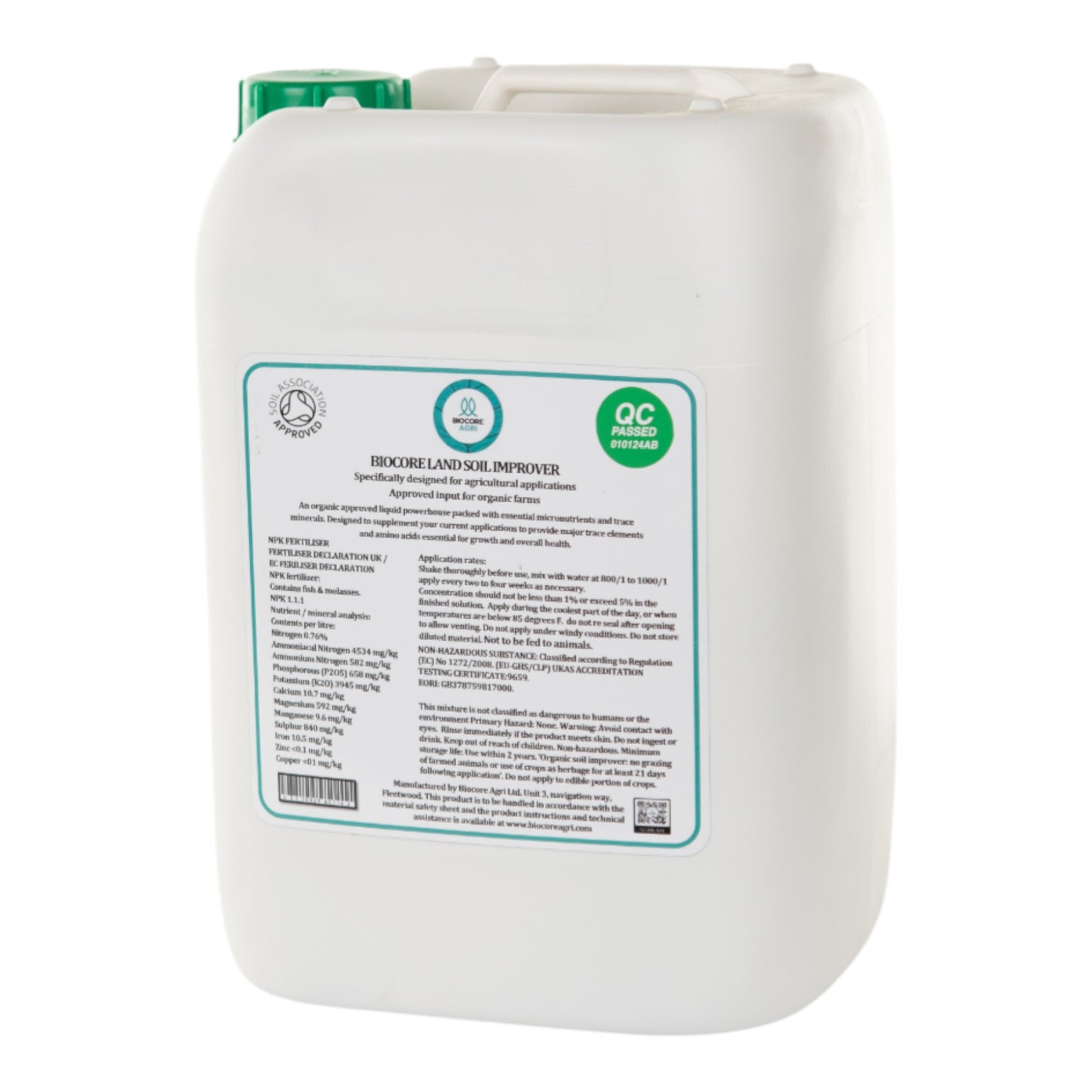


£110.00
Unit price per£110.00
Unit price perBioCore Agri Hydrolysed Fish Blood & Bones - 10L is a concentrated liquid fish-based fertiliser for professional horticultural and growing applications.
Made from hydrolysed fish blood and bone, it provides an easy-to-apply liquid source of organic nutrients for use in suitable crop and soil-feeding programmes.
Key benefits
Liquid fish-based plant nutrition
Hydrolysed fish fertilisers provide organic nutrient inputs in a liquid format that can be incorporated into suitable soil and crop nutrition programmes. Use should be matched to crop requirements, existing soil fertility and any other fertilisers being applied.
Dilution & application
The currently published product information gives a dilution rate of 1.2ml per litre of water. Measure accurately and mix consistently. Where crop, soil or application conditions require a different programme, follow the current BioCore Agri label or technical guidance.
When introducing a new feed programme, monitor crop response and avoid assuming that more concentrated applications will produce better results.
Soil biology & nutrient management
Organic liquid fertilisers can form part of programmes focused on soil biological activity and nutrient cycling. Results depend on soil condition, crop, weather, irrigation and the wider nutrition strategy, so use the product as one component of crop management rather than in isolation.
Using alongside other fertilisers
Account for nutrients already supplied by the soil, growing medium, irrigation water and other fertilisers. Avoid unnecessary duplication of nutrient inputs and check compatibility before tank-mixing with other products.
Storage & handling
Store in the original container according to the current product instructions. Keep measuring and application equipment clean and rinse equipment appropriately after use. Follow any current label or safety information for handling and storage.
BioCore Agri Success Story
Want to see BioCore Agri in action? Read our BioCore Agri Success Story, featuring the 275kg prize-winning squash grown using BioCore Agri.
BioCore Agri Hydrolysed Fish Blood & Bones - 10L product details
| Brand | BioCore Agri |
|---|---|
| Product type | Hydrolysed fish blood & bone liquid fertiliser |
| Pack size | 10L |
| Published dilution rate | 1.2ml per litre of water |
| Application | Professional horticulture and crop nutrition |
BioCore Agri Hydrolysed Fish Blood & Bones - 10L FAQs
What is BioCore Agri Hydrolysed Fish Blood & Bones?
It is a concentrated liquid fertiliser made from hydrolysed fish blood and bone for suitable horticultural and crop applications. What dilution rate is published?
The currently published product information states 1.2ml per litre of water. Is this a liquid fertiliser?
Yes. It is supplied as a concentrated liquid. Can it be used as part of a soil-health programme?
It can form part of a wider nutrition and soil-management programme; crop response also depends on soil, irrigation, weather and other nutrient inputs. Can it be mixed with other fertilisers?
Check product compatibility before tank mixing and account for nutrients already supplied by other inputs. Should I increase the concentration for a stronger effect?
Do not assume that higher concentration is beneficial. Follow current product guidance and monitor crop response. How should it be measured?
Use suitable clean measuring equipment so the concentrate can be diluted consistently. How should it be stored?
Keep it in the original container and follow current product instructions for storage and handling. Is the 1L/10L size the selling unit?
Yes. This listing is for one 10L container.


£2.50
Unit price per£2.50
Unit price perThe Growers Own Easy Fleece Jacket 50gsm provides quick, convenient frost protection for container plants, shrubs and young plants during cold weather. Measuring 1.8m x 2m, the ready-made plant cover features a full-length zipper for easy access and a drawstring base for securing the fleece around the plant or container.
Manufactured from 50gsm breathable polypropylene fleece, the jacket creates a protective layer around vulnerable plants while still allowing light, air and moisture to pass through. This makes it a practical alternative to repeatedly wrapping individual plants with sheets of horticultural fleece.
Simply open the zipper, position the jacket around the plant and close it before securing the drawstring at the base. The generous 1.8m x 2m size is particularly useful for larger container plants and shrubs that need additional protection during cold snaps and winter weather.
Why choose the Growers Own Easy Fleece Jacket?
Quick frost protection for larger plants
Protecting established container plants and shrubs with conventional fleece can involve wrapping several layers around the plant and securing them with ties. A ready-made fleece jacket makes the process considerably quicker.
The zipper allows the cover to open widely rather than having to pull the entire jacket down over delicate branches or foliage. Once positioned, close the zipper and use the drawstring around the base to help keep the cover securely in place.
This also makes the jacket easy to open when the plant needs checking, watering or additional ventilation during milder weather.
Ideal for overwintering container plants & shrubs
The 1.8m x 2m Easy Fleece Jacket is suitable for protecting a wide range of vulnerable plants, including:
The level of protection required will depend on the plant species, local conditions and severity of the weather. Particularly tender plants may require additional protection or a frost-free overwintering location during prolonged severe cold.
Breathable 50gsm horticultural fleece
Unlike an impermeable plastic cover, horticultural fleece is designed to remain breathable. Light, air and moisture can pass through the material while the fleece provides an additional protective layer around the plant.
The 50gsm weight gives this jacket a substantial construction for winter plant protection while retaining the flexibility needed to fit around foliage and containers.
During extended periods of milder weather, plants should still be checked regularly and the cover opened or removed when appropriate to maintain suitable growing conditions.
How to use the Easy Fleece Jacket
Open the zipper and carefully position the fleece around the plant, taking care not to force the material against delicate branches. Close the zipper and tighten the drawstring sufficiently to secure the base.
For container plants, the jacket can be positioned around the plant and pot as appropriate. Remember that the fleece primarily protects the above-ground plant. In very cold conditions, vulnerable containers and root systems may benefit from additional insulation.
Check the plant periodically throughout winter, particularly following strong winds, heavy rain or significant changes in temperature.
Reusable winter plant protection
After the risk of frost has passed, remove the jacket carefully and allow it to dry fully before storage. Fold it loosely and keep it in a clean, dry location ready for the following season.
Reusing the jacket across multiple winters makes it a convenient addition to the seasonal plant-protection kit for gardeners, nurseries and garden retailers.
Growers Own Easy Fleece Jacket product details
| Brand | Growers Own |
|---|---|
| Product type | Plant frost protection fleece jacket |
| Size | 1.8m x 2m |
| Fleece weight | 50gsm |
| Material | Polypropylene fleece |
| Closure | Zipper |
| Base | Adjustable drawstring |
| Breathable | Yes - allows light, air and moisture through |
| Reusable | Yes |
| Primary application | Frost and cold-weather plant protection |
| Suitable for | Container plants, shrubs, young plants and overwintering vulnerable plants |
Growers Own Easy Fleece Jacket FAQs
What size is this frost protection jacket?
This version measures 1.8m x 2m and is designed for larger container plants, shrubs and other appropriately sized plants. What does 50gsm fleece mean?
GSM means grams per square metre and describes the weight of the fleece material. This jacket uses 50gsm polypropylene fleece, giving it a more substantial construction than lightweight crop fleece. Does the plant fleece let light and moisture through?
Yes. The polypropylene fleece is breathable and allows light, air and moisture to pass through while providing an additional protective barrier around the plant. Why does the fleece jacket have a zipper?
The zipper makes the jacket easier to fit around larger plants without forcing the cover over branches and foliage. It also provides convenient access when the plant needs checking or watering. What is the drawstring for?
The drawstring helps secure the bottom of the fleece around the plant or container, reducing the chance of the cover being displaced by wind. Can I use the jacket on potted plants?
Yes. It is particularly useful for overwintering vulnerable container and patio plants that cannot easily be moved to a frost-free location. Does the fleece protect the plant roots as well?
The jacket primarily provides protection around the plant. Containers and root systems can still become very cold, so vulnerable pots may require additional insulation during severe winter conditions. Can the Easy Fleece Jacket be reused?
Yes. Provided it remains in good condition, allow the fleece to dry after use and store it somewhere clean and dry for reuse during future cold weather. Should I leave the fleece jacket on all winter?
Use it according to the plant and weather conditions. Check covered plants regularly and consider opening or removing the jacket during prolonged mild periods where additional protection is unnecessary. Is fleece enough for very tender plants?
That depends on the plant and the temperatures experienced. A fleece jacket provides useful additional protection, but very tender species may still require a sheltered or frost-free location during severe or prolonged cold.

£1.99
Unit price per£1.99
Unit price perThe Growers Own Easy Fleece Jacket 50gsm provides quick and convenient frost protection for container plants, shrubs and young plants during cold weather. Measuring 1.5m x 1.8m, this ready-made plant cover features a full-length zipper for easy access and a drawstring base for securing the fleece around the plant or container.
Manufactured from 50gsm breathable polypropylene fleece, the jacket creates a protective layer around vulnerable plants while allowing light, air and moisture to pass through. It offers a simple alternative to cutting and repeatedly wrapping plants with sheets of horticultural fleece.
The 1.5m x 1.8m size is ideal for medium-sized container plants, patio plants, shrubs and young plants that require additional protection during cold snaps and winter weather.
Why choose the Growers Own Easy Fleece Jacket?
Easy frost protection for plants
Protecting individual plants with loose sheets of fleece can be time-consuming, particularly when plants need to be uncovered and recovered as weather conditions change. The Growers Own Easy Fleece Jacket provides a ready-made solution that can be fitted quickly.
Open the zipper, position the fleece around the plant and close it before securing the drawstring at the base. The zipped opening also makes it easier to check or access the plant without completely removing the cover.
Suitable applications include:
Breathable 50gsm horticultural fleece
Horticultural fleece provides protection without completely sealing the plant inside an impermeable covering. The material allows light, air and moisture to pass through while creating an additional protective layer around vulnerable foliage.
The 50gsm construction provides a useful balance between protection and breathability for seasonal winter use. Plants should still be checked regularly, particularly during prolonged periods of milder weather.
How to use the Easy Fleece Jacket
Open the zipper fully and carefully position the jacket around the plant. Avoid forcing the fleece over delicate branches or foliage. Once correctly positioned, close the zipper and use the drawstring to secure the bottom of the jacket.
Check the cover periodically following strong winds or changes in weather conditions and make sure the plant continues to receive appropriate water and ventilation.
For plants growing in containers, remember that the fleece primarily protects the plant above ground. Vulnerable pots and root systems may require additional insulation during particularly cold conditions.
Choosing the right fleece jacket size
This 1.5m x 1.8m Easy Fleece Jacket is the more compact option in the Growers Own range and is well suited to medium-sized plants and containers.
Before choosing a size, measure both the height and widest point of the plant and allow enough room for the fleece to sit comfortably around the foliage without excessive compression.
Reusable winter plant protection
When frost protection is no longer required, remove the jacket carefully and allow it to dry thoroughly before storage. Store it in a clean, dry location so it is ready for the next period of cold weather.
Growers Own Easy Fleece Jacket product details
| Brand | Growers Own |
|---|---|
| Product type | Plant frost protection fleece jacket |
| Size | 1.5m x 1.8m |
| Fleece weight | 50gsm |
| Material | Polypropylene fleece |
| Closure | Zipper |
| Base | Adjustable drawstring |
| Breathable | Yes - allows light, air and moisture through |
| Reusable | Yes |
| Primary application | Frost and cold-weather plant protection |
| Suitable for | Container plants, patio plants, shrubs, young plants and other vulnerable plants |
Growers Own Easy Fleece Jacket FAQs
What size is this plant fleece jacket?
This version measures 1.5m x 1.8m and is designed for appropriately sized container plants, shrubs and young plants. What does 50gsm mean?
GSM means grams per square metre and describes the weight of the fleece material. This jacket is manufactured from 50gsm polypropylene fleece. Does the fleece allow light and water through?
Yes. The fleece is breathable and allows light, air and moisture to pass through while providing an additional protective layer around the plant. Why does the frost cover have a zipper?
The zipper makes the jacket easier to position around plants and provides convenient access for checking or watering without having to pull the entire cover over the foliage. Can I use this fleece jacket on potted plants?
Yes. It is particularly useful for protecting vulnerable container and patio plants during cold weather. What does the drawstring base do?
The drawstring allows the bottom of the jacket to be tightened around the plant or container, helping to keep the fleece securely positioned. Can the fleece jacket be reused?
Yes. If it remains in good condition, dry it thoroughly after use and store it somewhere clean and dry for future cold-weather protection. Will the fleece protect the roots of a container plant?
The jacket primarily protects the above-ground parts of the plant. During severe cold, vulnerable containers may need additional insulation to help protect the root zone. Should the fleece jacket stay on throughout winter?
Use the cover according to the plant and prevailing weather. Check protected plants regularly and open or remove the jacket during extended mild periods where additional protection is unnecessary. How do I know if the 1.5m x 1.8m size will fit my plant?
Measure the plant's height and widest point before purchase and allow sufficient room for the fleece to fit around the foliage without tightly compressing branches or leaves.


£3.40
Unit price per£3.40
Unit price perThe Aeroplas Danish Watering Tray is a heavy-duty, reusable full-shelf watering tray designed for use with Danish trolley systems. It creates a contained water reservoir beneath plants, helping growers and garden retailers manage watering more efficiently while keeping trolley displays cleaner and better presented.
Danish trolleys are widely used for plant handling, transport and retail presentation, but maintaining consistent moisture across plants displayed on trolley shelves can require frequent attention. The Aeroplas watering tray provides a simple solution by converting the shelf area into a contained watering zone.
The tray can be used on its own as a water reservoir or combined with suitable capillary matting to retain moisture and distribute water beneath containers. This can help reduce the frequency of manual watering while supporting more consistent hydration across a plant display.
Why choose the Aeroplas Danish Watering Tray?
Turn a Danish trolley shelf into a watering reservoir
The Aeroplas Danish Watering Tray was developed to create a reservoir across a Danish trolley shelf, making it easier to maintain plants while they remain on the trolley.
Rather than watering plants individually and allowing excess water to drain through the trolley, the tray provides a contained area beneath the pots. This is particularly useful in retail environments where plants may remain on Danish trolleys throughout their display period.
Containing water at shelf level also helps reduce the amount of plant and compost debris falling from one level of the trolley to another, contributing to a cleaner and more professional plant display.
Ideal for use with capillary matting
For enhanced water management, the Danish Watering Tray can be paired with capillary matting. The matting retains water within the tray and provides a moist surface beneath suitable plant containers.
This arrangement can help distribute moisture across the shelf and reduce the speed at which the watering area dries, making it particularly useful for garden centre displays and nursery holding areas where plants require regular attention.
The exact watering requirement will depend on the crop, pot size, growing medium, weather and surrounding conditions, so plants should still be monitored rather than relying on a fixed watering interval.
Designed for growers & garden retailers
Plant quality can deteriorate quickly when retail stock is allowed to dry excessively. This is particularly challenging during warmer weather when large numbers of plants may need watering several times across a busy retail area.
By creating a dedicated reservoir beneath the plants, the Aeroplas tray provides a practical way to improve water management without removing stock from the Danish trolley.
Typical applications include:
Support plant quality & reduce avoidable waste
Consistent access to moisture is important when maintaining plants through storage, handling and retail display. Plants that dry excessively can quickly lose their presentation quality and may become unsaleable.
A reservoir tray does not replace appropriate plant care, but it provides retailers and growers with another tool for managing moisture more consistently and reducing the amount of repeated hand watering required.
The contained tray also helps keep surrounding areas cleaner by catching water and debris that would otherwise fall through an open Danish trolley shelf.
About Aeroplas
Aeroplas is a UK manufacturer of pots, trays and plant packaging for professional horticulture. The company has a long-standing presence in the British horticultural industry, supplying products designed around the practical requirements of commercial growers, nurseries and plant retailers.
Based in the West Midlands, Aeroplas manufactures horticultural plastics in the UK and has developed products specifically for both grower and retail applications.
The Danish Watering Tray is a good example of that practical product development. It was created specifically to provide a water reservoir across a Danish trolley shelf, making plant watering easier while helping reduce the water, compost and plant debris that can fall through the trolley in a retail environment.
Choosing Aeroplas also gives professional horticultural businesses access to a British-manufactured range developed specifically for commercial plant production, handling and presentation.
Aeroplas Danish Watering Tray product details
| Brand | Aeroplas |
|---|---|
| Product type | Danish trolley watering tray |
| Design | Full-shelf water reservoir tray |
| Primary application | Water management for plants displayed or held on Danish trolleys |
| Compatible system | Danish trolley shelving |
| Capillary matting | Suitable for use with capillary matting for improved moisture retention and distribution |
| Reusable | Yes |
| Suitable for | Commercial growers, nurseries, garden centres and plant retailers |
| Manufacturing | UK manufactured |
Aeroplas Danish Watering Tray FAQs
What is an Aeroplas Danish Watering Tray?
It is a reusable tray designed to create a contained water reservoir across a Danish trolley shelf, helping growers and plant retailers manage watering while stock remains on the trolley. Is the tray designed specifically for Danish trolleys?
Yes. The Aeroplas tray was developed as a full-shelf watering solution for Danish trolley systems. Can I use capillary matting with the tray?
Yes. Adding suitable capillary matting can help retain moisture and distribute water beneath compatible plant containers. Does the tray automatically water the plants?
No. It creates a reservoir that can support more efficient watering, particularly when combined with capillary matting. Plants still need to be monitored and watered according to their individual requirements. Why use watering trays on garden centre Danish trolleys?
They provide a contained watering area directly beneath the plants, helping retailers maintain stock without repeatedly removing plants from the trolley while also reducing water and debris falling through the shelves. Can the tray help reduce plant waste?
Better moisture management can help maintain plant quality and reduce losses associated with plants drying excessively while being held or displayed. Does it help keep Danish trolley displays cleaner?
Yes. One of the advantages of the reservoir design is that it can contain water and help reduce compost and plant debris falling through the trolley onto lower shelves or the surrounding floor. Can the Aeroplas watering tray be reused?
Yes. It is designed as a heavy-duty reusable horticultural tray for repeated professional use. Who is this watering tray designed for?
It is particularly suited to commercial growers, nurseries, garden centres and plant retailers using Danish trolleys for plant handling, holding or display. Where are Aeroplas horticultural products manufactured?
Aeroplas is a UK horticultural manufacturer based in the West Midlands, producing pots, trays and plant packaging for professional grower and retail markets.

£35.00
Unit price per£35.00
Unit price perThis 1200mm x 150m Bubble Wrap Roll provides a simple and versatile way to add insulation around plant pots, containers, greenhouse areas and other vulnerable items during colder weather. The air-filled bubble structure creates an insulating layer that helps reduce heat loss and provides useful protection during winter.
With a generous 1.2m width and 150m roll length, it is particularly well suited to nurseries, garden centres, commercial growers and gardeners requiring a larger quantity of insulation material for seasonal use.
Bubble wrap is especially useful for insulating pots and containers. Container-grown plants can be more vulnerable to cold because their roots do not benefit from the same insulation as plants growing directly in the ground. Wrapping the outside of suitable containers adds another insulating layer around the root zone.
Why use bubble wrap for winter plant protection?
Insulate plant pots & containers
Roots growing in containers can be exposed to greater temperature fluctuations than roots protected by the surrounding ground. This becomes particularly important with vulnerable plants, smaller containers and pots positioned in exposed areas.
Bubble wrap can be cut to size and wrapped around the outside of the plant container, adding an insulating layer between the pot and cold surrounding air.
It is particularly useful around decorative pots and containers that cannot easily be moved into a protected environment for winter. The plant itself can then be protected separately with a suitable breathable horticultural fleece where required.
Bubble wrap for greenhouse insulation
Bubble wrap is commonly used during winter as an additional insulating layer in greenhouses and other protected growing structures. The trapped air within the material helps reduce heat transfer, which can assist with retaining warmth during colder periods.
For greenhouse applications, the material should be fitted securely using suitable fixings for the structure. Ventilation must still be managed appropriately, particularly during sunny or milder weather when temperatures and humidity can rise quickly.
The amount of insulation required will depend on the greenhouse construction, local conditions, crops being protected and whether supplementary heating is being used.
Using bubble wrap alongside horticultural fleece
Bubble wrap and horticultural fleece perform different roles and can be particularly useful when used together.
Bubble wrap is best suited to insulating pots, containers and structures, while breathable horticultural fleece is generally the more appropriate material for covering plant foliage.
For a vulnerable container plant, for example, bubble wrap can be placed around the outside of the pot to provide additional root-zone insulation while fleece is used around the foliage to provide protection from cold weather.
150m roll for commercial & larger-scale use
At 150 metres long, this roll provides a substantial quantity of bubble wrap for professional growers, nurseries and garden centres preparing larger numbers of plants for winter.
The 1200mm width provides good coverage while the continuous roll can be cut according to each application, helping minimise unnecessary joins and allowing the material to be adapted to different pot and structure sizes.
Outside the growing area, any remaining material can also be used for general protective wrapping and cushioning of suitable goods.
Bubble Wrap Roll product details
| Product type | Bubble wrap insulation and protective wrapping |
|---|---|
| Roll width | 1200mm / 1.2m |
| Roll length | 150m |
| Total nominal sheet area | 180m² |
| Primary horticultural uses | Plant pot insulation, container protection and greenhouse insulation |
| Additional uses | General wrapping, cushioning and protective packaging |
| Format | Continuous roll, cut to required length |
Bubble Wrap for Plant & Greenhouse Insulation FAQs
Can bubble wrap be used to protect plants from frost?
Bubble wrap is particularly useful for insulating pots and containers, helping provide an additional barrier around vulnerable root zones. Breathable horticultural fleece is generally more suitable for directly covering plant foliage. Can I wrap bubble wrap around plant pots?
Yes. Wrapping the outside of containers is a common winter protection technique, particularly for plants whose roots may be vulnerable to low temperatures. Can this bubble wrap be used in a greenhouse?
Yes. Bubble wrap can be installed as an additional insulating layer in suitable greenhouse structures to help reduce heat loss during colder periods. Should bubble wrap touch plant leaves?
For foliage protection, a breathable horticultural fleece is generally preferable. Bubble wrap is better used around containers or as structural insulation rather than tightly wrapping living foliage. How wide is this bubble wrap roll?
The roll is 1200mm wide, equivalent to 1.2 metres. How much bubble wrap is supplied?
The roll measures 1.2m x 150m, providing a total nominal sheet area of 180m². Can I cut the bubble wrap to size?
Yes. The continuous roll can be cut to the required length, making it suitable for different pot sizes and insulation projects. Is bubble wrap a replacement for horticultural fleece?
Not necessarily. The two materials are useful for different purposes. Bubble wrap is particularly effective for insulating containers and structures, while breathable fleece is better suited to protecting plant foliage. Can this roll be used for normal packaging?
Yes. In addition to horticultural insulation, bubble wrap can be used for general protective wrapping and cushioning of suitable items during handling, storage or transport.

£8.50
Unit price per£8.50
Unit price perClover Chicken Manure Pellets are a natural organic fertiliser made from composted chicken manure, providing slow-release plant nutrition while adding valuable organic matter to the soil. Supplied in a convenient 7kg resealable bucket, they are suitable for vegetables, flowers, fruit, shrubs, borders and lawns.
Chicken manure is naturally rich in the major nutrients required for healthy plant growth. Once incorporated into the soil and watered, the pellets gradually break down, releasing nutrients while also contributing organic matter to the growing environment.
Unlike fresh manure, the dry pelleted format is straightforward to handle, measure, spread and store. This makes Clover Chicken Manure Pellets a practical option for gardeners, allotment growers, landscapers and professional horticultural users looking for a convenient organic fertiliser.
They can be incorporated into soil before planting or applied around established plants as a top dressing, making them a versatile feed and soil improver for use throughout the growing season.
Why choose Clover Chicken Manure Pellets?
Natural slow-release plant nutrition
Clover Chicken Manure Pellets provide the three principal macronutrients associated with healthy plant growth: nitrogen, phosphorus and potassium.
Nitrogen supports vegetative growth and healthy foliage, phosphorus contributes to normal root development and plant energy processes, while potassium plays an important role in overall plant strength, flowering, fruit development and water regulation.
Because these nutrients are supplied within an organic manure-based fertiliser, availability develops as the pellets break down in moist soil rather than behaving like a highly soluble mineral feed.
Feed the plant while improving the soil
Chicken manure pellets offer more than plant nutrients alone. They also introduce organic matter into the soil, making them useful where the aim is to maintain or improve soil fertility over time.
Organic matter supports soil structure and biological activity and can contribute to better moisture and nutrient management within cultivated soils.
This makes pelleted chicken manure particularly useful in vegetable plots, allotments, beds and borders where soil is repeatedly cultivated and cropped.
What can Clover Chicken Manure Pellets be used for?
Application should be adjusted according to the crop and soil condition. Always follow the directions provided on the current product packaging.
How to use chicken manure pellets
For soil preparation, spread the required quantity over the growing area and work the pellets into the soil before planting. Watering after application helps begin the breakdown and nutrient-release process.
For established plants, pellets can be distributed around the surrounding soil and gently incorporated into the surface where appropriate. Avoid concentrating fertiliser directly against plant stems or other sensitive plant tissue.
Clover's pellets can also be reapplied during active growth where additional feeding is required. The amount and frequency should follow the current instructions on the product packaging and take account of the crop, soil fertility and previous fertiliser applications.
Ideal for vegetable plots & allotments
Pelleted chicken manure is particularly useful for preparing productive ground before planting vegetables. It can be incorporated during bed preparation, allowing organic matter and nutrients to begin integrating with the soil before crops establish.
It can also be used during the growing season as part of a wider crop-feeding programme, depending on the nutritional requirements of the vegetables being grown.
For allotment growers managing the same ground season after season, regular additions of appropriate organic materials can play an important role in maintaining productive soil.
Convenient 7kg resealable bucket
The 7kg bucket provides a practical alternative to an open fertiliser bag, particularly where the entire product will not be used in a single application.
Keep the container closed and store it in a cool, dry location away from excessive moisture. Keeping the pellets dry during storage helps maintain their free-flowing form and makes subsequent application easier.
Clover Chicken Manure Pellets product details
| Brand | Clover |
|---|---|
| Product type | Pelleted organic fertiliser and soil improver |
| Primary ingredient | Composted chicken manure |
| Form | Dry pellets |
| Pack size | 7kg |
| Packaging | Resealable bucket |
| Key nutrients | Nitrogen, phosphorus and potassium (NPK) |
| Nutrient release | Slow release |
| Suitable for | Vegetables, flowers, fruit, shrubs, borders, lawns and general garden use |
| Application | Soil incorporation before planting or top dressing established plants |
Clover Chicken Manure Pellets FAQs
What are Clover Chicken Manure Pellets made from?
They are made from composted chicken manure that has been processed into convenient dry pellets for easier application and storage. Are chicken manure pellets a fertiliser or a soil improver?
They perform both roles. Chicken manure supplies plant nutrients while its organic matter also contributes to soil fertility and structure. Are Clover Chicken Manure Pellets slow release?
Yes. The pellets gradually break down in the soil, providing a slower release of nutrients than highly soluble plant feeds. Can I use chicken manure pellets for vegetables?
Yes. They are well suited to vegetable plots and allotments and can be incorporated into the soil before planting or used during the growing season according to the product directions. Can they be used around fruit trees and bushes?
Yes. Chicken manure pellets can be used around suitable established fruit trees and bushes as part of their feeding programme. Apply according to the current pack instructions. Can Clover Chicken Manure Pellets be used on lawns?
Yes, Clover lists lawns among the suitable applications for its chicken manure pellets. Apply evenly and follow the current directions on the packaging. Do chicken manure pellets need watering in?
Watering after application helps the pellets begin to break down and release their nutrients into the surrounding soil. Can I dig the pellets into the soil before planting?
Yes. Incorporating chicken manure pellets during soil preparation is a useful way to introduce organic matter and nutrients before planting. Are chicken manure pellets easier to use than fresh manure?
The dry pelleted form is generally easier to store, distribute and measure than fresh loose manure, making it particularly convenient for routine garden and allotment use. Can chicken manure pellets improve poor soil?
They add organic matter and nutrients, so they can form part of a wider programme for improving soil fertility. Soil condition, texture, pH and drainage should also be considered when managing poor ground. How should I store the 7kg bucket?
Keep the lid closed and store the bucket in a cool, dry location. Protecting the pellets from unnecessary moisture helps keep them in good condition between applications. How much Clover Chicken Manure should I apply?
Application rate varies according to the crop and intended use. Follow the current directions printed on the Clover packaging for the appropriate rate and frequency.
The New Products collection showcases the latest additions to the horticultural range, featuring innovations in plant care, equipment and growing systems. This section allows customers to stay up to date with evolving techniques, materials and technologies shaping modern horticulture.
For garden centres, growers and professional horticulturalists, introducing new products helps maintain relevance and competitiveness. These additions support experimentation, improved efficiency and enhanced growing results across retail and commercial environments.