
What is acoustic ducting?
Acoustic ducting is flexible ventilation duct surrounded by insulation designed to help reduce sound transmitted through a ventilation system.

Commercial Products
Commercial Products
 Professional Growing Media
 Plant Nutrition
 Plant Health
 Sprayers & Protective Clothing
 Pots, Planters & Trays
 Propagation
 Baskets & Planters
 Fabrics & Netting
 Environment
 Plant Lighting
 Irrigation
 Plant Support & Tree Care
 Equipment
 Tools
 Plant Labels
 Packaging
 Lawn Care
 Clearance
Retail Products
Retail Products
 Growing Media
 Plant Nutrition
 Plant Health
 Pots, Planters & Tanks
 Propagation
 Baskets & Planters
 Fabrics & Netting
 Environment
 Plant Lighting
 Plant Support
 Equipment
 Tools
1993 products
1993 products
Sort by:

£21.80
Unit price per£21.80
Unit price per254mm (10") x 5m Mute Silent Ducting is an acoustically insulated flexible ventilation duct designed to help reduce fan and airflow noise in powerful extraction and intake systems.
High-capacity ventilation equipment can generate significant noise from the fan itself and from fast-moving air travelling through the ductwork. This insulated ducting provides a practical solution where quieter ventilation is required without sacrificing the flexibility of conventional flexible duct.
The flexible inner airflow duct is surrounded by an acoustic insulation layer that helps absorb sound transmitted along the ventilation system. It is particularly useful in grow rooms and indoor horticultural environments where extraction equipment may operate for extended periods.
Supplied in a 5 metre length with a nominal 254mm / 10" diameter, it is suitable for compatible 10-inch fans, carbon filters and ventilation fittings and can be cut to the required length during installation.
Why choose 254mm acoustic silent ducting?
How does acoustic ducting reduce ventilation noise?
Noise from an extraction system does not only come directly from the fan. Fan noise, vibration and turbulent airflow can travel along ordinary ductwork, allowing sound to become noticeable elsewhere in the installation.
Acoustic ducting surrounds the flexible inner air passage with an insulating layer designed to absorb transmitted sound. This helps reduce the amount of fan and airflow noise travelling through the duct run.
It can be particularly effective when used immediately before or after an extraction fan, between a fan and carbon filter, or along duct runs where ventilation noise needs to be controlled.
Acoustic ducting is intended to reduce transmitted noise rather than make an extraction system completely silent. Fan type, speed, vibration, airflow velocity and installation quality will all influence the final sound level.
Ideal for 10-inch grow room ventilation systems
Larger grow rooms and indoor horticultural environments often require powerful ventilation to remove excess heat and humidity and maintain regular air exchange. As fan capacity increases, controlling ventilation noise becomes increasingly important.
The 254mm / 10" diameter makes this ducting suitable for compatible high-volume extraction and intake equipment, while its insulated construction helps reduce the sound transmitted through the ductwork.
It can be used as part of a complete ventilation system incorporating an inline fan, carbon filter, metal duct fittings, reducers and other appropriately sized components.
Getting the best airflow from flexible ducting
Good duct installation is important for maintaining the performance of an extraction fan. Every length of ducting, bend and fitting introduces some resistance to airflow.
Extend the duct sufficiently rather than leaving unnecessary sections heavily compressed. This provides a smoother internal airflow path and helps reduce avoidable resistance.
Keep the ventilation route as short and direct as practical and avoid crushing the duct or creating unnecessarily tight bends. Gradual changes in direction are preferable to sharp turns.
The supplied 5m length does not need to be used in full. Cutting it to the length actually required can help create a cleaner and more efficient installation.
Installing 254mm Mute Silent Ducting
Before installation, check that the fan, carbon filter and other fittings are compatible with the nominal 254mm / 10" duct size.
Fit the flexible inner duct securely around the ventilation connection and fasten it using a suitably sized duct clamp or fixing. HVAC foil tape can also be used where additional sealing is required.
Arrange the acoustic insulation and outer covering neatly around the completed connection so that the insulating layer remains as continuous as practical.
Longer sections should be supported appropriately along the route. Avoid allowing the full weight of the ducting to hang directly from an extraction fan, carbon filter or other ventilation component.
Compatible ventilation equipment
254mm acoustic ducting can be incorporated into appropriately sized ventilation systems using components such as:
Always check the actual connection diameter of individual components before installation, as dimensions can vary slightly between different ventilation equipment manufacturers.
254mm (10") x 5m Mute Silent Ducting product details
| Product type | Acoustic insulated flexible ventilation ducting |
|---|---|
| Nominal diameter | 254mm / 10" |
| Length | 5m |
| Duct type | Flexible |
| Construction | Insulated acoustic ducting |
| Primary purpose | Ventilation with reduced transmission of fan and airflow noise |
| Suitable airflow | Extraction & intake |
| Compatible system size | Nominal 254mm / 10" round ventilation systems |
| Suitable applications | Grow rooms, indoor horticulture & other compatible ventilation installations |
254mm (10") Mute Silent Ducting FAQs
What is acoustic ducting?
Acoustic ducting is flexible ventilation duct surrounded by insulation designed to help reduce sound transmitted through a ventilation system. What size is this ducting?
This version has a nominal diameter of 254mm, equivalent to 10 inches, and is supplied in a 5 metre length. Is this suitable for a 10-inch extraction fan?
Yes, provided the fan has a compatible nominal 254mm / 10" connection. Always check the fan connection dimensions before installation. Can I connect it to a 10-inch carbon filter?
Yes. It can be used with a compatible 254mm / 10" carbon filter as part of a correctly sized extraction system. Does acoustic ducting make a fan silent?
No. It helps reduce noise transmitted through the ductwork but cannot completely eliminate fan motor noise, vibration or airflow noise. Is acoustic ducting quieter than standard flexible ducting?
Its insulated construction is specifically intended to reduce transmitted ventilation noise compared with basic uninsulated flexible ducting. Can it be used for both extraction and intake?
Yes. The ducting can be incorporated into compatible extraction or fresh-air intake systems. Can the 5m duct be cut into shorter sections?
Yes. It can be cut to suit the required installation, allowing one length to be divided into several sections if necessary. Should I use the entire 5m length?
Only if required. Keeping duct runs reasonably short and direct generally helps reduce resistance and maintain ventilation performance. Does long ducting reduce fan airflow?
Every duct run introduces resistance. Longer routes, tight bends and additional fittings can increase this resistance and reduce the effective airflow delivered by the system. Do bends in flexible ducting affect airflow?
Yes. Sharp bends increase resistance, so gradual changes in direction are preferable wherever the installation allows. Should acoustic ducting be stretched out?
It should be extended sufficiently for the installation rather than left heavily compressed, helping provide a smoother path for airflow. Where should acoustic ducting be positioned?
It can be used throughout a compatible ventilation route. Sections close to powerful extraction fans can be particularly useful for reducing sound transmitted into the duct system. Does 10-inch acoustic ducting need supporting?
Long runs should be adequately supported so the weight of the duct is not carried entirely by the fan, filter or connecting fittings. How else can I make a grow room extraction system quieter?
Good duct routing, correctly sized ventilation equipment, vibration isolation, suitable fan-speed control and ventilation silencers can all help reduce overall system noise.
£0.35
Unit price per£0.35
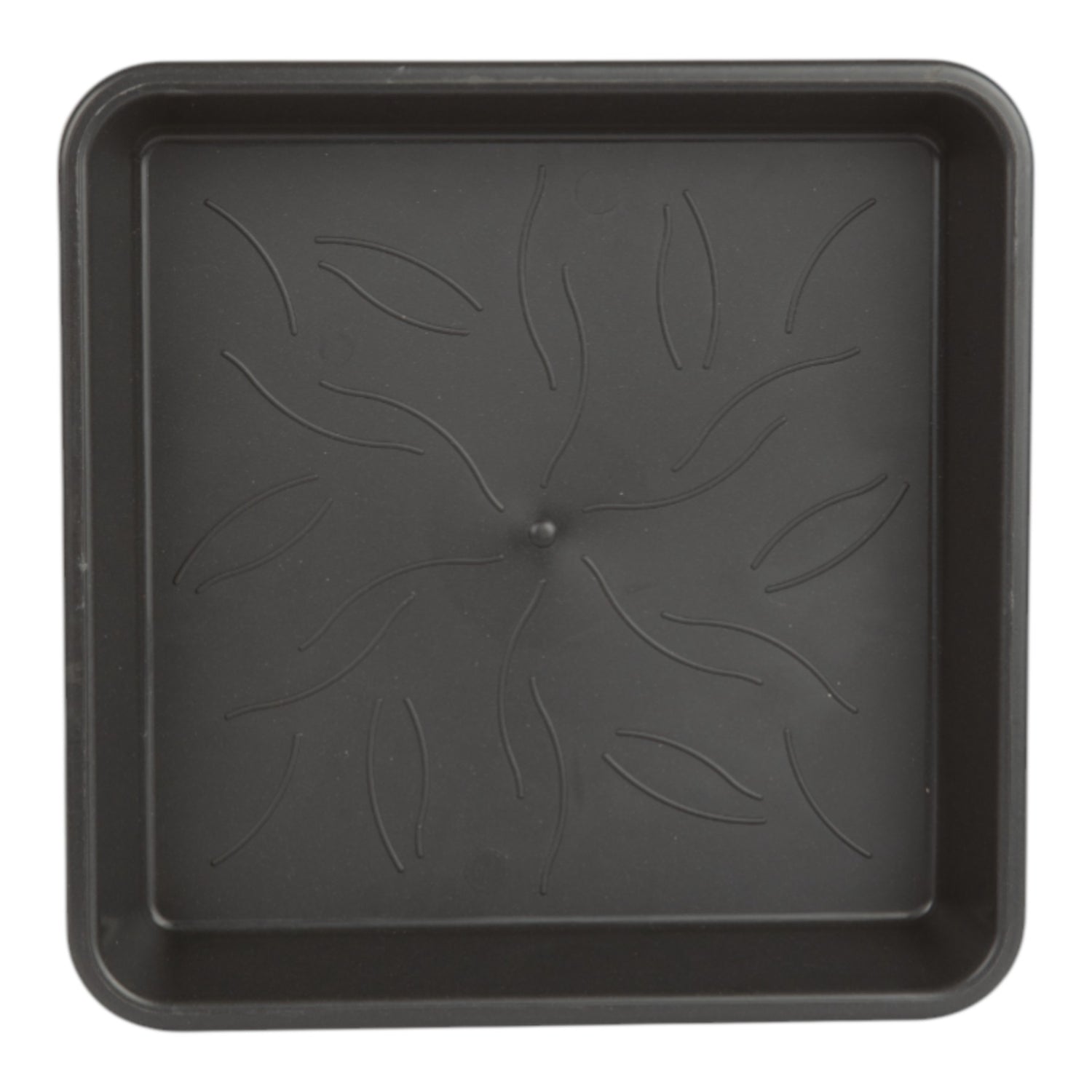
Unit price perThe 25cm Square Plant Pot Saucer in Black is a compact plastic drip tray designed for use beneath square plant pots and containers, catching excess irrigation water and helping protect greenhouse benches, floors, patios and display areas from unwanted runoff.
With a nominal size of 25cm square, this is the smallest option in the square saucer range and is well suited to appropriately sized smaller square nursery pots, decorative planters and other container-grown plants.
Its solid base and raised sides provide a defined collection area beneath the pot, containing drainage water along with small amounts of compost or irrigation residue that may pass through the drainage holes during watering.
The square format makes efficient use of space beneath square containers, while the black finish provides a simple, discreet appearance for professional growing, garden retail and domestic applications.
The square saucer range is available in 25cm, 29cm and 34cm sizes, providing options for several commonly used container footprints.
Why choose the 25cm Square Plant Pot Saucer?
A space-efficient saucer for square pots
Square nursery pots are useful where efficient use of bench and growing space is important because neighbouring containers can be positioned closely together.
A square saucer follows this footprint more closely than an oversized round alternative, providing water collection while minimising unnecessary space around the container.
The compact 25cm version is particularly useful for smaller square pots used on greenhouse staging, nursery benches, shelving and plant displays.
Ideal for smaller square pots & planters
The 25cm Square Saucer can be used beneath a variety of appropriately sized containers in professional and domestic growing environments.
Typical applications include:
Always measure the actual base of the container before ordering. The usable internal dimensions of the saucer will be smaller than its nominal 25cm overall size.
Catch drainage water & protect surfaces
Free drainage allows surplus irrigation water to leave the growing medium, but without a suitable collection tray this runoff can spread across surrounding surfaces.
The solid 25cm saucer catches water beneath the container, helping reduce puddles and contain small quantities of growing media or fertiliser residue carried through the drainage holes.
This can make routine watering and cleaning easier in greenhouses, nurseries, garden centres and indoor growing areas.
Useful for top watering & bottom watering
When plants are watered from above, excess moisture can drain naturally through the container and collect within the saucer below.
Where suitable for the crop, water can also be added directly to the saucer for bottom watering. Moisture is then absorbed through the drainage openings in the base of the pot and into the growing medium.
Plants requiring free-draining conditions should not normally be left permanently standing in water. Remove unwanted excess water once the required moisture level has been reached.
Practical for indoor plants
The compact size makes the 25cm Square Saucer particularly useful beneath suitable indoor planters and houseplant containers where drainage water needs to be contained.
The simple black finish works with a wide range of container styles without drawing attention away from the plant.
On timber, furniture or other moisture-sensitive surfaces, check regularly for condensation or trapped moisture beneath the saucer and use additional protection where appropriate.
Suitable for nurseries & garden centres
For professional growers, individual saucers provide a straightforward way to contain runoff beneath selected plants without changing the drainage characteristics of the pot itself.
They can also be useful in retail environments where plant displays need to be watered while keeping surrounding shelves, benches and display areas cleaner.
The reusable plastic construction allows saucers to be cleaned and repositioned as crops and displays change.
Available in three square sizes
| 25cm Square Saucer | This compact size for appropriately sized smaller square pots and planters. |
|---|---|
| 29cm Square Saucer | Mid-sized option for suitable square nursery pots and containers. |
| 34cm Square Saucer | The largest option in the range for appropriately sized larger square pots. |
How to choose the correct square saucer
Measure the width and depth of the plant pot at its base, rather than relying solely on its maximum dimensions at the top. Many square nursery pots taper towards the bottom.
Both dimensions of the pot base should fit comfortably inside the usable area of the saucer, ideally leaving some surrounding space for collecting water.
A pot described as 25cm square will not necessarily fit inside this saucer because the saucer's usable internal dimensions are smaller than its nominal external measurement.
Cleaning & maintenance
Empty unwanted standing water regularly and remove compost, leaves and other debris as it accumulates.
Periodic washing helps prevent growing media and fertiliser residues building up. In commercial growing environments, follow established crop hygiene procedures when moving reusable equipment between production areas.
When used outdoors, check the saucer following prolonged rainfall and remove excess water where required.
25cm Square Plant Pot Saucer product details
| Product type | Square plant pot saucer / drip tray |
|---|---|
| Nominal size | 25cm square |
| Shape | Square |
| Material | Plastic |
| Colour | Black |
| Base | Solid, designed to collect excess water |
| Primary application | Collecting irrigation runoff beneath square plant pots and containers |
| Suitable environments | Gardens, greenhouses, nurseries, garden centres and indoor growing areas |
| Other available sizes | 29cm and 34cm square |
| Suitable users | Commercial growers, nurseries, garden centres, landscapers and gardeners |
25cm Square Plant Pot Saucer FAQs
What size is this square plant pot saucer?
This version has a nominal size of 25cm square and is the smallest of the three square saucers in the range. Will a 25cm square plant pot fit inside it?
Not necessarily. The usable internal dimensions are smaller than the nominal 25cm overall measurement, so measure the actual base of your pot before ordering. Why choose a square saucer?
A square saucer follows the footprint of a square pot closely, providing a compact water collection area without the additional footprint of an oversized round saucer. Can this saucer be used indoors?
Yes. It can help contain drainage water beneath suitable indoor plant pots. Additional protection may be appropriate on moisture-sensitive furniture and flooring. Can the 25cm Square Saucer be used outdoors?
Yes. It can be used beneath appropriately sized outdoor pots and planters. Remove unwanted standing water following prolonged rainfall where necessary. Can I use it for bottom watering?
Yes, where bottom watering is suitable for the crop. Water placed in the saucer can be absorbed through the drainage holes in the plant pot. Should I leave water standing in the saucer?
For plants requiring free-draining conditions, unwanted standing water should normally be removed once the plant has absorbed the required moisture. What other square saucer sizes are available?
The range includes 25cm, 29cm and 34cm square saucers. How should I measure my square plant pot?
Measure both the width and depth of the pot at its base and make sure both dimensions fit within the usable internal area of the saucer. Can the saucer be reused?
Yes. The plastic construction allows the saucer to be emptied, cleaned and reused as required.

£1.75
Unit price per£1.75
Unit price perThe 25L Round Plant Pot is a large black horticultural grow pot designed for established plants, larger nursery stock, vegetables, shrubs and productive container crops. Measuring approximately 39cm across the upper rim, 31cm across the base and 28.5cm high, it provides a generous 25 litre root volume while retaining a practical, easy-to-manage round format.
A 25 litre container gives established plants considerably more room for root development than standard nursery pots. The larger substrate volume provides increased reserves of moisture and nutrients and creates a more buffered root environment for vigorous or longer-term crops.
The broad 39cm opening provides excellent access for watering, feeding, mulching and top dressing, while the tapered round profile makes the pot suitable for professional nursery production, greenhouses, polytunnels, indoor growing and outdoor horticulture.
Drainage openings in the base allow excess irrigation water to escape, helping maintain the balance between moisture and oxygen required around healthy roots.
Suitable for peat-based and peat-free compost, soil, living soil, coco coir and other horticultural growing media, the 25L Round Pot is a versatile option for both commercial growers and home gardeners.
Why choose the 25L Round Plant Pot?
Generous 25 litre root volume
A 25L container provides substantial space for an established root system to develop. This makes it particularly useful for plants that have outgrown medium-sized nursery containers or require a larger final growing volume.
More growing medium also provides a greater reserve of water and nutrients than a small pot. This can reduce the speed at which the entire root zone dries, although irrigation demand will still vary significantly according to crop size, substrate, temperature and environmental conditions.
For many container-grown crops, 25L can serve as a practical final pot. Very large, vigorous or long-lived plants may eventually require additional root volume.
25L Round Pot dimensions
The pot measures approximately 39cm across the upper rim, 31cm across the base and 28.5cm high.
Its broad 39cm opening provides a substantial surface area for irrigation and makes it easy to apply compost, mulch, worm castings, dry fertilisers and other top-dress amendments.
The 31cm base creates a useful footprint for stability while the tapered sides allow empty pots to nest together for more efficient storage.
What can you grow in a 25L pot?
Twenty-five litres provides enough root volume for a wide range of larger and more vigorous container-grown plants. Typical applications include:
The appropriate container size always depends on the species, expected mature size, crop duration and growing method, but 25L provides substantial capacity for many productive and ornamental crops.
Excellent for living soil growing
The 25L capacity makes this pot particularly useful for growers working with living soil and biologically active growing media.
Compared with small containers, the larger soil volume provides more physical space for roots and a larger reservoir of moisture, organic matter and biological activity.
The broad surface is also convenient for adding mulch, compost, worm castings and dry organic amendments during the crop.
For larger plants or long-duration living soil systems, even greater soil volumes may provide additional buffering, but 25L offers a useful balance between root-zone volume and container manageability.
Suitable growing media
The 25L Round Plant Pot can be used with a wide range of horticultural substrates, including:
Watering and feeding practices should be matched to the selected substrate. A moisture-retentive compost or living soil mix behaves differently from a highly aerated coco-perlite substrate.
Drainage & irrigation
Drainage openings in the base allow excess irrigation water or nutrient solution to leave the pot rather than remaining trapped around the lower root zone.
Effective drainage is particularly important in a larger container because 25 litres of growing medium can retain a substantial quantity of water. Healthy roots require access to both moisture and oxygen.
When a plant has recently been moved into a 25L pot, its roots may initially occupy only part of the new growing medium. Irrigation should therefore be adjusted to root development rather than automatically saturating the entire container on a fixed schedule.
The pot can be used with hand watering, drip irrigation and other compatible nursery or greenhouse irrigation systems.
Fits the 40cm Pot Saucer
The 25L Round Plant Pot is compatible with the 40cm Pot Saucer, product code P00082.
The matching saucer measures approximately 41cm across the rim, 37.5cm across the base and 6cm high.
A saucer is particularly useful when the pot is positioned indoors, in a greenhouse or on a surface where irrigation runoff needs to be contained.
In outdoor or free-draining nursery areas, a saucer may not be required.
Ideal for nursery & greenhouse production
The 25L Round Pot provides commercial growers with substantial growing volume while remaining considerably easier to handle than very large tubs and planters.
It is suitable for growing larger nursery specimens, shrubs, productive greenhouse crops and plants that need a substantial final container before sale or planting out.
The simple black horticultural finish provides a clean professional presentation for plants destined for garden centres, landscapers and direct retail.
When should you move a plant into a 25L pot?
Potting-on should be determined by root development and plant requirements rather than following a fixed timetable.
A plant is generally ready for more container volume once its roots have established well through the existing growing medium, the current pot is drying increasingly quickly or the plant requires greater physical stability and root space.
Avoid placing a very small plant directly into 25 litres of wet substrate unnecessarily. Progressive potting can make irrigation management easier while the root system develops.
Practical & reusable
Pots that remain in sound condition can be emptied, cleaned and reused for subsequent crops.
Remove old growing medium and root debris before cleaning. Appropriate hygiene between crops can help reduce the risk of transferring pests or plant pathogens.
The tapered profile allows empty containers to nest together, reducing the storage space required between growing cycles.
25L Round Plant Pot product details
| Product | Round Plant Pot |
|---|---|
| Nominal capacity | 25L |
| Shape | Round |
| Colour | Black |
| Upper rim diameter | Approximately 39cm |
| Base diameter | Approximately 31cm |
| Height | Approximately 28.5cm |
| Drainage | Pre-formed base drainage openings |
| Suitable media | Soil, compost, peat-free media, living soil, coco & compatible horticultural substrates |
| Suitable environments | Nurseries, greenhouses, polytunnels, indoor growing & outdoor cultivation |
| Typical applications | Vegetables, shrubs, perennials, fruit plants, ornamentals, young trees & larger nursery stock |
| Compatible saucer | 40cm Pot Saucer - product code P00082 |
| Compatible saucer dimensions | Rim 41cm x base 37.5cm x height 6cm |
| Reusable | Yes, when cleaned and maintained appropriately |
25L Round Plant Pot FAQs
What are the dimensions of the 25L Round Pot?
The pot measures approximately 39cm across the upper rim, 31cm across the base and 28.5cm high.
What can I grow in a 25L plant pot?
A 25L pot is suitable for many tomatoes, chillies, peppers, aubergines, shrubs, large perennials, climbing plants, fruit plants, ornamentals and larger nursery crops.
Is a 25L pot big enough for tomatoes?
Yes. Twenty-five litres provides substantial root volume for container-grown tomatoes and is a useful final pot size for many varieties.
Is a 25L pot suitable for chillies and peppers?
Yes. A 25L container provides generous root space for larger chilli and pepper plants and can be used as a final container for many varieties.
Can I use the 25L pot for living soil?
Yes. The larger soil volume and broad surface area make it well suited to living soil, organic growing and top-dress programmes.
Can I use coco coir in the 25L Round Pot?
Yes. Coco and coco-based substrates can be used. Irrigation frequency and volume should be adjusted to the plant, root development and characteristics of the growing medium.
Can I use peat-free compost?
Yes. The pot is suitable for peat-free growing media as well as conventional compost, soil mixes, living soil and coco.
Does the 25L Round Pot have drainage holes?
Yes. Pre-formed openings in the base allow excess irrigation water to drain from the growing medium.
Which saucer fits the 25L Round Pot?
The compatible option is the 40cm Pot Saucer, product code P00082. It measures approximately 41cm across the rim, 37.5cm across the base and 6cm high.
Do I need a saucer underneath a 25L pot?
A saucer is useful where runoff needs to be collected, particularly indoors or on protected surfaces. It may not be necessary outdoors or in free-draining production areas.
Can I use drip irrigation with this pot?
Yes. The pot can be used with hand watering and suitable drip irrigation systems. Irrigation should be matched to the crop, growing medium and stage of root development.
Is the 25L pot suitable for professional nursery production?
Yes. It provides substantial growing volume for larger nursery stock while retaining a practical format for handling, irrigation and plant presentation.
Can the 25L Round Pot be reused?
Yes. Pots that remain in good condition can be emptied, cleaned and reused. Appropriate crop hygiene is recommended between uses.
Is 25L suitable as a final plant pot?
For many crops, yes. The final volume required depends on species, mature plant size, crop duration and growing method. Very large or long-lived plants may eventually require a larger container.
When should I move a plant into a 25L pot?
Move into a 25L container once the plant has established a healthy root system in its existing pot and requires additional root space. Progressive potting can make moisture management easier than moving a very small plant directly into a large container.
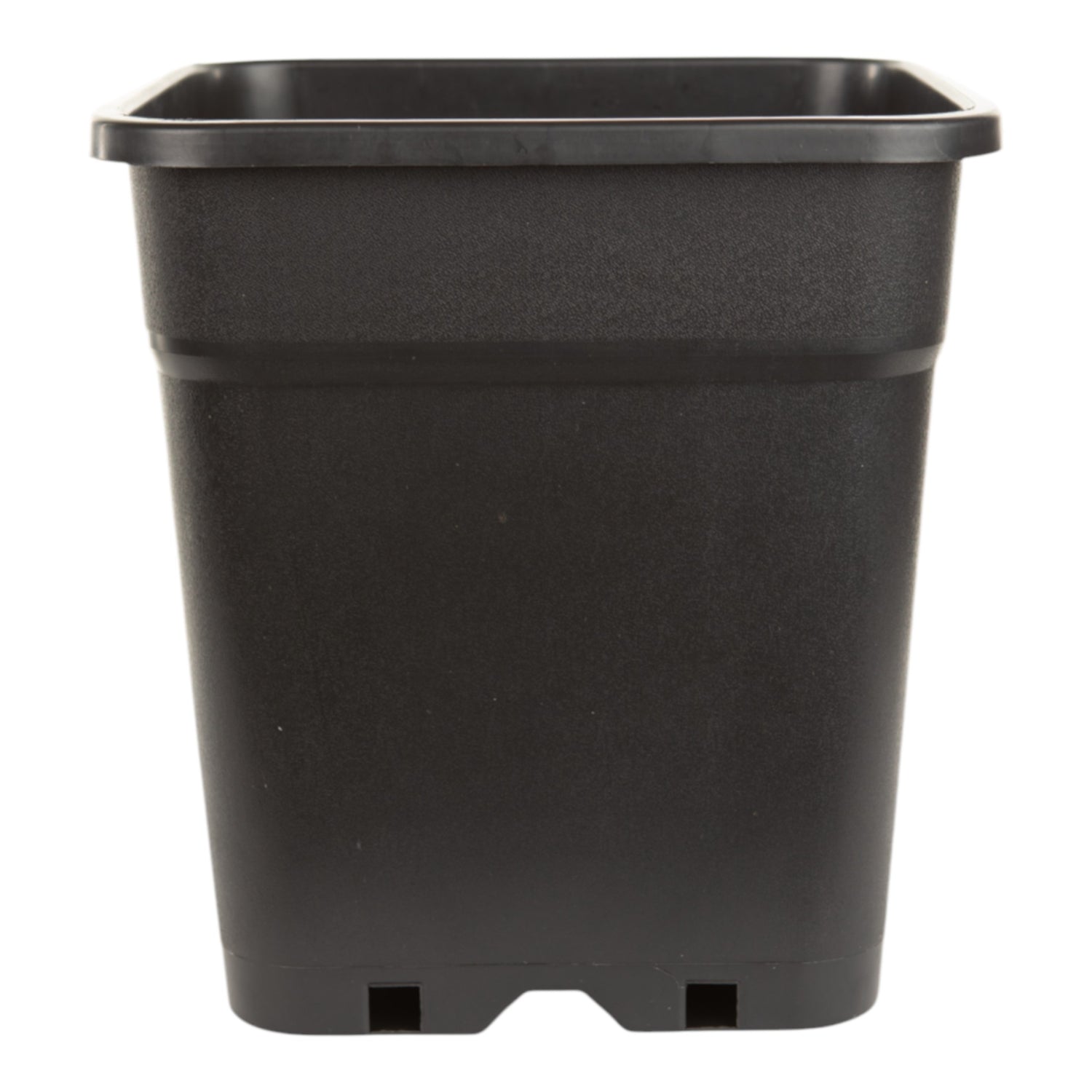
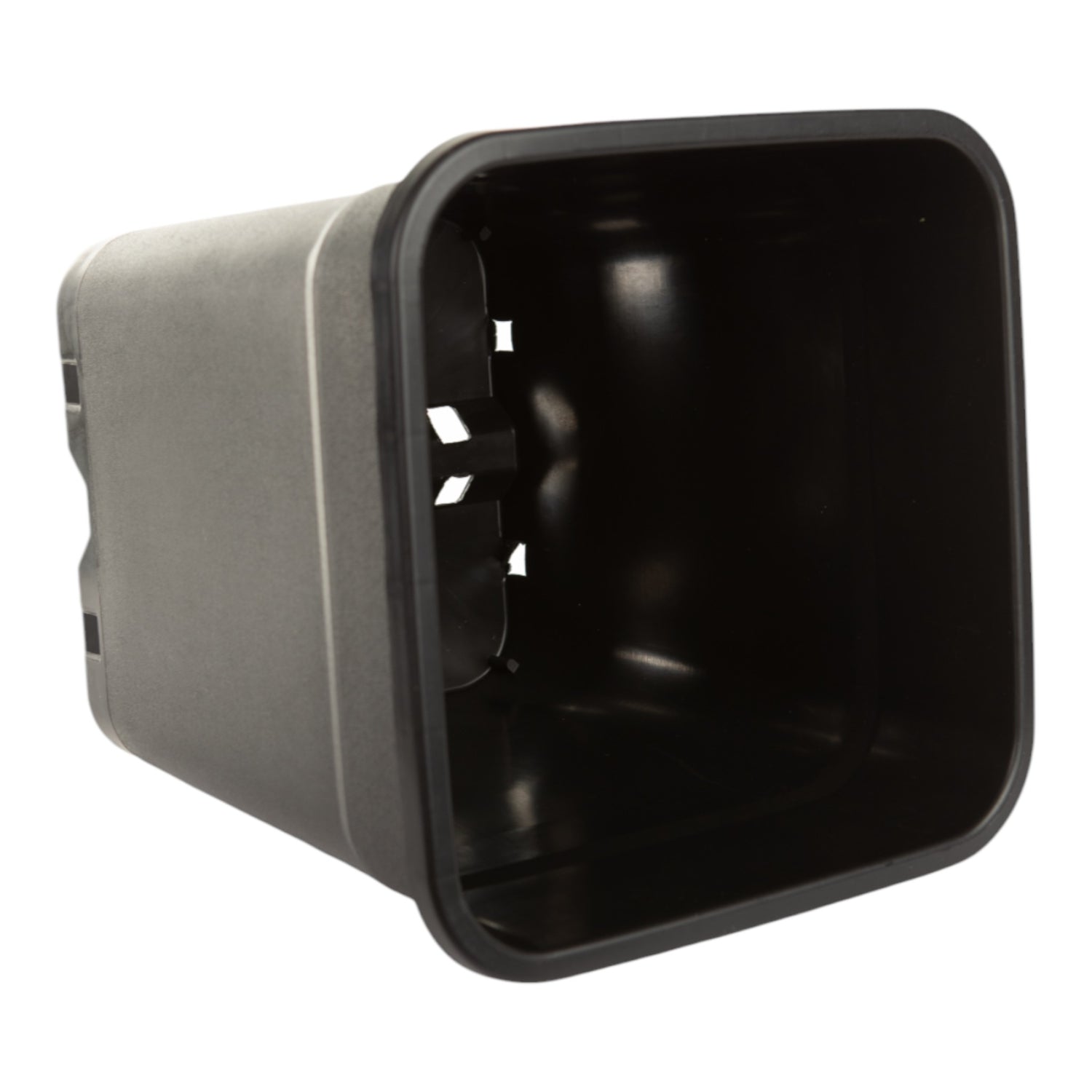
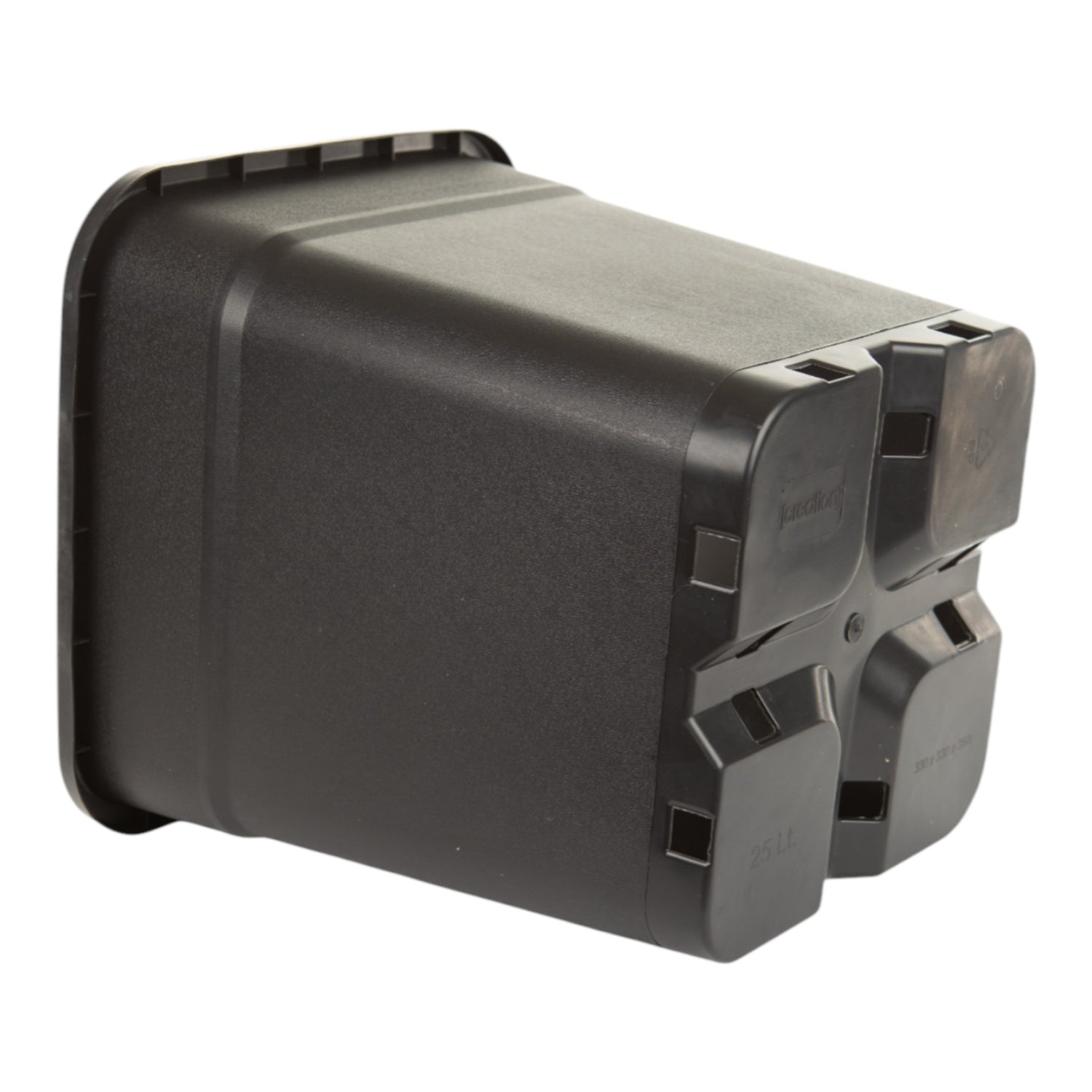
The 25L Square Pot is a professional growing container designed for professional container production where efficient bench or floor spacing is useful.
The 25L format provides substantial root volume for crops that need more space than standard nursery pots, while the container style is intended for repeated handling through production, spacing, irrigation and dispatch.
Sold individually.
Key benefits
Efficient container production
The 25L square format is useful where growers want to organise crops efficiently across benches, beds or standing areas. Square pots can reduce unused gaps between adjacent containers compared with equivalent round formats.
Match the container volume to the crop and production period, allowing adequate root space without creating an excessively wet or slow-drying root zone.
Choosing the growing medium
Use a professional growing medium appropriate to the crop, container size and irrigation system. Larger pots need a substrate with enough structure to maintain air-filled porosity and drainage throughout the production period while retaining sufficient available moisture.
Avoid excessive compaction during filling. Settle the medium consistently and leave suitable watering space at the top of the container.
Irrigation & root-zone management
Container size has a major effect on drying behaviour. Check moisture through the root zone rather than judging only the surface, and adjust irrigation frequency and volume as crop size, weather and rooting increase.
Ensure drainage points remain clear and avoid leaving containers standing in prolonged saturation unless the crop and production system are specifically designed for it.
Handling, spacing & stability
Position larger pots on a stable, well-drained growing surface and allow sufficient spacing for crop development and access. Consider wind exposure as top-heavy trees and shrubs develop.
Filled containers can be substantially heavier than their nominal litre capacity suggests. Use appropriate lifting and handling methods, particularly with the larger sizes in this range.
Reuse & crop hygiene
Where pots remain serviceable, they may be reused subject to the nursery's crop-hygiene requirements. Remove old substrate and plant material, inspect the container for damage and clean or disinfect as appropriate before the next crop cycle.
25L Square Pot product details
| Product type | Square Nursery Pot |
|---|---|
| Nominal capacity | 25L |
| Selling quantity | 1 pot |
| Primary application | professional container production where efficient bench or floor spacing is useful |
25L Square Pot FAQs
Is this nursery pot sold individually?
Yes. The selling unit is one pot. What capacity is this pot?
The stated nominal capacity is 25L. What is this pot suitable for?
It is intended for professional container production where efficient bench or floor spacing is useful. What growing medium should I use?
Use a professional substrate appropriate to the crop, container size and irrigation system, with suitable structure, drainage, aeration and moisture retention. How should larger pots be watered?
Check moisture through the root zone and adjust irrigation to crop size, rooting, weather and substrate behaviour rather than relying on a fixed timetable. Can the pot be reused?
Yes where it remains serviceable and nursery hygiene requirements are met. Remove old substrate and clean appropriately before reuse. What should I consider when moving a filled pot?
A filled and watered container can be very heavy. Use appropriate manual-handling methods or mechanical assistance where required. How do I choose between pot sizes?
Match container volume to crop vigour, root development, production period and intended finished-plant size.

Heavy duty 25mm barbed irrigation elbow for creating a secure 90° change of direction in flexible irrigation pipework.
This 25mm Heavy Duty Barbed Irrigation Elbow provides a simple way to route compatible 25mm pipe around corners without forcing the pipe itself into a tight bend. Its 90° configuration makes it particularly useful when building compact irrigation layouts or directing supply pipework neatly around a growing area.
Barbed connections at both ends grip compatible flexible pipe, making the elbow a practical fitting for hydroponic irrigation, horticultural watering systems and other water or air pipework using 25mm tubing.
Why choose a 25mm Heavy Duty Barbed Irrigation Elbow?
What is a 25mm barbed elbow used for?
A 25mm barbed elbow is used to connect two sections of compatible 25mm flexible pipe at a 90° angle. Instead of bending the irrigation pipe sharply around a corner, the elbow creates a defined change of direction while helping the pipework maintain its intended route.
It is particularly useful when constructing hydroponic irrigation systems, routing water or nutrient supply lines around equipment, or altering an existing 25mm irrigation layout.
How to use a 25mm Heavy Duty Barbed Elbow
Position the elbow where the 25mm pipework needs to change direction. Push one section of compatible 25mm flexible pipe securely over each barbed end, creating a 90° connection between the two pipe runs.
Once installed, run the irrigation system and inspect both connections. Make sure the pipe is seated securely on the barbed fitting and check the joint for leaks before returning the system to normal operation.
Product details
| Product | 25mm Heavy Duty Barbed Irrigation Elbow |
|---|---|
| Product type | Barbed irrigation elbow fitting |
| Pipe size | 25mm |
| Connections | 2 x 25mm |
| Connection style | Barbed |
| Configuration | 90° elbow |
| Construction | Heavy duty machine-moulded plastic |
| Colour | Black |
| Suitable media | Water & air |
| Typical applications | Hydroponic irrigation, horticultural watering systems & 25mm flexible pipework |
25mm Heavy Duty Barbed Irrigation Elbow FAQs
What is a 25mm barbed elbow?
It is a 90° irrigation fitting with a barbed connection at each end, allowing two sections of compatible 25mm flexible pipe to be joined at a right angle.
What size pipe does this elbow fit?
The elbow is designed for compatible 25mm irrigation pipe, including suitable 25mm flexible and LDPE pipework.
Does the elbow create a 90-degree bend?
Yes. The fitting creates a 90° change of direction in the pipe run, making it useful for routing irrigation lines neatly around corners.
Why use an elbow instead of bending 25mm irrigation pipe?
Using an elbow creates a defined 90° turn without forcing the pipe into a tight bend. This helps avoid kinking the pipe when routing an irrigation line around a corner.
Are both ends of the fitting barbed?
Yes. Both connections are barbed and designed to fit compatible 25mm flexible pipework.
Can this 25mm elbow be used in hydroponic irrigation systems?
Yes. The fitting is suitable for compatible hydroponic and horticultural irrigation systems using 25mm pipework.
Can the 25mm barbed elbow be used with water and air?
Yes. This heavy duty barbed plastic fitting is suitable for compatible water and air applications.
What is the difference between a barbed elbow and a straight connector?
A straight connector joins two sections of pipe in the same direction. A barbed elbow joins two sections while changing the direction of the pipework by 90°.

Barbed irrigation reducer for joining 25mm and 19mm pipe in one straightforward inline connection.
This 25mm to 19mm Barbed Irrigation Reducer provides a simple way to change between two commonly used irrigation pipe sizes. With a 25mm connection at one end and a 19mm connection at the other, it allows different diameter pipework to be joined within the same irrigation system.
The straight inline design makes it useful when stepping a larger 25mm supply line down to 19mm pipework. Barbed connections provide a secure push-fit connection with compatible irrigation pipe, making the reducer suitable for new installations, system alterations and replacement work.
Why choose a 25mm to 19mm Barbed Irrigation Reducer?
What is a 25mm to 19mm irrigation reducer used for?
A 25mm to 19mm reducer is used where two different irrigation pipe sizes need to be connected. It creates a direct transition between compatible 25mm and 19mm pipework while keeping the irrigation line running in the same direction.
This is particularly useful when a larger 25mm main supply needs to transition to 19mm distribution pipework elsewhere in a hydroponic, greenhouse or horticultural irrigation system.
How to use a 25mm to 19mm Barbed Irrigation Reducer
Position the reducer where the irrigation pipe needs to change size. Connect the compatible 25mm pipe to the larger barbed end and the compatible 19mm pipe to the smaller barbed end, pushing each section securely onto the fitting.
Once installed, run the irrigation system and inspect both connections. Make sure the pipework remains securely seated on the fitting and check for leaks before returning the system to normal operation.
Product details
| Product | 25mm to 19mm Barbed Irrigation Reducer |
|---|---|
| Alternative name | Reducer joiner |
| Product type | Straight irrigation reducing connector |
| Large connection | 25mm |
| Small connection | 19mm |
| Connection style | Barbed |
| Configuration | Straight inline reducer |
| Typical applications | Hydroponic irrigation, horticultural watering systems & reducing 25mm pipework to 19mm |
25mm to 19mm Barbed Irrigation Reducer FAQs
What does a 25mm to 19mm irrigation reducer do?
It joins compatible 25mm and 19mm irrigation pipe, allowing the pipe diameter to change within the same irrigation run.
Which end connects to 25mm irrigation pipe?
The larger barbed end is the 25mm connection, while the smaller barbed end is designed for compatible 19mm irrigation pipe.
Can I use this fitting to reduce a 25mm irrigation line to 19mm?
Yes. This is the primary purpose of the fitting, providing a direct transition from compatible 25mm pipework to 19mm pipework.
Is this a straight or angled reducer?
It is a straight inline reducer, so the pipework continues in the same direction while changing from one diameter to the other.
Are both ends of the reducer barbed?
Yes. It uses different-sized barbed connections at either end for compatible 25mm and 19mm irrigation pipe.
Can this reducer be used in hydroponic irrigation systems?
Yes. It is suitable for compatible hydroponic and horticultural irrigation layouts using 25mm and 19mm pipework.
What is the difference between a reducer and a reducing tee?
This reducer joins 25mm and 19mm pipe in one continuous straight run. A reducing tee creates an additional branch, allowing another section of pipework to leave the main irrigation line.
Can the reducer be installed in either direction?
The fitting simply connects compatible 25mm pipework to 19mm pipework, so it can be used wherever those two pipe sizes need to meet within the irrigation layout.
£0.45
Unit price per£0.45
Unit price perThe 29cm Square Plant Pot Saucer in Black is a durable plastic drip tray designed to sit beneath square plant pots and containers, catching excess irrigation water and helping protect greenhouse benches, floors, patios and display areas from unwanted runoff.
With a nominal size of 29cm square, this mid-sized saucer is a practical choice for appropriately sized square nursery pots, decorative planters and other container-grown plants.
Its solid base and raised sides provide a defined collection area for water draining from the pot above. This helps contain runoff, compost particles and irrigation residue rather than allowing them to spread across the surrounding surface.
The square format makes efficient use of space beneath square containers, while the black finish provides a discreet appearance for professional growing, garden retail and domestic use.
This 29cm version forms part of a three-size square saucer range, with 25cm and 34cm options also available.
Why choose the 29cm Square Plant Pot Saucer?
Designed for square plant pots
Square pots are widely used where efficient use of growing space is important. Their straight-sided footprint allows containers to be positioned closely together on greenhouse benches, staging and retail displays.
Using a square saucer beneath a square pot follows the container footprint more closely than an oversized round saucer, helping make efficient use of the available space while still providing an area to collect drainage water.
The 29cm size provides a useful middle option between the smaller 25cm and larger 34cm square saucers.
Ideal for square pots & planters
The 29cm Square Saucer can be used beneath a variety of appropriately sized containers in professional and domestic growing environments.
Typical applications include:
Always measure the actual base of the container before selecting a saucer. The usable internal dimensions will be smaller than the nominal 29cm overall size.
Catch runoff & protect surrounding surfaces
Free drainage is important for many container-grown plants, but the water leaving the pot after irrigation can create puddles and carry compost or fertiliser residue onto surrounding surfaces.
Positioning a saucer beneath the pot provides a dedicated collection area for this excess moisture, helping keep growing areas, patios and plant displays cleaner.
Once the container has finished draining, unwanted standing water can be removed from the saucer as required.
Useful for top watering & bottom watering
During conventional top watering, the saucer collects excess water passing through the drainage holes in the bottom of the plant pot.
Where appropriate for the plant and growing medium, water can also be introduced directly into the saucer for bottom watering. Moisture can then be absorbed upwards through the drainage openings in the pot.
Plants that require free-draining conditions should not normally be left standing permanently in water. Remove excess moisture after watering where necessary.
Practical for growers, nurseries & garden centres
Square saucers provide a straightforward way to manage drainage beneath individual production pots and retail plants.
Professional growers can use them where individual containers require localised runoff collection, while garden centres can position them beneath suitable display plants to help prevent water spreading across retail surfaces.
The simple black finish works particularly well beneath conventional nursery containers and keeps the saucer visually unobtrusive.
Available in three square sizes
| 25cm Square Saucer | For appropriately sized smaller square plant pots and containers. |
|---|---|
| 29cm Square Saucer | This mid-sized option for suitable square nursery pots and planters. |
| 34cm Square Saucer | The largest size in the range for appropriately sized larger square containers. |
How to choose the correct square saucer size
Measure the width and depth of the plant pot at its base rather than relying on the maximum dimensions across the top of the container. Many square pots taper towards the bottom.
Both base dimensions should fit comfortably within the usable internal area of the saucer, ideally leaving some surrounding space to collect drainage water.
A pot described as 29cm square will not necessarily fit inside this saucer because its usable internal dimensions are smaller than the nominal external measurement.
Simple cleaning & maintenance
Empty unwanted standing water regularly and remove compost, leaves and other debris that accumulates within the saucer.
Periodic cleaning helps prevent growing media and fertiliser residues building up. In commercial nurseries and growing environments, follow established crop hygiene procedures when moving reusable equipment between production areas.
When used outside, check the saucer following prolonged rainfall and remove excess water where required.
29cm Square Plant Pot Saucer product details
| Product type | Square plant pot saucer / drip tray |
|---|---|
| Nominal size | 29cm square |
| Shape | Square |
| Material | Plastic |
| Colour | Black |
| Base | Solid, designed to collect excess water |
| Primary application | Collecting irrigation runoff beneath square plant pots and containers |
| Suitable environments | Gardens, greenhouses, nurseries, garden centres and indoor growing areas |
| Other available sizes | 25cm and 34cm square |
| Suitable users | Commercial growers, nurseries, garden centres, landscapers and gardeners |
29cm Square Plant Pot Saucer FAQs
What size is this square plant pot saucer?
This version has a nominal size of 29cm square. Will a 29cm square pot fit inside the saucer?
Not necessarily. The usable internal dimensions are smaller than the nominal 29cm overall measurement. Measure the actual base of your pot before ordering. Why use a square saucer beneath a square pot?
The matching shape makes efficient use of space around a square container while still providing an area for collecting drainage water. Can the saucer be used indoors?
Yes. It can help contain drainage beneath suitable indoor plant pots, although additional protection should be considered on moisture-sensitive furniture and flooring. Can the 29cm Square Saucer be used outdoors?
Yes. It can be used beneath appropriately sized outdoor planters. Check for excess standing water after prolonged rain. Can I use this saucer for bottom watering?
Yes, where bottom watering is appropriate for the crop. Water can be introduced into the saucer and absorbed through the drainage openings in the plant pot. Should standing water be removed?
For plants requiring free-draining growing conditions, unwanted standing water should normally be removed after the pot has finished draining or absorbing the required moisture. What other square saucer sizes are available?
The range is available in 25cm, 29cm and 34cm square sizes. How should I measure a square pot for a saucer?
Measure both the width and depth of the pot at its base and make sure both dimensions fit comfortably within the saucer's usable internal area. Can the 29cm saucer be reused?
Yes. The plastic saucer can be emptied, cleaned and reused as required.
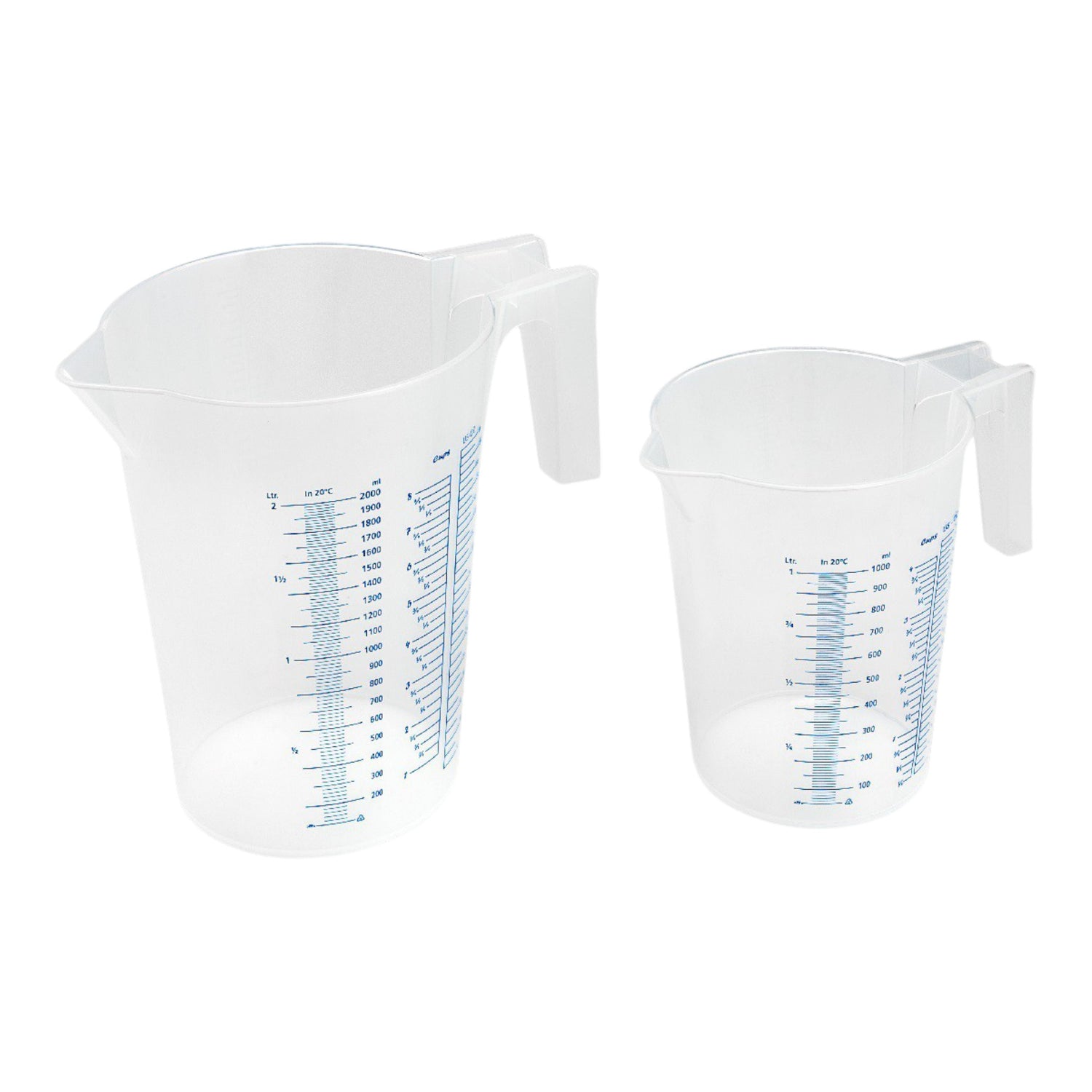
The 2L Measuring Jug is designed for measuring suitable horticultural liquids and concentrates.
Accurate measuring helps improve repeatability when preparing feeds, additives or other suitable horticultural liquids.
Key benefits
Repeatable liquid measurement
Place the jug on a level surface and read the graduation at eye level where practical. Use a jug size appropriate to the volume being measured so small additions are not estimated from an unnecessarily large vessel.
Rinse between incompatible products to avoid cross-contamination and use separate measuring equipment where product instructions or site procedures require it.
Good working practice
Keep equipment and materials clean and clearly identified. Follow the instructions for any fertiliser, additive or treatment being prepared and use appropriate PPE where required by the product label or workplace assessment.
Storage & maintenance
Store the product clean, dry and protected from damage. Electronic meters should be maintained according to their manufacturer instructions; measuring equipment should be replaced if markings or condition no longer allow reliable use.
2L Measuring Jug product details
| Product | 2L Measuring Jug |
|---|---|
| Product type | Measuring Jug |
| Primary use | measuring suitable horticultural liquids and concentrates |
| Stated size / capacity | 2L |
2L Measuring Jug FAQs
What is this product used for?
Measuring suitable horticultural liquids and concentrates. How should it be used?
Follow the product instructions and use it only for compatible horticultural applications. How should it be stored?
Keep it clean, dry and protected from physical damage or contamination. Should equipment be cleaned between uses?
Yes where appropriate, particularly when moving between different solutions or materials. Can one measurement represent every part of a crop or growing area?
Not necessarily. Use representative sampling where conditions may vary. When should the product be replaced?
Replace damaged equipment or material that can no longer be used reliably for its intended purpose. Does this replace crop-specific guidance?
No. Use measurements or growing-media components alongside the requirements of the crop and production system. What should I do if a reading or result looks wrong?
Repeat the measurement or check the equipment and method before making significant adjustments.

The 3L Round Plant Pot is a practical black horticultural grow pot designed for nursery production, greenhouse growing, potting-on and general container cultivation. With an approximately 18.5cm upper rim, 14cm base and 15cm height, it provides a useful 3 litre root volume in a compact, easy-to-handle format.
Three litre pots are one of the most versatile sizes in horticulture, providing a useful intermediate step between small propagation containers and larger finishing pots. They are suitable for a wide range of perennials, herbs, vegetables, ornamentals and young nursery plants.
The tapered round profile makes the pot straightforward to handle and allows empty containers to nest efficiently for storage. A reinforced upper rim provides a practical gripping point when plants need to be moved around a nursery, greenhouse or growing area.
Drainage openings in the base allow excess irrigation water to escape, helping maintain an appropriate balance between moisture and oxygen within the root zone.
Suitable for peat-based and peat-free compost, soil, coco coir and other horticultural growing media, this 3L pot is equally useful for professional growers and home gardeners.
Why choose the 3L Round Plant Pot?
A versatile 3 litre growing volume
A 3L pot provides significantly more root volume than small propagation and early-stage containers while remaining compact enough for efficient plant spacing.
This makes it particularly useful for growing-on established young plants. Moving a plant into a suitably larger container gives developing roots additional growing medium to explore without immediately placing a small root system into an unnecessarily large volume of wet substrate.
For many nursery crops, 3L is also a convenient retail and finishing size. For larger or more vigorous plants, it can instead serve as an intermediate stage before moving into a larger container.
3L Round Pot dimensions
The pot measures approximately 18.5cm across the upper rim, 14cm across the base and 15cm high.
These proportions create a compact horticultural container with useful root volume while maintaining a manageable footprint for greenhouse benches, nursery beds and indoor growing areas.
The tapered sides also allow empty pots to nest inside one another, making storage and handling considerably more efficient.
Suitable growing media
The 3L Round Plant Pot can be used with a broad range of horticultural substrates, including:
Irrigation frequency should always be adjusted to suit the crop and substrate. Free-draining coco behaves very differently from a moisture-retentive compost, even when both are used in the same size container.
What can you grow in a 3L pot?
Three litres is a widely useful container size for growing-on and finishing smaller plants. Typical applications include:
Whether 3L is suitable as a final pot depends on the plant species, expected mature size and crop duration. Vigorous plants may eventually need potting-on again.
Drainage & root-zone management
Drainage openings in the base allow excess irrigation water to leave the container instead of remaining trapped around the lower roots.
Effective drainage helps maintain the combination of moisture and air required for healthy root development. It is particularly important when plants are frequently irrigated or grown in controlled greenhouse and indoor environments.
The pot can be used with hand watering, drip irrigation and other suitable nursery irrigation systems.
Avoid watering purely according to a fixed timetable. Plant size, root development, substrate, temperature, humidity and light levels all affect how quickly a 3L pot will dry.
Fits the 18cm Pot Saucer
The 3L Round Plant Pot is compatible with the 18cm Pot Saucer, product code P00103.
The matching saucer measures approximately 18.5cm across the rim, 16.5cm across the base and 3cm high.
A saucer is useful when the pot is used indoors, on greenhouse benches or on protected surfaces where irrigation runoff needs to be contained.
In outdoor or free-draining production areas, a saucer may not be necessary.
Ideal for nursery & greenhouse production
Three litre round pots are particularly useful in nursery production because they provide enough growing-medium volume for established young plants without requiring the space of much larger containers.
The manageable size makes plants easy to move, space, irrigate and prepare for sale, while the black horticultural finish provides a straightforward professional presentation.
The pot is also useful for home growers who want a functional growing container rather than a decorative planter.
Practical & reusable
Pots that remain in good condition can be emptied, cleaned and reused for future crops.
Remove old substrate and root debris before cleaning. Where pots are being transferred between crops, appropriate hygiene procedures can help reduce the risk of carrying pests or plant pathogens into the next planting.
Empty pots can be nested together for compact storage between uses.
3L Round Plant Pot product details
| Product | Round Plant Pot |
|---|---|
| Nominal capacity | 3L |
| Shape | Round |
| Colour | Black |
| Upper rim diameter | Approximately 18.5cm |
| Base diameter | Approximately 14cm |
| Height | Approximately 15cm |
| Drainage | Pre-formed base drainage openings |
| Suitable media | Soil, compost, peat-free media, coco & compatible horticultural substrates |
| Suitable environments | Nurseries, greenhouses, polytunnels, indoor growing & outdoor cultivation |
| Typical applications | Perennials, herbs, vegetables, young shrubs, ornamentals & nursery stock |
| Compatible saucer | 18cm Pot Saucer - product code P00103 |
| Compatible saucer dimensions | Rim 18.5cm x base 16.5cm x height 3cm |
| Reusable | Yes, when cleaned and maintained appropriately |
3L Round Plant Pot FAQs
What are the dimensions of the 3L Round Pot?
The pot measures approximately 18.5cm across the upper rim, 14cm across the base and 15cm high.
What can I grow in a 3L plant pot?
A 3L pot is suitable for many perennials, herbs, bedding plants, young shrubs, chillies, peppers, strawberries, ornamentals and nursery crops. Larger plants may eventually require potting-on.
Is a 3L pot suitable for chillies and peppers?
Yes. Three litres can be suitable for smaller chilli and pepper plants or as an intermediate growing size. Larger and more vigorous plants may benefit from additional root volume later in the crop.
Can this pot be used for tomatoes?
It is suitable for growing-on young tomato plants, but most mature tomato plants will normally benefit from a substantially larger final container.
Can I use coco coir in the 3L Round Pot?
Yes. Coco and coco-based blends can be used in this pot. Adjust irrigation frequency to suit the free-draining characteristics of the growing medium.
Can I use peat-free compost?
Yes. The pot is suitable for peat-free growing media as well as conventional compost, soil mixes, coco and other appropriate horticultural substrates.
Does the 3L Round Pot have drainage holes?
Yes. Drainage openings in the base allow excess irrigation water to leave the growing medium.
Which saucer fits the 3L Round Pot?
The compatible option is the 18cm Pot Saucer, product code P00103. It measures approximately 18.5cm across the rim, 16.5cm across the base and 3cm high.
Do I need a saucer underneath the pot?
A saucer is useful where runoff needs to be contained, particularly indoors or on protected surfaces. It is not essential where excess water can safely drain away.
Is this pot suitable for nursery production?
Yes. The 3L size is widely useful for growing-on nursery plants because it combines practical root volume with a compact, easy-to-handle container.
Can this pot be used outdoors?
Yes. It can be used outdoors as well as in greenhouses, polytunnels and indoor growing areas.
Can the 3L Round Pot be used with drip irrigation?
Yes. It is suitable for hand watering and compatible drip irrigation systems. Irrigation frequency should be adjusted to crop demand and substrate moisture.
Can the pot be reused?
Yes. Pots that remain in good condition can be emptied, cleaned and reused. Appropriate hygiene is recommended between crops.
Is 3L suitable as a final plant pot?
For many smaller plants it can be. Larger, vigorous or longer-lived crops may need to be moved into a larger container as their root systems develop.

£0.22
Unit price per£0.22
Unit price perThe 2L Square Round Plant Pot is a compact black horticultural grow pot designed for potting-on young plants, nursery production and efficient greenhouse growing. Measuring approximately 13.5cm across the upper rim, 11cm across the base and 14.5cm high, it combines the space-saving advantages of a square pot with a tapered lower profile.
A 2 litre container provides a useful step between small propagation pots and larger nursery or finishing containers. It gives developing roots additional growing-medium volume while keeping plants compact, lightweight and easy to handle.
The square upper profile allows neighbouring pots to sit closely together, helping maximise available bench, greenhouse and nursery space. This makes the format particularly useful where larger numbers of young plants are being grown simultaneously.
The tapered lower section creates a practical root zone, assists removal of established root balls during potting-on and allows empty pots to nest together for efficient storage.
Suitable for peat-based and peat-free compost, soil, coco coir and other horticultural growing media, this versatile 2L pot can be used for a wide range of edible, ornamental and nursery crops.
Why choose the 2L Square Round Plant Pot?
Space-efficient square round design
Square round pots combine features of both square and conventional round horticultural containers.
The predominantly square upper profile allows pots to be positioned efficiently alongside one another. Compared with rows of conventional round pots, this can reduce the unused space between containers and help growers make better use of nursery and greenhouse benches.
The lower section tapers towards the base, creating a practical growing profile while allowing empty containers to nest together for compact storage.
This combination makes the format particularly useful for professional growing-on applications where plant density, handling and storage efficiency are important.
A practical 2 litre growing-on pot
Two litres provides a useful intermediate root volume for plants that have outgrown smaller propagation or nursery pots.
Potting-on into a 2L container gives developing roots access to additional growing medium without immediately placing a young plant into an unnecessarily large volume of substrate.
This makes the size particularly useful for progressive potting, where plants are moved through increasingly larger containers as their root systems develop.
For compact plants and shorter production cycles, a 2L container may also be suitable as a final growing or retail pot.
What can you grow in a 2L pot?
The 2L Square Round Plant Pot is suitable for growing-on a broad range of plants, including:
Whether 2L is suitable as the final container depends on the crop, mature plant size and growing period. Vigorous plants will generally require additional root volume as they develop.
Ideal for progressive potting-on
Progressive potting allows the container volume to increase alongside development of the root system.
A 2L pot is particularly useful after smaller propagation and growing-on containers. Once roots have established throughout the existing medium, moving into 2 litres provides fresh substrate and additional space for continued growth.
Avoid potting very small plants into excessively large containers unnecessarily. A large volume of wet, unrooted growing medium can take longer to dry and may make irrigation more difficult to manage.
Suitable growing media
The 2L Square Round Plant Pot can be used with a wide variety of horticultural growing media, including:
Choose a substrate appropriate for the crop and growing method. Moisture retention, drainage and irrigation frequency can vary considerably between different growing media.
Watering plants in 2L pots
Smaller containers respond relatively quickly to changes in temperature, light levels and plant water demand, so substrate moisture should be checked regularly.
Immediately after potting-on, roots may occupy only part of the fresh growing medium. Water according to the needs of the developing root system rather than automatically saturating the entire pot on a fixed schedule.
As the plant becomes established, increased root mass and foliage will normally increase water demand.
The pot can be used with hand watering and compatible nursery, greenhouse and drip irrigation systems.
Fits the 14cm Pot Saucer
The 2L Square Round Plant Pot is listed for use with the 14cm saucer, product code P00047.
The compatible saucer measures approximately 17cm across the rim, 14cm across the base and 2cm high.
A saucer can help collect irrigation runoff when plants are grown indoors, on greenhouse benches or on surfaces that need protection from excess water.
Avoid leaving the pot permanently standing in stagnant runoff unless this forms part of the intended irrigation method.
Ideal for nursery & greenhouse production
The compact 2L format provides professional growers with a useful balance between root volume and production footprint.
Its square upper profile allows plants to be arranged efficiently while young. As the canopy develops, containers can be spaced further apart where required to improve airflow and light distribution.
The manageable size also makes plants straightforward to move, grade, irrigate and prepare for sale or further potting-on.
Practical & reusable
Pots that remain in good condition can be emptied, cleaned and reused for subsequent crops.
Remove old roots and growing-medium residue before cleaning. Appropriate hygiene between crops can help reduce the risk of transferring pests or plant pathogens.
The tapered profile allows empty pots to nest together, reducing the storage space required between growing cycles.
2L Square Round Plant Pot product details
| Product | Square Round Plant Pot |
|---|---|
| Nominal capacity | 2L |
| Shape | Square round |
| Colour | Black |
| Upper rim width | Approximately 13.5cm |
| Base width | Approximately 11cm |
| Height | Approximately 14.5cm |
| Primary use | Potting-on, growing-on & nursery production |
| Suitable media | Soil, compost, peat-free media, coco & compatible horticultural substrates |
| Suitable environments | Nurseries, greenhouses, polytunnels, indoor growing & outdoor cultivation |
| Compatible saucer | 14cm Saucer - product code P00047 |
| Saucer dimensions | Rim 17cm x base 14cm x height 2cm |
| Reusable | Yes, when cleaned and maintained appropriately |
2L Square Round Plant Pot FAQs
What capacity is this Square Round Pot?
The pot has a nominal capacity of approximately 2 litres.
What are the dimensions of the 2L Square Round Pot?
It measures approximately 13.5cm across the upper rim, 11cm across the base and 14.5cm high.
What is a square round plant pot?
A square round pot combines a predominantly square upper profile with a tapered lower body. This provides efficient spacing while retaining a practical nursery-pot shape.
Is a 2L pot suitable for potting-on?
Yes. Two litres is a useful growing-on size for established seedlings, rooted cuttings and young plants that have outgrown smaller propagation containers.
Which saucer fits the 2L Square Round Pot?
The listed compatible option is the 14cm saucer, product code P00047, measuring approximately 17cm across the rim, 14cm across the base and 2cm high.
Can I grow chillies and peppers in a 2L pot?
Yes. A 2L container is useful for growing-on chilli and pepper plants. Larger mature plants will often benefit from being moved into a bigger final pot.
Can I grow tomatoes in a 2L pot?
It is suitable for growing-on young tomato plants, but most mature tomato crops require substantially more root volume for long-term production.
Can I use peat-free compost?
Yes. The pot is suitable for peat-free growing media as well as conventional nursery compost and other appropriate horticultural substrates.
Can I use coco coir?
Yes. Coco coir and coco-based mixes can be used. Irrigation frequency should be matched to the plant and drainage characteristics of the chosen substrate.
Why use a square round pot instead of a round pot?
The square upper profile allows neighbouring containers to sit more efficiently together, helping reduce wasted space across nursery and greenhouse benches.
Is this pot suitable for professional nurseries?
Yes. The 2L size and space-efficient profile make it well suited to commercial growing-on and nursery production.
Can the 2L pot be used outdoors?
Yes. It can be used outdoors as well as in greenhouses, polytunnels, nurseries and indoor growing environments.
Can this plant pot be reused?
Yes. Pots that remain in sound condition can be emptied, cleaned and reused. Appropriate crop hygiene is recommended between uses.
Is 2L suitable as a final pot size?
It can be a final container for some compact plants and shorter production cycles. Larger or more vigorous plants will generally require additional root volume.
When should I move a plant out of a 2L pot?
Consider potting-on once roots have established throughout the growing medium, the pot begins drying increasingly quickly or the plant requires additional root space to continue developing.
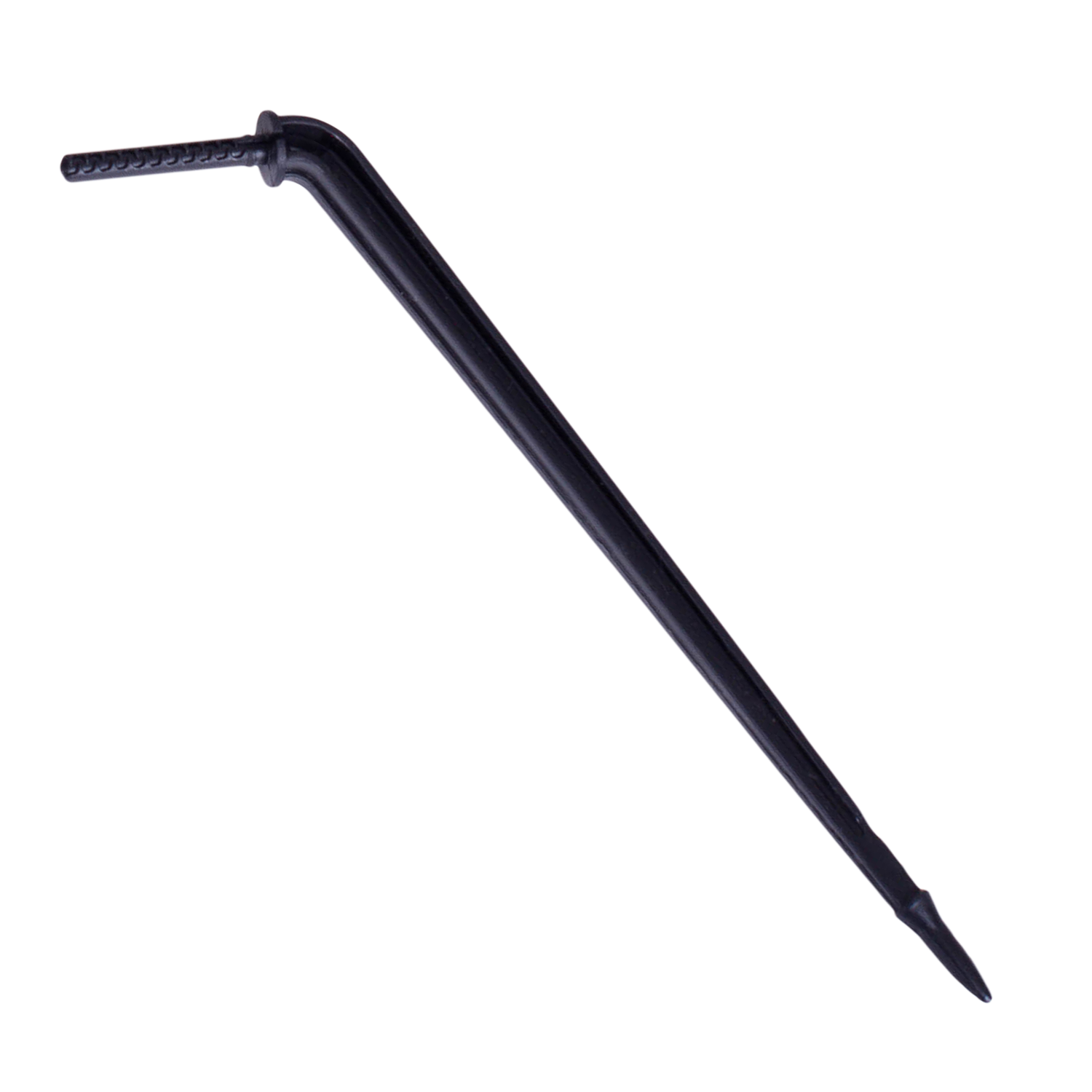
The 2L/h Black Dripper Stake is designed for delivering irrigation water at the pot or plant position in professional nursery, greenhouse and horticultural irrigation systems.
Reliable irrigation depends on matching emitters, stakes, pipework and installation tools correctly so water is delivered consistently and connections remain secure.
Key benefits
Point irrigation at container level
Dripper stakes position the water outlet close to the crop root zone, helping keep individual container irrigation organised. Insert the stake securely without damaging important roots and route the connected microtube so it is not kinked or under tension.
Actual delivered water depends on the upstream dripper, pressure, pipework and system design. Where a flow figure is stated for the product, verify irrigation uniformity under the operating conditions of the complete system.
Checking irrigation uniformity
Periodically compare output across representative pots, particularly at the beginning and end of irrigation lines. Investigate blocked outlets, damaged tube, pressure differences or displaced stakes if crop moisture becomes uneven.
Irrigation system management
Good components cannot compensate for poor system design. Size pipework, zones and water supply for the required flow and pressure, and use suitable filtration where emitters or small waterways are vulnerable to debris.
Flush and inspect irrigation systems as appropriate to water quality and crop hygiene requirements.
Maintenance & storage
Inspect components periodically for blockage, wear, leaks or physical damage. Keep installation tools clean and dry between jobs and replace damaged components rather than relying on temporary fixes in production systems.
2L/h Black Dripper Stake product details
| Product type | 2L/h Black Dripper Stake |
|---|---|
| Primary use | delivering irrigation water at the pot or plant position |
| Application | Professional horticultural irrigation |
| Stated flow | 2L/h |
2L/h Black Dripper Stake FAQs
What is this product used for?
Delivering irrigation water at the pot or plant position. Is it suitable for professional irrigation systems?
Yes, where the component is compatible with the pipework, emitters and system configuration being used. What should I check before installation?
Confirm component and pipe compatibility, inspect the parts for damage and plan the connection so pipework is not kinked or under unnecessary tension. Should the system be tested after fitting?
Yes. Pressurise or run the irrigation zone and check for leaks, secure connections and expected water delivery. How can I maintain irrigation uniformity?
Inspect representative outlets, maintain filtration and flushing as required and investigate blocked or damaged components promptly. Can one irrigation run time suit every crop?
No. Irrigation duration and frequency depend on crop size, container volume, substrate, weather and emitter output. How should spare components or tools be stored?
Keep them clean, dry and organised so sealing surfaces, cutting edges and small waterways are protected from damage and contamination. Where should the stake be positioned?
Place it securely in the container or root-zone area so water reaches the growing medium without the tube being kinked or strained. Does 2L/h guarantee exactly 2 litres every hour in every installation?
It is the stated nominal flow. Actual delivery should be checked under the pressure and configuration of the complete irrigation system.

£2.95
Unit price per£2.95
Unit price perThis 2m black UK power lead provides a straightforward replacement mains connection for compatible electrical equipment fitted with an IEC C14 power inlet.
Commonly referred to as a kettle lead, IEC lead or computer power lead, the cable connects a standard UK 3-pin mains socket to compatible equipment using an IEC C13 female connector.
The practical 2 metre cable length provides useful reach without the excess cable associated with longer leads, making it well suited to lighting installations, controllers and other compatible electrical equipment.
It is particularly useful as a replacement for lost or damaged ballast power cables where the equipment uses a standard IEC C14 inlet.
Why choose the 2m UK IEC power lead?
UK plug to IEC C13 connection
The equipment end of the lead uses an IEC C13 female connector. This mates with the corresponding IEC C14 inlet commonly fitted to electrical equipment.
This connector format is widely used across computers, monitors, power supplies, controllers and compatible lighting equipment, including some ballasts.
Always check the inlet fitted to your equipment before ordering. IEC connectors are available in several different formats and a similar-looking connector does not necessarily mean the lead is suitable for the equipment.
Practical 2 metre cable length
At 2 metres long, this cable provides a useful balance between reach and cable management. It is long enough for many equipment installations without leaving large amounts of unnecessary cable to manage.
The additional reach can also help avoid placing unnecessary tension on either the mains plug or the equipment connector.
Route the cable carefully so that it is protected from sharp edges, crushing and excessive tension, and avoid positioning it where it could create a trip hazard.
Replacement power lead for compatible equipment
Equipment using a detachable IEC power connection can normally have the lead replaced independently if the original cable becomes lost or damaged.
This 2m cable provides a replacement UK mains connection for compatible equipment requiring an IEC C13 connector.
Always confirm both the connector type and the electrical requirements of the equipment before use. A connector physically fitting the appliance does not by itself confirm suitability for every electrical load or application.
Power lead installation & safety
2m UK Power Lead product details
| Product type | UK mains power lead |
|---|---|
| Cable length | 2m |
| Colour | Black |
| Mains connection | UK 3-pin plug |
| Equipment connection | IEC C13 female connector |
| Compatible equipment inlet | IEC C14 |
| Common description | Kettle lead / IEC power lead |
| Typical use | Replacement mains connection for compatible electrical equipment and lighting ballasts |
| Outer case quantity | 50 leads |
2m UK IEC Power Lead FAQs
How long is this power lead?
The cable is 2 metres long, providing practical reach for connecting compatible equipment to a nearby mains socket. What connector is on the equipment end?
The equipment end uses an IEC C13 female connector, designed to mate with a compatible IEC C14 inlet. Does it have a UK plug?
Yes. The mains end is fitted with a UK 3-pin plug. Is this commonly called a kettle lead?
Yes. IEC C13 power cables are commonly described as kettle leads in the UK, although IEC C13 is the more precise connector description. What equipment does an IEC C13 power lead fit?
It connects to compatible electrical equipment fitted with an IEC C14 inlet. Can I use it as a replacement ballast power cable?
Yes, where the ballast uses a compatible IEC C14 inlet and the power lead is suitable for the ballast's electrical requirements. Will it fit every lighting ballast?
No. Different ballasts can use different power connections, so check the equipment connector before ordering. What is the difference between IEC C13 and C14?
The C13 is the cable-mounted connector on this power lead. It connects to the corresponding C14 inlet fitted to compatible equipment. Why choose a 2m power lead?
A 2m cable provides useful reach while remaining relatively easy to route and manage around electrical equipment. Can this replace a lost IEC power cable?
Yes, provided the original equipment uses the same compatible IEC connection and the replacement lead meets its electrical requirements. Can I use a damaged power lead?
No. Do not use a lead if the cable insulation, mains plug or equipment connector shows signs of damage. Should the connections be kept dry?
Yes. Electrical plugs and connections should be protected from water and excessive moisture and installed appropriately for the operating environment. How many 2m power leads are in an outer case?
The outer case quantity for this product is 50 leads.
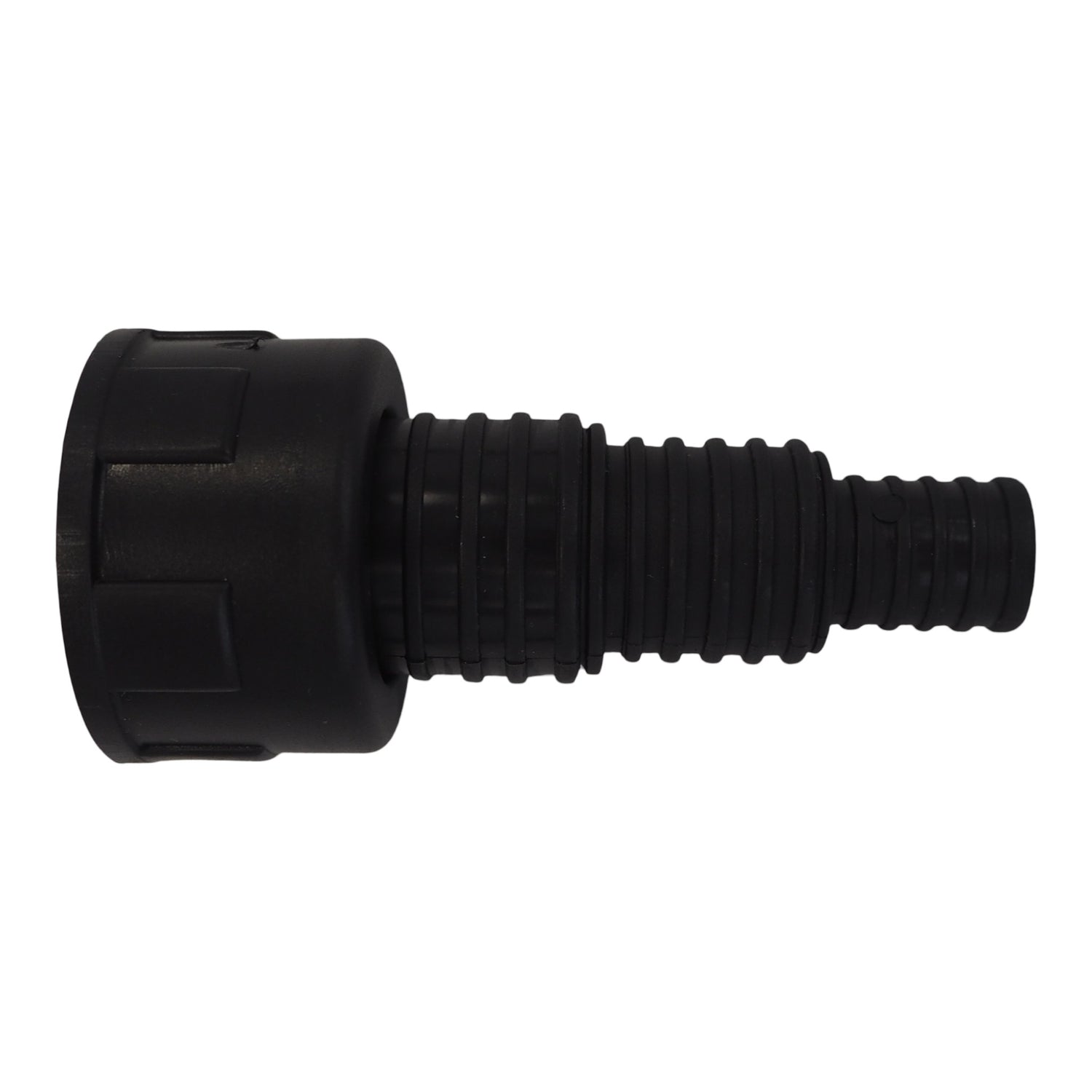
The 3 Part Fitting 1/2", 3/4" or 1" is designed for connecting compatible 1/2, 3/4 or 1 inch hose/fitting systems in professional horticultural, nursery, landscape and garden watering systems.
Correct hose fittings and storage equipment help keep watering systems organised, serviceable and easier to move between working areas.
Key benefits
Building serviceable hose connections
Match the fitting to the stated hose diameter and coupling system. Push barbed fittings fully into compatible hose and secure them using the appropriate method for the system.
Keep sealing faces and washers clean. If a connection leaks, inspect the seal, hose end and coupling condition rather than relying on excessive tightening.
Watering-system setup
Choose hose diameter and fittings according to the required flow, run length and available water pressure. Long hose runs and restrictive fittings can reduce pressure and flow at the watering lance or outlet.
Leak checks & maintenance
Inspect hose ends, seals, couplings and moving trolley parts periodically. Replace split hose, worn seals and damaged fittings rather than accepting persistent leakage.
Storage
Store hose and fittings clean and protected from unnecessary physical damage. Avoid leaving hose tightly kinked or under tension around fittings during storage.
3 Part Fitting 1/2", 3/4" or 1" product details
| Product type | Three-Part Hose Fitting |
|---|---|
| Primary use | connecting compatible 1/2, 3/4 or 1 inch hose/fitting systems |
| Source designation | 3 Part Fitting 1/2", 3/4" or 1" |
| Application | Professional horticultural and garden watering systems |
3 Part Fitting 1/2", 3/4" or 1" FAQs
What is this product used for?
Connecting compatible 1/2, 3/4 or 1 inch hose/fitting systems. How do I check compatibility?
Match the stated hose diameter, fitting type and coupling system to the equipment already in use. Can different hose diameters use the same fitting?
Not unless the fitting is specifically designed for those sizes. Use the stated compatible diameter. What should I check if a hose connection leaks?
Inspect the hose end, seal, washer and coupling surfaces and replace damaged components. Does hose length affect water delivery?
Yes. Longer runs and restrictive fittings can contribute to pressure loss and reduced flow. How should hose equipment be stored?
Keep it clean and protected and avoid severe kinks, crushing or continuous strain on fittings. Should fittings be inspected regularly?
Yes. Check seals, coupling faces and hose connections for wear or damage. Can hose trolleys be overloaded?
Use each component only within the capacity and application appropriate to the complete watering system.

£0.00
Unit price per£0.00
Unit price perThe 3" Irrigation Pressure Filter - 155 Mesh / 100 micron is a irrigation filter for compatible professional horticultural irrigation systems.
The stated filtration grade is 155 mesh / 100 micron. Filtration helps protect drippers, sprinklers, foggers and valves from suspended debris that can reduce flow or cause blockage.
Key benefits
Why irrigation filtration matters
Small emitter waterways are vulnerable to suspended particles. A correctly selected filter reduces the amount of debris reaching downstream equipment, helping maintain irrigation uniformity and reducing avoidable blockage.
The stated grade for this version is 155 mesh / 100 micron. Select filtration according to the water source and the requirements of the most restrictive downstream component.
Choosing filter grade
Mesh and micron figures describe filtration fineness in different ways. A finer filter is not automatically better if it creates excessive pressure loss or requires impractical cleaning frequency. Follow the irrigation-equipment requirements and account for water quality and expected flow.
Installation & pressure loss
Install the filter in the correct flow direction and orientation for the filter body. Allow access for inspection and cleaning. Pipework should be supported so its weight does not strain the filter connections.
As debris accumulates, pressure loss across the filter can increase. Monitor the system and clean the element before restriction begins to affect downstream irrigation performance.
Cleaning & maintenance
Depressurise the system before opening a filter housing. Remove the element carefully and clean it using a method appropriate to the element material and the contamination present. Inspect seals, screens and housing components before reassembly.
Replace damaged or permanently blocked elements rather than operating with compromised filtration.
Water quality & system management
Filtration is one part of irrigation maintenance. Source-water quality, line flushing, storage tanks and chemical or biological contamination can all influence system reliability. Maintain the complete water system rather than relying on the filter alone.
3" Irrigation Pressure Filter - 155 Mesh / 100 micron product details
| Product type | Pressure Filter |
|---|---|
| Stated size | 3" |
| Filtration grade | 155 mesh |
| Equivalent stated filtration | 100 micron |
| Colour | Yellow |
| Application | Professional horticultural irrigation |
3" Irrigation Pressure Filter - 155 Mesh / 100 micron FAQs
What filtration grade is stated?
This version is stated as 155 mesh / 100 micron. What is the filter used for?
It helps remove suspended debris before water reaches downstream irrigation equipment such as drippers, sprinklers, foggers and valves. How do I choose the right filtration grade?
Follow the requirements of the downstream irrigation equipment and consider water quality, flow demand and acceptable pressure loss. Does a finer filter always improve the system?
No. Excessively fine filtration can increase pressure loss and cleaning frequency if it is not appropriate to the water source and equipment. When should the filter be cleaned?
Inspect and clean it before accumulated debris causes unacceptable pressure loss or reduced downstream performance. Should the system be depressurised before opening the filter?
Yes. Safely isolate and depressurise the system before opening a filter housing. Can a damaged element be reused?
No. Replace damaged, distorted or persistently blocked filtration elements. Does filtration remove the need to flush irrigation lines?
No. Filtration and line flushing perform different roles and both may be required as part of system maintenance. How can I tell if the filter is restricting flow?
A growing pressure difference across the filter or reduced downstream performance can indicate that cleaning or inspection is required.

£0.00
Unit price per£0.00
Unit price perThe 3" Irrigation Pressure Filter - 75 Mesh / 200 micron is a irrigation filter for compatible professional horticultural irrigation systems.
The stated filtration grade is 75 mesh / 200 micron. Filtration helps protect drippers, sprinklers, foggers and valves from suspended debris that can reduce flow or cause blockage.
Key benefits
Why irrigation filtration matters
Small emitter waterways are vulnerable to suspended particles. A correctly selected filter reduces the amount of debris reaching downstream equipment, helping maintain irrigation uniformity and reducing avoidable blockage.
The stated grade for this version is 75 mesh / 200 micron. Select filtration according to the water source and the requirements of the most restrictive downstream component.
Choosing filter grade
Mesh and micron figures describe filtration fineness in different ways. A finer filter is not automatically better if it creates excessive pressure loss or requires impractical cleaning frequency. Follow the irrigation-equipment requirements and account for water quality and expected flow.
Installation & pressure loss
Install the filter in the correct flow direction and orientation for the filter body. Allow access for inspection and cleaning. Pipework should be supported so its weight does not strain the filter connections.
As debris accumulates, pressure loss across the filter can increase. Monitor the system and clean the element before restriction begins to affect downstream irrigation performance.
Cleaning & maintenance
Depressurise the system before opening a filter housing. Remove the element carefully and clean it using a method appropriate to the element material and the contamination present. Inspect seals, screens and housing components before reassembly.
Replace damaged or permanently blocked elements rather than operating with compromised filtration.
Water quality & system management
Filtration is one part of irrigation maintenance. Source-water quality, line flushing, storage tanks and chemical or biological contamination can all influence system reliability. Maintain the complete water system rather than relying on the filter alone.
3" Irrigation Pressure Filter - 75 Mesh / 200 micron product details
| Product type | Pressure Filter |
|---|---|
| Stated size | 3" |
| Filtration grade | 75 mesh |
| Equivalent stated filtration | 200 micron |
| Colour | Grey |
| Application | Professional horticultural irrigation |
3" Irrigation Pressure Filter - 75 Mesh / 200 micron FAQs
What filtration grade is stated?
This version is stated as 75 mesh / 200 micron. What is the filter used for?
It helps remove suspended debris before water reaches downstream irrigation equipment such as drippers, sprinklers, foggers and valves. How do I choose the right filtration grade?
Follow the requirements of the downstream irrigation equipment and consider water quality, flow demand and acceptable pressure loss. Does a finer filter always improve the system?
No. Excessively fine filtration can increase pressure loss and cleaning frequency if it is not appropriate to the water source and equipment. When should the filter be cleaned?
Inspect and clean it before accumulated debris causes unacceptable pressure loss or reduced downstream performance. Should the system be depressurised before opening the filter?
Yes. Safely isolate and depressurise the system before opening a filter housing. Can a damaged element be reused?
No. Replace damaged, distorted or persistently blocked filtration elements. Does filtration remove the need to flush irrigation lines?
No. Filtration and line flushing perform different roles and both may be required as part of system maintenance. How can I tell if the filter is restricting flow?
A growing pressure difference across the filter or reduced downstream performance can indicate that cleaning or inspection is required.
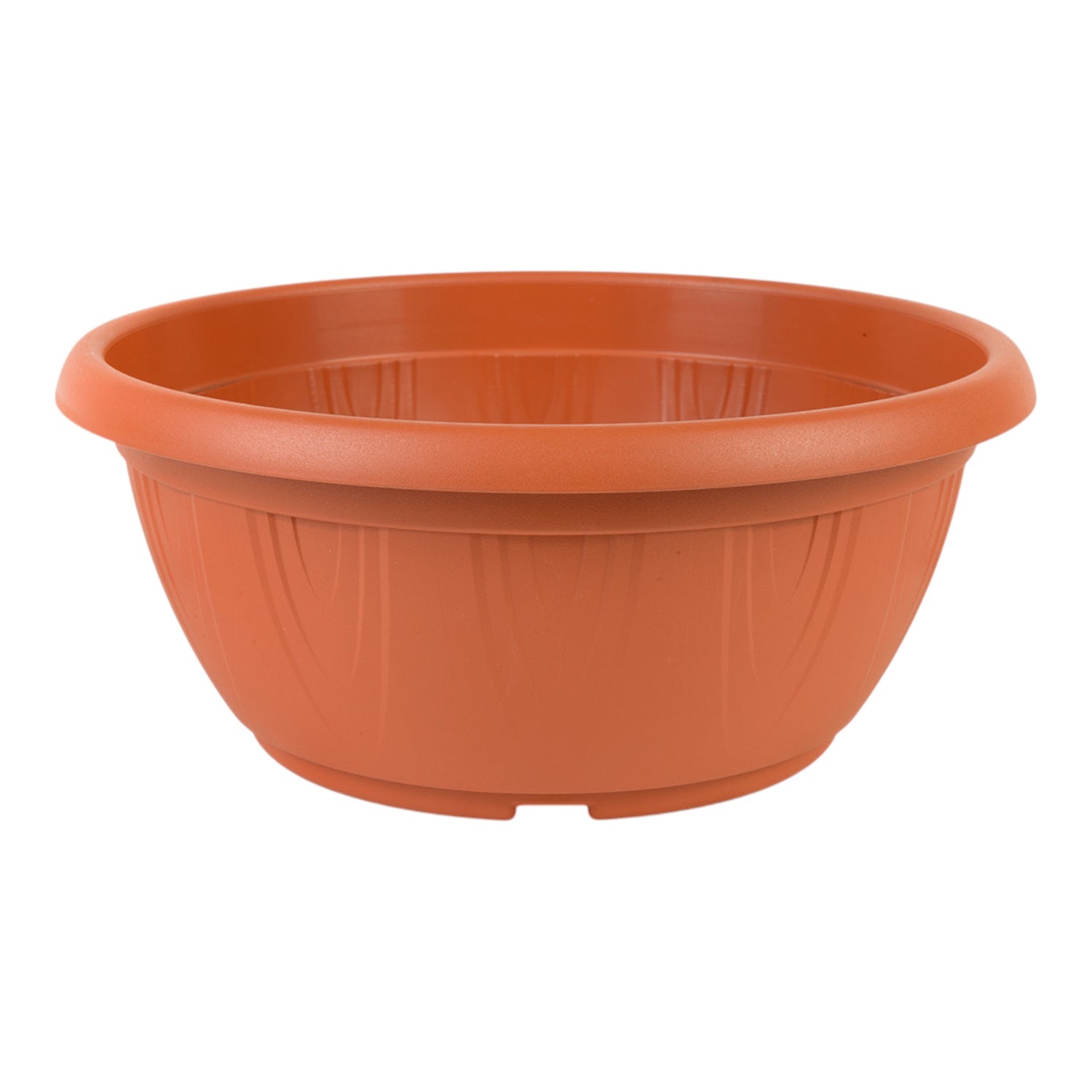

£0.80
Unit price per£0.80
Unit price perThe 3.9L Luna Bowl Terracotta Planter 27.1cm x 12cm is a decorative bowl planter for attractive container planting in gardens, patios, entrances and retail displays.
Its shape and decorative finish make it suitable for low-profile seasonal planting, mixed bedding displays and compact ornamental arrangements. It has a stated capacity of 3.9L, stated dimensions of 27.1cm x 12cm.
Sold individually. A full pallet contains 2000 planters for commercial volume orders.
Key benefits
Ideal for container planting
This planter can be used for low-profile seasonal planting, mixed bedding displays and compact ornamental arrangements. Choose plants whose mature size and root requirements suit the available container volume.
For mixed displays, combine plants with similar requirements for light, watering and feeding so that the planting remains easier to manage throughout the season.
Planting & care
Use a suitable container growing medium and avoid excessive compaction when filling. Check that water can drain appropriately for the plants being grown, and position the planter on a stable surface before filling.
Water according to the crop, weather and moisture level of the growing medium. Container-grown plants may also require supplementary feeding as nutrients in the substrate are used over time.
For garden centres, landscapers & larger planting schemes
The planter is sold individually, making it practical for both one-off displays and larger projects. For volume planning, a full pallet contains 2000 planters.
3.9L Luna Bowl Terracotta Planter 27.1cm x 12cm product details
| Brand | Growers Own |
|---|---|
| Product type | Decorative bowl planter |
| Selling quantity | 1 planter |
| Capacity | 3.9L |
| Stated dimensions | 27.1cm x 12cm |
| Pallet quantity | 2000 planters |
3.9L Luna Bowl Terracotta Planter 27.1cm x 12cm FAQs
Is this planter sold individually?
Yes. The price and ordering quantity are for one planter. What capacity is this planter?
The stated capacity is 3.9L. What size is the planter?
The stated dimensions are 27.1cm x 12cm. What can I plant in it?
It is suitable for low-profile seasonal planting, mixed bedding displays and compact ornamental arrangements, provided the chosen plants are appropriate for the available root volume. What compost should I use?
Use a container growing medium suited to the plants being grown. The required drainage, moisture retention and nutrient level will vary by plant type. Can I create a mixed planting display?
Yes. Choose plants with compatible light, watering and feeding requirements and allow enough space for their mature growth. How often should I water it?
Water according to plant demand and the moisture level of the growing medium rather than following a fixed timetable. Containers can dry more quickly in warm, bright or windy conditions. How many planters are on a full pallet?
A full pallet contains 2000 planters. Individual planters can still be ordered separately.
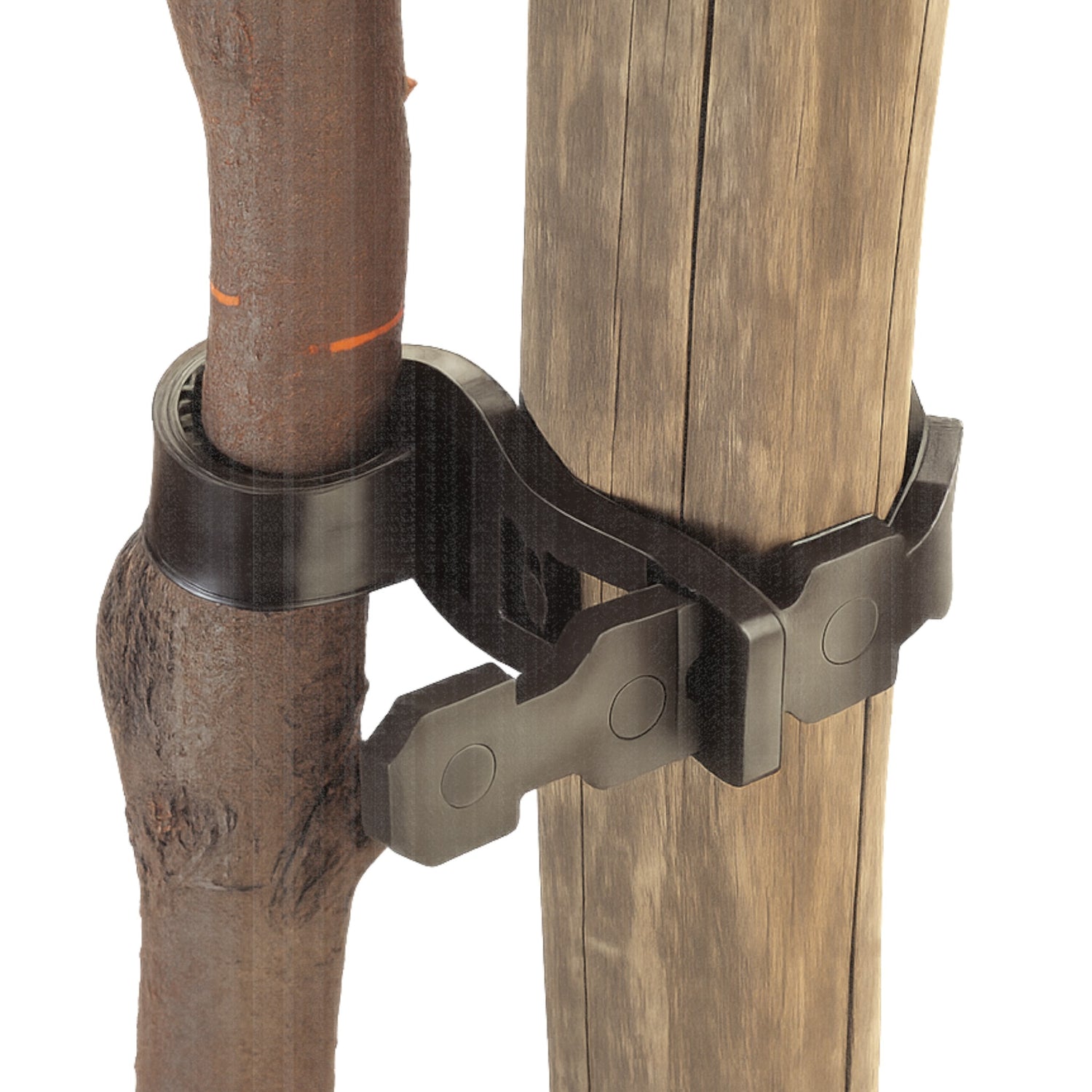
£32.44
Unit price per£32.44
Unit price perThe 30cm / 12" Super Soft Tree Tie BLACK (Box of 100) is a tree tie intended for supporting trees against suitable stakes while allowing appropriate movement.
Correct tree and shrub support helps newly planted or container-grown stock establish while reducing excessive movement at the root zone. Supports should hold the plant securely without creating unnecessary pressure on the stem or trunk.
Supplied as: box of 100.
Key benefits
Tree & shrub support
Use this product for supporting trees against suitable stakes while allowing appropriate movement. Select stakes, ties and support components according to the size of the plant, exposure of the site and the support system being used.
A correctly installed support should reduce damaging movement without holding the trunk completely rigid. Some natural movement helps the plant develop as it establishes.
Installation & ongoing checks
Position ties and support components so they do not rub, cut into or constrict the bark. Avoid over-tightening and inspect the installation regularly as the trunk or stems increase in diameter.
Adjust or remove supports once they are no longer required. Leaving a tie in place for too long can cause restriction or damage as the plant grows.
For nurseries, landscapers & tree planting
Tree-support products are useful for nursery stock, landscape planting, public-realm schemes and garden installations where newly planted trees or shrubs need temporary stabilisation.
30cm / 12" Super Soft Tree Tie BLACK (Box of 100) product details
| Product type | Tree tie |
|---|---|
| Primary use | supporting trees against suitable stakes while allowing appropriate movement |
| Stated size | 30cm / 12" |
| Colour | Black |
| Box quantity | 100 |
30cm / 12" Super Soft Tree Tie BLACK (Box of 100) FAQs
What size is this product?
The stated size is 30cm / 12". How many are supplied?
This product is supplied in a box of 100. How tight should a tree tie be?
It should support the plant without constricting the trunk or rubbing the bark. Leave appropriate room for movement and growth. How often should tree ties be checked?
Inspect supports regularly, particularly during active growth, and loosen or reposition them before they become restrictive. How long should a tree remain staked?
Only for as long as support is genuinely required. Establishment time varies with plant size, species, root system and site exposure. Can the same support be used for every tree?
No. Match the tie, stake and support arrangement to the trunk size, plant form and site conditions.
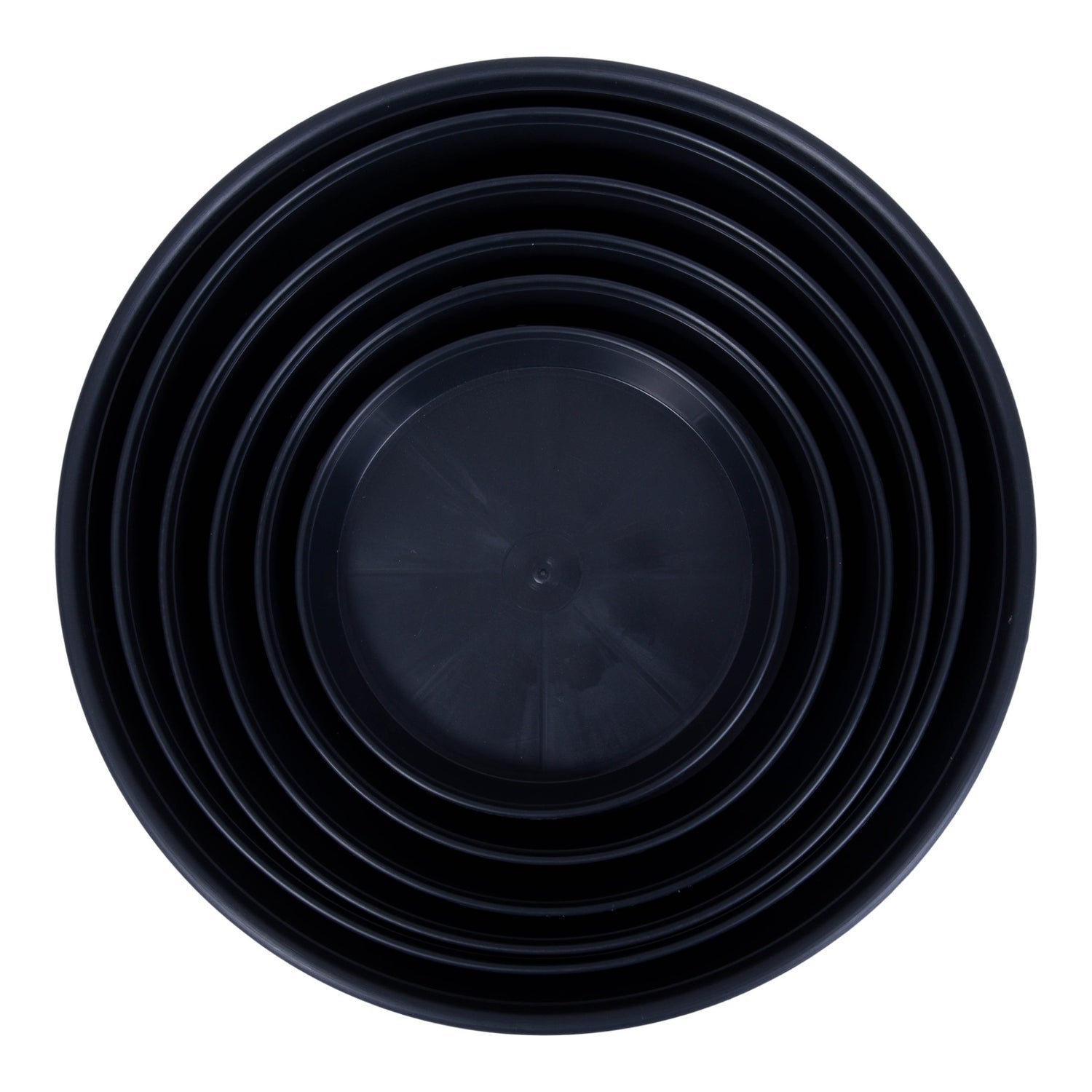
£0.50
Unit price per£0.50
Unit price perThe 30cm Round Plant Pot Saucer in Black is a practical plastic drip tray designed to collect excess water beneath plant pots and containers, helping keep greenhouse benches, floors, patios and display areas cleaner during watering.
With a nominal diameter of 30cm (12 inches), this is the smallest saucer in the round range and is ideal for appropriately sized smaller and medium plant pots where a compact water-catching tray is required.
The solid base catches water draining through the pot above rather than allowing it to spread across the surrounding surface. It can also collect small amounts of compost and other material carried through the pot's drainage holes during watering.
Manufactured from durable black plastic, the saucer is lightweight, reusable and discreet beneath conventional nursery pots and decorative planters.
The complete range is available in 30cm, 35cm, 40cm, 45cm and 50cm nominal diameters, allowing the most appropriate size to be selected for the container being used.
Why choose the 30cm Round Plant Pot Saucer?
Ideal for plant pots & growing containers
Good drainage is important for many container-grown plants, allowing surplus water to leave the growing medium after irrigation. A plant saucer provides a simple way to manage the resulting runoff.
The 30cm size is particularly useful where a compact saucer is needed beneath an appropriately sized container.
Typical applications include:
Measure the actual base of the container before selecting a saucer. The usable internal diameter will be smaller than the nominal 30cm overall measurement.
Catch excess water & protect surfaces
Water draining from plant pots can leave puddles, compost particles and fertiliser residue on greenhouse benches, patios, floors and other surfaces.
Positioning the 30cm saucer beneath a suitable container provides a dedicated collection area for this runoff, helping keep the immediate growing area cleaner.
Once the plant has finished draining, unwanted standing water can be emptied from the saucer as required.
Top watering & bottom watering
When plants are watered from above, excess moisture can drain naturally through the container and collect in the saucer below.
Where suitable for the crop and growing medium, the saucer can also be used for bottom watering. Water placed directly into the saucer can be absorbed through drainage openings in the base of the pot.
Avoid leaving plants permanently standing in water unless this is appropriate for the species and growing method. Many plants require good aeration around the root zone as well as adequate moisture.
Useful for indoor plants & houseplants
A compact 30cm saucer can be particularly useful beneath indoor plant pots where irrigation water needs to be contained rather than allowed to reach surrounding surfaces.
The black finish provides a simple, neutral appearance beneath many common plant containers.
When using the saucer on furniture, timber floors or other moisture-sensitive surfaces, check regularly for condensation or trapped moisture beneath the tray and use additional surface protection where appropriate.
Practical for nurseries & garden centres
The saucer is equally useful in professional horticultural environments where individual pots require localised water collection.
Growers can use saucers beneath selected plants on greenhouse staging or benches, while garden centres can use them to help control runoff beneath suitable retail display plants.
Their simple reusable construction also makes the saucers easy to reposition as crops and displays change.
Available in five round sizes
| 30cm (12 inches) | This size, suitable for appropriately sized smaller and medium plant pots. |
|---|---|
| 35cm (14 inches) | For appropriately sized medium nursery pots and planters. |
| 40cm (16 inches) | For medium-to-large plant pots and containers. |
| 45cm (18 inches) | For appropriately sized larger pots and planters. |
| 50cm (20 inches) | The largest size in the range for suitably sized large containers. |
How to choose the correct saucer size
Measure the diameter of the plant pot at its base, rather than simply using the advertised diameter across the top of the pot. Many nursery and decorative pots taper towards their base.
The pot base should sit comfortably within the usable internal area of the saucer, ideally leaving some surrounding space to collect water.
A plant pot described as 30cm in diameter will not necessarily fit inside this saucer because the saucer's usable internal diameter is smaller than its nominal overall measurement.
Cleaning & maintenance
Empty unwanted standing water regularly and remove compost, leaves and other debris that accumulates during use.
Periodic cleaning helps prevent the build-up of growing media and fertiliser deposits. In professional growing environments, follow normal nursery hygiene procedures when moving reusable equipment between crops.
When used outdoors, check the saucer after periods of prolonged rainfall and remove excess water where necessary.
30cm Round Plant Pot Saucer product details
| Product type | Round plant pot saucer / drip tray |
|---|---|
| Nominal diameter | 30cm |
| Imperial size | 12 inches (nominal) |
| Shape | Round |
| Material | Plastic |
| Colour | Black |
| Base | Solid, designed to collect excess water |
| Primary application | Collecting irrigation runoff beneath plant pots and containers |
| Suitable environments | Gardens, greenhouses, nurseries, garden centres and indoor growing areas |
| Other available sizes | 35cm, 40cm, 45cm and 50cm |
| Suitable users | Commercial growers, nurseries, garden centres, landscapers and gardeners |
30cm Round Plant Pot Saucer FAQs
What size is this plant pot saucer?
This saucer has a nominal diameter of 30cm (12 inches). Will a 30cm plant pot fit inside this saucer?
Not necessarily. The usable internal diameter is smaller than the nominal 30cm overall measurement. Measure the actual base of the plant pot before ordering. What is the saucer designed to do?
It sits beneath a plant pot to collect excess irrigation water and help contain runoff around the container. Can the 30cm saucer be used indoors?
Yes. It can help contain water beneath suitable houseplants and indoor growing containers. Take additional precautions on moisture-sensitive surfaces. Can it be used outdoors?
Yes. The saucer can be used beneath suitable outdoor pots and planters. Check it after heavy or prolonged rainfall and remove unwanted standing water. Can I bottom-water plants with this saucer?
Yes, where appropriate for the crop. Water placed in the saucer can be absorbed into the growing medium through drainage holes in the base of the pot. Should excess water be emptied?
For plants requiring free-draining conditions, unwanted standing water should normally be removed once the plant has drained or absorbed the required moisture. What other sizes are available?
The round saucer range includes 30cm, 35cm, 40cm, 45cm and 50cm nominal sizes. How should I measure my plant pot?
Measure across the base of the pot at its widest point and select a saucer with sufficient internal space for the pot plus room to collect drainage water. Can the saucer be reused?
Yes. The plastic saucer can be emptied, cleaned and reused as required.


£7.85
Unit price per£7.85
Unit price perThis 30L Black Plastic Bucket with Lid & Handle is a large-capacity reusable storage container suitable for horticultural, nursery, garden, warehouse, workshop and general-purpose applications. Supplied complete with a fitted lid and carrying handle, it provides a practical solution for storing, organising and transporting suitable materials.
With a generous 30 litre capacity, this bucket is particularly useful where larger quantities of growing media components, fertilisers, soil amendments, horticultural supplies or other materials need to be kept together and protected during storage.
The removable lid helps keep contents contained and reduces exposure to dust and debris, while the carrying handle makes the bucket easier to move around the workplace when required.
Why choose this 30L bucket with lid?
Large-capacity horticultural & general storage
The 30L capacity makes this bucket particularly useful in professional growing and nursery environments where materials are often purchased, mixed or handled in larger quantities.
Potential applications include:
Always ensure the bucket is appropriate for the material being stored. Food-contact suitability, chemical resistance and hazardous-material certification should not be assumed unless separately confirmed for the intended application.
Supplied with a fitted lid
The included lid makes the 30L bucket particularly useful for materials that need to remain contained between uses. Covering the contents helps reduce contamination from dust, dirt and general workplace debris.
This can be useful when storing dry horticultural materials such as fertilisers and substrate components, although products that are sensitive to moisture should always be stored according to their own manufacturer's instructions.
Useful around the nursery, garden & warehouse
A reusable lidded bucket is one of those simple pieces of equipment that can serve numerous purposes around a professional horticultural business.
The larger 30L capacity is useful for organising bulkier items, separating different materials or keeping frequently used products together. When appropriate, the bucket can be emptied, cleaned and returned to service for another suitable application.
Its versatility also makes it useful outside horticulture, including workshops, warehouses, maintenance departments and general storage areas.
30L Black Bucket product details
| Product type | Reusable plastic bucket with lid |
|---|---|
| Capacity | 30 litres |
| Colour | Black |
| Lid included | Yes |
| Handle | Yes |
| Reusable | Yes |
| Primary use | Storage, organisation and transport of suitable materials |
| Suitable environments | Nurseries, growing areas, gardens, warehouses, workshops and general storage areas |
30L Bucket with Lid FAQs
What capacity is this bucket?
The bucket has a nominal capacity of 30 litres, making it suitable for larger-volume storage applications. Does the 30L bucket come with a lid?
Yes. The bucket is supplied complete with a fitted lid to help keep suitable contents contained during storage. Does the bucket have a carrying handle?
Yes. It includes a carrying handle to assist with moving the bucket. Always consider the total weight of the contents before lifting or carrying a filled 30L container. Can I store fertiliser in the bucket?
It can be useful for storing suitable dry fertiliser products, provided the fertiliser is compatible with the container and its own storage instructions are followed. Can it be used for growing media and soil amendments?
Yes. The large capacity makes it useful for suitable dry growing media components, amendments and other horticultural materials. Can the 30L bucket be reused?
Yes. The bucket can be cleaned and reused where appropriate, provided its previous contents and intended new use make reuse suitable. Is the lid leak-proof?
A leak-proof specification is not stated, so the bucket should not be assumed to provide leak-proof transport of liquids. Is this 30L bucket food safe?
No food-contact certification is specified for this product, so food-grade suitability should not be assumed. Can the bucket be used for chemicals?
This depends on the substance being stored. Always confirm material compatibility and the storage requirements of the specific chemical before use.
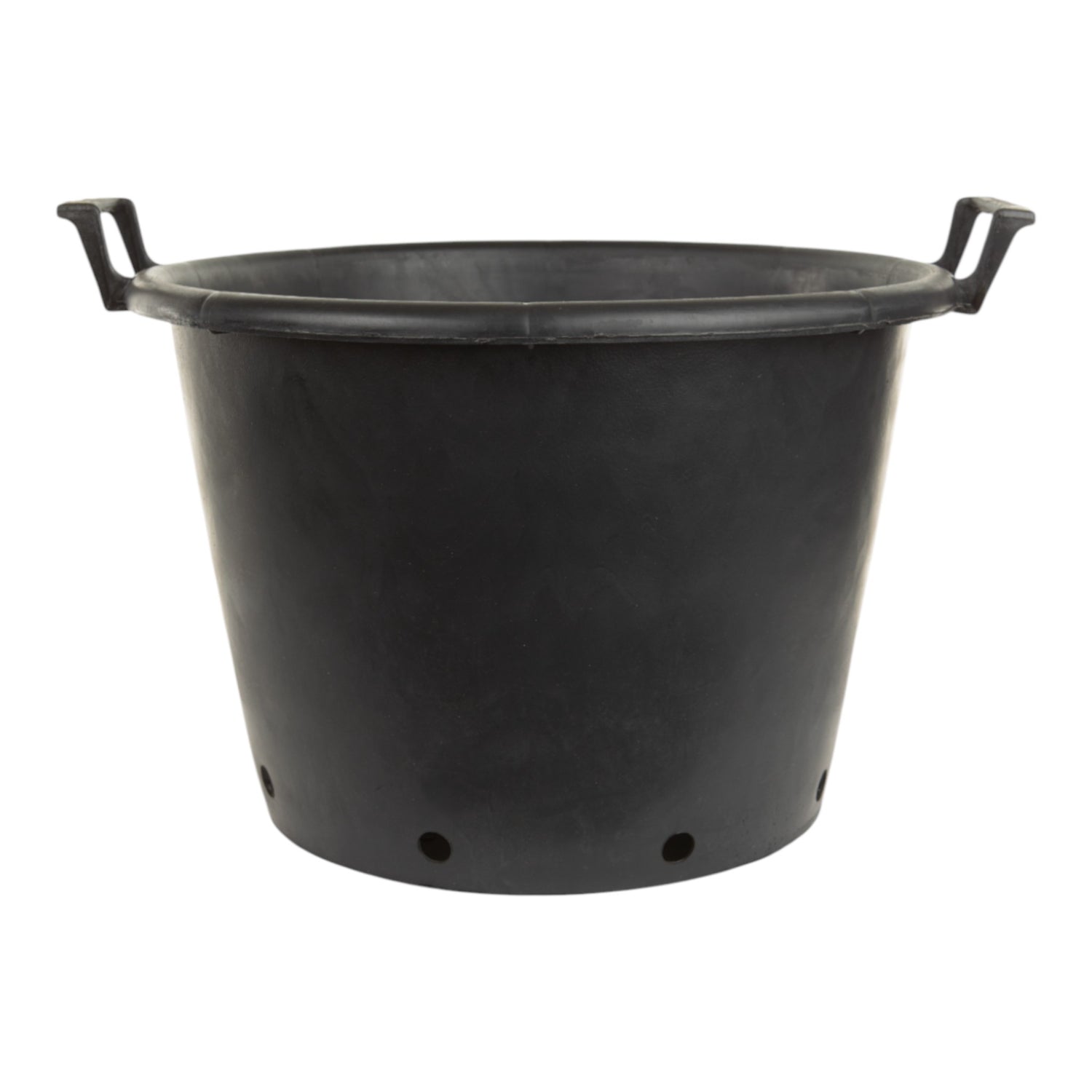
£2.25
Unit price per£2.25
Unit price perThe 30L Heavy Duty Round Plastic Pot (with handles) is a professional growing container designed for larger nursery stock, shrubs and specimen container production.
The 30L format provides substantial root volume for crops that need more space than standard nursery pots, while the container style is intended for repeated handling through production, spacing, irrigation and dispatch.
Sold individually.
Key benefits
Tree & shrub container production
The 30L format is suited to larger woody nursery stock where adequate root volume and practical container handling are important. Select container size according to crop vigour, root development, production period and final sale specification.
Where handles are incorporated into the pot design, they can assist positioning and handling, but a filled 30L container may still require appropriate manual-handling controls or mechanical assistance.
Choosing the growing medium
Use a professional growing medium appropriate to the crop, container size and irrigation system. Larger pots need a substrate with enough structure to maintain air-filled porosity and drainage throughout the production period while retaining sufficient available moisture.
Avoid excessive compaction during filling. Settle the medium consistently and leave suitable watering space at the top of the container.
Irrigation & root-zone management
Container size has a major effect on drying behaviour. Check moisture through the root zone rather than judging only the surface, and adjust irrigation frequency and volume as crop size, weather and rooting increase.
Ensure drainage points remain clear and avoid leaving containers standing in prolonged saturation unless the crop and production system are specifically designed for it.
Handling, spacing & stability
Position larger pots on a stable, well-drained growing surface and allow sufficient spacing for crop development and access. Consider wind exposure as top-heavy trees and shrubs develop.
Filled containers can be substantially heavier than their nominal litre capacity suggests. Use appropriate lifting and handling methods, particularly with the larger sizes in this range.
Reuse & crop hygiene
Where pots remain serviceable, they may be reused subject to the nursery's crop-hygiene requirements. Remove old substrate and plant material, inspect the container for damage and clean or disinfect as appropriate before the next crop cycle.
30L Heavy Duty Round Plastic Pot (with handles) product details
| Product type | Heavy-Duty Round Nursery Pot with Handles |
|---|---|
| Nominal capacity | 30L |
| Selling quantity | 1 pot |
| Primary application | larger nursery stock, shrubs and specimen container production |
| Handles | Yes |
30L Heavy Duty Round Plastic Pot (with handles) FAQs
Is this nursery pot sold individually?
Yes. The selling unit is one pot. What capacity is this pot?
The stated nominal capacity is 30L. What is this pot suitable for?
It is intended for larger nursery stock, shrubs and specimen container production. What growing medium should I use?
Use a professional substrate appropriate to the crop, container size and irrigation system, with suitable structure, drainage, aeration and moisture retention. How should larger pots be watered?
Check moisture through the root zone and adjust irrigation to crop size, rooting, weather and substrate behaviour rather than relying on a fixed timetable. Can the pot be reused?
Yes where it remains serviceable and nursery hygiene requirements are met. Remove old substrate and clean appropriately before reuse. What should I consider when moving a filled pot?
A filled and watered container can be very heavy. Use appropriate manual-handling methods or mechanical assistance where required. How do I choose between pot sizes?
Match container volume to crop vigour, root development, production period and intended finished-plant size. Do the handles mean the pot can always be lifted by one person?
No. Handles can assist positioning, but the filled weight may still require team handling or mechanical assistance.
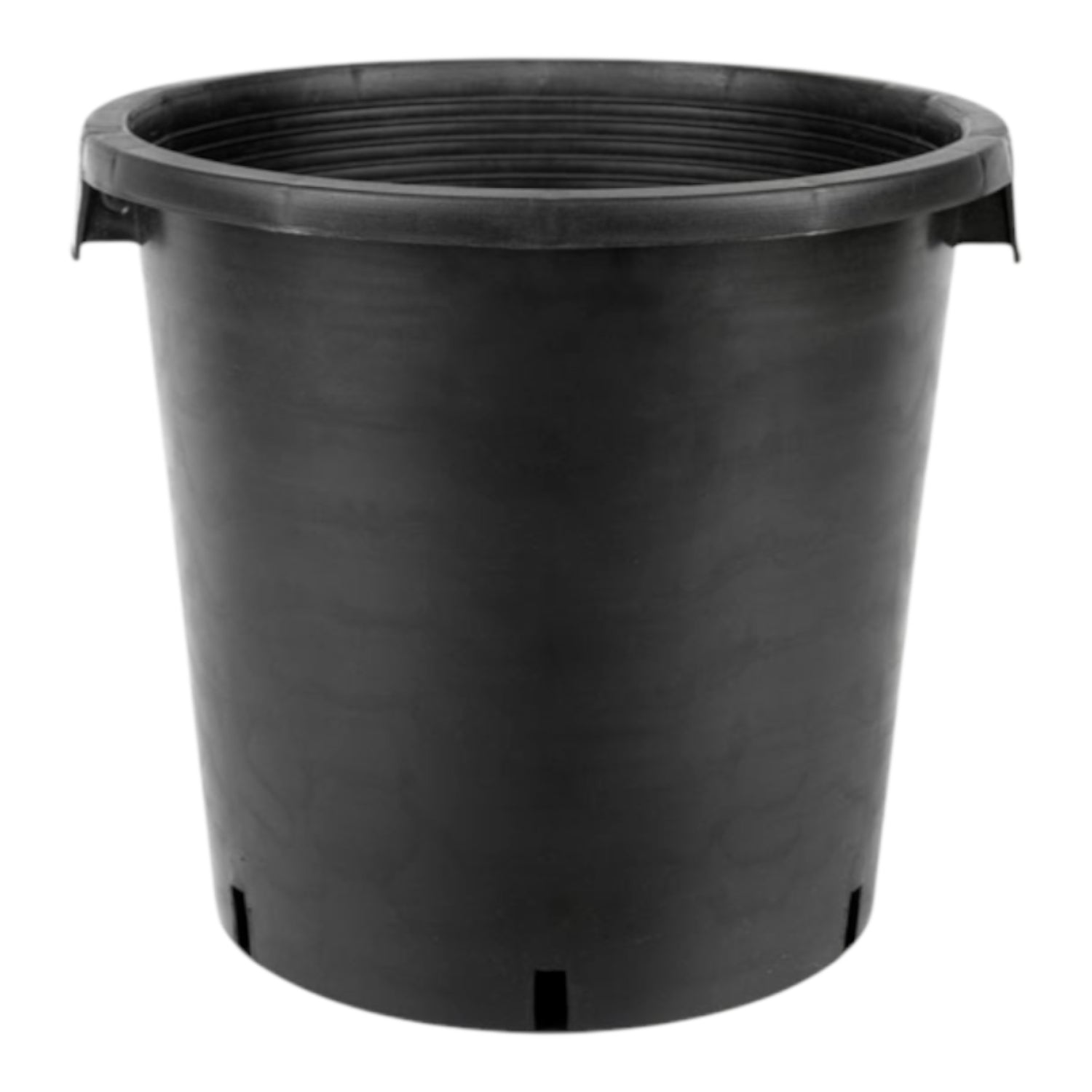
The 30L Reinforced Nursery Pot is a professional growing container designed for professional nursery production where a more substantial container format is required.
The 30L format provides substantial root volume for crops that need more space than standard nursery pots, while the container style is intended for repeated handling through production, spacing, irrigation and dispatch.
Sold individually. A full commercial pallet contains 400 pots.
Key benefits
Professional nursery production
The reinforced 30L format is intended for nursery crops that need a robust production container through repeated irrigation, spacing, handling and dispatch operations.
Choose the pot size to provide sufficient root volume without moving crops into an unnecessarily large substrate mass too early in production.
Choosing the growing medium
Use a professional growing medium appropriate to the crop, container size and irrigation system. Larger pots need a substrate with enough structure to maintain air-filled porosity and drainage throughout the production period while retaining sufficient available moisture.
Avoid excessive compaction during filling. Settle the medium consistently and leave suitable watering space at the top of the container.
Irrigation & root-zone management
Container size has a major effect on drying behaviour. Check moisture through the root zone rather than judging only the surface, and adjust irrigation frequency and volume as crop size, weather and rooting increase.
Ensure drainage points remain clear and avoid leaving containers standing in prolonged saturation unless the crop and production system are specifically designed for it.
Handling, spacing & stability
Position larger pots on a stable, well-drained growing surface and allow sufficient spacing for crop development and access. Consider wind exposure as top-heavy trees and shrubs develop.
Filled containers can be substantially heavier than their nominal litre capacity suggests. Use appropriate lifting and handling methods, particularly with the larger sizes in this range.
Reuse & crop hygiene
Where pots remain serviceable, they may be reused subject to the nursery's crop-hygiene requirements. Remove old substrate and plant material, inspect the container for damage and clean or disinfect as appropriate before the next crop cycle.
30L Reinforced Nursery Pot product details
| Product type | Reinforced Nursery Pot |
|---|---|
| Nominal capacity | 30L |
| Selling quantity | 1 pot |
| Primary application | professional nursery production where a more substantial container format is required |
| Commercial pallet quantity | 400 pots |
30L Reinforced Nursery Pot FAQs
Is this nursery pot sold individually?
Yes. The selling unit is one pot. What capacity is this pot?
The stated nominal capacity is 30L. What is this pot suitable for?
It is intended for professional nursery production where a more substantial container format is required. What growing medium should I use?
Use a professional substrate appropriate to the crop, container size and irrigation system, with suitable structure, drainage, aeration and moisture retention. How should larger pots be watered?
Check moisture through the root zone and adjust irrigation to crop size, rooting, weather and substrate behaviour rather than relying on a fixed timetable. Can the pot be reused?
Yes where it remains serviceable and nursery hygiene requirements are met. Remove old substrate and clean appropriately before reuse. What should I consider when moving a filled pot?
A filled and watered container can be very heavy. Use appropriate manual-handling methods or mechanical assistance where required. How do I choose between pot sizes?
Match container volume to crop vigour, root development, production period and intended finished-plant size. How many pots are on a full pallet?
A full commercial pallet contains 400 pots. The product itself is sold individually.

£2.65
Unit price per£2.65
Unit price perThe 30L Round Plant Pot is a large, robust black horticultural container providing generous root volume for established plants, shrubs, vegetables and longer-term container crops. Measuring approximately 42cm across the upper rim, 32.5cm across the base and 30cm high, it combines substantial growing capacity with a stable, practical round design.
The 30 litre capacity provides a significant step up from standard nursery pots, giving established plants more room for root development and a larger reserve of growing medium, moisture and nutrients.
Its traditional tapered round profile makes it suitable for professional nurseries, greenhouses, polytunnels and home horticulture. The wide upper opening provides excellent access for watering, feeding, mulching and dry top dressing, while the broad base helps support larger plants.
Pre-formed drainage openings allow excess irrigation water to escape from the bottom of the container, helping maintain the balance of moisture and air required for healthy root development.
Suitable for soil, peat-based and peat-free compost, coco coir, living soil and other horticultural growing media, this is a versatile large-format grow pot for indoor and outdoor cultivation.
Why choose the 30L Round Plant Pot?
Generous 30 litre root volume
Larger plants need sufficient growing-medium volume to support their developing root systems. A 30L pot provides considerably more root space than smaller nursery and intermediate containers.
This additional volume gives roots more growing medium to explore while also increasing the amount of water and nutrition that can be held within the container.
The result is a useful potting-on or finishing size for many vigorous plants, particularly where crops will remain in the same container for an extended period.
A larger container does not automatically mean more frequent watering. Newly transplanted plants may initially use only a small proportion of the available moisture, so irrigation should always reflect actual root development and crop demand.
30L Round Pot dimensions
The pot measures approximately 42cm across the upper rim, 32.5cm across the base and 30cm high.
The 42cm upper diameter creates a broad surface that is easy to irrigate evenly and provides plenty of room for surface amendments such as compost, worm castings, mulch and granular or powdered fertilisers.
Its 32.5cm base provides a stable footprint while retaining the tapered profile needed for efficient handling and nesting when pots are empty.
Suitable for living soil growing
The 30L capacity makes this pot particularly useful for growers wanting more biologically active soil volume than is available in conventional small containers.
Larger soil volumes provide more physical space for roots and soil biology while creating a greater reserve of moisture, organic matter and plant-available nutrition.
The wide 42cm surface also provides good access for adding compost, worm castings, mulch and dry amendments throughout the growing cycle.
Whether 30L is suitable as a final living soil container depends on the crop, expected plant size and growing method. Larger or particularly demanding plants may benefit from still greater soil volumes.
Suitable growing media
The 30L Round Pot can be used with a broad range of horticultural substrates, including:
Irrigation and nutrition should always be matched to the chosen substrate. A moisture-retentive compost will require a different watering strategy from a highly aerated coco or coco-perlite mix.
What can you grow in a 30L pot?
A 30 litre container provides sufficient root volume for a broad range of established plants and productive crops. Typical applications include:
The correct final container size will depend on plant species, crop duration, expected mature size and cultivation method.
Drainage & irrigation
Drainage openings in the base allow excess irrigation water and nutrient solution to escape rather than remaining trapped around the lower root zone.
Good drainage is particularly important in large containers because an excessive volume of saturated growing medium can remain wet for considerably longer than a small pot.
After potting-on, irrigation should initially be matched to the size of the existing root ball. As roots establish throughout the 30L volume, the wetted area and irrigation volume can be increased accordingly.
The pot can be used with hand watering, drip irrigation and other suitable automated irrigation systems.
Fits the 40cm Pot Saucer
The 30L Round Pot is compatible with the 40cm Pot Saucer, product code P00082.
The matching saucer measures approximately 41cm across the rim, 37.5cm across the base and 6cm high.
A saucer is useful where irrigation runoff needs to be collected, particularly in indoor growing areas, greenhouses and on protected surfaces.
When used outdoors or in a free-draining commercial production area, a saucer may not be required.
Robust & reusable
The practical horticultural construction allows sound pots to be reused over multiple growing cycles.
After use, remove old substrate and root material before cleaning the container. Where pots are being moved between crops, suitable hygiene procedures should be followed to reduce the risk of transferring pests or plant pathogens.
The tapered round profile also allows empty pots to nest inside one another for more efficient storage and transport.
30L Round Plant Pot product details
| Product | Round Plant Pot |
|---|---|
| Nominal capacity | 30L |
| Shape | Round |
| Colour | Black |
| Upper rim diameter | Approximately 42cm |
| Base diameter | Approximately 32.5cm |
| Height | Approximately 30cm |
| Drainage | Pre-formed base drainage openings |
| Suitable media | Soil, compost, peat-free media, living soil, coco & compatible soilless substrates |
| Suitable environments | Nurseries, greenhouses, polytunnels, indoor growing & outdoor cultivation |
| Typical applications | Shrubs, vegetables, ornamentals, nursery stock & established container plants |
| Compatible saucer | 40cm Pot Saucer - product code P00082 |
| Compatible saucer dimensions | Rim 41cm x base 37.5cm x height 6cm |
| Reusable | Yes, when cleaned and maintained appropriately |
30L Round Plant Pot FAQs
What are the dimensions of the 30L Round Pot?
The pot measures approximately 42cm across the upper rim, 32.5cm across the base and 30cm high.
What can I grow in a 30L plant pot?
A 30L pot is suitable for many established plants including shrubs, large perennials, tomatoes, peppers, chillies, aubergines, climbing plants and suitable nursery stock.
Is a 30L pot large enough for tomatoes?
Yes. A 30L container provides generous root and growing-medium volume for tomato plants when irrigation and nutrition are managed appropriately.
Is the 30L Round Pot suitable for living soil?
Yes. The 30L capacity provides useful soil volume for living soil growing, while the wide surface makes applying mulch, compost and dry amendments straightforward.
Can this pot be used with coco coir?
Yes. The pot can be filled with coco coir or coco-based blends. Irrigation should be adjusted to the crop and drainage characteristics of the substrate.
Does the 30L pot have drainage holes?
Yes. Drainage openings in the base allow excess irrigation water to escape from the growing medium.
Which saucer fits the 30L Round Pot?
The compatible saucer is the 40cm Pot Saucer, product code P00082. It measures approximately 41cm across the rim, 37.5cm across the base and 6cm high.
Do I need a saucer underneath the pot?
A saucer is useful where irrigation runoff needs to be contained, particularly indoors or on protected surfaces. It is not essential where drainage water can safely escape.
Can I use peat-free compost in this pot?
Yes. The pot is suitable for peat-free compost as well as peat-based media, soil mixes, living soil, coco and other appropriate horticultural substrates.
Can the 30L pot be used outdoors?
Yes. It is suitable for outdoor gardens, patios and nursery production as well as greenhouses, polytunnels and indoor growing.
Can I use drip irrigation with a 30L pot?
Yes. The pot can be used with drip irrigation and other suitable automated watering systems. Irrigation frequency and emitter arrangement should be matched to the plant and growing medium.
How should I water immediately after potting into 30L?
Irrigate according to the size of the existing root system rather than automatically saturating the entire container repeatedly. As roots colonise more of the substrate, irrigation volume and coverage can be increased.
Can the 30L Round Pot be reused?
Yes. Pots that remain in good condition can be emptied, cleaned and reused. Good crop hygiene is recommended between uses.
What is the difference between the 30L and 32L Round Pots?
Both have an approximately 42cm upper rim and 30cm height. The 30L pot has an approximately 32.5cm base, while the 32L version has an approximately 35cm base, giving the 32L pot slightly greater growing-medium capacity and a broader lower profile.

£3.35
Unit price per£3.35
Unit price perThe 315mm (12.5") Fast Clamp provides a strong, secure and vibration-reducing connection between compatible circular ventilation components such as inline fans, filters and rigid duct fittings.
Rather than joining two pieces of ventilation equipment with a short section of flexible ducting, a Fast Clamp fits around the adjoining circular spigots to create a neat mechanical connection. This makes it particularly useful when installing fans directly alongside filters, silencers and other compatible ventilation equipment.
The galvanised steel outer band provides a strong connection, while the cushioned inner lining helps isolate vibration between connected components. Reducing the direct transfer of fan vibration into adjoining ductwork can help reduce structure-borne noise within a ventilation system.
The clamp can also be released when equipment needs to be removed, making it a practical choice for installations where fans or other components may require periodic inspection, cleaning or servicing.
Why use a 315mm Fast Clamp?
Connecting fans, filters and ventilation equipment
Fast Clamps are particularly useful where two compatible pieces of circular ventilation equipment need to be connected directly together. Typical examples include joining an inline extraction fan to a filter or connecting a fan to compatible rigid circular ductwork.
The cushioned lining sits between the metal clamp and the connected components, helping provide a secure fit while reducing the direct transmission of vibration from operating equipment into the rest of the ventilation system.
This makes Fast Clamps useful in propagation facilities, nurseries, growing areas, controlled environments and general ventilation installations where both secure connections and vibration management are important.
How to install a 315mm Fast Clamp
Position the two compatible 315mm circular components together so that their connection points are correctly aligned. Open or loosen the Fast Clamp sufficiently to position it evenly around the joint.
Make sure the cushioned inner lining sits correctly around the connection before tightening the clamp. Tighten the fixings evenly until the components are held securely in position.
Avoid excessive tightening beyond what is required to produce a secure connection. Fans, filters and other heavy ventilation equipment should always be independently supported rather than relying on the Fast Clamp to carry their weight.
315mm (12.5") Fast Clamp product details
| Product type | Anti-vibration ventilation Fast Clamp |
|---|---|
| Nominal connection size | 315mm / 12.5" |
| Outer construction | Galvanised steel |
| Inner construction | Cushioned anti-vibration lining |
| Primary purpose | Connecting compatible circular ventilation components |
| Vibration control | Inner lining helps reduce vibration transfer between connected components |
| Typical connections | Fans, filters, rigid circular ductwork & compatible ventilation fittings |
| Maintenance | Removable connection allows compatible equipment to be disconnected for servicing or cleaning |
| Suitable applications | Controlled environment, propagation, nursery, growing area & general ventilation systems |
315mm (12.5") Fast Clamp FAQs
What is a ventilation Fast Clamp?
A Fast Clamp is a metal connector designed to securely join compatible circular ventilation components while its cushioned inner lining helps isolate vibration between them. What size is this Fast Clamp?
This model is designed for compatible ventilation components with a nominal 315mm / 12.5" circular connection. Can I use it to connect a fan to a filter?
Yes. Connecting compatible fans and filters is one of the common applications for this type of Fast Clamp. Can it connect a fan directly to rigid ducting?
Yes, provided the components have compatible nominal 315mm circular connections suitable for this type of clamp. Does a Fast Clamp reduce vibration?
Yes. The cushioned inner lining helps isolate vibration rather than allowing it to transfer directly from an operating fan into adjoining ductwork or equipment. Can reducing vibration make a ventilation system quieter?
It can help. Mechanical vibration transferred from a fan into ductwork can contribute to system noise, so isolating the connection can reduce this source of transmitted noise. Is the clamp made from metal?
Yes. The outer clamp is manufactured from galvanised steel and incorporates a cushioned inner lining. Can I remove the clamp again?
Yes. Fast Clamps are designed to provide a removable mechanical connection, making them useful where equipment may need to be disconnected for inspection, cleaning or servicing. Is a Fast Clamp better than joining equipment with ducting?
Where two compatible rigid circular components are positioned directly together, a Fast Clamp can provide a neater and more compact connection than using a short section of flexible ducting between them. Can I use this with 315mm ducting?
It is designed for compatible nominal 315mm circular ventilation connections. Always check the actual connection arrangement of the equipment being joined before installation. Does the Fast Clamp support the weight of a fan or filter?
No. Fans, filters and other substantial ventilation equipment should be properly and independently supported. The clamp is intended to secure the connection rather than act as the equipment's primary support. Where can 315mm Fast Clamps be used?
They are suitable for compatible circular ventilation systems in controlled environments, propagation facilities, nurseries, growing areas and other commercial or general ventilation applications.

£0.99
Unit price per£0.99
Unit price per315mm (12.5") Quick Release Ducting Clip provides a strong, secure and removable connection for compatible 315mm round ventilation ducting, fans, filters and fittings.
A secure duct connection is important for maintaining an efficient ventilation system. Loose connections can allow ducting to move and create unwanted air leakage. This adjustable metal clip fits around the outside of the duct and tightens securely around the connection point.
The quick-release design is particularly useful where ventilation equipment may need to be disconnected for cleaning, maintenance or replacement. The clip can be released and refitted, providing a practical alternative to relying solely on tape for mechanical fixing.
Sized for 315mm / 12.5" ventilation systems, it is suitable for connecting compatible flexible ducting and acoustic ducting to fans, carbon filters, rigid fittings and other round ventilation components.
Why choose a quick release ducting clip?
Secure 315mm ventilation connections
Quick release ducting clips are designed to create a reliable mechanical connection between flexible ducting and round ventilation equipment.
They are particularly useful in indoor horticultural ventilation systems where fans, filters and ductwork may need periodic inspection, cleaning or replacement.
The 315mm size is suited to larger ventilation installations where high-capacity fans and filters require substantial duct connections. The clip can be used around compatible standard flexible ducting or the flexible inner section of acoustic ducting.
How to fit a 315mm quick release ducting clip
Position the ducting over the compatible 315mm connection and place the clip around the outside of the duct. Make sure sufficient ducting overlaps the connection before tightening the clip.
Tighten the band until the duct is held securely. The connection should be firm without unnecessarily crushing or damaging the ducting.
Where a particularly airtight connection is required, suitable HVAC foil tape can also be used in conjunction with the mechanical fixing.
When equipment needs to be removed for cleaning or maintenance, release the clip, disconnect the duct and refit the clip when the system is reassembled.
What can a 315mm ducting clip be used with?
Always check the actual outside diameter of the connection and the required clamping range before installation, particularly when combining components from different manufacturers.
315mm (12.5") Quick Release Ducting Clip product details
| Product type | Quick release ventilation ducting clip |
|---|---|
| Nominal size | 315mm / 12.5" |
| Construction | Metal band clamp |
| Fastening type | Adjustable quick-release fastening |
| Primary purpose | Securing ducting to compatible round ventilation connections |
| Suitable ducting | Compatible flexible & acoustic ventilation ducting |
| Suitable equipment | Fans, carbon filters, connectors & compatible round ventilation fittings |
| Outer case quantity | 100 clips |
315mm (12.5") Quick Release Ducting Clip FAQs
What is a quick release ducting clip?
It is an adjustable metal band clamp used to secure flexible ducting around a compatible round ventilation connection. What size ventilation system is this clip for?
This version is intended for compatible nominal 315mm / 12.5" ventilation connections. Can I use this with flexible ducting?
Yes. It is designed for securing compatible flexible ventilation ducting to round fans, filters, connectors and fittings. Can it be used with acoustic ducting?
Yes. It can be used to secure the flexible duct section of compatible 315mm acoustic ducting to an appropriately sized connection. Can I use it to connect ducting to an extraction fan?
Yes, provided the fan connection and ducting are compatible with the clip's 315mm nominal size. Can it secure ducting to a carbon filter?
Yes. It is suitable for compatible 315mm carbon filter connections. Why use a ducting clip instead of tape?
A ducting clip provides a mechanical fixing around the connection and can be released when equipment needs servicing. Foil tape can still be added where additional air sealing is required. Is the ducting clip reusable?
Yes. The quick-release fastening allows the clip to be opened and refitted when ventilation components need to be disconnected. How tight should the clip be?
It should be tightened sufficiently to hold the duct securely without unnecessarily crushing or damaging the ducting or connection. Does a ducting clip help prevent air leaks?
A secure mechanical connection helps keep ducting firmly seated on the fitting. Where additional sealing is required, suitable HVAC foil tape can be used alongside the clip. Can it be used on intake and extraction systems?
Yes. The clip can be used on compatible duct connections in both intake and extraction ventilation systems. Is this suitable for horticultural ventilation systems?
Yes. It is suitable for compatible ventilation installations used in propagation areas, indoor growing areas and other controlled horticultural environments. Can it connect two pieces of ducting directly together?
A suitable duct connector or coupler is normally placed between the two duct sections, with a separate clip securing the duct at each end. Should I check the connection diameter before ordering?
Yes. Check the nominal and actual connection dimensions of your fan, filter or fitting, particularly when combining ventilation equipment from different manufacturers.


£13.90
Unit price per£13.90
Unit price perThe 315mm Galvanised Steel 90° Elbow is a rigid round ventilation bend designed to change the direction of 315mm ducting through approximately 90 degrees while maintaining the full nominal duct diameter.
Also known as a 315mm duct bend, ventilation elbow or 90-degree duct elbow, this fitting provides a purpose-made solution when a large-diameter ventilation run needs to turn around walls, ceilings, equipment or other obstacles.
The curved, segmented construction creates a smoother transition than attempting to force flexible ducting through a tight bend. This helps maintain a more consistent internal airflow path while producing a stronger and more professional installation.
Manufactured from galvanised steel, the elbow is suitable for 315mm extraction and intake systems used in larger grow rooms, commercial horticulture, warehouses, workshops and other high-airflow ventilation applications.
Why choose a 315mm galvanised duct elbow?
What is a 315mm ducting elbow used for?
A ventilation elbow changes the direction of a duct run without changing its nominal diameter. This allows a 315mm ventilation system to be routed around structural features, equipment and other obstacles while retaining a purpose-made airflow path.
Typical applications include taking ducting from a horizontal to a vertical run, routing extraction around a corner, turning ductwork towards an external vent or positioning ducting correctly between a fan, filter, silencer and outlet.
Because both connections remain at a nominal 315mm diameter, no separate reducer is required when the adjoining system also uses compatible 315mm components.
A better alternative to crushing flexible duct around corners
Flexible ventilation ducting can be bent around corners, but excessively tight bends can compress or deform the duct. This reduces the effective internal area and can create additional resistance and turbulence.
A rigid 315mm elbow maintains a defined internal passage through the change of direction, making it particularly useful where the duct route requires a substantial turn.
The result is also a neater installation, with the adjoining duct sections able to approach and leave the bend in the intended direction.
315mm elbow for grow room ventilation
Larger indoor horticultural environments often require substantial airflow to remove excess heat and humidity and maintain effective air exchange.
Large 315mm ventilation systems may include extraction fans, carbon filters, silencers and extensive duct runs. A rigid elbow allows these components to be connected even where the available space prevents the ductwork from continuing in a straight line.
This makes the fitting useful in grow rooms, propagation facilities, indoor horticultural spaces and other environments where high-capacity ventilation equipment needs to be installed efficiently.
Installing a 315mm ventilation elbow
Plan the duct route before installation and position the elbow where the system needs to change direction. Ensure there is sufficient space around the bend for the adjoining ductwork and any required clamps or supports.
Connect compatible 315mm ducting or ventilation components to each end. Flexible ducting can typically be secured using appropriately sized duct clamps or clips.
Where reducing air leakage is important, seal the joints using suitable HVAC foil tape or another appropriate ventilation-system sealing method.
Large-diameter ducting should be properly supported so that its weight is not transferred unnecessarily to the elbow, fan, carbon filter or other connected equipment.
How bends affect ventilation performance
Every change of direction introduces some additional resistance into a ventilation system. A 90-degree elbow will therefore create more resistance than an equivalent length of straight duct.
When designing a high-airflow system, consider the complete duct route rather than fan capacity alone. Carbon filters, silencers, reducers, tees, long duct runs and multiple bends all contribute to total system resistance.
Keeping the number of bends to a practical minimum and avoiding unnecessary changes in direction can help maintain airflow through the system.
Compatible 315mm ventilation equipment
The 315mm elbow can form part of a complete round ventilation system using appropriately sized components such as:
Nominal duct size does not always describe the exact male or female connection arrangement. Check the actual dimensions and fitting style of adjoining equipment before installation.
315mm Galvanised Steel Elbow product details
| Product | Round Ventilation Duct Elbow |
|---|---|
| Nominal diameter | 315mm |
| Nominal bend angle | 90° |
| Material | Galvanised steel |
| Shape | Round |
| Fitting type | Ventilation elbow / duct bend |
| Number of connections | 2 |
| Nominal diameter change | None - 315mm at both ends |
| Primary use | Changing the direction of 315mm round ventilation ducting |
| Airflow application | Extraction & intake ventilation systems |
| Suitable applications | Grow rooms, commercial horticulture, workshops, warehouses & general ventilation installations |
315mm Galvanised Steel Elbow FAQs
What is a 315mm duct elbow used for?
It is used to change the direction of compatible 315mm round ventilation ductwork while maintaining the same nominal duct diameter. What angle is this ventilation elbow?
It is a nominal 90-degree elbow, designed for substantial direction changes within a ventilation duct run. What is the elbow made from?
It is manufactured from galvanised steel, providing a strong and rigid fitting for ventilation installations. Does the elbow reduce the duct diameter?
No. Both ends are designed around the same nominal 315mm duct size. A separate reducer is required where another diameter needs to be connected. Can I connect flexible ducting to the elbow?
Yes. Compatible 315mm flexible ventilation ducting can be connected and secured using appropriately sized clamps or clips. Can the elbow be used with rigid ducting?
Yes, provided the adjoining rigid duct components use compatible connection dimensions and fitting arrangements. Can this 315mm elbow be used for extraction?
Yes. It is suitable for use within compatible 315mm extraction and exhaust-air systems. Can it be used for intake ventilation?
Yes. The elbow can also be incorporated into compatible intake and supply-air ventilation systems. Is a rigid elbow better than sharply bending flexible ducting?
A rigid elbow maintains a defined airflow path and avoids the crushing and deformation that can occur when flexible duct is forced around a tight corner. Does a 90-degree elbow reduce airflow?
Any substantial change in airflow direction introduces additional system resistance. The actual effect depends on the fan, duct layout and other components in the installation. Should I avoid using too many elbows?
Where practical, yes. Keeping duct routes relatively direct and minimising unnecessary bends can help reduce resistance within the ventilation system. Should the connections be sealed?
Where minimising air leakage is important, secure the connections correctly and seal them using suitable HVAC foil tape or another appropriate ventilation sealing method. Can this elbow be used with a 315mm carbon filter?
Yes. It can form part of a ventilation system containing a compatible 315mm carbon filter, fan or silencer. Is a 315mm elbow suitable for grow room ventilation?
Yes. It is particularly useful in larger grow room and horticultural ventilation systems where high-capacity 315mm ductwork needs to change direction. Do I need to support the ductwork around the elbow?
Yes. Large-diameter ductwork should be adequately supported so that excessive weight is not placed on the elbow or adjoining ventilation equipment.


£3.93
Unit price per£3.93
Unit price perThe 315mm Galvanised Steel Straight Connector is a rigid round duct coupler designed for joining compatible 315mm ventilation ducting and components in a straight line.
Sometimes referred to as a 315mm duct connector, coupler, joiner or male connector, this simple metal fitting provides a secure connection point between two sections of compatible round ductwork.
Its galvanised steel construction provides a strong and rigid alternative to improvised duct joints, while the compact straight-through design introduces minimal unnecessary complexity into the airflow path.
The large 315mm nominal diameter makes this connector particularly useful in high-airflow extraction and intake systems used in larger grow rooms, commercial horticulture, workshops, warehouses and other ventilation installations.
Why choose a 315mm straight duct connector?
What is a 315mm straight duct connector used for?
A straight connector is one of the simplest components in a round ventilation system. Its purpose is to provide a connection point between two compatible sections while maintaining the same nominal duct diameter.
It is particularly useful when joining lengths of flexible ducting, extending an existing duct run or connecting compatible components where a short straight coupling is required.
Unlike a reducer, bend or tee piece, the connector does not intentionally change the duct diameter, airflow direction or number of branches.
315mm ventilation for grow rooms & horticulture
Larger indoor growing environments often require substantial ventilation capacity to remove heat and humidity and maintain regular air exchange.
A 315mm round ventilation system provides a large cross-sectional area for moving air and is commonly paired with appropriately sized extraction fans, carbon filters and silencers in high-airflow installations.
Straight connectors allow longer duct routes to be assembled from separate sections while retaining the same nominal 315mm diameter throughout the connection.
Joining 315mm flexible ducting
When joining compatible flexible ventilation duct, position the end of each duct section over the appropriate side of the connector and secure it using suitable 315mm duct clamps or clips.
Where reducing air leakage is important, the joint can additionally be sealed using suitable HVAC foil tape or another appropriate ventilation-system sealing method.
Avoid crushing or excessively deforming flexible duct around the connection, as this can reduce the effective airflow area and create unnecessary resistance.
Maintain a smooth 315mm duct run
Straight duct routes generally create less resistance than installations containing unnecessary bends, reductions and compressed flexible ducting.
A purpose-made straight connector allows two compatible sections to be joined while maintaining a direct airflow path through the joint.
For the most efficient installation, keep duct runs as short and straight as practical and support the duct correctly to prevent sagging or excessive compression.
Why use a galvanised steel duct connector?
Ventilation joints need to remain secure while air is continuously moved through the system. A rigid galvanised steel connector provides a stable surface onto which compatible ducting can be secured.
Galvanised steel is widely used for ventilation fittings because it combines structural rigidity with a protective zinc-coated surface.
The result is a straightforward fitting suitable for both permanent and semi-permanent ventilation installations.
Compatible 315mm ventilation equipment
The straight connector can be incorporated into a wider 315mm round ventilation system containing appropriately sized components such as:
Ventilation components described as the same nominal diameter can use different male and female connection arrangements. Always check the actual connection dimensions and fitting style of adjoining components before installation.
315mm Galvanised Straight Connector product details
| Product | Straight Round Ventilation Connector |
|---|---|
| Nominal diameter | 315mm |
| Material | Galvanised steel |
| Shape | Round |
| Fitting type | Straight duct connector / coupler |
| Number of connections | 2 |
| Diameter change | None - 315mm nominal diameter throughout |
| Primary use | Joining compatible sections of 315mm round ventilation ducting |
| Airflow application | Extraction & intake ventilation systems |
| Suitable applications | Grow rooms, commercial horticulture, workshops, warehouses & general ventilation installations |
315mm Galvanised Straight Connector FAQs
What is a 315mm straight duct connector?
It is a rigid round fitting used to join two compatible sections of 315mm ventilation ducting in a straight line. Is a straight connector the same as a duct coupler?
The terms straight connector, duct coupler and duct joiner are commonly used for fittings designed to connect sections of round ventilation ductwork. Always check the required male or female connection arrangement when matching specific components. What size ducting is this connector designed for?
It is designed for nominal 315mm round ventilation systems. What is the connector made from?
It is manufactured from galvanised steel, providing a rigid connection point within the ventilation system. Can I use it to join two pieces of flexible ducting?
Yes. A straight connector is commonly used to provide a solid joining point between compatible sections of flexible ventilation duct. How do I secure flexible ducting to the connector?
Compatible flexible ducting can be secured using appropriately sized duct clamps or clips. The joint can also be sealed with suitable HVAC foil tape where required. Can it be used with rigid ducting?
Yes, provided the adjoining rigid duct components use a compatible connection arrangement and dimensions. Can this connector be used for extraction?
Yes. It is suitable for compatible 315mm extraction ducting systems. Can it be used for air intake?
Yes. The fitting can also be incorporated into compatible intake and supply-air ventilation systems. Does this fitting reduce from 315mm to another size?
No. This is a straight 315mm connector intended to maintain the same nominal duct diameter through the joint. Will a straight connector restrict airflow?
Any joint can introduce some resistance, but a correctly installed straight connector maintains a direct airflow path and avoids the larger directional changes associated with bends and junctions. Should I seal the connection?
Where minimising air leakage is important, secure the duct correctly and seal the joint using suitable HVAC foil tape or another appropriate ventilation sealing method. Can I use this with a 315mm carbon filter?
It can form part of a ventilation system containing a compatible 315mm carbon filter, although the exact connection arrangement of the filter and adjoining ductwork should be checked first. Is 315mm ducting suitable for high-airflow ventilation?
315mm is a large ventilation duct diameter commonly used in higher-airflow systems. Actual airflow depends on the fan, duct layout, filters and overall resistance of the installation.


£17.40
Unit price per£17.40
Unit price perThe 315mm Galvanised Steel Tee Piece is a rigid round ducting fitting designed to create a 90-degree branch in 315mm ventilation and air-extraction systems.
A tee piece allows one main duct run to be divided into two directions or two duct runs to be connected into a common line. Its three 315mm circular connections make it particularly useful when building larger extraction, intake and air-distribution systems.
Manufactured from galvanised steel, the fitting provides a strong and durable alternative to improvised flexible-duct junctions. The rigid construction helps maintain the shape of the airflow path while providing secure connection points for compatible 315mm ducting and ventilation components.
The large 315mm diameter makes this fitting particularly suited to high-airflow ventilation installations, including commercial horticulture, larger grow rooms, warehouses, workshops and other environments using 315mm round ductwork.
Why choose a 315mm galvanised tee piece?
What is a ventilation tee piece used for?
A tee piece creates a three-way junction within a ventilation system. Air can travel along the main straight section while the perpendicular connection creates an additional branch.
Depending on the system design and direction of airflow, this can be used to divide one airflow into two duct runs or bring airflow from separate branches into a common duct.
This makes tee pieces useful when one extraction system needs to serve multiple areas, when air needs to be distributed to different locations or when several ventilation components need to connect into a larger duct network.
315mm ducting for grow rooms & horticulture
Larger indoor growing environments can require substantial airflow to remove heat, manage humidity and maintain effective air exchange. A 315mm ducting system provides considerably more cross-sectional area than smaller domestic-style duct sizes, making it suitable for high-capacity ventilation installations.
The 315mm tee can be used when dividing an extraction line between different sections of a grow room, combining suitable duct runs or constructing a more complex air-distribution system.
When designing a branched ventilation system, remember that airflow will not necessarily divide equally between branches. Duct length, bends, filters, silencers, restrictions and pressure differences all affect the final airflow through each route.
Why use rigid galvanised steel duct fittings?
Flexible ducting is convenient for connecting equipment and negotiating awkward spaces, but rigid fittings provide much greater structural stability at junctions and direction changes.
A galvanised steel tee maintains its shape under normal ventilation-system pressure and provides defined connection points for the three duct runs.
Combining rigid fittings with carefully installed ducting can also produce a tidier, more professional ventilation installation.
Installing a 315mm ducting tee
Plan the duct route before installation and determine whether the tee is being used to divide or combine airflow. Position the fitting so the connected duct runs can reach each opening without unnecessary bends or compression.
Connect compatible 315mm ducting or fittings to each connection and secure them using an appropriate method for the type of duct being installed. Flexible ducting is commonly secured with suitable duct clips or clamps, while rigid systems may use appropriate connectors and sealing methods.
For installations where air leakage needs to be minimised, seal the joints using suitable HVAC foil tape or another appropriate ventilation-system sealing method.
Plan branch airflow carefully
Adding a tee changes the resistance and pressure characteristics of a ventilation system. If one branch is considerably shorter or less restrictive than another, more air may naturally travel through that route.
Where controlled airflow distribution is important, the system may require suitable dampers or other balancing components.
Fans should also be selected according to the total resistance of the completed duct system rather than duct diameter alone. Carbon filters, silencers, long duct runs and multiple fittings can all reduce delivered airflow.
Compatible 315mm ventilation equipment
This tee piece can form part of a complete 315mm round ventilation system and can be used alongside appropriately sized equipment such as:
Always check the actual connection dimensions and fitting method of adjoining components before installation.
315mm Galvanised Tee Piece product details
| Product | Round Ventilation Tee Piece |
|---|---|
| Nominal diameter | 315mm |
| Number of connections | 3 |
| Branch angle | 90 degrees |
| Material | Galvanised steel |
| Shape | Round |
| Fitting type | Tee / three-way duct junction |
| Primary use | Branching, combining or distributing airflow in round ventilation systems |
| Suitable applications | Grow rooms, commercial horticulture, workshops, warehouses & other ventilation installations |
| Suitable airflow | Extraction & intake ventilation systems |
315mm Galvanised Tee Piece FAQs
What is a 315mm ducting tee used for?
It creates a three-way junction in a 315mm round ventilation system, allowing airflow to be divided between branches or combined into a common duct run. What size ducting fits this tee piece?
The fitting is designed for nominal 315mm round ventilation systems. Always check the connection method and actual dimensions of adjoining equipment before installation. Is the branch at 90 degrees?
Yes. The side branch is positioned perpendicular to the main straight duct path, creating a conventional tee configuration. What is the tee piece made from?
It is manufactured from galvanised steel, providing a strong and rigid fitting for ventilation installations. Can I connect flexible ducting to it?
Yes, compatible 315mm flexible ventilation ducting can be connected and secured using suitable clamps or clips, subject to the dimensions and construction of the duct being used. Can it be used with rigid ducting?
Yes. It is designed as a rigid ventilation fitting and can be incorporated into compatible 315mm rigid duct systems using the appropriate connection method. Can I use this tee on an extraction system?
Yes. It can be used to divide or combine duct routes within a correctly designed extraction system. Can it be used for intake ventilation?
Yes. The same fitting can be used in suitable air-supply and intake duct systems. Will airflow split equally through both branches?
Not necessarily. Airflow distribution depends on the resistance of each duct route, including its length, bends, filters, silencers and other restrictions. Do I need to seal the duct connections?
Where minimising air leakage is important, joints should be secured and sealed using suitable ventilation-system clamps, foil tape or another appropriate method. Can I use this with a 315mm carbon filter?
It can form part of a ventilation system containing a 315mm carbon filter, provided the overall system is correctly designed and the adjoining components are dimensionally compatible. Can I use a tee to connect two grow-room extraction points?
Yes, a tee can be used to combine suitable duct runs, but the fan capacity, pressure losses and airflow balance of the complete system should be considered. Is 315mm ducting suitable for high-airflow systems?
315mm is a relatively large ventilation duct diameter and is commonly selected for systems designed to move substantial volumes of air. Actual airflow depends on the fan and resistance of the complete installation. Do I need a damper with a tee piece?
Not always. However, dampers can be useful where airflow needs to be balanced between branches rather than allowing it to divide according to the natural resistance of each duct route.

£23.95
Unit price per£23.95
Unit price per317mm (12.5") x 10m Acoustic Ducting is a large-diameter insulated flexible ventilation duct designed to help reduce fan and airflow noise transmitted through high-capacity extraction and intake systems.
Powerful ventilation systems generate sound from both the fan itself and the movement of large volumes of air. Standard uninsulated ducting can allow this noise to travel along the ventilation route, while acoustic ducting incorporates an insulating layer around the inner duct to help absorb transmitted sound.
This makes it particularly useful for indoor horticulture, commercial growing areas and controlled growing environments where substantial ventilation equipment may operate for extended periods and controlling unnecessary noise is important.
Supplied in a generous 10 metre length with a nominal 317mm / 12.5" diameter, it can be connected to compatible high-capacity fans, carbon filters and ventilation fittings. The flexible construction allows it to be routed around equipment and cut into the exact lengths required for the installation.
Why choose 317mm acoustic ducting?
How does acoustic ducting reduce noise?
Noise within a ventilation system can come from the fan motor, vibration and turbulent air moving through the ductwork. With larger ventilation systems, substantial airflow can make transmitted sound particularly noticeable.
Acoustic ducting surrounds the flexible inner airflow passage with insulation designed to absorb transmitted sound. This helps reduce the amount of fan and airflow noise travelling through the duct route.
It can be particularly useful around high-capacity extraction fans, between compatible fans and carbon filters, and along longer sections of ductwork where transmitted ventilation noise needs to be controlled.
Acoustic ducting is intended to reduce transmitted noise rather than make a ventilation system completely silent. Fan design, fan speed, airflow velocity, vibration and installation quality all contribute to the final noise level.
Large-diameter acoustic ducting for indoor horticulture
Larger indoor horticultural environments can require substantial air movement to manage temperature, humidity and air exchange. High-capacity extraction and intake systems can consequently become a significant source of environmental-control noise.
Acoustic ducting provides a practical way to reduce sound transmission while maintaining the flexibility needed to connect large ventilation components and route air through the installation.
The 317mm / 12.5" diameter is suitable for compatible high-capacity ventilation systems using appropriately sized inline fans, carbon filters, connectors and other round duct fittings.
The 10m length is particularly useful for larger growing areas, longer ventilation routes or installations requiring several separate sections of acoustic ducting.
Getting the best airflow from acoustic ducting
Correct installation is particularly important with large-diameter ventilation systems. Every length of duct, bend and fitting introduces resistance that the fan must overcome.
Flexible ducting should be extended sufficiently rather than left heavily compressed. This provides a smoother internal path for moving air and helps minimise unnecessary resistance and turbulence.
Keep the ventilation route as short and direct as practical. Avoid crushed sections and excessively tight bends, using gradual changes in direction wherever possible.
Although 10 metres of ducting is supplied, there is no requirement to use the complete length in one continuous run. Cutting each section to the length actually required can help minimise unnecessary airflow resistance.
Installing 317mm acoustic ducting
Before installation, check that the fan, carbon filter and other ventilation components have compatible nominal 317mm / 12.5" connections.
Fit the flexible inner duct securely over the ventilation connection and fasten it using a suitably sized duct clamp or appropriate fixing. HVAC foil tape can also be used where additional sealing is required.
Arrange the surrounding insulation and outer covering neatly around the completed connection so that the acoustic layer remains as continuous as practical.
Large-diameter insulated ducting can become bulky and relatively heavy over longer runs. Support the duct appropriately rather than allowing its full weight to hang directly from a fan, carbon filter or connecting fitting.
Compatible ventilation equipment
Check the actual connection diameter of individual ventilation components before installation, as nominal sizes and connection dimensions can vary between manufacturers.
317mm (12.5") x 10m Acoustic Ducting product details
| Product type | Insulated acoustic flexible ducting |
|---|---|
| Nominal diameter | 317mm / 12.5" |
| Length | 10m |
| Duct type | Flexible |
| Construction | Acoustically insulated flexible ventilation duct |
| Primary purpose | Air movement with reduced transmission of ventilation noise |
| Suitable airflow | Extraction & intake |
| Compatible system size | Nominal 317mm / 12.5" round ventilation systems |
| Suitable applications | Indoor horticulture, commercial growing areas, controlled growing environments & compatible ventilation installations |
317mm (12.5") Acoustic Ducting FAQs
What is acoustic ducting?
Acoustic ducting is insulated flexible ventilation duct designed to help absorb and reduce sound transmitted through an extraction or intake system. What size is this acoustic duct?
This version has a nominal diameter of 317mm, equivalent to 12.5 inches, and is supplied in a 10 metre length. What is 317mm acoustic ducting typically used for?
Its large diameter makes it suitable for compatible high-capacity ventilation systems where substantial volumes of air need to be moved. Can it be used with a carbon filter?
Yes. It can be used with a carbon filter that has a compatible nominal 317mm / 12.5" connection. Does acoustic ducting reduce fan noise?
It helps reduce fan and airflow sound transmitted along the ductwork. It does not completely eliminate noise generated directly by the fan. Is acoustic ducting quieter than ordinary flexible ducting?
Its insulating layer is specifically intended to absorb transmitted sound, making it useful where reducing ventilation noise is important. Can acoustic ducting be used for horticultural extraction?
Yes. It is well suited to indoor horticultural ventilation systems where temperature, humidity and air exchange need to be managed while keeping transmitted ventilation noise under control. Can it be used for air intake?
Yes. Acoustic ducting can be incorporated into compatible intake as well as extraction systems. Can I cut the 10m duct into shorter sections?
Yes. It can be cut to suit the required ventilation route or divided into several individual sections. Do I need to use the full 10 metre length?
No. Use only the amount required for the installation. Keeping duct routes reasonably short and direct generally helps minimise unnecessary airflow resistance. Should flexible acoustic ducting be fully extended?
It should be extended sufficiently for the installation rather than left unnecessarily compressed. This helps create a smoother internal path for airflow. Do bends in acoustic ducting affect airflow?
Yes. Tight bends increase resistance and turbulence, so smooth and gradual changes in direction are preferable wherever possible. Does a longer duct run affect extraction performance?
Every length of duct introduces some resistance. Longer runs, multiple bends and additional fittings can therefore reduce the effective airflow of a ventilation system. Does large acoustic ducting need supporting?
Yes. Large-diameter insulated duct should be supported appropriately so its weight is not carried entirely by the fan, filter or connecting fittings. How can horticultural ventilation noise be reduced further?
Correct fan sizing, sensible duct routing, vibration isolation, suitable fan-speed control and ventilation silencers can be combined with acoustic ducting to create a quieter overall system.

£19.90
Unit price per£19.90
Unit price per317mm (12.5") x 10m COMBI Ducting is a large-diameter flexible reinforced ventilation duct designed for reliable air movement in extraction and intake systems.
COMBI ducting combines the flexibility required for straightforward installation with a more robust outer construction than basic foil ducting. It is well suited to ventilation systems where ductwork needs to negotiate equipment, corners or other obstacles while remaining easy to position.
The flexible construction allows the duct to be extended, routed and cut to the required length. Its large 317mm diameter makes it particularly suitable for higher-airflow ventilation systems using correspondingly sized fans, filters and fittings.
Supplied in a generous 10 metre length, the duct can be used for a longer continuous run or cut into multiple shorter sections to suit the installation.
Why choose COMBI ducting?
Large-diameter flexible ventilation ducting
Larger ventilation installations often require greater airflow capacity, making duct diameter an important part of system design. This 317mm COMBI ducting provides a flexible connection between compatible high-airflow ventilation components without requiring rigid ductwork throughout the entire system.
It can be used to connect appropriately sized extraction fans, air filters and ventilation fittings in propagation facilities, nurseries, growing areas and other controlled environments.
The 10 metre length is particularly useful where a longer duct run is required or where several shorter sections are needed from a single length.
Installing 317mm COMBI ducting
Plan the duct route before making the final connections and cut the ducting to the length actually required. Keeping the route reasonably short and direct helps minimise unnecessary airflow resistance.
Avoid excessively tight bends, severe compression or crushing the duct. Restrictions become particularly important in higher-airflow systems because unnecessary resistance can affect overall ventilation performance.
Fit the duct securely over compatible 317mm connections and use an appropriately sized ducting clip or clamp to provide a reliable mechanical fixing. Suitable HVAC foil tape can also be used where additional air sealing is required.
Longer horizontal runs should be supported at suitable intervals to reduce sagging and help maintain a clear airflow path.
Getting the best airflow from 317mm ducting
The performance of a ventilation system depends on more than fan capacity alone. Duct diameter, total duct length, bends, filters, reducers and other fittings all contribute to resistance within the airflow path.
Keep flexible ducting as straight and properly extended as practical. Where a direction change is required, use a gradual bend rather than sharply folding or compressing the duct.
There is no need to use the entire 10 metre length where a shorter run will do the job. Cutting the duct to the required length can reduce unnecessary resistance and create a cleaner installation.
317mm (12.5") x 10m COMBI Ducting product details
| Product type | Reinforced flexible ventilation ducting |
|---|---|
| Nominal diameter | 317mm / 12.5" |
| Length | 10m |
| Duct type | Flexible |
| Primary purpose | Air extraction & intake ventilation |
| Compatible system size | Nominal 317mm / 12.5" round ventilation systems |
| Suitable connections | Compatible fans, filters, connectors, reducers & round ventilation fittings |
| Suitable applications | Controlled environment, propagation, nursery, growing area & general ventilation installations |
317mm (12.5") x 10m COMBI Ducting FAQs
What is COMBI ducting?
COMBI ducting is flexible ventilation ducting with a reinforced outer construction, providing a practical way to connect ventilation equipment while retaining the flexibility needed for installation. What diameter is this COMBI ducting?
This version has a nominal diameter of 317mm, commonly referred to as 12.5-inch ducting. How long is the ducting?
This product is supplied as a 10 metre length. What is 317mm ducting typically used for?
Its large diameter makes it suitable for compatible higher-airflow extraction and intake systems using correspondingly sized ventilation equipment. Can it be connected to an extraction fan?
Yes. It can be used with a compatible fan designed for a nominal 317mm / 12.5" duct connection. Can 317mm COMBI ducting connect to an air filter?
Yes. It can be connected to compatible 317mm filters or incorporated into systems using suitable reducers and adapters where component sizes differ. Can COMBI ducting be used for air intake?
Yes. It is suitable for both extraction and intake applications within an appropriately designed ventilation system. Can I cut the 10m duct into shorter lengths?
Yes. The ducting can be cut to suit the installation, making the 10 metre length useful where several separate sections are required. Do I need to use the entire 10m length?
No. Use only the length required for the installation. Keeping duct runs reasonably short and direct can help reduce unnecessary airflow resistance. How should 317mm COMBI ducting be attached?
Fit the duct over the compatible connection and secure it using an appropriately sized ducting clip or clamp. HVAC foil tape can be used where additional air sealing is required. Can this ducting bend around obstacles?
Yes. The flexible construction allows the duct to be routed around equipment and obstacles, although gradual bends are preferable to tight folds. Do bends reduce airflow?
Tight bends, excessive duct length and compressed sections can increase airflow resistance. Keeping the route direct and unrestricted helps maintain system performance. Can I use a reducer with 317mm COMBI ducting?
Yes. A suitable ventilation reducer can be used to transition between different duct diameters where required by the system design. Should long runs of flexible ducting be supported?
Yes. Supporting longer duct runs helps prevent excessive sagging and keeps the intended airflow path open. Is COMBI ducting the same as acoustic ducting?
No. COMBI ducting is primarily a reinforced flexible air duct. Acoustic ducting incorporates additional insulation specifically intended to help reduce transmitted fan and airflow noise.
£57.50
Unit price per£57.50
Unit price per317mm (12.5") x 10m Mute Silent Ducting is a large-diameter acoustically insulated flexible ventilation duct designed to help reduce fan and airflow noise transmitted through high-volume extraction and intake systems.
Large ventilation systems can move substantial volumes of air, but powerful extraction fans and high airflow rates can also generate noticeable noise. This insulated ducting provides a practical way to reduce sound transmission through the ductwork while retaining the flexibility required for routing around fans, filters and other ventilation equipment.
The flexible inner airflow duct is surrounded by an acoustic insulation layer that helps absorb transmitted sound. This makes it particularly useful for larger grow rooms, indoor horticultural facilities and other controlled environments where high-capacity ventilation equipment may operate for extended periods.
Supplied as a generous 10 metre length with a nominal 317mm / 12.5" diameter, it is well suited to longer ventilation routes and can also be cut into shorter sections where required.
Why choose 317mm acoustic silent ducting?
How does acoustic ducting help reduce noise?
Ventilation noise can originate from the extraction fan, vibration and turbulent air moving through filters, fittings and ductwork. Some of this sound can travel along ordinary flexible ducting and become noticeable at other points in the ventilation system.
Acoustic ducting surrounds the flexible inner air passage with insulation designed to absorb transmitted sound. This helps reduce the amount of fan and airflow noise travelling along the duct route.
It can be particularly useful immediately before or after powerful extraction fans, between compatible ventilation components and along exhaust routes where controlling transmitted sound is important.
Acoustic ducting is designed to reduce transmitted ventilation noise rather than make a system completely silent. Fan design, airflow velocity, vibration, duct routing and installation quality all influence the final sound level.
Large-diameter ducting for high-volume grow room ventilation
Larger indoor growing environments can require substantial airflow to remove excess heat and humidity and maintain a regular exchange of air. High-capacity extraction systems therefore commonly use larger fans, filters and ductwork.
The 317mm / 12.5" diameter makes this ducting suitable for compatible large-scale ventilation installations, while the acoustic insulation helps control the noise transmitted through the ductwork.
The 10m length is particularly useful for larger rooms, longer exhaust routes and installations where several sections of acoustic ducting are required.
Maintaining efficient airflow
Correct duct installation is important in any extraction system, particularly where large volumes of air are being moved. Every metre of ducting, bend and fitting creates resistance that the ventilation fan must overcome.
Extend flexible ducting sufficiently rather than leaving large sections heavily compressed. A properly extended duct provides a smoother internal airflow path and reduces unnecessary resistance.
Keep the route as short and direct as the installation allows. Avoid crushing the duct, creating excessively tight bends or leaving unnecessary lengths coiled within the ventilation system.
Although this product provides 10m of ducting, there is no requirement to use the complete length in a single run. Cutting the duct to the required length can help keep the system efficient.
Installing 317mm Mute Silent Ducting
Plan the ventilation route before cutting the duct and check that the fan, filter and any connectors or fittings are compatible with the nominal 317mm / 12.5" size.
Connect the inner flexible duct securely around the compatible ventilation connection using a suitably sized duct clamp or fixing. Suitable HVAC foil tape can be used where additional sealing is required.
Arrange the insulation and outer covering neatly around the completed connection so the acoustic layer remains as continuous as practical.
Large-diameter insulated ducting can become relatively bulky over a long run. Provide suitable support along the route rather than allowing the entire weight of the duct to hang directly from the extraction fan, carbon filter or another ventilation component.
Compatible ventilation equipment
This ducting can be incorporated into appropriately sized ventilation systems using components such as:
Always check the actual connection diameter of adjoining equipment before installation. Nominal ventilation sizes and the exact outside diameter of individual fittings can vary slightly between manufacturers.
317mm (12.5") x 10m Mute Silent Ducting product details
| Product type | Acoustic insulated flexible ventilation ducting |
|---|---|
| Nominal diameter | 317mm / 12.5" |
| Length | 10m |
| Duct type | Flexible |
| Construction | Insulated acoustic ducting |
| Primary purpose | Ventilation with reduced transmission of fan and airflow noise |
| Suitable airflow | Extraction & intake |
| Compatible system size | Nominal 317mm / 12.5" round ventilation systems |
| Suitable applications | Grow rooms, indoor horticulture & other compatible high-volume ventilation installations |
317mm (12.5") Mute Silent Ducting FAQs
What is acoustic ducting?
Acoustic ducting is flexible ventilation ducting surrounded by insulation designed to help reduce sound transmitted through the ductwork. What size is this ducting?
This version has a nominal diameter of 317mm, approximately 12.5 inches, and is supplied in a 10m length. What is 317mm ducting used for?
Its large diameter makes it suitable for compatible high-volume ventilation systems used in larger grow rooms and other environments requiring substantial extraction or intake airflow. Does acoustic ducting make an extraction system silent?
No. It helps reduce sound transmitted through the ductwork but cannot completely eliminate fan motor noise, vibration or airflow noise. Is acoustic ducting quieter than standard flexible ducting?
Its insulated construction is specifically intended to reduce transmitted ventilation noise compared with basic uninsulated flexible ducting. Can I connect it to a carbon filter?
Yes, provided the carbon filter connection is compatible with the nominal 317mm / 12.5" duct size. Can I use it with an extraction fan?
Yes. It can be connected to appropriately sized extraction equipment as part of a compatible ventilation system. Can this ducting be used for air intake?
Yes. It can be used for compatible intake systems as well as extraction ductwork. Can I cut the 10m roll into shorter lengths?
Yes. The duct can be cut to suit the installation, allowing the roll to be used for one long ventilation route or several shorter sections. Should I use the entire 10m length?
Only where the installation requires it. Using the shortest practical duct route generally helps minimise airflow resistance. Does duct length affect extraction performance?
Yes. Longer duct runs create additional resistance, particularly when combined with multiple bends and fittings. Do bends in ducting reduce airflow?
Bends increase resistance, especially when they are sharp or tightly compressed. Smooth, gradual changes in direction are preferable wherever possible. Should flexible ducting be fully extended?
It should be sufficiently extended for the required route rather than left heavily compressed, as excessive internal corrugation can increase airflow resistance. How should a long run of acoustic ducting be supported?
Use suitable supports along the route so that the weight of the ducting is not carried entirely by the extraction fan, carbon filter or connecting fittings. What else can help reduce extraction-system noise?
Good duct routing, suitable fan sizing, vibration isolation, appropriate fan-speed control and compatible ventilation silencers can all contribute to a quieter ventilation installation.
£14.99
Unit price per£14.99
Unit price per317mm (12.5") x 5m Acoustic Ducting is a large-diameter insulated flexible ventilation duct designed to help reduce fan and airflow noise transmitted through high-capacity extraction and intake systems.
Powerful ventilation systems generate sound from both the fan itself and the movement of large volumes of air. Standard uninsulated ducting can allow this noise to travel along the ventilation route, while acoustic ducting incorporates an insulating layer around the inner duct to help absorb transmitted sound.
This makes it particularly useful for indoor horticulture, commercial growing areas and controlled growing environments where substantial ventilation equipment may operate for extended periods and controlling unnecessary noise is important.
Supplied in a 5 metre length with a nominal 317mm / 12.5" diameter, it can be connected to compatible high-capacity fans, carbon filters and ventilation fittings. The flexible construction allows the duct to be routed around equipment and cut to the required length during installation.
Why choose 317mm acoustic ducting?
How does acoustic ducting reduce noise?
Noise within a ventilation system can come from the fan motor, vibration and turbulent air moving through the ductwork. With larger ventilation systems, substantial airflow can make transmitted sound particularly noticeable.
Acoustic ducting surrounds the flexible inner airflow passage with insulation designed to absorb transmitted sound. This helps reduce the amount of fan and airflow noise travelling through the duct route.
It can be particularly useful around high-capacity extraction fans, between compatible fans and carbon filters, and along sections of ductwork where transmitted ventilation noise needs to be controlled.
Acoustic ducting is intended to reduce transmitted noise rather than make a ventilation system completely silent. Fan design, fan speed, airflow velocity, vibration and installation quality all contribute to the final noise level.
Large-diameter acoustic ducting for indoor horticulture
Larger indoor horticultural environments can require substantial air movement to manage temperature, humidity and air exchange. High-capacity extraction and intake systems can consequently become a significant source of environmental-control noise.
Acoustic ducting provides a practical way to reduce sound transmission while maintaining the flexibility needed to connect large ventilation components and route air through the installation.
The 317mm / 12.5" diameter is suitable for compatible high-capacity ventilation systems using appropriately sized inline fans, carbon filters, connectors and other round duct fittings.
Getting the best airflow from acoustic ducting
Correct installation is particularly important with large-diameter ventilation systems. Every length of duct, bend and fitting introduces resistance that the fan must overcome.
Flexible ducting should be extended sufficiently rather than left heavily compressed. This provides a smoother internal path for moving air and helps minimise unnecessary resistance and turbulence.
Keep the ventilation route as short and direct as practical. Avoid crushed sections and excessively tight bends, using gradual changes in direction wherever possible.
The supplied 5m length does not need to be used in full. Cutting the duct to the length actually required can help maintain an efficient airflow path.
Installing 317mm acoustic ducting
Before installation, check that the fan, carbon filter and other ventilation components have compatible nominal 317mm / 12.5" connections.
Fit the flexible inner duct securely over the ventilation connection and fasten it using a suitably sized duct clamp or appropriate fixing. HVAC foil tape can also be used where additional sealing is required.
Arrange the surrounding insulation and outer covering neatly around the completed connection so that the acoustic layer remains as continuous as practical.
Large-diameter insulated ducting can become bulky and relatively heavy over longer runs. Support the duct appropriately rather than allowing its full weight to hang directly from a fan, carbon filter or connecting fitting.
Compatible ventilation equipment
Check the actual connection diameter of individual ventilation components before installation, as nominal sizes and connection dimensions can vary between manufacturers.
317mm (12.5") x 5m Acoustic Ducting product details
| Product type | Insulated acoustic flexible ducting |
|---|---|
| Nominal diameter | 317mm / 12.5" |
| Length | 5m |
| Duct type | Flexible |
| Construction | Acoustically insulated flexible ventilation duct |
| Primary purpose | Air movement with reduced transmission of ventilation noise |
| Suitable airflow | Extraction & intake |
| Compatible system size | Nominal 317mm / 12.5" round ventilation systems |
| Suitable applications | Indoor horticulture, commercial growing areas, controlled growing environments & compatible ventilation installations |
317mm (12.5") Acoustic Ducting FAQs
What is acoustic ducting?
Acoustic ducting is insulated flexible ventilation duct designed to help absorb and reduce sound transmitted through an extraction or intake system. What size is this acoustic duct?
This version has a nominal diameter of 317mm, equivalent to 12.5 inches, and is supplied in a 5 metre length. What is 317mm acoustic ducting typically used for?
Its large diameter makes it suitable for compatible high-capacity ventilation systems where substantial volumes of air need to be moved. Can it be used with a carbon filter?
Yes. It can be used with a carbon filter that has a compatible nominal 317mm / 12.5" connection. Does acoustic ducting reduce fan noise?
It helps reduce fan and airflow sound transmitted along the ductwork. It does not completely eliminate noise generated directly by the fan. Is acoustic ducting quieter than ordinary flexible ducting?
Its insulating layer is specifically intended to absorb transmitted sound, making it useful where reducing ventilation noise is important. Can acoustic ducting be used for horticultural extraction?
Yes. It is well suited to indoor horticultural ventilation systems where temperature, humidity and air exchange need to be managed while keeping transmitted ventilation noise under control. Can it be used for air intake?
Yes. Acoustic ducting can be incorporated into compatible intake as well as extraction systems. Can I cut the 5m duct into shorter sections?
Yes. The duct can be cut to suit the required ventilation route or divided into several individual sections. Should flexible acoustic ducting be fully extended?
It should be extended sufficiently for the installation rather than left unnecessarily compressed. This helps create a smoother internal path for airflow. Do bends in acoustic ducting affect airflow?
Yes. Tight bends increase resistance and turbulence, so smooth and gradual changes in direction are preferable wherever possible. Does duct length affect extraction performance?
Every length of duct introduces some resistance. Longer runs, multiple bends and additional fittings can therefore reduce the effective airflow of a ventilation system. Does large acoustic ducting need supporting?
Yes. Large-diameter insulated duct should be supported appropriately so its weight is not carried entirely by the fan, filter or connecting fittings. How should acoustic ducting be secured?
Use appropriately sized duct clamps or suitable ventilation fixings, with HVAC foil tape where additional sealing is required. How can horticultural ventilation noise be reduced further?
Correct fan sizing, sensible duct routing, vibration isolation, suitable fan-speed control and ventilation silencers can be combined with acoustic ducting to create a quieter overall system.
£11.69
Unit price per£11.69
Unit price per317mm (12.5") x 5m COMBI Ducting is a large-diameter flexible reinforced ventilation duct designed for reliable air movement in extraction and intake systems.
COMBI ducting combines the flexibility required for straightforward installation with a more robust outer construction than basic foil ducting. It is well suited to ventilation systems where ductwork needs to negotiate equipment, corners or other obstacles while remaining easy to position.
The flexible construction allows the duct to be extended, routed and cut to the required length. Its large 317mm diameter makes it particularly suitable for higher-airflow ventilation systems using correspondingly sized fans, filters and fittings.
Supplied in a practical 5 metre length, the duct can be used as a complete run or cut into shorter sections to suit the installation.
Why choose COMBI ducting?
Large-diameter flexible ventilation ducting
Larger ventilation installations often require greater airflow capacity, making duct diameter an important part of system design. This 317mm COMBI ducting provides a flexible connection between compatible high-airflow ventilation components without requiring rigid ductwork throughout the entire system.
It can be used to connect appropriately sized extraction fans, air filters and ventilation fittings in propagation facilities, nurseries, growing areas and other controlled environments.
The 5 metre length provides useful flexibility for individual equipment connections and ventilation runs while allowing excess ducting to be removed where a shorter route is required.
Installing 317mm COMBI ducting
Plan the duct route before making the final connections and extend the ducting to the required length. Keeping the route reasonably short and direct helps minimise unnecessary airflow resistance.
Avoid excessively tight bends, severe compression or crushing the duct. Restrictions become particularly important in higher-airflow systems because unnecessary resistance can affect overall ventilation performance.
Fit the duct securely over compatible 317mm connections and use an appropriately sized ducting clip or clamp to provide a reliable mechanical fixing. Suitable HVAC foil tape can also be used where additional air sealing is required.
The duct should be supported where necessary, particularly across longer horizontal sections, to prevent excessive sagging and maintain a clear airflow path.
Getting the best airflow from 317mm ducting
The performance of a ventilation system depends on more than fan capacity alone. Duct diameter, total duct length, bends, filters, reducers and other fittings all contribute to resistance within the airflow path.
Keep flexible ducting as straight and properly extended as practical. Where a direction change is required, use a gradual bend rather than sharply folding or compressing the duct.
There is no need to use the complete 5 metre length where a shorter connection is sufficient. Removing unnecessary duct length can help create a cleaner and less restrictive installation.
317mm (12.5") x 5m COMBI Ducting product details
| Product type | Reinforced flexible ventilation ducting |
|---|---|
| Nominal diameter | 317mm / 12.5" |
| Length | 5m |
| Duct type | Flexible |
| Primary purpose | Air extraction & intake ventilation |
| Compatible system size | Nominal 317mm / 12.5" round ventilation systems |
| Suitable connections | Compatible fans, filters, connectors, reducers & round ventilation fittings |
| Suitable applications | Controlled environment, propagation, nursery, growing area & general ventilation installations |
317mm (12.5") x 5m COMBI Ducting FAQs
What is COMBI ducting?
COMBI ducting is flexible ventilation ducting with a reinforced outer construction, providing a practical way to connect ventilation equipment while retaining the flexibility needed for installation. What diameter is this COMBI ducting?
This version has a nominal diameter of 317mm, commonly referred to as 12.5-inch ducting. How long is the ducting?
This product is supplied as a 5 metre length. What is 317mm ducting typically used for?
Its large diameter makes it suitable for compatible higher-airflow extraction and intake systems using correspondingly sized ventilation equipment. Can it be connected to an extraction fan?
Yes. It can be used with a compatible fan designed for a nominal 317mm / 12.5" duct connection. Can 317mm COMBI ducting connect to an air filter?
Yes. It can be connected to compatible 317mm filters or incorporated into systems using suitable reducers and adapters where component sizes differ. Can COMBI ducting be used for air intake?
Yes. It is suitable for both extraction and intake applications within an appropriately designed ventilation system. Can I cut the 5m duct to shorter lengths?
Yes. The flexible ducting can be cut to suit the installation, allowing the 5 metre length to be divided where required. How should 317mm COMBI ducting be attached?
Fit the duct over the compatible connection and secure it using an appropriately sized ducting clip or clamp. HVAC foil tape can be used where additional air sealing is required. Can this ducting bend around obstacles?
Yes. The flexible construction allows the duct to be routed around equipment and obstacles, although gradual bends are preferable to tight folds. Do bends reduce airflow?
Tight bends, excessive duct length and compressed sections can increase airflow resistance. Keeping the route direct and unrestricted helps maintain system performance. Can I use a reducer with 317mm COMBI ducting?
Yes. A suitable ventilation reducer can be used to transition between different duct diameters where required by the system design. Should large flexible ducting be supported?
Yes. Supporting the duct where necessary helps prevent excessive sagging and keeps the intended airflow path open. Should flexible ducting be fully extended?
Where practical, the duct should be extended rather than left heavily compressed. This helps create a smoother internal airflow path and reduces unnecessary restriction. Is COMBI ducting the same as acoustic ducting?
No. COMBI ducting is primarily a reinforced flexible air duct. Acoustic ducting incorporates additional insulation specifically intended to help reduce transmitted fan and airflow noise.
£25.65
Unit price per£25.65
Unit price per317mm (12.5") x 5m Mute Silent Ducting is a large-diameter acoustically insulated flexible ventilation duct designed to help reduce fan and airflow noise transmitted through high-volume extraction and intake systems.
Large extraction systems can move substantial volumes of air, but increased airflow can also make ventilation noise more noticeable. This insulated ducting provides a practical way to reduce sound transmission through the ductwork while maintaining the flexibility required for installation around fans, filters and other ventilation equipment.
The flexible inner airflow duct is surrounded by an acoustic insulation layer that helps absorb transmitted sound. This makes it particularly useful for larger grow rooms, horticultural facilities and other controlled environments where powerful ventilation equipment may operate for extended periods.
Supplied as a 5 metre length with a nominal 317mm / 12.5" diameter, it can be used as a continuous duct run or cut into shorter sections to suit the ventilation layout.
Why choose 317mm acoustic silent ducting?
How does acoustic ducting reduce ventilation noise?
Ventilation noise can originate from several sources, including the extraction fan itself, vibration and turbulent air moving through filters, bends and ductwork. Some of this sound can travel through ordinary flexible ducting and become noticeable elsewhere in the ventilation system.
Acoustic ducting surrounds the flexible inner air passage with insulation designed to absorb transmitted sound. This helps limit the amount of fan and airflow noise travelling along the duct route.
It is particularly useful immediately before or after extraction fans, between compatible ventilation components and along exhaust routes where reducing transmitted noise is desirable.
Acoustic ducting is designed to reduce noise rather than make an extraction system completely silent. Fan design, airflow velocity, vibration, duct length, bends and installation quality all influence the final sound level.
Large-diameter ducting for grow room ventilation
Larger indoor growing environments can require substantial airflow to remove excess heat and humidity and maintain a regular exchange of air. High-capacity extraction fans and carbon filters therefore commonly require larger-diameter ductwork.
The generous 317mm diameter allows this ducting to be paired with compatible large ventilation equipment while the acoustic insulation helps control noise travelling through the system.
It can be used for both extraction and intake routes, making it suitable for building complete ventilation systems in grow rooms and other indoor horticultural environments.
Maintaining efficient airflow
Correct duct installation is particularly important with high-volume ventilation systems. Every metre of duct, bend and fitting creates resistance that the extraction fan must overcome.
Extend flexible ducting sufficiently rather than leaving long sections heavily compressed. A properly extended duct creates a smoother internal airflow path and reduces unnecessary resistance.
Keep the route as short and direct as practical. Avoid crushing the duct, creating excessively tight bends or leaving unnecessary lengths coiled within the installation.
If the full 5m length is not required, the ducting can be cut to the appropriate length for the installation.
Installing 317mm Mute Silent Ducting
Plan the complete ventilation route before cutting or installing the duct. Check that the fan, filter and any connectors or fittings are compatible with the nominal 317mm / 12.5" duct size.
Connect the inner flexible duct securely around the equipment connection using a suitably sized duct clamp or fixing. Suitable HVAC foil tape can be used where additional sealing is required.
Arrange the insulation and outer covering neatly around the completed connection to maintain the acoustic layer as effectively as possible.
Because large-diameter insulated ducting can become relatively bulky over longer runs, provide suitable support rather than allowing its full weight to hang directly from a fan, carbon filter or other ventilation component.
Compatible ventilation equipment
The ducting can be incorporated into appropriately sized ventilation systems using components such as:
Always check the actual connection diameter of adjoining equipment before installation. Nominal ventilation sizes and the exact outside diameter of individual fittings can vary slightly between manufacturers.
317mm (12.5") x 5m Mute Silent Ducting product details
| Product type | Acoustic insulated flexible ventilation ducting |
|---|---|
| Nominal diameter | 317mm / 12.5" |
| Length | 5m |
| Duct type | Flexible |
| Construction | Insulated acoustic ducting |
| Primary purpose | Ventilation with reduced transmission of fan and airflow noise |
| Suitable airflow | Extraction & intake |
| Compatible system size | Nominal 317mm / 12.5" round ventilation systems |
| Suitable applications | Grow rooms, indoor horticulture & other compatible ventilation installations |
317mm (12.5") Mute Silent Ducting FAQs
What is acoustic ducting?
Acoustic ducting is flexible ventilation ducting surrounded by insulation designed to help reduce sound transmitted through the ductwork. What size is this ducting?
This version has a nominal diameter of 317mm, approximately 12.5 inches, and is supplied in a 5m length. What is 317mm ducting used for?
Its large diameter makes it suitable for compatible high-volume ventilation systems used in larger grow rooms and other environments requiring substantial extraction or intake airflow. Does acoustic ducting make an extraction system silent?
No. It helps reduce sound transmitted through the ductwork but cannot completely eliminate fan motor noise, vibration or airflow noise. Is it quieter than standard flexible ducting?
Its insulated construction is specifically intended to reduce transmitted ventilation noise compared with basic uninsulated flexible ducting. Can I connect it to a carbon filter?
Yes, provided the carbon filter connection is compatible with the nominal 317mm / 12.5" duct size. Can I use it with an extraction fan?
Yes. It is designed for use as part of a compatible ventilation system and can be connected to appropriately sized extraction equipment. Can this ducting be used for air intake?
Yes. It can be used for compatible intake systems as well as extraction ductwork. Can the 5m duct be cut?
Yes. It can be cut into the length or individual sections required for the ventilation installation. Does the length of ducting affect airflow?
Yes. Longer duct runs create additional resistance, so using the shortest practical route can help maintain effective airflow. Do bends in ducting reduce airflow?
Bends increase resistance, particularly when they are sharp or tightly compressed. Smooth, gradual changes in direction are preferable wherever possible. Should flexible ducting be fully stretched?
It should be sufficiently extended for the required route rather than left heavily compressed, as excessive internal corrugation can increase airflow resistance. How should large acoustic ducting be supported?
Use suitable supports along the duct route so that the weight of the ducting is not carried entirely by the extraction fan, filter or connecting fittings. Can acoustic ducting be used with a ventilation silencer?
Yes. Combining acoustic ducting with a compatible ventilation silencer can provide additional control of sound transmitted through an extraction system. What else can help reduce grow room extraction noise?
Good duct routing, suitable fan sizing, vibration isolation, appropriate fan-speed control and compatible silencers can all contribute to a quieter ventilation installation.

£2.96
Unit price per£2.96
Unit price perThe 32L Round Plant Pot is a large, robust black horticultural container providing generous root volume for established plants, shrubs, vegetables and longer-term container crops. With a 42cm top diameter and 30cm height, it offers substantially more growing-medium volume than standard nursery pots while remaining straightforward to handle and irrigate.
Its traditional tapered round profile makes this a versatile pot for professional nurseries, greenhouses, polytunnels, indoor growing and outdoor horticulture. The wide upper opening provides plenty of surface area for irrigation and top dressing, while the broad base helps keep larger plants stable.
The 32 litre capacity provides an extensive root zone for plants that have outgrown smaller production pots. This additional substrate volume can support larger root systems, provide greater moisture and nutrient reserves and reduce the restrictions associated with undersized containers.
Base drainage openings allow excess irrigation water to escape, helping maintain an appropriate balance between moisture and air within the root zone.
Suitable for soil, peat-based and peat-free compost, coco coir, living soil and other horticultural growing media, this is a practical large-format pot for both commercial and home growers.
Why choose the 32L Round Plant Pot?
Generous 32 litre root volume
Container volume has a significant influence on how much space is available for roots, water and growing media.
At 32 litres, this pot provides considerably more root-zone volume than typical intermediate nursery containers. It is therefore useful for established plants that require more room to develop or crops intended to remain in the same container for an extended period.
More substrate also provides a larger reservoir of moisture and nutrients. This can make the root environment more buffered against rapid changes than a very small container, although irrigation frequency must still be matched to plant demand and environmental conditions.
The relatively wide profile is particularly useful where a generous root volume is wanted without using an excessively deep container.
32L Round Pot dimensions
The pot measures approximately 42cm across the upper rim, 35cm across the base and 30cm high.
Its 42cm upper diameter provides a generous surface area, making it easy to irrigate evenly and providing plenty of room for surface amendments, mulches and dry fertiliser top dressings.
The 35cm base creates a broad footprint that helps provide stability when supporting larger plants and heavier growing media.
A useful size for living soil growing
Larger containers are particularly useful for living soil because they provide more physical space for roots and a greater volume of biologically active growing medium.
At 32L, this pot offers significantly more soil volume than small conventional plant pots, making it suitable for growers using biologically managed substrates, organic amendments and microbial inoculants.
The wide surface also makes it straightforward to apply compost, worm castings, mulch and dry top-dress products before watering them into the upper soil profile.
Whether 32L is sufficient as a final living soil container will depend on the crop, its size and the intended cultivation method.
Suitable growing media
The 32L Round Pot can be used with a broad range of horticultural substrates, including:
Always adjust irrigation and nutrition to the physical characteristics of the chosen substrate. A 32L container filled with moisture-retentive compost will behave very differently from the same pot filled with a highly aerated coco and perlite blend.
What can you grow in a 32L pot?
A 32 litre container is suitable for a broad range of established plants and larger container crops. Typical applications include:
The correct final container size depends on the species, expected mature size, crop duration and growing method.
Drainage & irrigation
Drainage openings in the base allow excess irrigation water to escape rather than remaining trapped around the lower root zone.
With a larger container it is particularly important to irrigate according to the moisture content of the growing medium rather than following a fixed schedule. A newly transplanted plant may initially occupy only a small proportion of the available substrate and can use water much more slowly than a fully established plant.
As the root system develops through the 32L volume, irrigation can be adjusted according to increasing crop demand.
The pot can be used with hand watering, drip irrigation and other suitable automated irrigation systems.
Fits the 40cm Pot Saucer
This 32L Round Pot is designed to pair with the 40cm Pot Saucer, product code P00082.
The matching saucer measures approximately 41cm across the rim, 37.5cm across the base and 6cm high.
Using a saucer is particularly useful indoors, in greenhouses or on protected surfaces where irrigation runoff needs to be contained or managed.
Where plants are being grown outdoors or within a free-draining commercial irrigation system, a saucer may not be necessary.
Reusable for multiple growing cycles
The robust horticultural construction makes the 32L Round Pot suitable for repeated use when the container remains in good condition.
Between crops, remove old growing media and root debris before cleaning the pot. Where containers are being reused for different plants or production cycles, appropriate hygiene procedures can help reduce the transfer of pests and plant pathogens.
The tapered profile also allows empty pots to nest together, reducing the amount of storage space required.
32L Round Plant Pot product details
| Product | Round Plant Pot |
|---|---|
| Nominal capacity | 32L |
| Shape | Round |
| Colour | Black |
| Upper rim diameter | Approximately 42cm |
| Base diameter | Approximately 35cm |
| Height | Approximately 30cm |
| Drainage | Pre-formed base drainage openings |
| Suitable media | Soil, compost, peat-free media, living soil, coco & compatible soilless substrates |
| Suitable environments | Nurseries, greenhouses, polytunnels, indoor growing & outdoor cultivation |
| Typical applications | Shrubs, vegetables, ornamentals, larger nursery stock & established container plants |
| Compatible saucer | 40cm Pot Saucer - product code P00082 |
| Compatible saucer dimensions | Rim 41cm x base 37.5cm x height 6cm |
| Reusable | Yes, when cleaned and maintained appropriately |
32L Round Plant Pot FAQs
What are the dimensions of the 32L Round Pot?
The pot measures approximately 42cm across the upper rim, 35cm across the base and 30cm high.
What can I grow in a 32L plant pot?
A 32L pot can accommodate a wide range of established plants including shrubs, large perennials, tomatoes, peppers, aubergines, climbing plants and suitable nursery stock. The required container size ultimately depends on the species and intended final plant size.
Is a 32L pot suitable for tomatoes?
Yes. A 32L container provides generous growing-medium volume for tomatoes and other productive vegetable crops, provided irrigation and nutrition are managed appropriately.
Is this pot suitable for living soil?
Yes. Its 32 litre capacity provides useful soil volume for living soil cultivation and plenty of surface area for mulch, compost, worm castings and dry top dressings.
Can the 32L Round Pot be used with coco?
Yes. Coco coir and coco-based blends can be used in this pot. Irrigation frequency should be adjusted to the crop and the drainage characteristics of the substrate.
Does the pot have drainage holes?
Yes. The pot incorporates drainage openings in its base to allow excess irrigation water to leave the growing medium.
Which saucer fits the 32L Round Pot?
The compatible option is the 40cm Pot Saucer, product code P00082. The saucer measures approximately 41cm across its rim, 37.5cm across its base and 6cm high.
Do I need to use a saucer?
Not necessarily. A saucer is useful where runoff needs to be contained, particularly indoors or on protected surfaces. It may not be required in outdoor or free-draining production areas.
Can this pot be used with peat-free compost?
Yes. It can be used with peat-free growing media as well as peat-based compost, soil mixes, living soil, coco and other suitable horticultural substrates.
Is the 32L pot suitable for greenhouse growing?
Yes. The pot is suitable for greenhouses, polytunnels and professional nursery production as well as indoor and outdoor growing.
Can I use drip irrigation with this pot?
Yes. The pot can be used with drip irrigation and other suitable automated watering systems. The number of emitters and irrigation frequency should be selected according to the crop and substrate.
Should I water a newly transplanted plant across the entire 32L pot?
Avoid keeping a large volume of unrooted growing medium excessively wet. Irrigation should initially reflect the size of the existing root system and can be expanded as roots establish throughout the container.
Can the 32L pot be reused?
Yes. Pots that remain in sound condition can be emptied, cleaned and reused. Good hygiene is recommended between crops.
Is 32L suitable as a final pot?
It can be a final container for many crops, but this depends on plant species, mature size, crop duration and growing method. Particularly large or long-lived plants may eventually require additional root volume.
£0.59
Unit price per£0.59
Unit price perThe 34cm Square Plant Pot Saucer in Black is a durable plastic drip tray designed for use beneath square plant pots and containers, collecting excess irrigation water and helping protect greenhouse benches, floors, patios and display areas from unwanted runoff.
With a nominal size of 34cm square, this is the largest of the three square saucers in the range and provides a practical solution for appropriately sized larger square nursery pots and planters.
The solid base and raised sides contain water draining from the pot above, helping prevent puddles and reducing the amount of growing media and irrigation residue reaching the surrounding surface.
Its square format makes particularly efficient use of space beneath square pots, while the black finish provides a discreet appearance suitable for professional growing, garden retail and domestic container gardening.
The range is also available in 25cm and 29cm square sizes, allowing the saucer to be matched more closely to the dimensions of the container being used.
Why choose the 34cm Square Plant Pot Saucer?
Designed for square plant pots
Square containers make efficient use of growing and bench space because they can be positioned closely together with less unused space between neighbouring pots.
A square saucer complements this format by providing drainage collection without the unnecessary surrounding footprint created when a square pot is placed inside an oversized round saucer.
This makes the 34cm saucer particularly useful in greenhouse, nursery and indoor growing environments where efficient use of available space is important.
Ideal for larger square pots & planters
The 34cm format is suitable for appropriately sized square containers used for a variety of ornamental and productive plants.
Potential applications include:
Always measure the actual base of the pot before ordering. The usable internal dimensions of the saucer will be smaller than its nominal external size.
Collect irrigation runoff & keep surfaces cleaner
Good container drainage allows excess water to leave the growing medium after irrigation. Without a saucer, that water can spread across the surrounding surface and carry small amounts of compost or fertiliser residue with it.
The solid 34cm saucer provides a dedicated collection area beneath the pot, helping keep benches, floors, patios and retail display areas cleaner.
Once the pot has finished draining, unwanted standing water can be emptied from the saucer as required.
Suitable for top watering & bottom watering
During conventional top watering, the saucer catches water as it passes through the drainage openings in the plant pot.
Where suitable for the crop, it can also be used for bottom watering. Water introduced into the saucer can be absorbed through the drainage holes in the pot and drawn into the growing medium.
Avoid leaving plants permanently standing in water unless this is appropriate for the species and growing method. For plants requiring free-draining conditions, remove unwanted water after irrigation.
Practical for growers, nurseries & garden centres
The 34cm Square Saucer is a straightforward accessory for professional growing areas where individual pots need their own runoff collection.
Its square footprint works particularly well alongside square production pots on greenhouse staging or nursery benches, while the black finish keeps the saucer visually unobtrusive beneath the container.
In garden centres, the saucer can help manage drainage beneath suitable display plants, reducing uncontrolled water around retail areas.
Available in three square sizes
The square saucer range is available in three nominal sizes:
| 25cm Square Saucer | For appropriately sized smaller square plant pots and containers. |
|---|---|
| 29cm Square Saucer | Mid-sized option for suitable square nursery pots and planters. |
| 34cm Square Saucer | The largest size in the range for appropriately sized larger square pots and containers. |
Choosing the correct square saucer size
Measure the base of the plant pot rather than relying on its maximum top dimensions. Many square plant pots taper towards the bottom and therefore have a smaller base than their nominal pot size might suggest.
Measure both the width and depth of the pot base and make sure both dimensions fit comfortably within the usable internal area of the saucer.
A pot described as 34cm square will not necessarily fit inside a nominal 34cm saucer because the saucer's internal dimensions are smaller than its overall external measurements.
Cleaning & maintenance
Empty unwanted standing water regularly and remove compost, leaves and other debris that accumulates during use.
Periodic cleaning helps prevent the build-up of growing media and fertiliser deposits. In professional nursery environments, follow normal crop hygiene procedures when moving reusable equipment between different growing areas.
When used outdoors, check the saucer after periods of prolonged rainfall and remove excess water where necessary.
34cm Square Plant Pot Saucer product details
| Product type | Square plant pot saucer / drip tray |
|---|---|
| Nominal size | 34cm square |
| Shape | Square |
| Material | Plastic |
| Colour | Black |
| Base | Solid, designed to collect excess water |
| Primary application | Collecting irrigation runoff beneath square plant pots and containers |
| Suitable environments | Gardens, greenhouses, nurseries, garden centres and indoor growing areas |
| Other available sizes | 25cm and 29cm square |
| Suitable users | Commercial growers, nurseries, garden centres, landscapers and gardeners |
34cm Square Plant Pot Saucer FAQs
What size is this square plant saucer?
This is the 34cm square version and is the largest of the three square saucers in the range. Will a 34cm square pot fit inside this saucer?
Not necessarily. The usable internal dimensions are smaller than the nominal overall 34cm size. Measure the actual base of your pot before selecting the saucer. Why use a square saucer with a square plant pot?
A square saucer follows the footprint of a square container more closely, providing efficient runoff collection without requiring an unnecessarily large round saucer. What does the saucer collect?
It is designed to collect excess irrigation water and can also catch small amounts of growing media or residue washed through the pot's drainage holes. Can the 34cm Square Saucer be used outdoors?
Yes. It can be used beneath suitable outdoor containers, although excess rainwater should be removed where necessary. Can I use it indoors?
Yes. It can help contain drainage beneath indoor pots, although moisture-sensitive floors and furniture should still be protected appropriately. Can the saucer be used for bottom watering?
Yes, where appropriate for the crop. Water can be added to the saucer and absorbed into the growing medium through the drainage openings in the pot. Should excess water be removed?
For plants requiring free-draining conditions, unwanted standing water should normally be emptied after the pot has finished draining or absorbing the required moisture. What other square saucer sizes are available?
The range is available in 25cm, 29cm and 34cm square sizes. How should I measure my pot for a square saucer?
Measure the width and depth of the pot at its base and choose a saucer with enough internal space for both dimensions plus some surrounding room for drainage water.
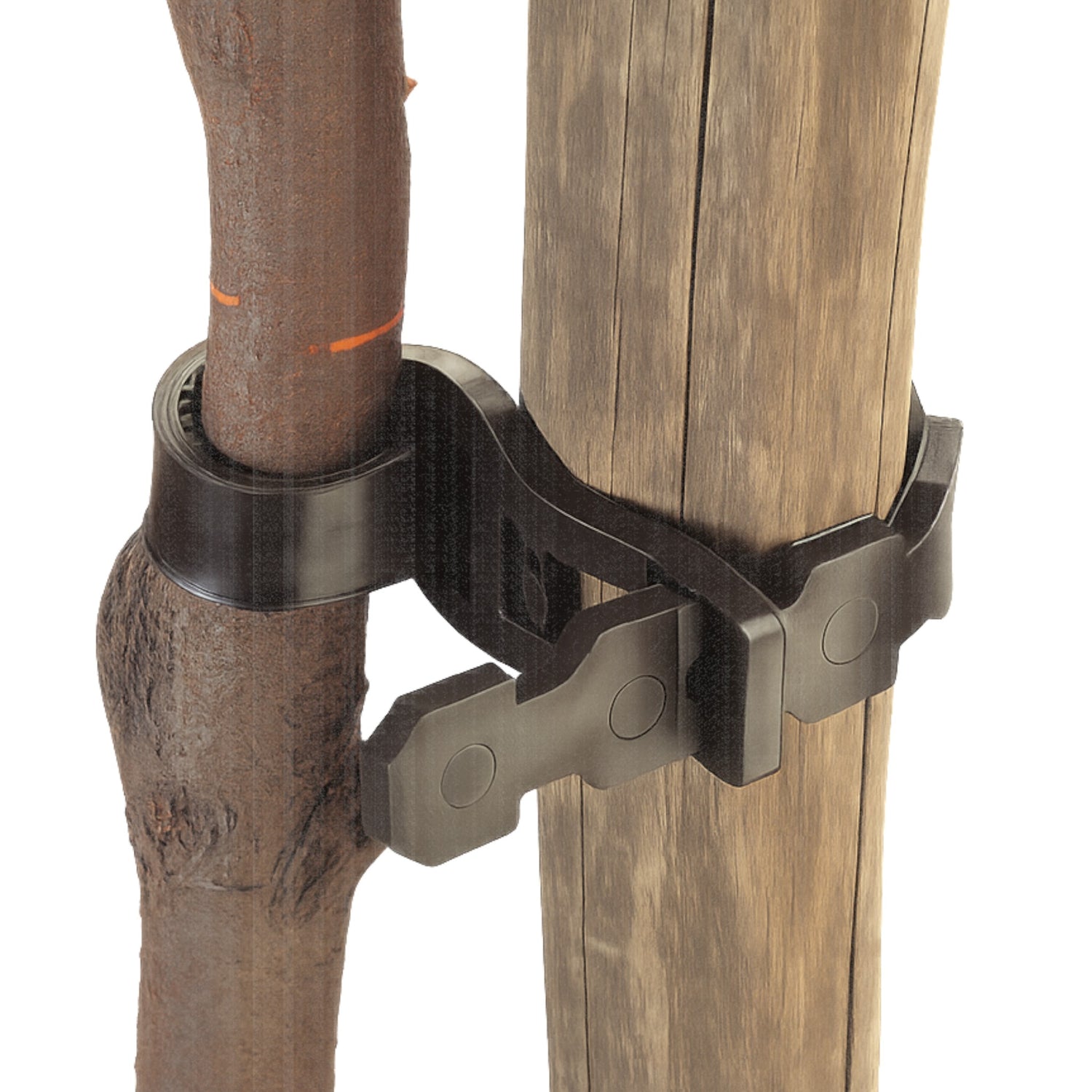
£41.67
Unit price per£41.67
Unit price perThe 35cm / 14" Super Soft Tree Tie BLACK (Box of 100) is a tree tie intended for supporting trees against suitable stakes while allowing appropriate movement.
Correct tree and shrub support helps newly planted or container-grown stock establish while reducing excessive movement at the root zone. Supports should hold the plant securely without creating unnecessary pressure on the stem or trunk.
Supplied as: box of 100.
Key benefits
Tree & shrub support
Use this product for supporting trees against suitable stakes while allowing appropriate movement. Select stakes, ties and support components according to the size of the plant, exposure of the site and the support system being used.
A correctly installed support should reduce damaging movement without holding the trunk completely rigid. Some natural movement helps the plant develop as it establishes.
Installation & ongoing checks
Position ties and support components so they do not rub, cut into or constrict the bark. Avoid over-tightening and inspect the installation regularly as the trunk or stems increase in diameter.
Adjust or remove supports once they are no longer required. Leaving a tie in place for too long can cause restriction or damage as the plant grows.
For nurseries, landscapers & tree planting
Tree-support products are useful for nursery stock, landscape planting, public-realm schemes and garden installations where newly planted trees or shrubs need temporary stabilisation.
35cm / 14" Super Soft Tree Tie BLACK (Box of 100) product details
| Product type | Tree tie |
|---|---|
| Primary use | supporting trees against suitable stakes while allowing appropriate movement |
| Stated size | 35cm / 14" |
| Colour | Black |
| Box quantity | 100 |
35cm / 14" Super Soft Tree Tie BLACK (Box of 100) FAQs
What size is this product?
The stated size is 35cm / 14". How many are supplied?
This product is supplied in a box of 100. How tight should a tree tie be?
It should support the plant without constricting the trunk or rubbing the bark. Leave appropriate room for movement and growth. How often should tree ties be checked?
Inspect supports regularly, particularly during active growth, and loosen or reposition them before they become restrictive. How long should a tree remain staked?
Only for as long as support is genuinely required. Establishment time varies with plant size, species, root system and site exposure. Can the same support be used for every tree?
No. Match the tie, stake and support arrangement to the trunk size, plant form and site conditions.
£0.69
Unit price per£0.69
Unit price perThe 35cm Round Plant Pot Saucer in Black is a durable plastic drip tray designed to collect excess water beneath plant pots and containers, helping keep greenhouse benches, floors, patios and other growing surfaces cleaner during routine watering.
With a nominal diameter of 35cm (14 inches), this practical saucer is suited to appropriately sized medium plant pots, nursery containers and decorative planters.
The solid base catches water draining through the pot above rather than allowing it to spread freely across the surrounding surface. It can also contain small amounts of compost or growing media washed through the drainage holes during irrigation.
Manufactured from durable black plastic, the saucer is lightweight, reusable and unobtrusive beneath conventional black nursery pots and a wide range of decorative containers.
The 35cm saucer forms part of a five-size range comprising 30cm, 35cm, 40cm, 45cm and 50cm options.
Why choose the 35cm Round Plant Pot Saucer?
Ideal for medium-sized plant pots & containers
Free-draining plant pots allow excess irrigation water to escape from the growing medium, helping maintain a suitable balance of moisture and air around the roots. The resulting runoff, however, needs to be managed.
Positioning a 35cm saucer beneath an appropriately sized container provides a simple collection area directly below the pot.
The saucer can be useful beneath appropriate:
Always measure the actual base of the plant pot before selecting a saucer. The usable internal diameter will be smaller than the nominal 35cm overall measurement.
Catch runoff & keep growing areas cleaner
Water draining freely from pots can create puddles and leave growing media or fertiliser deposits on the surrounding surface.
A saucer catches this runoff directly beneath the container, making excess water easier to manage and helping keep greenhouse benches, indoor growing spaces, patios and display areas cleaner.
The saucer can simply be emptied once the container has finished draining, helping prevent unwanted standing water around the pot.
Useful for top watering & bottom watering
When watering conventionally from above, the saucer catches moisture passing through the drainage holes in the base of the container.
Where suitable for the plant and growing medium, the saucer can also be used for bottom watering. Water placed in the saucer can be absorbed upwards through the drainage openings in the pot.
Remove unwanted standing water once the plant has absorbed the required moisture. Many container plants should not be left permanently sitting in water.
Practical for growers, nurseries & garden centres
Plant pot saucers provide a simple solution wherever irrigation runoff needs to be contained beneath individual pots.
Professional growers can use them beneath selected containers on benches or growing surfaces, while garden centres can use them beneath display plants where excess water could otherwise spread into customer areas.
The black finish complements conventional nursery pots and remains relatively unobtrusive beneath the container.
Available in five practical sizes
The round saucer range is available in five nominal diameters:
| 30cm (12 inches) | For appropriately sized smaller plant pots and containers. |
|---|---|
| 35cm (14 inches) | This size, suitable for appropriately sized medium pots and planters. |
| 40cm (16 inches) | For medium-to-large nursery pots and decorative containers. |
| 45cm (18 inches) | For appropriately sized larger pots and planters. |
| 50cm (20 inches) | The largest option in the range for suitably sized large containers. |
How to choose the correct plant saucer size
Measure the bottom of the plant pot rather than relying solely on its advertised top diameter. Many plant pots taper considerably towards their base.
The pot should sit comfortably within the usable internal area of the saucer while leaving sufficient space around it to collect drainage water.
A pot described as 35cm in diameter will not necessarily fit inside a nominal 35cm saucer because the internal diameter of the saucer is smaller than its overall external measurement.
Simple cleaning & maintenance
Empty unwanted standing water regularly and remove compost, leaves and other debris that accumulates during use.
Periodic cleaning helps prevent the build-up of growing media and fertiliser residues. In professional growing environments, follow the nursery's normal hygiene procedures when moving reusable equipment between different crops.
When the saucer is used outdoors, check it following prolonged rainfall to ensure plants requiring free-draining conditions are not left sitting in excess water.
35cm Round Plant Pot Saucer product details
| Product type | Round plant pot saucer / drip tray |
|---|---|
| Nominal diameter | 35cm |
| Imperial size | 14 inches (nominal) |
| Shape | Round |
| Material | Plastic |
| Colour | Black |
| Base | Solid, designed to collect excess water |
| Primary application | Collecting irrigation runoff beneath plant pots and containers |
| Suitable environments | Gardens, greenhouses, nurseries, garden centres and indoor growing areas |
| Other available sizes | 30cm, 40cm, 45cm and 50cm |
| Suitable users | Commercial growers, nurseries, garden centres, landscapers and gardeners |
35cm Round Plant Pot Saucer FAQs
What size is this plant pot saucer?
This saucer has a nominal diameter of 35cm (14 inches). Will a 35cm plant pot fit in this saucer?
Not necessarily. The usable internal diameter is smaller than the nominal 35cm overall measurement, so measure the actual base of your pot before ordering. What does a plant pot saucer do?
It collects excess water draining from the plant pot and helps contain runoff beneath the container. Can the 35cm saucer be used outdoors?
Yes. It can be used beneath appropriately sized outdoor containers. Check it after prolonged rain and remove unwanted standing water where necessary. Can I use this saucer indoors?
Yes. It can help contain drainage water beneath suitable indoor plant pots, although additional protection may be appropriate for moisture-sensitive furniture or flooring. Can the saucer be used for bottom watering?
Yes, where bottom watering is suitable for the crop. Water can be placed in the saucer and absorbed through the drainage openings in the base of the pot. Should I empty water from the saucer after watering?
For plants requiring free-draining conditions, unwanted standing water should normally be removed after the pot has finished draining or absorbing the required moisture. Can this saucer be used with fabric pots?
It can be used beneath appropriately sized fabric pots, although fabric containers may release moisture through their sides as well as their bases. What other sizes are available?
The range includes 30cm, 35cm, 40cm, 45cm and 50cm round plant pot saucers. How do I choose the correct saucer?
Measure the base of the pot and choose a saucer with enough internal space for the container plus sufficient surrounding area to collect drainage water.
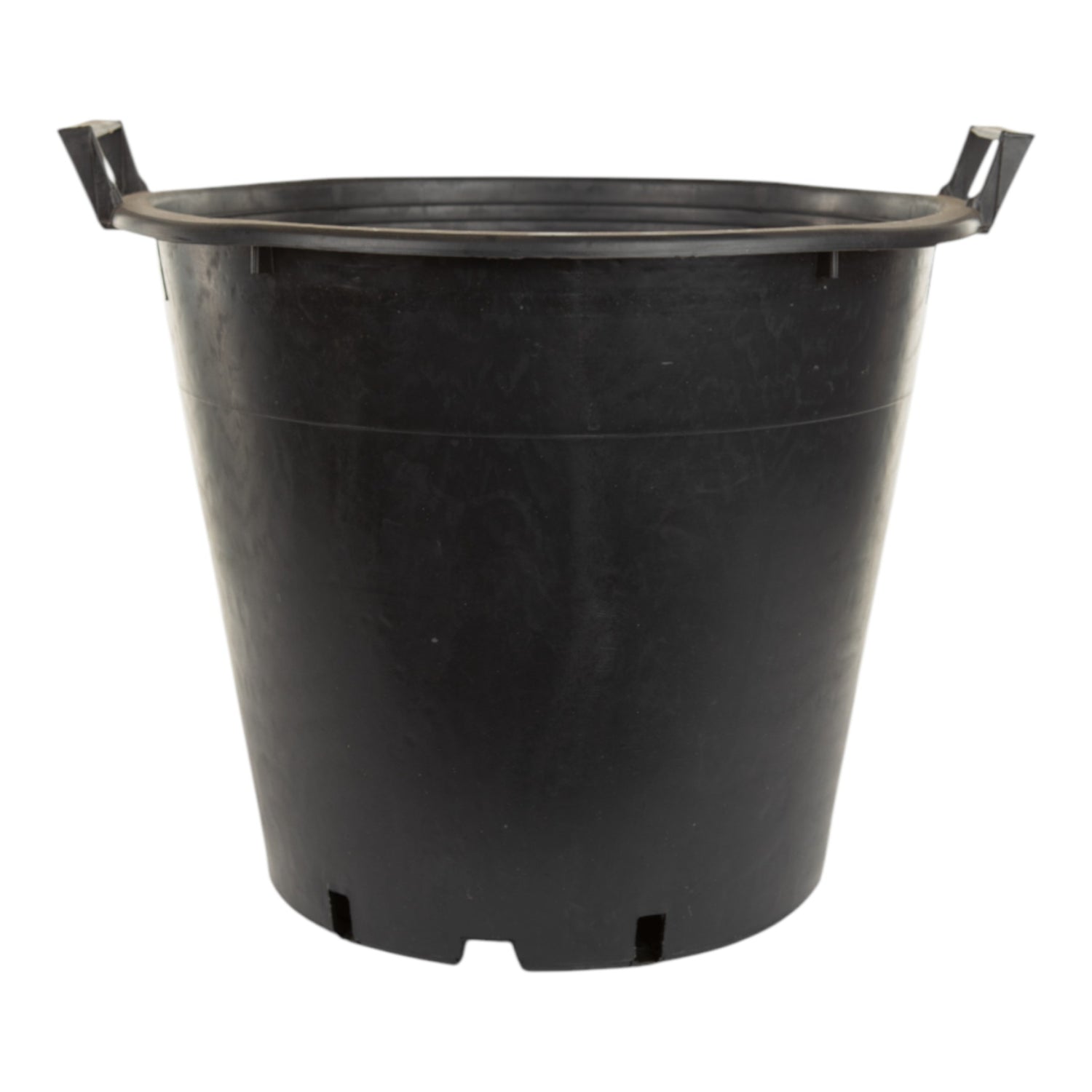
£2.97
Unit price per£2.97
Unit price perThe 35L Heavy Duty Round Plastic Pot (with handles) is a professional growing container designed for larger nursery stock, shrubs and specimen container production.
The 35L format provides substantial root volume for crops that need more space than standard nursery pots, while the container style is intended for repeated handling through production, spacing, irrigation and dispatch.
Sold individually.
Key benefits
Tree & shrub container production
The 35L format is suited to larger woody nursery stock where adequate root volume and practical container handling are important. Select container size according to crop vigour, root development, production period and final sale specification.
Where handles are incorporated into the pot design, they can assist positioning and handling, but a filled 35L container may still require appropriate manual-handling controls or mechanical assistance.
Choosing the growing medium
Use a professional growing medium appropriate to the crop, container size and irrigation system. Larger pots need a substrate with enough structure to maintain air-filled porosity and drainage throughout the production period while retaining sufficient available moisture.
Avoid excessive compaction during filling. Settle the medium consistently and leave suitable watering space at the top of the container.
Irrigation & root-zone management
Container size has a major effect on drying behaviour. Check moisture through the root zone rather than judging only the surface, and adjust irrigation frequency and volume as crop size, weather and rooting increase.
Ensure drainage points remain clear and avoid leaving containers standing in prolonged saturation unless the crop and production system are specifically designed for it.
Handling, spacing & stability
Position larger pots on a stable, well-drained growing surface and allow sufficient spacing for crop development and access. Consider wind exposure as top-heavy trees and shrubs develop.
Filled containers can be substantially heavier than their nominal litre capacity suggests. Use appropriate lifting and handling methods, particularly with the larger sizes in this range.
Reuse & crop hygiene
Where pots remain serviceable, they may be reused subject to the nursery's crop-hygiene requirements. Remove old substrate and plant material, inspect the container for damage and clean or disinfect as appropriate before the next crop cycle.
35L Heavy Duty Round Plastic Pot (with handles) product details
| Product type | Heavy-Duty Round Nursery Pot with Handles |
|---|---|
| Nominal capacity | 35L |
| Selling quantity | 1 pot |
| Primary application | larger nursery stock, shrubs and specimen container production |
| Handles | Yes |
35L Heavy Duty Round Plastic Pot (with handles) FAQs
Is this nursery pot sold individually?
Yes. The selling unit is one pot. What capacity is this pot?
The stated nominal capacity is 35L. What is this pot suitable for?
It is intended for larger nursery stock, shrubs and specimen container production. What growing medium should I use?
Use a professional substrate appropriate to the crop, container size and irrigation system, with suitable structure, drainage, aeration and moisture retention. How should larger pots be watered?
Check moisture through the root zone and adjust irrigation to crop size, rooting, weather and substrate behaviour rather than relying on a fixed timetable. Can the pot be reused?
Yes where it remains serviceable and nursery hygiene requirements are met. Remove old substrate and clean appropriately before reuse. What should I consider when moving a filled pot?
A filled and watered container can be very heavy. Use appropriate manual-handling methods or mechanical assistance where required. How do I choose between pot sizes?
Match container volume to crop vigour, root development, production period and intended finished-plant size. Do the handles mean the pot can always be lifted by one person?
No. Handles can assist positioning, but the filled weight may still require team handling or mechanical assistance.
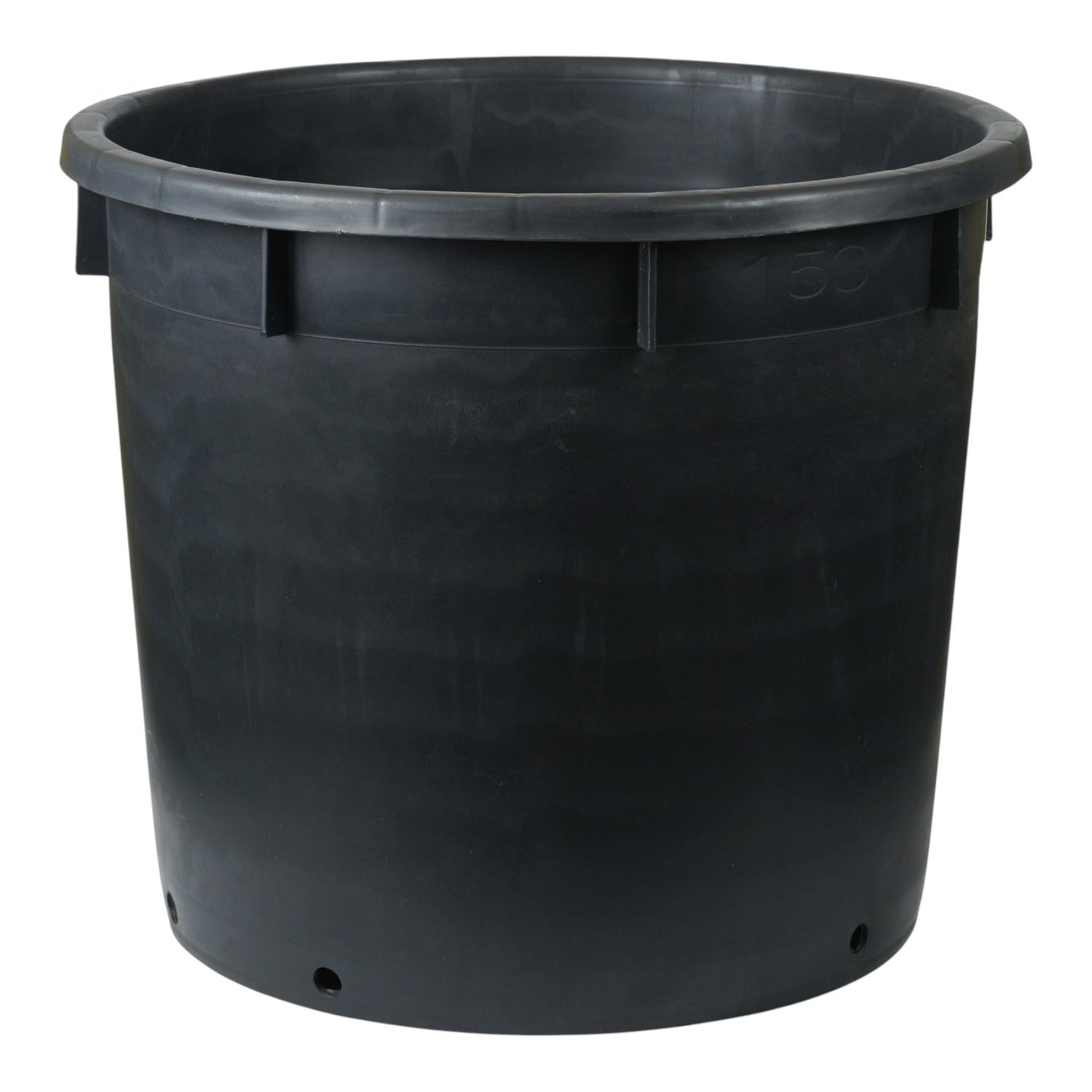
The 375L Nursery Tub is a professional growing container designed for large-specimen, tree, shrub and nursery container production.
The 375L format provides substantial root volume for crops that need more space than standard nursery pots, while the container style is intended for repeated handling through production, spacing, irrigation and dispatch.
Sold individually.
Key benefits
Large-volume nursery & specimen production
The 375L nursery tub is intended for crops requiring a substantial container volume, including larger shrubs, trees and specimen plants where the crop, production period and root system justify the additional growing-medium volume.
Large containers become extremely heavy once filled and irrigated. Plan the production area, irrigation method and mechanical or team handling arrangements before potting.
Choosing the growing medium
Use a professional growing medium appropriate to the crop, container size and irrigation system. Larger pots need a substrate with enough structure to maintain air-filled porosity and drainage throughout the production period while retaining sufficient available moisture.
Avoid excessive compaction during filling. Settle the medium consistently and leave suitable watering space at the top of the container.
Irrigation & root-zone management
Container size has a major effect on drying behaviour. Check moisture through the root zone rather than judging only the surface, and adjust irrigation frequency and volume as crop size, weather and rooting increase.
Ensure drainage points remain clear and avoid leaving containers standing in prolonged saturation unless the crop and production system are specifically designed for it.
Handling, spacing & stability
Position larger pots on a stable, well-drained growing surface and allow sufficient spacing for crop development and access. Consider wind exposure as top-heavy trees and shrubs develop.
Filled containers can be substantially heavier than their nominal litre capacity suggests. Use appropriate lifting and handling methods, particularly with the larger sizes in this range.
Reuse & crop hygiene
Where pots remain serviceable, they may be reused subject to the nursery's crop-hygiene requirements. Remove old substrate and plant material, inspect the container for damage and clean or disinfect as appropriate before the next crop cycle.
375L Nursery Tub product details
| Product type | Large Nursery Tub |
|---|---|
| Nominal capacity | 375L |
| Selling quantity | 1 pot |
| Primary application | large-specimen, tree, shrub and nursery container production |
375L Nursery Tub FAQs
Is this nursery pot sold individually?
Yes. The selling unit is one pot. What capacity is this pot?
The stated nominal capacity is 375L. What is this pot suitable for?
It is intended for large-specimen, tree, shrub and nursery container production. What growing medium should I use?
Use a professional substrate appropriate to the crop, container size and irrigation system, with suitable structure, drainage, aeration and moisture retention. How should larger pots be watered?
Check moisture through the root zone and adjust irrigation to crop size, rooting, weather and substrate behaviour rather than relying on a fixed timetable. Can the pot be reused?
Yes where it remains serviceable and nursery hygiene requirements are met. Remove old substrate and clean appropriately before reuse. What should I consider when moving a filled pot?
A filled and watered container can be very heavy. Use appropriate manual-handling methods or mechanical assistance where required. How do I choose between pot sizes?
Match container volume to crop vigour, root development, production period and intended finished-plant size.

The 3L Round Plant Pot is a practical black horticultural grow pot designed for nursery production, greenhouse growing, potting-on and general container cultivation. With an approximately 18.5cm upper rim, 14cm base and 15cm height, it provides a useful 3 litre root volume in a compact, easy-to-handle format.
Three litre pots are one of the most versatile sizes in horticulture, providing a useful intermediate step between small propagation containers and larger finishing pots. They are suitable for a wide range of perennials, herbs, vegetables, ornamentals and young nursery plants.
The tapered round profile makes the pot straightforward to handle and allows empty containers to nest efficiently for storage. A reinforced upper rim provides a practical gripping point when plants need to be moved around a nursery, greenhouse or growing area.
Drainage openings in the base allow excess irrigation water to escape, helping maintain an appropriate balance between moisture and oxygen within the root zone.
Suitable for peat-based and peat-free compost, soil, coco coir and other horticultural growing media, this 3L pot is equally useful for professional growers and home gardeners.
Why choose the 3L Round Plant Pot?
A versatile 3 litre growing volume
A 3L pot provides significantly more root volume than small propagation and early-stage containers while remaining compact enough for efficient plant spacing.
This makes it particularly useful for growing-on established young plants. Moving a plant into a suitably larger container gives developing roots additional growing medium to explore without immediately placing a small root system into an unnecessarily large volume of wet substrate.
For many nursery crops, 3L is also a convenient retail and finishing size. For larger or more vigorous plants, it can instead serve as an intermediate stage before moving into a larger container.
3L Round Pot dimensions
The pot measures approximately 18.5cm across the upper rim, 14cm across the base and 15cm high.
These proportions create a compact horticultural container with useful root volume while maintaining a manageable footprint for greenhouse benches, nursery beds and indoor growing areas.
The tapered sides also allow empty pots to nest inside one another, making storage and handling considerably more efficient.
Suitable growing media
The 3L Round Plant Pot can be used with a broad range of horticultural substrates, including:
Irrigation frequency should always be adjusted to suit the crop and substrate. Free-draining coco behaves very differently from a moisture-retentive compost, even when both are used in the same size container.
What can you grow in a 3L pot?
Three litres is a widely useful container size for growing-on and finishing smaller plants. Typical applications include:
Whether 3L is suitable as a final pot depends on the plant species, expected mature size and crop duration. Vigorous plants may eventually need potting-on again.
Drainage & root-zone management
Drainage openings in the base allow excess irrigation water to leave the container instead of remaining trapped around the lower roots.
Effective drainage helps maintain the combination of moisture and air required for healthy root development. It is particularly important when plants are frequently irrigated or grown in controlled greenhouse and indoor environments.
The pot can be used with hand watering, drip irrigation and other suitable nursery irrigation systems.
Avoid watering purely according to a fixed timetable. Plant size, root development, substrate, temperature, humidity and light levels all affect how quickly a 3L pot will dry.
Fits the 18cm Pot Saucer
The 3L Round Plant Pot is compatible with the 18cm Pot Saucer, product code P00103.
The matching saucer measures approximately 18.5cm across the rim, 16.5cm across the base and 3cm high.
A saucer is useful when the pot is used indoors, on greenhouse benches or on protected surfaces where irrigation runoff needs to be contained.
In outdoor or free-draining production areas, a saucer may not be necessary.
Ideal for nursery & greenhouse production
Three litre round pots are particularly useful in nursery production because they provide enough growing-medium volume for established young plants without requiring the space of much larger containers.
The manageable size makes plants easy to move, space, irrigate and prepare for sale, while the black horticultural finish provides a straightforward professional presentation.
The pot is also useful for home growers who want a functional growing container rather than a decorative planter.
Practical & reusable
Pots that remain in good condition can be emptied, cleaned and reused for future crops.
Remove old substrate and root debris before cleaning. Where pots are being transferred between crops, appropriate hygiene procedures can help reduce the risk of carrying pests or plant pathogens into the next planting.
Empty pots can be nested together for compact storage between uses.
3L Round Plant Pot product details
| Product | Round Plant Pot |
|---|---|
| Nominal capacity | 3L |
| Shape | Round |
| Colour | Black |
| Upper rim diameter | Approximately 18.5cm |
| Base diameter | Approximately 14cm |
| Height | Approximately 15cm |
| Drainage | Pre-formed base drainage openings |
| Suitable media | Soil, compost, peat-free media, coco & compatible horticultural substrates |
| Suitable environments | Nurseries, greenhouses, polytunnels, indoor growing & outdoor cultivation |
| Typical applications | Perennials, herbs, vegetables, young shrubs, ornamentals & nursery stock |
| Compatible saucer | 18cm Pot Saucer - product code P00103 |
| Compatible saucer dimensions | Rim 18.5cm x base 16.5cm x height 3cm |
| Reusable | Yes, when cleaned and maintained appropriately |
3L Round Plant Pot FAQs
What are the dimensions of the 3L Round Pot?
The pot measures approximately 18.5cm across the upper rim, 14cm across the base and 15cm high.
What can I grow in a 3L plant pot?
A 3L pot is suitable for many perennials, herbs, bedding plants, young shrubs, chillies, peppers, strawberries, ornamentals and nursery crops. Larger plants may eventually require potting-on.
Is a 3L pot suitable for chillies and peppers?
Yes. Three litres can be suitable for smaller chilli and pepper plants or as an intermediate growing size. Larger and more vigorous plants may benefit from additional root volume later in the crop.
Can this pot be used for tomatoes?
It is suitable for growing-on young tomato plants, but most mature tomato plants will normally benefit from a substantially larger final container.
Can I use coco coir in the 3L Round Pot?
Yes. Coco and coco-based blends can be used in this pot. Adjust irrigation frequency to suit the free-draining characteristics of the growing medium.
Can I use peat-free compost?
Yes. The pot is suitable for peat-free growing media as well as conventional compost, soil mixes, coco and other appropriate horticultural substrates.
Does the 3L Round Pot have drainage holes?
Yes. Drainage openings in the base allow excess irrigation water to leave the growing medium.
Which saucer fits the 3L Round Pot?
The compatible option is the 18cm Pot Saucer, product code P00103. It measures approximately 18.5cm across the rim, 16.5cm across the base and 3cm high.
Do I need a saucer underneath the pot?
A saucer is useful where runoff needs to be contained, particularly indoors or on protected surfaces. It is not essential where excess water can safely drain away.
Is this pot suitable for nursery production?
Yes. The 3L size is widely useful for growing-on nursery plants because it combines practical root volume with a compact, easy-to-handle container.
Can this pot be used outdoors?
Yes. It can be used outdoors as well as in greenhouses, polytunnels and indoor growing areas.
Can the 3L Round Pot be used with drip irrigation?
Yes. It is suitable for hand watering and compatible drip irrigation systems. Irrigation frequency should be adjusted to crop demand and substrate moisture.
Can the pot be reused?
Yes. Pots that remain in good condition can be emptied, cleaned and reused. Appropriate hygiene is recommended between crops.
Is 3L suitable as a final plant pot?
For many smaller plants it can be. Larger, vigorous or longer-lived crops may need to be moved into a larger container as their root systems develop.

£0.29
Unit price per£0.29
Unit price perThe 3L Square Round Plant Pot is a compact black horticultural grow pot designed for efficient nursery production, potting-on and growing established young plants. Measuring approximately 15.5cm across the upper rim, 13cm across the base and 16cm high, it combines the space efficiency of a square pot with a tapered lower profile.
The 3 litre capacity makes this an excellent intermediate container between small propagation pots and larger finishing pots. It provides developing plants with additional root volume while remaining compact enough for efficient greenhouse, nursery and growing-room layouts.
Its square upper profile allows pots to be positioned closely together, reducing wasted space between containers. This can be particularly useful in professional horticulture where maximising available bench and production space is important.
The tapered body helps make established root balls easier to remove during potting-on and allows empty pots to nest together for compact storage.
Suitable for peat-based and peat-free compost, soil, coco coir and other horticultural growing media, this versatile 3L pot can be used for ornamental, edible and nursery crops.
Why choose the 3L Square Round Plant Pot?
Space-efficient square round design
Square round horticultural pots combine characteristics of conventional square and round containers.
The squarer upper profile allows neighbouring pots to sit more closely together than traditional round pots, helping growers make efficient use of greenhouse benches, nursery areas and propagation spaces.
The lower section tapers towards a smaller base, creating a practical root-zone shape while allowing empty pots to nest together efficiently.
This combination makes square round pots particularly useful for commercial horticulture where space efficiency, handling and straightforward potting-on are all important.
A versatile 3 litre growing-on pot
Three litres is a useful intermediate container volume for plants that have established in smaller pots but do not yet require a large finishing container.
Moving an established plant into a 3L pot provides additional growing medium for continued root development while keeping irrigation and handling manageable.
The larger substrate volume provides a greater reserve of moisture and nutrients than small propagation pots, helping support increasing root mass and canopy growth.
For compact plants and shorter production cycles, 3L may also be suitable as the final growing or retail container.
What can you grow in a 3L pot?
The 3L Square Round Plant Pot is suitable for growing-on a wide range of edible and ornamental crops, including:
Whether 3L is suitable as a final container depends on the mature size and vigour of the crop. Larger plants and longer growing cycles may eventually require additional root volume.
Suitable growing media
The 3L Square Round Pot can be used with a broad range of horticultural substrates, including:
Choose a growing medium appropriate for the crop and production system. Watering frequency should be adjusted according to substrate structure, plant size and environmental conditions.
Watering plants in 3L pots
After potting-on, the plant's existing root system may initially occupy only part of the fresh growing medium. Water carefully while new roots establish throughout the container rather than automatically saturating the pot on a fixed schedule.
As root mass and foliage increase, water demand will normally rise. Monitoring the moisture content and weight of the growing medium can provide a more useful indication of irrigation requirements than watering solely according to time.
The pot is suitable for hand watering and compatible nursery, greenhouse and drip irrigation systems.
Fits the 14cm Pot Saucer
The 3L Square Round Pot is listed for use with the 14cm saucer, product code P00047.
The saucer measures approximately 17cm across the rim, 14cm across the base and 2cm high.
Using a saucer can help collect irrigation runoff and protect greenhouse benches, shelving, floors and other surfaces from excess water.
Avoid allowing the pot to remain permanently standing in excess runoff unless this forms part of the intended irrigation method.
When should you pot on into a 3L container?
Potting-on is best determined by root development rather than following a fixed number of weeks.
A plant may be ready for a 3L container when roots have established throughout its existing growing medium, water demand has increased significantly or the plant has become large relative to its current pot.
Moving plants progressively through appropriate container sizes can make moisture management easier and encourage the root system to establish throughout the available growing medium.
Ideal for nursery & greenhouse production
The 3L Square Round Pot provides a useful balance between root volume and production footprint.
Its relatively compact dimensions allow significant numbers of plants to be accommodated within nursery and greenhouse environments while still providing enough substrate for substantial plant development.
As crops mature, pots can be spaced further apart where necessary to improve airflow, light interception and canopy development.
Reusable horticultural pot
Pots that remain in good condition can be emptied, cleaned and reused for subsequent plants.
Remove old roots and growing-medium residue before cleaning. Where pots are reused between different crops, suitable hygiene procedures can help reduce the risk of transferring pests or plant pathogens.
The tapered profile allows empty containers to nest together, helping minimise storage requirements between growing cycles.
3L Square Round Plant Pot product details
| Product | Square Round Plant Pot |
|---|---|
| Nominal capacity | 3L |
| Shape | Square round |
| Colour | Black |
| Upper rim width | Approximately 15.5cm |
| Base width | Approximately 13cm |
| Height | Approximately 16cm |
| Primary use | Growing-on, nursery production & compact finishing applications |
| Suitable media | Soil, compost, peat-free media, coco & compatible horticultural substrates |
| Suitable environments | Nurseries, greenhouses, polytunnels, indoor growing & outdoor cultivation |
| Compatible saucer | 14cm Saucer - product code P00047 |
| Saucer dimensions | Rim 17cm x base 14cm x height 2cm |
| Reusable | Yes, when cleaned and maintained appropriately |
3L Square Round Plant Pot FAQs
What capacity is the Square Round Pot?
This pot has a nominal capacity of approximately 3 litres.
What are the dimensions of the 3L Square Round Pot?
It measures approximately 15.5cm across the upper rim, 13cm across the base and 16cm high.
What is a square round plant pot?
A square round pot combines a predominantly square upper profile with a tapered lower body. This provides efficient spacing while retaining the practical handling characteristics of a conventional nursery pot.
Is a 3L pot good for potting-on?
Yes. Three litres is a useful intermediate volume for established young plants that have outgrown smaller propagation or nursery containers.
Which saucer fits this 3L pot?
The specified saucer is the 14cm saucer, product code P00047. It measures approximately 17cm across the rim, 14cm across the base and 2cm high.
Can I grow chillies in a 3L pot?
Yes. A 3L pot is useful for growing-on chilli and pepper plants. Larger or particularly vigorous plants may benefit from a bigger final container.
Can I grow tomatoes in a 3L pot?
It can be used for growing-on young tomato plants, although most mature tomato plants will normally benefit from substantially more root volume.
Can I use peat-free compost?
Yes. The pot is suitable for peat-free growing media as well as conventional compost and other appropriate horticultural substrates.
Can I use coco coir?
Yes. Coco coir and coco-based growing media can be used in the 3L Square Round Pot. Irrigation should be managed according to the characteristics of the chosen substrate.
Why are square round pots useful in nurseries?
Their square upper profile allows containers to be positioned efficiently together, reducing wasted bench space while still providing a practical tapered root zone.
Is the 3L pot suitable for outdoor use?
Yes. It can be used outdoors as well as in greenhouses, nurseries, polytunnels and indoor growing environments.
Can the pot be reused?
Yes. Pots that remain in sound condition can be emptied, cleaned and reused for subsequent crops.
Is 3L large enough as a final plant pot?
For some compact plants and shorter production cycles it can be. Larger or more vigorous crops may eventually require a larger container.
When should I move a plant out of a 3L pot?
Consider potting-on when roots have thoroughly established through the growing medium, the container begins drying increasingly quickly or the plant requires more root volume to continue developing.

£0.30
Unit price per£0.30
Unit price perThe 3L Square Round Plant Pot Premium is a robust black horticultural container designed for professional nursery production, greenhouse growing and home horticulture. Its square top and rounded lower profile combine efficient plant spacing with practical drainage, stability and easy handling.
The 3 litre capacity provides useful root volume for young and established plants while maintaining a compact footprint. It is particularly well suited to nursery stock, perennials, bedding plants, vegetables, herbs and other crops that require a durable intermediate growing container.
Unlike lightweight disposable pots, the Premium 3L Square Round Pot has a strong, rigid construction designed for repeated handling. This makes it a practical choice for professional growers moving plants through potting, production, transport and retail stages.
Its square-round design combines two useful characteristics. The square upper profile allows pots to be arranged efficiently alongside one another, while the tapered rounded lower section supports straightforward handling and nesting when empty.
Multiple drainage points in the base allow excess irrigation water to escape while helping maintain an aerated root zone. The pot is suitable for peat-based and peat-free compost, soil, coco coir and other horticultural growing media.
Why choose the Premium 3L Square Round Pot?
What is a square round plant pot?
A square round pot combines a broadly square upper profile with a tapered lower section that transitions towards a rounded base.
This design is widely used in professional horticulture because it offers a useful balance between space efficiency, strength, drainage and handling.
The square upper section means neighbouring pots can be positioned more closely than conventional round containers. This helps growers make better use of greenhouse benches, nursery beds, transport areas and retail displays.
The tapered lower profile also allows empty pots to nest together efficiently, reducing the amount of storage space required between production runs.
A premium pot for repeated horticultural use
The key difference between a premium nursery pot and a lightweight disposable container is rigidity.
A stronger injection-moulded style of pot maintains its shape more effectively when filled with wet growing media, picked up repeatedly or moved around a nursery or greenhouse.
Strong shoulders around the upper section provide additional rigidity, making the container easier to handle when filled with compost and an established plant.
This makes the 3L Premium Square Round Pot particularly useful where containers need to survive more than a single short production stage.
Professional drainage for healthy root development
Good drainage is essential in container horticulture because roots require both moisture and oxygen.
The Premium 3L Square Round Pot incorporates multiple drainage openings across the base. Its multi-level drainage arrangement helps water escape even when the container is standing directly on a relatively flat surface.
This makes the pot suitable for conventional hand watering as well as many drip and automated irrigation systems.
Irrigation frequency should always be adjusted according to the crop, substrate, root development, temperature and environmental conditions rather than simply according to pot size.
Suitable growing media
The 3L Square Round Pot can be used with a wide range of professional and general-purpose horticultural substrates, including:
Always match irrigation and nutrition to the chosen growing medium and crop rather than treating all substrates in the same way.
What can you grow in a 3L pot?
Three litres is one of the most versatile sizes in professional plant production. The correct final pot size depends on the species and intended finishing size, but typical applications include:
Larger or longer-lived crops may eventually require potting-on into a larger container as their root systems develop.
Designed for efficient nursery production
Commercial growers need pots that work efficiently throughout the entire production process rather than simply holding compost.
The square-round format allows plants to be arranged in regular rows, making crop spacing, irrigation, handling and stock management straightforward.
Efficient spacing also matters during transport. A more compact arrangement can make better use of trolleys, benches and other production areas compared with conventional round pots of a similar capacity.
The clean black finish provides a professional appearance suitable for both growing and retail presentation.
Reusable & easy to handle
The rigid construction allows these pots to be reused when they remain in good condition.
After a crop has finished, remove old substrate and root material before cleaning the container. Where pots are being transferred between crops, appropriate hygiene and disinfection procedures should be followed to reduce the risk of transferring pests or plant pathogens.
When empty, the tapered pots nest together for compact storage.
3L Square Round Pot Premium product details
| Product | Premium Square Round Plant Pot |
|---|---|
| Nominal capacity | 3L |
| Shape | Square round |
| Colour | Black |
| Construction | Rigid horticultural plastic |
| Approximate top width | 15-16cm |
| Approximate height | 16cm |
| Drainage | Multiple base drainage openings with multi-level drainage |
| Suitable media | Soil, compost, peat-free media, coco & compatible soilless substrates |
| Suitable environments | Nurseries, garden centres, greenhouses, polytunnels, indoor growing & outdoor cultivation |
| Typical applications | Nursery stock, perennials, bedding, herbs, vegetables, young shrubs & general container growing |
| Reusable | Yes, when cleaned and maintained appropriately |
3L Square Round Pot Premium FAQs
What is a square round plant pot?
A square round pot has a broadly square upper profile that transitions towards a rounded lower section. This provides efficient spacing while retaining the practical handling and drainage characteristics of a tapered nursery pot.
What can I grow in a 3L pot?
Three litre pots are commonly used for perennials, herbs, bedding plants, young shrubs, roses, climbing plants and vegetables such as tomatoes, peppers and cucumbers. Larger plants may eventually require potting-on.
Why choose a premium 3L pot?
A premium rigid pot is better suited to repeated handling than a very lightweight disposable container. It maintains its shape when filled and can be reused when appropriately cleaned.
Does the 3L Square Round Pot have drainage holes?
Yes. The pot has multiple drainage openings in its base to allow excess irrigation water to leave the growing medium.
Can this 3L pot be used with coco?
Yes. Coco coir and coco-based mixes can be used in the pot. Irrigation frequency should be adjusted to suit the crop and the free-draining characteristics of coco.
Can I use peat-free compost in this pot?
Yes. The container is suitable for peat-free compost as well as peat-based, soil-based and other appropriate horticultural growing media.
Are square round pots good for nurseries?
Yes. Square round pots are widely used in professional horticulture because they combine efficient plant spacing with strong construction, good drainage and straightforward handling.
Can this pot be used with drip irrigation?
Yes. It can be used with hand watering or suitable automated irrigation systems, including drip irrigation. Irrigation volume and frequency should be matched to the substrate and crop.
Can the 3L Premium Pot be reused?
Yes. Sound pots can be emptied, cleaned and reused. Appropriate hygiene procedures are recommended when containers are transferred between crops.
Is this pot suitable for greenhouse growing?
Yes. Its compact footprint and practical drainage make it suitable for greenhouse benches, polytunnels and other protected growing environments.
Can the pot be used outdoors?
Yes. It is suitable for outdoor nursery production, gardens, patios and allotments as well as protected and indoor cultivation.
What is the advantage of the square top?
The square upper profile reduces the gaps between neighbouring containers, helping growers make more efficient use of available bench and floor space.
Are these pots easy to store?
Yes. The tapered profile allows empty pots to nest inside one another, reducing storage space between production runs.
Is a 3L pot suitable as a final pot?
It can be a final container for many smaller plants and nursery crops. Larger, vigorous or longer-lived plants may require moving into a larger pot as the root system develops.

£2.95
Unit price per£2.95
Unit price perThe 3m IEC Extension Cable provides an additional three metres of reach between compatible IEC power connections, making it particularly useful for extending reflector, lighting and equipment power cables.
The cable uses an IEC male to IEC female configuration, allowing an existing compatible IEC power connection to be extended when the original cable does not provide sufficient reach.
With an IEC C14 male connector at one end and an IEC C13 female connector at the other, it uses the familiar IEC connection found across a wide range of lighting and electrical equipment.
The 3 metre cable length provides useful additional reach while remaining relatively easy to route and manage around equipment installations.
Why choose the 3m IEC Extension Cable?
IEC C14 male to C13 female connection
This extension cable uses an IEC C14 male plug at one end and an IEC C13 female connector at the other.
The C13 female connector is designed to connect to the corresponding IEC C14 inlet found on compatible electrical equipment. The male C14 end can connect to a compatible C13 connector on an existing power cable or suitable power source.
The result is an additional three metres between the existing power connection and the equipment, without needing to replace the complete power cable.
Always check the connectors fitted to your equipment before ordering. Several IEC connector formats exist and similar-looking connectors are not necessarily interchangeable.
Ideal for extending reflector & equipment power cables
The 3m IEC extension lead is particularly useful in lighting installations where the existing reflector or equipment cable does not provide sufficient reach.
It allows compatible components to be positioned more freely while maintaining a detachable IEC connection between the power supply and equipment.
The same C13/C14 connection format is also widely used by compatible ballasts, controllers, computers, monitors, power supplies and other electrical equipment.
Always confirm both physical connector compatibility and electrical suitability for the equipment being connected.
3 metres of additional cable reach
The 3m length provides a useful middle ground where a standard equipment cable is too short but a longer 5m extension is unnecessary.
Additional reach can make equipment positioning easier and helps prevent shorter cables from being stretched or placed under unnecessary tension.
Route the extension carefully and avoid sharp bends, crushing, excessive tension or contact with sharp edges. Any excess cable should be managed neatly without placing strain on the IEC connections.
IEC extension cable vs standard UK power lead
This product is an IEC extension cable, rather than a conventional UK mains power lead.
A standard UK IEC power lead normally has a UK 3-pin plug at one end and an IEC C13 female connector at the other.
This extension cable instead uses an IEC C14 male connector and IEC C13 female connector. It is intended to extend an existing compatible IEC power connection rather than plug directly into a standard UK wall socket.
Installation & electrical safety
3m IEC Extension Cable product details
| Product type | IEC power extension cable |
|---|---|
| Cable length | 3m |
| Colour | Black |
| Connector A | IEC C14 male |
| Connector B | IEC C13 female |
| Configuration | Male-to-female IEC extension |
| Primary function | Extending an existing compatible IEC power connection |
| Typical applications | Compatible reflectors, lighting equipment, ballasts, controllers and other IEC-powered electrical equipment |
| Outer case quantity | 40 cables |
3m IEC Extension Cable FAQs
How long is this IEC extension cable?
The cable is 3 metres long, adding three metres of reach to a compatible IEC power connection. What connectors does the cable use?
It uses an IEC C14 male connector at one end and an IEC C13 female connector at the other. Is this a C13 to C14 IEC extension lead?
Yes. It uses the standard C13/C14 IEC connection, with a C13 female equipment connector and C14 male plug. Can this extend a reflector power cable?
Yes, where the reflector or lighting equipment uses compatible IEC C13/C14 connections and the cable is electrically suitable for the equipment. Can it extend an existing kettle lead?
Yes, where the existing power lead terminates in a compatible IEC C13 connector and the equipment uses an IEC C14 inlet. Does this cable plug directly into a UK wall socket?
No. This is an IEC-to-IEC extension cable. It does not have a UK 3-pin mains plug. Can it be used with a compatible lighting ballast?
Yes, provided the ballast uses the appropriate IEC connection and the cable is suitable for its electrical requirements. What is the difference between IEC C13 and IEC C14?
The C13 is the female connector commonly found on an IEC power cable, while the C14 is the corresponding male connection commonly fitted to equipment or an extension lead. Why use a 3m IEC extension lead?
It provides additional positioning flexibility where the original equipment or reflector power cable is too short, without introducing the extra cable length of a 5m extension. Is this the same as a standard UK power lead?
No. A standard UK IEC power lead has a UK 3-pin plug at the mains end. This cable has an IEC C14 male connector and is specifically intended as an extension. Can IEC C13/C14 cables be used with any electrical equipment?
No. The equipment must have compatible connectors and the extension cable must be suitable for its electrical requirements. Should the IEC connections be kept dry?
Yes. Electrical connections should be protected from water, irrigation spray and excessive moisture unless the complete installation is specifically designed and rated for those conditions. How many 3m IEC extension cables are in an outer case?
The outer case quantity is 40 cables.

Pre-cut 80cm length of 3mm dripper line for building, extending or replacing individual feed lines in horticultural irrigation systems.
This 3mm Dripper Line provides a convenient ready-cut length of irrigation tubing for delivering water or nutrient solution between compatible irrigation components. Supplied at 80cm long, there is no need to measure and cut tubing from a larger roll when setting up individual plant feeds.
Suitable for DIY hydroponic and drip irrigation systems, it is particularly useful when assembling new irrigation layouts or replacing existing 3mm dripper lines. The tubing can be used in conjunction with compatible 4mm manifold fittings.
Why choose 80cm Pre-Cut Dripper Line?
What is 3mm dripper line used for?
Dripper line is used within irrigation systems to carry water or nutrient solution towards individual plants or growing positions. It is commonly used as the smaller feed line between a manifold or other compatible irrigation fitting and the delivery point at the plant.
The pre-cut 80cm format is particularly useful when setting up multiple growing positions, as each feed starts with a consistent length of tubing. It can also be used as a replacement when an existing section of 3mm irrigation line becomes damaged or needs changing.
How to use 80cm Pre-Cut Dripper Line
Connect one end of the dripper line to the appropriate compatible irrigation fitting or manifold outlet, then route the tubing towards the required growing position. The other end can then be connected to the appropriate compatible irrigation component for your system.
Position the line so that it follows a clean route without unnecessary kinks or tight bends that could interfere with water movement. Once the irrigation system is assembled, run it and inspect the connections before leaving it in normal operation.
Product details
| Product | Pre-Cut Dripper Line |
|---|---|
| Product type | Irrigation dripper line / feed tubing |
| Length | 80cm |
| Internal diameter | 3mm |
| Colour | Black |
| Compatible fittings | 4mm manifold fittings |
| Typical applications | Hydroponic systems, drip irrigation, individual plant feeds & replacement dripper lines |
| Format | Single pre-cut length |
80cm Dripper Line FAQs
What size is this dripper line?
The tubing has a 3mm internal diameter and is supplied as an individual pre-cut 80cm length.
What is dripper line used for in an irrigation system?
Dripper line carries water or nutrient solution towards individual growing positions, allowing a main irrigation system to supply separate plants or containers.
Can this 80cm dripper line be used with a manifold?
Yes. The 3mm dripper line can be used in conjunction with compatible 4mm manifold fittings, making it useful for multi-outlet irrigation layouts.
Is the dripper line already cut to length?
Yes. Each piece is supplied pre-cut to 80cm, so there is no need to measure and cut the line from a larger roll before installation.
Can I use this as replacement dripper tubing?
Yes. The 80cm line is suitable for replacing an existing 3mm dripper line within a compatible irrigation system.
Is this suitable for hydroponic irrigation systems?
Yes. The 3mm dripper line is suitable for compatible DIY hydroponic irrigation systems as well as other drip irrigation layouts.
Does the 80cm dripper line include a dripper or stake?
No. This product is the pre-cut dripper line itself. Drippers, stakes, manifolds and other irrigation fittings are separate components unless otherwise stated.
The 3mm Irrigation Hole Punch with Adaptor is designed for creating correctly sized take-off holes in compatible irrigation pipe in professional nursery, greenhouse and horticultural irrigation systems.
Reliable irrigation depends on matching emitters, stakes, pipework and installation tools correctly so water is delivered consistently and connections remain secure.
Key benefits
Clean, repeatable irrigation installation
Use the correct installation tool for the pipe, dripper or fitting being installed. Purpose-designed cutters and punches help create cleaner connections than improvised blades or sharp objects, reducing the risk of distorted pipe and poor seals.
Support the pipe while working, keep hands clear of cutting or punching edges and inspect the finished connection before pressurising the irrigation system.
Commissioning after installation
Once fittings or emitters have been installed, flush the line where appropriate, pressurise the system gradually and check for leakage, restricted flow and secure connections before relying on it for crop irrigation.
Irrigation system management
Good components cannot compensate for poor system design. Size pipework, zones and water supply for the required flow and pressure, and use suitable filtration where emitters or small waterways are vulnerable to debris.
Flush and inspect irrigation systems as appropriate to water quality and crop hygiene requirements.
Maintenance & storage
Inspect components periodically for blockage, wear, leaks or physical damage. Keep installation tools clean and dry between jobs and replace damaged components rather than relying on temporary fixes in production systems.
3mm Irrigation Hole Punch with Adaptor product details
| Product type | 3mm Irrigation Hole Punch with Adaptor |
|---|---|
| Primary use | creating correctly sized take-off holes in compatible irrigation pipe |
| Application | Professional horticultural irrigation |
| Punch size | 3mm |
3mm Irrigation Hole Punch with Adaptor FAQs
What is this product used for?
Creating correctly sized take-off holes in compatible irrigation pipe. Is it suitable for professional irrigation systems?
Yes, where the component is compatible with the pipework, emitters and system configuration being used. What should I check before installation?
Confirm component and pipe compatibility, inspect the parts for damage and plan the connection so pipework is not kinked or under unnecessary tension. Should the system be tested after fitting?
Yes. Pressurise or run the irrigation zone and check for leaks, secure connections and expected water delivery. How can I maintain irrigation uniformity?
Inspect representative outlets, maintain filtration and flushing as required and investigate blocked or damaged components promptly. Can one irrigation run time suit every crop?
No. Irrigation duration and frequency depend on crop size, container volume, substrate, weather and emitter output. How should spare components or tools be stored?
Keep them clean, dry and organised so sealing surfaces, cutting edges and small waterways are protected from damage and contamination.

£6.35
Unit price per£6.35
Unit price perThe 4 Gang Extension Lead 5m provides four UK mains sockets from a single wall outlet, combining practical multi-socket power distribution with an extended 5 metre cable for greater flexibility when positioning electrical equipment.
With four UK socket outlets and a 5 metre lead, it provides a convenient way to supply several compatible electrical devices where the available wall socket is some distance from the equipment.
The extended cable length makes it particularly useful in larger working areas and controlled environments where lighting accessories, ventilation equipment, controllers or monitoring devices need to be positioned away from fixed electrical outlets.
The four sockets provide additional connection points but do not increase the electrical capacity of the original supply. The combined electrical load of all connected equipment must remain within the permitted rating of the extension lead and the circuit supplying it.
Why choose a 4 Gang 5m Extension Lead?
Four sockets for multiple electrical devices
A four-way extension lead provides a convenient power distribution point where several pieces of electrical equipment need to operate within the same area.
In horticultural and controlled-environment installations, this may include compatible circulation fans, environmental controllers, monitoring equipment, lighting accessories and other electrical devices.
All connected equipment shares the electrical capacity available through the extension lead. The total load should therefore be calculated from everything that may operate simultaneously rather than considering each socket independently.
Extended 5 metre cable
The 5m cable length provides considerably more positioning flexibility than a typical short extension lead.
This is useful where equipment layout is determined by lighting, ventilation, irrigation or working-space requirements rather than the position of the nearest wall socket.
The additional cable length can also help prevent plugs and connections being placed under unnecessary tension when equipment needs to be positioned further away from the electrical supply.
Route the cable carefully, avoiding sharp edges, crushing, excessive tension and locations where it could create a trip hazard or be accidentally damaged.
Understanding extension lead loading
Four available sockets should not be interpreted as meaning that four high-powered appliances can automatically be operated simultaneously.
The electrical load of every connected device contributes to the total demand placed on the extension lead and the circuit supplying it.
Check the electrical requirements of the connected equipment and ensure the combined load remains within the permitted rating of the extension lead and electrical supply.
Particular care should be taken with high-powered lighting, heating and other equipment with substantial electrical demand. Where there is uncertainty about electrical loading or installation suitability, seek advice from a suitably qualified electrician.
Safe installation & cable management
4 Gang Extension Lead 5m product details
| Product type | Mains extension lead |
|---|---|
| Number of sockets | 4 |
| Socket type | UK mains sockets |
| Lead length | 5m |
| Colour | White |
| Configuration | 4 gang / 4 way |
| Primary function | Power distribution for multiple compatible electrical devices |
| Typical applications | Lighting accessories, controllers, ventilation equipment, monitoring equipment and general electrical devices |
| Outer case quantity | 30 extension leads |
4 Gang Extension Lead 5m FAQs
How many sockets does this extension lead have?
It provides four UK mains socket outlets from a single mains connection. How long is the extension cable?
The extension lead has a 5 metre cable, providing additional reach where equipment is positioned away from the nearest wall socket. Is this a 4 gang or 4 way extension lead?
Both terms describe the same configuration. This extension lead provides four UK mains sockets. Can I connect four devices at once?
Four devices can physically be connected, but their combined electrical load must remain within the permitted rating of the extension lead and electrical supply. Can I use this extension lead for lighting equipment?
It can be used with compatible lighting equipment provided the combined electrical load remains within the permitted rating of the extension lead and supply circuit. Can it be used with fans and environmental controllers?
Yes, compatible fans, controllers and monitoring equipment can be connected provided their combined electrical load is suitable. What is the advantage of a 5m extension lead?
The longer cable allows the four-way socket strip to be positioned considerably further from the original wall socket, providing greater flexibility when arranging equipment. Does having four sockets increase the available electrical capacity?
No. The four sockets provide additional connection points but do not increase the electrical capacity available from the original mains supply. Can I connect high-powered equipment?
The electrical requirements of all connected equipment must be considered together. High-powered equipment can quickly increase the combined load, so suitability should be checked before connection. Can I plug another extension lead into this one?
Extension leads should not be daisy-chained together. Use an appropriately designed power distribution arrangement if additional outlets are required. Can this extension lead be used in wet conditions?
Unless specifically rated for such use, mains extension leads and their connections should be kept protected from water, irrigation spray and excessive moisture. What should I check before using the extension lead?
Inspect the plug, cable and socket housing for damage and confirm that the combined electrical load of the connected equipment is suitable for the extension lead and supply. How many 5m 4 gang extension leads are in an outer case?
The outer case quantity is 30 extension leads.
The 4/7 x 4/7 Barb Connector is designed for joining compatible 4/7 micro-irrigation tube.
This component forms part of professional greenhouse, nursery and protected-crop irrigation installations where sprinklers, misters, suspended stands and low-pressure drainage components are selected as a complete compatible system.
Key benefits
Building compatible micro-irrigation assemblies
Use the fitting only with compatible tube and modular components. Insert connections fully and route tubing without sharp bends, kinks or continuous side load.
After assembly, pressurise the zone and inspect connections for leakage or movement before routine crop use.
Pressure, filtration & system design
Misting and sprinkler performance depends on appropriate pressure and clean water. Use filtration suitable for the water source and the smallest waterways in the system, and consider pressure loss through pipework, elevation and total zone flow.
Calculate total flow demand before expanding a zone; adding outlets without checking supply capacity can reduce performance across the installation.
Maintenance
Inspect nozzles, filters, LPD components, tube and connections for blockage, scale, wear or damage. Flush and clean the system as appropriate to water quality and crop-hygiene requirements.
4/7 x 4/7 Barb Connector product details
| Product type | Irrigation Fitting |
|---|---|
| Primary use | joining compatible 4/7 micro-irrigation tube |
| Connection / variant | 4/7 |
| Application | Professional horticultural irrigation |
4/7 x 4/7 Barb Connector FAQs
What is this product used for?
Joining compatible 4/7 micro-irrigation tube. Is it suitable for professional greenhouse irrigation?
Yes, where it is compatible with the rest of the irrigation assembly and the system is designed for the required flow and pressure. How do I check component compatibility?
Match connection type, tube size and modular fitting system rather than relying on appearance alone. Why is filtration important?
Small sprinkler, fogger and LPD waterways can be affected by debris, so suitable filtration helps maintain reliable operation. Should the system be tested after installation?
Yes. Run the zone under normal operating conditions and inspect output, connections and distribution. Can I keep adding outlets to an existing zone?
Only if the water supply, pipework and pressure can support the additional total flow demand. What maintenance is required?
Inspect and clean outlets and filters as appropriate, flush lines where required and replace damaged or persistently blocked components. Can mounting position affect performance?
Yes. Height, orientation, spacing and crop canopy can all affect how overhead water reaches the crop.

£97.89
Unit price per£97.89
Unit price perThe 40cm / 16" Soft Buckle Tree Tie BLACK (Box of 100) is a tree tie intended for supporting trees against suitable stakes while allowing appropriate movement.
Correct tree and shrub support helps newly planted or container-grown stock establish while reducing excessive movement at the root zone. Supports should hold the plant securely without creating unnecessary pressure on the stem or trunk.
Supplied as: box of 100.
Key benefits
Tree & shrub support
Use this product for supporting trees against suitable stakes while allowing appropriate movement. Select stakes, ties and support components according to the size of the plant, exposure of the site and the support system being used.
A correctly installed support should reduce damaging movement without holding the trunk completely rigid. Some natural movement helps the plant develop as it establishes.
Installation & ongoing checks
Position ties and support components so they do not rub, cut into or constrict the bark. Avoid over-tightening and inspect the installation regularly as the trunk or stems increase in diameter.
Adjust or remove supports once they are no longer required. Leaving a tie in place for too long can cause restriction or damage as the plant grows.
For nurseries, landscapers & tree planting
Tree-support products are useful for nursery stock, landscape planting, public-realm schemes and garden installations where newly planted trees or shrubs need temporary stabilisation.
40cm / 16" Soft Buckle Tree Tie BLACK (Box of 100) product details
| Product type | Tree tie |
|---|---|
| Primary use | supporting trees against suitable stakes while allowing appropriate movement |
| Stated size | 40cm / 16" |
| Colour | Black |
| Box quantity | 100 |
40cm / 16" Soft Buckle Tree Tie BLACK (Box of 100) FAQs
What size is this product?
The stated size is 40cm / 16". How many are supplied?
This product is supplied in a box of 100. How tight should a tree tie be?
It should support the plant without constricting the trunk or rubbing the bark. Leave appropriate room for movement and growth. How often should tree ties be checked?
Inspect supports regularly, particularly during active growth, and loosen or reposition them before they become restrictive. How long should a tree remain staked?
Only for as long as support is genuinely required. Establishment time varies with plant size, species, root system and site exposure. Can the same support be used for every tree?
No. Match the tie, stake and support arrangement to the trunk size, plant form and site conditions.

£55.44
Unit price per£55.44
Unit price perThe 40cm / 16" Super Soft Tree Tie BLACK (Box of 100) is a tree tie intended for supporting trees against suitable stakes while allowing appropriate movement.
Correct tree and shrub support helps newly planted or container-grown stock establish while reducing excessive movement at the root zone. Supports should hold the plant securely without creating unnecessary pressure on the stem or trunk.
Supplied as: box of 100.
Key benefits
Tree & shrub support
Use this product for supporting trees against suitable stakes while allowing appropriate movement. Select stakes, ties and support components according to the size of the plant, exposure of the site and the support system being used.
A correctly installed support should reduce damaging movement without holding the trunk completely rigid. Some natural movement helps the plant develop as it establishes.
Installation & ongoing checks
Position ties and support components so they do not rub, cut into or constrict the bark. Avoid over-tightening and inspect the installation regularly as the trunk or stems increase in diameter.
Adjust or remove supports once they are no longer required. Leaving a tie in place for too long can cause restriction or damage as the plant grows.
For nurseries, landscapers & tree planting
Tree-support products are useful for nursery stock, landscape planting, public-realm schemes and garden installations where newly planted trees or shrubs need temporary stabilisation.
40cm / 16" Super Soft Tree Tie BLACK (Box of 100) product details
| Product type | Tree tie |
|---|---|
| Primary use | supporting trees against suitable stakes while allowing appropriate movement |
| Stated size | 40cm / 16" |
| Colour | Black |
| Box quantity | 100 |
40cm / 16" Super Soft Tree Tie BLACK (Box of 100) FAQs
What size is this product?
The stated size is 40cm / 16". How many are supplied?
This product is supplied in a box of 100. How tight should a tree tie be?
It should support the plant without constricting the trunk or rubbing the bark. Leave appropriate room for movement and growth. How often should tree ties be checked?
Inspect supports regularly, particularly during active growth, and loosen or reposition them before they become restrictive. How long should a tree remain staked?
Only for as long as support is genuinely required. Establishment time varies with plant size, species, root system and site exposure. Can the same support be used for every tree?
No. Match the tie, stake and support arrangement to the trunk size, plant form and site conditions.
£0.90
Unit price per£0.90
Unit price perThe 40cm Round Plant Pot Saucer in Black is a durable plastic drip tray designed to sit beneath plant pots and containers, collecting excess irrigation water and helping protect surrounding surfaces from runoff, compost deposits and water marks.
With a nominal diameter of 40cm (16 inches), this saucer is a practical choice for appropriately sized medium-to-large nursery pots, decorative planters and container-grown plants.
The solid base catches water draining through the holes in the pot above, helping keep greenhouse staging, floors, patios, benches and plant display areas cleaner during routine watering.
Manufactured from durable black plastic, the saucer is lightweight, reusable and discreet beneath both conventional nursery pots and decorative containers.
This 40cm version sits in the middle of a five-size range comprising 30cm, 35cm, 40cm, 45cm and 50cm round saucers.
Why choose the 40cm Round Plant Pot Saucer?
Ideal for medium-to-large plant pots
Container-grown plants need adequate drainage, but the resulting runoff can create unwanted water and growing media deposits around the pot.
Placing an appropriately sized saucer beneath the container provides a simple collection point for this excess moisture.
The 40cm saucer can be useful beneath appropriate:
Measure the actual base of the pot before ordering. The usable internal diameter of a nominal 40cm saucer will be smaller than its overall external diameter.
Collect irrigation runoff & protect surfaces
Thorough watering should allow moisture to move throughout the growing medium, and in free-draining containers some water will normally emerge from the drainage holes.
The saucer catches this runoff directly beneath the pot rather than allowing it to spread across the surrounding area. This can be particularly useful on greenhouse benches, patios and indoor growing surfaces.
Small quantities of compost and other debris washed from the drainage holes can also be contained within the saucer, helping make routine cleaning easier.
Suitable for top watering & bottom watering
For conventional top watering, simply position the plant pot within the saucer and allow excess moisture to drain naturally from the container after irrigation.
Where suitable for the crop, the saucer can also be used for bottom watering. Water placed in the saucer can be drawn upwards through the drainage holes and into the growing medium.
Avoid leaving plants permanently standing in water unless this is appropriate for the particular crop and growing method. Many plants require adequate air around their roots as well as moisture.
Useful for growers, nurseries & garden centres
Round saucers provide a straightforward way to manage runoff beneath individual container-grown plants in professional growing and retail environments.
Nurseries can use them beneath selected pots where water needs to be locally contained, while garden centres can use saucers beneath display plants to help keep surrounding areas cleaner.
The black finish is particularly practical beneath conventional black nursery containers, where the saucer remains visually unobtrusive.
Available in five practical sizes
The round saucer range includes five nominal diameters to accommodate different container sizes:
| 30cm (12 inches) | For appropriately sized smaller plant pots and containers. |
|---|---|
| 35cm (14 inches) | For medium-sized nursery pots and decorative planters. |
| 40cm (16 inches) | This size, providing a useful option for medium-to-large containers. |
| 45cm (18 inches) | For appropriately sized larger pots and planters. |
| 50cm (20 inches) | The largest option in the range for suitably sized large containers. |
How to select the correct saucer
Measure the bottom diameter of the plant pot, not simply its maximum top diameter. Most plant pots taper towards their base, so these measurements can differ considerably.
Select a saucer with enough usable internal space for the base of the pot to sit comfortably inside while leaving some surrounding area for drainage water.
A pot described as 40cm in diameter will not necessarily fit within a nominal 40cm saucer, because the saucer's internal usable diameter is smaller than its overall measurement.
Simple cleaning & maintenance
Empty unwanted standing water regularly and remove compost, leaves and other debris as they accumulate.
Periodic washing helps prevent the build-up of fertiliser and growing media residues. In commercial growing environments, follow the nursery's established hygiene procedures when moving reusable equipment between crops.
When used outdoors, check the saucer following periods of prolonged rain to ensure plants that require free drainage are not left standing in excessive water.
40cm Round Plant Pot Saucer product details
| Product type | Round plant pot saucer / drip tray |
|---|---|
| Nominal diameter | 40cm |
| Imperial size | 16 inches (nominal) |
| Shape | Round |
| Material | Plastic |
| Colour | Black |
| Base | Solid, designed to collect excess water |
| Primary application | Collecting irrigation runoff beneath plant pots and containers |
| Suitable environments | Gardens, greenhouses, nurseries, garden centres and indoor growing areas |
| Other available sizes | 30cm, 35cm, 45cm and 50cm |
| Suitable users | Commercial growers, nurseries, garden centres, landscapers and gardeners |
40cm Round Plant Pot Saucer FAQs
What size is this plant pot saucer?
This saucer has a nominal diameter of 40cm (16 inches). Will a 40cm plant pot fit in this saucer?
Not necessarily. The usable internal diameter is smaller than the nominal overall 40cm measurement. Measure the actual base of your pot before selecting the saucer. What is a plant pot saucer used for?
It collects water draining from a plant pot and helps prevent uncontrolled runoff around the container. Can I use the 40cm saucer outdoors?
Yes. It can be used beneath appropriately sized outdoor pots and planters. Check regularly for excess rainwater. Can this saucer be used indoors?
Yes. It can help contain irrigation runoff beneath suitable indoor pots, although moisture-sensitive floors and furniture should still be protected appropriately. Can I bottom-water plants using the saucer?
Yes, where appropriate for the plant. Water can be placed in the saucer and absorbed through the drainage holes in the bottom of the pot. Should water be left standing in the saucer?
For plants requiring free-draining conditions, unwanted standing water should normally be removed after the pot has finished draining or absorbing the required moisture. Can I use this saucer beneath a fabric pot?
Yes, provided the fabric pot fits within the usable area. Remember that fabric containers can also release moisture through their sides. What other sizes are available?
The range includes 30cm, 35cm, 40cm, 45cm and 50cm round plant pot saucers. How do I choose the right saucer size?
Measure the base of the plant pot and choose a saucer with sufficient internal space for the container plus room around it to collect drainage water.