
What is Ecofective Organic Seaweed?
It is a concentrated, 100% cold pressed seaweed product designed as a natural growth stimulant and tonic for all plant types.

Commercial Products
Commercial Products
 Professional Growing Media
 Plant Nutrition
 Plant Health
 Sprayers & Protective Clothing
 Pots, Planters & Trays
 Propagation
 Baskets & Planters
 Fabrics & Netting
 Environment
 Plant Lighting
 Irrigation
 Plant Support & Tree Care
 Equipment
 Tools
 Plant Labels
 Packaging
 Lawn Care
 Clearance
Retail Products
Retail Products
 Growing Media
 Plant Nutrition
 Plant Health
 Pots, Planters & Tanks
 Propagation
 Baskets & Planters
 Fabrics & Netting
 Environment
 Plant Lighting
 Plant Support
 Equipment
 Tools
1993 products
1993 products
Sort by:


£4.92
Unit price per£4.92
Unit price perEcofective Organic Seaweed 800ml is a concentrated, 100% cold pressed seaweed plant growth stimulant designed to give all plant types an extra tonic boost. Suitable for use across flowers, fruit, vegetables and ornamental plants, it provides a simple way to support vigorous growth, bigger crops and impressive blooms throughout the growing season.
Seaweed has long been valued by gardeners as a natural addition to plant-care programmes. Ecofective's concentrated Organic Seaweed is designed as a natural growth stimulant rather than simply another general-purpose fertiliser, making it ideal for supplementing a regular feeding and watering routine.
The seaweed is 100% cold pressed, helping retain the naturally occurring compounds for which seaweed-based plant products are valued. The concentrate can be used across a wide range of plant types, making it a versatile addition to the potting shed for gardeners growing mixed crops and ornamentals.
Why choose Ecofective Organic Seaweed?
Why use seaweed on plants?
Seaweed products are widely used by gardeners and professional growers as plant biostimulants. Rather than being used solely for their conventional fertiliser value, seaweed-based products are incorporated into growing programmes to support plant development and complement normal crop nutrition.
Ecofective Organic Seaweed is specifically marketed as a natural growth stimulant, providing an additional tonic boost to plants throughout the garden.
This makes it particularly useful during periods of active vegetative growth, flowering and crop development, when plants are working hardest and good overall plant health is important.
100% cold pressed organic seaweed
Ecofective Organic Seaweed is produced using a 100% cold-press process. Cold pressing provides a straightforward way of extracting useful components from the seaweed without subjecting the raw material to unnecessary high-temperature processing.
The result is a concentrated liquid seaweed product that can be diluted and incorporated easily into an existing plant-care programme.
Because it is designed for a broad range of plants, one bottle can be used across mixed garden planting rather than requiring a separate seaweed product for individual crops.
Suitable for flowers, fruit & vegetables
Ecofective Organic Seaweed is suitable for all plant types, making it particularly useful for gardeners managing several different crops and ornamentals.
The broad application makes it easy to incorporate seaweed into a general garden-care programme without restricting the product to one particular plant group.
How to use Ecofective Organic Seaweed
Shake the bottle before use. Ecofective Organic Seaweed is supplied as a concentrated liquid and should be diluted with water before application.
Measure the appropriate amount into a watering can, add water and mix thoroughly before applying around the plant's root zone. It can be incorporated into the normal watering and feeding routine during active plant growth.
Application requirements can vary according to plant type, season and growing conditions, so always follow the current dilution rate and frequency printed on the product packaging.
Seaweed should complement rather than automatically replace a complete plant nutrition programme. Where plants require significant amounts of nitrogen, phosphorus, potassium or other essential nutrients, use an appropriate fertiliser alongside the seaweed treatment.
Seaweed tonic or plant fertiliser?
Seaweed products and complete plant feeds serve related but different purposes. A conventional fertiliser is primarily selected to provide essential mineral nutrients, commonly expressed through an NPK analysis.
Ecofective Organic Seaweed is positioned as a natural plant growth stimulant and tonic. Its role is therefore to complement plant nutrition and support overall plant performance rather than simply acting as another standard NPK feed.
This distinction makes Organic Seaweed particularly useful for gardeners who already have a feeding programme but want to introduce the additional benefits associated with a seaweed-based plant stimulant.
Ecofective Organic Seaweed product details
| Brand | Ecofective |
|---|---|
| Product | Organic Seaweed |
| Pack size | 800ml |
| Format | Concentrated liquid |
| Product type | Natural plant growth stimulant and seaweed tonic |
| Processing | 100% cold pressed |
| Suitable for | All plant types |
| Typical applications | Flowers, fruit, vegetables, ornamentals, pots, containers, beds and borders |
| Key purpose | Provides plants with an additional tonic boost and supports bigger crops and blooms |
| Product code | ECF0113 |
| Outer case quantity | 6 x 800ml bottles |
Ecofective Organic Seaweed FAQs
What is Ecofective Organic Seaweed?
It is a concentrated, 100% cold pressed seaweed product designed as a natural growth stimulant and tonic for all plant types. What plants can I use Organic Seaweed on?
Ecofective describes the product as suitable for all plant types, making it useful across flowers, fruit, vegetables, ornamentals and mixed garden planting. Is Ecofective Organic Seaweed cold pressed?
Yes. The seaweed is 100% cold pressed, which is a key feature of this concentrated formulation. Can seaweed help flowering and cropping plants?
Yes. Ecofective specifically positions Organic Seaweed as a natural growth stimulant for bigger crops and blooms and as an extra tonic boost for plants. Does Organic Seaweed replace normal plant food?
Not necessarily. Organic Seaweed is primarily a growth stimulant and plant tonic. Plants still require adequate essential nutrition, so it can be used alongside an appropriate fertiliser where additional feeding is required. Can I use Ecofective Organic Seaweed on container plants?
Yes. It can be incorporated into the care programme for plants growing in pots, patio containers, planters and hanging baskets as well as plants growing directly in the ground. Is the 800ml Organic Seaweed concentrated?
Yes. This is a concentrated liquid product and should be diluted before application according to the current instructions printed on the pack. How many 800ml bottles are supplied per outer case?
This SKU is supplied in an outer case quantity of 6 x 800ml bottles.


£4.92
Unit price per£4.92
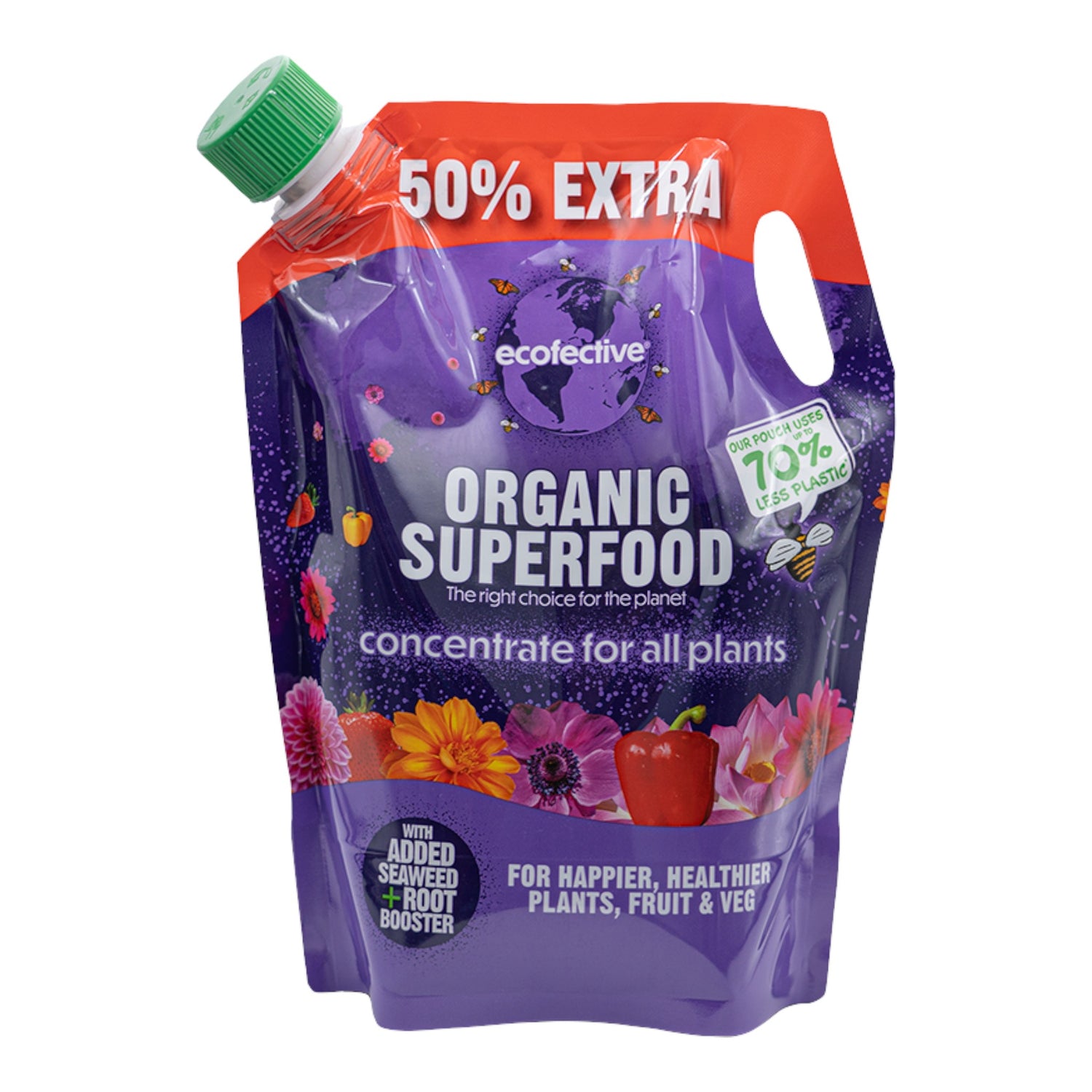
Unit price perEcofective Organic Superfood All Plants 1.2L is a concentrated organic liquid plant feed and root booster for flowers, fruit, vegetables and ornamental plants. This promotional 1.2 litre pouch contains 50% extra compared with the standard 800ml size, providing more of Ecofective's versatile all-purpose feed for regular garden use.
Designed to support happier, healthier plants, Organic Superfood provides an easy way to feed mixed planting with one versatile liquid fertiliser. It can be used across pots, containers, beds and borders and is suitable for plants grown indoors, outdoors or under glass.
The concentrated liquid formulation is diluted with water before application, delivering nutrition directly to the root zone. Ecofective combines its plant feed with ingredients designed to support root development, healthy growth and plant resilience.
Why choose Ecofective Organic Superfood?
1.2L promotional pack with 50% extra free
This special-value pack contains 1.2 litres of Organic Superfood, giving 50% more product than the regular 800ml pack.
The larger format is particularly useful during the main growing season when containers, flowering plants and productive crops require regular feeding. It provides the same convenient all-purpose approach while reducing how frequently another pack needs to be purchased.
For gardeners with a mixture of flowers, fruit and vegetables, the ability to use one general-purpose liquid feed across numerous plant types also helps simplify the feeding routine.
Liquid plant feed with root-boosting support
Healthy roots play an essential role in the uptake of water and nutrients. Ecofective Organic Superfood is designed not only to feed visible plant growth but also to support the root system below the surface.
This makes it useful for both established plants and plants that are actively developing through the growing season. Maintaining good root health helps plants make effective use of the water and nutrition available within their soil or compost.
Correct watering, suitable growing conditions and appropriate feeding should always work together. Organic Superfood provides the nutritional part of that routine in a convenient concentrated liquid format.
One feed for flowers, fruit & vegetables
Organic Superfood All Plants is intended as a broad all-purpose feed, making it particularly convenient for gardens containing many different plant types.
Its general-purpose formulation is especially useful where several different crops and ornamentals need feeding at the same time.
How to use Ecofective Organic Superfood All Plants
Shake the pack thoroughly before use. Measure the required amount of concentrated Organic Superfood into a watering can and dilute with water according to the current directions printed on the product packaging.
Apply the diluted feed around the base of the plant so that it reaches the active root zone. For best results, avoid allowing container compost to become excessively dry before feeding and maintain a regular watering routine appropriate for the plant and growing conditions.
Feeding requirements vary according to plant type, growth rate, season, container size and environmental conditions. Always follow the current manufacturer's application rate and feeding frequency shown on the pack.
Ideal for pots & container growing
Plants grown in containers have access to a limited volume of compost, so the nutrients initially present in the growing medium are gradually depleted as the plant develops.
Regular liquid feeding provides a practical way to replenish available nutrition without repotting the plant. Organic Superfood can therefore form part of the routine care programme for flowering containers, productive patio crops and other actively growing potted plants.
Always adjust watering to suit the weather and the individual crop. Containers can dry quickly during warm conditions, while overwatering can reduce the amount of oxygen available around the roots.
Ecofective Organic Superfood All Plants product details
| Brand | Ecofective |
|---|---|
| Product | Organic Superfood All Plants |
| Pack size | 1.2L |
| Promotional size | 50% extra free compared with the standard 800ml pack |
| Format | Concentrated liquid |
| Product type | Organic liquid plant feed and root booster |
| Suitable for | Flowers, fruit, vegetables and ornamental plants |
| Growing situations | Pots, containers, beds, borders and mixed planting |
| Application | Dilute with water and apply to the root zone in accordance with current pack directions |
| Outer case quantity | 6 x 1.2L pouches |
Ecofective Organic Superfood All Plants FAQs
What is Ecofective Organic Superfood All Plants?
It is a concentrated organic liquid plant feed and root booster designed for a wide range of flowers, fruit, vegetables and ornamental plants. How much product is in this promotional pack?
This pack contains 1.2 litres. That is 50% more product than the standard 800ml Organic Superfood pack. Can I use Organic Superfood on fruit and vegetables?
Yes. The All Plants formulation is designed for fruit and vegetable crops as well as flowers and other garden plants. Can it be used for plants in containers?
Yes. Liquid feeding is particularly useful for actively growing container plants because the nutrient supply within a limited volume of compost is gradually depleted. Is Ecofective Organic Superfood ready to use?
No. This is a concentrated liquid feed and should be diluted with water according to the current instructions supplied on the pack. Is Organic Superfood also a root booster?
Yes. The formulation is designed to provide plant nutrition while supporting healthy root development. Can I use the same feed across a mixed garden?
Yes. One of the main advantages of the All Plants formulation is its versatility across flowers, fruit, vegetables, ornamentals, containers, beds and borders. How many 1.2L pouches are supplied in an outer case?
This SKU is supplied in an outer case quantity of 6 x 1.2L pouches.


£4.35
Unit price per£4.35
Unit price perEcofective Organic Superfood All Plants 800g is a 6-in-1 pelleted organic plant food formulated to support healthier plants, stronger roots, brighter flowers and productive fruit and vegetable crops. With an NPK of 4.3-3.95-2.5, the slow-release feed combines essential nutrients with natural biostimulants, magnesium and organic matter for long-lasting plant support.
Designed as a versatile feed for virtually every part of the garden, Organic Superfood can be used when potting seedlings, filling containers, transplanting flowers, fruit and vegetables, feeding established pots or nourishing plants growing directly in beds and borders.
Unlike a straightforward NPK fertiliser, the formulation combines plant nutrition with ingredients designed to support the wider growing environment. Ecofective highlights improved root development, better water retention and increased resilience during stressful conditions such as heat, drought and overwatering.
Why choose Ecofective Organic Superfood?
6-in-1 nutrition for healthier plants
Ecofective Organic Superfood is designed to do more than simply provide basic plant nutrition. Its 6-in-1 approach combines slow-release feeding with biostimulants and organic matter to support several aspects of plant performance.
The manufacturer highlights benefits including stronger root development, improved moisture retention, support during environmental stress and the production of healthier plants, fruit and flowers.
This makes the pellets particularly useful as an all-round garden feed where one product is required across multiple plant types rather than maintaining separate fertilisers for every planting area.
Balanced NPK 4.3-3.95-2.5 plant nutrition
Organic Superfood All Plants has an NPK analysis of 4.3-3.95-2.5, providing the three primary macronutrients required for healthy plant growth.
The formulation also contains magnesium, natural biostimulants and organic matter, creating a broader nutritional package than NPK alone.
One organic feed for flowers, fruit & vegetables
Organic Superfood is designed as a genuine all-purpose garden feed and can be incorporated into a wide range of planting and maintenance routines.
The pellet format makes the product easy to distribute through compost or soil when planting, or to work gently into the surface around established plants before watering.
How to use Ecofective Organic Superfood
Potting up seedlings
Mix 2 tablespoons (30ml) into every 3 litres of potting compost, then water lightly.
Potting into plant pots & containers
Mix 2 tablespoons (30ml) into every 3 litres of soil or compost. Mix thoroughly, add the plant and water gently. After four weeks, add a further 1/2 tablespoon to the top layer and water in.
Transplanting flowers, shrubs & trees
Sprinkle the pellets into the planting hole before transplanting, then water the plant in:
Established pots & containers
For an established 1 litre pot, add 1/2 tablespoon (7.5ml) to the top layer of soil or compost, gently work it in and water. Repeat after four weeks. For larger pots, increase the quantity by 7.5ml for each additional litre of pot volume.
Always refer to the current product packaging before application, particularly when feeding sensitive plants or changing pot and container sizes.
Supports roots, moisture management & plant resilience
Strong plant performance starts below the surface. Ecofective specifically formulates Organic Superfood to help improve root development, giving plants a stronger foundation from which to establish and grow.
The formulation also helps improve water retention within the growing medium. This can support more consistent moisture availability around the root zone, particularly useful for container plants where compost can dry more quickly than open ground.
Ecofective also identifies increased plant support during stressful growing conditions including heat, drought and overwatering. Good watering and plant-care practices remain important, but the feed is designed to support plants when growing conditions become less favourable.
Organic nutrition with a more sustainable approach
Ecofective Organic Superfood is manufactured using a process designed to reduce its carbon footprint and avoid harmful gas emissions including methane and ammonium.
The result is a slow-release organic plant food intended to combine effective garden nutrition with Ecofective's wider focus on environmentally considerate garden care.
Ecofective Organic Superfood All Plants product details
| Brand | Ecofective |
|---|---|
| Product | Organic Superfood All Plants |
| Pack size | 800g |
| Format | Pellets |
| Product type | 6-in-1 organic plant food and booster |
| NPK | 4.3-3.95-2.5 |
| Additional components | Natural biostimulants, magnesium and organic matter |
| Nutrient release | Slow release |
| Suitable for | Flowers, fruit, vegetables, shrubs, trees, pots, containers, beds and borders |
| Key benefits | Plant nutrition, improved root development, improved water retention and support during stressful growing conditions |
| Outer case quantity | 5 x 800g packs |
Ecofective Organic Superfood All Plants FAQs
What plants can I feed with Ecofective Organic Superfood?
It is an all-purpose feed suitable for a wide range of plants, including flowers, fruit, vegetables, shrubs, trees and plants grown in pots and containers. What is the NPK of Ecofective Organic Superfood?
The pelleted Organic Superfood has an NPK analysis of 4.3-3.95-2.5 and also contains magnesium, natural biostimulants and organic matter. Is Organic Superfood a slow-release plant food?
Yes. Ecofective describes the pellets as providing slow-release nutrients for longer-lasting plant support. Can I use it when transplanting shrubs and trees?
Yes. Ecofective provides specific application guidance for flowers, shrubs and trees when transplanting, making the pellets useful for both routine feeding and new planting. Can it be used in pots and containers?
Yes. It can be mixed into compost when potting or applied as a surface feed to established container plants. Does Organic Superfood contain biostimulants?
Yes. Natural biostimulants form part of the 6-in-1 formulation alongside NPK nutrients, magnesium and organic matter. How often should established container plants be fed?
For established pots and containers, Ecofective instructs users to apply the appropriate quantity to the top layer of compost, water it in and repeat after four weeks. How many 800g packs are supplied per outer case?
This SKU is supplied in an outer case quantity of 5 x 800g packs.

£4.92
Unit price per£4.92
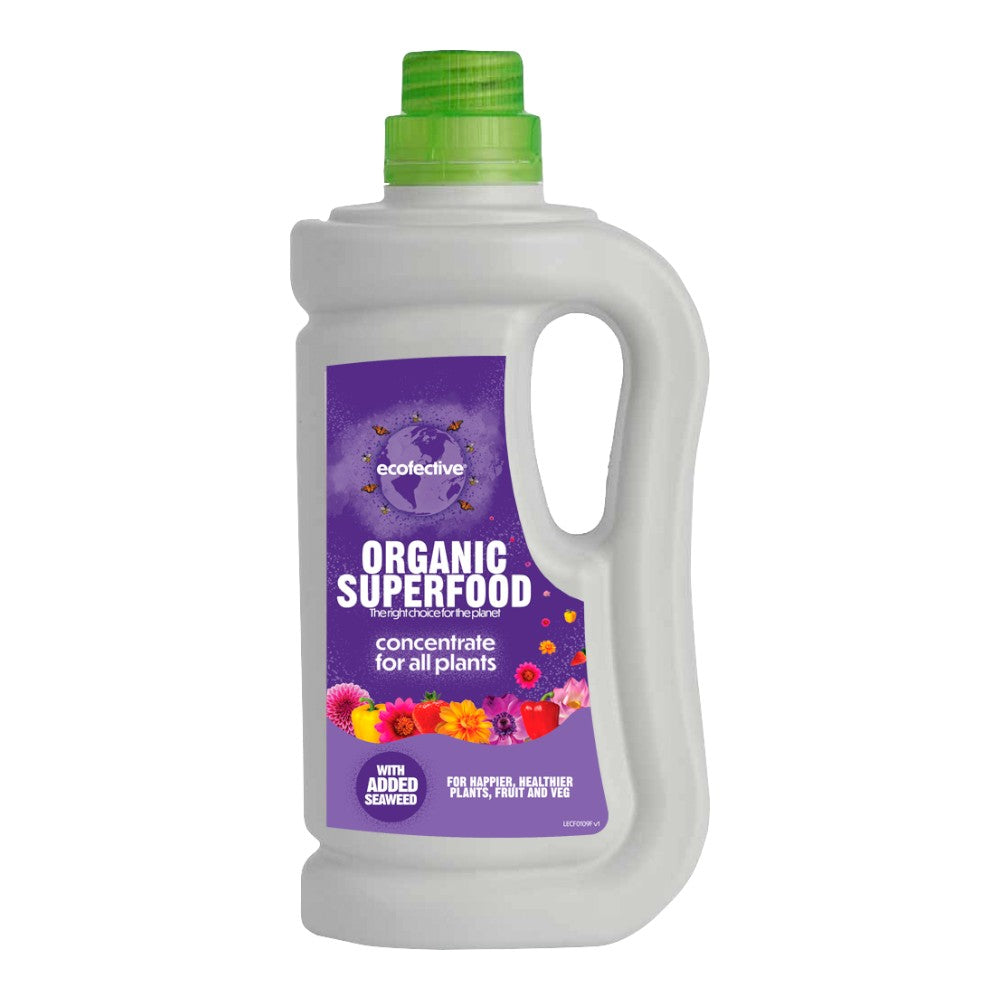
Unit price perEcofective Organic Superfood All Plants 800ml is a concentrated organic liquid plant feed with added seaweed and a root booster, developed for healthier plants, brighter flowers and productive fruit and vegetable crops. Suitable for a wide range of plants, it combines natural nutrition with ingredients that support root development, plant resilience and healthy growth.
Designed as an easy all-round feed for the garden, Organic Superfood can be used for plants grown indoors, outdoors or under glass. The concentrated liquid is diluted into water before application and fed directly into the root zone, making it suitable for regular feeding throughout the growing season.
Ecofective produces Organic Superfood using nutrient-rich digestate originating from a UK farm. The formulation is enhanced with organic seaweed and natural humic acids, creating a liquid feed designed to support both plant and soil health.
Why choose Ecofective Organic Superfood?
Seaweed, natural humic acids & plant nutrition
Organic Superfood is more than a basic liquid fertiliser. Its nutrient base originates as a byproduct of anaerobic digestion, where organic material is broken down by microorganisms to produce biogas and nutrient-rich digestate.
Ecofective uses this digestate as the nutritional foundation of Organic Superfood before enhancing the formulation with organic seaweed and natural humic acids. Humic substances are naturally associated with organic materials such as traditional farm manure and are included to support plant and soil health.
The resulting concentrated feed provides a straightforward way to supply plants with nutrition while also supporting the root environment and overall plant development.
Supports root development & plant resilience
Healthy root development is essential for efficient uptake of both water and nutrients. Ecofective specifically identifies improved root development as one of the benefits of Organic Superfood, making it useful for newly established plants as well as ongoing feeding.
The formulation is also designed to support plants during periods of environmental stress, including heat, drought and overwatering. This does not replace correct watering and plant care, but provides nutritional support that can help plants maintain healthy growth when conditions become challenging.
Improved water retention is another key feature, helping support a more consistent root-zone environment for plants grown in soil and compost.
One liquid feed for plants, fruit & vegetables
Organic Superfood All Plants is designed as a versatile general-purpose feed rather than a fertiliser restricted to one particular crop.
Its broad suitability makes it a convenient option for gardeners who want one regular liquid feed for mixed planting rather than several different general-purpose fertilisers.
How to use Ecofective Organic Superfood All Plants
Shake the container before opening. Add 25ml of Organic Superfood to 4.5 litres of water in a watering can fitted with a fine rose and mix thoroughly.
Apply the diluted feed to the base of plants while the growing medium is already moist, ensuring the root area is thoroughly watered. The same dilution can also be applied using a suitable sprayer.
Ecofective recommends feeding every 10 days for plants grown indoors, outdoors or under glass.
Apply out of direct sunlight, preferably during the early morning or late evening, and avoid applying the feed directly to foliage.
At the standard 25ml per 4.5L dilution rate, an 800ml container provides approximately 32 measured doses, although Ecofective's published product information describes the 800ml format as making up to approximately 26 watering cans. Always follow the current directions printed on the product supplied.
Plant nutrition with a more sustainable approach
The nutrient-rich digestate used to produce Organic Superfood originates as a byproduct of anaerobic digestion on a UK farm. This process breaks down organic matter without oxygen, producing biogas alongside digestate that can be used as a natural fertiliser.
Ecofective developed the Organic Superfood range as an alternative that makes productive use of this nutrient-rich material while reducing reliance on purely synthetic fertiliser inputs.
This combination of plant nutrition, organic seaweed, natural humic acids and a more circular source of fertiliser makes Organic Superfood particularly relevant for gardeners looking to combine productive growing with more environmentally considered garden care.
Ecofective Organic Superfood All Plants product details
| Brand | Ecofective |
|---|---|
| Product | Organic Superfood All Plants |
| Pack size | 800ml |
| Format | Concentrated liquid plant feed |
| Feed type | Organic liquid feed and root booster |
| Enhanced with | Organic seaweed and natural humic acids |
| Suitable for | Flowers, fruit, vegetables and a broad range of indoor and outdoor plants |
| Standard dilution | 25ml per 4.5L water |
| Feeding frequency | Every 10 days for plants grown indoors, outdoors or under glass |
| Application | Apply diluted feed to the base of plants while the growing medium is moist |
| Suitable for organic growing | Yes |
| Product code | ECF0109 |
| Outer case quantity | 6 x 800ml bottles |
Ecofective Organic Superfood All Plants FAQs
What plants can I use Ecofective Organic Superfood on?
It is designed as an all-purpose feed for a broad range of plants, including flowers, fruit, vegetables and ornamental plants grown indoors, outdoors or under glass. Does Organic Superfood contain seaweed?
Yes. Ecofective enhances the liquid feed with organic seaweed as well as naturally occurring humic acids to support plant and soil health. Is Organic Superfood a root booster?
Yes. Improved root development is one of the key benefits identified by Ecofective for its All Plants Organic Superfood formulation. How often should I use Ecofective Organic Superfood?
For general use, Ecofective recommends feeding plants every 10 days. Apply to moist growing media and avoid feeding in strong direct sunlight. Can Organic Superfood be used on fruit and vegetables?
Yes. The All Plants formulation is specifically designed for flowers, fruit and vegetables as well as other garden plants. Is it suitable for organic growing?
Yes. Ecofective identifies Organic Superfood All Plants as suitable for organic growing. What is the difference between the liquid and pelleted Organic Superfood?
This 800ml product is a concentrated liquid feed diluted into irrigation water for regular root-zone feeding. The pelleted version is a dry slow-release feed incorporated into soil or compost or applied around established plants. How many 800ml bottles are supplied in an outer case?
This SKU is supplied in an outer case quantity of 6 x 800ml bottles.


£4.35
Unit price per£4.35
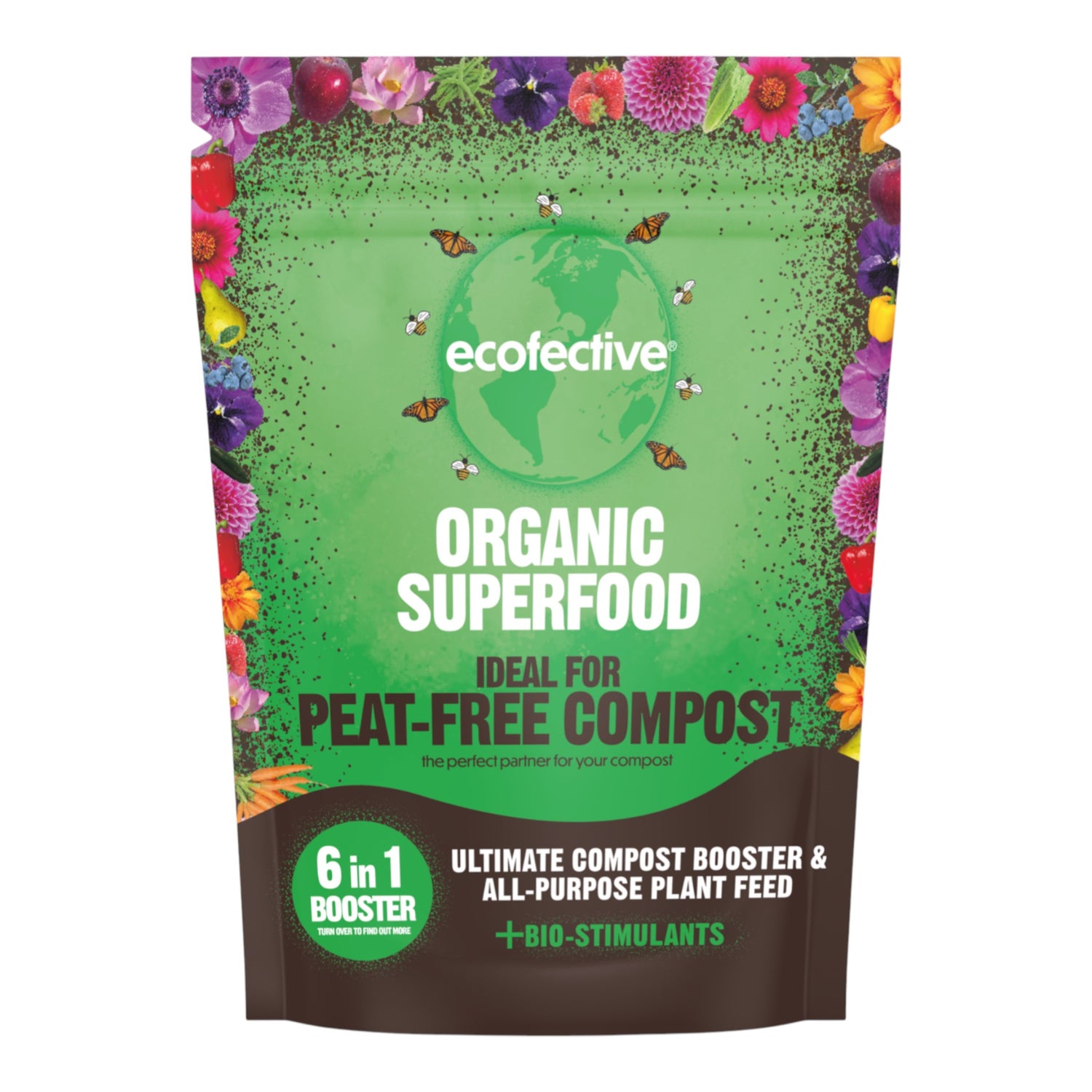
Unit price perEcofective Organic Superfood for Peat-Free Compost 800g is a concentrated 6-in-1 plant food and compost booster developed specifically to improve the performance of peat-free growing media. Combining plant nutrients with biostimulants, it helps replenish compost, support stronger plant growth and get more from peat-free pots and containers throughout the growing season.
Peat-free compost is now widely used for container growing, but plants can gradually use up the nutrients available within the growing medium. Ecofective Organic Superfood provides a simple way to supplement tired or depleted compost rather than automatically replacing it.
The powdered formulation is designed to be mixed into peat-free compost, delivering a combination of plant nutrition and biostimulant ingredients to support healthy growth. It can be used when planting into fresh peat-free compost or to reinvigorate compost that has already been used.
Why choose Ecofective Organic Superfood?
Designed specifically for peat-free compost
Peat-free composts use alternative materials to provide the structure, moisture management and root environment required by plants. As with any container growing medium, however, the nutrients initially available within the compost are gradually consumed by the plant or lost through repeated watering.
Ecofective Organic Superfood has been developed specifically with peat-free compost performance in mind. Rather than treating the compost simply as something to discard once its initial nutrient charge has been used, the booster allows additional nutrition and biostimulants to be incorporated into the growing medium.
This makes it particularly useful for gardeners moving towards peat-free growing while still wanting vigorous, healthy plants and productive containers.
6-in-1 compost booster
Organic Superfood combines multiple functions in one powdered treatment. Its 6-in-1 approach is designed to provide more than a straightforward feed, supporting both the plant and the growing medium in which it is growing.
The formulation combines nutrients with biostimulants, helping provide the resources plants need for healthy growth while supporting the performance of peat-free compost.
For container gardeners, this provides a convenient way to supplement peat-free compost without needing several separate additives.
Give peat-free compost another life
One of the most useful applications for Organic Superfood is the revitalisation of previously used peat-free compost.
Compost does not necessarily become physically unusable simply because a previous crop has consumed much of its available nutrition. Where the compost remains in suitable condition, adding fresh nutrients and organic inputs can help prepare it for further growing.
Remove old roots and unwanted plant material, check that the compost remains in good physical condition, then incorporate Organic Superfood according to the current pack directions.
Compost previously used for diseased plants should not automatically be reused for new planting. Good hygiene and an assessment of the condition of the growing medium remain important.
Ideal for pots, containers & peat-free growing
Ecofective Organic Superfood is particularly useful wherever plants are being grown in peat-free compost and additional nutrition is required.
Its powdered format allows the product to be mixed through the compost rather than simply remaining concentrated on the surface.
How to use Organic Superfood for Peat-Free Compost
Ecofective Organic Superfood is designed to be incorporated into peat-free compost. Distribute the powder evenly through the growing medium according to the current application instructions supplied with the pack.
When refreshing previously used compost, remove old roots and plant debris first. Break up compacted material and check the condition of the compost before incorporating the booster thoroughly.
After planting, water appropriately for the crop and container. Peat-free compost can behave differently from traditional peat-based media, so assess moisture within the root zone rather than relying solely on the appearance of the compost surface.
Always follow the current manufacturer's application rate on the packaging rather than exceeding the recommended quantity.
Supporting more sustainable peat-free growing
Moving away from peat is only one part of reducing the environmental impact associated with container gardening. Making effective use of growing media for as long as practical can also help reduce unnecessary waste.
Organic Superfood has been developed to help gardeners get more from peat-free compost by replenishing nutrients and supporting continued plant growth. Where compost remains healthy and structurally suitable, refreshing it can reduce the need to discard and replace the entire growing medium.
Ecofective Organic Superfood product details
| Brand | Ecofective |
|---|---|
| Product | Organic Superfood for Peat-Free Compost |
| Pack size | 800g |
| Format | Powder |
| Product type | 6-in-1 plant food and compost booster |
| Designed for | Peat-free compost |
| Key function | Boosts and replenishes peat-free growing media |
| Biostimulants | Yes |
| Suitable uses | Fresh peat-free compost and suitable previously used peat-free compost |
| Application areas | Pots, containers, planters, hanging baskets and other peat-free container growing applications |
| Outer case quantity | 6 x 800g pouches |
Ecofective Organic Superfood FAQs
What is Ecofective Organic Superfood for Peat-Free Compost?
It is a concentrated 6-in-1 powdered plant food and compost booster developed specifically to improve and replenish peat-free growing media. Can I use Organic Superfood to refresh old peat-free compost?
Yes. One of its key uses is revitalising suitable previously used peat-free compost by adding fresh nutrition and biostimulants. Remove old roots and debris and only reuse compost that remains in good condition. Does Ecofective Organic Superfood contain biostimulants?
Yes. The 6-in-1 formulation includes biostimulants alongside plant nutrition to support healthy plant development and peat-free compost performance. Can it be used when planting into new peat-free compost?
It can be used to boost peat-free compost as well as to replenish suitable previously used growing media. Follow the current application directions supplied with the product. Is it suitable for pots and containers?
Yes. Organic Superfood is particularly useful for plants grown in peat-free compost in pots, containers, planters and hanging baskets. Can all old compost be reused?
No. Check the condition of previously used compost before reusing it. Growing media associated with significant plant disease or other problems may be unsuitable for immediate reuse, and heavily degraded compost may need replacing or blending with fresh material. Why does peat-free compost need additional feeding?
Plants gradually consume the nutrients available in container compost, while repeated watering can also reduce nutrient reserves. Supplementary feeding helps maintain nutrition as plants continue to grow. How many 800g pouches are supplied in an outer case?
Ecofective Organic Superfood for Peat-Free Compost 800g is supplied in an outer case quantity of 6.

£4.92
Unit price per£4.92
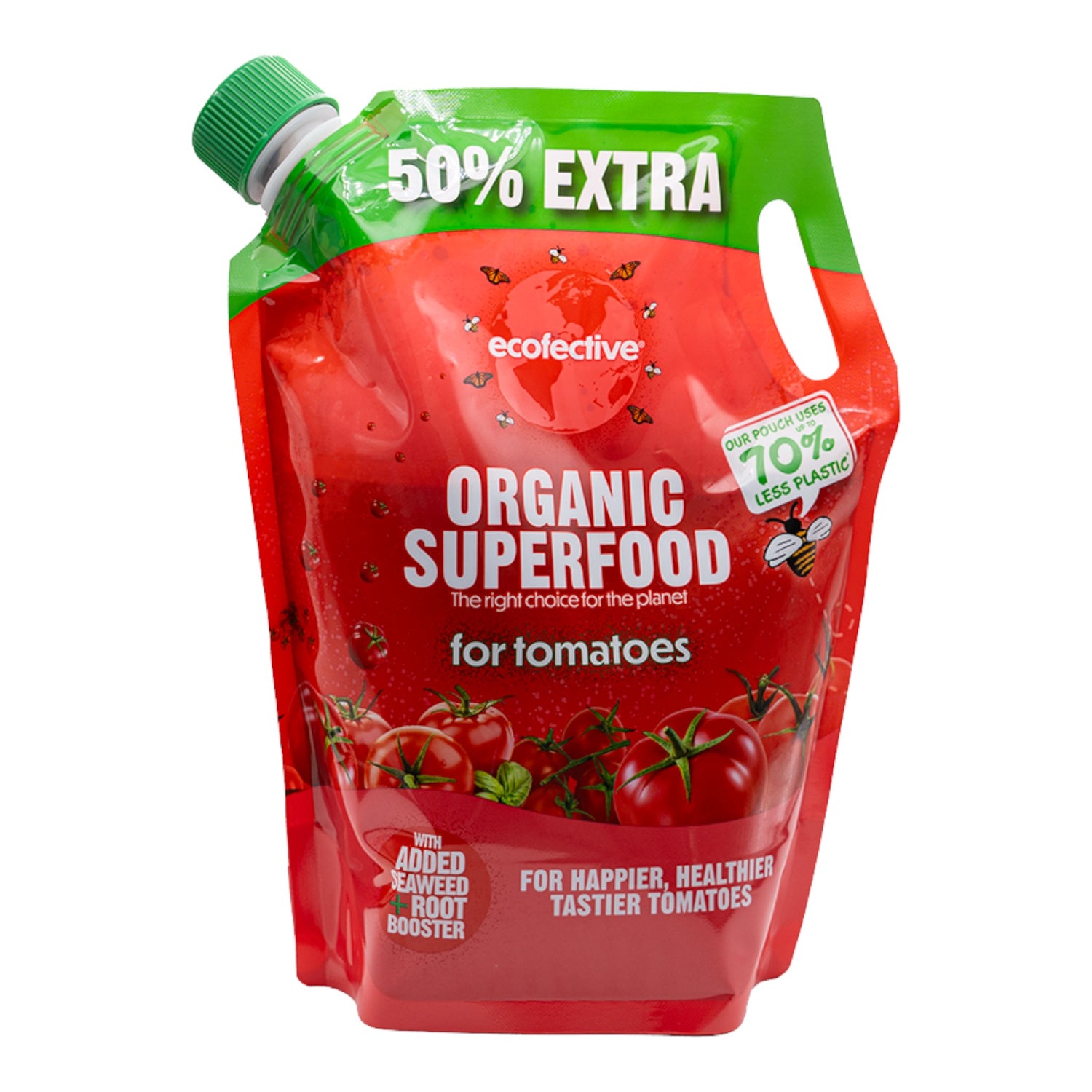
Unit price perEcofective Organic Superfood for Tomatoes 1.2L is a concentrated organic liquid tomato feed and root booster developed to support healthier plants and productive tomato crops. This promotional pouch contains 50% extra compared with the standard 800ml size, providing 1.2 litres of specialist tomato nutrition for regular feeding throughout flowering and fruit development.
Designed specifically for tomatoes, the concentrated feed supports healthy root development, vigorous plant growth and productive cropping. It is suitable for tomatoes grown outdoors, under glass, in containers, grow bags and other common tomato-growing systems.
The formulation combines plant nutrition with ingredients designed to support the root environment and overall plant health, making it a convenient feeding solution throughout the demanding fruiting stage.
Why choose Ecofective Organic Superfood for Tomatoes?
1.2L promotional pouch with 50% extra free
This promotional pack contains 1.2 litres of Organic Superfood for Tomatoes, compared with 800ml in the standard pack. That gives you an additional 400ml of concentrated feed, equivalent to 50% extra.
Tomatoes can require regular feeding for an extended period once flowering and fruiting begin, so the larger pouch is particularly practical for gardeners growing several plants or maintaining a productive greenhouse crop.
Specialist nutrition for flowering & fruiting tomatoes
Tomato plants become increasingly demanding as they move from vegetative growth into flowering and fruit production. At this stage, the plant must maintain healthy leaves and roots while supporting developing fruit across multiple trusses.
Ecofective Organic Superfood for Tomatoes is designed specifically for this stage of the crop cycle, providing a convenient source of nutrition that can be incorporated into a regular watering and feeding programme.
Consistent feeding is particularly important for container and grow bag tomatoes because the roots have access to a limited volume of growing medium. As plants develop, the nutrients originally present in the compost are gradually used, making supplementary feeding increasingly important.
Root-boosting support for healthy plants
A productive tomato crop depends on a healthy root system capable of taking up water and available nutrients efficiently. Organic Superfood for Tomatoes combines its feeding function with root-boosting support to help maintain strong plant development.
Healthy roots are especially important during fruiting, when tomato plants have substantial requirements for both water and nutrition. Maintaining consistent moisture alongside an appropriate feeding programme helps provide the stable root environment needed for continued growth and fruit development.
Suitable for greenhouse, outdoor & grow bag tomatoes
Ecofective Organic Superfood for Tomatoes can be used across the most common methods of growing tomatoes, making it suitable for home gardeners with anything from a few patio plants to a larger greenhouse crop.
Feeding frequency and concentration should always be adjusted in accordance with the current manufacturer's directions for the particular growing method and crop stage.
How to use Ecofective Organic Superfood for Tomatoes
Shake the pouch thoroughly before use. Dilute the concentrated feed with water according to the current application instructions printed on the product packaging.
Apply the diluted feed around the base of the tomato plant so that it reaches the active root zone. Avoid repeatedly allowing container compost or grow bags to dry excessively between watering, particularly when plants are carrying a developing fruit crop.
Tomato feeding is normally linked to flowering and fruit development rather than simply the age of the plant. Follow the current Ecofective pack directions for the correct point to begin feeding and for the appropriate frequency for greenhouse, outdoor and grow bag crops.
Getting the best from your tomato crop
Plant food works best as part of a complete tomato-growing routine. Tomatoes benefit from consistent watering, adequate light, healthy airflow and regular monitoring as flowers and fruit develop.
Pay particular attention to watering once plants are carrying fruit. Large swings between very dry and very wet compost can place unnecessary stress on the crop. Regular watering combined with an appropriate feeding programme provides a more consistent environment for root activity and fruit development.
Feeding should also be matched to plant performance. Variety, temperature, light levels, container volume and crop load can all affect how quickly an individual tomato plant grows and uses available nutrients.
Ecofective Organic Superfood for Tomatoes product details
| Brand | Ecofective |
|---|---|
| Product | Organic Superfood for Tomatoes |
| Pack size | 1.2L |
| Promotional size | 50% extra free compared with the standard 800ml pack |
| Extra product | 400ml additional concentrate |
| Format | Concentrated liquid plant feed |
| Product type | Organic tomato feed and root booster |
| Suitable for | Tomato plants during flowering and fruit development |
| Growing situations | Greenhouse, outdoor, pots, containers and grow bags |
| Application | Dilute with water and apply to the root zone according to current pack directions |
| Outer case quantity | 6 x 1.2L pouches |
Ecofective Organic Superfood for Tomatoes FAQs
What is Ecofective Organic Superfood for Tomatoes?
It is a concentrated liquid tomato feed and root booster developed specifically to support healthy plants through flowering and fruit production. How much is in the 50% extra free pouch?
The promotional pouch contains 1.2 litres, which is 400ml more than the standard 800ml pack and therefore provides 50% extra product. Can I use it on tomatoes grown in a greenhouse?
Yes. The feed is suitable for greenhouse and under-glass tomato crops as well as tomatoes grown outdoors. Can Ecofective Tomato Superfood be used in grow bags?
Yes. It is suitable for grow bag tomatoes. Follow the current pack directions for the appropriate dilution and feeding frequency for this growing method. When should I start feeding tomato plants?
Feeding should be linked to the flowering and fruiting stage of the crop. Follow the current Ecofective instructions for greenhouse, outdoor or grow bag tomatoes rather than feeding purely according to plant age. Is this a ready-to-use tomato feed?
No. Organic Superfood for Tomatoes is a concentrated liquid feed and should be diluted with water according to the manufacturer's current directions before application. What is the difference between the 800ml and 1.2L Tomato Organic Superfood?
The 1.2L pouch is the 50% extra promotional format. It contains an additional 400ml compared with the standard 800ml pack. How many 1.2L pouches are supplied per outer case?
This SKU is supplied in an outer case quantity of 6 x 1.2L pouches.


£4.92
Unit price per£4.92
Unit price perEcofective Organic Superfood for Tomatoes 800ml is a concentrated organic tomato feed with added seaweed and root-boosting support, developed for happier, healthier and tastier tomatoes. The specialist liquid feed promotes greener, healthier plants, supports improved root development and is formulated to help increase crop yield.
Designed specifically around the demands of tomato plants, Organic Superfood provides regular nutrition from flowering through fruit development. It can be used with greenhouse-grown and outdoor tomatoes as well as plants grown in grow bags or ring culture.
The formulation is based on nutrient-rich digestate originating from a UK farm and is enhanced with organic seaweed and natural humic acids. This combination provides plant nutrition while supporting healthy roots, plant resilience and the wider root environment.
Why choose Ecofective Organic Superfood for Tomatoes?
Organic tomato nutrition with seaweed & humic acids
Ecofective Organic Superfood for Tomatoes starts with nutrient-rich digestate originating from a UK farm. Digestate is produced as a byproduct of anaerobic digestion, where microorganisms break down organic matter without oxygen to produce biogas and a nutrient-containing material suitable for use as a natural fertiliser.
Ecofective enhances this nutritional base with organic seaweed and natural humic acids. The resulting concentrate is designed to provide tomato plants with effective nutrition while also supporting root development and plant health.
This is particularly useful for tomatoes because their nutritional demands increase significantly once flowering and fruit production begin.
Suitable for greenhouse, outdoor & grow bag tomatoes
Organic Superfood for Tomatoes can be incorporated into several common tomato-growing systems, with Ecofective providing different feeding schedules according to how and where the crop is grown.
The concentrated format means the feed strength and frequency can be adjusted according to the manufacturer's directions for the particular growing system.
How to use Ecofective Organic Superfood for Tomatoes
Shake well before use. For the standard dilution, add 25ml to 4.5 litres of water in a watering can fitted with a fine rose. Mix thoroughly and apply around the base of plants while the growing medium is already moist, ensuring the root area is thoroughly watered.
A 4.5 litre watering can of diluted feed will treat up to 9 tomato plants. The same dilution can also be applied using a suitable sprayer.
Greenhouse-grown tomatoes
Once the first truss has set and is flowering, apply the standard feed every 7 days and continue until the end of fruiting.
Outdoor-grown tomatoes
Begin feeding when the second truss has set, then apply every 10 days.
Grow bags & ring culture
Ecofective recommends using the feed at double strength every 7 days for tomatoes grown in grow bags or ring culture.
For higher-yield feeding
For greenhouse plants, grow bags and ring culture, Ecofective advises using the product at double strength every 3-4 days where a higher-yield feeding programme is required. For outdoor-grown tomatoes, the manufacturer's higher-yield programme uses double strength every 5-7 days.
Apply out of direct sunlight, preferably during the early morning or late evening, and avoid applying directly to the foliage. Always check the current pack directions before use.
Why tomato feeding starts after fruit trusses develop
Tomatoes have different nutritional requirements as they progress from early vegetative growth into flowering and fruit production. Once fruit trusses begin to set, the plant must support continued foliage and root growth while simultaneously developing an increasing crop of tomatoes.
Ecofective therefore bases its feeding schedule around truss development rather than a fixed number of weeks. This makes the instructions more relevant to the actual growth stage of the plant and allows for differences caused by variety, temperature and growing conditions.
Supports tomatoes during demanding growing conditions
Tomato plants can be particularly responsive to changes in temperature and moisture. Ecofective formulates Organic Superfood to support plants during stressful conditions including heat, drought and overwatering.
The feed is also designed to strengthen the plant and help it resist disease attack. Good ventilation, correct watering, suitable temperatures and regular crop inspection remain important parts of tomato cultivation, with nutrition forming one part of an effective overall growing programme.
Ecofective Organic Superfood for Tomatoes product details
| Brand | Ecofective |
|---|---|
| Product | Organic Superfood for Tomatoes |
| Pack size | 800ml |
| Format | Concentrated liquid tomato feed |
| Enhanced with | Organic seaweed and natural humic acids |
| Suitable for | Greenhouse, outdoor, container, grow bag and ring-culture tomatoes |
| Standard dilution | 25ml per 4.5L water |
| Coverage per 4.5L | Up to 9 tomato plants |
| Key benefits | Plant nutrition, root development, healthier growth, plant resilience and support for productive cropping |
| Vegan friendly | Yes |
| Outer case quantity | 6 x 800ml bottles |
Ecofective Organic Superfood for Tomatoes FAQs
When should I start feeding greenhouse tomatoes?
Ecofective recommends beginning once the first truss has set and is flowering, then feeding every 7 days until the end of fruiting. When should outdoor tomato plants be fed?
For outdoor-grown tomatoes, begin feeding when the second truss has set and then feed every 10 days according to the manufacturer's standard programme. Can I use Ecofective Tomato Superfood in grow bags?
Yes. It is suitable for grow bags and ring culture. Ecofective provides a stronger feeding programme specifically for these growing methods. Does this tomato feed contain seaweed?
Yes. The formulation is enhanced with organic seaweed and natural humic acids as part of its approach to plant and root health. Does it help tomato root development?
Yes. Improved root development is one of the key benefits identified by Ecofective for Organic Superfood for Tomatoes. Is Ecofective Organic Superfood for Tomatoes vegan friendly?
Yes. Ecofective identifies the tomato formulation as vegan friendly. What is the difference between Tomato Organic Superfood and All Plants Organic Superfood?
The Tomato version has a feeding programme specifically designed around tomato flowering, truss development and fruit production. All Plants Organic Superfood is a broader general-purpose feed for mixed flowers, fruit, vegetables and ornamental plants. How many 800ml bottles are supplied per outer case?
This SKU is supplied in an outer case quantity of 6 x 800ml bottles.


£4.35
Unit price per£4.35
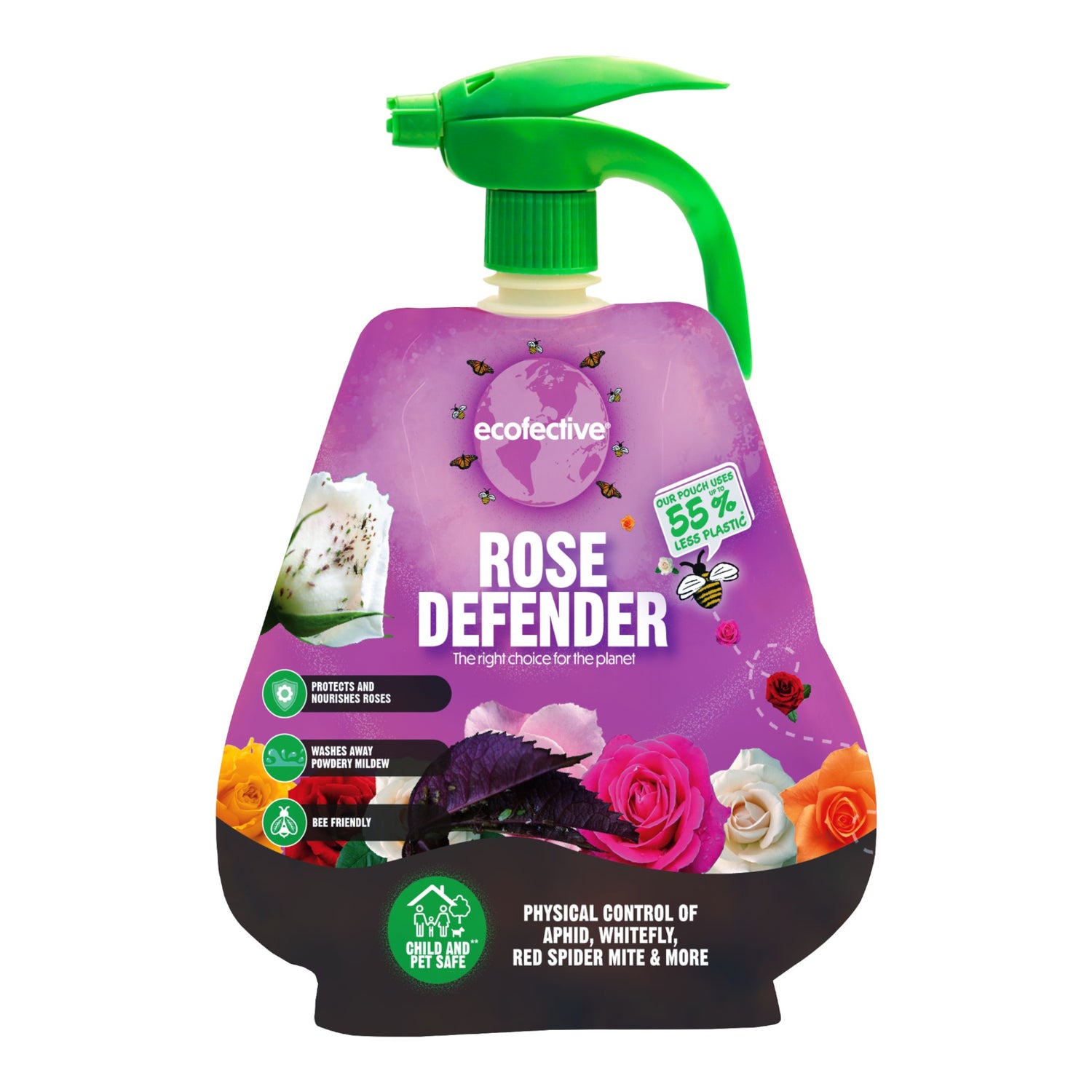
Unit price perEcofective Rose Defender 1L is a pesticide-free, ready-to-use spray providing physical control of common rose pests including aphids, whitefly and red spider mite while also helping to control powdery mildew by washing spores from the foliage. The formula also contains nutrients to support healthy, vibrant roses.
Rather than relying on a conventional pesticide, Rose Defender works through a physical mode of action. Its surfactant-based formulation acts directly on pests, making it a useful option for gardeners looking to reduce their reliance on conventional pesticide chemistry.
Rose Defender is supplied ready to use in Ecofective's flexible 1 litre trigger pouch, so there is no measuring, mixing or dilution required. The pouch uses up to 55% less plastic than a traditional rigid bottle and incorporates an ergonomic thumb-pump trigger for straightforward one-handed spraying.
Why choose Ecofective Rose Defender?
What does Rose Defender control?
Ecofective Rose Defender provides physical control of several common plant pests. The manufacturer's current information specifically identifies:
Because the product acts physically, thorough spray coverage is important. Pay particular attention to areas where pests are present, including the undersides of leaves.
Rose pest control & powdery mildew care in one spray
Rose Defender is more than an insect-control spray. With regular use, it can also help manage powdery mildew by physically washing active mildew spores from the foliage.
This makes it particularly useful for roses affected by both sap-feeding pests and powdery mildew, providing a straightforward addition to regular plant-care routines without requiring separate pesticide and mildew treatments for the listed applications.
How does pesticide-free Rose Defender work?
Rose Defender contains a blend of surfactants and works through a physical mode of action. The formulation acts directly on susceptible pests, restricting their movement and ability to feed.
This physical approach distinguishes Rose Defender from conventional pesticide products and makes thorough contact with the target pest important for effective treatment.
The formulation simultaneously helps remove active powdery mildew spores from plant surfaces while supplying foliar nutrients to the plant.
How to use Ecofective Rose Defender
Rose Defender is supplied ready to use and should not be diluted.
Good coverage is particularly important with a physical-control product because the spray needs to reach the pests being targeted.
Is Rose Defender only for roses?
Despite its name, Ecofective's formulation is not restricted solely to roses. Manufacturer information also identifies it for use on other flowers, shrubs and vegetables.
This makes the product useful where similar susceptible pests occur elsewhere in the garden, while its added nutrients provide foliar nourishment to support healthy plant growth.
Always follow the current pack instructions for the plants being treated.
Flexible pouch with up to 55% less plastic
Ecofective has moved Rose Defender into a flexible trigger pouch designed to reduce packaging material. According to Ecofective, the pouch uses up to 55% less plastic than a traditional rigid bottle.
The pouch is also more compact and lightweight than a conventional rigid container, helping reduce the amount of material required for each 1 litre ready-to-use pack.
An ergonomic thumb-pump trigger provides one-handed application directly from the pouch.
Ecofective Rose Defender 1L product details
| Brand | Ecofective |
|---|---|
| Product | Rose Defender |
| Pack size | 1L |
| Format | Ready-to-use trigger pouch |
| Dilution required | No |
| Control method | Pesticide-free physical mode of action |
| Target pests | Aphids, whitefly, red spider mite, mealybug, scale insects, psyllids and other susceptible pests |
| Powdery mildew | Helps control powdery mildew by physically washing active spores from foliage |
| Plant nutrition | Contains nutrients to support plant growth |
| Suitable plants | Roses, other flowers, shrubs and vegetables |
| Packaging | Flexible pouch using up to 55% less plastic than a traditional rigid bottle |
| Application frequency | Reapply weekly for continued pest control |
| Outer case quantity | 6 x 1L pouches |
Ecofective Rose Defender FAQs
Is Ecofective Rose Defender a pesticide?
No. Ecofective describes Rose Defender as pesticide-free. It uses a physical mode of action to control susceptible pests rather than relying on conventional pesticide chemistry. Which pests does Rose Defender control?
Manufacturer information identifies aphids, whitefly, red spider mite, mealybug, scale insects and psyllids among the pests controlled by Rose Defender. Does Rose Defender help with powdery mildew?
Yes. With regular use, Rose Defender helps control powdery mildew by physically washing active mildew spores from the foliage. Do I need to dilute Rose Defender?
No. The 1L trigger pouch is supplied ready to use. Shake the pouch before application and spray directly onto the plant according to the instructions. How often should I apply Ecofective Rose Defender?
Ecofective recommends reapplying weekly to maintain control of susceptible pests. Thoroughly cover both the upper and lower surfaces of the leaves. Can Rose Defender be used on plants other than roses?
Yes. Ecofective states that the formulation can also be used on other flowers, shrubs and vegetables. Always follow the current instructions supplied with the product. Is Ecofective Rose Defender safe around children and pets?
Ecofective describes Rose Defender as child and pet safe when used as directed. As with any garden treatment, store the product responsibly and follow all instructions on the pack. Is Rose Defender bee friendly?
Yes. Ecofective identifies Rose Defender as bee friendly. Always apply the product according to the manufacturer's current instructions. Why is Rose Defender supplied in a pouch?
The flexible pouch is designed to reduce packaging material. Ecofective states that it uses up to 55% less plastic than a traditional rigid bottle while retaining a convenient ready-to-use trigger spray format. How many Ecofective Rose Defender pouches are in an outer case?
The 1L ready-to-use trigger pouch is supplied in an outer case quantity of 6.


£4.35
Unit price per£4.35
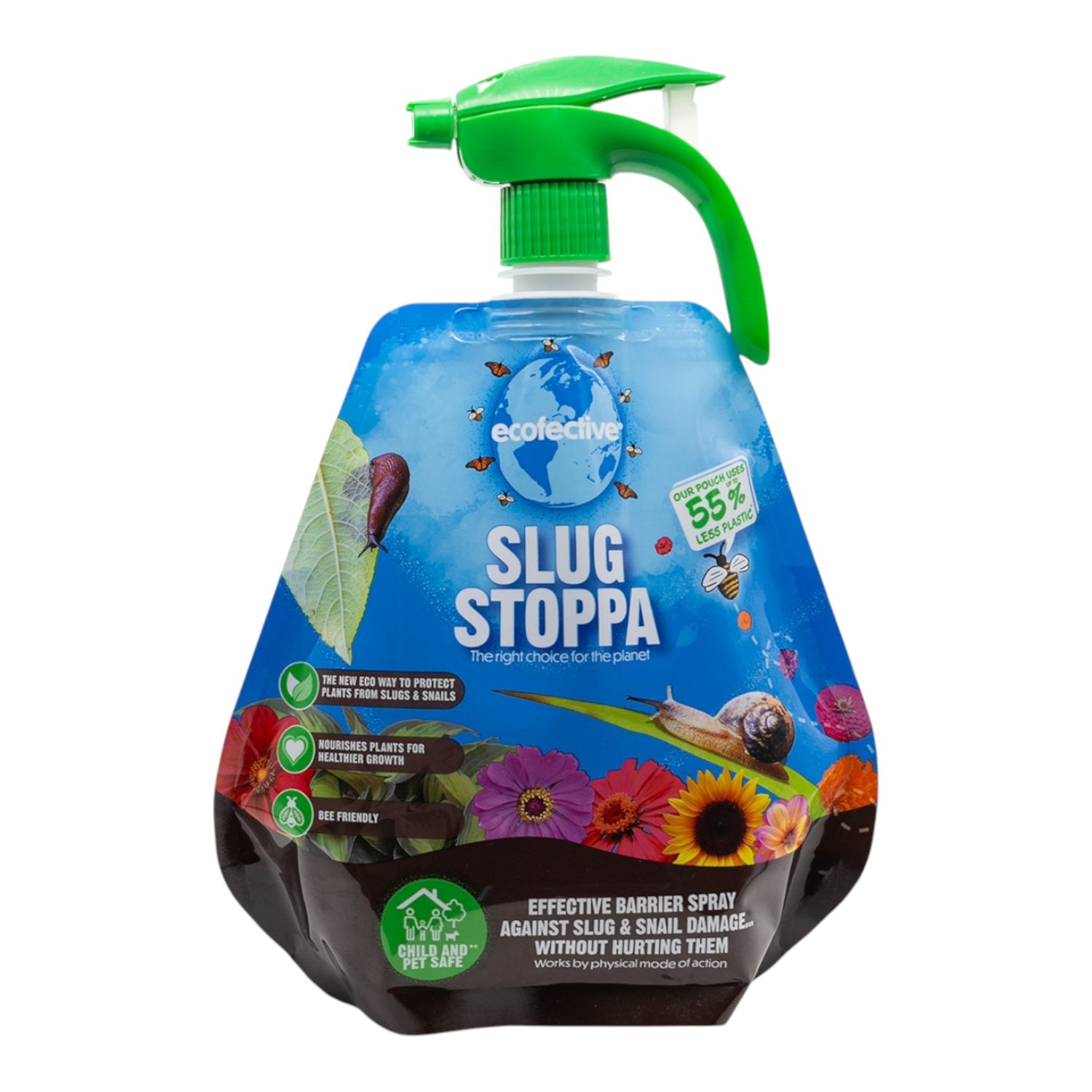
Unit price perEcofective Slug Stoppa 1L is a ready-to-use barrier spray designed to help protect plants from slug and snail damage without killing them. Applied around vulnerable plants, pots and growing areas, Slug Stoppa creates a physical barrier that slugs and snails are reluctant to cross, providing a practical alternative to conventional slug pellets.
Slugs and snails can cause significant damage to young plants, seedlings, vegetables and ornamental plants, particularly during mild and damp conditions. Slug Stoppa takes a different approach to traditional slug control by helping to discourage these pests from reaching vulnerable plants rather than acting as a poison or conventional pesticide.
Supplied in a convenient 1 litre ready-to-use trigger pouch, there is no mixing or dilution required. Simply apply the product as a barrier around the area you want to protect, following the current instructions supplied with the pack.
Why choose Ecofective Slug Stoppa?
How does Ecofective Slug Stoppa work?
Slug Stoppa works by creating a physical barrier around the plants or areas being protected. Rather than poisoning slugs and snails, the treated barrier is designed to discourage them from crossing it.
This makes it particularly useful where the objective is to protect plants from feeding damage without using a product designed to kill the slug or snail.
Because the product relies on maintaining a barrier, correct placement and coverage are important. The barrier should surround the area requiring protection so that slugs and snails cannot simply bypass the treated section.
Protect vulnerable plants from slug & snail damage
Slugs and snails are particularly troublesome around soft, fresh plant growth. Seedlings and recently planted crops can suffer significant damage in a short period when pest pressure is high.
Slug Stoppa can be incorporated into routine garden protection around susceptible plants and growing areas. Potential applications include:
Always use the product in accordance with the current manufacturer's instructions and only on or around areas identified as suitable on the pack.
How to use Slug Stoppa barrier spray
Ecofective Slug Stoppa is supplied ready to use, so no dilution is required.
Apply the product to create a continuous barrier around the plant, container or growing area requiring protection. Pay attention to gaps that could allow slugs or snails to enter the protected area without crossing the treated barrier.
Environmental conditions can affect outdoor barrier treatments. Inspect treated areas regularly and reapply when required in accordance with the current product instructions, particularly where weather or watering may have affected the barrier.
A useful part of integrated slug management
Slug Stoppa can form part of a broader approach to reducing slug and snail damage rather than relying on a single control method.
Garden hygiene, removing unnecessary hiding places, checking underneath pots and containers, protecting particularly vulnerable young plants and regularly inspecting crops can all help identify slug activity before serious damage occurs.
A barrier treatment can then be positioned around areas where additional protection is needed.
Ready-to-use 1L trigger pouch
The ready-to-use format makes Slug Stoppa straightforward to incorporate into routine garden maintenance. There is no concentrate to measure and no separate sprayer is required.
The trigger allows the product to be applied directly where the barrier is needed, helping users concentrate treatment around vulnerable plants and growing areas rather than treating unnecessarily large areas.
Ecofective Slug Stoppa 1L product details
| Brand | Ecofective |
|---|---|
| Product | Slug Stoppa |
| Pack size | 1L |
| Format | Ready-to-use trigger pouch |
| Dilution required | No |
| Target pests | Slugs and snails |
| Control method | Physical barrier / deterrent |
| Primary purpose | Helping protect plants from slug and snail feeding damage |
| Effect on slugs & snails | Designed to deter rather than kill |
| Outer case quantity | 6 x 1L pouches |
Ecofective Slug Stoppa FAQs
What is Ecofective Slug Stoppa?
Slug Stoppa is a ready-to-use barrier spray designed to help protect plants from feeding damage caused by slugs and snails. Does Slug Stoppa kill slugs and snails?
No. Slug Stoppa is designed to create a barrier that discourages slugs and snails from crossing into the protected area rather than killing them. Is Slug Stoppa an alternative to slug pellets?
It offers a different approach to traditional slug pellets by using a deterrent barrier rather than a product designed to poison or kill slugs and snails. Does Ecofective Slug Stoppa need diluting?
No. The 1L trigger pouch is supplied ready to use and should be applied according to the current instructions provided with the product. Where should Slug Stoppa be applied?
The product is used to create a protective barrier around suitable plants, pots or growing areas. The barrier should be continuous so pests cannot simply move around an untreated gap. Do I need to reapply Slug Stoppa after rain?
Outdoor conditions can affect physical barrier treatments. Inspect the treated area after significant rain or watering and follow the current pack instructions regarding reapplication. When are plants most vulnerable to slug and snail damage?
Young plants, seedlings and fresh soft growth can be particularly vulnerable. Regular inspection is useful during mild, damp periods when slug and snail activity can increase. How many Ecofective Slug Stoppa 1L pouches are supplied per case?
The 1L ready-to-use trigger pouch is supplied in an outer case quantity of 6.
£5.20
Unit price per£5.20
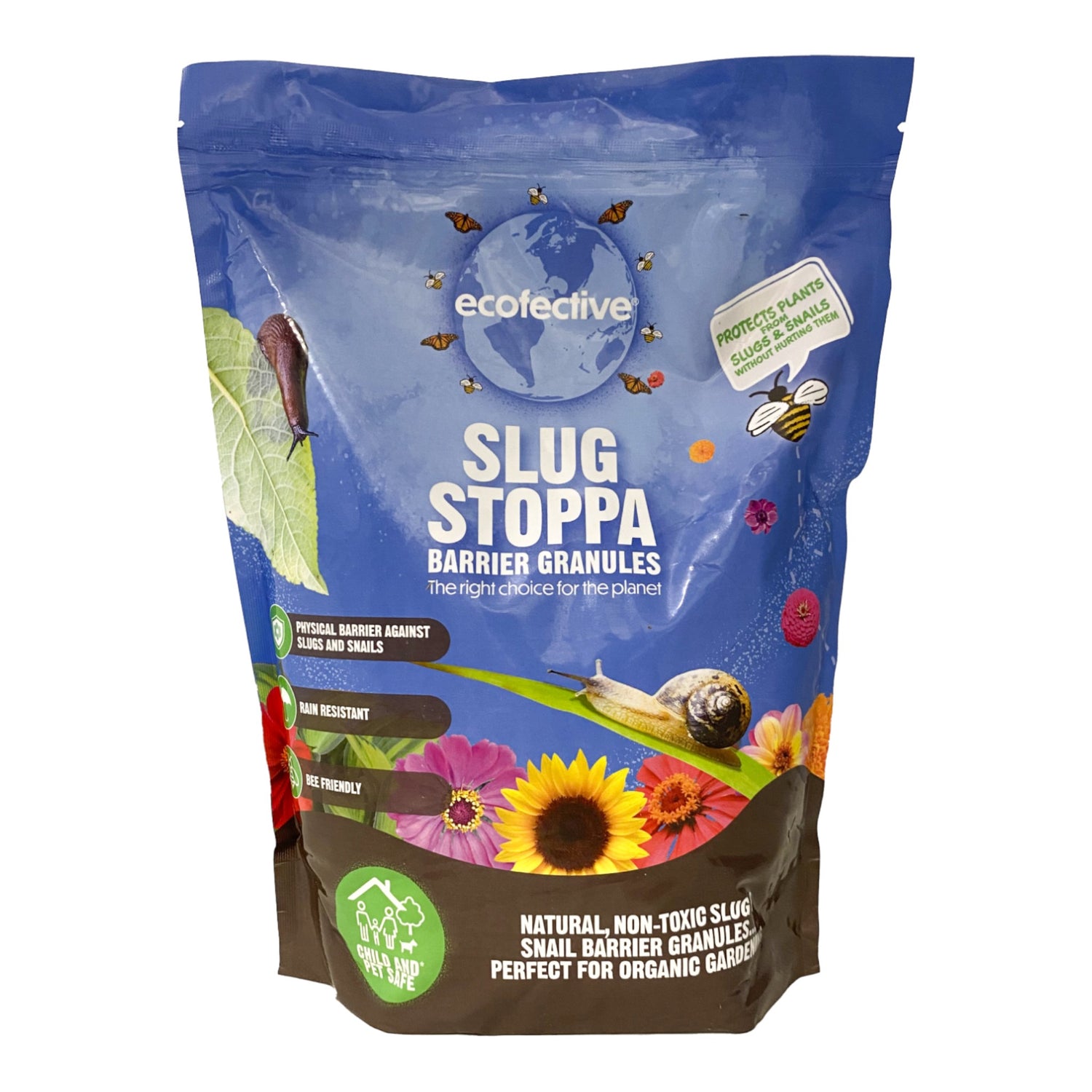
Unit price perEcofective Slug Stoppa Barrier Granules 2L are natural, non-toxic and pesticide-free granules that create a physical barrier around plants to help deter slugs and snails. Suitable for edible and ornamental plants in beds, borders, pots and containers, the rain-resistant granules protect vulnerable plants without harming slugs and snails.
Made from naturally derived ingredients, Slug Stoppa Barrier Granules provide an alternative to conventional slug pellets. Rather than attracting and killing slugs, the granules form a protective barrier that discourages slugs and snails from reaching the plants inside.
Unlike clay-based barriers that can become soft and degrade when wet, Ecofective's granules are designed to dry quickly after rain or watering and remain effective. This makes them particularly useful for outdoor planting where changing weather conditions are unavoidable.
Why choose Ecofective Slug Stoppa Barrier Granules?
How do Slug Stoppa Barrier Granules work?
Slug Stoppa Granules work by forming a physical barrier around the plant. Slugs and snails are deterred from crossing the granules, helping prevent them from reaching and feeding on the protected plant.
The product is not designed to kill slugs or snails. Instead, it provides a physical defence around edible and non-edible plants while allowing the pests themselves to remain unharmed.
This also supports a more wildlife-conscious approach to slug management, leaving naturally occurring slugs and snails available to predators such as birds, frogs, toads and hedgehogs.
Rain-resistant slug protection
One of the key advantages of Ecofective Slug Stoppa Barrier Granules is their behaviour after getting wet.
Ecofective states that the naturally derived granules do not turn spongy when wet. Instead, they dry out quickly and remain effective after rainfall or watering.
This distinguishes them from some clay-based slug barriers that can soften and deteriorate following repeated exposure to moisture.
Where can Slug Stoppa Granules be used?
Ecofective Slug Stoppa Barrier Granules can be applied around the base of edible and ornamental plants in both garden soil and containers.
They are particularly useful around young plants and fresh growth, which can suffer substantial damage when slug and snail activity is high.
How to use Ecofective Slug Stoppa Barrier Granules
For garden plants, pots and tubs, place the granules close to the stem of the plant in a complete circle. Ecofective recommends using approximately 15-20g, or a small handful, per plant.
Apply the granules to a depth of up to 2cm, ensuring the protective circle is complete. A continuous barrier is important because gaps can provide slugs and snails with an untreated route to the plant.
When planting into an existing garden area, inspect the planting area first because slugs may already be present inside the area you intend to protect. Creating a barrier around a slug that is already beside the plant will not prevent feeding damage.
Always follow the current instructions supplied with the product.
Slug Stoppa Granules or Slug Stoppa Spray?
| Product | How it is used |
|---|---|
| Slug Stoppa Barrier Granules | Placed around plants to form a physical barrier that deters slugs and snails from reaching them. |
| Slug Stoppa Spray | Sprayed directly onto suitable plants to create an invisible deterrent on the foliage. |
Both products provide pesticide-free approaches to slug and snail protection, but they work in different locations. The granules protect the perimeter around the plant, while the spray is applied directly to suitable plant foliage.
Wildlife-conscious slug & snail control
Slugs and snails form part of the garden food chain and are eaten by wildlife including birds, frogs, toads and hedgehogs. Slug Stoppa Barrier Granules are designed to deter the pests rather than kill them.
Ecofective describes the granules as safe for use around children, pets, wildlife and bees when used as directed, making them particularly attractive to gardeners looking for a non-toxic physical approach to plant protection.
Ecofective Slug Stoppa Barrier Granules product details
| Brand | Ecofective |
|---|---|
| Product | Slug Stoppa Barrier Granules |
| Pack size | 2L |
| Format | Ready-to-use barrier granules |
| Target pests | Slugs and snails |
| Mode of action | Physical deterrent barrier |
| Pesticide free | Yes |
| Ingredients | Naturally derived |
| Suitable plants | Edible and ornamental plants |
| Suitable locations | Garden beds, borders, pots, tubs and containers |
| Rain resistant | Yes - granules dry quickly after rain or watering |
| Typical application | 15-20g around the plant in a complete circle, up to 2cm deep |
| Organic gardening | Certified for organic gardening |
| Product code | ECF0124 |
| Outer case quantity | 6 x 2L pouches |
Ecofective Slug Stoppa Barrier Granules FAQs
Do Slug Stoppa Barrier Granules kill slugs and snails?
No. They create a physical barrier designed to deter slugs and snails from reaching the protected plant rather than killing them. Are Slug Stoppa Granules the same as conventional slug pellets?
No. Slug Stoppa Granules are a non-toxic, pesticide-free physical deterrent. They are placed around plants to form a barrier rather than acting as a poisonous bait. Can I use the granules around vegetables?
Yes. Ecofective specifies the granules for protecting both edible and ornamental plants. Do Slug Stoppa Granules still work after rain?
They are rain resistant. Ecofective states that the granules do not turn spongy when wet, but instead dry quickly and remain effective after rain or watering. Can I use Slug Stoppa in plant pots?
Yes. The granules can be used around plants in pots and tubs as well as around plants growing in garden beds and borders. Are the granules suitable for organic gardening?
Yes. Ecofective identifies Slug Stoppa Barrier Granules as certified for organic gardening. What is the difference between Slug Stoppa Granules and the spray?
The granules create a physical barrier around the plant to deter slugs and snails from reaching it. Slug Stoppa Spray is applied directly to suitable foliage to make the plant itself less attractive to them. How many 2L pouches are supplied in an outer case?
Ecofective Slug Stoppa Barrier Granules 2L are supplied in an outer case quantity of 6.

£3.80
Unit price per£3.80
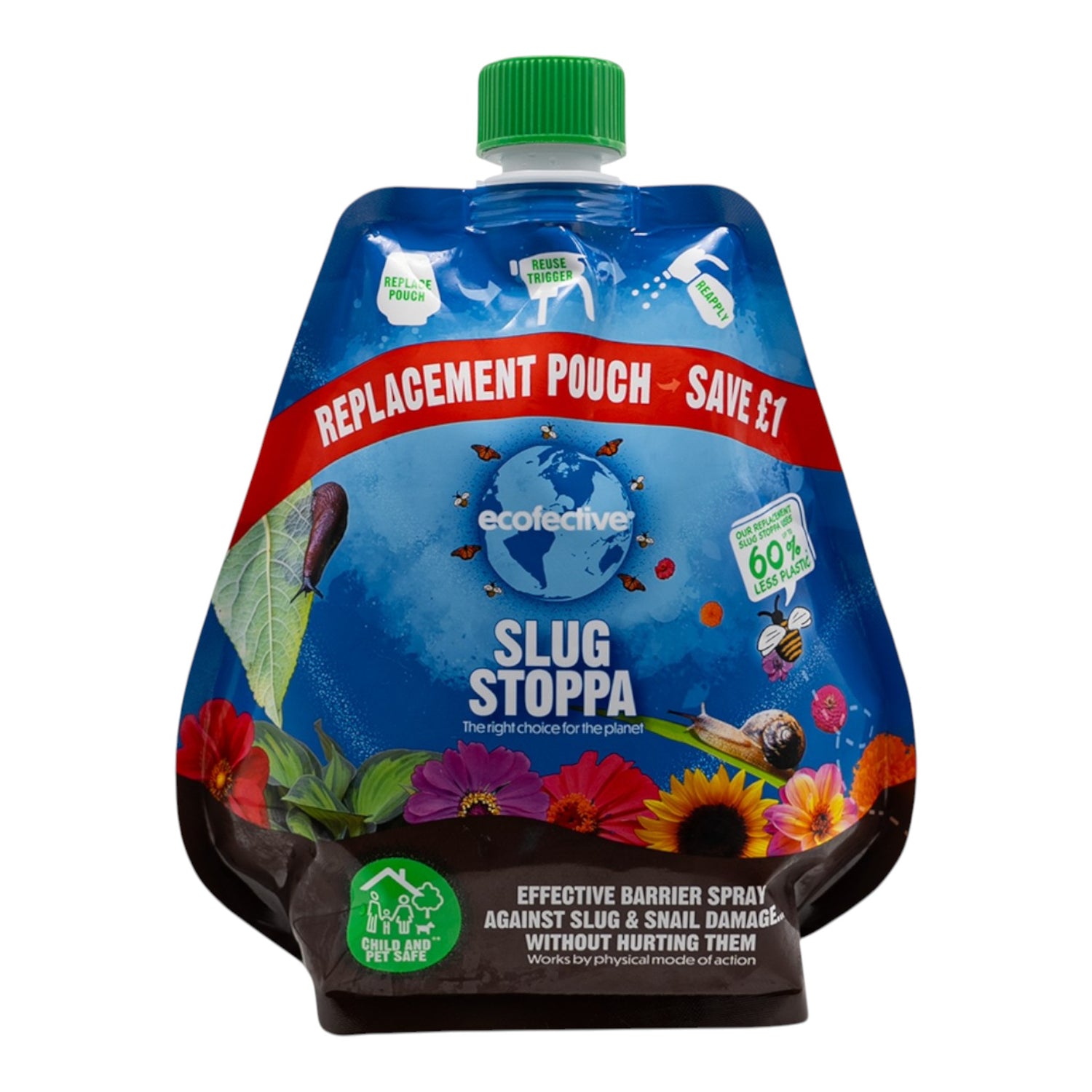
Unit price perEcofective Slug Stoppa Replacement Pouch 1L is the trigger-free refill for the Ecofective Slug Stoppa spray system. Simply remove the trigger from your previous Slug Stoppa pouch and attach it to the replacement pack for the same ready-to-use, pesticide-free protection against slug and snail damage.
Slug Stoppa works by a physical mode of action, creating an invisible barrier on plants that discourages slugs and snails without harming them. Unlike conventional slug-control products designed to kill the pest, Slug Stoppa helps protect vulnerable plants while leaving slugs, snails and their natural predators unharmed.
The formulation can be used on edible and ornamental plants and also contains nutrients to enhance and promote healthy plant growth. It is ready to use with no dilution or mixing required.
Please note: this is the 1L replacement pouch and does not include a trigger. It is designed for customers who already have a reusable trigger from a previous Ecofective Slug Stoppa spray pouch.
Why choose the Slug Stoppa Replacement Pouch?
Reuse your original Slug Stoppa trigger
The key difference between this product and the standard Ecofective Slug Stoppa 1L Spray Pouch is the trigger.
The replacement pouch does not come with a new spray trigger. Instead, Ecofective has designed it so the trigger from your previous Slug Stoppa can be removed and attached directly to the new 1L pouch.
This gives customers a simple way to continue using Slug Stoppa while keeping a perfectly serviceable trigger in use rather than disposing of it with every finished pack.
How does Ecofective Slug Stoppa work?
Slug Stoppa is a pesticide-free spray that uses a physical mode of action. When sprayed onto the plant, the formulation creates an invisible barrier that helps deter slugs and snails from feeding on the treated foliage.
It is designed to protect the plant without harming the slug or snail. This also means natural garden predators such as hedgehogs, amphibians and birds are not feeding on slugs that have consumed conventional slug-control pesticide from the treatment.
The formula also contains nutrients to help enhance and promote plant growth, combining plant protection and nourishment in one ready-to-use treatment.
For edible & ornamental plants
Ecofective Slug Stoppa is suitable for use on both edible and ornamental plants, making the replacement pouch useful across a wide range of garden applications.
Slugs and snails are particularly damaging to young, soft growth and can rapidly damage seedlings and newly established plants. Regular inspection is worthwhile during periods of increased slug activity so treatment can begin while plants remain vulnerable.
Always follow the current manufacturer's instructions when applying the product to edible or ornamental plants.
How to use the Slug Stoppa Replacement Pouch
No dilution is required. The formulation inside the replacement pouch is supplied ready to use.
Less plastic, less waste
Ecofective's flexible pouch format is designed to reduce the amount of packaging required compared with a conventional rigid spray bottle. Ecofective states that its pouch format uses up to 55% less plastic than a traditional rigid bottle.
The replacement version takes this concept a step further by allowing the existing Slug Stoppa trigger to be reused. Instead of receiving and eventually disposing of another trigger mechanism with each purchase, customers can transfer the original trigger onto the new pouch.
The flexible pouch is also more compact and lightweight than a conventional rigid bottle, helping reduce the amount of material associated with the product.
Slug Stoppa Spray Pouch or Replacement Pouch?
| Option | Best for |
|---|---|
| Slug Stoppa 1L Spray Pouch | First-time purchase or customers who need a new spray trigger |
| Slug Stoppa 1L Replacement Pouch | Existing users who already have a Slug Stoppa trigger to reuse |
If you do not already have a compatible Slug Stoppa trigger, choose the standard 1L Spray Pouch. Once you have the trigger, replacement pouches provide the straightforward option for subsequent purchases.
Ecofective Slug Stoppa Replacement Pouch product details
| Brand | Ecofective |
|---|---|
| Product | Slug Stoppa Replacement Pouch |
| Pack size | 1L |
| Format | Ready-to-use replacement pouch |
| Trigger included | No - reuse the trigger from your previous Slug Stoppa pouch |
| Dilution required | No |
| Target pests | Slugs and snails |
| Mode of action | Physical, pesticide-free deterrent |
| Suitable plants | Edible and ornamental plants |
| Plant nutrition | Contains nutrients to enhance and promote plant growth |
| Application | Spray foliage until the application is just starting to drip |
| Reapplication | Every 4-6 days while plants are at risk of slug and snail damage |
| Outer case quantity | 6 x 1L replacement pouches |
Ecofective Slug Stoppa Replacement Pouch FAQs
Does the Slug Stoppa Replacement Pouch include a trigger?
No. This product is specifically the replacement pouch. Remove the trigger from your previous Ecofective Slug Stoppa pouch and attach it to the new replacement pack. Is the product inside the replacement pouch ready to use?
Yes. The 1L pouch contains ready-to-use Slug Stoppa and does not require dilution or mixing. Does Slug Stoppa kill slugs and snails?
No. Ecofective Slug Stoppa is designed to deter slugs and snails without harming them. It works through a pesticide-free physical mode of action. Can Slug Stoppa be used on vegetables and edible plants?
Yes. Ecofective identifies Slug Stoppa for use on both edible and ornamental plants. Always follow the current instructions supplied with the product. How often should Slug Stoppa be reapplied?
Ecofective recommends reapplying every 4-6 days while plants are at risk of damage from slugs and snails. How much should I spray onto the plant?
Ecofective's directions state that plants should be sprayed until the application is just starting to drip from the foliage. Is Ecofective Slug Stoppa safe around children and pets?
Ecofective describes Slug Stoppa as child and pet safe when used according to the manufacturer's instructions. The product is also described as bee friendly. Why buy the replacement pouch instead of another trigger pouch?
If you already have the original Slug Stoppa trigger, the replacement pouch allows you to reuse it rather than receiving another trigger with every 1L pack. This reduces unnecessary packaging and makes better use of the existing spray mechanism. How many replacement pouches are supplied in an outer case?
The Ecofective Slug Stoppa 1L Replacement Pouch is supplied in an outer case quantity of 6.

£37.89
Unit price per£37.89
Unit price perA complete two-part biomineral base nutrient supplying essential plant nutrition throughout vegetative growth and flowering.
Ecolizer Basics A+B forms the nutritional foundation of the Ecolizer feeding programme. The two-component liquid nutrient supplies the primary nitrogen, phosphorus and potassium plants need for sustained growth and productive flowering.
The formula is produced from carefully selected food-grade raw materials and is designed without unnecessary bulking ingredients. Dividing the concentrated nutrients between Parts A and B helps maintain their stability before they are diluted into the final nutrient solution.
Suitable for use across a range of growing media, Ecolizer Basics A+B gives growers control over feed strength throughout the crop cycle. The larger 10L format is particularly practical for commercial growers, nurseries and high-volume growing environments.
Why choose Ecolizer Basics A+B?
What is Ecolizer Basics A+B used for?
Ecolizer Basics A+B is the primary base feed within the Ecolizer nutrient system. It provides essential nutrition throughout vegetative growth and flowering, while products such as Root Up, Grow Up and Bloom Up can be introduced for more specialised stage-specific support.
The two-part formula is particularly useful in hydroponic and inert growing systems where the majority of plant nutrition must be supplied through the irrigation solution. It can also be incorporated into coco and soil-based growing programmes.
Because plant demand changes throughout the crop cycle, growers can adjust the concentration of Basics A+B according to plant development, water quality and the required nutrient strength.
How to use Ecolizer Basics A+B
Use 1–4ml of Part A and 1–4ml of Part B per litre of irrigation water, adjusting the concentration according to crop stage and the required nutrient strength.
Fill the reservoir or mixing tank with water before adding the nutrients. Add the required amount of Part A first and mix thoroughly. Once Part A is dispersed through the water, add the corresponding amount of Part B and mix again.
Never combine undiluted Part A and Part B directly together. The concentrates are designed to remain separate until each has been diluted into the irrigation water.
Once both components are thoroughly mixed, measure the EC and pH of the finished nutrient solution and adjust the feed strength to suit the crop, water source and growing medium.
Ecolizer Basics A+B 10L product details
| Product | Ecolizer Basics A+B |
|---|---|
| Product type | Two-part biomineral base nutrient |
| Product size | 10L |
| Nutrient format | Two-part liquid concentrate |
| Components | Part A & Part B |
| Primary nutrients | Nitrogen, phosphorus & potassium |
| Raw material quality | Food-grade |
| Growth stages | Vegetative growth & flowering |
| Suitable growing media | Hydroponics, coco & soil |
| Application rate | 1–4ml/L Part A + 1–4ml/L Part B |
| Application method | Add Part A and Part B separately to irrigation water & mix thoroughly |
| Direct concentrate mixing | No – never mix undiluted Parts A & B together |
| Complete base nutrient | Yes |
Ecolizer Basics A+B FAQs
What is Ecolizer Basics A+B?
Ecolizer Basics A+B is a two-part biomineral base nutrient formulated to supply essential plant nutrition throughout vegetative growth and flowering.
Is Ecolizer Basics A+B a complete base nutrient?
Yes. Basics A+B provides the primary nutrition within the Ecolizer feeding programme. Products such as Root Up, Grow Up and Bloom Up are supplementary products rather than replacements for the base feed.
How much Ecolizer Basics A+B should I use?
Use 1–4ml of Part A and 1–4ml of Part B per litre of irrigation water. The appropriate concentration depends on crop stage, water quality and the required nutrient strength.
How do I mix Ecolizer Basics A+B?
Add Part A to the required volume of water and mix thoroughly. Add Part B afterwards and mix again before measuring and adjusting the finished nutrient solution.
Can I mix Ecolizer Basics A and B concentrates together?
No. Never combine the undiluted A and B concentrates directly. Each component should be added separately to the irrigation water and thoroughly diluted.
Can Ecolizer Basics A+B be used during flowering?
Yes. Basics A+B is designed to provide base nutrition through both vegetative growth and flowering, with nutrient strength adjusted as plant requirements change.
Can Ecolizer Basics A+B be used in hydroponics?
Yes. Ecolizer Basics A+B is suitable for hydroponic growing and provides growers with control over the strength of the nutrient solution through the crop cycle.
Can Ecolizer Basics A+B be used in coco?
Yes. Basics A+B can be incorporated into coco feeding programmes as well as hydroponic and soil-based growing.
Can Ecolizer Basics A+B be used in soil?
Yes. Ecolizer Basics A+B can be used in soil, although feed strength should take account of any nutrition already present in the growing medium.
Can I use Ecolizer Root Up, Grow Up and Bloom Up with Basics A+B?
Yes. Basics A+B provides the base nutrition, while Ecolizer's Root Up, Grow Up and Bloom Up products provide more specialised support at different stages of plant development.
Why is Ecolizer Basics supplied as an A+B nutrient?
Separating the concentrated nutrient into Parts A and B keeps components that are incompatible at high concentration apart during storage. They combine safely once each part has been diluted into the irrigation water.
£7.80
Unit price per£7.80
Unit price perA complete two-part biomineral base nutrient supplying essential plant nutrition throughout vegetative growth and flowering.
Ecolizer Basics A+B forms the nutritional foundation of the Ecolizer feeding programme. This two-component liquid base nutrient supplies the essential nutrition plants need for sustained vegetative development and productive flowering.
The formula combines nitrogen, phosphorus and potassium with trace elements and is made using food-grade raw materials without unnecessary bulking ingredients. Separating the concentrated nutrient between Parts A and B helps maintain stability before the components are diluted into the final nutrient solution.
Ecolizer Basics A+B was developed with open hydroponic systems and nutrient-poor substrates such as rockwool in mind, while also being suitable for use across other growing media. The 1L format is a convenient choice for smaller systems, trial crops and growers who want to introduce the Ecolizer nutrient programme without moving straight to a larger pack.
Why choose Ecolizer Basics A+B?
What is Ecolizer Basics A+B used for?
Ecolizer Basics A+B is the primary base feed within the Ecolizer nutrient system. It supplies the fundamental nutrition required throughout vegetative growth and flowering, while specialist Ecolizer products such as Root Up, Grow Up and Bloom Up can be added according to the stage of plant development.
The formula is particularly well suited to hydroponic systems and nutrient-poor substrates where growers need direct control over the nutrition supplied through irrigation. It can also be incorporated into coco and soil-based growing programmes.
Because nutrient demand changes as plants develop, Basics A+B is used at a variable concentration rather than one fixed strength. Growers can increase or reduce the concentration of both components according to crop stage and the required EC.
How to use Ecolizer Basics A+B
Use 1–4ml of Part A and 1–4ml of Part B per litre of irrigation water. Adjust the concentration according to plant development and the required nutrient strength.
Fill the reservoir or mixing container with water before adding the nutrient. Add the required amount of Part A first and mix thoroughly. Once Part A is dispersed through the water, add the corresponding amount of Part B and mix again.
Never mix undiluted Part A and Part B concentrates directly together. Each component should be diluted separately into the irrigation water.
After both components have been thoroughly mixed, measure the EC and pH of the finished nutrient solution and make any adjustments required for the crop, water source and growing medium.
Ecolizer Basics A+B 1L product details
| Product | Ecolizer Basics A+B |
|---|---|
| Product type | Two-part biomineral base nutrient |
| Product size | 1L |
| Nutrient format | Two-part liquid concentrate |
| Components | Part A & Part B |
| Primary nutrients | Nitrogen, phosphorus & potassium |
| Micronutrients | Includes trace elements |
| Raw material quality | Food-grade |
| Growth stages | Vegetative growth & flowering |
| Suitable growing media | Hydroponics, coco & soil |
| Application rate | 1–4ml/L Part A + 1–4ml/L Part B |
| Application method | Add Part A and Part B separately to irrigation water & mix thoroughly |
| Direct concentrate mixing | No – never mix undiluted Parts A & B together |
| Complete base nutrient | Yes |
Ecolizer Basics A+B FAQs
What is Ecolizer Basics A+B?
Ecolizer Basics A+B is a two-part biomineral base nutrient formulated to supply essential plant nutrition throughout vegetative growth and flowering.
Is Ecolizer Basics A+B a complete base nutrient?
Yes. Basics A+B provides the primary nutrition within the Ecolizer feeding programme. Products such as Root Up, Grow Up and Bloom Up are supplementary products rather than replacements for the base feed.
How much Ecolizer Basics A+B should I use?
Use 1–4ml of Part A and 1–4ml of Part B per litre of irrigation water. Adjust the concentration according to crop development and the required EC.
How do I mix Ecolizer Basics A+B?
Add Part A to the required volume of water and mix thoroughly. Add Part B afterwards and mix again before checking the EC and pH of the finished nutrient solution.
Can I mix Ecolizer Basics A and B concentrates together?
No. The concentrated A and B components should remain separate. Add each component individually to the irrigation water and mix thoroughly before use.
Can Ecolizer Basics A+B be used throughout flowering?
Yes. Basics A+B provides base nutrition during both vegetative growth and flowering. The concentration can be adjusted as the crop's nutrient requirements change.
Can Ecolizer Basics A+B be used in hydroponics?
Yes. Ecolizer Basics A+B was developed for use in open hydroponic systems and nutrient-poor growing media such as rockwool.
Can Ecolizer Basics A+B be used in coco?
Yes. Basics A+B can be incorporated into coco feeding programmes as well as hydroponic and soil-based growing.
Can Ecolizer Basics A+B be used in soil?
Yes. Basics A+B can be used in soil-based growing, with nutrient strength adjusted to suit the crop and the level of nutrition already present in the growing medium.
Can Ecolizer Basics A+B be used in drip irrigation systems?
Yes. Ecolizer Basics A+B dissolves readily in the nutrient solution and is suitable for drip and irrigation systems.
Can I use Ecolizer Root Up, Grow Up and Bloom Up with Basics A+B?
Yes. Basics A+B provides the base nutrition, while Root Up, Grow Up and Bloom Up provide more specialised support at different stages of plant development.
Why is Ecolizer Basics supplied as an A+B nutrient?
Separating the concentrated nutrient into Parts A and B keeps the components stable during storage. The two parts are combined only after each has been diluted into the irrigation water.
£22.38
Unit price per£22.38
Unit price perA complete two-part biomineral base nutrient supplying essential plant nutrition throughout vegetative growth and flowering.
Ecolizer Basics A+B forms the nutritional foundation of the Ecolizer feeding programme. The two-component liquid nutrient supplies the primary nitrogen, phosphorus and potassium plants need for sustained growth and productive flowering.
The formula is produced from carefully selected food-grade raw materials and is designed without unnecessary bulking ingredients. Dividing the concentrated nutrients between Parts A and B helps maintain their stability before they are diluted into the final nutrient solution.
Suitable for use across a range of growing media, Ecolizer Basics A+B gives growers control over feed strength throughout the crop cycle. The 5L format is a practical option for growers looking for a versatile base feed that can be used from vegetative development through to flowering.
Why choose Ecolizer Basics A+B?
What is Ecolizer Basics A+B used for?
Ecolizer Basics A+B is the primary base feed within the Ecolizer nutrient system. It provides essential nutrition throughout vegetative growth and flowering, while products such as Root Up, Grow Up and Bloom Up can be introduced for more specialised stage-specific support.
The two-part formula is particularly useful in hydroponic and inert growing systems where the majority of plant nutrition must be supplied through the irrigation solution. It can also be incorporated into coco and soil-based growing programmes.
Because plant demand changes throughout the crop cycle, growers can adjust the concentration of Basics A+B according to plant development, water quality and the required nutrient strength.
How to use Ecolizer Basics A+B
Use 1–4ml of Part A and 1–4ml of Part B per litre of irrigation water, adjusting the concentration according to crop stage and the required nutrient strength.
Fill the reservoir or mixing tank with water before adding the nutrients. Add the required amount of Part A first and mix thoroughly. Once Part A is dispersed through the water, add the corresponding amount of Part B and mix again.
Never combine undiluted Part A and Part B directly together. The concentrates are designed to remain separate until each has been diluted into the irrigation water.
Once both components are thoroughly mixed, measure the EC and pH of the finished nutrient solution and adjust the feed strength to suit the crop, water source and growing medium.
Ecolizer Basics A+B 5L product details
| Product | Ecolizer Basics A+B |
|---|---|
| Product type | Two-part biomineral base nutrient |
| Product size | 5L |
| Nutrient format | Two-part liquid concentrate |
| Components | Part A & Part B |
| Primary nutrients | Nitrogen, phosphorus & potassium |
| Raw material quality | Food-grade |
| Growth stages | Vegetative growth & flowering |
| Suitable growing media | Hydroponics, coco & soil |
| Application rate | 1–4ml/L Part A + 1–4ml/L Part B |
| Application method | Add Part A and Part B separately to irrigation water & mix thoroughly |
| Direct concentrate mixing | No – never mix undiluted Parts A & B together |
| Complete base nutrient | Yes |
Ecolizer Basics A+B FAQs
What is Ecolizer Basics A+B?
Ecolizer Basics A+B is a two-part biomineral base nutrient formulated to supply essential plant nutrition throughout vegetative growth and flowering.
Is Ecolizer Basics A+B a complete base nutrient?
Yes. Basics A+B provides the primary nutrition within the Ecolizer feeding programme. Products such as Root Up, Grow Up and Bloom Up are supplementary products rather than replacements for the base feed.
How much Ecolizer Basics A+B should I use?
Use 1–4ml of Part A and 1–4ml of Part B per litre of irrigation water. The appropriate concentration depends on crop stage, water quality and the required nutrient strength.
How do I mix Ecolizer Basics A+B?
Add Part A to the required volume of water and mix thoroughly. Add Part B afterwards and mix again before measuring and adjusting the finished nutrient solution.
Can I mix Ecolizer Basics A and B concentrates together?
No. Never combine the undiluted A and B concentrates directly. Each component should be added separately to the irrigation water and thoroughly diluted.
Can Ecolizer Basics A+B be used during flowering?
Yes. Basics A+B is designed to provide base nutrition through both vegetative growth and flowering, with nutrient strength adjusted as plant requirements change.
Can Ecolizer Basics A+B be used in hydroponics?
Yes. Ecolizer Basics A+B is suitable for hydroponic growing and provides growers with control over the strength of the nutrient solution throughout the crop cycle.
Can Ecolizer Basics A+B be used in coco?
Yes. Basics A+B can be incorporated into coco feeding programmes as well as hydroponic and soil-based growing.
Can Ecolizer Basics A+B be used in soil?
Yes. Ecolizer Basics A+B can be used in soil, with feed strength adjusted to take account of the crop and nutrition already present in the growing medium.
Can I use Ecolizer Root Up, Grow Up and Bloom Up with Basics A+B?
Yes. Basics A+B provides the base nutrition, while Ecolizer Root Up, Grow Up and Bloom Up provide more specialised support at different stages of plant development.
Why is Ecolizer Basics supplied as an A+B nutrient?
Separating the concentrated nutrient into Parts A and B keeps components that are incompatible at high concentration apart during storage. They combine in the final nutrient solution after each part has been diluted into the irrigation water.

£21.89
Unit price per£21.89
Unit price perA highly concentrated flowering stimulator formulated to support abundant flower and fruit development throughout the bloom phase.
Ecolizer Bloom Up is a specialist flowering stimulator developed for the productive stage of the plant cycle. Once vegetative growth gives way to flowering, Bloom Up provides targeted support for flower and fruit formation alongside the normal base nutrient programme.
Its naturally derived formulation combines seaweed and plant extracts with enzymes, natural plant hormones and more than 30 trace elements. Bloom Up also contains antioxidants including biotin, tocopherol, choline and carotene, creating a broad flowering-stage formula designed to support strong, productive development.
Bloom Up also supports the transport of sugars throughout the plant. The concentrated 1L format makes it a practical choice for growers who want a dedicated flowering additive that can be incorporated into an established crop nutrition programme.
Why choose Ecolizer Bloom Up?
What is Ecolizer Bloom Up used for?
Ecolizer Bloom Up is designed for flowering and fruiting plants. It follows Ecolizer Grow Up in the Ecolizer programme, allowing growers to move from a vegetative growth stimulator to a formula specifically developed for the productive stage.
The combination of seaweed and plant extracts, natural plant hormones, enzymes, trace elements and antioxidants provides targeted support during flower formation. Bloom Up also supports the transport of sugars throughout the plant as flowering develops.
Bloom Up is a specialist additive rather than a complete fertiliser. It should therefore be incorporated alongside the appropriate base nutrient programme rather than used as the plant's sole source of nutrition.
How to use Ecolizer Bloom Up
Ecolizer product information specifies a concentration of 1:5000, equivalent to 0.2ml per litre of water or nutrient solution.
This equates to 2ml per 10 litres, 10ml per 50 litres or 20ml per 100 litres of working solution.
Use Bloom Up during the flowering phase alongside the normal base nutrient programme. Measure the required amount carefully, add it to the irrigation water or prepared nutrient solution and mix thoroughly before application.
When plants move from vegetative growth into flowering, Bloom Up takes over from Ecolizer Grow Up as the stage-specific stimulator.
Ecolizer Bloom Up 1L product details
| Product | Ecolizer Bloom Up |
|---|---|
| Product type | Flowering & fruiting stimulator |
| Size | 1L |
| Form | Concentrated liquid |
| Primary use | Supporting flower & fruit development during the bloom phase |
| Key ingredients | Seaweed extracts, plant extracts & enzymes |
| Natural plant hormones | Cytokinins & auxins |
| Trace elements | More than 30 |
| Antioxidants | Biotin, tocopherol, choline & carotene |
| Concentration | 1:5000 |
| Application rate | 0.2ml per litre |
| Equivalent dosage | 2ml per 10L / 20ml per 100L |
| Growth stage | Flowering & fruiting |
| Complete base nutrient | No – use alongside an appropriate flowering nutrient programme |
| Approximate working solution | Up to 5,000L at 0.2ml/L |
| Outer case quantity | 12 |
Ecolizer Bloom Up FAQs
What does Ecolizer Bloom Up do?
Ecolizer Bloom Up is a specialist flowering stimulator formulated to support flower and fruit development. It combines plant and seaweed extracts with enzymes, trace elements, natural plant hormones and antioxidants for targeted support during bloom.
When should I start using Ecolizer Bloom Up?
Bloom Up is intended for use once plants enter the flowering stage. It follows Ecolizer Grow Up, which is formulated for vegetative development.
How much Ecolizer Bloom Up should I use?
The established Ecolizer concentration is 1:5000, equivalent to 0.2ml per litre. This works out at 2ml per 10 litres or 20ml per 100 litres of water or nutrient solution.
Is Ecolizer Bloom Up a complete flowering fertiliser?
No. Bloom Up is a specialist flowering stimulator designed to complement an appropriate base nutrient programme rather than replace it.
What is in Ecolizer Bloom Up?
Bloom Up contains seaweed and plant extracts, enzymes, naturally occurring plant hormones including cytokinins and auxins, more than 30 trace elements and antioxidants including biotin, tocopherol, choline and carotene.
Does Ecolizer Bloom Up contain plant hormones?
Yes. Bloom Up contains naturally occurring cytokinins and auxins as part of its flowering-stage formulation.
What is the difference between Ecolizer Grow Up and Bloom Up?
Ecolizer Grow Up is formulated for vegetative development, while Bloom Up is designed for flowering and fruiting. Growers move from Grow Up to Bloom Up as plants enter the flowering stage.
Does Ecolizer Bloom Up help with sugar transport?
Yes. Bloom Up is formulated to support the transport of sugars throughout the plant during flowering and productive development.
Can Ecolizer Bloom Up be used with base nutrients?
Yes. Bloom Up is intended to complement the normal flowering nutrient programme and should not replace the plant's base nutrition.
How much working solution will 1L of Ecolizer Bloom Up make?
At the established 1:5000 concentration, a 1L bottle provides enough Bloom Up for approximately 5,000 litres of working solution.
£12.04
Unit price per£12.04
Unit price perA concentrated flowering stimulator formulated to support abundant flower and fruit development throughout the bloom phase.
Ecolizer Bloom Up is a specialist flowering stimulator designed for use once plants move from vegetative growth into bloom. Its naturally derived formulation combines seaweed and plant extracts with enzymes, natural plant hormones, trace elements and antioxidants to support productive flowering and fruit formation.
Bloom Up contains naturally occurring cytokinins and auxins together with more than 30 trace elements. The formulation also includes antioxidants such as biotin, tocopherol, choline and carotene, providing targeted support during the demanding flowering stage.
Bloom Up also supports the transport of sugars throughout the plant. Used alongside an appropriate base nutrient, it provides targeted flowering-stage support without replacing the crop's primary nutrition.
Why choose Ecolizer Bloom Up?
What is Ecolizer Bloom Up used for?
Ecolizer Bloom Up is formulated for the flowering and fruiting stage of the plant cycle. It follows Ecolizer Grow Up, which is used during vegetative development, allowing the stimulator to be matched to the plant's changing requirements.
Its combination of plant and seaweed extracts, enzymes, natural plant hormones, trace elements and antioxidants supports flower formation while helping with the transport of sugars throughout the plant.
Bloom Up is a flowering additive rather than a complete base nutrient. It is designed to complement an established flowering feed programme, making it suitable for growers looking for targeted bloom-stage support.
How to use Ecolizer Bloom Up
Ecolizer product information specifies a concentration of 1:5000, equivalent to 0.2ml per litre of water or nutrient solution.
This equates to 2ml per 10 litres, 10ml per 50 litres or 20ml per 100 litres of working solution.
Use Bloom Up during the flowering phase alongside the normal base nutrient programme. Measure the required amount carefully, add it to the irrigation water or prepared nutrient solution and mix thoroughly before application.
When plants move from vegetative growth into flowering, Bloom Up takes over from Ecolizer Grow Up as the stage-specific stimulator.
Ecolizer Bloom Up 500ml product details
| Product | Ecolizer Bloom Up |
|---|---|
| Product type | Flowering & fruiting stimulator |
| Size | 500ml |
| Form | Concentrated liquid |
| Primary use | Supporting flower & fruit development during the bloom phase |
| Key ingredients | Seaweed extracts, plant extracts & enzymes |
| Natural plant hormones | Cytokinins & auxins |
| Trace elements | More than 30 |
| Antioxidants | Biotin, tocopherol, choline & carotene |
| Concentration | 1:5000 |
| Application rate | 0.2ml per litre |
| Equivalent dosage | 2ml per 10L / 20ml per 100L |
| Growth stage | Flowering & fruiting |
| Complete base nutrient | No – use alongside an appropriate flowering nutrient programme |
| Approximate working solution | Up to 2,500L at 0.2ml/L |
| Outer case quantity | 12 |
Ecolizer Bloom Up FAQs
What does Ecolizer Bloom Up do?
Ecolizer Bloom Up is a flowering stimulator formulated to support flower and fruit development. It combines naturally derived plant and seaweed extracts with enzymes, trace elements, plant hormones and antioxidants for targeted support during bloom.
When should I start using Ecolizer Bloom Up?
Bloom Up is intended for the flowering stage. It follows Ecolizer Grow Up, which is formulated for vegetative development.
How much Ecolizer Bloom Up should I use?
The established Ecolizer concentration is 1:5000, equivalent to 0.2ml per litre. This works out at 2ml per 10 litres or 20ml per 100 litres of water or nutrient solution.
Is Ecolizer Bloom Up a complete flowering fertiliser?
No. Bloom Up is a specialist flowering stimulator designed to complement an appropriate base nutrient programme rather than replace it.
What is in Ecolizer Bloom Up?
Bloom Up contains seaweed and plant extracts, enzymes, naturally occurring plant hormones including cytokinins and auxins, more than 30 trace elements and antioxidants including biotin, tocopherol, choline and carotene.
Does Ecolizer Bloom Up contain plant hormones?
Yes. The formulation contains naturally occurring cytokinins and auxins as part of its flowering-stage blend.
What is the difference between Ecolizer Grow Up and Bloom Up?
Ecolizer Grow Up is formulated for vegetative growth, while Bloom Up is designed for flowering and fruiting. The change from Grow Up to Bloom Up follows the plant's transition into the flowering stage.
Does Ecolizer Bloom Up help with sugar transport?
Yes. Bloom Up is formulated to support the transport of sugars throughout the plant during flowering and productive development.
Can Ecolizer Bloom Up be used with a base nutrient?
Yes. Bloom Up is intended to complement a normal flowering nutrient programme and is not a replacement for the plant's base nutrition.
How much working solution will 500ml of Ecolizer Bloom Up make?
At the established 1:5000 concentration, a 500ml bottle is sufficient for approximately 2,500 litres of working solution.
£82.48
Unit price per£82.48
Unit price perA concentrated flowering stimulator formulated to support flower and fruit formation, sugar transport and productive development throughout the bloom phase.
Ecolizer Bloom Up is a specialist flowering stimulator designed for use once plants move from vegetative growth into bloom. Its naturally derived formulation combines plant and seaweed extracts with enzymes, plant hormones, trace elements and antioxidants to support strong flower and fruit development.
Bloom Up contains natural plant hormones including cytokinins and auxins together with more than 30 trace elements. These work alongside antioxidants including biotin, tocopherol, choline and carotene to support flower formation and firm, well-developed blooms and fruits.
The formulation also supports the transport of sugars throughout the plant, making Bloom Up a useful addition to an established flowering nutrient programme. The 5L size is particularly suited to commercial growers, nurseries and larger growing facilities using substantial volumes of nutrient solution.
Why choose Ecolizer Bloom Up?
What is Ecolizer Bloom Up used for?
Ecolizer Bloom Up is intended for the flowering and fruiting stage of the crop cycle. It follows the vegetative-stage Grow Up product and provides a formulation specifically geared towards productive growth once flowering begins.
Its combination of plant and seaweed extracts, enzymes, natural plant hormones, trace elements and antioxidants supports flower formation while helping transport sugars throughout the plant.
Bloom Up is an additive rather than a complete base nutrient. It is designed to complement the normal flowering feed, allowing growers to add targeted bloom-stage support without replacing the crop's primary nutrition.
How to use Ecolizer Bloom Up
Add Ecolizer Bloom Up at a rate of 1ml per litre of irrigation water or nutrient solution during the flowering phase.
This equates to 10ml per 10 litres, 50ml per 50 litres or 100ml per 100 litres of working solution.
Use Bloom Up throughout flowering alongside the normal base nutrient programme. Measure the required amount, add it to the irrigation water or prepared nutrient solution and mix thoroughly before application.
When moving from vegetative growth into flowering, replace Ecolizer Grow Up with Bloom Up so that the stimulator used matches the plant's current stage of development.
Ecolizer Bloom Up 5L product details
| Product | Ecolizer Bloom Up |
|---|---|
| Product type | Flowering & fruiting stimulator |
| Size | 5L |
| Form | Concentrated liquid |
| Primary use | Supporting flower & fruit development during the bloom phase |
| Key ingredients | Seaweed extracts, plant extracts & enzymes |
| Natural plant hormones | Cytokinins & auxins |
| Trace elements | More than 30 |
| Antioxidants | Biotin, tocopherol, choline & carotene |
| Application rate | 1ml per litre |
| Equivalent dosage | 10ml per 10L / 100ml per 100L |
| Growth stage | Flowering & fruiting |
| Complete base nutrient | No – use alongside an appropriate flowering nutrient programme |
| Approximate working solution | Up to 5,000L at 1ml/L |
Ecolizer Bloom Up FAQs
What does Ecolizer Bloom Up do?
Ecolizer Bloom Up is a flowering stimulator designed to support flower and fruit formation during the bloom phase. Its formulation also supports sugar transport throughout the plant and provides trace elements, enzymes and naturally derived plant compounds.
When should I start using Ecolizer Bloom Up?
Start using Bloom Up when plants enter the flowering stage. It follows Ecolizer Grow Up, which is intended for vegetative development.
How much Ecolizer Bloom Up should I use?
Use Ecolizer Bloom Up at 1ml per litre of irrigation water or nutrient solution. This is equivalent to 10ml per 10 litres or 100ml per 100 litres.
Can Ecolizer Bloom Up be used throughout flowering?
Yes. Bloom Up is formulated for use throughout the flowering phase as part of the crop's normal feeding programme.
Is Ecolizer Bloom Up a complete flowering fertiliser?
No. Bloom Up is a specialist flowering stimulator designed to complement an appropriate base nutrient rather than replace the crop's primary nutrition.
What is in Ecolizer Bloom Up?
Bloom Up contains plant and seaweed extracts, enzymes, natural plant hormones including cytokinins and auxins, more than 30 trace elements and antioxidants including biotin, tocopherol, choline and carotene.
Does Ecolizer Bloom Up contain plant hormones?
Yes. Ecolizer Bloom Up contains naturally occurring plant hormones including cytokinins and auxins as part of its flowering-stage formulation.
What is the difference between Ecolizer Grow Up and Bloom Up?
Grow Up is formulated for vegetative growth, while Bloom Up is formulated for flowering and fruiting. Growers move from Grow Up to Bloom Up when plants enter the flowering stage.
Does Ecolizer Bloom Up help with sugar transport?
Yes. One of the stated functions of Bloom Up is to stimulate the transport of sugars throughout the plant during flowering.
How much working solution will 5L of Ecolizer Bloom Up make?
At an application rate of 1ml per litre, a 5L container provides enough Bloom Up for approximately 5,000 litres of working solution.

£7.80
Unit price per£7.80
Unit price perA concentrated foliar treatment for preventative and curative use against common plant pests including spider mites, aphids, thrips and whitefly.
Ecolizer Bugs Away is a concentrated foliar pest-control treatment based on a combination of potassium salts and fatty acids. It is designed to help growers manage common sap-feeding pests while fitting into a regular crop-care programme.
Bugs Away can be used against red spider mites, aphids, thrips and whitefly, with Ecolizer product information also highlighting its effectiveness against both larval and adult stages of red spider mite.
The formulation is biodegradable and does not leave residue behind on the foliage. It can be used preventatively before pest populations become established or more frequently as a curative treatment when an infestation is present.
Why choose Ecolizer Bugs Away?
What pests can Ecolizer Bugs Away be used against?
Ecolizer Bugs Away is intended for foliar pest management and is particularly relevant where crops are affected by red spider mites, aphids, thrips or whitefly.
Thorough coverage matters when treating foliage. Pests such as spider mites commonly occupy protected areas on the underside of leaves, so Bugs Away should be applied across both upper and lower leaf surfaces rather than simply misted over the top of the crop.
Bugs Away can also be introduced preventatively before an infestation becomes established. This makes it suitable for growers who want to incorporate regular foliar monitoring and treatment into their wider pest-management programme.
How to use Ecolizer Bugs Away
Dilute Ecolizer Bugs Away at 10–20ml per litre of water. Apply as a foliar spray, thoroughly wetting both the upper and lower surfaces of the leaves.
For preventative treatment, apply once per week from the beginning of the crop cycle until flower formation begins.
For curative treatment, apply twice per week. Where pest pressure is particularly severe, the established Ecolizer instructions allow treatment up to three times per week.
Avoid application in direct sunlight. Ecolizer's product guidance also advises against using Bugs Away once bud formation begins.
Ecolizer Bugs Away 500ml product details
| Product | Ecolizer Bugs Away |
|---|---|
| Product type | Concentrated foliar pest-control treatment |
| Size | 500ml |
| Form | Concentrated liquid |
| Formulation | Based on potassium salts & fatty acids |
| Target pests | Red spider mites, aphids, thrips & whitefly |
| Application method | Foliar spray |
| Dilution rate | 10–20ml per litre of water |
| Preventative use | Once per week until flower formation begins |
| Curative use | Twice per week |
| Severe pest pressure | Up to three applications per week |
| Coverage | Thoroughly wet upper & lower leaf surfaces |
| Biodegradable | Yes |
| Leaf residue | No residue left behind after breakdown |
| Approximate working solution | 25–50L depending on dilution rate |
Ecolizer Bugs Away FAQs
What pests does Ecolizer Bugs Away target?
Ecolizer Bugs Away is intended for use against common foliar pests including red spider mites, aphids, thrips and whitefly.
Does Ecolizer Bugs Away work against spider mites?
Yes. Red spider mite is one of the principal pests associated with Bugs Away, with Ecolizer product information specifically identifying activity against both larval and adult stages.
How much Ecolizer Bugs Away should I use?
Dilute 10–20ml of Ecolizer Bugs Away per litre of water. A 500ml bottle therefore produces approximately 25–50 litres of diluted spray solution.
How do I apply Ecolizer Bugs Away?
Apply Bugs Away as a foliar spray and thoroughly wet both the upper and lower surfaces of the leaves. Good coverage is particularly important where pests are sheltering underneath foliage.
How often should I use Ecolizer Bugs Away?
For preventative treatment, apply once per week until flower formation begins. For an existing pest problem, apply twice per week, increasing to three times per week where pest pressure is severe.
Can Ecolizer Bugs Away be used preventatively?
Yes. Bugs Away can be used once per week as a preventative foliar treatment from the beginning of the crop cycle until flower formation begins.
Can Ecolizer Bugs Away be used during flowering?
Ecolizer's application guidance advises preventative treatment only until flower formation begins and warns against application once buds begin to form.
Should I spray the underside of the leaves?
Yes. Both the upper and lower surfaces of the foliage should be thoroughly treated. This is particularly important for pests such as spider mites that commonly occupy the underside of leaves.
Is Ecolizer Bugs Away biodegradable?
Yes. Ecolizer describes Bugs Away as biodegradable and states that it leaves no residue behind on the foliage.
How much spray will a 500ml bottle of Ecolizer Bugs Away make?
At the recommended dilution range of 10–20ml per litre, a 500ml bottle makes approximately 25–50 litres of ready-to-use spray solution.

£32.00
Unit price per£32.00
Unit price perA concentrated enzyme treatment that breaks down dead root material, supports nutrient availability and helps maintain a healthy, active root zone.
Ecolizer Enzymes is a 100% natural enzyme preparation designed to keep the growing medium active and productive throughout the crop cycle. Its enzyme action accelerates the breakdown of dead root material and residual organic matter within the root zone, helping prevent unwanted debris from accumulating around healthy roots.
As dead root matter is broken down, nutrients held within this material can be recycled within the growing medium. Ecolizer Enzymes also stimulates microorganisms in biologically active media and supports efficient nutrient absorption by the plant.
The large 10L format is particularly well suited to commercial growers, nurseries and larger growing facilities where enzyme treatments are incorporated into substantial volumes of irrigation water or nutrient solution.
Why choose Ecolizer Enzymes?
What is Ecolizer Enzymes used for?
Ecolizer Enzymes is used to help manage dead root matter and residual organic material within the growing medium. Roots naturally shed material as a crop develops, and enzyme activity helps break this material down rather than allowing it to remain around the active root system.
This process helps maintain an active root environment while recycling nutrients held within decomposing material. Ecolizer Enzymes also stimulates microorganisms within the growing medium and supports the plant's ability to absorb available nutrients.
It can be incorporated into an established crop nutrition programme alongside the normal base nutrients, making it particularly useful for growers who want to manage the root environment throughout an ongoing crop cycle.
How to use Ecolizer Enzymes
Add Ecolizer Enzymes at a rate of 2ml per litre of water or nutrient solution.
This equates to 20ml per 10 litres, 100ml per 50 litres or 200ml per 100 litres of working solution.
Ecolizer Enzymes can be used alongside the normal base nutrient programme. Measure the required quantity, add it to the irrigation water or prepared nutrient solution and mix thoroughly before application.
Ecolizer Enzymes is an enzyme and root-zone treatment rather than a complete plant feed, so it should complement rather than replace the crop's normal base nutrition.
Ecolizer Enzymes 10L product details
| Product | Ecolizer Enzymes |
|---|---|
| Product type | Enzyme & root-zone treatment |
| Size | 10L |
| Form | Concentrated liquid |
| Preparation | 100% natural enzyme preparation |
| Primary use | Breaking down dead root material & maintaining the root environment |
| Application rate | 2ml per litre |
| Equivalent dosage | 20ml per 10L / 200ml per 100L |
| Root-zone action | Helps break down dead roots & residual organic material |
| Microbial activity | Stimulates microorganisms within biologically active growing media |
| Complete base nutrient | No – use alongside an appropriate base nutrient programme |
| Approximate working solution | Up to 5,000L at 2ml/L |
Ecolizer Enzymes FAQs
What does Ecolizer Enzymes do?
Ecolizer Enzymes helps break down dead root material and residual organic matter within the growing medium. This helps maintain the root environment while supporting nutrient recycling, microbial activity and nutrient absorption.
How much Ecolizer Enzymes should I use?
Use Ecolizer Enzymes at 2ml per litre of water or nutrient solution. This is equivalent to 20ml per 10 litres or 200ml per 100 litres.
Does Ecolizer Enzymes break down dead roots?
Yes. Breaking down dead root matter is one of the main functions of Ecolizer Enzymes. Its enzyme activity helps accelerate the decomposition of root debris within the growing medium.
Does Ecolizer Enzymes help recycle nutrients?
Yes. By breaking down dead root matter and residual organic material, Ecolizer Enzymes helps make nutrients held within that material available for reuse within the root zone.
Can Ecolizer Enzymes be used with base nutrients?
Yes. Ecolizer Enzymes is designed to work alongside a normal base nutrient programme rather than replace it.
Is Ecolizer Enzymes a fertiliser?
No. Ecolizer Enzymes is an enzyme and root-zone treatment. Plants still require an appropriate base nutrient programme to provide their primary nutrition.
Can Ecolizer Enzymes be used throughout the crop cycle?
Yes. Ecolizer Enzymes can be incorporated into root-zone management during both vegetative growth and flowering.
Does Ecolizer Enzymes support microorganisms in the growing medium?
Yes. Ecolizer Enzymes stimulates microorganisms within biologically active growing media, supporting an active environment around the root system.
Why use an enzyme treatment in the root zone?
Enzyme treatments accelerate the breakdown of dead organic material around the roots. This helps manage root debris while allowing material that would otherwise remain in the growing medium to be broken down and recycled.
How much working solution will 10L of Ecolizer Enzymes make?
At an application rate of 2ml per litre, a 10L container provides enough Ecolizer Enzymes for approximately 5,000 litres of working solution.
£3.45
Unit price per£3.45
Unit price perA concentrated enzyme treatment that breaks down dead root material, supports nutrient availability and helps maintain a healthy, active root zone.
Ecolizer Enzymes is a 100% natural enzyme preparation developed to help maintain the growing medium throughout the crop cycle. Its enzyme action accelerates the breakdown of dead root matter and remaining organic material, helping keep the environment around active roots in better condition.
Breaking down dead root material also allows nutrients held within that organic matter to be recycled within the growing medium. At the same time, Ecolizer Enzymes stimulates microorganisms in biologically active media and supports efficient nutrient absorption by the plant.
Designed to work alongside the normal base nutrient programme, the concentrated 1L bottle is a practical choice for growers looking to incorporate enzyme-based root-zone management into their regular feeding routine.
Why choose Ecolizer Enzymes?
What is Ecolizer Enzymes used for?
Ecolizer Enzymes is used to manage dead root matter and residual organic material within the root zone. Roots naturally shed material as plants develop, and enzyme activity helps break this material down rather than allowing it to accumulate within the growing medium.
This decomposition process helps recycle nutrients contained within organic matter while supporting microorganisms in the growing medium. The result is a more active root environment in which plants can continue to absorb available nutrition efficiently.
Ecolizer Enzymes can be incorporated alongside the normal base nutrient programme, making it suitable for ongoing root-zone management rather than being limited to one particular stage of plant development.
How to use Ecolizer Enzymes
Add Ecolizer Enzymes at a rate of 2ml per litre of water or nutrient solution and use daily alongside the normal base nutrient programme.
This equates to 20ml per 10 litres, 100ml per 50 litres or 200ml per 100 litres of working solution.
Measure the required amount, add it to the prepared irrigation water or nutrient solution and mix thoroughly before application.
Ecolizer Enzymes is an enzyme and root-zone treatment rather than a complete plant feed, so continue to provide the appropriate base nutrition for the crop.
Ecolizer Enzymes 1L product details
| Product | Ecolizer Enzymes |
|---|---|
| Product type | Enzyme & root-zone treatment |
| Size | 1L |
| Form | Concentrated liquid |
| Preparation | 100% natural enzyme preparation |
| Primary use | Breaking down dead root material & maintaining the root environment |
| Application rate | 2ml per litre |
| Equivalent dosage | 20ml per 10L / 200ml per 100L |
| Application frequency | Daily with base nutrients |
| Root-zone action | Helps break down dead roots & residual organic material |
| Microbial activity | Stimulates microorganisms within biologically active growing media |
| Complete base nutrient | No – use alongside an appropriate base nutrient programme |
| Approximate working solution | Up to 500L at 2ml/L |
| Outer case quantity | 12 |
Ecolizer Enzymes FAQs
What does Ecolizer Enzymes do?
Ecolizer Enzymes helps break down dead root material and residual organic matter within the growing medium. It also supports microbial activity and nutrient absorption, helping maintain an active environment around the root system.
How much Ecolizer Enzymes should I use?
Use Ecolizer Enzymes at 2ml per litre of water or nutrient solution. This is equivalent to 20ml per 10 litres or 200ml per 100 litres.
How often should I use Ecolizer Enzymes?
Ecolizer Enzymes can be used daily alongside the normal base nutrient programme at a rate of 2ml per litre.
Does Ecolizer Enzymes break down dead roots?
Yes. Breaking down dead root material is one of its main functions. The enzyme activity accelerates the decomposition of root debris within the growing medium.
Does Ecolizer Enzymes help recycle nutrients?
Yes. As dead root matter and other organic material are broken down, nutrients held within that material can become available for reuse within the root zone.
Can Ecolizer Enzymes be used with base nutrients?
Yes. Ecolizer Enzymes is designed to be used alongside a normal base nutrient programme rather than as a replacement for it.
Is Ecolizer Enzymes a fertiliser?
No. Ecolizer Enzymes is an enzyme and root-zone treatment rather than a complete fertiliser. Plants still require an appropriate base nutrient programme.
Does Ecolizer Enzymes support microorganisms?
Yes. Ecolizer Enzymes stimulates microorganisms within biologically active growing media, helping maintain an active root-zone environment.
Why use enzymes in the root zone?
Enzymes accelerate the breakdown of dead organic material around the roots. This helps manage root debris and allows nutrients contained within decomposing material to be recycled within the growing medium.
How much working solution will 1L of Ecolizer Enzymes make?
At 2ml per litre, a 1L bottle provides enough Ecolizer Enzymes for approximately 500 litres of working solution.
£17.94
Unit price per£17.94
Unit price perA concentrated enzyme treatment that breaks down dead root material, supports a healthier root zone and helps plants make better use of available nutrients.
Ecolizer Enzymes is a 100% natural enzyme preparation designed to maintain a healthy and active growing medium. It works within the root zone to accelerate the breakdown of dead root material and remaining nutrients, helping prevent unwanted organic debris from accumulating around the roots.
As dead root matter is broken down, nutrients contained within this material can become available for reuse by the plant. Ecolizer Enzymes also encourages beneficial microbial activity within the growing medium, helping maintain a more balanced environment around the root system.
The 5L format is particularly practical for commercial growers, nurseries and larger growing facilities where an enzyme treatment is used regularly across substantial volumes of irrigation water or nutrient solution.
Why choose Ecolizer Enzymes?
What is Ecolizer Enzymes used for?
Ecolizer Enzymes is used to manage organic material within the root zone. Roots naturally shed material as plants develop, and an enzyme treatment helps accelerate the breakdown of this dead root matter rather than allowing it to accumulate within the growing medium.
This breakdown process also helps recycle nutrients contained within dead organic material. At the same time, Ecolizer Enzymes supports microbial activity and nutrient availability, helping maintain an active root environment throughout the crop cycle.
It is particularly useful as part of a regular root-zone management programme and can be used alongside a suitable base nutrient rather than replacing the plant's normal nutrition.
How to use Ecolizer Enzymes
Add Ecolizer Enzymes to water or nutrient solution at a rate of 2ml per litre.
This equates to 20ml per 10 litres, 100ml per 50 litres or 200ml per 100 litres of working solution.
Ecolizer Enzymes can be incorporated alongside the normal base nutrient programme. Measure the required quantity, add it to the irrigation water or prepared nutrient solution and mix thoroughly before application.
Ecolizer Enzymes is an enzyme and root-zone treatment rather than a complete plant feed, so continue to provide the appropriate base nutrition for the crop.
Ecolizer Enzymes 5L product details
| Product | Ecolizer Enzymes |
|---|---|
| Product type | Enzyme & root-zone treatment |
| Size | 5L |
| Form | Concentrated liquid |
| Preparation | 100% natural enzyme preparation |
| Primary use | Breaking down dead root material & maintaining the root environment |
| Application rate | 2ml per litre |
| Equivalent dosage | 20ml per 10L / 200ml per 100L |
| Growth stages | Vegetative growth & flowering |
| Root-zone action | Helps break down dead roots & residual organic material |
| Microbial activity | Supports microorganisms within biologically active growing media |
| Complete base nutrient | No – use alongside an appropriate plant nutrition programme |
| Approximate working solution | Up to 2,500L at 2ml/L |
Ecolizer Enzymes FAQs
What does Ecolizer Enzymes do?
Ecolizer Enzymes helps break down dead root material and remaining organic matter within the growing medium. This supports a cleaner root environment while helping nutrients contained within decomposing material become available for reuse.
How much Ecolizer Enzymes should I use?
Use Ecolizer Enzymes at 2ml per litre of water or nutrient solution. This is equivalent to 20ml per 10 litres or 200ml per 100 litres.
Does Ecolizer Enzymes break down dead roots?
Yes. Breaking down dead root material is one of the primary purposes of Ecolizer Enzymes. Its enzyme activity helps accelerate the decomposition of root debris within the growing medium.
Does Ecolizer Enzymes turn dead roots into plant nutrients?
The enzyme treatment helps break down dead root material so that nutrients contained within this organic matter can become available for reuse within the root zone.
Can Ecolizer Enzymes be used with base nutrients?
Yes. Ecolizer Enzymes is designed to complement the normal nutrient programme and can be incorporated alongside suitable base nutrients.
Is Ecolizer Enzymes a fertiliser?
No. Ecolizer Enzymes is an enzyme and root-zone treatment rather than a complete fertiliser. Plants still require an appropriate base nutrient programme.
Can Ecolizer Enzymes be used during flowering?
Yes. Ecolizer Enzymes can be used as part of root-zone management during both vegetative growth and flowering.
Does Ecolizer Enzymes support beneficial microorganisms?
Yes. Ecolizer Enzymes is formulated to stimulate microorganisms within biologically active growing media while helping maintain a balanced root environment.
Why use enzymes in the root zone?
Enzymes help accelerate the breakdown of dead organic material around the roots. This can help keep the growing medium cleaner while recycling material that would otherwise remain as root debris.
How much working solution will 5L of Ecolizer Enzymes make?
At an application rate of 2ml per litre, a 5L container is sufficient for approximately 2,500 litres of working solution.

£11.72
Unit price per£11.72
Unit price perA concentrated vegetative growth stimulator designed to support rapid nutrient uptake, vigorous shoot development and healthy green growth.
Ecolizer Grow Up is a specialist growth stimulator formulated for the vegetative stage of the plant cycle. Used alongside the normal feeding programme, it supports nutrient uptake and helps transport sugars and nutrients throughout the plant.
Grow Up is based on fermented plant and seaweed extracts and contains a naturally derived mixture of amino acids, vitamins, enzymes and micronutrients. The formulation is geared towards active vegetative development, when plants are building shoots, stems and foliage before flowering begins.
Suitable for soil, coco and hydroponic growing programmes, Grow Up can be used alongside regular plant nutrients without affecting the pH or EC of the nutrient solution.
Why choose Ecolizer Grow Up?
What is Ecolizer Grow Up used for?
Ecolizer Grow Up is designed for the vegetative stage, when plants are actively developing new shoots, stems and foliage. It complements the regular base nutrient rather than replacing it.
Its formulation supports nutrient uptake and the movement of sugars and nutrients throughout the plant, making Grow Up particularly useful where strong and sustained vegetative development is required.
Grow Up can be incorporated into soil, coco and hydroponic feeding programmes. Once flowering begins, the Ecolizer programme moves from Grow Up to Bloom Up, the corresponding flowering-stage stimulator.
How to use Ecolizer Grow Up
Mix Ecolizer Grow Up at 1ml per litre of irrigation water or nutrient solution during vegetative growth.
This equates to 10ml per 10 litres, 50ml per 50 litres or 100ml per 100 litres of working solution.
Use during the vegetative growth stage alongside the normal plant nutrient programme. Measure the required amount, add it to the irrigation water or nutrient solution and mix thoroughly before application.
When the crop enters flowering, move from Ecolizer Grow Up to Ecolizer Bloom Up as the corresponding flowering-stage stimulator.
Ecolizer Grow Up 1L product details
| Product | Ecolizer Grow Up |
|---|---|
| Product type | Vegetative growth stimulator / biostimulant |
| Size | 1L |
| Form | Concentrated liquid |
| Formulation | Fermented plant & seaweed extracts |
| Key components | Amino acids, natural vitamins, enzymes & micronutrients |
| Application rate | 1ml per litre |
| Equivalent dosage | 10ml per 10L / 100ml per 100L |
| Growth stage | Vegetative growth |
| Suitable growing methods | Soil, coco & hydroponics |
| Effect on EC | Does not affect EC |
| Effect on pH | Does not affect pH |
| Complete base nutrient | No – use alongside a suitable base nutrient programme |
| Approximate working solution | Up to 1,000L at 1ml/L |
| Outer case quantity | 12 |
Ecolizer Grow Up FAQs
What does Ecolizer Grow Up do?
Ecolizer Grow Up is a vegetative growth stimulator designed to support rapid nutrient uptake and the movement of sugars and nutrients throughout the plant. It complements the normal feeding programme during active vegetative growth.
How much Ecolizer Grow Up should I use?
Use Ecolizer Grow Up at 1ml per litre of irrigation water or nutrient solution during vegetative growth. This is equivalent to 10ml per 10 litres or 100ml per 100 litres.
When should I use Ecolizer Grow Up?
Grow Up is intended for the vegetative stage, when plants are actively developing shoots, stems and foliage. Move to Ecolizer Bloom Up when flowering begins.
Is Ecolizer Grow Up a complete fertiliser?
No. Grow Up is a specialist growth stimulator designed to complement a suitable base nutrient programme rather than replace it.
Can Ecolizer Grow Up be used in hydroponics?
Yes. Ecolizer Grow Up can be incorporated into hydroponic nutrient programmes as well as coco and soil-based cultivation.
Does Ecolizer Grow Up affect EC?
No. Ecolizer Grow Up does not influence the EC of the nutrient solution, allowing it to be incorporated without changing the measured EC.
Does Ecolizer Grow Up affect pH?
No. Ecolizer Grow Up does not influence the pH of the nutrient solution.
What is Ecolizer Grow Up made from?
Grow Up is based on fermented plant and seaweed extracts and contains naturally derived compounds including amino acids, vitamins, enzymes and micronutrients.
What is the difference between Ecolizer Grow Up and Bloom Up?
Grow Up is formulated for vegetative development, while Bloom Up is designed for the flowering stage. Switch from Grow Up to Bloom Up when the crop enters flowering.
How much working solution will 1L of Ecolizer Grow Up make?
At 1ml per litre, a 1L bottle provides enough Ecolizer Grow Up for approximately 1,000 litres of working solution.
£7.51
Unit price per£7.51
Unit price perA concentrated vegetative growth stimulator designed to support rapid nutrient uptake, vigorous shoot development and healthy green growth.
Ecolizer Grow Up is a specialist growth stimulator formulated for the vegetative stage of the plant cycle. It works alongside the normal feeding programme to support nutrient uptake and the transport of sugars and nutrients throughout the plant.
Based on fermented plant and seaweed extracts, Grow Up provides a naturally derived mixture containing amino acids, vitamins, enzymes and micronutrients. Its formulation is specifically geared towards the growth phase, when active shoot, stem and foliage development is the priority.
Grow Up can be incorporated into soil, coco and hydroponic growing programmes and used alongside regular plant nutrients. It does not influence the pH or EC of the nutrient solution, making it straightforward to incorporate into an established feeding routine.
Why choose Ecolizer Grow Up?
What is Ecolizer Grow Up used for?
Ecolizer Grow Up is designed for the vegetative stage, when plants are actively developing shoots, stems and foliage. It is used alongside the regular base nutrient to support the processes associated with vigorous plant growth.
The formulation supports nutrient uptake and helps with the transport of sugars and nutrients throughout the plant. This makes Grow Up particularly useful where growers want to maintain strong, sustained vegetative development before the crop enters flowering.
Grow Up is suitable for soil, coco and hydroponic cultivation. When flowering begins, the Ecolizer programme moves from Grow Up to Bloom Up, which is formulated specifically for the bloom stage.
How to use Ecolizer Grow Up
Mix Ecolizer Grow Up at 1ml per litre of irrigation water or nutrient solution during vegetative growth.
This equates to 10ml per 10 litres, 50ml per 50 litres or 100ml per 100 litres of working solution.
Use throughout the vegetative growth stage alongside the normal plant nutrient programme. Measure the required quantity, add it to the irrigation water or nutrient solution and mix thoroughly before application.
Once the crop enters flowering, move from Ecolizer Grow Up to Ecolizer Bloom Up as the corresponding flowering-stage stimulator.
Ecolizer Grow Up 500ml product details
| Product | Ecolizer Grow Up |
|---|---|
| Product type | Vegetative growth stimulator / biostimulant |
| Size | 500ml |
| Form | Concentrated liquid |
| Formulation | Fermented plant & seaweed extracts |
| Key components | Amino acids, natural vitamins, enzymes & micronutrients |
| Application rate | 1ml per litre |
| Equivalent dosage | 10ml per 10L / 100ml per 100L |
| Growth stage | Vegetative growth |
| Suitable growing methods | Soil, coco & hydroponics |
| Effect on EC | Does not affect EC |
| Effect on pH | Does not affect pH |
| Complete base nutrient | No – use alongside a suitable base nutrient programme |
| Approximate working solution | Up to 500L at 1ml/L |
| Outer case quantity | 12 |
Ecolizer Grow Up FAQs
What does Ecolizer Grow Up do?
Ecolizer Grow Up is a vegetative growth stimulator designed to support rapid nutrient uptake and the transport of sugars and nutrients throughout the plant. It complements the normal feeding programme during active vegetative growth.
How much Ecolizer Grow Up should I use?
Use Ecolizer Grow Up at 1ml per litre of irrigation water or nutrient solution during vegetative growth. This is equivalent to 10ml per 10 litres or 100ml per 100 litres.
When should I use Ecolizer Grow Up?
Grow Up is intended for the vegetative stage, when plants are actively developing shoots, stems and foliage. Move to Ecolizer Bloom Up when the flowering stage begins.
Is Ecolizer Grow Up a complete fertiliser?
No. Grow Up is a specialist growth stimulator designed to complement a suitable base nutrient programme rather than replace it.
Can Ecolizer Grow Up be used in hydroponics?
Yes. Ecolizer Grow Up can be used in hydroponic cultivation as well as with coco and soil-based growing programmes.
Does Ecolizer Grow Up affect EC?
No. Ecolizer Grow Up does not influence the EC value of the nutrient solution, so it can be incorporated into an established feeding programme without changing the measured EC.
Does Ecolizer Grow Up affect pH?
No. Ecolizer Grow Up does not influence the pH of the nutrient solution.
What is Ecolizer Grow Up made from?
Grow Up is based on fermented plant and seaweed extracts and contains naturally derived compounds including amino acids, vitamins, enzymes and micronutrients.
What is the difference between Ecolizer Grow Up and Bloom Up?
Grow Up is formulated for vegetative development, while Bloom Up is designed for the flowering stage. The Ecolizer feeding programme moves from Grow Up to Bloom Up when flowering begins.
How much working solution will 500ml of Ecolizer Grow Up make?
At 1ml per litre, a 500ml bottle provides enough Ecolizer Grow Up for approximately 500 litres of working solution.
£50.96
Unit price per£50.96
Unit price perA concentrated vegetative growth stimulator designed to support rapid nutrient uptake, vigorous shoot development and healthy green growth.
Ecolizer Grow Up is a specialist growth stimulator formulated for the vegetative stage of the plant cycle. Rather than replacing the base nutrient, it works alongside the normal feeding programme to support nutrient uptake and the movement of sugars and nutrients throughout the plant.
Its naturally derived formulation is based on fermented plant and seaweed extracts and provides a complex mixture of amino acids, natural vitamins, enzymes and trace elements. These components support active plant development at the stage when strong vegetative growth is the priority.
Grow Up can be used across soil, coco and hydroponic cultivation and does not alter the pH or EC of the nutrient solution. The 5L format is particularly well suited to commercial growers, nurseries and larger growing facilities using the product across substantial volumes of irrigation water.
Why choose Ecolizer Grow Up?
What is Ecolizer Grow Up used for?
Ecolizer Grow Up is designed for the vegetative stage, when plants are concentrating on developing shoots, stems and foliage before flowering begins.
It works alongside the regular base nutrient rather than replacing it. Grow Up supports rapid nutrient uptake and helps transport sugars and nutrients through the plant, making it a useful addition where strong, sustained vegetative development is required.
It can be incorporated into soil, coco and hydroponic feeding programmes. Once plants move into flowering, Grow Up is replaced by Ecolizer Bloom Up, which is formulated for the next stage of the crop cycle.
How to use Ecolizer Grow Up
Mix Ecolizer Grow Up at 1ml per litre of water or nutrient solution during the vegetative growth stage.
This equates to 10ml per 10 litres, 50ml per 50 litres or 100ml per 100 litres of working solution.
Grow Up can be used throughout vegetative growth alongside the regular plant nutrient programme. Mix thoroughly into the irrigation water or nutrient solution before application.
When the crop moves into the flowering stage, discontinue Grow Up and move to Ecolizer Bloom Up as the corresponding flowering-stage stimulator.
Ecolizer Grow Up 5L product details
| Product | Ecolizer Grow Up |
|---|---|
| Product type | Vegetative growth stimulator / biostimulant |
| Size | 5L |
| Form | Concentrated liquid |
| Formulation | Fermented plant & seaweed extracts |
| Key components | Amino acids, natural vitamins, enzymes & trace elements |
| Application rate | 1ml per litre |
| Equivalent dosage | 10ml per 10L / 100ml per 100L |
| Growth stage | Vegetative growth |
| Suitable growing methods | Soil, coco & hydroponics |
| Effect on EC | Does not affect EC |
| Effect on pH | Does not affect pH |
| Complete base nutrient | No – use alongside a suitable base nutrient programme |
| Approximate working solution | Up to 5,000L at 1ml/L |
Ecolizer Grow Up FAQs
What does Ecolizer Grow Up do?
Ecolizer Grow Up is a vegetative growth stimulator that supports nutrient uptake and the transport of sugars and nutrients throughout the plant. It is designed to complement the normal base nutrient during active vegetative growth.
How much Ecolizer Grow Up should I use?
Use Ecolizer Grow Up at 1ml per litre of water or nutrient solution. This is equivalent to 10ml per 10 litres or 100ml per 100 litres.
When should I use Ecolizer Grow Up?
Grow Up is designed for the vegetative stage of the crop cycle. Use it while plants are actively developing shoots, stems and foliage, then switch to Ecolizer Bloom Up when flowering begins.
Is Ecolizer Grow Up a complete fertiliser?
No. Grow Up is a specialist growth stimulator designed to work alongside a suitable base nutrient rather than replace it.
Can Ecolizer Grow Up be used in hydroponics?
Yes. Ecolizer Grow Up is suitable for hydroponic cultivation as well as plants grown in coco and soil.
Does Ecolizer Grow Up affect EC?
No. Ecolizer Grow Up does not affect the EC value of the nutrient solution, making it easy to incorporate into an established feeding programme.
Does Ecolizer Grow Up affect pH?
No. Grow Up does not affect the pH of the nutrient solution.
What is Ecolizer Grow Up made from?
Grow Up is based on fermented plant and seaweed extracts and contains naturally occurring compounds including amino acids, vitamins, enzymes and trace elements.
What is the difference between Ecolizer Grow Up and Bloom Up?
Grow Up is formulated for vegetative growth, when active shoot, stem and foliage development is the priority. Bloom Up is the corresponding Ecolizer stimulator for the flowering stage.
How much working solution will 5L of Ecolizer Grow Up make?
At the recommended rate of 1ml per litre, a 5L container provides enough Ecolizer Grow Up for approximately 5,000 litres of working solution.

£4.69
Unit price per£4.69
Unit price perA fast-acting 20% potassium supplement for correcting potassium deficiencies and providing additional potassium during flowering.
Ecolizer K 20% is a concentrated potassium supplement designed to complement an existing base nutrient programme. It provides growers with a targeted way to increase potassium when crop requirements call for it, without simply increasing the complete base feed.
Potassium performs several important functions within the plant. It is involved in the regulation of stomata and water balance, contributes to nutrient transport and supports the strength of plant cell tissue. Potassium demand is also particularly relevant during flowering, making K 20% a useful addition to a carefully managed bloom feeding programme.
As a standalone nutrient supplement, Ecolizer K 20% is particularly useful for correcting an identified potassium deficiency or fine-tuning the potassium contribution of an established feeding programme.
Why choose Ecolizer K 20%?
What is Ecolizer K 20% used for?
Ecolizer K 20% is used when a crop requires additional potassium beyond that supplied by its normal base nutrient. One of its primary applications is the correction of an identified potassium deficiency.
It can also be incorporated into a nutrient programme during flowering. Potassium has an important role in water regulation, nutrient transport and plant tissue strength, while Ecolizer specifically positions K 20% as a potassium supplement for the flowering phase.
Because K 20% supplies potassium independently, it gives experienced growers greater control over nutrient management. Additional potassium can be supplied without automatically increasing every other nutrient contained within the base fertiliser.
How to use Ecolizer K 20%
Use Ecolizer K 20% as a supplement to the normal base nutrient programme when additional potassium is required, including during the flowering phase.
Prepare the normal nutrient solution before incorporating K 20% according to the requirements of the crop and feeding programme. Mix the nutrient solution thoroughly before application.
Ecolizer K 20% is a concentrated single-nutrient supplement rather than a complete plant feed. Avoid treating it as a replacement for the base nutrient or automatically increasing potassium where no additional requirement has been identified.
Ecolizer K 20% 1L product details
| Product | Ecolizer K 20% |
|---|---|
| Product type | Concentrated potassium supplement |
| Size | 1L |
| Form | Concentrated liquid |
| Potassium | 20% |
| Primary nutrient | Potassium (K) |
| Primary use | Supplementing potassium & correcting potassium deficiencies |
| Key growth stage | Flowering / bloom |
| Plant functions supported | Cell tissue strength, stomatal regulation, water balance & nutrient transport |
| Application | Add to an existing nutrient programme when additional potassium is required |
| Complete base nutrient | No – concentrated single-nutrient supplement |
Ecolizer K 20% FAQs
What is Ecolizer K 20% used for?
Ecolizer K 20% is a concentrated potassium supplement used when additional potassium is required alongside a normal base nutrient programme. It can be used to correct potassium deficiencies and during the flowering phase.
How much potassium does Ecolizer K 20% contain?
Ecolizer K 20% is a concentrated liquid supplement containing 20% potassium.
Can Ecolizer K 20% help with potassium deficiency?
Yes. Correcting potassium deficiency is one of the main applications of Ecolizer K 20%. It allows additional potassium to be supplied alongside the crop's normal base nutrient programme.
Can Ecolizer K 20% be used during flowering?
Yes. Ecolizer K 20% can be incorporated into the nutrient solution during the flowering phase when additional potassium is required.
What does potassium do for plants?
Potassium is involved in several important plant processes. It contributes to stomatal regulation and water balance, supports nutrient transport and plays a role in maintaining strong plant cell tissue.
Is Ecolizer K 20% a bloom booster?
It is better described as a concentrated potassium supplement. It can be used during flowering, but its purpose is to provide additional potassium rather than act as a complete flowering nutrient.
Is Ecolizer K 20% a complete fertiliser?
No. Ecolizer K 20% is a single-nutrient supplement designed to complement a suitable base nutrient programme.
What is the advantage of a standalone potassium supplement?
A standalone potassium supplement gives growers greater control over the nutrient profile. Potassium can be increased when required without automatically increasing all of the other nutrients contained in a complete base feed.
What is the difference between Ecolizer K 20% and N 27%?
Ecolizer K 20% is a potassium supplement that is particularly relevant to potassium correction and flowering-stage nutrition. Ecolizer N 27% supplies additional nitrogen and is particularly relevant to nitrogen correction and vegetative growth.

£4.69
Unit price per£4.69
Unit price perA concentrated 27% nitrogen supplement for correcting nitrogen deficiencies and providing additional nitrogen when plants need it most.
Ecolizer N 27% is a fast-acting standalone nitrogen supplement designed to complement an existing base nutrient programme. It gives growers a straightforward way to increase nitrogen availability without unnecessarily changing the phosphorus and potassium supplied by the main feed.
Nitrogen is particularly important during vegetative growth, where it contributes to the development of leaves and plant biomass. It is also an essential component of chlorophyll, proteins and enzymes, making an adequate nitrogen supply fundamental to healthy plant development.
The concentrated single-nutrient formulation makes Ecolizer N 27% particularly useful when correcting a nitrogen deficiency or fine-tuning a feeding programme where additional nitrogen is required.
Why choose Ecolizer N 27%?
What is Ecolizer N 27% used for?
Ecolizer N 27% is primarily used to supplement a normal feeding programme when plants require additional nitrogen. This may be particularly useful during vegetative growth, when plants are actively producing new leaves and increasing their overall biomass.
It can also be used as a corrective nutrient where a nitrogen deficiency has been identified. Because N 27% supplies nitrogen independently, growers can increase this particular nutrient without automatically adding more phosphorus and potassium at the same time.
This makes Ecolizer N 27% especially useful for experienced growers who want greater control over individual nutrient levels rather than relying solely on adjustments to a complete base feed.
How to use Ecolizer N 27%
Ecolizer N 27% should be used as a supplement to the normal base nutrient programme when additional nitrogen is required.
Prepare the normal nutrient solution first, then incorporate N 27% according to the requirements of the crop and existing feeding programme. Mix the solution thoroughly before application.
Because this is a highly concentrated single-nutrient product, it should be used to make controlled adjustments rather than as a replacement for a complete base nutrient.
Ecolizer N 27% 1L product details
| Product | Ecolizer N 27% |
|---|---|
| Product type | Concentrated nitrogen supplement |
| Size | 1L |
| Form | Concentrated liquid |
| Nitrogen | 27% |
| Primary nutrient | Nitrogen (N) |
| Primary use | Supplementing nitrogen & correcting nitrogen deficiencies |
| Key growth stage | Vegetative growth |
| Application | Add to an existing nutrient programme when additional nitrogen is required |
| Complete base nutrient | No – concentrated single-nutrient supplement |
Ecolizer N 27% FAQs
What is Ecolizer N 27% used for?
Ecolizer N 27% is a concentrated nitrogen supplement used to provide additional nitrogen alongside a normal base nutrient programme. It is particularly useful when plants require more nitrogen or when correcting a nitrogen deficiency.
How much nitrogen does Ecolizer N 27% contain?
Ecolizer N 27% contains 27% nitrogen, making it a highly concentrated standalone nitrogen supplement.
When should I use Ecolizer N 27%?
N 27% is particularly useful during vegetative growth, when plants have a strong requirement for nitrogen to support leaf formation and increasing plant biomass. It can also be used when additional nitrogen is required within an established feeding programme.
Can Ecolizer N 27% help with nitrogen deficiency?
Yes. Ecolizer N 27% is specifically sold as a supplementary nutrient for situations where additional nitrogen is required, including the correction of nitrogen deficiencies.
Is Ecolizer N 27% a complete fertiliser?
No. N 27% is a concentrated single-nutrient supplement rather than a complete base fertiliser. It is designed to add nitrogen to an existing plant nutrition programme.
Why do plants need nitrogen?
Nitrogen is an essential plant nutrient involved in chlorophyll formation, proteins, enzymes and the development of new plant tissue. During vegetative growth, an adequate nitrogen supply is particularly important for healthy leaf and biomass development.
What is the advantage of a standalone nitrogen supplement?
A standalone nitrogen supplement allows growers to increase nitrogen without simultaneously increasing every nutrient supplied by the base fertiliser. This provides greater control when fine-tuning a feeding programme.
Can Ecolizer N 27% replace my base nutrient?
No. Ecolizer N 27% is intended to supplement a suitable base nutrient rather than replace it. A complete feeding programme needs to provide the wider range of nutrients required by the crop.
Is Ecolizer N 27% only for nitrogen deficiencies?
No. Correcting a nitrogen deficiency is one of its main uses, but experienced growers can also use N 27% to adjust the nitrogen contribution of an existing nutrient programme when crop requirements call for additional nitrogen.

£3.55
Unit price per£3.55
Unit price perA flowering-stage pH adjuster for lowering the pH of nutrient solutions and keeping root-zone conditions within the required range during bloom.
Ecolizer pH Down Bloom is a liquid pH adjuster developed specifically for use during the flowering stage. It provides growers with a straightforward way to lower the pH of irrigation water or a prepared nutrient solution when readings are higher than required.
Maintaining suitable pH conditions is an important part of nutrient management. Even when the correct nutrients are present, an unsuitable root-zone pH can affect how readily individual elements are available to the plant.
Ecolizer separates its pH Down products into Grow and Bloom formulations, allowing growers to use the flowering-specific version once the crop moves into bloom. The 1L bottle is suitable for regular use in hydroponic, coco and other nutrient-based growing programmes where accurate pH management is required.
Why choose Ecolizer pH Down Bloom?
What is Ecolizer pH Down Bloom used for?
Ecolizer pH Down Bloom is used to reduce the pH of water or nutrient solution during the flowering stage. It is particularly useful where source water or the completed nutrient mix produces a pH reading above the level required for the growing method or substrate.
Rather than being a plant feed or flowering booster, pH Down Bloom is a nutrient-management product. Its job is to correct the acidity of the final solution so that the root-zone environment can be managed accurately throughout flowering.
Because the amount required depends on the starting pH, water chemistry, nutrient concentration and volume of solution being prepared, pH Down should be added gradually while measuring the solution rather than treated as a fixed-dose nutrient.
How to use Ecolizer pH Down Bloom
Prepare the water and nutrient solution first, following the feeding programme being used for the crop. Mix thoroughly, then measure the pH with a suitable calibrated pH meter.
If the pH is above the required level, add Ecolizer pH Down Bloom gradually, mixing the solution thoroughly after each addition. Allow the solution to stabilise and measure the pH again before adding any more.
Continue with small adjustments until the required pH has been reached. Avoid adding a large amount in a single dose, as the quantity required will vary according to the water and nutrient solution being adjusted.
Ecolizer pH Down Bloom is a concentrated pH-control product. Handle carefully, avoid contact with skin and eyes and keep out of reach of children. Follow the safety information supplied with the product.
Ecolizer pH Down Bloom 1L product details
| Product | Ecolizer pH Down Bloom |
|---|---|
| Product type | Flowering-stage pH adjuster |
| Size | 1L |
| Form | Liquid |
| Function | Lowers the pH of water & nutrient solutions |
| Growth stage | Flowering / bloom |
| Application | Add gradually to prepared nutrient solution until the required pH is reached |
| Measurement | Use with a suitable calibrated pH meter |
| Complete plant nutrient | No – this product is for pH adjustment |
| Related formulation | Ecolizer pH Down Grow for the vegetative growth stage |
Ecolizer pH Down Bloom FAQs
What is Ecolizer pH Down Bloom used for?
Ecolizer pH Down Bloom is used to lower the pH of water or nutrient solutions during the flowering stage. It allows growers to correct a solution that is above the required pH before feeding plants.
When should I use Ecolizer pH Down Bloom?
Use the Bloom formulation during the flowering stage when a measured nutrient solution needs its pH reducing. Ecolizer also produces a separate pH Down Grow formulation for vegetative growth.
How much Ecolizer pH Down Bloom should I use?
There is no single fixed dose suitable for every nutrient solution. The amount required depends on the starting pH, water chemistry, nutrient concentration and volume being prepared. Add a small amount, mix thoroughly, measure the pH and repeat until the required reading is reached.
Should I add pH Down before or after nutrients?
Prepare and thoroughly mix the nutrient solution first. Measure its pH and then use pH Down Bloom to make the required final adjustment, mixing and retesting between additions.
Why is pH important during flowering?
Root-zone pH influences the availability of nutrients to the plant. Keeping the nutrient solution within the appropriate range for the growing method helps growers maintain more consistent nutrient availability throughout flowering.
Can I use Ecolizer pH Down Bloom in hydroponics?
Yes. pH Down Bloom can be used to correct prepared hydroponic nutrient solutions during flowering. Measure the solution with a calibrated pH meter and adjust gradually.
Is Ecolizer pH Down Bloom a flowering nutrient?
No. It is a pH-control product rather than a base nutrient or bloom booster. Its purpose is to lower the pH of the prepared solution when adjustment is required.
What is the difference between Ecolizer pH Down Grow and pH Down Bloom?
Both products are designed to lower pH, but Ecolizer separates them according to the crop cycle. pH Down Grow is intended for vegetative growth, while pH Down Bloom is the flowering-stage formulation.
Do I need a pH meter when using Ecolizer pH Down Bloom?
Accurate measurement is strongly recommended. A pH meter allows you to establish the starting pH, monitor each adjustment and stop adding pH Down once the required reading has been reached.

£19.92
Unit price per£19.92
Unit price perA highly concentrated root stimulator designed to encourage fine root-hair development and help plants make efficient use of water and nutrients.
Ecolizer Root Up is a concentrated root stimulator developed to support vigorous root development during propagation, establishment and vegetative growth. It encourages the production of fine root hairs, increasing the effective root area available for absorbing water and nutrients.
The formulation is based on naturally derived ingredients, including concentrated seaweed and botanical extracts. Root Up also contains enzymes that support the root-zone environment while providing a cleansing action within irrigation lines and drip systems.
Suitable for soil, coco and hydroponic cultivation, Root Up can be incorporated into an existing feeding programme without affecting the pH or EC of the nutrient solution.
Why choose Ecolizer Root Up?
What is Ecolizer Root Up used for?
Ecolizer Root Up is used when developing a healthy and extensive root system is the priority. It is particularly suited to young plants and rooted cuttings as they establish, as well as plants progressing through vegetative growth.
By encouraging the formation of fine root hairs, Root Up increases the active root area available for absorbing water and dissolved nutrients. A well-developed root system gives the plant a strong foundation for the growth stages that follow.
Root Up can be incorporated into soil, coco and hydroponic feeding programmes and used alongside appropriate base nutrients.
How to use Ecolizer Root Up
Mix Ecolizer Root Up at 0.5ml per litre of water or nutrient solution, equivalent to a concentration of 1:2000.
This equates to 5ml per 10 litres, 25ml per 50 litres or 50ml per 100 litres of working solution.
Use during propagation, establishment and vegetative growth when active root development is required. Add the measured Root Up to the water or nutrient solution and mix thoroughly before application.
Root Up is a specialist root stimulator rather than a complete base nutrient, so it should be used alongside an appropriate feeding programme where additional plant nutrition is required.
Ecolizer Root Up 1L product details
| Product | Ecolizer Root Up |
|---|---|
| Product type | Concentrated root stimulator |
| Size | 1L |
| Form | Concentrated liquid |
| Key components | Concentrated seaweed extracts, botanical extracts & enzymes |
| Concentration | 1:2000 |
| Application rate | 0.5ml per litre |
| Equivalent dosage | 5ml per 10L / 50ml per 100L |
| Growth stage | Propagation, establishment & vegetative growth |
| Suitable growing methods | Soil, coco & hydroponics |
| Effect on EC | Does not affect EC |
| Effect on pH | Does not affect pH |
| Complete base nutrient | No – use alongside an appropriate nutrient programme |
| Approximate working solution | Up to 2,000L at 0.5ml/L |
Ecolizer Root Up FAQs
What does Ecolizer Root Up do?
Ecolizer Root Up encourages the development of fine root hairs, helping to create a larger active root system through which plants can absorb water and nutrients.
How much Ecolizer Root Up should I use?
Use Ecolizer Root Up at 0.5ml per litre of water or nutrient solution. This is equivalent to a concentration of 1:2000.
When should I use Ecolizer Root Up?
Root Up is primarily used during propagation, establishment and vegetative growth, when developing an extensive and active root system is particularly important.
Can Ecolizer Root Up be used with rooted cuttings?
Yes. Root Up is suitable for rooted cuttings and young plants as they establish and develop their root systems.
Can Ecolizer Root Up be used in hydroponics?
Yes. Root Up is suitable for hydroponic growing as well as plants cultivated in coco and soil.
Does Ecolizer Root Up affect EC?
No. Ecolizer Root Up does not affect the EC of the nutrient solution, allowing it to be incorporated into an existing feeding programme.
Does Ecolizer Root Up affect pH?
No. Root Up does not affect the pH of the nutrient solution.
Is Ecolizer Root Up a complete fertiliser?
No. Root Up is a specialist root stimulator rather than a complete base fertiliser. It is intended to complement an appropriate nutrient programme.
Does Ecolizer Root Up contain seaweed extracts?
Yes. Root Up contains highly concentrated seaweed and botanical extracts as part of its root-supporting formulation.
How much working solution will 1L of Ecolizer Root Up make?
At the standard 0.5ml per litre concentration, a 1L bottle provides enough Ecolizer Root Up for approximately 2,000 litres of working solution.
£82.12
Unit price per£82.12
Unit price perA highly concentrated root stimulator designed to encourage fine root-hair development, improve nutrient and water uptake and support vigorous early plant growth.
Ecolizer Root Up is a concentrated root biostimulant formulated for propagation and vegetative growth. It supports the biological environment around the roots and encourages the development of fine root hairs, helping young and established plants build a more effective root system.
The formulation uses naturally derived seaweed and botanical extracts alongside enzymes. By supporting a healthy, active root zone, Root Up helps plants make efficient use of the water and nutrients available to them during the important establishment and vegetative stages.
Root Up does not alter the pH or EC of the nutrient solution, making it particularly easy to incorporate into an established feeding programme. The 5L format is well suited to commercial growers, nurseries and larger growing facilities where a concentrated root treatment is used across substantial volumes of irrigation water.
Why choose Ecolizer Root Up?
What is Ecolizer Root Up used for?
Ecolizer Root Up is designed for the stages of cultivation where establishing a healthy root system is the priority. It can be introduced once roots are developing and used during propagation and vegetative growth to encourage further root-hair formation.
Increased fine-root development gives the plant a larger effective area through which it can absorb water and dissolved nutrients. This makes Root Up particularly useful for young plants, recently established plants and crops developing their root structure before flowering or fruiting.
Root Up can be incorporated into soil, coco and hydroponic feeding programmes. Because it does not alter EC or pH, it can be used alongside an appropriate base nutrient without unnecessarily changing the measured strength or acidity of the nutrient solution.
How to use Ecolizer Root Up
Mix Ecolizer Root Up at a concentration of 1:2000, equivalent to 0.5ml per litre of water or nutrient solution.
This equates to 5ml per 10 litres, 25ml per 50 litres or 50ml per 100 litres of working solution.
Use Root Up during propagation, establishment and the vegetative growth period when active root development is required. Add the required amount to the water or nutrient solution and mix thoroughly before application.
Root Up is a root-zone biostimulant rather than a complete base nutrient, so it should be incorporated into an appropriate feeding programme where additional plant nutrition is required.
Ecolizer Root Up 5L product details
| Product | Ecolizer Root Up |
|---|---|
| Product type | Concentrated root stimulator & biostimulant |
| Size | 5L |
| Form | Concentrated liquid |
| Key components | Seaweed extracts, botanical extracts & enzymes |
| Concentration | 1:2000 |
| Application rate | 0.5ml per litre |
| Equivalent dosage | 5ml per 10L / 50ml per 100L |
| Growth stage | Propagation, establishment & vegetative growth |
| Suitable growing methods | Soil, coco & hydroponics |
| Effect on EC | Does not affect EC |
| Effect on pH | Does not affect pH |
| Complete base nutrient | No – use alongside an appropriate nutrient programme |
| Approximate working solution | Up to 10,000L at 0.5ml/L |
Ecolizer Root Up FAQs
What does Ecolizer Root Up do?
Ecolizer Root Up is a concentrated root biostimulant designed to encourage fine root-hair development and support an active, healthy root zone. This helps plants absorb water and nutrients efficiently during establishment and vegetative growth.
How much Ecolizer Root Up should I use?
Use Ecolizer Root Up at a concentration of 1:2000, equivalent to 0.5ml per litre of water or nutrient solution. That works out at 5ml per 10 litres or 50ml per 100 litres.
When should I use Ecolizer Root Up?
Root Up is intended primarily for propagation, plant establishment and vegetative growth, when developing a strong and effective root system is particularly important.
Can Ecolizer Root Up be used with cuttings?
Yes. Root Up is particularly suited to young plants and rooted cuttings as they establish and begin developing their root systems.
Can Ecolizer Root Up be used in hydroponics?
Yes. Ecolizer Root Up can be incorporated into hydroponic nutrient programmes as well as soil and coco cultivation.
Does Ecolizer Root Up affect EC?
No. Ecolizer Root Up is formulated so that its use does not affect the EC value of the nutrient solution.
Does Ecolizer Root Up affect pH?
No. Root Up does not affect the pH value of the nutrient solution, helping it fit easily into an established feeding programme.
Is Ecolizer Root Up a fertiliser?
Root Up is best described as a root stimulator and biostimulant rather than a complete base fertiliser. It is designed to support root development alongside an appropriate nutrient programme.
Does Ecolizer Root Up contain seaweed?
Yes. Ecolizer Root Up is formulated using concentrated seaweed and botanical extracts together with enzymes to support root-zone activity and plant establishment.
How much working solution will 5L of Ecolizer Root Up make?
At the 1:2000 concentration of 0.5ml per litre, a 5L container is sufficient for approximately 10,000 litres of working solution.

£33.64
Unit price per£33.64
Unit price perA concentrated 2-10-4 late-flowering finisher designed to support the final development and ripening of flowers and fruit during the last three weeks of bloom.
Ecolizer Top-Up is a specialist flowering additive developed for the closing stages of the crop cycle. Rather than being used throughout bloom, it is introduced during the final three weeks of flowering, when plants are approaching maturity and their nutritional requirements begin to change.
Its low-nitrogen 2-10-4 nutrient profile provides concentrated phosphorus and potassium for late flowering. The liquid formulation also combines botanical extracts and minerals and is designed to complement an established base nutrient programme.
Suitable for soil, coco and hydroponic cultivation, the 1L bottle provides a convenient size for smaller growing rooms and regular crop cycles, with enough concentrate to prepare up to approximately 1,000 litres of working solution.
Why choose Ecolizer Top-Up?
What is Ecolizer Top-Up used for?
Ecolizer Top-Up is used during the final three weeks of flowering, when flowers and fruit are moving towards maturity. Its formulation provides targeted late-stage nutrition to support this final period of development and ripening.
Unlike a general-purpose fertiliser, Top-Up has a clearly defined place within the feeding schedule. Its 2-10-4 analysis provides relatively little nitrogen while supplying higher levels of phosphorus and potassium for the late flowering period.
Top-Up can be incorporated into feeding programmes for plants grown in soil, coco or hydroponic systems, making it suitable for a broad range of indoor and professional growing setups.
How to use Ecolizer Top-Up
Add 1ml of Ecolizer Top-Up per litre of irrigation water or nutrient solution. This is equivalent to 10ml per 10 litres.
Introduce Top-Up during the final three weeks of the flowering period. Continue using an appropriate base nutrient programme while Top-Up is being applied.
Do not combine Ecolizer Top-Up with PK 13/14. Top-Up already supplies concentrated phosphorus and potassium for the final flowering stage and is intended to take the place of a separate PK 13/14 product during this period.
Ecolizer Top-Up 1L product details
| Product | Ecolizer Top-Up |
|---|---|
| Product type | Late-flowering finisher |
| Size | 1L |
| Form | Concentrated liquid |
| NPK | 2-10-4 |
| Application rate | 1ml per litre |
| Equivalent dosage | 10ml per 10L |
| Growth stage | Final 3 weeks of flowering |
| Suitable growing methods | Soil, coco & hydroponics |
| Use with base nutrients | Yes |
| Use with PK 13/14 | No – combination is not recommended |
| Approximate working solution | Up to 1,000L at 1ml/L |
| Outer case quantity | 12 |
Ecolizer Top-Up FAQs
What is Ecolizer Top-Up used for?
Ecolizer Top-Up is a specialist late-flowering product designed to support the final development and ripening of flowers and fruit. It is introduced during the last three weeks of the flowering period.
When should I start using Ecolizer Top-Up?
Start using Ecolizer Top-Up during the final three weeks of flowering. It is specifically formulated for this late stage rather than for vegetative growth or early flowering.
How much Ecolizer Top-Up should I use?
Use Ecolizer Top-Up at a rate of 1ml per litre of water or nutrient solution, equivalent to 10ml per 10 litres.
What is the NPK of Ecolizer Top-Up?
Ecolizer Top-Up has an NPK analysis of 2-10-4, giving it a low-nitrogen, phosphorus and potassium-rich profile suited to the final flowering stage.
Can Ecolizer Top-Up be used in hydroponics?
Yes. Ecolizer Top-Up is suitable for hydroponic cultivation as well as plants grown in coco and soil.
Can Ecolizer Top-Up be used with PK 13/14?
No. Current application guidance recommends against combining Ecolizer Top-Up with PK 13/14. Top-Up already provides concentrated phosphorus and potassium for the final flowering stage.
Do I still use base nutrients with Ecolizer Top-Up?
Yes. Top-Up is a specialist late-flowering product rather than a complete base feeding programme. It is designed to complement suitable base nutrition during the final flowering period.
Is Ecolizer Top-Up a bloom booster or finisher?
Ecolizer Top-Up is best described as a late-flowering finisher. Unlike bloom boosters intended for earlier stages, it is specifically designed for the final three weeks of flowering.
How much nutrient solution will 1L of Ecolizer Top-Up treat?
At the recommended application rate of 1ml per litre, a 1L bottle provides enough Ecolizer Top-Up to treat approximately 1,000 litres of working solution.

£132.80
Unit price per£132.80
Unit price perA concentrated 2-10-4 late-flowering finisher designed to support the final ripening and development of flowers and fruit during the last three weeks of bloom.
Ecolizer Top-Up is a specialist flowering additive developed for the final stage of the crop cycle. Rather than being used throughout flowering, Top-Up is introduced during the last three weeks to provide targeted support as flowers and fruit move through their final stages of development and ripening.
The concentrated liquid combines botanical extracts and minerals with a phosphorus and potassium-rich nutrient profile. Its low-nitrogen 2-10-4 analysis is particularly suited to late flowering, when the nutritional demands of the crop are very different from those during vegetative growth.
Suitable for soil, coco and hydroponic cultivation, this 5L format is a practical choice for commercial growers and larger growing facilities using Top-Up across significant volumes of irrigation or nutrient solution.
Why choose Ecolizer Top-Up?
What is Ecolizer Top-Up used for?
Ecolizer Top-Up is used during the final three weeks of flowering, when the crop is approaching maturity. Its formulation is designed to support the development and ripening of flowers and fruit during this important final stage.
Unlike a general-purpose nutrient, Top-Up is intended for a specific point in the crop cycle. It works alongside the grower's normal base nutrition and flowering programme, providing additional phosphorus and potassium with relatively little nitrogen.
Top-Up can be incorporated into feeding programmes for plants grown in soil, coco or hydroponic systems, making it suitable for a wide range of professional and hobby growing setups.
How to use Ecolizer Top-Up
Add 1ml of Ecolizer Top-Up per litre of irrigation water or nutrient solution. This is equivalent to 10ml per 10 litres.
Introduce Top-Up during the final three weeks of the flowering period. Continue using an appropriate base nutrient programme while Top-Up is being applied.
Do not combine Ecolizer Top-Up with PK 13/14. Top-Up already provides concentrated phosphorus and potassium for the final flowering stage and is intended to take the place of a separate PK 13/14 product during this period.
Ecolizer Top-Up 5L product details
| Product | Ecolizer Top-Up |
|---|---|
| Product type | Late-flowering finisher |
| Size | 5L |
| Form | Concentrated liquid |
| NPK | 2-10-4 |
| Application rate | 1ml per litre |
| Equivalent dosage | 10ml per 10L |
| Growth stage | Final 3 weeks of flowering |
| Suitable growing methods | Soil, coco & hydroponics |
| Use with base nutrients | Yes |
| Use with PK 13/14 | No – combination is not recommended |
| Approximate working solution | Up to 5,000L at 1ml/L |
Ecolizer Top-Up FAQs
What is Ecolizer Top-Up used for?
Ecolizer Top-Up is a specialist late-flowering product designed to support the final development and ripening of flowers and fruit. It is introduced during the last three weeks of the flowering period.
When should I start using Ecolizer Top-Up?
Start using Ecolizer Top-Up during the final three weeks of flowering. It is specifically formulated for this late stage rather than for vegetative or early flowering growth.
How much Ecolizer Top-Up should I use?
Use Ecolizer Top-Up at 1ml per litre of water or nutrient solution, equivalent to 10ml per 10 litres.
What is the NPK of Ecolizer Top-Up?
Ecolizer Top-Up has an NPK analysis of approximately 2-10-4, giving it a low-nitrogen and phosphorus-rich profile suited to the final flowering stage.
Can Ecolizer Top-Up be used in hydroponics?
Yes. Ecolizer Top-Up is suitable for hydroponic cultivation as well as plants grown in coco and soil.
Can Ecolizer Top-Up be used with PK 13/14?
No. Current Ecolizer Top-Up application guidance specifically recommends against combining the product with PK 13/14. Top-Up already provides concentrated phosphorus and potassium for the final flowering stage.
Do I still use my base nutrients with Ecolizer Top-Up?
Yes. Top-Up is a specialist late-flowering product rather than a complete base feeding programme. It is designed to work alongside suitable base nutrition during the final flowering period.
Is Ecolizer Top-Up a bloom booster or finisher?
Top-Up is best described as a late-flowering finisher. Unlike flowering boosters intended for earlier stages, it is specifically designed for the final three weeks of bloom and the crop's ripening stage.
How much nutrient solution will 5L of Ecolizer Top-Up treat?
At the recommended application rate of 1ml per litre, a 5L container provides enough Ecolizer Top-Up to treat approximately 5,000 litres of working solution.


£25.00
Unit price per£25.00
Unit price perEcothrive Biosys 250g is a highly concentrated instant microbial tea combining endomycorrhizal fungi, Trichoderma, beneficial bacteria and natural growth-promoting ingredients in one easy-to-use powder. Simply mix with water and apply to the root zone to introduce a diverse population of beneficial microorganisms that support root function, nutrient and water uptake, organic matter cycling and resilient plant growth.
Unlike a traditional aerated compost tea, Biosys requires no lengthy brewing process, pumps or air stones for normal soil and coco applications. The powder activates rapidly when mixed with water, providing a convenient way to introduce beneficial biology during propagation, after transplanting, throughout active growth and during periods of environmental stress.
Biosys combines five species of endomycorrhizal fungi, two species of Trichoderma and a diverse population of beneficial bacteria, including Bacillus, Pseudomonas and nitrogen-fixing microorganisms. The microbial consortium is supported by natural plant growth stimulants and catalysts including humic acids, fulvic acids and seaweed extract.
Ecothrive's improved formulation uses finer-grade humic acids, fulvic acids and seaweed extract to create a more homogeneous powder. This helps ensure that both small and large measured doses contain a consistent blend of the complete formulation, while also allowing Biosys to disperse faster in water with less sediment.
Suitable for soil, living soil, coco and hydroponic cultivation, the larger 250g pack is particularly useful for regular users, larger living soil systems and professional growers requiring an economical source of concentrated root-zone biology.
Why choose Ecothrive Biosys?
A diverse microbial inoculant for the root zone
A healthy rhizosphere contains many different microorganisms rather than relying on a single bacterial or fungal species. Biosys is therefore formulated around a broad consortium of beneficial organisms that perform different biological roles around plant roots.
The formula combines endomycorrhizal fungi, Trichoderma and multiple beneficial bacterial species. Together, these microorganisms help establish a more biologically active root environment and contribute to nutrient cycling, root function, organic matter breakdown and plant establishment.
The bacterial population includes species from genera such as Azospirillum, Gluconacetobacter, Bacillus and Pseudomonas. These groups include organisms associated with processes such as nitrogen fixation, nutrient mobilisation and rhizosphere activity.
Combining bacteria with mycorrhizal fungi and Trichoderma gives Biosys a much broader biological profile than a simple single-species inoculant.
Five species of endomycorrhizal fungi
Biosys contains five species of endomycorrhizal fungi with a combined declared concentration of 125 propagules per gram.
Mycorrhizal fungi form a symbiotic relationship with compatible living roots. Once established, microscopic fungal structures extend through the surrounding growing medium beyond the immediate root surface.
This fungal network effectively increases the volume of growing medium that can be explored for water and nutrients, making early mycorrhizal establishment particularly valuable during propagation and transplanting.
Biosys can then be reapplied throughout the growing cycle to introduce additional beneficial microorganisms and biological inputs to the root zone.
Trichoderma for an active rhizosphere
Biosys contains both Trichoderma harzianum and Trichoderma viride, with a combined declared population of 3.5 million CFU per gram.
Trichoderma are free-living beneficial fungi well adapted to colonising the rhizosphere. They participate in organic matter breakdown and interact competitively with other microorganisms around plant roots.
Their inclusion alongside mycorrhizae and beneficial bacteria helps Biosys create a diverse rather than single-dimensional biological environment.
Beneficial bacteria & rhizosphere biology
Biosys contains a diverse bacterial population with a combined declared concentration of approximately 14 million CFU per gram.
The bacterial consortium includes species of Azospirillum, Gluconacetobacter, Bacillus and Pseudomonas. Different organisms within this group perform different functions in the rhizosphere, including nutrient cycling and interactions with developing roots.
The result is an all-in-one biological inoculant designed to introduce a wide range of useful microorganisms in a single application.
Ecothrive's improved Biosys formula
Ecothrive has refined Biosys to improve the consistency and dispersal of the powder.
The humic acids, fulvic acids and seaweed extract used as catalysts are now incorporated in a finer-grade form. This creates a more homogeneous blend, helping ensure that even a small measured scoop contains a representative mix of the complete formulation.
The finer texture also means Biosys dissolves and disperses more rapidly in water with less sediment, simplifying preparation before root-zone application.
How to use Ecothrive Biosys
Propagation & potting-on
Mix 1g of Biosys per litre of water.
Use for watering newly potted plants. For seeds and cuttings, propagation plugs can be pre-soaked in the Biosys solution for approximately 15 minutes.
Established plants in soil or coco
Mix 0.5g per litre of water and apply to the growing medium approximately every 1-2 weeks.
Ecothrive recommends using Biosys with water or a half-strength nutrient solution for established soil and coco plants.
Recirculating hydroponic systems
Mix 2.5g per 10 litres of water, equivalent to 0.25g/L. Repeat every 1-2 weeks with each reservoir change.
When Biosys is used in a recirculating hydroponic system, the nutrient solution must be actively aerated.
Stress recovery
Mix 1g per litre of water and use with water or a low-strength nutrient solution. Apply twice with approximately five days between applications.
Mixing Biosys correctly
Biosys is designed for rapid preparation. Simply measure the required amount, disperse it thoroughly in water and apply the finished solution to the root zone.
When preparing larger volumes, Ecothrive recommends making a concentrate first. A useful example is to dissolve 10g of Biosys in approximately 250ml of tepid water before adding the concentrate to the main irrigation volume.
Preparing a concentrate helps distribute the fine powder evenly through larger irrigation tanks.
Once mixed with water, use the prepared Biosys solution within 24 hours for best results.
Use dechlorinated water for beneficial microbes
Biosys can be mixed with different water sources, but Ecothrive recommends dechlorinated water for best results because chlorine and chloramine can negatively affect beneficial microorganisms.
Rainwater and reverse-osmosis water are naturally suitable where correctly stored and managed. Tap water can also be used after appropriate dechlorination.
Leaving tap water standing can remove free chlorine, but it does not reliably remove chloramine. Ecothrive recommends adding 1-2 drops of Ecothrive Neutralise per litre where rapid removal of chlorine and chloramine is required.
Using Biosys with nutrients
Biosys can be used alongside fertilisers, but microbial products perform best when the root environment is not excessively concentrated.
For established soil and coco plants, Ecothrive recommends applying Biosys with water or a half-strength nutrient solution.
Ecothrive also advises keeping the total electrical conductivity of the nutrient solution at or below approximately 1.5mS when using Biosys to avoid unnecessarily stressing the microbial population.
Biosys in living soil
Biosys fits naturally into living soil cultivation because it directly increases the diversity and activity of beneficial organisms around plant roots.
Ecothrive recommends Biosys as an optional biological enhancement within its current living soil programmes. For larger pots and living soil beds, Biosys and Bio-Blend can be alternated weekly as a cost-effective way of maintaining strong biological activity.
Biosys can also be used alongside Ecothrive Charge, Life-Cycle, Soil Food, Flourish and Trace as part of a wider living soil management programme.
Ecothrive Biosys 250g treatment capacity
| Propagation & potting-on | 1g/L - approximately 250L of solution |
|---|---|
| Established soil & coco plants | 0.5g/L - approximately 500L of solution |
| Recirculating hydroponics | 0.25g/L - approximately 1,000L of reservoir solution |
| Stress recovery | 1g/L - approximately 250L of solution |
Ecothrive Biosys microbial analysis
Endomycorrhizal fungi
| Rhizophagus irregularis | 43 propagules/g |
|---|---|
| Septoglomus deserticola | 32 propagules/g |
| Claroideoglomus etunicatum | 20 propagules/g |
| Funneliformis mosseae | 15 propagules/g |
| Claroideoglomus claroideum | 15 propagules/g |
| Total endomycorrhizae | 125 propagules/g |
Trichoderma
| Trichoderma harzianum | 1,750,000 CFU/g |
|---|---|
| Trichoderma viride | 1,750,000 CFU/g |
| Total Trichoderma | 3,500,000 CFU/g |
Beneficial bacteria
| Azospirillum brasilense | 1,750,000 CFU/g |
|---|---|
| Azospirillum lipoferum | 1,750,000 CFU/g |
| Gluconacetobacter diazotrophicus | 1,750,000 CFU/g |
| Bacillus megaterium | 525,000 CFU/g |
| Bacillus azotofixans | 525,000 CFU/g |
| Bacillus circulans | 525,000 CFU/g |
| Bacillus pumilus | 525,000 CFU/g |
| Bacillus subtilis | 525,000 CFU/g |
| Bacillus amyloliquefaciens | 525,000 CFU/g |
| Bacillus mycoides | 525,000 CFU/g |
| Bacillus firmus | 525,000 CFU/g |
| Bacillus polymyxa | 525,000 CFU/g |
| Pseudomonas striata | 525,000 CFU/g |
| Pseudomonas fluorescens | 1,750,000 CFU/g |
| Pseudomonas putida | 1,750,000 CFU/g |
| Total beneficial bacteria | 14,000,000 CFU/g |
Ecothrive Biosys 250g product details
| Brand | Ecothrive |
|---|---|
| Product | Biosys |
| Product type | Instant microbial tea & root-zone inoculant |
| Pack size | 250g |
| Outer case quantity | 9 x 250g packs |
| Microbial groups | Endomycorrhizal fungi, Trichoderma & beneficial bacteria |
| Endomycorrhizae | 5 species, 125 propagules/g combined |
| Trichoderma | 2 species, 3.5 million CFU/g combined |
| Beneficial bacteria | 14 million CFU/g combined |
| Propagation rate | 1g/L |
| Established soil/coco rate | 0.5g/L every 1-2 weeks |
| Recirculating hydroponic rate | 2.5g/10L every 1-2 weeks with reservoir changes |
| Stress recovery rate | 1g/L, applied twice approximately 5 days apart |
| Suitable systems | Living soil, conventional soil, coco & actively aerated recirculating hydroponics |
| Preferred water | Dechlorinated water |
| Maximum recommended nutrient EC with Biosys | Approximately 1.5mS |
| Prepared solution | Use within 24 hours for best results |
| Powder storage | Keep sealed in a cool, dry place |
| Typical unopened shelf life | Approximately 2 years when correctly stored - check pack expiry date |
| Brewing required | No for standard soil/coco applications - mix with water & apply |
Ecothrive Biosys 250g FAQs
What is Ecothrive Biosys?
Biosys is a concentrated powdered microbial inoculant that mixes with water to create an instant microbial tea containing beneficial bacteria, endomycorrhizal fungi, Trichoderma and natural growth-promoting ingredients.
Does Biosys need to be brewed like compost tea?
No. For normal soil and coco applications there is no lengthy brewing process. Mix the powder thoroughly with water and apply it to the root zone. Recirculating hydroponic applications require the reservoir to be actively aerated.
Does Ecothrive Biosys contain mycorrhizal fungi?
Yes. Biosys contains five species of endomycorrhizal fungi with a combined declared concentration of 125 propagules per gram.
Does Biosys contain Trichoderma?
Yes. Biosys contains Trichoderma harzianum and Trichoderma viride at a combined declared concentration of 3.5 million CFU per gram.
What bacteria are in Ecothrive Biosys?
Biosys contains a diverse bacterial consortium including Azospirillum, Gluconacetobacter, Bacillus and Pseudomonas species, with a combined declared bacterial population of approximately 14 million CFU per gram.
When is the best time to use Biosys?
Biosys can be used throughout the crop cycle but is particularly useful during seedling and cutting propagation, after transplanting and during periods of stress recovery.
Can Biosys be used in living soil?
Yes. Biosys is particularly well suited to living soil because it directly introduces beneficial bacteria and fungi into the root zone. Ecothrive also recommends alternating Biosys and Bio-Blend in larger pots and living soil beds.
Can Biosys be used in coco?
Yes. Established coco-grown plants can be treated at 0.5g/L approximately every 1-2 weeks using water or a half-strength nutrient solution.
Can Biosys be used in hydroponics?
Yes. Ecothrive recommends 2.5g per 10L for recirculating hydroponic systems, repeated every 1-2 weeks with each reservoir change. The nutrient solution must be actively aerated.
Should I use tap water with Biosys?
Biosys can be mixed with tap water, but Ecothrive recommends dechlorinated water for best microbial performance because chlorine and chloramine can negatively affect beneficial microorganisms.
Can Ecothrive Neutralise be used before Biosys?
Yes. Ecothrive specifically recommends Neutralise as a quick way to dechlorinate tap water before using microbial products. Current guidance is 1-2 drops of Neutralise per litre of water.
Can Biosys be used when transplanting?
Yes. Potting-on and transplanting are key applications for Biosys. Ecothrive recommends 1g/L for newly potted plants to introduce beneficial microorganisms directly into the developing root zone.
Can Biosys be used with fertilisers?
Yes. Biosys can be used alongside fertilisers. For established soil and coco plants, Ecothrive recommends water or a half-strength nutrient solution and advises keeping total nutrient EC at or below approximately 1.5mS when using Biosys.
How should Biosys be stored?
Keep the dry powder sealed in a cool, dry place and check the expiry date on the pack. Once Biosys has been mixed with water, Ecothrive recommends using the prepared solution within 24 hours.
How far does a 250g pack of Biosys go?
A 250g pack makes approximately 500L of solution for established soil or coco plants at 0.5g/L, 250L for propagation or stress recovery at 1g/L, or 1,000L of recirculating hydroponic solution at 0.25g/L.

£6.00
Unit price per£6.00
Unit price perEcothrive Biosys 50g is a highly concentrated instant microbial tea combining endomycorrhizal fungi, Trichoderma, beneficial bacteria and natural biological catalysts in one easy-to-use powder. Simply mix with water and apply to the root zone to introduce a diverse population of beneficial microorganisms that support root function, nutrient and water uptake, organic matter cycling and resilient plant growth.
Unlike a traditional aerated compost tea, Biosys requires no lengthy brewing process, pumps or air stones for normal soil and coco applications. The powder activates rapidly when mixed with water, providing growers with a convenient way to introduce beneficial biology during propagation, after potting-on, throughout active growth and during periods of plant stress.
Biosys combines five species of endomycorrhizal fungi, two species of Trichoderma and a diverse population of beneficial bacteria, including Bacillus, Pseudomonas and nitrogen-fixing organisms. The formula is supported by humic and fulvic acids, amino acids, enzymes, yeasts, proteins, carbohydrates and seaweed extract.
Ecothrive's improved formulation uses finer-grade humic acids, fulvic acids and seaweed extract to create a more homogeneous powder. This helps ensure that even small measured doses contain a consistent blend of the complete formulation, while also allowing the powder to dissolve faster with less sediment.
Suitable for soil, living soil, coco and hydroponic cultivation, Biosys is particularly valuable during propagation and transplanting, but can continue to be used throughout the crop cycle to maintain an active and diverse root-zone ecosystem.
Why choose Ecothrive Biosys?
A diverse microbial inoculant for the root zone
A healthy rhizosphere is not dominated by a single microorganism. Ecothrive therefore formulated Biosys around a broad consortium of bacteria and fungi that perform different biological roles around plant roots.
The formula includes endomycorrhizal fungi, Trichoderma and multiple beneficial bacterial species. These organisms interact with plant roots and the growing medium in different ways, helping create a more biologically active root environment.
Some of the Bacillus, Pseudomonas and nitrogen-fixing bacteria included in Biosys are classed as plant growth-promoting rhizobacteria. These microorganisms colonise the rhizosphere and can produce plant-active substances such as auxins and cytokinins.
Rather than relying on one biological mechanism, Biosys is designed to introduce a diverse community that supports root development, nutrient cycling, organic matter decomposition and overall rhizosphere function.
Five species of endomycorrhizal fungi
Biosys contains five species of endomycorrhizal fungi with a combined declared concentration of 125 propagules per gram.
Mycorrhizal fungi form a close biological relationship with compatible plant roots. Once established, microscopic fungal structures extend through the surrounding growing medium beyond the immediate root surface.
This expanded biological network can help plants access water and nutrients from a greater volume of growing medium, making mycorrhizae particularly valuable during establishment and throughout active growth.
Direct root contact during early establishment is particularly useful because mycorrhizal fungi need living roots to form their symbiotic relationship.
Trichoderma for an active rhizosphere
Biosys contains both Trichoderma harzianum and Trichoderma viride, with a combined declared population of 3.5 million CFU per gram.
Trichoderma are free-living beneficial fungi well adapted to colonising the root zone. They contribute to the decomposition and cycling of organic material and compete within the rhizosphere.
Ecothrive describes Trichoderma as biological "security guards" around plant roots because of their ability to compete with and antagonise certain undesirable fungi while supporting a biologically active root environment.
Beneficial bacteria & plant growth-promoting rhizobacteria
Biosys contains a diverse bacterial population with a combined declared concentration of approximately 14 million CFU per gram.
The bacterial blend includes species from genera such as Azospirillum, Gluconacetobacter, Bacillus and Pseudomonas.
These organisms perform different roles within the rhizosphere. Ecothrive highlights nutrient cycling, nitrogen fixation and the production of naturally occurring plant growth-promoting compounds among the functions represented by the bacterial consortium.
Combining bacteria with mycorrhizal fungi and Trichoderma gives Biosys a much broader biological profile than a single-species microbial inoculant.
More than just bacteria & fungi
The microorganisms in Biosys are supported by a broad spectrum of microbial catalysts and plant growth-promoting inputs.
These include humic acids, fulvic acids, amino acids, enzymes, yeasts, proteins, carbohydrates and seaweed extract.
Ecothrive's improved Biosys formula uses finer-grade humic acids, fulvic acids and seaweed extract, creating a more homogeneous powder. This means a small scoop is more representative of the complete formulation and the powder dissolves more rapidly with reduced sediment.
How to use Ecothrive Biosys
Propagation & potting-on
Mix 1g of Biosys per litre of water.
Use for watering newly potted plants. For seeds and cuttings, propagation plugs can be pre-soaked in the solution for approximately 15 minutes before use.
Established plants in soil or coco
Mix 0.5g per litre of water and apply to the growing medium. Repeat approximately every 1-2 weeks.
Ecothrive recommends using Biosys with water or a half-strength nutrient solution for this application.
Recirculating hydroponic systems
Mix 2.5g per 10 litres of water, equivalent to 0.25g/L. Repeat every 1-2 weeks with each reservoir change.
For recirculating hydroponic use, the nutrient solution must be actively aerated.
Stress recovery
Mix 1g per litre of water and apply with water or a low-strength nutrient solution. Ecothrive recommends two applications with approximately five days between treatments.
Mixing Biosys correctly
Biosys is designed to be easy to prepare. For larger volumes of solution, Ecothrive recommends making a concentrate first.
Add the required amount of Biosys to a small quantity of tepid water and stir thoroughly until dispersed. The concentrate can then be diluted into the required final volume.
Ecothrive gives an example of dissolving 10g in approximately 250ml of tepid water before adding it to the main irrigation volume.
This approach makes it easier to disperse the powder evenly, particularly when preparing larger irrigation tanks.
Use dechlorinated water for beneficial microbes
Biosys can technically be mixed with different water sources, but Ecothrive recommends dechlorinated water wherever possible because chlorine and chloramine are intended to suppress microorganisms.
This is particularly important when introducing a concentrated microbial product whose purpose is to establish beneficial organisms around plant roots.
Ecothrive Neutralise can be added to tap water before preparing Biosys to rapidly remove chlorine and chloramine. This is especially useful where the local water supply contains chloramine, which is considerably more persistent than free chlorine.
Biosys in living soil
Biosys fits naturally into living soil cultivation because its purpose is to increase the diversity and activity of beneficial organisms around plant roots.
Ecothrive's current living soil programmes use Biosys alongside Bio-Blend as an optional but highly recommended biological enhancement.
For pots up to approximately 25L, Ecothrive's living soil guidance incorporates beneficial biology regularly. For larger pots and living soil beds, Biosys and Bio-Blend can be alternated to provide a cost-effective way of maintaining biological activity.
Biosys can also be used alongside Ecothrive Charge, Life-Cycle and Soil Food products as part of a wider biologically managed nutrition programme.
How far does Ecothrive Biosys 50g go?
Because application rates change according to use, the treatment capacity of a 50g pack varies:
| Propagation & potting-on | 1g/L - approximately 50L of solution |
|---|---|
| Established soil & coco plants | 0.5g/L - approximately 100L of solution |
| Recirculating hydroponics | 0.25g/L - approximately 200L of reservoir solution |
| Stress recovery | 1g/L - approximately 50L of solution |
Ecothrive Biosys microbial analysis
Endomycorrhizal fungi
| Rhizophagus irregularis | 43 propagules/g |
|---|---|
| Septoglomus deserticola | 32 propagules/g |
| Claroideoglomus etunicatum | 20 propagules/g |
| Funneliformis mosseae | 15 propagules/g |
| Claroideoglomus claroideum | 15 propagules/g |
| Total endomycorrhizae | 125 propagules/g |
Trichoderma
| Trichoderma harzianum | 1,750,000 CFU/g |
|---|---|
| Trichoderma viride | 1,750,000 CFU/g |
| Total Trichoderma | 3,500,000 CFU/g |
Beneficial bacteria
| Azospirillum brasilense | 1,750,000 CFU/g |
|---|---|
| Azospirillum lipoferum | 1,750,000 CFU/g |
| Gluconacetobacter diazotrophicus | 1,750,000 CFU/g |
| Bacillus megaterium | 525,000 CFU/g |
| Bacillus azotofixans | 525,000 CFU/g |
| Bacillus circulans | 525,000 CFU/g |
| Bacillus pumilus | 525,000 CFU/g |
| Bacillus subtilis | 525,000 CFU/g |
| Bacillus amyloliquefaciens | 525,000 CFU/g |
| Bacillus mycoides | 525,000 CFU/g |
| Bacillus firmus | 525,000 CFU/g |
| Bacillus polymyxa | 525,000 CFU/g |
| Pseudomonas striata | 525,000 CFU/g |
| Pseudomonas fluorescens | 1,750,000 CFU/g |
| Pseudomonas putida | 1,750,000 CFU/g |
| Total beneficial bacteria | 14,000,000 CFU/g |
Ecothrive Biosys 50g product details
| Brand | Ecothrive |
|---|---|
| Product | Biosys |
| Product type | Instant microbial tea & root-zone inoculant |
| Pack size | 50g |
| Outer case quantity | 15 x 50g packs |
| Microbial groups | Endomycorrhizal fungi, Trichoderma & beneficial bacteria |
| Endomycorrhizae | 5 species, 125 propagules/g combined |
| Trichoderma | 2 species, 3.5 million CFU/g combined |
| Beneficial bacteria | 14 million CFU/g combined |
| Additional biological inputs | Humic acids, fulvic acids, amino acids, enzymes, yeasts, proteins, carbohydrates & seaweed extract |
| Propagation rate | 1g/L |
| Established soil/coco rate | 0.5g/L every 1-2 weeks |
| Recirculating hydroponic rate | 2.5g/10L every 1-2 weeks with reservoir changes |
| Stress recovery rate | 1g/L, applied twice approximately 5 days apart |
| Suitable systems | Living soil, conventional soil, coco & actively aerated recirculating hydroponics |
| Preferred water | Dechlorinated water |
| Brewing required | No for standard soil/coco applications - mix with water & apply |
Ecothrive Biosys 50g FAQs
What is Ecothrive Biosys?
Biosys is a concentrated powdered microbial inoculant that mixes with water to create an instant microbial tea containing beneficial bacteria, endomycorrhizal fungi, Trichoderma and biological catalysts.
Does Biosys need to be brewed like compost tea?
No. For normal soil and coco applications there is no lengthy brewing process. Mix the powder thoroughly with water and apply it to the root zone. Recirculating hydroponic applications require the nutrient solution to be actively aerated.
Does Ecothrive Biosys contain mycorrhizal fungi?
Yes. The current formulation contains five endomycorrhizal species with a combined concentration of 125 propagules per gram.
Does Biosys contain Trichoderma?
Yes. Biosys contains Trichoderma harzianum and Trichoderma viride at a combined declared concentration of 3.5 million CFU per gram.
What bacteria are in Ecothrive Biosys?
Biosys contains a diverse bacterial consortium including Azospirillum, Gluconacetobacter, Bacillus and Pseudomonas species, with a combined declared bacterial population of approximately 14 million CFU per gram.
When is the best time to use Biosys?
Biosys is particularly useful during propagation and potting-on, when establishing a biologically active relationship between roots and beneficial microorganisms is especially valuable. It can then be reapplied throughout active growth.
Can Biosys be used in living soil?
Yes. Biosys is well suited to living soil and is included within Ecothrive's own living soil programmes as an optional biological enhancement for increasing microbial activity and supporting nutrient uptake.
Can Biosys be used in coco?
Yes. Established coco-grown plants can be treated at 0.5g/L approximately every 1-2 weeks, using water or a half-strength nutrient solution.
Can Biosys be used in hydroponics?
Yes. Ecothrive provides a specific rate of 2.5g per 10L for recirculating hydroponic systems. The reservoir must be actively aerated when Biosys is used in this way.
Should I use tap water with Biosys?
Biosys performs best with dechlorinated water because chlorine and chloramine can negatively affect beneficial microorganisms. Where necessary, treat source water before adding Biosys.
Can Ecothrive Neutralise be used before Biosys?
Yes. Neutralise is designed to remove chlorine and chloramine from source water and is particularly useful when preparing water for microbial products such as Biosys.
Can Biosys be used when transplanting?
Yes. Potting-on and transplanting are key applications for Biosys. Ecothrive recommends 1g/L for newly potted plants, helping introduce beneficial microorganisms directly into the developing root zone.
Can Biosys help plants recover from stress?
Ecothrive provides a dedicated stress-recovery programme using 1g/L with water or a low-strength nutrient solution, applied twice approximately five days apart.
Can Biosys be used with Ecothrive Charge?
Yes. The products are complementary. Charge provides mealworm frass, organic nutrition and chitin, while Biosys directly introduces a diverse consortium of beneficial bacteria and fungi into the root zone.
How far does a 50g pack of Biosys go?
A 50g pack makes approximately 100L of solution for established soil or coco plants at 0.5g/L, 50L for propagation or stress recovery at 1g/L, or 200L of recirculating hydroponic solution at 0.25g/L.


£11.00
Unit price per£11.00
Unit price perEcothrive Charge 1.75kg is a premium organic soil amendment made from naturally produced mealworm frass. With a balanced NPK of 3.5-2.5-2, beneficial microorganisms and naturally occurring chitin, Charge improves soil fertility, supports nutrient cycling and helps create a biologically active root environment for strong, resilient plant growth.
Charge can be used across potting soil, living soil and coco coir. It can be mixed through growing media before planting or applied later as a top-dress, making it a versatile organic input for propagation, vegetative growth and productive crops.
The current Charge formulation is supplied as small compressed frass chunks rather than the older loose powder. Ecothrive introduced this format to reduce dust, simplify application and increase concentration. The compressed product is approximately 50% more concentrated than the previous mealworm frass powder by volume.
This 1.75kg pack replaces the old 5L Charge format. Growers familiar with the previous product should use Ecothrive's current gram-based application rates rather than trying to match the old product by volume.
Charge is also Soil Association approved for organic cultivation, making it suitable for growers looking to build fertility and biological activity using naturally derived inputs.
Why choose Ecothrive Charge?
What is mealworm frass?
Insect frass is material produced during insect rearing and includes insect waste together with residual feed material and fragments of shed exoskeleton.
Ecothrive Charge is produced from organically fed mealworms. The resulting material provides organic plant nutrition while also supplying carbon and other compounds that support biological activity within the growing medium.
Unlike a conventional soluble mineral fertiliser, Charge works closely with the biology of the root zone. Microorganisms break down its organic components and cycle nutrients into forms that become available to plants.
This makes Charge particularly relevant to living soil, organic cultivation and other systems where growers want to maintain an active soil food web.
Mealworm frass & naturally occurring chitin
One of the distinctive characteristics of Ecothrive Charge is its naturally occurring chitin.
Chitin is a structural material found in insect exoskeletons. Mealworm skins and other insect fragments within Charge provide a natural source that can be utilised by microorganisms in the growing medium.
Chitin acts as a food source for particular beneficial microorganisms, including fungi. As these organisms break the material down, they contribute to biological activity within the root zone.
Chitin and its breakdown products are also associated with plant defence signalling. This is one reason insect frass is valued as more than simply a source of NPK.
Charge therefore combines organic nutrition, beneficial biological activity and naturally occurring chitin in a single amendment.
New compressed Charge versus the old powder
Ecothrive changed Charge from its traditional loose mealworm frass powder into a compressed format.
The small compressed pieces significantly reduce dust and make measuring, mixing and top-dressing cleaner and easier.
Ecothrive states that the compressed Charge is approximately 50% more concentrated than the previous powder by volume.
As a result, the current 1.75kg bag replaces the previous 5L Charge format. The physical pack may appear smaller, but growers should compare the products using the current application rates rather than bag volume.
How to use Ecothrive Charge in potting soil
Charge can be thoroughly mixed into potting soil before planting. Adjust the rate according to plant age and required fertility:
Mix Charge evenly through the growing medium before planting so the amendment is distributed throughout the developing root zone.
Follow-up top-dress applications can be made approximately every 2-4 weeks during active growth where required. Ecothrive recommends making the final Charge application approximately five weeks before harvest.
Using Ecothrive Charge with coco coir
Charge can be mixed through coco coir to introduce organic nutrition and biological activity into the root zone.
Thoroughly distribute Charge through the coco before planting. Follow-up top-dress applications can be made every 2-4 weeks where required.
Charge complements a coco feeding programme rather than automatically replacing the crop's complete nutritional requirements. Irrigation, EC, pH and base nutrition should still be managed appropriately.
Top-dressing established plants with Charge
Charge can be applied directly to the surface of established pots and living soil beds, allowing additional organic nutrition and biological inputs to be added without remixing the growing medium.
Spread the measured amount evenly, lightly scratch it into the upper 2-4cm of growing medium and water after application.
Top-dressing can be repeated approximately every 2-4 weeks during active growth according to plant demand and the wider nutrition programme.
Using Ecothrive Charge outdoors
Charge is equally suitable for outdoor beds, borders, vegetable gardens, fruit crops and ornamental planting.
At planting or sowing
Apply approximately 250-500g per m². Prepare the planting area and lightly fork Charge into approximately the top 10cm of soil before planting or sowing. A follow-up top-dress can be made four to six weeks later.
Established outdoor crops
Apply approximately 80-160g per m² around established plants and water thoroughly. Applications can be repeated approximately every four to six weeks during active growth where required.
How far does a 1.75kg bag of Charge go?
Coverage depends on the growing medium and fertility level required.
Potting soil
At 1-4g/L, a 1.75kg bag can amend approximately 438-1,750 litres of potting soil.
Coco coir
At 2-6g/L, a 1.75kg bag can amend approximately 292-875 litres of coco.
Living soil bed top-dressing
At 50-100g/m², a 1.75kg bag provides approximately 17.5-35m² of top-dress coverage.
This substantial coverage helps explain why the compressed 1.75kg format replaces the physically larger old 5L bag.
Ecothrive Charge nutrient analysis
| Nitrogen (N) | 3.5% |
|---|---|
| Phosphorus (P) | 2.5% |
| Potassium (K) | 2% |
| NPK ratio | 3.5-2.5-2 |
| Natural biological component | Beneficial microorganisms associated with mealworm frass |
| Natural structural component | Chitin from mealworm exoskeleton material |
Ecothrive Charge 1.75kg product details
| Brand | Ecothrive |
|---|---|
| Product | Charge |
| Product type | Organic insect frass soil amendment & conditioner |
| Pack size | 1.75kg |
| Current format | Compressed mealworm frass chunks |
| Previous equivalent format | Replaces the old 5L loose Charge format |
| Concentration | Approximately 50% more concentrated by volume than the previous mealworm frass powder |
| NPK | 3.5-2.5-2 |
| Potting soil mixing rate | 1-2g/L for low fertility; 3-4g/L for established plants or higher fertility |
| Coco mixing rate | 2-3g/L for low fertility; 4-6g/L for established plants or higher fertility |
| Top-dress rate | 3-6g per 15-20L pot; 9-18g per 50-60L pot; 50-100g/m² for beds |
| Outdoor incorporation rate | 250-500g/m² at planting or sowing |
| Outdoor established crop rate | 80-160g/m² |
| Approximate measure | 1 teaspoon = 3g; 1 tablespoon = 9g |
| Suitable media | Potting soil, living soil, coco coir & compatible soilless potting mixes |
| Application | Mix through growing media or apply as a top-dress |
| Organic cultivation | Soil Association approved |
Ecothrive Charge 1.75kg FAQs
What is Ecothrive Charge?
Ecothrive Charge is an organic soil amendment made from mealworm frass. It supplies organic NPK nutrition, beneficial biological inputs and naturally occurring chitin to support soil fertility and a healthy root environment.
Is Ecothrive Charge suitable for organic growing?
Yes. Charge is a naturally produced insect frass soil amendment and is Soil Association approved for use in organic agriculture.
Why is the new Charge 1.75kg instead of 5L?
Ecothrive changed Charge from loose mealworm frass powder to compressed chunks. The current format is approximately 50% more concentrated by volume, so the 1.75kg pack replaces the old 5L format while providing a denser, lower-dust product.
What is the NPK of Ecothrive Charge?
Ecothrive Charge has a balanced NPK ratio of 3.5-2.5-2, supplying organic nitrogen, phosphorus and potassium.
What is chitin and why is it in Charge?
Chitin is a structural material found in insect exoskeletons. Mealworm fragments naturally present in Charge provide chitin that can support chitin-degrading soil microorganisms and is associated with natural plant defence signalling.
Does Charge contain beneficial microorganisms?
Yes. Beneficial biological activity is an important part of Charge, helping support nutrient cycling and a biologically active growing medium.
Can Ecothrive Charge be used in living soil?
Yes. Charge is particularly well suited to living soil because it supplies organic nutrition while supporting the microbial processes involved in nutrient cycling.
Can Ecothrive Charge be used with coco?
Yes. Charge can be thoroughly mixed into coco before planting and can also be applied later as a top-dress. Ecothrive provides specific application rates for coco according to the required fertility level.
Can Charge be used for seedlings and cuttings?
Yes. Charge can be used at reduced rates for seedlings, cuttings and lower-fertility mixes, with higher rates reserved for established plants and more demanding crops.
Can Ecothrive Charge be used as a top-dress?
Yes. Charge can be spread over the surface of pots or beds, lightly scratched into the upper 2-4cm of growing medium and watered in.
How often can Charge be top-dressed?
For container-grown plants, follow-up top-dress applications can be made approximately every 2-4 weeks where required. Outdoor established crops can generally be treated every 4-6 weeks during active growth.
Is Charge suitable for outdoor gardens?
Yes. Charge can be incorporated into outdoor soil before planting or applied around established vegetables, fruit, flowers and ornamental plants.
Does Charge replace a complete feeding programme?
Charge provides organic nutrition and biological inputs, but total crop requirements depend on the plant, growing medium and cultivation method. It can be combined with other compatible amendments where additional or stage-specific nutrition is required.
What is the difference between Charge and Ecothrive Life-Cycle?
Charge is a focused mealworm frass amendment supplying organic nutrition, beneficial biological inputs and chitin. Life-Cycle is a broader multi-ingredient amendment containing Charge alongside insect meal, neem cake, rock phosphate, seaweed, basalt, gypsum and other ingredients for building and rejuvenating living soil.
How far does a 1.75kg bag of Ecothrive Charge go?
Depending on the application rate, 1.75kg can amend approximately 438-1,750L of potting soil, 292-875L of coco, or top-dress approximately 17.5-35m² of living soil bed.


£16.50
Unit price per£16.50
Unit price perEcothrive Charge 3.5kg is a premium organic soil amendment made from naturally produced mealworm frass. With a balanced NPK of 3.5-2.5-2, beneficial microorganisms and naturally occurring chitin, Charge improves soil fertility, supports nutrient cycling and helps create a biologically active root environment for strong, resilient plant growth.
Charge is one of Ecothrive's flagship soil amendments and can be used across potting soil, living soil and coco coir. It can be mixed through growing media before planting or applied later as a top-dress, making it an extremely versatile organic input for propagation, vegetative growth and productive crops.
The current Charge formulation is supplied as small compressed frass chunks rather than the older loose powder. Ecothrive introduced this format to reduce dust, simplify application and increase concentration. The compressed product is approximately 50% more concentrated than the previous mealworm frass powder by volume.
This is why the current 3.5kg pack replaces the old 10L Charge format. Application rates should therefore be measured by weight using Ecothrive's current gram-based guidance rather than by comparing the volume of the new product with the old loose frass.
Charge is also Soil Association approved for organic cultivation, making it suitable for growers looking to build fertility and biological activity using naturally derived inputs.
Why choose Ecothrive Charge?
What is mealworm frass?
Insect frass is the material produced during insect rearing and includes insect waste together with residual feed material and fragments of shed exoskeleton.
Ecothrive Charge is produced from organically fed mealworms. The resulting material provides organic plant nutrition while also supplying carbon and other compounds that support biological activity within the growing medium.
Unlike a conventional soluble mineral fertiliser, Charge works closely with the biology of the root zone. Microorganisms break down its organic components and cycle nutrients into forms that can be used by plants.
This makes Charge particularly relevant to living soil, organic growing and other systems where growers want to maintain an active soil food web rather than relying exclusively on soluble mineral nutrition.
Mealworm frass & naturally occurring chitin
One of the distinctive characteristics of Ecothrive Charge is its naturally occurring chitin.
Chitin is a structural material found in insect exoskeletons. Mealworm skins and other insect fragments within Charge provide a natural source that can be utilised by microorganisms in the growing medium.
Chitin acts as a food source for particular beneficial microorganisms, including fungi. As these organisms proliferate and break the material down, biological activity within the root zone increases.
Ecothrive also highlights chitin's role in stimulating natural plant defence responses. Plants recognise compounds associated with chitin and can respond by activating their own defence mechanisms.
Charge should therefore be viewed as more than an NPK fertiliser. Its combination of organic nutrition, microbial activity and chitin is central to how the product is intended to work.
New compressed Charge versus the old powder
Ecothrive changed Charge from its traditional loose mealworm frass powder into a compressed crumb format in 2024.
The small compressed pieces significantly reduce dust and make measuring, mixing and top-dressing cleaner and easier.
More importantly, Ecothrive states that the new compressed Charge is approximately 50% more concentrated than the previous powder form by volume.
As a result, the current 3.5kg bag is the replacement for the previous 10L format. Growers familiar with the old product should follow the current weight-based application rates rather than attempting to use the new material at the same volume as the old loose frass.
How to use Ecothrive Charge in potting soil
Charge can be thoroughly mixed into potting soil before planting. Ecothrive recommends adjusting the rate according to plant age and required fertility:
Mix Charge evenly through the growing medium before planting so the amendment is distributed throughout the root zone.
Follow-up top-dress applications can be made approximately every 2-4 weeks during active growth where required. Ecothrive recommends making the final Charge application approximately five weeks before harvest.
Using Ecothrive Charge with coco coir
Charge can also be mixed through coco coir to introduce organic nutrition and biological activity into the root zone.
Thoroughly distribute Charge through the coco before planting. Follow-up top-dress applications can be made every 2-4 weeks where required.
Charge complements a coco feeding programme rather than automatically replacing the crop's complete nutritional requirements. Irrigation, EC, pH and base nutrition should still be managed appropriately for the crop and growing system.
Top-dressing established plants with Charge
Charge can be applied directly to the surface of established pots and living soil beds, allowing additional organic nutrition and biological inputs to be added without remixing the growing medium.
Spread the measured amount evenly, lightly scratch it into the upper 2-4cm of growing medium and water after application.
Top-dressing can be repeated approximately every 2-4 weeks during active growth according to plant demand and the wider nutrition programme.
Using Ecothrive Charge outdoors
Charge is equally suitable for outdoor beds, borders, vegetable gardens, fruit crops and ornamental planting.
At planting or sowing
Apply approximately 250-500g per m². Prepare the planting area and lightly fork Charge into approximately the top 10cm of soil before planting or sowing. A follow-up top-dress can be made four to six weeks later.
Established outdoor crops
Apply approximately 80-160g per m² around established plants and water thoroughly. Applications can be repeated approximately every four to six weeks during active growth where required.
How far does a 3.5kg bag of Charge go?
The total coverage depends heavily on the growing medium and fertility level required.
Potting soil
At 1-4g/L, a 3.5kg bag can amend approximately 875-3,500 litres of potting soil.
Coco coir
At 2-6g/L, a 3.5kg bag can amend approximately 583-1,750 litres of coco.
Living soil bed top-dressing
At 50-100g/m², a 3.5kg bag provides approximately 35-70m² of top-dress coverage.
These figures demonstrate why the compressed 3.5kg format provides substantial coverage despite appearing physically smaller than the old 10L bag.
Ecothrive Charge nutrient analysis
| Nitrogen (N) | 3.5% |
|---|---|
| Phosphorus (P) | 2.5% |
| Potassium (K) | 2% |
| NPK ratio | 3.5-2.5-2 |
| Natural biological component | Beneficial microorganisms associated with mealworm frass |
| Natural structural component | Chitin from mealworm exoskeleton material |
Ecothrive Charge 3.5kg product details
| Brand | Ecothrive |
|---|---|
| Product | Charge |
| Product type | Organic insect frass soil amendment & conditioner |
| Pack size | 3.5kg |
| Current format | Compressed mealworm frass chunks |
| Previous equivalent format | Replaces the old 10L loose Charge format |
| Concentration | Approximately 50% more concentrated by volume than the previous mealworm frass powder |
| NPK | 3.5-2.5-2 |
| Potting soil mixing rate | 1-2g/L for low fertility; 3-4g/L for established plants or higher fertility |
| Coco mixing rate | 2-3g/L for low fertility; 4-6g/L for established plants or higher fertility |
| Top-dress rate | 3-6g per 15-20L pot; 9-18g per 50-60L pot; 50-100g/m² for beds |
| Outdoor incorporation rate | 250-500g/m² at planting or sowing |
| Outdoor established crop rate | 80-160g/m² |
| Approximate measure | 1 teaspoon = 3g; 1 tablespoon = 9g |
| Suitable media | Potting soil, living soil, coco coir & compatible soilless potting mixes |
| Application | Mix through growing media or apply as a top-dress |
| Organic cultivation | Soil Association approved |
Ecothrive Charge 3.5kg FAQs
What is Ecothrive Charge?
Ecothrive Charge is an organic soil amendment made from mealworm frass. It supplies organic NPK nutrition, beneficial biological inputs and naturally occurring chitin to support soil fertility and a healthy root environment.
Is Ecothrive Charge an organic fertiliser?
Charge is a naturally produced insect frass soil amendment and is approved by the Soil Association for use in organic agriculture.
Why is the new Charge 3.5kg instead of 10L?
Ecothrive changed Charge from loose mealworm frass powder to compressed chunks. The new format is approximately 50% more concentrated by volume, so the current 3.5kg pack replaces the old 10L format while providing a denser, lower-dust product.
What is the NPK of Ecothrive Charge?
The current Charge formulation has a balanced NPK ratio of 3.5-2.5-2, supplying organic nitrogen, phosphorus and potassium.
What is chitin and why is it in Charge?
Chitin is a structural material found in insect exoskeletons. Mealworm fragments naturally present in Charge provide chitin that feeds particular soil microorganisms and is associated with stimulation of natural plant defence responses.
Does Charge contain beneficial microorganisms?
Yes. Ecothrive highlights beneficial microorganisms as an important part of Charge, helping support biological activity and nutrient cycling within the growing medium.
Can Ecothrive Charge be used in living soil?
Yes. Charge is particularly well suited to living soil because it supplies organic nutrition while supporting the microbial processes responsible for nutrient cycling.
Can Ecothrive Charge be used with coco?
Yes. Charge can be thoroughly mixed into coco coir before planting and can also be applied later as a top-dress. Ecothrive provides specific application rates for coco because it generally requires a higher Charge rate than potting soil.
Can Charge be used for seedlings and cuttings?
Yes. Charge can be used at reduced rates for seedlings, cuttings and lower-fertility mixes, allowing young plants to benefit from organic nutrition and biological activity without using the higher rates intended for established plants.
Can Ecothrive Charge be used as a top-dress?
Yes. Charge can be spread over the surface of pots or beds, lightly scratched into the upper 2-4cm of soil and watered in. This makes it easy to supplement established plants without disturbing the root zone.
How often can Charge be top-dressed?
For container-grown plants, Ecothrive recommends follow-up top-dress applications approximately every 2-4 weeks where required. Outdoor established crops can generally be top-dressed every 4-6 weeks during active growth.
Is Charge suitable for outdoor gardens?
Yes. Charge can be incorporated into outdoor soil before planting or applied around established vegetables, fruit, flowers and ornamental plants as a top-dress.
Does Charge replace a complete feeding programme?
Charge supplies valuable organic nutrition and biological inputs, but whether it provides all required fertility depends on the crop, growing medium, container size and cultivation method. It can be used alongside other compatible Ecothrive amendments where additional or stage-specific nutrition is required.
What is the difference between Charge and Life-Cycle?
Charge is a single premium mealworm frass amendment focused on organic nutrition, beneficial biology and chitin. Life-Cycle is a broader multi-ingredient amendment containing Charge alongside insect meal, neem, rock phosphate, seaweed, minerals and other ingredients for building and rejuvenating complete living soil mixes.
Who is the 3.5kg Charge size best suited to?
The 3.5kg format is ideal for growers using substantial volumes of soil or coco, larger living soil beds, commercial horticulture and anyone regularly using Charge as part of an ongoing organic growing programme.


£3.50
Unit price per£3.50
Unit price perEcothrive Charge 500g is a premium organic soil amendment made from naturally produced mealworm frass. With a balanced NPK of 3.5-2.5-2, beneficial microorganisms and naturally occurring chitin, Charge improves soil fertility, supports nutrient cycling and helps create a biologically active root environment for strong, resilient plant growth.
Charge can be used across potting soil, living soil and coco coir. It can be mixed through growing media before planting or applied later as a top-dress, making it a versatile organic input for propagation, vegetative growth and productive crops.
The current Charge formulation is supplied as small compressed frass chunks rather than the older loose powder. Ecothrive introduced this format to reduce dust, simplify application and increase concentration. The compressed product is approximately 50% more concentrated than the previous mealworm frass powder by volume.
This 500g pack replaces the old 1L Charge format. Growers familiar with the previous product should follow Ecothrive's current gram-based application rates rather than trying to match the old product by volume.
Charge is also Soil Association approved for organic cultivation, making it suitable for growers looking to build fertility and biological activity using naturally derived inputs.
Why choose Ecothrive Charge?
What is mealworm frass?
Insect frass is material produced during insect rearing and includes insect waste together with residual feed material and fragments of shed exoskeleton.
Ecothrive Charge is produced from organically fed mealworms. The resulting material provides organic plant nutrition while also supplying carbon and other compounds that support biological activity within the growing medium.
Unlike a conventional soluble mineral fertiliser, Charge works closely with the biology of the root zone. Microorganisms break down its organic components and cycle nutrients into forms that become available to plants.
This makes Charge particularly relevant to living soil, organic cultivation and other systems where growers want to maintain an active soil food web.
Mealworm frass & naturally occurring chitin
One of the distinctive characteristics of Ecothrive Charge is its naturally occurring chitin.
Chitin is a structural material found in insect exoskeletons. Mealworm skins and other insect fragments within Charge provide a natural source that can be utilised by microorganisms in the growing medium.
Chitin acts as a food source for particular beneficial microorganisms, including fungi. As these organisms break the material down, they contribute to biological activity within the root zone.
Chitin and its breakdown products are also associated with plant defence signalling. This is one reason insect frass is valued as more than simply a source of NPK.
Charge therefore combines organic nutrition, beneficial biological activity and naturally occurring chitin in a single amendment.
New compressed Charge versus the old powder
Ecothrive changed Charge from its traditional loose mealworm frass powder into a compressed format.
The small compressed pieces significantly reduce dust and make measuring, mixing and top-dressing cleaner and easier.
Ecothrive states that the compressed Charge is approximately 50% more concentrated than the previous powder by volume.
As a result, the current 500g bag replaces the previous 1L Charge format. The current product should be measured using Ecothrive's gram-based application guidance rather than using the same volume as the old loose frass.
How to use Ecothrive Charge in potting soil
Charge can be thoroughly mixed into potting soil before planting. Adjust the rate according to plant age and required fertility:
Mix Charge evenly through the growing medium before planting so the amendment is distributed throughout the developing root zone.
Follow-up top-dress applications can be made approximately every 2-4 weeks during active growth where required. Ecothrive recommends making the final Charge application approximately five weeks before harvest.
Using Ecothrive Charge with coco coir
Charge can be mixed through coco coir to introduce organic nutrition and biological activity into the root zone.
Thoroughly distribute Charge through the coco before planting. Follow-up top-dress applications can be made every 2-4 weeks where required.
Charge complements a coco feeding programme rather than automatically replacing the crop's complete nutritional requirements. Irrigation, EC, pH and base nutrition should still be managed appropriately.
Top-dressing established plants with Charge
Charge can be applied directly to the surface of established pots and living soil beds, allowing additional organic nutrition and biological inputs to be added without remixing the growing medium.
Spread the measured amount evenly, lightly scratch it into the upper 2-4cm of growing medium and water after application.
Top-dressing can be repeated approximately every 2-4 weeks during active growth according to plant demand and the wider nutrition programme.
Using Ecothrive Charge outdoors
Charge is equally suitable for outdoor beds, borders, vegetable gardens, fruit crops and ornamental planting.
At planting or sowing
Apply approximately 250-500g per m². Prepare the planting area and lightly fork Charge into approximately the top 10cm of soil before planting or sowing.
Established outdoor crops
Apply approximately 80-160g per m² around established plants and water thoroughly. Applications can be repeated approximately every four to six weeks during active growth where required.
How far does a 500g bag of Charge go?
Coverage depends on the growing medium and fertility level required.
Potting soil
At 1-4g/L, a 500g bag can amend approximately 125-500 litres of potting soil.
Coco coir
At 2-6g/L, a 500g bag can amend approximately 83-250 litres of coco.
Living soil bed top-dressing
At 50-100g/m², a 500g bag provides approximately 5-10m² of top-dress coverage.
This makes the 500g pack a practical size for home growers, smaller living soil systems and growers wanting to introduce Charge into an existing organic cultivation programme.
Ecothrive Charge nutrient analysis
| Nitrogen (N) | 3.5% |
|---|---|
| Phosphorus (P) | 2.5% |
| Potassium (K) | 2% |
| NPK ratio | 3.5-2.5-2 |
| Natural biological component | Beneficial microorganisms associated with mealworm frass |
| Natural structural component | Chitin from mealworm exoskeleton material |
Ecothrive Charge 500g product details
| Brand | Ecothrive |
|---|---|
| Product | Charge |
| Product type | Organic insect frass soil amendment & conditioner |
| Pack size | 500g |
| Current format | Compressed mealworm frass chunks |
| Previous equivalent format | Replaces the old 1L loose Charge format |
| Concentration | Approximately 50% more concentrated by volume than the previous mealworm frass powder |
| NPK | 3.5-2.5-2 |
| Potting soil mixing rate | 1-2g/L for low fertility; 3-4g/L for established plants or higher fertility |
| Coco mixing rate | 2-3g/L for low fertility; 4-6g/L for established plants or higher fertility |
| Top-dress rate | 3-6g per 15-20L pot; 9-18g per 50-60L pot; 50-100g/m² for beds |
| Outdoor incorporation rate | 250-500g/m² at planting or sowing |
| Outdoor established crop rate | 80-160g/m² |
| Approximate measure | 1 teaspoon = 3g; 1 tablespoon = 9g |
| Suitable media | Potting soil, living soil, coco coir & compatible soilless potting mixes |
| Application | Mix through growing media or apply as a top-dress |
| Organic cultivation | Soil Association approved |
Ecothrive Charge 500g FAQs
What is Ecothrive Charge?
Ecothrive Charge is an organic soil amendment made from mealworm frass. It supplies organic NPK nutrition, beneficial biological inputs and naturally occurring chitin to support soil fertility and a healthy root environment.
Is Ecothrive Charge suitable for organic growing?
Yes. Charge is a naturally produced insect frass soil amendment and is Soil Association approved for use in organic agriculture.
Why is the new Charge 500g instead of 1L?
Ecothrive changed Charge from loose mealworm frass powder to compressed chunks. The current format is approximately 50% more concentrated by volume, so the 500g pack replaces the old 1L format while providing a denser, lower-dust product.
What is the NPK of Ecothrive Charge?
Ecothrive Charge has a balanced NPK ratio of 3.5-2.5-2, supplying organic nitrogen, phosphorus and potassium.
What is chitin and why is it in Charge?
Chitin is a structural material found in insect exoskeletons. Mealworm fragments naturally present in Charge provide chitin that can support chitin-degrading soil microorganisms and is associated with natural plant defence signalling.
Does Charge contain beneficial microorganisms?
Yes. Beneficial biological activity is an important part of Charge, helping support nutrient cycling and a biologically active growing medium.
Can Ecothrive Charge be used in living soil?
Yes. Charge is particularly well suited to living soil because it supplies organic nutrition while supporting the microbial processes involved in nutrient cycling.
Can Ecothrive Charge be used with coco?
Yes. Charge can be mixed into coco before planting and can also be applied later as a top-dress. Ecothrive provides specific application rates for coco according to the required fertility level.
Can Charge be used for seedlings and cuttings?
Yes. Charge can be used at reduced rates for seedlings, cuttings and lower-fertility mixes, with higher rates reserved for established plants and more demanding crops.
Can Ecothrive Charge be used as a top-dress?
Yes. Charge can be spread over the surface of pots or beds, lightly scratched into the upper 2-4cm of growing medium and watered in.
How often can Charge be top-dressed?
For container-grown plants, follow-up top-dress applications can be made approximately every 2-4 weeks where required. Outdoor established crops can generally be treated every 4-6 weeks during active growth.
Is Charge suitable for outdoor gardens?
Yes. Charge can be incorporated into outdoor soil before planting or applied around established vegetables, fruit, flowers and ornamental plants.
Does Charge replace a complete feeding programme?
Charge provides organic nutrition and biological inputs, but total crop requirements depend on the plant, growing medium and cultivation method. It can be combined with other compatible amendments where additional or stage-specific nutrition is required.
What is the difference between Charge and Ecothrive Life-Cycle?
Charge is a focused mealworm frass amendment supplying organic nutrition, beneficial biological inputs and chitin. Life-Cycle is a broader multi-ingredient amendment containing Charge alongside insect meal, neem cake, rock phosphate, seaweed, basalt, gypsum and other ingredients for building and rejuvenating living soil.
How far does a 500g bag of Ecothrive Charge go?
Depending on the application rate, 500g can amend approximately 125-500L of potting soil, 83-250L of coco, or top-dress approximately 5-10m² of living soil bed.


£8.50
Unit price per£8.50
Unit price perEcothrive Flourish 1L is a 100% natural, organic-approved seaweed biostimulant made from ultra-purified Ascophyllum nodosum extract. Rich in naturally occurring phytohormones and bioactive compounds, Flourish is designed to support germination, root and shoot development, vegetative vigour, flower and fruit development, nutrient uptake and plant resilience.
Unlike many traditional seaweed products, Flourish has been specifically processed to create a clean, fully soluble and highly stable extract. This makes it suitable for soil and living soil as well as coco and hydroponic reservoirs where less refined organic extracts can create sediment, fouling or blockages.
Ecothrive produces Flourish using a low-temperature, high-pressure extraction process designed to preserve a wide spectrum of naturally occurring bioactive compounds. These include auxins, cytokinins, gibberellins, betaines, alginic acid, laminarin, fucoidan and mannitol.
Flourish can be used from propagation through vegetative growth and flowering as a root feed, or applied as a foliar spray during appropriate crop stages. It is particularly useful in intensive growing environments where plants are exposed to high light levels, rapid growth and changing environmental conditions.
At the recommended root-feed rate of 0.25-0.5ml/L, a 1L bottle makes approximately 2,000-4,000 litres of irrigation solution.
Why choose Ecothrive Flourish?
Premium Ascophyllum nodosum seaweed extract
Flourish is produced from Ascophyllum nodosum, a brown seaweed species widely valued in professional horticulture for its naturally occurring bioactive compounds.
Ecothrive sources its seaweed from the tidal waters of Northwest Scotland and the West Coast of Ireland, where it is sustainably hand harvested.
Rather than relying on harsh chemical extraction, Ecothrive uses a low-temperature, high-pressure process. This efficiently breaks down the seaweed material while helping preserve sensitive compounds that can otherwise be degraded during aggressive processing.
Advanced filtration removes residual solids and produces the clean, highly soluble liquid that allows Flourish to be used across living soil, conventional soil, coco and hydroponic systems.
It's the bioactive compounds that make Flourish different
The benefits of a quality seaweed extract extend beyond its trace mineral content. Ecothrive specifically formulates Flourish around a broad spectrum of naturally occurring bioactive compounds and phytohormones.
Phytohormones
Flourish contains naturally occurring auxins, cytokinins and gibberellins. These plant signalling compounds are associated with processes including germination, root and shoot development, flowering and fruit development.
Betaines
Betaines are naturally occurring compounds associated with plant responses to environmental stresses such as drought and temperature extremes.
Polysaccharides
Seaweed-derived polysaccharides including alginic acid, laminarin and fucoidan form part of Flourish's broad bioactive profile and contribute to its plant biostimulant properties.
Mannitol
Mannitol is another naturally occurring seaweed compound retained within Flourish's wide-spectrum extract.
Support plants under demanding growing conditions
One of the major reasons growers use seaweed biostimulants is to support plants during periods of rapid growth and environmental stress.
Flourish is particularly useful around propagation, transplanting and transitions between vegetative and productive growth, when plants are adapting to changes in their environment.
Ecothrive also highlights Flourish for high-intensity cultivation, where powerful lighting, higher temperatures and rapid wet/dry cycles can place additional demands on plants.
Flourish does not replace correct environmental management, irrigation or complete plant nutrition. Instead, it provides additional biostimulant support within a well-managed growing programme.
Ultra-purified for hydroponic reservoirs
Traditional seaweed extracts can contain suspended organic material that makes them difficult to use in recirculating hydroponic systems and fine irrigation equipment.
Ecothrive developed Flourish to overcome this limitation. Its processing and advanced filtration create a clean, fully soluble and highly stable seaweed extract.
Ecothrive states that Flourish can remain stable in a hydroponic reservoir for weeks without the fouling and blockages associated with less refined seaweed products.
Flourish is also tank stable and highly compatible with other nutrients and additives, allowing it to be incorporated into an existing feeding programme.
How to use Ecothrive Flourish
For root feeding, apply Flourish at 0.25-0.5ml per litre with every watering.
It can be used as a stand-alone biostimulant or mixed with compatible nutrients and additives as part of a regular nutrient programme.
Root application is suitable across the crop cycle, including:
Ecothrive recommends stopping root applications approximately one to two weeks before harvest.
Flourish 1L root-feed calculations
At the recommended root-feed rate of 0.25-0.5ml/L:
One 1L bottle therefore makes approximately 2,000-4,000L of root-feed solution, depending on application strength.
Using Ecothrive Flourish as a foliar spray
Flourish can also be applied directly to plant foliage at 10ml per litre every 10-14 days.
Foliar application is particularly useful during propagation, after transplanting, during vegetative growth and around important crop transitions.
For flowering plants, Ecothrive recommends stopping foliar applications once flowers begin to form. Fruiting plants can continue to receive foliar applications later into the crop where appropriate.
A 1L bottle makes approximately 100 litres of foliar spray at the standard 10ml/L application rate.
Ecothrive Flourish bioactive analysis
Flourish contains a wide spectrum of measured seaweed-derived bioactive compounds. Typical analysis includes:
| Alginic acid | 4.125g/100ml |
|---|---|
| Laminarin | 1.12g/100ml |
| Fucoidan | 1.19g/100ml |
| Mannitol | 0.44g/100ml |
| Betaines | 36mg/100ml |
| Auxins | 10mg/100ml |
| Gibberellins | 5mg/100ml |
| Cytokinins | 10mg/100ml |
Ecothrive Flourish 1L product details
| Brand | Ecothrive |
|---|---|
| Product | Flourish |
| Product type | Natural seaweed extract plant biostimulant |
| Pack size | 1L |
| Seaweed species | Ascophyllum nodosum |
| Seaweed origin | Northwest Scotland & West Coast of Ireland |
| Extraction | Low-temperature, high-pressure extraction with advanced filtration |
| Root-feed rate | 0.25-0.5ml/L with every watering |
| Foliar rate | 10ml/L every 10-14 days |
| Approximate root-feed capacity | 2,000-4,000L |
| Approximate foliar capacity | 100L of spray solution |
| Suitable crop stages | Propagation, transplanting, vegetative growth, flowering & fruiting |
| Suitable systems | Living soil, conventional soil, coco & hydroponics |
| Reservoir compatibility | Fully soluble, tank stable & suitable for hydroponic reservoirs |
| Typical nitrogen | 0% |
| Typical phosphorus | 0% |
| Typical potassium | 0.5% |
| Seaweed solids | 3-4% w/v |
| Organic matter | 2.5% |
| Typical pH | 4.2 |
Ecothrive Flourish 1L FAQs
What is Ecothrive Flourish?
Flourish is a concentrated Ascophyllum nodosum seaweed extract containing naturally occurring phytohormones and other bioactive compounds. It is used as a plant biostimulant to support growth, nutrient uptake and plant resilience.
Is Ecothrive Flourish suitable for organic growing?
Yes. Flourish is a 100% natural, organic-approved biostimulant suitable for living soil and organic cultivation programmes.
What type of seaweed is used in Flourish?
Flourish is produced from Ascophyllum nodosum sourced from the tidal waters of Northwest Scotland and the West Coast of Ireland.
What makes Flourish different from ordinary seaweed extract?
Ecothrive uses low-temperature, high-pressure extraction followed by advanced filtration. This preserves a broad spectrum of bioactive compounds while creating a clean, fully soluble product suitable for hydroponics as well as soil and coco.
What bioactive compounds are found in Ecothrive Flourish?
Flourish contains measured levels of auxins, cytokinins, gibberellins, betaines, alginic acid, laminarin, fucoidan and mannitol.
Can Flourish be used during propagation?
Yes. Flourish can be used for seed soaking, cube soaking, seedlings, cuttings and other propagation applications before continuing through later crop stages.
Can Ecothrive Flourish be used after transplanting?
Yes. Flourish is particularly useful around transplanting, where its seaweed-derived compounds support root development and plant establishment.
Can Flourish be used during flowering?
Yes. Root applications can continue throughout flowering and fruiting. Ecothrive recommends stopping root feeding approximately one to two weeks before harvest.
Can Flourish be used as a foliar spray?
Yes. Apply Flourish at 10ml/L every 10-14 days. For flowering plants, foliar applications should stop once flowers begin to form.
Is Ecothrive Flourish suitable for hydroponics?
Yes. Flourish is highly filtered, fully soluble and reservoir stable, making it suitable for hydroponic systems without the heavy organic residues associated with many traditional seaweed extracts.
Can Flourish be used in coco?
Yes. Flourish is suitable for coco and can be mixed alongside compatible base nutrients and additives as part of a regular irrigation programme.
Is Flourish a complete fertiliser?
No. Flourish is primarily a plant biostimulant rather than a complete base fertiliser. Plants still require an appropriate source of complete nutrition.
Can Ecothrive Flourish be mixed with other nutrients?
Yes. Flourish is tank stable and highly compatible with other nutrients and additives, allowing it to be incorporated into an existing feeding programme.
How far does Ecothrive Flourish 1L go?
At the 0.25-0.5ml/L root-feed rate, a 1L bottle makes approximately 2,000-4,000 litres of irrigation solution. At the 10ml/L foliar rate, it makes approximately 100 litres of spray solution.
Can Flourish and Ecothrive Trace be used together?
Yes. The two products perform different roles. Flourish supplies seaweed-derived biostimulant compounds, while Ecothrive Trace supplies a targeted blend of essential chelated micronutrients.

£3.90
Unit price per£3.90
Unit price perEcothrive Flourish 250ml is a 100% natural, organic-approved seaweed biostimulant made from ultra-purified Ascophyllum nodosum extract. Rich in naturally occurring phytohormones and bioactive compounds, Flourish is designed to support germination, root and shoot development, vegetative vigour, flower and fruit development, nutrient uptake and plant resilience.
Unlike many traditional seaweed products, Flourish has been specifically processed to create a clean, fully soluble and highly stable extract. This makes it suitable for soil and living soil as well as coco and hydroponic reservoirs where less refined organic extracts can create sediment, fouling or blockages.
Ecothrive produces Flourish using a low-temperature, high-pressure extraction process designed to preserve a wide spectrum of naturally occurring bioactive compounds. These include auxins, cytokinins, gibberellins, betaines, alginic acid, laminarin, fucoidan and mannitol.
Flourish can be used from propagation through vegetative growth and flowering as a root feed, or applied as a foliar spray during appropriate crop stages. It is particularly useful in intensive growing environments where plants are exposed to high light levels, rapid growth and changing environmental conditions.
At the recommended root-feed rate of 0.25-0.5ml/L, a 250ml bottle makes approximately 500-1,000 litres of irrigation solution.
Why choose Ecothrive Flourish?
Premium Ascophyllum nodosum seaweed extract
Flourish is produced from Ascophyllum nodosum, a brown seaweed species widely valued in professional horticulture for its naturally occurring bioactive compounds.
Ecothrive sources its seaweed from the tidal waters of Northwest Scotland and the West Coast of Ireland, where it is sustainably hand harvested.
Rather than relying on harsh chemical extraction, Ecothrive uses a low-temperature, high-pressure process. This efficiently breaks down the seaweed material while helping preserve sensitive compounds that can otherwise be degraded during aggressive processing.
Advanced filtration removes residual solids and produces the clean, highly soluble liquid that allows Flourish to be used across living soil, conventional soil, coco and hydroponic systems.
It's the bioactive compounds that make Flourish different
The benefits of a quality seaweed extract extend beyond its trace mineral content. Ecothrive specifically formulates Flourish around a broad spectrum of naturally occurring bioactive compounds and phytohormones.
Phytohormones
Flourish contains naturally occurring auxins, cytokinins and gibberellins. These plant signalling compounds are associated with processes including germination, root and shoot growth, flower development and fruit set.
Betaines
Betaines are naturally occurring compounds associated with plant responses to environmental stresses such as drought and temperature extremes.
Polysaccharides
Seaweed-derived polysaccharides including alginic acid, laminarin and fucoidan form part of Flourish's broad bioactive profile and contribute to its plant biostimulant properties.
Mannitol
Mannitol is another naturally occurring seaweed compound retained within Flourish's wide-spectrum extract.
Support plants under demanding growing conditions
One of the major reasons growers use seaweed biostimulants is to support plants during periods of rapid growth and environmental stress.
Flourish is particularly useful around propagation, transplanting and transitions between vegetative and productive growth, when plants are adapting to changes in their environment.
Ecothrive also highlights Flourish for high-intensity cultivation, including crops grown under powerful LED lighting where higher air temperatures and rapid wet/dry cycles can place additional demands on plants.
Flourish does not replace correct environmental management, irrigation or complete plant nutrition. Instead, it provides additional biostimulant support within a well-managed growing programme.
Ultra-purified for hydroponic reservoirs
Traditional seaweed extracts can contain suspended organic material that makes them difficult to use in recirculating hydroponic systems and fine irrigation equipment.
Ecothrive developed Flourish to overcome this limitation. Its proprietary processing and filtration create a clean, fully soluble and highly stable seaweed extract.
Ecothrive states that Flourish can remain stable in a hydroponic reservoir for weeks without the fouling and blockages associated with less refined seaweed products.
Flourish is also tank stable and highly compatible with other nutrients and additives, allowing it to be incorporated into an existing feeding programme.
How to use Ecothrive Flourish
For root feeding, apply Flourish at 0.25-0.5ml per litre with every watering.
It can be used as a stand-alone biostimulant or mixed with compatible nutrients and additives as part of a regular nutrient programme.
Root application is suitable across the crop cycle, including:
Ecothrive recommends stopping root applications approximately one to two weeks before harvest.
Flourish 250ml root-feed calculations
At the recommended root-feed rate of 0.25-0.5ml/L:
One 250ml bottle therefore makes approximately 500-1,000L of root-feed solution, depending on application strength.
Using Ecothrive Flourish as a foliar spray
Flourish can also be applied directly to plant foliage at 10ml per litre every 10-14 days.
Foliar application is particularly useful during propagation, after transplanting, during vegetative growth and around important crop transitions.
For flowering plants, Ecothrive recommends stopping foliar applications once flowers begin to form. Fruiting plants can continue to receive foliar applications later into the crop where appropriate.
A 250ml bottle makes approximately 25 litres of foliar spray at the standard 10ml/L application rate.
Ecothrive Flourish bioactive analysis
Flourish contains a wide spectrum of measured seaweed-derived bioactive compounds. Typical analysis includes:
| Alginic acid | 4.125g/100ml |
|---|---|
| Laminarin | 1.12g/100ml |
| Fucoidan | 1.19g/100ml |
| Mannitol | 0.44g/100ml |
| Betaines | 36mg/100ml |
| Auxins | 10mg/100ml |
| Gibberellins | 5mg/100ml |
| Cytokinins | 10mg/100ml |
Ecothrive Flourish 250ml product details
| Brand | Ecothrive |
|---|---|
| Product | Flourish |
| Product type | Natural seaweed extract plant biostimulant |
| Pack size | 250ml |
| Seaweed species | Ascophyllum nodosum |
| Seaweed origin | Northwest Scotland & West Coast of Ireland |
| Extraction | Low-temperature, high-pressure extraction with advanced filtration |
| Root-feed rate | 0.25-0.5ml/L with every watering |
| Foliar rate | 10ml/L every 10-14 days |
| Approximate root-feed capacity | 500-1,000L |
| Approximate foliar capacity | 25L of spray solution |
| Suitable crop stages | Propagation, transplanting, vegetative growth, flowering & fruiting |
| Suitable systems | Living soil, conventional soil, coco & hydroponics |
| Reservoir compatibility | Fully soluble, tank stable & suitable for hydroponic reservoirs |
| Typical nitrogen | 0% |
| Typical phosphorus | 0% |
| Typical potassium | 0.5% |
| Typical sodium | 0.13% |
| Seaweed solids | 3-4% w/v |
| Organic matter | 2.5% |
| Typical pH | 4.2 |
Ecothrive Flourish 250ml FAQs
What is Ecothrive Flourish?
Flourish is a concentrated Ascophyllum nodosum seaweed extract containing naturally occurring phytohormones and other bioactive compounds. It is used as a plant biostimulant to support growth, nutrient uptake and plant resilience.
Is Ecothrive Flourish suitable for organic growing?
Yes. Flourish is a 100% natural, organic-approved biostimulant suitable for living soil and organic cultivation programmes.
What type of seaweed is used in Flourish?
Flourish is produced from Ascophyllum nodosum sourced from the tidal waters of Northwest Scotland and the West Coast of Ireland.
What makes Flourish different from ordinary seaweed extract?
Ecothrive uses low-temperature, high-pressure extraction followed by advanced filtration. This preserves a broad spectrum of bioactive compounds while creating a clean, fully soluble product suitable for hydroponics as well as soil and coco.
What bioactive compounds are found in Ecothrive Flourish?
Flourish contains measured levels of auxins, cytokinins, gibberellins, betaines, alginic acid, laminarin, fucoidan and mannitol.
Can Flourish be used during propagation?
Yes. Flourish can be used for seed soaking, cube soaking, seedlings, cuttings and other propagation applications before continuing through later crop stages.
Can Ecothrive Flourish be used after transplanting?
Yes. Ecothrive recommends Flourish around transplanting to support root development and help plants cope with transplant stress as they establish in fresh growing media.
Can Flourish be used during flowering?
Yes. Root applications can continue throughout flowering and fruiting. Ecothrive recommends stopping root feeding approximately one to two weeks before harvest.
Can Flourish be used as a foliar spray?
Yes. Apply Flourish at 10ml/L every 10-14 days. For flowering plants, foliar applications should stop once flowers begin to form. Fruiting plants can continue to receive foliar applications later into the crop where appropriate.
Is Ecothrive Flourish suitable for hydroponics?
Yes. Flourish is highly filtered, fully soluble and reservoir stable, making it suitable for hydroponic systems without the heavy organic residues associated with many traditional seaweed extracts.
Can Flourish be used in coco?
Yes. Flourish is suitable for coco and can be mixed alongside compatible base nutrients and additives as part of a regular irrigation programme.
Is Flourish a complete fertiliser?
No. Flourish is primarily a plant biostimulant rather than a complete base fertiliser. Its typical analysis contains 0% nitrogen, 0% phosphorus and 0.5% potassium, so plants still require appropriate complete nutrition.
Can Ecothrive Flourish be mixed with other nutrients?
Yes. Flourish is tank stable and highly compatible with other nutrients and additives, allowing it to be incorporated into an existing feeding programme.
How far does Ecothrive Flourish 250ml go?
At the 0.25-0.5ml/L root-feed rate, a 250ml bottle makes approximately 500-1,000 litres of irrigation solution. At the 10ml/L foliar rate, it makes approximately 25 litres of spray solution.
Can Flourish and Ecothrive Trace be used together?
Yes. Ecothrive's living soil programmes pair Flourish and Trace as complementary products. Flourish supplies seaweed-derived biostimulant compounds, while Trace supplies essential chelated micronutrients.

£0.00
Unit price per£0.00
Unit price perEcothrive Flourish 5L is a 100% natural, organic-approved seaweed biostimulant made from ultra-purified Ascophyllum nodosum extract. Rich in naturally occurring phytohormones and bioactive compounds, Flourish is designed to improve germination, root and shoot development, vegetative vigour, flower and fruit development, nutrient uptake and plant resilience.
Unlike many traditional seaweed products, Flourish has been specifically processed to create a clean, fully soluble and highly stable extract. This makes it suitable not only for soil and living soil, but also for coco and hydroponic reservoirs where less refined organic extracts can create sediment, fouling or blockages.
Ecothrive produces Flourish using a low-temperature, high-pressure extraction process that preserves a wide spectrum of naturally occurring bioactive compounds within the seaweed. These include auxins, cytokinins, gibberellins, betaines, alginic acid, laminarin, fucoidan and mannitol.
Flourish can be used from propagation through vegetative growth and flowering as a root feed, or applied as a foliar spray during appropriate crop stages. It is particularly useful for plants growing under intensive conditions where strong growth and improved tolerance to environmental stress are important.
At the root-feed rate of 0.25-0.5ml/L, the 5L format treats approximately 10,000-20,000 litres of irrigation water.
Why choose Ecothrive Flourish?
Premium Ascophyllum nodosum seaweed extract
Flourish is produced from Ascophyllum nodosum, a brown seaweed species widely valued in professional horticulture for its naturally occurring bioactive compounds.
Ecothrive sources its seaweed from the tidal waters of Northwest Scotland and the West Coast of Ireland, where it is sustainably hand harvested.
Rather than relying on harsh chemical extraction, Ecothrive uses a low-temperature, high-pressure process. This breaks down the seaweed material while helping preserve sensitive compounds that can otherwise be degraded during aggressive processing.
Advanced filtration then produces the clean, highly soluble liquid that allows Flourish to be used across living soil, coco and hydroponic systems.
It's the bioactive compounds that make Flourish different
Seaweed products are sometimes treated simply as sources of trace minerals. Ecothrive specifically highlights that the primary biostimulant effect of Flourish comes from its natural bioactive compounds rather than its mineral content alone.
Phytohormones
Flourish contains naturally occurring auxins, cytokinins and gibberellins. These plant signalling compounds are associated with processes including root and shoot development, germination, flowering and fruit development.
Betaines
Betaines help plants respond to environmental stress, including conditions associated with drought and temperature extremes.
Polysaccharides
Seaweed-derived polysaccharides including alginic acid, laminarin and fucoidan form part of Flourish's broad bioactive profile and contribute to plant resilience and biological responses.
Mannitol
Mannitol is another naturally occurring seaweed compound retained within the wide-spectrum extract.
Support plants under environmental stress
One of the major reasons growers use seaweed biostimulants is to support the plant's ability to cope with challenging environmental conditions.
Flourish is particularly suited to high-intensity cultivation where plants can experience strong lighting, higher temperatures, rapid wet/dry cycles and demanding growth rates.
It can also be particularly useful around propagation, transplanting and transitions between crop stages, when plants are adapting to changes in their growing environment.
Flourish does not replace good environmental management, irrigation or nutrition. Instead, it provides additional biostimulant support within a well-managed growing system.
Ultra-purified for hydroponic reservoirs
Traditional seaweed products can contain suspended organic material that makes them difficult to use in recirculating hydroponic systems and fine irrigation equipment.
Ecothrive developed Flourish to overcome this limitation. Its proprietary purification and filtration process creates a fully soluble, reservoir-stable seaweed extract.
Ecothrive states that Flourish can remain stable in a hydroponic reservoir for weeks without the fouling and blockages associated with less refined seaweed extracts.
This allows hydroponic and coco growers to access the benefits of a natural seaweed biostimulant while maintaining a cleaner irrigation system.
How to use Flourish as a root feed
Apply Ecothrive Flourish at 0.25-0.5ml per litre with every watering.
It can be used as a stand-alone biostimulant or mixed alongside compatible nutrients and additives as part of a regular feeding programme.
Root application is suitable across the crop cycle, including:
Ecothrive recommends stopping root applications approximately one to two weeks before harvest.
Flourish 5L root-feed calculations
At the recommended root-feed rate of 0.25-0.5ml/L:
A 5L container therefore makes approximately 10,000-20,000L of root-feed solution, depending on application strength.
Using Ecothrive Flourish as a foliar spray
Flourish can also be applied directly to plant foliage at 10ml per litre every 10-14 days.
Foliar application is particularly useful during propagation, after transplanting, during vegetative growth and around important crop transitions.
For plants grown primarily for their flowers, Ecothrive recommends stopping foliar applications once flowers begin to form.
Fruiting plants can continue to receive foliar applications later into the crop where appropriate.
Ecothrive's living soil programme allows Flourish to be used through regular root feeding or alternatively as a foliar treatment, giving growers flexibility over how it is incorporated into their crop management.
Ecothrive Flourish bioactive analysis
Flourish contains a wide spectrum of measured seaweed-derived bioactive compounds. Typical analysis includes:
| Alginic acid | 4.125g/100ml |
|---|---|
| Laminarin | 1.12g/100ml |
| Fucoidan | 1.19g/100ml |
| Mannitol | 0.44g/100ml |
| Betaines | 36mg/100ml |
| Auxins | 10mg/100ml |
| Gibberellins | 5mg/100ml |
| Cytokinins | 10mg/100ml |
Ecothrive Flourish 5L product details
| Brand | Ecothrive |
|---|---|
| Product | Flourish |
| Product type | Natural seaweed extract plant biostimulant |
| Pack size | 5L |
| Seaweed species | Ascophyllum nodosum |
| Seaweed origin | Northwest Scotland & West Coast of Ireland |
| Extraction | Low-temperature, high-pressure extraction with advanced filtration |
| Root-feed rate | 0.25-0.5ml/L with every watering |
| Foliar rate | 10ml/L every 10-14 days |
| Approximate root-feed capacity | 10,000-20,000L |
| Suitable crop stages | Propagation, transplanting, vegetative growth, flowering & fruiting |
| Suitable systems | Living soil, conventional soil, coco & hydroponics |
| Reservoir compatibility | Fully soluble, tank stable & suitable for hydroponic reservoirs |
| Typical nitrogen | 0% |
| Typical phosphorus | 0% |
| Typical potassium | 0.5% |
| Seaweed solids | 3-4% w/v |
| Organic matter | 2.5% |
| Typical pH | 4.2 |
Ecothrive Flourish 5L FAQs
What is Ecothrive Flourish?
Flourish is a concentrated Ascophyllum nodosum seaweed extract containing naturally occurring phytohormones and other bioactive compounds. It is used as a plant biostimulant to support growth, nutrient uptake and resilience.
Is Ecothrive Flourish an organic product?
Ecothrive describes Flourish as a 100% natural and organic-approved biostimulant, making it suitable for living soil and organic growing programmes.
What type of seaweed is used in Flourish?
Flourish is produced from Ascophyllum nodosum, sustainably hand harvested from tidal waters around Northwest Scotland and the West Coast of Ireland.
What makes Flourish different from ordinary seaweed extract?
Ecothrive uses low-temperature, high-pressure extraction followed by advanced filtration. This preserves a wide range of bioactive compounds while creating a clean, fully soluble product suitable for hydroponic reservoirs as well as soil and coco.
What bioactive compounds are in Ecothrive Flourish?
Flourish contains measured levels of auxins, cytokinins, gibberellins, betaines, alginic acid, laminarin, fucoidan and mannitol alongside naturally occurring minerals.
Can Flourish be used from propagation?
Yes. Flourish can be used for seed soaking, cube soaking, seedlings and cuttings, and can then continue through vegetative growth and flowering as part of the crop programme.
Can Ecothrive Flourish help after transplanting?
Yes. Transplanting is an important stage for establishing a healthy root system. Flourish's seaweed-derived biostimulant compounds support root development and help plants respond to environmental stress during establishment.
Can Flourish be used during flowering?
Yes. Root feeding can continue throughout flowering and fruiting, with Ecothrive recommending that root applications stop approximately one to two weeks before harvest.
Can Flourish be foliar sprayed?
Yes. Flourish can be applied at 10ml/L every 10-14 days. For flowering plants, stop foliar applications once flowers begin to form. Fruiting plants can be treated later into their crop where appropriate.
Is Flourish suitable for hydroponics?
Yes. Flourish has been specifically refined and filtered to produce a fully soluble extract that remains stable in hydroponic reservoirs without the fouling associated with many less refined seaweed products.
Can Flourish be used in coco?
Yes. Flourish is compatible with coco cultivation and can be mixed alongside suitable base nutrients and additives as part of a regular irrigation programme.
Is Flourish a complete fertiliser?
No. Flourish is primarily a biostimulant rather than a complete base fertiliser. Its typical analysis contains 0% nitrogen, 0% phosphorus and 0.5% potassium, so plants still require an appropriate source of complete nutrition.
Can Flourish be mixed with other nutrients?
Yes. Ecothrive describes Flourish as tank stable and highly compatible with other nutrients and additives, allowing it to be incorporated into an existing feeding programme.
How much solution does Ecothrive Flourish 5L make?
At the 0.25-0.5ml/L root-feed rate, a 5L container makes approximately 10,000-20,000 litres of irrigation solution.
Who is the 5L Flourish size best suited to?
The 5L format is particularly well suited to commercial horticulture, larger living soil systems, multi-reservoir installations and growers using Flourish regularly throughout propagation, vegetative growth and productive crop stages.

£31.00
Unit price per£31.00
Unit price perEcothrive Flourish 5L is a 100% natural, organic-approved seaweed biostimulant made from ultra-purified Ascophyllum nodosum extract. Rich in naturally occurring phytohormones and bioactive compounds, Flourish is designed to improve germination, root and shoot development, vegetative vigour, flower and fruit development, nutrient uptake and plant resilience.
Unlike many traditional seaweed products, Flourish has been specifically processed to create a clean, fully soluble and highly stable extract. This makes it suitable not only for soil and living soil, but also for coco and hydroponic reservoirs where less refined organic extracts can create sediment, fouling or blockages.
Ecothrive produces Flourish using a low-temperature, high-pressure extraction process that preserves a wide spectrum of naturally occurring bioactive compounds within the seaweed. These include auxins, cytokinins, gibberellins, betaines, alginic acid, laminarin, fucoidan and mannitol.
Flourish can be used from propagation through vegetative growth and flowering as a root feed, or applied as a foliar spray during appropriate crop stages. It is particularly useful for plants growing under intensive conditions where strong growth and improved tolerance to environmental stress are important.
At the root-feed rate of 0.25-0.5ml/L, the 5L format treats approximately 10,000-20,000 litres of irrigation water.
Why choose Ecothrive Flourish?
Premium Ascophyllum nodosum seaweed extract
Flourish is produced from Ascophyllum nodosum, a brown seaweed species widely valued in professional horticulture for its naturally occurring bioactive compounds.
Ecothrive sources its seaweed from the tidal waters of Northwest Scotland and the West Coast of Ireland, where it is sustainably hand harvested.
Rather than relying on harsh chemical extraction, Ecothrive uses a low-temperature, high-pressure process. This breaks down the seaweed material while helping preserve sensitive compounds that can otherwise be degraded during aggressive processing.
Advanced filtration then produces the clean, highly soluble liquid that allows Flourish to be used across living soil, coco and hydroponic systems.
It's the bioactive compounds that make Flourish different
Seaweed products are sometimes treated simply as sources of trace minerals. Ecothrive specifically highlights that the primary biostimulant effect of Flourish comes from its natural bioactive compounds rather than its mineral content alone.
Phytohormones
Flourish contains naturally occurring auxins, cytokinins and gibberellins. These plant signalling compounds are associated with processes including root and shoot development, germination, flowering and fruit development.
Betaines
Betaines help plants respond to environmental stress, including conditions associated with drought and temperature extremes.
Polysaccharides
Seaweed-derived polysaccharides including alginic acid, laminarin and fucoidan form part of Flourish's broad bioactive profile and contribute to plant resilience and biological responses.
Mannitol
Mannitol is another naturally occurring seaweed compound retained within the wide-spectrum extract.
Support plants under environmental stress
One of the major reasons growers use seaweed biostimulants is to support the plant's ability to cope with challenging environmental conditions.
Flourish is particularly suited to high-intensity cultivation where plants can experience strong lighting, higher temperatures, rapid wet/dry cycles and demanding growth rates.
It can also be particularly useful around propagation, transplanting and transitions between crop stages, when plants are adapting to changes in their growing environment.
Flourish does not replace good environmental management, irrigation or nutrition. Instead, it provides additional biostimulant support within a well-managed growing system.
Ultra-purified for hydroponic reservoirs
Traditional seaweed products can contain suspended organic material that makes them difficult to use in recirculating hydroponic systems and fine irrigation equipment.
Ecothrive developed Flourish to overcome this limitation. Its proprietary purification and filtration process creates a fully soluble, reservoir-stable seaweed extract.
Ecothrive states that Flourish can remain stable in a hydroponic reservoir for weeks without the fouling and blockages associated with less refined seaweed extracts.
This allows hydroponic and coco growers to access the benefits of a natural seaweed biostimulant while maintaining a cleaner irrigation system.
How to use Flourish as a root feed
Apply Ecothrive Flourish at 0.25-0.5ml per litre with every watering.
It can be used as a stand-alone biostimulant or mixed alongside compatible nutrients and additives as part of a regular feeding programme.
Root application is suitable across the crop cycle, including:
Ecothrive recommends stopping root applications approximately one to two weeks before harvest.
Flourish 5L root-feed calculations
At the recommended root-feed rate of 0.25-0.5ml/L:
A 5L container therefore makes approximately 10,000-20,000L of root-feed solution, depending on application strength.
Using Ecothrive Flourish as a foliar spray
Flourish can also be applied directly to plant foliage at 10ml per litre every 10-14 days.
Foliar application is particularly useful during propagation, after transplanting, during vegetative growth and around important crop transitions.
For plants grown primarily for their flowers, Ecothrive recommends stopping foliar applications once flowers begin to form.
Fruiting plants can continue to receive foliar applications later into the crop where appropriate.
Ecothrive's living soil programme allows Flourish to be used through regular root feeding or alternatively as a foliar treatment, giving growers flexibility over how it is incorporated into their crop management.
Ecothrive Flourish bioactive analysis
Flourish contains a wide spectrum of measured seaweed-derived bioactive compounds. Typical analysis includes:
| Alginic acid | 4.125g/100ml |
|---|---|
| Laminarin | 1.12g/100ml |
| Fucoidan | 1.19g/100ml |
| Mannitol | 0.44g/100ml |
| Betaines | 36mg/100ml |
| Auxins | 10mg/100ml |
| Gibberellins | 5mg/100ml |
| Cytokinins | 10mg/100ml |
Ecothrive Flourish 5L product details
| Brand | Ecothrive |
|---|---|
| Product | Flourish |
| Product type | Natural seaweed extract plant biostimulant |
| Pack size | 5L |
| Seaweed species | Ascophyllum nodosum |
| Seaweed origin | Northwest Scotland & West Coast of Ireland |
| Extraction | Low-temperature, high-pressure extraction with advanced filtration |
| Root-feed rate | 0.25-0.5ml/L with every watering |
| Foliar rate | 10ml/L every 10-14 days |
| Approximate root-feed capacity | 10,000-20,000L |
| Suitable crop stages | Propagation, transplanting, vegetative growth, flowering & fruiting |
| Suitable systems | Living soil, conventional soil, coco & hydroponics |
| Reservoir compatibility | Fully soluble, tank stable & suitable for hydroponic reservoirs |
| Typical nitrogen | 0% |
| Typical phosphorus | 0% |
| Typical potassium | 0.5% |
| Seaweed solids | 3-4% w/v |
| Organic matter | 2.5% |
| Typical pH | 4.2 |
Ecothrive Flourish 5L FAQs
What is Ecothrive Flourish?
Flourish is a concentrated Ascophyllum nodosum seaweed extract containing naturally occurring phytohormones and other bioactive compounds. It is used as a plant biostimulant to support growth, nutrient uptake and resilience.
Is Ecothrive Flourish an organic product?
Ecothrive describes Flourish as a 100% natural and organic-approved biostimulant, making it suitable for living soil and organic growing programmes.
What type of seaweed is used in Flourish?
Flourish is produced from Ascophyllum nodosum, sustainably hand harvested from tidal waters around Northwest Scotland and the West Coast of Ireland.
What makes Flourish different from ordinary seaweed extract?
Ecothrive uses low-temperature, high-pressure extraction followed by advanced filtration. This preserves a wide range of bioactive compounds while creating a clean, fully soluble product suitable for hydroponic reservoirs as well as soil and coco.
What bioactive compounds are in Ecothrive Flourish?
Flourish contains measured levels of auxins, cytokinins, gibberellins, betaines, alginic acid, laminarin, fucoidan and mannitol alongside naturally occurring minerals.
Can Flourish be used from propagation?
Yes. Flourish can be used for seed soaking, cube soaking, seedlings and cuttings, and can then continue through vegetative growth and flowering as part of the crop programme.
Can Ecothrive Flourish help after transplanting?
Yes. Transplanting is an important stage for establishing a healthy root system. Flourish's seaweed-derived biostimulant compounds support root development and help plants respond to environmental stress during establishment.
Can Flourish be used during flowering?
Yes. Root feeding can continue throughout flowering and fruiting, with Ecothrive recommending that root applications stop approximately one to two weeks before harvest.
Can Flourish be foliar sprayed?
Yes. Flourish can be applied at 10ml/L every 10-14 days. For flowering plants, stop foliar applications once flowers begin to form. Fruiting plants can be treated later into their crop where appropriate.
Is Flourish suitable for hydroponics?
Yes. Flourish has been specifically refined and filtered to produce a fully soluble extract that remains stable in hydroponic reservoirs without the fouling associated with many less refined seaweed products.
Can Flourish be used in coco?
Yes. Flourish is compatible with coco cultivation and can be mixed alongside suitable base nutrients and additives as part of a regular irrigation programme.
Is Flourish a complete fertiliser?
No. Flourish is primarily a biostimulant rather than a complete base fertiliser. Its typical analysis contains 0% nitrogen, 0% phosphorus and 0.5% potassium, so plants still require an appropriate source of complete nutrition.
Can Flourish be mixed with other nutrients?
Yes. Ecothrive describes Flourish as tank stable and highly compatible with other nutrients and additives, allowing it to be incorporated into an existing feeding programme.
How much solution does Ecothrive Flourish 5L make?
At the 0.25-0.5ml/L root-feed rate, a 5L container makes approximately 10,000-20,000 litres of irrigation solution.
Who is the 5L Flourish size best suited to?
The 5L format is particularly well suited to commercial horticulture, larger living soil systems, multi-reservoir installations and growers using Flourish regularly throughout propagation, vegetative growth and productive crop stages.


£4.50
Unit price per£4.50
Unit price perEcothrive Life-Cycle 1kg is a complete organic dry soil amendment designed to replenish depleted growing media, build nutrient-rich living soil and provide a versatile top-dress throughout vegetative growth and flowering. Its broad spectrum of organic nutrition, minerals and beneficial biology allows soil and coco-based potting mixes to be revitalised and reused crop after crop.
Life-Cycle sits at the heart of Ecothrive's living soil feeding system. Rather than discarding growing media after each crop, growers can replenish the nutrients and minerals removed by the previous plants and prepare the medium for another productive cycle.
The formulation combines ingredients including Ecothrive Charge mealworm frass, insect meal, neem cake, micronised rock phosphate, seaweed meal, basalt rock dust, humic and fulvic acids and gypsum. Together they provide nutrients with different release characteristics alongside minerals and biologically active ingredients.
Life-Cycle is not restricted to reconditioning old soil. It can be mixed into new soil or coco-based potting mixes to create a fertile organic growing medium, or applied as a surface top-dress to provide additional nutrition during an active crop.
This makes Life-Cycle a highly flexible amendment for growers who want to build, maintain and reuse biologically active growing media rather than continually replacing it.
Why choose Ecothrive Life-Cycle?
What's in Ecothrive Life-Cycle?
Life-Cycle is built around a diverse blend of raw, dry organic and mineral ingredients rather than a single concentrated fertiliser source.
Ecothrive Charge mealworm frass
Ecothrive's mealworm frass contributes nitrogen, phosphorus and potassium alongside beneficial microorganisms. Fragments of mealworm exoskeleton also provide a natural source of chitin.
Insect meal
Insect meal provides a relatively fast-acting nutrient source, complementing the slower nutrient release of other organic ingredients in the blend.
Neem cake
Neem is a nutrient-rich organic amendment containing nitrogen, phosphorus, potassium, calcium and magnesium. Within Life-Cycle it contributes longer-term fertility alongside the faster nutrient sources.
Micronised rock phosphate
Rock phosphate provides a slow-release source of phosphorus. Ecothrive's updated Life-Cycle formulation uses micronised rock phosphate to improve availability compared with coarser material.
Seaweed meal
Seaweed meal contributes a broad range of naturally occurring minerals and forms part of Life-Cycle's diverse organic nutrient profile.
Basalt rock dust
Basalt supplies a broad spectrum of trace minerals as well as silica, supporting the long-term mineral reserve of the growing medium.
Humic & fulvic acids
Humic and fulvic substances support the nutrient-rich, biologically active environment that living soil growers aim to maintain.
Gypsum
Gypsum contributes calcium and sulphur without functioning as a conventional liming material, adding further mineral diversity to the blend.
Balanced organic nutrition & mineral content
Ecothrive gives Life-Cycle a typical analysis of N 2%, P₂O₅ 4.5%, K₂O 2.4%, magnesium 1% and calcium 6%.
Because Life-Cycle is manufactured from natural organic ingredients, the exact nutrient analysis and physical appearance can vary slightly between batches. This is normal for this type of dry organic amendment.
The formulation is designed around more than headline NPK values. Its combination of organic nutrient sources, calcium, magnesium, phosphorus, trace minerals, silica, humic substances and biological inputs is intended to maintain a diverse soil nutrient reserve.
Rejuvenating used living soil
One of Life-Cycle's primary uses is restoring growing media after harvest so it can be planted again rather than replaced.
Ecothrive's current guidance for used living soil is to apply approximately 30-120g to 45-60L of used soil. The appropriate amount depends on how heavily the previous crop depleted the medium.
Ecothrive also recommends adding high-quality fresh compost or worm castings at around 5% of the pot volume when rejuvenating used living soil.
After particularly long crop cycles or large harvests, additional Ecothrive Charge can also be used where greater fertility is required.
This approach is particularly suited to no-till and soil-reuse systems, where the objective is to maintain the growing medium and its biological ecosystem across successive crops.
Making your own living soil with Life-Cycle
Life-Cycle can also be blended through a soil or coco-based potting mix when creating a fresh organic growing medium.
Ecothrive currently recommends different rates according to the required fertility level:
Mix the amendment as evenly as possible through the growing medium. Ecothrive also recommends including approximately 20-30% high-quality compost or worm castings/vermicompost when building a living soil mix. This adds biological diversity and helps convert organic ingredients into plant-available nutrition.
Allow freshly amended soil to stabilise
Adding concentrated organic nutrition to growing media can produce a natural biological reaction that causes the soil to warm temporarily.
After mixing Life-Cycle through a new soil blend, allow the medium to warm and then cool before planting where necessary.
The effect becomes more noticeable with larger volumes and higher amendment rates. Ecothrive advises that batches above approximately 500L at higher fertility levels may need turning every two to three days for up to two weeks while they stabilise.
Small batches of around 50L prepared with a light amendment rate may require little or no extended conditioning period. Use the temperature and condition of the soil rather than treating a fixed waiting period as mandatory.
Using Life-Cycle as a top-dress
Life-Cycle is also designed to provide an additional nutrient boost to established plants without remixing the growing medium.
For a 40-50L pot, Ecothrive recommends lightly dusting approximately 1-2 tablespoons over the soil surface and watering normally after application.
With a fresh living soil blend, Ecothrive suggests a top-dress around late vegetative growth to early flowering, followed by another application approximately three to four weeks later where required.
The final top-dressing should be applied sufficiently ahead of harvest to allow the slow-release organic nutrition to be utilised by the crop.
How far does a 1kg bag of Life-Cycle go?
Coverage depends heavily on how Life-Cycle is being used.
When building fresh growing media, a 1kg bag provides approximately:
When rejuvenating established living soil, substantially less may be required because the objective is to replace nutrients removed by the previous crop rather than construct the entire nutrient reserve from scratch.
Ecothrive Life-Cycle 1kg product details
| Brand | Ecothrive |
|---|---|
| Product | Life-Cycle |
| Product type | Complete organic soil amendment & reconditioner |
| Pack size | 1kg |
| Primary uses | Living soil building, soil reuse, depleted-media rejuvenation & top-dressing |
| Typical nitrogen (N) | 2% |
| Typical phosphorus (P₂O₅) | 4.5% |
| Typical potassium (K₂O) | 2.4% |
| Typical magnesium | 1% |
| Typical calcium | 6% |
| Key ingredients | Mealworm frass, insect meal, neem cake, micronised rock phosphate, seaweed meal, basalt rock dust, humic & fulvic acids and gypsum |
| Fresh mix rate | 300-400g per 50L light fertility; 500-600g per 50L moderate fertility; 800-1,000g per 50L high fertility |
| Used living soil rate | Approximately 30-120g per 45-60L of used soil, adjusted to previous crop depletion |
| Top-dress rate | Approximately 1-2 tablespoons per 40-50L pot |
| Suitable media | Living soil, organic soil & compatible coco-based potting mixes |
| Application methods | Mix through growing media, use to rejuvenate depleted soil or apply as a surface top-dress |
Ecothrive Life-Cycle 1kg FAQs
What is Ecothrive Life-Cycle?
Life-Cycle is a complete organic dry soil amendment formulated to replenish nutrients and minerals in growing media. It can be used to build living soil, rejuvenate used soil or provide additional nutrition as a top-dress.
Can I reuse soil with Ecothrive Life-Cycle?
Yes. Soil reuse is one of Life-Cycle's main purposes. It replenishes nutrients removed during the previous crop so biologically active growing media can be maintained across successive cycles.
Is Ecothrive Life-Cycle organic?
Yes. Ecothrive describes Life-Cycle as a natural, organic amendment made from premium raw dry ingredients.
What is the NPK of Ecothrive Life-Cycle?
The current typical analysis is 2% nitrogen, 4.5% P₂O₅ and 2.4% K₂O, together with approximately 1% magnesium and 6% calcium. Because the ingredients are natural, Ecothrive notes that analysis can vary slightly between batches.
What ingredients are in Ecothrive Life-Cycle?
The current formulation includes Ecothrive Charge mealworm frass, insect meal, neem cake, micronised rock phosphate, seaweed meal, basalt rock dust, humic and fulvic acids and gypsum.
Can Life-Cycle be used to make living soil?
Yes. Life-Cycle can provide the amendment component of a living soil mix. Ecothrive also recommends incorporating 20-30% quality compost or worm castings to increase biological diversity and assist nutrient cycling.
Can Ecothrive Life-Cycle be used as a top-dress?
Yes. Life-Cycle can be lightly spread over the soil surface and watered in to provide additional organic nutrition during an active crop.
Can Life-Cycle be used during both vegetative growth and flowering?
Yes. Life-Cycle is designed as a broad-spectrum amendment and can provide a nutritional boost during both vegetative growth and flowering as well as being used between crops to rejuvenate the medium.
Can Life-Cycle be used with coco?
Ecothrive states that Life-Cycle can be used with soil or coco-based potting mixes. When using coco as part of an organic potting mix, sufficient compost, biological activity and overall media structure remain important.
Why does amended soil sometimes get warm?
Concentrated organic amendments can stimulate biological activity as their ingredients begin to break down. This can temporarily generate heat, particularly in large batches or heavily amended mixes.
Do I need to let soil sit after mixing in Life-Cycle?
If the freshly amended soil warms up, allow it to cool and stabilise before planting. Large, highly amended batches may require more conditioning time than small, lightly amended mixes.
What is the difference between Life-Cycle and Ecothrive Soil Food?
Life-Cycle is Ecothrive's broad-spectrum foundation amendment for building, maintaining and rejuvenating living soil. The Soil Food range provides more targeted Grow, Bloom and Re-Gen formulations for specific stages and applications.
Can Life-Cycle reduce the cost of growing media?
Yes. By replenishing and reusing suitable growing media rather than replacing it after every crop, growers can reduce both substrate purchasing costs and the amount of spent growing medium requiring disposal.
Why has Ecothrive updated the Life-Cycle formulation?
Ecothrive has refined Life-Cycle over time, including the use of micronised rock phosphate and finer-grade ingredients. These changes are intended to improve nutrient availability and make the amendment easier and more effective to use.

£15.00
Unit price per£15.00
Unit price perEcothrive Life-Cycle 5kg is a complete organic dry soil amendment designed to replenish depleted growing media, build nutrient-rich living soil and provide a versatile top-dress throughout vegetative growth and flowering. Its broad spectrum of organic nutrition, minerals and beneficial biology allows soil and coco-based potting mixes to be revitalised and reused crop after crop.
Life-Cycle is designed to restore the fertility removed from growing media during an intensive crop. Instead of disposing of used soil and starting again, growers can replenish its nutrient and mineral reserves and prepare the medium for another productive growing cycle.
The formulation combines Ecothrive Charge mealworm frass, insect meal, neem cake, micronised rock phosphate, premium seaweed meal, basalt rock dust, humic and fulvic acids and gypsum. These ingredients provide complementary nutrient release rates alongside minerals and biological inputs for a diverse living soil ecosystem.
Life-Cycle is equally useful when building a fresh living soil. It can be blended through soil or coco-based potting mixes at different rates depending on the required fertility, or applied as a surface top-dress to established plants.
The larger 5kg format is particularly useful for growers working with substantial soil volumes, multiple containers, large living soil beds or repeated crop cycles.
Why choose Ecothrive Life-Cycle?
What's in Ecothrive Life-Cycle?
Life-Cycle is built around a diverse combination of premium organic and mineral ingredients rather than relying on a single concentrated fertiliser source.
Ecothrive Charge mealworm frass
Ecothrive Charge contributes nitrogen, phosphorus and potassium alongside beneficial microorganisms. Mealworm frass also contains fragments of exoskeleton that provide a natural source of chitin.
Insect meal
Ecothrive uses insect meal produced from black soldier fly larvae. It provides amino acids, nitrogen and phosphorus while offering a relatively fast-acting source of organic nutrition within the blend.
Neem cake
Neem is a nutrient-rich organic amendment containing nitrogen, phosphorus, potassium, calcium and magnesium. Its slower nutrient release complements the faster organic ingredients in Life-Cycle.
Micronised rock phosphate
Rock phosphate supplies slow-release phosphorus for root development, vegetative growth, flowering and fruit production. The current Life-Cycle formulation uses micronised rock phosphate to improve availability.
Premium seaweed meal
Ecothrive uses Ascophyllum nodosum seaweed meal, a naturally mineral-rich amendment containing a broad spectrum of trace elements.
Basalt rock dust
Basalt rock dust contributes a wide range of trace minerals together with silica, helping maintain the long-term mineral reserve of the growing medium.
Humic & fulvic acids
Humic and fulvic substances complement the organic nutrient sources and support the nutrient-rich, biologically active environment associated with living soil cultivation.
Gypsum
Gypsum supplies calcium and sulphur while also contributing to soil structure. Ecothrive's current formulation combines different forms of gypsum to improve its effectiveness when Life-Cycle is used as a top-dress.
Balanced organic nutrition & mineral content
Ecothrive gives Life-Cycle a typical analysis of N 2%, P₂O₅ 4.5%, K₂O 2.4%, magnesium 1% and calcium 6%.
Life-Cycle is made from natural organic ingredients, so its exact nutrient analysis and physical appearance can vary slightly between batches.
The formulation is designed around more than headline NPK values. Its combination of organic nutrient sources, calcium, magnesium, phosphorus, trace minerals, silica, humic substances and beneficial biology provides a broad nutritional foundation for living soil.
Rejuvenating used living soil
One of Life-Cycle's key applications is restoring growing media after harvest so it can be planted again rather than discarded.
Ecothrive's current guidance is to lightly apply approximately 30-120g of Life-Cycle per 45-60L of used soil. The appropriate amount depends on the length and intensity of the previous crop and how heavily the soil has been depleted.
Ecothrive also recommends adding high-quality fresh compost or worm castings at approximately 5% of the pot volume when rejuvenating used living soil.
After particularly long growing cycles or large harvests, additional Ecothrive Charge can be incorporated where a greater fertility boost is required.
Life-Cycle was developed with a no-till approach in mind, making it particularly useful for established living soil systems where growers want to retain the soil ecosystem and continue using the same medium.
Make your own living soil with Life-Cycle
Life-Cycle can be blended into soil or coco-based potting mixes to create a complete organic growing medium.
Ecothrive currently recommends three amendment levels:
Mix Life-Cycle as evenly as possible throughout the growing medium to create a homogeneous blend.
When making living soil, Ecothrive also recommends including approximately 20-30% high-quality compost or worm castings/vermicompost. This increases biological diversity and helps convert the organic ingredients into plant-available nutrition.
Allow freshly amended soil to stabilise
Adding concentrated organic nutrition to growing media can stimulate biological activity and create a natural heat-producing reaction.
After blending Life-Cycle through a fresh soil mix, allow the medium to warm and then cool before planting where necessary.
Larger volumes above approximately 500L, particularly when prepared at higher amendment rates, can generate more heat. Ecothrive advises that these larger batches may need turning every two to three days for up to two weeks while they stabilise.
Smaller batches of around 50L prepared with a light amendment rate may require little or no extended conditioning period. The temperature and condition of the mix should determine when it is ready for planting.
Using Life-Cycle as a top-dress
Life-Cycle can also provide additional organic nutrition to established plants without disturbing or remixing the entire growing medium.
Ecothrive recommends lightly dusting approximately 1-2 tablespoons (15-30ml) over the surface of each 40-50L pot, followed by normal watering.
When using a fresh living soil blend, Ecothrive recommends top-dressing once around late vegetative growth to early flowering and then again approximately three to four weeks later where required.
Apply the final top-dress sufficiently ahead of harvest to allow the slow-release organic nutrition time to be utilised.
How far does a 5kg bag of Life-Cycle go?
The coverage of a 5kg bag depends on the fertility level being created.
When building fresh growing media, 5kg provides approximately:
When rejuvenating existing living soil, substantially less Life-Cycle may be required because the objective is to replace fertility removed by the previous crop rather than build the entire nutrient reserve from scratch.
This makes the 5kg format particularly economical for commercial growers, large living soil beds, multi-pot installations and growers committed to long-term soil reuse.
Designed for long-term soil reuse
Living soil is not intended to be treated as a disposable growing medium. With appropriate management, its structure, biology and nutrient reserves can be maintained and refined over successive crops.
Life-Cycle replaces a broad spectrum of the nutrition removed during cropping, helping growers continue using suitable growing media instead of repeatedly buying and disposing of new substrate.
For growers running soil over many cycles, periodic soil testing can be used to understand how nutrient levels are changing and fine-tune amendment inputs over time.
Ecothrive Life-Cycle 5kg product details
| Brand | Ecothrive |
|---|---|
| Product | Life-Cycle |
| Product type | Complete organic soil amendment & reconditioner |
| Pack size | 5kg |
| Primary uses | Living soil building, soil reuse, depleted-media rejuvenation & top-dressing |
| Typical nitrogen (N) | 2% |
| Typical phosphorus (P₂O₅) | 4.5% |
| Typical potassium (K₂O) | 2.4% |
| Typical magnesium | 1% |
| Typical calcium | 6% |
| Key ingredients | Mealworm frass, insect meal, neem cake, micronised rock phosphate, seaweed meal, basalt rock dust, humic & fulvic acids and gypsum |
| Fresh mix rate | 300-400g per 50L light fertility; 500-600g per 50L moderate fertility; 800-1,000g per 50L high fertility |
| Used living soil rate | Approximately 30-120g per 45-60L of used soil, adjusted to previous crop depletion |
| Top-dress rate | Approximately 1-2 tablespoons (15-30ml) per 40-50L pot |
| Approximate fresh mix coverage | 250-833L depending on required fertility |
| Suitable media | Living soil, organic soil & compatible coco-based potting mixes |
| Application methods | Mix through growing media, use to rejuvenate depleted soil or apply as a surface top-dress |
Ecothrive Life-Cycle 5kg FAQs
What is Ecothrive Life-Cycle?
Life-Cycle is a complete organic dry soil amendment designed to replenish nutrients and minerals in growing media. It can be used to make living soil, rejuvenate used soil or provide additional nutrition as a top-dress.
Can I reuse soil with Ecothrive Life-Cycle?
Yes. Soil reuse is one of Life-Cycle's main applications. It replenishes fertility removed during the previous crop so suitable biologically active growing media can be maintained across successive cycles.
Is Ecothrive Life-Cycle organic?
Yes. Ecothrive describes Life-Cycle as a natural and organic amendment formulated from premium raw, dry organic ingredients.
What is the NPK of Ecothrive Life-Cycle?
The current typical analysis is 2% nitrogen, 4.5% P₂O₅ and 2.4% K₂O, together with approximately 1% magnesium and 6% calcium. Natural ingredients mean slight variation between batches is normal.
What ingredients are in Ecothrive Life-Cycle?
The current formulation includes Ecothrive Charge mealworm frass, insect meal, neem cake, micronised rock phosphate, premium seaweed meal, basalt rock dust, humic and fulvic acids and gypsum.
Can Life-Cycle be used to make living soil?
Yes. Life-Cycle provides the amendment component of a living soil mix. Ecothrive also recommends incorporating approximately 20-30% quality compost or worm castings to increase biological diversity and assist nutrient cycling.
Can Ecothrive Life-Cycle be used as a top-dress?
Yes. Life-Cycle can be lightly dusted over the soil surface and watered in, making it useful for providing additional organic nutrition without disturbing an established root zone.
Can Life-Cycle be used during vegetative growth and flowering?
Yes. Life-Cycle can provide a tactical nutritional boost during both growth and bloom, as well as being used between crops to rejuvenate the growing medium.
Can Life-Cycle be used with coco?
Yes. Ecothrive states that Life-Cycle can be used with soil and coco-based potting mixes. When building an organic coco-based mix, adequate compost, biology and physical structure remain important.
Why does freshly amended soil sometimes get warm?
Adding concentrated organic ingredients can stimulate microbial activity as the materials begin to break down. This can temporarily generate heat, particularly in large or heavily amended batches.
Do I need to let soil sit after mixing in Life-Cycle?
If the amended mix warms up, allow it to cool and stabilise before planting. Large, heavily amended batches may require more conditioning time than small, lightly amended mixes.
What is the difference between Life-Cycle and Ecothrive Soil Food?
Life-Cycle is Ecothrive's broad-spectrum amendment for building, maintaining and rejuvenating living soil. Soil Food Grow, Bloom and Re-Gen provide more targeted formulations for specific crop stages and soil-reuse applications.
Can Life-Cycle reduce growing-media costs?
Yes. Replenishing and reusing suitable growing media can substantially reduce the amount of fresh substrate that needs to be purchased and the volume of spent growing medium requiring disposal.
How much growing medium will a 5kg bag amend?
Depending on the required fertility, a 5kg bag can amend approximately 625-833L at the light rate, 417-500L at the moderate rate or 250-313L at the high-fertility rate.
Who is the 5kg Life-Cycle size best suited to?
The 5kg format is particularly useful for larger living soil beds, multiple containers, professional growing facilities and growers who regularly rejuvenate and reuse substantial volumes of growing media.


£30.00
Unit price per£30.00
Unit price perEcothrive Neutralise 1L is a highly concentrated water conditioner designed to rapidly neutralise chlorine and chloramine in tap water before irrigation. Ideal for living soil and biologically active growing systems, Neutralise helps protect beneficial microorganisms by removing residual disinfectants before treated mains water reaches the root zone.
Chlorine and chloramine are routinely used by water suppliers to control microorganisms within mains water. While this is important for drinking-water hygiene, the same antimicrobial action is not necessarily desirable when growers are deliberately maintaining populations of beneficial bacteria and fungi.
Neutralise provides a simple and economical solution. Add a very small quantity to tap water and it rapidly dechlorinates the water, allowing it to be used immediately without leaving reservoirs standing for extended periods.
This is particularly valuable for living soil, organic cultivation and microbial growing programmes, but Neutralise can also be used to condition source water for coco and hydroponic systems.
At the standard application rate of 1ml per 20 litres of water, the 1L bottle can treat approximately 20,000 litres of tap water.
Why choose Ecothrive Neutralise?
Why remove chlorine from irrigation water?
Chlorine is used in mains water because it is an effective disinfectant. Its purpose is to control microorganisms as water travels through the distribution network.
In living soil and biologically active growing systems, however, growers are deliberately encouraging microorganisms within the root zone.
Beneficial bacteria, fungi and other organisms contribute to decomposition, nutrient cycling and the conversion of organic materials into forms that plants can access.
Conditioning chlorinated tap water before irrigation therefore removes an unnecessary source of antimicrobial activity before the water reaches the growing medium.
Why chloramine needs proper water treatment
Leaving tap water standing has traditionally been used by growers as a simple way of reducing free chlorine.
The limitation is chloramine. Chloramine is considerably more persistent in water and does not dissipate as readily as free chlorine.
This means that filling a reservoir and leaving it overnight is not a reliable method of dealing with all disinfectants that may be present in mains water.
Ecothrive Neutralise is designed to neutralise both chlorine and chloramine, providing a straightforward method of conditioning source water before irrigation.
Protect the biology in living soil
A productive living soil contains a complex biological community working around plant roots and throughout the growing medium.
These organisms help break down organic matter, cycle nutrients and support the processes that make biologically active cultivation possible.
Neutralise allows growers to condition mains water before irrigation so chlorine and chloramine are neutralised before the water reaches this microbial ecosystem.
It is particularly useful when using beneficial bacteria, fungi, microbial inoculants, compost extracts and other biological root-zone products.
Ideal for Ecothrive Biosys & microbial products
Dechlorinated water is particularly important when preparing concentrated microbial inoculants such as Ecothrive Biosys.
When using mains water, Neutralise should be added first so chlorine and chloramine are neutralised before beneficial microorganisms are introduced.
The same principle applies to other microbial inoculants, compost extracts and biological root-zone products. Treating the source water first helps avoid exposing newly introduced microorganisms directly to residual disinfectants.
How to use Ecothrive Neutralise
Use 1ml of Ecothrive Neutralise per 20 litres of tap water, equivalent to 0.05ml/L.
Add Neutralise directly to the source water and mix thoroughly. The product acts rapidly, so there is no requirement to leave the treated water standing before use.
When preparing a nutrient or microbial solution, add Neutralise to the water first. Once the water has been conditioned, add nutrients, supplements and biological products in their normal mixing sequence.
Ecothrive Neutralise dosage calculations
At the standard application rate of 1ml per 20L:
The very low application rate makes the 1L size particularly economical for growers preparing substantial quantities of irrigation water.
1L treats approximately 20,000 litres of water
A 1L bottle of Ecothrive Neutralise can condition approximately 20,000 litres of tap water at the standard application rate.
That is equivalent to approximately:
This makes the 1L format particularly suitable for larger living soil systems, regular irrigation preparation and growers working with medium to large reservoirs.
Suitable for soil, coco & hydroponics
Living soil
Neutralise is especially valuable in living soil, where beneficial microorganisms are central to decomposition, nutrient cycling and root-zone function.
Organic soil cultivation
Condition tap water before applying microbial inoculants, biological amendments, compost extracts and other biologically active inputs.
Coco coir
Neutralise can be used to condition mains water before preparing coco nutrient solutions, particularly where microbial additives form part of the growing programme.
Hydroponics
Growers using tap water can condition their source water before preparing a hydroponic nutrient reservoir.
Propagation
Neutralise can also be used when preparing irrigation water for seedlings, cuttings and young plants, especially where beneficial microbial products are being used.
What Neutralise does and does not do
Ecothrive Neutralise is specifically designed to deal with chlorine and chloramine. It should not be confused with a reverse-osmosis system or complete water purification treatment.
Neutralise does not remove the calcium, magnesium and other dissolved minerals responsible for water hardness or background EC.
Where the objective is specifically to condition mains water for living soil, microbial products or irrigation, Neutralise provides a simple alternative to processing the entire water supply through specialist filtration equipment.
Ecothrive Neutralise 1L product details
| Brand | Ecothrive |
|---|---|
| Product | Neutralise |
| Product type | Concentrated chlorine & chloramine water conditioner |
| Pack size | 1L |
| Primary function | Dechlorination of tap water |
| Targets | Chlorine & chloramine |
| Application rate | 1ml per 20L of water |
| Equivalent concentration | 0.05ml/L |
| Approximate treatment capacity | 20,000L of water per 1L bottle |
| Action | Rapid chlorine & chloramine neutralisation |
| Waiting period | No standing period required after treatment |
| Suitable systems | Living soil, organic soil, coco & hydroponics |
| Particularly suitable for | Living soil & water used with microbial products |
| Mixing order | Add to source water before microbial products & other inputs |
| Outer case quantity | 12 x 1L bottles |
| Total product per case | 12L |
Ecothrive Neutralise 1L FAQs
What does Ecothrive Neutralise do?
Ecothrive Neutralise rapidly conditions tap water by neutralising chlorine and chloramine before the water is used for irrigation or with biological growing products.
Does Ecothrive Neutralise work on chloramine?
Yes. Neutralise is designed for both chlorine and chloramine, making it more reliable than simply leaving tap water standing to allow free chlorine to dissipate.
How much Ecothrive Neutralise should I use?
Use 1ml per 20 litres of tap water. Add Neutralise to the source water first and mix before adding microbial products or preparing the rest of the growing solution.
How much water does Ecothrive Neutralise 1L treat?
At the standard rate of 1ml per 20L, a 1L bottle can treat approximately 20,000 litres of tap water.
Why should I dechlorinate water for living soil?
Living soil relies on beneficial microorganisms. Because chlorine and chloramine are disinfectants, neutralising them before irrigation helps avoid unnecessarily exposing the soil's biological community to antimicrobial compounds.
Can I leave tap water standing instead of using Neutralise?
Standing water can help free chlorine dissipate, but chloramine is much more persistent. Neutralise provides a direct method of dealing with both chlorine and chloramine.
Can I use Neutralise with Ecothrive Biosys?
Yes. Dechlorinated water is recommended when preparing microbial products such as Ecothrive Biosys. Treat the tap water first, then add the microbial product.
Should Neutralise be added before nutrients and additives?
Add Neutralise to the source water first. Once the water has been conditioned, nutrients, supplements and biological products can be added in their normal mixing sequence.
Can Ecothrive Neutralise be used in coco?
Yes. It can be used to condition chlorinated mains water before preparing irrigation or nutrient solutions for coco-grown plants.
Can Ecothrive Neutralise be used in hydroponics?
Yes. Neutralise can be used to condition mains water before preparing a hydroponic nutrient reservoir.
Does Neutralise reduce hard-water EC?
No. Neutralise targets chlorine and chloramine. It does not remove the dissolved calcium, magnesium and other minerals responsible for water hardness and background EC.
Does Ecothrive Neutralise replace reverse osmosis?
No. Reverse osmosis removes a broad range of dissolved substances from water. Neutralise has the much more specific purpose of neutralising chlorine and chloramine.
Is Ecothrive Neutralise suitable for commercial growing?
Yes. The 1L format treats approximately 20,000L of water, making it practical for larger reservoirs, frequent irrigation preparation and professional growing environments.
Why choose the 1L Neutralise bottle?
The 1L size combines substantial treatment capacity with a manageable container size. It is particularly useful for regular growers who prepare hundreds or thousands of litres of irrigation water over a crop cycle.

£10.00
Unit price per£10.00
Unit price perEcothrive Neutralise 250ml is a highly concentrated water conditioner designed to rapidly neutralise chlorine and chloramine in tap water before irrigation. Ideal for living soil and biologically active growing systems, Neutralise helps protect beneficial microorganisms by removing residual disinfectants before treated mains water reaches the root zone.
Chlorine and chloramine are routinely used by water suppliers to control microorganisms within mains water. While this is important for drinking-water hygiene, the same antimicrobial action is not necessarily desirable when growers are deliberately maintaining populations of beneficial bacteria and fungi.
Neutralise provides a simple and highly economical solution. Add a small amount to tap water and it rapidly dechlorinates the water, allowing it to be used immediately without leaving reservoirs standing for extended periods.
This is particularly valuable for living soil, organic cultivation and microbial growing programmes, but Neutralise can also be used to condition source water for coco and hydroponic systems.
At Ecothrive's recommended rate of 1ml per 20 litres of water, the 250ml bottle can treat approximately 5,000 litres of tap water.
Why choose Ecothrive Neutralise?
Why remove chlorine from irrigation water?
Chlorine is used in mains water because it is an effective disinfectant. Its purpose is to control microorganisms as water passes through the distribution network.
In living soil and biologically active growing systems, however, growers are deliberately encouraging microorganisms within the root zone.
Beneficial bacteria, fungi and other organisms contribute to decomposition, nutrient cycling and the conversion of organic materials into plant-available forms.
Conditioning chlorinated tap water before irrigation therefore removes an unnecessary source of antimicrobial activity before the water reaches the soil.
Why chloramine needs proper water treatment
Leaving tap water standing has traditionally been used by growers as a simple way of reducing free chlorine.
The limitation is chloramine. Chloramine is considerably more persistent in water and does not dissipate as readily as free chlorine.
This means that filling a reservoir and leaving it overnight is not a reliable method of dealing with all disinfectants that may be present in mains water.
Ecothrive Neutralise is designed to neutralise both chlorine and chloramine, giving growers a straightforward method of conditioning their source water before use.
Protect the biology in living soil
A productive living soil contains a complex biological community working around plant roots and throughout the growing medium.
These organisms help break down organic matter, cycle nutrients and support the processes that make biologically active cultivation possible.
Neutralise allows growers to condition mains water before irrigation so chlorine and chloramine are neutralised before the water reaches this microbial ecosystem.
It is particularly useful when using beneficial bacteria, fungi, microbial inoculants, compost extracts and other biological root-zone products.
Ideal for Ecothrive Biosys & microbial products
Ecothrive recommends using dechlorinated water when preparing Biosys, its concentrated microbial inoculant.
When using mains water, Neutralise should be added first so chlorine and chloramine are neutralised before beneficial microorganisms are introduced.
The same principle applies to other microbial inoculants and biological root-zone products. Treating the source water first helps avoid exposing newly introduced microorganisms directly to residual disinfectants.
How to use Ecothrive Neutralise
Use 1ml of Ecothrive Neutralise per 20 litres of tap water, equivalent to 0.05ml/L.
Add Neutralise directly to the source water and mix thoroughly. The product acts rapidly, so there is no requirement to leave the treated water standing before use.
When preparing a nutrient or microbial solution, add Neutralise to the water first. Once the water has been conditioned, add nutrients, supplements and biological products in their normal mixing order.
Ecothrive Neutralise dosage calculations
At the standard application rate of 1ml per 20L:
The low application rate makes Neutralise extremely economical, particularly for growers who prepare irrigation water regularly.
250ml treats approximately 5,000 litres of water
A 250ml bottle of Ecothrive Neutralise can condition approximately 5,000 litres of tap water at the recommended rate of 1ml per 20L.
That is equivalent to approximately:
This makes the 250ml size a useful middle ground for regular growers who need substantial treatment capacity without moving up to a commercial 5L container.
Suitable for soil, coco & hydroponics
Living soil
Neutralise is especially valuable in living soil, where beneficial microorganisms are central to decomposition, nutrient cycling and root-zone function.
Organic soil cultivation
Condition tap water before applying microbial inoculants, biological amendments, compost extracts and other biologically active inputs.
Coco coir
Neutralise can be used to condition mains water before preparing coco nutrient solutions, particularly where microbial additives form part of the growing programme.
Hydroponics
Growers using tap water can condition their source water before preparing a hydroponic nutrient reservoir.
Propagation
Useful for preparing conditioned water for seedlings, cuttings and young plants, especially where beneficial microbial products are being used.
What Neutralise does and does not do
Ecothrive Neutralise is specifically designed to deal with chlorine and chloramine. It should not be confused with a reverse-osmosis system or complete water purification treatment.
It does not remove the calcium, magnesium and other dissolved minerals responsible for water hardness or background EC.
Where the objective is specifically to condition mains water for living soil, microbial products or irrigation, Neutralise provides a much simpler approach than processing the entire water supply through specialist filtration equipment.
Ecothrive Neutralise 250ml product details
| Brand | Ecothrive |
|---|---|
| Product | Neutralise |
| Product type | Concentrated chlorine & chloramine water conditioner |
| Pack size | 250ml |
| Primary function | Dechlorination of tap water |
| Targets | Chlorine & chloramine |
| Application rate | 1ml per 20L of water |
| Equivalent concentration | 0.05ml/L |
| Approximate treatment capacity | 5,000L of water per 250ml bottle |
| Action | Rapid chlorine & chloramine neutralisation |
| Waiting period | No standing period required after treatment |
| Suitable systems | Living soil, organic soil, coco & hydroponics |
| Particularly suitable for | Living soil & water used with microbial products |
| Mixing order | Add to source water before microbial products & other inputs |
| Outer case quantity | 12 x 250ml bottles |
| Total product per case | 3L |
Ecothrive Neutralise 250ml FAQs
What does Ecothrive Neutralise do?
Ecothrive Neutralise rapidly conditions tap water by neutralising chlorine and chloramine before the water is used for irrigation or biological growing products.
Does Ecothrive Neutralise work on chloramine?
Yes. Neutralise is designed for both chlorine and chloramine, making it more reliable than simply leaving tap water standing to allow free chlorine to dissipate.
How much Ecothrive Neutralise should I use?
Use 1ml per 20 litres of tap water. Add Neutralise to the source water first and mix before adding microbial products or preparing the rest of the growing solution.
How much water does Ecothrive Neutralise 250ml treat?
At the recommended rate of 1ml per 20L, a 250ml bottle can treat approximately 5,000 litres of tap water.
Why should I dechlorinate water for living soil?
Living soil relies on beneficial microorganisms. Because chlorine and chloramine are disinfectants, neutralising them before irrigation helps avoid unnecessarily exposing the soil's biological community to antimicrobial compounds.
Can I leave tap water standing instead of using Neutralise?
Standing water can help free chlorine dissipate, but chloramine is much more persistent. Neutralise provides a direct method of dealing with both chlorine and chloramine.
Can I use Neutralise with Ecothrive Biosys?
Yes. Dechlorinated water is recommended when preparing microbial products such as Ecothrive Biosys. Treat the tap water first, then add the microbial product.
Should Neutralise be added before nutrients?
Add Neutralise to the source water first. Once the water has been conditioned, nutrients, supplements and biological products can be added in their normal mixing sequence.
Can Ecothrive Neutralise be used in coco?
Yes. It can be used to condition chlorinated mains water before preparing irrigation or nutrient solutions for coco-grown plants.
Can Ecothrive Neutralise be used in hydroponics?
Yes. Neutralise can be used to condition mains water before preparing a hydroponic nutrient reservoir.
Is Neutralise useful during propagation?
Yes. It can be used to condition water for seedlings, cuttings and young plants, particularly when beneficial microbial products are part of the propagation programme.
Does Neutralise reduce hard-water EC?
No. Neutralise targets chlorine and chloramine. It does not remove the dissolved calcium, magnesium and other minerals responsible for water hardness and background EC.
Does Ecothrive Neutralise replace reverse osmosis?
No. Reverse osmosis removes a broad range of dissolved substances from water. Neutralise has the much more specific purpose of neutralising chlorine and chloramine.
Why choose the 250ml Neutralise bottle?
The 250ml format offers approximately 5,000L of water treatment capacity, making it a practical size for regular growers, larger living soil systems and growers preparing medium-sized irrigation reservoirs.

£3.00
Unit price per£3.00
Unit price perEcothrive Neutralise 50ml is a highly concentrated tap water conditioner designed to rapidly neutralise both chlorine and chloramine before irrigation. Just 1-2 drops per litre prepares tap water for use with living soil and beneficial microorganisms, helping protect the biology that drives nutrient cycling and healthy plant growth.
Chlorine and chloramine are added to mains water to control microorganisms within the public water supply. That is important for drinking-water hygiene, but it can be counterproductive when growers are deliberately cultivating beneficial bacteria, fungi and other microorganisms within the root zone.
Neutralise provides a simple solution. Add a tiny quantity to tap water and it rapidly dechlorinates the water, allowing it to be used immediately rather than relying on lengthy standing periods or filtration equipment.
This is particularly useful for living soil, organic growing and microbial feeding programmes, but Neutralise can also be used to condition tap water for coco and hydroponic cultivation.
The compact 50ml dropper bottle is ideal for smaller growing systems and precise dosing. At Ecothrive's current guidance of 1-2 drops per litre, one bottle provides approximately 500-1,000 litres of treated water.
Why choose Ecothrive Neutralise?
Why dechlorinate water for living soil?
Living soil cultivation depends on biology. Beneficial bacteria, fungi and other microorganisms break down organic materials, cycle nutrients and form complex relationships around plant roots.
Chlorine and chloramine are used specifically because of their antimicrobial properties. When maintaining a biologically active growing medium, it therefore makes sense to remove these disinfectants before irrigation.
Ecothrive specifically recommends Neutralise as part of its living soil approach to help keep soil biology alive and functioning effectively.
Dechlorinated water is also particularly important when preparing microbial products because it avoids introducing beneficial microorganisms directly into water that still contains residual disinfectants.
Why chloramine changes the way tap water should be treated
Many growers are familiar with the traditional method of filling a watering can or reservoir and leaving it standing before use.
This can help free chlorine dissipate, but chloramine is considerably more persistent. Ecothrive notes that standing tap water for 24-48 hours can gas off free chlorine, but this does not remove chloramine that may also be present.
Neutralise removes that uncertainty by conditioning water for both chlorine and chloramine.
Instead of preparing irrigation water a day or two in advance, growers can treat the water when required and use it immediately.
Ideal for use with Ecothrive Biosys & microbial products
Ecothrive specifically recommends dechlorinated water when preparing Biosys, its concentrated microbial inoculant.
When using tap water, Neutralise can be added first to remove chlorine and chloramine before the beneficial microorganisms are introduced.
The same principle applies when preparing other microbial inoculants, compost extracts and biological root-zone products.
Treating the source water first gives those organisms a more suitable environment from the moment they are introduced.
How to use Ecothrive Neutralise
Add 1-2 drops of Ecothrive Neutralise per litre of tap water.
Mix the water after dosing. Neutralise acts rapidly, allowing the conditioned water to be used immediately.
When preparing water containing nutrients or microbial products, add Neutralise to the source water first. Once the water has been dechlorinated, add the remaining products in your normal mixing sequence.
The dropper bottle makes the 50ml format particularly convenient for smaller reservoirs and hand-watering applications where dosing in millilitres would be unnecessarily difficult.
How much water will a 50ml bottle treat?
Ecothrive's current guidance is 1-2 drops per litre.
Using Ecothrive's dosage equivalence, a 50ml bottle can condition approximately 500-1,000 litres of tap water, depending on whether one or two drops per litre are used.
This gives the small 50ml bottle substantial treatment capacity while retaining the convenience of precise drop-by-drop application.
Where can Ecothrive Neutralise be used?
Living soil
Neutralise is especially useful in living soil, where growers are actively maintaining populations of beneficial microorganisms responsible for nutrient cycling and organic matter decomposition.
Organic soil cultivation
Condition tap water before applying organic amendments, microbial products, compost extracts or biological soil treatments.
Coco coir
Neutralise can be used to condition mains water before preparing coco nutrient solutions, particularly when biological additives form part of the feeding programme.
Hydroponics
Growers using tap water can dechlorinate their source water before preparing a hydroponic nutrient solution or reservoir.
Propagation
The precise 50ml dropper format is particularly convenient for the smaller quantities of water commonly prepared for seedlings, cuttings and young plants.
What Neutralise does and does not do
Ecothrive Neutralise is specifically designed to dechlorinate tap water. It should not be confused with a complete water purification or reverse-osmosis system.
It neutralises chlorine and chloramine but does not remove all of the naturally occurring dissolved minerals responsible for water hardness and background EC.
If the objective is simply to protect living soil or beneficial microorganisms from chlorine and chloramine, Neutralise provides a much simpler solution than processing the entire water supply through a specialist filtration system.
Ecothrive Neutralise 50ml product details
| Brand | Ecothrive |
|---|---|
| Product | Neutralise |
| Product type | Concentrated chlorine & chloramine water conditioner |
| Pack size | 50ml dropper bottle |
| Primary function | Dechlorination of tap water |
| Targets | Chlorine & chloramine |
| Application rate | 1-2 drops per litre of water |
| Approximate treatment capacity | 500-1,000L of water per 50ml bottle |
| Action | Rapid chlorine & chloramine neutralisation |
| Waiting period | No standing period required after treatment |
| Suitable systems | Living soil, organic soil, coco & hydroponics |
| Particularly suitable for | Living soil & water used with microbial products |
| Mixing order | Add to tap water before microbial products & other inputs |
| Outer case quantity | 12 x 50ml bottles |
| Total product per case | 600ml |
Ecothrive Neutralise 50ml FAQs
What does Ecothrive Neutralise do?
Neutralise rapidly dechlorinates tap water by neutralising both chlorine and chloramine before the water is used for irrigation or biological growing products.
Does Ecothrive Neutralise remove chloramine as well as chlorine?
Yes. Neutralise is specifically used for both chlorine and chloramine, making it more reliable than simply leaving tap water standing.
How much Ecothrive Neutralise should I use?
Ecothrive's current guidance is 1-2 drops per litre of tap water. Add it to the source water and mix before introducing microbial products or other inputs.
How much water does Ecothrive Neutralise 50ml treat?
A 50ml bottle can treat approximately 500-1,000 litres of tap water at the recommended 1-2 drops per litre.
Why should I dechlorinate water for living soil?
Living soil relies on beneficial microorganisms. Chlorine and chloramine are disinfectants, so removing them before irrigation helps protect the biological community growers are trying to maintain.
Can I just leave tap water standing overnight instead?
Standing water can help free chlorine dissipate, but Ecothrive notes that it does not remove persistent chloramine. Neutralise deals with both.
Can I use Neutralise with Ecothrive Biosys?
Yes. Ecothrive recommends dechlorinated water for Biosys because chlorine can harm beneficial microbes. Treat tap water with Neutralise before adding Biosys.
Should I add Neutralise before microbial products?
Yes. Condition the tap water first so the chlorine and chloramine have been neutralised before beneficial microorganisms are introduced.
Can Ecothrive Neutralise be used in coco?
Yes. It can be used to dechlorinate tap water before preparing irrigation or nutrient solutions for coco-grown plants.
Can Ecothrive Neutralise be used in hydroponics?
Yes. Neutralise can condition chlorinated mains water before it is used to prepare a hydroponic nutrient reservoir.
Is Neutralise useful during propagation?
Yes. The 50ml dropper bottle is particularly convenient when preparing small volumes of water for seedlings, cuttings and young plants.
Does Neutralise remove calcium and magnesium from hard water?
No. Neutralise targets chlorine and chloramine. It is not an RO filter and does not remove the dissolved calcium, magnesium and other minerals responsible for water hardness.
Does Ecothrive Neutralise replace a water filter?
It can remove the need for specialist filtration where the objective is specifically chlorine and chloramine neutralisation. It does not remove every dissolved substance that a full water purification system may target.
Why choose the 50ml Neutralise bottle?
The 50ml dropper bottle provides precise dosing for smaller reservoirs and hand watering while still treating approximately 500-1,000L of tap water.

£90.00
Unit price per£90.00
Unit price perEcothrive Neutralise 5L is an ultra-concentrated water conditioner designed to rapidly neutralise chlorine and chloramine in tap water before irrigation or nutrient mixing. Based on concentrated Vitamin C, it provides a simple way to protect beneficial microorganisms and prepare treated mains water for use in living soil, organic growing, coco and hydroponic systems.
Chlorine and chloramine are routinely used by water suppliers to disinfect mains water. That is useful for drinking-water hygiene, but disinfectants are not necessarily desirable when growers are deliberately trying to maintain a thriving microbial population within living soil or a biologically active root zone.
Neutralise provides a quick solution. Rather than leaving water standing in the hope that chlorine will dissipate, simply add the required quantity of Neutralise to the water before adding nutrients or biological products.
The concentrated Vitamin C reacts with chlorine and chloramine, converting them into harmless chloride. Once treated, the water can be used immediately.
At only 1ml per 20 litres of water, the 5L format is extremely concentrated and can treat approximately 100,000 litres of water.
Why choose Ecothrive Neutralise?
Why remove chlorine from irrigation water?
Chlorine is added to mains water because it is an effective disinfectant. Its purpose is to control microorganisms as water travels through the distribution network.
In a conventional mineral growing programme, low residual concentrations may not always present a significant concern. In living soil and biologically active systems, however, growers are deliberately cultivating microorganisms within the root zone.
Beneficial bacteria, fungi and other soil organisms contribute to decomposition, nutrient cycling and the conversion of organic materials into forms that plants can access.
Conditioning chlorinated tap water before irrigation removes an unnecessary source of antimicrobial activity from the growing system.
Chloramine is different from chlorine
Allowing tap water to stand has traditionally been used as a simple way of reducing free chlorine. The problem is that modern water supplies can also contain chloramine.
Chloramine is considerably more persistent in water than free chlorine and does not disappear as readily simply by leaving a reservoir uncovered.
This means the familiar method of filling a tank and waiting overnight is not a reliable solution where chloramine is present.
Ecothrive Neutralise is specifically formulated to neutralise both chlorine and chloramine, giving growers a consistent treatment method regardless of which disinfectant is present in their mains water.
Vitamin C based dechlorination
Ecothrive Neutralise uses concentrated Vitamin C as its active water-conditioning ingredient.
Vitamin C reacts rapidly with chlorine and chloramine, neutralising their disinfecting action and converting them into harmless chloride.
The process is fast, straightforward and requires only a very small quantity of concentrated product.
This makes Neutralise particularly convenient for growers who regularly prepare large volumes of irrigation water and do not want to depend on filtration systems or lengthy standing periods.
Protect the biology in living soil
Living soil depends on a diverse community of microorganisms working around plant roots and throughout the growing medium.
These organisms help decompose organic materials, mineralise nutrients and maintain the biological nutrient cycling that makes living soil cultivation possible.
Using a disinfectant-containing water source works against this objective. Neutralise allows growers to condition their mains water before it reaches the soil, removing chlorine and chloramine before irrigation.
This is especially useful when using products containing beneficial bacteria, fungi, microbial inoculants, compost extracts or biologically active organic inputs.
How to use Ecothrive Neutralise
Ecothrive Neutralise is highly concentrated. Use 1ml per 20 litres of tap water.
Add Neutralise directly to the water and mix thoroughly. The chlorine and chloramine are neutralised rapidly, so there is no requirement to leave the water standing before use.
When preparing a nutrient solution, treat the water with Neutralise first. Once the water has been conditioned, add your base nutrients, supplements and biological products as normal.
This sequence ensures that microbial products are not introduced until the disinfectants in the source water have been neutralised.
Ecothrive Neutralise dosage calculations
The standard application rate of 1ml per 20L is equivalent to 0.05ml/L.
This very low application rate makes the 5L size particularly economical for commercial horticulture, large living soil beds and growing facilities that prepare substantial volumes of irrigation water.
5L treats approximately 100,000 litres of water
At the standard rate of 1ml per 20L, a single 5L container of Ecothrive Neutralise can treat approximately 100,000 litres of tap water.
To put that into practical terms, one 5L container provides approximately:
This makes the 5L pack particularly well suited to commercial growing facilities, nurseries and growers operating large irrigation reservoirs.
Suitable for soil, coco & hydroponics
Although Neutralise is particularly relevant to living soil, it can be used wherever growers want to remove chlorine and chloramine from mains water before irrigation.
Living soil & organic growing
Helps protect the beneficial microorganisms responsible for decomposition and nutrient cycling within biologically active growing media.
Coco coir
Treat source water before adding coco base nutrients and supplements, particularly where microbial or biological additives form part of the feeding programme.
Hydroponics
Can be used to condition mains water before preparing a hydroponic nutrient reservoir.
Propagation
Useful where young plants, cuttings or seedlings are being irrigated with conditioned tap water or biological root-zone products.
Neutralise vs leaving tap water to stand
Leaving tap water standing can reduce some free chlorine because chlorine can dissipate into the atmosphere over time.
This approach has two major drawbacks: it takes time, and it is much less effective against persistent chloramine.
Neutralise removes this uncertainty by treating both disinfectants directly. Water can be prepared as required rather than storing large quantities in advance simply to allow chlorine to dissipate.
For growers using large reservoirs or preparing fresh irrigation water regularly, this can make water management considerably simpler.
Ecothrive Neutralise 5L product details
| Brand | Ecothrive |
|---|---|
| Product | Neutralise |
| Product type | Concentrated chlorine & chloramine water conditioner |
| Pack size | 5L |
| Primary function | Neutralises chlorine & chloramine in tap water |
| Active ingredient | Concentrated Vitamin C |
| Application rate | 1ml per 20L of water |
| Equivalent concentration | 0.05ml/L |
| Approximate treatment capacity | 100,000L of water |
| Action | Rapid chlorine & chloramine neutralisation |
| Waiting period | No standing period required after treatment |
| Suitable systems | Living soil, organic soil, coco & hydroponics |
| Particularly suitable for | Biologically active growing systems & microbial products |
| Mixing order | Add to source water before nutrients & biological additives |
Ecothrive Neutralise 5L FAQs
What does Ecothrive Neutralise do?
Ecothrive Neutralise rapidly neutralises chlorine and chloramine in mains water, allowing the treated water to be used for irrigation and nutrient preparation without a lengthy standing period.
Does Ecothrive Neutralise remove both chlorine and chloramine?
Yes. Neutralise is designed to neutralise both free chlorine and the more persistent chloramine used by some water suppliers.
How much Ecothrive Neutralise should I use?
Use 1ml per 20 litres of tap water, equivalent to 0.05ml/L. Add it to the source water and mix before adding nutrients or biological products.
How much water will Ecothrive Neutralise 5L treat?
At the standard 1ml per 20L application rate, a 5L container treats approximately 100,000 litres of water.
What is the active ingredient in Ecothrive Neutralise?
Neutralise uses concentrated Vitamin C to react with and neutralise chlorine and chloramine in treated mains water.
Do I need to leave water standing after adding Neutralise?
No. Neutralise acts rapidly, so conditioned water can be used immediately after the product has been thoroughly mixed in.
Why isn't leaving tap water overnight enough?
Leaving water standing can help free chlorine dissipate, but chloramine is considerably more persistent. Neutralise directly treats both chlorine and chloramine.
Is Ecothrive Neutralise useful for living soil?
Yes. Living soil depends on beneficial microorganisms, so removing residual disinfectants from irrigation water helps avoid unnecessarily exposing the soil ecosystem to chlorine or chloramine.
Can I use Ecothrive Neutralise with microbial products?
Yes. This is one of its most useful applications. Treat the water first so chlorine and chloramine are neutralised before beneficial bacteria, fungi or other microbial products are introduced.
Should Neutralise be added before nutrients?
Yes. Add Neutralise to the source water first and mix thoroughly. Once the water has been conditioned, prepare your nutrient or biological solution as normal.
Can Ecothrive Neutralise be used in coco?
Yes. It can be used to condition mains water before preparing coco nutrient solutions, particularly where microbial or biological additives are also being used.
Can Ecothrive Neutralise be used in hydroponics?
Yes. Neutralise can be used to condition chlorinated mains water before preparing a hydroponic nutrient reservoir.
Does Neutralise lower the EC of hard water?
No. Neutralise is designed specifically to deal with chlorine and chloramine. It is not a reverse-osmosis system and does not remove the dissolved calcium, magnesium and other minerals responsible for water hardness or background EC.
Does Ecothrive Neutralise replace a water filter?
It can remove the need for filtration where the objective is specifically chlorine and chloramine neutralisation. It does not remove every dissolved mineral, contaminant or impurity that a specialist filtration system may target.
Why use a 5L container of Neutralise?
The 5L size is ideal for growers using large quantities of tap water. With approximately 100,000L of treatment capacity at the standard rate, it is particularly practical for commercial growing facilities, large reservoirs and extensive living soil systems.


£7.50
Unit price per£7.50
Unit price perEcothrive Soil Food Bloom 1kg is a premium organic top-dress soil amendment formulated specifically for flowering and fruiting plants grown in living soil. With a typical NPK analysis of 2-8-6, Bloom reduces nitrogen while increasing phosphorus and potassium to replenish the nutrients plants demand as they move from vegetative growth into flower and fruit production.
Soil Food Bloom forms the flowering stage of Ecothrive's complete Soil Food system. It is designed to replace nutrients as plants use them, supporting productive flowering and fruiting while maintaining the biologically active soil ecosystem responsible for nutrient cycling.
At the heart of the formulation is potassium lignosulphonate, an organic potassium source rich in fulvic compounds. Ecothrive uses this material not only to supply potassium but also to support nutrient availability and help plants access phosphorus, calcium and other important elements during the energy-intensive flowering stage.
Mealworm frass, micronised rock phosphate and complementary mineral inputs combine with the potassium lignosulphonate to supply phosphorus, potassium, calcium, magnesium and sulphur.
The result is a targeted living soil bloom amendment designed primarily for early and mid-flowering, when plants are rapidly forming flowers and fruits and their demand for phosphorus and potassium increases.
Why choose Ecothrive Soil Food Bloom?
Targeted nutrition for flowering & fruiting
Plant nutritional demand changes as vegetative growth gives way to flowering and fruit production.
Nitrogen remains important, but the nutritional balance shifts towards increased phosphorus and potassium demand. Soil Food Bloom reflects this change with a typical analysis of:
Compared with Soil Food Grow, Bloom contains less nitrogen and substantially more phosphorus and potassium, matching the shift in plant demand as flowering begins.
Potassium lignosulphonate & fulvic compounds
The defining ingredient in Soil Food Bloom is potassium lignosulphonate.
Lignosulphonates are derived from lignin, a natural structural component of plants. In Soil Food Bloom, Ecothrive uses potassium lignosulphonate as an organic potassium source while also taking advantage of its fulvic-rich characteristics.
Fulvic compounds can help chelate nutrients and maintain their availability within the root zone, supporting efficient nutrient uptake.
This becomes particularly useful during flowering, when developing flowers and fruits place increased demand on the soil's reserves of phosphorus, potassium, calcium and other essential elements.
Ecothrive also highlights the soluble carbon and wood-derived sugars associated with this ingredient, which provide an additional energy source for soil microorganisms.
Phosphorus for sustained flower formation
Soil Food Bloom contains 8% P₂O₅, equivalent to approximately 3.5% elemental phosphorus.
Phosphorus is essential for plant energy transfer, root function and reproductive development. Demand becomes particularly important as plants establish flowering sites and begin producing flowers and fruits.
Micronised rock phosphate forms part of the Bloom formulation, helping maintain phosphorus availability through the early and mid-flowering stages.
The fulvic compounds supplied by potassium lignosulphonate further support the availability and uptake of phosphorus and other nutrients within the soil.
Potassium for flowers, fruits & crop quality
Potassium is heavily utilised by productive flowering and fruiting plants. Soil Food Bloom contains 6% K₂O, equivalent to approximately 5% elemental potassium.
Potassium contributes to water regulation, enzyme activity, carbohydrate movement and numerous physiological processes involved in productive flowering and fruit development.
Replenishing potassium during bloom helps prevent the soil's existing reserves from becoming a limiting factor as crop demand increases.
Calcium, magnesium & sulphur support
Effective flowering nutrition is not simply a matter of increasing phosphorus and potassium. Plants continue to require calcium, magnesium and sulphur throughout the generative stage.
Soil Food Bloom contains 10% calcium, 1% magnesium and 2.5% sulphur, helping replenish these important secondary nutrients alongside its NPK nutrition.
Calcium contributes to normal cell-wall development and structural integrity. Magnesium remains essential to chlorophyll and photosynthesis, while sulphur is required for amino acids, proteins and numerous plant metabolic processes.
Support flowering plants & living soil biology
Soil Food Bloom is designed to nourish flowering plants without abandoning the biological principles of living soil.
Mealworm frass in the form of Ecothrive Charge contributes organic nutrition while supporting microbial activity and nutrient cycling.
The potassium lignosulphonate component also supplies soluble carbon and wood-derived sugars that can provide an energy source for soil microorganisms.
This allows Bloom to replenish nutrients required by flowering plants while continuing to support the soil ecosystem responsible for processing and cycling organic nutrition.
Key ingredients in Soil Food Bloom
Potassium lignosulphonate
The defining Bloom ingredient, supplying organic potassium together with fulvic-rich compounds that support nutrient availability and uptake.
Mealworm frass - Ecothrive Charge
Provides an organic input that supports microbial activity and nutrient cycling during the energy-intensive flowering stage.
Micronised rock phosphate
Provides a finely ground source of phosphorus to help maintain phosphorus availability during sustained flower and fruit production.
Complementary mineral nutrition
The complete formulation provides substantial calcium together with magnesium and sulphur, making Soil Food Bloom a broad flowering amendment rather than simply a phosphorus and potassium booster.
How to use Ecothrive Soil Food Bloom
Soil Food Bloom should be top-dressed as plants enter the flowering or fruiting stage.
For established indoor plants, use 1-2g per litre of soil, calculating the required quantity from the soil volume within approximately the top 15cm of the pot or bed.
Spread the measured amendment evenly over the soil surface, lightly scratch it into the top 2-4cm and water after application.
For established plants in approximately 40-60L pots, Ecothrive recommends applying Bloom during the early generative stage once flowers have started to form.
Some cultivars and longer flowering cycles can benefit from a second application approximately 2-3 weeks later. Avoid further top dressing during the final 4-5 weeks before harvest.
When should Soil Food Bloom be applied?
Soil Food Bloom is intended primarily for early and mid-flowering.
The transition from Grow to Bloom should be based on crop stage rather than simply following a rigid calendar. Once flowers begin to form, the plant's nutrient requirements change and Bloom becomes more appropriate than the vegetative Soil Food Grow formulation.
Ecothrive recommends an initial Bloom top-dress once flowers have started to form. A second application 2-3 weeks later may be appropriate for some cultivars, longer flowering cycles or situations where soil reserves are being depleted rapidly.
Container volume, plant size, crop duration, environmental intensity and previous use of the soil can all influence nutrient demand.
Using Soil Food Bloom outdoors
Soil Food Bloom can also be used with established flowering and fruiting crops grown in field or garden soil.
Apply 100-200g per m² as a top dressing.
Spread evenly across the soil surface, scratch into the top 2-4cm and water after application.
Ecothrive's general outdoor Soil Food guidance is to repeat applications approximately every 4-6 weeks where required, adjusting according to crop stage, plant performance and soil condition.
Grow, Bloom & Re-Gen - the Ecothrive Soil Food system
Soil Food Bloom forms the generative stage of Ecothrive's three-product organic powdered nutrient system for living soil.
Soil Food Grow
Use during vegetative growth to replenish nitrogen and balanced nutrition required for strong roots, stems and foliage.
Soil Food Bloom
Transition to Bloom as flowers begin to form. Its lower nitrogen and increased phosphorus and potassium are designed to match the nutritional demands of flowering and fruiting plants.
Soil Food Re-Gen
After harvest, use Re-Gen to replenish depleted living soil and prepare it for another crop.
The three products are designed to be used sequentially according to crop stage and soil condition, rather than routinely applying them together.
Designed specifically for Ecothrive Living Soil
Ecothrive Living Soil contains an initial reserve of organic nutrition, so newly planted crops do not automatically require additional fertiliser.
As plants develop and enter flowering, those nutrient reserves are gradually consumed. Productive flowering and fruiting plants can place particularly high demand on phosphorus and potassium.
Soil Food Bloom is designed to replace what plants have used, extending the productive life of the existing soil without converting the system into a conventional liquid-feeding programme.
This approach is particularly useful in smaller containers, long crop cycles and high-intensity environments where nutrient reserves can be exhausted more rapidly.
How much soil will a 1kg bag treat?
At Ecothrive's indoor application rate of 1-2g per litre of calculated soil volume, a 1kg bag provides useful coverage for multiple containers or a smaller living soil bed.
At 1g/L, 1kg provides enough Soil Food Bloom for approximately 1,000 litres of calculated soil volume.
At 2g/L, it provides enough for approximately 500 litres.
For indoor containers and beds, Ecothrive recommends calculating the application from the soil volume within approximately the top 15cm, rather than automatically using the entire volume of a deep container or bed.
For outdoor applications at 100-200g/m², a 1kg bag provides approximately 5-10m² of coverage per application.
Ecothrive Soil Food Bloom 1kg product details
| Brand | Ecothrive |
|---|---|
| Range | Soil Food |
| Product | Soil Food Bloom |
| Product type | Organic flowering & fruiting living soil top-dress amendment |
| Pack size | 1kg |
| Primary crop stage | Early & mid-flowering / fruiting |
| Typical NPK | 2-8-6 |
| Nitrogen (N) | 2% |
| Phosphorus (P₂O₅) | 8% - approximately 3.5% elemental P |
| Potassium (K₂O) | 6% - approximately 5% elemental K |
| Calcium | 10% |
| Magnesium | 1% |
| Sulphur | 2.5% |
| Fulvic compounds | 2.5% |
| Key ingredient | Potassium lignosulphonate |
| Other key ingredients | Mealworm frass & micronised rock phosphate with complementary mineral nutrition |
| Indoor application rate | 1-2g per litre of calculated soil volume |
| Indoor calculation depth | Approximately the top 15cm of soil |
| Application method | Top-dress, scratch into the top 2-4cm & water |
| Application timing | Once flowers begin to form during the early generative stage |
| Repeat application | Some cultivars may benefit from a second application 2-3 weeks later |
| Late-stage guidance | Avoid top dressing during the final 4-5 weeks before harvest |
| Outdoor application rate | 100-200g per m² |
| Approximate indoor coverage | 500-1,000L of calculated soil volume at 1-2g/L |
| Approximate outdoor coverage | 5-10m² per application at 100-200g/m² |
| Suitable for | Living soil pots, beds & organically managed outdoor soil |
| Contains animal-derived ingredients | Yes - contains mealworm frass |
Ecothrive Soil Food Bloom 1kg FAQs
What is Ecothrive Soil Food Bloom?
Soil Food Bloom is an organic powdered top-dress amendment formulated specifically for flowering and fruiting plants grown in living soil. It replenishes phosphorus, potassium and other essential nutrients as plants move through their generative stage.
What is the NPK of Ecothrive Soil Food Bloom?
Soil Food Bloom has a typical NPK analysis of 2-8-6. It also contains 10% calcium, 1% magnesium, 2.5% sulphur and 2.5% fulvic compounds.
When should I use Soil Food Bloom?
Apply Bloom during the early generative stage once flowers have started to form. It is designed primarily for early and mid-flowering rather than vegetative growth.
How much Ecothrive Soil Food Bloom should I use?
For established indoor plants, use 1-2g/L, calculated from the soil volume within approximately the top 15cm. Top-dress evenly, scratch into the upper 2-4cm and water after application.
Can Soil Food Bloom be applied more than once?
Yes. Some cultivars and longer flowering cycles can benefit from a second application approximately 2-3 weeks after the first. Avoid further top dressing during the final 4-5 weeks before harvest.
What is potassium lignosulphonate?
Potassium lignosulphonate is the key ingredient in Soil Food Bloom. It supplies potassium while providing fulvic-rich compounds that support nutrient availability and efficient uptake within living soil.
Why does Soil Food Bloom contain less nitrogen than Grow?
Plant nutrient demand changes as flowering begins. Bloom reduces nitrogen while increasing phosphorus and potassium to better match the requirements of flower and fruit development.
Does Soil Food Bloom contain calcium and magnesium?
Yes. Its typical analysis includes 10% calcium and 1% magnesium, helping replenish these essential secondary nutrients during flowering.
Can Soil Food Bloom be used for tomatoes and fruiting plants?
Yes. Soil Food Bloom is designed for flowering and fruiting plants grown in living soil, making it suitable for crops such as tomatoes as they move into flower and fruit production.
Is Soil Food Bloom only for Ecothrive Living Soil?
It is formulated specifically for Ecothrive Living Soil, but the Soil Food range can also be used with other compatible organic living soil systems.
What is the difference between Soil Food Grow and Bloom?
Grow is formulated for vegetative development and has a typical NPK of 3.5-3-4.5. Bloom has a typical NPK of 2-8-6, reducing nitrogen and increasing phosphorus and potassium for flowering and fruiting.
What is the difference between Soil Food Bloom and Re-Gen?
Bloom is applied to actively flowering plants. Re-Gen is used after harvest to replenish depleted living soil and prepare it for another crop.
Can Soil Food Bloom be used outdoors?
Yes. For established outdoor crops, apply 100-200g/m², scratch it into the top 2-4cm and water afterwards. Adjust repeat applications according to crop stage and plant demand.
Does Soil Food Bloom contain animal-derived ingredients?
Yes. Soil Food Bloom contains mealworm frass in the form of Ecothrive Charge.
How much soil can a 1kg bag of Soil Food Bloom treat?
At the recommended indoor rate of 1-2g/L, 1kg is sufficient for approximately 500-1,000 litres of calculated soil volume. For indoor pots and beds, Ecothrive recommends calculating the dose from approximately the top 15cm of soil.


£25.00
Unit price per£25.00
Unit price perEcothrive Soil Food Bloom 5kg is a premium organic top-dress soil amendment formulated specifically for flowering and fruiting plants grown in living soil. With a typical NPK analysis of 2-8-6, Bloom reduces nitrogen while increasing phosphorus and potassium to replenish the nutrients plants demand as they move from vegetative growth into flower and fruit production.
Soil Food Bloom forms the flowering stage of Ecothrive's complete Soil Food system. It is designed to replace nutrients as plants use them, supporting abundant flowers and fruits while maintaining the biologically active soil ecosystem responsible for nutrient cycling.
At the heart of the formulation is potassium lignosulphonate, an organic potassium source rich in fulvic compounds. Ecothrive uses this material not only to supply potassium but also to improve nutrient availability and help plants access phosphorus, calcium and other important elements during the energy-intensive flowering stage.
Mealworm frass, micronised rock phosphate and additional mineral inputs complement the potassium lignosulphonate, supplying a balanced combination of phosphorus, potassium, calcium, magnesium and sulphur.
The result is a targeted living soil bloom amendment designed for early and mid-flowering, when plants are rapidly forming flowers and fruits and their demand for phosphorus and potassium increases.
Why choose Ecothrive Soil Food Bloom?
Targeted nutrition for flowering & fruiting
Plant nutritional demand changes as vegetative growth gives way to flowering and fruit production.
Nitrogen remains important, but the balance shifts towards greater phosphorus and potassium demand. Soil Food Bloom reflects this change with a typical analysis of:
Compared with Soil Food Grow, Bloom contains less nitrogen and substantially more phosphorus and potassium, matching the change in nutrient demand as plants enter their generative stage.
Potassium lignosulphonate & fulvic compounds
The defining ingredient in Soil Food Bloom is potassium lignosulphonate.
Lignosulphonates are derived from lignin, a natural structural component of plants. In Soil Food Bloom, Ecothrive uses potassium lignosulphonate as an organic potassium source while taking advantage of its fulvic-rich characteristics.
Fulvic compounds can act as natural chelating agents, helping keep nutrients available within the root zone and improving the efficiency with which plants can access them.
This is particularly valuable during flowering, when rapidly developing flowers and fruits place increased demand on the soil's reserves of phosphorus, potassium, calcium and other essential elements.
Ecothrive also highlights the soluble carbon and wood-derived sugars associated with this ingredient, which provide an additional energy source for soil microorganisms.
Phosphorus for sustained flower formation
Soil Food Bloom contains 8% P₂O₅, equivalent to approximately 3.5% elemental phosphorus.
Phosphorus is essential for plant energy transfer, root function and reproductive development. Demand becomes particularly important as plants establish flowering sites and begin producing flowers and fruits.
Micronised rock phosphate forms part of the Bloom formulation, helping maintain phosphorus availability through the early and mid-flowering stages.
The fulvic compounds supplied by potassium lignosulphonate further support the availability and uptake of phosphorus and other nutrients within the soil.
Potassium for flowers, fruits & crop quality
Potassium is heavily utilised by productive flowering and fruiting plants. Soil Food Bloom contains 6% K₂O, equivalent to approximately 5% elemental potassium.
Potassium contributes to water regulation, enzyme activity, carbohydrate movement and numerous processes involved in productive flowering and fruit development.
By replenishing potassium as plants move through bloom, Soil Food Bloom helps prevent the soil's existing reserves from becoming a limiting factor during this demanding stage.
Calcium, magnesium & sulphur support
Flowering nutrition is not simply a matter of increasing phosphorus and potassium. Plants continue to require calcium, magnesium and sulphur throughout the generative stage.
Soil Food Bloom contains 10% calcium, 1% magnesium and 2.5% sulphur, helping replenish these important secondary nutrients alongside its NPK nutrition.
Calcium contributes to normal cell-wall development and structural integrity, while magnesium remains essential to chlorophyll and photosynthesis. Sulphur is required for amino acids, proteins and numerous plant metabolic processes.
Support flowering plants & living soil biology
Soil Food Bloom is designed to nourish plants without abandoning the biological principles of living soil.
Mealworm frass in the form of Ecothrive Charge contributes organic nutrition while supporting microbial activity and nutrient cycling.
The potassium lignosulphonate component also supplies soluble carbon and wood-derived sugars that can provide an energy source for soil microorganisms.
This allows Bloom to replenish nutrients required by flowering plants while continuing to support the soil ecosystem responsible for processing and cycling organic nutrition.
Key ingredients in Soil Food Bloom
Potassium lignosulphonate
The defining Bloom ingredient, supplying organic potassium together with fulvic-rich compounds that support nutrient availability and efficient uptake.
Mealworm frass - Ecothrive Charge
Provides an organic input that supports microbial activity and nutrient cycling during the energy-intensive flowering stage.
Micronised rock phosphate
Provides a finely ground source of phosphorus to help maintain phosphorus availability during sustained flower and fruit production.
Additional mineral nutrition
The complete formulation provides substantial calcium together with magnesium and sulphur, creating a broader flowering amendment rather than a simple phosphorus and potassium booster.
How to use Ecothrive Soil Food Bloom
Soil Food Bloom should be top-dressed as plants enter the flowering or fruiting stage.
For established indoor plants, use 1-2g per litre of soil, calculating the required quantity from the soil volume within approximately the top 15cm of the pot or bed.
Spread the measured amendment evenly over the soil surface, lightly scratch it into the top 2-4cm and water after application.
For established plants in approximately 40-60L pots, Ecothrive recommends applying Bloom during the early generative stage once flowers have started to form.
Some cultivars and longer flowering cycles can benefit from a second application approximately 2-3 weeks later. Ecothrive advises avoiding further top dressing during the final 4-5 weeks before harvest.
When should Soil Food Bloom be applied?
Soil Food Bloom is intended for early and mid-flowering, rather than being used automatically from the beginning of vegetative growth.
The transition should be based primarily on crop stage. Once plants begin forming flowers, their nutrient demand changes and Bloom becomes more appropriate than Soil Food Grow.
Ecothrive recommends an initial Bloom top-dress when flowers have started to form. A second application 2-3 weeks later may be appropriate for some cultivars, long cycles or situations where soil reserves are depleted more rapidly.
Avoid automatic feeding simply because a particular week has been reached. Container volume, plant size, crop duration, environmental intensity and previous use of the soil all influence nutrient demand.
Using Soil Food Bloom outdoors
Soil Food Bloom can also be used with established flowering and fruiting crops grown in field or garden soil.
Apply 100-200g per m² as a top dressing.
Spread evenly across the soil surface, scratch into the top 2-4cm and water after application.
Ecothrive's general outdoor Soil Food guidance is to repeat applications approximately every 4-6 weeks where required, always adjusting according to crop stage and plant demand.
Grow, Bloom & Re-Gen - the Ecothrive Soil Food system
Soil Food Bloom forms the generative stage of Ecothrive's three-product organic powdered nutrient system.
Soil Food Grow
Use during vegetative growth to replenish nitrogen and balanced nutrition required for strong roots, stems and foliage.
Soil Food Bloom
Transition to Bloom as flowers begin to form. Its lower nitrogen and increased phosphorus and potassium are designed to match the nutritional demands of flowering and fruiting plants.
Soil Food Re-Gen
After harvest, use Re-Gen to replenish depleted living soil and prepare it for another crop.
The products are designed to be used sequentially according to crop stage and soil condition, rather than applying all three at the same time.
Designed specifically for Ecothrive Living Soil
Ecothrive Living Soil contains an initial reserve of organic nutrition, meaning newly planted crops do not automatically require additional fertiliser.
As a crop grows and enters flowering, however, nutrient reserves are gradually consumed. Heavy-flowering and fruiting plants can place particularly high demand on phosphorus and potassium.
Soil Food Bloom is designed to replace what the plants have used, extending the productive life of the existing soil without converting the system into a conventional liquid-feeding programme.
This is particularly useful for smaller containers, long crop cycles and high-intensity environments where nutrient reserves can be exhausted more rapidly.
How much soil will a 5kg bag treat?
At Ecothrive's indoor application rate of 1-2g per litre of soil, a 5kg bag provides substantial coverage for larger living soil systems.
At 1g/L, 5kg provides enough Soil Food Bloom for approximately 5,000 litres of calculated soil volume.
At 2g/L, it provides enough for approximately 2,500 litres.
For indoor containers and beds, Ecothrive recommends calculating the application from the soil volume within approximately the top 15cm, rather than automatically using the entire volume of a deep bed.
For outdoor applications at 100-200g/m², a 5kg bag provides approximately 25-50m² of coverage per application.
Ecothrive Soil Food Bloom 5kg product details
| Brand | Ecothrive |
|---|---|
| Range | Soil Food |
| Product | Soil Food Bloom |
| Product type | Organic flowering & fruiting living soil top-dress amendment |
| Pack size | 5kg |
| Primary crop stage | Early & mid-flowering / fruiting |
| Typical NPK | 2-8-6 |
| Nitrogen (N) | 2% |
| Phosphorus (P₂O₅) | 8% - approximately 3.5% elemental P |
| Potassium (K₂O) | 6% - approximately 5% elemental K |
| Calcium | 10% |
| Magnesium | 1% |
| Sulphur | 2.5% |
| Fulvic compounds | 2.5% |
| Key ingredient | Potassium lignosulphonate |
| Other key ingredients | Mealworm frass & micronised rock phosphate with complementary mineral nutrition |
| Indoor application rate | 1-2g per litre of calculated soil volume |
| Indoor calculation depth | Approximately the top 15cm of soil |
| Application method | Top-dress, scratch into the top 2-4cm & water |
| Application timing | Once flowers begin to form during the early generative stage |
| Repeat application | Some cultivars may benefit from a second application 2-3 weeks later |
| Late-stage guidance | Avoid top dressing during the final 4-5 weeks before harvest |
| Outdoor application rate | 100-200g per m² |
| Approximate indoor coverage | 2,500-5,000L of calculated soil volume at 1-2g/L |
| Approximate outdoor coverage | 25-50m² per application at 100-200g/m² |
| Suitable for | Living soil pots, beds & organically managed outdoor soil |
| Contains animal-derived ingredients | Yes - contains mealworm frass |
Ecothrive Soil Food Bloom 5kg FAQs
What is Ecothrive Soil Food Bloom?
Soil Food Bloom is an organic powdered top-dress amendment formulated specifically for flowering and fruiting plants grown in living soil. It replenishes phosphorus, potassium and other essential nutrients as plants move through their generative stage.
What is the NPK of Ecothrive Soil Food Bloom?
Soil Food Bloom has a typical NPK analysis of 2-8-6. It also contains 10% calcium, 1% magnesium, 2.5% sulphur and 2.5% fulvic compounds.
When should I use Soil Food Bloom?
Apply Bloom during the early generative stage once flowers have started to form. It is designed primarily for early and mid-flowering rather than vegetative growth.
How much Ecothrive Soil Food Bloom should I use?
For established indoor plants, use 1-2g/L, calculated from the soil volume within approximately the top 15cm. Top-dress evenly, scratch into the upper 2-4cm and water after application.
Can Soil Food Bloom be applied more than once?
Yes. Ecothrive states that some cultivars can benefit from a second application approximately 2-3 weeks after the first. Avoid further top dressing during the final 4-5 weeks before harvest.
What is potassium lignosulphonate?
Potassium lignosulphonate is the key ingredient in Soil Food Bloom. It supplies potassium while providing fulvic-rich compounds that support nutrient availability, chelation and efficient uptake within living soil.
Why does Soil Food Bloom contain less nitrogen than Grow?
Plant nutrient demand changes as flowering begins. Bloom reduces nitrogen while increasing phosphorus and potassium to better match the requirements of flower and fruit development.
Does Soil Food Bloom contain calcium and magnesium?
Yes. Its typical analysis includes 10% calcium and 1% magnesium, helping replenish these essential secondary nutrients during flowering.
Can Soil Food Bloom be used for tomatoes and fruiting plants?
Yes. Soil Food Bloom is designed for flowering and fruiting plants grown in living soil, making it suitable for crops such as tomatoes as they move into flower and fruit production.
Is Soil Food Bloom only for Ecothrive Living Soil?
It is formulated specifically for Ecothrive Living Soil, but the Soil Food range can also be used with other compatible organic living soil systems.
What is the difference between Soil Food Grow and Bloom?
Grow is formulated for vegetative development and has a typical NPK of 3.5-3-4.5. Bloom has a typical NPK of 2-8-6, reducing nitrogen and increasing phosphorus and potassium for flowering and fruiting.
What is the difference between Soil Food Bloom and Re-Gen?
Bloom is applied to actively flowering plants. Re-Gen is used after harvest to replenish depleted living soil and prepare it for another crop.
Can Soil Food Bloom be used outdoors?
Yes. For established outdoor crops, apply 100-200g/m², scratch it into the top 2-4cm and water afterwards. Adjust repeat applications according to crop stage and plant demand.
Does Soil Food Bloom contain animal-derived ingredients?
Yes. Soil Food Bloom contains mealworm frass in the form of Ecothrive Charge.
How much soil can a 5kg bag of Soil Food Bloom treat?
At the recommended indoor rate of 1-2g/L, 5kg is sufficient for approximately 2,500-5,000 litres of calculated soil volume. For indoor pots and beds, Ecothrive recommends calculating the dose from approximately the top 15cm of soil.


£7.50
Unit price per£7.50
Unit price perEcothrive Soil Food Grow 5kg is a premium organic top-dress soil amendment formulated specifically for vigorous vegetative growth in living soil. With a typical NPK analysis of 3.5-3-4.5, it combines readily assimilable nitrogen with phosphorus, potassium, calcium, magnesium, sulphur and amino acids to replenish nutrients as plants build roots, stems and healthy foliage.
Soil Food Grow is part of Ecothrive's complete Soil Food system and is designed around a simple living soil principle: replace the nutrients plants have used rather than continuously feeding them with soluble fertiliser.
The key ingredient is soy amino hydrolysate, which provides fast-acting organic amine nitrogen. Ecothrive selected this highly accessible form of nitrogen to support strong vegetative development while stimulating the biological processes responsible for nutrient cycling within living soil.
Mealworm frass, micronised rock phosphate, potassium sulphate and gypsum complement the nitrogen source, creating a balanced top-dress containing both immediately useful and medium-release nutrition.
Soil Food Grow is particularly useful for fast-growing or heavy-feeding plants that begin to draw down the original nutrient reserves in their living soil during the vegetative stage.
Why choose Ecothrive Soil Food Grow?
Balanced organic nutrition for vegetative growth
Vegetative plants need sufficient nitrogen to construct new foliage, proteins and chlorophyll, but successful growth requires more than nitrogen alone.
Soil Food Grow provides a balanced blend of macro and secondary nutrients with a typical analysis of:
The result is a vegetative top-dress designed to replenish the nutrients that an actively growing plant removes from its soil while maintaining a balanced living soil system.
Soy amino hydrolysate - fast-acting organic nitrogen
The key ingredient in Soil Food Grow is soy amino hydrolysate, a fast-acting organic source of amine nitrogen.
Nitrogen is fundamental to vegetative growth, but different organic nitrogen sources become available at different rates. Ecothrive uses soy amino hydrolysate because its amine nitrogen is readily assimilable, helping plants access useful nitrogen without waiting exclusively for slower organic materials to break down.
This makes it particularly valuable when established plants begin placing greater demand on the original nutrient reserve in their living soil.
The formulation balances this relatively fast response with medium-release inputs, helping provide useful vegetative nutrition while reducing the risk of unnecessarily accumulating large quantities of residual nutrients.
Feed the plant while supporting living soil biology
Soil Food Grow is designed to work with the biological processes that make living soil function.
Organic nutrients are transformed and cycled by microorganisms within the root zone. Ecothrive's formulation is designed to encourage this biological activity rather than bypass it with a conventional high-strength soluble mineral feed.
The soy amino hydrolysate provides accessible organic nitrogen, while Ecothrive Charge mealworm frass contributes organic material that supports microbial life and nutrient cycling.
Maintaining an active soil ecosystem helps organic nutrient sources become part of a continuing cycle between soil, microorganisms and plant roots.
Key ingredients in Soil Food Grow
Soy amino hydrolysate
Provides fast-acting organic amine nitrogen and amino acids to support vigorous vegetative development and active soil biology.
Mealworm frass - Ecothrive Charge
Ecothrive's mealworm frass contributes organic nutrition and supports microbial activity and nutrient cycling within living soil.
Micronised rock phosphate
Provides phosphorus in a finely ground mineral form, supporting root development while contributing to the soil's phosphorus reserve.
Potassium sulphate
Provides potassium and sulphur, supporting numerous plant processes including water regulation, enzyme activity and healthy structural development.
Gypsum
Provides calcium and sulphur without being used primarily as a liming material, helping replenish secondary nutrients required by actively growing plants.
How to use Ecothrive Soil Food Grow
Soil Food Grow is designed to be top-dressed periodically during vegetative growth.
For established indoor plants, use 1-2g per litre of soil. Calculate the dose using the volume of soil within approximately the top 15cm of the pot or bed.
Spread the measured amendment evenly over the soil surface, lightly scratch it into the top 2-4cm and water after application.
For established plants in approximately 40-60L pots, Ecothrive recommends applying Soil Food Grow during the late vegetative or early transition stage, approximately 3-4 weeks after planting.
Smaller containers generally deplete their nutrient reserves more quickly than larger containers and living soil beds, so application should always be adjusted according to plant demand, container volume and growing conditions.
When should Soil Food Grow be applied?
Ecothrive's Soil Food system is designed around plant demand rather than a rigid weekly fertiliser schedule.
Soil Food Grow is intended for the vegetative phase, when plants are actively producing roots, stems, shoots and foliage.
As a general guide, Ecothrive suggests using Grow around 3-4 weeks after planting in smaller pots or 4-6 weeks in larger pots. For established 40-60L containers, application during late vegetative growth or early transition is recommended.
These timings should be treated as guidance rather than an automatic feeding date. Plant size, crop duration, soil volume, environmental intensity and previous soil use all affect nutrient demand.
Using Soil Food Grow outdoors
Soil Food Grow can also be used as an organic top-dress for established outdoor crops grown in field or garden soil.
Apply 100-200g per m², spread evenly across the soil surface.
Lightly scratch the amendment into the top 2-4cm of soil and water after application.
For established outdoor crops, Ecothrive recommends repeating the application approximately every 4-6 weeks, adjusting according to plant performance and growing conditions.
Grow, Bloom & Re-Gen - the Ecothrive Soil Food system
Soil Food Grow is one part of Ecothrive's three-stage organic powdered nutrient system for living soil.
Soil Food Grow
Use during vegetative growth to replenish nitrogen and balanced nutrition required for strong roots, stems and foliage.
Soil Food Bloom
Switch to Soil Food Bloom as plants enter flowering or fruiting. Its formulation reduces nitrogen and increases phosphorus and potassium to better match generative plant demand.
Soil Food Re-Gen
After harvest, use Soil Food Re-Gen to restore depleted living soil and prepare it for another crop.
The products are designed to be used sequentially according to crop stage, rather than applying all three together.
Designed specifically for Ecothrive Living Soil
Ecothrive Living Soil contains an initial reserve of nutrition, so newly planted crops do not automatically need additional fertiliser.
As plants grow, however, those nutrient reserves are gradually consumed. Heavy-feeding plants, smaller soil volumes and high-intensity growing environments can accelerate this depletion.
Soil Food Grow is designed to replenish the nutrients used during vegetative development without abandoning the living soil approach.
Rather than feeding on a fixed liquid nutrient schedule, the aim is to top up the soil when plant demand indicates that additional nutrition is required.
How much soil will a 5kg bag treat?
At the recommended indoor rate of 1-2g per litre of soil, a 5kg bag provides substantial coverage for multiple containers or large living soil beds.
At 1g/L, 5kg provides enough Soil Food Grow for approximately 5,000 litres of calculated soil volume.
At 2g/L, it provides enough for approximately 2,500 litres.
Remember that Ecothrive recommends calculating indoor top-dress quantities using the soil volume within approximately the top 15cm of the pot or bed rather than automatically using the entire container volume.
For outdoor applications at 100-200g/m², a 5kg bag provides approximately 25-50m² of coverage per application.
Ecothrive Soil Food Grow 5kg product details
| Brand | Ecothrive |
|---|---|
| Range | Soil Food |
| Product | Soil Food Grow |
| Product type | Organic vegetative living soil top-dress amendment |
| Pack size | 5kg |
| Primary crop stage | Vegetative growth & early transition |
| Typical NPK | 3.5-3-4.5 |
| Nitrogen (N) | 3.5% |
| Phosphorus (P₂O₅) | 3% - approximately 1.3% elemental P |
| Potassium (K₂O) | 4.5% - approximately 3.8% elemental K |
| Calcium | 6% |
| Magnesium | 1% |
| Sulphur | 4% |
| Amino acids | 6% |
| Key ingredient | Soy amino hydrolysate |
| Other key ingredients | Mealworm frass, micronised rock phosphate, potassium sulphate & gypsum |
| Indoor application rate | 1-2g per litre of calculated soil volume |
| Indoor calculation depth | Approximately the top 15cm of soil |
| Application method | Top-dress, scratch into the top 2-4cm & water |
| Outdoor application rate | 100-200g per m² |
| Outdoor frequency | Approximately every 4-6 weeks for established crops, adjusted to plant demand |
| Approximate indoor coverage | 2,500-5,000L of calculated soil volume at 1-2g/L |
| Approximate outdoor coverage | 25-50m² per application at 100-200g/m² |
| Suitable for | Living soil pots, beds & organically managed outdoor soil |
| Contains animal-derived ingredients | Yes - contains mealworm frass |
Ecothrive Soil Food Grow 5kg FAQs
What is Ecothrive Soil Food Grow?
Soil Food Grow is an organic powdered top-dress amendment formulated to replenish nutrients during vegetative growth in living soil. It provides fast and medium-release nutrition while supporting the soil's biological ecosystem.
What is the NPK of Ecothrive Soil Food Grow?
Soil Food Grow has a typical NPK analysis of 3.5-3-4.5. It also contains 6% calcium, 1% magnesium, 4% sulphur and 6% amino acids.
When should I use Soil Food Grow?
Use Soil Food Grow during vegetative development when plants begin depleting the nutrient reserves in their living soil. For 40-60L pots, Ecothrive recommends application during late vegetative growth or early transition, around 3-4 weeks after planting.
How much Ecothrive Soil Food Grow should I use?
For established indoor plants, use 1-2g/L, calculated from the soil volume within approximately the top 15cm of the pot or bed. Top-dress evenly, scratch into the upper 2-4cm and water afterwards.
What is soy amino hydrolysate?
Soy amino hydrolysate is an organic source of amino acids and readily assimilable amine nitrogen. Ecothrive uses it to provide relatively fast nitrogen availability during vigorous vegetative growth while supporting biological activity in the soil.
Is Soil Food Grow only for Ecothrive Living Soil?
It was formulated specifically for Ecothrive Living Soil, but Ecothrive states that the Soil Food range can also be used effectively with other organic living soil systems.
Does Soil Food Grow replace liquid fertiliser?
In an appropriately managed living soil system, Soil Food Grow is designed to replenish nutrients through organic top dressing rather than relying on continuous soluble liquid feeding.
What is the difference between Soil Food Grow and Bloom?
Grow is formulated for vegetative development with accessible nitrogen and balanced nutrition for roots, stems and foliage. Bloom contains less nitrogen and increased phosphorus and potassium for flowering and fruiting plants.
What is the difference between Soil Food Grow and Re-Gen?
Grow is a top-dress for actively growing plants during the vegetative stage. Re-Gen is blended into depleted soil after harvest to restore fertility before the next crop.
Can Soil Food Grow be used in living soil beds?
Yes. It is suitable for both containers and living soil beds. For indoor beds, Ecothrive recommends calculating the dose from the soil volume within approximately the top 15cm.
Can Soil Food Grow be used outdoors?
Yes. For established outdoor crops, use 100-200g/m², scratch it into the top 2-4cm and water afterwards. Ecothrive recommends repeating approximately every 4-6 weeks where required.
Does Soil Food Grow contain calcium and magnesium?
Yes. Its typical analysis includes 6% calcium and 1% magnesium, alongside nitrogen, phosphorus, potassium and sulphur.
Does Soil Food Grow contain animal-derived ingredients?
Yes. Soil Food Grow contains mealworm frass in the form of Ecothrive Charge.
How much soil can a 5kg bag of Soil Food Grow treat?
At 1-2g/L, 5kg is sufficient for approximately 2,500-5,000 litres of calculated soil volume. For indoor pots and beds, Ecothrive recommends calculating the dose from approximately the top 15cm of soil.
Do I use Soil Food Grow and Bloom together?
They are designed primarily for sequential use. Apply Grow during vegetative development, move to Bloom when plants enter flowering or fruiting, and use Re-Gen after harvest to prepare the soil for reuse.

£25.00
Unit price per£25.00
Unit price perEcothrive Soil Food Grow 5kg is a premium organic top-dress soil amendment formulated specifically for vigorous vegetative growth in living soil. With a typical NPK analysis of 3.5-3-4.5, it combines readily assimilable nitrogen with phosphorus, potassium, calcium, magnesium, sulphur and amino acids to replenish nutrients as plants build roots, stems and healthy foliage.
Soil Food Grow is part of Ecothrive's complete Soil Food system and is designed around a simple living soil principle: replace the nutrients plants have used rather than continuously feeding them with soluble fertiliser.
The key ingredient is soy amino hydrolysate, which provides fast-acting organic amine nitrogen. Ecothrive selected this highly accessible form of nitrogen to support strong vegetative development while stimulating the biological processes responsible for nutrient cycling within living soil.
Mealworm frass, micronised rock phosphate, potassium sulphate and gypsum complement the nitrogen source, creating a balanced top-dress containing both immediately useful and medium-release nutrition.
Soil Food Grow is particularly useful for fast-growing or heavy-feeding plants that begin to draw down the original nutrient reserves in their living soil during the vegetative stage.
Why choose Ecothrive Soil Food Grow?
Balanced organic nutrition for vegetative growth
Vegetative plants need sufficient nitrogen to construct new foliage, proteins and chlorophyll, but successful growth requires more than nitrogen alone.
Soil Food Grow provides a balanced blend of macro and secondary nutrients with a typical analysis of:
The result is a vegetative top-dress designed to replenish the nutrients that an actively growing plant removes from its soil while maintaining a balanced living soil system.
Soy amino hydrolysate - fast-acting organic nitrogen
The key ingredient in Soil Food Grow is soy amino hydrolysate, a fast-acting organic source of amine nitrogen.
Nitrogen is fundamental to vegetative growth, but different organic nitrogen sources become available at different rates. Ecothrive uses soy amino hydrolysate because its amine nitrogen is readily assimilable, helping plants access useful nitrogen without waiting exclusively for slower organic materials to break down.
This makes it particularly valuable when established plants begin placing greater demand on the original nutrient reserve in their living soil.
The formulation balances this relatively fast response with medium-release inputs, helping provide useful vegetative nutrition while reducing the risk of unnecessarily accumulating large quantities of residual nutrients.
Feed the plant while supporting living soil biology
Soil Food Grow is designed to work with the biological processes that make living soil function.
Organic nutrients are transformed and cycled by microorganisms within the root zone. Ecothrive's formulation is designed to encourage this biological activity rather than bypass it with a conventional high-strength soluble mineral feed.
The soy amino hydrolysate provides accessible organic nitrogen, while Ecothrive Charge mealworm frass contributes organic material that supports microbial life and nutrient cycling.
Maintaining an active soil ecosystem helps organic nutrient sources become part of a continuing cycle between soil, microorganisms and plant roots.
Key ingredients in Soil Food Grow
Soy amino hydrolysate
Provides fast-acting organic amine nitrogen and amino acids to support vigorous vegetative development and active soil biology.
Mealworm frass - Ecothrive Charge
Ecothrive's mealworm frass contributes organic nutrition and supports microbial activity and nutrient cycling within living soil.
Micronised rock phosphate
Provides phosphorus in a finely ground mineral form, supporting root development while contributing to the soil's phosphorus reserve.
Potassium sulphate
Provides potassium and sulphur, supporting numerous plant processes including water regulation, enzyme activity and healthy structural development.
Gypsum
Provides calcium and sulphur without being used primarily as a liming material, helping replenish secondary nutrients required by actively growing plants.
How to use Ecothrive Soil Food Grow
Soil Food Grow is designed to be top-dressed periodically during vegetative growth.
For established indoor plants, use 1-2g per litre of soil. Calculate the dose using the volume of soil within approximately the top 15cm of the pot or bed.
Spread the measured amendment evenly over the soil surface, lightly scratch it into the top 2-4cm and water after application.
For established plants in approximately 40-60L pots, Ecothrive recommends applying Soil Food Grow during the late vegetative or early transition stage, approximately 3-4 weeks after planting.
Smaller containers generally deplete their nutrient reserves more quickly than larger containers and living soil beds, so application should always be adjusted according to plant demand, container volume and growing conditions.
When should Soil Food Grow be applied?
Ecothrive's Soil Food system is designed around plant demand rather than a rigid weekly fertiliser schedule.
Soil Food Grow is intended for the vegetative phase, when plants are actively producing roots, stems, shoots and foliage.
As a general guide, Ecothrive suggests using Grow around 3-4 weeks after planting in smaller pots or 4-6 weeks in larger pots. For established 40-60L containers, application during late vegetative growth or early transition is recommended.
These timings should be treated as guidance rather than an automatic feeding date. Plant size, crop duration, soil volume, environmental intensity and previous soil use all affect nutrient demand.
Using Soil Food Grow outdoors
Soil Food Grow can also be used as an organic top-dress for established outdoor crops grown in field or garden soil.
Apply 100-200g per m², spread evenly across the soil surface.
Lightly scratch the amendment into the top 2-4cm of soil and water after application.
For established outdoor crops, Ecothrive recommends repeating the application approximately every 4-6 weeks, adjusting according to plant performance and growing conditions.
Grow, Bloom & Re-Gen - the Ecothrive Soil Food system
Soil Food Grow is one part of Ecothrive's three-stage organic powdered nutrient system for living soil.
Soil Food Grow
Use during vegetative growth to replenish nitrogen and balanced nutrition required for strong roots, stems and foliage.
Soil Food Bloom
Switch to Soil Food Bloom as plants enter flowering or fruiting. Its formulation reduces nitrogen and increases phosphorus and potassium to better match generative plant demand.
Soil Food Re-Gen
After harvest, use Soil Food Re-Gen to restore depleted living soil and prepare it for another crop.
The products are designed to be used sequentially according to crop stage, rather than applying all three together.
Designed specifically for Ecothrive Living Soil
Ecothrive Living Soil contains an initial reserve of nutrition, so newly planted crops do not automatically need additional fertiliser.
As plants grow, however, those nutrient reserves are gradually consumed. Heavy-feeding plants, smaller soil volumes and high-intensity growing environments can accelerate this depletion.
Soil Food Grow is designed to replenish the nutrients used during vegetative development without abandoning the living soil approach.
Rather than feeding on a fixed liquid nutrient schedule, the aim is to top up the soil when plant demand indicates that additional nutrition is required.
How much soil will a 5kg bag treat?
At the recommended indoor rate of 1-2g per litre of soil, a 5kg bag provides substantial coverage for multiple containers or large living soil beds.
At 1g/L, 5kg provides enough Soil Food Grow for approximately 5,000 litres of calculated soil volume.
At 2g/L, it provides enough for approximately 2,500 litres.
Remember that Ecothrive recommends calculating indoor top-dress quantities using the soil volume within approximately the top 15cm of the pot or bed rather than automatically using the entire container volume.
For outdoor applications at 100-200g/m², a 5kg bag provides approximately 25-50m² of coverage per application.
Ecothrive Soil Food Grow 5kg product details
| Brand | Ecothrive |
|---|---|
| Range | Soil Food |
| Product | Soil Food Grow |
| Product type | Organic vegetative living soil top-dress amendment |
| Pack size | 5kg |
| Primary crop stage | Vegetative growth & early transition |
| Typical NPK | 3.5-3-4.5 |
| Nitrogen (N) | 3.5% |
| Phosphorus (P₂O₅) | 3% - approximately 1.3% elemental P |
| Potassium (K₂O) | 4.5% - approximately 3.8% elemental K |
| Calcium | 6% |
| Magnesium | 1% |
| Sulphur | 4% |
| Amino acids | 6% |
| Key ingredient | Soy amino hydrolysate |
| Other key ingredients | Mealworm frass, micronised rock phosphate, potassium sulphate & gypsum |
| Indoor application rate | 1-2g per litre of calculated soil volume |
| Indoor calculation depth | Approximately the top 15cm of soil |
| Application method | Top-dress, scratch into the top 2-4cm & water |
| Outdoor application rate | 100-200g per m² |
| Outdoor frequency | Approximately every 4-6 weeks for established crops, adjusted to plant demand |
| Approximate indoor coverage | 2,500-5,000L of calculated soil volume at 1-2g/L |
| Approximate outdoor coverage | 25-50m² per application at 100-200g/m² |
| Suitable for | Living soil pots, beds & organically managed outdoor soil |
| Contains animal-derived ingredients | Yes - contains mealworm frass |
Ecothrive Soil Food Grow 5kg FAQs
What is Ecothrive Soil Food Grow?
Soil Food Grow is an organic powdered top-dress amendment formulated to replenish nutrients during vegetative growth in living soil. It provides fast and medium-release nutrition while supporting the soil's biological ecosystem.
What is the NPK of Ecothrive Soil Food Grow?
Soil Food Grow has a typical NPK analysis of 3.5-3-4.5. It also contains 6% calcium, 1% magnesium, 4% sulphur and 6% amino acids.
When should I use Soil Food Grow?
Use Soil Food Grow during vegetative development when plants begin depleting the nutrient reserves in their living soil. For 40-60L pots, Ecothrive recommends application during late vegetative growth or early transition, around 3-4 weeks after planting.
How much Ecothrive Soil Food Grow should I use?
For established indoor plants, use 1-2g/L, calculated from the soil volume within approximately the top 15cm of the pot or bed. Top-dress evenly, scratch into the upper 2-4cm and water afterwards.
What is soy amino hydrolysate?
Soy amino hydrolysate is an organic source of amino acids and readily assimilable amine nitrogen. Ecothrive uses it to provide relatively fast nitrogen availability during vigorous vegetative growth while supporting biological activity in the soil.
Is Soil Food Grow only for Ecothrive Living Soil?
It was formulated specifically for Ecothrive Living Soil, but Ecothrive states that the Soil Food range can also be used effectively with other organic living soil systems.
Does Soil Food Grow replace liquid fertiliser?
In an appropriately managed living soil system, Soil Food Grow is designed to replenish nutrients through organic top dressing rather than relying on continuous soluble liquid feeding.
What is the difference between Soil Food Grow and Bloom?
Grow is formulated for vegetative development with accessible nitrogen and balanced nutrition for roots, stems and foliage. Bloom contains less nitrogen and increased phosphorus and potassium for flowering and fruiting plants.
What is the difference between Soil Food Grow and Re-Gen?
Grow is a top-dress for actively growing plants during the vegetative stage. Re-Gen is blended into depleted soil after harvest to restore fertility before the next crop.
Can Soil Food Grow be used in living soil beds?
Yes. It is suitable for both containers and living soil beds. For indoor beds, Ecothrive recommends calculating the dose from the soil volume within approximately the top 15cm.
Can Soil Food Grow be used outdoors?
Yes. For established outdoor crops, use 100-200g/m², scratch it into the top 2-4cm and water afterwards. Ecothrive recommends repeating approximately every 4-6 weeks where required.
Does Soil Food Grow contain calcium and magnesium?
Yes. Its typical analysis includes 6% calcium and 1% magnesium, alongside nitrogen, phosphorus, potassium and sulphur.
Does Soil Food Grow contain animal-derived ingredients?
Yes. Soil Food Grow contains mealworm frass in the form of Ecothrive Charge.
How much soil can a 5kg bag of Soil Food Grow treat?
At 1-2g/L, 5kg is sufficient for approximately 2,500-5,000 litres of calculated soil volume. For indoor pots and beds, Ecothrive recommends calculating the dose from approximately the top 15cm of soil.
Do I use Soil Food Grow and Bloom together?
They are designed primarily for sequential use. Apply Grow during vegetative development, move to Bloom when plants enter flowering or fruiting, and use Re-Gen after harvest to prepare the soil for reuse.