
What is this fitting used for?
Creating a four-way junction in compatible pvc pipework.

Commercial Products
Commercial Products
 Professional Growing Media
 Plant Nutrition
 Plant Health
 Sprayers & Protective Clothing
 Pots, Planters & Trays
 Propagation
 Baskets & Planters
 Fabrics & Netting
 Environment
 Plant Lighting
 Irrigation
 Plant Support & Tree Care
 Equipment
 Tools
 Plant Labels
 Packaging
 Lawn Care
 Clearance
Retail Products
Retail Products
 Growing Media
 Plant Nutrition
 Plant Health
 Pots, Planters & Tanks
 Propagation
 Baskets & Planters
 Fabrics & Netting
 Environment
 Plant Lighting
 Plant Support
 Equipment
 Tools
364 products
364 products
Sort by:
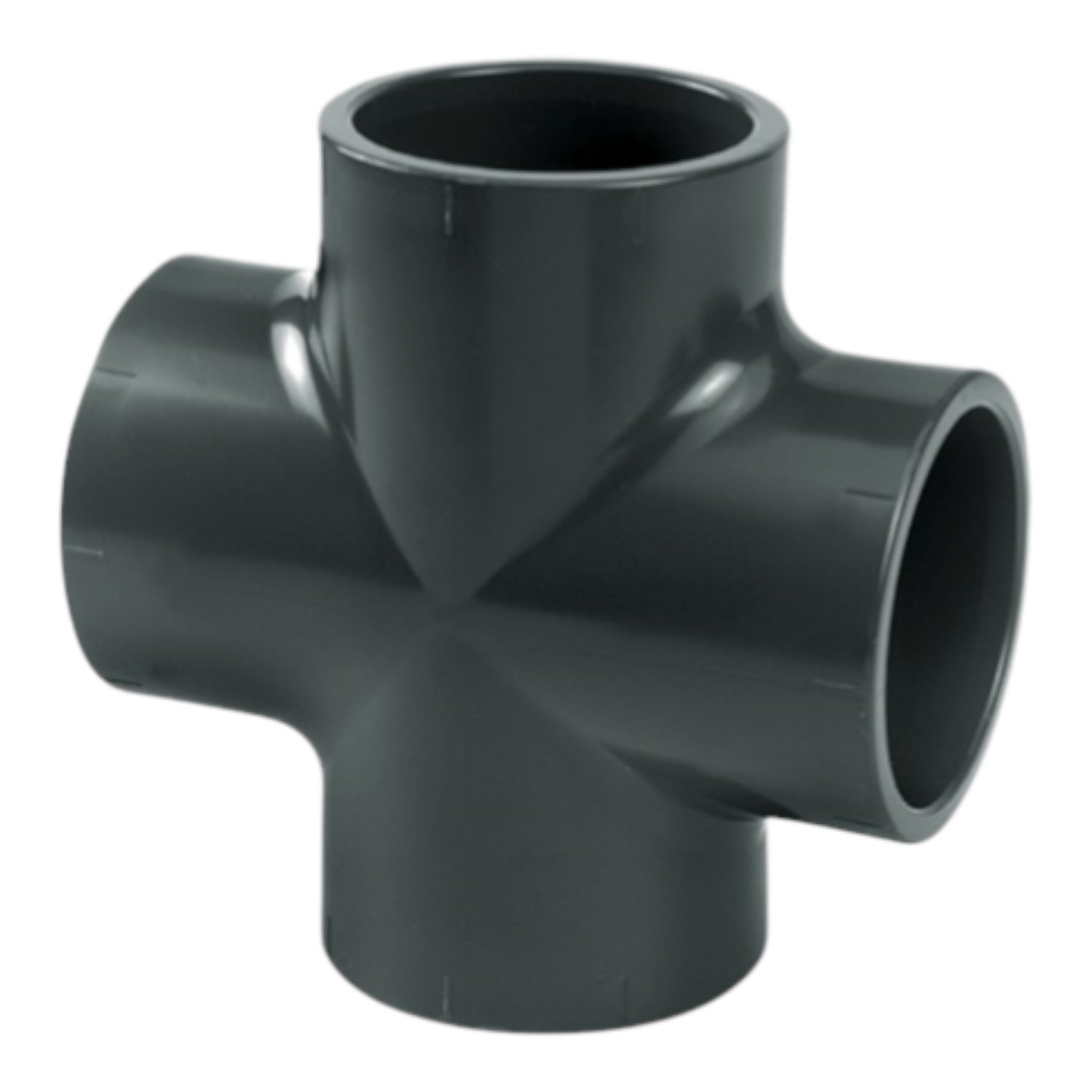
The PVC 32mm Four Way Tee Cross is designed for creating a four-way junction in compatible PVC pipework in professional PVC irrigation and water-distribution systems.
Correct fitting selection helps create serviceable pipe layouts without forcing incompatible diameters, threads or connection types.
Key benefits
Creating branches & service points
Plan branch or drain positions before assembly so connected pipework can be supported and accessed. Adding branches can increase total downstream flow demand, so consider the hydraulic effect on the complete irrigation zone.
Preparing PVC pipe & fittings
Cut pipe squarely, remove burrs and clean the joint area before assembly. Dry-fit the layout first where practical to confirm alignment and component selection.
For solvent-weld joints, use cleaner and adhesive compatible with the PVC system and follow the manufacturer's application and curing instructions. For threaded joints, use an appropriate sealing method and avoid excessive tightening.
Installation & commissioning
Support pipework so fittings do not carry avoidable bending loads. After the applicable curing or assembly process, commission the system gradually and inspect joints for leakage before routine crop use.
Pressure & compatibility
Nominal dimensions identify connection sizes but do not by themselves establish pressure rating or compatibility with every PVC system. Confirm the requirements of the complete installation before use.
Maintenance
Inspect accessible pipework and fittings periodically for leakage, movement, cracking or mechanical damage. Isolate and repair faults properly rather than relying on temporary external sealing.
PVC 32mm Four Way Tee Cross product details
| Product type | PVC Four-Way Tee Cross |
|---|---|
| Primary use | creating a four-way junction in compatible PVC pipework |
| Source dimensions / designation | 32mm Four Way Tee Cross |
| Application | Professional PVC irrigation and water-distribution systems |
PVC 32mm Four Way Tee Cross FAQs
What is this fitting used for?
Creating a four-way junction in compatible pvc pipework. How do I check the correct size?
Match every stated pipe diameter, thread and connection type to the components in the intended system. Should PVC pipe be cut squarely?
Yes. Square, deburred cuts help fittings seat correctly and support reliable joint preparation. Can I force a fitting onto a slightly different pipe size?
No. Use components specifically compatible with the stated dimensions and connection system. Should pipework be supported?
Yes. Support runs so fittings are not carrying unnecessary pipe or water weight. Can threaded PVC fittings be overtightened?
Yes. Excessive tightening can damage plastic threads or fitting bodies. When can a solvent-weld system be pressurised?
Follow the adhesive manufacturer's current curing and commissioning instructions rather than assuming a universal time. What should I do if a PVC joint leaks?
Safely isolate the system and inspect the joint, fitting and assembly method; repair it correctly rather than relying on a temporary external seal.
The PVC 20mm Four Way Tee Cross is designed for creating a four-way junction in compatible PVC pipework in professional PVC irrigation and water-distribution systems.
Correct fitting selection helps create serviceable pipe layouts without forcing incompatible diameters, threads or connection types.
Key benefits
Creating branches & service points
Plan branch or drain positions before assembly so connected pipework can be supported and accessed. Adding branches can increase total downstream flow demand, so consider the hydraulic effect on the complete irrigation zone.
Preparing PVC pipe & fittings
Cut pipe squarely, remove burrs and clean the joint area before assembly. Dry-fit the layout first where practical to confirm alignment and component selection.
For solvent-weld joints, use cleaner and adhesive compatible with the PVC system and follow the manufacturer's application and curing instructions. For threaded joints, use an appropriate sealing method and avoid excessive tightening.
Installation & commissioning
Support pipework so fittings do not carry avoidable bending loads. After the applicable curing or assembly process, commission the system gradually and inspect joints for leakage before routine crop use.
Pressure & compatibility
Nominal dimensions identify connection sizes but do not by themselves establish pressure rating or compatibility with every PVC system. Confirm the requirements of the complete installation before use.
Maintenance
Inspect accessible pipework and fittings periodically for leakage, movement, cracking or mechanical damage. Isolate and repair faults properly rather than relying on temporary external sealing.
PVC 20mm Four Way Tee Cross product details
| Product type | PVC Four-Way Tee Cross |
|---|---|
| Primary use | creating a four-way junction in compatible PVC pipework |
| Source dimensions / designation | 20mm Four Way Tee Cross |
| Application | Professional PVC irrigation and water-distribution systems |
PVC 20mm Four Way Tee Cross FAQs
What is this fitting used for?
Creating a four-way junction in compatible pvc pipework. How do I check the correct size?
Match every stated pipe diameter, thread and connection type to the components in the intended system. Should PVC pipe be cut squarely?
Yes. Square, deburred cuts help fittings seat correctly and support reliable joint preparation. Can I force a fitting onto a slightly different pipe size?
No. Use components specifically compatible with the stated dimensions and connection system. Should pipework be supported?
Yes. Support runs so fittings are not carrying unnecessary pipe or water weight. Can threaded PVC fittings be overtightened?
Yes. Excessive tightening can damage plastic threads or fitting bodies. When can a solvent-weld system be pressurised?
Follow the adhesive manufacturer's current curing and commissioning instructions rather than assuming a universal time. What should I do if a PVC joint leaks?
Safely isolate the system and inspect the joint, fitting and assembly method; repair it correctly rather than relying on a temporary external seal.
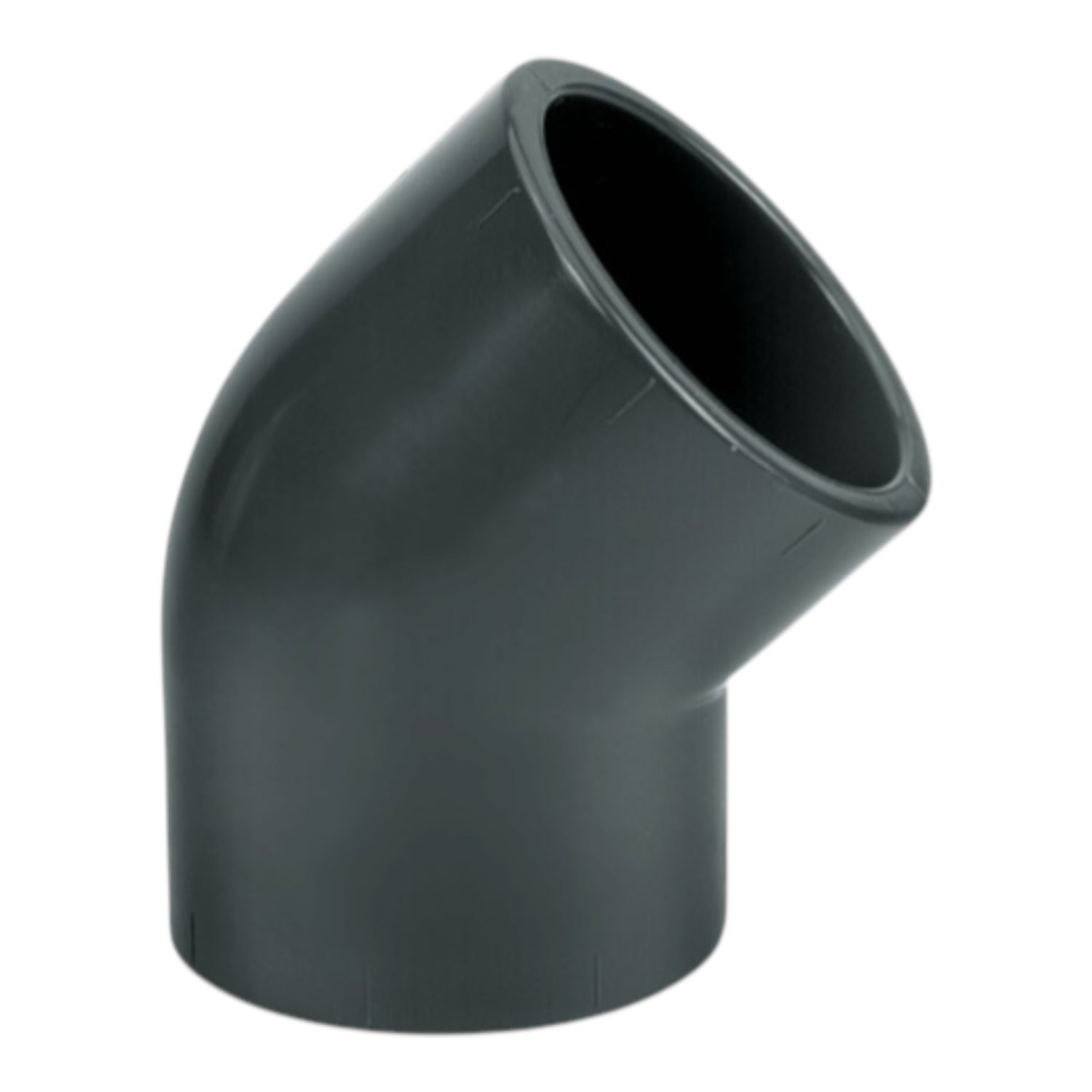
The PVC 63mm x 63mm 45° Elbow is designed for changing pipe direction by 45 degrees in professional PVC irrigation and water-distribution systems.
Correct fitting selection helps create serviceable pipe layouts without forcing incompatible diameters, threads or connection types.
Key benefits
Changing pipe direction
Use the elbow to create the stated change of direction without forcing straight pipe into an excessively tight bend. Align both pipe runs before permanent assembly so the fitting is not left under continuous side load.
Preparing PVC pipe & fittings
Cut pipe squarely, remove burrs and clean the joint area before assembly. Dry-fit the layout first where practical to confirm alignment and component selection.
For solvent-weld joints, use cleaner and adhesive compatible with the PVC system and follow the manufacturer's application and curing instructions. For threaded joints, use an appropriate sealing method and avoid excessive tightening.
Installation & commissioning
Support pipework so fittings do not carry avoidable bending loads. After the applicable curing or assembly process, commission the system gradually and inspect joints for leakage before routine crop use.
Pressure & compatibility
Nominal dimensions identify connection sizes but do not by themselves establish pressure rating or compatibility with every PVC system. Confirm the requirements of the complete installation before use.
Maintenance
Inspect accessible pipework and fittings periodically for leakage, movement, cracking or mechanical damage. Isolate and repair faults properly rather than relying on temporary external sealing.
PVC 63mm x 63mm 45° Elbow product details
| Product type | PVC 45° Elbow |
|---|---|
| Primary use | changing pipe direction by 45 degrees |
| Source dimensions / designation | 63mm x 63mm 45° Elbow |
| Application | Professional PVC irrigation and water-distribution systems |
PVC 63mm x 63mm 45° Elbow FAQs
What is this fitting used for?
Changing pipe direction by 45 degrees. How do I check the correct size?
Match every stated pipe diameter, thread and connection type to the components in the intended system. Should PVC pipe be cut squarely?
Yes. Square, deburred cuts help fittings seat correctly and support reliable joint preparation. Can I force a fitting onto a slightly different pipe size?
No. Use components specifically compatible with the stated dimensions and connection system. Should pipework be supported?
Yes. Support runs so fittings are not carrying unnecessary pipe or water weight. Can threaded PVC fittings be overtightened?
Yes. Excessive tightening can damage plastic threads or fitting bodies. When can a solvent-weld system be pressurised?
Follow the adhesive manufacturer's current curing and commissioning instructions rather than assuming a universal time. What should I do if a PVC joint leaks?
Safely isolate the system and inspect the joint, fitting and assembly method; repair it correctly rather than relying on a temporary external seal.
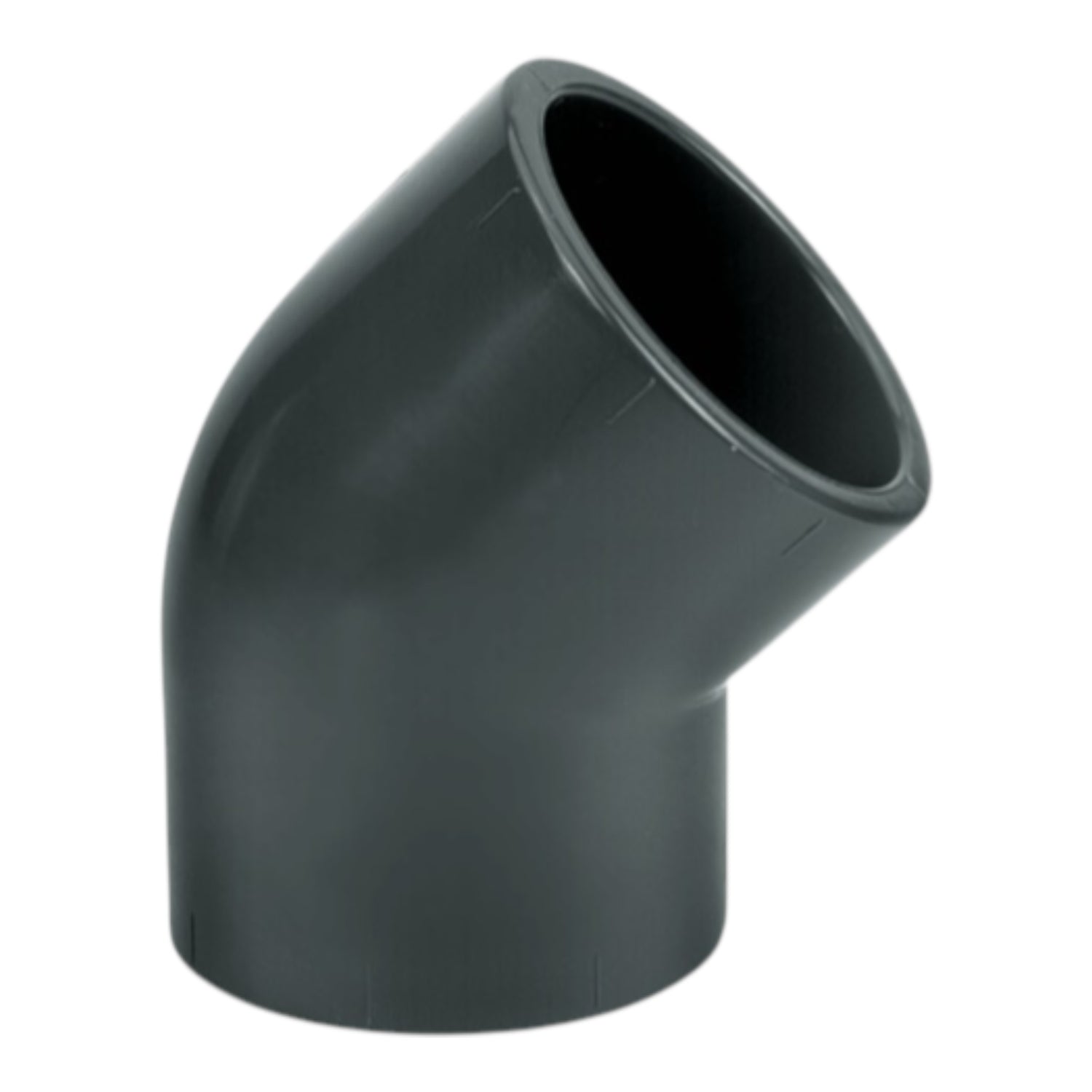
The PVC 50mm x 50mm 45° Elbow is designed for changing pipe direction by 45 degrees in professional PVC irrigation and water-distribution systems.
Correct fitting selection helps create serviceable pipe layouts without forcing incompatible diameters, threads or connection types.
Key benefits
Changing pipe direction
Use the elbow to create the stated change of direction without forcing straight pipe into an excessively tight bend. Align both pipe runs before permanent assembly so the fitting is not left under continuous side load.
Preparing PVC pipe & fittings
Cut pipe squarely, remove burrs and clean the joint area before assembly. Dry-fit the layout first where practical to confirm alignment and component selection.
For solvent-weld joints, use cleaner and adhesive compatible with the PVC system and follow the manufacturer's application and curing instructions. For threaded joints, use an appropriate sealing method and avoid excessive tightening.
Installation & commissioning
Support pipework so fittings do not carry avoidable bending loads. After the applicable curing or assembly process, commission the system gradually and inspect joints for leakage before routine crop use.
Pressure & compatibility
Nominal dimensions identify connection sizes but do not by themselves establish pressure rating or compatibility with every PVC system. Confirm the requirements of the complete installation before use.
Maintenance
Inspect accessible pipework and fittings periodically for leakage, movement, cracking or mechanical damage. Isolate and repair faults properly rather than relying on temporary external sealing.
PVC 50mm x 50mm 45° Elbow product details
| Product type | PVC 45° Elbow |
|---|---|
| Primary use | changing pipe direction by 45 degrees |
| Source dimensions / designation | 50mm x 50mm 45° Elbow |
| Application | Professional PVC irrigation and water-distribution systems |
PVC 50mm x 50mm 45° Elbow FAQs
What is this fitting used for?
Changing pipe direction by 45 degrees. How do I check the correct size?
Match every stated pipe diameter, thread and connection type to the components in the intended system. Should PVC pipe be cut squarely?
Yes. Square, deburred cuts help fittings seat correctly and support reliable joint preparation. Can I force a fitting onto a slightly different pipe size?
No. Use components specifically compatible with the stated dimensions and connection system. Should pipework be supported?
Yes. Support runs so fittings are not carrying unnecessary pipe or water weight. Can threaded PVC fittings be overtightened?
Yes. Excessive tightening can damage plastic threads or fitting bodies. When can a solvent-weld system be pressurised?
Follow the adhesive manufacturer's current curing and commissioning instructions rather than assuming a universal time. What should I do if a PVC joint leaks?
Safely isolate the system and inspect the joint, fitting and assembly method; repair it correctly rather than relying on a temporary external seal.
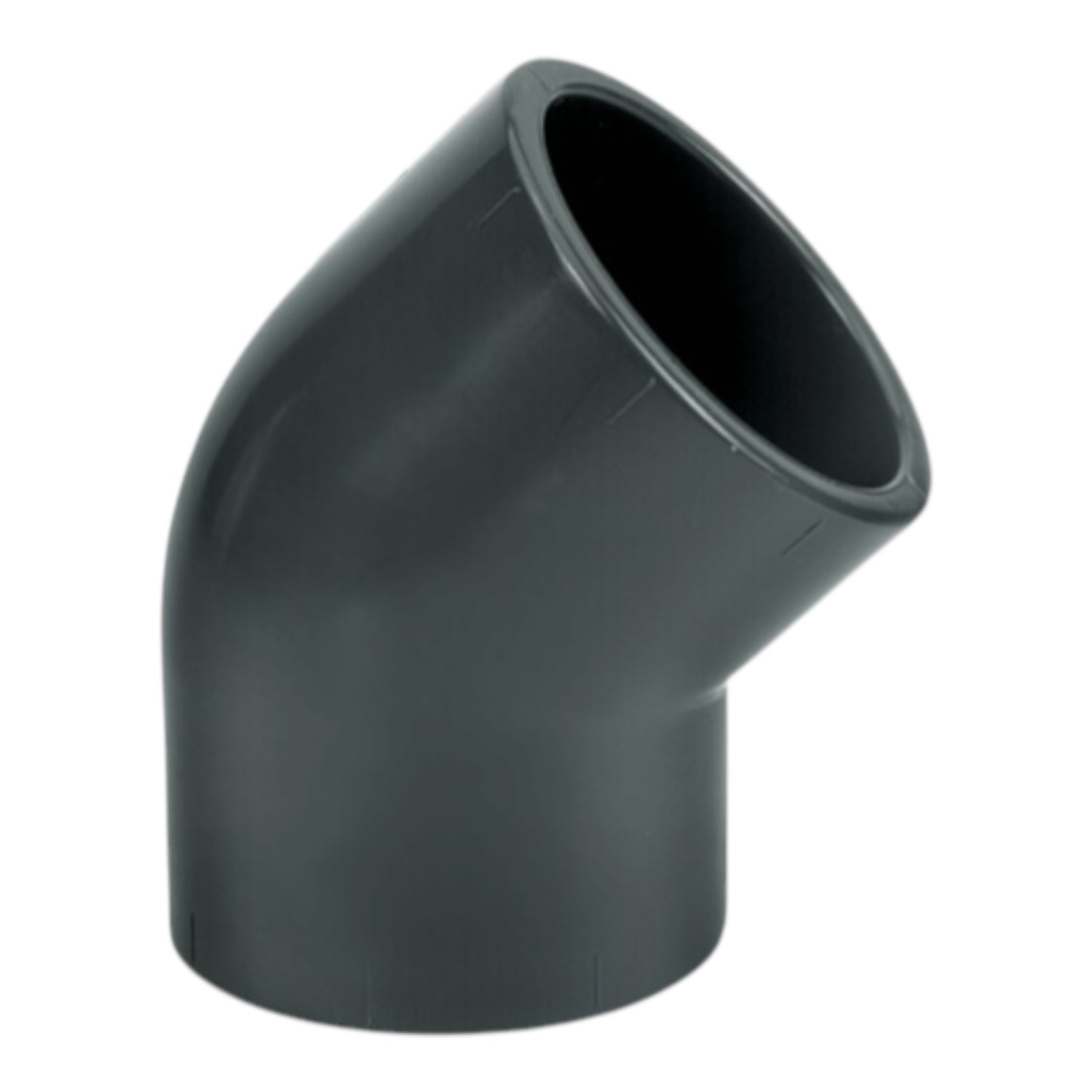
The PVC 40mm x 40mm 45° Elbow is designed for changing pipe direction by 45 degrees in professional PVC irrigation and water-distribution systems.
Correct fitting selection helps create serviceable pipe layouts without forcing incompatible diameters, threads or connection types.
Key benefits
Changing pipe direction
Use the elbow to create the stated change of direction without forcing straight pipe into an excessively tight bend. Align both pipe runs before permanent assembly so the fitting is not left under continuous side load.
Preparing PVC pipe & fittings
Cut pipe squarely, remove burrs and clean the joint area before assembly. Dry-fit the layout first where practical to confirm alignment and component selection.
For solvent-weld joints, use cleaner and adhesive compatible with the PVC system and follow the manufacturer's application and curing instructions. For threaded joints, use an appropriate sealing method and avoid excessive tightening.
Installation & commissioning
Support pipework so fittings do not carry avoidable bending loads. After the applicable curing or assembly process, commission the system gradually and inspect joints for leakage before routine crop use.
Pressure & compatibility
Nominal dimensions identify connection sizes but do not by themselves establish pressure rating or compatibility with every PVC system. Confirm the requirements of the complete installation before use.
Maintenance
Inspect accessible pipework and fittings periodically for leakage, movement, cracking or mechanical damage. Isolate and repair faults properly rather than relying on temporary external sealing.
PVC 40mm x 40mm 45° Elbow product details
| Product type | PVC 45° Elbow |
|---|---|
| Primary use | changing pipe direction by 45 degrees |
| Source dimensions / designation | 40mm x 40mm 45° Elbow |
| Application | Professional PVC irrigation and water-distribution systems |
PVC 40mm x 40mm 45° Elbow FAQs
What is this fitting used for?
Changing pipe direction by 45 degrees. How do I check the correct size?
Match every stated pipe diameter, thread and connection type to the components in the intended system. Should PVC pipe be cut squarely?
Yes. Square, deburred cuts help fittings seat correctly and support reliable joint preparation. Can I force a fitting onto a slightly different pipe size?
No. Use components specifically compatible with the stated dimensions and connection system. Should pipework be supported?
Yes. Support runs so fittings are not carrying unnecessary pipe or water weight. Can threaded PVC fittings be overtightened?
Yes. Excessive tightening can damage plastic threads or fitting bodies. When can a solvent-weld system be pressurised?
Follow the adhesive manufacturer's current curing and commissioning instructions rather than assuming a universal time. What should I do if a PVC joint leaks?
Safely isolate the system and inspect the joint, fitting and assembly method; repair it correctly rather than relying on a temporary external seal.

The PVC 32mm x 32mm 45° Elbow is designed for changing pipe direction by 45 degrees in professional PVC irrigation and water-distribution systems.
Correct fitting selection helps create serviceable pipe layouts without forcing incompatible diameters, threads or connection types.
Key benefits
Changing pipe direction
Use the elbow to create the stated change of direction without forcing straight pipe into an excessively tight bend. Align both pipe runs before permanent assembly so the fitting is not left under continuous side load.
Preparing PVC pipe & fittings
Cut pipe squarely, remove burrs and clean the joint area before assembly. Dry-fit the layout first where practical to confirm alignment and component selection.
For solvent-weld joints, use cleaner and adhesive compatible with the PVC system and follow the manufacturer's application and curing instructions. For threaded joints, use an appropriate sealing method and avoid excessive tightening.
Installation & commissioning
Support pipework so fittings do not carry avoidable bending loads. After the applicable curing or assembly process, commission the system gradually and inspect joints for leakage before routine crop use.
Pressure & compatibility
Nominal dimensions identify connection sizes but do not by themselves establish pressure rating or compatibility with every PVC system. Confirm the requirements of the complete installation before use.
Maintenance
Inspect accessible pipework and fittings periodically for leakage, movement, cracking or mechanical damage. Isolate and repair faults properly rather than relying on temporary external sealing.
PVC 32mm x 32mm 45° Elbow product details
| Product type | PVC 45° Elbow |
|---|---|
| Primary use | changing pipe direction by 45 degrees |
| Source dimensions / designation | 32mm x 32mm 45° Elbow |
| Application | Professional PVC irrigation and water-distribution systems |
PVC 32mm x 32mm 45° Elbow FAQs
What is this fitting used for?
Changing pipe direction by 45 degrees. How do I check the correct size?
Match every stated pipe diameter, thread and connection type to the components in the intended system. Should PVC pipe be cut squarely?
Yes. Square, deburred cuts help fittings seat correctly and support reliable joint preparation. Can I force a fitting onto a slightly different pipe size?
No. Use components specifically compatible with the stated dimensions and connection system. Should pipework be supported?
Yes. Support runs so fittings are not carrying unnecessary pipe or water weight. Can threaded PVC fittings be overtightened?
Yes. Excessive tightening can damage plastic threads or fitting bodies. When can a solvent-weld system be pressurised?
Follow the adhesive manufacturer's current curing and commissioning instructions rather than assuming a universal time. What should I do if a PVC joint leaks?
Safely isolate the system and inspect the joint, fitting and assembly method; repair it correctly rather than relying on a temporary external seal.

The PVC 20mm x 20mm 45° Elbow is designed for changing pipe direction by 45 degrees in professional PVC irrigation and water-distribution systems.
Correct fitting selection helps create serviceable pipe layouts without forcing incompatible diameters, threads or connection types.
Key benefits
Changing pipe direction
Use the elbow to create the stated change of direction without forcing straight pipe into an excessively tight bend. Align both pipe runs before permanent assembly so the fitting is not left under continuous side load.
Preparing PVC pipe & fittings
Cut pipe squarely, remove burrs and clean the joint area before assembly. Dry-fit the layout first where practical to confirm alignment and component selection.
For solvent-weld joints, use cleaner and adhesive compatible with the PVC system and follow the manufacturer's application and curing instructions. For threaded joints, use an appropriate sealing method and avoid excessive tightening.
Installation & commissioning
Support pipework so fittings do not carry avoidable bending loads. After the applicable curing or assembly process, commission the system gradually and inspect joints for leakage before routine crop use.
Pressure & compatibility
Nominal dimensions identify connection sizes but do not by themselves establish pressure rating or compatibility with every PVC system. Confirm the requirements of the complete installation before use.
Maintenance
Inspect accessible pipework and fittings periodically for leakage, movement, cracking or mechanical damage. Isolate and repair faults properly rather than relying on temporary external sealing.
PVC 20mm x 20mm 45° Elbow product details
| Product type | PVC 45° Elbow |
|---|---|
| Primary use | changing pipe direction by 45 degrees |
| Source dimensions / designation | 20mm x 20mm 45° Elbow |
| Application | Professional PVC irrigation and water-distribution systems |
PVC 20mm x 20mm 45° Elbow FAQs
What is this fitting used for?
Changing pipe direction by 45 degrees. How do I check the correct size?
Match every stated pipe diameter, thread and connection type to the components in the intended system. Should PVC pipe be cut squarely?
Yes. Square, deburred cuts help fittings seat correctly and support reliable joint preparation. Can I force a fitting onto a slightly different pipe size?
No. Use components specifically compatible with the stated dimensions and connection system. Should pipework be supported?
Yes. Support runs so fittings are not carrying unnecessary pipe or water weight. Can threaded PVC fittings be overtightened?
Yes. Excessive tightening can damage plastic threads or fitting bodies. When can a solvent-weld system be pressurised?
Follow the adhesive manufacturer's current curing and commissioning instructions rather than assuming a universal time. What should I do if a PVC joint leaks?
Safely isolate the system and inspect the joint, fitting and assembly method; repair it correctly rather than relying on a temporary external seal.

The PVC 63mm x 63mm 90° Elbow is designed for changing pipe direction by 90 degrees in professional PVC irrigation and water-distribution systems.
Correct fitting selection helps create serviceable pipe layouts without forcing incompatible diameters, threads or connection types.
Key benefits
Changing pipe direction
Use the elbow to create the stated change of direction without forcing straight pipe into an excessively tight bend. Align both pipe runs before permanent assembly so the fitting is not left under continuous side load.
Preparing PVC pipe & fittings
Cut pipe squarely, remove burrs and clean the joint area before assembly. Dry-fit the layout first where practical to confirm alignment and component selection.
For solvent-weld joints, use cleaner and adhesive compatible with the PVC system and follow the manufacturer's application and curing instructions. For threaded joints, use an appropriate sealing method and avoid excessive tightening.
Installation & commissioning
Support pipework so fittings do not carry avoidable bending loads. After the applicable curing or assembly process, commission the system gradually and inspect joints for leakage before routine crop use.
Pressure & compatibility
Nominal dimensions identify connection sizes but do not by themselves establish pressure rating or compatibility with every PVC system. Confirm the requirements of the complete installation before use.
Maintenance
Inspect accessible pipework and fittings periodically for leakage, movement, cracking or mechanical damage. Isolate and repair faults properly rather than relying on temporary external sealing.
PVC 63mm x 63mm 90° Elbow product details
| Product type | PVC 90° Elbow |
|---|---|
| Primary use | changing pipe direction by 90 degrees |
| Source dimensions / designation | 63mm x 63mm 90° Elbow |
| Application | Professional PVC irrigation and water-distribution systems |
PVC 63mm x 63mm 90° Elbow FAQs
What is this fitting used for?
Changing pipe direction by 90 degrees. How do I check the correct size?
Match every stated pipe diameter, thread and connection type to the components in the intended system. Should PVC pipe be cut squarely?
Yes. Square, deburred cuts help fittings seat correctly and support reliable joint preparation. Can I force a fitting onto a slightly different pipe size?
No. Use components specifically compatible with the stated dimensions and connection system. Should pipework be supported?
Yes. Support runs so fittings are not carrying unnecessary pipe or water weight. Can threaded PVC fittings be overtightened?
Yes. Excessive tightening can damage plastic threads or fitting bodies. When can a solvent-weld system be pressurised?
Follow the adhesive manufacturer's current curing and commissioning instructions rather than assuming a universal time. What should I do if a PVC joint leaks?
Safely isolate the system and inspect the joint, fitting and assembly method; repair it correctly rather than relying on a temporary external seal.

The PVC 50mm x 50mm 90° Elbow is designed for changing pipe direction by 90 degrees in professional PVC irrigation and water-distribution systems.
Correct fitting selection helps create serviceable pipe layouts without forcing incompatible diameters, threads or connection types.
Key benefits
Changing pipe direction
Use the elbow to create the stated change of direction without forcing straight pipe into an excessively tight bend. Align both pipe runs before permanent assembly so the fitting is not left under continuous side load.
Preparing PVC pipe & fittings
Cut pipe squarely, remove burrs and clean the joint area before assembly. Dry-fit the layout first where practical to confirm alignment and component selection.
For solvent-weld joints, use cleaner and adhesive compatible with the PVC system and follow the manufacturer's application and curing instructions. For threaded joints, use an appropriate sealing method and avoid excessive tightening.
Installation & commissioning
Support pipework so fittings do not carry avoidable bending loads. After the applicable curing or assembly process, commission the system gradually and inspect joints for leakage before routine crop use.
Pressure & compatibility
Nominal dimensions identify connection sizes but do not by themselves establish pressure rating or compatibility with every PVC system. Confirm the requirements of the complete installation before use.
Maintenance
Inspect accessible pipework and fittings periodically for leakage, movement, cracking or mechanical damage. Isolate and repair faults properly rather than relying on temporary external sealing.
PVC 50mm x 50mm 90° Elbow product details
| Product type | PVC 90° Elbow |
|---|---|
| Primary use | changing pipe direction by 90 degrees |
| Source dimensions / designation | 50mm x 50mm 90° Elbow |
| Application | Professional PVC irrigation and water-distribution systems |
PVC 50mm x 50mm 90° Elbow FAQs
What is this fitting used for?
Changing pipe direction by 90 degrees. How do I check the correct size?
Match every stated pipe diameter, thread and connection type to the components in the intended system. Should PVC pipe be cut squarely?
Yes. Square, deburred cuts help fittings seat correctly and support reliable joint preparation. Can I force a fitting onto a slightly different pipe size?
No. Use components specifically compatible with the stated dimensions and connection system. Should pipework be supported?
Yes. Support runs so fittings are not carrying unnecessary pipe or water weight. Can threaded PVC fittings be overtightened?
Yes. Excessive tightening can damage plastic threads or fitting bodies. When can a solvent-weld system be pressurised?
Follow the adhesive manufacturer's current curing and commissioning instructions rather than assuming a universal time. What should I do if a PVC joint leaks?
Safely isolate the system and inspect the joint, fitting and assembly method; repair it correctly rather than relying on a temporary external seal.

The PVC 40mm x 40mm 90° Elbow is designed for changing pipe direction by 90 degrees in professional PVC irrigation and water-distribution systems.
Correct fitting selection helps create serviceable pipe layouts without forcing incompatible diameters, threads or connection types.
Key benefits
Changing pipe direction
Use the elbow to create the stated change of direction without forcing straight pipe into an excessively tight bend. Align both pipe runs before permanent assembly so the fitting is not left under continuous side load.
Preparing PVC pipe & fittings
Cut pipe squarely, remove burrs and clean the joint area before assembly. Dry-fit the layout first where practical to confirm alignment and component selection.
For solvent-weld joints, use cleaner and adhesive compatible with the PVC system and follow the manufacturer's application and curing instructions. For threaded joints, use an appropriate sealing method and avoid excessive tightening.
Installation & commissioning
Support pipework so fittings do not carry avoidable bending loads. After the applicable curing or assembly process, commission the system gradually and inspect joints for leakage before routine crop use.
Pressure & compatibility
Nominal dimensions identify connection sizes but do not by themselves establish pressure rating or compatibility with every PVC system. Confirm the requirements of the complete installation before use.
Maintenance
Inspect accessible pipework and fittings periodically for leakage, movement, cracking or mechanical damage. Isolate and repair faults properly rather than relying on temporary external sealing.
PVC 40mm x 40mm 90° Elbow product details
| Product type | PVC 90° Elbow |
|---|---|
| Primary use | changing pipe direction by 90 degrees |
| Source dimensions / designation | 40mm x 40mm 90° Elbow |
| Application | Professional PVC irrigation and water-distribution systems |
PVC 40mm x 40mm 90° Elbow FAQs
What is this fitting used for?
Changing pipe direction by 90 degrees. How do I check the correct size?
Match every stated pipe diameter, thread and connection type to the components in the intended system. Should PVC pipe be cut squarely?
Yes. Square, deburred cuts help fittings seat correctly and support reliable joint preparation. Can I force a fitting onto a slightly different pipe size?
No. Use components specifically compatible with the stated dimensions and connection system. Should pipework be supported?
Yes. Support runs so fittings are not carrying unnecessary pipe or water weight. Can threaded PVC fittings be overtightened?
Yes. Excessive tightening can damage plastic threads or fitting bodies. When can a solvent-weld system be pressurised?
Follow the adhesive manufacturer's current curing and commissioning instructions rather than assuming a universal time. What should I do if a PVC joint leaks?
Safely isolate the system and inspect the joint, fitting and assembly method; repair it correctly rather than relying on a temporary external seal.

The PVC 32mm x 32mm 90° Elbow is designed for changing pipe direction by 90 degrees in professional PVC irrigation and water-distribution systems.
Correct fitting selection helps create serviceable pipe layouts without forcing incompatible diameters, threads or connection types.
Key benefits
Changing pipe direction
Use the elbow to create the stated change of direction without forcing straight pipe into an excessively tight bend. Align both pipe runs before permanent assembly so the fitting is not left under continuous side load.
Preparing PVC pipe & fittings
Cut pipe squarely, remove burrs and clean the joint area before assembly. Dry-fit the layout first where practical to confirm alignment and component selection.
For solvent-weld joints, use cleaner and adhesive compatible with the PVC system and follow the manufacturer's application and curing instructions. For threaded joints, use an appropriate sealing method and avoid excessive tightening.
Installation & commissioning
Support pipework so fittings do not carry avoidable bending loads. After the applicable curing or assembly process, commission the system gradually and inspect joints for leakage before routine crop use.
Pressure & compatibility
Nominal dimensions identify connection sizes but do not by themselves establish pressure rating or compatibility with every PVC system. Confirm the requirements of the complete installation before use.
Maintenance
Inspect accessible pipework and fittings periodically for leakage, movement, cracking or mechanical damage. Isolate and repair faults properly rather than relying on temporary external sealing.
PVC 32mm x 32mm 90° Elbow product details
| Product type | PVC 90° Elbow |
|---|---|
| Primary use | changing pipe direction by 90 degrees |
| Source dimensions / designation | 32mm x 32mm 90° Elbow |
| Application | Professional PVC irrigation and water-distribution systems |
PVC 32mm x 32mm 90° Elbow FAQs
What is this fitting used for?
Changing pipe direction by 90 degrees. How do I check the correct size?
Match every stated pipe diameter, thread and connection type to the components in the intended system. Should PVC pipe be cut squarely?
Yes. Square, deburred cuts help fittings seat correctly and support reliable joint preparation. Can I force a fitting onto a slightly different pipe size?
No. Use components specifically compatible with the stated dimensions and connection system. Should pipework be supported?
Yes. Support runs so fittings are not carrying unnecessary pipe or water weight. Can threaded PVC fittings be overtightened?
Yes. Excessive tightening can damage plastic threads or fitting bodies. When can a solvent-weld system be pressurised?
Follow the adhesive manufacturer's current curing and commissioning instructions rather than assuming a universal time. What should I do if a PVC joint leaks?
Safely isolate the system and inspect the joint, fitting and assembly method; repair it correctly rather than relying on a temporary external seal.

The PVC 20mm x 20mm 90° Elbow is designed for changing pipe direction by 90 degrees in professional PVC irrigation and water-distribution systems.
Correct fitting selection helps create serviceable pipe layouts without forcing incompatible diameters, threads or connection types.
Key benefits
Changing pipe direction
Use the elbow to create the stated change of direction without forcing straight pipe into an excessively tight bend. Align both pipe runs before permanent assembly so the fitting is not left under continuous side load.
Preparing PVC pipe & fittings
Cut pipe squarely, remove burrs and clean the joint area before assembly. Dry-fit the layout first where practical to confirm alignment and component selection.
For solvent-weld joints, use cleaner and adhesive compatible with the PVC system and follow the manufacturer's application and curing instructions. For threaded joints, use an appropriate sealing method and avoid excessive tightening.
Installation & commissioning
Support pipework so fittings do not carry avoidable bending loads. After the applicable curing or assembly process, commission the system gradually and inspect joints for leakage before routine crop use.
Pressure & compatibility
Nominal dimensions identify connection sizes but do not by themselves establish pressure rating or compatibility with every PVC system. Confirm the requirements of the complete installation before use.
Maintenance
Inspect accessible pipework and fittings periodically for leakage, movement, cracking or mechanical damage. Isolate and repair faults properly rather than relying on temporary external sealing.
PVC 20mm x 20mm 90° Elbow product details
| Product type | PVC 90° Elbow |
|---|---|
| Primary use | changing pipe direction by 90 degrees |
| Source dimensions / designation | 20mm x 20mm 90° Elbow |
| Application | Professional PVC irrigation and water-distribution systems |
PVC 20mm x 20mm 90° Elbow FAQs
What is this fitting used for?
Changing pipe direction by 90 degrees. How do I check the correct size?
Match every stated pipe diameter, thread and connection type to the components in the intended system. Should PVC pipe be cut squarely?
Yes. Square, deburred cuts help fittings seat correctly and support reliable joint preparation. Can I force a fitting onto a slightly different pipe size?
No. Use components specifically compatible with the stated dimensions and connection system. Should pipework be supported?
Yes. Support runs so fittings are not carrying unnecessary pipe or water weight. Can threaded PVC fittings be overtightened?
Yes. Excessive tightening can damage plastic threads or fitting bodies. When can a solvent-weld system be pressurised?
Follow the adhesive manufacturer's current curing and commissioning instructions rather than assuming a universal time. What should I do if a PVC joint leaks?
Safely isolate the system and inspect the joint, fitting and assembly method; repair it correctly rather than relying on a temporary external seal.

The PVC 63mm Spacing Block for Caps is designed for spacing or supporting compatible PVC cap assemblies in professional PVC irrigation and water-distribution systems.
Correct fitting selection helps create serviceable pipe layouts without forcing incompatible diameters, threads or connection types.
Key benefits
Supporting PVC pipework
Use supports at suitable intervals so pipe weight, water weight and movement are not transferred unnecessarily into fittings and valves. Do not overtighten clamps in a way that distorts the pipe.
Preparing PVC pipe & fittings
Cut pipe squarely, remove burrs and clean the joint area before assembly. Dry-fit the layout first where practical to confirm alignment and component selection.
For solvent-weld joints, use cleaner and adhesive compatible with the PVC system and follow the manufacturer's application and curing instructions. For threaded joints, use an appropriate sealing method and avoid excessive tightening.
Installation & commissioning
Support pipework so fittings do not carry avoidable bending loads. After the applicable curing or assembly process, commission the system gradually and inspect joints for leakage before routine crop use.
Pressure & compatibility
Nominal dimensions identify connection sizes but do not by themselves establish pressure rating or compatibility with every PVC system. Confirm the requirements of the complete installation before use.
Maintenance
Inspect accessible pipework and fittings periodically for leakage, movement, cracking or mechanical damage. Isolate and repair faults properly rather than relying on temporary external sealing.
PVC 63mm Spacing Block for Caps product details
| Product type | PVC Spacing Block |
|---|---|
| Primary use | spacing or supporting compatible PVC cap assemblies |
| Source dimensions / designation | 63mm Spacing Block for Caps |
| Application | Professional PVC irrigation and water-distribution systems |
PVC 63mm Spacing Block for Caps FAQs
What is this fitting used for?
Spacing or supporting compatible pvc cap assemblies. How do I check the correct size?
Match every stated pipe diameter, thread and connection type to the components in the intended system. Should PVC pipe be cut squarely?
Yes. Square, deburred cuts help fittings seat correctly and support reliable joint preparation. Can I force a fitting onto a slightly different pipe size?
No. Use components specifically compatible with the stated dimensions and connection system. Should pipework be supported?
Yes. Support runs so fittings are not carrying unnecessary pipe or water weight. Can threaded PVC fittings be overtightened?
Yes. Excessive tightening can damage plastic threads or fitting bodies. When can a solvent-weld system be pressurised?
Follow the adhesive manufacturer's current curing and commissioning instructions rather than assuming a universal time. What should I do if a PVC joint leaks?
Safely isolate the system and inspect the joint, fitting and assembly method; repair it correctly rather than relying on a temporary external seal.

The PVC 50mm Spacing Block for Caps is designed for spacing or supporting compatible PVC cap assemblies in professional PVC irrigation and water-distribution systems.
Correct fitting selection helps create serviceable pipe layouts without forcing incompatible diameters, threads or connection types.
Key benefits
Supporting PVC pipework
Use supports at suitable intervals so pipe weight, water weight and movement are not transferred unnecessarily into fittings and valves. Do not overtighten clamps in a way that distorts the pipe.
Preparing PVC pipe & fittings
Cut pipe squarely, remove burrs and clean the joint area before assembly. Dry-fit the layout first where practical to confirm alignment and component selection.
For solvent-weld joints, use cleaner and adhesive compatible with the PVC system and follow the manufacturer's application and curing instructions. For threaded joints, use an appropriate sealing method and avoid excessive tightening.
Installation & commissioning
Support pipework so fittings do not carry avoidable bending loads. After the applicable curing or assembly process, commission the system gradually and inspect joints for leakage before routine crop use.
Pressure & compatibility
Nominal dimensions identify connection sizes but do not by themselves establish pressure rating or compatibility with every PVC system. Confirm the requirements of the complete installation before use.
Maintenance
Inspect accessible pipework and fittings periodically for leakage, movement, cracking or mechanical damage. Isolate and repair faults properly rather than relying on temporary external sealing.
PVC 50mm Spacing Block for Caps product details
| Product type | PVC Spacing Block |
|---|---|
| Primary use | spacing or supporting compatible PVC cap assemblies |
| Source dimensions / designation | 50mm Spacing Block for Caps |
| Application | Professional PVC irrigation and water-distribution systems |
PVC 50mm Spacing Block for Caps FAQs
What is this fitting used for?
Spacing or supporting compatible pvc cap assemblies. How do I check the correct size?
Match every stated pipe diameter, thread and connection type to the components in the intended system. Should PVC pipe be cut squarely?
Yes. Square, deburred cuts help fittings seat correctly and support reliable joint preparation. Can I force a fitting onto a slightly different pipe size?
No. Use components specifically compatible with the stated dimensions and connection system. Should pipework be supported?
Yes. Support runs so fittings are not carrying unnecessary pipe or water weight. Can threaded PVC fittings be overtightened?
Yes. Excessive tightening can damage plastic threads or fitting bodies. When can a solvent-weld system be pressurised?
Follow the adhesive manufacturer's current curing and commissioning instructions rather than assuming a universal time. What should I do if a PVC joint leaks?
Safely isolate the system and inspect the joint, fitting and assembly method; repair it correctly rather than relying on a temporary external seal.

The PVC 40mm Spacing Block for Caps is designed for spacing or supporting compatible PVC cap assemblies in professional PVC irrigation and water-distribution systems.
Correct fitting selection helps create serviceable pipe layouts without forcing incompatible diameters, threads or connection types.
Key benefits
Supporting PVC pipework
Use supports at suitable intervals so pipe weight, water weight and movement are not transferred unnecessarily into fittings and valves. Do not overtighten clamps in a way that distorts the pipe.
Preparing PVC pipe & fittings
Cut pipe squarely, remove burrs and clean the joint area before assembly. Dry-fit the layout first where practical to confirm alignment and component selection.
For solvent-weld joints, use cleaner and adhesive compatible with the PVC system and follow the manufacturer's application and curing instructions. For threaded joints, use an appropriate sealing method and avoid excessive tightening.
Installation & commissioning
Support pipework so fittings do not carry avoidable bending loads. After the applicable curing or assembly process, commission the system gradually and inspect joints for leakage before routine crop use.
Pressure & compatibility
Nominal dimensions identify connection sizes but do not by themselves establish pressure rating or compatibility with every PVC system. Confirm the requirements of the complete installation before use.
Maintenance
Inspect accessible pipework and fittings periodically for leakage, movement, cracking or mechanical damage. Isolate and repair faults properly rather than relying on temporary external sealing.
PVC 40mm Spacing Block for Caps product details
| Product type | PVC Spacing Block |
|---|---|
| Primary use | spacing or supporting compatible PVC cap assemblies |
| Source dimensions / designation | 40mm Spacing Block for Caps |
| Application | Professional PVC irrigation and water-distribution systems |
PVC 40mm Spacing Block for Caps FAQs
What is this fitting used for?
Spacing or supporting compatible pvc cap assemblies. How do I check the correct size?
Match every stated pipe diameter, thread and connection type to the components in the intended system. Should PVC pipe be cut squarely?
Yes. Square, deburred cuts help fittings seat correctly and support reliable joint preparation. Can I force a fitting onto a slightly different pipe size?
No. Use components specifically compatible with the stated dimensions and connection system. Should pipework be supported?
Yes. Support runs so fittings are not carrying unnecessary pipe or water weight. Can threaded PVC fittings be overtightened?
Yes. Excessive tightening can damage plastic threads or fitting bodies. When can a solvent-weld system be pressurised?
Follow the adhesive manufacturer's current curing and commissioning instructions rather than assuming a universal time. What should I do if a PVC joint leaks?
Safely isolate the system and inspect the joint, fitting and assembly method; repair it correctly rather than relying on a temporary external seal.

The PVC 32mm Spacing Block for Caps is designed for spacing or supporting compatible PVC cap assemblies in professional PVC irrigation and water-distribution systems.
Correct fitting selection helps create serviceable pipe layouts without forcing incompatible diameters, threads or connection types.
Key benefits
Supporting PVC pipework
Use supports at suitable intervals so pipe weight, water weight and movement are not transferred unnecessarily into fittings and valves. Do not overtighten clamps in a way that distorts the pipe.
Preparing PVC pipe & fittings
Cut pipe squarely, remove burrs and clean the joint area before assembly. Dry-fit the layout first where practical to confirm alignment and component selection.
For solvent-weld joints, use cleaner and adhesive compatible with the PVC system and follow the manufacturer's application and curing instructions. For threaded joints, use an appropriate sealing method and avoid excessive tightening.
Installation & commissioning
Support pipework so fittings do not carry avoidable bending loads. After the applicable curing or assembly process, commission the system gradually and inspect joints for leakage before routine crop use.
Pressure & compatibility
Nominal dimensions identify connection sizes but do not by themselves establish pressure rating or compatibility with every PVC system. Confirm the requirements of the complete installation before use.
Maintenance
Inspect accessible pipework and fittings periodically for leakage, movement, cracking or mechanical damage. Isolate and repair faults properly rather than relying on temporary external sealing.
PVC 32mm Spacing Block for Caps product details
| Product type | PVC Spacing Block |
|---|---|
| Primary use | spacing or supporting compatible PVC cap assemblies |
| Source dimensions / designation | 32mm Spacing Block for Caps |
| Application | Professional PVC irrigation and water-distribution systems |
PVC 32mm Spacing Block for Caps FAQs
What is this fitting used for?
Spacing or supporting compatible pvc cap assemblies. How do I check the correct size?
Match every stated pipe diameter, thread and connection type to the components in the intended system. Should PVC pipe be cut squarely?
Yes. Square, deburred cuts help fittings seat correctly and support reliable joint preparation. Can I force a fitting onto a slightly different pipe size?
No. Use components specifically compatible with the stated dimensions and connection system. Should pipework be supported?
Yes. Support runs so fittings are not carrying unnecessary pipe or water weight. Can threaded PVC fittings be overtightened?
Yes. Excessive tightening can damage plastic threads or fitting bodies. When can a solvent-weld system be pressurised?
Follow the adhesive manufacturer's current curing and commissioning instructions rather than assuming a universal time. What should I do if a PVC joint leaks?
Safely isolate the system and inspect the joint, fitting and assembly method; repair it correctly rather than relying on a temporary external seal.

The PVC 20mm Spacing Block for Caps is designed for spacing or supporting compatible PVC cap assemblies in professional PVC irrigation and water-distribution systems.
Correct fitting selection helps create serviceable pipe layouts without forcing incompatible diameters, threads or connection types.
Key benefits
Supporting PVC pipework
Use supports at suitable intervals so pipe weight, water weight and movement are not transferred unnecessarily into fittings and valves. Do not overtighten clamps in a way that distorts the pipe.
Preparing PVC pipe & fittings
Cut pipe squarely, remove burrs and clean the joint area before assembly. Dry-fit the layout first where practical to confirm alignment and component selection.
For solvent-weld joints, use cleaner and adhesive compatible with the PVC system and follow the manufacturer's application and curing instructions. For threaded joints, use an appropriate sealing method and avoid excessive tightening.
Installation & commissioning
Support pipework so fittings do not carry avoidable bending loads. After the applicable curing or assembly process, commission the system gradually and inspect joints for leakage before routine crop use.
Pressure & compatibility
Nominal dimensions identify connection sizes but do not by themselves establish pressure rating or compatibility with every PVC system. Confirm the requirements of the complete installation before use.
Maintenance
Inspect accessible pipework and fittings periodically for leakage, movement, cracking or mechanical damage. Isolate and repair faults properly rather than relying on temporary external sealing.
PVC 20mm Spacing Block for Caps product details
| Product type | PVC Spacing Block |
|---|---|
| Primary use | spacing or supporting compatible PVC cap assemblies |
| Source dimensions / designation | 20mm Spacing Block for Caps |
| Application | Professional PVC irrigation and water-distribution systems |
PVC 20mm Spacing Block for Caps FAQs
What is this fitting used for?
Spacing or supporting compatible pvc cap assemblies. How do I check the correct size?
Match every stated pipe diameter, thread and connection type to the components in the intended system. Should PVC pipe be cut squarely?
Yes. Square, deburred cuts help fittings seat correctly and support reliable joint preparation. Can I force a fitting onto a slightly different pipe size?
No. Use components specifically compatible with the stated dimensions and connection system. Should pipework be supported?
Yes. Support runs so fittings are not carrying unnecessary pipe or water weight. Can threaded PVC fittings be overtightened?
Yes. Excessive tightening can damage plastic threads or fitting bodies. When can a solvent-weld system be pressurised?
Follow the adhesive manufacturer's current curing and commissioning instructions rather than assuming a universal time. What should I do if a PVC joint leaks?
Safely isolate the system and inspect the joint, fitting and assembly method; repair it correctly rather than relying on a temporary external seal.

The PVC 50mm x 32mm Reducing Elbow is designed for changing pipe direction while reducing between compatible pipe sizes in professional PVC irrigation and water-distribution systems.
Correct fitting selection helps create serviceable pipe layouts without forcing incompatible diameters, threads or connection types.
Key benefits
Changing pipe direction
Use the elbow to create the stated change of direction without forcing straight pipe into an excessively tight bend. Align both pipe runs before permanent assembly so the fitting is not left under continuous side load.
Preparing PVC pipe & fittings
Cut pipe squarely, remove burrs and clean the joint area before assembly. Dry-fit the layout first where practical to confirm alignment and component selection.
For solvent-weld joints, use cleaner and adhesive compatible with the PVC system and follow the manufacturer's application and curing instructions. For threaded joints, use an appropriate sealing method and avoid excessive tightening.
Installation & commissioning
Support pipework so fittings do not carry avoidable bending loads. After the applicable curing or assembly process, commission the system gradually and inspect joints for leakage before routine crop use.
Pressure & compatibility
Nominal dimensions identify connection sizes but do not by themselves establish pressure rating or compatibility with every PVC system. Confirm the requirements of the complete installation before use.
Maintenance
Inspect accessible pipework and fittings periodically for leakage, movement, cracking or mechanical damage. Isolate and repair faults properly rather than relying on temporary external sealing.
PVC 50mm x 32mm Reducing Elbow product details
| Product type | PVC Reducing Elbow |
|---|---|
| Primary use | changing pipe direction while reducing between compatible pipe sizes |
| Source dimensions / designation | 50mm x 32mm Reducing Elbow |
| Application | Professional PVC irrigation and water-distribution systems |
PVC 50mm x 32mm Reducing Elbow FAQs
What is this fitting used for?
Changing pipe direction while reducing between compatible pipe sizes. How do I check the correct size?
Match every stated pipe diameter, thread and connection type to the components in the intended system. Should PVC pipe be cut squarely?
Yes. Square, deburred cuts help fittings seat correctly and support reliable joint preparation. Can I force a fitting onto a slightly different pipe size?
No. Use components specifically compatible with the stated dimensions and connection system. Should pipework be supported?
Yes. Support runs so fittings are not carrying unnecessary pipe or water weight. Can threaded PVC fittings be overtightened?
Yes. Excessive tightening can damage plastic threads or fitting bodies. When can a solvent-weld system be pressurised?
Follow the adhesive manufacturer's current curing and commissioning instructions rather than assuming a universal time. What should I do if a PVC joint leaks?
Safely isolate the system and inspect the joint, fitting and assembly method; repair it correctly rather than relying on a temporary external seal.

The PVC 63mm Pipe Clamp with Clip is designed for supporting compatible PVC pipework in professional PVC irrigation and water-distribution systems.
Correct fitting selection helps create serviceable pipe layouts without forcing incompatible diameters, threads or connection types.
Key benefits
Supporting PVC pipework
Use supports at suitable intervals so pipe weight, water weight and movement are not transferred unnecessarily into fittings and valves. Do not overtighten clamps in a way that distorts the pipe.
Preparing PVC pipe & fittings
Cut pipe squarely, remove burrs and clean the joint area before assembly. Dry-fit the layout first where practical to confirm alignment and component selection.
For solvent-weld joints, use cleaner and adhesive compatible with the PVC system and follow the manufacturer's application and curing instructions. For threaded joints, use an appropriate sealing method and avoid excessive tightening.
Installation & commissioning
Support pipework so fittings do not carry avoidable bending loads. After the applicable curing or assembly process, commission the system gradually and inspect joints for leakage before routine crop use.
Pressure & compatibility
Nominal dimensions identify connection sizes but do not by themselves establish pressure rating or compatibility with every PVC system. Confirm the requirements of the complete installation before use.
Maintenance
Inspect accessible pipework and fittings periodically for leakage, movement, cracking or mechanical damage. Isolate and repair faults properly rather than relying on temporary external sealing.
PVC 63mm Pipe Clamp with Clip product details
| Product type | PVC Pipe Clamp |
|---|---|
| Primary use | supporting compatible PVC pipework |
| Source dimensions / designation | 63mm Pipe Clamp with Clip |
| Application | Professional PVC irrigation and water-distribution systems |
PVC 63mm Pipe Clamp with Clip FAQs
What is this fitting used for?
Supporting compatible pvc pipework. How do I check the correct size?
Match every stated pipe diameter, thread and connection type to the components in the intended system. Should PVC pipe be cut squarely?
Yes. Square, deburred cuts help fittings seat correctly and support reliable joint preparation. Can I force a fitting onto a slightly different pipe size?
No. Use components specifically compatible with the stated dimensions and connection system. Should pipework be supported?
Yes. Support runs so fittings are not carrying unnecessary pipe or water weight. Can threaded PVC fittings be overtightened?
Yes. Excessive tightening can damage plastic threads or fitting bodies. When can a solvent-weld system be pressurised?
Follow the adhesive manufacturer's current curing and commissioning instructions rather than assuming a universal time. What should I do if a PVC joint leaks?
Safely isolate the system and inspect the joint, fitting and assembly method; repair it correctly rather than relying on a temporary external seal.

The PVC 50mm Pipe Clamp with Clip is designed for supporting compatible PVC pipework in professional PVC irrigation and water-distribution systems.
Correct fitting selection helps create serviceable pipe layouts without forcing incompatible diameters, threads or connection types.
Key benefits
Supporting PVC pipework
Use supports at suitable intervals so pipe weight, water weight and movement are not transferred unnecessarily into fittings and valves. Do not overtighten clamps in a way that distorts the pipe.
Preparing PVC pipe & fittings
Cut pipe squarely, remove burrs and clean the joint area before assembly. Dry-fit the layout first where practical to confirm alignment and component selection.
For solvent-weld joints, use cleaner and adhesive compatible with the PVC system and follow the manufacturer's application and curing instructions. For threaded joints, use an appropriate sealing method and avoid excessive tightening.
Installation & commissioning
Support pipework so fittings do not carry avoidable bending loads. After the applicable curing or assembly process, commission the system gradually and inspect joints for leakage before routine crop use.
Pressure & compatibility
Nominal dimensions identify connection sizes but do not by themselves establish pressure rating or compatibility with every PVC system. Confirm the requirements of the complete installation before use.
Maintenance
Inspect accessible pipework and fittings periodically for leakage, movement, cracking or mechanical damage. Isolate and repair faults properly rather than relying on temporary external sealing.
PVC 50mm Pipe Clamp with Clip product details
| Product type | PVC Pipe Clamp |
|---|---|
| Primary use | supporting compatible PVC pipework |
| Source dimensions / designation | 50mm Pipe Clamp with Clip |
| Application | Professional PVC irrigation and water-distribution systems |
PVC 50mm Pipe Clamp with Clip FAQs
What is this fitting used for?
Supporting compatible pvc pipework. How do I check the correct size?
Match every stated pipe diameter, thread and connection type to the components in the intended system. Should PVC pipe be cut squarely?
Yes. Square, deburred cuts help fittings seat correctly and support reliable joint preparation. Can I force a fitting onto a slightly different pipe size?
No. Use components specifically compatible with the stated dimensions and connection system. Should pipework be supported?
Yes. Support runs so fittings are not carrying unnecessary pipe or water weight. Can threaded PVC fittings be overtightened?
Yes. Excessive tightening can damage plastic threads or fitting bodies. When can a solvent-weld system be pressurised?
Follow the adhesive manufacturer's current curing and commissioning instructions rather than assuming a universal time. What should I do if a PVC joint leaks?
Safely isolate the system and inspect the joint, fitting and assembly method; repair it correctly rather than relying on a temporary external seal.

The PVC 40mm Pipe Clamp with Clip is designed for supporting compatible PVC pipework in professional PVC irrigation and water-distribution systems.
Correct fitting selection helps create serviceable pipe layouts without forcing incompatible diameters, threads or connection types.
Key benefits
Supporting PVC pipework
Use supports at suitable intervals so pipe weight, water weight and movement are not transferred unnecessarily into fittings and valves. Do not overtighten clamps in a way that distorts the pipe.
Preparing PVC pipe & fittings
Cut pipe squarely, remove burrs and clean the joint area before assembly. Dry-fit the layout first where practical to confirm alignment and component selection.
For solvent-weld joints, use cleaner and adhesive compatible with the PVC system and follow the manufacturer's application and curing instructions. For threaded joints, use an appropriate sealing method and avoid excessive tightening.
Installation & commissioning
Support pipework so fittings do not carry avoidable bending loads. After the applicable curing or assembly process, commission the system gradually and inspect joints for leakage before routine crop use.
Pressure & compatibility
Nominal dimensions identify connection sizes but do not by themselves establish pressure rating or compatibility with every PVC system. Confirm the requirements of the complete installation before use.
Maintenance
Inspect accessible pipework and fittings periodically for leakage, movement, cracking or mechanical damage. Isolate and repair faults properly rather than relying on temporary external sealing.
PVC 40mm Pipe Clamp with Clip product details
| Product type | PVC Pipe Clamp |
|---|---|
| Primary use | supporting compatible PVC pipework |
| Source dimensions / designation | 40mm Pipe Clamp with Clip |
| Application | Professional PVC irrigation and water-distribution systems |
PVC 40mm Pipe Clamp with Clip FAQs
What is this fitting used for?
Supporting compatible pvc pipework. How do I check the correct size?
Match every stated pipe diameter, thread and connection type to the components in the intended system. Should PVC pipe be cut squarely?
Yes. Square, deburred cuts help fittings seat correctly and support reliable joint preparation. Can I force a fitting onto a slightly different pipe size?
No. Use components specifically compatible with the stated dimensions and connection system. Should pipework be supported?
Yes. Support runs so fittings are not carrying unnecessary pipe or water weight. Can threaded PVC fittings be overtightened?
Yes. Excessive tightening can damage plastic threads or fitting bodies. When can a solvent-weld system be pressurised?
Follow the adhesive manufacturer's current curing and commissioning instructions rather than assuming a universal time. What should I do if a PVC joint leaks?
Safely isolate the system and inspect the joint, fitting and assembly method; repair it correctly rather than relying on a temporary external seal.

The PVC 32mm Pipe Clamp is designed for supporting compatible PVC pipework in professional PVC irrigation and water-distribution systems.
Correct fitting selection helps create serviceable pipe layouts without forcing incompatible diameters, threads or connection types.
Key benefits
Supporting PVC pipework
Use supports at suitable intervals so pipe weight, water weight and movement are not transferred unnecessarily into fittings and valves. Do not overtighten clamps in a way that distorts the pipe.
Preparing PVC pipe & fittings
Cut pipe squarely, remove burrs and clean the joint area before assembly. Dry-fit the layout first where practical to confirm alignment and component selection.
For solvent-weld joints, use cleaner and adhesive compatible with the PVC system and follow the manufacturer's application and curing instructions. For threaded joints, use an appropriate sealing method and avoid excessive tightening.
Installation & commissioning
Support pipework so fittings do not carry avoidable bending loads. After the applicable curing or assembly process, commission the system gradually and inspect joints for leakage before routine crop use.
Pressure & compatibility
Nominal dimensions identify connection sizes but do not by themselves establish pressure rating or compatibility with every PVC system. Confirm the requirements of the complete installation before use.
Maintenance
Inspect accessible pipework and fittings periodically for leakage, movement, cracking or mechanical damage. Isolate and repair faults properly rather than relying on temporary external sealing.
PVC 32mm Pipe Clamp product details
| Product type | PVC Pipe Clamp |
|---|---|
| Primary use | supporting compatible PVC pipework |
| Source dimensions / designation | 32mm Pipe Clamp |
| Application | Professional PVC irrigation and water-distribution systems |
PVC 32mm Pipe Clamp FAQs
What is this fitting used for?
Supporting compatible pvc pipework. How do I check the correct size?
Match every stated pipe diameter, thread and connection type to the components in the intended system. Should PVC pipe be cut squarely?
Yes. Square, deburred cuts help fittings seat correctly and support reliable joint preparation. Can I force a fitting onto a slightly different pipe size?
No. Use components specifically compatible with the stated dimensions and connection system. Should pipework be supported?
Yes. Support runs so fittings are not carrying unnecessary pipe or water weight. Can threaded PVC fittings be overtightened?
Yes. Excessive tightening can damage plastic threads or fitting bodies. When can a solvent-weld system be pressurised?
Follow the adhesive manufacturer's current curing and commissioning instructions rather than assuming a universal time. What should I do if a PVC joint leaks?
Safely isolate the system and inspect the joint, fitting and assembly method; repair it correctly rather than relying on a temporary external seal.

The PVC 20mm Pipe Clamp is designed for supporting compatible PVC pipework in professional PVC irrigation and water-distribution systems.
Correct fitting selection helps create serviceable pipe layouts without forcing incompatible diameters, threads or connection types.
Key benefits
Supporting PVC pipework
Use supports at suitable intervals so pipe weight, water weight and movement are not transferred unnecessarily into fittings and valves. Do not overtighten clamps in a way that distorts the pipe.
Preparing PVC pipe & fittings
Cut pipe squarely, remove burrs and clean the joint area before assembly. Dry-fit the layout first where practical to confirm alignment and component selection.
For solvent-weld joints, use cleaner and adhesive compatible with the PVC system and follow the manufacturer's application and curing instructions. For threaded joints, use an appropriate sealing method and avoid excessive tightening.
Installation & commissioning
Support pipework so fittings do not carry avoidable bending loads. After the applicable curing or assembly process, commission the system gradually and inspect joints for leakage before routine crop use.
Pressure & compatibility
Nominal dimensions identify connection sizes but do not by themselves establish pressure rating or compatibility with every PVC system. Confirm the requirements of the complete installation before use.
Maintenance
Inspect accessible pipework and fittings periodically for leakage, movement, cracking or mechanical damage. Isolate and repair faults properly rather than relying on temporary external sealing.
PVC 20mm Pipe Clamp product details
| Product type | PVC Pipe Clamp |
|---|---|
| Primary use | supporting compatible PVC pipework |
| Source dimensions / designation | 20mm Pipe Clamp |
| Application | Professional PVC irrigation and water-distribution systems |
PVC 20mm Pipe Clamp FAQs
What is this fitting used for?
Supporting compatible pvc pipework. How do I check the correct size?
Match every stated pipe diameter, thread and connection type to the components in the intended system. Should PVC pipe be cut squarely?
Yes. Square, deburred cuts help fittings seat correctly and support reliable joint preparation. Can I force a fitting onto a slightly different pipe size?
No. Use components specifically compatible with the stated dimensions and connection system. Should pipework be supported?
Yes. Support runs so fittings are not carrying unnecessary pipe or water weight. Can threaded PVC fittings be overtightened?
Yes. Excessive tightening can damage plastic threads or fitting bodies. When can a solvent-weld system be pressurised?
Follow the adhesive manufacturer's current curing and commissioning instructions rather than assuming a universal time. What should I do if a PVC joint leaks?
Safely isolate the system and inspect the joint, fitting and assembly method; repair it correctly rather than relying on a temporary external seal.

The PVC 75mm x 63mm Reducing Bush is designed for reducing between compatible PVC pipe sizes in professional PVC irrigation and water-distribution systems.
Correct fitting selection helps create serviceable pipe layouts without forcing incompatible diameters, threads or connection types.
Key benefits
Reducing between connection sizes
Use the reducing fitting only for the stated compatible dimensions. Confirm whether each side is solvent-weld, threaded or otherwise connected before assembly, particularly where metric and threaded dimensions appear together.
Preparing PVC pipe & fittings
Cut pipe squarely, remove burrs and clean the joint area before assembly. Dry-fit the layout first where practical to confirm alignment and component selection.
For solvent-weld joints, use cleaner and adhesive compatible with the PVC system and follow the manufacturer's application and curing instructions. For threaded joints, use an appropriate sealing method and avoid excessive tightening.
Installation & commissioning
Support pipework so fittings do not carry avoidable bending loads. After the applicable curing or assembly process, commission the system gradually and inspect joints for leakage before routine crop use.
Pressure & compatibility
Nominal dimensions identify connection sizes but do not by themselves establish pressure rating or compatibility with every PVC system. Confirm the requirements of the complete installation before use.
Maintenance
Inspect accessible pipework and fittings periodically for leakage, movement, cracking or mechanical damage. Isolate and repair faults properly rather than relying on temporary external sealing.
PVC 75mm x 63mm Reducing Bush product details
| Product type | PVC Reducing Bush |
|---|---|
| Primary use | reducing between compatible PVC pipe sizes |
| Source dimensions / designation | 75mm x 63mm Reducing Bush |
| Application | Professional PVC irrigation and water-distribution systems |
PVC 75mm x 63mm Reducing Bush FAQs
What is this fitting used for?
Reducing between compatible pvc pipe sizes. How do I check the correct size?
Match every stated pipe diameter, thread and connection type to the components in the intended system. Should PVC pipe be cut squarely?
Yes. Square, deburred cuts help fittings seat correctly and support reliable joint preparation. Can I force a fitting onto a slightly different pipe size?
No. Use components specifically compatible with the stated dimensions and connection system. Should pipework be supported?
Yes. Support runs so fittings are not carrying unnecessary pipe or water weight. Can threaded PVC fittings be overtightened?
Yes. Excessive tightening can damage plastic threads or fitting bodies. When can a solvent-weld system be pressurised?
Follow the adhesive manufacturer's current curing and commissioning instructions rather than assuming a universal time. What should I do if a PVC joint leaks?
Safely isolate the system and inspect the joint, fitting and assembly method; repair it correctly rather than relying on a temporary external seal.

The PVC 63mm x 50mm Reducing Bush is designed for reducing between compatible PVC pipe sizes in professional PVC irrigation and water-distribution systems.
Correct fitting selection helps create serviceable pipe layouts without forcing incompatible diameters, threads or connection types.
Key benefits
Reducing between connection sizes
Use the reducing fitting only for the stated compatible dimensions. Confirm whether each side is solvent-weld, threaded or otherwise connected before assembly, particularly where metric and threaded dimensions appear together.
Preparing PVC pipe & fittings
Cut pipe squarely, remove burrs and clean the joint area before assembly. Dry-fit the layout first where practical to confirm alignment and component selection.
For solvent-weld joints, use cleaner and adhesive compatible with the PVC system and follow the manufacturer's application and curing instructions. For threaded joints, use an appropriate sealing method and avoid excessive tightening.
Installation & commissioning
Support pipework so fittings do not carry avoidable bending loads. After the applicable curing or assembly process, commission the system gradually and inspect joints for leakage before routine crop use.
Pressure & compatibility
Nominal dimensions identify connection sizes but do not by themselves establish pressure rating or compatibility with every PVC system. Confirm the requirements of the complete installation before use.
Maintenance
Inspect accessible pipework and fittings periodically for leakage, movement, cracking or mechanical damage. Isolate and repair faults properly rather than relying on temporary external sealing.
PVC 63mm x 50mm Reducing Bush product details
| Product type | PVC Reducing Bush |
|---|---|
| Primary use | reducing between compatible PVC pipe sizes |
| Source dimensions / designation | 63mm x 50mm Reducing Bush |
| Application | Professional PVC irrigation and water-distribution systems |
PVC 63mm x 50mm Reducing Bush FAQs
What is this fitting used for?
Reducing between compatible pvc pipe sizes. How do I check the correct size?
Match every stated pipe diameter, thread and connection type to the components in the intended system. Should PVC pipe be cut squarely?
Yes. Square, deburred cuts help fittings seat correctly and support reliable joint preparation. Can I force a fitting onto a slightly different pipe size?
No. Use components specifically compatible with the stated dimensions and connection system. Should pipework be supported?
Yes. Support runs so fittings are not carrying unnecessary pipe or water weight. Can threaded PVC fittings be overtightened?
Yes. Excessive tightening can damage plastic threads or fitting bodies. When can a solvent-weld system be pressurised?
Follow the adhesive manufacturer's current curing and commissioning instructions rather than assuming a universal time. What should I do if a PVC joint leaks?
Safely isolate the system and inspect the joint, fitting and assembly method; repair it correctly rather than relying on a temporary external seal.

The PVC 63mm x 32mm Reducing Bush is designed for reducing between compatible PVC pipe sizes in professional PVC irrigation and water-distribution systems.
Correct fitting selection helps create serviceable pipe layouts without forcing incompatible diameters, threads or connection types.
Key benefits
Reducing between connection sizes
Use the reducing fitting only for the stated compatible dimensions. Confirm whether each side is solvent-weld, threaded or otherwise connected before assembly, particularly where metric and threaded dimensions appear together.
Preparing PVC pipe & fittings
Cut pipe squarely, remove burrs and clean the joint area before assembly. Dry-fit the layout first where practical to confirm alignment and component selection.
For solvent-weld joints, use cleaner and adhesive compatible with the PVC system and follow the manufacturer's application and curing instructions. For threaded joints, use an appropriate sealing method and avoid excessive tightening.
Installation & commissioning
Support pipework so fittings do not carry avoidable bending loads. After the applicable curing or assembly process, commission the system gradually and inspect joints for leakage before routine crop use.
Pressure & compatibility
Nominal dimensions identify connection sizes but do not by themselves establish pressure rating or compatibility with every PVC system. Confirm the requirements of the complete installation before use.
Maintenance
Inspect accessible pipework and fittings periodically for leakage, movement, cracking or mechanical damage. Isolate and repair faults properly rather than relying on temporary external sealing.
PVC 63mm x 32mm Reducing Bush product details
| Product type | PVC Reducing Bush |
|---|---|
| Primary use | reducing between compatible PVC pipe sizes |
| Source dimensions / designation | 63mm x 32mm Reducing Bush |
| Application | Professional PVC irrigation and water-distribution systems |
PVC 63mm x 32mm Reducing Bush FAQs
What is this fitting used for?
Reducing between compatible pvc pipe sizes. How do I check the correct size?
Match every stated pipe diameter, thread and connection type to the components in the intended system. Should PVC pipe be cut squarely?
Yes. Square, deburred cuts help fittings seat correctly and support reliable joint preparation. Can I force a fitting onto a slightly different pipe size?
No. Use components specifically compatible with the stated dimensions and connection system. Should pipework be supported?
Yes. Support runs so fittings are not carrying unnecessary pipe or water weight. Can threaded PVC fittings be overtightened?
Yes. Excessive tightening can damage plastic threads or fitting bodies. When can a solvent-weld system be pressurised?
Follow the adhesive manufacturer's current curing and commissioning instructions rather than assuming a universal time. What should I do if a PVC joint leaks?
Safely isolate the system and inspect the joint, fitting and assembly method; repair it correctly rather than relying on a temporary external seal.

The PVC 63mm x 1.5" Female Reducing Bush is designed for reducing between compatible PVC and female-threaded connection sizes in professional PVC irrigation and water-distribution systems.
Correct fitting selection helps create serviceable pipe layouts without forcing incompatible diameters, threads or connection types.
Key benefits
Reducing between connection sizes
Use the reducing fitting only for the stated compatible dimensions. Confirm whether each side is solvent-weld, threaded or otherwise connected before assembly, particularly where metric and threaded dimensions appear together.
Preparing PVC pipe & fittings
Cut pipe squarely, remove burrs and clean the joint area before assembly. Dry-fit the layout first where practical to confirm alignment and component selection.
For solvent-weld joints, use cleaner and adhesive compatible with the PVC system and follow the manufacturer's application and curing instructions. For threaded joints, use an appropriate sealing method and avoid excessive tightening.
Installation & commissioning
Support pipework so fittings do not carry avoidable bending loads. After the applicable curing or assembly process, commission the system gradually and inspect joints for leakage before routine crop use.
Pressure & compatibility
Nominal dimensions identify connection sizes but do not by themselves establish pressure rating or compatibility with every PVC system. Confirm the requirements of the complete installation before use.
Maintenance
Inspect accessible pipework and fittings periodically for leakage, movement, cracking or mechanical damage. Isolate and repair faults properly rather than relying on temporary external sealing.
PVC 63mm x 1.5" Female Reducing Bush product details
| Product type | PVC Female Threaded Reducing Bush |
|---|---|
| Primary use | reducing between compatible PVC and female-threaded connection sizes |
| Source dimensions / designation | 63mm x 1.5" Female Reducing Bush |
| Application | Professional PVC irrigation and water-distribution systems |
PVC 63mm x 1.5" Female Reducing Bush FAQs
What is this fitting used for?
Reducing between compatible pvc and female-threaded connection sizes. How do I check the correct size?
Match every stated pipe diameter, thread and connection type to the components in the intended system. Should PVC pipe be cut squarely?
Yes. Square, deburred cuts help fittings seat correctly and support reliable joint preparation. Can I force a fitting onto a slightly different pipe size?
No. Use components specifically compatible with the stated dimensions and connection system. Should pipework be supported?
Yes. Support runs so fittings are not carrying unnecessary pipe or water weight. Can threaded PVC fittings be overtightened?
Yes. Excessive tightening can damage plastic threads or fitting bodies. When can a solvent-weld system be pressurised?
Follow the adhesive manufacturer's current curing and commissioning instructions rather than assuming a universal time. What should I do if a PVC joint leaks?
Safely isolate the system and inspect the joint, fitting and assembly method; repair it correctly rather than relying on a temporary external seal.

The PVC 50mm x 40mm Reducing Bush is designed for reducing between compatible PVC pipe sizes in professional PVC irrigation and water-distribution systems.
Correct fitting selection helps create serviceable pipe layouts without forcing incompatible diameters, threads or connection types.
Key benefits
Reducing between connection sizes
Use the reducing fitting only for the stated compatible dimensions. Confirm whether each side is solvent-weld, threaded or otherwise connected before assembly, particularly where metric and threaded dimensions appear together.
Preparing PVC pipe & fittings
Cut pipe squarely, remove burrs and clean the joint area before assembly. Dry-fit the layout first where practical to confirm alignment and component selection.
For solvent-weld joints, use cleaner and adhesive compatible with the PVC system and follow the manufacturer's application and curing instructions. For threaded joints, use an appropriate sealing method and avoid excessive tightening.
Installation & commissioning
Support pipework so fittings do not carry avoidable bending loads. After the applicable curing or assembly process, commission the system gradually and inspect joints for leakage before routine crop use.
Pressure & compatibility
Nominal dimensions identify connection sizes but do not by themselves establish pressure rating or compatibility with every PVC system. Confirm the requirements of the complete installation before use.
Maintenance
Inspect accessible pipework and fittings periodically for leakage, movement, cracking or mechanical damage. Isolate and repair faults properly rather than relying on temporary external sealing.
PVC 50mm x 40mm Reducing Bush product details
| Product type | PVC Reducing Bush |
|---|---|
| Primary use | reducing between compatible PVC pipe sizes |
| Source dimensions / designation | 50mm x 40mm Reducing Bush |
| Application | Professional PVC irrigation and water-distribution systems |
PVC 50mm x 40mm Reducing Bush FAQs
What is this fitting used for?
Reducing between compatible pvc pipe sizes. How do I check the correct size?
Match every stated pipe diameter, thread and connection type to the components in the intended system. Should PVC pipe be cut squarely?
Yes. Square, deburred cuts help fittings seat correctly and support reliable joint preparation. Can I force a fitting onto a slightly different pipe size?
No. Use components specifically compatible with the stated dimensions and connection system. Should pipework be supported?
Yes. Support runs so fittings are not carrying unnecessary pipe or water weight. Can threaded PVC fittings be overtightened?
Yes. Excessive tightening can damage plastic threads or fitting bodies. When can a solvent-weld system be pressurised?
Follow the adhesive manufacturer's current curing and commissioning instructions rather than assuming a universal time. What should I do if a PVC joint leaks?
Safely isolate the system and inspect the joint, fitting and assembly method; repair it correctly rather than relying on a temporary external seal.

The PVC 50mm x 32mm Reducing Bush is designed for reducing between compatible PVC pipe sizes in professional PVC irrigation and water-distribution systems.
Correct fitting selection helps create serviceable pipe layouts without forcing incompatible diameters, threads or connection types.
Key benefits
Reducing between connection sizes
Use the reducing fitting only for the stated compatible dimensions. Confirm whether each side is solvent-weld, threaded or otherwise connected before assembly, particularly where metric and threaded dimensions appear together.
Preparing PVC pipe & fittings
Cut pipe squarely, remove burrs and clean the joint area before assembly. Dry-fit the layout first where practical to confirm alignment and component selection.
For solvent-weld joints, use cleaner and adhesive compatible with the PVC system and follow the manufacturer's application and curing instructions. For threaded joints, use an appropriate sealing method and avoid excessive tightening.
Installation & commissioning
Support pipework so fittings do not carry avoidable bending loads. After the applicable curing or assembly process, commission the system gradually and inspect joints for leakage before routine crop use.
Pressure & compatibility
Nominal dimensions identify connection sizes but do not by themselves establish pressure rating or compatibility with every PVC system. Confirm the requirements of the complete installation before use.
Maintenance
Inspect accessible pipework and fittings periodically for leakage, movement, cracking or mechanical damage. Isolate and repair faults properly rather than relying on temporary external sealing.
PVC 50mm x 32mm Reducing Bush product details
| Product type | PVC Reducing Bush |
|---|---|
| Primary use | reducing between compatible PVC pipe sizes |
| Source dimensions / designation | 50mm x 32mm Reducing Bush |
| Application | Professional PVC irrigation and water-distribution systems |
PVC 50mm x 32mm Reducing Bush FAQs
What is this fitting used for?
Reducing between compatible pvc pipe sizes. How do I check the correct size?
Match every stated pipe diameter, thread and connection type to the components in the intended system. Should PVC pipe be cut squarely?
Yes. Square, deburred cuts help fittings seat correctly and support reliable joint preparation. Can I force a fitting onto a slightly different pipe size?
No. Use components specifically compatible with the stated dimensions and connection system. Should pipework be supported?
Yes. Support runs so fittings are not carrying unnecessary pipe or water weight. Can threaded PVC fittings be overtightened?
Yes. Excessive tightening can damage plastic threads or fitting bodies. When can a solvent-weld system be pressurised?
Follow the adhesive manufacturer's current curing and commissioning instructions rather than assuming a universal time. What should I do if a PVC joint leaks?
Safely isolate the system and inspect the joint, fitting and assembly method; repair it correctly rather than relying on a temporary external seal.

The PVC 50mm x 1" Female Reducing Bush is designed for reducing between compatible PVC and female-threaded connection sizes in professional PVC irrigation and water-distribution systems.
Correct fitting selection helps create serviceable pipe layouts without forcing incompatible diameters, threads or connection types.
Key benefits
Reducing between connection sizes
Use the reducing fitting only for the stated compatible dimensions. Confirm whether each side is solvent-weld, threaded or otherwise connected before assembly, particularly where metric and threaded dimensions appear together.
Preparing PVC pipe & fittings
Cut pipe squarely, remove burrs and clean the joint area before assembly. Dry-fit the layout first where practical to confirm alignment and component selection.
For solvent-weld joints, use cleaner and adhesive compatible with the PVC system and follow the manufacturer's application and curing instructions. For threaded joints, use an appropriate sealing method and avoid excessive tightening.
Installation & commissioning
Support pipework so fittings do not carry avoidable bending loads. After the applicable curing or assembly process, commission the system gradually and inspect joints for leakage before routine crop use.
Pressure & compatibility
Nominal dimensions identify connection sizes but do not by themselves establish pressure rating or compatibility with every PVC system. Confirm the requirements of the complete installation before use.
Maintenance
Inspect accessible pipework and fittings periodically for leakage, movement, cracking or mechanical damage. Isolate and repair faults properly rather than relying on temporary external sealing.
PVC 50mm x 1" Female Reducing Bush product details
| Product type | PVC Female Threaded Reducing Bush |
|---|---|
| Primary use | reducing between compatible PVC and female-threaded connection sizes |
| Source dimensions / designation | 50mm x 1" Female Reducing Bush |
| Application | Professional PVC irrigation and water-distribution systems |
PVC 50mm x 1" Female Reducing Bush FAQs
What is this fitting used for?
Reducing between compatible pvc and female-threaded connection sizes. How do I check the correct size?
Match every stated pipe diameter, thread and connection type to the components in the intended system. Should PVC pipe be cut squarely?
Yes. Square, deburred cuts help fittings seat correctly and support reliable joint preparation. Can I force a fitting onto a slightly different pipe size?
No. Use components specifically compatible with the stated dimensions and connection system. Should pipework be supported?
Yes. Support runs so fittings are not carrying unnecessary pipe or water weight. Can threaded PVC fittings be overtightened?
Yes. Excessive tightening can damage plastic threads or fitting bodies. When can a solvent-weld system be pressurised?
Follow the adhesive manufacturer's current curing and commissioning instructions rather than assuming a universal time. What should I do if a PVC joint leaks?
Safely isolate the system and inspect the joint, fitting and assembly method; repair it correctly rather than relying on a temporary external seal.

The PVC 40mm x 32mm Reducing Bush is designed for reducing between compatible PVC pipe sizes in professional PVC irrigation and water-distribution systems.
Correct fitting selection helps create serviceable pipe layouts without forcing incompatible diameters, threads or connection types.
Key benefits
Reducing between connection sizes
Use the reducing fitting only for the stated compatible dimensions. Confirm whether each side is solvent-weld, threaded or otherwise connected before assembly, particularly where metric and threaded dimensions appear together.
Preparing PVC pipe & fittings
Cut pipe squarely, remove burrs and clean the joint area before assembly. Dry-fit the layout first where practical to confirm alignment and component selection.
For solvent-weld joints, use cleaner and adhesive compatible with the PVC system and follow the manufacturer's application and curing instructions. For threaded joints, use an appropriate sealing method and avoid excessive tightening.
Installation & commissioning
Support pipework so fittings do not carry avoidable bending loads. After the applicable curing or assembly process, commission the system gradually and inspect joints for leakage before routine crop use.
Pressure & compatibility
Nominal dimensions identify connection sizes but do not by themselves establish pressure rating or compatibility with every PVC system. Confirm the requirements of the complete installation before use.
Maintenance
Inspect accessible pipework and fittings periodically for leakage, movement, cracking or mechanical damage. Isolate and repair faults properly rather than relying on temporary external sealing.
PVC 40mm x 32mm Reducing Bush product details
| Product type | PVC Reducing Bush |
|---|---|
| Primary use | reducing between compatible PVC pipe sizes |
| Source dimensions / designation | 40mm x 32mm Reducing Bush |
| Application | Professional PVC irrigation and water-distribution systems |
PVC 40mm x 32mm Reducing Bush FAQs
What is this fitting used for?
Reducing between compatible pvc pipe sizes. How do I check the correct size?
Match every stated pipe diameter, thread and connection type to the components in the intended system. Should PVC pipe be cut squarely?
Yes. Square, deburred cuts help fittings seat correctly and support reliable joint preparation. Can I force a fitting onto a slightly different pipe size?
No. Use components specifically compatible with the stated dimensions and connection system. Should pipework be supported?
Yes. Support runs so fittings are not carrying unnecessary pipe or water weight. Can threaded PVC fittings be overtightened?
Yes. Excessive tightening can damage plastic threads or fitting bodies. When can a solvent-weld system be pressurised?
Follow the adhesive manufacturer's current curing and commissioning instructions rather than assuming a universal time. What should I do if a PVC joint leaks?
Safely isolate the system and inspect the joint, fitting and assembly method; repair it correctly rather than relying on a temporary external seal.

The PVC 40mm x 1" Female Reducing Bush is designed for reducing between compatible PVC and female-threaded connection sizes in professional PVC irrigation and water-distribution systems.
Correct fitting selection helps create serviceable pipe layouts without forcing incompatible diameters, threads or connection types.
Key benefits
Reducing between connection sizes
Use the reducing fitting only for the stated compatible dimensions. Confirm whether each side is solvent-weld, threaded or otherwise connected before assembly, particularly where metric and threaded dimensions appear together.
Preparing PVC pipe & fittings
Cut pipe squarely, remove burrs and clean the joint area before assembly. Dry-fit the layout first where practical to confirm alignment and component selection.
For solvent-weld joints, use cleaner and adhesive compatible with the PVC system and follow the manufacturer's application and curing instructions. For threaded joints, use an appropriate sealing method and avoid excessive tightening.
Installation & commissioning
Support pipework so fittings do not carry avoidable bending loads. After the applicable curing or assembly process, commission the system gradually and inspect joints for leakage before routine crop use.
Pressure & compatibility
Nominal dimensions identify connection sizes but do not by themselves establish pressure rating or compatibility with every PVC system. Confirm the requirements of the complete installation before use.
Maintenance
Inspect accessible pipework and fittings periodically for leakage, movement, cracking or mechanical damage. Isolate and repair faults properly rather than relying on temporary external sealing.
PVC 40mm x 1" Female Reducing Bush product details
| Product type | PVC Female Threaded Reducing Bush |
|---|---|
| Primary use | reducing between compatible PVC and female-threaded connection sizes |
| Source dimensions / designation | 40mm x 1" Female Reducing Bush |
| Application | Professional PVC irrigation and water-distribution systems |
PVC 40mm x 1" Female Reducing Bush FAQs
What is this fitting used for?
Reducing between compatible pvc and female-threaded connection sizes. How do I check the correct size?
Match every stated pipe diameter, thread and connection type to the components in the intended system. Should PVC pipe be cut squarely?
Yes. Square, deburred cuts help fittings seat correctly and support reliable joint preparation. Can I force a fitting onto a slightly different pipe size?
No. Use components specifically compatible with the stated dimensions and connection system. Should pipework be supported?
Yes. Support runs so fittings are not carrying unnecessary pipe or water weight. Can threaded PVC fittings be overtightened?
Yes. Excessive tightening can damage plastic threads or fitting bodies. When can a solvent-weld system be pressurised?
Follow the adhesive manufacturer's current curing and commissioning instructions rather than assuming a universal time. What should I do if a PVC joint leaks?
Safely isolate the system and inspect the joint, fitting and assembly method; repair it correctly rather than relying on a temporary external seal.

The PVC 32mm x 3/4" Female Reducing Bush is designed for reducing between compatible PVC and female-threaded connection sizes in professional PVC irrigation and water-distribution systems.
Correct fitting selection helps create serviceable pipe layouts without forcing incompatible diameters, threads or connection types.
Key benefits
Reducing between connection sizes
Use the reducing fitting only for the stated compatible dimensions. Confirm whether each side is solvent-weld, threaded or otherwise connected before assembly, particularly where metric and threaded dimensions appear together.
Preparing PVC pipe & fittings
Cut pipe squarely, remove burrs and clean the joint area before assembly. Dry-fit the layout first where practical to confirm alignment and component selection.
For solvent-weld joints, use cleaner and adhesive compatible with the PVC system and follow the manufacturer's application and curing instructions. For threaded joints, use an appropriate sealing method and avoid excessive tightening.
Installation & commissioning
Support pipework so fittings do not carry avoidable bending loads. After the applicable curing or assembly process, commission the system gradually and inspect joints for leakage before routine crop use.
Pressure & compatibility
Nominal dimensions identify connection sizes but do not by themselves establish pressure rating or compatibility with every PVC system. Confirm the requirements of the complete installation before use.
Maintenance
Inspect accessible pipework and fittings periodically for leakage, movement, cracking or mechanical damage. Isolate and repair faults properly rather than relying on temporary external sealing.
PVC 32mm x 3/4" Female Reducing Bush product details
| Product type | PVC Female Threaded Reducing Bush |
|---|---|
| Primary use | reducing between compatible PVC and female-threaded connection sizes |
| Source dimensions / designation | 32mm x 3/4" Female Reducing Bush |
| Application | Professional PVC irrigation and water-distribution systems |
PVC 32mm x 3/4" Female Reducing Bush FAQs
What is this fitting used for?
Reducing between compatible pvc and female-threaded connection sizes. How do I check the correct size?
Match every stated pipe diameter, thread and connection type to the components in the intended system. Should PVC pipe be cut squarely?
Yes. Square, deburred cuts help fittings seat correctly and support reliable joint preparation. Can I force a fitting onto a slightly different pipe size?
No. Use components specifically compatible with the stated dimensions and connection system. Should pipework be supported?
Yes. Support runs so fittings are not carrying unnecessary pipe or water weight. Can threaded PVC fittings be overtightened?
Yes. Excessive tightening can damage plastic threads or fitting bodies. When can a solvent-weld system be pressurised?
Follow the adhesive manufacturer's current curing and commissioning instructions rather than assuming a universal time. What should I do if a PVC joint leaks?
Safely isolate the system and inspect the joint, fitting and assembly method; repair it correctly rather than relying on a temporary external seal.

The PVC 32mm x 1/2" Female Reducing Bush is designed for reducing between compatible PVC and female-threaded connection sizes in professional PVC irrigation and water-distribution systems.
Correct fitting selection helps create serviceable pipe layouts without forcing incompatible diameters, threads or connection types.
Key benefits
Reducing between connection sizes
Use the reducing fitting only for the stated compatible dimensions. Confirm whether each side is solvent-weld, threaded or otherwise connected before assembly, particularly where metric and threaded dimensions appear together.
Preparing PVC pipe & fittings
Cut pipe squarely, remove burrs and clean the joint area before assembly. Dry-fit the layout first where practical to confirm alignment and component selection.
For solvent-weld joints, use cleaner and adhesive compatible with the PVC system and follow the manufacturer's application and curing instructions. For threaded joints, use an appropriate sealing method and avoid excessive tightening.
Installation & commissioning
Support pipework so fittings do not carry avoidable bending loads. After the applicable curing or assembly process, commission the system gradually and inspect joints for leakage before routine crop use.
Pressure & compatibility
Nominal dimensions identify connection sizes but do not by themselves establish pressure rating or compatibility with every PVC system. Confirm the requirements of the complete installation before use.
Maintenance
Inspect accessible pipework and fittings periodically for leakage, movement, cracking or mechanical damage. Isolate and repair faults properly rather than relying on temporary external sealing.
PVC 32mm x 1/2" Female Reducing Bush product details
| Product type | PVC Female Threaded Reducing Bush |
|---|---|
| Primary use | reducing between compatible PVC and female-threaded connection sizes |
| Source dimensions / designation | 32mm x 1/2" Female Reducing Bush |
| Application | Professional PVC irrigation and water-distribution systems |
PVC 32mm x 1/2" Female Reducing Bush FAQs
What is this fitting used for?
Reducing between compatible pvc and female-threaded connection sizes. How do I check the correct size?
Match every stated pipe diameter, thread and connection type to the components in the intended system. Should PVC pipe be cut squarely?
Yes. Square, deburred cuts help fittings seat correctly and support reliable joint preparation. Can I force a fitting onto a slightly different pipe size?
No. Use components specifically compatible with the stated dimensions and connection system. Should pipework be supported?
Yes. Support runs so fittings are not carrying unnecessary pipe or water weight. Can threaded PVC fittings be overtightened?
Yes. Excessive tightening can damage plastic threads or fitting bodies. When can a solvent-weld system be pressurised?
Follow the adhesive manufacturer's current curing and commissioning instructions rather than assuming a universal time. What should I do if a PVC joint leaks?
Safely isolate the system and inspect the joint, fitting and assembly method; repair it correctly rather than relying on a temporary external seal.

The PVC 50mm Double Union Ball Valve is designed for isolating or controlling flow while allowing valve removal through union connections in compatible professional PVC irrigation and water-distribution systems.
Correctly selected valves, tees, caps and sealing components make irrigation pipework easier to isolate, branch, terminate and maintain.
Key benefits
Flow isolation & service access
Use the valve where a section of compatible irrigation pipework needs to be isolated or controlled. Position valves where they can be operated and serviced without dismantling unrelated pipework.
Open and close the valve deliberately rather than forcing the handle. Double-union versions can simplify removal of the valve body where the installation has been laid out with suitable service clearance.
Preparing PVC connections
Cut pipe squarely, remove burrs and clean the connection area. Dry-fit the layout before permanent assembly where practical so dimensions and alignment can be checked.
Use solvent-weld cleaner and adhesive compatible with the PVC system where required. For threaded connections, use a suitable sealing method and avoid excessive force on plastic threads.
Installation & pipe support
Support pipework so valves, tees and end fittings do not carry unnecessary pipe or water weight. Allow access around valves, unions and service points so future maintenance can be carried out without damaging adjacent components.
Commissioning & leak checks
After the applicable curing or assembly process, commission the system gradually. Inspect new joints, valve bodies and sealed ends for leakage before routine operation.
Maintenance
Inspect accessible components periodically for leaks, cracking, damaged seals or mechanical strain. Isolate the system before servicing and replace deteriorated sealing parts rather than relying on repeated overtightening.
PVC 50mm Double Union Ball Valve product details
| Product type | PVC Double-Union Ball Valve |
|---|---|
| Primary use | isolating or controlling flow while allowing valve removal through union connections |
| Source size / designation | 50mm Double Union Ball Valve |
| Application | Professional PVC irrigation and water-distribution systems |
PVC 50mm Double Union Ball Valve FAQs
What is this product used for?
Isolating or controlling flow while allowing valve removal through union connections. How do I check the correct size?
Match every stated pipe diameter, thread and connection type to the components in the intended system. Can I force a fitting onto a different pipe size?
No. Use components specifically compatible with the stated dimensions and connection system. Should PVC pipe be prepared before assembly?
Yes. Cut pipe squarely, remove burrs and clean the joint area before assembly. Can threaded PVC fittings be overtightened?
Yes. Excessive force can damage plastic threads, caps or valve bodies. Should pipework be supported?
Yes. Support runs so valves, tees and end fittings are not carrying unnecessary pipe or water weight. When can a solvent-weld system be pressurised?
Follow the adhesive manufacturer's current curing and commissioning instructions rather than assuming a universal time. What should I do if a connection leaks?
Safely isolate the system and inspect the fitting, seal and assembly method rather than relying on temporary external sealing. Can the valve be used as a service isolation point?
Yes, where it is correctly sized, installed and accessible within the irrigation layout.

The PVC 40mm Double Union Ball Valve is designed for isolating or controlling flow while allowing valve removal through union connections in compatible professional PVC irrigation and water-distribution systems.
Correctly selected valves, tees, caps and sealing components make irrigation pipework easier to isolate, branch, terminate and maintain.
Key benefits
Flow isolation & service access
Use the valve where a section of compatible irrigation pipework needs to be isolated or controlled. Position valves where they can be operated and serviced without dismantling unrelated pipework.
Open and close the valve deliberately rather than forcing the handle. Double-union versions can simplify removal of the valve body where the installation has been laid out with suitable service clearance.
Preparing PVC connections
Cut pipe squarely, remove burrs and clean the connection area. Dry-fit the layout before permanent assembly where practical so dimensions and alignment can be checked.
Use solvent-weld cleaner and adhesive compatible with the PVC system where required. For threaded connections, use a suitable sealing method and avoid excessive force on plastic threads.
Installation & pipe support
Support pipework so valves, tees and end fittings do not carry unnecessary pipe or water weight. Allow access around valves, unions and service points so future maintenance can be carried out without damaging adjacent components.
Commissioning & leak checks
After the applicable curing or assembly process, commission the system gradually. Inspect new joints, valve bodies and sealed ends for leakage before routine operation.
Maintenance
Inspect accessible components periodically for leaks, cracking, damaged seals or mechanical strain. Isolate the system before servicing and replace deteriorated sealing parts rather than relying on repeated overtightening.
PVC 40mm Double Union Ball Valve product details
| Product type | PVC Double-Union Ball Valve |
|---|---|
| Primary use | isolating or controlling flow while allowing valve removal through union connections |
| Source size / designation | 40mm Double Union Ball Valve |
| Application | Professional PVC irrigation and water-distribution systems |
PVC 40mm Double Union Ball Valve FAQs
What is this product used for?
Isolating or controlling flow while allowing valve removal through union connections. How do I check the correct size?
Match every stated pipe diameter, thread and connection type to the components in the intended system. Can I force a fitting onto a different pipe size?
No. Use components specifically compatible with the stated dimensions and connection system. Should PVC pipe be prepared before assembly?
Yes. Cut pipe squarely, remove burrs and clean the joint area before assembly. Can threaded PVC fittings be overtightened?
Yes. Excessive force can damage plastic threads, caps or valve bodies. Should pipework be supported?
Yes. Support runs so valves, tees and end fittings are not carrying unnecessary pipe or water weight. When can a solvent-weld system be pressurised?
Follow the adhesive manufacturer's current curing and commissioning instructions rather than assuming a universal time. What should I do if a connection leaks?
Safely isolate the system and inspect the fitting, seal and assembly method rather than relying on temporary external sealing. Can the valve be used as a service isolation point?
Yes, where it is correctly sized, installed and accessible within the irrigation layout.

The PVC 32mm Double Union Ball Valve is designed for isolating or controlling flow while allowing valve removal through union connections in compatible professional PVC irrigation and water-distribution systems.
Correctly selected valves, tees, caps and sealing components make irrigation pipework easier to isolate, branch, terminate and maintain.
Key benefits
Flow isolation & service access
Use the valve where a section of compatible irrigation pipework needs to be isolated or controlled. Position valves where they can be operated and serviced without dismantling unrelated pipework.
Open and close the valve deliberately rather than forcing the handle. Double-union versions can simplify removal of the valve body where the installation has been laid out with suitable service clearance.
Preparing PVC connections
Cut pipe squarely, remove burrs and clean the connection area. Dry-fit the layout before permanent assembly where practical so dimensions and alignment can be checked.
Use solvent-weld cleaner and adhesive compatible with the PVC system where required. For threaded connections, use a suitable sealing method and avoid excessive force on plastic threads.
Installation & pipe support
Support pipework so valves, tees and end fittings do not carry unnecessary pipe or water weight. Allow access around valves, unions and service points so future maintenance can be carried out without damaging adjacent components.
Commissioning & leak checks
After the applicable curing or assembly process, commission the system gradually. Inspect new joints, valve bodies and sealed ends for leakage before routine operation.
Maintenance
Inspect accessible components periodically for leaks, cracking, damaged seals or mechanical strain. Isolate the system before servicing and replace deteriorated sealing parts rather than relying on repeated overtightening.
PVC 32mm Double Union Ball Valve product details
| Product type | PVC Double-Union Ball Valve |
|---|---|
| Primary use | isolating or controlling flow while allowing valve removal through union connections |
| Source size / designation | 32mm Double Union Ball Valve |
| Application | Professional PVC irrigation and water-distribution systems |
PVC 32mm Double Union Ball Valve FAQs
What is this product used for?
Isolating or controlling flow while allowing valve removal through union connections. How do I check the correct size?
Match every stated pipe diameter, thread and connection type to the components in the intended system. Can I force a fitting onto a different pipe size?
No. Use components specifically compatible with the stated dimensions and connection system. Should PVC pipe be prepared before assembly?
Yes. Cut pipe squarely, remove burrs and clean the joint area before assembly. Can threaded PVC fittings be overtightened?
Yes. Excessive force can damage plastic threads, caps or valve bodies. Should pipework be supported?
Yes. Support runs so valves, tees and end fittings are not carrying unnecessary pipe or water weight. When can a solvent-weld system be pressurised?
Follow the adhesive manufacturer's current curing and commissioning instructions rather than assuming a universal time. What should I do if a connection leaks?
Safely isolate the system and inspect the fitting, seal and assembly method rather than relying on temporary external sealing. Can the valve be used as a service isolation point?
Yes, where it is correctly sized, installed and accessible within the irrigation layout.

The PVC 20mm Double Union Ball Valve is designed for isolating or controlling flow while allowing valve removal through union connections in compatible professional PVC irrigation and water-distribution systems.
Correctly selected valves, tees, caps and sealing components make irrigation pipework easier to isolate, branch, terminate and maintain.
Key benefits
Flow isolation & service access
Use the valve where a section of compatible irrigation pipework needs to be isolated or controlled. Position valves where they can be operated and serviced without dismantling unrelated pipework.
Open and close the valve deliberately rather than forcing the handle. Double-union versions can simplify removal of the valve body where the installation has been laid out with suitable service clearance.
Preparing PVC connections
Cut pipe squarely, remove burrs and clean the connection area. Dry-fit the layout before permanent assembly where practical so dimensions and alignment can be checked.
Use solvent-weld cleaner and adhesive compatible with the PVC system where required. For threaded connections, use a suitable sealing method and avoid excessive force on plastic threads.
Installation & pipe support
Support pipework so valves, tees and end fittings do not carry unnecessary pipe or water weight. Allow access around valves, unions and service points so future maintenance can be carried out without damaging adjacent components.
Commissioning & leak checks
After the applicable curing or assembly process, commission the system gradually. Inspect new joints, valve bodies and sealed ends for leakage before routine operation.
Maintenance
Inspect accessible components periodically for leaks, cracking, damaged seals or mechanical strain. Isolate the system before servicing and replace deteriorated sealing parts rather than relying on repeated overtightening.
PVC 20mm Double Union Ball Valve product details
| Product type | PVC Double-Union Ball Valve |
|---|---|
| Primary use | isolating or controlling flow while allowing valve removal through union connections |
| Source size / designation | 20mm Double Union Ball Valve |
| Application | Professional PVC irrigation and water-distribution systems |
PVC 20mm Double Union Ball Valve FAQs
What is this product used for?
Isolating or controlling flow while allowing valve removal through union connections. How do I check the correct size?
Match every stated pipe diameter, thread and connection type to the components in the intended system. Can I force a fitting onto a different pipe size?
No. Use components specifically compatible with the stated dimensions and connection system. Should PVC pipe be prepared before assembly?
Yes. Cut pipe squarely, remove burrs and clean the joint area before assembly. Can threaded PVC fittings be overtightened?
Yes. Excessive force can damage plastic threads, caps or valve bodies. Should pipework be supported?
Yes. Support runs so valves, tees and end fittings are not carrying unnecessary pipe or water weight. When can a solvent-weld system be pressurised?
Follow the adhesive manufacturer's current curing and commissioning instructions rather than assuming a universal time. What should I do if a connection leaks?
Safely isolate the system and inspect the fitting, seal and assembly method rather than relying on temporary external sealing. Can the valve be used as a service isolation point?
Yes, where it is correctly sized, installed and accessible within the irrigation layout.
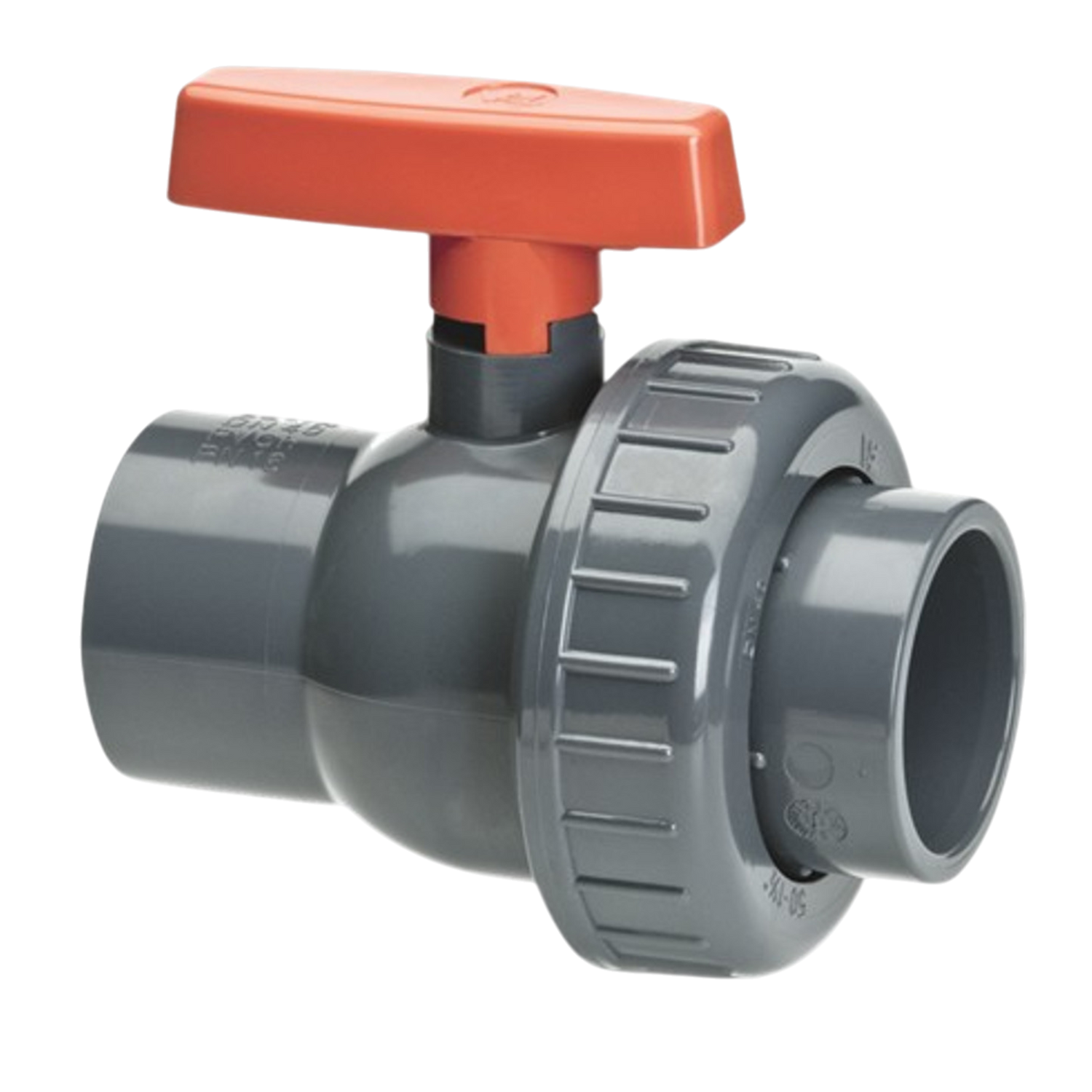
The PVC 63mm Ball Valve is designed for isolating or controlling flow in compatible PVC pipework in compatible professional PVC irrigation and water-distribution systems.
Correctly selected valves, tees, caps and sealing components make irrigation pipework easier to isolate, branch, terminate and maintain.
Key benefits
Flow isolation & service access
Use the valve where a section of compatible irrigation pipework needs to be isolated or controlled. Position valves where they can be operated and serviced without dismantling unrelated pipework.
Open and close the valve deliberately rather than forcing the handle. Double-union versions can simplify removal of the valve body where the installation has been laid out with suitable service clearance.
Preparing PVC connections
Cut pipe squarely, remove burrs and clean the connection area. Dry-fit the layout before permanent assembly where practical so dimensions and alignment can be checked.
Use solvent-weld cleaner and adhesive compatible with the PVC system where required. For threaded connections, use a suitable sealing method and avoid excessive force on plastic threads.
Installation & pipe support
Support pipework so valves, tees and end fittings do not carry unnecessary pipe or water weight. Allow access around valves, unions and service points so future maintenance can be carried out without damaging adjacent components.
Commissioning & leak checks
After the applicable curing or assembly process, commission the system gradually. Inspect new joints, valve bodies and sealed ends for leakage before routine operation.
Maintenance
Inspect accessible components periodically for leaks, cracking, damaged seals or mechanical strain. Isolate the system before servicing and replace deteriorated sealing parts rather than relying on repeated overtightening.
PVC 63mm Ball Valve product details
| Product type | PVC Ball Valve |
|---|---|
| Primary use | isolating or controlling flow in compatible PVC pipework |
| Source size / designation | 63mm Ball Valve |
| Application | Professional PVC irrigation and water-distribution systems |
PVC 63mm Ball Valve FAQs
What is this product used for?
Isolating or controlling flow in compatible pvc pipework. How do I check the correct size?
Match every stated pipe diameter, thread and connection type to the components in the intended system. Can I force a fitting onto a different pipe size?
No. Use components specifically compatible with the stated dimensions and connection system. Should PVC pipe be prepared before assembly?
Yes. Cut pipe squarely, remove burrs and clean the joint area before assembly. Can threaded PVC fittings be overtightened?
Yes. Excessive force can damage plastic threads, caps or valve bodies. Should pipework be supported?
Yes. Support runs so valves, tees and end fittings are not carrying unnecessary pipe or water weight. When can a solvent-weld system be pressurised?
Follow the adhesive manufacturer's current curing and commissioning instructions rather than assuming a universal time. What should I do if a connection leaks?
Safely isolate the system and inspect the fitting, seal and assembly method rather than relying on temporary external sealing. Can the valve be used as a service isolation point?
Yes, where it is correctly sized, installed and accessible within the irrigation layout.
The PVC 50mm Ball Valve is designed for isolating or controlling flow in compatible PVC pipework in compatible professional PVC irrigation and water-distribution systems.
Correctly selected valves, tees, caps and sealing components make irrigation pipework easier to isolate, branch, terminate and maintain.
Key benefits
Flow isolation & service access
Use the valve where a section of compatible irrigation pipework needs to be isolated or controlled. Position valves where they can be operated and serviced without dismantling unrelated pipework.
Open and close the valve deliberately rather than forcing the handle. Double-union versions can simplify removal of the valve body where the installation has been laid out with suitable service clearance.
Preparing PVC connections
Cut pipe squarely, remove burrs and clean the connection area. Dry-fit the layout before permanent assembly where practical so dimensions and alignment can be checked.
Use solvent-weld cleaner and adhesive compatible with the PVC system where required. For threaded connections, use a suitable sealing method and avoid excessive force on plastic threads.
Installation & pipe support
Support pipework so valves, tees and end fittings do not carry unnecessary pipe or water weight. Allow access around valves, unions and service points so future maintenance can be carried out without damaging adjacent components.
Commissioning & leak checks
After the applicable curing or assembly process, commission the system gradually. Inspect new joints, valve bodies and sealed ends for leakage before routine operation.
Maintenance
Inspect accessible components periodically for leaks, cracking, damaged seals or mechanical strain. Isolate the system before servicing and replace deteriorated sealing parts rather than relying on repeated overtightening.
PVC 50mm Ball Valve product details
| Product type | PVC Ball Valve |
|---|---|
| Primary use | isolating or controlling flow in compatible PVC pipework |
| Source size / designation | 50mm Ball Valve |
| Application | Professional PVC irrigation and water-distribution systems |
PVC 50mm Ball Valve FAQs
What is this product used for?
Isolating or controlling flow in compatible pvc pipework. How do I check the correct size?
Match every stated pipe diameter, thread and connection type to the components in the intended system. Can I force a fitting onto a different pipe size?
No. Use components specifically compatible with the stated dimensions and connection system. Should PVC pipe be prepared before assembly?
Yes. Cut pipe squarely, remove burrs and clean the joint area before assembly. Can threaded PVC fittings be overtightened?
Yes. Excessive force can damage plastic threads, caps or valve bodies. Should pipework be supported?
Yes. Support runs so valves, tees and end fittings are not carrying unnecessary pipe or water weight. When can a solvent-weld system be pressurised?
Follow the adhesive manufacturer's current curing and commissioning instructions rather than assuming a universal time. What should I do if a connection leaks?
Safely isolate the system and inspect the fitting, seal and assembly method rather than relying on temporary external sealing. Can the valve be used as a service isolation point?
Yes, where it is correctly sized, installed and accessible within the irrigation layout.
The PVC 40mm Ball Valve is designed for isolating or controlling flow in compatible PVC pipework in compatible professional PVC irrigation and water-distribution systems.
Correctly selected valves, tees, caps and sealing components make irrigation pipework easier to isolate, branch, terminate and maintain.
Key benefits
Flow isolation & service access
Use the valve where a section of compatible irrigation pipework needs to be isolated or controlled. Position valves where they can be operated and serviced without dismantling unrelated pipework.
Open and close the valve deliberately rather than forcing the handle. Double-union versions can simplify removal of the valve body where the installation has been laid out with suitable service clearance.
Preparing PVC connections
Cut pipe squarely, remove burrs and clean the connection area. Dry-fit the layout before permanent assembly where practical so dimensions and alignment can be checked.
Use solvent-weld cleaner and adhesive compatible with the PVC system where required. For threaded connections, use a suitable sealing method and avoid excessive force on plastic threads.
Installation & pipe support
Support pipework so valves, tees and end fittings do not carry unnecessary pipe or water weight. Allow access around valves, unions and service points so future maintenance can be carried out without damaging adjacent components.
Commissioning & leak checks
After the applicable curing or assembly process, commission the system gradually. Inspect new joints, valve bodies and sealed ends for leakage before routine operation.
Maintenance
Inspect accessible components periodically for leaks, cracking, damaged seals or mechanical strain. Isolate the system before servicing and replace deteriorated sealing parts rather than relying on repeated overtightening.
PVC 40mm Ball Valve product details
| Product type | PVC Ball Valve |
|---|---|
| Primary use | isolating or controlling flow in compatible PVC pipework |
| Source size / designation | 40mm Ball Valve |
| Application | Professional PVC irrigation and water-distribution systems |
PVC 40mm Ball Valve FAQs
What is this product used for?
Isolating or controlling flow in compatible pvc pipework. How do I check the correct size?
Match every stated pipe diameter, thread and connection type to the components in the intended system. Can I force a fitting onto a different pipe size?
No. Use components specifically compatible with the stated dimensions and connection system. Should PVC pipe be prepared before assembly?
Yes. Cut pipe squarely, remove burrs and clean the joint area before assembly. Can threaded PVC fittings be overtightened?
Yes. Excessive force can damage plastic threads, caps or valve bodies. Should pipework be supported?
Yes. Support runs so valves, tees and end fittings are not carrying unnecessary pipe or water weight. When can a solvent-weld system be pressurised?
Follow the adhesive manufacturer's current curing and commissioning instructions rather than assuming a universal time. What should I do if a connection leaks?
Safely isolate the system and inspect the fitting, seal and assembly method rather than relying on temporary external sealing. Can the valve be used as a service isolation point?
Yes, where it is correctly sized, installed and accessible within the irrigation layout.
The PVC 32mm Ball Valve is designed for isolating or controlling flow in compatible PVC pipework in compatible professional PVC irrigation and water-distribution systems.
Correctly selected valves, tees, caps and sealing components make irrigation pipework easier to isolate, branch, terminate and maintain.
Key benefits
Flow isolation & service access
Use the valve where a section of compatible irrigation pipework needs to be isolated or controlled. Position valves where they can be operated and serviced without dismantling unrelated pipework.
Open and close the valve deliberately rather than forcing the handle. Double-union versions can simplify removal of the valve body where the installation has been laid out with suitable service clearance.
Preparing PVC connections
Cut pipe squarely, remove burrs and clean the connection area. Dry-fit the layout before permanent assembly where practical so dimensions and alignment can be checked.
Use solvent-weld cleaner and adhesive compatible with the PVC system where required. For threaded connections, use a suitable sealing method and avoid excessive force on plastic threads.
Installation & pipe support
Support pipework so valves, tees and end fittings do not carry unnecessary pipe or water weight. Allow access around valves, unions and service points so future maintenance can be carried out without damaging adjacent components.
Commissioning & leak checks
After the applicable curing or assembly process, commission the system gradually. Inspect new joints, valve bodies and sealed ends for leakage before routine operation.
Maintenance
Inspect accessible components periodically for leaks, cracking, damaged seals or mechanical strain. Isolate the system before servicing and replace deteriorated sealing parts rather than relying on repeated overtightening.
PVC 32mm Ball Valve product details
| Product type | PVC Ball Valve |
|---|---|
| Primary use | isolating or controlling flow in compatible PVC pipework |
| Source size / designation | 32mm Ball Valve |
| Application | Professional PVC irrigation and water-distribution systems |
PVC 32mm Ball Valve FAQs
What is this product used for?
Isolating or controlling flow in compatible pvc pipework. How do I check the correct size?
Match every stated pipe diameter, thread and connection type to the components in the intended system. Can I force a fitting onto a different pipe size?
No. Use components specifically compatible with the stated dimensions and connection system. Should PVC pipe be prepared before assembly?
Yes. Cut pipe squarely, remove burrs and clean the joint area before assembly. Can threaded PVC fittings be overtightened?
Yes. Excessive force can damage plastic threads, caps or valve bodies. Should pipework be supported?
Yes. Support runs so valves, tees and end fittings are not carrying unnecessary pipe or water weight. When can a solvent-weld system be pressurised?
Follow the adhesive manufacturer's current curing and commissioning instructions rather than assuming a universal time. What should I do if a connection leaks?
Safely isolate the system and inspect the fitting, seal and assembly method rather than relying on temporary external sealing. Can the valve be used as a service isolation point?
Yes, where it is correctly sized, installed and accessible within the irrigation layout.
The PVC 20mm Ball Valve - Single Union Metric is designed for isolating or controlling flow in compatible PVC pipework in compatible professional PVC irrigation and water-distribution systems.
Correctly selected valves, tees, caps and sealing components make irrigation pipework easier to isolate, branch, terminate and maintain.
Key benefits
Flow isolation & service access
Use the valve where a section of compatible irrigation pipework needs to be isolated or controlled. Position valves where they can be operated and serviced without dismantling unrelated pipework.
Open and close the valve deliberately rather than forcing the handle. Double-union versions can simplify removal of the valve body where the installation has been laid out with suitable service clearance.
Preparing PVC connections
Cut pipe squarely, remove burrs and clean the connection area. Dry-fit the layout before permanent assembly where practical so dimensions and alignment can be checked.
Use solvent-weld cleaner and adhesive compatible with the PVC system where required. For threaded connections, use a suitable sealing method and avoid excessive force on plastic threads.
Installation & pipe support
Support pipework so valves, tees and end fittings do not carry unnecessary pipe or water weight. Allow access around valves, unions and service points so future maintenance can be carried out without damaging adjacent components.
Commissioning & leak checks
After the applicable curing or assembly process, commission the system gradually. Inspect new joints, valve bodies and sealed ends for leakage before routine operation.
Maintenance
Inspect accessible components periodically for leaks, cracking, damaged seals or mechanical strain. Isolate the system before servicing and replace deteriorated sealing parts rather than relying on repeated overtightening.
PVC 20mm Ball Valve - Single Union Metric product details
| Product type | PVC Ball Valve |
|---|---|
| Primary use | isolating or controlling flow in compatible PVC pipework |
| Source size / designation | 20mm Ball Valve - Single Union Metric |
| Application | Professional PVC irrigation and water-distribution systems |
PVC 20mm Ball Valve - Single Union Metric FAQs
What is this product used for?
Isolating or controlling flow in compatible pvc pipework. How do I check the correct size?
Match every stated pipe diameter, thread and connection type to the components in the intended system. Can I force a fitting onto a different pipe size?
No. Use components specifically compatible with the stated dimensions and connection system. Should PVC pipe be prepared before assembly?
Yes. Cut pipe squarely, remove burrs and clean the joint area before assembly. Can threaded PVC fittings be overtightened?
Yes. Excessive force can damage plastic threads, caps or valve bodies. Should pipework be supported?
Yes. Support runs so valves, tees and end fittings are not carrying unnecessary pipe or water weight. When can a solvent-weld system be pressurised?
Follow the adhesive manufacturer's current curing and commissioning instructions rather than assuming a universal time. What should I do if a connection leaks?
Safely isolate the system and inspect the fitting, seal and assembly method rather than relying on temporary external sealing. Can the valve be used as a service isolation point?
Yes, where it is correctly sized, installed and accessible within the irrigation layout.

The Rubber Cap Washer 3/4" is designed for sealing a compatible threaded cap assembly in compatible professional PVC irrigation and water-distribution systems.
Correctly selected valves, tees, caps and sealing components make irrigation pipework easier to isolate, branch, terminate and maintain.
Key benefits
Terminating & sealing pipework
Use the cap, stop end or washer only with the matching connection size and fitting type. Keep sealing surfaces clean and inspect washers or seals for distortion, cuts or deterioration before assembly.
Where a solvent-weld cap is used, follow the cleaner/adhesive manufacturer's preparation and curing instructions. Threaded caps should use an appropriate sealing method without excessive tightening.
Preparing PVC connections
Cut pipe squarely, remove burrs and clean the connection area. Dry-fit the layout before permanent assembly where practical so dimensions and alignment can be checked.
Use solvent-weld cleaner and adhesive compatible with the PVC system where required. For threaded connections, use a suitable sealing method and avoid excessive force on plastic threads.
Installation & pipe support
Support pipework so valves, tees and end fittings do not carry unnecessary pipe or water weight. Allow access around valves, unions and service points so future maintenance can be carried out without damaging adjacent components.
Commissioning & leak checks
After the applicable curing or assembly process, commission the system gradually. Inspect new joints, valve bodies and sealed ends for leakage before routine operation.
Maintenance
Inspect accessible components periodically for leaks, cracking, damaged seals or mechanical strain. Isolate the system before servicing and replace deteriorated sealing parts rather than relying on repeated overtightening.
Rubber Cap Washer 3/4" product details
| Product type | Rubber Cap Washer |
|---|---|
| Primary use | sealing a compatible threaded cap assembly |
| Source size / designation | Rubber Cap Washer 3/4" |
| Application | Professional PVC irrigation and water-distribution systems |
Rubber Cap Washer 3/4" FAQs
What is this product used for?
Sealing a compatible threaded cap assembly. How do I check the correct size?
Match every stated pipe diameter, thread and connection type to the components in the intended system. Can I force a fitting onto a different pipe size?
No. Use components specifically compatible with the stated dimensions and connection system. Should PVC pipe be prepared before assembly?
Yes. Cut pipe squarely, remove burrs and clean the joint area before assembly. Can threaded PVC fittings be overtightened?
Yes. Excessive force can damage plastic threads, caps or valve bodies. Should pipework be supported?
Yes. Support runs so valves, tees and end fittings are not carrying unnecessary pipe or water weight. When can a solvent-weld system be pressurised?
Follow the adhesive manufacturer's current curing and commissioning instructions rather than assuming a universal time. What should I do if a connection leaks?
Safely isolate the system and inspect the fitting, seal and assembly method rather than relying on temporary external sealing.

The Rubber Cap Washer 2" is designed for sealing a compatible threaded cap assembly in compatible professional PVC irrigation and water-distribution systems.
Correctly selected valves, tees, caps and sealing components make irrigation pipework easier to isolate, branch, terminate and maintain.
Key benefits
Terminating & sealing pipework
Use the cap, stop end or washer only with the matching connection size and fitting type. Keep sealing surfaces clean and inspect washers or seals for distortion, cuts or deterioration before assembly.
Where a solvent-weld cap is used, follow the cleaner/adhesive manufacturer's preparation and curing instructions. Threaded caps should use an appropriate sealing method without excessive tightening.
Preparing PVC connections
Cut pipe squarely, remove burrs and clean the connection area. Dry-fit the layout before permanent assembly where practical so dimensions and alignment can be checked.
Use solvent-weld cleaner and adhesive compatible with the PVC system where required. For threaded connections, use a suitable sealing method and avoid excessive force on plastic threads.
Installation & pipe support
Support pipework so valves, tees and end fittings do not carry unnecessary pipe or water weight. Allow access around valves, unions and service points so future maintenance can be carried out without damaging adjacent components.
Commissioning & leak checks
After the applicable curing or assembly process, commission the system gradually. Inspect new joints, valve bodies and sealed ends for leakage before routine operation.
Maintenance
Inspect accessible components periodically for leaks, cracking, damaged seals or mechanical strain. Isolate the system before servicing and replace deteriorated sealing parts rather than relying on repeated overtightening.
Rubber Cap Washer 2" product details
| Product type | Rubber Cap Washer |
|---|---|
| Primary use | sealing a compatible threaded cap assembly |
| Source size / designation | Rubber Cap Washer 2" |
| Application | Professional PVC irrigation and water-distribution systems |
Rubber Cap Washer 2" FAQs
What is this product used for?
Sealing a compatible threaded cap assembly. How do I check the correct size?
Match every stated pipe diameter, thread and connection type to the components in the intended system. Can I force a fitting onto a different pipe size?
No. Use components specifically compatible with the stated dimensions and connection system. Should PVC pipe be prepared before assembly?
Yes. Cut pipe squarely, remove burrs and clean the joint area before assembly. Can threaded PVC fittings be overtightened?
Yes. Excessive force can damage plastic threads, caps or valve bodies. Should pipework be supported?
Yes. Support runs so valves, tees and end fittings are not carrying unnecessary pipe or water weight. When can a solvent-weld system be pressurised?
Follow the adhesive manufacturer's current curing and commissioning instructions rather than assuming a universal time. What should I do if a connection leaks?
Safely isolate the system and inspect the fitting, seal and assembly method rather than relying on temporary external sealing.

The Rubber Cap Washer 1/2" is designed for sealing a compatible threaded cap assembly in compatible professional PVC irrigation and water-distribution systems.
Correctly selected valves, tees, caps and sealing components make irrigation pipework easier to isolate, branch, terminate and maintain.
Key benefits
Terminating & sealing pipework
Use the cap, stop end or washer only with the matching connection size and fitting type. Keep sealing surfaces clean and inspect washers or seals for distortion, cuts or deterioration before assembly.
Where a solvent-weld cap is used, follow the cleaner/adhesive manufacturer's preparation and curing instructions. Threaded caps should use an appropriate sealing method without excessive tightening.
Preparing PVC connections
Cut pipe squarely, remove burrs and clean the connection area. Dry-fit the layout before permanent assembly where practical so dimensions and alignment can be checked.
Use solvent-weld cleaner and adhesive compatible with the PVC system where required. For threaded connections, use a suitable sealing method and avoid excessive force on plastic threads.
Installation & pipe support
Support pipework so valves, tees and end fittings do not carry unnecessary pipe or water weight. Allow access around valves, unions and service points so future maintenance can be carried out without damaging adjacent components.
Commissioning & leak checks
After the applicable curing or assembly process, commission the system gradually. Inspect new joints, valve bodies and sealed ends for leakage before routine operation.
Maintenance
Inspect accessible components periodically for leaks, cracking, damaged seals or mechanical strain. Isolate the system before servicing and replace deteriorated sealing parts rather than relying on repeated overtightening.
Rubber Cap Washer 1/2" product details
| Product type | Rubber Cap Washer |
|---|---|
| Primary use | sealing a compatible threaded cap assembly |
| Source size / designation | Rubber Cap Washer 1/2" |
| Application | Professional PVC irrigation and water-distribution systems |
Rubber Cap Washer 1/2" FAQs
What is this product used for?
Sealing a compatible threaded cap assembly. How do I check the correct size?
Match every stated pipe diameter, thread and connection type to the components in the intended system. Can I force a fitting onto a different pipe size?
No. Use components specifically compatible with the stated dimensions and connection system. Should PVC pipe be prepared before assembly?
Yes. Cut pipe squarely, remove burrs and clean the joint area before assembly. Can threaded PVC fittings be overtightened?
Yes. Excessive force can damage plastic threads, caps or valve bodies. Should pipework be supported?
Yes. Support runs so valves, tees and end fittings are not carrying unnecessary pipe or water weight. When can a solvent-weld system be pressurised?
Follow the adhesive manufacturer's current curing and commissioning instructions rather than assuming a universal time. What should I do if a connection leaks?
Safely isolate the system and inspect the fitting, seal and assembly method rather than relying on temporary external sealing.

The Rubber Cap Washer 1½" is designed for sealing a compatible threaded cap assembly in compatible professional PVC irrigation and water-distribution systems.
Correctly selected valves, tees, caps and sealing components make irrigation pipework easier to isolate, branch, terminate and maintain.
Key benefits
Terminating & sealing pipework
Use the cap, stop end or washer only with the matching connection size and fitting type. Keep sealing surfaces clean and inspect washers or seals for distortion, cuts or deterioration before assembly.
Where a solvent-weld cap is used, follow the cleaner/adhesive manufacturer's preparation and curing instructions. Threaded caps should use an appropriate sealing method without excessive tightening.
Preparing PVC connections
Cut pipe squarely, remove burrs and clean the connection area. Dry-fit the layout before permanent assembly where practical so dimensions and alignment can be checked.
Use solvent-weld cleaner and adhesive compatible with the PVC system where required. For threaded connections, use a suitable sealing method and avoid excessive force on plastic threads.
Installation & pipe support
Support pipework so valves, tees and end fittings do not carry unnecessary pipe or water weight. Allow access around valves, unions and service points so future maintenance can be carried out without damaging adjacent components.
Commissioning & leak checks
After the applicable curing or assembly process, commission the system gradually. Inspect new joints, valve bodies and sealed ends for leakage before routine operation.
Maintenance
Inspect accessible components periodically for leaks, cracking, damaged seals or mechanical strain. Isolate the system before servicing and replace deteriorated sealing parts rather than relying on repeated overtightening.
Rubber Cap Washer 1½" product details
| Product type | Rubber Cap Washer |
|---|---|
| Primary use | sealing a compatible threaded cap assembly |
| Source size / designation | Rubber Cap Washer 1½" |
| Application | Professional PVC irrigation and water-distribution systems |
Rubber Cap Washer 1½" FAQs
What is this product used for?
Sealing a compatible threaded cap assembly. How do I check the correct size?
Match every stated pipe diameter, thread and connection type to the components in the intended system. Can I force a fitting onto a different pipe size?
No. Use components specifically compatible with the stated dimensions and connection system. Should PVC pipe be prepared before assembly?
Yes. Cut pipe squarely, remove burrs and clean the joint area before assembly. Can threaded PVC fittings be overtightened?
Yes. Excessive force can damage plastic threads, caps or valve bodies. Should pipework be supported?
Yes. Support runs so valves, tees and end fittings are not carrying unnecessary pipe or water weight. When can a solvent-weld system be pressurised?
Follow the adhesive manufacturer's current curing and commissioning instructions rather than assuming a universal time. What should I do if a connection leaks?
Safely isolate the system and inspect the fitting, seal and assembly method rather than relying on temporary external sealing.

The Rubber Cap Washer 1¼" is designed for sealing a compatible threaded cap assembly in compatible professional PVC irrigation and water-distribution systems.
Correctly selected valves, tees, caps and sealing components make irrigation pipework easier to isolate, branch, terminate and maintain.
Key benefits
Terminating & sealing pipework
Use the cap, stop end or washer only with the matching connection size and fitting type. Keep sealing surfaces clean and inspect washers or seals for distortion, cuts or deterioration before assembly.
Where a solvent-weld cap is used, follow the cleaner/adhesive manufacturer's preparation and curing instructions. Threaded caps should use an appropriate sealing method without excessive tightening.
Preparing PVC connections
Cut pipe squarely, remove burrs and clean the connection area. Dry-fit the layout before permanent assembly where practical so dimensions and alignment can be checked.
Use solvent-weld cleaner and adhesive compatible with the PVC system where required. For threaded connections, use a suitable sealing method and avoid excessive force on plastic threads.
Installation & pipe support
Support pipework so valves, tees and end fittings do not carry unnecessary pipe or water weight. Allow access around valves, unions and service points so future maintenance can be carried out without damaging adjacent components.
Commissioning & leak checks
After the applicable curing or assembly process, commission the system gradually. Inspect new joints, valve bodies and sealed ends for leakage before routine operation.
Maintenance
Inspect accessible components periodically for leaks, cracking, damaged seals or mechanical strain. Isolate the system before servicing and replace deteriorated sealing parts rather than relying on repeated overtightening.
Rubber Cap Washer 1¼" product details
| Product type | Rubber Cap Washer |
|---|---|
| Primary use | sealing a compatible threaded cap assembly |
| Source size / designation | Rubber Cap Washer 1¼" |
| Application | Professional PVC irrigation and water-distribution systems |
Rubber Cap Washer 1¼" FAQs
What is this product used for?
Sealing a compatible threaded cap assembly. How do I check the correct size?
Match every stated pipe diameter, thread and connection type to the components in the intended system. Can I force a fitting onto a different pipe size?
No. Use components specifically compatible with the stated dimensions and connection system. Should PVC pipe be prepared before assembly?
Yes. Cut pipe squarely, remove burrs and clean the joint area before assembly. Can threaded PVC fittings be overtightened?
Yes. Excessive force can damage plastic threads, caps or valve bodies. Should pipework be supported?
Yes. Support runs so valves, tees and end fittings are not carrying unnecessary pipe or water weight. When can a solvent-weld system be pressurised?
Follow the adhesive manufacturer's current curing and commissioning instructions rather than assuming a universal time. What should I do if a connection leaks?
Safely isolate the system and inspect the fitting, seal and assembly method rather than relying on temporary external sealing.

The Rubber Cap Washer 1" is designed for sealing a compatible threaded cap assembly in compatible professional PVC irrigation and water-distribution systems.
Correctly selected valves, tees, caps and sealing components make irrigation pipework easier to isolate, branch, terminate and maintain.
Key benefits
Terminating & sealing pipework
Use the cap, stop end or washer only with the matching connection size and fitting type. Keep sealing surfaces clean and inspect washers or seals for distortion, cuts or deterioration before assembly.
Where a solvent-weld cap is used, follow the cleaner/adhesive manufacturer's preparation and curing instructions. Threaded caps should use an appropriate sealing method without excessive tightening.
Preparing PVC connections
Cut pipe squarely, remove burrs and clean the connection area. Dry-fit the layout before permanent assembly where practical so dimensions and alignment can be checked.
Use solvent-weld cleaner and adhesive compatible with the PVC system where required. For threaded connections, use a suitable sealing method and avoid excessive force on plastic threads.
Installation & pipe support
Support pipework so valves, tees and end fittings do not carry unnecessary pipe or water weight. Allow access around valves, unions and service points so future maintenance can be carried out without damaging adjacent components.
Commissioning & leak checks
After the applicable curing or assembly process, commission the system gradually. Inspect new joints, valve bodies and sealed ends for leakage before routine operation.
Maintenance
Inspect accessible components periodically for leaks, cracking, damaged seals or mechanical strain. Isolate the system before servicing and replace deteriorated sealing parts rather than relying on repeated overtightening.
Rubber Cap Washer 1" product details
| Product type | Rubber Cap Washer |
|---|---|
| Primary use | sealing a compatible threaded cap assembly |
| Source size / designation | Rubber Cap Washer 1" |
| Application | Professional PVC irrigation and water-distribution systems |
Rubber Cap Washer 1" FAQs
What is this product used for?
Sealing a compatible threaded cap assembly. How do I check the correct size?
Match every stated pipe diameter, thread and connection type to the components in the intended system. Can I force a fitting onto a different pipe size?
No. Use components specifically compatible with the stated dimensions and connection system. Should PVC pipe be prepared before assembly?
Yes. Cut pipe squarely, remove burrs and clean the joint area before assembly. Can threaded PVC fittings be overtightened?
Yes. Excessive force can damage plastic threads, caps or valve bodies. Should pipework be supported?
Yes. Support runs so valves, tees and end fittings are not carrying unnecessary pipe or water weight. When can a solvent-weld system be pressurised?
Follow the adhesive manufacturer's current curing and commissioning instructions rather than assuming a universal time. What should I do if a connection leaks?
Safely isolate the system and inspect the fitting, seal and assembly method rather than relying on temporary external sealing.
The Irrigation collection provides complete water management solutions for professional horticulture and landscaping. Efficient irrigation supports plant health, reduces water waste and improves operational control across growing environments.
Supplied through specialist horticultural distributors, this category supports system design, installation and maintenance for nurseries and landscapers. It is essential for modern, efficient plant production.