
What is this product used for?
Creating an offset in compatible pvc pipework.

Commercial Products
Commercial Products
 Professional Growing Media
 Plant Nutrition
 Plant Health
 Sprayers & Protective Clothing
 Pots, Planters & Trays
 Propagation
 Baskets & Planters
 Fabrics & Netting
 Environment
 Plant Lighting
 Irrigation
 Plant Support & Tree Care
 Equipment
 Tools
 Plant Labels
 Packaging
 Lawn Care
 Clearance
Retail Products
Retail Products
 Growing Media
 Plant Nutrition
 Plant Health
 Pots, Planters & Tanks
 Propagation
 Baskets & Planters
 Fabrics & Netting
 Environment
 Plant Lighting
 Plant Support
 Equipment
 Tools
364 products
364 products
Sort by:

The PVC 32mm x 32mm S Bend is designed for creating an offset in compatible PVC pipework in compatible professional PVC irrigation and water-distribution systems.
Correct pipe and adaptor selection helps maintain clean alignment, serviceability and reliable connections throughout fixed irrigation installations.
Key benefits
Creating a controlled pipe offset
An S-bend allows a compatible PVC run to shift alignment without assembling several separate elbows. Position it so both adjoining pipe sections line up naturally and the fitting is not left under continuous bending stress.
Pipe preparation & solvent welding
Cut PVC pipe squarely, remove burrs and clean the mating surfaces. Dry-fit the layout where practical before applying compatible cleaner and adhesive.
Follow the adhesive manufacturer's current application and curing instructions. Do not assume one curing time is suitable for every pipe diameter, temperature or installation condition.
Supporting the installation
Support rigid pipework at suitable intervals and around valves, unions and heavy equipment. Avoid transferring mechanical strain into threaded adaptors or solvent-weld joints.
Commissioning & pressure checks
After the applicable curing period, commission the system gradually and inspect joints for leakage. Operating pressure must remain within the requirements of every component in the complete system, not simply the pipe itself.
Maintenance
Inspect accessible pipe and fittings periodically for leakage, movement, impact damage or cracking. Isolate the system before servicing and repair faults using compatible components and proper joint preparation.
PVC 32mm x 32mm S Bend product details
| Product type | PVC S-Bend |
|---|---|
| Source dimensions / designation | 32mm x 32mm S Bend |
| Primary use | creating an offset in compatible PVC pipework |
| Application | Professional PVC irrigation and water-distribution systems |
PVC 32mm x 32mm S Bend FAQs
What is this product used for?
Creating an offset in compatible pvc pipework. How do I check the correct size?
Match every stated pipe diameter, thread and connection type to the intended system. Should PVC pipe be cut squarely?
Yes. Square, deburred cuts help fittings seat correctly and support reliable solvent-weld preparation. Can I force an adaptor onto a different size?
No. Use components specifically compatible with the stated dimensions and thread type. Should rigid PVC pipe be supported?
Yes. Support runs so joints and equipment connections are not carrying avoidable mechanical loads. When can a solvent-weld system be pressurised?
Follow the adhesive manufacturer's current curing and commissioning instructions. Does pipe diameter affect irrigation performance?
Yes. Diameter, run length and flow affect water velocity and pressure loss through the system. What should I do if a joint leaks?
Safely isolate the system and repair the joint correctly rather than relying on temporary external sealing.

The PVC Reducing Socket - 63mm x 50mm is designed for joining compatible PVC pipe sizes while reducing diameter in compatible professional PVC irrigation and water-distribution systems.
Correct pipe and adaptor selection helps maintain clean alignment, serviceability and reliable connections throughout fixed irrigation installations.
Key benefits
Reducing pipe diameter
Use the reducing socket to transition between the stated compatible PVC diameters. A reduction changes downstream velocity and pressure-loss characteristics, so consider the hydraulic effect as well as the physical fit.
Pipe preparation & solvent welding
Cut PVC pipe squarely, remove burrs and clean the mating surfaces. Dry-fit the layout where practical before applying compatible cleaner and adhesive.
Follow the adhesive manufacturer's current application and curing instructions. Do not assume one curing time is suitable for every pipe diameter, temperature or installation condition.
Supporting the installation
Support rigid pipework at suitable intervals and around valves, unions and heavy equipment. Avoid transferring mechanical strain into threaded adaptors or solvent-weld joints.
Commissioning & pressure checks
After the applicable curing period, commission the system gradually and inspect joints for leakage. Operating pressure must remain within the requirements of every component in the complete system, not simply the pipe itself.
Maintenance
Inspect accessible pipe and fittings periodically for leakage, movement, impact damage or cracking. Isolate the system before servicing and repair faults using compatible components and proper joint preparation.
PVC Reducing Socket - 63mm x 50mm product details
| Product type | PVC Reducing Socket |
|---|---|
| Source dimensions / designation | Reducing Socket - 63mm x 50mm |
| Primary use | joining compatible PVC pipe sizes while reducing diameter |
| Application | Professional PVC irrigation and water-distribution systems |
PVC Reducing Socket - 63mm x 50mm FAQs
What is this product used for?
Joining compatible pvc pipe sizes while reducing diameter. How do I check the correct size?
Match every stated pipe diameter, thread and connection type to the intended system. Should PVC pipe be cut squarely?
Yes. Square, deburred cuts help fittings seat correctly and support reliable solvent-weld preparation. Can I force an adaptor onto a different size?
No. Use components specifically compatible with the stated dimensions and thread type. Should rigid PVC pipe be supported?
Yes. Support runs so joints and equipment connections are not carrying avoidable mechanical loads. When can a solvent-weld system be pressurised?
Follow the adhesive manufacturer's current curing and commissioning instructions. Does pipe diameter affect irrigation performance?
Yes. Diameter, run length and flow affect water velocity and pressure loss through the system. What should I do if a joint leaks?
Safely isolate the system and repair the joint correctly rather than relying on temporary external sealing.

The PVC Reducing Socket - 63/50mm x 40mm is designed for joining compatible PVC pipe sizes while reducing diameter in compatible professional PVC irrigation and water-distribution systems.
Correct pipe and adaptor selection helps maintain clean alignment, serviceability and reliable connections throughout fixed irrigation installations.
Key benefits
Reducing pipe diameter
Use the reducing socket to transition between the stated compatible PVC diameters. A reduction changes downstream velocity and pressure-loss characteristics, so consider the hydraulic effect as well as the physical fit.
Pipe preparation & solvent welding
Cut PVC pipe squarely, remove burrs and clean the mating surfaces. Dry-fit the layout where practical before applying compatible cleaner and adhesive.
Follow the adhesive manufacturer's current application and curing instructions. Do not assume one curing time is suitable for every pipe diameter, temperature or installation condition.
Supporting the installation
Support rigid pipework at suitable intervals and around valves, unions and heavy equipment. Avoid transferring mechanical strain into threaded adaptors or solvent-weld joints.
Commissioning & pressure checks
After the applicable curing period, commission the system gradually and inspect joints for leakage. Operating pressure must remain within the requirements of every component in the complete system, not simply the pipe itself.
Maintenance
Inspect accessible pipe and fittings periodically for leakage, movement, impact damage or cracking. Isolate the system before servicing and repair faults using compatible components and proper joint preparation.
PVC Reducing Socket - 63/50mm x 40mm product details
| Product type | PVC Reducing Socket |
|---|---|
| Source dimensions / designation | Reducing Socket - 63/50mm x 40mm |
| Primary use | joining compatible PVC pipe sizes while reducing diameter |
| Application | Professional PVC irrigation and water-distribution systems |
PVC Reducing Socket - 63/50mm x 40mm FAQs
What is this product used for?
Joining compatible pvc pipe sizes while reducing diameter. How do I check the correct size?
Match every stated pipe diameter, thread and connection type to the intended system. Should PVC pipe be cut squarely?
Yes. Square, deburred cuts help fittings seat correctly and support reliable solvent-weld preparation. Can I force an adaptor onto a different size?
No. Use components specifically compatible with the stated dimensions and thread type. Should rigid PVC pipe be supported?
Yes. Support runs so joints and equipment connections are not carrying avoidable mechanical loads. When can a solvent-weld system be pressurised?
Follow the adhesive manufacturer's current curing and commissioning instructions. Does pipe diameter affect irrigation performance?
Yes. Diameter, run length and flow affect water velocity and pressure loss through the system. What should I do if a joint leaks?
Safely isolate the system and repair the joint correctly rather than relying on temporary external sealing.

The PVC Reducing Socket - 50/40mm x 32mm is designed for joining compatible PVC pipe sizes while reducing diameter in compatible professional PVC irrigation and water-distribution systems.
Correct pipe and adaptor selection helps maintain clean alignment, serviceability and reliable connections throughout fixed irrigation installations.
Key benefits
Reducing pipe diameter
Use the reducing socket to transition between the stated compatible PVC diameters. A reduction changes downstream velocity and pressure-loss characteristics, so consider the hydraulic effect as well as the physical fit.
Pipe preparation & solvent welding
Cut PVC pipe squarely, remove burrs and clean the mating surfaces. Dry-fit the layout where practical before applying compatible cleaner and adhesive.
Follow the adhesive manufacturer's current application and curing instructions. Do not assume one curing time is suitable for every pipe diameter, temperature or installation condition.
Supporting the installation
Support rigid pipework at suitable intervals and around valves, unions and heavy equipment. Avoid transferring mechanical strain into threaded adaptors or solvent-weld joints.
Commissioning & pressure checks
After the applicable curing period, commission the system gradually and inspect joints for leakage. Operating pressure must remain within the requirements of every component in the complete system, not simply the pipe itself.
Maintenance
Inspect accessible pipe and fittings periodically for leakage, movement, impact damage or cracking. Isolate the system before servicing and repair faults using compatible components and proper joint preparation.
PVC Reducing Socket - 50/40mm x 32mm product details
| Product type | PVC Reducing Socket |
|---|---|
| Source dimensions / designation | Reducing Socket - 50/40mm x 32mm |
| Primary use | joining compatible PVC pipe sizes while reducing diameter |
| Application | Professional PVC irrigation and water-distribution systems |
PVC Reducing Socket - 50/40mm x 32mm FAQs
What is this product used for?
Joining compatible pvc pipe sizes while reducing diameter. How do I check the correct size?
Match every stated pipe diameter, thread and connection type to the intended system. Should PVC pipe be cut squarely?
Yes. Square, deburred cuts help fittings seat correctly and support reliable solvent-weld preparation. Can I force an adaptor onto a different size?
No. Use components specifically compatible with the stated dimensions and thread type. Should rigid PVC pipe be supported?
Yes. Support runs so joints and equipment connections are not carrying avoidable mechanical loads. When can a solvent-weld system be pressurised?
Follow the adhesive manufacturer's current curing and commissioning instructions. Does pipe diameter affect irrigation performance?
Yes. Diameter, run length and flow affect water velocity and pressure loss through the system. What should I do if a joint leaks?
Safely isolate the system and repair the joint correctly rather than relying on temporary external sealing.

The PVC Reducing Socket - 40/32mm x 20mm is designed for joining compatible PVC pipe sizes while reducing diameter in compatible professional PVC irrigation and water-distribution systems.
Correct pipe and adaptor selection helps maintain clean alignment, serviceability and reliable connections throughout fixed irrigation installations.
Key benefits
Reducing pipe diameter
Use the reducing socket to transition between the stated compatible PVC diameters. A reduction changes downstream velocity and pressure-loss characteristics, so consider the hydraulic effect as well as the physical fit.
Pipe preparation & solvent welding
Cut PVC pipe squarely, remove burrs and clean the mating surfaces. Dry-fit the layout where practical before applying compatible cleaner and adhesive.
Follow the adhesive manufacturer's current application and curing instructions. Do not assume one curing time is suitable for every pipe diameter, temperature or installation condition.
Supporting the installation
Support rigid pipework at suitable intervals and around valves, unions and heavy equipment. Avoid transferring mechanical strain into threaded adaptors or solvent-weld joints.
Commissioning & pressure checks
After the applicable curing period, commission the system gradually and inspect joints for leakage. Operating pressure must remain within the requirements of every component in the complete system, not simply the pipe itself.
Maintenance
Inspect accessible pipe and fittings periodically for leakage, movement, impact damage or cracking. Isolate the system before servicing and repair faults using compatible components and proper joint preparation.
PVC Reducing Socket - 40/32mm x 20mm product details
| Product type | PVC Reducing Socket |
|---|---|
| Source dimensions / designation | Reducing Socket - 40/32mm x 20mm |
| Primary use | joining compatible PVC pipe sizes while reducing diameter |
| Application | Professional PVC irrigation and water-distribution systems |
PVC Reducing Socket - 40/32mm x 20mm FAQs
What is this product used for?
Joining compatible pvc pipe sizes while reducing diameter. How do I check the correct size?
Match every stated pipe diameter, thread and connection type to the intended system. Should PVC pipe be cut squarely?
Yes. Square, deburred cuts help fittings seat correctly and support reliable solvent-weld preparation. Can I force an adaptor onto a different size?
No. Use components specifically compatible with the stated dimensions and thread type. Should rigid PVC pipe be supported?
Yes. Support runs so joints and equipment connections are not carrying avoidable mechanical loads. When can a solvent-weld system be pressurised?
Follow the adhesive manufacturer's current curing and commissioning instructions. Does pipe diameter affect irrigation performance?
Yes. Diameter, run length and flow affect water velocity and pressure loss through the system. What should I do if a joint leaks?
Safely isolate the system and repair the joint correctly rather than relying on temporary external sealing.

The PVC Union Socket 63mm x 63mm is designed for joining equal-size compatible PVC pipe sections with a serviceable union connection in compatible professional PVC irrigation and water-distribution systems.
Correct pipe and adaptor selection helps maintain clean alignment, serviceability and reliable connections throughout fixed irrigation installations.
Key benefits
Joining PVC pipe with service access
A union socket joins compatible pipe while allowing the connection to be separated later for servicing. Install it where there is sufficient access to undo and remove components without placing strain on adjacent pipework.
Pipe preparation & solvent welding
Cut PVC pipe squarely, remove burrs and clean the mating surfaces. Dry-fit the layout where practical before applying compatible cleaner and adhesive.
Follow the adhesive manufacturer's current application and curing instructions. Do not assume one curing time is suitable for every pipe diameter, temperature or installation condition.
Supporting the installation
Support rigid pipework at suitable intervals and around valves, unions and heavy equipment. Avoid transferring mechanical strain into threaded adaptors or solvent-weld joints.
Commissioning & pressure checks
After the applicable curing period, commission the system gradually and inspect joints for leakage. Operating pressure must remain within the requirements of every component in the complete system, not simply the pipe itself.
Maintenance
Inspect accessible pipe and fittings periodically for leakage, movement, impact damage or cracking. Isolate the system before servicing and repair faults using compatible components and proper joint preparation.
PVC Union Socket 63mm x 63mm product details
| Product type | PVC Union Socket |
|---|---|
| Source dimensions / designation | Union Socket 63mm x 63mm |
| Primary use | joining equal-size compatible PVC pipe sections with a serviceable union connection |
| Application | Professional PVC irrigation and water-distribution systems |
PVC Union Socket 63mm x 63mm FAQs
What is this product used for?
Joining equal-size compatible pvc pipe sections with a serviceable union connection. How do I check the correct size?
Match every stated pipe diameter, thread and connection type to the intended system. Should PVC pipe be cut squarely?
Yes. Square, deburred cuts help fittings seat correctly and support reliable solvent-weld preparation. Can I force an adaptor onto a different size?
No. Use components specifically compatible with the stated dimensions and thread type. Should rigid PVC pipe be supported?
Yes. Support runs so joints and equipment connections are not carrying avoidable mechanical loads. When can a solvent-weld system be pressurised?
Follow the adhesive manufacturer's current curing and commissioning instructions. Does pipe diameter affect irrigation performance?
Yes. Diameter, run length and flow affect water velocity and pressure loss through the system. What should I do if a joint leaks?
Safely isolate the system and repair the joint correctly rather than relying on temporary external sealing.

The PVC Union Socket 50mm x 50mm is designed for joining equal-size compatible PVC pipe sections with a serviceable union connection in compatible professional PVC irrigation and water-distribution systems.
Correct pipe and adaptor selection helps maintain clean alignment, serviceability and reliable connections throughout fixed irrigation installations.
Key benefits
Joining PVC pipe with service access
A union socket joins compatible pipe while allowing the connection to be separated later for servicing. Install it where there is sufficient access to undo and remove components without placing strain on adjacent pipework.
Pipe preparation & solvent welding
Cut PVC pipe squarely, remove burrs and clean the mating surfaces. Dry-fit the layout where practical before applying compatible cleaner and adhesive.
Follow the adhesive manufacturer's current application and curing instructions. Do not assume one curing time is suitable for every pipe diameter, temperature or installation condition.
Supporting the installation
Support rigid pipework at suitable intervals and around valves, unions and heavy equipment. Avoid transferring mechanical strain into threaded adaptors or solvent-weld joints.
Commissioning & pressure checks
After the applicable curing period, commission the system gradually and inspect joints for leakage. Operating pressure must remain within the requirements of every component in the complete system, not simply the pipe itself.
Maintenance
Inspect accessible pipe and fittings periodically for leakage, movement, impact damage or cracking. Isolate the system before servicing and repair faults using compatible components and proper joint preparation.
PVC Union Socket 50mm x 50mm product details
| Product type | PVC Union Socket |
|---|---|
| Source dimensions / designation | Union Socket 50mm x 50mm |
| Primary use | joining equal-size compatible PVC pipe sections with a serviceable union connection |
| Application | Professional PVC irrigation and water-distribution systems |
PVC Union Socket 50mm x 50mm FAQs
What is this product used for?
Joining equal-size compatible pvc pipe sections with a serviceable union connection. How do I check the correct size?
Match every stated pipe diameter, thread and connection type to the intended system. Should PVC pipe be cut squarely?
Yes. Square, deburred cuts help fittings seat correctly and support reliable solvent-weld preparation. Can I force an adaptor onto a different size?
No. Use components specifically compatible with the stated dimensions and thread type. Should rigid PVC pipe be supported?
Yes. Support runs so joints and equipment connections are not carrying avoidable mechanical loads. When can a solvent-weld system be pressurised?
Follow the adhesive manufacturer's current curing and commissioning instructions. Does pipe diameter affect irrigation performance?
Yes. Diameter, run length and flow affect water velocity and pressure loss through the system. What should I do if a joint leaks?
Safely isolate the system and repair the joint correctly rather than relying on temporary external sealing.

The PVC Union Socket 40mm x 40mm is designed for joining equal-size compatible PVC pipe sections with a serviceable union connection in compatible professional PVC irrigation and water-distribution systems.
Correct pipe and adaptor selection helps maintain clean alignment, serviceability and reliable connections throughout fixed irrigation installations.
Key benefits
Joining PVC pipe with service access
A union socket joins compatible pipe while allowing the connection to be separated later for servicing. Install it where there is sufficient access to undo and remove components without placing strain on adjacent pipework.
Pipe preparation & solvent welding
Cut PVC pipe squarely, remove burrs and clean the mating surfaces. Dry-fit the layout where practical before applying compatible cleaner and adhesive.
Follow the adhesive manufacturer's current application and curing instructions. Do not assume one curing time is suitable for every pipe diameter, temperature or installation condition.
Supporting the installation
Support rigid pipework at suitable intervals and around valves, unions and heavy equipment. Avoid transferring mechanical strain into threaded adaptors or solvent-weld joints.
Commissioning & pressure checks
After the applicable curing period, commission the system gradually and inspect joints for leakage. Operating pressure must remain within the requirements of every component in the complete system, not simply the pipe itself.
Maintenance
Inspect accessible pipe and fittings periodically for leakage, movement, impact damage or cracking. Isolate the system before servicing and repair faults using compatible components and proper joint preparation.
PVC Union Socket 40mm x 40mm product details
| Product type | PVC Union Socket |
|---|---|
| Source dimensions / designation | Union Socket 40mm x 40mm |
| Primary use | joining equal-size compatible PVC pipe sections with a serviceable union connection |
| Application | Professional PVC irrigation and water-distribution systems |
PVC Union Socket 40mm x 40mm FAQs
What is this product used for?
Joining equal-size compatible pvc pipe sections with a serviceable union connection. How do I check the correct size?
Match every stated pipe diameter, thread and connection type to the intended system. Should PVC pipe be cut squarely?
Yes. Square, deburred cuts help fittings seat correctly and support reliable solvent-weld preparation. Can I force an adaptor onto a different size?
No. Use components specifically compatible with the stated dimensions and thread type. Should rigid PVC pipe be supported?
Yes. Support runs so joints and equipment connections are not carrying avoidable mechanical loads. When can a solvent-weld system be pressurised?
Follow the adhesive manufacturer's current curing and commissioning instructions. Does pipe diameter affect irrigation performance?
Yes. Diameter, run length and flow affect water velocity and pressure loss through the system. What should I do if a joint leaks?
Safely isolate the system and repair the joint correctly rather than relying on temporary external sealing.

The PVC Union Socket 32mm x 32mm is designed for joining equal-size compatible PVC pipe sections with a serviceable union connection in compatible professional PVC irrigation and water-distribution systems.
Correct pipe and adaptor selection helps maintain clean alignment, serviceability and reliable connections throughout fixed irrigation installations.
Key benefits
Joining PVC pipe with service access
A union socket joins compatible pipe while allowing the connection to be separated later for servicing. Install it where there is sufficient access to undo and remove components without placing strain on adjacent pipework.
Pipe preparation & solvent welding
Cut PVC pipe squarely, remove burrs and clean the mating surfaces. Dry-fit the layout where practical before applying compatible cleaner and adhesive.
Follow the adhesive manufacturer's current application and curing instructions. Do not assume one curing time is suitable for every pipe diameter, temperature or installation condition.
Supporting the installation
Support rigid pipework at suitable intervals and around valves, unions and heavy equipment. Avoid transferring mechanical strain into threaded adaptors or solvent-weld joints.
Commissioning & pressure checks
After the applicable curing period, commission the system gradually and inspect joints for leakage. Operating pressure must remain within the requirements of every component in the complete system, not simply the pipe itself.
Maintenance
Inspect accessible pipe and fittings periodically for leakage, movement, impact damage or cracking. Isolate the system before servicing and repair faults using compatible components and proper joint preparation.
PVC Union Socket 32mm x 32mm product details
| Product type | PVC Union Socket |
|---|---|
| Source dimensions / designation | Union Socket 32mm x 32mm |
| Primary use | joining equal-size compatible PVC pipe sections with a serviceable union connection |
| Application | Professional PVC irrigation and water-distribution systems |
PVC Union Socket 32mm x 32mm FAQs
What is this product used for?
Joining equal-size compatible pvc pipe sections with a serviceable union connection. How do I check the correct size?
Match every stated pipe diameter, thread and connection type to the intended system. Should PVC pipe be cut squarely?
Yes. Square, deburred cuts help fittings seat correctly and support reliable solvent-weld preparation. Can I force an adaptor onto a different size?
No. Use components specifically compatible with the stated dimensions and thread type. Should rigid PVC pipe be supported?
Yes. Support runs so joints and equipment connections are not carrying avoidable mechanical loads. When can a solvent-weld system be pressurised?
Follow the adhesive manufacturer's current curing and commissioning instructions. Does pipe diameter affect irrigation performance?
Yes. Diameter, run length and flow affect water velocity and pressure loss through the system. What should I do if a joint leaks?
Safely isolate the system and repair the joint correctly rather than relying on temporary external sealing.

The PVC Union Socket 20mm x 20mm is designed for joining equal-size compatible PVC pipe sections with a serviceable union connection in compatible professional PVC irrigation and water-distribution systems.
Correct pipe and adaptor selection helps maintain clean alignment, serviceability and reliable connections throughout fixed irrigation installations.
Key benefits
Joining PVC pipe with service access
A union socket joins compatible pipe while allowing the connection to be separated later for servicing. Install it where there is sufficient access to undo and remove components without placing strain on adjacent pipework.
Pipe preparation & solvent welding
Cut PVC pipe squarely, remove burrs and clean the mating surfaces. Dry-fit the layout where practical before applying compatible cleaner and adhesive.
Follow the adhesive manufacturer's current application and curing instructions. Do not assume one curing time is suitable for every pipe diameter, temperature or installation condition.
Supporting the installation
Support rigid pipework at suitable intervals and around valves, unions and heavy equipment. Avoid transferring mechanical strain into threaded adaptors or solvent-weld joints.
Commissioning & pressure checks
After the applicable curing period, commission the system gradually and inspect joints for leakage. Operating pressure must remain within the requirements of every component in the complete system, not simply the pipe itself.
Maintenance
Inspect accessible pipe and fittings periodically for leakage, movement, impact damage or cracking. Isolate the system before servicing and repair faults using compatible components and proper joint preparation.
PVC Union Socket 20mm x 20mm product details
| Product type | PVC Union Socket |
|---|---|
| Source dimensions / designation | Union Socket 20mm x 20mm |
| Primary use | joining equal-size compatible PVC pipe sections with a serviceable union connection |
| Application | Professional PVC irrigation and water-distribution systems |
PVC Union Socket 20mm x 20mm FAQs
What is this product used for?
Joining equal-size compatible pvc pipe sections with a serviceable union connection. How do I check the correct size?
Match every stated pipe diameter, thread and connection type to the intended system. Should PVC pipe be cut squarely?
Yes. Square, deburred cuts help fittings seat correctly and support reliable solvent-weld preparation. Can I force an adaptor onto a different size?
No. Use components specifically compatible with the stated dimensions and thread type. Should rigid PVC pipe be supported?
Yes. Support runs so joints and equipment connections are not carrying avoidable mechanical loads. When can a solvent-weld system be pressurised?
Follow the adhesive manufacturer's current curing and commissioning instructions. Does pipe diameter affect irrigation performance?
Yes. Diameter, run length and flow affect water velocity and pressure loss through the system. What should I do if a joint leaks?
Safely isolate the system and repair the joint correctly rather than relying on temporary external sealing.

The PVC Pipe Solid 63mm x 5m - 10 bar is designed for forming rigid pressure-rated irrigation and water-distribution pipe runs in compatible professional PVC irrigation and water-distribution systems.
Correct pipe and adaptor selection helps maintain clean alignment, serviceability and reliable connections throughout fixed irrigation installations.
Key benefits
Rigid pressure pipe for irrigation mains
Use solid PVC pressure pipe for compatible fixed irrigation runs where its diameter and stated pressure class suit the hydraulic design. Pipe diameter affects velocity and pressure loss, so size the line for the required flow rather than choosing solely by connection availability.
Support long runs appropriately and allow for changes in direction, service points and equipment connections before cutting pipe.
Pipe preparation & solvent welding
Cut PVC pipe squarely, remove burrs and clean the mating surfaces. Dry-fit the layout where practical before applying compatible cleaner and adhesive.
Follow the adhesive manufacturer's current application and curing instructions. Do not assume one curing time is suitable for every pipe diameter, temperature or installation condition.
Supporting the installation
Support rigid pipework at suitable intervals and around valves, unions and heavy equipment. Avoid transferring mechanical strain into threaded adaptors or solvent-weld joints.
Commissioning & pressure checks
After the applicable curing period, commission the system gradually and inspect joints for leakage. Operating pressure must remain within the requirements of every component in the complete system, not simply the pipe itself.
Maintenance
Inspect accessible pipe and fittings periodically for leakage, movement, impact damage or cracking. Isolate the system before servicing and repair faults using compatible components and proper joint preparation.
PVC Pipe Solid 63mm x 5m - 10 bar product details
| Product type | 10 Bar Solid PVC Pressure Pipe |
|---|---|
| Source dimensions / designation | Pipe Solid 63mm x 5m - 10 bar |
| Primary use | forming rigid pressure-rated irrigation and water-distribution pipe runs |
| Application | Professional PVC irrigation and water-distribution systems |
| Stated pressure rating | 10 bar |
PVC Pipe Solid 63mm x 5m - 10 bar FAQs
What is this product used for?
Forming rigid pressure-rated irrigation and water-distribution pipe runs. How do I check the correct size?
Match every stated pipe diameter, thread and connection type to the intended system. Should PVC pipe be cut squarely?
Yes. Square, deburred cuts help fittings seat correctly and support reliable solvent-weld preparation. Can I force an adaptor onto a different size?
No. Use components specifically compatible with the stated dimensions and thread type. Should rigid PVC pipe be supported?
Yes. Support runs so joints and equipment connections are not carrying avoidable mechanical loads. When can a solvent-weld system be pressurised?
Follow the adhesive manufacturer's current curing and commissioning instructions. Does pipe diameter affect irrigation performance?
Yes. Diameter, run length and flow affect water velocity and pressure loss through the system. What should I do if a joint leaks?
Safely isolate the system and repair the joint correctly rather than relying on temporary external sealing. What pressure rating is stated?
The source product specification states 10 bar; the complete installation must still remain within the rating of its lowest-rated component.
The PVC Pipe Solid 50mm x 5m - 10 bar is designed for forming rigid pressure-rated irrigation and water-distribution pipe runs in compatible professional PVC irrigation and water-distribution systems.
Correct pipe and adaptor selection helps maintain clean alignment, serviceability and reliable connections throughout fixed irrigation installations.
Key benefits
Rigid pressure pipe for irrigation mains
Use solid PVC pressure pipe for compatible fixed irrigation runs where its diameter and stated pressure class suit the hydraulic design. Pipe diameter affects velocity and pressure loss, so size the line for the required flow rather than choosing solely by connection availability.
Support long runs appropriately and allow for changes in direction, service points and equipment connections before cutting pipe.
Pipe preparation & solvent welding
Cut PVC pipe squarely, remove burrs and clean the mating surfaces. Dry-fit the layout where practical before applying compatible cleaner and adhesive.
Follow the adhesive manufacturer's current application and curing instructions. Do not assume one curing time is suitable for every pipe diameter, temperature or installation condition.
Supporting the installation
Support rigid pipework at suitable intervals and around valves, unions and heavy equipment. Avoid transferring mechanical strain into threaded adaptors or solvent-weld joints.
Commissioning & pressure checks
After the applicable curing period, commission the system gradually and inspect joints for leakage. Operating pressure must remain within the requirements of every component in the complete system, not simply the pipe itself.
Maintenance
Inspect accessible pipe and fittings periodically for leakage, movement, impact damage or cracking. Isolate the system before servicing and repair faults using compatible components and proper joint preparation.
PVC Pipe Solid 50mm x 5m - 10 bar product details
| Product type | 10 Bar Solid PVC Pressure Pipe |
|---|---|
| Source dimensions / designation | Pipe Solid 50mm x 5m - 10 bar |
| Primary use | forming rigid pressure-rated irrigation and water-distribution pipe runs |
| Application | Professional PVC irrigation and water-distribution systems |
| Stated pressure rating | 10 bar |
PVC Pipe Solid 50mm x 5m - 10 bar FAQs
What is this product used for?
Forming rigid pressure-rated irrigation and water-distribution pipe runs. How do I check the correct size?
Match every stated pipe diameter, thread and connection type to the intended system. Should PVC pipe be cut squarely?
Yes. Square, deburred cuts help fittings seat correctly and support reliable solvent-weld preparation. Can I force an adaptor onto a different size?
No. Use components specifically compatible with the stated dimensions and thread type. Should rigid PVC pipe be supported?
Yes. Support runs so joints and equipment connections are not carrying avoidable mechanical loads. When can a solvent-weld system be pressurised?
Follow the adhesive manufacturer's current curing and commissioning instructions. Does pipe diameter affect irrigation performance?
Yes. Diameter, run length and flow affect water velocity and pressure loss through the system. What should I do if a joint leaks?
Safely isolate the system and repair the joint correctly rather than relying on temporary external sealing. What pressure rating is stated?
The source product specification states 10 bar; the complete installation must still remain within the rating of its lowest-rated component.
The PVC Pipe Solid 40mm x 5m - 10 bar is designed for forming rigid pressure-rated irrigation and water-distribution pipe runs in compatible professional PVC irrigation and water-distribution systems.
Correct pipe and adaptor selection helps maintain clean alignment, serviceability and reliable connections throughout fixed irrigation installations.
Key benefits
Rigid pressure pipe for irrigation mains
Use solid PVC pressure pipe for compatible fixed irrigation runs where its diameter and stated pressure class suit the hydraulic design. Pipe diameter affects velocity and pressure loss, so size the line for the required flow rather than choosing solely by connection availability.
Support long runs appropriately and allow for changes in direction, service points and equipment connections before cutting pipe.
Pipe preparation & solvent welding
Cut PVC pipe squarely, remove burrs and clean the mating surfaces. Dry-fit the layout where practical before applying compatible cleaner and adhesive.
Follow the adhesive manufacturer's current application and curing instructions. Do not assume one curing time is suitable for every pipe diameter, temperature or installation condition.
Supporting the installation
Support rigid pipework at suitable intervals and around valves, unions and heavy equipment. Avoid transferring mechanical strain into threaded adaptors or solvent-weld joints.
Commissioning & pressure checks
After the applicable curing period, commission the system gradually and inspect joints for leakage. Operating pressure must remain within the requirements of every component in the complete system, not simply the pipe itself.
Maintenance
Inspect accessible pipe and fittings periodically for leakage, movement, impact damage or cracking. Isolate the system before servicing and repair faults using compatible components and proper joint preparation.
PVC Pipe Solid 40mm x 5m - 10 bar product details
| Product type | 10 Bar Solid PVC Pressure Pipe |
|---|---|
| Source dimensions / designation | Pipe Solid 40mm x 5m - 10 bar |
| Primary use | forming rigid pressure-rated irrigation and water-distribution pipe runs |
| Application | Professional PVC irrigation and water-distribution systems |
| Stated pressure rating | 10 bar |
PVC Pipe Solid 40mm x 5m - 10 bar FAQs
What is this product used for?
Forming rigid pressure-rated irrigation and water-distribution pipe runs. How do I check the correct size?
Match every stated pipe diameter, thread and connection type to the intended system. Should PVC pipe be cut squarely?
Yes. Square, deburred cuts help fittings seat correctly and support reliable solvent-weld preparation. Can I force an adaptor onto a different size?
No. Use components specifically compatible with the stated dimensions and thread type. Should rigid PVC pipe be supported?
Yes. Support runs so joints and equipment connections are not carrying avoidable mechanical loads. When can a solvent-weld system be pressurised?
Follow the adhesive manufacturer's current curing and commissioning instructions. Does pipe diameter affect irrigation performance?
Yes. Diameter, run length and flow affect water velocity and pressure loss through the system. What should I do if a joint leaks?
Safely isolate the system and repair the joint correctly rather than relying on temporary external sealing. What pressure rating is stated?
The source product specification states 10 bar; the complete installation must still remain within the rating of its lowest-rated component.
The PVC Pipe Solid 32mm x 5m - 10 bar is designed for forming rigid pressure-rated irrigation and water-distribution pipe runs in compatible professional PVC irrigation and water-distribution systems.
Correct pipe and adaptor selection helps maintain clean alignment, serviceability and reliable connections throughout fixed irrigation installations.
Key benefits
Rigid pressure pipe for irrigation mains
Use solid PVC pressure pipe for compatible fixed irrigation runs where its diameter and stated pressure class suit the hydraulic design. Pipe diameter affects velocity and pressure loss, so size the line for the required flow rather than choosing solely by connection availability.
Support long runs appropriately and allow for changes in direction, service points and equipment connections before cutting pipe.
Pipe preparation & solvent welding
Cut PVC pipe squarely, remove burrs and clean the mating surfaces. Dry-fit the layout where practical before applying compatible cleaner and adhesive.
Follow the adhesive manufacturer's current application and curing instructions. Do not assume one curing time is suitable for every pipe diameter, temperature or installation condition.
Supporting the installation
Support rigid pipework at suitable intervals and around valves, unions and heavy equipment. Avoid transferring mechanical strain into threaded adaptors or solvent-weld joints.
Commissioning & pressure checks
After the applicable curing period, commission the system gradually and inspect joints for leakage. Operating pressure must remain within the requirements of every component in the complete system, not simply the pipe itself.
Maintenance
Inspect accessible pipe and fittings periodically for leakage, movement, impact damage or cracking. Isolate the system before servicing and repair faults using compatible components and proper joint preparation.
PVC Pipe Solid 32mm x 5m - 10 bar product details
| Product type | 10 Bar Solid PVC Pressure Pipe |
|---|---|
| Source dimensions / designation | Pipe Solid 32mm x 5m - 10 bar |
| Primary use | forming rigid pressure-rated irrigation and water-distribution pipe runs |
| Application | Professional PVC irrigation and water-distribution systems |
| Stated pressure rating | 10 bar |
PVC Pipe Solid 32mm x 5m - 10 bar FAQs
What is this product used for?
Forming rigid pressure-rated irrigation and water-distribution pipe runs. How do I check the correct size?
Match every stated pipe diameter, thread and connection type to the intended system. Should PVC pipe be cut squarely?
Yes. Square, deburred cuts help fittings seat correctly and support reliable solvent-weld preparation. Can I force an adaptor onto a different size?
No. Use components specifically compatible with the stated dimensions and thread type. Should rigid PVC pipe be supported?
Yes. Support runs so joints and equipment connections are not carrying avoidable mechanical loads. When can a solvent-weld system be pressurised?
Follow the adhesive manufacturer's current curing and commissioning instructions. Does pipe diameter affect irrigation performance?
Yes. Diameter, run length and flow affect water velocity and pressure loss through the system. What should I do if a joint leaks?
Safely isolate the system and repair the joint correctly rather than relying on temporary external sealing. What pressure rating is stated?
The source product specification states 10 bar; the complete installation must still remain within the rating of its lowest-rated component.
The PVC Pipe Solid 20mm x 4m - 10 bar is designed for forming rigid pressure-rated irrigation and water-distribution pipe runs in compatible professional PVC irrigation and water-distribution systems.
Correct pipe and adaptor selection helps maintain clean alignment, serviceability and reliable connections throughout fixed irrigation installations.
Key benefits
Rigid pressure pipe for irrigation mains
Use solid PVC pressure pipe for compatible fixed irrigation runs where its diameter and stated pressure class suit the hydraulic design. Pipe diameter affects velocity and pressure loss, so size the line for the required flow rather than choosing solely by connection availability.
Support long runs appropriately and allow for changes in direction, service points and equipment connections before cutting pipe.
Pipe preparation & solvent welding
Cut PVC pipe squarely, remove burrs and clean the mating surfaces. Dry-fit the layout where practical before applying compatible cleaner and adhesive.
Follow the adhesive manufacturer's current application and curing instructions. Do not assume one curing time is suitable for every pipe diameter, temperature or installation condition.
Supporting the installation
Support rigid pipework at suitable intervals and around valves, unions and heavy equipment. Avoid transferring mechanical strain into threaded adaptors or solvent-weld joints.
Commissioning & pressure checks
After the applicable curing period, commission the system gradually and inspect joints for leakage. Operating pressure must remain within the requirements of every component in the complete system, not simply the pipe itself.
Maintenance
Inspect accessible pipe and fittings periodically for leakage, movement, impact damage or cracking. Isolate the system before servicing and repair faults using compatible components and proper joint preparation.
PVC Pipe Solid 20mm x 4m - 10 bar product details
| Product type | 10 Bar Solid PVC Pressure Pipe |
|---|---|
| Source dimensions / designation | Pipe Solid 20mm x 4m - 10 bar |
| Primary use | forming rigid pressure-rated irrigation and water-distribution pipe runs |
| Application | Professional PVC irrigation and water-distribution systems |
| Stated pressure rating | 10 bar |
PVC Pipe Solid 20mm x 4m - 10 bar FAQs
What is this product used for?
Forming rigid pressure-rated irrigation and water-distribution pipe runs. How do I check the correct size?
Match every stated pipe diameter, thread and connection type to the intended system. Should PVC pipe be cut squarely?
Yes. Square, deburred cuts help fittings seat correctly and support reliable solvent-weld preparation. Can I force an adaptor onto a different size?
No. Use components specifically compatible with the stated dimensions and thread type. Should rigid PVC pipe be supported?
Yes. Support runs so joints and equipment connections are not carrying avoidable mechanical loads. When can a solvent-weld system be pressurised?
Follow the adhesive manufacturer's current curing and commissioning instructions. Does pipe diameter affect irrigation performance?
Yes. Diameter, run length and flow affect water velocity and pressure loss through the system. What should I do if a joint leaks?
Safely isolate the system and repair the joint correctly rather than relying on temporary external sealing. What pressure rating is stated?
The source product specification states 10 bar; the complete installation must still remain within the rating of its lowest-rated component.

£164.95
Unit price per£164.95
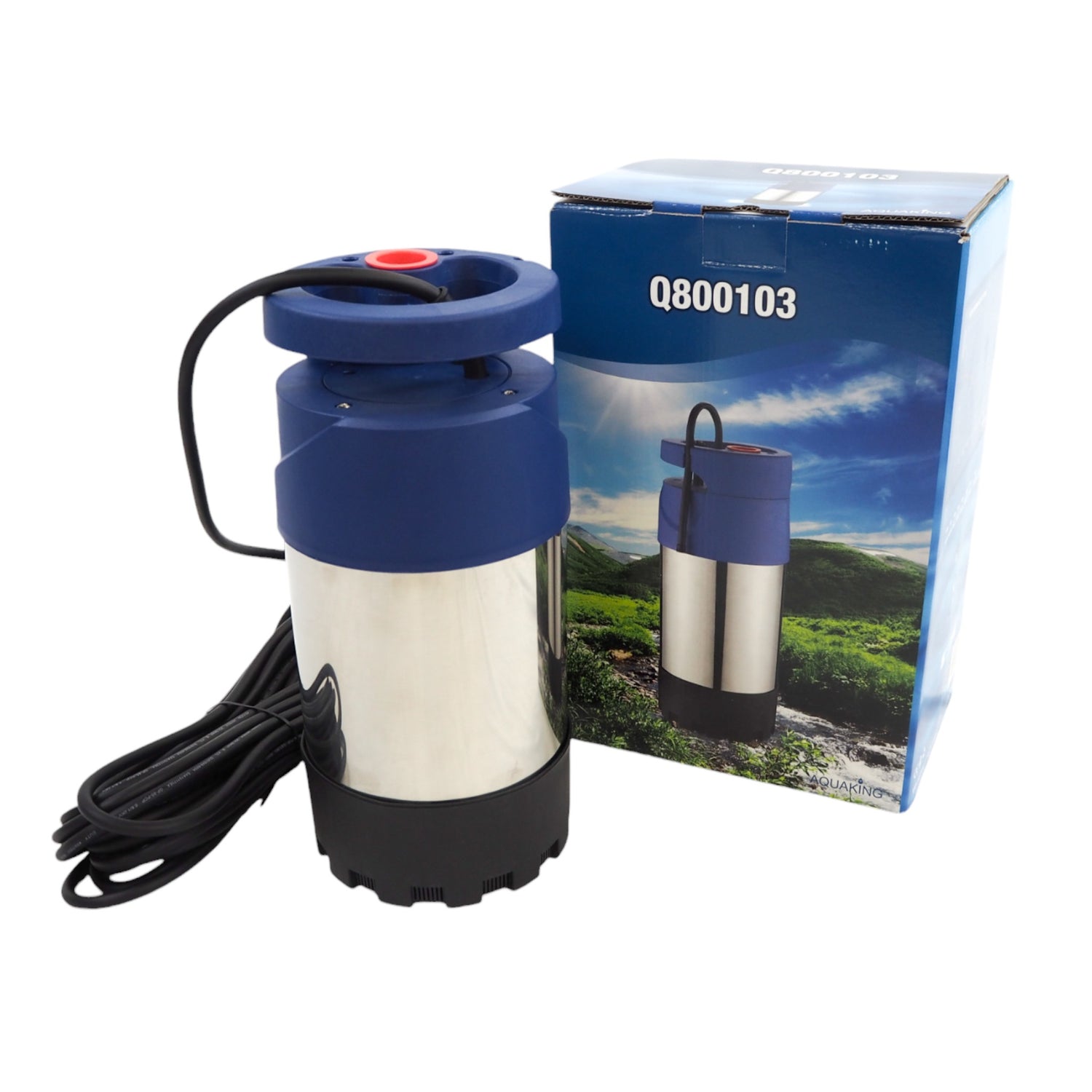
Unit price perThe AquaKing Q800103 is a submersible water pump rated at up to 5,500 litres per hour, with a 800W motor and a maximum head of approximately 30 metres.
Designed for moving water in suitable reservoirs, drainage and horticultural irrigation arrangements, the pump provides a practical way to transfer water between tanks or supply compatible distribution systems.
The Q800103 is the high-pressure model in this selection: its approximately 30m maximum head makes it materially different from the higher-flow, lower-head Q-series pumps.
The supplied Shopify SKU represents one pump, not a case. An adaptor is listed as included in the existing product export. No case quantity is confirmed for this SKU.
Why choose the AquaKing Q800103?
Understanding flow rate and head pressure
The stated 5,500L/h is the manufacturer’s maximum rated capacity under favourable conditions. Maximum head of 30m is a separate performance limit, not a promise that the pump delivers its full rated flow at that height. As lift and pipe friction increase, usable flow falls. Select pipework, fittings and any emitters against the actual pump curve and the installation requirements.
Suitable horticultural applications
This pump can be considered for moving water between suitable tanks, reservoir circulation, drainage or irrigation feed duties where the required head and flow are within its operating range. For pressure-sensitive drip emitters or long pipe runs, check working pressure at the emitters rather than selecting on litres per hour alone.
Installation and connection guidance
The manufacturer lists the connection arrangement as 1-inch internal thread. Confirm the supplied adaptor, hose size and thread compatibility before installation. Place the pump on a stable surface, keep the intake clear of debris and follow the product instructions for permitted water quality, immersion depth and electrical safety. Do not run dry unless the model documentation expressly allows it.
Choosing between AquaKing pump models
The Q2007 and Q2503 suit lower-flow duties, while the Q4003, Q50011 and Q5503 offer progressively higher nominal flow. The Q800103 differs by providing substantially greater maximum head. A higher L/h rating does not necessarily mean a pump is better for a pressurised irrigation network.
Maintenance and reliable operation
Inspect the intake regularly and remove accumulated debris as directed by the manufacturer. Check hoses, connections and cable condition before use. Disconnect power before cleaning or maintenance, and follow the supplied manual for permitted liquids and operating conditions.
Trade packing and ordering
Selling unit: one pump. Pallet quantities have not been assumed. Order quantities on the website refer to individual pumps, not full cases.
Product specifications
| Brand | AquaKing |
|---|---|
| Model | Q800103 |
| Product type | Submersible water pump |
| Maximum rated flow | 5,500 L/h |
| Power | 800W |
| Maximum head | 30m |
| Connection | 1-inch internal thread |
| Plug adaptor | Included (existing catalogue) |
| Selling unit | 1 pump |
Frequently asked questions
What is the maximum flow rate?
The published maximum is 5,500 litres per hour; actual flow depends on lift and pipe resistance. What is the maximum head?
The published maximum head is approximately 30 metres. Full flow is not available at maximum head. Is the pump sold individually?
Yes. This Shopify SKU is for one pump. Any case figure is for trade packing only. Can I use it with drip irrigation?
Only if the pump provides the required operating pressure and flow after allowing for pipework and fittings. Check the emitter specification and pump curve. Does it include an adaptor?
The existing product listing states an adaptor is included. Check the connection type before installation. Can it run dry?
Do not run the pump dry unless the specific manufacturer instructions expressly permit it. How do I choose between the Q-series models?
Compare required flow at your actual lift and pressure, not maximum L/h alone. How should I maintain it?
Disconnect power and clean the intake as directed in the manufacturer instructions; check hoses and cable condition regularly.
£47.51
Unit price per£47.51
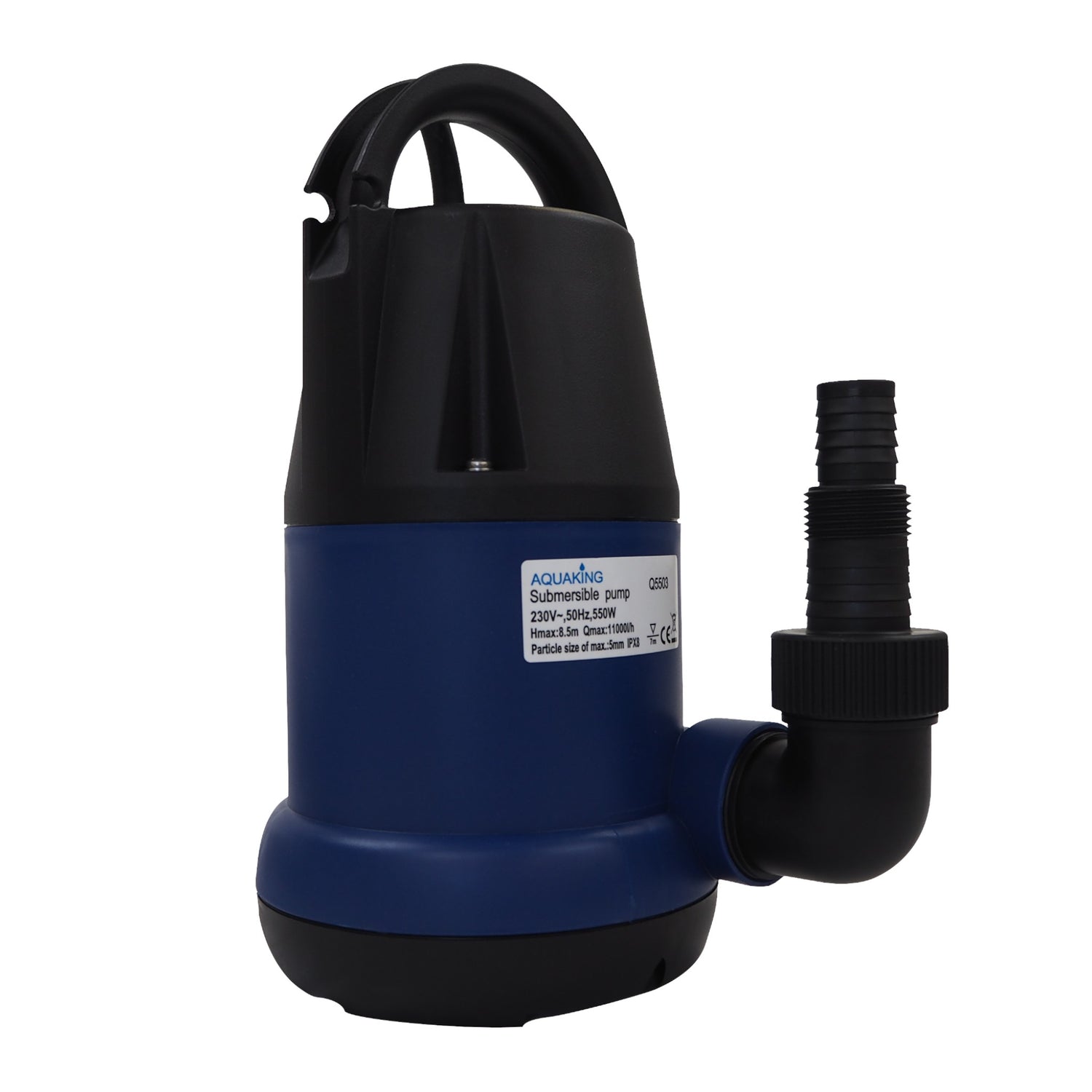
Unit price perThe AquaKing Q5503 is a submersible water pump rated at up to 11,000 litres per hour, with a 550W motor and a maximum head of approximately 8.5 metres.
Designed for moving water in suitable reservoirs, drainage and horticultural irrigation arrangements, the pump provides a practical way to transfer water between tanks or supply compatible distribution systems.
This model prioritises dependable bulk water movement. The published maximum flow is a free-flow rating; actual delivery decreases as pumping height, hose length and system resistance increase.
The supplied Shopify SKU represents one pump, not a case. An adaptor is listed as included in the existing product export. The trade case contains 4 pumps, for logistics only.
Why choose the AquaKing Q5503?
Understanding flow rate and head pressure
The stated 11,000L/h is the manufacturer’s maximum rated capacity under favourable conditions. Maximum head of 8.5m is a separate performance limit, not a promise that the pump delivers its full rated flow at that height. As lift and pipe friction increase, usable flow falls. Select pipework, fittings and any emitters against the actual pump curve and the installation requirements.
Suitable horticultural applications
This pump can be considered for moving water between suitable tanks, reservoir circulation, drainage or irrigation feed duties where the required head and flow are within its operating range. For pressure-sensitive drip emitters or long pipe runs, check working pressure at the emitters rather than selecting on litres per hour alone.
Installation and connection guidance
The manufacturer lists the connection arrangement as 25/30mm hose connection; 1-inch external thread. Confirm the supplied adaptor, hose size and thread compatibility before installation. Place the pump on a stable surface, keep the intake clear of debris and follow the product instructions for permitted water quality, immersion depth and electrical safety. Do not run dry unless the model documentation expressly allows it.
Choosing between AquaKing pump models
The Q2007 and Q2503 suit lower-flow duties, while the Q4003, Q50011 and Q5503 offer progressively higher nominal flow. The Q800103 differs by providing substantially greater maximum head. A higher L/h rating does not necessarily mean a pump is better for a pressurised irrigation network.
Maintenance and reliable operation
Inspect the intake regularly and remove accumulated debris as directed by the manufacturer. Check hoses, connections and cable condition before use. Disconnect power before cleaning or maintenance, and follow the supplied manual for permitted liquids and operating conditions.
Trade packing and ordering
Selling unit: one pump. Case quantity: 4 pumps (logistics only). Pallet quantities have not been assumed. Order quantities on the website refer to individual pumps, not full cases.
Product specifications
| Brand | AquaKing |
|---|---|
| Model | Q5503 |
| Product type | Submersible water pump |
| Maximum rated flow | 11,000 L/h |
| Power | 550W |
| Maximum head | 8.5m |
| Connection | 25/30mm hose connection; 1-inch external thread |
| Plug adaptor | Included (existing catalogue) |
| Selling unit | 1 pump |
| Case quantity | 4 pumps |
Frequently asked questions
What is the maximum flow rate?
The published maximum is 11,000 litres per hour; actual flow depends on lift and pipe resistance. What is the maximum head?
The published maximum head is approximately 8.5 metres. Full flow is not available at maximum head. Is the pump sold individually?
Yes. This Shopify SKU is for one pump. Any case figure is for trade packing only. Can I use it with drip irrigation?
Only if the pump provides the required operating pressure and flow after allowing for pipework and fittings. Check the emitter specification and pump curve. Does it include an adaptor?
The existing product listing states an adaptor is included. Check the connection type before installation. Can it run dry?
Do not run the pump dry unless the specific manufacturer instructions expressly permit it. How do I choose between the Q-series models?
Compare required flow at your actual lift and pressure, not maximum L/h alone. How should I maintain it?
Disconnect power and clean the intake as directed in the manufacturer instructions; check hoses and cable condition regularly.
£55.80
Unit price per£55.80
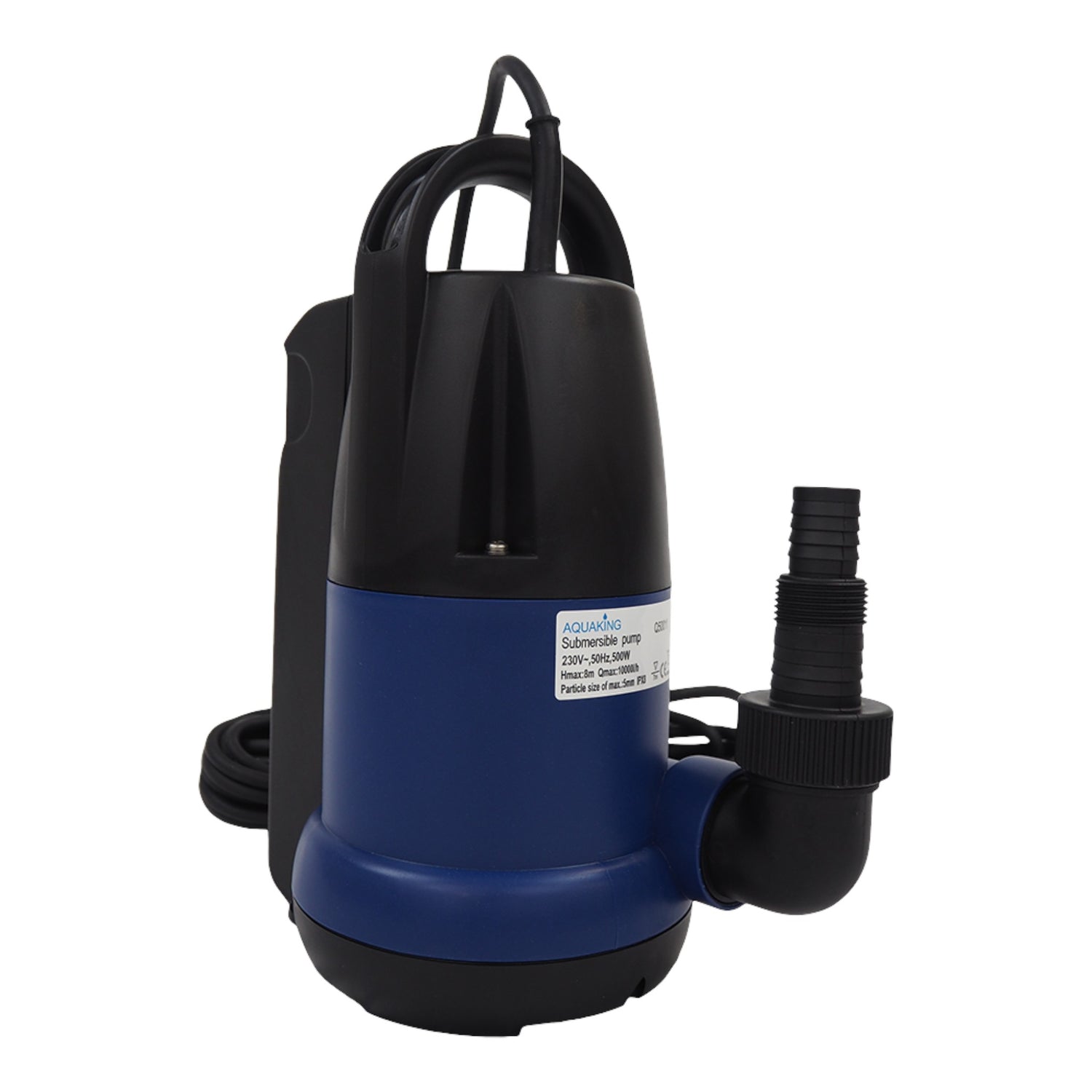
Unit price perThe AquaKing Q50011 is a submersible water pump rated at up to 10,000 litres per hour, with a 500W motor and a maximum head of approximately 8.5 metres.
Designed for moving water in suitable reservoirs, drainage and horticultural irrigation arrangements, the pump provides a practical way to transfer water between tanks or supply compatible distribution systems.
This model prioritises dependable bulk water movement. The published maximum flow is a free-flow rating; actual delivery decreases as pumping height, hose length and system resistance increase.
The supplied Shopify SKU represents one pump, not a case. An adaptor is listed as included in the existing product export. The trade case contains 4 pumps, for logistics only.
Why choose the AquaKing Q50011?
Understanding flow rate and head pressure
The stated 10,000L/h is the manufacturer’s maximum rated capacity under favourable conditions. Maximum head of 8.5m is a separate performance limit, not a promise that the pump delivers its full rated flow at that height. As lift and pipe friction increase, usable flow falls. Select pipework, fittings and any emitters against the actual pump curve and the installation requirements.
Suitable horticultural applications
This pump can be considered for moving water between suitable tanks, reservoir circulation, drainage or irrigation feed duties where the required head and flow are within its operating range. For pressure-sensitive drip emitters or long pipe runs, check working pressure at the emitters rather than selecting on litres per hour alone.
Installation and connection guidance
The manufacturer lists the connection arrangement as 25mm hose connection; 1-inch external thread. Confirm the supplied adaptor, hose size and thread compatibility before installation. Place the pump on a stable surface, keep the intake clear of debris and follow the product instructions for permitted water quality, immersion depth and electrical safety. Do not run dry unless the model documentation expressly allows it.
Choosing between AquaKing pump models
The Q2007 and Q2503 suit lower-flow duties, while the Q4003, Q50011 and Q5503 offer progressively higher nominal flow. The Q800103 differs by providing substantially greater maximum head. A higher L/h rating does not necessarily mean a pump is better for a pressurised irrigation network.
Maintenance and reliable operation
Inspect the intake regularly and remove accumulated debris as directed by the manufacturer. Check hoses, connections and cable condition before use. Disconnect power before cleaning or maintenance, and follow the supplied manual for permitted liquids and operating conditions.
Trade packing and ordering
Selling unit: one pump. Case quantity: 4 pumps (logistics only). Pallet quantities have not been assumed. Order quantities on the website refer to individual pumps, not full cases.
Product specifications
| Brand | AquaKing |
|---|---|
| Model | Q50011 |
| Product type | Submersible water pump |
| Maximum rated flow | 10,000 L/h |
| Power | 500W |
| Maximum head | 8.5m |
| Connection | 25mm hose connection; 1-inch external thread |
| Plug adaptor | Included (existing catalogue) |
| Selling unit | 1 pump |
| Case quantity | 4 pumps |
Frequently asked questions
What is the maximum flow rate?
The published maximum is 10,000 litres per hour; actual flow depends on lift and pipe resistance. What is the maximum head?
The published maximum head is approximately 8.5 metres. Full flow is not available at maximum head. Is the pump sold individually?
Yes. This Shopify SKU is for one pump. Any case figure is for trade packing only. Can I use it with drip irrigation?
Only if the pump provides the required operating pressure and flow after allowing for pipework and fittings. Check the emitter specification and pump curve. Does it include an adaptor?
The existing product listing states an adaptor is included. Check the connection type before installation. Can it run dry?
Do not run the pump dry unless the specific manufacturer instructions expressly permit it. How do I choose between the Q-series models?
Compare required flow at your actual lift and pressure, not maximum L/h alone. How should I maintain it?
Disconnect power and clean the intake as directed in the manufacturer instructions; check hoses and cable condition regularly.
£42.52
Unit price per£42.52
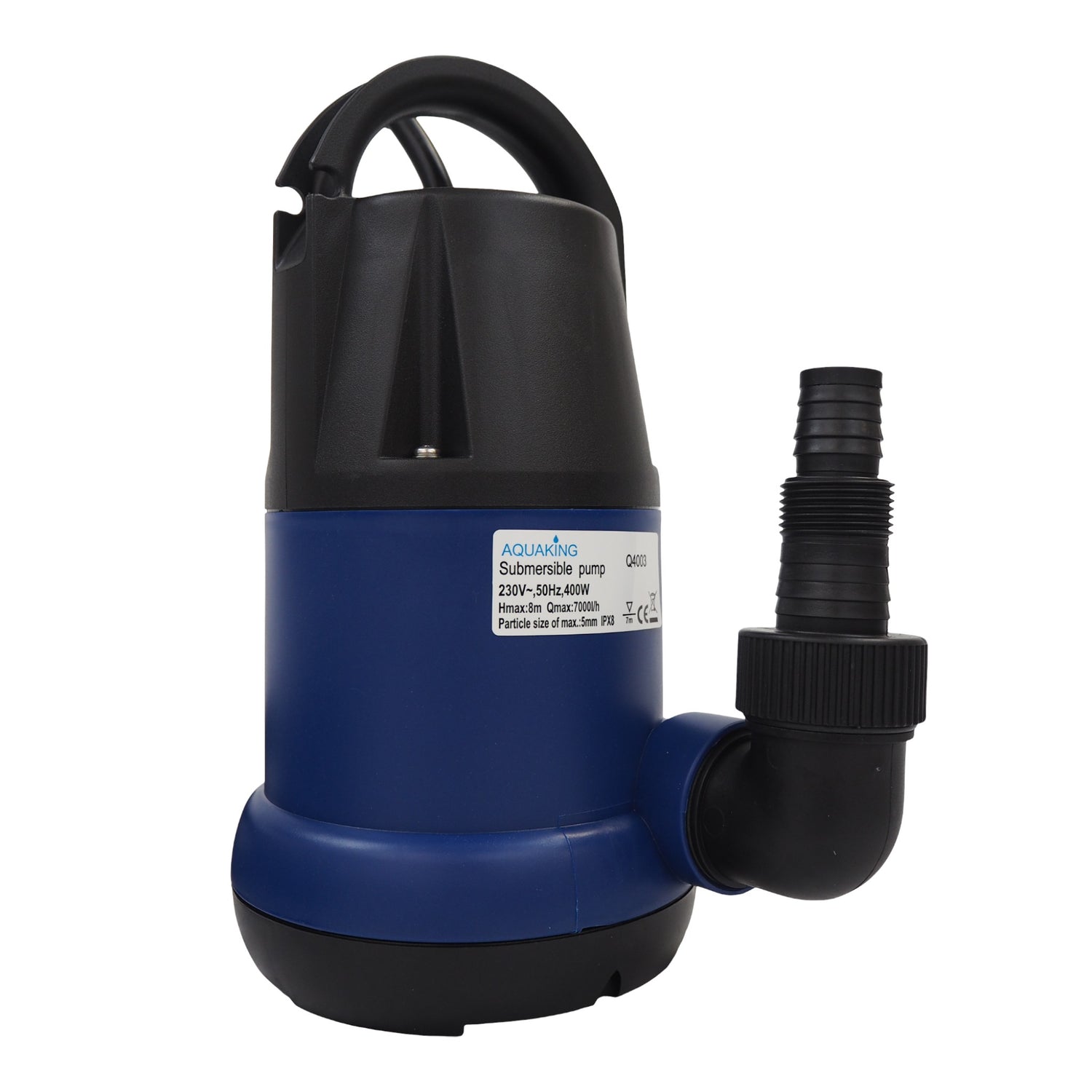
Unit price perThe AquaKing Q4003 is a submersible water pump rated at up to 7,000 litres per hour, with a 400W motor and a maximum head of approximately 8 metres.
Designed for moving water in suitable reservoirs, drainage and horticultural irrigation arrangements, the pump provides a practical way to transfer water between tanks or supply compatible distribution systems.
This model prioritises dependable bulk water movement. The published maximum flow is a free-flow rating; actual delivery decreases as pumping height, hose length and system resistance increase.
The supplied Shopify SKU represents one pump, not a case. An adaptor is listed as included in the existing product export. The trade case contains 6 pumps, for logistics only.
Why choose the AquaKing Q4003?
Understanding flow rate and head pressure
The stated 7,000L/h is the manufacturer’s maximum rated capacity under favourable conditions. Maximum head of 8m is a separate performance limit, not a promise that the pump delivers its full rated flow at that height. As lift and pipe friction increase, usable flow falls. Select pipework, fittings and any emitters against the actual pump curve and the installation requirements.
Suitable horticultural applications
This pump can be considered for moving water between suitable tanks, reservoir circulation, drainage or irrigation feed duties where the required head and flow are within its operating range. For pressure-sensitive drip emitters or long pipe runs, check working pressure at the emitters rather than selecting on litres per hour alone.
Installation and connection guidance
The manufacturer lists the connection arrangement as 25/30mm hose connection; 1-inch external thread. Confirm the supplied adaptor, hose size and thread compatibility before installation. Place the pump on a stable surface, keep the intake clear of debris and follow the product instructions for permitted water quality, immersion depth and electrical safety. Do not run dry unless the model documentation expressly allows it.
Choosing between AquaKing pump models
The Q2007 and Q2503 suit lower-flow duties, while the Q4003, Q50011 and Q5503 offer progressively higher nominal flow. The Q800103 differs by providing substantially greater maximum head. A higher L/h rating does not necessarily mean a pump is better for a pressurised irrigation network.
Maintenance and reliable operation
Inspect the intake regularly and remove accumulated debris as directed by the manufacturer. Check hoses, connections and cable condition before use. Disconnect power before cleaning or maintenance, and follow the supplied manual for permitted liquids and operating conditions.
Trade packing and ordering
Selling unit: one pump. Case quantity: 6 pumps (logistics only). Pallet quantities have not been assumed. Order quantities on the website refer to individual pumps, not full cases.
Product specifications
| Brand | AquaKing |
|---|---|
| Model | Q4003 |
| Product type | Submersible water pump |
| Maximum rated flow | 7,000 L/h |
| Power | 400W |
| Maximum head | 8m |
| Connection | 25/30mm hose connection; 1-inch external thread |
| Plug adaptor | Included (existing catalogue) |
| Selling unit | 1 pump |
| Case quantity | 6 pumps |
Frequently asked questions
What is the maximum flow rate?
The published maximum is 7,000 litres per hour; actual flow depends on lift and pipe resistance. What is the maximum head?
The published maximum head is approximately 8 metres. Full flow is not available at maximum head. Is the pump sold individually?
Yes. This Shopify SKU is for one pump. Any case figure is for trade packing only. Can I use it with drip irrigation?
Only if the pump provides the required operating pressure and flow after allowing for pipework and fittings. Check the emitter specification and pump curve. Does it include an adaptor?
The existing product listing states an adaptor is included. Check the connection type before installation. Can it run dry?
Do not run the pump dry unless the specific manufacturer instructions expressly permit it. How do I choose between the Q-series models?
Compare required flow at your actual lift and pressure, not maximum L/h alone. How should I maintain it?
Disconnect power and clean the intake as directed in the manufacturer instructions; check hoses and cable condition regularly.
£41.64
Unit price per£41.64
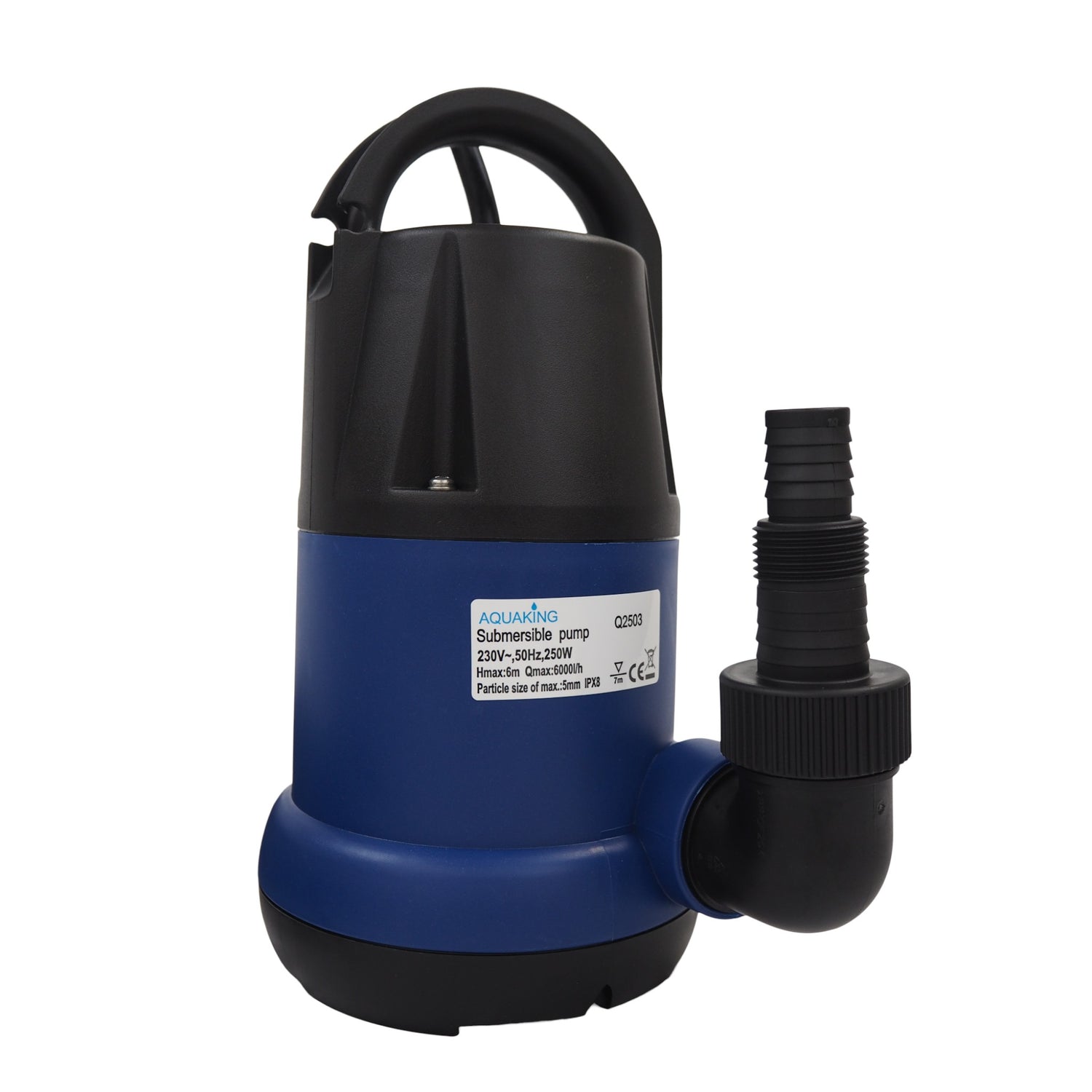
Unit price perThe AquaKing Q2503 is a submersible water pump rated at up to 5,000 litres per hour, with a 250W motor and a maximum head of approximately 6 metres.
Designed for moving water in suitable reservoirs, drainage and horticultural irrigation arrangements, the pump provides a practical way to transfer water between tanks or supply compatible distribution systems.
This model prioritises dependable bulk water movement. The published maximum flow is a free-flow rating; actual delivery decreases as pumping height, hose length and system resistance increase.
The supplied Shopify SKU represents one pump, not a case. An adaptor is listed as included in the existing product export. The trade case contains 4 pumps, for logistics only.
Why choose the AquaKing Q2503?
Understanding flow rate and head pressure
The stated 5,000L/h is the manufacturer’s maximum rated capacity under favourable conditions. Maximum head of 6m is a separate performance limit, not a promise that the pump delivers its full rated flow at that height. As lift and pipe friction increase, usable flow falls. Select pipework, fittings and any emitters against the actual pump curve and the installation requirements.
Suitable horticultural applications
This pump can be considered for moving water between suitable tanks, reservoir circulation, drainage or irrigation feed duties where the required head and flow are within its operating range. For pressure-sensitive drip emitters or long pipe runs, check working pressure at the emitters rather than selecting on litres per hour alone.
Installation and connection guidance
The manufacturer lists the connection arrangement as 25/30mm hose connection; 1-inch external thread. Confirm the supplied adaptor, hose size and thread compatibility before installation. Place the pump on a stable surface, keep the intake clear of debris and follow the product instructions for permitted water quality, immersion depth and electrical safety. Do not run dry unless the model documentation expressly allows it.
Choosing between AquaKing pump models
The Q2007 and Q2503 suit lower-flow duties, while the Q4003, Q50011 and Q5503 offer progressively higher nominal flow. The Q800103 differs by providing substantially greater maximum head. A higher L/h rating does not necessarily mean a pump is better for a pressurised irrigation network.
Maintenance and reliable operation
Inspect the intake regularly and remove accumulated debris as directed by the manufacturer. Check hoses, connections and cable condition before use. Disconnect power before cleaning or maintenance, and follow the supplied manual for permitted liquids and operating conditions.
Trade packing and ordering
Selling unit: one pump. Case quantity: 4 pumps (logistics only). Pallet quantities have not been assumed. Order quantities on the website refer to individual pumps, not full cases.
Product specifications
| Brand | AquaKing |
|---|---|
| Model | Q2503 |
| Product type | Submersible water pump |
| Maximum rated flow | 5,000 L/h |
| Power | 250W |
| Maximum head | 6m |
| Connection | 25/30mm hose connection; 1-inch external thread |
| Plug adaptor | Included (existing catalogue) |
| Selling unit | 1 pump |
| Case quantity | 4 pumps |
Frequently asked questions
What is the maximum flow rate?
The published maximum is 5,000 litres per hour; actual flow depends on lift and pipe resistance. What is the maximum head?
The published maximum head is approximately 6 metres. Full flow is not available at maximum head. Is the pump sold individually?
Yes. This Shopify SKU is for one pump. Any case figure is for trade packing only. Can I use it with drip irrigation?
Only if the pump provides the required operating pressure and flow after allowing for pipework and fittings. Check the emitter specification and pump curve. Does it include an adaptor?
The existing product listing states an adaptor is included. Check the connection type before installation. Can it run dry?
Do not run the pump dry unless the specific manufacturer instructions expressly permit it. How do I choose between the Q-series models?
Compare required flow at your actual lift and pressure, not maximum L/h alone. How should I maintain it?
Disconnect power and clean the intake as directed in the manufacturer instructions; check hoses and cable condition regularly.
£39.85
Unit price per£39.85
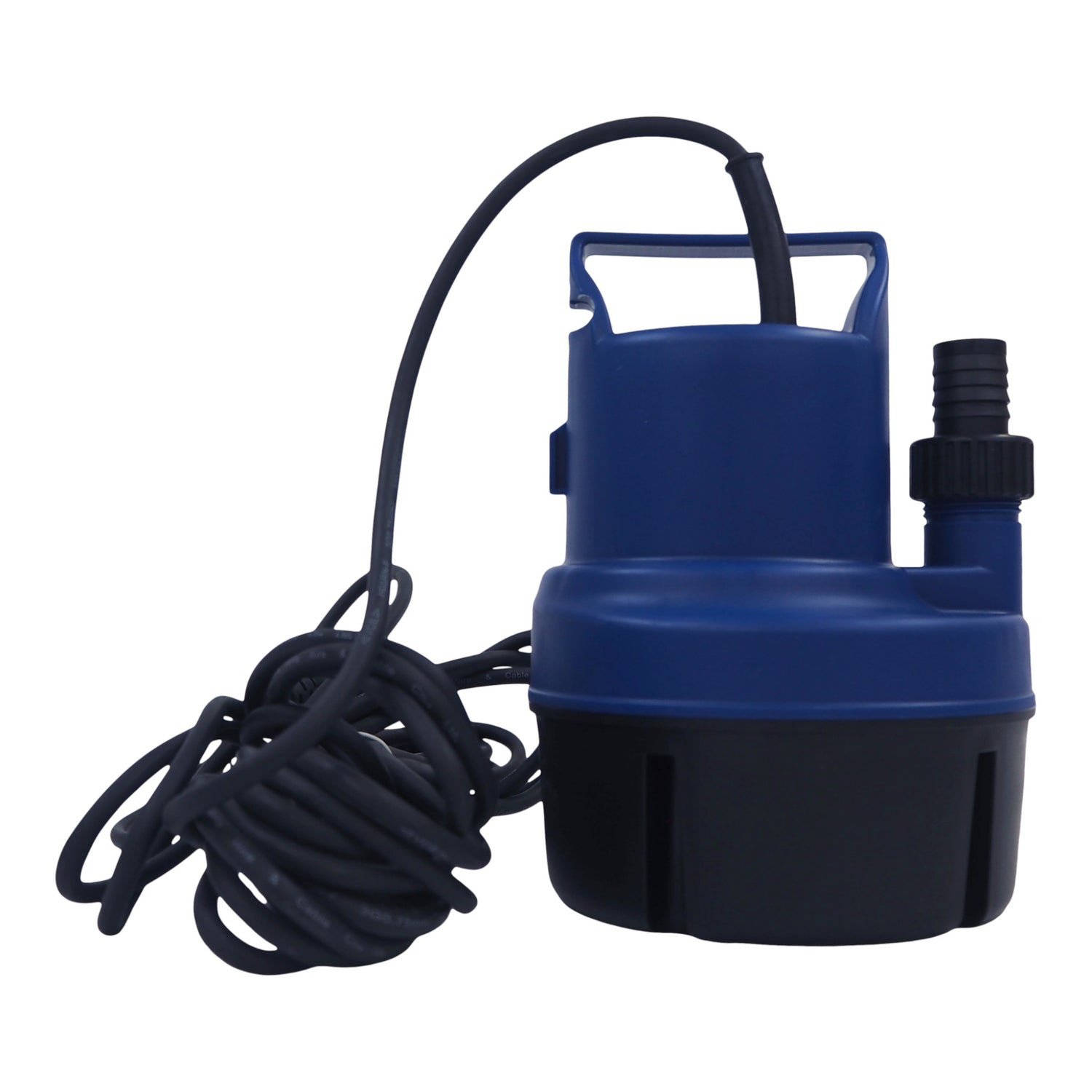
Unit price perThe AquaKing Q2007 is a submersible water pump rated at up to 3,600 litres per hour, with a 200W motor and a maximum head of approximately 5 metres.
Designed for moving water in suitable reservoirs, drainage and horticultural irrigation arrangements, the pump provides a practical way to transfer water between tanks or supply compatible distribution systems.
This model prioritises dependable bulk water movement. The published maximum flow is a free-flow rating; actual delivery decreases as pumping height, hose length and system resistance increase.
The supplied Shopify SKU represents one pump, not a case. An adaptor is listed as included in the existing product export. The trade case contains 6 pumps, for logistics only.
Why choose the AquaKing Q2007?
Understanding flow rate and head pressure
The stated 3,600L/h is the manufacturer’s maximum rated capacity under favourable conditions. Maximum head of 5m is a separate performance limit, not a promise that the pump delivers its full rated flow at that height. As lift and pipe friction increase, usable flow falls. Select pipework, fittings and any emitters against the actual pump curve and the installation requirements.
Suitable horticultural applications
This pump can be considered for moving water between suitable tanks, reservoir circulation, drainage or irrigation feed duties where the required head and flow are within its operating range. For pressure-sensitive drip emitters or long pipe runs, check working pressure at the emitters rather than selecting on litres per hour alone.
Installation and connection guidance
The manufacturer lists the connection arrangement as 20/25mm hose connection; 1-inch external thread. Confirm the supplied adaptor, hose size and thread compatibility before installation. Place the pump on a stable surface, keep the intake clear of debris and follow the product instructions for permitted water quality, immersion depth and electrical safety. Do not run dry unless the model documentation expressly allows it.
Choosing between AquaKing pump models
The Q2007 and Q2503 suit lower-flow duties, while the Q4003, Q50011 and Q5503 offer progressively higher nominal flow. The Q800103 differs by providing substantially greater maximum head. A higher L/h rating does not necessarily mean a pump is better for a pressurised irrigation network.
Maintenance and reliable operation
Inspect the intake regularly and remove accumulated debris as directed by the manufacturer. Check hoses, connections and cable condition before use. Disconnect power before cleaning or maintenance, and follow the supplied manual for permitted liquids and operating conditions.
Trade packing and ordering
Selling unit: one pump. Case quantity: 6 pumps (logistics only). Pallet quantities have not been assumed. Order quantities on the website refer to individual pumps, not full cases.
Product specifications
| Brand | AquaKing |
|---|---|
| Model | Q2007 |
| Product type | Submersible water pump |
| Maximum rated flow | 3,600 L/h |
| Power | 200W |
| Maximum head | 5m |
| Connection | 20/25mm hose connection; 1-inch external thread |
| Plug adaptor | Included (existing catalogue) |
| Selling unit | 1 pump |
| Case quantity | 6 pumps |
Frequently asked questions
What is the maximum flow rate?
The published maximum is 3,600 litres per hour; actual flow depends on lift and pipe resistance. What is the maximum head?
The published maximum head is approximately 5 metres. Full flow is not available at maximum head. Is the pump sold individually?
Yes. This Shopify SKU is for one pump. Any case figure is for trade packing only. Can I use it with drip irrigation?
Only if the pump provides the required operating pressure and flow after allowing for pipework and fittings. Check the emitter specification and pump curve. Does it include an adaptor?
The existing product listing states an adaptor is included. Check the connection type before installation. Can it run dry?
Do not run the pump dry unless the specific manufacturer instructions expressly permit it. How do I choose between the Q-series models?
Compare required flow at your actual lift and pressure, not maximum L/h alone. How should I maintain it?
Disconnect power and clean the intake as directed in the manufacturer instructions; check hoses and cable condition regularly.


£69.23
Unit price per£69.23
Unit price perThe Clarke 750W Submersible Pump - Flow rate 216L/min is a submersible water pump intended for compatible water-circulation and transfer applications.
Select a pump by the required flow, lift/head, water characteristics and installation rather than model name alone. Actual flow normally falls as head and system resistance increase.
Sold individually. The source commercial box quantity is 4 pumps.
Key benefits
Choosing a pump for the system
Start with the flow required at the actual delivery height, not simply the headline free-flow figure. Vertical lift, hose or pipe diameter, bends, valves, filters and fittings all add resistance and can reduce delivered flow.
Confirm the pump is suitable for the water type, solids content, temperature and duty required. Do not assume every water pump is suitable for dirty water, continuous duty or nutrient solutions unless the manufacturer specifies it.
Submersible installation
Use a submersible pump only within the immersion, water-quality and electrical conditions specified by the manufacturer. Keep the inlet clear of debris where practical and prevent the pump from running dry if the model is not designed for it.
Pipework & flow
Use adequately sized hose or pipe and avoid unnecessary restrictions. Undersized pipework can waste pump capacity through friction loss. Secure connections and support pipework so the pump outlet is not carrying avoidable mechanical load.
Electrical safety
Water and electricity require appropriate protection. Use a suitable supply, RCD protection and connections appropriate to the environment, following the manufacturer's instructions. Isolate the pump before handling, cleaning or servicing.
Maintenance
Inspect the inlet, impeller area, cable and connections periodically. Remove debris according to the manufacturer's instructions and investigate reduced flow before assuming the pump itself has failed.
Clarke 750W Submersible Pump - Flow rate 216L/min product details
| Brand | Clarke |
|---|---|
| Product type | Submersible Water Pump |
| Primary application | Compatible water circulation or transfer |
| Stated power | 750W |
| Stated flow figure | 216L/min |
| Selling quantity | 1 pump |
| Commercial box quantity | 4 pumps |
Clarke 750W Submersible Pump - Flow rate 216L/min FAQs
What should I consider when choosing a pump?
Required flow at the actual head, pipework resistance, water type, duty and electrical installation. Does the headline flow stay the same at every height?
No. Delivered flow normally reduces as vertical lift and system resistance increase. Can I use any hose size?
Use a hose or pipe size suitable for the pump and required flow; restrictive pipework can significantly reduce performance. Can the pump run dry?
Do not assume so. Follow the manufacturer's instructions for the exact model. Is it suitable for dirty water or nutrient solution?
Only where the manufacturer confirms compatibility with the liquid and solids content involved. What electrical precautions are needed?
Use a suitable protected supply and installation for the wet environment and isolate power before handling or servicing. What should I check if flow drops?
Inspect the inlet, pipework, filters, fittings and impeller area for restriction or blockage. How should the pump be maintained?
Follow the manufacturer's cleaning and servicing instructions and inspect cables and connections regularly. How many pumps am I buying?
The selling unit is one pump. The source commercial box quantity is four.

£53.50
Unit price per£53.50
Unit price perThe Clarke 400W Submersible Pump - Flow rate 115L/min is a submersible water pump intended for compatible water-circulation and transfer applications.
Select a pump by the required flow, lift/head, water characteristics and installation rather than model name alone. Actual flow normally falls as head and system resistance increase.
Sold individually. The source commercial box quantity is 4 pumps.
Key benefits
Choosing a pump for the system
Start with the flow required at the actual delivery height, not simply the headline free-flow figure. Vertical lift, hose or pipe diameter, bends, valves, filters and fittings all add resistance and can reduce delivered flow.
Confirm the pump is suitable for the water type, solids content, temperature and duty required. Do not assume every water pump is suitable for dirty water, continuous duty or nutrient solutions unless the manufacturer specifies it.
Submersible installation
Use a submersible pump only within the immersion, water-quality and electrical conditions specified by the manufacturer. Keep the inlet clear of debris where practical and prevent the pump from running dry if the model is not designed for it.
Pipework & flow
Use adequately sized hose or pipe and avoid unnecessary restrictions. Undersized pipework can waste pump capacity through friction loss. Secure connections and support pipework so the pump outlet is not carrying avoidable mechanical load.
Electrical safety
Water and electricity require appropriate protection. Use a suitable supply, RCD protection and connections appropriate to the environment, following the manufacturer's instructions. Isolate the pump before handling, cleaning or servicing.
Maintenance
Inspect the inlet, impeller area, cable and connections periodically. Remove debris according to the manufacturer's instructions and investigate reduced flow before assuming the pump itself has failed.
Clarke 400W Submersible Pump - Flow rate 115L/min product details
| Brand | Clarke |
|---|---|
| Product type | Submersible Water Pump |
| Primary application | Compatible water circulation or transfer |
| Stated power | 400W |
| Stated flow figure | 115L/min |
| Selling quantity | 1 pump |
| Commercial box quantity | 4 pumps |
Clarke 400W Submersible Pump - Flow rate 115L/min FAQs
What should I consider when choosing a pump?
Required flow at the actual head, pipework resistance, water type, duty and electrical installation. Does the headline flow stay the same at every height?
No. Delivered flow normally reduces as vertical lift and system resistance increase. Can I use any hose size?
Use a hose or pipe size suitable for the pump and required flow; restrictive pipework can significantly reduce performance. Can the pump run dry?
Do not assume so. Follow the manufacturer's instructions for the exact model. Is it suitable for dirty water or nutrient solution?
Only where the manufacturer confirms compatibility with the liquid and solids content involved. What electrical precautions are needed?
Use a suitable protected supply and installation for the wet environment and isolate power before handling or servicing. What should I check if flow drops?
Inspect the inlet, pipework, filters, fittings and impeller area for restriction or blockage. How should the pump be maintained?
Follow the manufacturer's cleaning and servicing instructions and inspect cables and connections regularly. How many pumps am I buying?
The selling unit is one pump. The source commercial box quantity is four.

£119.73
Unit price per£119.73
Unit price perThe Clarke 1100W Submersible Pump - Flow rate 258L/min is a submersible water pump intended for compatible water-circulation and transfer applications.
Select a pump by the required flow, lift/head, water characteristics and installation rather than model name alone. Actual flow normally falls as head and system resistance increase.
Key benefits
Choosing a pump for the system
Start with the flow required at the actual delivery height, not simply the headline free-flow figure. Vertical lift, hose or pipe diameter, bends, valves, filters and fittings all add resistance and can reduce delivered flow.
Confirm the pump is suitable for the water type, solids content, temperature and duty required. Do not assume every water pump is suitable for dirty water, continuous duty or nutrient solutions unless the manufacturer specifies it.
Submersible installation
Use a submersible pump only within the immersion, water-quality and electrical conditions specified by the manufacturer. Keep the inlet clear of debris where practical and prevent the pump from running dry if the model is not designed for it.
Pipework & flow
Use adequately sized hose or pipe and avoid unnecessary restrictions. Undersized pipework can waste pump capacity through friction loss. Secure connections and support pipework so the pump outlet is not carrying avoidable mechanical load.
Electrical safety
Water and electricity require appropriate protection. Use a suitable supply, RCD protection and connections appropriate to the environment, following the manufacturer's instructions. Isolate the pump before handling, cleaning or servicing.
Maintenance
Inspect the inlet, impeller area, cable and connections periodically. Remove debris according to the manufacturer's instructions and investigate reduced flow before assuming the pump itself has failed.
Clarke 1100W Submersible Pump - Flow rate 258L/min product details
| Brand | Clarke |
|---|---|
| Product type | Submersible Water Pump |
| Primary application | Compatible water circulation or transfer |
| Stated power | 1100W |
| Stated flow figure | 258L/min |
| Selling quantity | 1 pump |
Clarke 1100W Submersible Pump - Flow rate 258L/min FAQs
What should I consider when choosing a pump?
Required flow at the actual head, pipework resistance, water type, duty and electrical installation. Does the headline flow stay the same at every height?
No. Delivered flow normally reduces as vertical lift and system resistance increase. Can I use any hose size?
Use a hose or pipe size suitable for the pump and required flow; restrictive pipework can significantly reduce performance. Can the pump run dry?
Do not assume so. Follow the manufacturer's instructions for the exact model. Is it suitable for dirty water or nutrient solution?
Only where the manufacturer confirms compatibility with the liquid and solids content involved. What electrical precautions are needed?
Use a suitable protected supply and installation for the wet environment and isolate power before handling or servicing. What should I check if flow drops?
Inspect the inlet, pipework, filters, fittings and impeller area for restriction or blockage. How should the pump be maintained?
Follow the manufacturer's cleaning and servicing instructions and inspect cables and connections regularly.

The New Jet 3500 Pump is a water pump intended for compatible water-circulation and transfer applications.
Select a pump by the required flow, lift/head, water characteristics and installation rather than model name alone. Actual flow normally falls as head and system resistance increase.
Key benefits
Choosing a pump for the system
Start with the flow required at the actual delivery height, not simply the headline free-flow figure. Vertical lift, hose or pipe diameter, bends, valves, filters and fittings all add resistance and can reduce delivered flow.
Confirm the pump is suitable for the water type, solids content, temperature and duty required. Do not assume every water pump is suitable for dirty water, continuous duty or nutrient solutions unless the manufacturer specifies it.
Pipework & flow
Use adequately sized hose or pipe and avoid unnecessary restrictions. Undersized pipework can waste pump capacity through friction loss. Secure connections and support pipework so the pump outlet is not carrying avoidable mechanical load.
Electrical safety
Water and electricity require appropriate protection. Use a suitable supply, RCD protection and connections appropriate to the environment, following the manufacturer's instructions. Isolate the pump before handling, cleaning or servicing.
Maintenance
Inspect the inlet, impeller area, cable and connections periodically. Remove debris according to the manufacturer's instructions and investigate reduced flow before assuming the pump itself has failed.
New Jet 3500 Pump product details
| Brand | New Jet |
|---|---|
| Product type | Water Pump |
| Primary application | Compatible water circulation or transfer |
| Selling quantity | 1 pump |
New Jet 3500 Pump FAQs
What should I consider when choosing a pump?
Required flow at the actual head, pipework resistance, water type, duty and electrical installation. Does the headline flow stay the same at every height?
No. Delivered flow normally reduces as vertical lift and system resistance increase. Can I use any hose size?
Use a hose or pipe size suitable for the pump and required flow; restrictive pipework can significantly reduce performance. Can the pump run dry?
Do not assume so. Follow the manufacturer's instructions for the exact model. Is it suitable for dirty water or nutrient solution?
Only where the manufacturer confirms compatibility with the liquid and solids content involved. What electrical precautions are needed?
Use a suitable protected supply and installation for the wet environment and isolate power before handling or servicing. What should I check if flow drops?
Inspect the inlet, pipework, filters, fittings and impeller area for restriction or blockage. How should the pump be maintained?
Follow the manufacturer's cleaning and servicing instructions and inspect cables and connections regularly.

The New Jet 2400 Pump is a water pump intended for compatible water-circulation and transfer applications.
Select a pump by the required flow, lift/head, water characteristics and installation rather than model name alone. Actual flow normally falls as head and system resistance increase.
Key benefits
Choosing a pump for the system
Start with the flow required at the actual delivery height, not simply the headline free-flow figure. Vertical lift, hose or pipe diameter, bends, valves, filters and fittings all add resistance and can reduce delivered flow.
Confirm the pump is suitable for the water type, solids content, temperature and duty required. Do not assume every water pump is suitable for dirty water, continuous duty or nutrient solutions unless the manufacturer specifies it.
Pipework & flow
Use adequately sized hose or pipe and avoid unnecessary restrictions. Undersized pipework can waste pump capacity through friction loss. Secure connections and support pipework so the pump outlet is not carrying avoidable mechanical load.
Electrical safety
Water and electricity require appropriate protection. Use a suitable supply, RCD protection and connections appropriate to the environment, following the manufacturer's instructions. Isolate the pump before handling, cleaning or servicing.
Maintenance
Inspect the inlet, impeller area, cable and connections periodically. Remove debris according to the manufacturer's instructions and investigate reduced flow before assuming the pump itself has failed.
New Jet 2400 Pump product details
| Brand | New Jet |
|---|---|
| Product type | Water Pump |
| Primary application | Compatible water circulation or transfer |
| Selling quantity | 1 pump |
New Jet 2400 Pump FAQs
What should I consider when choosing a pump?
Required flow at the actual head, pipework resistance, water type, duty and electrical installation. Does the headline flow stay the same at every height?
No. Delivered flow normally reduces as vertical lift and system resistance increase. Can I use any hose size?
Use a hose or pipe size suitable for the pump and required flow; restrictive pipework can significantly reduce performance. Can the pump run dry?
Do not assume so. Follow the manufacturer's instructions for the exact model. Is it suitable for dirty water or nutrient solution?
Only where the manufacturer confirms compatibility with the liquid and solids content involved. What electrical precautions are needed?
Use a suitable protected supply and installation for the wet environment and isolate power before handling or servicing. What should I check if flow drops?
Inspect the inlet, pipework, filters, fittings and impeller area for restriction or blockage. How should the pump be maintained?
Follow the manufacturer's cleaning and servicing instructions and inspect cables and connections regularly.

The Maxi Jet MJ500 Pump is a water pump intended for compatible water-circulation and transfer applications.
Select a pump by the required flow, lift/head, water characteristics and installation rather than model name alone. Actual flow normally falls as head and system resistance increase.
Key benefits
Choosing a pump for the system
Start with the flow required at the actual delivery height, not simply the headline free-flow figure. Vertical lift, hose or pipe diameter, bends, valves, filters and fittings all add resistance and can reduce delivered flow.
Confirm the pump is suitable for the water type, solids content, temperature and duty required. Do not assume every water pump is suitable for dirty water, continuous duty or nutrient solutions unless the manufacturer specifies it.
Pipework & flow
Use adequately sized hose or pipe and avoid unnecessary restrictions. Undersized pipework can waste pump capacity through friction loss. Secure connections and support pipework so the pump outlet is not carrying avoidable mechanical load.
Electrical safety
Water and electricity require appropriate protection. Use a suitable supply, RCD protection and connections appropriate to the environment, following the manufacturer's instructions. Isolate the pump before handling, cleaning or servicing.
Maintenance
Inspect the inlet, impeller area, cable and connections periodically. Remove debris according to the manufacturer's instructions and investigate reduced flow before assuming the pump itself has failed.
Maxi Jet MJ500 Pump product details
| Brand | Maxi Jet |
|---|---|
| Product type | Water Pump |
| Primary application | Compatible water circulation or transfer |
| Selling quantity | 1 pump |
Maxi Jet MJ500 Pump FAQs
What should I consider when choosing a pump?
Required flow at the actual head, pipework resistance, water type, duty and electrical installation. Does the headline flow stay the same at every height?
No. Delivered flow normally reduces as vertical lift and system resistance increase. Can I use any hose size?
Use a hose or pipe size suitable for the pump and required flow; restrictive pipework can significantly reduce performance. Can the pump run dry?
Do not assume so. Follow the manufacturer's instructions for the exact model. Is it suitable for dirty water or nutrient solution?
Only where the manufacturer confirms compatibility with the liquid and solids content involved. What electrical precautions are needed?
Use a suitable protected supply and installation for the wet environment and isolate power before handling or servicing. What should I check if flow drops?
Inspect the inlet, pipework, filters, fittings and impeller area for restriction or blockage. How should the pump be maintained?
Follow the manufacturer's cleaning and servicing instructions and inspect cables and connections regularly.

The Maxi Jet MJ1000 Pump is a water pump intended for compatible water-circulation and transfer applications.
Select a pump by the required flow, lift/head, water characteristics and installation rather than model name alone. Actual flow normally falls as head and system resistance increase.
Key benefits
Choosing a pump for the system
Start with the flow required at the actual delivery height, not simply the headline free-flow figure. Vertical lift, hose or pipe diameter, bends, valves, filters and fittings all add resistance and can reduce delivered flow.
Confirm the pump is suitable for the water type, solids content, temperature and duty required. Do not assume every water pump is suitable for dirty water, continuous duty or nutrient solutions unless the manufacturer specifies it.
Pipework & flow
Use adequately sized hose or pipe and avoid unnecessary restrictions. Undersized pipework can waste pump capacity through friction loss. Secure connections and support pipework so the pump outlet is not carrying avoidable mechanical load.
Electrical safety
Water and electricity require appropriate protection. Use a suitable supply, RCD protection and connections appropriate to the environment, following the manufacturer's instructions. Isolate the pump before handling, cleaning or servicing.
Maintenance
Inspect the inlet, impeller area, cable and connections periodically. Remove debris according to the manufacturer's instructions and investigate reduced flow before assuming the pump itself has failed.
Maxi Jet MJ1000 Pump product details
| Brand | Maxi Jet |
|---|---|
| Product type | Water Pump |
| Primary application | Compatible water circulation or transfer |
| Selling quantity | 1 pump |
Maxi Jet MJ1000 Pump FAQs
What should I consider when choosing a pump?
Required flow at the actual head, pipework resistance, water type, duty and electrical installation. Does the headline flow stay the same at every height?
No. Delivered flow normally reduces as vertical lift and system resistance increase. Can I use any hose size?
Use a hose or pipe size suitable for the pump and required flow; restrictive pipework can significantly reduce performance. Can the pump run dry?
Do not assume so. Follow the manufacturer's instructions for the exact model. Is it suitable for dirty water or nutrient solution?
Only where the manufacturer confirms compatibility with the liquid and solids content involved. What electrical precautions are needed?
Use a suitable protected supply and installation for the wet environment and isolate power before handling or servicing. What should I check if flow drops?
Inspect the inlet, pipework, filters, fittings and impeller area for restriction or blockage. How should the pump be maintained?
Follow the manufacturer's cleaning and servicing instructions and inspect cables and connections regularly.

The Maxi Jet Micro 140 - 400 Water Pump is a water pump intended for compatible water-circulation and transfer applications.
Select a pump by the required flow, lift/head, water characteristics and installation rather than model name alone. Actual flow normally falls as head and system resistance increase.
Key benefits
Choosing a pump for the system
Start with the flow required at the actual delivery height, not simply the headline free-flow figure. Vertical lift, hose or pipe diameter, bends, valves, filters and fittings all add resistance and can reduce delivered flow.
Confirm the pump is suitable for the water type, solids content, temperature and duty required. Do not assume every water pump is suitable for dirty water, continuous duty or nutrient solutions unless the manufacturer specifies it.
Pipework & flow
Use adequately sized hose or pipe and avoid unnecessary restrictions. Undersized pipework can waste pump capacity through friction loss. Secure connections and support pipework so the pump outlet is not carrying avoidable mechanical load.
Electrical safety
Water and electricity require appropriate protection. Use a suitable supply, RCD protection and connections appropriate to the environment, following the manufacturer's instructions. Isolate the pump before handling, cleaning or servicing.
Maintenance
Inspect the inlet, impeller area, cable and connections periodically. Remove debris according to the manufacturer's instructions and investigate reduced flow before assuming the pump itself has failed.
Maxi Jet Micro 140 - 400 Water Pump product details
| Brand | Maxi Jet |
|---|---|
| Product type | Water Pump |
| Primary application | Compatible water circulation or transfer |
| Selling quantity | 1 pump |
Maxi Jet Micro 140 - 400 Water Pump FAQs
What should I consider when choosing a pump?
Required flow at the actual head, pipework resistance, water type, duty and electrical installation. Does the headline flow stay the same at every height?
No. Delivered flow normally reduces as vertical lift and system resistance increase. Can I use any hose size?
Use a hose or pipe size suitable for the pump and required flow; restrictive pipework can significantly reduce performance. Can the pump run dry?
Do not assume so. Follow the manufacturer's instructions for the exact model. Is it suitable for dirty water or nutrient solution?
Only where the manufacturer confirms compatibility with the liquid and solids content involved. What electrical precautions are needed?
Use a suitable protected supply and installation for the wet environment and isolate power before handling or servicing. What should I check if flow drops?
Inspect the inlet, pipework, filters, fittings and impeller area for restriction or blockage. How should the pump be maintained?
Follow the manufacturer's cleaning and servicing instructions and inspect cables and connections regularly.

£570.60
Unit price per£570.60
Unit price perThe DAB KVCX 45-120 M Multi-Stage Centrifugal Pump 240v is a DAB multi-stage centrifugal pump intended for pressurised clean-water transfer and compatible irrigation applications.
Selecting a pump requires matching the water source, required flow, delivery head, pipework and control arrangement to the installation rather than choosing on model name alone.
Key benefits
Pump installation & system design
Provide a suitable clean-water supply to the pump and install suction and delivery pipework to minimise unnecessary restriction and air ingress. Prime the pump where required by the model before operation.
System design should account for required flow and total head, including elevation and pipe/friction losses.
Selecting the correct pump
Confirm the required duty point before selecting a pump. Flow and pressure/head are linked, so maximum figures should never be treated as simultaneously available unless the manufacturer's pump curve shows that operating point.
Also consider water quality, suction conditions, pipe diameter, elevation, control method and how the irrigation system behaves as zones open and close.
Electrical installation & commissioning
Follow DAB installation instructions and applicable electrical requirements. Fixed electrical work should be carried out by a suitably competent person. Protect the pump and controls using the arrangements specified for the installation.
After commissioning, check for leaks, abnormal noise, cycling, loss of prime and correct operation across the expected irrigation demand.
Maintenance
Inspect strainers, water source, pipework and connections periodically. Investigate changes in flow, pressure, noise or cycling rather than continuing to run a pump that is operating abnormally.
DAB KVCX 45-120 M Multi-Stage Centrifugal Pump 240v product details
| Brand | DAB |
|---|---|
| Product type | Multi-stage centrifugal pump |
| Primary use | pressurised clean-water transfer and compatible irrigation applications |
| Stated supply | 240V |
Manufacturer technical data
Figures are from the DAB manufacturer technical documentation for the named model. Manufacturer figures are quoted at the stated flow points; maximum head and maximum flow do not occur together. For models with a different suffix or bundled control, verify the exact product code/nameplate before specifying an installation.
| Supply | 1 × 230 V, 50 Hz |
|---|---|
| Maximum input power (P1) | 2.83 kW |
| Nominal motor output (P2) | 1.8 kW |
| Nominal current | 13.4 A |
| Head at zero flow | 62.4 m |
| Head at 100 L/min | 51.4 m |
| Head at 200 L/min | 17.0 m |
| Suction / discharge | G 1¼ / G 1¼ |
| Maximum system operating pressure | 12 bar |
Manufacturer technical reference: DAB technical documentation.
DAB KVCX 45-120 M Multi-Stage Centrifugal Pump 240v FAQs
What is this pump intended for?
Pressurised clean-water transfer and compatible irrigation applications. What electrical supply is stated for this model?
The product title states 240V. Confirm the complete electrical requirements in the current DAB documentation before installation. How do I know whether this pump is large enough?
Determine the required flow and total head for the installation, then compare that duty point with the current DAB pump curve for the exact model. Can I choose a pump using maximum flow alone?
No. Pump flow changes with head and system resistance. Select against the required operating point rather than a single maximum figure. What pipe size should I use?
Size pipework for the required flow, run length and acceptable friction loss, while following the pump connection and installation requirements. Who should carry out the electrical installation?
Follow DAB instructions and applicable electrical requirements. Fixed electrical work should be completed by a suitably competent person. What should I check if pump performance drops?
Check the water source, intake or strainer, suction conditions where applicable, pipework, leaks and system demand before assuming the pump itself has failed.

The DAB Divertron 900 is a DAB submersible water pump intended for pumping clean water from suitable tanks, wells or water-storage applications.
Selecting a pump requires matching the water source, required flow, delivery head, pipework and control arrangement to the installation rather than choosing on model name alone.
Key benefits
Submersible water pumping
Install the pump only in a water source and configuration suitable for the model. Keep intake areas clear of debris and ensure the pump remains within the manufacturer's permitted operating conditions.
Check water level and installation requirements before operation; a submersible pump should not be assumed suitable for every water quality or dry-running condition.
Selecting the correct pump
Confirm the required duty point before selecting a pump. Flow and pressure/head are linked, so maximum figures should never be treated as simultaneously available unless the manufacturer's pump curve shows that operating point.
Also consider water quality, suction conditions, pipe diameter, elevation, control method and how the irrigation system behaves as zones open and close.
Electrical installation & commissioning
Follow DAB installation instructions and applicable electrical requirements. Fixed electrical work should be carried out by a suitably competent person. Protect the pump and controls using the arrangements specified for the installation.
After commissioning, check for leaks, abnormal noise, cycling, loss of prime and correct operation across the expected irrigation demand.
Maintenance
Inspect strainers, water source, pipework and connections periodically. Investigate changes in flow, pressure, noise or cycling rather than continuing to run a pump that is operating abnormally.
DAB Divertron 900 product details
| Brand | DAB |
|---|---|
| Product type | Submersible water pump |
| Primary use | pumping clean water from suitable tanks, wells or water-storage applications |
Manufacturer technical data
These are reference figures for the named pump family or hydraulic curve, not a confirmed specification for every suffix or control-package variant. Manufacturer figures are quoted at the stated flow points; maximum head and maximum flow do not occur together. For models with a different suffix or bundled control, verify the exact product code/nameplate before specifying an installation.
| Supply | 230 V, 50 Hz, single phase |
|---|---|
| Maximum head at zero flow | 45.8 m |
| Head at 40 L/min | 35.6 m |
| Head at 60 L/min | 25.2 m |
| Head at 80 L/min | 11.9 m |
| Maximum input power (range) | Up to 920 W (Divertron family) |
| Discharge connection | 1 inch |
| Pump diameter | 160 mm |
| Protection rating | IP68 |
| Power cable | 15 m with plug |
Manufacturer technical reference: DAB technical documentation.
DAB Divertron 900 FAQs
What is this pump intended for?
Pumping clean water from suitable tanks, wells or water-storage applications. How do I know whether this pump is large enough?
Determine the required flow and total head for the installation, then compare that duty point with the current DAB pump curve for the exact model. Can I choose a pump using maximum flow alone?
No. Pump flow changes with head and system resistance. Select against the required operating point rather than a single maximum figure. What pipe size should I use?
Size pipework for the required flow, run length and acceptable friction loss, while following the pump connection and installation requirements. Who should carry out the electrical installation?
Follow DAB instructions and applicable electrical requirements. Fixed electrical work should be completed by a suitably competent person. What should I check if pump performance drops?
Check the water source, intake or strainer, suction conditions where applicable, pipework, leaks and system demand before assuming the pump itself has failed.

The DAB Aquajet 82 MG IE2 is a DAB automatic pressure / booster pump system intended for pressurised water supply for compatible irrigation and water-distribution systems.
Selecting a pump requires matching the water source, required flow, delivery head, pipework and control arrangement to the installation rather than choosing on model name alone.
Key benefits
Pressurised water supply
Use the booster system where a compatible water supply requires controlled pressure for downstream irrigation or distribution. Size pipework and demand so the system can operate within the manufacturer's performance envelope.
Check pressure settings, vessel/system condition and downstream demand during commissioning.
Selecting the correct pump
Confirm the required duty point before selecting a pump. Flow and pressure/head are linked, so maximum figures should never be treated as simultaneously available unless the manufacturer's pump curve shows that operating point.
Also consider water quality, suction conditions, pipe diameter, elevation, control method and how the irrigation system behaves as zones open and close.
Electrical installation & commissioning
Follow DAB installation instructions and applicable electrical requirements. Fixed electrical work should be carried out by a suitably competent person. Protect the pump and controls using the arrangements specified for the installation.
After commissioning, check for leaks, abnormal noise, cycling, loss of prime and correct operation across the expected irrigation demand.
Maintenance
Inspect strainers, water source, pipework and connections periodically. Investigate changes in flow, pressure, noise or cycling rather than continuing to run a pump that is operating abnormally.
DAB Aquajet 82 MG IE2 product details
| Brand | DAB |
|---|---|
| Product type | Automatic pressure / booster pump system |
| Primary use | pressurised water supply for compatible irrigation and water-distribution systems |
| Motor designation | IE2 |
Manufacturer technical data
These are reference figures for the named pump family or hydraulic curve, not a confirmed specification for every suffix or control-package variant. Manufacturer figures are quoted at the stated flow points; maximum head and maximum flow do not occur together. For models with a different suffix or bundled control, verify the exact product code/nameplate before specifying an installation.
| Expansion vessel | 20 L |
|---|---|
| Maximum system operating pressure | 8 bar |
| Head at zero flow (AquaJet 82 M curve) | 47 m |
| Head at 30 L/min (AquaJet 82 M curve) | 30 m |
| Head at 60 L/min (AquaJet 82 M curve) | 20.3 m |
Manufacturer technical reference: DAB technical documentation.
DAB Aquajet 82 MG IE2 FAQs
What is this pump intended for?
Pressurised water supply for compatible irrigation and water-distribution systems. How do I know whether this pump is large enough?
Determine the required flow and total head for the installation, then compare that duty point with the current DAB pump curve for the exact model. Can I choose a pump using maximum flow alone?
No. Pump flow changes with head and system resistance. Select against the required operating point rather than a single maximum figure. What pipe size should I use?
Size pipework for the required flow, run length and acceptable friction loss, while following the pump connection and installation requirements. Who should carry out the electrical installation?
Follow DAB instructions and applicable electrical requirements. Fixed electrical work should be completed by a suitably competent person. What should I check if pump performance drops?
Check the water source, intake or strainer, suction conditions where applicable, pipework, leaks and system demand before assuming the pump itself has failed.

The DAB AquaJet 132 M-G is a DAB automatic pressure / booster pump system intended for pressurised water supply for compatible irrigation and water-distribution systems.
Selecting a pump requires matching the water source, required flow, delivery head, pipework and control arrangement to the installation rather than choosing on model name alone.
Key benefits
Pressurised water supply
Use the booster system where a compatible water supply requires controlled pressure for downstream irrigation or distribution. Size pipework and demand so the system can operate within the manufacturer's performance envelope.
Check pressure settings, vessel/system condition and downstream demand during commissioning.
Selecting the correct pump
Confirm the required duty point before selecting a pump. Flow and pressure/head are linked, so maximum figures should never be treated as simultaneously available unless the manufacturer's pump curve shows that operating point.
Also consider water quality, suction conditions, pipe diameter, elevation, control method and how the irrigation system behaves as zones open and close.
Electrical installation & commissioning
Follow DAB installation instructions and applicable electrical requirements. Fixed electrical work should be carried out by a suitably competent person. Protect the pump and controls using the arrangements specified for the installation.
After commissioning, check for leaks, abnormal noise, cycling, loss of prime and correct operation across the expected irrigation demand.
Maintenance
Inspect strainers, water source, pipework and connections periodically. Investigate changes in flow, pressure, noise or cycling rather than continuing to run a pump that is operating abnormally.
DAB AquaJet 132 M-G product details
| Brand | DAB |
|---|---|
| Product type | Automatic pressure / booster pump system |
| Primary use | pressurised water supply for compatible irrigation and water-distribution systems |
Manufacturer technical data
These are reference figures for the named pump family or hydraulic curve, not a confirmed specification for every suffix or control-package variant. Manufacturer figures are quoted at the stated flow points; maximum head and maximum flow do not occur together. For models with a different suffix or bundled control, verify the exact product code/nameplate before specifying an installation.
| Expansion vessel | 20 L |
|---|---|
| Maximum system operating pressure | 8 bar |
| Head at zero flow (AquaJet 132 M curve) | 48.3 m |
| Head at 40 L/min (AquaJet 132 M curve) | 37.6 m |
| Head at 80 L/min (AquaJet 132 M curve) | 27.2 m |
Manufacturer technical reference: DAB technical documentation.
DAB AquaJet 132 M-G FAQs
What is this pump intended for?
Pressurised water supply for compatible irrigation and water-distribution systems. How do I know whether this pump is large enough?
Determine the required flow and total head for the installation, then compare that duty point with the current DAB pump curve for the exact model. Can I choose a pump using maximum flow alone?
No. Pump flow changes with head and system resistance. Select against the required operating point rather than a single maximum figure. What pipe size should I use?
Size pipework for the required flow, run length and acceptable friction loss, while following the pump connection and installation requirements. Who should carry out the electrical installation?
Follow DAB instructions and applicable electrical requirements. Fixed electrical work should be completed by a suitably competent person. What should I check if pump performance drops?
Check the water source, intake or strainer, suction conditions where applicable, pipework, leaks and system demand before assuming the pump itself has failed.

The DAB Jet 82 M with Control D IE2 is a DAB self-priming centrifugal pump intended for clean-water transfer and compatible irrigation or pressure applications.
Selecting a pump requires matching the water source, required flow, delivery head, pipework and control arrangement to the installation rather than choosing on model name alone.
Key benefits
Pump installation & system design
Provide a suitable clean-water supply to the pump and install suction and delivery pipework to minimise unnecessary restriction and air ingress. Prime the pump where required by the model before operation.
System design should account for required flow and total head, including elevation and pipe/friction losses.
Selecting the correct pump
Confirm the required duty point before selecting a pump. Flow and pressure/head are linked, so maximum figures should never be treated as simultaneously available unless the manufacturer's pump curve shows that operating point.
Also consider water quality, suction conditions, pipe diameter, elevation, control method and how the irrigation system behaves as zones open and close.
Electrical installation & commissioning
Follow DAB installation instructions and applicable electrical requirements. Fixed electrical work should be carried out by a suitably competent person. Protect the pump and controls using the arrangements specified for the installation.
After commissioning, check for leaks, abnormal noise, cycling, loss of prime and correct operation across the expected irrigation demand.
Maintenance
Inspect strainers, water source, pipework and connections periodically. Investigate changes in flow, pressure, noise or cycling rather than continuing to run a pump that is operating abnormally.
DAB Jet 82 M with Control D IE2 product details
| Brand | DAB |
|---|---|
| Product type | Self-priming centrifugal pump |
| Primary use | clean-water transfer and compatible irrigation or pressure applications |
| Control | Control D |
| Motor designation | IE2 |
Manufacturer technical data
These are reference figures for the named pump family or hydraulic curve, not a confirmed specification for every suffix or control-package variant. Manufacturer figures are quoted at the stated flow points; maximum head and maximum flow do not occur together. For models with a different suffix or bundled control, verify the exact product code/nameplate before specifying an installation.
| Head at zero flow (JET 82 M-P curve) | 47 m |
|---|---|
| Head at 30 L/min (JET 82 M-P curve) | 30 m |
| Head at 60 L/min (JET 82 M-P curve) | 20.3 m |
Manufacturer technical reference: DAB technical documentation.
DAB Jet 82 M with Control D IE2 FAQs
What is this pump intended for?
Clean-water transfer and compatible irrigation or pressure applications. How do I know whether this pump is large enough?
Determine the required flow and total head for the installation, then compare that duty point with the current DAB pump curve for the exact model. Can I choose a pump using maximum flow alone?
No. Pump flow changes with head and system resistance. Select against the required operating point rather than a single maximum figure. What pipe size should I use?
Size pipework for the required flow, run length and acceptable friction loss, while following the pump connection and installation requirements. Who should carry out the electrical installation?
Follow DAB instructions and applicable electrical requirements. Fixed electrical work should be completed by a suitably competent person. What should I check if pump performance drops?
Check the water source, intake or strainer, suction conditions where applicable, pipework, leaks and system demand before assuming the pump itself has failed.

The DAB Jet 251 M-P IE2 is a DAB self-priming centrifugal pump intended for clean-water transfer and compatible irrigation or pressure applications.
Selecting a pump requires matching the water source, required flow, delivery head, pipework and control arrangement to the installation rather than choosing on model name alone.
Key benefits
Pump installation & system design
Provide a suitable clean-water supply to the pump and install suction and delivery pipework to minimise unnecessary restriction and air ingress. Prime the pump where required by the model before operation.
System design should account for required flow and total head, including elevation and pipe/friction losses.
Selecting the correct pump
Confirm the required duty point before selecting a pump. Flow and pressure/head are linked, so maximum figures should never be treated as simultaneously available unless the manufacturer's pump curve shows that operating point.
Also consider water quality, suction conditions, pipe diameter, elevation, control method and how the irrigation system behaves as zones open and close.
Electrical installation & commissioning
Follow DAB installation instructions and applicable electrical requirements. Fixed electrical work should be carried out by a suitably competent person. Protect the pump and controls using the arrangements specified for the installation.
After commissioning, check for leaks, abnormal noise, cycling, loss of prime and correct operation across the expected irrigation demand.
Maintenance
Inspect strainers, water source, pipework and connections periodically. Investigate changes in flow, pressure, noise or cycling rather than continuing to run a pump that is operating abnormally.
DAB Jet 251 M-P IE2 product details
| Brand | DAB |
|---|---|
| Product type | Self-priming centrifugal pump |
| Primary use | clean-water transfer and compatible irrigation or pressure applications |
| Motor designation | IE2 |
Manufacturer technical data
Figures are from the DAB manufacturer technical documentation for the named model. Manufacturer figures are quoted at the stated flow points; maximum head and maximum flow do not occur together. For models with a different suffix or bundled control, verify the exact product code/nameplate before specifying an installation.
| Supply | 1 × 220–240 V, 50 Hz |
|---|---|
| Maximum input power (P1) | 2.0 kW |
| Nominal motor output (P2) | 1.85 kW / 2.5 HP |
| Nominal current | 10 A |
| Suction connection | G 1¼ |
| Discharge connection | G 1 |
Manufacturer technical reference: DAB technical documentation.
DAB Jet 251 M-P IE2 FAQs
What is this pump intended for?
Clean-water transfer and compatible irrigation or pressure applications. How do I know whether this pump is large enough?
Determine the required flow and total head for the installation, then compare that duty point with the current DAB pump curve for the exact model. Can I choose a pump using maximum flow alone?
No. Pump flow changes with head and system resistance. Select against the required operating point rather than a single maximum figure. What pipe size should I use?
Size pipework for the required flow, run length and acceptable friction loss, while following the pump connection and installation requirements. Who should carry out the electrical installation?
Follow DAB instructions and applicable electrical requirements. Fixed electrical work should be completed by a suitably competent person. What should I check if pump performance drops?
Check the water source, intake or strainer, suction conditions where applicable, pipework, leaks and system demand before assuming the pump itself has failed.

The DAB Jet 132 M with Control D IE2 is a DAB self-priming centrifugal pump intended for clean-water transfer and compatible irrigation or pressure applications.
Selecting a pump requires matching the water source, required flow, delivery head, pipework and control arrangement to the installation rather than choosing on model name alone.
Key benefits
Pump installation & system design
Provide a suitable clean-water supply to the pump and install suction and delivery pipework to minimise unnecessary restriction and air ingress. Prime the pump where required by the model before operation.
System design should account for required flow and total head, including elevation and pipe/friction losses.
Selecting the correct pump
Confirm the required duty point before selecting a pump. Flow and pressure/head are linked, so maximum figures should never be treated as simultaneously available unless the manufacturer's pump curve shows that operating point.
Also consider water quality, suction conditions, pipe diameter, elevation, control method and how the irrigation system behaves as zones open and close.
Electrical installation & commissioning
Follow DAB installation instructions and applicable electrical requirements. Fixed electrical work should be carried out by a suitably competent person. Protect the pump and controls using the arrangements specified for the installation.
After commissioning, check for leaks, abnormal noise, cycling, loss of prime and correct operation across the expected irrigation demand.
Maintenance
Inspect strainers, water source, pipework and connections periodically. Investigate changes in flow, pressure, noise or cycling rather than continuing to run a pump that is operating abnormally.
DAB Jet 132 M with Control D IE2 product details
| Brand | DAB |
|---|---|
| Product type | Self-priming centrifugal pump |
| Primary use | clean-water transfer and compatible irrigation or pressure applications |
| Control | Control D |
| Motor designation | IE2 |
Manufacturer technical data
These are reference figures for the named pump family or hydraulic curve, not a confirmed specification for every suffix or control-package variant. Manufacturer figures are quoted at the stated flow points; maximum head and maximum flow do not occur together. For models with a different suffix or bundled control, verify the exact product code/nameplate before specifying an installation.
| Head at zero flow (JET 132 M-P curve) | 48.3 m |
|---|---|
| Head at 40 L/min (JET 132 M-P curve) | 37.6 m |
| Head at 80 L/min (JET 132 M-P curve) | 27.2 m |
Manufacturer technical reference: DAB technical documentation.
DAB Jet 132 M with Control D IE2 FAQs
What is this pump intended for?
Clean-water transfer and compatible irrigation or pressure applications. How do I know whether this pump is large enough?
Determine the required flow and total head for the installation, then compare that duty point with the current DAB pump curve for the exact model. Can I choose a pump using maximum flow alone?
No. Pump flow changes with head and system resistance. Select against the required operating point rather than a single maximum figure. What pipe size should I use?
Size pipework for the required flow, run length and acceptable friction loss, while following the pump connection and installation requirements. Who should carry out the electrical installation?
Follow DAB instructions and applicable electrical requirements. Fixed electrical work should be completed by a suitably competent person. What should I check if pump performance drops?
Check the water source, intake or strainer, suction conditions where applicable, pipework, leaks and system demand before assuming the pump itself has failed.

The DAB Jet 102 M with Control D IE2 is a DAB self-priming centrifugal pump intended for clean-water transfer and compatible irrigation or pressure applications.
Selecting a pump requires matching the water source, required flow, delivery head, pipework and control arrangement to the installation rather than choosing on model name alone.
Key benefits
Pump installation & system design
Provide a suitable clean-water supply to the pump and install suction and delivery pipework to minimise unnecessary restriction and air ingress. Prime the pump where required by the model before operation.
System design should account for required flow and total head, including elevation and pipe/friction losses.
Selecting the correct pump
Confirm the required duty point before selecting a pump. Flow and pressure/head are linked, so maximum figures should never be treated as simultaneously available unless the manufacturer's pump curve shows that operating point.
Also consider water quality, suction conditions, pipe diameter, elevation, control method and how the irrigation system behaves as zones open and close.
Electrical installation & commissioning
Follow DAB installation instructions and applicable electrical requirements. Fixed electrical work should be carried out by a suitably competent person. Protect the pump and controls using the arrangements specified for the installation.
After commissioning, check for leaks, abnormal noise, cycling, loss of prime and correct operation across the expected irrigation demand.
Maintenance
Inspect strainers, water source, pipework and connections periodically. Investigate changes in flow, pressure, noise or cycling rather than continuing to run a pump that is operating abnormally.
DAB Jet 102 M with Control D IE2 product details
| Brand | DAB |
|---|---|
| Product type | Self-priming centrifugal pump |
| Primary use | clean-water transfer and compatible irrigation or pressure applications |
| Control | Control D |
| Motor designation | IE2 |
Manufacturer technical data
These are reference figures for the named pump family or hydraulic curve, not a confirmed specification for every suffix or control-package variant. Manufacturer figures are quoted at the stated flow points; maximum head and maximum flow do not occur together. For models with a different suffix or bundled control, verify the exact product code/nameplate before specifying an installation.
| Head at zero flow (JET 102 M-P curve) | 53.8 m |
|---|---|
| Head at 30 L/min (JET 102 M-P curve) | 36.3 m |
| Head at 60 L/min (JET 102 M-P curve) | 25.8 m |
Manufacturer technical reference: DAB technical documentation.
DAB Jet 102 M with Control D IE2 FAQs
What is this pump intended for?
Clean-water transfer and compatible irrigation or pressure applications. How do I know whether this pump is large enough?
Determine the required flow and total head for the installation, then compare that duty point with the current DAB pump curve for the exact model. Can I choose a pump using maximum flow alone?
No. Pump flow changes with head and system resistance. Select against the required operating point rather than a single maximum figure. What pipe size should I use?
Size pipework for the required flow, run length and acceptable friction loss, while following the pump connection and installation requirements. Who should carry out the electrical installation?
Follow DAB instructions and applicable electrical requirements. Fixed electrical work should be completed by a suitably competent person. What should I check if pump performance drops?
Check the water source, intake or strainer, suction conditions where applicable, pipework, leaks and system demand before assuming the pump itself has failed.

The DOSATRON Trolley with 25L Barrel is designed for mobile support and concentrate-container arrangement for a compatible dosing injector.
DOSATRON proportional dosing equipment uses irrigation-water flow to introduce a concentrate into the water stream. Correct selection, installation and calibration are essential where nutrient or treatment concentration matters to crop performance.
Key benefits
Mobile dosing arrangement
The trolley format provides a practical way to position compatible dosing equipment and a concentrate container together. Keep the trolley stable, route suction and water connections without kinks and prevent the concentrate container from being contaminated during filling or movement.
Before moving the assembly, isolate it appropriately and secure hoses and components so they are not dragged or strained.
Installation & hydraulic conditions
Install the unit in the correct flow direction and within the water-flow and pressure conditions specified for the exact DOSATRON model. Use suitable filtration and provide isolation or bypass arrangements where required by the installation.
Pipework should be supported so its weight is not transferred into the injector body.
Concentrate preparation
Prepare fertiliser or treatment concentrate according to the product instructions and the target final concentration. Ensure products are fully compatible with the dosing equipment and with any other materials entering the irrigation system.
Where concentrated fertilisers are mixed, consider solubility and chemical compatibility to avoid precipitation or blocked irrigation components.
Calibration & verification
Check the delivered concentration after commissioning and periodically during use. Water quality, concentrate condition, maintenance state and installation issues can affect practical dosing performance.
Maintenance
Follow the current DOSATRON maintenance instructions for seals, suction components and internal service parts. Flush equipment where appropriate after use and protect it from freezing or incompatible chemicals.
DOSATRON Trolley with 25L Barrel product details
| Brand | DOSATRON |
|---|---|
| Product | DOSATRON Trolley with 25L Barrel |
| Primary use | mobile support and concentrate-container arrangement for a compatible dosing injector |
| Application | Professional proportional irrigation dosing |
| Concentrate container | 25L barrel |
DOSATRON Trolley with 25L Barrel FAQs
What is this DOSATRON product used for?
Mobile support and concentrate-container arrangement for a compatible dosing injector. Does a DOSATRON injector need electricity to dose?
These products are intended as water-powered proportional dosing equipment; confirm the exact model installation requirements before use. How do I set the dosing concentration?
Follow the current DOSATRON instructions for the exact model and verify the delivered solution after adjustment. Should the irrigation water be filtered?
Use filtration appropriate to the injector and downstream irrigation equipment. Can any fertiliser concentrate be used?
Confirm chemical compatibility, solubility and the DOSATRON material-compatibility requirements before dosing. Should dosing be checked after commissioning?
Yes. Verify the delivered concentration using an appropriate measurement method. Can different DOSATRON models use the same settings?
Do not assume so. Model ranges and adjustment systems can differ. What maintenance is required?
Follow DOSATRON guidance for seals, suction assemblies and service parts, and flush or protect the unit as appropriate. What should I consider when preparing concentrate?
Calculate the concentrate strength from the target final application rate and injector setting, and make sure the materials remain soluble and compatible.

The DOSATRON D3GL5 Greenline Dosing Pump is designed for water-powered proportional dosing in compatible horticultural irrigation systems.
DOSATRON proportional dosing equipment uses irrigation-water flow to introduce a concentrate into the water stream. Correct selection, installation and calibration are essential where nutrient or treatment concentration matters to crop performance.
Key benefits
Proportional dosing in irrigation water
Set the injector according to the required concentration and the current DOSATRON instructions for the exact model. Do not assume settings from another injector model are interchangeable.
After adjustment, verify the delivered solution using an appropriate measurement method for the product being dosed rather than relying only on the scale setting.
Installation & hydraulic conditions
Install the unit in the correct flow direction and within the water-flow and pressure conditions specified for the exact DOSATRON model. Use suitable filtration and provide isolation or bypass arrangements where required by the installation.
Pipework should be supported so its weight is not transferred into the injector body.
Concentrate preparation
Prepare fertiliser or treatment concentrate according to the product instructions and the target final concentration. Ensure products are fully compatible with the dosing equipment and with any other materials entering the irrigation system.
Where concentrated fertilisers are mixed, consider solubility and chemical compatibility to avoid precipitation or blocked irrigation components.
Calibration & verification
Check the delivered concentration after commissioning and periodically during use. Water quality, concentrate condition, maintenance state and installation issues can affect practical dosing performance.
Maintenance
Follow the current DOSATRON maintenance instructions for seals, suction components and internal service parts. Flush equipment where appropriate after use and protect it from freezing or incompatible chemicals.
DOSATRON D3GL5 Greenline Dosing Pump product details
| Brand | DOSATRON |
|---|---|
| Product | DOSATRON D3GL5 Greenline Dosing Pump |
| Primary use | water-powered proportional dosing in compatible horticultural irrigation systems |
| Application | Professional proportional irrigation dosing |
DOSATRON D3GL5 Greenline Dosing Pump FAQs
What is this DOSATRON product used for?
Water-powered proportional dosing in compatible horticultural irrigation systems. Does a DOSATRON injector need electricity to dose?
These products are intended as water-powered proportional dosing equipment; confirm the exact model installation requirements before use. How do I set the dosing concentration?
Follow the current DOSATRON instructions for the exact model and verify the delivered solution after adjustment. Should the irrigation water be filtered?
Use filtration appropriate to the injector and downstream irrigation equipment. Can any fertiliser concentrate be used?
Confirm chemical compatibility, solubility and the DOSATRON material-compatibility requirements before dosing. Should dosing be checked after commissioning?
Yes. Verify the delivered concentration using an appropriate measurement method. Can different DOSATRON models use the same settings?
Do not assume so. Model ranges and adjustment systems can differ. What maintenance is required?
Follow DOSATRON guidance for seals, suction assemblies and service parts, and flush or protect the unit as appropriate. What should I consider when preparing concentrate?
Calculate the concentrate strength from the target final application rate and injector setting, and make sure the materials remain soluble and compatible.

£806.67
Unit price per£806.67
Unit price perThe DOSATRON D3 GL2 Trolley System with 25L Barrel is designed for mobile proportional dosing using a D3 GL2 injector and 25L concentrate barrel.
DOSATRON proportional dosing equipment uses irrigation-water flow to introduce a concentrate into the water stream. Correct selection, installation and calibration are essential where nutrient or treatment concentration matters to crop performance.
Key benefits
Mobile dosing arrangement
The trolley format provides a practical way to position compatible dosing equipment and a concentrate container together. Keep the trolley stable, route suction and water connections without kinks and prevent the concentrate container from being contaminated during filling or movement.
Before moving the assembly, isolate it appropriately and secure hoses and components so they are not dragged or strained.
Installation & hydraulic conditions
Install the unit in the correct flow direction and within the water-flow and pressure conditions specified for the exact DOSATRON model. Use suitable filtration and provide isolation or bypass arrangements where required by the installation.
Pipework should be supported so its weight is not transferred into the injector body.
Concentrate preparation
Prepare fertiliser or treatment concentrate according to the product instructions and the target final concentration. Ensure products are fully compatible with the dosing equipment and with any other materials entering the irrigation system.
Where concentrated fertilisers are mixed, consider solubility and chemical compatibility to avoid precipitation or blocked irrigation components.
Calibration & verification
Check the delivered concentration after commissioning and periodically during use. Water quality, concentrate condition, maintenance state and installation issues can affect practical dosing performance.
Maintenance
Follow the current DOSATRON maintenance instructions for seals, suction components and internal service parts. Flush equipment where appropriate after use and protect it from freezing or incompatible chemicals.
DOSATRON D3 GL2 Trolley System with 25L Barrel product details
| Brand | DOSATRON |
|---|---|
| Product | DOSATRON D3 GL2 Trolley System with 25L Barrel |
| Primary use | mobile proportional dosing using a D3 GL2 injector and 25L concentrate barrel |
| Application | Professional proportional irrigation dosing |
| Concentrate container | 25L barrel |
DOSATRON D3 GL2 Trolley System with 25L Barrel FAQs
What is this DOSATRON product used for?
Mobile proportional dosing using a d3 gl2 injector and 25l concentrate barrel. Does a DOSATRON injector need electricity to dose?
These products are intended as water-powered proportional dosing equipment; confirm the exact model installation requirements before use. How do I set the dosing concentration?
Follow the current DOSATRON instructions for the exact model and verify the delivered solution after adjustment. Should the irrigation water be filtered?
Use filtration appropriate to the injector and downstream irrigation equipment. Can any fertiliser concentrate be used?
Confirm chemical compatibility, solubility and the DOSATRON material-compatibility requirements before dosing. Should dosing be checked after commissioning?
Yes. Verify the delivered concentration using an appropriate measurement method. Can different DOSATRON models use the same settings?
Do not assume so. Model ranges and adjustment systems can differ. What maintenance is required?
Follow DOSATRON guidance for seals, suction assemblies and service parts, and flush or protect the unit as appropriate. What should I consider when preparing concentrate?
Calculate the concentrate strength from the target final application rate and injector setting, and make sure the materials remain soluble and compatible.

The DOSATRON D20GL Injector - 0.2–2.0% is designed for water-powered proportional dosing in compatible horticultural irrigation systems.
DOSATRON proportional dosing equipment uses irrigation-water flow to introduce a concentrate into the water stream. Correct selection, installation and calibration are essential where nutrient or treatment concentration matters to crop performance.
Key benefits
Proportional dosing in irrigation water
Set the injector according to the required concentration and the current DOSATRON instructions for the exact model. Do not assume settings from another injector model are interchangeable.
After adjustment, verify the delivered solution using an appropriate measurement method for the product being dosed rather than relying only on the scale setting.
Installation & hydraulic conditions
Install the unit in the correct flow direction and within the water-flow and pressure conditions specified for the exact DOSATRON model. Use suitable filtration and provide isolation or bypass arrangements where required by the installation.
Pipework should be supported so its weight is not transferred into the injector body.
Concentrate preparation
Prepare fertiliser or treatment concentrate according to the product instructions and the target final concentration. Ensure products are fully compatible with the dosing equipment and with any other materials entering the irrigation system.
Where concentrated fertilisers are mixed, consider solubility and chemical compatibility to avoid precipitation or blocked irrigation components.
Calibration & verification
Check the delivered concentration after commissioning and periodically during use. Water quality, concentrate condition, maintenance state and installation issues can affect practical dosing performance.
Maintenance
Follow the current DOSATRON maintenance instructions for seals, suction components and internal service parts. Flush equipment where appropriate after use and protect it from freezing or incompatible chemicals.
DOSATRON D20GL Injector - 0.2–2.0% product details
| Brand | DOSATRON |
|---|---|
| Product | DOSATRON D20GL Injector - 0.2–2.0% |
| Primary use | water-powered proportional dosing in compatible horticultural irrigation systems |
| Application | Professional proportional irrigation dosing |
| Stated dosing range | 0.2–2.0% |
DOSATRON D20GL Injector - 0.2–2.0% FAQs
What is this DOSATRON product used for?
Water-powered proportional dosing in compatible horticultural irrigation systems. Does a DOSATRON injector need electricity to dose?
These products are intended as water-powered proportional dosing equipment; confirm the exact model installation requirements before use. How do I set the dosing concentration?
Follow the current DOSATRON instructions for the exact model and verify the delivered solution after adjustment. Should the irrigation water be filtered?
Use filtration appropriate to the injector and downstream irrigation equipment. Can any fertiliser concentrate be used?
Confirm chemical compatibility, solubility and the DOSATRON material-compatibility requirements before dosing. Should dosing be checked after commissioning?
Yes. Verify the delivered concentration using an appropriate measurement method. Can different DOSATRON models use the same settings?
Do not assume so. Model ranges and adjustment systems can differ. What maintenance is required?
Follow DOSATRON guidance for seals, suction assemblies and service parts, and flush or protect the unit as appropriate. What should I consider when preparing concentrate?
Calculate the concentrate strength from the target final application rate and injector setting, and make sure the materials remain soluble and compatible.

The DOSATRON D9GL2 Injector Unit is designed for water-powered proportional dosing in compatible horticultural irrigation systems.
DOSATRON proportional dosing equipment uses irrigation-water flow to introduce a concentrate into the water stream. Correct selection, installation and calibration are essential where nutrient or treatment concentration matters to crop performance.
Key benefits
Proportional dosing in irrigation water
Set the injector according to the required concentration and the current DOSATRON instructions for the exact model. Do not assume settings from another injector model are interchangeable.
After adjustment, verify the delivered solution using an appropriate measurement method for the product being dosed rather than relying only on the scale setting.
Installation & hydraulic conditions
Install the unit in the correct flow direction and within the water-flow and pressure conditions specified for the exact DOSATRON model. Use suitable filtration and provide isolation or bypass arrangements where required by the installation.
Pipework should be supported so its weight is not transferred into the injector body.
Concentrate preparation
Prepare fertiliser or treatment concentrate according to the product instructions and the target final concentration. Ensure products are fully compatible with the dosing equipment and with any other materials entering the irrigation system.
Where concentrated fertilisers are mixed, consider solubility and chemical compatibility to avoid precipitation or blocked irrigation components.
Calibration & verification
Check the delivered concentration after commissioning and periodically during use. Water quality, concentrate condition, maintenance state and installation issues can affect practical dosing performance.
Maintenance
Follow the current DOSATRON maintenance instructions for seals, suction components and internal service parts. Flush equipment where appropriate after use and protect it from freezing or incompatible chemicals.
DOSATRON D9GL2 Injector Unit product details
| Brand | DOSATRON |
|---|---|
| Product | DOSATRON D9GL2 Injector Unit |
| Primary use | water-powered proportional dosing in compatible horticultural irrigation systems |
| Application | Professional proportional irrigation dosing |
DOSATRON D9GL2 Injector Unit FAQs
What is this DOSATRON product used for?
Water-powered proportional dosing in compatible horticultural irrigation systems. Does a DOSATRON injector need electricity to dose?
These products are intended as water-powered proportional dosing equipment; confirm the exact model installation requirements before use. How do I set the dosing concentration?
Follow the current DOSATRON instructions for the exact model and verify the delivered solution after adjustment. Should the irrigation water be filtered?
Use filtration appropriate to the injector and downstream irrigation equipment. Can any fertiliser concentrate be used?
Confirm chemical compatibility, solubility and the DOSATRON material-compatibility requirements before dosing. Should dosing be checked after commissioning?
Yes. Verify the delivered concentration using an appropriate measurement method. Can different DOSATRON models use the same settings?
Do not assume so. Model ranges and adjustment systems can differ. What maintenance is required?
Follow DOSATRON guidance for seals, suction assemblies and service parts, and flush or protect the unit as appropriate. What should I consider when preparing concentrate?
Calculate the concentrate strength from the target final application rate and injector setting, and make sure the materials remain soluble and compatible.

The DOSATRON D3 GL2 Fertiliser Injector is designed for proportional fertiliser dosing in compatible horticultural irrigation systems.
DOSATRON proportional dosing equipment uses irrigation-water flow to introduce a concentrate into the water stream. Correct selection, installation and calibration are essential where nutrient or treatment concentration matters to crop performance.
Key benefits
Proportional dosing in irrigation water
Set the injector according to the required concentration and the current DOSATRON instructions for the exact model. Do not assume settings from another injector model are interchangeable.
After adjustment, verify the delivered solution using an appropriate measurement method for the product being dosed rather than relying only on the scale setting.
Installation & hydraulic conditions
Install the unit in the correct flow direction and within the water-flow and pressure conditions specified for the exact DOSATRON model. Use suitable filtration and provide isolation or bypass arrangements where required by the installation.
Pipework should be supported so its weight is not transferred into the injector body.
Concentrate preparation
Prepare fertiliser or treatment concentrate according to the product instructions and the target final concentration. Ensure products are fully compatible with the dosing equipment and with any other materials entering the irrigation system.
Where concentrated fertilisers are mixed, consider solubility and chemical compatibility to avoid precipitation or blocked irrigation components.
Calibration & verification
Check the delivered concentration after commissioning and periodically during use. Water quality, concentrate condition, maintenance state and installation issues can affect practical dosing performance.
Maintenance
Follow the current DOSATRON maintenance instructions for seals, suction components and internal service parts. Flush equipment where appropriate after use and protect it from freezing or incompatible chemicals.
DOSATRON D3 GL2 Fertiliser Injector product details
| Brand | DOSATRON |
|---|---|
| Product | DOSATRON D3 GL2 Fertiliser Injector |
| Primary use | proportional fertiliser dosing in compatible horticultural irrigation systems |
| Application | Professional proportional irrigation dosing |
DOSATRON D3 GL2 Fertiliser Injector FAQs
What is this DOSATRON product used for?
Proportional fertiliser dosing in compatible horticultural irrigation systems. Does a DOSATRON injector need electricity to dose?
These products are intended as water-powered proportional dosing equipment; confirm the exact model installation requirements before use. How do I set the dosing concentration?
Follow the current DOSATRON instructions for the exact model and verify the delivered solution after adjustment. Should the irrigation water be filtered?
Use filtration appropriate to the injector and downstream irrigation equipment. Can any fertiliser concentrate be used?
Confirm chemical compatibility, solubility and the DOSATRON material-compatibility requirements before dosing. Should dosing be checked after commissioning?
Yes. Verify the delivered concentration using an appropriate measurement method. Can different DOSATRON models use the same settings?
Do not assume so. Model ranges and adjustment systems can differ. What maintenance is required?
Follow DOSATRON guidance for seals, suction assemblies and service parts, and flush or protect the unit as appropriate. What should I consider when preparing concentrate?
Calculate the concentrate strength from the target final application rate and injector setting, and make sure the materials remain soluble and compatible.

The GEKA Shower Rose 3/4" Female is a GEKA watering rose designed for producing a dispersed watering pattern from a compatible lance or 3/4-inch fitting.
Professional hand watering allows growers to direct water where it is needed and adjust technique to the crop, container size and growing environment.
Key benefits
Choosing & maintaining a watering rose
Fit the rose only to a compatible lance or fitting. Select the watering pattern to suit the crop and avoid using excessive pressure that can disturb growing media, seedlings or delicate foliage.
Keep rose openings clean and remove mineral or debris build-up if the watering pattern becomes uneven.
Watering crops effectively
Water demand changes with crop size, container volume, substrate, temperature, light and airflow. Check the crop and growing medium rather than applying the same volume automatically to every plant.
Where possible, water evenly and allow appropriate drainage, adjusting frequency and volume to the crop rather than compensating for poor irrigation uniformity with excessive water.
Care & maintenance
Keep connections, valves and rose openings clean. Inspect seals and threaded fittings periodically and replace worn parts when leakage or poor operation develops.
GEKA Shower Rose 3/4" Female product details
| Brand | GEKA |
|---|---|
| Product type | Watering rose |
| Primary use | producing a dispersed watering pattern from a compatible lance or 3/4-inch fitting |
| Connection | 3/4" |
GEKA Shower Rose 3/4" Female FAQs
What connection size is stated?
The stated connection is 3/4". Check compatibility with your existing fittings before ordering. What is a watering rose used for?
It breaks the water stream into a broader pattern for gentler, more even hand watering. How do I stop the rose pattern becoming uneven?
Keep the openings clean and remove debris or mineral deposits when required. Should I always use maximum water pressure?
No. Use enough pressure for an even pattern without disturbing the growing medium or damaging delicate plants.

£14.76
Unit price per£14.76
Unit price perThe GEKA Pro Spray Lance Rose (to fit Geka Pro Spray Lance) is a GEKA watering rose designed for producing a dispersed watering pattern from a compatible lance or 3/4-inch fitting.
Professional hand watering allows growers to direct water where it is needed and adjust technique to the crop, container size and growing environment.
Key benefits
Choosing & maintaining a watering rose
Fit the rose only to a compatible lance or fitting. Select the watering pattern to suit the crop and avoid using excessive pressure that can disturb growing media, seedlings or delicate foliage.
Keep rose openings clean and remove mineral or debris build-up if the watering pattern becomes uneven.
Watering crops effectively
Water demand changes with crop size, container volume, substrate, temperature, light and airflow. Check the crop and growing medium rather than applying the same volume automatically to every plant.
Where possible, water evenly and allow appropriate drainage, adjusting frequency and volume to the crop rather than compensating for poor irrigation uniformity with excessive water.
Care & maintenance
Keep connections, valves and rose openings clean. Inspect seals and threaded fittings periodically and replace worn parts when leakage or poor operation develops.
GEKA Pro Spray Lance Rose (to fit Geka Pro Spray Lance) product details
| Brand | GEKA |
|---|---|
| Product type | Watering rose |
| Primary use | producing a dispersed watering pattern from a compatible lance or 3/4-inch fitting |
GEKA Pro Spray Lance Rose (to fit Geka Pro Spray Lance) FAQs
What is a watering rose used for?
It breaks the water stream into a broader pattern for gentler, more even hand watering. How do I stop the rose pattern becoming uneven?
Keep the openings clean and remove debris or mineral deposits when required. Should I always use maximum water pressure?
No. Use enough pressure for an even pattern without disturbing the growing medium or damaging delicate plants.
£16.02
Unit price per£16.02
Unit price perThe GEKA Large Alloy Rose 3/4" Female 1MM COARSE is a GEKA watering rose designed for producing a dispersed watering pattern from a compatible lance or 3/4-inch fitting.
Professional hand watering allows growers to direct water where it is needed and adjust technique to the crop, container size and growing environment.
Key benefits
Choosing & maintaining a watering rose
Fit the rose only to a compatible lance or fitting. Select the watering pattern to suit the crop and avoid using excessive pressure that can disturb growing media, seedlings or delicate foliage.
Keep rose openings clean and remove mineral or debris build-up if the watering pattern becomes uneven.
Watering crops effectively
Water demand changes with crop size, container volume, substrate, temperature, light and airflow. Check the crop and growing medium rather than applying the same volume automatically to every plant.
Where possible, water evenly and allow appropriate drainage, adjusting frequency and volume to the crop rather than compensating for poor irrigation uniformity with excessive water.
Care & maintenance
Keep connections, valves and rose openings clean. Inspect seals and threaded fittings periodically and replace worn parts when leakage or poor operation develops.
GEKA Large Alloy Rose 3/4" Female 1MM COARSE product details
| Brand | GEKA |
|---|---|
| Product type | Watering rose |
| Primary use | producing a dispersed watering pattern from a compatible lance or 3/4-inch fitting |
| Connection | 3/4" |
| Rose pattern | 1mm coarse |
GEKA Large Alloy Rose 3/4" Female 1MM COARSE FAQs
What connection size is stated?
The stated connection is 3/4". Check compatibility with your existing fittings before ordering. What is a watering rose used for?
It breaks the water stream into a broader pattern for gentler, more even hand watering. How do I stop the rose pattern becoming uneven?
Keep the openings clean and remove debris or mineral deposits when required. Should I always use maximum water pressure?
No. Use enough pressure for an even pattern without disturbing the growing medium or damaging delicate plants.

The GEKA Small Alloy Rose 3/4" Female is a GEKA watering rose designed for producing a dispersed watering pattern from a compatible lance or 3/4-inch fitting.
Professional hand watering allows growers to direct water where it is needed and adjust technique to the crop, container size and growing environment.
Key benefits
Choosing & maintaining a watering rose
Fit the rose only to a compatible lance or fitting. Select the watering pattern to suit the crop and avoid using excessive pressure that can disturb growing media, seedlings or delicate foliage.
Keep rose openings clean and remove mineral or debris build-up if the watering pattern becomes uneven.
Watering crops effectively
Water demand changes with crop size, container volume, substrate, temperature, light and airflow. Check the crop and growing medium rather than applying the same volume automatically to every plant.
Where possible, water evenly and allow appropriate drainage, adjusting frequency and volume to the crop rather than compensating for poor irrigation uniformity with excessive water.
Care & maintenance
Keep connections, valves and rose openings clean. Inspect seals and threaded fittings periodically and replace worn parts when leakage or poor operation develops.
GEKA Small Alloy Rose 3/4" Female product details
| Brand | GEKA |
|---|---|
| Product type | Watering rose |
| Primary use | producing a dispersed watering pattern from a compatible lance or 3/4-inch fitting |
| Connection | 3/4" |
GEKA Small Alloy Rose 3/4" Female FAQs
What connection size is stated?
The stated connection is 3/4". Check compatibility with your existing fittings before ordering. What is a watering rose used for?
It breaks the water stream into a broader pattern for gentler, more even hand watering. How do I stop the rose pattern becoming uneven?
Keep the openings clean and remove debris or mineral deposits when required. Should I always use maximum water pressure?
No. Use enough pressure for an even pattern without disturbing the growing medium or damaging delicate plants.

The GEKA Spare Lance Handle is a GEKA replacement lance handle designed for replacement on a compatible GEKA watering lance.
Professional hand watering allows growers to direct water where it is needed and adjust technique to the crop, container size and growing environment.
Key benefits
Replacement & maintenance
Fit the replacement component only to a compatible GEKA lance. Check threads, seals and connections before pressurising the system and inspect for leaks after installation.
Watering crops effectively
Water demand changes with crop size, container volume, substrate, temperature, light and airflow. Check the crop and growing medium rather than applying the same volume automatically to every plant.
Where possible, water evenly and allow appropriate drainage, adjusting frequency and volume to the crop rather than compensating for poor irrigation uniformity with excessive water.
Care & maintenance
Keep connections, valves and rose openings clean. Inspect seals and threaded fittings periodically and replace worn parts when leakage or poor operation develops.
GEKA Spare Lance Handle product details
| Brand | GEKA |
|---|---|
| Product type | Replacement lance handle |
| Primary use | replacement on a compatible GEKA watering lance |
GEKA Spare Lance Handle FAQs
Is this a complete watering lance?
No. This is a replacement or control component for a compatible GEKA lance. What should I check before fitting it?
Confirm thread and model compatibility and inspect seals and mating surfaces. What should I do after installation?
Pressurise the system carefully and check the new connection for leaks and correct operation.

The Water Butt Tap 16mm is designed for controlling water discharge from a compatible water butt or storage container in professional horticultural, nursery, landscape and garden watering systems.
Correct hose fittings and storage equipment help keep watering systems organised, serviceable and easier to move between working areas.
Key benefits
Water-storage outlet control
Use the tap only with a compatible water-butt outlet or fitting. Ensure the connection is properly sealed and supported, then check for leakage after filling the container.
Watering-system setup
Choose hose diameter and fittings according to the required flow, run length and available water pressure. Long hose runs and restrictive fittings can reduce pressure and flow at the watering lance or outlet.
Leak checks & maintenance
Inspect hose ends, seals, couplings and moving trolley parts periodically. Replace split hose, worn seals and damaged fittings rather than accepting persistent leakage.
Storage
Store hose and fittings clean and protected from unnecessary physical damage. Avoid leaving hose tightly kinked or under tension around fittings during storage.
Water Butt Tap 16mm product details
| Product type | 16mm Water Butt Tap |
|---|---|
| Primary use | controlling water discharge from a compatible water butt or storage container |
| Source designation | Water Butt Tap 16mm |
| Application | Professional horticultural and garden watering systems |
Water Butt Tap 16mm FAQs
What is this product used for?
Controlling water discharge from a compatible water butt or storage container. How do I check compatibility?
Match the stated hose diameter, fitting type and coupling system to the equipment already in use. Can different hose diameters use the same fitting?
Not unless the fitting is specifically designed for those sizes. Use the stated compatible diameter. What should I check if a hose connection leaks?
Inspect the hose end, seal, washer and coupling surfaces and replace damaged components. Does hose length affect water delivery?
Yes. Longer runs and restrictive fittings can contribute to pressure loss and reduced flow. How should hose equipment be stored?
Keep it clean and protected and avoid severe kinks, crushing or continuous strain on fittings. Should fittings be inspected regularly?
Yes. Check seals, coupling faces and hose connections for wear or damage. Can hose trolleys be overloaded?
Use each component only within the capacity and application appropriate to the complete watering system.

The GEKA Spare Spray Lance Filter / Gauze is designed for replacing the filter/gauze in a compatible GEKA spray lance in professional horticultural, nursery, landscape and garden watering systems.
Correct hose fittings and storage equipment help keep watering systems organised, serviceable and easier to move between working areas.
Key benefits
Maintaining spray-lance filtration
The filter/gauze helps prevent debris from reaching compatible spray-lance components. Inspect it periodically, clean it carefully and replace it if damaged or permanently blocked.
Watering-system setup
Choose hose diameter and fittings according to the required flow, run length and available water pressure. Long hose runs and restrictive fittings can reduce pressure and flow at the watering lance or outlet.
Leak checks & maintenance
Inspect hose ends, seals, couplings and moving trolley parts periodically. Replace split hose, worn seals and damaged fittings rather than accepting persistent leakage.
Storage
Store hose and fittings clean and protected from unnecessary physical damage. Avoid leaving hose tightly kinked or under tension around fittings during storage.
GEKA Spare Spray Lance Filter / Gauze product details
| Product type | GEKA Spray Lance Filter / Gauze |
|---|---|
| Primary use | replacing the filter/gauze in a compatible GEKA spray lance |
| Source designation | GEKA Spare Spray Lance Filter / Gauze |
| Application | Professional horticultural and garden watering systems |
GEKA Spare Spray Lance Filter / Gauze FAQs
What is this product used for?
Replacing the filter/gauze in a compatible geka spray lance. How do I check compatibility?
Match the stated hose diameter, fitting type and coupling system to the equipment already in use. Can different hose diameters use the same fitting?
Not unless the fitting is specifically designed for those sizes. Use the stated compatible diameter. What should I check if a hose connection leaks?
Inspect the hose end, seal, washer and coupling surfaces and replace damaged components. Does hose length affect water delivery?
Yes. Longer runs and restrictive fittings can contribute to pressure loss and reduced flow. How should hose equipment be stored?
Keep it clean and protected and avoid severe kinks, crushing or continuous strain on fittings. Should fittings be inspected regularly?
Yes. Check seals, coupling faces and hose connections for wear or damage. Can hose trolleys be overloaded?
Use each component only within the capacity and application appropriate to the complete watering system.
The Irrigation collection provides complete water management solutions for professional horticulture and landscaping. Efficient irrigation supports plant health, reduces water waste and improves operational control across growing environments.
Supplied through specialist horticultural distributors, this category supports system design, installation and maintenance for nurseries and landscapers. It is essential for modern, efficient plant production.