
What size is this product?
The stated dimensions are 2M x 100M.

Commercial Products
Commercial Products
 Professional Growing Media
 Plant Nutrition
 Plant Health
 Sprayers & Protective Clothing
 Pots, Planters & Trays
 Propagation
 Baskets & Planters
 Fabrics & Netting
 Environment
 Plant Lighting
 Irrigation
 Plant Support & Tree Care
 Equipment
 Tools
 Plant Labels
 Packaging
 Lawn Care
 Clearance
Retail Products
Retail Products
 Growing Media
 Plant Nutrition
 Plant Health
 Pots, Planters & Tanks
 Propagation
 Baskets & Planters
 Fabrics & Netting
 Environment
 Plant Lighting
 Plant Support
 Equipment
 Tools

57 products
57 products
Sort by:

Growers Own Frost Fleece 30gsm 2M x 100M is designed for providing a lightweight protective layer over suitable crops and planting areas.
Part of the Growers Own practical horticultural range, this product helps growers, landscapers and gardeners manage planting areas and crop protection with an appropriately selected size and format.
Key benefits
Laying frost fleece
Drape the fleece loosely over the crop or support it with suitable hoops, allowing space for growth. Secure edges so the material cannot blow onto delicate plants. Check crops beneath covers regularly.
Crop protection and ventilation
Fleece can moderate exposure to cold conditions, but protection depends on fabric grade, fit, weather and plant sensitivity. Check the forecast and crop regularly; no specific frost-temperature rating is claimed for this product.
Product specifications
| Brand | Growers Own |
|---|---|
| Product type | Horticultural frost fleece |
| Primary application | providing a lightweight protective layer over suitable crops and planting areas |
| Fabric weight | 30gsm |
| Dimensions | 2M x 100M |
Frequently asked questions
What size is this product?
The stated dimensions are 2M x 100M. What fabric weight is specified?
The stated material weight is 30gsm. This is not a verified frost-temperature rating. Can frost fleece be placed directly over plants?
It can be laid loosely over suitable plants, or supported on hoops to avoid contact with delicate growth. How should the edges be secured?
Use suitable pegs, weights or fixings to prevent the fleece lifting in wind. Can plants overheat under fleece?
Yes, conditions beneath covers can change in sunshine. Inspect and ventilate or remove as needed.


£3.00
Unit price per£3.00
Unit price perThe Growers Own Black Rattan Hanging Basket 12" Round - 30 x 15cm is a decorative hanging basket designed for seasonal planting in gardens, garden centres, nurseries and landscape displays.
The round profile and black rattan-style finish provide a strong backdrop for flowering and foliage plants.
Sold individually.
Key benefits
Creating a strong seasonal display
Choose plants whose mature habit suits the round basket profile. Trailing plants can soften the edge, while upright or mounded varieties add height and structure. Mixed planting works best where plants share similar light, watering and feeding requirements.
Use a quality container growing medium and fill evenly without excessive compaction, leaving practical watering space at the top.
Watering & feeding
Hanging baskets are exposed on all sides and can dry rapidly in warm, bright or windy conditions. Check moisture frequently and water according to actual plant demand rather than a fixed timetable.
As plants establish, nutrient demand increases. Use a feeding programme appropriate to the plants and growing medium.
Positioning & hanging safely
Choose a position appropriate to the plants and consider wind exposure. The chain, hook, bracket and fixing point must be suitable for the weight of the fully planted and freshly watered basket, not simply the empty container.
Inspect hanging components periodically and replace worn, distorted or corroded parts where necessary.
Commercial ordering
This SKU is sold as one basket. The commercial box quantity is 20 baskets; that logistics quantity is not the customer selling unit.
Growers Own Black Rattan Hanging Basket 12" Round - 30 x 15cm product details
| Brand | Growers Own |
|---|---|
| Product type | Black rattan-style hanging basket |
| Colour | Black |
| Shape | Round |
| Nominal size | 12" |
| Dimensions | 30 x 15cm |
| Selling quantity | 1 basket |
| Commercial box quantity | 20 baskets |
Growers Own Black Rattan Hanging Basket 12" Round - 30 x 15cm FAQs
Is this basket sold individually?
Yes. The selling unit is one basket. What size is this basket?
This version is the 12" round model, measuring 30 x 15cm. What colour is it?
This range has a black rattan-style finish. What can I plant in it?
Use suitable seasonal bedding, trailing plants, foliage plants or other container crops whose mature size suits the basket. What growing medium should I use?
Use a container growing medium appropriate to the plants, with suitable drainage, aeration, moisture retention and nutrition. How often should it be watered?
Check moisture frequently because hanging baskets can dry quickly in warm or windy conditions. Will it need feeding?
Long-season displays commonly require supplementary feeding as plant demand increases. What should I check before hanging it?
Check the complete hanging assembly for the weight of the fully planted and watered basket. How many are in a commercial box?
The commercial box quantity is 20 baskets, but the product is sold individually.


£49.99
Unit price per£49.99
Unit price perGrowers Own Ground Cover 25cm x 25cm Grid 100GSM 2M x 100M is designed for suppressing weed growth in nurseries, beds and landscaped planting areas.
Part of the Growers Own practical horticultural range, this product helps growers, landscapers and gardeners manage planting areas and crop protection with an appropriately selected size and format.
Key benefits
Installing ground cover
Clear the site of persistent weeds and sharp debris, level the surface and lay the fabric flat. Overlap adjoining sections where appropriate, secure edges and make neat planting openings where needed. Remove accumulated debris that could support weed growth on top.
Weed management and maintenance
Ground-cover fabric helps suppress weeds but does not replace site preparation or routine inspection. Check joins, edges and planting holes for emerging weeds and repair displaced fixings promptly.
Product specifications
| Brand | Growers Own |
|---|---|
| Product type | Woven ground-cover fabric |
| Primary application | suppressing weed growth in nurseries, beds and landscaped planting areas |
| Fabric weight | 100gsm |
| Dimensions | 25cm x 25cm |
Frequently asked questions
What size is this product?
The stated dimensions are 25cm x 25cm. What fabric weight is specified?
The stated material weight is 100gsm. This is not a verified frost-temperature rating. Will ground cover stop every weed?
It reduces light reaching weeds beneath the fabric but does not eliminate the need for site preparation and maintenance. How should adjoining sections be joined?
Overlap and secure the edges as appropriate for the site and installation. Can I cut planting holes?
Yes, make openings sized for the crop while avoiding unnecessary exposed soil. Does the material require maintenance?
Inspect joins and edges and remove debris or weeds that establish on top of the fabric.

£3.50
Unit price per£3.50
Unit price perThe Growers Own Black Rattan Hanging Basket 16" Round - 40 x 20cm is a decorative hanging basket designed for seasonal planting in gardens, garden centres, nurseries and landscape displays.
The round profile and black rattan-style finish provide a strong backdrop for flowering and foliage plants.
Sold individually.
Key benefits
Creating a strong seasonal display
Choose plants whose mature habit suits the round basket profile. Trailing plants can soften the edge, while upright or mounded varieties add height and structure. Mixed planting works best where plants share similar light, watering and feeding requirements.
Use a quality container growing medium and fill evenly without excessive compaction, leaving practical watering space at the top.
Watering & feeding
Hanging baskets are exposed on all sides and can dry rapidly in warm, bright or windy conditions. Check moisture frequently and water according to actual plant demand rather than a fixed timetable.
As plants establish, nutrient demand increases. Use a feeding programme appropriate to the plants and growing medium.
Positioning & hanging safely
Choose a position appropriate to the plants and consider wind exposure. The chain, hook, bracket and fixing point must be suitable for the weight of the fully planted and freshly watered basket, not simply the empty container.
Inspect hanging components periodically and replace worn, distorted or corroded parts where necessary.
Commercial ordering
This SKU is sold as one basket. The commercial box quantity is 20 baskets; that logistics quantity is not the customer selling unit.
Growers Own Black Rattan Hanging Basket 16" Round - 40 x 20cm product details
| Brand | Growers Own |
|---|---|
| Product type | Black rattan-style hanging basket |
| Colour | Black |
| Shape | Round |
| Nominal size | 16" |
| Dimensions | 40 x 20cm |
| Selling quantity | 1 basket |
| Commercial box quantity | 20 baskets |
Growers Own Black Rattan Hanging Basket 16" Round - 40 x 20cm FAQs
Is this basket sold individually?
Yes. The selling unit is one basket. What size is this basket?
This version is the 16" round model, measuring 40 x 20cm. What colour is it?
This range has a black rattan-style finish. What can I plant in it?
Use suitable seasonal bedding, trailing plants, foliage plants or other container crops whose mature size suits the basket. What growing medium should I use?
Use a container growing medium appropriate to the plants, with suitable drainage, aeration, moisture retention and nutrition. How often should it be watered?
Check moisture frequently because hanging baskets can dry quickly in warm or windy conditions. Will it need feeding?
Long-season displays commonly require supplementary feeding as plant demand increases. What should I check before hanging it?
Check the complete hanging assembly for the weight of the fully planted and watered basket. How many are in a commercial box?
The commercial box quantity is 20 baskets, but the product is sold individually.

£2.09
Unit price per£2.09
Unit price perThe Growers Own Black Rattan Hanging Basket 14" Round - 35 x 18cm is a decorative hanging basket designed for seasonal planting in gardens, garden centres, nurseries and landscape displays.
The round profile and black rattan-style finish provide a strong backdrop for flowering and foliage plants.
Sold individually.
Key benefits
Creating a strong seasonal display
Choose plants whose mature habit suits the round basket profile. Trailing plants can soften the edge, while upright or mounded varieties add height and structure. Mixed planting works best where plants share similar light, watering and feeding requirements.
Use a quality container growing medium and fill evenly without excessive compaction, leaving practical watering space at the top.
Watering & feeding
Hanging baskets are exposed on all sides and can dry rapidly in warm, bright or windy conditions. Check moisture frequently and water according to actual plant demand rather than a fixed timetable.
As plants establish, nutrient demand increases. Use a feeding programme appropriate to the plants and growing medium.
Positioning & hanging safely
Choose a position appropriate to the plants and consider wind exposure. The chain, hook, bracket and fixing point must be suitable for the weight of the fully planted and freshly watered basket, not simply the empty container.
Inspect hanging components periodically and replace worn, distorted or corroded parts where necessary.
Commercial ordering
This SKU is sold as one basket. The commercial box quantity is 20 baskets; that logistics quantity is not the customer selling unit.
Growers Own Black Rattan Hanging Basket 14" Round - 35 x 18cm product details
| Brand | Growers Own |
|---|---|
| Product type | Black rattan-style hanging basket |
| Colour | Black |
| Shape | Round |
| Nominal size | 14" |
| Dimensions | 35 x 18cm |
| Selling quantity | 1 basket |
| Commercial box quantity | 20 baskets |
Growers Own Black Rattan Hanging Basket 14" Round - 35 x 18cm FAQs
Is this basket sold individually?
Yes. The selling unit is one basket. What size is this basket?
This version is the 14" round model, measuring 35 x 18cm. What colour is it?
This range has a black rattan-style finish. What can I plant in it?
Use suitable seasonal bedding, trailing plants, foliage plants or other container crops whose mature size suits the basket. What growing medium should I use?
Use a container growing medium appropriate to the plants, with suitable drainage, aeration, moisture retention and nutrition. How often should it be watered?
Check moisture frequently because hanging baskets can dry quickly in warm or windy conditions. Will it need feeding?
Long-season displays commonly require supplementary feeding as plant demand increases. What should I check before hanging it?
Check the complete hanging assembly for the weight of the fully planted and watered basket. How many are in a commercial box?
The commercial box quantity is 20 baskets, but the product is sold individually.


£79.99
Unit price per£79.99
Unit price perGrowers Own Ground Cover 25cm x 25cm Grid 100GSM 3.3M x 100M is designed for suppressing weed growth in nurseries, beds and landscaped planting areas.
Part of the Growers Own practical horticultural range, this product helps growers, landscapers and gardeners manage planting areas and crop protection with an appropriately selected size and format.
Key benefits
Installing ground cover
Clear the site of persistent weeds and sharp debris, level the surface and lay the fabric flat. Overlap adjoining sections where appropriate, secure edges and make neat planting openings where needed. Remove accumulated debris that could support weed growth on top.
Weed management and maintenance
Ground-cover fabric helps suppress weeds but does not replace site preparation or routine inspection. Check joins, edges and planting holes for emerging weeds and repair displaced fixings promptly.
Product specifications
| Brand | Growers Own |
|---|---|
| Product type | Woven ground-cover fabric |
| Primary application | suppressing weed growth in nurseries, beds and landscaped planting areas |
| Fabric weight | 100gsm |
| Dimensions | 25cm x 25cm |
Frequently asked questions
What size is this product?
The stated dimensions are 25cm x 25cm. What fabric weight is specified?
The stated material weight is 100gsm. This is not a verified frost-temperature rating. Will ground cover stop every weed?
It reduces light reaching weeds beneath the fabric but does not eliminate the need for site preparation and maintenance. How should adjoining sections be joined?
Overlap and secure the edges as appropriate for the site and installation. Can I cut planting holes?
Yes, make openings sized for the crop while avoiding unnecessary exposed soil. Does the material require maintenance?
Inspect joins and edges and remove debris or weeds that establish on top of the fabric.

£4.00
Unit price per£4.00
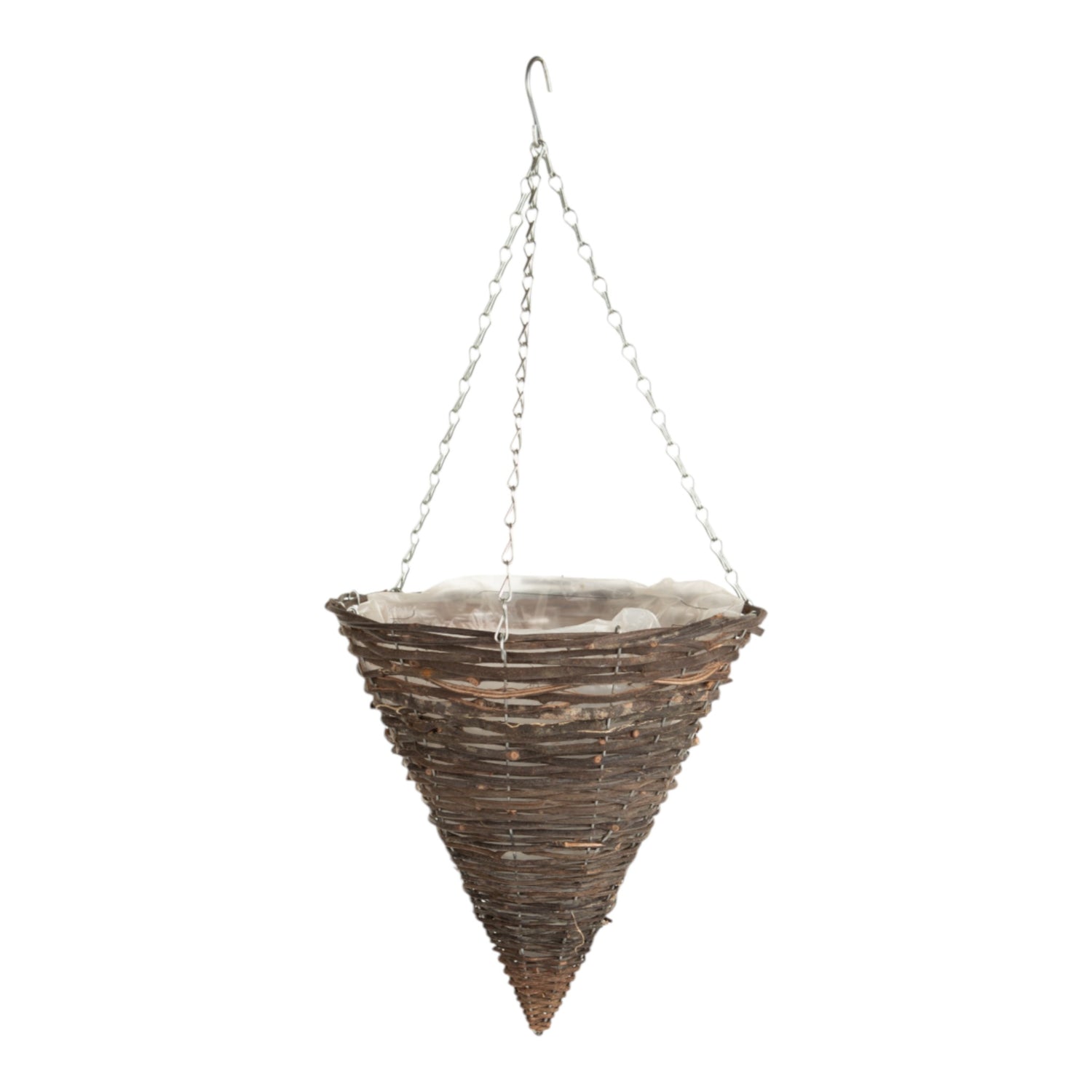
Unit price perThe Growers Own Black Rattan Hanging Basket 14" Cone - 35 x 39.5cm is a decorative hanging basket designed for seasonal planting in gardens, garden centres, nurseries and landscape displays.
The cone profile and black rattan-style finish provide a strong backdrop for flowering and foliage plants.
Sold individually.
Key benefits
Creating a strong seasonal display
Choose plants whose mature habit suits the cone basket profile. Trailing plants can soften the edge, while upright or mounded varieties add height and structure. Mixed planting works best where plants share similar light, watering and feeding requirements.
Use a quality container growing medium and fill evenly without excessive compaction, leaving practical watering space at the top.
Watering & feeding
Hanging baskets are exposed on all sides and can dry rapidly in warm, bright or windy conditions. Check moisture frequently and water according to actual plant demand rather than a fixed timetable.
As plants establish, nutrient demand increases. Use a feeding programme appropriate to the plants and growing medium.
Positioning & hanging safely
Choose a position appropriate to the plants and consider wind exposure. The chain, hook, bracket and fixing point must be suitable for the weight of the fully planted and freshly watered basket, not simply the empty container.
Inspect hanging components periodically and replace worn, distorted or corroded parts where necessary.
Commercial ordering
This SKU is sold as one basket. The commercial box quantity is 20 baskets; that logistics quantity is not the customer selling unit.
Growers Own Black Rattan Hanging Basket 14" Cone - 35 x 39.5cm product details
| Brand | Growers Own |
|---|---|
| Product type | Black rattan-style hanging basket |
| Colour | Black |
| Shape | Cone |
| Nominal size | 14" |
| Dimensions | 35 x 39.5cm |
| Selling quantity | 1 basket |
| Commercial box quantity | 20 baskets |
Growers Own Black Rattan Hanging Basket 14" Cone - 35 x 39.5cm FAQs
Is this basket sold individually?
Yes. The selling unit is one basket. What size is this basket?
This version is the 14" cone model, measuring 35 x 39.5cm. What colour is it?
This range has a black rattan-style finish. What can I plant in it?
Use suitable seasonal bedding, trailing plants, foliage plants or other container crops whose mature size suits the basket. What growing medium should I use?
Use a container growing medium appropriate to the plants, with suitable drainage, aeration, moisture retention and nutrition. How often should it be watered?
Check moisture frequently because hanging baskets can dry quickly in warm or windy conditions. Will it need feeding?
Long-season displays commonly require supplementary feeding as plant demand increases. What should I check before hanging it?
Check the complete hanging assembly for the weight of the fully planted and watered basket. How many are in a commercial box?
The commercial box quantity is 20 baskets, but the product is sold individually.
£1.85
Unit price per£1.85
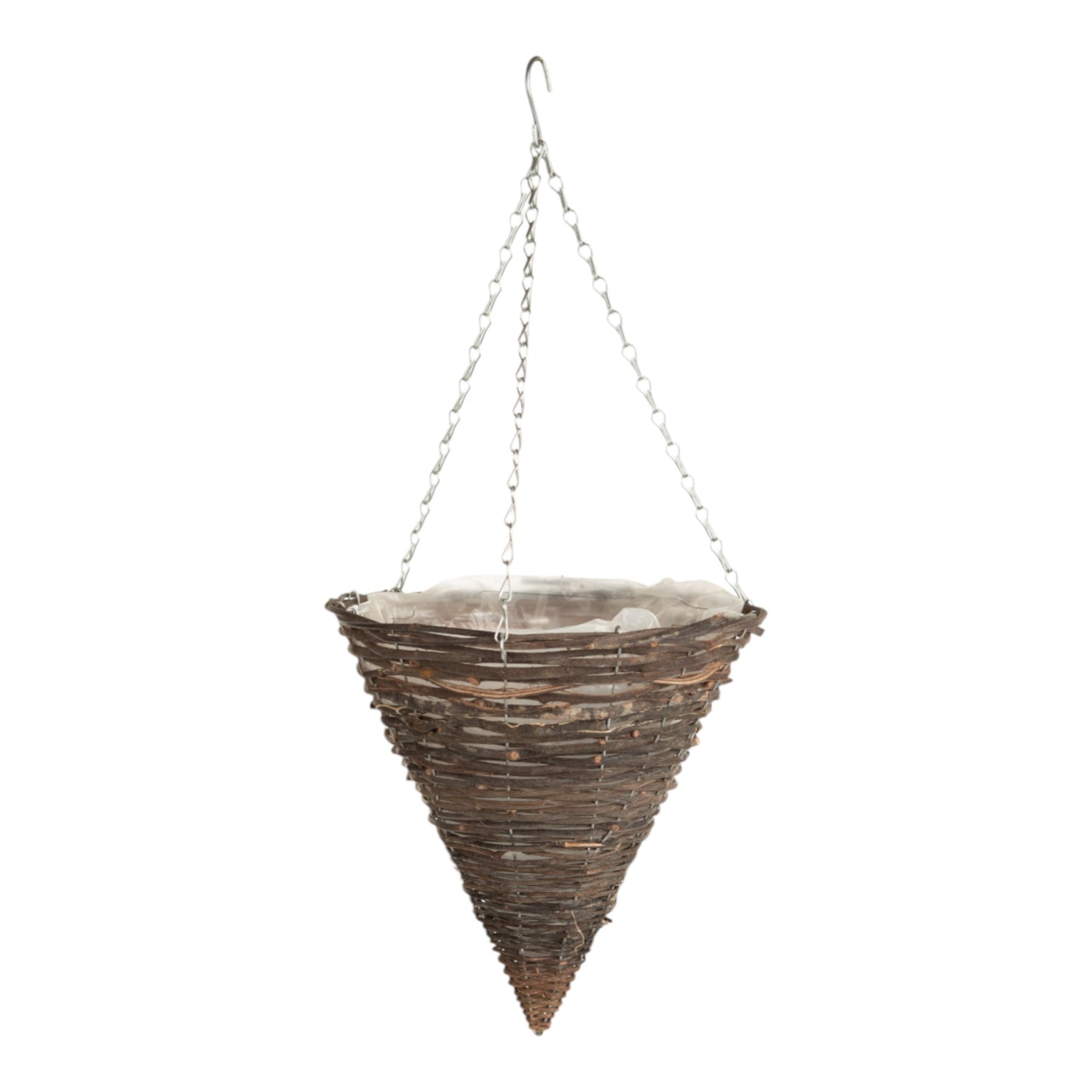
Unit price perThe Growers Own Black Rattan Hanging Basket 12" Cone - 30 x 35cm is a decorative hanging basket designed for seasonal planting in gardens, garden centres, nurseries and landscape displays.
The cone profile and black rattan-style finish provide a strong backdrop for flowering and foliage plants.
Sold individually.
Key benefits
Creating a strong seasonal display
Choose plants whose mature habit suits the cone basket profile. Trailing plants can soften the edge, while upright or mounded varieties add height and structure. Mixed planting works best where plants share similar light, watering and feeding requirements.
Use a quality container growing medium and fill evenly without excessive compaction, leaving practical watering space at the top.
Watering & feeding
Hanging baskets are exposed on all sides and can dry rapidly in warm, bright or windy conditions. Check moisture frequently and water according to actual plant demand rather than a fixed timetable.
As plants establish, nutrient demand increases. Use a feeding programme appropriate to the plants and growing medium.
Positioning & hanging safely
Choose a position appropriate to the plants and consider wind exposure. The chain, hook, bracket and fixing point must be suitable for the weight of the fully planted and freshly watered basket, not simply the empty container.
Inspect hanging components periodically and replace worn, distorted or corroded parts where necessary.
Commercial ordering
This SKU is sold as one basket. The commercial box quantity is 20 baskets; that logistics quantity is not the customer selling unit.
Growers Own Black Rattan Hanging Basket 12" Cone - 30 x 35cm product details
| Brand | Growers Own |
|---|---|
| Product type | Black rattan-style hanging basket |
| Colour | Black |
| Shape | Cone |
| Nominal size | 12" |
| Dimensions | 30 x 35cm |
| Selling quantity | 1 basket |
| Commercial box quantity | 20 baskets |
Growers Own Black Rattan Hanging Basket 12" Cone - 30 x 35cm FAQs
Is this basket sold individually?
Yes. The selling unit is one basket. What size is this basket?
This version is the 12" cone model, measuring 30 x 35cm. What colour is it?
This range has a black rattan-style finish. What can I plant in it?
Use suitable seasonal bedding, trailing plants, foliage plants or other container crops whose mature size suits the basket. What growing medium should I use?
Use a container growing medium appropriate to the plants, with suitable drainage, aeration, moisture retention and nutrition. How often should it be watered?
Check moisture frequently because hanging baskets can dry quickly in warm or windy conditions. Will it need feeding?
Long-season displays commonly require supplementary feeding as plant demand increases. What should I check before hanging it?
Check the complete hanging assembly for the weight of the fully planted and watered basket. How many are in a commercial box?
The commercial box quantity is 20 baskets, but the product is sold individually.

£2.88
Unit price per£2.88
Unit price perClover Blended Farmyard Manure 40L is a completely natural and organic garden fertiliser and soil improver, ideal for enriching garden soil with organic matter while supporting healthy plant growth. Suitable for planting, mulching and soil conditioning, it is a versatile choice for flowers, fruit, vegetables, roses, trees and shrubs.
Farmyard manure has long been used to improve cultivated soils by adding valuable organic matter. As it becomes incorporated into the soil, it contributes humus and nutrients while helping improve the physical condition of the root zone.
Clover's ready-to-use blended farmyard manure provides gardeners with a convenient bagged soil improver that can be used across beds, borders, vegetable plots, allotments and other cultivated areas.
Supplied in a 40 litre bag, Creation Horticulture supplies 80 x 40L bags per full pallet.
Why choose Clover Blended Farmyard Manure?
Improve soil with organic matter
Organic matter plays an important role in maintaining healthy garden soil. Regular incorporation of suitable organic material can improve soil structure and create better conditions for root development.
Clover Blended Farmyard Manure provides a convenient source of organic matter and humus that can be incorporated into cultivated ground during soil preparation.
In lighter soils, additional organic matter can help improve moisture and nutrient retention. In heavier soils, it can contribute towards a more workable structure when incorporated as part of a wider soil-improvement programme.
Soil improvement is gradual rather than instant. Regular additions of organic matter over successive growing seasons can help maintain productive, workable garden soil.
Where can Clover Farmyard Manure be used?
Clover Blended Farmyard Manure is suitable for a broad range of garden and allotment applications, including:
The requirements of individual plants should always be considered. Some plants prefer relatively low-fertility conditions or have specialist soil requirements, so manure does not need to be added indiscriminately to every part of the garden.
Farmyard manure for vegetable gardens & allotments
Vegetable plots and allotments can benefit considerably from regular additions of organic matter, particularly where crops are grown intensively year after year.
Clover Blended Farmyard Manure can be incorporated into suitable beds as part of soil preparation, helping replenish organic matter and improve the condition of cultivated ground.
It is particularly useful when preparing areas for crops that benefit from rich, moisture-retentive soil. Crop requirements vary, however, so the timing and quantity of manure used should be appropriate for the plants being grown.
Using farmyard manure when planting
Clover Blended Farmyard Manure can be used as part of ground preparation before establishing flowers, fruit, vegetables, roses, trees and shrubs.
When preparing a bed or border, incorporate the manure into the existing soil rather than treating it as a replacement for soil or potting compost. This adds organic material throughout the cultivated layer and helps improve the overall root environment.
When planting individual trees and shrubs, manure can be used as part of wider soil preparation, but avoid placing concentrated manure directly against sensitive roots or stems.
Using Clover Farmyard Manure as a mulch
Farmyard manure can also be used as an organic surface mulch around suitable established plants.
Applied over the soil surface, organic material helps protect the ground and gradually becomes incorporated into the upper soil layers through natural biological activity and cultivation.
When mulching around trees, shrubs and other established plants, leave a clear space immediately around stems, crowns and tree trunks rather than piling organic material directly against them.
Farmyard manure vs compost
Clover Blended Farmyard Manure and Clover Multi Purpose Compost perform different jobs in the garden.
Farmyard manure is primarily a fertiliser and soil improver. It is intended to add organic matter and nutrients to existing garden soil and can also be used for suitable mulching applications.
Multi-purpose compost is a growing medium designed for applications such as pots, containers, potting-on and seed sowing.
Clover Farmyard Manure should therefore not be treated as a direct substitute for potting compost when filling containers.
Farmyard manure vs soil conditioner
Both products can improve garden soil, but they have slightly different roles.
Clover Blended Farmyard Manure combines its soil-improving properties with its role as a natural organic garden fertiliser, making it particularly useful where both organic matter and fertility are required.
A dedicated soil conditioner is more specifically focused on adding organic fibre and humus to improve soil structure and moisture management.
About Clover
Clover produces growing media, soil improvers and related products for professional horticulture and the retail gardening market. Its retail range includes multi-purpose and specialist composts alongside products designed specifically for improving existing garden soil.
Blended Farmyard Manure provides a traditional approach to soil improvement in a convenient bagged format, making it suitable for gardeners, allotment growers and professional users who want to introduce organic matter into cultivated ground.
40L Farmyard Manure for garden centres & professional users
The 40L bag provides a practical retail format for garden centres while also being convenient for customers carrying out larger soil-improvement and planting projects.
Creation Horticulture supplies 80 x 40L bags per full pallet, providing a total nominal volume of 3,200 litres per pallet.
Clover packaging update
Clover is currently rolling out updated branded packaging across selected products. During this transition, customers may receive the previous packaging design, the newer design, or a mixture of both when ordering multiple bags.
This is a packaging change only. Customers will receive the same Clover Blended Farmyard Manure regardless of which current packaging design is supplied.
Clover Blended Farmyard Manure 40L product details
| Brand | Clover |
|---|---|
| Product | Blended Farmyard Manure |
| Bag size | 40L |
| Product type | Natural organic garden fertiliser and soil improver |
| Primary use | Improving and enriching existing garden soil |
| Suitable applications | Planting, soil conditioning and mulching |
| Suitable for | Flowers, fruit, vegetables, roses, trees and shrubs |
| Growing medium | No - intended primarily as a fertiliser and soil improver |
| Pallet quantity | 80 x 40L bags |
| Total nominal volume per pallet | 3,200L |
Clover Blended Farmyard Manure 40L FAQs
What is Clover Blended Farmyard Manure?
It is a completely natural and organic garden fertiliser and soil improver supplied in a convenient 40L bag. Is farmyard manure the same as multi-purpose compost?
No. Farmyard manure is primarily used to improve and enrich existing soil. Multi-purpose compost is a growing medium intended for jobs such as potting and container growing. Can I use Clover Farmyard Manure in a vegetable garden?
Yes. It is suitable for vegetable plots and allotments and can be incorporated into suitable beds as part of soil preparation. Is Clover Farmyard Manure suitable for roses?
Yes. Clover identifies farmyard manure as suitable for flowers, fruit and vegetables as well as roses, trees and shrubs. Can farmyard manure improve clay soil?
Adding organic matter can help improve the structure and workability of heavy soils over time. For best results, soil improvement should be viewed as an ongoing process rather than a one-off treatment. Can Clover Farmyard Manure be used as mulch?
Yes. It can be used for suitable mulching applications around established plants. Keep the material away from direct contact with stems, crowns and tree trunks. Can I fill pots with farmyard manure?
Farmyard manure is not intended to replace a formulated potting compost. For container growing, choose an appropriate Clover growing medium and use manure only where suitable for the particular plant and application. Why might the Clover bag I receive look different from the product image?
Clover is transitioning selected products to updated branded packaging, so either current packaging design may be supplied during the changeover. How many Clover Farmyard Manure 40L bags are supplied per pallet?
A full Creation Horticulture pallet contains 80 x 40L bags, providing a total nominal volume of 3,200 litres.
£12.73
Unit price per£12.73
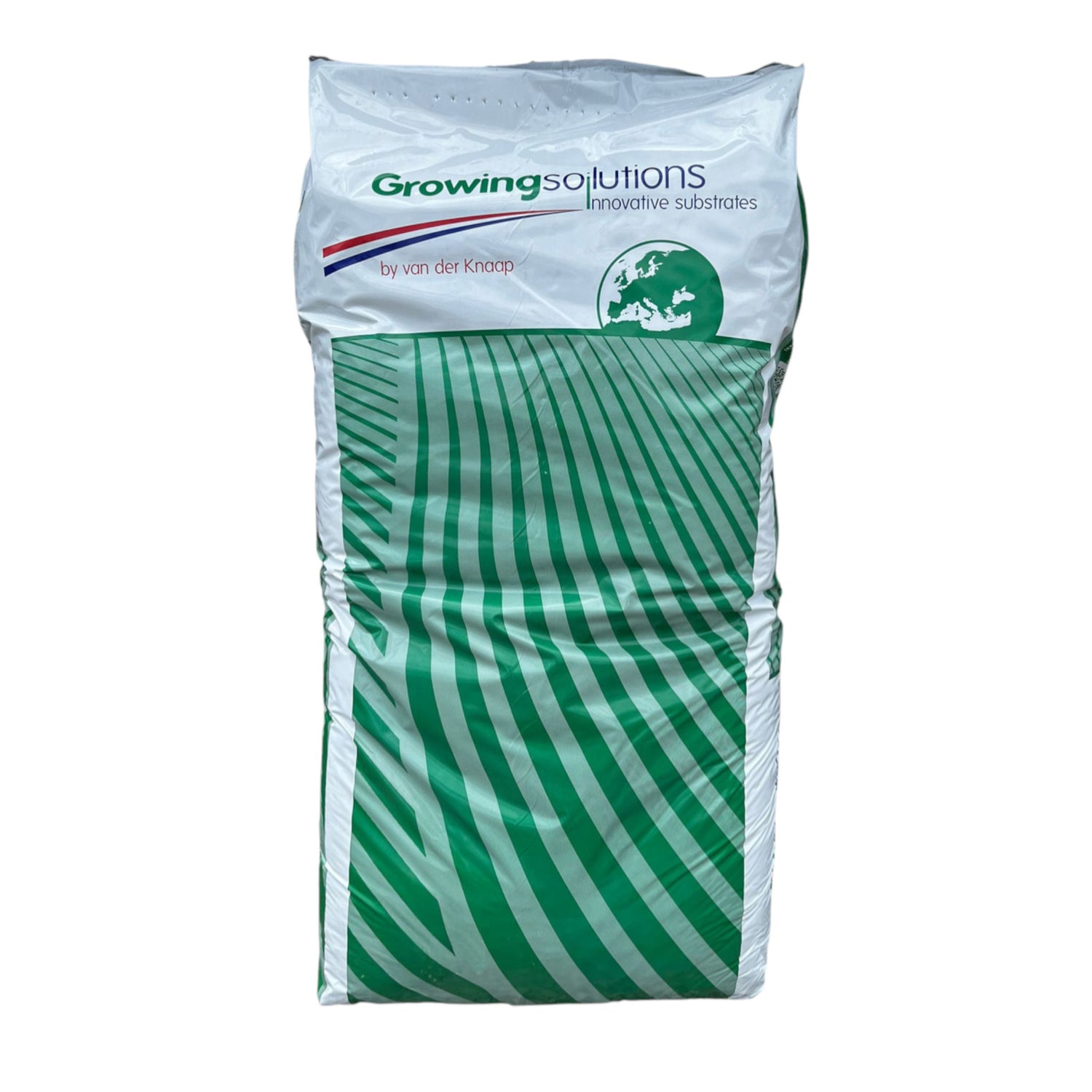
Unit price perVan der Knaap Peat-Free Potting & Bedding 70L is a professional peat-free growing medium developed for container potting and bedding plant production.
A peat-free growing medium intended for potting and bedding production.
Supplied in a 70L bag, with 39 bags per full pallet.
Key benefits
Where to use this growing medium
A peat-free growing medium intended for potting and bedding production. Select the formulation to match the crop, container volume and intended production period.
Van der Knaap develops peat-reduced and peat-free growing media for professional horticulture. These categories are distinct: peat-reduced is not peat-free.
Irrigation & root-zone management
Adjust irrigation and feeding to the crop and actual substrate response, rather than automatically reusing a peat-based schedule.
Fill containers consistently without unnecessary compaction. Monitor moisture through the root zone and adjust watering according to crop size, weather, pot volume and the substrate's behaviour.
Feeding & crop management
Set nutrient inputs according to crop demand, irrigation water and the growing-medium analysis. The exact nutrient charge, pH and EC for this formulation should be checked on the current product specification before establishing a crop-specific feeding programme.
Commercial supply & handling
Supplied individually in 70L bags. A full pallet contains 39 bags. Store unopened bags appropriately and protect opened substrate from contamination.
Van der Knaap Peat-Free Potting & Bedding 70L product details
| Manufacturer | Van der Knaap |
|---|---|
| Range | Peat-Free |
| Growing-medium type | Potting & Bedding |
| Bag volume | 70L |
| Selling quantity | 1 bag |
| Pallet quantity | 39 bags |
| Primary use | container potting and bedding plant production |
Van der Knaap Peat-Free Potting & Bedding 70L FAQs
What is this blend intended for?
A peat-free growing medium intended for potting and bedding production. What is the difference between peat-free and peat-reduced?
Peat-free growing media contain no peat. Peat-reduced growing media still contain some peat, alongside other substrate components. How should I manage watering?
Adjust irrigation and feeding to the crop and actual substrate response, rather than automatically reusing a peat-based schedule. Is this the peat-free potting and bedding mix?
Yes. This is the peat-free 70L potting and bedding product, distinct from the peat-reduced version. Is this supplied by the bag or pallet?
It is sold as one 70L bag. A full pallet contains 39 bags. Will I need to adjust feeding?
Possibly. Monitor crop response and the growing medium and adjust nutrition to the crop, water quality and production stage rather than assuming one feeding programme suits every blend.
£80.00
Unit price per£80.00
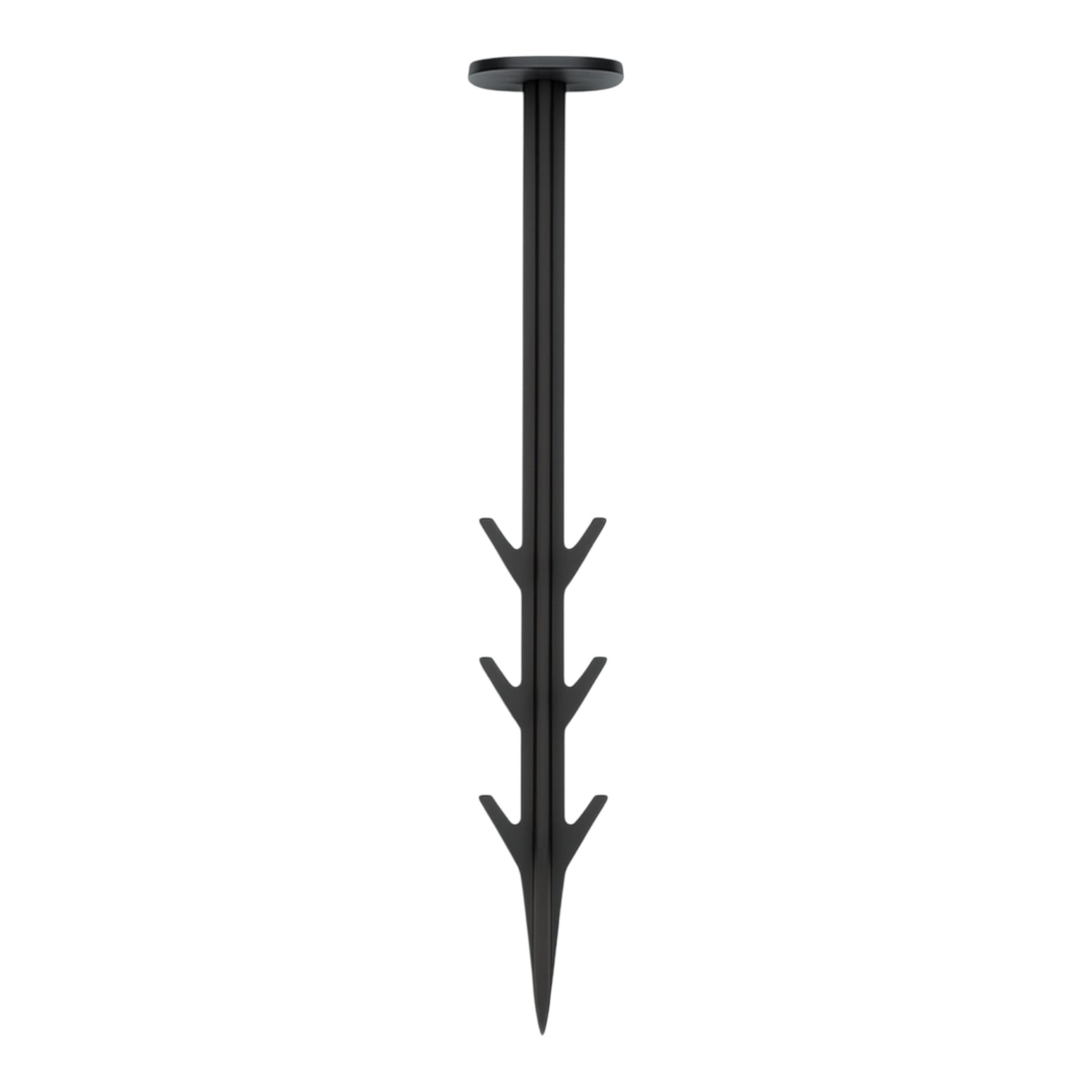
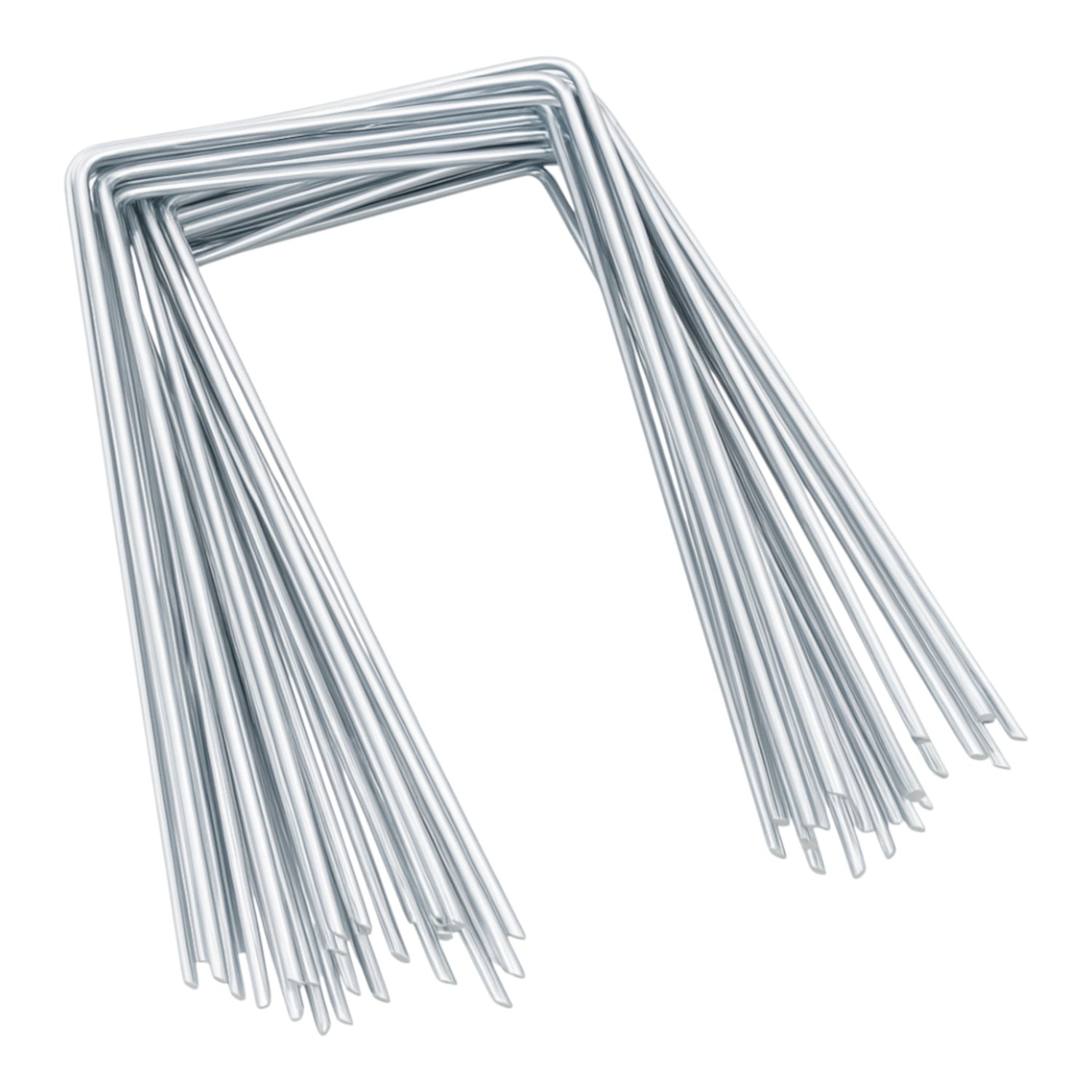
Unit price perGrowers Own Ground Cover Fixing Pegs are practical plastic anchoring pegs designed for securing weed control fabric, ground cover, fleece and lightweight garden sheeting directly into the soil. Supplied in a bulk pack of 1,000, they are particularly suited to nurseries, professional growers, landscapers and larger garden projects where a substantial quantity of reliable fixings is required.
Each peg combines a pointed end for straightforward ground insertion with multiple barbs along the shaft. Once pushed into suitable soil, the barbed profile helps resist the peg pulling back out, while the broad head holds the covering material against the ground.
The large 1,000-piece pack provides a cost-effective option for installing extensive runs of ground cover or keeping a useful stock of replacement fixings available for ongoing maintenance and seasonal work.
Why choose Growers Own Ground Cover Fixing Pegs?
Ideal for ground cover & weed control fabric
Ground cover performs best when it remains properly positioned and close to the soil surface. Unsecured edges can lift, while loose areas of fabric can move during installation or become displaced by wind and routine work around the growing area.
Growers Own Ground Cover Fixing Pegs provide straightforward mechanical fixing points around the perimeter of the material and throughout larger covered areas. Additional pegs can also be used around overlaps, joins, corners and other areas where extra restraint is required.
| Weed control fabric | Secure weed membrane around beds, borders and landscaped areas. |
|---|---|
| Ground cover | Useful for anchoring larger areas of woven or non-woven ground-cover material. |
| Horticultural fleece | Can be used to secure suitable fleece and lightweight protective coverings at ground level. |
| Nurseries | Bulk pack format suits larger-scale ground-cover installation and ongoing maintenance. |
| Landscaping | Useful for fixing landscape fabric beneath suitable mulches and planted areas. |
Barbed design for improved ground grip
The shaft incorporates a series of angled barbs designed to increase resistance once the peg has been inserted into the soil. This gives the fixing more grip than a completely smooth-sided peg and helps keep the covering material in position.
At the top, the wider head spreads the fixing point over a larger area of the material. At the opposite end, the tapered point helps the peg enter suitable soil cleanly.
This simple design makes the pegs useful for both initial installations and subsequent maintenance where individual fixings need to be added or replaced.
How to use ground cover fixing pegs
Position the ground cover or membrane and tension it sufficiently to remove excessive slack. Insert fixing pegs through the material and into the soil, positioning them around edges and at suitable intervals across the installation.
Pay particular attention to corners, joins, overlaps and exposed edges, as these are typically the areas most likely to lift or move. Larger installations may require additional intermediate fixing points to keep the material evenly secured.
Soil conditions can affect how easily a plastic peg can be installed. Avoid forcing the peg directly into stones, compacted rubble or exceptionally hard ground, as excessive impact can damage plastic fixings.
Bulk 1,000 pack for professional use
Large ground-cover installations can require considerably more fixings than expected once perimeter edges, joins, overlaps and intermediate fixing points are taken into account. The 1,000-piece pack is designed for users who need ground-cover pegs in meaningful quantities.
It is particularly useful for commercial nurseries, professional growers, landscapers, grounds maintenance teams and contractors, as well as customers completing substantial garden projects.
Keeping additional pegs available also makes it easier to replace missing fixings or add extra anchoring points during routine maintenance.
Growers Own Ground Cover Fixing Pegs product details
| Brand | Growers Own |
|---|---|
| Product | Ground Cover Fixing Pegs |
| Pack quantity | 1,000 pegs |
| Material | Plastic |
| Design | Pointed fixing peg with barbed shaft and broad head |
| Primary use | Securing ground cover and weed control fabric |
| Other applications | Landscape fabric, horticultural fleece and suitable lightweight garden coverings |
| Installation | Push into suitable soil through the covering material |
| Typical users | Professional growers, nurseries, landscapers, contractors & gardeners |
Growers Own Ground Cover Fixing Pegs FAQs
How many ground cover pegs are supplied?
Each pack contains 1,000 plastic fixing pegs, making this a useful bulk option for larger installations and professional users. What are these fixing pegs designed for?
They are primarily designed for securing ground cover and weed control fabric to suitable soil. Can these pegs be used with weed membrane?
Yes. Weed control membrane and landscape fabric are key applications for this style of fixing peg. Can I use the pegs with horticultural fleece?
They can be used to help anchor suitable fleece and lightweight protective coverings at ground level. Why do the pegs have barbs?
The barbs increase resistance against the surrounding soil after insertion, helping the peg remain anchored rather than pulling out as easily as a smooth-sided fixing. Where should ground cover pegs be positioned?
Use fixing points around the perimeter of the covering and pay particular attention to corners, joins and overlaps. Additional intermediate pegs can be added where greater restraint is required. Can these be used by professional landscapers and nurseries?
Yes. The 1,000-piece bulk quantity is particularly suitable for professional growers, nurseries, landscapers and contractors completing larger installations. Can the pegs be installed in very hard ground?
They are designed for insertion into suitable soil. Avoid forcing plastic pegs directly into stones, rubble or exceptionally hard ground, as this can damage the fixing. Are plastic ground cover pegs affected by rust?
No. As the pegs are plastic rather than untreated metal, they do not rust when exposed to moisture in the soil.
£22.99
Unit price per£22.99
Unit price perGrowers Own Ground Staples for fixing Ground Cover 6" x 4" (15cm x 10cm) Box of 100 is designed for securing compatible weed-control fabrics, fleece or ground-cover materials.
Part of the Growers Own practical horticultural range, this product helps growers, landscapers and gardeners manage planting areas and crop protection with an appropriately selected size and format.
Key benefits
Fixing ground-cover materials
Lay out the material before fixing and place pegs or staples at suitable intervals, with additional fixings at edges and exposed corners. Check the ground for buried services before inserting fixings.
Weed management and maintenance
Ground-cover fabric helps suppress weeds but does not replace site preparation or routine inspection. Check joins, edges and planting holes for emerging weeds and repair displaced fixings promptly.
Product specifications
| Brand | Growers Own |
|---|---|
| Product type | Ground cover fixing staple |
| Primary application | securing compatible weed-control fabrics, fleece or ground-cover materials |
| Dimensions | 15cm x 10cm |
| Pack quantity | 100 |
Frequently asked questions
What size is this product?
The stated dimensions are 15cm x 10cm. How many are supplied?
The stated quantity is 100. What can these fixings secure?
Compatible ground-cover fabrics, fleece and other horticultural covering materials. How many fixings do I need?
The number depends on material size, soil conditions and exposure; use more at edges and corners. Should I check for buried services?
Yes. Check the area before driving pegs or staples into the ground.
Van der Knaap Peat-Free Propagation 70L is a professional peat-free growing medium developed for seedlings, cuttings and modular young-plant production.
A peat-free propagation blend intended for early crop establishment in trays, modules and small pots.
Supplied in a 70L bag, with 39 bags per full pallet.
Key benefits
Where to use this growing medium
A peat-free propagation blend intended for early crop establishment in trays, modules and small pots. Select the formulation to match the crop, container volume and intended production period.
Van der Knaap develops peat-reduced and peat-free growing media for professional horticulture. These categories are distinct: peat-reduced is not peat-free.
Irrigation & root-zone management
Peat-free media can wet and dry differently from peat-based media; check moisture throughout the propagation unit.
Fill containers consistently without unnecessary compaction. Monitor moisture through the root zone and adjust watering according to crop size, weather, pot volume and the substrate's behaviour.
Feeding & crop management
Set nutrient inputs according to crop demand, irrigation water and the growing-medium analysis. The exact nutrient charge, pH and EC for this formulation should be checked on the current product specification before establishing a crop-specific feeding programme.
Commercial supply & handling
Supplied individually in 70L bags. A full pallet contains 39 bags. Store unopened bags appropriately and protect opened substrate from contamination.
Van der Knaap Peat-Free Propagation 70L product details
| Manufacturer | Van der Knaap |
|---|---|
| Range | Peat-Free |
| Growing-medium type | Propagation |
| Bag volume | 70L |
| Selling quantity | 1 bag |
| Pallet quantity | 39 bags |
| Primary use | seedlings, cuttings and modular young-plant production |
Van der Knaap Peat-Free Propagation 70L FAQs
What is this blend intended for?
A peat-free propagation blend intended for early crop establishment in trays, modules and small pots. What is the difference between peat-free and peat-reduced?
Peat-free growing media contain no peat. Peat-reduced growing media still contain some peat, alongside other substrate components. How should I manage watering?
Peat-free media can wet and dry differently from peat-based media; check moisture throughout the propagation unit. Does this propagation medium contain peat?
No. This is the peat-free propagation version. Is this supplied by the bag or pallet?
It is sold as one 70L bag. A full pallet contains 39 bags. Will I need to adjust feeding?
Possibly. Monitor crop response and the growing medium and adjust nutrition to the crop, water quality and production stage rather than assuming one feeding programme suits every blend.


£40.00
Unit price per£40.00
Unit price perThe Ground Cover 25cm x 25cm Grid 100GSM 1M x 100M is a practical horticultural accessory designed for general horticultural work.
It is suited to routine horticultural work in nurseries, greenhouses, garden centres and gardens where a straightforward accessory is required.
Key benefits
How to use it
Use this product for general horticultural work. Select the size and format to suit the plant, container or growing area and check its position periodically as plants develop.
For professional & garden use
This accessory can be used for individual plants and displays or incorporated into larger nursery, landscaping and retail programmes.
Ground Cover 25cm x 25cm Grid 100GSM 1M x 100M product details
| Supplier | Creation Horticulture |
|---|---|
| Product type | Horticultural accessory |
| Stated size | 25cm x 25cm |
| Primary use | general horticultural work |
Ground Cover 25cm x 25cm Grid 100GSM 1M x 100M FAQs
What size is this product?
The stated size is 25cm x 25cm. What is this product used for?
It is designed for general horticultural work. Who is it suitable for?
It is suitable for professional growers, nurseries, garden centres and gardeners where its size and function match the task. How do I choose the right size?
Check the stated dimensions against the plant, container or working area before ordering. Can it be reused?
Reuse depends on the product material, condition and hygiene requirements. Inspect and clean it as appropriate before reuse.
£12.73
Unit price per£12.73
Unit price perVan der Knaap Peat-Reduced Potting & Bedding 70L is a professional peat-reduced growing medium developed for potting-on and bedding plant production.
A potting and bedding blend intended for plants moving into growing-on containers and bedding production.
Supplied in a 70L bag, with 39 bags per full pallet.
Key benefits
Where to use this growing medium
A potting and bedding blend intended for plants moving into growing-on containers and bedding production. Select the formulation to match the crop, container volume and intended production period.
Van der Knaap develops peat-reduced and peat-free growing media for professional horticulture. These categories are distinct: peat-reduced is not peat-free.
Irrigation & root-zone management
Choose pot size to match the crop and monitor the substrate moisture through the full root zone.
Fill containers consistently without unnecessary compaction. Monitor moisture through the root zone and adjust watering according to crop size, weather, pot volume and the substrate's behaviour.
Feeding & crop management
Set nutrient inputs according to crop demand, irrigation water and the growing-medium analysis. The exact nutrient charge, pH and EC for this formulation should be checked on the current product specification before establishing a crop-specific feeding programme.
Commercial supply & handling
Supplied individually in 70L bags. A full pallet contains 39 bags. Store unopened bags appropriately and protect opened substrate from contamination.
Van der Knaap Peat-Reduced Potting & Bedding 70L product details
| Manufacturer | Van der Knaap |
|---|---|
| Range | Peat-Reduced |
| Growing-medium type | Potting & Bedding |
| Bag volume | 70L |
| Selling quantity | 1 bag |
| Pallet quantity | 39 bags |
| Primary use | potting-on and bedding plant production |
Van der Knaap Peat-Reduced Potting & Bedding 70L FAQs
What is this blend intended for?
A potting and bedding blend intended for plants moving into growing-on containers and bedding production. What is the difference between peat-free and peat-reduced?
Peat-free growing media contain no peat. Peat-reduced growing media still contain some peat, alongside other substrate components. How should I manage watering?
Choose pot size to match the crop and monitor the substrate moisture through the full root zone. Is this suitable for bedding plants?
Yes. It is a potting and bedding formulation; check suitability for the particular crop and production programme. Is this supplied by the bag or pallet?
It is sold as one 70L bag. A full pallet contains 39 bags. Will I need to adjust feeding?
Possibly. Monitor crop response and the growing medium and adjust nutrition to the crop, water quality and production stage rather than assuming one feeding programme suits every blend.


£9.25
Unit price per£9.25
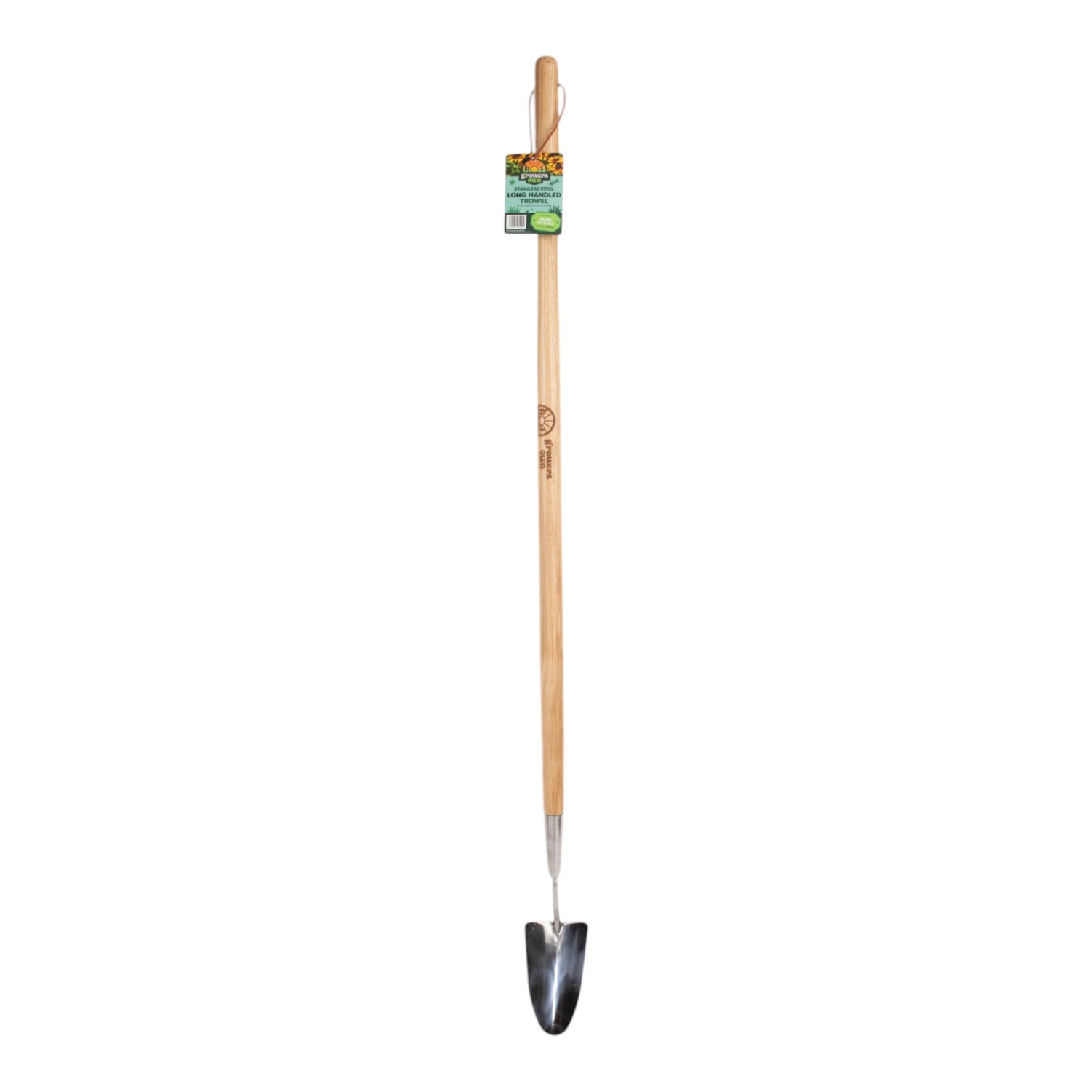
Unit price perThe Growers Own Stainless Steel Long-Handled Trowel with Ashwood Handle is designed for planting and cultivation where extra reach helps reduce bending.
It is a practical tool for growers, landscapers and gardeners who want dependable equipment for regular horticultural work. Using a tool designed for the specific job improves control and helps avoid unnecessary strain or damage.
The product specification identifies a stainless-steel working head or blade and an ashwood handle, combining a corrosion-resistant working surface with a traditional timber handle.
Key benefits
Planting, potting & close cultivation
Use the trowel for planting smaller plants, transplanting, filling containers and working amendments into manageable areas. The long-handled version provides extra reach into beds and borders.
Care & maintenance
Remove soil, sap and plant debris after use and allow the tool to dry before storage. Check the working head or blade, handle, fasteners and joints for wear, looseness or damage.
Stainless steel is corrosion resistant, but it still benefits from being cleaned and dried rather than stored covered in wet soil or sap.
Keep the ashwood handle dry and inspect it periodically for splits, rough areas or looseness. Avoid leaving wooden-handled tools exposed outdoors for long periods.
Choosing the right tool for the job
This product is intended for planting and cultivation where extra reach helps reduce bending. Where the material, soil condition or branch size makes the job difficult, switch to a more appropriate tool rather than applying excessive leverage or force.
Using the correct tool generally gives better results and reduces wear on both the equipment and the operator.
Stainless Steel Long-Handled Trowel with Ashwood Handle product details
| Brand | Growers Own |
|---|---|
| Product type | Long-handled trowel |
| Primary use | planting and cultivation where extra reach helps reduce bending |
| Working material | Stainless steel |
| Handle material | Ashwood |
Stainless Steel Long-Handled Trowel with Ashwood Handle FAQs
What is this tool designed for?
Planting and cultivation where extra reach helps reduce bending. Who is it suitable for?
Professional growers, landscapers and gardeners where the tool matches the task. How should it be cleaned?
Remove soil, sap or plant debris after use, dry it and store it in a suitable dry location. How should it be stored?
Store it dry and protected from prolonged weather exposure. Can I use it for heavier work than intended?
No. If the task requires excessive force or leverage, choose a heavier or more appropriate tool. Does stainless steel still need maintenance?
Yes. Clean and dry it after use and remove plant residues rather than leaving the working surface dirty or wet. How should the ashwood handle be cared for?
Keep it dry, inspect it for splits or looseness and avoid prolonged outdoor exposure when the tool is not in use.


£9.25
Unit price per£9.25
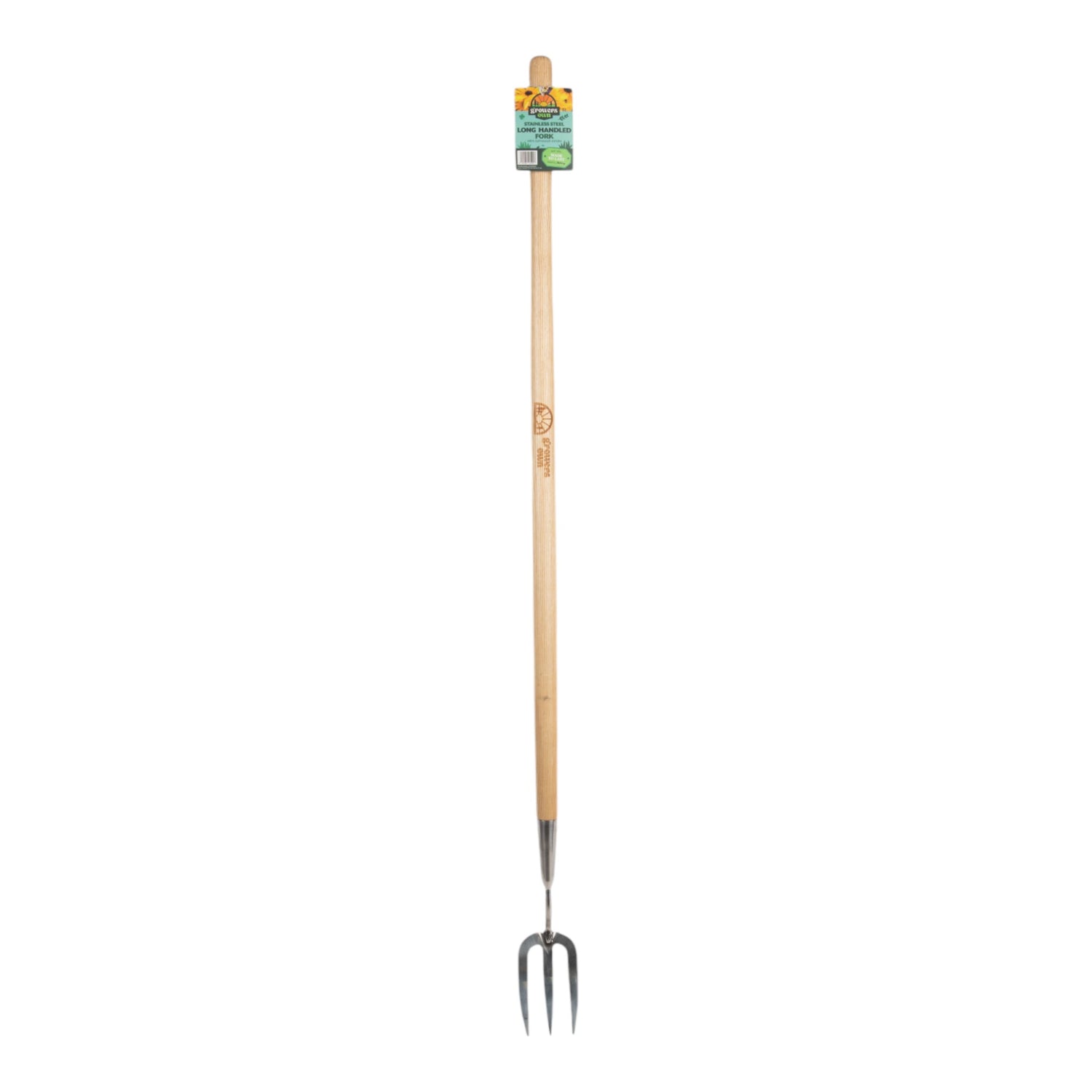
Unit price perThe Growers Own Stainless Steel Long-Handled Fork with Ashwood Handle is designed for loosening and cultivating soil where extra reach is useful.
It is a practical tool for growers, landscapers and gardeners who want dependable equipment for regular horticultural work. Using a tool designed for the specific job improves control and helps avoid unnecessary strain or damage.
The product specification identifies a stainless-steel working head or blade and an ashwood handle, combining a corrosion-resistant working surface with a traditional timber handle.
Key benefits
Loosening soil around plants
Use the fork to loosen the upper soil layer, break up small clods and cultivate around established plants. Work carefully around shallow roots and plant crowns.
Care & maintenance
Remove soil, sap and plant debris after use and allow the tool to dry before storage. Check the working head or blade, handle, fasteners and joints for wear, looseness or damage.
Stainless steel is corrosion resistant, but it still benefits from being cleaned and dried rather than stored covered in wet soil or sap.
Keep the ashwood handle dry and inspect it periodically for splits, rough areas or looseness. Avoid leaving wooden-handled tools exposed outdoors for long periods.
Choosing the right tool for the job
This product is intended for loosening and cultivating soil where extra reach is useful. Where the material, soil condition or branch size makes the job difficult, switch to a more appropriate tool rather than applying excessive leverage or force.
Using the correct tool generally gives better results and reduces wear on both the equipment and the operator.
Stainless Steel Long-Handled Fork with Ashwood Handle product details
| Brand | Growers Own |
|---|---|
| Product type | Long-handled fork |
| Primary use | loosening and cultivating soil where extra reach is useful |
| Working material | Stainless steel |
| Handle material | Ashwood |
Stainless Steel Long-Handled Fork with Ashwood Handle FAQs
What is this tool designed for?
Loosening and cultivating soil where extra reach is useful. Who is it suitable for?
Professional growers, landscapers and gardeners where the tool matches the task. How should it be cleaned?
Remove soil, sap or plant debris after use, dry it and store it in a suitable dry location. How should it be stored?
Store it dry and protected from prolonged weather exposure. Can I use it for heavier work than intended?
No. If the task requires excessive force or leverage, choose a heavier or more appropriate tool. Does stainless steel still need maintenance?
Yes. Clean and dry it after use and remove plant residues rather than leaving the working surface dirty or wet. How should the ashwood handle be cared for?
Keep it dry, inspect it for splits or looseness and avoid prolonged outdoor exposure when the tool is not in use.


£19.75
Unit price per£19.75
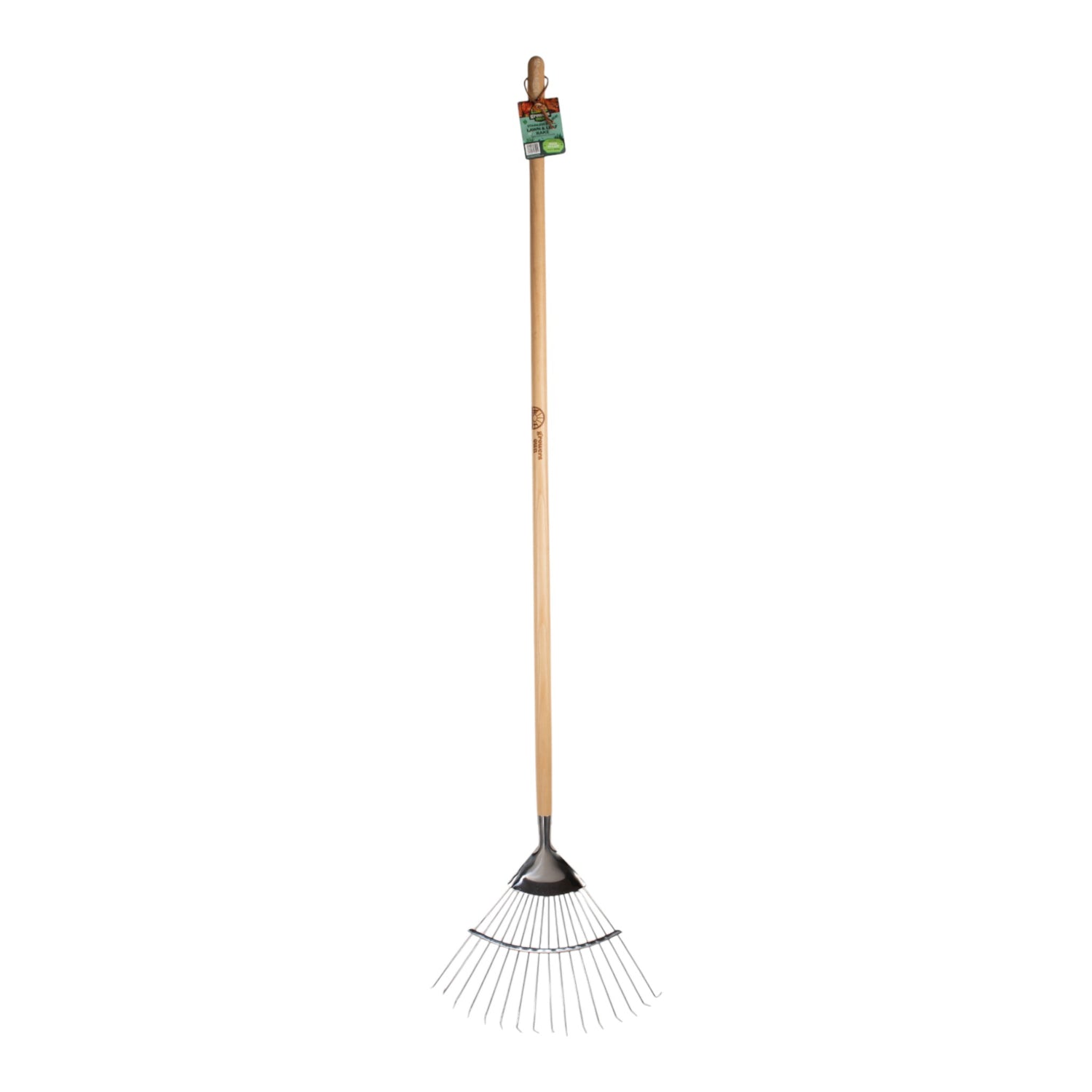
Unit price perThe Growers Own Stainless Steel Lawn & Leaf Rake with Ashwood Handle is designed for collecting leaves, grass clippings and light garden debris.
It is a practical tool for growers, landscapers and gardeners who want dependable equipment for regular horticultural work. Using a tool designed for the specific job improves control and helps avoid unnecessary strain or damage.
The product specification identifies a stainless-steel working head or blade and an ashwood handle, combining a corrosion-resistant working surface with a traditional timber handle.
Key benefits
Leaves & light garden debris
Use the rake for gathering fallen leaves, grass clippings and other light material without unnecessarily digging into the soil surface.
Care & maintenance
Remove soil, sap and plant debris after use and allow the tool to dry before storage. Check the working head or blade, handle, fasteners and joints for wear, looseness or damage.
Stainless steel is corrosion resistant, but it still benefits from being cleaned and dried rather than stored covered in wet soil or sap.
Keep the ashwood handle dry and inspect it periodically for splits, rough areas or looseness. Avoid leaving wooden-handled tools exposed outdoors for long periods.
Choosing the right tool for the job
This product is intended for collecting leaves, grass clippings and light garden debris. Where the material, soil condition or branch size makes the job difficult, switch to a more appropriate tool rather than applying excessive leverage or force.
Using the correct tool generally gives better results and reduces wear on both the equipment and the operator.
Stainless Steel Lawn & Leaf Rake with Ashwood Handle product details
| Brand | Growers Own |
|---|---|
| Product type | Lawn & leaf rake |
| Primary use | collecting leaves, grass clippings and light garden debris |
| Working material | Stainless steel |
| Handle material | Ashwood |
Stainless Steel Lawn & Leaf Rake with Ashwood Handle FAQs
What is this tool designed for?
Collecting leaves, grass clippings and light garden debris. Who is it suitable for?
Professional growers, landscapers and gardeners where the tool matches the task. How should it be cleaned?
Remove soil, sap or plant debris after use, dry it and store it in a suitable dry location. How should it be stored?
Store it dry and protected from prolonged weather exposure. Can I use it for heavier work than intended?
No. If the task requires excessive force or leverage, choose a heavier or more appropriate tool. Does stainless steel still need maintenance?
Yes. Clean and dry it after use and remove plant residues rather than leaving the working surface dirty or wet. How should the ashwood handle be cared for?
Keep it dry, inspect it for splits or looseness and avoid prolonged outdoor exposure when the tool is not in use.

£4.99
Unit price per£4.99
Unit price perVan der Knaap Peat Free Nursery Stock 70L is a professional peat-free growing medium developed for container-grown nursery stock. Designed to provide the root-zone structure and water management required by longer-term container crops, it offers commercial growers a professional substrate for peat-free nursery production.
Nursery stock places very different demands on a growing medium compared with short-cycle crops. Plants may remain in their containers for extended periods, making reliable structure, drainage, moisture management and root-zone aeration particularly important.
Van der Knaap's Nursery Stock formulation provides an open, well-structured and free-draining growing environment designed to support strong root development and healthy plant growth throughout the production cycle.
Supplied in 70L bags with 39 bags per pallet, it is suited to professional nurseries, commercial growers, landscapers and other horticultural businesses moving towards peat-free container production.
Why choose Van der Knaap Peat Free Nursery Stock?
Developed for professional nursery stock production
Container-grown nursery stock requires a substrate capable of performing over a longer production period. As roots develop and the crop increases in size, the physical characteristics of the growing medium become increasingly important.
An appropriate nursery substrate needs to provide sufficient moisture for the crop while retaining enough air-filled space around the root system and allowing excess irrigation water to drain.
Van der Knaap Peat Free Nursery Stock is formulated around these requirements, providing a structured root-zone environment for professional container production.
Professional peat-free growing media
Replacing peat in professional growing media involves considerably more than substituting one raw material for another. Different renewable materials have different physical, chemical and water-holding characteristics, which can change how a crop needs to be irrigated and fed.
Van der Knaap actively researches renewable and circular substrate materials and evaluates how changes in growing media affect crop performance. This includes assessing physical and chemical characteristics and carrying out practical cultivation trials.
The result is a professional approach to peat-free growing media that considers both the composition of the substrate and how that substrate performs within a real horticultural production system.
Root-zone structure & water management
Water and air compete for pore space within every growing medium. A substrate that remains excessively wet can restrict root-zone aeration, while one that dries too quickly can make maintaining consistent moisture difficult.
The open, free-draining structure of Van der Knaap Peat Free Nursery Stock is designed to provide an effective balance for container-grown plants, supporting root development while allowing growers to manage irrigation according to crop demand.
As with any professional peat-free substrate, irrigation should be based on the actual moisture condition within the container rather than simply following a watering programme developed for a previous peat-based growing medium.
Suitable applications
Van der Knaap Peat Free Nursery Stock is primarily intended for professional container nursery production and is particularly useful where plants require a structured growing medium for an extended crop cycle.
Managing peat-free growing media successfully
Professional peat-free substrates may require a different approach to irrigation and nutrition compared with familiar peat-based mixes. The characteristics of the substrate, crop, container size, weather and production environment should all be considered.
Growers should monitor moisture throughout the root zone and adjust irrigation frequency and volume accordingly. The surface of a growing medium does not always provide an accurate indication of moisture deeper within the container.
Nutrition should likewise be matched to the crop and production system. Where controlled-release fertiliser or liquid feeding is used, the programme should account for crop requirements, irrigation strategy, container size and intended production period.
About Van der Knaap
Van der Knaap is an international specialist in rooting and growing media for professional horticulture. The company works with growers across a wide range of crops, developing substrate solutions around crop requirements and practical cultivation conditions.
Its expertise extends across potting soils and professional substrates, rooting media, coco products and organic fertilisers. Van der Knaap works with a range of natural substrate materials and develops mixtures according to the physical and nutritional requirements of different crops and production systems.
Research and crop testing form an important part of this approach. At its own 'de Kas' innovation centre, Van der Knaap carries out cultivation trials to investigate growing media, rooting products and new raw materials under practical growing conditions.
This work is particularly relevant as professional horticulture moves towards reduced-peat and peat-free production. Van der Knaap has been researching renewable and circular substrate materials, examining characteristics such as structure, moisture behaviour, pH and nutrition alongside their effects on actual crop growth.
For professional growers, that combination of substrate manufacturing, crop knowledge, research and practical cultivation experience makes Van der Knaap a strong partner when moving towards new growing media and more sustainable production systems.
Van der Knaap Peat Free Nursery Stock product details
| Brand | Van der Knaap |
|---|---|
| Product | Peat Free Nursery Stock |
| Product type | Professional peat-free growing medium |
| Bag size | 70L |
| Peat content | 100% peat-free |
| Structure | Open, well-structured and free-draining |
| Primary application | Container-grown nursery stock |
| Container suitability | Container pots and larger decorative pots |
| Professional use | Nurseries, commercial growers and professional landscaping |
| Pallet quantity | 39 x 70L bags |
| Total nominal volume per pallet | 2,730L |
Van der Knaap Peat Free Nursery Stock FAQs
Is Van der Knaap Nursery Stock completely peat free?
Yes. This Nursery Stock growing medium is a 100% peat-free formulation intended for professional horticultural production. What is this growing medium designed for?
It is designed primarily for container-grown nursery stock where good root-zone structure, drainage and moisture management are required throughout the production cycle. Is this the same as general-purpose peat-free compost?
No. This is a professional nursery stock substrate formulated around the requirements of container-grown plants rather than a general-purpose retail compost. Why is an open substrate structure important?
An open structure helps maintain air within the root zone while allowing excess irrigation water to drain. This is particularly important for plants remaining in containers for extended periods. Is it suitable for shrubs and ornamental plants?
Yes. The formulation is intended for nursery stock and is suitable for appropriate container-grown shrubs, ornamentals and other longer-term nursery crops. Can it be used in larger plant pots?
Yes. Van der Knaap Peat Free Nursery Stock is suitable for container pots and larger decorative pots used in professional plant production. Will I need to change my irrigation when switching from peat?
Potentially. Peat-free substrates can have different moisture and drainage characteristics from peat-based growing media. Monitor the root zone and adjust irrigation according to the substrate, crop, container and growing conditions. Can controlled-release fertiliser be used with this growing medium?
Controlled-release fertiliser can form part of a nursery nutrition programme where appropriate. Product choice, rate and longevity should be matched to the crop, container, irrigation regime and intended production period. Who is Van der Knaap?
Van der Knaap is a specialist producer of professional rooting and growing media. Its expertise includes substrates, rooting products, coco products and crop-focused growing solutions for professional horticulture. Does Van der Knaap test its growing media?
Van der Knaap conducts research and cultivation trials at its 'de Kas' innovation centre, including work with new renewable and circular raw materials and peat-free rooting and growing media. How much growing medium is in each bag?
Each bag contains a nominal 70 litres of Van der Knaap Peat Free Nursery Stock growing medium. How many 70L bags are supplied on a pallet?
A full pallet contains 39 x 70L bags, equivalent to a total nominal growing media volume of 2,730 litres.

£8.40
Unit price per£8.40
Unit price perClover Peat Free Multi-Purpose Compost 40L is a high-quality 100% peat-free growing medium made from organic matter blended with woodfibre and coir, with added perlite and 6 months slow release feed. Developed as a versatile alternative to traditional peat-based compost, it is suitable for a wide range of everyday gardening and container-growing applications.
Clover has developed this peat-free formulation to provide the physical structure, moisture management and nutrition required by a broad range of plants without using peat. The blend combines several complementary growing-media ingredients rather than relying on a single peat substitute.
Woodfibre and coir contribute to the structure of the growing medium, while added perlite helps maintain air space within the root zone. Clover also incorporates 6 months slow release feed to provide sustained plant nutrition throughout an extended growing period.
Supplied in a 40 litre bag, Creation Horticulture supplies 100 x 40L bags per full pallet.
Why choose Clover Peat Free Multi-Purpose Compost?
What's in Clover Peat Free Multi-Purpose Compost?
Clover's current Peat Free Multi-Purpose Compost is made using a carefully blended combination of organic matter, woodfibre, coir and perlite.
Using several different materials allows each component to contribute different physical properties to the growing medium. This is particularly important in peat-free compost, where maintaining a suitable balance between moisture retention, drainage and air availability is essential for healthy root development.
The inclusion of perlite helps create additional air-filled pore space within the compost, while the fibrous components contribute to the overall structure of the mix.
6 months slow release feed
A major feature of Clover Peat Free Multi-Purpose Compost is its 6 months slow release feed.
Rather than relying solely on a short initial nutrient charge, the incorporated slow release fertiliser is designed to provide plant nutrition progressively over an extended period.
This makes the compost particularly convenient for container plants and seasonal displays that will remain in the same growing medium for several months.
The stated feeding period should not be treated as a guarantee that every plant will require identical nutrition for exactly six months. Nutrient demand varies considerably according to plant species, container size, growing conditions and rate of growth.
What can Clover Peat Free Multi-Purpose Compost be used for?
As a multi-purpose growing medium, this compost is suitable for a broad range of everyday garden and container-growing applications, including:
Plants with specialist pH or growing-medium requirements should be matched with an appropriate specialist compost. Clover also produces dedicated peat-free formulations for applications including ericaceous plants, tubs and baskets and John Innes-style growing.
Watering peat-free compost
Peat-free growing media can behave differently from traditional peat-based compost, so it is worth checking the compost itself rather than automatically following an established watering routine.
Check moisture within the root zone before watering and apply enough water to wet the growing medium thoroughly without leaving containers permanently saturated. Always use pots and planters with appropriate drainage.
Water demand will increase as plants become larger and can change rapidly during warm, sunny or windy conditions. Hanging and exposed containers generally require particularly close attention during summer.
Using Clover Peat Free Compost for potting
When potting or potting-on, choose a clean container with suitable drainage and enough room for continued root development.
Add fresh Clover Peat Free Multi-Purpose Compost, position the plant at an appropriate depth and carefully fill around the root ball. Gently firm the compost to remove large air pockets without heavily compacting the growing medium.
Water thoroughly after potting and allow excess water to drain. Continue to monitor moisture as the plant establishes, adjusting irrigation to suit the crop, container and growing conditions.
Why is perlite added to the compost?
Perlite is deliberately included in Clover's peat-free formulation. The lightweight material helps create pore space within the compost, supporting air availability around developing roots.
This is particularly valuable in container growing, where the entire root system is restricted to a relatively small volume of growing medium.
The small white particles visible throughout the compost are therefore a normal and beneficial part of the formulation.
Peat-free vs traditional peat-based multi-purpose compost
The key difference is the material used to create the growing medium. Traditional Clover Multi Purpose Compost is peat based, whereas this product is completely peat free.
Clover's peat-free formulation instead combines organic matter with woodfibre, coir and perlite. The aim is to provide the root-zone structure and growing conditions required by plants using a blend that does not contain peat.
Gardeners accustomed to peat-based compost may notice differences in texture and watering behaviour. Checking moisture regularly and responding to the condition of the growing medium is preferable to watering purely by habit.
About Clover's peat-free range
Clover manufactures growing media for both professional horticulture and the retail gardening market and has developed a dedicated range of peat-free retail composts.
Alongside this Multi-Purpose Compost, the current peat-free range includes specialist formulations for John Innes-style growing, tubs and baskets, ericaceous plants and other applications, allowing gardeners to choose a peat-free growing medium suited to the plants they are growing.
40L peat-free compost for garden centres & professional users
The 40L format provides a practical retail pack for customers moving to peat-free growing media while remaining convenient for regular garden and container-growing projects.
Creation Horticulture supplies 100 x 40L bags per full pallet, providing a total nominal growing-media volume of 4,000 litres per pallet.
Clover packaging update
Clover is currently rolling out updated branded packaging across selected products. During this transition, customers may receive the previous packaging design, the newer design, or a mixture of both when ordering multiple bags.
Packaging appearance may therefore vary from the product imagery shown.
Clover Peat Free Multi-Purpose Compost 40L product details
| Brand | Clover |
|---|---|
| Product | Peat Free Multi-Purpose Compost |
| Bag size | 40L |
| Peat content | 100% peat free |
| Growing media components | Organic matter, woodfibre, coir and added perlite |
| Perlite | Yes |
| Plant nutrition | 6 months slow release feed |
| Product type | Peat-free multi-purpose growing medium |
| Typical applications | Potting, potting-on, containers, planters and general garden growing |
| Pallet quantity | 100 x 40L bags |
| Total nominal volume per pallet | 4,000L |
Clover Peat Free Multi-Purpose Compost 40L FAQs
Is Clover Peat Free Multi-Purpose Compost completely peat free?
Yes. Clover describes this product as a 100% peat-free multi-purpose compost. What is Clover Peat Free Compost made from?
The current formulation is made from organic matter blended with woodfibre and coir, with added perlite. Does Clover Peat Free Compost contain fertiliser?
Yes. The current formulation contains 6 months slow release feed to provide sustained plant nutrition during the growing period. What are the white particles in the compost?
They are perlite. Perlite is deliberately incorporated into the formulation to help maintain an open structure and air space around developing roots. Can I use Clover Peat Free Compost for pots and containers?
Yes. As a multi-purpose growing medium it is well suited to general potting, potting-on, planters and container growing. Do I water peat-free compost differently?
Peat-free growing media can have different moisture characteristics from peat-based compost. Check the compost regularly and water according to actual root-zone moisture, plant demand and weather conditions rather than relying on a fixed schedule. Does peat-free compost look or feel different?
It can. Clover's formulation uses organic matter, woodfibre, coir and perlite rather than peat, so its appearance, texture and watering characteristics can differ from a traditional peat-based compost. Does Clover make other peat-free composts?
Yes. Clover's peat-free retail range includes several specialist formulations alongside its Multi-Purpose Compost, including products developed for more specific growing applications. How many Clover Peat Free Multi-Purpose Compost 40L bags are supplied per pallet?
A full Creation Horticulture pallet contains 100 x 40L bags, providing a total nominal growing-media volume of 4,000 litres.

£2.93
Unit price per£2.93
Unit price perClover John Innes No.3 Compost 25L is a traditional loam-based compost formulated for the final potting of established and mature plants. Designed for plants with greater nutritional demands, it provides a substantial growing medium for tomatoes, chrysanthemums, shrubs, tubs, baskets and a wide range of established fruit, vegetable and ornamental plants.
John Innes No.3 represents the most nutrient-rich stage of the traditional numbered John Innes potting compost system. It is intended for established plants that have progressed beyond the earlier propagation and potting-on stages and require a growing medium suited to continued development in larger containers.
The loam-based formulation gives the compost useful weight, structure and stability, making it particularly well suited to mature container plants, shrubs and vigorous crops that may remain in the same pot for an extended period.
Supplied in a 25 litre bag, Creation Horticulture supplies 80 x 25L bags per full pallet.
Why choose Clover John Innes No.3 Compost?
What is John Innes No.3 Compost used for?
Clover John Innes No.3 is specifically formulated for the final potting-on stage of mature plants. Clover identifies the compost as suitable for:
Its stronger formulation makes it particularly useful once plants have moved beyond seedling and young-plant stages and require more substantial nutrition and root support.
What does John Innes No.3 mean?
John Innes is not a brand name. It refers to a traditional system of loam-based compost formulations designed around different stages of plant development.
Within the numbered John Innes potting range, the nutrient level increases as the number rises. This allows growers to select a formulation that better matches the maturity and nutritional requirements of the plant.
John Innes No.3 is intended for established and mature plants and is traditionally used for final potting, where plants may remain in the same container for considerably longer than they would during propagation or early potting-on.
John Innes No.1, No.2 & No.3 - what's the difference?
The numbered John Innes composts are designed for progressively more established plants.
| John Innes No.1 | Designed for sensitive subjects, pricking out seedlings and bedding plants. |
|---|---|
| John Innes No.2 | Designed for potting-on established bedding and vegetable plants as their nutritional requirements increase. |
| John Innes No.3 | Designed for final potting of mature plants, including tomatoes, chrysanthemums, tubs, baskets and shrubs. |
Choosing the appropriate stage helps match the growing medium to the plant rather than using the strongest formulation unnecessarily for very young plants.
Ideal for mature container plants
Mature plants grown in containers need more than simply a space for their roots. The growing medium must provide physical support, retain appropriate moisture and nutrients and remain sufficiently stable as the plant develops.
The loam content of John Innes No.3 gives it considerably more body than many lightweight potting media. This additional weight can also be useful when growing larger or top-heavy plants in pots, helping provide a more substantial base around the root system.
It is particularly useful for plants that are reaching their final container size and will not be repeatedly potted-on during the same growing cycle.
John Innes No.3 for tomatoes
Tomatoes are specifically listed by Clover as a suitable crop for John Innes No.3. Once established, tomato plants develop substantial root systems and become increasingly demanding as flowering and fruit production progress.
No.3 provides a substantial loam-based medium for established tomato plants grown in suitable containers. As with any container-grown tomato crop, watering and nutrition should continue to be monitored throughout the season.
Mature fruiting plants can eventually require supplementary feeding as the nutrients available within a finite volume of compost are used.
John Innes No.3 for shrubs & long-term containers
Established shrubs can remain in containers for several seasons, making the physical properties of the growing medium particularly important.
A loam-based compost provides useful weight and structure around established root systems, making John Innes No.3 a popular choice for suitable mature shrubs and other long-term container specimens.
When repotting, choose a container with suitable drainage and avoid moving a plant into a dramatically oversized pot. A modest increase in container size generally makes moisture management easier while providing fresh rooting space.
How to use Clover John Innes No.3 Compost
Choose a clean container with adequate drainage and sufficient space for the plant's established root system. Add fresh compost to the base before carefully removing the plant from its previous pot.
Position the plant at approximately the same planting depth at which it was previously growing. Fill around the root ball with Clover John Innes No.3, gently firming the compost to remove large air pockets without heavily compacting the growing medium.
Water thoroughly after potting and allow excess water to drain. Continue to monitor moisture according to plant requirements, container size, weather and growing conditions.
What about acid-loving plants?
Standard John Innes No.3 should not automatically be used for plants that specifically require acidic growing conditions.
Rhododendrons, azaleas, camellias, heathers and other lime-hating plants have specialist pH requirements. For these plants, choose an appropriate ericaceous growing medium rather than assuming a standard mature-plant compost is suitable.
About Clover John Innes composts
Clover produces a range of traditional John Innes growing media for different stages of plant development. The range progresses from specialist seed compost through No.1 and No.2 to the stronger No.3 formulation for final potting.
This staged approach allows gardeners and professional growers to select a loam-based compost appropriate to the maturity of the plant and its changing nutritional requirements.
25L John Innes No.3 for garden centres & professional growers
The 25L format is convenient for mature container plants, shrubs and final potting applications while remaining manageable for retail customers and professional users.
Creation Horticulture supplies 80 x 25L bags per full pallet, providing a total nominal growing-media volume of 2,000 litres per pallet.
Clover packaging update
Clover is currently rolling out updated branded packaging across selected products. During this transition, customers may receive the previous packaging design, the newer design, or a mixture of both when ordering multiple bags.
This is a packaging change only. Customers will receive the same Clover John Innes No.3 Compost regardless of which current packaging design is supplied.
Clover John Innes No.3 Compost 25L product details
| Brand | Clover |
|---|---|
| Product | John Innes No.3 Compost |
| Bag size | 25L |
| Product type | Traditional loam-based potting compost |
| Growth stage | Established and mature plants |
| Primary use | Final potting and mature container growing |
| Suitable for | Tomatoes, chrysanthemums, tubs, baskets, shrubs and a wide range of established fruit, vegetable and ornamental plants |
| Pallet quantity | 80 x 25L bags |
| Total nominal volume per pallet | 2,000L |
Clover John Innes No.3 Compost 25L FAQs
What is Clover John Innes No.3 used for?
It is a traditional loam-based compost designed for the final potting of established and mature plants, including tomatoes, chrysanthemums, tubs, baskets and shrubs. Is John Innes No.3 suitable for mature plants?
Yes. No.3 is specifically intended for established plants at the final potting stage and provides a stronger formulation than the earlier numbered John Innes composts. Can I grow tomatoes in John Innes No.3?
Yes. Tomatoes are specifically identified by Clover as a suitable crop for its John Innes No.3 Compost. What is the difference between John Innes No.2 and No.3?
No.2 is intended for potting-on bedding and vegetable plants, while No.3 is the stronger formulation intended for final potting and more mature plants. Is John Innes No.3 suitable for shrubs in containers?
Yes. Shrubs are one of Clover's specified applications for No.3, and its loam-based composition makes it particularly useful for established container plants. Can I use John Innes No.3 for seedlings?
It is not the appropriate Clover John Innes formulation for seed sowing. Clover produces John Innes Seed Compost for seeds and No.1 for sensitive subjects, pricking out seedlings and bedding plants. Can I use John Innes No.3 for rhododendrons and azaleas?
Plants with specialist acidic growing requirements should be grown in an appropriate ericaceous medium rather than standard John Innes No.3 unless the individual plant's requirements indicate otherwise. Why might the Clover bag I receive look different from the product image?
Clover is transitioning selected products to updated branded packaging, so either current packaging design may be supplied during the changeover. How many Clover John Innes No.3 25L bags are supplied per pallet?
A full Creation Horticulture pallet contains 80 x 25L bags, providing a total nominal volume of 2,000 litres.
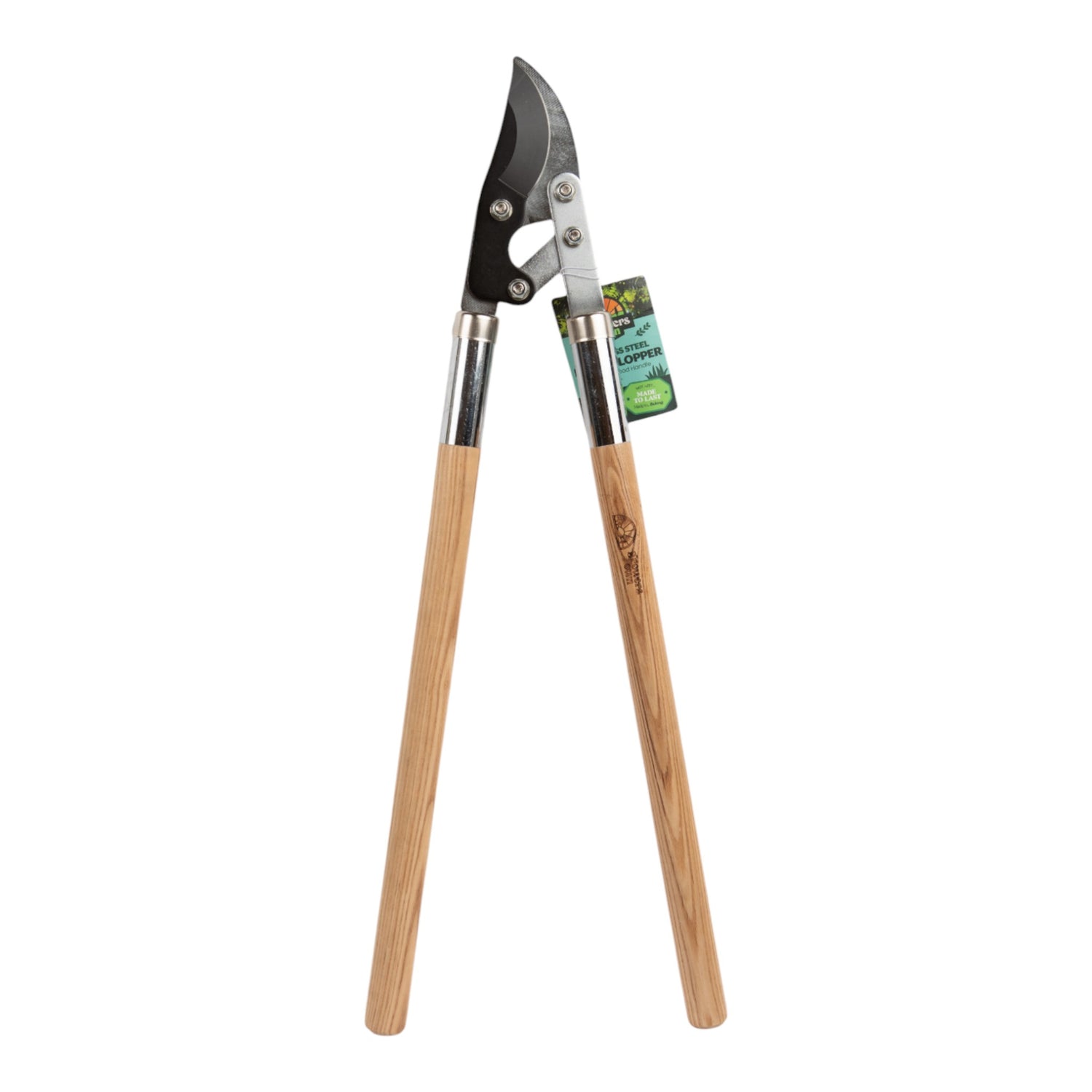


£13.50
Unit price per£13.50
Unit price perThe Growers Own Stainless Steel Bypass Lopper with Ashwood Handle is designed for two-handed pruning of larger live branches within the practical capacity of the tool.
It is a practical tool for growers, landscapers and gardeners who want dependable equipment for regular horticultural work. Using a tool designed for the specific job improves control and helps avoid unnecessary strain or damage.
The product specification identifies a stainless-steel working head or blade and an ashwood handle, combining a corrosion-resistant working surface with a traditional timber handle.
Key benefits
Two-handed pruning for larger growth
Bypass loppers provide extra leverage for live branches beyond comfortable secateur work. Use a stable stance, position the cutting head accurately and close the handles smoothly.
For branches beyond the practical capacity of the lopper, use a pruning saw rather than extending the handles or forcing the mechanism.
Care & maintenance
Remove soil, sap and plant debris after use and allow the tool to dry before storage. Check the working head or blade, handle, fasteners and joints for wear, looseness or damage.
Stainless steel is corrosion resistant, but it still benefits from being cleaned and dried rather than stored covered in wet soil or sap.
Keep the ashwood handle dry and inspect it periodically for splits, rough areas or looseness. Avoid leaving wooden-handled tools exposed outdoors for long periods.
Choosing the right tool for the job
This product is intended for two-handed pruning of larger live branches within the practical capacity of the tool. Where the material, soil condition or branch size makes the job difficult, switch to a more appropriate tool rather than applying excessive leverage or force.
Using the correct tool generally gives better results and reduces wear on both the equipment and the operator.
Stainless Steel Bypass Lopper with Ashwood Handle product details
| Brand | Growers Own |
|---|---|
| Product type | Bypass lopper |
| Primary use | two-handed pruning of larger live branches within the practical capacity of the tool |
| Working material | Stainless steel |
| Handle material | Ashwood |
Stainless Steel Bypass Lopper with Ashwood Handle FAQs
What is this tool designed for?
Two-handed pruning of larger live branches within the practical capacity of the tool. Who is it suitable for?
Professional growers, landscapers and gardeners where the tool matches the task. How should it be cleaned?
Remove soil, sap or plant debris after use, dry it and store it in a suitable dry location. How should it be stored?
Store it dry and protected from prolonged weather exposure. Can I use it for heavier work than intended?
No. If the task requires excessive force or leverage, choose a heavier or more appropriate tool. Does stainless steel still need maintenance?
Yes. Clean and dry it after use and remove plant residues rather than leaving the working surface dirty or wet. How should the ashwood handle be cared for?
Keep it dry, inspect it for splits or looseness and avoid prolonged outdoor exposure when the tool is not in use. How should the cutting edge be maintained?
Keep blades clean and sharp and inspect pivots and fasteners periodically. What if the material is too thick to cut comfortably?
Use a larger suitable pruning tool or saw rather than forcing the cut.
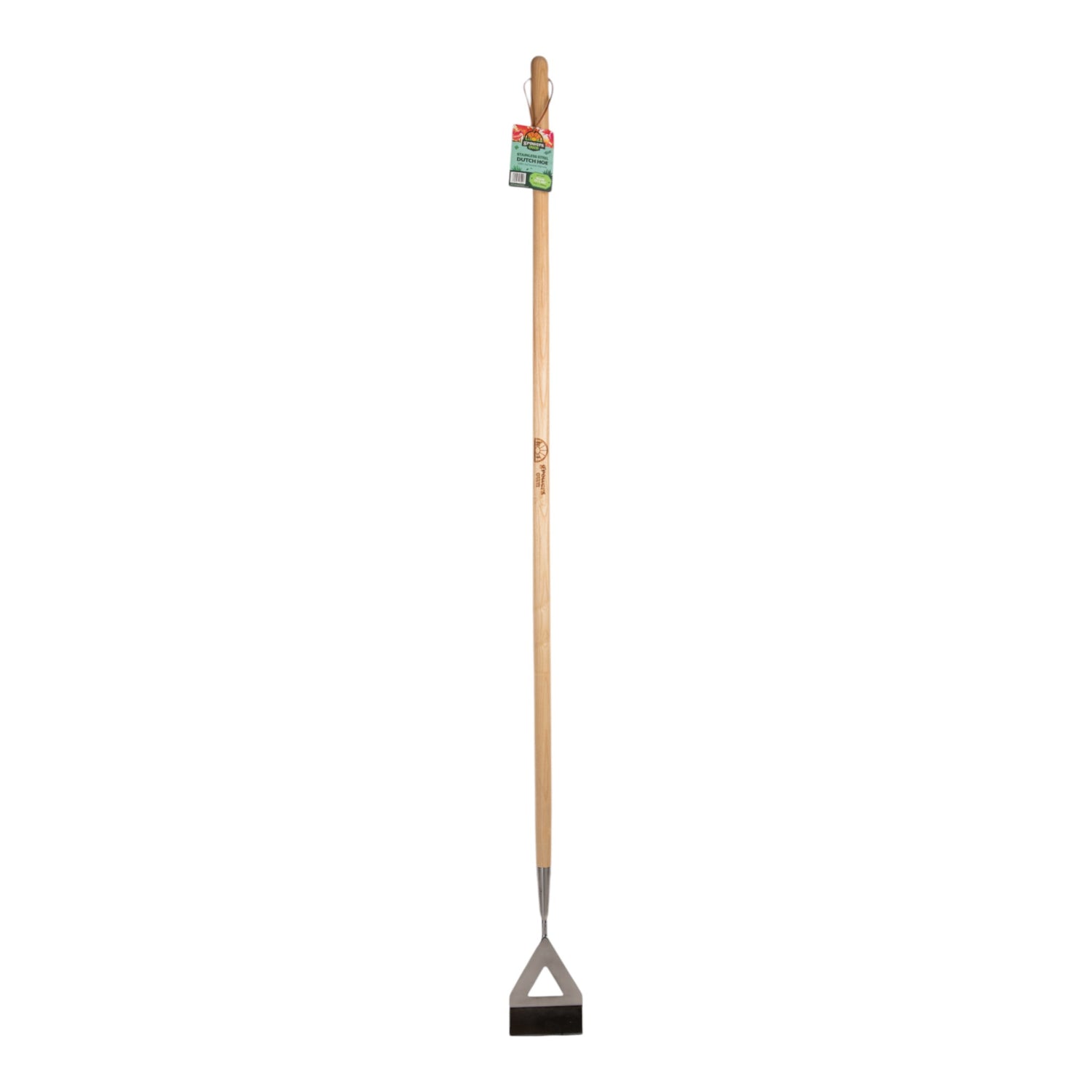


£14.50
Unit price per£14.50
Unit price perThe Growers Own Stainless Steel Dutch Hoe with Ashwood Handle is designed for shallow hoeing and weed control between plants and across prepared beds.
It is a practical tool for growers, landscapers and gardeners who want dependable equipment for regular horticultural work. Using a tool designed for the specific job improves control and helps avoid unnecessary strain or damage.
The product specification identifies a stainless-steel working head or blade and an ashwood handle, combining a corrosion-resistant working surface with a traditional timber handle.
Key benefits
Shallow weed control
A Dutch hoe is useful for severing small weeds close to the soil surface before they become established. Work through the upper layer of prepared soil rather than cultivating deeply around crop roots.
Care & maintenance
Remove soil, sap and plant debris after use and allow the tool to dry before storage. Check the working head or blade, handle, fasteners and joints for wear, looseness or damage.
Stainless steel is corrosion resistant, but it still benefits from being cleaned and dried rather than stored covered in wet soil or sap.
Keep the ashwood handle dry and inspect it periodically for splits, rough areas or looseness. Avoid leaving wooden-handled tools exposed outdoors for long periods.
Choosing the right tool for the job
This product is intended for shallow hoeing and weed control between plants and across prepared beds. Where the material, soil condition or branch size makes the job difficult, switch to a more appropriate tool rather than applying excessive leverage or force.
Using the correct tool generally gives better results and reduces wear on both the equipment and the operator.
Stainless Steel Dutch Hoe with Ashwood Handle product details
| Brand | Growers Own |
|---|---|
| Product type | Dutch hoe |
| Primary use | shallow hoeing and weed control between plants and across prepared beds |
| Working material | Stainless steel |
| Handle material | Ashwood |
Stainless Steel Dutch Hoe with Ashwood Handle FAQs
What is this tool designed for?
Shallow hoeing and weed control between plants and across prepared beds. Who is it suitable for?
Professional growers, landscapers and gardeners where the tool matches the task. How should it be cleaned?
Remove soil, sap or plant debris after use, dry it and store it in a suitable dry location. How should it be stored?
Store it dry and protected from prolonged weather exposure. Can I use it for heavier work than intended?
No. If the task requires excessive force or leverage, choose a heavier or more appropriate tool. Does stainless steel still need maintenance?
Yes. Clean and dry it after use and remove plant residues rather than leaving the working surface dirty or wet. How should the ashwood handle be cared for?
Keep it dry, inspect it for splits or looseness and avoid prolonged outdoor exposure when the tool is not in use.
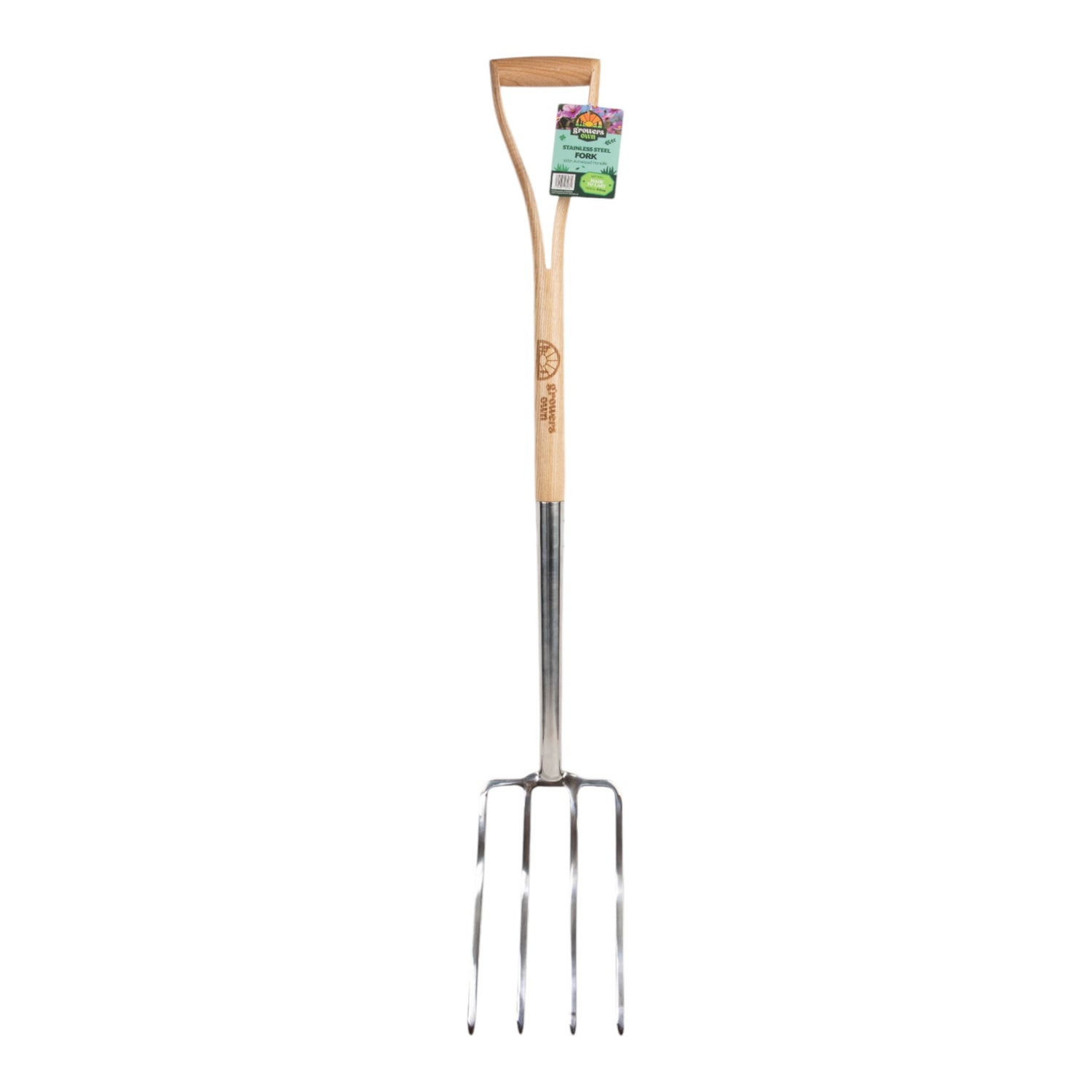

£19.75
Unit price per£19.75
Unit price perThe Growers Own Stainless Steel Digging Fork with Ashwood Handle is designed for digging, lifting, loosening and cultivating garden soil.
It is a practical tool for growers, landscapers and gardeners who want dependable equipment for regular horticultural work. Using a tool designed for the specific job improves control and helps avoid unnecessary strain or damage.
The product specification identifies a stainless-steel working head or blade and an ashwood handle, combining a corrosion-resistant working surface with a traditional timber handle.
Key benefits
Digging, lifting & cultivation
Use the fork to loosen compacted soil, lift and turn material and incorporate appropriate organic matter. Work progressively and avoid levering against immovable stones or roots.
Care & maintenance
Remove soil, sap and plant debris after use and allow the tool to dry before storage. Check the working head or blade, handle, fasteners and joints for wear, looseness or damage.
Stainless steel is corrosion resistant, but it still benefits from being cleaned and dried rather than stored covered in wet soil or sap.
Keep the ashwood handle dry and inspect it periodically for splits, rough areas or looseness. Avoid leaving wooden-handled tools exposed outdoors for long periods.
Choosing the right tool for the job
This product is intended for digging, lifting, loosening and cultivating garden soil. Where the material, soil condition or branch size makes the job difficult, switch to a more appropriate tool rather than applying excessive leverage or force.
Using the correct tool generally gives better results and reduces wear on both the equipment and the operator.
Stainless Steel Digging Fork with Ashwood Handle product details
| Brand | Growers Own |
|---|---|
| Product type | Digging fork |
| Primary use | digging, lifting, loosening and cultivating garden soil |
| Working material | Stainless steel |
| Handle material | Ashwood |
Stainless Steel Digging Fork with Ashwood Handle FAQs
What is this tool designed for?
Digging, lifting, loosening and cultivating garden soil. Who is it suitable for?
Professional growers, landscapers and gardeners where the tool matches the task. How should it be cleaned?
Remove soil, sap or plant debris after use, dry it and store it in a suitable dry location. How should it be stored?
Store it dry and protected from prolonged weather exposure. Can I use it for heavier work than intended?
No. If the task requires excessive force or leverage, choose a heavier or more appropriate tool. Does stainless steel still need maintenance?
Yes. Clean and dry it after use and remove plant residues rather than leaving the working surface dirty or wet. How should the ashwood handle be cared for?
Keep it dry, inspect it for splits or looseness and avoid prolonged outdoor exposure when the tool is not in use.
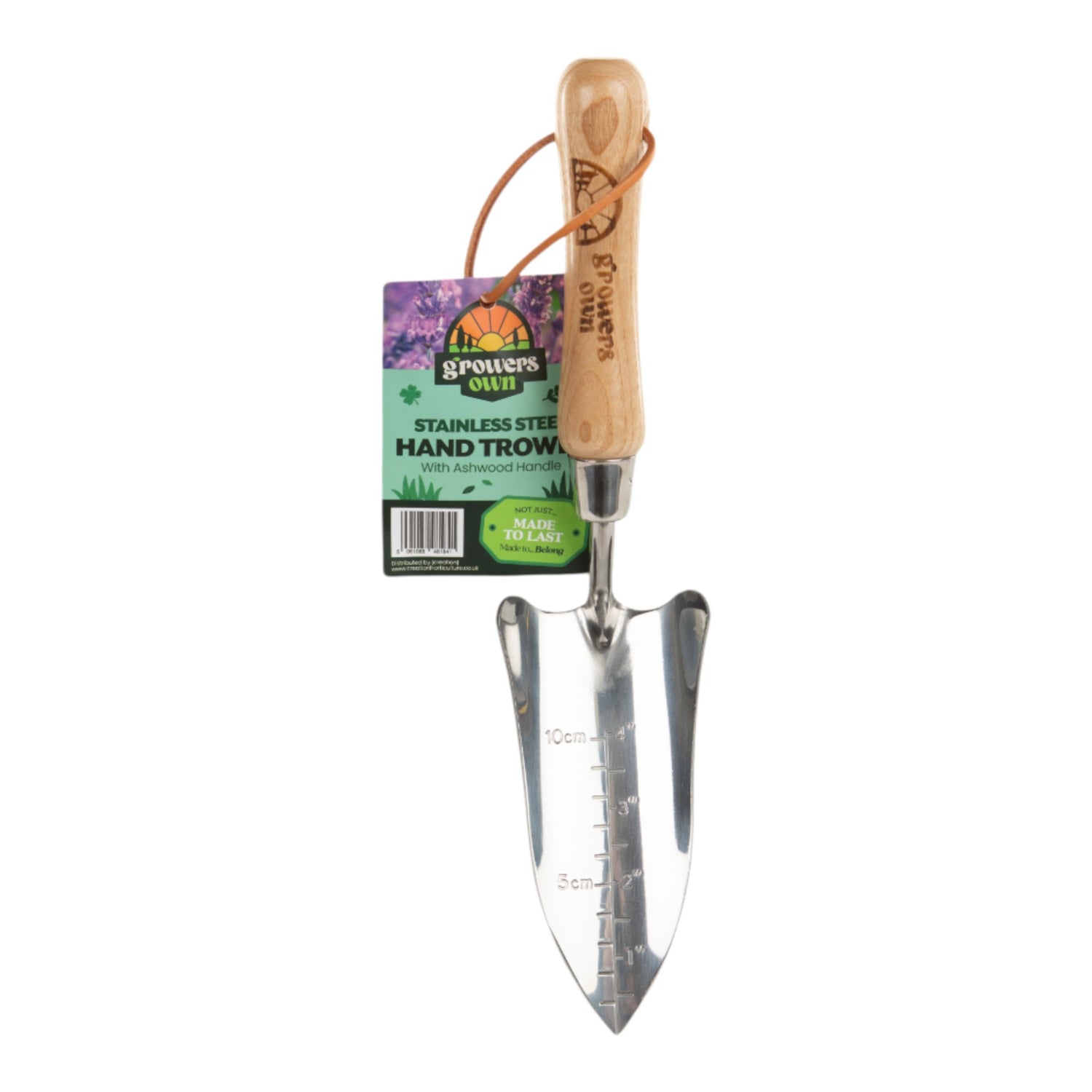


£4.50
Unit price per£4.50
Unit price perThe Growers Own Stainless Steel Hand Trowel with Ashwood Handle is designed for planting, potting, transplanting and close-up cultivation.
It is a practical tool for growers, landscapers and gardeners who want dependable equipment for regular horticultural work. Using a tool designed for the specific job improves control and helps avoid unnecessary strain or damage.
The product specification identifies a stainless-steel working head or blade and an ashwood handle, combining a corrosion-resistant working surface with a traditional timber handle.
Key benefits
Planting, potting & close cultivation
Use the trowel for planting smaller plants, transplanting, filling containers and working amendments into manageable areas. The long-handled version provides extra reach into beds and borders.
Care & maintenance
Remove soil, sap and plant debris after use and allow the tool to dry before storage. Check the working head or blade, handle, fasteners and joints for wear, looseness or damage.
Stainless steel is corrosion resistant, but it still benefits from being cleaned and dried rather than stored covered in wet soil or sap.
Keep the ashwood handle dry and inspect it periodically for splits, rough areas or looseness. Avoid leaving wooden-handled tools exposed outdoors for long periods.
Choosing the right tool for the job
This product is intended for planting, potting, transplanting and close-up cultivation. Where the material, soil condition or branch size makes the job difficult, switch to a more appropriate tool rather than applying excessive leverage or force.
Using the correct tool generally gives better results and reduces wear on both the equipment and the operator.
Stainless Steel Hand Trowel with Ashwood Handle product details
| Brand | Growers Own |
|---|---|
| Product type | Hand trowel |
| Primary use | planting, potting, transplanting and close-up cultivation |
| Working material | Stainless steel |
| Handle material | Ashwood |
Stainless Steel Hand Trowel with Ashwood Handle FAQs
What is this tool designed for?
Planting, potting, transplanting and close-up cultivation. Who is it suitable for?
Professional growers, landscapers and gardeners where the tool matches the task. How should it be cleaned?
Remove soil, sap or plant debris after use, dry it and store it in a suitable dry location. How should it be stored?
Store it dry and protected from prolonged weather exposure. Can I use it for heavier work than intended?
No. If the task requires excessive force or leverage, choose a heavier or more appropriate tool. Does stainless steel still need maintenance?
Yes. Clean and dry it after use and remove plant residues rather than leaving the working surface dirty or wet. How should the ashwood handle be cared for?
Keep it dry, inspect it for splits or looseness and avoid prolonged outdoor exposure when the tool is not in use.
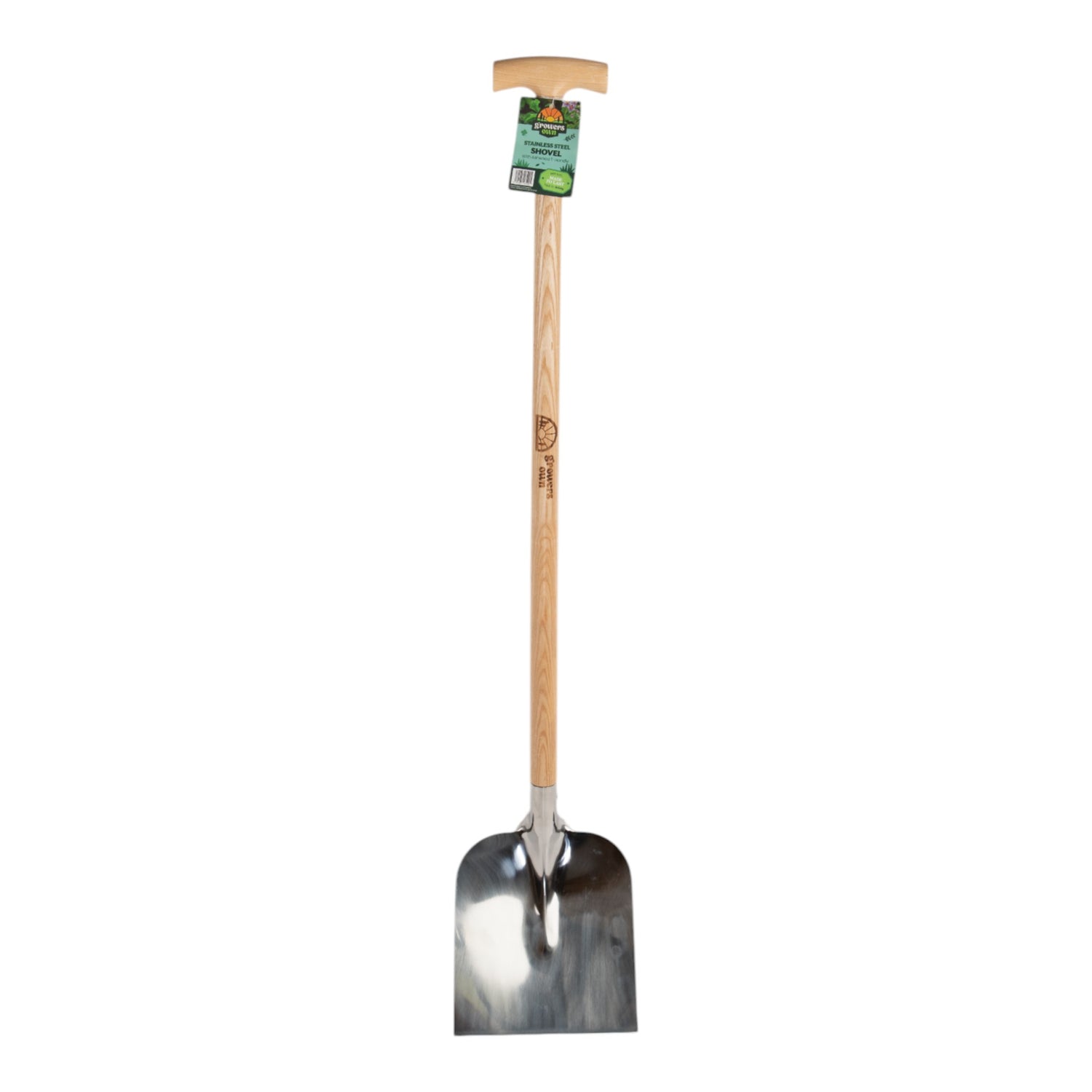

£19.75
Unit price per£19.75
Unit price perThe Growers Own Stainless Steel Shovel with Ashwood T-Handle is designed for moving soil, compost, mulch and other loose horticultural materials.
It is a practical tool for growers, landscapers and gardeners who want dependable equipment for regular horticultural work. Using a tool designed for the specific job improves control and helps avoid unnecessary strain or damage.
The product specification identifies a stainless-steel working head or blade and an ashwood handle, combining a corrosion-resistant working surface with a traditional timber handle.
Key benefits
Moving loose horticultural materials
Use the shovel for manageable quantities of compost, soil, mulch and similar loose materials. Avoid overloading the blade and keep loads controlled when lifting.
Care & maintenance
Remove soil, sap and plant debris after use and allow the tool to dry before storage. Check the working head or blade, handle, fasteners and joints for wear, looseness or damage.
Stainless steel is corrosion resistant, but it still benefits from being cleaned and dried rather than stored covered in wet soil or sap.
Keep the ashwood handle dry and inspect it periodically for splits, rough areas or looseness. Avoid leaving wooden-handled tools exposed outdoors for long periods.
Choosing the right tool for the job
This product is intended for moving soil, compost, mulch and other loose horticultural materials. Where the material, soil condition or branch size makes the job difficult, switch to a more appropriate tool rather than applying excessive leverage or force.
Using the correct tool generally gives better results and reduces wear on both the equipment and the operator.
Stainless Steel Shovel with Ashwood T-Handle product details
| Brand | Growers Own |
|---|---|
| Product type | Garden shovel |
| Primary use | moving soil, compost, mulch and other loose horticultural materials |
| Working material | Stainless steel |
| Handle material | Ashwood |
Stainless Steel Shovel with Ashwood T-Handle FAQs
What is this tool designed for?
Moving soil, compost, mulch and other loose horticultural materials. Who is it suitable for?
Professional growers, landscapers and gardeners where the tool matches the task. How should it be cleaned?
Remove soil, sap or plant debris after use, dry it and store it in a suitable dry location. How should it be stored?
Store it dry and protected from prolonged weather exposure. Can I use it for heavier work than intended?
No. If the task requires excessive force or leverage, choose a heavier or more appropriate tool. Does stainless steel still need maintenance?
Yes. Clean and dry it after use and remove plant residues rather than leaving the working surface dirty or wet. How should the ashwood handle be cared for?
Keep it dry, inspect it for splits or looseness and avoid prolonged outdoor exposure when the tool is not in use.
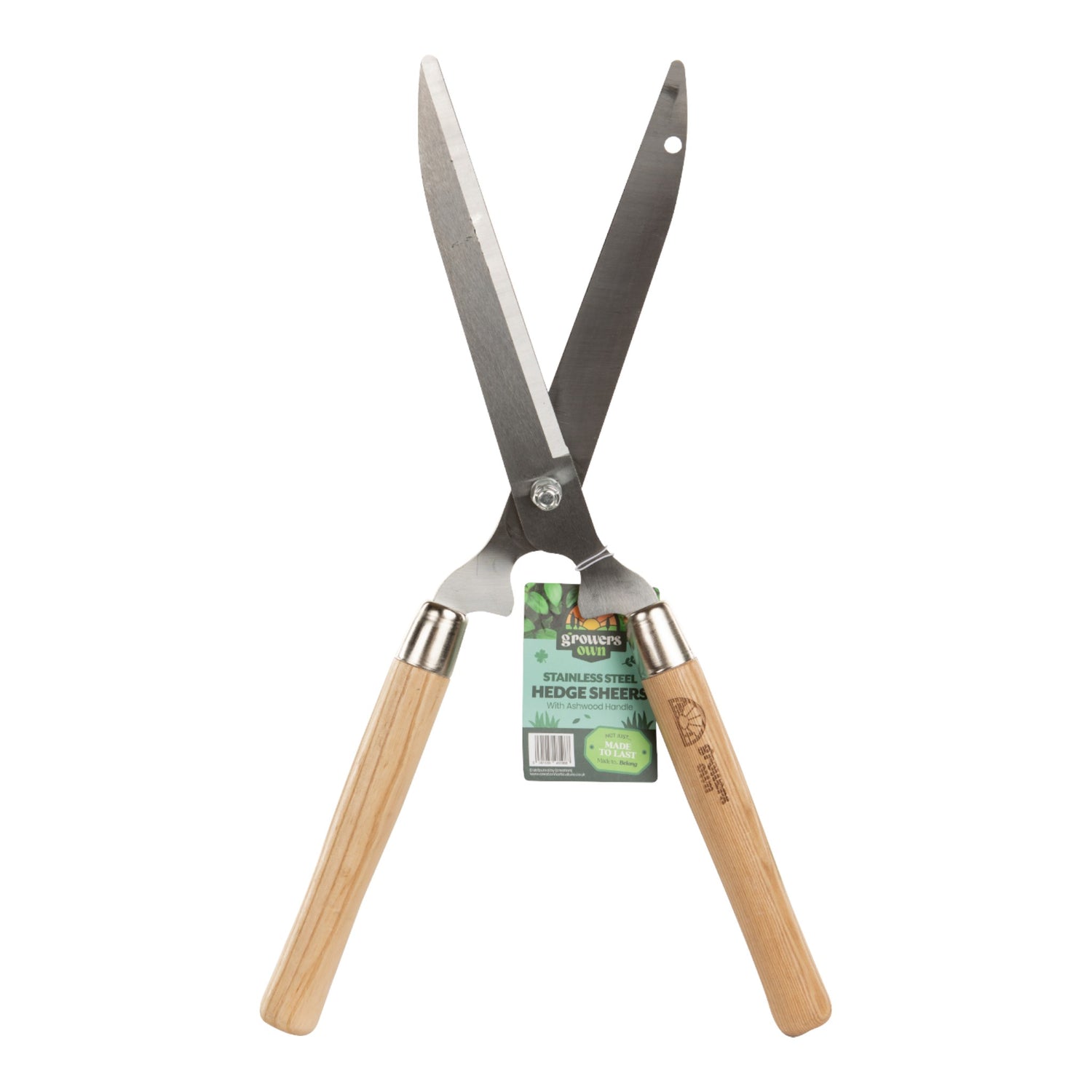


£9.25
Unit price per£9.25
Unit price perThe Growers Own Stainless Steel Hedge Shears with Ashwood Handle is designed for trimming and shaping suitable hedge growth and shrubs.
It is a practical tool for growers, landscapers and gardeners who want dependable equipment for regular horticultural work. Using a tool designed for the specific job improves control and helps avoid unnecessary strain or damage.
The product specification identifies a stainless-steel working head or blade and an ashwood handle, combining a corrosion-resistant working surface with a traditional timber handle.
Key benefits
Hedge trimming & shaping
Use the shears for suitable hedge growth and shrub shaping. Work with controlled strokes and check the line regularly. Cut individual woody stems with secateurs, loppers or a saw where appropriate.
Care & maintenance
Remove soil, sap and plant debris after use and allow the tool to dry before storage. Check the working head or blade, handle, fasteners and joints for wear, looseness or damage.
Stainless steel is corrosion resistant, but it still benefits from being cleaned and dried rather than stored covered in wet soil or sap.
Keep the ashwood handle dry and inspect it periodically for splits, rough areas or looseness. Avoid leaving wooden-handled tools exposed outdoors for long periods.
Choosing the right tool for the job
This product is intended for trimming and shaping suitable hedge growth and shrubs. Where the material, soil condition or branch size makes the job difficult, switch to a more appropriate tool rather than applying excessive leverage or force.
Using the correct tool generally gives better results and reduces wear on both the equipment and the operator.
Stainless Steel Hedge Shears with Ashwood Handle product details
| Brand | Growers Own |
|---|---|
| Product type | Hedge shears |
| Primary use | trimming and shaping suitable hedge growth and shrubs |
| Working material | Stainless steel |
| Handle material | Ashwood |
Stainless Steel Hedge Shears with Ashwood Handle FAQs
What is this tool designed for?
Trimming and shaping suitable hedge growth and shrubs. Who is it suitable for?
Professional growers, landscapers and gardeners where the tool matches the task. How should it be cleaned?
Remove soil, sap or plant debris after use, dry it and store it in a suitable dry location. How should it be stored?
Store it dry and protected from prolonged weather exposure. Can I use it for heavier work than intended?
No. If the task requires excessive force or leverage, choose a heavier or more appropriate tool. Does stainless steel still need maintenance?
Yes. Clean and dry it after use and remove plant residues rather than leaving the working surface dirty or wet. How should the ashwood handle be cared for?
Keep it dry, inspect it for splits or looseness and avoid prolonged outdoor exposure when the tool is not in use. How should the cutting edge be maintained?
Keep blades clean and sharp and inspect pivots and fasteners periodically. What if the material is too thick to cut comfortably?
Use a larger suitable pruning tool or saw rather than forcing the cut.
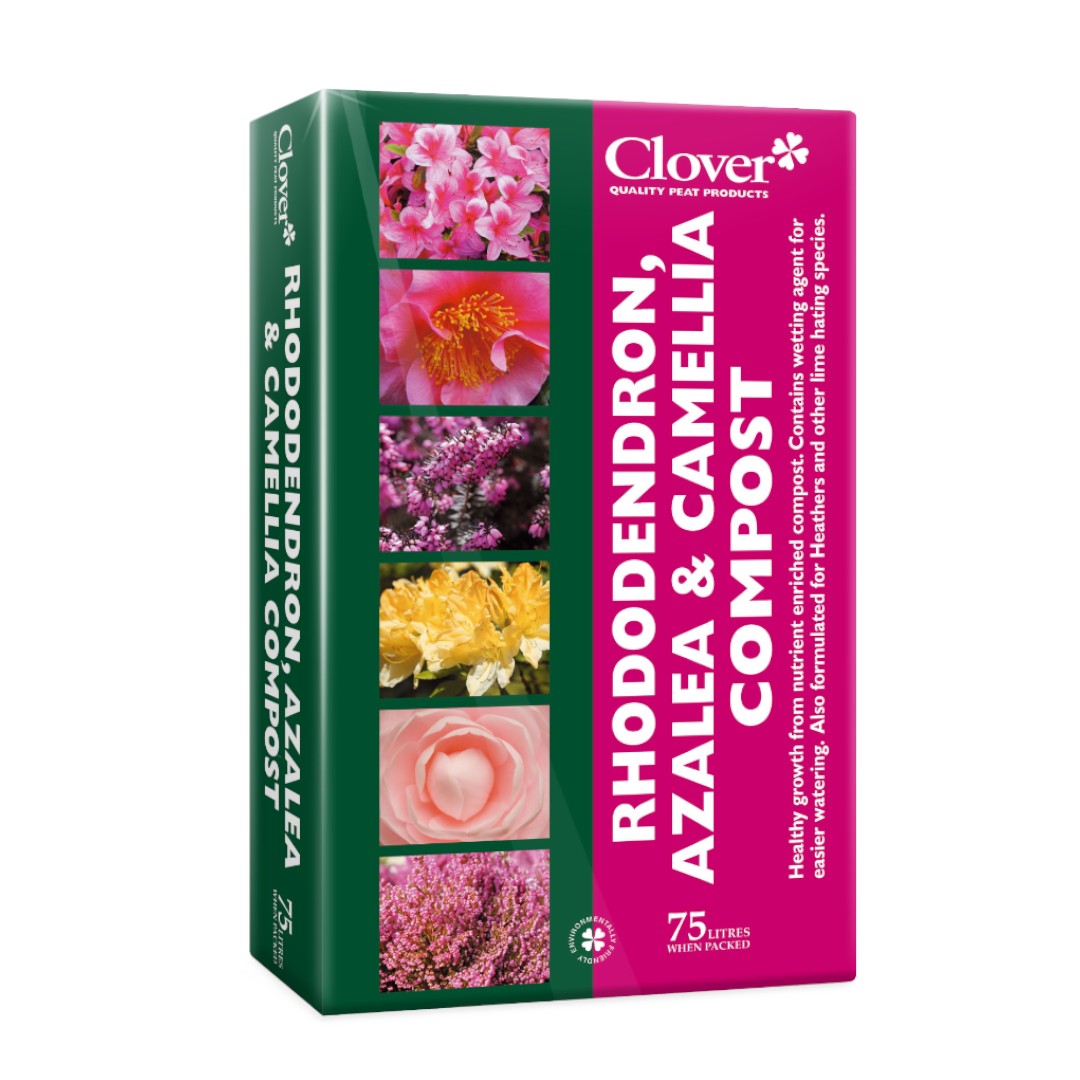
£3.75
Unit price per£3.75
Unit price perClover Ericaceous Compost 75L is a specialist peat-based growing medium formulated for acid-loving and lime-sensitive plants. Its acidic formulation provides the conditions required by popular ericaceous plants including rhododendrons, azaleas, camellias, heathers and blueberries.
Acid-loving plants can struggle when grown in ordinary garden soils or general-purpose composts with an unsuitable pH. Clover Ericaceous Compost provides a dedicated growing medium designed around their requirements, helping create an appropriate root environment for healthy establishment and continued growth.
The formulation includes essential nutrients, trace elements and a wetting agent, combining plant nutrition with improved water distribution through the growing medium.
Supplied in a generous 75 litre bag, it is suitable for planting acid-loving species in pots, planters and other appropriate growing situations. Creation Horticulture supplies 60 x 75L bags per full pallet.
Why choose Clover Ericaceous Compost?
Which plants need ericaceous compost?
Ericaceous compost is designed for plants that prefer acidic growing conditions and are often described as acid-loving, lime-hating or calcifuge plants.
Popular plants that can benefit from a suitable ericaceous growing medium include:
Not every plant requires acidic compost. For general planting, a multi-purpose or crop-specific growing medium may be more appropriate, so it is worth checking the requirements of the species before planting.
Why do acid-loving plants need specialist compost?
Soil and compost pH influences the availability of nutrients around plant roots. Ericaceous plants are adapted to acidic conditions and can struggle when the root environment becomes too alkaline.
One of the most recognisable symptoms is yellowing between the veins of younger leaves. This can occur when an unsuitable root-zone pH restricts the plant's ability to access important nutrients, even when those nutrients are physically present in the growing medium.
Using a dedicated ericaceous compost from the outset provides a more appropriate environment for these plants than relying on a standard general-purpose growing medium.
Growing ericaceous plants in containers
Container growing is particularly useful for acid-loving plants where the natural garden soil is unsuitable. Instead of trying to alter an entire garden bed, a container allows the root environment to be managed using an appropriate specialist compost.
Choose a container large enough for the plant's developing root system and make sure it has adequate drainage. Fill with Clover Ericaceous Compost, position the plant at the correct depth and gently firm the growing medium around the root ball before watering thoroughly.
As permanent container plants mature, they may eventually need repotting into a larger container or refreshing with suitable ericaceous growing medium.
Watering acid-loving plants
Clover Ericaceous Compost contains a wetting agent to help distribute moisture through the growing medium, but watering frequency should always be adjusted to the plant, container size and prevailing weather conditions.
Avoid allowing container-grown plants to remain permanently waterlogged, but do not repeatedly allow sensitive plants to dry out completely either.
In hard-water areas, repeated watering with alkaline tap water can gradually influence conditions within a container. Where practical, collected rainwater is often a useful choice for established acid-loving plants.
Feeding rhododendrons, azaleas & other ericaceous plants
Clover Ericaceous Compost contains essential nutrients and trace elements as part of its formulation, helping plants establish after planting.
Plants remaining in containers for extended periods may eventually require supplementary feeding as the original nutrient supply is used. When additional nutrition is required, select a fertiliser specifically suitable for acid-loving or ericaceous plants and follow the fertiliser manufacturer's instructions.
Maintaining an appropriate root environment is just as important as supplying fertiliser, which is why using the correct compost and suitable irrigation water can make a significant difference to long-term plant performance.
About Clover
Clover is a specialist manufacturer of growing media supplying both professional horticulture and the retail gardening market. Its range includes everyday retail composts alongside specialist substrates formulated for particular crops and commercial growing applications.
Specialist products such as Clover Ericaceous Compost demonstrate the importance of matching the growing medium to the plant rather than treating every crop in the same way. By providing a formulation intended for lime-sensitive species, gardeners can create appropriate growing conditions even where their natural garden soil is unsuitable.
The wider Clover range covers general-purpose growing media, specialist plant composts and professional horticultural substrates for nurseries and commercial growers.
75L ericaceous compost for garden centres & nurseries
Ericaceous compost is an important specialist line for garden centres because it naturally complements the sale of rhododendrons, azaleas, camellias, heathers, blueberries and other acid-loving plants.
The large 75L format provides customers with enough growing medium for substantial containers or several smaller planting projects, while Creation Horticulture supplies 60 bags per full pallet.
A full pallet therefore represents a total nominal growing media volume of 4,500 litres.
Clover packaging update
Clover is currently rolling out updated branded packaging across selected products. During this transition, customers may receive the previous packaging design, the newer design, or a mixture of both when ordering multiple bags.
This is a packaging change only. Customers will receive the same Clover Ericaceous Compost formulation regardless of which current packaging design is supplied.
Clover Ericaceous Compost 75L product details
| Brand | Clover |
|---|---|
| Product | Ericaceous Compost |
| Bag size | 75L |
| Growing medium | Peat-based specialist ericaceous compost |
| Designed for | Acid-loving and lime-sensitive plants |
| Nutrition | Essential nutrients and trace elements |
| Wetting agent | Yes |
| Suitable plants | Rhododendrons, azaleas, camellias, heathers, blueberries and other suitable acid-loving plants |
| Typical applications | Pots, planters and suitable garden planting applications |
| Pallet quantity | 60 x 75L bags |
| Total nominal volume per pallet | 4,500L |
Clover Ericaceous Compost 75L FAQs
What is ericaceous compost?
Ericaceous compost is a specialist acidic growing medium intended for lime-sensitive plants that prefer lower-pH growing conditions. Which plants can I grow in Clover Ericaceous Compost?
It is suitable for acid-loving plants including rhododendrons, azaleas, camellias, heathers and blueberries, as well as other species with similar growing requirements. Can I use ordinary multi-purpose compost for rhododendrons and azaleas?
A dedicated ericaceous compost is the better choice where a plant specifically requires acidic conditions. Standard multi-purpose compost may not provide the root-zone conditions preferred by lime-sensitive species. Can Clover Ericaceous Compost be used for blueberries?
Yes. Blueberries prefer acidic growing conditions and are well suited to cultivation in an appropriate ericaceous growing medium. Can I grow acid-loving plants in pots if my garden soil is alkaline?
Yes. Container growing is a practical solution because the plant can be grown in specialist ericaceous compost without relying on the pH of the surrounding garden soil. Should I use rainwater for ericaceous plants?
Rainwater can be particularly useful in hard-water areas because repeated use of alkaline tap water may gradually influence the growing conditions within a container. Why are the leaves on my acid-loving plant turning yellow?
Yellowing between the veins of younger leaves can be associated with nutrient availability problems caused by unsuitable root-zone conditions. Several factors can cause yellowing, however, so watering, nutrition and general plant health should also be checked. Does Clover Ericaceous Compost contain nutrients?
Yes. The formulation contains essential nutrients and trace elements as well as a wetting agent to assist water distribution. Why might the Clover bag I receive look different from the photograph?
Clover is transitioning selected products to updated branded packaging. Either current packaging design may therefore be supplied during the changeover, while the compost formulation remains the same. How many 75L bags are supplied on a pallet?
A full Creation Horticulture pallet contains 60 x 75L bags, providing a total nominal growing media volume of 4,500 litres.

£4.91
Unit price per£4.91
Unit price perClover Tub & Basket Compost 40L is a specialist growing medium formulated for hanging baskets, tubs, pots and ornamental container displays. Enriched with essential plant nutrients and moisture-retaining granules, it is designed to support vigorous growth and help maintain more consistent moisture around developing roots.
Hanging baskets and containers can be demanding environments for plants. Their limited compost volume means they can dry rapidly during warm or windy weather, while vigorous flowering plants can quickly use the available nutrients.
Clover Tub & Basket Compost is formulated specifically for these conditions. Its nutrient package supports plant development, while Moisture Store granules help retain water within the growing medium, making it particularly useful for colourful seasonal displays.
Supplied in a convenient 40 litre bag, Creation Horticulture supplies 100 x 40L bags per full pallet.
Why choose Clover Tub & Basket Compost?
What can Clover Tub & Basket Compost be used for?
This compost is specifically designed around container growing and seasonal ornamental planting. Typical applications include:
Plants with specialist pH, drainage or nutritional requirements should be matched with an appropriate specialist growing medium.
Moisture Store granules for improved water retention
A key feature of Clover Tub & Basket Compost is the inclusion of Moisture Store granules. These help the growing medium retain water and make moisture available within the root zone between watering.
This is particularly valuable in hanging baskets. Unlike plants growing in open ground, basket plants have access only to the relatively small volume of compost surrounding their roots. Once mature, a heavily planted basket can therefore use water surprisingly quickly.
Tubs, window boxes and patio planters face similar challenges, especially when positioned in warm, sunny or exposed locations.
Moisture-retaining granules do not remove the need for regular watering, but they help create more consistent root-zone conditions and reduce the speed at which containers dry out.
Essential nutrients for vigorous plant growth
Clover Tub & Basket Compost is enriched with the essential nutrients required to support healthy plant establishment and development.
This is important in containers because plants are unable to extend their roots into surrounding garden soil in search of additional nutrition. Everything required for growth must be supplied within the restricted root environment.
As plants become larger and flowering intensifies, nutrient demand can increase substantially. Long-season and particularly vigorous displays may therefore require supplementary feeding as the season progresses.
Choose a fertiliser appropriate for the plants being grown and always follow the feed manufacturer's recommended application instructions.
How to use Clover Tub & Basket Compost
Fill the basket, tub or planter with fresh compost, leaving sufficient space for the root balls of the plants being installed. Position plants at the appropriate depth and carefully fill around their roots.
Gently firm the compost to remove large air gaps without heavily compressing the growing medium. Water thoroughly after planting and allow excess water to drain.
For hanging baskets, make sure the basket is securely supported before watering. A freshly watered basket can be considerably heavier than one containing dry compost.
As the display develops, check moisture levels regularly rather than relying on a fixed watering timetable. Plant size, weather, basket volume and location can all significantly affect water demand.
Designed for demanding summer containers
Seasonal flowering plants can produce an impressive amount of foliage and flowers from a relatively small container. This rapid growth also means that both water and nutrients are consumed quickly.
A specialist tub and basket compost is designed with these demands in mind. Clover combines plant nutrition with moisture-retaining technology to create a growing medium suited to sustained ornamental displays.
Regular deadheading, appropriate feeding and careful watering can further help maintain flowering and overall plant quality throughout the season.
Tub & Basket Compost vs Multi Purpose Compost
Clover Multi Purpose Compost is a versatile growing medium suitable for numerous everyday gardening applications, including containers and hanging baskets.
Clover Tub & Basket Compost is the more specialised option for dedicated ornamental container displays. Its formulation includes Moisture Store granules specifically to help manage the greater moisture demands associated with baskets, tubs and pots.
For occasional general potting, a multi-purpose compost provides excellent versatility. For a substantial summer basket or container display, the specialist Tub & Basket formulation provides features targeted specifically at that application.
Tub & Basket vs Traditional Gold Tub & Basket Compost
Clover offers more than one option for customers creating tubs and hanging baskets.
Clover Tub & Basket Compost is enriched with essential nutrients and Moisture Store granules to support plant growth and improve water retention.
Clover Traditional Gold Tub & Basket Compost is positioned as the premium option within the range, using Clover's Traditional Gold formulation for customers looking to step up to a higher-specification growing medium.
Both products are specifically targeted at the demands of ornamental plants grown in baskets, tubs and containers.
About Clover
Clover produces growing media for both professional horticulture and the retail gardening market. Its range includes general-purpose composts alongside specialist formulations developed around particular plants and growing applications.
Tub & Basket Compost is an example of this application-led approach, combining plant nutrition and moisture-management technology specifically for container-grown ornamental plants.
40L Tub & Basket Compost for garden centres
The 40L bag provides a practical retail size for customers planting hanging baskets, patio tubs and seasonal containers, while the specialist formulation gives garden centres a clear alternative to standard multi-purpose compost.
Creation Horticulture supplies 100 x 40L bags per full pallet, giving a total nominal growing-media volume of 4,000 litres per pallet.
Clover packaging update
Clover is currently rolling out updated branded packaging across selected products. During this transition, customers may receive the previous packaging design, the newer design, or a mixture of both when ordering multiple bags.
This is a packaging change only. Customers will receive the same Clover Tub & Basket Compost formulation regardless of which current packaging design is supplied.
Clover Tub & Basket Compost 40L product details
| Brand | Clover |
|---|---|
| Product | Tub & Basket Compost |
| Bag size | 40L |
| Product type | Specialist tub, basket and container growing medium |
| Plant nutrition | Enriched with essential plant nutrients |
| Moisture management | Contains Moisture Store granules to help improve water retention |
| Suitable for hanging baskets | Yes |
| Suitable for tubs & planters | Yes |
| Suitable for seasonal flowering displays | Yes |
| Pallet quantity | 100 x 40L bags |
| Total nominal volume per pallet | 4,000L |
Clover Tub & Basket Compost 40L FAQs
What is Clover Tub & Basket Compost designed for?
It is specifically formulated for hanging baskets, tubs, pots and ornamental container displays where plants have high water and nutrient demands. What are Moisture Store granules?
Moisture Store granules are included in the compost to help retain water within the growing medium, supporting more consistent moisture availability around plant roots. Will Moisture Store granules mean I need to water less often?
They help the compost retain moisture, but watering frequency will still depend on plant size, container volume and weather. Established hanging baskets may require frequent watering during hot conditions. Can I use this compost in patio tubs and window boxes?
Yes. The formulation is suitable for hanging baskets as well as tubs, pots, window boxes and other ornamental containers. Does Clover Tub & Basket Compost contain plant nutrients?
Yes. It is enriched with essential nutrients to support healthy plant establishment and development. Is Tub & Basket Compost better than multi-purpose compost for hanging baskets?
Both can be used, but Tub & Basket Compost is specifically formulated for this application and includes Moisture Store granules to help address the high water demand associated with container displays. Will I need to feed plants later in the season?
Vigorous plants grown for a long season can eventually require additional nutrition. Supplementary feeding should be matched to the plants being grown and applied according to the fertiliser manufacturer's instructions. Why might the Clover bag I receive look different from the product image?
Clover is transitioning selected products to updated branded packaging. Either current packaging design may therefore be supplied during the changeover while the compost formulation remains the same. How many Clover Tub & Basket Compost 40L bags are supplied per pallet?
A full Creation Horticulture pallet contains 100 x 40L bags, providing a total nominal growing-media volume of 4,000 litres.

£3.83
Unit price per£3.83
Unit price perClover 4 Plant Growing Bag is a convenient ready-filled grow bag containing nutrient-rich compost for growing tomatoes, peppers and a wide range of other productive and ornamental plants. Designed to accommodate up to four suitable plants, it provides a simple way to establish crops without the need for separate pots and loose compost.
Grow bags are particularly useful where garden space is limited or where plants are being grown on patios, in greenhouses or other productive growing areas. The enclosed format provides each plant with a defined volume of growing medium while keeping planting straightforward and tidy.
Clover's growing bag is supplied ready for planting and contains the nutrients required to support plants during establishment and early development. As plants mature and begin producing substantial growth, flowers and fruit, feeding and watering can be adjusted according to crop demand.
Creation Horticulture supplies 100 Clover 4 Plant Growing Bags per full pallet.
Why choose the Clover 4 Plant Growing Bag?
What can you grow in a Clover Growing Bag?
Clover's 4 Plant Growing Bag is suitable for a variety of edible and ornamental plants. Popular applications include:
The number of plants used should always reflect the mature size and vigour of the chosen crop. Although the bag provides four planting positions, particularly vigorous plants may benefit from additional root space rather than automatically filling every position.
How to use a Clover 4 Plant Growing Bag
Before planting, position the bag in its final growing location. Once planted and thoroughly watered, moving a growing bag becomes considerably more difficult and can disturb established plants.
Gently work the bag to distribute the compost evenly before opening the designated planting positions. Make an opening large enough to accommodate the plant's root ball, place the plant into the compost and gently firm the growing medium around it.
Water after planting and continue to monitor moisture carefully while the roots establish. Where crops require support, install canes, strings or another suitable support system without damaging the bag or root system.
Growing tomatoes in a Clover Grow Bag
Tomatoes are one of the most popular crops for grow bags. The format provides a convenient contained root zone and works particularly well in greenhouses, on patios and in other sunny growing positions.
Tomato plants become increasingly demanding as they mature. Regular watering becomes especially important once plants develop substantial foliage and begin setting fruit.
Avoid allowing the growing medium to repeatedly swing between extremely dry and heavily saturated conditions. Consistent moisture management helps maintain steady plant development and is particularly important once fruit is forming.
Taller tomato varieties will also require suitable support as they grow.
Watering plants in a growing bag
Growing bags contain a finite volume of compost, so moisture can be used relatively quickly by large, actively growing plants.
Check the growing medium regularly, particularly during warm and sunny weather. Water requirements will increase as root systems develop and plants produce more foliage, flowers and fruit.
Water should reach the root zone rather than merely wetting the surface. At the same time, avoid continually saturating the compost, as healthy roots require both moisture and air.
When should grow bag plants be fed?
The compost within the Clover Growing Bag contains plant nutrients to support establishment and initial growth. However, productive crops can have substantial nutrient requirements as they mature.
Once the initial nutrient supply is being depleted, supplementary feeding can be introduced according to the requirements of the crop being grown.
Fruiting plants such as tomatoes and peppers are commonly moved onto an appropriate crop feed as flowering and fruit production develop. Always follow the instructions supplied with the chosen fertiliser rather than increasing concentration in an attempt to accelerate growth.
Space-efficient growing for patios & greenhouses
One of the main advantages of a growing bag is the ability to raise productive plants without a permanent vegetable bed.
Bags can be positioned on suitable greenhouse floors, patios and other stable growing surfaces, making them useful for gardeners working with limited space or areas where planting directly into the ground is not practical.
They also make seasonal crop changes straightforward because the entire growing medium is contained within the bag.
Grow bag vs individual pots
Both systems can produce excellent plants, but a grow bag offers a particularly simple approach. Several plants can share one contained volume of growing medium without purchasing and filling multiple individual containers.
Individual pots provide greater control over the root volume and watering of each plant, while a growing bag offers convenience and efficient use of available growing space.
The best option depends on the crop, available space and preferred growing method.
About Clover
Clover produces growing media for professional horticulture and the retail gardening market. Its range includes general-purpose and specialist composts alongside convenient growing products designed for productive garden crops.
The Clover 4 Plant Growing Bag provides a straightforward ready-to-plant format for customers wanting to grow tomatoes, peppers and other seasonal crops without preparing a separate bed or filling individual containers.
Clover packaging update
Clover is currently rolling out updated branded packaging across selected products. During this transition, customers may receive the previous packaging design, the newer design, or a mixture of both when ordering multiple bags.
Packaging appearance may therefore vary from the product imagery shown.
Clover 4 Plant Growing Bag product details
| Brand | Clover |
|---|---|
| Product | 4 Plant Growing Bag |
| Product type | Ready-filled growing bag |
| Planting positions | Up to 4 suitable plants |
| Growing medium | Nutrient-rich compost |
| Suitable for | Tomatoes, peppers, chillies, herbs, suitable vegetables and ornamental plants |
| Typical locations | Greenhouses, patios and other suitable growing areas |
| Pallet quantity | 100 growing bags |
Clover 4 Plant Growing Bag FAQs
How many plants can I grow in a Clover Growing Bag?
The bag is designed with capacity for up to four suitable plants. For particularly vigorous crops, using fewer plants can provide each root system with more growing space. Can I grow tomatoes in this grow bag?
Yes. Tomatoes are an ideal crop for grow bags. Remember that plants will require increasing amounts of water as they become larger and begin producing fruit. Can I grow peppers and chillies in it?
Yes. Peppers and chillies are well suited to container and grow-bag cultivation where suitable warmth, light, watering and nutrition are provided. Do I need to add compost before planting?
No. The Clover Growing Bag is supplied already filled with growing medium, so plants can be established directly into the bag. Can I use the grow bag outside?
Yes. It can be used in a suitable outdoor position as well as in a greenhouse. Choose a location appropriate for the crop and ensure plants receive suitable light and protection from adverse weather where necessary. Do plants in grow bags need extra feeding?
The compost contains nutrients for establishment and initial growth, but vigorous and fruiting plants may require supplementary feeding later as the available nutrients are used. Why do grow bags need regular watering?
The roots are contained within a limited volume of growing medium. As plants become larger, they can use the available water quickly, particularly during warm weather. Why might the Clover Growing Bag I receive look different from the product image?
Clover is transitioning selected products to updated branded packaging, so either current packaging design may be supplied during the changeover. How many Clover 4 Plant Growing Bags are supplied per pallet?
A full Creation Horticulture pallet contains 100 growing bags.


£160.00
Unit price per£160.00
Unit price perGrowers Own Ground Cover 25cm x 25cm Grid 100GSM 4M x 100M is designed for suppressing weed growth in nurseries, beds and landscaped planting areas.
Part of the Growers Own practical horticultural range, this product helps growers, landscapers and gardeners manage planting areas and crop protection with an appropriately selected size and format.
Key benefits
Installing ground cover
Clear the site of persistent weeds and sharp debris, level the surface and lay the fabric flat. Overlap adjoining sections where appropriate, secure edges and make neat planting openings where needed. Remove accumulated debris that could support weed growth on top.
Weed management and maintenance
Ground-cover fabric helps suppress weeds but does not replace site preparation or routine inspection. Check joins, edges and planting holes for emerging weeds and repair displaced fixings promptly.
Product specifications
| Brand | Growers Own |
|---|---|
| Product type | Woven ground-cover fabric |
| Primary application | suppressing weed growth in nurseries, beds and landscaped planting areas |
| Fabric weight | 100gsm |
| Dimensions | 25cm x 25cm |
Frequently asked questions
What size is this product?
The stated dimensions are 25cm x 25cm. What fabric weight is specified?
The stated material weight is 100gsm. This is not a verified frost-temperature rating. Will ground cover stop every weed?
It reduces light reaching weeds beneath the fabric but does not eliminate the need for site preparation and maintenance. How should adjoining sections be joined?
Overlap and secure the edges as appropriate for the site and installation. Can I cut planting holes?
Yes, make openings sized for the crop while avoiding unnecessary exposed soil. Does the material require maintenance?
Inspect joins and edges and remove debris or weeds that establish on top of the fabric.

The Fresh Spagnum Moss - Bag is designed for horticultural lining, propagation and specialist growing applications.
This product is intended for practical professional horticultural, nursery, greenhouse, landscaping or garden use according to its specific application.
Key benefits
Horticultural moss applications
Fresh sphagnum moss can be used for suitable propagation, lining and specialist horticultural applications. Manage moisture according to the crop and application and keep unused material appropriately stored.
Use & maintenance
Keep the product clean and inspect it periodically for wear, damage or contamination appropriate to its application. Store it in conditions that protect it from unnecessary weather, crushing or physical damage.
Choosing the right product
Check dimensions, capacity, connection type or intended application before ordering. Similar-looking horticultural products may not be interchangeable where technical compatibility matters.
Fresh Spagnum Moss - Bag product details
| Product type | Fresh Sphagnum Moss |
|---|---|
| Primary use | horticultural lining, propagation and specialist growing applications |
| Source designation | Fresh Spagnum Moss - Bag |
| Application | Professional horticulture, nursery, greenhouse, landscaping or garden use |
Fresh Spagnum Moss - Bag FAQs
What is this product used for?
Horticultural lining, propagation and specialist growing applications. Who is it suitable for?
Professional growers, nurseries, landscapers, garden centres or gardeners where the product matches the intended task. Are the dimensions and technical details retained?
Yes. The product title retains the relevant source dimensions or technical designation. How should it be maintained?
Keep it clean, inspect it for damage and follow maintenance appropriate to the product type. How should it be stored?
Store it clean and protected from unnecessary weather, contamination or physical damage. How do I check compatibility?
Check dimensions, connection type, capacity and intended application before ordering. Can it be used outside its intended application?
Use it only where its design and specification are suitable for the task. Should it be inspected before use?
Yes. Check condition and suitability before putting the product into service.

The Clover 75L TREE PLANTING & MULCHING is a tree planting & mulching compost intended for tree and shrub planting, backfilling and mulching where this product is appropriate.
Clover growing media are used across professional horticulture where growers need to select the substrate according to crop type, container size, irrigation practice and production stage.
Bag size: 75L.
Key benefits
Recommended applications
Use this product for tree and shrub planting, backfilling and mulching where this product is appropriate. The exact crop response will depend on plant species, container volume, irrigation, feeding and the wider production environment.
Using professional growing media
Fill pots, trays or planting areas evenly without unnecessary compaction. After planting, irrigate according to the crop and allow the medium to settle naturally around the root system.
Monitor moisture rather than watering solely to a fixed timetable. Water demand changes with crop size, temperature, light, airflow and container volume.
Nutrition & crop management
Where a growing medium contains a starter nutrient charge, its duration will vary with crop demand and irrigation. Establish an appropriate ongoing feeding programme for longer-term production rather than assuming the original nutrient supply will last indefinitely.
For specialist crops, match pH, nutrition and irrigation to the plant's requirements and current production guidance.
Storage & handling
Store bags in a suitable area before use and protect opened material from contamination. Avoid unnecessary compaction during handling so the physical structure of the growing medium is maintained.
Clover 75L TREE PLANTING & MULCHING product details
| Manufacturer | Clover |
|---|---|
| Product type | Tree planting & mulching compost |
| Bag size | 75L |
| Primary application | tree and shrub planting, backfilling and mulching where this product is appropriate |
Clover 75L TREE PLANTING & MULCHING FAQs
What is this product used for?
It is intended for tree and shrub planting, backfilling and mulching where the formulation is appropriate. Can it be used as a mulch?
Yes, mulching is one of the stated applications for this product. Should newly planted trees still be watered?
Yes. Newly planted trees and shrubs require appropriate establishment watering according to soil, weather and species requirements. How much growing medium is in the bag?
This product is supplied in a 75L bag. Should the compost be compressed firmly into pots?
Avoid excessive compaction. Fill consistently and settle the medium sufficiently to support the plant while maintaining appropriate pore space. How often should plants be watered?
Water according to crop demand and substrate moisture. Requirements vary with plant size, container volume and environmental conditions.

The Clover 75L ALPINE COMPOST is a alpine compost intended for alpines and other plants requiring a suitably structured specialist growing medium.
Clover growing media are used across professional horticulture where growers need to select the substrate according to crop type, container size, irrigation practice and production stage.
Bag size: 75L.
Key benefits
Recommended applications
Use this product for alpines and other plants requiring a suitably structured specialist growing medium. The exact crop response will depend on plant species, container volume, irrigation, feeding and the wider production environment.
Using professional growing media
Fill pots, trays or planting areas evenly without unnecessary compaction. After planting, irrigate according to the crop and allow the medium to settle naturally around the root system.
Monitor moisture rather than watering solely to a fixed timetable. Water demand changes with crop size, temperature, light, airflow and container volume.
Nutrition & crop management
Where a growing medium contains a starter nutrient charge, its duration will vary with crop demand and irrigation. Establish an appropriate ongoing feeding programme for longer-term production rather than assuming the original nutrient supply will last indefinitely.
For specialist crops, match pH, nutrition and irrigation to the plant's requirements and current production guidance.
Storage & handling
Store bags in a suitable area before use and protect opened material from contamination. Avoid unnecessary compaction during handling so the physical structure of the growing medium is maintained.
Clover 75L ALPINE COMPOST product details
| Manufacturer | Clover |
|---|---|
| Product type | Alpine compost |
| Bag size | 75L |
| Primary application | alpines and other plants requiring a suitably structured specialist growing medium |
Clover 75L ALPINE COMPOST FAQs
What plants is alpine compost for?
It is intended for alpines and other suitable plants requiring a specialist growing medium. Can I use ordinary multipurpose compost instead?
Alpine crops often benefit from a medium selected specifically for their root-zone and drainage requirements, so use the formulation appropriate to the plant. How should alpine containers be watered?
Water according to the plant and weather while avoiding prolonged saturation where the crop requires freer-draining conditions. How much growing medium is in the bag?
This product is supplied in a 75L bag. Should the compost be compressed firmly into pots?
Avoid excessive compaction. Fill consistently and settle the medium sufficiently to support the plant while maintaining appropriate pore space. How often should plants be watered?
Water according to crop demand and substrate moisture. Requirements vary with plant size, container volume and environmental conditions.


£2.50
Unit price per£2.50
Unit price perThe Growers Own Easy Fleece Jacket 50gsm provides quick, convenient frost protection for container plants, shrubs and young plants during cold weather. Measuring 1.8m x 2m, the ready-made plant cover features a full-length zipper for easy access and a drawstring base for securing the fleece around the plant or container.
Manufactured from 50gsm breathable polypropylene fleece, the jacket creates a protective layer around vulnerable plants while still allowing light, air and moisture to pass through. This makes it a practical alternative to repeatedly wrapping individual plants with sheets of horticultural fleece.
Simply open the zipper, position the jacket around the plant and close it before securing the drawstring at the base. The generous 1.8m x 2m size is particularly useful for larger container plants and shrubs that need additional protection during cold snaps and winter weather.
Why choose the Growers Own Easy Fleece Jacket?
Quick frost protection for larger plants
Protecting established container plants and shrubs with conventional fleece can involve wrapping several layers around the plant and securing them with ties. A ready-made fleece jacket makes the process considerably quicker.
The zipper allows the cover to open widely rather than having to pull the entire jacket down over delicate branches or foliage. Once positioned, close the zipper and use the drawstring around the base to help keep the cover securely in place.
This also makes the jacket easy to open when the plant needs checking, watering or additional ventilation during milder weather.
Ideal for overwintering container plants & shrubs
The 1.8m x 2m Easy Fleece Jacket is suitable for protecting a wide range of vulnerable plants, including:
The level of protection required will depend on the plant species, local conditions and severity of the weather. Particularly tender plants may require additional protection or a frost-free overwintering location during prolonged severe cold.
Breathable 50gsm horticultural fleece
Unlike an impermeable plastic cover, horticultural fleece is designed to remain breathable. Light, air and moisture can pass through the material while the fleece provides an additional protective layer around the plant.
The 50gsm weight gives this jacket a substantial construction for winter plant protection while retaining the flexibility needed to fit around foliage and containers.
During extended periods of milder weather, plants should still be checked regularly and the cover opened or removed when appropriate to maintain suitable growing conditions.
How to use the Easy Fleece Jacket
Open the zipper and carefully position the fleece around the plant, taking care not to force the material against delicate branches. Close the zipper and tighten the drawstring sufficiently to secure the base.
For container plants, the jacket can be positioned around the plant and pot as appropriate. Remember that the fleece primarily protects the above-ground plant. In very cold conditions, vulnerable containers and root systems may benefit from additional insulation.
Check the plant periodically throughout winter, particularly following strong winds, heavy rain or significant changes in temperature.
Reusable winter plant protection
After the risk of frost has passed, remove the jacket carefully and allow it to dry fully before storage. Fold it loosely and keep it in a clean, dry location ready for the following season.
Reusing the jacket across multiple winters makes it a convenient addition to the seasonal plant-protection kit for gardeners, nurseries and garden retailers.
Growers Own Easy Fleece Jacket product details
| Brand | Growers Own |
|---|---|
| Product type | Plant frost protection fleece jacket |
| Size | 1.8m x 2m |
| Fleece weight | 50gsm |
| Material | Polypropylene fleece |
| Closure | Zipper |
| Base | Adjustable drawstring |
| Breathable | Yes - allows light, air and moisture through |
| Reusable | Yes |
| Primary application | Frost and cold-weather plant protection |
| Suitable for | Container plants, shrubs, young plants and overwintering vulnerable plants |
Growers Own Easy Fleece Jacket FAQs
What size is this frost protection jacket?
This version measures 1.8m x 2m and is designed for larger container plants, shrubs and other appropriately sized plants. What does 50gsm fleece mean?
GSM means grams per square metre and describes the weight of the fleece material. This jacket uses 50gsm polypropylene fleece, giving it a more substantial construction than lightweight crop fleece. Does the plant fleece let light and moisture through?
Yes. The polypropylene fleece is breathable and allows light, air and moisture to pass through while providing an additional protective barrier around the plant. Why does the fleece jacket have a zipper?
The zipper makes the jacket easier to fit around larger plants without forcing the cover over branches and foliage. It also provides convenient access when the plant needs checking or watering. What is the drawstring for?
The drawstring helps secure the bottom of the fleece around the plant or container, reducing the chance of the cover being displaced by wind. Can I use the jacket on potted plants?
Yes. It is particularly useful for overwintering vulnerable container and patio plants that cannot easily be moved to a frost-free location. Does the fleece protect the plant roots as well?
The jacket primarily provides protection around the plant. Containers and root systems can still become very cold, so vulnerable pots may require additional insulation during severe winter conditions. Can the Easy Fleece Jacket be reused?
Yes. Provided it remains in good condition, allow the fleece to dry after use and store it somewhere clean and dry for reuse during future cold weather. Should I leave the fleece jacket on all winter?
Use it according to the plant and weather conditions. Check covered plants regularly and consider opening or removing the jacket during prolonged mild periods where additional protection is unnecessary. Is fleece enough for very tender plants?
That depends on the plant and the temperatures experienced. A fleece jacket provides useful additional protection, but very tender species may still require a sheltered or frost-free location during severe or prolonged cold.

£1.99
Unit price per£1.99
Unit price perThe Growers Own Easy Fleece Jacket 50gsm provides quick and convenient frost protection for container plants, shrubs and young plants during cold weather. Measuring 1.5m x 1.8m, this ready-made plant cover features a full-length zipper for easy access and a drawstring base for securing the fleece around the plant or container.
Manufactured from 50gsm breathable polypropylene fleece, the jacket creates a protective layer around vulnerable plants while allowing light, air and moisture to pass through. It offers a simple alternative to cutting and repeatedly wrapping plants with sheets of horticultural fleece.
The 1.5m x 1.8m size is ideal for medium-sized container plants, patio plants, shrubs and young plants that require additional protection during cold snaps and winter weather.
Why choose the Growers Own Easy Fleece Jacket?
Easy frost protection for plants
Protecting individual plants with loose sheets of fleece can be time-consuming, particularly when plants need to be uncovered and recovered as weather conditions change. The Growers Own Easy Fleece Jacket provides a ready-made solution that can be fitted quickly.
Open the zipper, position the fleece around the plant and close it before securing the drawstring at the base. The zipped opening also makes it easier to check or access the plant without completely removing the cover.
Suitable applications include:
Breathable 50gsm horticultural fleece
Horticultural fleece provides protection without completely sealing the plant inside an impermeable covering. The material allows light, air and moisture to pass through while creating an additional protective layer around vulnerable foliage.
The 50gsm construction provides a useful balance between protection and breathability for seasonal winter use. Plants should still be checked regularly, particularly during prolonged periods of milder weather.
How to use the Easy Fleece Jacket
Open the zipper fully and carefully position the jacket around the plant. Avoid forcing the fleece over delicate branches or foliage. Once correctly positioned, close the zipper and use the drawstring to secure the bottom of the jacket.
Check the cover periodically following strong winds or changes in weather conditions and make sure the plant continues to receive appropriate water and ventilation.
For plants growing in containers, remember that the fleece primarily protects the plant above ground. Vulnerable pots and root systems may require additional insulation during particularly cold conditions.
Choosing the right fleece jacket size
This 1.5m x 1.8m Easy Fleece Jacket is the more compact option in the Growers Own range and is well suited to medium-sized plants and containers.
Before choosing a size, measure both the height and widest point of the plant and allow enough room for the fleece to sit comfortably around the foliage without excessive compression.
Reusable winter plant protection
When frost protection is no longer required, remove the jacket carefully and allow it to dry thoroughly before storage. Store it in a clean, dry location so it is ready for the next period of cold weather.
Growers Own Easy Fleece Jacket product details
| Brand | Growers Own |
|---|---|
| Product type | Plant frost protection fleece jacket |
| Size | 1.5m x 1.8m |
| Fleece weight | 50gsm |
| Material | Polypropylene fleece |
| Closure | Zipper |
| Base | Adjustable drawstring |
| Breathable | Yes - allows light, air and moisture through |
| Reusable | Yes |
| Primary application | Frost and cold-weather plant protection |
| Suitable for | Container plants, patio plants, shrubs, young plants and other vulnerable plants |
Growers Own Easy Fleece Jacket FAQs
What size is this plant fleece jacket?
This version measures 1.5m x 1.8m and is designed for appropriately sized container plants, shrubs and young plants. What does 50gsm mean?
GSM means grams per square metre and describes the weight of the fleece material. This jacket is manufactured from 50gsm polypropylene fleece. Does the fleece allow light and water through?
Yes. The fleece is breathable and allows light, air and moisture to pass through while providing an additional protective layer around the plant. Why does the frost cover have a zipper?
The zipper makes the jacket easier to position around plants and provides convenient access for checking or watering without having to pull the entire cover over the foliage. Can I use this fleece jacket on potted plants?
Yes. It is particularly useful for protecting vulnerable container and patio plants during cold weather. What does the drawstring base do?
The drawstring allows the bottom of the jacket to be tightened around the plant or container, helping to keep the fleece securely positioned. Can the fleece jacket be reused?
Yes. If it remains in good condition, dry it thoroughly after use and store it somewhere clean and dry for future cold-weather protection. Will the fleece protect the roots of a container plant?
The jacket primarily protects the above-ground parts of the plant. During severe cold, vulnerable containers may need additional insulation to help protect the root zone. Should the fleece jacket stay on throughout winter?
Use the cover according to the plant and prevailing weather. Check protected plants regularly and open or remove the jacket during extended mild periods where additional protection is unnecessary. How do I know if the 1.5m x 1.8m size will fit my plant?
Measure the plant's height and widest point before purchase and allow sufficient room for the fleece to fit around the foliage without tightly compressing branches or leaves.
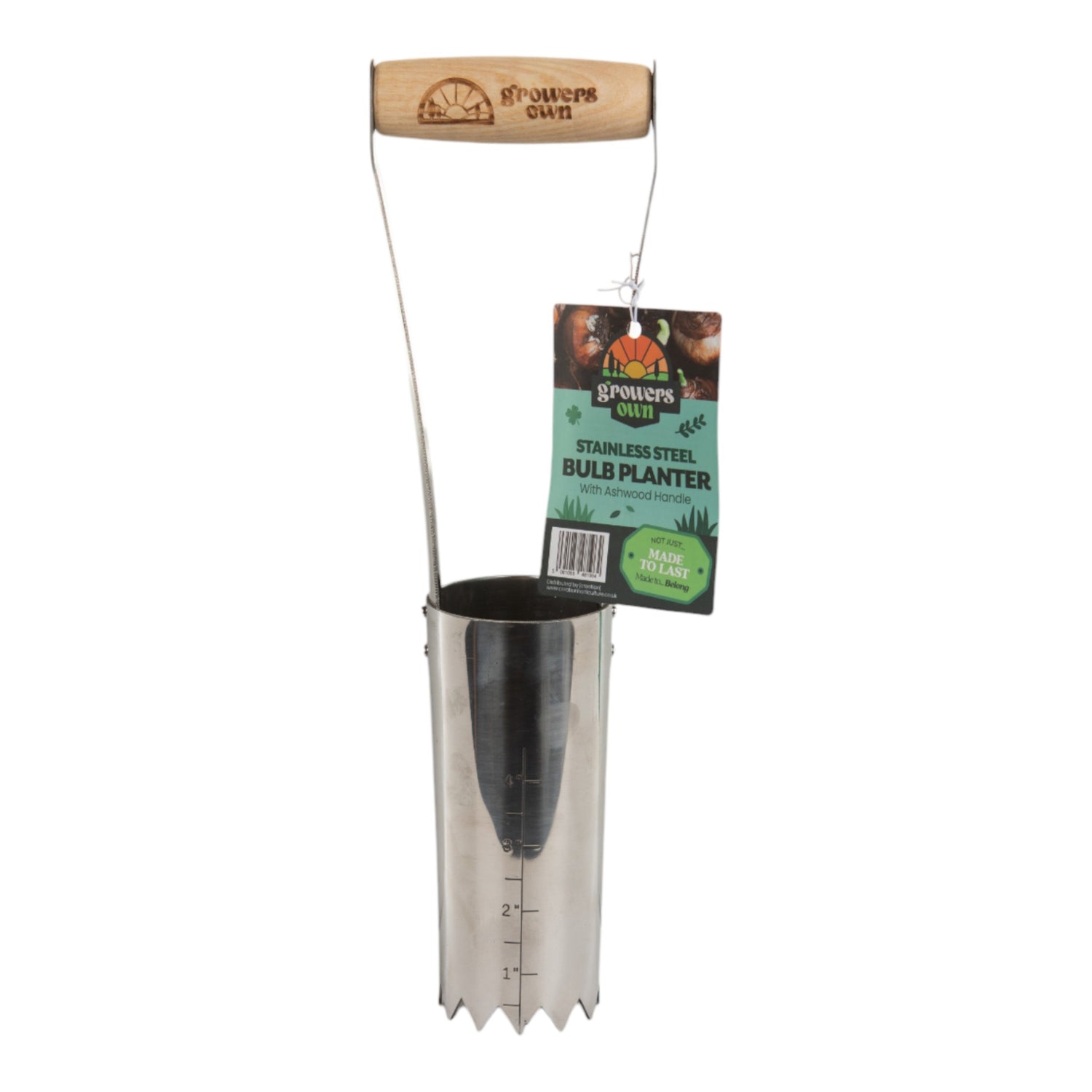


£5.75
Unit price per£5.75
Unit price perThe Growers Own Stainless Steel Bulb Planter with Ashwood Handle is designed for making consistent planting holes for bulbs and similar planting work.
It is a practical tool for growers, landscapers and gardeners who want dependable equipment for regular horticultural work. Using a tool designed for the specific job improves control and helps avoid unnecessary strain or damage.
The product specification identifies a stainless-steel working head or blade and an ashwood handle, combining a corrosion-resistant working surface with a traditional timber handle.
Key benefits
Consistent bulb planting
A bulb planter creates individual planting holes with limited disturbance to surrounding soil. Planting depth varies by bulb species and size, so follow the guidance for the bulbs being planted.
Care & maintenance
Remove soil, sap and plant debris after use and allow the tool to dry before storage. Check the working head or blade, handle, fasteners and joints for wear, looseness or damage.
Stainless steel is corrosion resistant, but it still benefits from being cleaned and dried rather than stored covered in wet soil or sap.
Keep the ashwood handle dry and inspect it periodically for splits, rough areas or looseness. Avoid leaving wooden-handled tools exposed outdoors for long periods.
Choosing the right tool for the job
This product is intended for making consistent planting holes for bulbs and similar planting work. Where the material, soil condition or branch size makes the job difficult, switch to a more appropriate tool rather than applying excessive leverage or force.
Using the correct tool generally gives better results and reduces wear on both the equipment and the operator.
Stainless Steel Bulb Planter with Ashwood Handle product details
| Brand | Growers Own |
|---|---|
| Product type | Bulb planter |
| Primary use | making consistent planting holes for bulbs and similar planting work |
| Working material | Stainless steel |
| Handle material | Ashwood |
Stainless Steel Bulb Planter with Ashwood Handle FAQs
What is this tool designed for?
Making consistent planting holes for bulbs and similar planting work. Who is it suitable for?
Professional growers, landscapers and gardeners where the tool matches the task. How should it be cleaned?
Remove soil, sap or plant debris after use, dry it and store it in a suitable dry location. How should it be stored?
Store it dry and protected from prolonged weather exposure. Can I use it for heavier work than intended?
No. If the task requires excessive force or leverage, choose a heavier or more appropriate tool. Does stainless steel still need maintenance?
Yes. Clean and dry it after use and remove plant residues rather than leaving the working surface dirty or wet. How should the ashwood handle be cared for?
Keep it dry, inspect it for splits or looseness and avoid prolonged outdoor exposure when the tool is not in use.
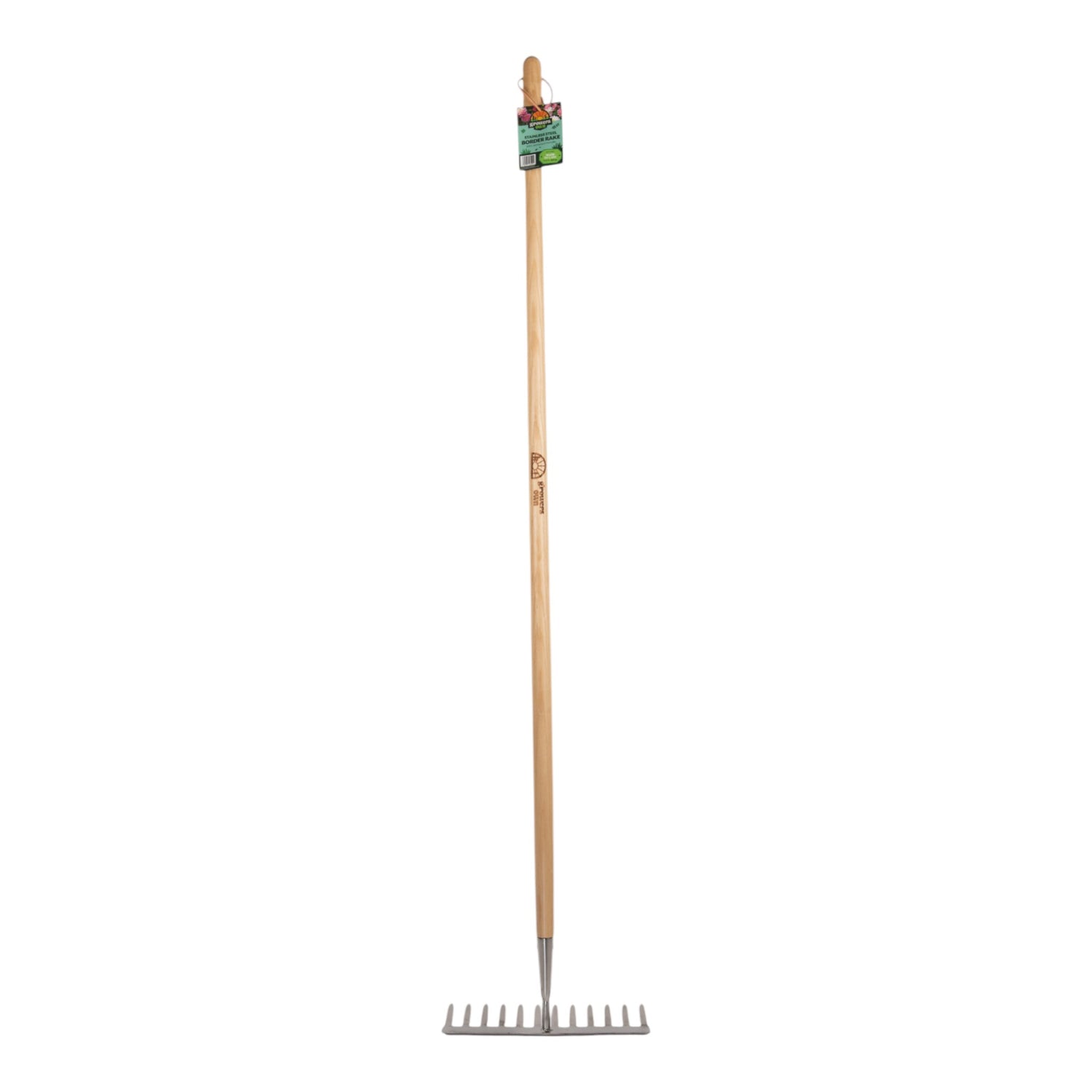


£17.50
Unit price per£17.50
Unit price perThe Growers Own Stainless Steel Border Rake with Ashwood Handle is designed for levelling, cultivating and tidying soil in beds, borders and confined planting areas.
It is a practical tool for growers, landscapers and gardeners who want dependable equipment for regular horticultural work. Using a tool designed for the specific job improves control and helps avoid unnecessary strain or damage.
The product specification identifies a stainless-steel working head or blade and an ashwood handle, combining a corrosion-resistant working surface with a traditional timber handle.
Key benefits
Levelling & preparing border soil
Use the rake to break down loose surface soil, level prepared beds and gather small stones or debris. Its compact width is useful between plants and in tighter border areas.
Care & maintenance
Remove soil, sap and plant debris after use and allow the tool to dry before storage. Check the working head or blade, handle, fasteners and joints for wear, looseness or damage.
Stainless steel is corrosion resistant, but it still benefits from being cleaned and dried rather than stored covered in wet soil or sap.
Keep the ashwood handle dry and inspect it periodically for splits, rough areas or looseness. Avoid leaving wooden-handled tools exposed outdoors for long periods.
Choosing the right tool for the job
This product is intended for levelling, cultivating and tidying soil in beds, borders and confined planting areas. Where the material, soil condition or branch size makes the job difficult, switch to a more appropriate tool rather than applying excessive leverage or force.
Using the correct tool generally gives better results and reduces wear on both the equipment and the operator.
Stainless Steel Border Rake with Ashwood Handle product details
| Brand | Growers Own |
|---|---|
| Product type | Border rake |
| Primary use | levelling, cultivating and tidying soil in beds, borders and confined planting areas |
| Working material | Stainless steel |
| Handle material | Ashwood |
Stainless Steel Border Rake with Ashwood Handle FAQs
What is this tool designed for?
Levelling, cultivating and tidying soil in beds, borders and confined planting areas. Who is it suitable for?
Professional growers, landscapers and gardeners where the tool matches the task. How should it be cleaned?
Remove soil, sap or plant debris after use, dry it and store it in a suitable dry location. How should it be stored?
Store it dry and protected from prolonged weather exposure. Can I use it for heavier work than intended?
No. If the task requires excessive force or leverage, choose a heavier or more appropriate tool. Does stainless steel still need maintenance?
Yes. Clean and dry it after use and remove plant residues rather than leaving the working surface dirty or wet. How should the ashwood handle be cared for?
Keep it dry, inspect it for splits or looseness and avoid prolonged outdoor exposure when the tool is not in use.
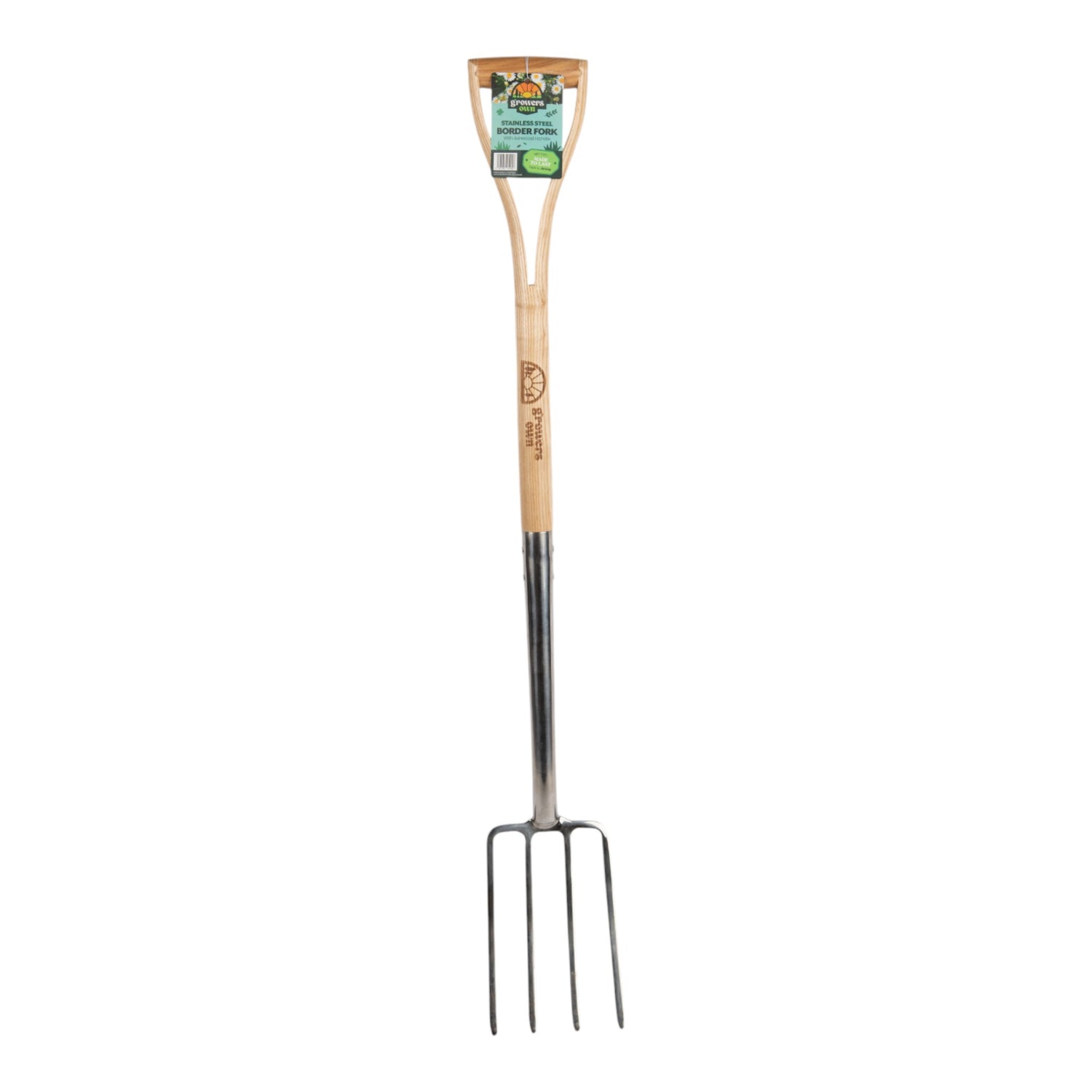

£19.75
Unit price per£19.75
Unit price perThe Growers Own Stainless Steel Border Fork with Ashwood Handle is designed for cultivating, loosening and lifting soil in beds and borders where a full-size fork can be cumbersome.
It is a practical tool for growers, landscapers and gardeners who want dependable equipment for regular horticultural work. Using a tool designed for the specific job improves control and helps avoid unnecessary strain or damage.
The product specification identifies a stainless-steel working head or blade and an ashwood handle, combining a corrosion-resistant working surface with a traditional timber handle.
Key benefits
Compact cultivation in beds & borders
The compact border-fork format is useful around established planting where a full-size digging fork can be cumbersome. Use it to loosen soil, incorporate suitable amendments and lift material while avoiding important roots.
Care & maintenance
Remove soil, sap and plant debris after use and allow the tool to dry before storage. Check the working head or blade, handle, fasteners and joints for wear, looseness or damage.
Stainless steel is corrosion resistant, but it still benefits from being cleaned and dried rather than stored covered in wet soil or sap.
Keep the ashwood handle dry and inspect it periodically for splits, rough areas or looseness. Avoid leaving wooden-handled tools exposed outdoors for long periods.
Choosing the right tool for the job
This product is intended for cultivating, loosening and lifting soil in beds and borders where a full-size fork can be cumbersome. Where the material, soil condition or branch size makes the job difficult, switch to a more appropriate tool rather than applying excessive leverage or force.
Using the correct tool generally gives better results and reduces wear on both the equipment and the operator.
Stainless Steel Border Fork with Ashwood Handle product details
| Brand | Growers Own |
|---|---|
| Product type | Border fork |
| Primary use | cultivating, loosening and lifting soil in beds and borders where a full-size fork can be cumbersome |
| Working material | Stainless steel |
| Handle material | Ashwood |
Stainless Steel Border Fork with Ashwood Handle FAQs
What is this tool designed for?
Cultivating, loosening and lifting soil in beds and borders where a full-size fork can be cumbersome. Who is it suitable for?
Professional growers, landscapers and gardeners where the tool matches the task. How should it be cleaned?
Remove soil, sap or plant debris after use, dry it and store it in a suitable dry location. How should it be stored?
Store it dry and protected from prolonged weather exposure. Can I use it for heavier work than intended?
No. If the task requires excessive force or leverage, choose a heavier or more appropriate tool. Does stainless steel still need maintenance?
Yes. Clean and dry it after use and remove plant residues rather than leaving the working surface dirty or wet. How should the ashwood handle be cared for?
Keep it dry, inspect it for splits or looseness and avoid prolonged outdoor exposure when the tool is not in use.
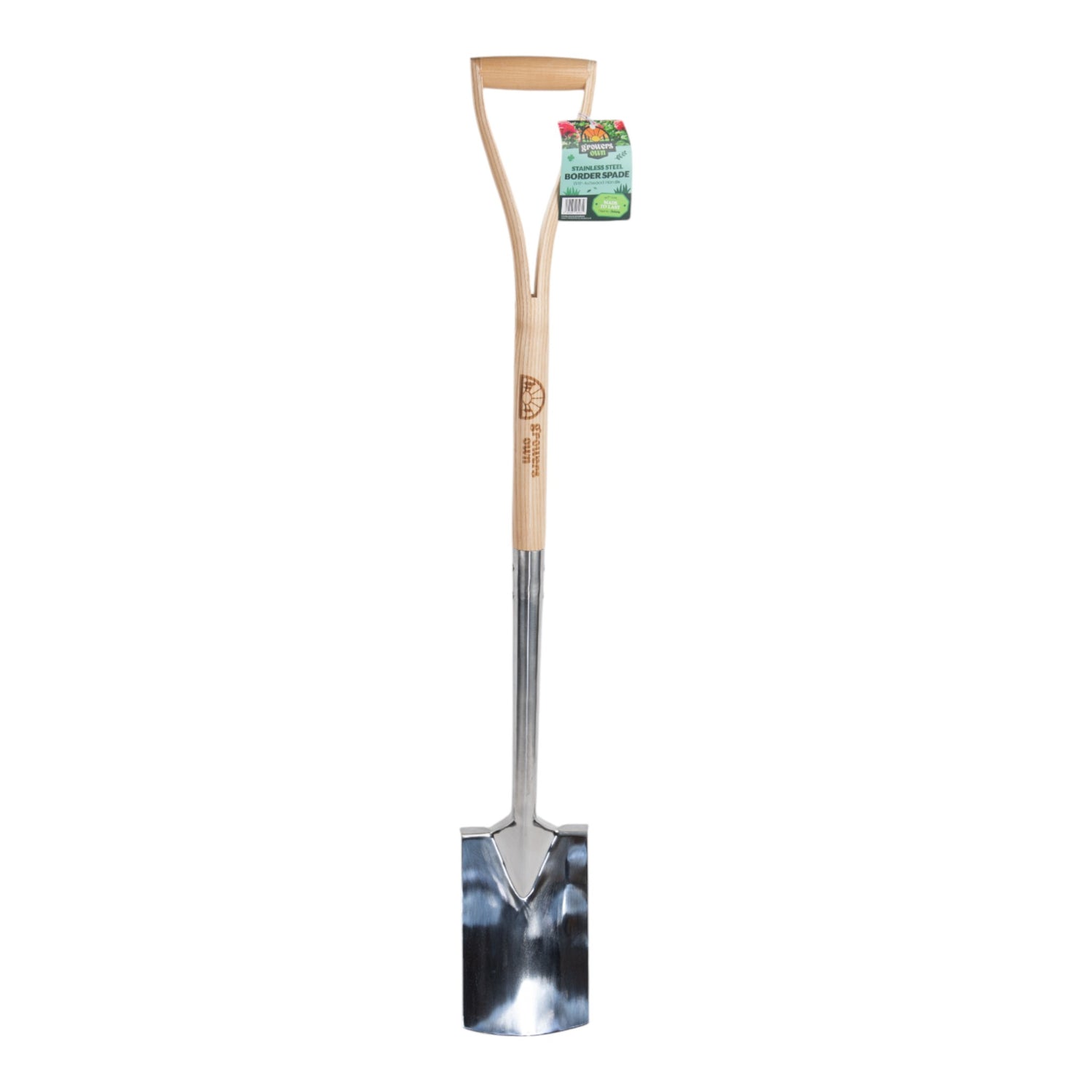


£19.75
Unit price per£19.75
Unit price perThe Growers Own Stainless Steel Border Spade with Ashwood Handle is designed for digging, planting and working in beds and borders where a compact spade is useful.
It is a practical tool for growers, landscapers and gardeners who want dependable equipment for regular horticultural work. Using a tool designed for the specific job improves control and helps avoid unnecessary strain or damage.
The product specification identifies a stainless-steel working head or blade and an ashwood handle, combining a corrosion-resistant working surface with a traditional timber handle.
Key benefits
Digging in beds & borders
The compact border-spade format is useful for planting and soil preparation where space is restricted. Use controlled cuts into workable soil and avoid levering against immovable objects.
Care & maintenance
Remove soil, sap and plant debris after use and allow the tool to dry before storage. Check the working head or blade, handle, fasteners and joints for wear, looseness or damage.
Stainless steel is corrosion resistant, but it still benefits from being cleaned and dried rather than stored covered in wet soil or sap.
Keep the ashwood handle dry and inspect it periodically for splits, rough areas or looseness. Avoid leaving wooden-handled tools exposed outdoors for long periods.
Choosing the right tool for the job
This product is intended for digging, planting and working in beds and borders where a compact spade is useful. Where the material, soil condition or branch size makes the job difficult, switch to a more appropriate tool rather than applying excessive leverage or force.
Using the correct tool generally gives better results and reduces wear on both the equipment and the operator.
Stainless Steel Border Spade with Ashwood Handle product details
| Brand | Growers Own |
|---|---|
| Product type | Border spade |
| Primary use | digging, planting and working in beds and borders where a compact spade is useful |
| Working material | Stainless steel |
| Handle material | Ashwood |
Stainless Steel Border Spade with Ashwood Handle FAQs
What is this tool designed for?
Digging, planting and working in beds and borders where a compact spade is useful. Who is it suitable for?
Professional growers, landscapers and gardeners where the tool matches the task. How should it be cleaned?
Remove soil, sap or plant debris after use, dry it and store it in a suitable dry location. How should it be stored?
Store it dry and protected from prolonged weather exposure. Can I use it for heavier work than intended?
No. If the task requires excessive force or leverage, choose a heavier or more appropriate tool. Does stainless steel still need maintenance?
Yes. Clean and dry it after use and remove plant residues rather than leaving the working surface dirty or wet. How should the ashwood handle be cared for?
Keep it dry, inspect it for splits or looseness and avoid prolonged outdoor exposure when the tool is not in use.
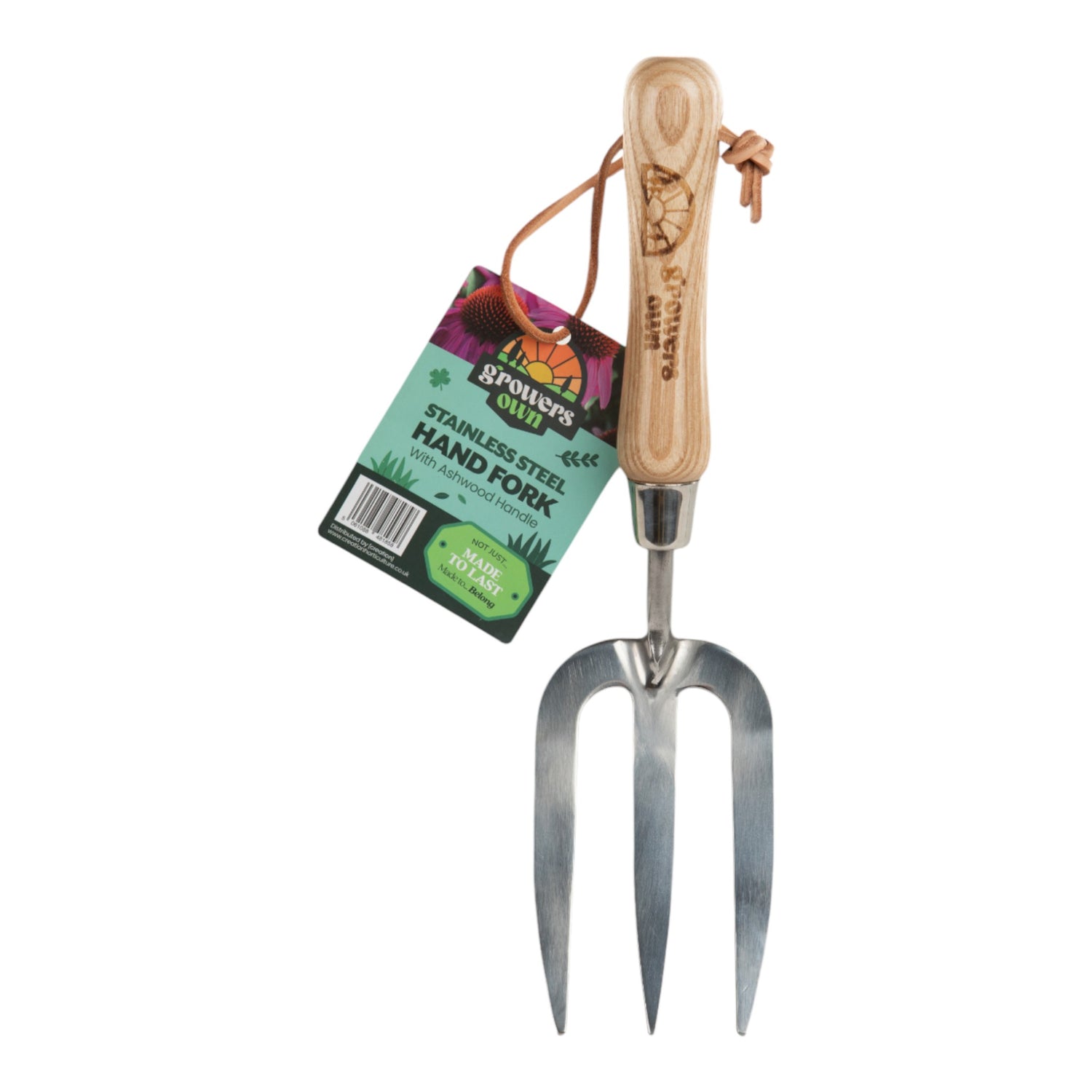


£4.50
Unit price per£4.50
Unit price perThe Growers Own Stainless Steel Hand Fork with Ashwood Handle is designed for loosening soil, cultivating around established plants and working in containers or raised beds.
It is a practical tool for growers, landscapers and gardeners who want dependable equipment for regular horticultural work. Using a tool designed for the specific job improves control and helps avoid unnecessary strain or damage.
The product specification identifies a stainless-steel working head or blade and an ashwood handle, combining a corrosion-resistant working surface with a traditional timber handle.
Key benefits
Loosening soil around plants
Use the fork to loosen the upper soil layer, break up small clods and cultivate around established plants. Work carefully around shallow roots and plant crowns.
Care & maintenance
Remove soil, sap and plant debris after use and allow the tool to dry before storage. Check the working head or blade, handle, fasteners and joints for wear, looseness or damage.
Stainless steel is corrosion resistant, but it still benefits from being cleaned and dried rather than stored covered in wet soil or sap.
Keep the ashwood handle dry and inspect it periodically for splits, rough areas or looseness. Avoid leaving wooden-handled tools exposed outdoors for long periods.
Choosing the right tool for the job
This product is intended for loosening soil, cultivating around established plants and working in containers or raised beds. Where the material, soil condition or branch size makes the job difficult, switch to a more appropriate tool rather than applying excessive leverage or force.
Using the correct tool generally gives better results and reduces wear on both the equipment and the operator.
Stainless Steel Hand Fork with Ashwood Handle product details
| Brand | Growers Own |
|---|---|
| Product type | Hand fork |
| Primary use | loosening soil, cultivating around established plants and working in containers or raised beds |
| Working material | Stainless steel |
| Handle material | Ashwood |
Stainless Steel Hand Fork with Ashwood Handle FAQs
What is this tool designed for?
Loosening soil, cultivating around established plants and working in containers or raised beds. Who is it suitable for?
Professional growers, landscapers and gardeners where the tool matches the task. How should it be cleaned?
Remove soil, sap or plant debris after use, dry it and store it in a suitable dry location. How should it be stored?
Store it dry and protected from prolonged weather exposure. Can I use it for heavier work than intended?
No. If the task requires excessive force or leverage, choose a heavier or more appropriate tool. Does stainless steel still need maintenance?
Yes. Clean and dry it after use and remove plant residues rather than leaving the working surface dirty or wet. How should the ashwood handle be cared for?
Keep it dry, inspect it for splits or looseness and avoid prolonged outdoor exposure when the tool is not in use.
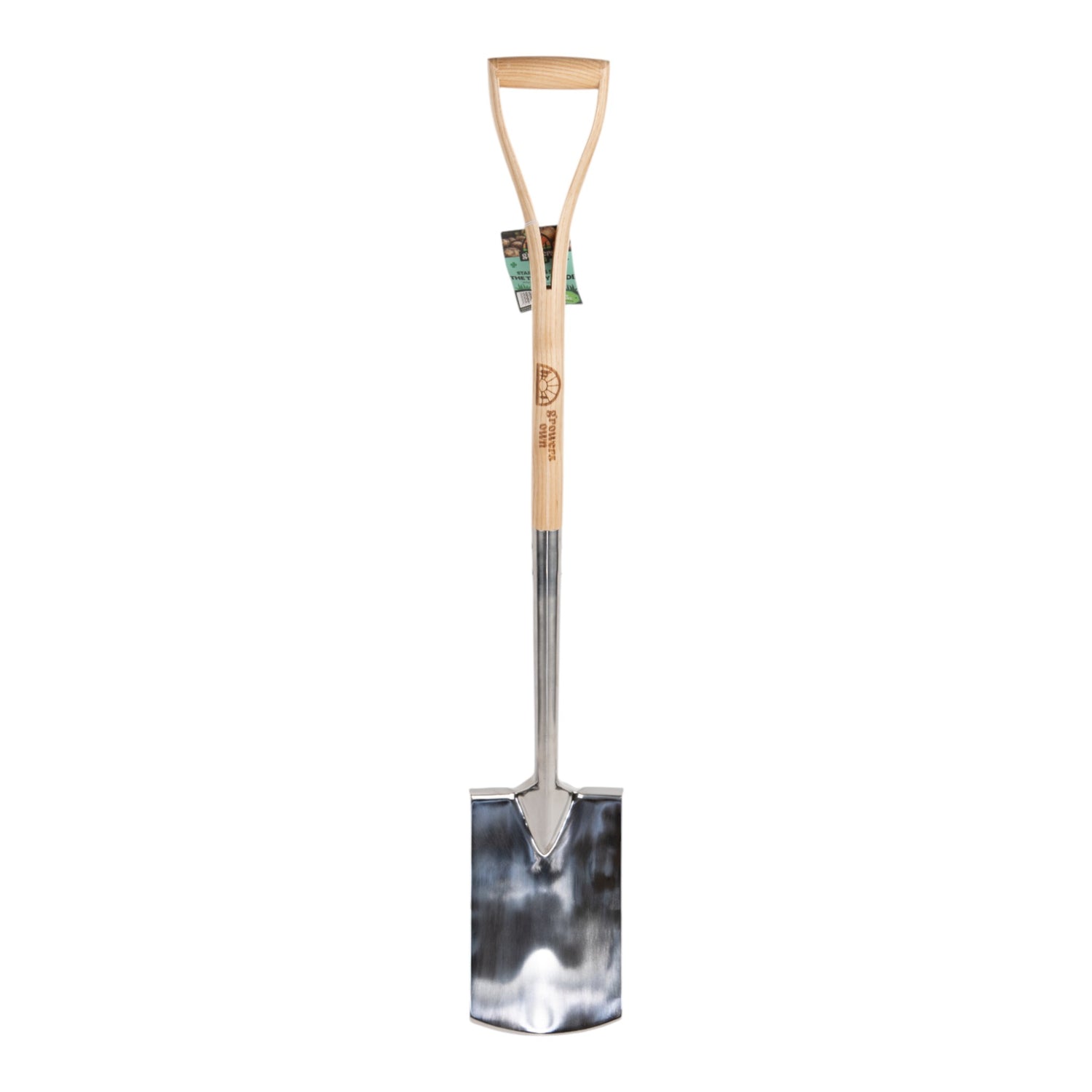


£19.75
Unit price per£19.75
Unit price perThe Growers Own Stainless Steel Terry Spade with Ashwood Handle is designed for general digging, planting and soil preparation.
It is a practical tool for growers, landscapers and gardeners who want dependable equipment for regular horticultural work. Using a tool designed for the specific job improves control and helps avoid unnecessary strain or damage.
The product specification identifies a stainless-steel working head or blade and an ashwood handle, combining a corrosion-resistant working surface with a traditional timber handle.
Key benefits
General digging & soil preparation
Use the spade for digging, planting holes and preparing beds. Work with manageable quantities of soil and loosen very compacted or stony ground progressively.
Care & maintenance
Remove soil, sap and plant debris after use and allow the tool to dry before storage. Check the working head or blade, handle, fasteners and joints for wear, looseness or damage.
Stainless steel is corrosion resistant, but it still benefits from being cleaned and dried rather than stored covered in wet soil or sap.
Keep the ashwood handle dry and inspect it periodically for splits, rough areas or looseness. Avoid leaving wooden-handled tools exposed outdoors for long periods.
Choosing the right tool for the job
This product is intended for general digging, planting and soil preparation. Where the material, soil condition or branch size makes the job difficult, switch to a more appropriate tool rather than applying excessive leverage or force.
Using the correct tool generally gives better results and reduces wear on both the equipment and the operator.
Stainless Steel Terry Spade with Ashwood Handle product details
| Brand | Growers Own |
|---|---|
| Product type | Garden spade |
| Primary use | general digging, planting and soil preparation |
| Working material | Stainless steel |
| Handle material | Ashwood |
Stainless Steel Terry Spade with Ashwood Handle FAQs
What is this tool designed for?
General digging, planting and soil preparation. Who is it suitable for?
Professional growers, landscapers and gardeners where the tool matches the task. How should it be cleaned?
Remove soil, sap or plant debris after use, dry it and store it in a suitable dry location. How should it be stored?
Store it dry and protected from prolonged weather exposure. Can I use it for heavier work than intended?
No. If the task requires excessive force or leverage, choose a heavier or more appropriate tool. Does stainless steel still need maintenance?
Yes. Clean and dry it after use and remove plant residues rather than leaving the working surface dirty or wet. How should the ashwood handle be cared for?
Keep it dry, inspect it for splits or looseness and avoid prolonged outdoor exposure when the tool is not in use.
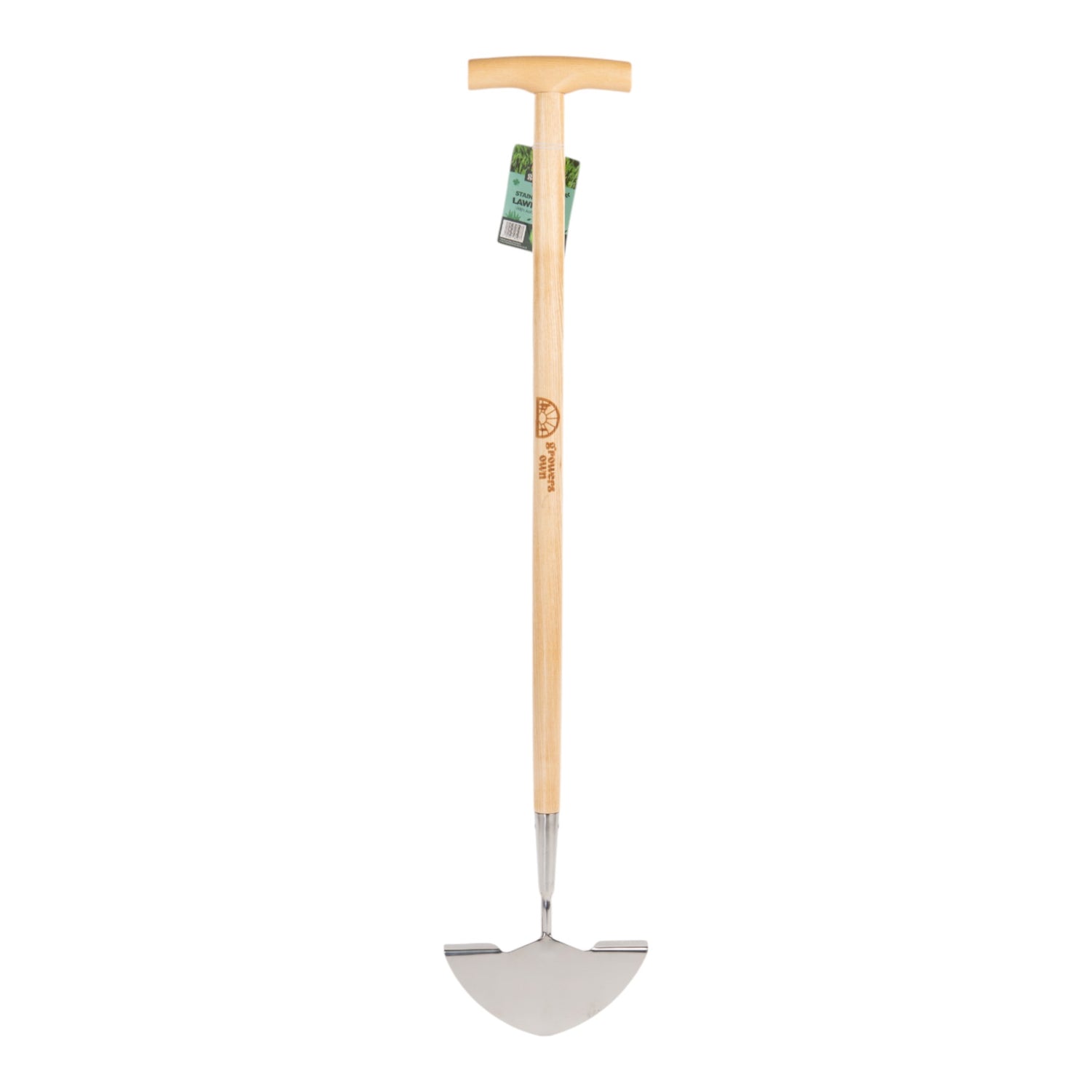

£14.50
Unit price per£14.50
Unit price perThe Growers Own Stainless Steel Lawn Edger with Ashwood Handle is designed for cutting and maintaining defined edges between lawns, borders and paths.
It is a practical tool for growers, landscapers and gardeners who want dependable equipment for regular horticultural work. Using a tool designed for the specific job improves control and helps avoid unnecessary strain or damage.
The product specification identifies a stainless-steel working head or blade and an ashwood handle, combining a corrosion-resistant working surface with a traditional timber handle.
Key benefits
Creating a defined lawn edge
Use the edger to cut a clear boundary between lawn and borders or paths. Mark the desired line first and work progressively along it for a consistent finish.
Care & maintenance
Remove soil, sap and plant debris after use and allow the tool to dry before storage. Check the working head or blade, handle, fasteners and joints for wear, looseness or damage.
Stainless steel is corrosion resistant, but it still benefits from being cleaned and dried rather than stored covered in wet soil or sap.
Keep the ashwood handle dry and inspect it periodically for splits, rough areas or looseness. Avoid leaving wooden-handled tools exposed outdoors for long periods.
Choosing the right tool for the job
This product is intended for cutting and maintaining defined edges between lawns, borders and paths. Where the material, soil condition or branch size makes the job difficult, switch to a more appropriate tool rather than applying excessive leverage or force.
Using the correct tool generally gives better results and reduces wear on both the equipment and the operator.
Stainless Steel Lawn Edger with Ashwood Handle product details
| Brand | Growers Own |
|---|---|
| Product type | Lawn edger |
| Primary use | cutting and maintaining defined edges between lawns, borders and paths |
| Working material | Stainless steel |
| Handle material | Ashwood |
Stainless Steel Lawn Edger with Ashwood Handle FAQs
What is this tool designed for?
Cutting and maintaining defined edges between lawns, borders and paths. Who is it suitable for?
Professional growers, landscapers and gardeners where the tool matches the task. How should it be cleaned?
Remove soil, sap or plant debris after use, dry it and store it in a suitable dry location. How should it be stored?
Store it dry and protected from prolonged weather exposure. Can I use it for heavier work than intended?
No. If the task requires excessive force or leverage, choose a heavier or more appropriate tool. Does stainless steel still need maintenance?
Yes. Clean and dry it after use and remove plant residues rather than leaving the working surface dirty or wet. How should the ashwood handle be cared for?
Keep it dry, inspect it for splits or looseness and avoid prolonged outdoor exposure when the tool is not in use.
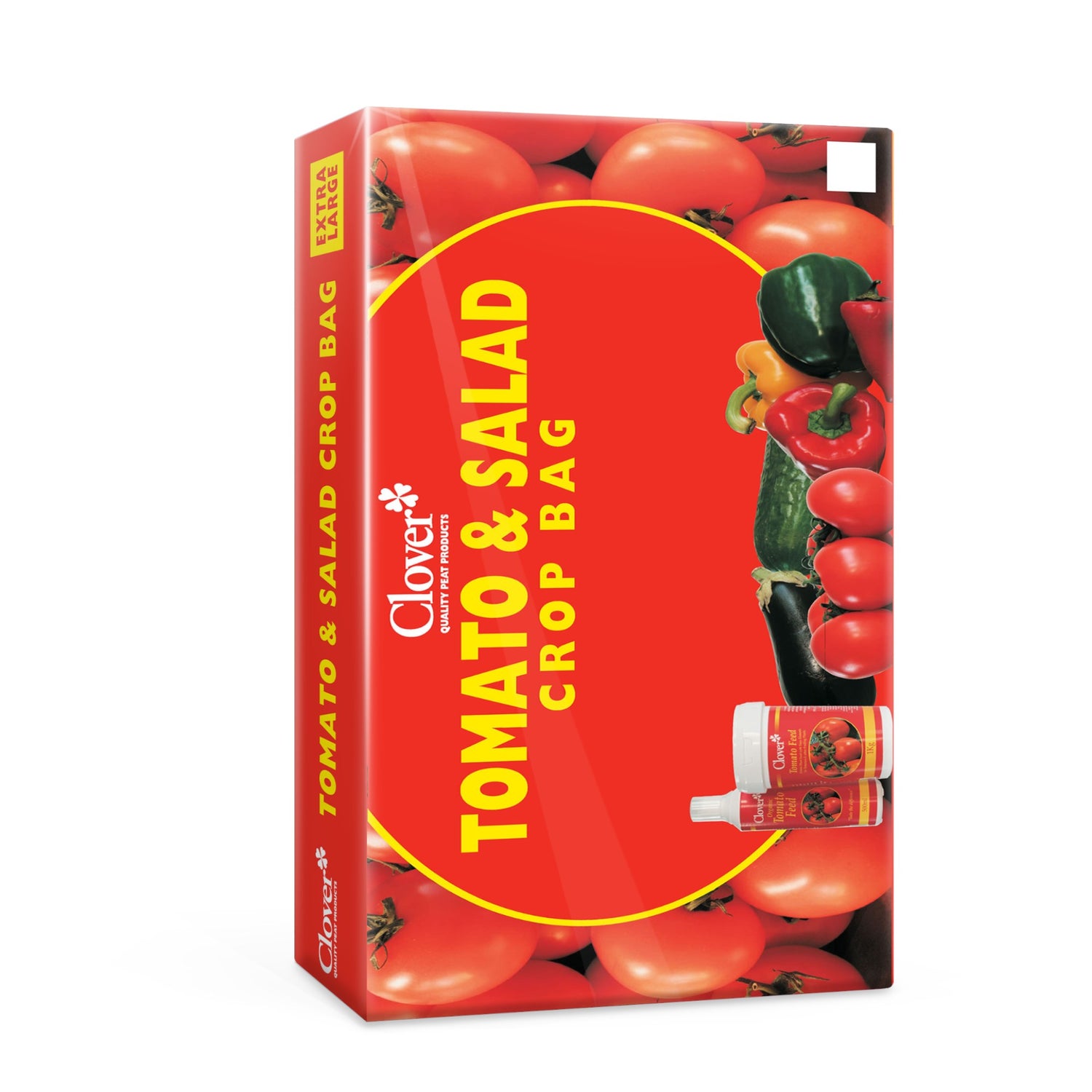
£5.79
Unit price per£5.79
Unit price perClover Tomato & Salad Crop Bag is a premium extra-large growing bag specially formulated for tomatoes and a wide range of productive summer crops. Enriched with organic nutrients and natural seaweed extract, it provides a ready-to-use growing medium designed to support healthy plants and productive cropping.
Developed specifically for fruiting and salad crops, this generously sized grow bag provides plenty of growing medium for developing root systems while supplying the conditions required for strong plant establishment.
Although tomatoes are an obvious choice, the Clover Tomato & Salad Crop Bag is equally useful for crops including aubergines, chillies, courgettes, cucumbers, lettuce, melons and strawberries.
It provides a straightforward growing solution for gardeners while also offering garden centres and horticultural retailers a recognised specialist crop bag for seasonal vegetable and fruit growing.
Why choose Clover Tomato & Salad Crop Bag?
What can you grow in a Clover Tomato & Salad Crop Bag?
Despite its name, this is far more than simply a tomato grow bag. Clover recommends it for a wide range of productive summer plants.
The number of plants grown in each bag should be adjusted according to the crop. Larger, vigorous plants require more root space than smaller salad crops, so avoid overcrowding simply to maximise the number of plants per bag.
How to plant a Clover Tomato & Salad Crop Bag
Position the crop bag in its final growing location before planting, particularly if it will be used in a greenhouse or another area where moving a planted bag later would be inconvenient.
Before planting, Clover recommends adding approximately 5-10 litres of water to each bag. Allow the growing medium to absorb the moisture rather than planting into a completely dry bag.
Use the marked planting positions on the bag as a guide, adjusting the final number of plants according to the crop being grown. Make suitable planting openings, create space within the growing medium and plant at the appropriate depth for the crop.
After planting, water carefully to settle the growing medium around the roots and continue monitoring moisture as the plants establish.
Watering tomatoes & salad crops in grow bags
Careful watering is particularly important when growing vigorous crops in bags because the available volume of growing medium is limited compared with open ground.
Clover advises that the growing medium should not be allowed to dry out, but overwatering should also be avoided because prolonged waterlogging can reduce the amount of air available around the roots.
Water demand will increase as plants establish, temperatures rise and fruiting crops develop larger canopies. Check the moisture condition regularly rather than relying on a fixed watering interval.
During warm summer conditions, established tomatoes and other vigorous crops may require considerably more frequent watering than young plants at the beginning of the growing cycle.
Feeding for sustained cropping
The Clover Tomato & Salad Crop Bag contains organic nutrients and natural seaweed extract to support crop establishment and development.
As plants mature and cropping increases, however, their nutritional demand also rises. Clover recommends supplementary liquid feeding for improved and sustained cropping.
Choose an appropriate feed for the crop being grown and follow the fertiliser manufacturer's application instructions. Tomatoes and other heavy-fruiting crops can have substantial nutritional requirements during flowering and fruit development.
Ideal for garden centres & horticultural retailers
Tomato and vegetable growing remains an important seasonal gardening category, and a specialist crop bag provides customers with a simple route into growing productive plants without requiring separate pots and bags of compost.
For garden centres and horticultural retailers, Clover Tomato & Salad Crop Bags pair naturally with tomato plants, vegetable plants, canes, supports, watering accessories and specialist feeds, making them a useful component of a complete seasonal growing range.
Creation Horticulture supplies this product in trade quantities, with 66 crop bags per pallet.
About Clover
Clover is a specialist growing media manufacturer supplying both professional horticulture and the retail gardening market. Its range covers retail composts and growing media alongside specialist professional substrates developed for commercial crop production.
The Tomato & Salad Crop Bag forms part of Clover's specialist retail growing media range and has been formulated specifically for productive fruit and vegetable growing rather than simply using a general-purpose compost in a bag.
For garden centres and horticultural retailers, the Clover range provides a recognised selection of growing media covering general gardening, specialist crops and professional growing requirements.
Clover packaging update
Clover is currently rolling out updated branded packaging across selected products. During this transition, stock may be supplied in the previous packaging design, the newer design, or a mixture of both when ordering multiple bags.
This packaging change does not indicate a different product. Customers will receive the same Clover Tomato & Salad Crop Bag formulation irrespective of which current packaging design is supplied.
Clover Tomato & Salad Crop Bag product details
| Brand | Clover |
|---|---|
| Product | Tomato & Salad Crop Bag |
| Product type | Extra-large specialist crop growing bag |
| Recommended planting | 3-5 plants depending on crop type and spacing requirements |
| Added nutrition | Organic nutrients and natural seaweed extract |
| Suitable crops | Tomatoes, aubergines, chillies, courgettes, cucumbers, lettuce, melons, strawberries and other suitable summer crops |
| Pre-plant watering | Approximately 5-10 litres per bag |
| Supplementary feeding | Liquid feeding recommended for improved and sustained cropping |
| Typical locations | Greenhouses, patios and suitable outdoor growing areas |
| Pallet quantity | 66 bags |
Clover Tomato & Salad Crop Bag FAQs
How many tomato plants can I grow in a Clover crop bag?
Clover describes the product as a 3-5 plant bag. The appropriate number depends on the crop and its eventual size, and larger plants should be given sufficient space rather than overcrowded. Is this crop bag only for tomatoes?
No. It is also suitable for crops including aubergines, chillies, courgettes, cucumbers, lettuce, melons and strawberries. Does the Clover Tomato & Salad Crop Bag contain nutrients?
Yes. Clover formulates the growing medium with organic nutrients and natural seaweed extract. Should I water the crop bag before planting?
Yes. Clover recommends adding approximately 5-10 litres of water to the bag before planting to moisten the growing medium. Do tomatoes in the bag need additional feeding?
Clover recommends supplementary liquid feeding for improved and sustained cropping. Follow the instructions for the chosen plant feed and adjust the programme to the crop being grown. How often should I water a tomato grow bag?
There is no single interval suitable for every situation. Water demand changes with plant size, crop, temperature and growing conditions. Check the growing medium regularly, avoiding both complete drying and prolonged waterlogging. Can the Clover crop bag be used in a greenhouse?
Yes. It is well suited to greenhouse production of tomatoes, cucumbers and other suitable warm-season crops, as well as patio and outdoor growing where conditions are appropriate. Can strawberries be grown in this crop bag?
Yes. Strawberries are included among the crops recommended for Clover Tomato & Salad Crop Bag. Why might the bag I receive look different from the product image?
Clover is transitioning selected products to updated branded packaging. During the changeover, either packaging design may be supplied, but the product formulation remains the same. How many Clover Tomato & Salad Crop Bags are on a pallet?
Creation Horticulture supplies 66 Clover Tomato & Salad Crop Bags per full pallet.
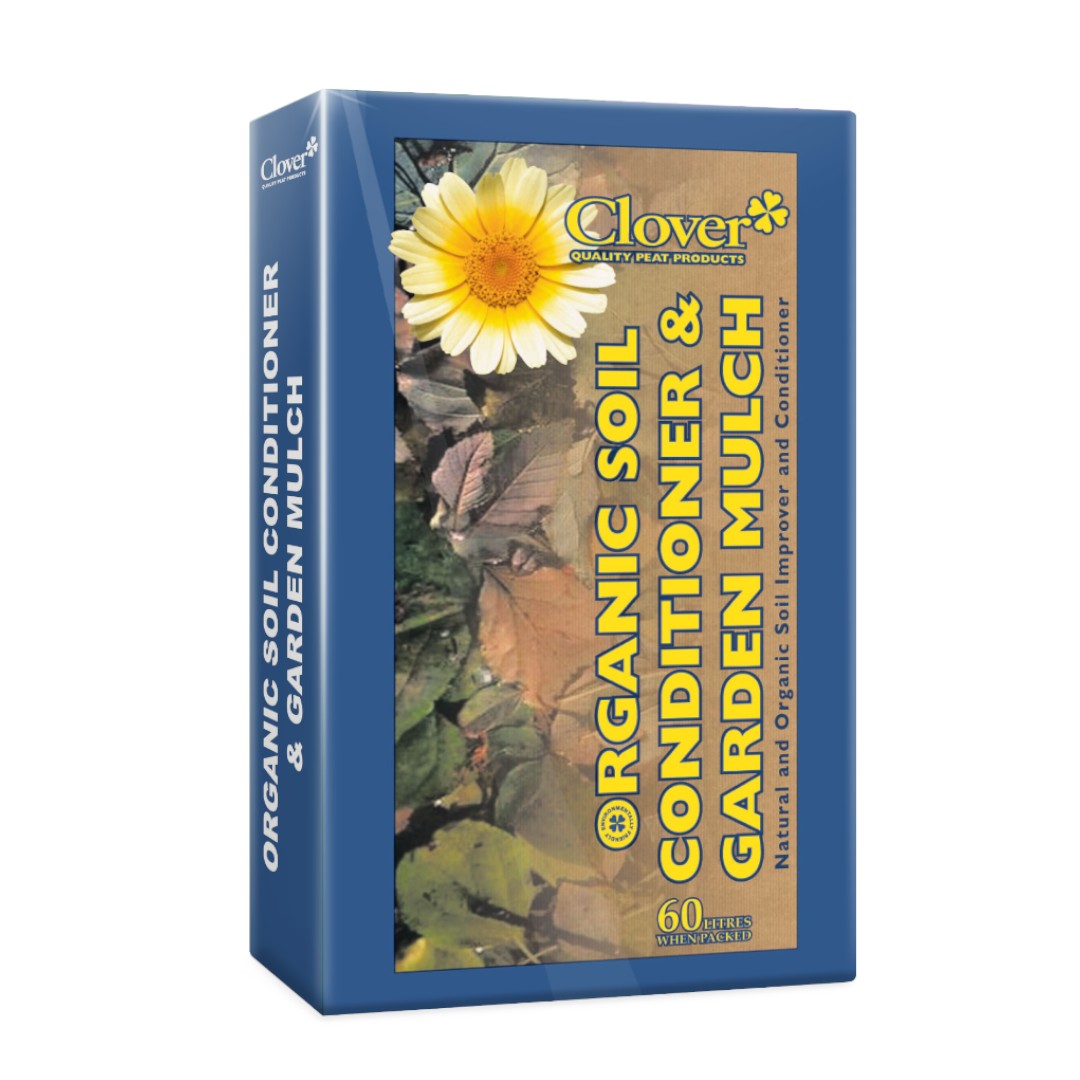

£6.45
Unit price per£6.45
Unit price perClover Organic Soil Conditioner 60L is a natural source of organic fibre and humus designed to improve the structure and condition of garden soil. Suitable for both heavy clay and light, dry soils, it helps improve drainage, moisture retention and the overall physical condition of the soil before planting.
Unlike a potting compost, this product is intended primarily as a soil improver. It is incorporated into existing garden soil to increase organic matter and help create a better environment for developing roots.
Its benefits work in two very different soil types. In heavy clay soils, incorporating organic material helps improve structure and drainage. In light and sandy soils, the added organic matter helps improve the soil's ability to retain moisture.
Clover also identifies its Organic Soil Conditioner as helping to suppress common weeds, making it a versatile product for preparing and improving beds, borders and other cultivated garden areas.
Why choose Clover Organic Soil Conditioner?
Improve clay, sandy & tired garden soils
Different soils present very different challenges, which is why adding organic matter is such a useful part of garden soil management.
Heavy clay soil
Heavy soils can become dense and difficult to work, particularly when wet. Incorporating Clover Organic Soil Conditioner adds organic material that helps improve the physical structure of the soil and encourages better drainage.
Light & sandy soil
Sandy soils tend to drain rapidly and can lose moisture quickly during warm weather. Clover Organic Soil Conditioner adds organic fibre and humus, helping improve moisture retention and giving light soil more body.
Tired cultivated soil
Beds and borders that have been cultivated repeatedly can benefit from the regular addition of organic matter. Incorporating a soil conditioner helps maintain and improve the physical condition of the soil rather than simply adding plant nutrients.
Where can Clover Organic Soil Conditioner be used?
This soil improver can be incorporated into existing soil across a wide range of garden areas, including:
Because this is a soil conditioner rather than a conventional potting compost, it is best used to improve existing soil rather than as a standalone growing medium for filling pots and containers.
How to use an organic soil conditioner
Spread the soil conditioner over the area to be improved and thoroughly incorporate it into the existing soil before planting. Concentrate on the root zone where improved soil structure will provide the greatest benefit to establishing plants.
For established beds and borders, it can be incorporated when preparing areas between planting cycles or when renovating tired soil.
The quantity required will depend on the existing soil condition and the area being improved. Very heavy clay, extremely light sandy soil or ground low in organic matter may benefit from more substantial improvement than already well-conditioned garden soil.
Soil conditioner vs compost: what's the difference?
Although the terms are sometimes used interchangeably, Clover Organic Soil Conditioner has a different primary purpose from a standard multi-purpose potting compost.
A potting compost is formulated to provide a growing medium in which plants can be raised directly. A soil conditioner is incorporated into existing soil to improve its physical characteristics and organic matter content.
This makes Clover Organic Soil Conditioner particularly useful for gardeners looking to improve beds, borders and vegetable plots rather than simply filling pots.
Why organic matter matters
Maintaining organic matter is an important part of looking after cultivated soil. Organic material influences soil structure, water management and the environment surrounding plant roots.
In heavy soils, it can help create a more workable structure with improved movement of air and water. In lighter soils, organic matter can improve moisture retention and reduce the tendency for water to drain away too rapidly.
This is why the same Clover Organic Soil Conditioner can be useful at opposite ends of the soil spectrum, from dense clay to free-draining sandy ground.
About Clover
Clover has around 50 years of experience producing growing media for farms, nurseries, gardens and greenhouses across the UK. Its range extends from retail composts and soil improvers through to growing media for professional horticultural production.
The Organic Soil Conditioner is part of Clover's retail range and is specifically designed for improving existing garden soils. Rather than being another general-purpose compost, its role is to add organic fibre and humus where the soil itself needs improvement.
Clover packaging update
Clover is currently rolling out updated branded packaging across selected products. During this transition, customers may receive the previous packaging design, the newer design, or a mixture of both when ordering multiple bags.
This is a packaging change only. Customers will receive the same Clover Organic Soil Conditioner regardless of which current packaging design is supplied.
Clover Organic Soil Conditioner 60L product details
| Brand | Clover |
|---|---|
| Product | Organic Soil Conditioner |
| Bag size | 60L |
| Product type | Organic soil conditioner and soil improver |
| Key components | Natural source of organic fibre and humus |
| Heavy clay soils | Helps improve soil structure and drainage |
| Light and sandy soils | Helps improve moisture retention |
| Weed suppression | Helps suppress common weeds |
| Primary application | Incorporation into existing garden soil |
| Suitable areas | Beds, borders, vegetable plots, raised beds and other cultivated garden soils |
| Pallet quantity | 60 x 60L bags |
| Total nominal volume per pallet | 3,600L |
Clover Organic Soil Conditioner FAQs
What does Clover Organic Soil Conditioner do?
It adds organic fibre and humus to existing garden soil, helping improve soil structure and creating better physical growing conditions for plant roots. Is Clover Organic Soil Conditioner good for clay soil?
Yes. Clover specifically identifies the product as useful for difficult soils and states that it helps improve drainage in heavy clay soil. Can I use it in sandy soil?
Yes. In light and dry soils, its organic fibre and humus help improve moisture retention, making it useful for sandy ground as well as heavy clay. Is soil conditioner the same as multi-purpose compost?
No. Multi-purpose compost is designed to act as a growing medium, while Clover Organic Soil Conditioner is primarily intended to be incorporated into existing soil to improve its condition. Can I plant directly into Clover Organic Soil Conditioner?
It is intended as a soil improver rather than a standalone potting medium. For most applications it should be thoroughly incorporated into existing garden soil before planting. Can it be used in vegetable beds?
Yes. It can be incorporated into existing soil in vegetable plots and raised beds where additional organic matter and improved soil structure are required. Does Clover Organic Soil Conditioner help suppress weeds?
Yes. Clover's product information states that the soil conditioner also acts to suppress common weeds. When is the best time to improve garden soil?
Soil can be improved whenever conditions allow it to be worked effectively. Incorporating organic matter before new planting or between cropping cycles makes it easier to mix the conditioner thoroughly through the root zone. Why might the bag I receive look different from the product image?
Clover is transitioning selected products to updated branded packaging. During the changeover either current packaging design may be supplied, while the product itself remains the same. How many 60L bags are supplied on a full pallet?
A full Creation Horticulture pallet contains 60 x 60L bags, providing a total nominal volume of 3,600 litres.

£6.79
Unit price per£6.79
Unit price perClover Sports Turf & Lawn Dressing 25L is a fine-grade top dressing developed for lawns, bowling greens and sports turf. Applied as a thin layer over established grass, it can help improve surface levels, support healthy turf growth and form part of a regular lawn renovation and maintenance programme.
Top dressing is widely used to maintain established turf because it allows small quantities of material to be worked gradually into the surface. Rather than covering the grass, the dressing is spread thinly and worked down towards the soil surface between the blades.
Clover's fine-grade formulation makes it suitable for both domestic lawns and more intensively maintained turf areas where an even surface and consistent finish are important.
Supplied in a convenient 25 litre bag, Creation Horticulture supplies 60 x 25L bags per full pallet.
Why choose Clover Sports Turf & Lawn Dressing?
What is lawn dressing used for?
Lawn dressing is applied over existing grass rather than being used as a replacement for the underlying soil. Typical applications include:
For substantial changes in ground level or the preparation of a completely new lawn, a suitable topsoil is normally more appropriate. Lawn dressing is intended primarily for gradual surface improvement and maintenance of established turf.
How to apply lawn top dressing
Before applying the dressing, mow the lawn to an appropriate height and remove excessive surface debris. If the lawn is being renovated, scarification or aeration can be carried out before top dressing where required.
Distribute the Clover Lawn Dressing evenly across the grass in a light, controlled layer. Work the material into the turf using a suitable lawn lute, levelling tool, brush or the back of a rake.
The objective is to move the dressing down towards the soil surface while leaving the majority of the grass blades exposed. Avoid burying healthy turf beneath a heavy layer of material.
Deeper depressions are better corrected gradually with repeated light applications rather than attempting to raise the surface dramatically in a single treatment.
Ideal for lawn renovation
Clover Sports Turf & Lawn Dressing can be incorporated into a wider renovation programme when an established lawn has become compacted, worn or uneven.
Depending on the condition of the turf, renovation may include mowing, scarifying to remove unwanted thatch, aerating compacted areas, top dressing and overseeding worn patches.
When top dressing follows aeration, some of the fine material can work into the openings created in the surface while the remainder is distributed around the existing grass.
Using lawn dressing when overseeding
Top dressing and overseeding are often combined when renovating thin or worn lawns.
After preparing the existing turf, appropriate grass seed can be distributed over the required area. A light application of fine lawn dressing can then help create closer contact between seed and the prepared surface.
Keep newly seeded areas appropriately moist during germination and avoid heavy traffic while young grass establishes. Always follow the sowing guidance supplied with the chosen grass seed.
Levelling an uneven lawn
Minor hollows and surface irregularities can make mowing more difficult and affect the appearance of a lawn. Fine top dressing provides a way to make gradual adjustments without completely lifting established turf.
Apply additional dressing selectively to shallow depressions and work it into the grass. Where more material is required, build the level progressively so that existing grass can continue growing through the dressing.
Significant depressions or major changes in ground level may require more extensive preparation using topsoil rather than lawn dressing alone.
When should you top dress a lawn?
Lawn dressing is best applied while grass is actively growing and capable of recovering from maintenance work. This makes it particularly useful as part of spring or autumn lawn renovation when conditions are suitable.
Avoid applying a heavy dressing when grass is under significant stress from drought, extreme heat, waterlogging or other adverse conditions.
For professional turf, application timing should form part of the wider maintenance programme and take account of grass species, surface condition, weather and intended use.
Lawn Dressing vs Topsoil
Clover Lawn Dressing and Clover Top Soil are both useful for lawn work, but they perform different jobs.
Clover Sports Turf & Lawn Dressing is a fine-grade material intended for spreading over established turf as part of maintenance, renovation and gradual surface levelling.
Clover Top Soil is better suited to more substantial ground preparation, building soil levels and preparing areas before establishing a new lawn.
For an existing lawn requiring relatively small surface corrections, lawn dressing is generally the more targeted product.
About Clover turf products
Clover produces growing media and garden products for professional horticulture and the retail gardening market. Its range includes specialist products for soil improvement, planting and turf maintenance alongside its established compost range.
Sports Turf & Lawn Dressing provides a convenient bagged solution for customers carrying out regular lawn care as well as grounds maintenance and turf renovation work.
25L Lawn Dressing for garden centres & professional turf care
The 25L format is convenient for domestic lawn renovation while also providing a manageable bag size for professional turf maintenance, landscaping and grounds-care applications.
Creation Horticulture supplies 60 x 25L bags per full pallet, providing a total nominal volume of 1,500 litres per pallet.
Clover packaging update
Clover is currently rolling out updated branded packaging across selected products. During this transition, customers may receive the previous packaging design, the newer design, or a mixture of both when ordering multiple bags.
Packaging appearance may therefore vary from the product imagery shown.
Clover Sports Turf & Lawn Dressing 25L product details
| Brand | Clover |
|---|---|
| Product | Sports Turf & Lawn Dressing |
| Bag size | 25L |
| Product type | Fine-grade lawn and turf top dressing |
| Suitable for domestic lawns | Yes |
| Suitable for sports turf | Yes |
| Suitable for bowling greens | Yes |
| Typical applications | Top dressing, lawn renovation, minor levelling, aeration programmes and overseeding |
| Pallet quantity | 60 x 25L bags |
| Total nominal volume per pallet | 1,500L |
Clover Sports Turf & Lawn Dressing 25L FAQs
What does lawn top dressing do?
Top dressing adds a fine layer of material to established turf and can be used to improve surface levels, support healthy grass growth and complement routine lawn renovation. Can Clover Lawn Dressing be used on domestic lawns?
Yes. Although suitable for sports turf and bowling greens, it can also be used for regular maintenance and renovation of domestic lawns. Can I use it after aerating my lawn?
Yes. Top dressing is commonly combined with aeration as part of lawn renovation, allowing fine material to work into the prepared turf surface. Can lawn dressing be used when overseeding?
Yes. A light dressing can be incorporated into an overseeding programme and can help create good contact between grass seed and the prepared surface. Can lawn dressing level dips in grass?
It is suitable for gradually correcting minor hollows and uneven areas. Deeper depressions should be corrected progressively, while major level changes may require additional topsoil or more extensive preparation. Should the grass be completely covered?
No. Lawn dressing should generally be applied as a light layer and worked down towards the soil surface so that established grass remains exposed and can continue growing. What is the difference between lawn dressing and topsoil?
Lawn dressing is intended for fine surface applications over established turf. Topsoil is better suited to substantial ground preparation, building levels and preparing soil before a new lawn is established. Why might the Clover bag I receive look different from the product image?
Clover is transitioning selected products to updated branded packaging, so either current packaging design may be supplied during the changeover. How many Clover Lawn Dressing 25L bags are supplied per pallet?
A full Creation Horticulture pallet contains 60 x 25L bags, providing a total nominal volume of 1,500 litres.

£2.56
Unit price per£2.56
Unit price perClover John Innes Seed Compost 25L is a traditional loam-based seed sowing compost formulated for germinating seeds and supporting healthy young seedlings. Its carefully balanced, relatively low nutrient formulation provides a stable growing environment for early root development without supplying the stronger feed levels associated with composts intended for established plants.
Seedlings begin life with small, delicate root systems, so the compost used at germination needs to provide an appropriate balance of moisture, air, structure and nutrition. John Innes Seed Compost is specifically formulated for this early stage rather than being a general-purpose potting medium.
The loam-based nature of a John Innes formulation gives the compost useful body and stability, making it particularly suitable for seed trays, pots and propagation modules.
Supplied in a convenient 25 litre bag, Creation Horticulture supplies 80 x 25L bags per full pallet.
Why choose Clover John Innes Seed Compost?
What is John Innes Seed Compost?
John Innes is a traditional system of loam-based compost formulations developed for different stages of plant growth. Rather than referring to a brand, the name describes a recognised type of growing medium.
John Innes Seed Compost is the formulation intended for seed sowing and young seedlings. Its nutrient level is deliberately lower than the John Innes potting composts used as plants become larger and require progressively more nutrition.
The inclusion of loam gives John Innes composts their characteristic weight and structure. This can be particularly useful in propagation pots and trays where a stable growing medium is desirable.
How to use Clover John Innes Seed Compost
Fill a clean seed tray, propagation module or pot with fresh compost and gently level the surface. Avoid heavily compressing the growing medium, as developing roots require access to both moisture and air.
Sow seeds according to the requirements of the individual plant species. Seed size and preferred germination conditions determine how deeply each seed should be covered, so always follow the instructions supplied with the seed.
After sowing, water carefully using a fine rose or another gentle method that will not disturb the seeds. Keep the compost appropriately moist throughout germination without leaving it continuously saturated.
Creating the right environment for germination
Compost is only one part of successful seed propagation. Temperature, moisture, light and seed quality all influence germination.
Some seeds require warmth to germinate effectively, while others perform better at cooler temperatures. Light requirements also vary between species, with some seeds needing to remain close to the surface and others requiring covering.
Once germination begins, provide seedlings with the light and ventilation appropriate to the species. Strong early growth depends on balancing these environmental conditions rather than relying on additional fertiliser alone.
Watering newly sown seeds
Newly sown compost should generally be kept appropriately moist but not waterlogged. Excessive watering can reduce the amount of air available around developing roots, while allowing the compost to dry excessively can interrupt germination.
Gentle watering is particularly important immediately after sowing because a strong stream of water can move small seeds, expose them or wash them deeper into the compost.
Trays and pots should have suitable drainage, and moisture should be checked regularly rather than following a fixed watering schedule.
When should seedlings be potted on?
John Innes Seed Compost is intended for germination and early seedling development rather than long-term cultivation of established plants.
Once seedlings are sufficiently developed to handle and have established a suitable root system, they can be transplanted into a growing medium appropriate for the next stage of growth.
The John Innes system includes progressively richer potting composts for established plants, while Clover also produces a range of other potting and multi-purpose growing media.
When transplanting, handle young seedlings carefully and minimise disturbance to their developing roots.
John Innes Seed Compost vs Seed & Cutting Compost
Both products are designed for propagation, but they provide different options depending on the preferred growing method.
Clover John Innes Seed Compost is a traditional loam-based formulation specifically intended for sowing seeds and raising young seedlings.
Clover Seed & Cutting Compost is a fine-textured specialist propagation medium designed for both seed sowing and the rooting of suitable plant cuttings.
For gardeners specifically looking for a traditional, soil-based John Innes seed compost, this 25L formulation is the appropriate choice.
Suitable seed-sowing applications
About Clover specialist growing media
Clover produces growing media for professional horticulture and the retail gardening market, including specialist formulations for different stages of plant development.
Its John Innes range provides gardeners with traditional loam-based growing media, while the wider Clover range includes propagation composts, multi-purpose growing media and specialist products for established plants.
25L John Innes Seed Compost for nurseries & garden centres
The 25L format is particularly practical for seasonal seed sowing, propagation benches and retail customers who require a specialist seed compost without purchasing a large-volume bag.
Creation Horticulture supplies 80 x 25L bags per full pallet, providing a total nominal growing-media volume of 2,000 litres per pallet.
Clover packaging update
Clover is currently rolling out updated branded packaging across selected products. During this transition, customers may receive the previous packaging design, the newer design, or a mixture of both when ordering multiple bags.
Packaging appearance may therefore vary from the product imagery shown.
Clover John Innes Seed Compost 25L product details
| Brand | Clover |
|---|---|
| Product | John Innes Seed Compost |
| Bag size | 25L |
| Product type | Traditional loam-based seed compost |
| Primary application | Seed sowing and early seedling development |
| Nutrient level | Controlled nutrient level formulated for young seedlings |
| Suitable for | Flower, vegetable and ornamental seeds |
| Suitable containers | Seed trays, propagation modules and pots |
| Pallet quantity | 80 x 25L bags |
| Total nominal volume per pallet | 2,000L |
Clover John Innes Seed Compost 25L FAQs
What is John Innes Seed Compost used for?
It is specifically formulated for sowing seeds and supporting seedlings through their early stages of development. Is John Innes a brand?
No. John Innes refers to a traditional system of loam-based compost formulations developed for different stages of plant growth. Why does seed compost have a lower nutrient level?
Very young seedlings have relatively modest nutritional requirements. A specialist seed compost provides an appropriate nutrient environment for early development rather than the stronger feeding associated with compost for established plants. Can I sow vegetable seeds in Clover John Innes Seed Compost?
Yes. It is suitable for a wide range of seeds, including many vegetables, flowers and ornamental plants. Follow the germination requirements of the individual species. Can I keep mature plants in John Innes Seed Compost?
It is primarily intended for germination and young seedlings. Once plants become established, they should normally be moved into a growing medium appropriate for their next stage of development. What is the difference between this and Clover Seed & Cutting Compost?
John Innes Seed Compost is a traditional loam-based formulation specifically for seed sowing. Clover Seed & Cutting Compost is a specialist propagation medium intended for both seeds and suitable plant cuttings. Why might the Clover bag I receive look different from the product image?
Clover is transitioning selected products to updated branded packaging, so either current packaging design may be supplied during the changeover. How many Clover John Innes Seed Compost 25L bags are supplied per pallet?
A full Creation Horticulture pallet contains 80 x 25L bags, providing a total nominal volume of 2,000 litres.
£10.00
Unit price per£10.00
Unit price perGrowers Own Ground Cover Fixing Pegs are practical plastic anchoring pegs designed for securing weed control fabric, ground cover, horticultural fleece and lightweight garden sheeting directly into the soil. Supplied in a convenient pack of 100, they are ideal for garden projects, allotments, nurseries and smaller professional installations.
Each fixing peg features a pointed end for straightforward insertion into suitable soil, together with multiple barbs along the shaft. These barbs help the peg grip the surrounding ground and resist pulling back out, while the broad head holds the covering material securely against the soil surface.
The 100-piece pack provides a useful quantity for installing new weed membrane, securing fleece or keeping spare ground-cover fixings available for maintenance and repairs.
Why choose Growers Own Ground Cover Fixing Pegs?
Secure weed membrane & ground cover
Weed control fabric needs to remain securely positioned to perform effectively and maintain a neat installation. Loose edges and insufficient fixing points can allow the material to lift or move, particularly around corners, overlaps and exposed areas.
Growers Own Ground Cover Fixing Pegs provide convenient mechanical fixing points around the perimeter and across the main area of the covering. Extra pegs can be positioned wherever additional restraint is required.
| Weed control fabric | Secure weed membrane around beds, borders and landscaped areas. |
|---|---|
| Ground cover | Anchor suitable woven and non-woven ground-cover fabrics to the soil. |
| Horticultural fleece | Useful for securing suitable fleece and lightweight protective coverings at ground level. |
| Allotments | Practical for weed-control installations around productive growing areas. |
| Landscaping | Useful for securing landscape fabric beneath suitable surface coverings and planted areas. |
Barbed design for improved grip
The shaft incorporates several angled barbs which increase resistance against the surrounding soil after installation. This helps the fixing remain anchored and makes it more difficult for the peg to work loose than a completely smooth-sided design.
A broad head at the top helps retain the covering material, while the tapered point at the bottom assists insertion into suitable soil. The result is a simple fixing designed specifically for securing lightweight landscaping and growing-area materials.
How to install ground cover fixing pegs
Position the ground cover or membrane over the prepared area and remove excessive slack. Push the fixing pegs through the material and into the soil, placing them around the perimeter and at suitable intervals across the installation.
Corners, joins, overlaps and exposed edges will generally benefit from additional fixing points. The exact number required will depend on the material being secured, the size and shape of the installation and local conditions.
Avoid forcing plastic pegs directly into stones, compacted rubble or exceptionally hard ground. Where resistance is encountered, reposition the fixing rather than applying excessive impact that could damage the peg.
Growers Own Ground Cover Fixing Pegs product details
| Brand | Growers Own |
|---|---|
| Product | Ground Cover Fixing Pegs |
| Pack quantity | 100 pegs |
| Material | Plastic |
| Design | Pointed fixing peg with barbed shaft and broad head |
| Primary use | Securing ground cover & weed control fabric |
| Other applications | Landscape fabric, horticultural fleece & suitable lightweight garden coverings |
| Installation | Push-in fixing for suitable soil |
| Typical users | Gardeners, allotment growers, nurseries & landscapers |
Growers Own Ground Cover Fixing Pegs FAQs
How many fixing pegs are included?
This pack contains 100 plastic ground cover fixing pegs. Can these pegs be used with weed control membrane?
Yes. Securing weed control fabric and membrane is one of the primary applications for this style of fixing peg. Can I use them with horticultural fleece?
Yes. They can be used to help anchor suitable horticultural fleece and lightweight protective coverings at ground level. Why are the sides of the peg barbed?
The barbs increase resistance against the surrounding soil, helping the fixing remain anchored after installation. Where should the pegs be positioned?
Concentrate fixing points around edges, corners, joins and overlaps, then add intermediate pegs where required to keep the material properly positioned. Are 100 pegs enough for a ground cover project?
That depends on the size and shape of the area and how closely the material needs to be secured. This 100-piece pack is a convenient option for smaller and medium-sized installations. Can the pegs be used in hard or stony ground?
They are intended for suitable soil. Avoid forcing them directly into stones, rubble or exceptionally compacted ground, as excessive force can damage a plastic fixing. Will the plastic pegs rust outdoors?
No. Plastic does not rust, making these pegs a practical option for fixing materials in damp soil and outdoor growing areas.
Van der Knaap Peat-Reduced Propagation 70L is a professional peat-reduced growing medium developed for seed sowing, rooted cuttings and modular young-plant production.
A propagation blend intended for early root establishment in trays, modules and small pots.
Supplied in a 70L bag, with 39 bags per full pallet.
Key benefits
Where to use this growing medium
A propagation blend intended for early root establishment in trays, modules and small pots. Select the formulation to match the crop, container volume and intended production period.
Van der Knaap develops peat-reduced and peat-free growing media for professional horticulture. These categories are distinct: peat-reduced is not peat-free.
Irrigation & root-zone management
Monitor small-cell moisture closely; do not assume the same irrigation interval as a peat-based mix.
Fill containers consistently without unnecessary compaction. Monitor moisture through the root zone and adjust watering according to crop size, weather, pot volume and the substrate's behaviour.
Feeding & crop management
Set nutrient inputs according to crop demand, irrigation water and the growing-medium analysis. The exact nutrient charge, pH and EC for this formulation should be checked on the current product specification before establishing a crop-specific feeding programme.
Commercial supply & handling
Supplied individually in 70L bags. A full pallet contains 39 bags. Store unopened bags appropriately and protect opened substrate from contamination.
Van der Knaap Peat-Reduced Propagation 70L product details
| Manufacturer | Van der Knaap |
|---|---|
| Range | Peat-Reduced |
| Growing-medium type | Propagation |
| Bag volume | 70L |
| Selling quantity | 1 bag |
| Pallet quantity | 39 bags |
| Primary use | seed sowing, rooted cuttings and modular young-plant production |
Van der Knaap Peat-Reduced Propagation 70L FAQs
What is this blend intended for?
A propagation blend intended for early root establishment in trays, modules and small pots. What is the difference between peat-free and peat-reduced?
Peat-free growing media contain no peat. Peat-reduced growing media still contain some peat, alongside other substrate components. How should I manage watering?
Monitor small-cell moisture closely; do not assume the same irrigation interval as a peat-based mix. Can I use this in plug trays?
Yes, where the cell size and crop requirements suit the propagation blend. Is this supplied by the bag or pallet?
It is sold as one 70L bag. A full pallet contains 39 bags. Will I need to adjust feeding?
Possibly. Monitor crop response and the growing medium and adjust nutrition to the crop, water quality and production stage rather than assuming one feeding programme suits every blend.
Van der Knaap Peat-Reduced Ericaceous 70L is a professional peat-reduced growing medium developed for acid-loving plants including rhododendrons, azaleas and camellias.
An ericaceous growing medium intended for crops requiring acidic root-zone conditions.
Supplied in a 70L bag, with 39 bags per full pallet.
Key benefits
Where to use this growing medium
An ericaceous growing medium intended for crops requiring acidic root-zone conditions. Select the formulation to match the crop, container volume and intended production period.
Van der Knaap develops peat-reduced and peat-free growing media for professional horticulture. These categories are distinct: peat-reduced is not peat-free.
Irrigation & root-zone management
Monitor irrigation-water alkalinity and growing-medium pH according to the crop programme.
Fill containers consistently without unnecessary compaction. Monitor moisture through the root zone and adjust watering according to crop size, weather, pot volume and the substrate's behaviour.
Feeding & crop management
Set nutrient inputs according to crop demand, irrigation water and the growing-medium analysis. The exact nutrient charge, pH and EC for this formulation should be checked on the current product specification before establishing a crop-specific feeding programme.
Commercial supply & handling
Supplied individually in 70L bags. A full pallet contains 39 bags. Store unopened bags appropriately and protect opened substrate from contamination.
Van der Knaap Peat-Reduced Ericaceous 70L product details
| Manufacturer | Van der Knaap |
|---|---|
| Range | Peat-Reduced |
| Growing-medium type | Ericaceous |
| Bag volume | 70L |
| Selling quantity | 1 bag |
| Pallet quantity | 39 bags |
| Primary use | acid-loving plants including rhododendrons, azaleas and camellias |
Van der Knaap Peat-Reduced Ericaceous 70L FAQs
What is this blend intended for?
An ericaceous growing medium intended for crops requiring acidic root-zone conditions. What is the difference between peat-free and peat-reduced?
Peat-free growing media contain no peat. Peat-reduced growing media still contain some peat, alongside other substrate components. How should I manage watering?
Monitor irrigation-water alkalinity and growing-medium pH according to the crop programme. Is this appropriate for rhododendrons?
Yes. It is an ericaceous blend intended for acid-loving crops such as rhododendrons and azaleas. Is this supplied by the bag or pallet?
It is sold as one 70L bag. A full pallet contains 39 bags. Will I need to adjust feeding?
Possibly. Monitor crop response and the growing medium and adjust nutrition to the crop, water quality and production stage rather than assuming one feeding programme suits every blend.
The Sale collection offers professional horticultural products at reduced prices, providing excellent value for commercial growers, landscapers and garden supply businesses. This section includes surplus stock, seasonal clearances and promotional lines across a range of horticultural categories.
For trade customers sourcing through a gardening wholesaler, this collection presents opportunities to reduce operational costs without compromising on product quality. It is particularly useful for landscapers and plant nurseries managing large projects or replenishing consumables at scale.