
What is this product used for?
Directing irrigation water into a container or root-zone position.

Commercial Products
Commercial Products
 Professional Growing Media
 Plant Nutrition
 Plant Health
 Sprayers & Protective Clothing
 Pots, Planters & Trays
 Propagation
 Baskets & Planters
 Fabrics & Netting
 Environment
 Plant Lighting
 Irrigation
 Plant Support & Tree Care
 Equipment
 Tools
 Plant Labels
 Packaging
 Lawn Care
 Clearance
Retail Products
Retail Products
 Growing Media
 Plant Nutrition
 Plant Health
 Pots, Planters & Tanks
 Propagation
 Baskets & Planters
 Fabrics & Netting
 Environment
 Plant Lighting
 Plant Support
 Equipment
 Tools

131 products
131 products
Sort by:
The 45° Dripper Stake is designed for directing irrigation water into a container or root-zone position in professional nursery, greenhouse and horticultural irrigation systems.
Reliable irrigation depends on matching emitters, stakes, pipework and installation tools correctly so water is delivered consistently and connections remain secure.
Key benefits
Point irrigation at container level
Dripper stakes position the water outlet close to the crop root zone, helping keep individual container irrigation organised. Insert the stake securely without damaging important roots and route the connected microtube so it is not kinked or under tension.
Actual delivered water depends on the upstream dripper, pressure, pipework and system design. Where a flow figure is stated for the product, verify irrigation uniformity under the operating conditions of the complete system.
Checking irrigation uniformity
Periodically compare output across representative pots, particularly at the beginning and end of irrigation lines. Investigate blocked outlets, damaged tube, pressure differences or displaced stakes if crop moisture becomes uneven.
Irrigation system management
Good components cannot compensate for poor system design. Size pipework, zones and water supply for the required flow and pressure, and use suitable filtration where emitters or small waterways are vulnerable to debris.
Flush and inspect irrigation systems as appropriate to water quality and crop hygiene requirements.
Maintenance & storage
Inspect components periodically for blockage, wear, leaks or physical damage. Keep installation tools clean and dry between jobs and replace damaged components rather than relying on temporary fixes in production systems.
45° Dripper Stake product details
| Product type | 45° Dripper Stake |
|---|---|
| Primary use | directing irrigation water into a container or root-zone position |
| Application | Professional horticultural irrigation |
45° Dripper Stake FAQs
What is this product used for?
Directing irrigation water into a container or root-zone position. Is it suitable for professional irrigation systems?
Yes, where the component is compatible with the pipework, emitters and system configuration being used. What should I check before installation?
Confirm component and pipe compatibility, inspect the parts for damage and plan the connection so pipework is not kinked or under unnecessary tension. Should the system be tested after fitting?
Yes. Pressurise or run the irrigation zone and check for leaks, secure connections and expected water delivery. How can I maintain irrigation uniformity?
Inspect representative outlets, maintain filtration and flushing as required and investigate blocked or damaged components promptly. Can one irrigation run time suit every crop?
No. Irrigation duration and frequency depend on crop size, container volume, substrate, weather and emitter output. How should spare components or tools be stored?
Keep them clean, dry and organised so sealing surfaces, cutting edges and small waterways are protected from damage and contamination. Where should the stake be positioned?
Place it securely in the container or root-zone area so water reaches the growing medium without the tube being kinked or strained.
The Prevo Blue Dripper Stake is designed for delivering irrigation water at the pot or plant position in professional nursery, greenhouse and horticultural irrigation systems.
Reliable irrigation depends on matching emitters, stakes, pipework and installation tools correctly so water is delivered consistently and connections remain secure.
Key benefits
Point irrigation at container level
Dripper stakes position the water outlet close to the crop root zone, helping keep individual container irrigation organised. Insert the stake securely without damaging important roots and route the connected microtube so it is not kinked or under tension.
Actual delivered water depends on the upstream dripper, pressure, pipework and system design. Where a flow figure is stated for the product, verify irrigation uniformity under the operating conditions of the complete system.
Checking irrigation uniformity
Periodically compare output across representative pots, particularly at the beginning and end of irrigation lines. Investigate blocked outlets, damaged tube, pressure differences or displaced stakes if crop moisture becomes uneven.
Irrigation system management
Good components cannot compensate for poor system design. Size pipework, zones and water supply for the required flow and pressure, and use suitable filtration where emitters or small waterways are vulnerable to debris.
Flush and inspect irrigation systems as appropriate to water quality and crop hygiene requirements.
Maintenance & storage
Inspect components periodically for blockage, wear, leaks or physical damage. Keep installation tools clean and dry between jobs and replace damaged components rather than relying on temporary fixes in production systems.
Prevo Blue Dripper Stake product details
| Product type | Prevo Blue Dripper Stake |
|---|---|
| Primary use | delivering irrigation water at the pot or plant position |
| Application | Professional horticultural irrigation |
Prevo Blue Dripper Stake FAQs
What is this product used for?
Delivering irrigation water at the pot or plant position. Is it suitable for professional irrigation systems?
Yes, where the component is compatible with the pipework, emitters and system configuration being used. What should I check before installation?
Confirm component and pipe compatibility, inspect the parts for damage and plan the connection so pipework is not kinked or under unnecessary tension. Should the system be tested after fitting?
Yes. Pressurise or run the irrigation zone and check for leaks, secure connections and expected water delivery. How can I maintain irrigation uniformity?
Inspect representative outlets, maintain filtration and flushing as required and investigate blocked or damaged components promptly. Can one irrigation run time suit every crop?
No. Irrigation duration and frequency depend on crop size, container volume, substrate, weather and emitter output. How should spare components or tools be stored?
Keep them clean, dry and organised so sealing surfaces, cutting edges and small waterways are protected from damage and contamination. Where should the stake be positioned?
Place it securely in the container or root-zone area so water reaches the growing medium without the tube being kinked or strained.
£4.92
Unit price per£4.92
Unit price perThe Rivulis Sprinklers Rondo Mist Complete Inverted Stand 47 L/h , Black Nozzle is designed for overhead misting in compatible professional irrigation systems.
This product is intended for practical professional horticultural, nursery, greenhouse, landscaping or garden use according to its specific application.
Key benefits
Overhead irrigation
Position the sprinkler or mister to suit the intended wetting pattern, crop area and available pressure. Check distribution under normal operating conditions and adjust spacing or positioning where coverage is uneven.
Use & maintenance
Keep the product clean and inspect it periodically for wear, damage or contamination appropriate to its application. Store it in conditions that protect it from unnecessary weather, crushing or physical damage.
Choosing the right product
Check dimensions, capacity, connection type or intended application before ordering. Similar-looking horticultural products may not be interchangeable where technical compatibility matters.
Rivulis Sprinklers Rondo Mist Complete Inverted Stand 47 L/h , Black Nozzle product details
| Product type | Rondo Mist Complete Inverted Stand |
|---|---|
| Primary use | overhead misting in compatible professional irrigation systems |
| Source designation | Rivulis Sprinklers Rondo Mist Complete Inverted Stand 47 L/h , Black Nozzle |
| Application | Professional horticulture, nursery, greenhouse, landscaping or garden use |
Rivulis Sprinklers Rondo Mist Complete Inverted Stand 47 L/h , Black Nozzle FAQs
What is this product used for?
Overhead misting in compatible professional irrigation systems. Who is it suitable for?
Professional growers, nurseries, landscapers, garden centres or gardeners where the product matches the intended task. Are the dimensions and technical details retained?
Yes. The product title retains the relevant source dimensions or technical designation. How should it be maintained?
Keep it clean, inspect it for damage and follow maintenance appropriate to the product type. How should it be stored?
Store it clean and protected from unnecessary weather, contamination or physical damage. How do I check compatibility?
Check dimensions, connection type, capacity and intended application before ordering. Can it be used outside its intended application?
Use it only where its design and specification are suitable for the task. Should it be inspected before use?
Yes. Check condition and suitability before putting the product into service.
The Supertif Straight Insertion Tool is designed for installing compatible Supertif drippers and fittings in professional nursery, greenhouse and horticultural irrigation systems.
Reliable irrigation depends on matching emitters, stakes, pipework and installation tools correctly so water is delivered consistently and connections remain secure.
Key benefits
Clean, repeatable irrigation installation
Use the correct installation tool for the pipe, dripper or fitting being installed. Purpose-designed cutters and punches help create cleaner connections than improvised blades or sharp objects, reducing the risk of distorted pipe and poor seals.
Support the pipe while working, keep hands clear of cutting or punching edges and inspect the finished connection before pressurising the irrigation system.
Commissioning after installation
Once fittings or emitters have been installed, flush the line where appropriate, pressurise the system gradually and check for leakage, restricted flow and secure connections before relying on it for crop irrigation.
Irrigation system management
Good components cannot compensate for poor system design. Size pipework, zones and water supply for the required flow and pressure, and use suitable filtration where emitters or small waterways are vulnerable to debris.
Flush and inspect irrigation systems as appropriate to water quality and crop hygiene requirements.
Maintenance & storage
Inspect components periodically for blockage, wear, leaks or physical damage. Keep installation tools clean and dry between jobs and replace damaged components rather than relying on temporary fixes in production systems.
Supertif Straight Insertion Tool product details
| Product type | Supertif Straight Insertion Tool |
|---|---|
| Primary use | installing compatible Supertif drippers and fittings |
| Application | Professional horticultural irrigation |
Supertif Straight Insertion Tool FAQs
What is this product used for?
Installing compatible supertif drippers and fittings. Is it suitable for professional irrigation systems?
Yes, where the component is compatible with the pipework, emitters and system configuration being used. What should I check before installation?
Confirm component and pipe compatibility, inspect the parts for damage and plan the connection so pipework is not kinked or under unnecessary tension. Should the system be tested after fitting?
Yes. Pressurise or run the irrigation zone and check for leaks, secure connections and expected water delivery. How can I maintain irrigation uniformity?
Inspect representative outlets, maintain filtration and flushing as required and investigate blocked or damaged components promptly. Can one irrigation run time suit every crop?
No. Irrigation duration and frequency depend on crop size, container volume, substrate, weather and emitter output. How should spare components or tools be stored?
Keep them clean, dry and organised so sealing surfaces, cutting edges and small waterways are protected from damage and contamination.
The Supertif Side-Barb Insertion Tool is designed for installing compatible Supertif drippers and fittings in professional nursery, greenhouse and horticultural irrigation systems.
Reliable irrigation depends on matching emitters, stakes, pipework and installation tools correctly so water is delivered consistently and connections remain secure.
Key benefits
Clean, repeatable irrigation installation
Use the correct installation tool for the pipe, dripper or fitting being installed. Purpose-designed cutters and punches help create cleaner connections than improvised blades or sharp objects, reducing the risk of distorted pipe and poor seals.
Support the pipe while working, keep hands clear of cutting or punching edges and inspect the finished connection before pressurising the irrigation system.
Commissioning after installation
Once fittings or emitters have been installed, flush the line where appropriate, pressurise the system gradually and check for leakage, restricted flow and secure connections before relying on it for crop irrigation.
Irrigation system management
Good components cannot compensate for poor system design. Size pipework, zones and water supply for the required flow and pressure, and use suitable filtration where emitters or small waterways are vulnerable to debris.
Flush and inspect irrigation systems as appropriate to water quality and crop hygiene requirements.
Maintenance & storage
Inspect components periodically for blockage, wear, leaks or physical damage. Keep installation tools clean and dry between jobs and replace damaged components rather than relying on temporary fixes in production systems.
Supertif Side-Barb Insertion Tool product details
| Product type | Supertif Side-Barb Insertion Tool |
|---|---|
| Primary use | installing compatible Supertif drippers and fittings |
| Application | Professional horticultural irrigation |
Supertif Side-Barb Insertion Tool FAQs
What is this product used for?
Installing compatible supertif drippers and fittings. Is it suitable for professional irrigation systems?
Yes, where the component is compatible with the pipework, emitters and system configuration being used. What should I check before installation?
Confirm component and pipe compatibility, inspect the parts for damage and plan the connection so pipework is not kinked or under unnecessary tension. Should the system be tested after fitting?
Yes. Pressurise or run the irrigation zone and check for leaks, secure connections and expected water delivery. How can I maintain irrigation uniformity?
Inspect representative outlets, maintain filtration and flushing as required and investigate blocked or damaged components promptly. Can one irrigation run time suit every crop?
No. Irrigation duration and frequency depend on crop size, container volume, substrate, weather and emitter output. How should spare components or tools be stored?
Keep them clean, dry and organised so sealing surfaces, cutting edges and small waterways are protected from damage and contamination.
The 4mm Irrigation Hole Punch with Adaptor is designed for creating correctly sized take-off holes in compatible irrigation pipe in professional nursery, greenhouse and horticultural irrigation systems.
Reliable irrigation depends on matching emitters, stakes, pipework and installation tools correctly so water is delivered consistently and connections remain secure.
Key benefits
Clean, repeatable irrigation installation
Use the correct installation tool for the pipe, dripper or fitting being installed. Purpose-designed cutters and punches help create cleaner connections than improvised blades or sharp objects, reducing the risk of distorted pipe and poor seals.
Support the pipe while working, keep hands clear of cutting or punching edges and inspect the finished connection before pressurising the irrigation system.
Commissioning after installation
Once fittings or emitters have been installed, flush the line where appropriate, pressurise the system gradually and check for leakage, restricted flow and secure connections before relying on it for crop irrigation.
Irrigation system management
Good components cannot compensate for poor system design. Size pipework, zones and water supply for the required flow and pressure, and use suitable filtration where emitters or small waterways are vulnerable to debris.
Flush and inspect irrigation systems as appropriate to water quality and crop hygiene requirements.
Maintenance & storage
Inspect components periodically for blockage, wear, leaks or physical damage. Keep installation tools clean and dry between jobs and replace damaged components rather than relying on temporary fixes in production systems.
4mm Irrigation Hole Punch with Adaptor product details
| Product type | 4mm Irrigation Hole Punch with Adaptor |
|---|---|
| Primary use | creating correctly sized take-off holes in compatible irrigation pipe |
| Application | Professional horticultural irrigation |
| Punch size | 4mm |
4mm Irrigation Hole Punch with Adaptor FAQs
What is this product used for?
Creating correctly sized take-off holes in compatible irrigation pipe. Is it suitable for professional irrigation systems?
Yes, where the component is compatible with the pipework, emitters and system configuration being used. What should I check before installation?
Confirm component and pipe compatibility, inspect the parts for damage and plan the connection so pipework is not kinked or under unnecessary tension. Should the system be tested after fitting?
Yes. Pressurise or run the irrigation zone and check for leaks, secure connections and expected water delivery. How can I maintain irrigation uniformity?
Inspect representative outlets, maintain filtration and flushing as required and investigate blocked or damaged components promptly. Can one irrigation run time suit every crop?
No. Irrigation duration and frequency depend on crop size, container volume, substrate, weather and emitter output. How should spare components or tools be stored?
Keep them clean, dry and organised so sealing surfaces, cutting edges and small waterways are protected from damage and contamination.
The 3mm Irrigation Hole Punch with Adaptor is designed for creating correctly sized take-off holes in compatible irrigation pipe in professional nursery, greenhouse and horticultural irrigation systems.
Reliable irrigation depends on matching emitters, stakes, pipework and installation tools correctly so water is delivered consistently and connections remain secure.
Key benefits
Clean, repeatable irrigation installation
Use the correct installation tool for the pipe, dripper or fitting being installed. Purpose-designed cutters and punches help create cleaner connections than improvised blades or sharp objects, reducing the risk of distorted pipe and poor seals.
Support the pipe while working, keep hands clear of cutting or punching edges and inspect the finished connection before pressurising the irrigation system.
Commissioning after installation
Once fittings or emitters have been installed, flush the line where appropriate, pressurise the system gradually and check for leakage, restricted flow and secure connections before relying on it for crop irrigation.
Irrigation system management
Good components cannot compensate for poor system design. Size pipework, zones and water supply for the required flow and pressure, and use suitable filtration where emitters or small waterways are vulnerable to debris.
Flush and inspect irrigation systems as appropriate to water quality and crop hygiene requirements.
Maintenance & storage
Inspect components periodically for blockage, wear, leaks or physical damage. Keep installation tools clean and dry between jobs and replace damaged components rather than relying on temporary fixes in production systems.
3mm Irrigation Hole Punch with Adaptor product details
| Product type | 3mm Irrigation Hole Punch with Adaptor |
|---|---|
| Primary use | creating correctly sized take-off holes in compatible irrigation pipe |
| Application | Professional horticultural irrigation |
| Punch size | 3mm |
3mm Irrigation Hole Punch with Adaptor FAQs
What is this product used for?
Creating correctly sized take-off holes in compatible irrigation pipe. Is it suitable for professional irrigation systems?
Yes, where the component is compatible with the pipework, emitters and system configuration being used. What should I check before installation?
Confirm component and pipe compatibility, inspect the parts for damage and plan the connection so pipework is not kinked or under unnecessary tension. Should the system be tested after fitting?
Yes. Pressurise or run the irrigation zone and check for leaks, secure connections and expected water delivery. How can I maintain irrigation uniformity?
Inspect representative outlets, maintain filtration and flushing as required and investigate blocked or damaged components promptly. Can one irrigation run time suit every crop?
No. Irrigation duration and frequency depend on crop size, container volume, substrate, weather and emitter output. How should spare components or tools be stored?
Keep them clean, dry and organised so sealing surfaces, cutting edges and small waterways are protected from damage and contamination.

£0.42
Unit price per£0.42
Unit price perThe Supertif Non-Drain Dripper - 5.3L/h MOP Straight Conic Outlet is a professional irrigation dripper with a stated nominal flow of 5.3L/h and a straight conic outlet configuration.
It is intended for compatible nursery, greenhouse and container-crop irrigation systems where individual emitters are selected as part of the complete hydraulic design.
Key benefits
Selecting dripper flow rate
The stated nominal flow for this model is 5.3L/h. Select emitter flow according to crop water demand, container volume, substrate, irrigation frequency and the number of emitters serving each plant.
A higher nominal flow is not automatically better. Short irrigation events, small containers or low-retention substrates may require a different strategy from large nursery stock or longer irrigation zones.
Outlet configuration & installation
This version uses a straight conic outlet. Match the outlet to the intended microtube, stake or downstream connection and use compatible insertion tools where required. Do not force mismatched tube or fittings onto the emitter.
Route downstream tube without kinks and avoid side-loading the dripper connection. Secure stakes or outlets so water is delivered consistently to the intended root-zone position.
Non-drain irrigation behaviour
A non-drain dripper should be considered as part of the complete irrigation zone. Line drainage, elevation changes, start-up behaviour and pressure conditions can influence how quickly individual containers receive water at the beginning and end of an irrigation cycle.
Where highly uniform short pulses are required, verify actual system behaviour across representative positions rather than relying only on the emitter's nominal flow figure.
Pressure, filtration & uniformity
Emitter performance depends on suitable operating pressure and clean water. Use filtration appropriate to the water source and irrigation system and monitor pressure where necessary across longer or more complex zones.
Periodically collect and compare output from representative emitters. Differences can indicate blockage, pressure variation, damaged pipework or installation issues.
Maintenance
Flush irrigation lines according to water quality and system requirements. Inspect emitters and downstream components for blockage or damage and replace components that cannot be restored to reliable operation.
Supertif Non-Drain Dripper - 5.3L/h MOP Straight Conic Outlet product details
| Product | Supertif Non-Drain Dripper |
|---|---|
| Nominal flow | 5.3L/h |
| Outlet | Straight Conic Outlet |
| Variant | MOP |
| Application | Professional nursery, greenhouse and container irrigation |
Supertif Non-Drain Dripper - 5.3L/h MOP Straight Conic Outlet FAQs
What is the stated flow rate?
The stated nominal flow is 5.3L/h. What outlet does this version use?
This version is described as a straight conic outlet. What does non-drain mean for irrigation management?
It describes the dripper format, but actual line drainage and start/stop behaviour still depend on the complete installation, elevation and pressure conditions. Will every dripper deliver exactly the nominal flow in any system?
No. Actual delivery should be verified under the operating pressure and layout of the complete irrigation system. How do I choose the right flow rate?
Consider crop demand, container volume, substrate, irrigation frequency, zone duration and the number of emitters per plant. Is filtration important?
Yes. Suitable filtration and line maintenance help reduce emitter blockage and loss of irrigation uniformity. How can I check irrigation uniformity?
Collect and compare output from representative emitters across the zone and investigate meaningful differences. Can I use any microtube or stake with this dripper?
Confirm compatibility with the outlet configuration and downstream components before installation. What maintenance is required?
Flush lines as appropriate, inspect emitters for blockage or damage and maintain filters and upstream irrigation equipment.

£0.42
Unit price per£0.42
Unit price perThe Supertif Non-Drain Dripper - 3.8L/h Straight Barbed Outlet is a professional irrigation dripper with a stated nominal flow of 3.8L/h and a straight barbed outlet configuration.
It is intended for compatible nursery, greenhouse and container-crop irrigation systems where individual emitters are selected as part of the complete hydraulic design.
Key benefits
Selecting dripper flow rate
The stated nominal flow for this model is 3.8L/h. Select emitter flow according to crop water demand, container volume, substrate, irrigation frequency and the number of emitters serving each plant.
A higher nominal flow is not automatically better. Short irrigation events, small containers or low-retention substrates may require a different strategy from large nursery stock or longer irrigation zones.
Outlet configuration & installation
This version uses a straight barbed outlet. Match the outlet to the intended microtube, stake or downstream connection and use compatible insertion tools where required. Do not force mismatched tube or fittings onto the emitter.
Route downstream tube without kinks and avoid side-loading the dripper connection. Secure stakes or outlets so water is delivered consistently to the intended root-zone position.
Non-drain irrigation behaviour
A non-drain dripper should be considered as part of the complete irrigation zone. Line drainage, elevation changes, start-up behaviour and pressure conditions can influence how quickly individual containers receive water at the beginning and end of an irrigation cycle.
Where highly uniform short pulses are required, verify actual system behaviour across representative positions rather than relying only on the emitter's nominal flow figure.
Pressure, filtration & uniformity
Emitter performance depends on suitable operating pressure and clean water. Use filtration appropriate to the water source and irrigation system and monitor pressure where necessary across longer or more complex zones.
Periodically collect and compare output from representative emitters. Differences can indicate blockage, pressure variation, damaged pipework or installation issues.
Maintenance
Flush irrigation lines according to water quality and system requirements. Inspect emitters and downstream components for blockage or damage and replace components that cannot be restored to reliable operation.
Supertif Non-Drain Dripper - 3.8L/h Straight Barbed Outlet product details
| Product | Supertif Non-Drain Dripper |
|---|---|
| Nominal flow | 3.8L/h |
| Outlet | Straight Barbed Outlet |
| Application | Professional nursery, greenhouse and container irrigation |
Supertif Non-Drain Dripper - 3.8L/h Straight Barbed Outlet FAQs
What is the stated flow rate?
The stated nominal flow is 3.8L/h. What outlet does this version use?
This version is described as a straight barbed outlet. What does non-drain mean for irrigation management?
It describes the dripper format, but actual line drainage and start/stop behaviour still depend on the complete installation, elevation and pressure conditions. Will every dripper deliver exactly the nominal flow in any system?
No. Actual delivery should be verified under the operating pressure and layout of the complete irrigation system. How do I choose the right flow rate?
Consider crop demand, container volume, substrate, irrigation frequency, zone duration and the number of emitters per plant. Is filtration important?
Yes. Suitable filtration and line maintenance help reduce emitter blockage and loss of irrigation uniformity. How can I check irrigation uniformity?
Collect and compare output from representative emitters across the zone and investigate meaningful differences. Can I use any microtube or stake with this dripper?
Confirm compatibility with the outlet configuration and downstream components before installation. What maintenance is required?
Flush lines as appropriate, inspect emitters for blockage or damage and maintain filters and upstream irrigation equipment.

£0.42
Unit price per£0.42
Unit price perThe Supertif Non-Drain Dripper - 3.8L/h MOP Side Barbed Outlet is a professional irrigation dripper with a stated nominal flow of 3.8L/h and a side barbed outlet configuration.
It is intended for compatible nursery, greenhouse and container-crop irrigation systems where individual emitters are selected as part of the complete hydraulic design.
Key benefits
Selecting dripper flow rate
The stated nominal flow for this model is 3.8L/h. Select emitter flow according to crop water demand, container volume, substrate, irrigation frequency and the number of emitters serving each plant.
A higher nominal flow is not automatically better. Short irrigation events, small containers or low-retention substrates may require a different strategy from large nursery stock or longer irrigation zones.
Outlet configuration & installation
This version uses a side barbed outlet. Match the outlet to the intended microtube, stake or downstream connection and use compatible insertion tools where required. Do not force mismatched tube or fittings onto the emitter.
Route downstream tube without kinks and avoid side-loading the dripper connection. Secure stakes or outlets so water is delivered consistently to the intended root-zone position.
Non-drain irrigation behaviour
A non-drain dripper should be considered as part of the complete irrigation zone. Line drainage, elevation changes, start-up behaviour and pressure conditions can influence how quickly individual containers receive water at the beginning and end of an irrigation cycle.
Where highly uniform short pulses are required, verify actual system behaviour across representative positions rather than relying only on the emitter's nominal flow figure.
Pressure, filtration & uniformity
Emitter performance depends on suitable operating pressure and clean water. Use filtration appropriate to the water source and irrigation system and monitor pressure where necessary across longer or more complex zones.
Periodically collect and compare output from representative emitters. Differences can indicate blockage, pressure variation, damaged pipework or installation issues.
Maintenance
Flush irrigation lines according to water quality and system requirements. Inspect emitters and downstream components for blockage or damage and replace components that cannot be restored to reliable operation.
Supertif Non-Drain Dripper - 3.8L/h MOP Side Barbed Outlet product details
| Product | Supertif Non-Drain Dripper |
|---|---|
| Nominal flow | 3.8L/h |
| Outlet | Side Barbed Outlet |
| Variant | MOP |
| Application | Professional nursery, greenhouse and container irrigation |
Supertif Non-Drain Dripper - 3.8L/h MOP Side Barbed Outlet FAQs
What is the stated flow rate?
The stated nominal flow is 3.8L/h. What outlet does this version use?
This version is described as a side barbed outlet. What does non-drain mean for irrigation management?
It describes the dripper format, but actual line drainage and start/stop behaviour still depend on the complete installation, elevation and pressure conditions. Will every dripper deliver exactly the nominal flow in any system?
No. Actual delivery should be verified under the operating pressure and layout of the complete irrigation system. How do I choose the right flow rate?
Consider crop demand, container volume, substrate, irrigation frequency, zone duration and the number of emitters per plant. Is filtration important?
Yes. Suitable filtration and line maintenance help reduce emitter blockage and loss of irrigation uniformity. How can I check irrigation uniformity?
Collect and compare output from representative emitters across the zone and investigate meaningful differences. Can I use any microtube or stake with this dripper?
Confirm compatibility with the outlet configuration and downstream components before installation. What maintenance is required?
Flush lines as appropriate, inspect emitters for blockage or damage and maintain filters and upstream irrigation equipment.

£0.42
Unit price per£0.42
Unit price perThe Supertif Non-Drain Dripper - 3.1L/h MOP Side Barbed Outlet is a professional irrigation dripper with a stated nominal flow of 3.1L/h and a side barbed outlet configuration.
It is intended for compatible nursery, greenhouse and container-crop irrigation systems where individual emitters are selected as part of the complete hydraulic design.
Key benefits
Selecting dripper flow rate
The stated nominal flow for this model is 3.1L/h. Select emitter flow according to crop water demand, container volume, substrate, irrigation frequency and the number of emitters serving each plant.
A higher nominal flow is not automatically better. Short irrigation events, small containers or low-retention substrates may require a different strategy from large nursery stock or longer irrigation zones.
Outlet configuration & installation
This version uses a side barbed outlet. Match the outlet to the intended microtube, stake or downstream connection and use compatible insertion tools where required. Do not force mismatched tube or fittings onto the emitter.
Route downstream tube without kinks and avoid side-loading the dripper connection. Secure stakes or outlets so water is delivered consistently to the intended root-zone position.
Non-drain irrigation behaviour
A non-drain dripper should be considered as part of the complete irrigation zone. Line drainage, elevation changes, start-up behaviour and pressure conditions can influence how quickly individual containers receive water at the beginning and end of an irrigation cycle.
Where highly uniform short pulses are required, verify actual system behaviour across representative positions rather than relying only on the emitter's nominal flow figure.
Pressure, filtration & uniformity
Emitter performance depends on suitable operating pressure and clean water. Use filtration appropriate to the water source and irrigation system and monitor pressure where necessary across longer or more complex zones.
Periodically collect and compare output from representative emitters. Differences can indicate blockage, pressure variation, damaged pipework or installation issues.
Maintenance
Flush irrigation lines according to water quality and system requirements. Inspect emitters and downstream components for blockage or damage and replace components that cannot be restored to reliable operation.
Supertif Non-Drain Dripper - 3.1L/h MOP Side Barbed Outlet product details
| Product | Supertif Non-Drain Dripper |
|---|---|
| Nominal flow | 3.1L/h |
| Outlet | Side Barbed Outlet |
| Variant | MOP |
| Application | Professional nursery, greenhouse and container irrigation |
Supertif Non-Drain Dripper - 3.1L/h MOP Side Barbed Outlet FAQs
What is the stated flow rate?
The stated nominal flow is 3.1L/h. What outlet does this version use?
This version is described as a side barbed outlet. What does non-drain mean for irrigation management?
It describes the dripper format, but actual line drainage and start/stop behaviour still depend on the complete installation, elevation and pressure conditions. Will every dripper deliver exactly the nominal flow in any system?
No. Actual delivery should be verified under the operating pressure and layout of the complete irrigation system. How do I choose the right flow rate?
Consider crop demand, container volume, substrate, irrigation frequency, zone duration and the number of emitters per plant. Is filtration important?
Yes. Suitable filtration and line maintenance help reduce emitter blockage and loss of irrigation uniformity. How can I check irrigation uniformity?
Collect and compare output from representative emitters across the zone and investigate meaningful differences. Can I use any microtube or stake with this dripper?
Confirm compatibility with the outlet configuration and downstream components before installation. What maintenance is required?
Flush lines as appropriate, inspect emitters for blockage or damage and maintain filters and upstream irrigation equipment.


£0.42
Unit price per£0.42
Unit price perThe Supertif Non-Drain Dripper - 2.2L/h Straight Barbed Outlet is a professional irrigation dripper with a stated nominal flow of 2.2L/h and a straight barbed outlet configuration.
It is intended for compatible nursery, greenhouse and container-crop irrigation systems where individual emitters are selected as part of the complete hydraulic design.
Key benefits
Selecting dripper flow rate
The stated nominal flow for this model is 2.2L/h. Select emitter flow according to crop water demand, container volume, substrate, irrigation frequency and the number of emitters serving each plant.
A higher nominal flow is not automatically better. Short irrigation events, small containers or low-retention substrates may require a different strategy from large nursery stock or longer irrigation zones.
Outlet configuration & installation
This version uses a straight barbed outlet. Match the outlet to the intended microtube, stake or downstream connection and use compatible insertion tools where required. Do not force mismatched tube or fittings onto the emitter.
Route downstream tube without kinks and avoid side-loading the dripper connection. Secure stakes or outlets so water is delivered consistently to the intended root-zone position.
Non-drain irrigation behaviour
A non-drain dripper should be considered as part of the complete irrigation zone. Line drainage, elevation changes, start-up behaviour and pressure conditions can influence how quickly individual containers receive water at the beginning and end of an irrigation cycle.
Where highly uniform short pulses are required, verify actual system behaviour across representative positions rather than relying only on the emitter's nominal flow figure.
Pressure, filtration & uniformity
Emitter performance depends on suitable operating pressure and clean water. Use filtration appropriate to the water source and irrigation system and monitor pressure where necessary across longer or more complex zones.
Periodically collect and compare output from representative emitters. Differences can indicate blockage, pressure variation, damaged pipework or installation issues.
Maintenance
Flush irrigation lines according to water quality and system requirements. Inspect emitters and downstream components for blockage or damage and replace components that cannot be restored to reliable operation.
Supertif Non-Drain Dripper - 2.2L/h Straight Barbed Outlet product details
| Product | Supertif Non-Drain Dripper |
|---|---|
| Nominal flow | 2.2L/h |
| Outlet | Straight Barbed Outlet |
| Application | Professional nursery, greenhouse and container irrigation |
Supertif Non-Drain Dripper - 2.2L/h Straight Barbed Outlet FAQs
What is the stated flow rate?
The stated nominal flow is 2.2L/h. What outlet does this version use?
This version is described as a straight barbed outlet. What does non-drain mean for irrigation management?
It describes the dripper format, but actual line drainage and start/stop behaviour still depend on the complete installation, elevation and pressure conditions. Will every dripper deliver exactly the nominal flow in any system?
No. Actual delivery should be verified under the operating pressure and layout of the complete irrigation system. How do I choose the right flow rate?
Consider crop demand, container volume, substrate, irrigation frequency, zone duration and the number of emitters per plant. Is filtration important?
Yes. Suitable filtration and line maintenance help reduce emitter blockage and loss of irrigation uniformity. How can I check irrigation uniformity?
Collect and compare output from representative emitters across the zone and investigate meaningful differences. Can I use any microtube or stake with this dripper?
Confirm compatibility with the outlet configuration and downstream components before installation. What maintenance is required?
Flush lines as appropriate, inspect emitters for blockage or damage and maintain filters and upstream irrigation equipment.

£0.42
Unit price per£0.42
Unit price perThe Supertif Non-Drain Dripper - 2.2L/h MOP Side Barbed Outlet is a professional irrigation dripper with a stated nominal flow of 2.2L/h and a side barbed outlet configuration.
It is intended for compatible nursery, greenhouse and container-crop irrigation systems where individual emitters are selected as part of the complete hydraulic design.
Key benefits
Selecting dripper flow rate
The stated nominal flow for this model is 2.2L/h. Select emitter flow according to crop water demand, container volume, substrate, irrigation frequency and the number of emitters serving each plant.
A higher nominal flow is not automatically better. Short irrigation events, small containers or low-retention substrates may require a different strategy from large nursery stock or longer irrigation zones.
Outlet configuration & installation
This version uses a side barbed outlet. Match the outlet to the intended microtube, stake or downstream connection and use compatible insertion tools where required. Do not force mismatched tube or fittings onto the emitter.
Route downstream tube without kinks and avoid side-loading the dripper connection. Secure stakes or outlets so water is delivered consistently to the intended root-zone position.
Non-drain irrigation behaviour
A non-drain dripper should be considered as part of the complete irrigation zone. Line drainage, elevation changes, start-up behaviour and pressure conditions can influence how quickly individual containers receive water at the beginning and end of an irrigation cycle.
Where highly uniform short pulses are required, verify actual system behaviour across representative positions rather than relying only on the emitter's nominal flow figure.
Pressure, filtration & uniformity
Emitter performance depends on suitable operating pressure and clean water. Use filtration appropriate to the water source and irrigation system and monitor pressure where necessary across longer or more complex zones.
Periodically collect and compare output from representative emitters. Differences can indicate blockage, pressure variation, damaged pipework or installation issues.
Maintenance
Flush irrigation lines according to water quality and system requirements. Inspect emitters and downstream components for blockage or damage and replace components that cannot be restored to reliable operation.
Supertif Non-Drain Dripper - 2.2L/h MOP Side Barbed Outlet product details
| Product | Supertif Non-Drain Dripper |
|---|---|
| Nominal flow | 2.2L/h |
| Outlet | Side Barbed Outlet |
| Variant | MOP |
| Application | Professional nursery, greenhouse and container irrigation |
Supertif Non-Drain Dripper - 2.2L/h MOP Side Barbed Outlet FAQs
What is the stated flow rate?
The stated nominal flow is 2.2L/h. What outlet does this version use?
This version is described as a side barbed outlet. What does non-drain mean for irrigation management?
It describes the dripper format, but actual line drainage and start/stop behaviour still depend on the complete installation, elevation and pressure conditions. Will every dripper deliver exactly the nominal flow in any system?
No. Actual delivery should be verified under the operating pressure and layout of the complete irrigation system. How do I choose the right flow rate?
Consider crop demand, container volume, substrate, irrigation frequency, zone duration and the number of emitters per plant. Is filtration important?
Yes. Suitable filtration and line maintenance help reduce emitter blockage and loss of irrigation uniformity. How can I check irrigation uniformity?
Collect and compare output from representative emitters across the zone and investigate meaningful differences. Can I use any microtube or stake with this dripper?
Confirm compatibility with the outlet configuration and downstream components before installation. What maintenance is required?
Flush lines as appropriate, inspect emitters for blockage or damage and maintain filters and upstream irrigation equipment.

£0.42
Unit price per£0.42
Unit price perThe Supertif Non-Drain Dripper - 1.6L/h Side Barbed Outlet High is a professional irrigation dripper with a stated nominal flow of 1.6L/h and a side barbed outlet configuration.
It is intended for compatible nursery, greenhouse and container-crop irrigation systems where individual emitters are selected as part of the complete hydraulic design.
Key benefits
Selecting dripper flow rate
The stated nominal flow for this model is 1.6L/h. Select emitter flow according to crop water demand, container volume, substrate, irrigation frequency and the number of emitters serving each plant.
A higher nominal flow is not automatically better. Short irrigation events, small containers or low-retention substrates may require a different strategy from large nursery stock or longer irrigation zones.
Outlet configuration & installation
This version uses a side barbed outlet. Match the outlet to the intended microtube, stake or downstream connection and use compatible insertion tools where required. Do not force mismatched tube or fittings onto the emitter.
Route downstream tube without kinks and avoid side-loading the dripper connection. Secure stakes or outlets so water is delivered consistently to the intended root-zone position.
Non-drain irrigation behaviour
A non-drain dripper should be considered as part of the complete irrigation zone. Line drainage, elevation changes, start-up behaviour and pressure conditions can influence how quickly individual containers receive water at the beginning and end of an irrigation cycle.
Where highly uniform short pulses are required, verify actual system behaviour across representative positions rather than relying only on the emitter's nominal flow figure.
Pressure, filtration & uniformity
Emitter performance depends on suitable operating pressure and clean water. Use filtration appropriate to the water source and irrigation system and monitor pressure where necessary across longer or more complex zones.
Periodically collect and compare output from representative emitters. Differences can indicate blockage, pressure variation, damaged pipework or installation issues.
Maintenance
Flush irrigation lines according to water quality and system requirements. Inspect emitters and downstream components for blockage or damage and replace components that cannot be restored to reliable operation.
Supertif Non-Drain Dripper - 1.6L/h Side Barbed Outlet High product details
| Product | Supertif Non-Drain Dripper |
|---|---|
| Nominal flow | 1.6L/h |
| Outlet | Side Barbed Outlet |
| Additional designation | High |
| Application | Professional nursery, greenhouse and container irrigation |
Supertif Non-Drain Dripper - 1.6L/h Side Barbed Outlet High FAQs
What is the stated flow rate?
The stated nominal flow is 1.6L/h. What outlet does this version use?
This version is described as a side barbed outlet. What does non-drain mean for irrigation management?
It describes the dripper format, but actual line drainage and start/stop behaviour still depend on the complete installation, elevation and pressure conditions. Will every dripper deliver exactly the nominal flow in any system?
No. Actual delivery should be verified under the operating pressure and layout of the complete irrigation system. How do I choose the right flow rate?
Consider crop demand, container volume, substrate, irrigation frequency, zone duration and the number of emitters per plant. Is filtration important?
Yes. Suitable filtration and line maintenance help reduce emitter blockage and loss of irrigation uniformity. How can I check irrigation uniformity?
Collect and compare output from representative emitters across the zone and investigate meaningful differences. Can I use any microtube or stake with this dripper?
Confirm compatibility with the outlet configuration and downstream components before installation. What maintenance is required?
Flush lines as appropriate, inspect emitters for blockage or damage and maintain filters and upstream irrigation equipment.

£0.42
Unit price per£0.42
Unit price perThe Supertif Non-Drain Dripper - 1.6L/h MOP Side Barbed Outlet is a professional irrigation dripper with a stated nominal flow of 1.6L/h and a side barbed outlet configuration.
It is intended for compatible nursery, greenhouse and container-crop irrigation systems where individual emitters are selected as part of the complete hydraulic design.
Key benefits
Selecting dripper flow rate
The stated nominal flow for this model is 1.6L/h. Select emitter flow according to crop water demand, container volume, substrate, irrigation frequency and the number of emitters serving each plant.
A higher nominal flow is not automatically better. Short irrigation events, small containers or low-retention substrates may require a different strategy from large nursery stock or longer irrigation zones.
Outlet configuration & installation
This version uses a side barbed outlet. Match the outlet to the intended microtube, stake or downstream connection and use compatible insertion tools where required. Do not force mismatched tube or fittings onto the emitter.
Route downstream tube without kinks and avoid side-loading the dripper connection. Secure stakes or outlets so water is delivered consistently to the intended root-zone position.
Non-drain irrigation behaviour
A non-drain dripper should be considered as part of the complete irrigation zone. Line drainage, elevation changes, start-up behaviour and pressure conditions can influence how quickly individual containers receive water at the beginning and end of an irrigation cycle.
Where highly uniform short pulses are required, verify actual system behaviour across representative positions rather than relying only on the emitter's nominal flow figure.
Pressure, filtration & uniformity
Emitter performance depends on suitable operating pressure and clean water. Use filtration appropriate to the water source and irrigation system and monitor pressure where necessary across longer or more complex zones.
Periodically collect and compare output from representative emitters. Differences can indicate blockage, pressure variation, damaged pipework or installation issues.
Maintenance
Flush irrigation lines according to water quality and system requirements. Inspect emitters and downstream components for blockage or damage and replace components that cannot be restored to reliable operation.
Supertif Non-Drain Dripper - 1.6L/h MOP Side Barbed Outlet product details
| Product | Supertif Non-Drain Dripper |
|---|---|
| Nominal flow | 1.6L/h |
| Outlet | Side Barbed Outlet |
| Variant | MOP |
| Application | Professional nursery, greenhouse and container irrigation |
Supertif Non-Drain Dripper - 1.6L/h MOP Side Barbed Outlet FAQs
What is the stated flow rate?
The stated nominal flow is 1.6L/h. What outlet does this version use?
This version is described as a side barbed outlet. What does non-drain mean for irrigation management?
It describes the dripper format, but actual line drainage and start/stop behaviour still depend on the complete installation, elevation and pressure conditions. Will every dripper deliver exactly the nominal flow in any system?
No. Actual delivery should be verified under the operating pressure and layout of the complete irrigation system. How do I choose the right flow rate?
Consider crop demand, container volume, substrate, irrigation frequency, zone duration and the number of emitters per plant. Is filtration important?
Yes. Suitable filtration and line maintenance help reduce emitter blockage and loss of irrigation uniformity. How can I check irrigation uniformity?
Collect and compare output from representative emitters across the zone and investigate meaningful differences. Can I use any microtube or stake with this dripper?
Confirm compatibility with the outlet configuration and downstream components before installation. What maintenance is required?
Flush lines as appropriate, inspect emitters for blockage or damage and maintain filters and upstream irrigation equipment.

£0.42
Unit price per£0.42
Unit price perThe Supertif Non-Drain Dripper - 1.1L/h MOP Side Barbed Outlet is a professional irrigation dripper with a stated nominal flow of 1.1L/h and a side barbed outlet configuration.
It is intended for compatible nursery, greenhouse and container-crop irrigation systems where individual emitters are selected as part of the complete hydraulic design.
Key benefits
Selecting dripper flow rate
The stated nominal flow for this model is 1.1L/h. Select emitter flow according to crop water demand, container volume, substrate, irrigation frequency and the number of emitters serving each plant.
A higher nominal flow is not automatically better. Short irrigation events, small containers or low-retention substrates may require a different strategy from large nursery stock or longer irrigation zones.
Outlet configuration & installation
This version uses a side barbed outlet. Match the outlet to the intended microtube, stake or downstream connection and use compatible insertion tools where required. Do not force mismatched tube or fittings onto the emitter.
Route downstream tube without kinks and avoid side-loading the dripper connection. Secure stakes or outlets so water is delivered consistently to the intended root-zone position.
Non-drain irrigation behaviour
A non-drain dripper should be considered as part of the complete irrigation zone. Line drainage, elevation changes, start-up behaviour and pressure conditions can influence how quickly individual containers receive water at the beginning and end of an irrigation cycle.
Where highly uniform short pulses are required, verify actual system behaviour across representative positions rather than relying only on the emitter's nominal flow figure.
Pressure, filtration & uniformity
Emitter performance depends on suitable operating pressure and clean water. Use filtration appropriate to the water source and irrigation system and monitor pressure where necessary across longer or more complex zones.
Periodically collect and compare output from representative emitters. Differences can indicate blockage, pressure variation, damaged pipework or installation issues.
Maintenance
Flush irrigation lines according to water quality and system requirements. Inspect emitters and downstream components for blockage or damage and replace components that cannot be restored to reliable operation.
Supertif Non-Drain Dripper - 1.1L/h MOP Side Barbed Outlet product details
| Product | Supertif Non-Drain Dripper |
|---|---|
| Nominal flow | 1.1L/h |
| Outlet | Side Barbed Outlet |
| Variant | MOP |
| Application | Professional nursery, greenhouse and container irrigation |
Supertif Non-Drain Dripper - 1.1L/h MOP Side Barbed Outlet FAQs
What is the stated flow rate?
The stated nominal flow is 1.1L/h. What outlet does this version use?
This version is described as a side barbed outlet. What does non-drain mean for irrigation management?
It describes the dripper format, but actual line drainage and start/stop behaviour still depend on the complete installation, elevation and pressure conditions. Will every dripper deliver exactly the nominal flow in any system?
No. Actual delivery should be verified under the operating pressure and layout of the complete irrigation system. How do I choose the right flow rate?
Consider crop demand, container volume, substrate, irrigation frequency, zone duration and the number of emitters per plant. Is filtration important?
Yes. Suitable filtration and line maintenance help reduce emitter blockage and loss of irrigation uniformity. How can I check irrigation uniformity?
Collect and compare output from representative emitters across the zone and investigate meaningful differences. Can I use any microtube or stake with this dripper?
Confirm compatibility with the outlet configuration and downstream components before installation. What maintenance is required?
Flush lines as appropriate, inspect emitters for blockage or damage and maintain filters and upstream irrigation equipment.

£5,387.33
Unit price per£5,387.33
Unit price perThe H6000 PE Layflat Irrigation Line - 4" x 100m - 2.0m Outlet Spacing is a PE layflat irrigation distribution line with a stated 1.5 bar rating, 1/2" outlets and 2.0m outlet spacing.
The 100m roll is intended for compatible professional horticultural irrigation layouts where a larger flexible distribution line supplies regularly spaced take-off points.
Key benefits
Layflat distribution for irrigation systems
Layflat pipe can provide a practical distribution route where a flexible main or sub-main is appropriate. Plan the line so outlets correspond with the crop layout and so the hose is protected from vehicles, sharp objects and avoidable abrasion.
The stated outlet spacing for this version is 2.0m. Check that this matches the intended bed, row or take-off arrangement before installation.
Pressure & system design
The title states a 1.5 bar pressure rating. System pressure should be controlled so the complete installation remains within the requirements of the pipe, outlets and downstream components. Pressure losses, elevation and total flow demand must also be considered.
Planning irrigation zones
Calculate the number of operating emitters or outlets and total flow demand before finalising a zone. Long runs, elevation changes and undersized supply pipework can affect pressure and irrigation uniformity.
Divide systems into manageable zones where necessary rather than exceeding the available water supply or the practical hydraulic capacity of the installation.
Filtration, flushing & commissioning
Use filtration appropriate to the water source and emitter waterways. Flush new lines before routine use where appropriate, then run the system and inspect representative outlets for expected delivery.
Maintain filters and flush lines according to water quality and system requirements. Investigate blocked emitters, leaks or damaged pipe promptly.
Installation & storage
Route lines without kinking or crushing and protect them from sharp edges and traffic. Store unused coils clean and protected from physical damage before installation.
H6000 PE Layflat Irrigation Line - 4" x 100m - 2.0m Outlet Spacing product details
| Product | H6000 PE Layflat Irrigation Line |
|---|---|
| Size | 4" |
| Roll length | 100m |
| Stated pressure rating | 1.5 bar |
| Outlet size | 1/2" |
| Outlet spacing | 2.0m |
H6000 PE Layflat Irrigation Line - 4" x 100m - 2.0m Outlet Spacing FAQs
How long is the supplied roll?
The supplied roll length is 100m. What spacing is stated?
The stated outlet/emitter spacing is 2.0m. What pressure rating is stated?
The product title states 1.5 bar. How do I know how much water the zone requires?
Calculate the number of operating emitters or outlets and their flow, then compare total demand with the available water supply and hydraulic design. Is filtration important?
Yes. Suitable filtration helps protect small emitter waterways and maintain irrigation uniformity. Should new irrigation lines be flushed?
Flush and commission lines as appropriate to the system before relying on them for crop irrigation. Can very long runs affect uniformity?
Yes. Run length, elevation, pipe size, total flow and pressure all influence system performance. How should the line be installed?
Avoid kinks, crushing and sharp edges and protect the line from traffic or other physical damage. How should irrigation performance be checked?
Inspect and, where useful, measure output at representative points across the zone and investigate meaningful differences.
£553.48
Unit price per£553.48
Unit price perThe H6000 PE Layflat Irrigation Line - 4" x 100m - 1.8m Outlet Spacing is a PE layflat irrigation distribution line with a stated 1.5 bar rating, 1/2" outlets and 1.8m outlet spacing.
The 100m roll is intended for compatible professional horticultural irrigation layouts where a larger flexible distribution line supplies regularly spaced take-off points.
Key benefits
Layflat distribution for irrigation systems
Layflat pipe can provide a practical distribution route where a flexible main or sub-main is appropriate. Plan the line so outlets correspond with the crop layout and so the hose is protected from vehicles, sharp objects and avoidable abrasion.
The stated outlet spacing for this version is 1.8m. Check that this matches the intended bed, row or take-off arrangement before installation.
Pressure & system design
The title states a 1.5 bar pressure rating. System pressure should be controlled so the complete installation remains within the requirements of the pipe, outlets and downstream components. Pressure losses, elevation and total flow demand must also be considered.
Planning irrigation zones
Calculate the number of operating emitters or outlets and total flow demand before finalising a zone. Long runs, elevation changes and undersized supply pipework can affect pressure and irrigation uniformity.
Divide systems into manageable zones where necessary rather than exceeding the available water supply or the practical hydraulic capacity of the installation.
Filtration, flushing & commissioning
Use filtration appropriate to the water source and emitter waterways. Flush new lines before routine use where appropriate, then run the system and inspect representative outlets for expected delivery.
Maintain filters and flush lines according to water quality and system requirements. Investigate blocked emitters, leaks or damaged pipe promptly.
Installation & storage
Route lines without kinking or crushing and protect them from sharp edges and traffic. Store unused coils clean and protected from physical damage before installation.
H6000 PE Layflat Irrigation Line - 4" x 100m - 1.8m Outlet Spacing product details
| Product | H6000 PE Layflat Irrigation Line |
|---|---|
| Size | 4" |
| Roll length | 100m |
| Stated pressure rating | 1.5 bar |
| Outlet size | 1/2" |
| Outlet spacing | 1.8m |
H6000 PE Layflat Irrigation Line - 4" x 100m - 1.8m Outlet Spacing FAQs
How long is the supplied roll?
The supplied roll length is 100m. What spacing is stated?
The stated outlet/emitter spacing is 1.8m. What pressure rating is stated?
The product title states 1.5 bar. How do I know how much water the zone requires?
Calculate the number of operating emitters or outlets and their flow, then compare total demand with the available water supply and hydraulic design. Is filtration important?
Yes. Suitable filtration helps protect small emitter waterways and maintain irrigation uniformity. Should new irrigation lines be flushed?
Flush and commission lines as appropriate to the system before relying on them for crop irrigation. Can very long runs affect uniformity?
Yes. Run length, elevation, pipe size, total flow and pressure all influence system performance. How should the line be installed?
Avoid kinks, crushing and sharp edges and protect the line from traffic or other physical damage. How should irrigation performance be checked?
Inspect and, where useful, measure output at representative points across the zone and investigate meaningful differences.
£0.00
Unit price per£0.00
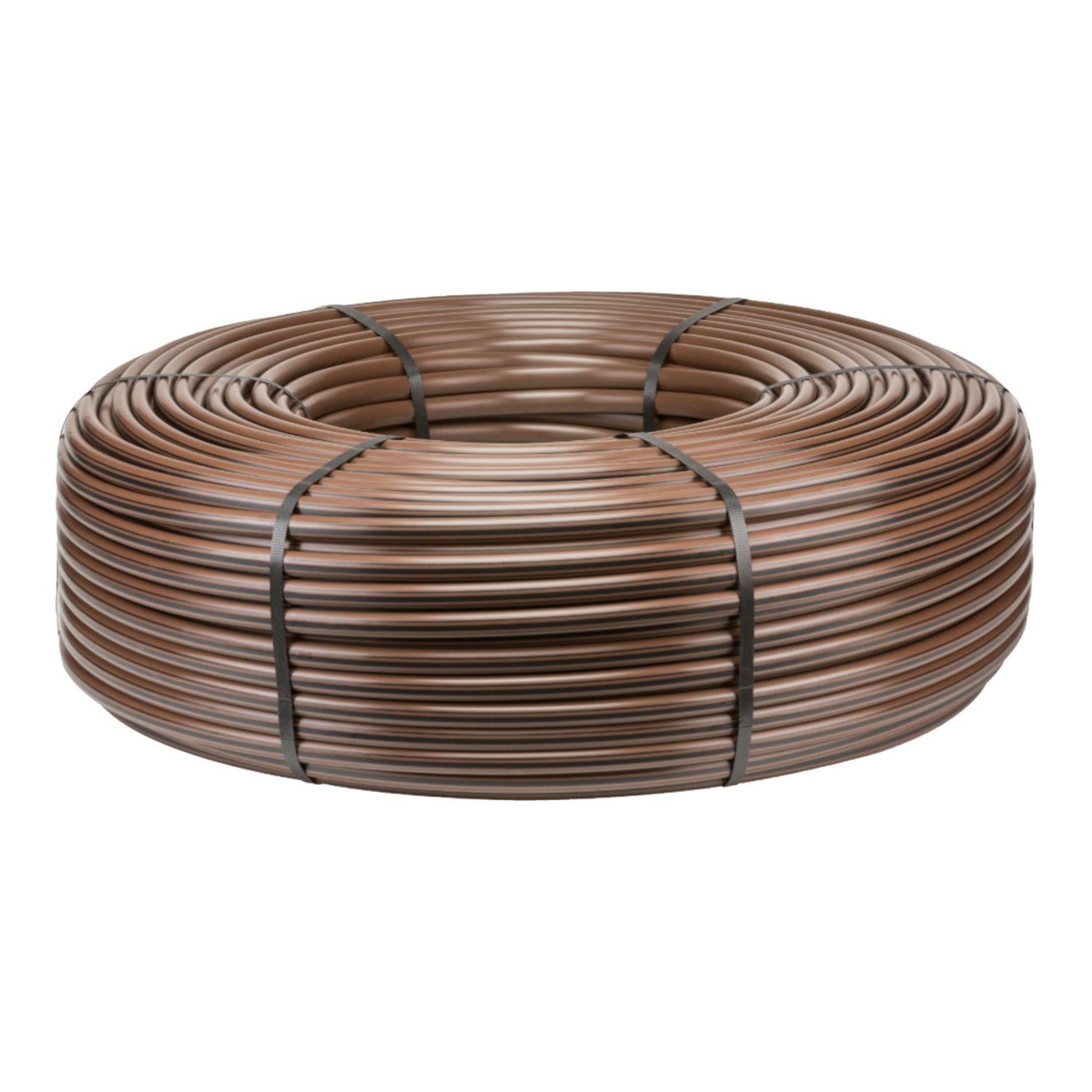
Unit price perThe HydroPC 16mm Pressure Compensated Drip Line - 2L/h - 50cm Spacing - 400m is a 16mm pressure-compensated drip line supplied in a 400m roll, with stated emitter flow of 2L/h and 50cm emitter spacing.
It is designed for compatible professional nursery, greenhouse and horticultural irrigation systems where emitter spacing and flow are matched to crop layout and water demand.
Key benefits
Matching emitter spacing to the crop
This line uses 50cm emitter spacing. Select spacing according to crop layout, substrate or soil wetting pattern and the number of emitters required across the root zone.
Closer spacing increases the number of emitters operating over a given run length and therefore changes total zone flow demand.
Emitter flow & irrigation scheduling
The stated emitter flow is 2L/h. Irrigation duration should be based on crop demand, root-zone volume, weather and actual system output rather than a fixed run time.
Pressure compensation is intended to support more consistent emitter performance within the product operating conditions, but the complete system still needs appropriate pressure, filtration and hydraulic design.
Planning irrigation zones
Calculate the number of operating emitters or outlets and total flow demand before finalising a zone. Long runs, elevation changes and undersized supply pipework can affect pressure and irrigation uniformity.
Divide systems into manageable zones where necessary rather than exceeding the available water supply or the practical hydraulic capacity of the installation.
Filtration, flushing & commissioning
Use filtration appropriate to the water source and emitter waterways. Flush new lines before routine use where appropriate, then run the system and inspect representative outlets for expected delivery.
Maintain filters and flush lines according to water quality and system requirements. Investigate blocked emitters, leaks or damaged pipe promptly.
Installation & storage
Route lines without kinking or crushing and protect them from sharp edges and traffic. Store unused coils clean and protected from physical damage before installation.
HydroPC 16mm Pressure Compensated Drip Line - 2L/h - 50cm Spacing - 400m product details
| Product | HydroPC Drip Line |
|---|---|
| Pipe size | 16mm |
| Roll length | 400m |
| Stated emitter flow | 2L/h |
| Emitter spacing | 50cm |
| Pressure compensated | Yes |
HydroPC 16mm Pressure Compensated Drip Line - 2L/h - 50cm Spacing - 400m FAQs
How long is the supplied roll?
The supplied roll length is 400m. What spacing is stated?
The stated outlet/emitter spacing is 50cm. What emitter flow is stated?
The stated emitter flow is 2L/h. How do I know how much water the zone requires?
Calculate the number of operating emitters or outlets and their flow, then compare total demand with the available water supply and hydraulic design. Is filtration important?
Yes. Suitable filtration helps protect small emitter waterways and maintain irrigation uniformity. Should new irrigation lines be flushed?
Flush and commission lines as appropriate to the system before relying on them for crop irrigation. Can very long runs affect uniformity?
Yes. Run length, elevation, pipe size, total flow and pressure all influence system performance. How should the line be installed?
Avoid kinks, crushing and sharp edges and protect the line from traffic or other physical damage. How should irrigation performance be checked?
Inspect and, where useful, measure output at representative points across the zone and investigate meaningful differences.
£0.00
Unit price per£0.00
Unit price perThe HydroPC 16mm Pressure Compensated Drip Line - 2L/h - 30cm Spacing - 400m is a 16mm pressure-compensated drip line supplied in a 400m roll, with stated emitter flow of 2L/h and 30cm emitter spacing.
It is designed for compatible professional nursery, greenhouse and horticultural irrigation systems where emitter spacing and flow are matched to crop layout and water demand.
Key benefits
Matching emitter spacing to the crop
This line uses 30cm emitter spacing. Select spacing according to crop layout, substrate or soil wetting pattern and the number of emitters required across the root zone.
Closer spacing increases the number of emitters operating over a given run length and therefore changes total zone flow demand.
Emitter flow & irrigation scheduling
The stated emitter flow is 2L/h. Irrigation duration should be based on crop demand, root-zone volume, weather and actual system output rather than a fixed run time.
Pressure compensation is intended to support more consistent emitter performance within the product operating conditions, but the complete system still needs appropriate pressure, filtration and hydraulic design.
Planning irrigation zones
Calculate the number of operating emitters or outlets and total flow demand before finalising a zone. Long runs, elevation changes and undersized supply pipework can affect pressure and irrigation uniformity.
Divide systems into manageable zones where necessary rather than exceeding the available water supply or the practical hydraulic capacity of the installation.
Filtration, flushing & commissioning
Use filtration appropriate to the water source and emitter waterways. Flush new lines before routine use where appropriate, then run the system and inspect representative outlets for expected delivery.
Maintain filters and flush lines according to water quality and system requirements. Investigate blocked emitters, leaks or damaged pipe promptly.
Installation & storage
Route lines without kinking or crushing and protect them from sharp edges and traffic. Store unused coils clean and protected from physical damage before installation.
HydroPC 16mm Pressure Compensated Drip Line - 2L/h - 30cm Spacing - 400m product details
| Product | HydroPC Drip Line |
|---|---|
| Pipe size | 16mm |
| Roll length | 400m |
| Stated emitter flow | 2L/h |
| Emitter spacing | 30cm |
| Pressure compensated | Yes |
HydroPC 16mm Pressure Compensated Drip Line - 2L/h - 30cm Spacing - 400m FAQs
How long is the supplied roll?
The supplied roll length is 400m. What spacing is stated?
The stated outlet/emitter spacing is 30cm. What emitter flow is stated?
The stated emitter flow is 2L/h. How do I know how much water the zone requires?
Calculate the number of operating emitters or outlets and their flow, then compare total demand with the available water supply and hydraulic design. Is filtration important?
Yes. Suitable filtration helps protect small emitter waterways and maintain irrigation uniformity. Should new irrigation lines be flushed?
Flush and commission lines as appropriate to the system before relying on them for crop irrigation. Can very long runs affect uniformity?
Yes. Run length, elevation, pipe size, total flow and pressure all influence system performance. How should the line be installed?
Avoid kinks, crushing and sharp edges and protect the line from traffic or other physical damage. How should irrigation performance be checked?
Inspect and, where useful, measure output at representative points across the zone and investigate meaningful differences.
£279.13
Unit price per£279.13
Unit price perThe HydroPC 16mm Pressure Compensated Drip Line - 1.6L/h - 50cm Spacing - 400m is a 16mm pressure-compensated drip line supplied in a 400m roll, with stated emitter flow of 1.6L/h and 50cm emitter spacing.
It is designed for compatible professional nursery, greenhouse and horticultural irrigation systems where emitter spacing and flow are matched to crop layout and water demand.
Key benefits
Matching emitter spacing to the crop
This line uses 50cm emitter spacing. Select spacing according to crop layout, substrate or soil wetting pattern and the number of emitters required across the root zone.
Closer spacing increases the number of emitters operating over a given run length and therefore changes total zone flow demand.
Emitter flow & irrigation scheduling
The stated emitter flow is 1.6L/h. Irrigation duration should be based on crop demand, root-zone volume, weather and actual system output rather than a fixed run time.
Pressure compensation is intended to support more consistent emitter performance within the product operating conditions, but the complete system still needs appropriate pressure, filtration and hydraulic design.
Planning irrigation zones
Calculate the number of operating emitters or outlets and total flow demand before finalising a zone. Long runs, elevation changes and undersized supply pipework can affect pressure and irrigation uniformity.
Divide systems into manageable zones where necessary rather than exceeding the available water supply or the practical hydraulic capacity of the installation.
Filtration, flushing & commissioning
Use filtration appropriate to the water source and emitter waterways. Flush new lines before routine use where appropriate, then run the system and inspect representative outlets for expected delivery.
Maintain filters and flush lines according to water quality and system requirements. Investigate blocked emitters, leaks or damaged pipe promptly.
Installation & storage
Route lines without kinking or crushing and protect them from sharp edges and traffic. Store unused coils clean and protected from physical damage before installation.
HydroPC 16mm Pressure Compensated Drip Line - 1.6L/h - 50cm Spacing - 400m product details
| Product | HydroPC Drip Line |
|---|---|
| Pipe size | 16mm |
| Roll length | 400m |
| Stated emitter flow | 1.6L/h |
| Emitter spacing | 50cm |
| Pressure compensated | Yes |
HydroPC 16mm Pressure Compensated Drip Line - 1.6L/h - 50cm Spacing - 400m FAQs
How long is the supplied roll?
The supplied roll length is 400m. What spacing is stated?
The stated outlet/emitter spacing is 50cm. What emitter flow is stated?
The stated emitter flow is 1.6L/h. How do I know how much water the zone requires?
Calculate the number of operating emitters or outlets and their flow, then compare total demand with the available water supply and hydraulic design. Is filtration important?
Yes. Suitable filtration helps protect small emitter waterways and maintain irrigation uniformity. Should new irrigation lines be flushed?
Flush and commission lines as appropriate to the system before relying on them for crop irrigation. Can very long runs affect uniformity?
Yes. Run length, elevation, pipe size, total flow and pressure all influence system performance. How should the line be installed?
Avoid kinks, crushing and sharp edges and protect the line from traffic or other physical damage. How should irrigation performance be checked?
Inspect and, where useful, measure output at representative points across the zone and investigate meaningful differences.
£432.92
Unit price per£432.92
Unit price perThe HydroPC 16mm Pressure Compensated Drip Line - 1.6L/h - 20cm Spacing - 400m is a 16mm pressure-compensated drip line supplied in a 400m roll, with stated emitter flow of 1.6L/h and 20cm emitter spacing.
It is designed for compatible professional nursery, greenhouse and horticultural irrigation systems where emitter spacing and flow are matched to crop layout and water demand.
Key benefits
Matching emitter spacing to the crop
This line uses 20cm emitter spacing. Select spacing according to crop layout, substrate or soil wetting pattern and the number of emitters required across the root zone.
Closer spacing increases the number of emitters operating over a given run length and therefore changes total zone flow demand.
Emitter flow & irrigation scheduling
The stated emitter flow is 1.6L/h. Irrigation duration should be based on crop demand, root-zone volume, weather and actual system output rather than a fixed run time.
Pressure compensation is intended to support more consistent emitter performance within the product operating conditions, but the complete system still needs appropriate pressure, filtration and hydraulic design.
Planning irrigation zones
Calculate the number of operating emitters or outlets and total flow demand before finalising a zone. Long runs, elevation changes and undersized supply pipework can affect pressure and irrigation uniformity.
Divide systems into manageable zones where necessary rather than exceeding the available water supply or the practical hydraulic capacity of the installation.
Filtration, flushing & commissioning
Use filtration appropriate to the water source and emitter waterways. Flush new lines before routine use where appropriate, then run the system and inspect representative outlets for expected delivery.
Maintain filters and flush lines according to water quality and system requirements. Investigate blocked emitters, leaks or damaged pipe promptly.
Installation & storage
Route lines without kinking or crushing and protect them from sharp edges and traffic. Store unused coils clean and protected from physical damage before installation.
HydroPC 16mm Pressure Compensated Drip Line - 1.6L/h - 20cm Spacing - 400m product details
| Product | HydroPC Drip Line |
|---|---|
| Pipe size | 16mm |
| Roll length | 400m |
| Stated emitter flow | 1.6L/h |
| Emitter spacing | 20cm |
| Pressure compensated | Yes |
HydroPC 16mm Pressure Compensated Drip Line - 1.6L/h - 20cm Spacing - 400m FAQs
How long is the supplied roll?
The supplied roll length is 400m. What spacing is stated?
The stated outlet/emitter spacing is 20cm. What emitter flow is stated?
The stated emitter flow is 1.6L/h. How do I know how much water the zone requires?
Calculate the number of operating emitters or outlets and their flow, then compare total demand with the available water supply and hydraulic design. Is filtration important?
Yes. Suitable filtration helps protect small emitter waterways and maintain irrigation uniformity. Should new irrigation lines be flushed?
Flush and commission lines as appropriate to the system before relying on them for crop irrigation. Can very long runs affect uniformity?
Yes. Run length, elevation, pipe size, total flow and pressure all influence system performance. How should the line be installed?
Avoid kinks, crushing and sharp edges and protect the line from traffic or other physical damage. How should irrigation performance be checked?
Inspect and, where useful, measure output at representative points across the zone and investigate meaningful differences.
£194.70
Unit price per£194.70
Unit price perThe HydroTif 16mm Drip Line - 2L/h - 50cm Spacing - 400m is a 16mm drip line supplied in a 400m roll, with stated emitter flow of 2L/h and 50cm emitter spacing.
It is designed for compatible professional nursery, greenhouse and horticultural irrigation systems where emitter spacing and flow are matched to crop layout and water demand.
Key benefits
Matching emitter spacing to the crop
This line uses 50cm emitter spacing. Select spacing according to crop layout, substrate or soil wetting pattern and the number of emitters required across the root zone.
Closer spacing increases the number of emitters operating over a given run length and therefore changes total zone flow demand.
Emitter flow & irrigation scheduling
The stated emitter flow is 2L/h. Irrigation duration should be based on crop demand, root-zone volume, weather and actual system output rather than a fixed run time.
Actual emitter delivery still depends on the operating conditions and hydraulic design of the complete system.
Planning irrigation zones
Calculate the number of operating emitters or outlets and total flow demand before finalising a zone. Long runs, elevation changes and undersized supply pipework can affect pressure and irrigation uniformity.
Divide systems into manageable zones where necessary rather than exceeding the available water supply or the practical hydraulic capacity of the installation.
Filtration, flushing & commissioning
Use filtration appropriate to the water source and emitter waterways. Flush new lines before routine use where appropriate, then run the system and inspect representative outlets for expected delivery.
Maintain filters and flush lines according to water quality and system requirements. Investigate blocked emitters, leaks or damaged pipe promptly.
Installation & storage
Route lines without kinking or crushing and protect them from sharp edges and traffic. Store unused coils clean and protected from physical damage before installation.
HydroTif 16mm Drip Line - 2L/h - 50cm Spacing - 400m product details
| Product | HydroTif Drip Line |
|---|---|
| Pipe size | 16mm |
| Roll length | 400m |
| Stated emitter flow | 2L/h |
| Emitter spacing | 50cm |
| Pressure compensated | Not stated |
HydroTif 16mm Drip Line - 2L/h - 50cm Spacing - 400m FAQs
How long is the supplied roll?
The supplied roll length is 400m. What spacing is stated?
The stated outlet/emitter spacing is 50cm. What emitter flow is stated?
The stated emitter flow is 2L/h. How do I know how much water the zone requires?
Calculate the number of operating emitters or outlets and their flow, then compare total demand with the available water supply and hydraulic design. Is filtration important?
Yes. Suitable filtration helps protect small emitter waterways and maintain irrigation uniformity. Should new irrigation lines be flushed?
Flush and commission lines as appropriate to the system before relying on them for crop irrigation. Can very long runs affect uniformity?
Yes. Run length, elevation, pipe size, total flow and pressure all influence system performance. How should the line be installed?
Avoid kinks, crushing and sharp edges and protect the line from traffic or other physical damage. How should irrigation performance be checked?
Inspect and, where useful, measure output at representative points across the zone and investigate meaningful differences.
£218.83
Unit price per£218.83
Unit price perThe HydroTif 16mm Drip Line - 2L/h - 30cm Spacing - 400m is a 16mm drip line supplied in a 400m roll, with stated emitter flow of 2L/h and 30cm emitter spacing.
It is designed for compatible professional nursery, greenhouse and horticultural irrigation systems where emitter spacing and flow are matched to crop layout and water demand.
Key benefits
Matching emitter spacing to the crop
This line uses 30cm emitter spacing. Select spacing according to crop layout, substrate or soil wetting pattern and the number of emitters required across the root zone.
Closer spacing increases the number of emitters operating over a given run length and therefore changes total zone flow demand.
Emitter flow & irrigation scheduling
The stated emitter flow is 2L/h. Irrigation duration should be based on crop demand, root-zone volume, weather and actual system output rather than a fixed run time.
Actual emitter delivery still depends on the operating conditions and hydraulic design of the complete system.
Planning irrigation zones
Calculate the number of operating emitters or outlets and total flow demand before finalising a zone. Long runs, elevation changes and undersized supply pipework can affect pressure and irrigation uniformity.
Divide systems into manageable zones where necessary rather than exceeding the available water supply or the practical hydraulic capacity of the installation.
Filtration, flushing & commissioning
Use filtration appropriate to the water source and emitter waterways. Flush new lines before routine use where appropriate, then run the system and inspect representative outlets for expected delivery.
Maintain filters and flush lines according to water quality and system requirements. Investigate blocked emitters, leaks or damaged pipe promptly.
Installation & storage
Route lines without kinking or crushing and protect them from sharp edges and traffic. Store unused coils clean and protected from physical damage before installation.
HydroTif 16mm Drip Line - 2L/h - 30cm Spacing - 400m product details
| Product | HydroTif Drip Line |
|---|---|
| Pipe size | 16mm |
| Roll length | 400m |
| Stated emitter flow | 2L/h |
| Emitter spacing | 30cm |
| Pressure compensated | Not stated |
HydroTif 16mm Drip Line - 2L/h - 30cm Spacing - 400m FAQs
How long is the supplied roll?
The supplied roll length is 400m. What spacing is stated?
The stated outlet/emitter spacing is 30cm. What emitter flow is stated?
The stated emitter flow is 2L/h. How do I know how much water the zone requires?
Calculate the number of operating emitters or outlets and their flow, then compare total demand with the available water supply and hydraulic design. Is filtration important?
Yes. Suitable filtration helps protect small emitter waterways and maintain irrigation uniformity. Should new irrigation lines be flushed?
Flush and commission lines as appropriate to the system before relying on them for crop irrigation. Can very long runs affect uniformity?
Yes. Run length, elevation, pipe size, total flow and pressure all influence system performance. How should the line be installed?
Avoid kinks, crushing and sharp edges and protect the line from traffic or other physical damage. How should irrigation performance be checked?
Inspect and, where useful, measure output at representative points across the zone and investigate meaningful differences.
The Filter for LPD is designed for filtering water at a compatible LPD component.
This component forms part of professional greenhouse, nursery and protected-crop irrigation installations where sprinklers, misters, suspended stands and low-pressure drainage components are selected as a complete compatible system.
Key benefits
Building compatible micro-irrigation assemblies
Use the fitting only with compatible tube and modular components. Insert connections fully and route tubing without sharp bends, kinks or continuous side load.
After assembly, pressurise the zone and inspect connections for leakage or movement before routine crop use.
Pressure, filtration & system design
Misting and sprinkler performance depends on appropriate pressure and clean water. Use filtration suitable for the water source and the smallest waterways in the system, and consider pressure loss through pipework, elevation and total zone flow.
Calculate total flow demand before expanding a zone; adding outlets without checking supply capacity can reduce performance across the installation.
Maintenance
Inspect nozzles, filters, LPD components, tube and connections for blockage, scale, wear or damage. Flush and clean the system as appropriate to water quality and crop-hygiene requirements.
Filter for LPD product details
| Product type | LPD Accessory |
|---|---|
| Primary use | filtering water at a compatible LPD component |
| Application | Professional horticultural irrigation |
Filter for LPD FAQs
What is this product used for?
Filtering water at a compatible lpd component. Is it suitable for professional greenhouse irrigation?
Yes, where it is compatible with the rest of the irrigation assembly and the system is designed for the required flow and pressure. How do I check component compatibility?
Match connection type, tube size and modular fitting system rather than relying on appearance alone. Why is filtration important?
Small sprinkler, fogger and LPD waterways can be affected by debris, so suitable filtration helps maintain reliable operation. Should the system be tested after installation?
Yes. Run the zone under normal operating conditions and inspect output, connections and distribution. Can I keep adding outlets to an existing zone?
Only if the water supply, pipework and pressure can support the additional total flow demand. What maintenance is required?
Inspect and clean outlets and filters as appropriate, flush lines where required and replace damaged or persistently blocked components. Can mounting position affect performance?
Yes. Height, orientation, spacing and crop canopy can all affect how overhead water reaches the crop.
The Fast & Fast Plug is designed for closing a compatible Fast & Fast connection.
This component forms part of professional greenhouse, nursery and protected-crop irrigation installations where sprinklers, misters, suspended stands and low-pressure drainage components are selected as a complete compatible system.
Key benefits
Building compatible micro-irrigation assemblies
Use the fitting only with compatible tube and modular components. Insert connections fully and route tubing without sharp bends, kinks or continuous side load.
After assembly, pressurise the zone and inspect connections for leakage or movement before routine crop use.
Pressure, filtration & system design
Misting and sprinkler performance depends on appropriate pressure and clean water. Use filtration suitable for the water source and the smallest waterways in the system, and consider pressure loss through pipework, elevation and total zone flow.
Calculate total flow demand before expanding a zone; adding outlets without checking supply capacity can reduce performance across the installation.
Maintenance
Inspect nozzles, filters, LPD components, tube and connections for blockage, scale, wear or damage. Flush and clean the system as appropriate to water quality and crop-hygiene requirements.
Fast & Fast Plug product details
| Product type | Irrigation Fitting |
|---|---|
| Primary use | closing a compatible Fast & Fast connection |
| Application | Professional horticultural irrigation |
Fast & Fast Plug FAQs
What is this product used for?
Closing a compatible fast & fast connection. Is it suitable for professional greenhouse irrigation?
Yes, where it is compatible with the rest of the irrigation assembly and the system is designed for the required flow and pressure. How do I check component compatibility?
Match connection type, tube size and modular fitting system rather than relying on appearance alone. Why is filtration important?
Small sprinkler, fogger and LPD waterways can be affected by debris, so suitable filtration helps maintain reliable operation. Should the system be tested after installation?
Yes. Run the zone under normal operating conditions and inspect output, connections and distribution. Can I keep adding outlets to an existing zone?
Only if the water supply, pipework and pressure can support the additional total flow demand. What maintenance is required?
Inspect and clean outlets and filters as appropriate, flush lines where required and replace damaged or persistently blocked components. Can mounting position affect performance?
Yes. Height, orientation, spacing and crop canopy can all affect how overhead water reaches the crop.
The Fast & Fast Connector is designed for connecting compatible Fast & Fast irrigation components.
This component forms part of professional greenhouse, nursery and protected-crop irrigation installations where sprinklers, misters, suspended stands and low-pressure drainage components are selected as a complete compatible system.
Key benefits
Building compatible micro-irrigation assemblies
Use the fitting only with compatible tube and modular components. Insert connections fully and route tubing without sharp bends, kinks or continuous side load.
After assembly, pressurise the zone and inspect connections for leakage or movement before routine crop use.
Pressure, filtration & system design
Misting and sprinkler performance depends on appropriate pressure and clean water. Use filtration suitable for the water source and the smallest waterways in the system, and consider pressure loss through pipework, elevation and total zone flow.
Calculate total flow demand before expanding a zone; adding outlets without checking supply capacity can reduce performance across the installation.
Maintenance
Inspect nozzles, filters, LPD components, tube and connections for blockage, scale, wear or damage. Flush and clean the system as appropriate to water quality and crop-hygiene requirements.
Fast & Fast Connector product details
| Product type | Irrigation Fitting |
|---|---|
| Primary use | connecting compatible Fast & Fast irrigation components |
| Application | Professional horticultural irrigation |
Fast & Fast Connector FAQs
What is this product used for?
Connecting compatible fast & fast irrigation components. Is it suitable for professional greenhouse irrigation?
Yes, where it is compatible with the rest of the irrigation assembly and the system is designed for the required flow and pressure. How do I check component compatibility?
Match connection type, tube size and modular fitting system rather than relying on appearance alone. Why is filtration important?
Small sprinkler, fogger and LPD waterways can be affected by debris, so suitable filtration helps maintain reliable operation. Should the system be tested after installation?
Yes. Run the zone under normal operating conditions and inspect output, connections and distribution. Can I keep adding outlets to an existing zone?
Only if the water supply, pipework and pressure can support the additional total flow demand. What maintenance is required?
Inspect and clean outlets and filters as appropriate, flush lines where required and replace damaged or persistently blocked components. Can mounting position affect performance?
Yes. Height, orientation, spacing and crop canopy can all affect how overhead water reaches the crop.
The 4/7 x 4/7 Barb Connector is designed for joining compatible 4/7 micro-irrigation tube.
This component forms part of professional greenhouse, nursery and protected-crop irrigation installations where sprinklers, misters, suspended stands and low-pressure drainage components are selected as a complete compatible system.
Key benefits
Building compatible micro-irrigation assemblies
Use the fitting only with compatible tube and modular components. Insert connections fully and route tubing without sharp bends, kinks or continuous side load.
After assembly, pressurise the zone and inspect connections for leakage or movement before routine crop use.
Pressure, filtration & system design
Misting and sprinkler performance depends on appropriate pressure and clean water. Use filtration suitable for the water source and the smallest waterways in the system, and consider pressure loss through pipework, elevation and total zone flow.
Calculate total flow demand before expanding a zone; adding outlets without checking supply capacity can reduce performance across the installation.
Maintenance
Inspect nozzles, filters, LPD components, tube and connections for blockage, scale, wear or damage. Flush and clean the system as appropriate to water quality and crop-hygiene requirements.
4/7 x 4/7 Barb Connector product details
| Product type | Irrigation Fitting |
|---|---|
| Primary use | joining compatible 4/7 micro-irrigation tube |
| Connection / variant | 4/7 |
| Application | Professional horticultural irrigation |
4/7 x 4/7 Barb Connector FAQs
What is this product used for?
Joining compatible 4/7 micro-irrigation tube. Is it suitable for professional greenhouse irrigation?
Yes, where it is compatible with the rest of the irrigation assembly and the system is designed for the required flow and pressure. How do I check component compatibility?
Match connection type, tube size and modular fitting system rather than relying on appearance alone. Why is filtration important?
Small sprinkler, fogger and LPD waterways can be affected by debris, so suitable filtration helps maintain reliable operation. Should the system be tested after installation?
Yes. Run the zone under normal operating conditions and inspect output, connections and distribution. Can I keep adding outlets to an existing zone?
Only if the water supply, pipework and pressure can support the additional total flow demand. What maintenance is required?
Inspect and clean outlets and filters as appropriate, flush lines where required and replace damaged or persistently blocked components. Can mounting position affect performance?
Yes. Height, orientation, spacing and crop canopy can all affect how overhead water reaches the crop.
The Super Fogger Female - 13L/h is designed for fine-water distribution in compatible misting/fogging systems.
This component forms part of professional greenhouse, nursery and protected-crop irrigation installations where sprinklers, misters, suspended stands and low-pressure drainage components are selected as a complete compatible system.
Key benefits
Overhead water distribution
Use the fogger as part of a correctly designed overhead irrigation or misting layout. Spacing, mounting height, operating pressure and overlap between adjacent outlets all influence the distribution reaching the crop.
The stated nominal flow for this version is 13L/h. Do not select an outlet by flow alone; consider crop density, target application, irrigation duration and the performance of the complete zone.
Checking distribution uniformity
Commission the system under normal operating conditions and inspect the wetting pattern across representative positions. Catch-can or other output checks can help identify pressure differences, blocked nozzles or poor overlap.
Pressure, filtration & system design
Misting and sprinkler performance depends on appropriate pressure and clean water. Use filtration suitable for the water source and the smallest waterways in the system, and consider pressure loss through pipework, elevation and total zone flow.
Calculate total flow demand before expanding a zone; adding outlets without checking supply capacity can reduce performance across the installation.
Maintenance
Inspect nozzles, filters, LPD components, tube and connections for blockage, scale, wear or damage. Flush and clean the system as appropriate to water quality and crop-hygiene requirements.
Super Fogger Female - 13L/h product details
| Product type | Fogger |
|---|---|
| Primary use | fine-water distribution in compatible misting/fogging systems |
| Stated nominal flow | 13L/h |
| Connection / variant | Female |
| Application | Professional horticultural irrigation |
Super Fogger Female - 13L/h FAQs
What is this product used for?
Fine-water distribution in compatible misting/fogging systems. What flow rate is stated?
The stated nominal flow for this version is 13L/h. Is it suitable for professional greenhouse irrigation?
Yes, where it is compatible with the rest of the irrigation assembly and the system is designed for the required flow and pressure. How do I check component compatibility?
Match connection type, tube size and modular fitting system rather than relying on appearance alone. Why is filtration important?
Small sprinkler, fogger and LPD waterways can be affected by debris, so suitable filtration helps maintain reliable operation. Should the system be tested after installation?
Yes. Run the zone under normal operating conditions and inspect output, connections and distribution. Can I keep adding outlets to an existing zone?
Only if the water supply, pipework and pressure can support the additional total flow demand. What maintenance is required?
Inspect and clean outlets and filters as appropriate, flush lines where required and replace damaged or persistently blocked components. Can mounting position affect performance?
Yes. Height, orientation, spacing and crop canopy can all affect how overhead water reaches the crop.
The Super Fogger Barbed - 13L/h is designed for fine-water distribution in compatible misting/fogging systems.
This component forms part of professional greenhouse, nursery and protected-crop irrigation installations where sprinklers, misters, suspended stands and low-pressure drainage components are selected as a complete compatible system.
Key benefits
Overhead water distribution
Use the fogger as part of a correctly designed overhead irrigation or misting layout. Spacing, mounting height, operating pressure and overlap between adjacent outlets all influence the distribution reaching the crop.
The stated nominal flow for this version is 13L/h. Do not select an outlet by flow alone; consider crop density, target application, irrigation duration and the performance of the complete zone.
Checking distribution uniformity
Commission the system under normal operating conditions and inspect the wetting pattern across representative positions. Catch-can or other output checks can help identify pressure differences, blocked nozzles or poor overlap.
Pressure, filtration & system design
Misting and sprinkler performance depends on appropriate pressure and clean water. Use filtration suitable for the water source and the smallest waterways in the system, and consider pressure loss through pipework, elevation and total zone flow.
Calculate total flow demand before expanding a zone; adding outlets without checking supply capacity can reduce performance across the installation.
Maintenance
Inspect nozzles, filters, LPD components, tube and connections for blockage, scale, wear or damage. Flush and clean the system as appropriate to water quality and crop-hygiene requirements.
Super Fogger Barbed - 13L/h product details
| Product type | Fogger |
|---|---|
| Primary use | fine-water distribution in compatible misting/fogging systems |
| Stated nominal flow | 13L/h |
| Connection / variant | Barbed |
| Application | Professional horticultural irrigation |
Super Fogger Barbed - 13L/h FAQs
What is this product used for?
Fine-water distribution in compatible misting/fogging systems. What flow rate is stated?
The stated nominal flow for this version is 13L/h. Is it suitable for professional greenhouse irrigation?
Yes, where it is compatible with the rest of the irrigation assembly and the system is designed for the required flow and pressure. How do I check component compatibility?
Match connection type, tube size and modular fitting system rather than relying on appearance alone. Why is filtration important?
Small sprinkler, fogger and LPD waterways can be affected by debris, so suitable filtration helps maintain reliable operation. Should the system be tested after installation?
Yes. Run the zone under normal operating conditions and inspect output, connections and distribution. Can I keep adding outlets to an existing zone?
Only if the water supply, pipework and pressure can support the additional total flow demand. What maintenance is required?
Inspect and clean outlets and filters as appropriate, flush lines where required and replace damaged or persistently blocked components. Can mounting position affect performance?
Yes. Height, orientation, spacing and crop canopy can all affect how overhead water reaches the crop.
The Super Fogger 3/8" WW - 13L/h is designed for fine-water distribution in compatible misting/fogging systems.
This component forms part of professional greenhouse, nursery and protected-crop irrigation installations where sprinklers, misters, suspended stands and low-pressure drainage components are selected as a complete compatible system.
Key benefits
Overhead water distribution
Use the fogger as part of a correctly designed overhead irrigation or misting layout. Spacing, mounting height, operating pressure and overlap between adjacent outlets all influence the distribution reaching the crop.
The stated nominal flow for this version is 13L/h. Do not select an outlet by flow alone; consider crop density, target application, irrigation duration and the performance of the complete zone.
Checking distribution uniformity
Commission the system under normal operating conditions and inspect the wetting pattern across representative positions. Catch-can or other output checks can help identify pressure differences, blocked nozzles or poor overlap.
Pressure, filtration & system design
Misting and sprinkler performance depends on appropriate pressure and clean water. Use filtration suitable for the water source and the smallest waterways in the system, and consider pressure loss through pipework, elevation and total zone flow.
Calculate total flow demand before expanding a zone; adding outlets without checking supply capacity can reduce performance across the installation.
Maintenance
Inspect nozzles, filters, LPD components, tube and connections for blockage, scale, wear or damage. Flush and clean the system as appropriate to water quality and crop-hygiene requirements.
Super Fogger 3/8" WW - 13L/h product details
| Product type | Fogger |
|---|---|
| Primary use | fine-water distribution in compatible misting/fogging systems |
| Stated nominal flow | 13L/h |
| Connection / variant | 3/8" WW |
| Application | Professional horticultural irrigation |
Super Fogger 3/8" WW - 13L/h FAQs
What is this product used for?
Fine-water distribution in compatible misting/fogging systems. What flow rate is stated?
The stated nominal flow for this version is 13L/h. Is it suitable for professional greenhouse irrigation?
Yes, where it is compatible with the rest of the irrigation assembly and the system is designed for the required flow and pressure. How do I check component compatibility?
Match connection type, tube size and modular fitting system rather than relying on appearance alone. Why is filtration important?
Small sprinkler, fogger and LPD waterways can be affected by debris, so suitable filtration helps maintain reliable operation. Should the system be tested after installation?
Yes. Run the zone under normal operating conditions and inspect output, connections and distribution. Can I keep adding outlets to an existing zone?
Only if the water supply, pipework and pressure can support the additional total flow demand. What maintenance is required?
Inspect and clean outlets and filters as appropriate, flush lines where required and replace damaged or persistently blocked components. Can mounting position affect performance?
Yes. Height, orientation, spacing and crop canopy can all affect how overhead water reaches the crop.
The NaanDan Sprinkler - Green - 105L/h is designed for overhead irrigation in compatible horticultural systems.
This component forms part of professional greenhouse, nursery and protected-crop irrigation installations where sprinklers, misters, suspended stands and low-pressure drainage components are selected as a complete compatible system.
Key benefits
Overhead water distribution
Use the sprinkler as part of a correctly designed overhead irrigation or misting layout. Spacing, mounting height, operating pressure and overlap between adjacent outlets all influence the distribution reaching the crop.
The stated nominal flow for this version is 105L/h. Do not select an outlet by flow alone; consider crop density, target application, irrigation duration and the performance of the complete zone.
Checking distribution uniformity
Commission the system under normal operating conditions and inspect the wetting pattern across representative positions. Catch-can or other output checks can help identify pressure differences, blocked nozzles or poor overlap.
Pressure, filtration & system design
Misting and sprinkler performance depends on appropriate pressure and clean water. Use filtration suitable for the water source and the smallest waterways in the system, and consider pressure loss through pipework, elevation and total zone flow.
Calculate total flow demand before expanding a zone; adding outlets without checking supply capacity can reduce performance across the installation.
Maintenance
Inspect nozzles, filters, LPD components, tube and connections for blockage, scale, wear or damage. Flush and clean the system as appropriate to water quality and crop-hygiene requirements.
NaanDan Sprinkler - Green - 105L/h product details
| Product type | Sprinkler |
|---|---|
| Primary use | overhead irrigation in compatible horticultural systems |
| Stated nominal flow | 105L/h |
| Connection / variant | Green |
| Application | Professional horticultural irrigation |
NaanDan Sprinkler - Green - 105L/h FAQs
What is this product used for?
Overhead irrigation in compatible horticultural systems. What flow rate is stated?
The stated nominal flow for this version is 105L/h. Is it suitable for professional greenhouse irrigation?
Yes, where it is compatible with the rest of the irrigation assembly and the system is designed for the required flow and pressure. How do I check component compatibility?
Match connection type, tube size and modular fitting system rather than relying on appearance alone. Why is filtration important?
Small sprinkler, fogger and LPD waterways can be affected by debris, so suitable filtration helps maintain reliable operation. Should the system be tested after installation?
Yes. Run the zone under normal operating conditions and inspect output, connections and distribution. Can I keep adding outlets to an existing zone?
Only if the water supply, pipework and pressure can support the additional total flow demand. What maintenance is required?
Inspect and clean outlets and filters as appropriate, flush lines where required and replace damaged or persistently blocked components. Can mounting position affect performance?
Yes. Height, orientation, spacing and crop canopy can all affect how overhead water reaches the crop.
The NaanDan Sprinkler - Orange - 120L/h is designed for overhead irrigation in compatible horticultural systems.
This component forms part of professional greenhouse, nursery and protected-crop irrigation installations where sprinklers, misters, suspended stands and low-pressure drainage components are selected as a complete compatible system.
Key benefits
Overhead water distribution
Use the sprinkler as part of a correctly designed overhead irrigation or misting layout. Spacing, mounting height, operating pressure and overlap between adjacent outlets all influence the distribution reaching the crop.
The stated nominal flow for this version is 120L/h. Do not select an outlet by flow alone; consider crop density, target application, irrigation duration and the performance of the complete zone.
Checking distribution uniformity
Commission the system under normal operating conditions and inspect the wetting pattern across representative positions. Catch-can or other output checks can help identify pressure differences, blocked nozzles or poor overlap.
Pressure, filtration & system design
Misting and sprinkler performance depends on appropriate pressure and clean water. Use filtration suitable for the water source and the smallest waterways in the system, and consider pressure loss through pipework, elevation and total zone flow.
Calculate total flow demand before expanding a zone; adding outlets without checking supply capacity can reduce performance across the installation.
Maintenance
Inspect nozzles, filters, LPD components, tube and connections for blockage, scale, wear or damage. Flush and clean the system as appropriate to water quality and crop-hygiene requirements.
NaanDan Sprinkler - Orange - 120L/h product details
| Product type | Sprinkler |
|---|---|
| Primary use | overhead irrigation in compatible horticultural systems |
| Stated nominal flow | 120L/h |
| Connection / variant | Orange |
| Application | Professional horticultural irrigation |
NaanDan Sprinkler - Orange - 120L/h FAQs
What is this product used for?
Overhead irrigation in compatible horticultural systems. What flow rate is stated?
The stated nominal flow for this version is 120L/h. Is it suitable for professional greenhouse irrigation?
Yes, where it is compatible with the rest of the irrigation assembly and the system is designed for the required flow and pressure. How do I check component compatibility?
Match connection type, tube size and modular fitting system rather than relying on appearance alone. Why is filtration important?
Small sprinkler, fogger and LPD waterways can be affected by debris, so suitable filtration helps maintain reliable operation. Should the system be tested after installation?
Yes. Run the zone under normal operating conditions and inspect output, connections and distribution. Can I keep adding outlets to an existing zone?
Only if the water supply, pipework and pressure can support the additional total flow demand. What maintenance is required?
Inspect and clean outlets and filters as appropriate, flush lines where required and replace damaged or persistently blocked components. Can mounting position affect performance?
Yes. Height, orientation, spacing and crop canopy can all affect how overhead water reaches the crop.
The NaanDan Sprinkler - Black - 160L/h is designed for overhead irrigation in compatible horticultural systems.
This component forms part of professional greenhouse, nursery and protected-crop irrigation installations where sprinklers, misters, suspended stands and low-pressure drainage components are selected as a complete compatible system.
Key benefits
Overhead water distribution
Use the sprinkler as part of a correctly designed overhead irrigation or misting layout. Spacing, mounting height, operating pressure and overlap between adjacent outlets all influence the distribution reaching the crop.
The stated nominal flow for this version is 160L/h. Do not select an outlet by flow alone; consider crop density, target application, irrigation duration and the performance of the complete zone.
Checking distribution uniformity
Commission the system under normal operating conditions and inspect the wetting pattern across representative positions. Catch-can or other output checks can help identify pressure differences, blocked nozzles or poor overlap.
Pressure, filtration & system design
Misting and sprinkler performance depends on appropriate pressure and clean water. Use filtration suitable for the water source and the smallest waterways in the system, and consider pressure loss through pipework, elevation and total zone flow.
Calculate total flow demand before expanding a zone; adding outlets without checking supply capacity can reduce performance across the installation.
Maintenance
Inspect nozzles, filters, LPD components, tube and connections for blockage, scale, wear or damage. Flush and clean the system as appropriate to water quality and crop-hygiene requirements.
NaanDan Sprinkler - Black - 160L/h product details
| Product type | Sprinkler |
|---|---|
| Primary use | overhead irrigation in compatible horticultural systems |
| Stated nominal flow | 160L/h |
| Connection / variant | Black |
| Application | Professional horticultural irrigation |
NaanDan Sprinkler - Black - 160L/h FAQs
What is this product used for?
Overhead irrigation in compatible horticultural systems. What flow rate is stated?
The stated nominal flow for this version is 160L/h. Is it suitable for professional greenhouse irrigation?
Yes, where it is compatible with the rest of the irrigation assembly and the system is designed for the required flow and pressure. How do I check component compatibility?
Match connection type, tube size and modular fitting system rather than relying on appearance alone. Why is filtration important?
Small sprinkler, fogger and LPD waterways can be affected by debris, so suitable filtration helps maintain reliable operation. Should the system be tested after installation?
Yes. Run the zone under normal operating conditions and inspect output, connections and distribution. Can I keep adding outlets to an existing zone?
Only if the water supply, pipework and pressure can support the additional total flow demand. What maintenance is required?
Inspect and clean outlets and filters as appropriate, flush lines where required and replace damaged or persistently blocked components. Can mounting position affect performance?
Yes. Height, orientation, spacing and crop canopy can all affect how overhead water reaches the crop.
The Rondo Mist 4/7 - 61L/h is designed for misting or fine overhead irrigation in compatible horticultural systems.
This component forms part of professional greenhouse, nursery and protected-crop irrigation installations where sprinklers, misters, suspended stands and low-pressure drainage components are selected as a complete compatible system.
Key benefits
Overhead water distribution
Use the mister as part of a correctly designed overhead irrigation or misting layout. Spacing, mounting height, operating pressure and overlap between adjacent outlets all influence the distribution reaching the crop.
The stated nominal flow for this version is 61L/h. Do not select an outlet by flow alone; consider crop density, target application, irrigation duration and the performance of the complete zone.
Checking distribution uniformity
Commission the system under normal operating conditions and inspect the wetting pattern across representative positions. Catch-can or other output checks can help identify pressure differences, blocked nozzles or poor overlap.
Pressure, filtration & system design
Misting and sprinkler performance depends on appropriate pressure and clean water. Use filtration suitable for the water source and the smallest waterways in the system, and consider pressure loss through pipework, elevation and total zone flow.
Calculate total flow demand before expanding a zone; adding outlets without checking supply capacity can reduce performance across the installation.
Maintenance
Inspect nozzles, filters, LPD components, tube and connections for blockage, scale, wear or damage. Flush and clean the system as appropriate to water quality and crop-hygiene requirements.
Rondo Mist 4/7 - 61L/h product details
| Product type | Mister |
|---|---|
| Primary use | misting or fine overhead irrigation in compatible horticultural systems |
| Stated nominal flow | 61L/h |
| Connection / variant | 4/7 |
| Application | Professional horticultural irrigation |
Rondo Mist 4/7 - 61L/h FAQs
What is this product used for?
Misting or fine overhead irrigation in compatible horticultural systems. What flow rate is stated?
The stated nominal flow for this version is 61L/h. Is it suitable for professional greenhouse irrigation?
Yes, where it is compatible with the rest of the irrigation assembly and the system is designed for the required flow and pressure. How do I check component compatibility?
Match connection type, tube size and modular fitting system rather than relying on appearance alone. Why is filtration important?
Small sprinkler, fogger and LPD waterways can be affected by debris, so suitable filtration helps maintain reliable operation. Should the system be tested after installation?
Yes. Run the zone under normal operating conditions and inspect output, connections and distribution. Can I keep adding outlets to an existing zone?
Only if the water supply, pipework and pressure can support the additional total flow demand. What maintenance is required?
Inspect and clean outlets and filters as appropriate, flush lines where required and replace damaged or persistently blocked components. Can mounting position affect performance?
Yes. Height, orientation, spacing and crop canopy can all affect how overhead water reaches the crop.
The Rondo Mist 4/7 - 47L/h is designed for misting or fine overhead irrigation in compatible horticultural systems.
This component forms part of professional greenhouse, nursery and protected-crop irrigation installations where sprinklers, misters, suspended stands and low-pressure drainage components are selected as a complete compatible system.
Key benefits
Overhead water distribution
Use the mister as part of a correctly designed overhead irrigation or misting layout. Spacing, mounting height, operating pressure and overlap between adjacent outlets all influence the distribution reaching the crop.
The stated nominal flow for this version is 47L/h. Do not select an outlet by flow alone; consider crop density, target application, irrigation duration and the performance of the complete zone.
Checking distribution uniformity
Commission the system under normal operating conditions and inspect the wetting pattern across representative positions. Catch-can or other output checks can help identify pressure differences, blocked nozzles or poor overlap.
Pressure, filtration & system design
Misting and sprinkler performance depends on appropriate pressure and clean water. Use filtration suitable for the water source and the smallest waterways in the system, and consider pressure loss through pipework, elevation and total zone flow.
Calculate total flow demand before expanding a zone; adding outlets without checking supply capacity can reduce performance across the installation.
Maintenance
Inspect nozzles, filters, LPD components, tube and connections for blockage, scale, wear or damage. Flush and clean the system as appropriate to water quality and crop-hygiene requirements.
Rondo Mist 4/7 - 47L/h product details
| Product type | Mister |
|---|---|
| Primary use | misting or fine overhead irrigation in compatible horticultural systems |
| Stated nominal flow | 47L/h |
| Connection / variant | 4/7 |
| Application | Professional horticultural irrigation |
Rondo Mist 4/7 - 47L/h FAQs
What is this product used for?
Misting or fine overhead irrigation in compatible horticultural systems. What flow rate is stated?
The stated nominal flow for this version is 47L/h. Is it suitable for professional greenhouse irrigation?
Yes, where it is compatible with the rest of the irrigation assembly and the system is designed for the required flow and pressure. How do I check component compatibility?
Match connection type, tube size and modular fitting system rather than relying on appearance alone. Why is filtration important?
Small sprinkler, fogger and LPD waterways can be affected by debris, so suitable filtration helps maintain reliable operation. Should the system be tested after installation?
Yes. Run the zone under normal operating conditions and inspect output, connections and distribution. Can I keep adding outlets to an existing zone?
Only if the water supply, pipework and pressure can support the additional total flow demand. What maintenance is required?
Inspect and clean outlets and filters as appropriate, flush lines where required and replace damaged or persistently blocked components. Can mounting position affect performance?
Yes. Height, orientation, spacing and crop canopy can all affect how overhead water reaches the crop.
The Super LPD Bayonet - M11 is designed for low-pressure drainage control within a compatible modular irrigation assembly.
This component forms part of professional greenhouse, nursery and protected-crop irrigation installations where sprinklers, misters, suspended stands and low-pressure drainage components are selected as a complete compatible system.
Key benefits
Low-pressure drainage control
LPD components are used within compatible sprinkler or misting assemblies to influence drainage and start/stop behaviour as system pressure changes. Correct operation depends on the complete assembly, operating pressure and installation orientation.
Match the connection type carefully to the modular sprinkler components being used and keep small waterways clean.
Pressure, filtration & system design
Misting and sprinkler performance depends on appropriate pressure and clean water. Use filtration suitable for the water source and the smallest waterways in the system, and consider pressure loss through pipework, elevation and total zone flow.
Calculate total flow demand before expanding a zone; adding outlets without checking supply capacity can reduce performance across the installation.
Maintenance
Inspect nozzles, filters, LPD components, tube and connections for blockage, scale, wear or damage. Flush and clean the system as appropriate to water quality and crop-hygiene requirements.
Super LPD Bayonet - M11 product details
| Product type | LPD Component |
|---|---|
| Primary use | low-pressure drainage control within a compatible modular irrigation assembly |
| Connection / variant | M11 |
| Application | Professional horticultural irrigation |
Super LPD Bayonet - M11 FAQs
What is this product used for?
Low-pressure drainage control within a compatible modular irrigation assembly. Is it suitable for professional greenhouse irrigation?
Yes, where it is compatible with the rest of the irrigation assembly and the system is designed for the required flow and pressure. How do I check component compatibility?
Match connection type, tube size and modular fitting system rather than relying on appearance alone. Why is filtration important?
Small sprinkler, fogger and LPD waterways can be affected by debris, so suitable filtration helps maintain reliable operation. Should the system be tested after installation?
Yes. Run the zone under normal operating conditions and inspect output, connections and distribution. Can I keep adding outlets to an existing zone?
Only if the water supply, pipework and pressure can support the additional total flow demand. What maintenance is required?
Inspect and clean outlets and filters as appropriate, flush lines where required and replace damaged or persistently blocked components. Can mounting position affect performance?
Yes. Height, orientation, spacing and crop canopy can all affect how overhead water reaches the crop.
The Super LPD Bayonet - Bayonet is designed for low-pressure drainage control within a compatible modular irrigation assembly.
This component forms part of professional greenhouse, nursery and protected-crop irrigation installations where sprinklers, misters, suspended stands and low-pressure drainage components are selected as a complete compatible system.
Key benefits
Low-pressure drainage control
LPD components are used within compatible sprinkler or misting assemblies to influence drainage and start/stop behaviour as system pressure changes. Correct operation depends on the complete assembly, operating pressure and installation orientation.
Match the connection type carefully to the modular sprinkler components being used and keep small waterways clean.
Pressure, filtration & system design
Misting and sprinkler performance depends on appropriate pressure and clean water. Use filtration suitable for the water source and the smallest waterways in the system, and consider pressure loss through pipework, elevation and total zone flow.
Calculate total flow demand before expanding a zone; adding outlets without checking supply capacity can reduce performance across the installation.
Maintenance
Inspect nozzles, filters, LPD components, tube and connections for blockage, scale, wear or damage. Flush and clean the system as appropriate to water quality and crop-hygiene requirements.
Super LPD Bayonet - Bayonet product details
| Product type | LPD Component |
|---|---|
| Primary use | low-pressure drainage control within a compatible modular irrigation assembly |
| Connection / variant | Bayonet |
| Application | Professional horticultural irrigation |
Super LPD Bayonet - Bayonet FAQs
What is this product used for?
Low-pressure drainage control within a compatible modular irrigation assembly. Is it suitable for professional greenhouse irrigation?
Yes, where it is compatible with the rest of the irrigation assembly and the system is designed for the required flow and pressure. How do I check component compatibility?
Match connection type, tube size and modular fitting system rather than relying on appearance alone. Why is filtration important?
Small sprinkler, fogger and LPD waterways can be affected by debris, so suitable filtration helps maintain reliable operation. Should the system be tested after installation?
Yes. Run the zone under normal operating conditions and inspect output, connections and distribution. Can I keep adding outlets to an existing zone?
Only if the water supply, pipework and pressure can support the additional total flow demand. What maintenance is required?
Inspect and clean outlets and filters as appropriate, flush lines where required and replace damaged or persistently blocked components. Can mounting position affect performance?
Yes. Height, orientation, spacing and crop canopy can all affect how overhead water reaches the crop.
The Super LPD Bayonet - Barbed is designed for low-pressure drainage control within a compatible modular irrigation assembly.
This component forms part of professional greenhouse, nursery and protected-crop irrigation installations where sprinklers, misters, suspended stands and low-pressure drainage components are selected as a complete compatible system.
Key benefits
Low-pressure drainage control
LPD components are used within compatible sprinkler or misting assemblies to influence drainage and start/stop behaviour as system pressure changes. Correct operation depends on the complete assembly, operating pressure and installation orientation.
Match the connection type carefully to the modular sprinkler components being used and keep small waterways clean.
Pressure, filtration & system design
Misting and sprinkler performance depends on appropriate pressure and clean water. Use filtration suitable for the water source and the smallest waterways in the system, and consider pressure loss through pipework, elevation and total zone flow.
Calculate total flow demand before expanding a zone; adding outlets without checking supply capacity can reduce performance across the installation.
Maintenance
Inspect nozzles, filters, LPD components, tube and connections for blockage, scale, wear or damage. Flush and clean the system as appropriate to water quality and crop-hygiene requirements.
Super LPD Bayonet - Barbed product details
| Product type | LPD Component |
|---|---|
| Primary use | low-pressure drainage control within a compatible modular irrigation assembly |
| Connection / variant | Barbed |
| Application | Professional horticultural irrigation |
Super LPD Bayonet - Barbed FAQs
What is this product used for?
Low-pressure drainage control within a compatible modular irrigation assembly. Is it suitable for professional greenhouse irrigation?
Yes, where it is compatible with the rest of the irrigation assembly and the system is designed for the required flow and pressure. How do I check component compatibility?
Match connection type, tube size and modular fitting system rather than relying on appearance alone. Why is filtration important?
Small sprinkler, fogger and LPD waterways can be affected by debris, so suitable filtration helps maintain reliable operation. Should the system be tested after installation?
Yes. Run the zone under normal operating conditions and inspect output, connections and distribution. Can I keep adding outlets to an existing zone?
Only if the water supply, pipework and pressure can support the additional total flow demand. What maintenance is required?
Inspect and clean outlets and filters as appropriate, flush lines where required and replace damaged or persistently blocked components. Can mounting position affect performance?
Yes. Height, orientation, spacing and crop canopy can all affect how overhead water reaches the crop.
The Super LPD Bayonet - 3/8" is designed for low-pressure drainage control within a compatible modular irrigation assembly.
This component forms part of professional greenhouse, nursery and protected-crop irrigation installations where sprinklers, misters, suspended stands and low-pressure drainage components are selected as a complete compatible system.
Key benefits
Low-pressure drainage control
LPD components are used within compatible sprinkler or misting assemblies to influence drainage and start/stop behaviour as system pressure changes. Correct operation depends on the complete assembly, operating pressure and installation orientation.
Match the connection type carefully to the modular sprinkler components being used and keep small waterways clean.
Pressure, filtration & system design
Misting and sprinkler performance depends on appropriate pressure and clean water. Use filtration suitable for the water source and the smallest waterways in the system, and consider pressure loss through pipework, elevation and total zone flow.
Calculate total flow demand before expanding a zone; adding outlets without checking supply capacity can reduce performance across the installation.
Maintenance
Inspect nozzles, filters, LPD components, tube and connections for blockage, scale, wear or damage. Flush and clean the system as appropriate to water quality and crop-hygiene requirements.
Super LPD Bayonet - 3/8" product details
| Product type | LPD Component |
|---|---|
| Primary use | low-pressure drainage control within a compatible modular irrigation assembly |
| Connection / variant | 3/8" |
| Application | Professional horticultural irrigation |
Super LPD Bayonet - 3/8" FAQs
What is this product used for?
Low-pressure drainage control within a compatible modular irrigation assembly. Is it suitable for professional greenhouse irrigation?
Yes, where it is compatible with the rest of the irrigation assembly and the system is designed for the required flow and pressure. How do I check component compatibility?
Match connection type, tube size and modular fitting system rather than relying on appearance alone. Why is filtration important?
Small sprinkler, fogger and LPD waterways can be affected by debris, so suitable filtration helps maintain reliable operation. Should the system be tested after installation?
Yes. Run the zone under normal operating conditions and inspect output, connections and distribution. Can I keep adding outlets to an existing zone?
Only if the water supply, pipework and pressure can support the additional total flow demand. What maintenance is required?
Inspect and clean outlets and filters as appropriate, flush lines where required and replace damaged or persistently blocked components. Can mounting position affect performance?
Yes. Height, orientation, spacing and crop canopy can all affect how overhead water reaches the crop.
£2.58
Unit price per£2.58
Unit price perThe Suspended Stand with Fast & Fast - 4/7 Barb - 30cm is designed for suspending compatible misting or sprinkler components above the crop.
This component forms part of professional greenhouse, nursery and protected-crop irrigation installations where sprinklers, misters, suspended stands and low-pressure drainage components are selected as a complete compatible system.
Key benefits
Suspending irrigation above the crop
A suspended stand positions compatible sprinkler or misting hardware above the crop. Set suspension height and spacing to suit the outlet pattern, crop canopy and installation layout.
Support supply tubing so its weight does not pull the stand out of position and check suspended assemblies regularly for secure connections.
Pressure, filtration & system design
Misting and sprinkler performance depends on appropriate pressure and clean water. Use filtration suitable for the water source and the smallest waterways in the system, and consider pressure loss through pipework, elevation and total zone flow.
Calculate total flow demand before expanding a zone; adding outlets without checking supply capacity can reduce performance across the installation.
Maintenance
Inspect nozzles, filters, LPD components, tube and connections for blockage, scale, wear or damage. Flush and clean the system as appropriate to water quality and crop-hygiene requirements.
Suspended Stand with Fast & Fast - 4/7 Barb - 30cm product details
| Product type | Suspended Stand |
|---|---|
| Primary use | suspending compatible misting or sprinkler components above the crop |
| Connection / variant | 4/7 Barb |
| Application | Professional horticultural irrigation |
Suspended Stand with Fast & Fast - 4/7 Barb - 30cm FAQs
What is this product used for?
Suspending compatible misting or sprinkler components above the crop. Is it suitable for professional greenhouse irrigation?
Yes, where it is compatible with the rest of the irrigation assembly and the system is designed for the required flow and pressure. How do I check component compatibility?
Match connection type, tube size and modular fitting system rather than relying on appearance alone. Why is filtration important?
Small sprinkler, fogger and LPD waterways can be affected by debris, so suitable filtration helps maintain reliable operation. Should the system be tested after installation?
Yes. Run the zone under normal operating conditions and inspect output, connections and distribution. Can I keep adding outlets to an existing zone?
Only if the water supply, pipework and pressure can support the additional total flow demand. What maintenance is required?
Inspect and clean outlets and filters as appropriate, flush lines where required and replace damaged or persistently blocked components. Can mounting position affect performance?
Yes. Height, orientation, spacing and crop canopy can all affect how overhead water reaches the crop.
£2.71
Unit price per£2.71
Unit price perThe Suspended Stand with Fast & Fast - 4/7 Barb - 60cm is designed for suspending compatible misting or sprinkler components above the crop.
This component forms part of professional greenhouse, nursery and protected-crop irrigation installations where sprinklers, misters, suspended stands and low-pressure drainage components are selected as a complete compatible system.
Key benefits
Suspending irrigation above the crop
A suspended stand positions compatible sprinkler or misting hardware above the crop. Set suspension height and spacing to suit the outlet pattern, crop canopy and installation layout.
Support supply tubing so its weight does not pull the stand out of position and check suspended assemblies regularly for secure connections.
Pressure, filtration & system design
Misting and sprinkler performance depends on appropriate pressure and clean water. Use filtration suitable for the water source and the smallest waterways in the system, and consider pressure loss through pipework, elevation and total zone flow.
Calculate total flow demand before expanding a zone; adding outlets without checking supply capacity can reduce performance across the installation.
Maintenance
Inspect nozzles, filters, LPD components, tube and connections for blockage, scale, wear or damage. Flush and clean the system as appropriate to water quality and crop-hygiene requirements.
Suspended Stand with Fast & Fast - 4/7 Barb - 60cm product details
| Product type | Suspended Stand |
|---|---|
| Primary use | suspending compatible misting or sprinkler components above the crop |
| Connection / variant | 4/7 Barb |
| Application | Professional horticultural irrigation |
Suspended Stand with Fast & Fast - 4/7 Barb - 60cm FAQs
What is this product used for?
Suspending compatible misting or sprinkler components above the crop. Is it suitable for professional greenhouse irrigation?
Yes, where it is compatible with the rest of the irrigation assembly and the system is designed for the required flow and pressure. How do I check component compatibility?
Match connection type, tube size and modular fitting system rather than relying on appearance alone. Why is filtration important?
Small sprinkler, fogger and LPD waterways can be affected by debris, so suitable filtration helps maintain reliable operation. Should the system be tested after installation?
Yes. Run the zone under normal operating conditions and inspect output, connections and distribution. Can I keep adding outlets to an existing zone?
Only if the water supply, pipework and pressure can support the additional total flow demand. What maintenance is required?
Inspect and clean outlets and filters as appropriate, flush lines where required and replace damaged or persistently blocked components. Can mounting position affect performance?
Yes. Height, orientation, spacing and crop canopy can all affect how overhead water reaches the crop.
£2.71
Unit price per£2.71
Unit price perThe Suspended Stand with Fast & Fast - 3/8" WW - 60cm is designed for suspending compatible misting or sprinkler components above the crop.
This component forms part of professional greenhouse, nursery and protected-crop irrigation installations where sprinklers, misters, suspended stands and low-pressure drainage components are selected as a complete compatible system.
Key benefits
Suspending irrigation above the crop
A suspended stand positions compatible sprinkler or misting hardware above the crop. Set suspension height and spacing to suit the outlet pattern, crop canopy and installation layout.
Support supply tubing so its weight does not pull the stand out of position and check suspended assemblies regularly for secure connections.
Pressure, filtration & system design
Misting and sprinkler performance depends on appropriate pressure and clean water. Use filtration suitable for the water source and the smallest waterways in the system, and consider pressure loss through pipework, elevation and total zone flow.
Calculate total flow demand before expanding a zone; adding outlets without checking supply capacity can reduce performance across the installation.
Maintenance
Inspect nozzles, filters, LPD components, tube and connections for blockage, scale, wear or damage. Flush and clean the system as appropriate to water quality and crop-hygiene requirements.
Suspended Stand with Fast & Fast - 3/8" WW - 60cm product details
| Product type | Suspended Stand |
|---|---|
| Primary use | suspending compatible misting or sprinkler components above the crop |
| Connection / variant | 3/8" WW |
| Application | Professional horticultural irrigation |
Suspended Stand with Fast & Fast - 3/8" WW - 60cm FAQs
What is this product used for?
Suspending compatible misting or sprinkler components above the crop. Is it suitable for professional greenhouse irrigation?
Yes, where it is compatible with the rest of the irrigation assembly and the system is designed for the required flow and pressure. How do I check component compatibility?
Match connection type, tube size and modular fitting system rather than relying on appearance alone. Why is filtration important?
Small sprinkler, fogger and LPD waterways can be affected by debris, so suitable filtration helps maintain reliable operation. Should the system be tested after installation?
Yes. Run the zone under normal operating conditions and inspect output, connections and distribution. Can I keep adding outlets to an existing zone?
Only if the water supply, pipework and pressure can support the additional total flow demand. What maintenance is required?
Inspect and clean outlets and filters as appropriate, flush lines where required and replace damaged or persistently blocked components. Can mounting position affect performance?
Yes. Height, orientation, spacing and crop canopy can all affect how overhead water reaches the crop.
£2.58
Unit price per£2.58
Unit price perThe Suspended Stand with Fast & Fast - 3/8" WW - 30cm is designed for suspending compatible misting or sprinkler components above the crop.
This component forms part of professional greenhouse, nursery and protected-crop irrigation installations where sprinklers, misters, suspended stands and low-pressure drainage components are selected as a complete compatible system.
Key benefits
Suspending irrigation above the crop
A suspended stand positions compatible sprinkler or misting hardware above the crop. Set suspension height and spacing to suit the outlet pattern, crop canopy and installation layout.
Support supply tubing so its weight does not pull the stand out of position and check suspended assemblies regularly for secure connections.
Pressure, filtration & system design
Misting and sprinkler performance depends on appropriate pressure and clean water. Use filtration suitable for the water source and the smallest waterways in the system, and consider pressure loss through pipework, elevation and total zone flow.
Calculate total flow demand before expanding a zone; adding outlets without checking supply capacity can reduce performance across the installation.
Maintenance
Inspect nozzles, filters, LPD components, tube and connections for blockage, scale, wear or damage. Flush and clean the system as appropriate to water quality and crop-hygiene requirements.
Suspended Stand with Fast & Fast - 3/8" WW - 30cm product details
| Product type | Suspended Stand |
|---|---|
| Primary use | suspending compatible misting or sprinkler components above the crop |
| Connection / variant | 3/8" WW |
| Application | Professional horticultural irrigation |
Suspended Stand with Fast & Fast - 3/8" WW - 30cm FAQs
What is this product used for?
Suspending compatible misting or sprinkler components above the crop. Is it suitable for professional greenhouse irrigation?
Yes, where it is compatible with the rest of the irrigation assembly and the system is designed for the required flow and pressure. How do I check component compatibility?
Match connection type, tube size and modular fitting system rather than relying on appearance alone. Why is filtration important?
Small sprinkler, fogger and LPD waterways can be affected by debris, so suitable filtration helps maintain reliable operation. Should the system be tested after installation?
Yes. Run the zone under normal operating conditions and inspect output, connections and distribution. Can I keep adding outlets to an existing zone?
Only if the water supply, pipework and pressure can support the additional total flow demand. What maintenance is required?
Inspect and clean outlets and filters as appropriate, flush lines where required and replace damaged or persistently blocked components. Can mounting position affect performance?
Yes. Height, orientation, spacing and crop canopy can all affect how overhead water reaches the crop.

The Super LPD for Modular Sprinkler - 3/8" WW is designed for low-pressure drainage control within a compatible modular sprinkler assembly.
This component forms part of professional greenhouse, nursery and protected-crop irrigation installations where sprinklers, misters, suspended stands and low-pressure drainage components are selected as a complete compatible system.
Key benefits
Low-pressure drainage control
LPD components are used within compatible sprinkler or misting assemblies to influence drainage and start/stop behaviour as system pressure changes. Correct operation depends on the complete assembly, operating pressure and installation orientation.
Match the connection type carefully to the modular sprinkler components being used and keep small waterways clean.
Pressure, filtration & system design
Misting and sprinkler performance depends on appropriate pressure and clean water. Use filtration suitable for the water source and the smallest waterways in the system, and consider pressure loss through pipework, elevation and total zone flow.
Calculate total flow demand before expanding a zone; adding outlets without checking supply capacity can reduce performance across the installation.
Maintenance
Inspect nozzles, filters, LPD components, tube and connections for blockage, scale, wear or damage. Flush and clean the system as appropriate to water quality and crop-hygiene requirements.
Super LPD for Modular Sprinkler - 3/8" WW product details
| Product type | LPD Component |
|---|---|
| Primary use | low-pressure drainage control within a compatible modular sprinkler assembly |
| Connection / variant | 3/8" WW |
| Application | Professional horticultural irrigation |
Super LPD for Modular Sprinkler - 3/8" WW FAQs
What is this product used for?
Low-pressure drainage control within a compatible modular sprinkler assembly. Is it suitable for professional greenhouse irrigation?
Yes, where it is compatible with the rest of the irrigation assembly and the system is designed for the required flow and pressure. How do I check component compatibility?
Match connection type, tube size and modular fitting system rather than relying on appearance alone. Why is filtration important?
Small sprinkler, fogger and LPD waterways can be affected by debris, so suitable filtration helps maintain reliable operation. Should the system be tested after installation?
Yes. Run the zone under normal operating conditions and inspect output, connections and distribution. Can I keep adding outlets to an existing zone?
Only if the water supply, pipework and pressure can support the additional total flow demand. What maintenance is required?
Inspect and clean outlets and filters as appropriate, flush lines where required and replace damaged or persistently blocked components. Can mounting position affect performance?
Yes. Height, orientation, spacing and crop canopy can all affect how overhead water reaches the crop.

The Super LPD for Modular Sprinkler - M11 is designed for low-pressure drainage control within a compatible modular sprinkler assembly.
This component forms part of professional greenhouse, nursery and protected-crop irrigation installations where sprinklers, misters, suspended stands and low-pressure drainage components are selected as a complete compatible system.
Key benefits
Low-pressure drainage control
LPD components are used within compatible sprinkler or misting assemblies to influence drainage and start/stop behaviour as system pressure changes. Correct operation depends on the complete assembly, operating pressure and installation orientation.
Match the connection type carefully to the modular sprinkler components being used and keep small waterways clean.
Pressure, filtration & system design
Misting and sprinkler performance depends on appropriate pressure and clean water. Use filtration suitable for the water source and the smallest waterways in the system, and consider pressure loss through pipework, elevation and total zone flow.
Calculate total flow demand before expanding a zone; adding outlets without checking supply capacity can reduce performance across the installation.
Maintenance
Inspect nozzles, filters, LPD components, tube and connections for blockage, scale, wear or damage. Flush and clean the system as appropriate to water quality and crop-hygiene requirements.
Super LPD for Modular Sprinkler - M11 product details
| Product type | LPD Component |
|---|---|
| Primary use | low-pressure drainage control within a compatible modular sprinkler assembly |
| Connection / variant | M11 |
| Application | Professional horticultural irrigation |
Super LPD for Modular Sprinkler - M11 FAQs
What is this product used for?
Low-pressure drainage control within a compatible modular sprinkler assembly. Is it suitable for professional greenhouse irrigation?
Yes, where it is compatible with the rest of the irrigation assembly and the system is designed for the required flow and pressure. How do I check component compatibility?
Match connection type, tube size and modular fitting system rather than relying on appearance alone. Why is filtration important?
Small sprinkler, fogger and LPD waterways can be affected by debris, so suitable filtration helps maintain reliable operation. Should the system be tested after installation?
Yes. Run the zone under normal operating conditions and inspect output, connections and distribution. Can I keep adding outlets to an existing zone?
Only if the water supply, pipework and pressure can support the additional total flow demand. What maintenance is required?
Inspect and clean outlets and filters as appropriate, flush lines where required and replace damaged or persistently blocked components. Can mounting position affect performance?
Yes. Height, orientation, spacing and crop canopy can all affect how overhead water reaches the crop.

The Super LPD for Modular Sprinkler - Barbed is designed for low-pressure drainage control within a compatible modular sprinkler assembly.
This component forms part of professional greenhouse, nursery and protected-crop irrigation installations where sprinklers, misters, suspended stands and low-pressure drainage components are selected as a complete compatible system.
Key benefits
Low-pressure drainage control
LPD components are used within compatible sprinkler or misting assemblies to influence drainage and start/stop behaviour as system pressure changes. Correct operation depends on the complete assembly, operating pressure and installation orientation.
Match the connection type carefully to the modular sprinkler components being used and keep small waterways clean.
Pressure, filtration & system design
Misting and sprinkler performance depends on appropriate pressure and clean water. Use filtration suitable for the water source and the smallest waterways in the system, and consider pressure loss through pipework, elevation and total zone flow.
Calculate total flow demand before expanding a zone; adding outlets without checking supply capacity can reduce performance across the installation.
Maintenance
Inspect nozzles, filters, LPD components, tube and connections for blockage, scale, wear or damage. Flush and clean the system as appropriate to water quality and crop-hygiene requirements.
Super LPD for Modular Sprinkler - Barbed product details
| Product type | LPD Component |
|---|---|
| Primary use | low-pressure drainage control within a compatible modular sprinkler assembly |
| Connection / variant | Barbed |
| Application | Professional horticultural irrigation |
Super LPD for Modular Sprinkler - Barbed FAQs
What is this product used for?
Low-pressure drainage control within a compatible modular sprinkler assembly. Is it suitable for professional greenhouse irrigation?
Yes, where it is compatible with the rest of the irrigation assembly and the system is designed for the required flow and pressure. How do I check component compatibility?
Match connection type, tube size and modular fitting system rather than relying on appearance alone. Why is filtration important?
Small sprinkler, fogger and LPD waterways can be affected by debris, so suitable filtration helps maintain reliable operation. Should the system be tested after installation?
Yes. Run the zone under normal operating conditions and inspect output, connections and distribution. Can I keep adding outlets to an existing zone?
Only if the water supply, pipework and pressure can support the additional total flow demand. What maintenance is required?
Inspect and clean outlets and filters as appropriate, flush lines where required and replace damaged or persistently blocked components. Can mounting position affect performance?
Yes. Height, orientation, spacing and crop canopy can all affect how overhead water reaches the crop.

The Super LPD for Modular Sprinkler - Female is designed for low-pressure drainage control within a compatible modular sprinkler assembly.
This component forms part of professional greenhouse, nursery and protected-crop irrigation installations where sprinklers, misters, suspended stands and low-pressure drainage components are selected as a complete compatible system.
Key benefits
Low-pressure drainage control
LPD components are used within compatible sprinkler or misting assemblies to influence drainage and start/stop behaviour as system pressure changes. Correct operation depends on the complete assembly, operating pressure and installation orientation.
Match the connection type carefully to the modular sprinkler components being used and keep small waterways clean.
Pressure, filtration & system design
Misting and sprinkler performance depends on appropriate pressure and clean water. Use filtration suitable for the water source and the smallest waterways in the system, and consider pressure loss through pipework, elevation and total zone flow.
Calculate total flow demand before expanding a zone; adding outlets without checking supply capacity can reduce performance across the installation.
Maintenance
Inspect nozzles, filters, LPD components, tube and connections for blockage, scale, wear or damage. Flush and clean the system as appropriate to water quality and crop-hygiene requirements.
Super LPD for Modular Sprinkler - Female product details
| Product type | LPD Component |
|---|---|
| Primary use | low-pressure drainage control within a compatible modular sprinkler assembly |
| Connection / variant | Female |
| Application | Professional horticultural irrigation |
Super LPD for Modular Sprinkler - Female FAQs
What is this product used for?
Low-pressure drainage control within a compatible modular sprinkler assembly. Is it suitable for professional greenhouse irrigation?
Yes, where it is compatible with the rest of the irrigation assembly and the system is designed for the required flow and pressure. How do I check component compatibility?
Match connection type, tube size and modular fitting system rather than relying on appearance alone. Why is filtration important?
Small sprinkler, fogger and LPD waterways can be affected by debris, so suitable filtration helps maintain reliable operation. Should the system be tested after installation?
Yes. Run the zone under normal operating conditions and inspect output, connections and distribution. Can I keep adding outlets to an existing zone?
Only if the water supply, pipework and pressure can support the additional total flow demand. What maintenance is required?
Inspect and clean outlets and filters as appropriate, flush lines where required and replace damaged or persistently blocked components. Can mounting position affect performance?
Yes. Height, orientation, spacing and crop canopy can all affect how overhead water reaches the crop.

The SABA PVC Cleaner - 650ml is designed for preparing compatible rigid PVC surfaces before solvent-weld assembly in compatible professional irrigation and water-distribution installations.
Use according to the current manufacturer label, technical information and safety data sheet. Appropriate ventilation, PPE, storage and workplace controls may be required.
Key benefits
Preparing PVC before solvent welding
Correct surface preparation is important when making compatible solvent-weld PVC joints. Follow SABA instructions for cleaning and preparation alongside correct cutting and deburring.
Installation & commissioning
Support pipework so fittings do not carry avoidable bending loads. Plan unions and service points where equipment may need to be removed later.
After the applicable assembly or curing process, commission gradually and inspect joints for leakage before routine operation.
Compatibility & maintenance
Confirm that pipe, fittings, adhesive and operating conditions are compatible with the intended system. Nominal dimensions alone do not establish pressure suitability.
Inspect accessible joints periodically and investigate leakage rather than relying on repeated tightening or temporary external sealing.
Safe handling & storage
Follow the current safety data sheet for PPE, ventilation, first-aid and storage requirements. Keep containers closed when not in use and follow workplace COSHH controls where applicable.
SABA PVC Cleaner - 650ml product details
| Product type | PVC Cleaner |
|---|---|
| Primary use | preparing compatible rigid PVC surfaces before solvent-weld assembly |
| Stated size / pack | 650ml |
| Application | Compatible PVC irrigation and water-distribution systems |
SABA PVC Cleaner - 650ml FAQs
What is this product used for?
Preparing compatible rigid pvc surfaces before solvent-weld assembly. What size or pack is this version?
The stated size/pack is 650ml. How do I check compatibility?
Confirm pipe diameter, thread or hose interface, material and complete-system requirements before assembly. Should PVC pipe be cut squarely?
Yes. Clean square cuts and deburring help fittings seat correctly. Can I pressure-test immediately after assembly?
Follow the applicable fitting or adhesive manufacturer's curing and commissioning instructions. Can threaded plastic fittings be overtightened?
Yes. Excessive force can damage threads or fitting bodies. Should pipework be supported?
Yes. Support runs so fittings and unions are not subjected to unnecessary bending or weight. What should I do if a joint leaks?
Safely isolate the system and inspect the joint, sealing method and component condition. Where can I find the safety requirements?
Use the current product label and safety data sheet. Can I guess an adhesive curing time?
No. Follow current SABA technical instructions.
The SABA PVC Cleaner - 250ml is designed for preparing compatible rigid PVC surfaces before solvent-weld assembly in compatible professional irrigation and water-distribution installations.
Use according to the current manufacturer label, technical information and safety data sheet. Appropriate ventilation, PPE, storage and workplace controls may be required.
Key benefits
Preparing PVC before solvent welding
Correct surface preparation is important when making compatible solvent-weld PVC joints. Follow SABA instructions for cleaning and preparation alongside correct cutting and deburring.
Installation & commissioning
Support pipework so fittings do not carry avoidable bending loads. Plan unions and service points where equipment may need to be removed later.
After the applicable assembly or curing process, commission gradually and inspect joints for leakage before routine operation.
Compatibility & maintenance
Confirm that pipe, fittings, adhesive and operating conditions are compatible with the intended system. Nominal dimensions alone do not establish pressure suitability.
Inspect accessible joints periodically and investigate leakage rather than relying on repeated tightening or temporary external sealing.
Safe handling & storage
Follow the current safety data sheet for PPE, ventilation, first-aid and storage requirements. Keep containers closed when not in use and follow workplace COSHH controls where applicable.
SABA PVC Cleaner - 250ml product details
| Product type | PVC Cleaner |
|---|---|
| Primary use | preparing compatible rigid PVC surfaces before solvent-weld assembly |
| Stated size / pack | 250ml |
| Application | Compatible PVC irrigation and water-distribution systems |
SABA PVC Cleaner - 250ml FAQs
What is this product used for?
Preparing compatible rigid pvc surfaces before solvent-weld assembly. What size or pack is this version?
The stated size/pack is 250ml. How do I check compatibility?
Confirm pipe diameter, thread or hose interface, material and complete-system requirements before assembly. Should PVC pipe be cut squarely?
Yes. Clean square cuts and deburring help fittings seat correctly. Can I pressure-test immediately after assembly?
Follow the applicable fitting or adhesive manufacturer's curing and commissioning instructions. Can threaded plastic fittings be overtightened?
Yes. Excessive force can damage threads or fitting bodies. Should pipework be supported?
Yes. Support runs so fittings and unions are not subjected to unnecessary bending or weight. What should I do if a joint leaks?
Safely isolate the system and inspect the joint, sealing method and component condition. Where can I find the safety requirements?
Use the current product label and safety data sheet. Can I guess an adhesive curing time?
No. Follow current SABA technical instructions.
The Irrigation Accessories collection includes essential components used to build, adapt and maintain irrigation systems in professional horticulture and landscaping environments. These accessories support system reliability, flexibility and long-term performance across nurseries, greenhouses and outdoor sites.
Supplied through horticultural distributors and garden wholesalers, irrigation accessories allow growers and landscapers to customise systems to site-specific requirements. This range is critical for maintaining efficient water delivery and reducing system downtime in professional operations.