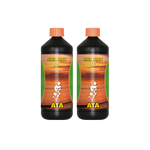
What is Atami ATA AWA Max A&B?
AWA Max A&B is Atami's two-part ATA base nutrient developed specifically for the flowering phase of plants grown in hydroponic systems.

Commercial Products
Commercial Products
 Professional Growing Media
 Plant Nutrition
 Plant Health
 Sprayers & Protective Clothing
 Pots, Planters & Trays
 Propagation
 Baskets & Planters
 Fabrics & Netting
 Environment
 Plant Lighting
 Irrigation
 Plant Support & Tree Care
 Equipment
 Tools
 Plant Labels
 Packaging
 Lawn Care
 Clearance
Retail Products
Retail Products
 Growing Media
 Plant Nutrition
 Plant Health
 Pots, Planters & Tanks
 Propagation
 Baskets & Planters
 Fabrics & Netting
 Environment
 Plant Lighting
 Plant Support
 Equipment
 Tools

£5.28
Unit price perEstimated delivery between October 26 and October 28.
Atami ATA AWA Max A&B 1L is a concentrated two-part mineral base nutrient developed specifically for the flowering phase of plants grown in hydroponic systems, supplying the primary NPK nutrition required for strong and efficient bloom development.
AWA Max is the flowering-stage nutrient within Atami's ATA hydroponic programme. Its mineral nutrition is proportioned specifically around the requirements of plants as they move into generative growth and concentrate increasingly on flower and fruit development.
The two-part formulation consists of AWA Max A, with an NK analysis of 3-6 W/W, and AWA Max B, with a PK analysis of 5-3 W/W. Together they provide complementary nutrition for hydroponically grown flowering crops.
AWA Max also has pH-regulating properties, designed to reduce the amount of adjustment normally required when managing a hydroponic nutrient solution. Atami also states that the prepared nutrient solution can be used more than once, making the product particularly relevant to recirculating hydroponic cultivation.
The general application rate is 1-4ml/L of A plus 1-4ml/L of B, allowing the final concentration to be adapted to the crop, its stage of development and the growing environment.
ATA AWA Max A&B is not a general soil or coco fertiliser. Atami developed it specifically as a hydroponic base nutrient for the bloom phase.
In hydroponic cultivation, the grower is responsible for supplying the mineral nutrition that would otherwise be available through a growing substrate. The composition and concentration of the nutrient solution therefore play a central role in crop development.
AWA Max provides the primary NPK nutrients in proportions intended for flowering, allowing the nutrient programme to change as the crop moves away from vegetative development and towards generative growth.
This makes it particularly suitable for growers using hydroponic systems who want a dedicated flowering base nutrient rather than relying on the same formulation throughout every crop stage.
AWA Max is supplied as separate A and B concentrates because certain mineral components can react with each other when held together at high concentration.
Keeping these components separate helps maintain their stability in the bottle. They are combined only after being diluted into water.
Never mix concentrated AWA Max A directly with concentrated AWA Max B.
Add the required amount of Part A to the water and mix thoroughly. Then add the required amount of Part B and mix again.
Atami recommends using water at approximately room temperature, around 21°C, for best results.
The two bottles are complementary components of one feeding system rather than separate grow and bloom fertilisers.
ATA AWA Max A has an NK analysis of 3-6 W/W, while ATA AWA Max B has a PK analysis of 5-3 W/W.
When diluted correctly into the same nutrient solution, the two components provide the primary mineral nutrition required by the crop during flowering.
Both components should therefore be used together at the appropriate concentration. Part A should not be substituted for Part B, or vice versa.
One of the distinguishing characteristics of ATA AWA Max is its pH-regulating formulation.
Maintaining an appropriate root-zone pH is important in hydroponic cultivation because nutrient availability can be affected when the solution moves outside the suitable range for the crop.
Atami designed AWA Max so that the nutrient solution requires fewer pH corrections, helping simplify reservoir management.
Growers should still monitor their nutrient solution, particularly where source-water chemistry, additives, crop uptake or recirculation can influence pH over time.
Atami states that the AWA Max nutrient solution can be used more than once, making it particularly useful for recirculating hydroponic systems.
In these systems, unused nutrient solution returns to the reservoir rather than being discarded after a single irrigation event.
Reservoir EC, pH, water level and general solution quality should still be monitored because plants remove water and individual nutrients at different rates.
Good reservoir hygiene and appropriate irrigation-system maintenance remain important when repeatedly circulating nutrient solution.
Atami's general dosage is 1-4ml of AWA Max A plus 1-4ml of AWA Max B per litre of water.
For a 10L reservoir this equals 10-40ml of A plus 10-40ml of B. For 50L use 50-200ml of each component, and for 100L use 100-400ml of each component.
Always add the concentrates separately. Add Part A to the reservoir water and mix thoroughly before adding Part B. Never combine undiluted A and B concentrates directly.
Atami's crop guides commonly use AWA Max within the upper part of its dosage range during active flowering, but the manufacturer's 1-4ml/L general specification allows the concentration to be adapted to individual crop requirements.
Monitor the final nutrient strength and adjust according to crop stage, plant health, environmental conditions, source water and any additional supplements being used.
Atami separates its ATA hydroponic base nutrition into formulations for different stages of the crop cycle.
ATA AWA Leaves A&B is the vegetative-stage formulation, developed to provide primary NPK nutrition during plant growth.
ATA AWA Max A&B is the flowering-stage formulation, with its primary nutrients proportioned for bloom and generative development.
Growers following the complete ATA hydro programme can therefore transition from AWA Leaves to AWA Max as the crop moves from vegetative growth into flowering.
AWA Max provides the base flowering nutrition within Atami's ATA hydroponic programme and can be combined with appropriate specialist additives according to crop stage and requirements.
Atami's hydro grow guides show AWA Max used alongside products such as Atazyme and Silic Boost, with specialist flowering products such as Bloombastic or Rokzbastic introduced where appropriate.
When additional nutrients or concentrated flowering additives are used, consider their contribution to the final EC rather than treating each product independently.
Manufacturer grow guides should be treated as starting points and adapted to the plant species, environmental conditions and response of the crop.
Both products are mineral base nutrients designed for hydroponic cultivation, but they belong to different Atami feeding programmes.
AWA Max A&B belongs to the ATA range and is specifically positioned as the flowering-stage base nutrient, normally following AWA Leaves during the vegetative phase.
B'cuzz Hydro A&B belongs to the B'cuzz range and is designed as a two-part hydroponic base nutrient that can be used throughout the crop cycle.
AWA Max is therefore particularly suited to growers following Atami's stage-specific ATA hydroponic programme.
Atami describes AWA Max as a universal hydroponic nutrient suitable for a broad range of flowering and productive crops.
Manufacturer examples include aubergines, sage and basil, together with indoor and potted ornamental plants such as Anthurium, Lavender, Gerbera and Pilea.
The final dosage should be adjusted to the requirements of the individual crop rather than assuming every species requires the same nutrient concentration.
| Brand | Atami |
|---|---|
| Range | ATA |
| Product | AWA Max A&B |
| Product type | Two-part mineral hydroponic base nutrient |
| Crop stage | Flowering / bloom phase |
| Growing method | Hydroponics |
| Pack size | 1L A + 1L B |
| Total concentrate supplied | 2L |
| AWA Max A analysis | NK 3-6 W/W |
| AWA Max B analysis | PK 5-3 W/W |
| General dosage | 1-4ml/L A + 1-4ml/L B |
| 10L reservoir | 10-40ml A + 10-40ml B |
| 50L reservoir | 50-200ml A + 50-200ml B |
| 100L reservoir | 100-400ml A + 100-400ml B |
| Approximate solution from each 1L component | 250-1,000L depending on dosage |
| Mixing | Dilute A into water first, mix thoroughly, then add B |
| Recommended water temperature | Approximately 21°C |
| pH regulation | pH-regulating formulation designed to reduce adjustment requirements |
| Recirculation | Prepared nutrient solution can be used more than once |
| Irrigation compatibility | Suitable for all watering systems |
AWA Max A&B is Atami's two-part ATA base nutrient developed specifically for the flowering phase of plants grown in hydroponic systems.
Yes. Atami specifically formulates AWA Max for the bloom phase, with its primary NPK nutrients proportioned around flowering and generative development.
AWA Max A has an NK analysis of 3-6 W/W, while AWA Max B has a PK analysis of 5-3 W/W.
Atami's general recommendation is 1-4ml/L of Part A plus 1-4ml/L of Part B. Adjust the final concentration to the crop, environment and complete feeding programme.
No. Never mix the concentrated A and B products directly. Add Part A to water and mix thoroughly before adding Part B.
Certain mineral components can react with one another at high concentration. Keeping A and B separate prevents these reactions until the nutrients have been diluted into water.
Yes. Atami describes AWA Max as having pH-regulating properties designed to reduce the amount of pH adjustment normally required. Reservoir pH should still be monitored.
Yes. Atami states that the prepared nutrient solution can be used more than once, making AWA Max suitable for recirculating hydroponic applications.
AWA Leaves A&B is formulated for vegetative growth, while AWA Max A&B is formulated for flowering. They form the growth and bloom base nutrients within Atami's ATA hydroponic programme.
No. Both are hydroponic base nutrients, but AWA Max belongs to Atami's ATA programme and is specifically formulated for flowering, while B'cuzz Hydro A&B belongs to the B'cuzz programme and is designed for use throughout the crop cycle.
Yes. Atami includes AWA Max and Bloombastic together in its hydroponic grow guides. Monitor the complete nutrient strength and adjust the programme to the requirements of the crop.
Yes. Atami also publishes hydroponic programmes combining AWA Max with Rokzbastic during appropriate flowering and ripening stages.
Atami recommends using water at approximately room temperature, around 21°C, when preparing the nutrient solution.
Atami lists crops including aubergines, sage and basil, together with flowering and potted plants such as Anthurium, Lavender, Gerbera and Pilea. Dosage should be adapted to the individual crop.
£5.28
Unit price perAtami ATA AWA Max A&B 1L is a concentrated two-part mineral base nutrient developed specifically for the flowering phase of plants grown in hydroponic systems, supplying the primary NPK nutrition required for strong and efficient bloom development.
AWA Max is the flowering-stage nutrient within Atami's ATA hydroponic programme. Its mineral nutrition is proportioned specifically around the requirements of plants as they move into generative growth and concentrate increasingly on flower and fruit development.
The two-part formulation consists of AWA Max A, with an NK analysis of 3-6 W/W, and AWA Max B, with a PK analysis of 5-3 W/W. Together they provide complementary nutrition for hydroponically grown flowering crops.
AWA Max also has pH-regulating properties, designed to reduce the amount of adjustment normally required when managing a hydroponic nutrient solution. Atami also states that the prepared nutrient solution can be used more than once, making the product particularly relevant to recirculating hydroponic cultivation.
The general application rate is 1-4ml/L of A plus 1-4ml/L of B, allowing the final concentration to be adapted to the crop, its stage of development and the growing environment.
ATA AWA Max A&B is not a general soil or coco fertiliser. Atami developed it specifically as a hydroponic base nutrient for the bloom phase.
In hydroponic cultivation, the grower is responsible for supplying the mineral nutrition that would otherwise be available through a growing substrate. The composition and concentration of the nutrient solution therefore play a central role in crop development.
AWA Max provides the primary NPK nutrients in proportions intended for flowering, allowing the nutrient programme to change as the crop moves away from vegetative development and towards generative growth.
This makes it particularly suitable for growers using hydroponic systems who want a dedicated flowering base nutrient rather than relying on the same formulation throughout every crop stage.
AWA Max is supplied as separate A and B concentrates because certain mineral components can react with each other when held together at high concentration.
Keeping these components separate helps maintain their stability in the bottle. They are combined only after being diluted into water.
Never mix concentrated AWA Max A directly with concentrated AWA Max B.
Add the required amount of Part A to the water and mix thoroughly. Then add the required amount of Part B and mix again.
Atami recommends using water at approximately room temperature, around 21°C, for best results.
The two bottles are complementary components of one feeding system rather than separate grow and bloom fertilisers.
ATA AWA Max A has an NK analysis of 3-6 W/W, while ATA AWA Max B has a PK analysis of 5-3 W/W.
When diluted correctly into the same nutrient solution, the two components provide the primary mineral nutrition required by the crop during flowering.
Both components should therefore be used together at the appropriate concentration. Part A should not be substituted for Part B, or vice versa.
One of the distinguishing characteristics of ATA AWA Max is its pH-regulating formulation.
Maintaining an appropriate root-zone pH is important in hydroponic cultivation because nutrient availability can be affected when the solution moves outside the suitable range for the crop.
Atami designed AWA Max so that the nutrient solution requires fewer pH corrections, helping simplify reservoir management.
Growers should still monitor their nutrient solution, particularly where source-water chemistry, additives, crop uptake or recirculation can influence pH over time.
Atami states that the AWA Max nutrient solution can be used more than once, making it particularly useful for recirculating hydroponic systems.
In these systems, unused nutrient solution returns to the reservoir rather than being discarded after a single irrigation event.
Reservoir EC, pH, water level and general solution quality should still be monitored because plants remove water and individual nutrients at different rates.
Good reservoir hygiene and appropriate irrigation-system maintenance remain important when repeatedly circulating nutrient solution.
Atami's general dosage is 1-4ml of AWA Max A plus 1-4ml of AWA Max B per litre of water.
For a 10L reservoir this equals 10-40ml of A plus 10-40ml of B. For 50L use 50-200ml of each component, and for 100L use 100-400ml of each component.
Always add the concentrates separately. Add Part A to the reservoir water and mix thoroughly before adding Part B. Never combine undiluted A and B concentrates directly.
Atami's crop guides commonly use AWA Max within the upper part of its dosage range during active flowering, but the manufacturer's 1-4ml/L general specification allows the concentration to be adapted to individual crop requirements.
Monitor the final nutrient strength and adjust according to crop stage, plant health, environmental conditions, source water and any additional supplements being used.
Atami separates its ATA hydroponic base nutrition into formulations for different stages of the crop cycle.
ATA AWA Leaves A&B is the vegetative-stage formulation, developed to provide primary NPK nutrition during plant growth.
ATA AWA Max A&B is the flowering-stage formulation, with its primary nutrients proportioned for bloom and generative development.
Growers following the complete ATA hydro programme can therefore transition from AWA Leaves to AWA Max as the crop moves from vegetative growth into flowering.
AWA Max provides the base flowering nutrition within Atami's ATA hydroponic programme and can be combined with appropriate specialist additives according to crop stage and requirements.
Atami's hydro grow guides show AWA Max used alongside products such as Atazyme and Silic Boost, with specialist flowering products such as Bloombastic or Rokzbastic introduced where appropriate.
When additional nutrients or concentrated flowering additives are used, consider their contribution to the final EC rather than treating each product independently.
Manufacturer grow guides should be treated as starting points and adapted to the plant species, environmental conditions and response of the crop.
Both products are mineral base nutrients designed for hydroponic cultivation, but they belong to different Atami feeding programmes.
AWA Max A&B belongs to the ATA range and is specifically positioned as the flowering-stage base nutrient, normally following AWA Leaves during the vegetative phase.
B'cuzz Hydro A&B belongs to the B'cuzz range and is designed as a two-part hydroponic base nutrient that can be used throughout the crop cycle.
AWA Max is therefore particularly suited to growers following Atami's stage-specific ATA hydroponic programme.
Atami describes AWA Max as a universal hydroponic nutrient suitable for a broad range of flowering and productive crops.
Manufacturer examples include aubergines, sage and basil, together with indoor and potted ornamental plants such as Anthurium, Lavender, Gerbera and Pilea.
The final dosage should be adjusted to the requirements of the individual crop rather than assuming every species requires the same nutrient concentration.
| Brand | Atami |
|---|---|
| Range | ATA |
| Product | AWA Max A&B |
| Product type | Two-part mineral hydroponic base nutrient |
| Crop stage | Flowering / bloom phase |
| Growing method | Hydroponics |
| Pack size | 1L A + 1L B |
| Total concentrate supplied | 2L |
| AWA Max A analysis | NK 3-6 W/W |
| AWA Max B analysis | PK 5-3 W/W |
| General dosage | 1-4ml/L A + 1-4ml/L B |
| 10L reservoir | 10-40ml A + 10-40ml B |
| 50L reservoir | 50-200ml A + 50-200ml B |
| 100L reservoir | 100-400ml A + 100-400ml B |
| Approximate solution from each 1L component | 250-1,000L depending on dosage |
| Mixing | Dilute A into water first, mix thoroughly, then add B |
| Recommended water temperature | Approximately 21°C |
| pH regulation | pH-regulating formulation designed to reduce adjustment requirements |
| Recirculation | Prepared nutrient solution can be used more than once |
| Irrigation compatibility | Suitable for all watering systems |
AWA Max A&B is Atami's two-part ATA base nutrient developed specifically for the flowering phase of plants grown in hydroponic systems.
Yes. Atami specifically formulates AWA Max for the bloom phase, with its primary NPK nutrients proportioned around flowering and generative development.
AWA Max A has an NK analysis of 3-6 W/W, while AWA Max B has a PK analysis of 5-3 W/W.
Atami's general recommendation is 1-4ml/L of Part A plus 1-4ml/L of Part B. Adjust the final concentration to the crop, environment and complete feeding programme.
No. Never mix the concentrated A and B products directly. Add Part A to water and mix thoroughly before adding Part B.
Certain mineral components can react with one another at high concentration. Keeping A and B separate prevents these reactions until the nutrients have been diluted into water.
Yes. Atami describes AWA Max as having pH-regulating properties designed to reduce the amount of pH adjustment normally required. Reservoir pH should still be monitored.
Yes. Atami states that the prepared nutrient solution can be used more than once, making AWA Max suitable for recirculating hydroponic applications.
AWA Leaves A&B is formulated for vegetative growth, while AWA Max A&B is formulated for flowering. They form the growth and bloom base nutrients within Atami's ATA hydroponic programme.
No. Both are hydroponic base nutrients, but AWA Max belongs to Atami's ATA programme and is specifically formulated for flowering, while B'cuzz Hydro A&B belongs to the B'cuzz programme and is designed for use throughout the crop cycle.
Yes. Atami includes AWA Max and Bloombastic together in its hydroponic grow guides. Monitor the complete nutrient strength and adjust the programme to the requirements of the crop.
Yes. Atami also publishes hydroponic programmes combining AWA Max with Rokzbastic during appropriate flowering and ripening stages.
Atami recommends using water at approximately room temperature, around 21°C, when preparing the nutrient solution.
Atami lists crops including aubergines, sage and basil, together with flowering and potted plants such as Anthurium, Lavender, Gerbera and Pilea. Dosage should be adapted to the individual crop.
Pay with
Your transaction is protected with advanced security measures to keep your information confidential
£5.28
Unit price per